

Introduction
Two quotes by Gordon W. Allport, a pioneer of prejudice research, provide an ideal starting point for this study. In his famous book “The Nature of Prejudice,” he wrote that “people who reject one out-group will tend to reject other out-groups” (Allport, Reference Allport1954, 68). In another one of his well-known works, “The Religious Context of Prejudice,” he stated that “there is something about religion that makes for prejudice, and something about it that unmakes prejudice” (Allport, Reference Allport1966, 447). These two insights from early prejudice research remain valuable today. It is common for several types of prejudice to co-occur, which is now being referred to as generalized prejudice (for a recent review, see Bergh and Brandt, Reference Bergh and Brandt2023; for a discussion of whether there is one or more generalized prejudice dimensions, see Duckitt and Sibley, Reference Duckitt and Sibley2007). At the same time, in recent decades, prejudice research has become increasingly specialized to focus on specific prejudices (e.g., racism, sexism, classism, Islamophobia, anti-Semitism). In addition, the religiosity–prejudice relationship is still contested (for an overview of empirical studies, see Klein et al., Reference Klein, Lühr, Streib, Streib and Klein2018). There have been several recent studies pointing to the prejudice-promoting and -reducing functions of religiosity (e.g., Scheepers et al., Reference Scheepers, Gijsberts and Hello2002; McDaniel et al., Reference McDaniel, Nooruddin and Shortle2011; Pickel et al., Reference Pickel, Liedhegener, Jaeckel, Odermatt and Yendell2020; Siegers, Reference Siegers, Schulz, Siegers, Westle and Hochman2021; Steinmann, Reference Steinmann2023). Inspired by Allport's insights, we investigate two types of prejudice: xenophobia (prejudice against foreign people) and homophobia (prejudice against homosexual people),Footnote 1 which we also refer to as anti-diversity attitudes. We also address the role that religiosity plays in these attitudes. Overall, we seek to answer two research questions: (1) What is the relationship between religiosity and anti-diversity attitudes? (2) How can this relationship be explained?
To answer these questions, a study of the religiosity–prejudice link was conducted in Germany. This represents a particular context because, from a cross-national perspective, Germany is a society with comparatively high scores in secular-rational and self-expression values (WVS, 2023). Thus, people in Germany place less emphasis on religion and demonstrate increasing tolerance toward foreign and homosexual people (Pickel and Pickel, Reference Pickel, Pickel, Polak and Rohs2023). This should not obscure the fact that there have also been counter-movements in recent years. These include the rise of the right-wing populist party “Alternative for Germany” (Arzheimer and Berning, Reference Arzheimer and Berning2019) and ongoing prejudice against Muslims (Yendell and Pickel, Reference Yendell and Pickel2020). Nevertheless, it would be erroneous to simply conclude that decreasing religiosity and increasing tolerance imply a positive link between religiosity and xenophobic or homophobic attitudes. Recent research on religiosity and xenophobia in Germany has documented two important findings. First, Siegers (Reference Siegers, Schulz, Siegers, Westle and Hochman2021) pointed out that the relationship has changed from positive to negative over recent decades in Western Germany. In the 1980s religious people in Western Germany tended to be more xenophobic than their non-religious counterparts, but today being religious is associated with less xenophobic attitudes. This change is less pronounced in Eastern Germany where religiosity and xenophobia have been negatively related for the entire period of observation (1994–2016). Second, Steinmann (Reference Steinmann2023) further qualified this finding by showing that highly religious people in Western Germany deviate from the linearity assumption of previous research. Here, religiosity and xenophobic attitudes are only negatively related up to a medium level of religiosity. The relationship is reversed when medium and high levels of religiosity are compared: people in Western Germany who are highly religious are more likely to be xenophobic. The negative relationship between religiosity and xenophobia is, however, confirmed for Eastern Germany.
In light of the studies by Siegers (Reference Siegers, Schulz, Siegers, Westle and Hochman2021) and Steinmann (Reference Steinmann2023), as well as further literature on the prejudice-promoting and -reducing functions of religiosity, we test whether there is a linear or curvilinear relationship between religiosity and anti-diversity attitudes among Christians in Western Germany. Because only a small proportion of Christians resides in Eastern Germany (Meulemann, Reference Meulemann2019),Footnote 2 we focus only on the part of Germany formerly known as West/Western Germany.Footnote 3 By applying (linear and curvilinear) regression, our empirical results support the idea of a curvilinear religiosity–prejudice relationship in Western Germany. Xenophobia and homophobia are particularly pronounced among the highly religious. We theoretically argue for and test two (complementary) explanations for this finding. First, the (widely accepted) religious-ideology explanation emphasizes the role of fundamentalism in understanding the exceptional views of the highly religious (Hunsberger, Reference Hunsberger1995). Second, the (recently introduced) loss-of-privileges explanation underscores the importance of perceived disadvantage in explaining the increased level of prejudice among the highly religious (Steinmann, Reference Steinmann2023). Empirically, we demonstrate that both arguments contribute to an explanation of the religiosity–prejudice link among Christians in Western Germany.
Our study adds to an ongoing discussion about the paradoxical role of religiosity for related constructs (for right-wing extremist attitudes, see Rebenstorf, Reference Rebenstorf2018; Schneider et al., Reference Schneider, Pickel and Öztürk2021; for interethnic contact, see Leszczensky and Pink, Reference Leszczensky and Pink2017; Steinmann, Reference Steinmann2020; for anti-Muslim attitudes, see Pickel and Öztürk, Reference Pickel, Öztürk, Wohlrab-Sahr and Tezcan2022; Xia, Reference Xia2022; for voting for populist right-wing parties, see Huber and Yendell, Reference Huber and Yendell2019; Steinmann, Reference Steinmann2022; for fear of crime, see Schwadel and Anderson, Reference Schwadel and Anderson2022; Steinmann, Reference Steinmann2024). However, the topic of curvilinearity has thus far been largely neglected.
Religiosity and anti-diversity attitudes
Prejudice tends to come as a package. For anti-diversity attitudes, this means that people who are more xenophobic are also more likely to be homophobic, and vice versa (Zick et al., Reference Zick, Wolf, Küpper, Davidov, Schmidt and Heitmeyer2008).Footnote 4 Apart from research on generalized prejudice (Bergh and Brandt, Reference Bergh and Brandt2023), xenophobia and homophobia are rarely examined together. Because research on the religiosity–xenophobia and religiosity–homophobia links represents two largely separate strands of research (for xenophobia, see Deslandes and Anderson, Reference Deslandes and Anderson2019; for homophobia, see Janssen and Scheepers, Reference Janssen and Scheepers2019; for two exceptions, see Herek, Reference Herek1987; Johnson et al., Reference Johnson, Rowatt, Barnard-Brak, Patock-Peckham, LaBouff and Carlisle2011), in the following, we draw attention to the parallels and differences between them.
Both strands have shown that religious institutions can be considered socializing agents that influence (xenophobic and homophobic) attitudes of individuals—an idea that dates back to Durkheim (Reference Durkheim1947). Religion in general and Christianity in particular still profoundly influence current attitudes and behaviors (Minkenberg, Reference Minkenberg2018; Siegers, Reference Siegers2019). Although religiosity is just one of many predictors explaining xenophobia (Billiet, Reference Billiet1995; Fussell, Reference Fussell2014; Deslandes and Anderson, Reference Deslandes and Anderson2019), it appears to be one of the most important factors predicting homophobia (Duck and Hunsberger, Reference Duck and Hunsberger1999; Jäckle and Wenzelburger, Reference Jäckle and Wenzelburger2015; Janssen and Scheepers, Reference Janssen and Scheepers2019). While religious effects on xenophobia shifted in recent decades, the religiosity–homophobia link has been relatively stable over time. Early studies on the relationship between religiosity and xenophobia consistently reported a non-relationship between the two constructs in Western Germany in the 1990s (McCutcheon, Reference McCutcheon, Pollack and Pickel2000; Terwey, Reference Terwey, Alba, Schmidt and Wasmer2000). In contrast, empirical evidence for the 2010s indicates a negative link between religiosity and xenophobia (Klein et al., Reference Klein, Lühr, Streib, Streib and Klein2018). Expanding on this, Siegers (Reference Siegers, Schulz, Siegers, Westle and Hochman2021) has demonstrated that the religiosity–xenophobia link has changed from positive to negative over recent decades in Western Germany. In the 1980s, being religious in Western Germany tended to be associated with more xenophobia. However, nowadays religious people tend to report less xenophobic attitudes compared to their non-religious counterparts. In contrast, research on the relationship between religiosity and homophobia has thus far found no substantial change in the relationship. Studies from both the German (Küpper and Zick, Reference Küpper, Zick and Heitmeyer2006; Küpper, Reference Küpper2010; Reese et al., Reference Reese, Steffens and Jonas2014) and international research contexts (Whitley, Reference Whitley2009; Jäckle and Wenzelburger, Reference Jäckle and Wenzelburger2015; Janssen and Scheepers, Reference Janssen and Scheepers2019) have identified a clear homophobia-promoting function of religiosity.Footnote 5
Research on the religiosity–xenophobia link has discussed the possibility of a curvilinear (instead of linear) relationship, but there has been no such discussion for the religiosity–homophobia link. Since the 1950s, studies have reported evidence of a curvilinear relationship between religion and xenophobia—with less xenophobic attitudes at both ends of the religious spectrum (Kelly et al., Reference Kelly, Ferson and Holtzman1958; Allport and Ross, Reference Allport and Ross1967; Gorsuch and Aleshire, Reference Gorsuch and Aleshire1974).Footnote 6 Recently, Steinmann (Reference Steinmann2023) revisited the topic of curvilinearity, pointing out that highly religious people in Western Germany deviate from the linearity assumption of previous research. Today, people at both ends of the religious spectrum exhibit the most pronounced xenophobia. Accordingly, religiosity and xenophobic attitudes are negatively related up to a medium level of religiosity. When comparing medium and high levels of religiosity, the relationship reverses.
Most studies on religious effects mainly focus on common facets of religion (i.e., belonging, belief, and behavior). However, common dimensions of religiosity often oversimplify its complexity. Therefore, both research strands also consider Allport's (Reference Allport1966) famous extrinsic–intrinsic dichotomy (see also Allport and Ross, Reference Allport and Ross1967) which emphasizes that different religious orientations result in different associations between religiosity and prejudice. Being extrinsically religiously motivated means practicing religion solely for instrumental reasons, whereas those who consider their practice of religion as a goal in itself are intrinsically religiously motivated. Prejudice research referring to the extrinsic–intrinsic dichotomy has shown that the effects of common dimensions of religiosity on prejudice are stronger among people with extrinsic (compared to intrinsic) religious motivation (for homophobia, see Jäckle and Wenzelburger, Reference Jäckle and Wenzelburger2015) and that the positive relation between extrinsic (versus intrinsic) religiosity and prejudice has decreased significantly over the years (for xenophobia, see Hall et al., Reference Hall, Matz and Wood2010). Allport's (Reference Allport1966) dichotomization of religious orientation has not kept its initial promise to solve the puzzle of why religion is making and unmaking prejudice.Footnote 7 Nonetheless, the idea that religious orientation (not religiosity per se) can be helpful when addressing religious effects on prejudice is crucial (Hunsberger, Reference Hunsberger1995). Previous research has shown that there is one religious orientation that is especially helpful for understanding anti-diversity attitudes: fundamentalist attitudes (Pickel et al., Reference Pickel, Liedhegener, Jaeckel, Odermatt and Yendell2020). In the following, a classical (fundamentalism) and a novel approach (perceived disadvantage) are described to explain the religiosity–prejudice relationship.
Why are highly religious Christians especially xenophobic and homophobic?
Following early prejudice research (Allport and Kramer, Reference Allport and Kramer1946; Adorno et al., Reference Adorno, Frenkel-Brunswik, Levinson and Sanford1950), and recognizing that religiosity has paradoxical effects, we assume that the link between religiosity and anti-diversity attitudes is not linear but curvilinear. Highly religious Christians deviate from the linearity assumption of previous research (e.g., Jäckle and Wenzelburger Reference Jäckle and Wenzelburger2015; Siegers Reference Siegers, Schulz, Siegers, Westle and Hochman2021). Thus, the following two (curvilinear) hypotheses are deduced:
H1a: Religiosity and xenophobia are negatively related up to a medium level of religiosity. The relationship reverses when medium and high levels of religiosity are compared.
H1b: Religiosity and homophobia are negatively related up to a medium level of religiosity. The relationship reverses when medium and high levels of religiosity are compared.
We provide two (complementary) theoretical explanations for the curvilinear relationship between religiosity and anti-diversity attitudes: a widely accepted religious-ideology explanation, which underlines the role of fundamentalist attitudes, and a recently introduced loss-of-privileges explanation, which highlights the importance of perceived disadvantage.
Religious-ideology explanation
Allport and Ross (Reference Allport and Ross1967) argued that religious orientations are helpful for understanding religious effects on prejudice. Subsequent research showed that fundamentalism can explain prejudice better than the extrinsic–intrinsic dichotomy (Herek, Reference Herek1987). Because highly religious people tend to report increased fundamentalist attitudes (e.g., Schneider et al., Reference Schneider, Pickel and Öztürk2021), our first approach focuses on fundamentalism as an explanation for the exceptional view of the highly religious.
Fundamentalism should be differentiated from alternative concepts, such as orthodoxy and traditionalism (Pollack et al., Reference Pollack, Demmrich and Müller2023). The definition of fundamentalism we use consists of four core components and is not specific to a particular religion but applicable to most world religions. First, fundamentalism is clearly related to the past. The current societal shift toward secular-rational and self-expression values (WVS, 2023)Footnote 8 is understood as a misguided development—fundamentalists think society would be better off returning to the eternal rules from the past. Second, according to fundamentalists, there is only one true interpretation of these religious rules written in the holy scriptures. Third, fundamentalists believe that these religious rules take precedence over secular laws. Finally, fundamentalists are sometimes willing to use violence to enforce their religious beliefs. This definition mainly follows the widely accepted definition of fundamentalism given by Altemeyer and Hunsberger (Reference Altemeyer and Hunsberger1992), but we deviate from their concept in two ways. We additionally include the last defining characteristic (acceptance of violence) proposed by Heitmeyer et al. (Reference Heitmeyer, Müller and Schröder1997).Footnote 9 We also exclude the aspect of fundamentalists' own religion being threatened by outsiders. Otherwise, the relationship between fundamentalism and xenophobic or homophobic attitudes would be a matter of definition rather than one of empirical investigation (Koopmans, Reference Koopmans2015).
Based on the presented definition of fundamentalism, it can be deduced that fundamentalists have pronounced anti-diversity attitudes. In the eyes of fundamentalists, the presence and emancipation of foreign and homosexual people are representative of undesirable societal developments. Fundamentalists of all religions tend to prefer a nativist concept of their nation, which considers any non-native element as a threat to the nation (Brandt and van Tongeren, Reference Brandt and van Tongeren2017). In addition, they tend to favor a traditional family concept, which is expressed above all by the desire for heteronormativity (Lazar and Hammer, Reference Lazar and Hammer2018). Thus, their orientation to the past leads to xenophobic and homophobic attitudes. Seeing oneself as a bearer of exclusive truth makes it difficult to accept alternative interpretations of the world by (foreign and homosexual) others, which also results in increased anti-diversity attitudes. Secular laws in Germany protect minority groups, such as foreign and homosexual people (e.g., the General Equal Treatment Act introduced in 2006, see Federal Anti-Discrimination Agency, 2023). Fundamentalists, however, believe their religious rules take priority over these laws. Thus, the devaluation of secular laws also leads to increased anti-diversity attitudes.
Considering the religious-ideology explanation above, combined with the ample empirical evidence that one relevant part of the highly religious shows increased fundamentalist attitudes (e.g., Doebler Reference Doebler2014; Schneider et al., Reference Schneider, Pickel and Öztürk2021), the following two (mediation) hypotheses can be derived:
H2a: Highly religious Christians are particularly xenophobic because they tend to report more fundamentalist attitudes.
H2b: Highly religious Christians are particularly homophobic because they tend to report more fundamentalist attitudes.
Loss-of-privileges explanation
Our second approach emphasizes perceived disadvantage among highly religious Christians in explaining their increased anti-diversity attitudes. The idea was developed following work by Wong (Reference Wong2018), who argued that the more conservative political attitudes of White Evangelicals in the United States are driven by the notion that their group is discriminated against as much or more than marginalized groups.
We interpret the perceptions of highly religious people against the background of the ongoing process of secularization. Religion's importance in German society began to decline in the late 1960s and continues to this day (Pollack and Pickel, Reference Pollack and Pickel2007). With increasing secularization, more and more people agree with more rational interpretations of the world (Berger, Reference Berger1967), whereas the highly religious remain reliant on transcendent explanations to make sense of the world. Thus, highly religious people must grapple with the contradiction between the largely secularized environment and the importance of their own religiosity (Stolz et al., Reference Stolz, Könemann, Purdie, Englberger and Krüggeler2016).
A societal transformation such as secularization implies a reevaluation of capital. One group loses privileges, and another group gains them. Even if the highly religious possesses kinds of capital other than religious, it should still be a decisive factor in determining their possibility for action. Following Bourdieu (Reference Bourdieu and Richardson1986), we define religious capital as accumulated labor in the religious field, analogous to cultural capital. Examples include relationships with co-religionists, religious artifacts, and religious knowledge. The religious capital of highly religious people should be particularly affected by secularization-induced devaluation. For instance, fellow believers lose prestige, and religious artifacts and religious knowledge are less valuable in everyday life. The lost privileges are primarily symbolic, though they may also have material implications. This argument aligns with Gusfield's (Reference Gusfield1963) classic work on status politics, emphasizing conflict over the distribution of prestige rather than resources.
The shift away from traditional principles can lead highly religious Christians to feel disadvantaged compared to other groups (e.g., foreign and homosexual people). The highly religious' perceived disadvantage resulting from increasing secularization means that their whole being is called into question. This reasoning shows parallels with the notion of religious defense in increasingly secular societies (Bruce, Reference Bruce and Segal2017; Siegers, Reference Siegers2019), which states that religion becomes an even more important marker of the social identity of highly religious Christians and that they develop more conservative political attitudes compared to the rest of the (religious and secular) population. However, highly religious people's perceived disadvantage is not just due to a nostalgic view of religion (Xia, Reference Xia2022), but also its consequential downside. During secularization, highly religious people lose certain privileges while others (e.g., foreign and homosexual people) gain them. This can result in the highly religious perceiving themselves as being at a disadvantage, which may, in turn, lead to their disproportionately high anti-diversity attitudes. Thus, for highly religious Christians, holding xenophobic and homophobic attitudes serves as a strategy for coping with the fear of changing societal conditions.Footnote 10 We derive the following two (mediation) hypotheses:
H3a: Highly religious Christians are particularly xenophobic because they tend to perceive themselves as being at a greater disadvantage.
H3b: Highly religious Christians are particularly homophobic because they tend to perceive themselves as being at a greater disadvantage.
Indeed, the religious-ideology explanation and the loss-of-privileges explanation are not entirely distinct. The similarity of the two approaches becomes particularly clear when one considers Riesebrodt's (Reference Riesebrodt2000, 271) concept of fundamentalism, which defines “fundamentalism as a specific type of religious revival movement which reacts to social changes perceived as a dramatic crisis.” Thus, both fundamentalism and perceived disadvantage are possible reactions to changing societal conditions.
Data and methods
The religiosity–prejudice link is examined using data from the project “Configurations of Individual and Collective Religious Identities and their Potential for Civil Society” (KONID).Footnote 11 This is a multi-topic survey that focuses on the role of religion in the construction of complex social identities and the implications for civil society, politics, and social cohesion (Liedhegener et al., Reference Liedhegener, Pickel, Odermatt, Yendell and Jaeckel2021). The survey occurred from spring to summer of 2019 in Germany and Switzerland. We use the German part of the KONID project, which provides a representative sample of the population in Germany aged 16 years and over (sample size: 2,363 participants). Respondents could choose between a computer-assisted telephone interview and a computer-assisted web interview.
Measures
Dependent variables
The two dimensions of anti-diversity attitudes were each assessed with a single-item measure. Respondents were asked to indicate on a scale from 1 (“completely disagree”) to 4 (“completely agree”) to which degree they agreed with the following statements: “Because of its many resident foreigners, Germany is dominated by foreign influences to a dangerous degree” (xenophobia, original: “Die Bundesrepublik ist durch die vielen Ausländer in einem gefährlichen Maß überfremdet”) and “A sexual relationship between persons of the same sex is unnatural” (homophobia, original: “Eine sexuelle Beziehung zwischen Personen desselben Geschlechts ist unnatürlich”). Xenophobic and homophobic attitudes are only moderately correlated (r = 0.372), which speaks against indexing the two items.
Independent variable
Respondents' level of religiosity was captured by their religious participation. They were asked to indicate their frequency of service attendance on a six-point scale ranging from 1 (“never”) to 6 (“more than once a week”).
Mediating variables
A mean index of four items indicates whether a respondent holds fundamentalist attitudes. These items collect information on religious claim (“There is only one true religion,” original: “Es gibt nur eine wahre Religion”), biblical literalism (“The Bible is to be understood literally,” original: “Die Bibel ist wortwörtlich zu verstehen”), priority over constitution (“The rules and values of my religion take precedence over the German constitution in case of conflict,” original: “Die Regeln und Werte meiner Religion haben im Konfliktfall Vorrang vor der Deutschen Verfassung”), and violent enforcement (“I would be ready to enforce my religious beliefs even with violence,” original: “Ich wäre bereit meine religiösen Überzeugungen auch mit Gewalt durchzusetzen”). The reliability coefficient of the constructed scale was satisfactory (α = 0.778). Respondents' perceived disadvantage was measured with two items, both referring to the religious affiliation they previously selected in the questionnaire (i.e., “Catholic church”; “Protestant church”; “Protestant free church”; “Christian orthodox church”; or “Another Christian denomination”). The first question asks whether respondents experienced unequal treatment because of their belonging to a Christian group (“And how often have you experienced prejudice or unfair treatment in the past year? Because you are [religious affiliation]?,” original: “Und wie oft haben Sie im letzten Jahr aufgrund folgender Eigenschaften Vorurteile oder ungerechte Behandlung erlebt? Weil Sie [religiöse Zugehörigkeit] sind?”). The second question assesses whether respondents feel like second-class citizens because of their religious affiliation (“I feel as [religious affiliation] here in Germany as a second-class citizen,” original: “Ich fühle mich als [religiöse Zugehörigkeit] hier in Deutschland als Bürger/in zweiter Klasse”). The reliability coefficient was moderate (α = 0.582). We transform both mediating variables by subtracting the minimum and dividing by the maximum. A range of 0–1 allows for easier interpretation, as the coefficients are comparable and indicate the difference between the empirical minimum and maximum.Footnote 12
Control variables
To identify the effect of interest (religiosity on prejudice), we have included a carefully chosen set of control variables in the analysis. Control variables were included based on their status as confounders, as established by prior research and excluded if identified as colliders or mediators. This procedure is based on the idea of “good” and “bad” controls (Cinelli et al., Reference Cinelli, Forney and Pearl2024; Kohler et al., Reference Kohler, Class and Sawert2024) which has recently gained traction in the social sciences. The following observed confounders, which are known to be associated with both religiosity (Ruiter and van Tubergen, Reference Ruiter and van Tubergen2009) and anti-diversity attitudes (Scheepers et al., Reference Scheepers, Gijsberts and Hello2002; Vermeer and Scheepers, Reference Vermeer and Scheepers2018), are accounted for: religious affiliation, education, employment, gender, age, and migration background.
Sample, missing data, and analytical strategy
As we address the religiosity–prejudice link among Christians in Western Germany, we exclude all non-Christians (including respondents unaffiliated with any religion, those who belong to another non-Christian denomination, and those missing information on religious affiliation) and persons residing in Eastern Germany. The final sample consisted of 1,103 respondents. Excluding all respondents with missing values would have resulted in a loss of about 21% of the sample. Thus, to maintain the original sample size and leave standard errors unbiased (Rubin, Reference Rubin and van Buuren2018), we apply multiple imputations by chained equations. This procedure involves running numerous regression models, accounting for the type of each variable, to model missing data as a function of all other variables. It is an iterative procedure and ideally leads to a convergence of the regression coefficients (Azur et al., Reference Azur, Stuart, Frangakis and Leaf2011; Royston and White, Reference Royston and White2011). Thereby, we use all variables of the present study and create 25 imputed data sets.
After a brief descriptive look at the data, our analytical strategy is to first graphically inspect the linear (with the linear term of religiosity) and curvilinear regressions (with the linear and quadratic terms of religiosity) and then compare them in terms of model fit. Hypotheses (H1a and H1b) are corroborated when the model fit of the curvilinear regressions is significantly higher than that of the linear ones. Furthermore, the turning point (TP) in the relationship between religiosity and anti-diversity attitudes is determined by the following equation, where β1 is the coefficient of the linear term, and β2 is the coefficient of the quadratic term (Plassmann and Khanna, Reference Plassmann and Khanna2007):

Finally, the two proposed theoretical explanations (religious ideology versus loss of privileges) for the exceptional views of the highly religious are tested empirically. Our hypotheses (H2a–H3b) are confirmed when introducing the mediating variables (fundamentalism and perceived disadvantage) in the models, resulting in the coefficient of interest (the squared term of religiosity) no longer being significantly different from zero.
Results
Descriptive overview
We briefly describe the characteristics of our group under study. As Table 1 shows, Christians in Western Germany report on average higher xenophobic than homophobic attitudes (2.03 versus 1.78).Footnote 13 Because xenophobia and homophobia were each captured with a single-item measure, this difference should not be overinterpreted. On average, respondents indicate that they attend religious services between several times a year to less frequently (2.60). Most Christian respondents belong to the two mainline denominations (the Catholic and Protestant church), with only a few respondents affiliated with the Protestant free church, the Christian orthodox church, or another Christian denomination. The level of fundamentalism found in the sample is comparable to that of perceived disadvantage (0.15 versus 0.13).
Distribution of model variables

Source: KONID, own calculation.
The following bivariate analyses provide information on the empirical relationships between our main variables. Figures 1 and 2 confirm the idea of a curvilinear religiosity–prejudice link. Xenophobic attitudes decrease as religiosity increases; however, Christians who attend religious services once a week or more often (frequent attendees) are as xenophobic as those who never or almost never attend (infrequent attendees). Homophobic attitudes also decrease with increasing religiosity and then increase again. Here, however, the reversing of the relationship occurs earlier—people who go to church between one and three times a month already have a higher level of homophobia than those who are less religious—and the level of homophobia among frequent attendees is strikingly high.
Xenophobia by religiosity in Western Germany.
Source: KONID 2019, own calculation.

Homophobia by religiosity in Western Germany.
Source: KONID 2019, own calculation.

To offer initial insight into the proposed mediating factors, Figures 3 and 4 illustrate the relationship between religiosity and fundamentalism or perceived disadvantage. The sharp rise in perceiving disadvantages and holding fundamentalist attitudes among frequent attendees compared to all other respondents is striking.
Fundamentalism by religiosity in Western Germany.
Source: KONID 2019, own calculation.

Perceived disadvantage by religiosity in Western Germany.
Source: KONID 2019, own calculation.

Linearity versus curvilinearity
Figures 5 and 6 provide graphical representations of linear and curvilinear regressions for the religiosity–prejudice link in Western Germany. Graphical inspection shows that the linear and curvilinear patterns differ only slightly for the religiosity–xenophobia link, while they differ substantially for the religiosity–homophobia link. Comparison of model fit between regressions with and without a quadratic term for religiosity reveals that the curvilinear version has the higher fit in both cases (xenophobia: R 2 = 0.001 versus 0.007; homophobia: R 2 = 0.034 versus 0.064). The results of two likelihood ratio (LR) tests show that adding a quadratic term of religiosity significantly improves the model fit (xenophobia: LR χ2(1) = 5.87, p = 0.015; homophobia: LR χ2(1) = 32.96, p ≤ 0.001)—confirming H1a and H1b. The TP for the religiosity–xenophobia relationship is located roughly in the middle of the religiosity scale, whereas the TP for the religiosity–homophobia relationship is between Christians who attend worship services several times a year and those who attend less frequently. After the TP, the increase in xenophobia is rather moderate, but the increase in homophobia is relatively steep.
Effect of religiosity on xenophobia in Western Germany (linear and curvilinear regression).
Note: Vertical line indicates TP.
Source: KONID 2019, own calculation.

Effect of religiosity on homophobia in Western Germany (linear and curvilinear regression).
Note: Vertical line indicates TP.
Source: KONID 2019, own calculation.

Effect heterogeneity
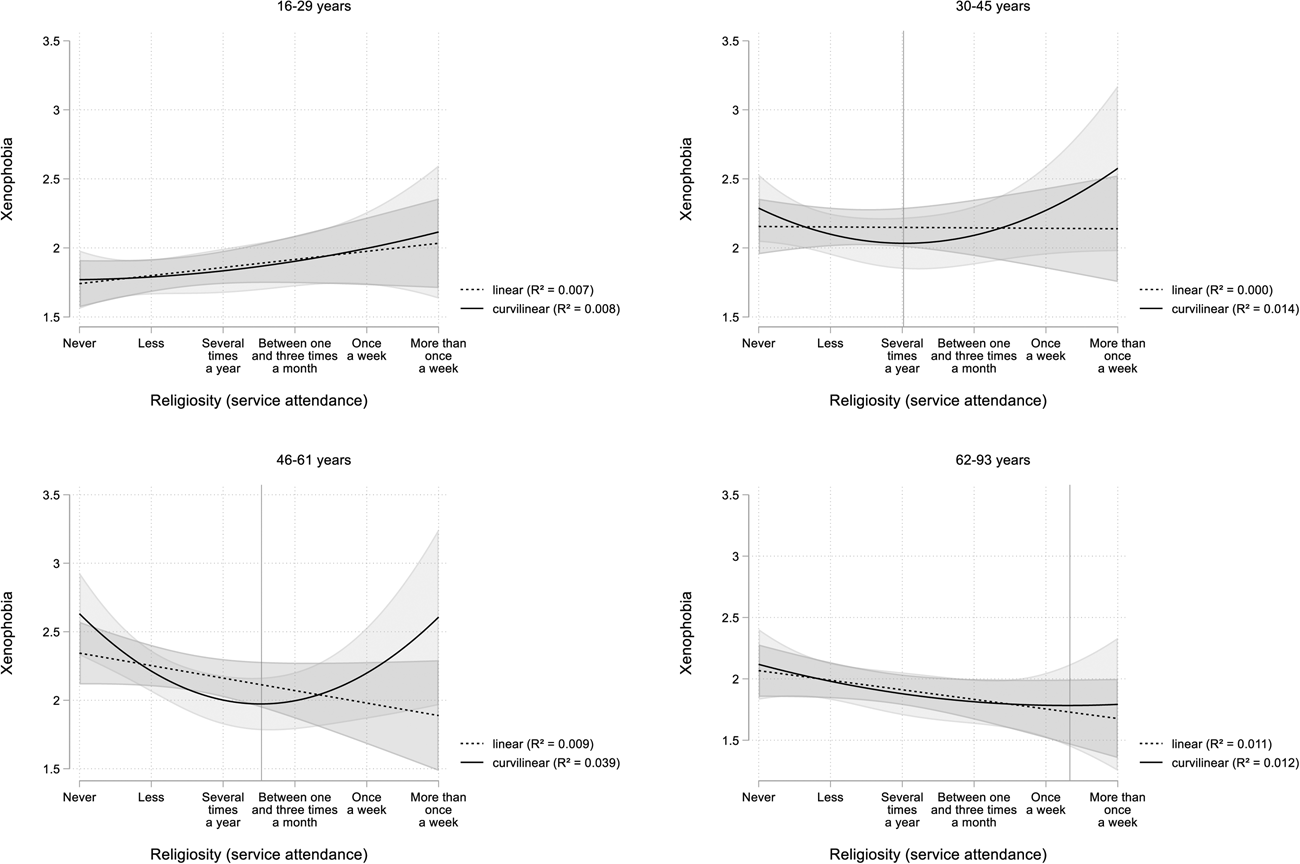
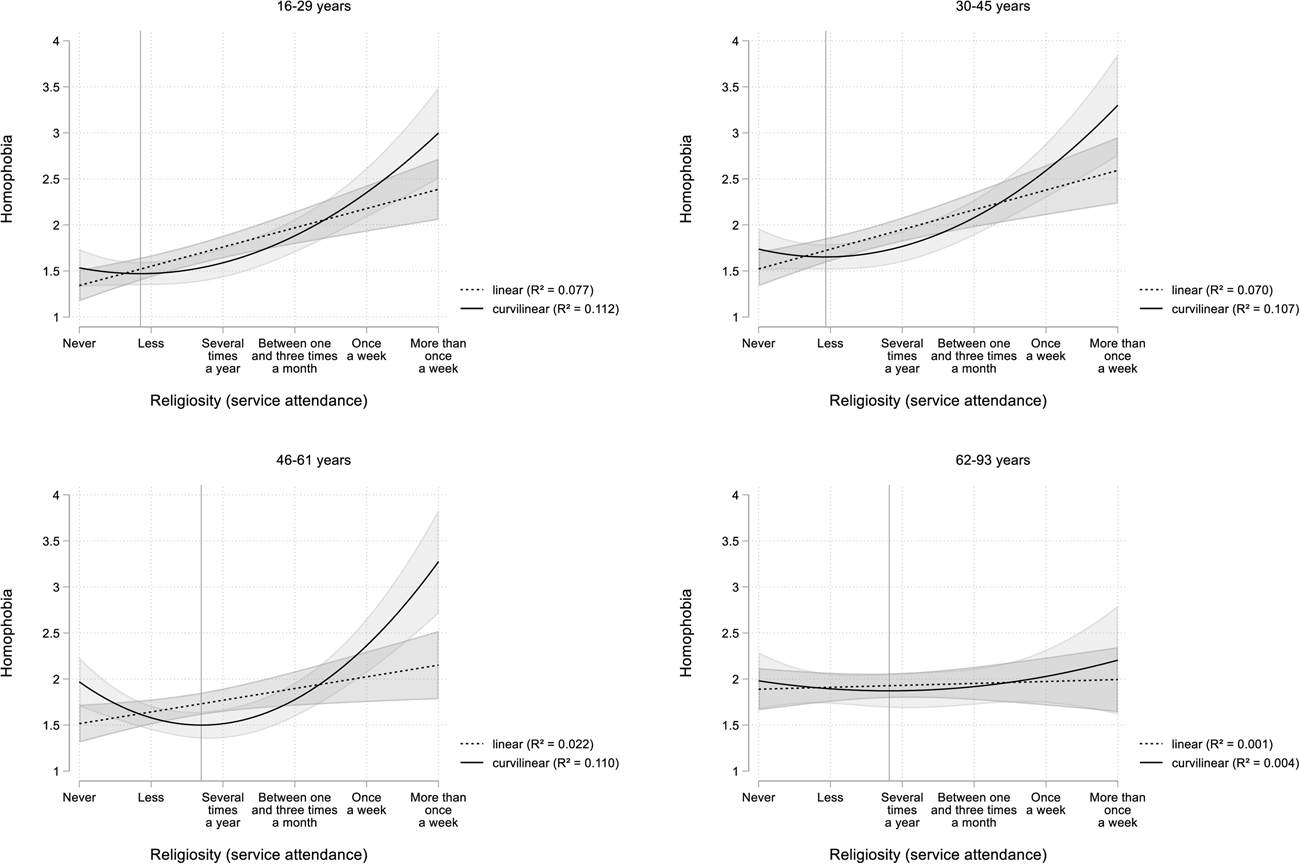
As demonstrated, Christians are far from being a homogeneous group; quite the contrary, there is considerable internal heterogeneity within Christianity. One might question whether the reported results obscure systematic differences among (anti- or pro-diversity) subgroups. Therefore, we briefly investigate whether the relationship between religiosity and prejudice is influenced by respondents' religious affiliation and age. Both variables are known to have varying effects on prejudice among Christians (for xenophobia, see Scheepers et al., Reference Scheepers, Gijsberts and Hello2002; for homophobia, see Vermeer and Scheepers, Reference Vermeer and Scheepers2018). First, we differentiate between religious majority members (Catholic church and Protestant church) and religious minority members (Protestant free church, Christian orthodox church, and another Christian denomination) and we calculate age quartiles (16–29 years, 30–45 years, 46–61 years, and 62–93 years). Second, we reproduce graphical representations of linear and curvilinear regressions for the link between religiosity and prejudice in Western Germany for each of the computed subgroup.Footnote 14 In general, the results support the curvilinear pattern. For all subgroups, the model fit is higher in the curvilinear version compared to the linear one. However, the differences between the linear and curvilinear versions are statistically significant in only 8 out of 12 subgroups. Concluding, the religiosity—prejudice relationship is characterized by curvilinearity, particularly among religious majority members and middle-aged individuals (30–61 years).
Explaining the exceptional views of the highly religious
In Table 2, five models are computed for each dependent variable (xenophobia and homophobia). The first model mirrors the curvilinear regressions presented above (M1a and M2a). In the second model, all control variablesFootnote 15 are introduced, to test whether religious effects hold (M1b and M2b). The third and fourth models account for fundamentalism (M1c and M2c) or perceived disadvantage (M1d and M2d) and respondents' religious affiliation. Finally, the fifth model considers the two mediating variables together (M1e and M2e).
Effect of religiosity on anti-diversity attitudes in Western Germany (curvilinear regression)

Source: KONID, own calculation.
Note: †p < 0.1, *p < 0.05, **p < 0.01, ***p < 0.001.
M1a and M2a corroborate the curvilinearity of the religiosity–prejudice link. Religiosity and anti-diversity attitudes are negatively related up to a certain level of religiosity, and the relationship reverses after that point. This finding also holds when one accounts for all control variables in M1b and M2b. As expected, and as shown in M1c/d and M2c/d, holding fundamentalist attitudes and perceiving disadvantages are related to more pronounced prejudice. These effects are striking. For instance, a respondent reporting the empirical maximum in fundamentalism scores roughly two points higher on the four-point homophobia scale (than someone with the empirical minimum), and a person reporting the empirical maximum in perceived disadvantage scores almost one and a half points higher on the four-point xenophobia scale (than someone with the empirical minimum).
Concerning our hypotheses, those related to xenophobia (H2a and H3a) can be confirmed, though the hypotheses regarding homophobia (H2b and H3b) are only partly supported. Accounting for fundamentalism and perceived disadvantage in M1e leads to an 81% decrease in the squared term of religiosity (from 0.031 in M1b to 0.006 in M1e). The coefficient of interest is no longer significantly different from zero, indicating that fundamentalism and perceived disadvantage fully explain the level of xenophobia among the highly religious—supporting H2a and H3a. In line with this interpretation, respondents' religious affiliation shows no effects on xenophobia in the final model. When fundamentalism and perceived disadvantage are introduced into M2e, the squared term of religiosity decreases by 42% (from 0.076 in M2b to 0.044 in M2e). Because the coefficient of interest is still significantly different from zero, fundamentalism and perceived disadvantage only partly explain the increased level of homophobia among the highly religious, which partly corroborates H2b and H3b. Consistent with this interpretation, respondents affiliated with the Protestant free church or the Christian orthodox church show an increased level of homophobia despite the accounting for fundamentalism and perceived disadvantage.
Robustness checks
To ensure the robustness of our findings, we conducted additional analyses. First, we operationalized our two mediating variables in slightly different ways. In the main analysis, acceptance of violence is one of our defining characteristics for fundamentalism. However, willingness to use violence is not a necessary criterion for fundamentalism in all conceptualizations of the term (Emerson and Hartman, Reference Emerson and Hartman2006). Therefore, we exclude the item referring to the acceptance of violence, reducing our index to three items. Furthermore, one of the two indicators used to measure perceived disadvantage more directly taps into the idea of the loss-of-privileges explanation (Steinmann, Reference Steinmann2023). Therefore, we exclusively use the item asking respondents whether they feel like second-class citizens because of their religious affiliation as the sole indicator of perceived disadvantage. Using the two alternative mediating variables yields results consistent with those of the main analysis.Footnote 16
Second, as multiple imputation does not always offer a benefit over listwise deletion for bias reduction in regression analysis (Lall, Reference Lall2016; Arel-Bundock and Pelc, Reference Arel-Bundock and Pelc2018), we applied listwise deletion instead of multiple imputation to handle missing values. Again, the results remain consistent with those of the main analysis.Footnote 17
Third, studies examining the meaning of the term “foreigners” have revealed that respondents in Germany primarily associate it with “Muslims” (Wallrich et al., Reference Wallrich, West and Rutland2020) when making their assessments. Consequently, the curvilinear relationship should also extend to the relationship between religiosity and Islamophobia. Additionally, fundamentalism and perceived disadvantage are expected to contribute to heightened levels of Islamophobia among highly religious Christians. Empirically, using an alternative dependent variable (Islamophobia: “Muslims should be banned from immigrating to Germany,” original: “Muslimen sollte die Zuwanderung nach Deutschland untersagt werden”) these assumptions are supported.Footnote 18
Conclusion
Adding to classic (Allport, Reference Allport1954, Reference Allport1966) and novel (Siegers, Reference Siegers, Schulz, Siegers, Westle and Hochman2021; Steinmann, Reference Steinmann2023) research on the prejudice-promoting and -reducing functions of religiosity, our findings for a sample of Christians in Western Germany show that anti-diversity attitudes first decrease as a function of religiosity, but the relationship reverses afterward—xenophobia and homophobia are particularly pronounced among the highly religious. We provide clear evidence of a curvilinear religiosity–prejudice relationship and thereby challenge the linearity assumption of previous research (e.g., Jäckle and Wenzelburger, Reference Jäckle and Wenzelburger2015; Siegers, Reference Siegers, Schulz, Siegers, Westle and Hochman2021). The curvilinearity is particularly pronounced among religious majority members and middle-aged individuals.
To better understand the exceptional views of the highly religious, we tested two (complementary) approaches: the religious-ideology explanation (Hunsberger, Reference Hunsberger1995) and the loss-of-privileges explanation (Steinmann, Reference Steinmann2023). Empirically, we demonstrated that pronounced anti-diversity attitudes of highly religious Christians can be attributed to both their increased fundamentalist attitudes and their increased perception of disadvantage. Fundamentalism and perceived disadvantage fully accounted for highly religious people's level of xenophobia, whereas their level of homophobia was only partially explained. These findings also contribute to the broader research field concerned with prejudice formation. We have demonstrated that prejudices can arise from both socialization processes (e.g., learned ideology), and reactions to ongoing societal changes (e.g., lost privileges). Future research on prejudice formation should explicitly consider both mechanisms together, as they have often been treated separately from each other (for socialization, see Levine et al., Reference Levine, Moreland, Ryan, Sedikides, Schopler, Insko and Insko1998; for societal changes, see Hodson et al., Reference Hodson, Earle and Craig2022).
By empirically showing the curvilinearity between religiosity and anti-diversity attitudes, we confirm Allport's (Reference Allport1966) assertion that religiosity makes and unmakes prejudice. However, the question of why religiosity is a much better predictor of homophobic than xenophobic attitudes remains open. Furthermore, despite Allport's (Reference Allport1954) notion that various forms of prejudice often co-occur, the underlying mechanisms responsible for different types of anti-diversity attitudes may not be the same. Our findings leave open the question of why fundamentalism and perceived disadvantage fully explain the level of xenophobia of the highly religious, but only partially their level of homophobia. A partial response to these two questions can utilize biblical content to provide an explanation. While the Bible paints an ambivalent picture of foreigners (Rainey, Reference Rainey2018), the few passages that address homosexuality are clearly characterized by a negative stance toward it (Locke, Reference Locke2005). However, instead of content, teachings may be more decisive in shaping prejudice. Thus, and following Herek (Reference Herek1987), differences in church teachings could be the answer to these questions. Some types of prejudice are proscribed by many religious denominations, whereas some other types are non-proscribed or even endorsed by some religious denominations (Batson and Burris, Reference Batson, Burris, Zanna and Olson1993). It depends on the type of outgroup—in our case, ethnic versus moral outgroups. Although various religious denominations increasingly advocate for the interests of ethnic outgroups (e.g., foreign people), church teachings concerning the acceptance of moral outgroups (e.g., homosexual people) are still less widespread (Saroglou, Reference Saroglou2016). Consequently, religious effects on prejudice as well as the underlying mechanisms and their importance may vary depending on the type of outgroup.
Our investigation is bound by some limitations that imply the need for further research. First, xenophobic and homophobic attitudes were each assessed with a single-item measure. More comprehensive measures of the two constructs should be used in the future. Second, with xenophobia and homophobia, only two dimensions of anti-diversity attitudes were addressed. Whether the results are the same for prejudice against women and refugees, for example, has yet to be examined. Third, although service attendance is a widely used indicator of religiosity, other facets of religiosity (e.g., praying and subjective belief) could work differently. Future research should examine whether the curvilinearity of the religiosity–prejudice link holds for other dimensions of religiosity. Finally, introducing and testing a novel approach to explain the exceptional views of highly religious Christians in relation to their anti-diversity attitudes is a step forward. However, it remains unclear to what comparison group(s) respondents compare themselves, when reporting whether they perceived themselves as disadvantaged. Therefore, more precise survey questions are needed to evaluate whether respondents who experience unequal treatment because of their religious affiliation and who report feeling like second-class citizens because they belong to a Christian group, are actually thinking of marginalized groups, such as foreign and homosexual people, when making this assessment.
Acknowledgments
The authors thank Mona Gröneweg, Antonia Hock, and Ines Tomala for their helpful comments and suggestions on earlier versions of this article.
Financial support
The KONID project is the quantitative part of the research network “Religious and Social Identities in Civil Society” (RESIC) and was funded by the German Research Foundation (DFG, Grant No. 384887304).
Competing interests
None.
Appendix
Effect of religiosity on anti-diversity attitudes in Western Germany (curvilinear regression)

Effect of religiosity on anti-diversity attitudes in Western Germany (curvilinear regression), alternative operationalization of mediating variables

Effect of religiosity on anti-diversity attitudes in Western Germany (curvilinear regression), listwise deletion

Effect of religiosity on Islamophobia in Western Germany (curvilinear regression), listwise deletion

Distribution of dependent variable (xenophobia).
Source: KONID, own calculation.

Distribution of dependent variable (homophobia).
Source: KONID, own calculation.

Effect of religiosity on xenophobia in Western Germany separately for religious majority and minority (linear and curvilinear regression).
Note: Vertical line indicates TP.
Source: KONID 2019, own calculation.

Effect of religiosity on homophobia in Western Germany separately for religious majority and minority (linear and curvilinear regression).
Note: Vertical line indicates TP.
Source: KONID 2019, own calculation.

Effect of religiosity on xenophobia in Western Germany separately for age quartiles (linear and curvilinear regression).
Note: Vertical line indicates TP.
Source: KONID 2019, own calculation.
Effect of religiosity on homophobia in Western Germany separately for age quartiles (linear and curvilinear regression).
Note: Vertical line indicates TP.
Source: KONID 2019, own calculation.
Dr. Jan-Philip Steinmann is head of the research unit “Aetiology of Deviance” at the Criminological Research Institute of Lower Saxony (KFN), Germany. His current research interests comprise social inequalities, migration and integration, right-wing populism, deviant behavior, and religion. His work has been published in European Journal of Criminology, International Migration Review, and Journal of Ethnic and Migration Studies.
Dr. Gert Pickel is chair of religion and church sociology at Leipzig University, Germany. His current research interests comprise (international comparative) sociology of religion and political culture, social cohesion, right-wing populism, radicalization, and prejudice. His work has been published in British Journal of Sociology, Frontiers in Political Science, and German Politics.


 Open access

