



The gestational period is characterised by several changes in biological, social and psychological domains, and it requires the assistance of women’s families and health services(Reference Costa, Souza and Pedroso1,Reference Vescovi, Flach and Teodózio2) . Studies suggest that the gestational period is an influential moment in mental health(Reference Costa, Souza and Pedroso1,Reference Carvalho, Fernandes and Fernandes3,Reference Morais, Simões and Rodrigues4) . Insecurity, fear and sleep alterations are examples of situations that occur during the gestational period and highlight feelings of anxiety and depression(Reference Arrais, De Araujo and Schiavo5).
Gestation and postpartum periods are critical for implementing health promotion and preventive interventions, as they may lead to the emergence or aggravation of mental health situations(Reference Costa, Souza and Pedroso1,Reference Vescovi, Flach and Teodózio2) . Untreated mental health conditions may cause difficulties in following medical guidance, a decrease in medical visits and a higher risk of problems with gestation and the baby, as well as irregular life habits(Reference Costa, Souza and Pedroso1).
Dietary choices may be influenced by the pregnant emotional state. Situations linked to negative emotions may stimulate a preference for more palatable foods, which are rich in sugars and fats, to provide comfort to an organism with high cortisol(Reference Fusco, Amancio and Pancieri6). Pregnant women’s adequate food consumption is a key factor in promoting mother-child health and preventing negative postpartum outcomes(Reference Gomes, Vasconcelos and Cintra7). An unhealthy diet during the gestational period may influence placental development, which may impact fetal development and growth, as well as increase the risk of gestational diabetes mellitus, hypertensive syndromes, nutritional deficiencies and excessive weight gain. This may favour the emergence of chronic non-communicable diseases for the mother and child(Reference Vitolo8).
A study with pregnant women in Alagoas, Brazil, showed that ultra-processed foods (UPF) – products formulated from mostly industrial ingredients that undergo several processing steps in the food industry until they are considered ready for consumption, such as sugary drinks, ice cream, chocolate, cookies, snacks, pre-ready and instant foods(Reference Monteiro, Cannon and Levy9) – corresponded to 22·2 % of their daily energy intake, with reduced ingestion of proteins, fibres, Mg, Fe, K, Zn, Se, folate and vitamins D and E. This affected the nutritional quality of their diet(Reference Graciliano, Silveira and Oliveira10).
Dietary patterns during the gestational period must prioritise the consumption of a great variety of minimally processed in natura foods such as fruits, vegetables, lean meat and whole grains because of their gestational physiological demands. The consumption of UPF must be restricted to preserve the mother’s and neonate’s health(Reference Rohatgi, Tinius and Cade11,12) . For this reason, the food consumption of pregnant women, especially regarding UPF, and its relationship with mental health must be investigated to subsidise actions to promote quality of life for mothers and infants. Thus, this study aimed to assess the association of UPF consumption with the mental health of pregnant women in Southern Brazil.
Methodology
Study design and sampling
This cross-sectional study is part of a larger study named ‘Mental health and living conditions of pregnant women serviced at Primary Health Care’. This investigation was carried out in the city of Criciúma between April and December 2022. Criciúma is located in the southernmost part of Santa Catarina state, Brazil. It has 217 965 inhabitants, a Human Development Index of 0·788 and a populational density of about 815·87 inhabitants per km2(13).
This study targeted pregnant women aged 18 years and above who had their prenatal consultation at any of the forty-eight basic health care units in the city and were in their third gestational trimester. Pregnant women who had different nationalities, which might affect Portuguese language comprehension, had an abortion or were at a high-risk pregnancy, were excluded from this study.
Identification of women who were in their third trimester of pregnancy was carried out via the health system used in the city called ‘CELK Saúde’. This system enabled the generation of monthly reports with a likely delivery date for every pregnant woman in the next 3 months, thus corresponding to the third trimester of their pregnancies. When the monthly reports were made, ‘new’ pregnant women were found; they had not yet been identified in previous searches due to a delay in entering data in the CELK system, in discovering their pregnancy and/or in searching for prenatal service. After that, a selection filter was used in the Excel software to identify pregnant women aged 18 years or over.
To calculate the sample size, the annual average of pregnant women who received service at the Primary Health Care of Criciúma (n 1517) was considered, as well as the following parameters: a 95 % confidence level, an 80 % statistical power and a 50 % unknown outcome prevalence. After adding a 10 % margin for losses and refusals and 15 % for confounding factors, 384 pregnant women should be studied. All eligible pregnant women were invited to participate in the study.
Data collection
Interviews were conducted in person, at a reserved place, during prenatal consultations or at the participant’s homes by previously trained interviewers. Tablets were used for data collection, and the mean interview time was 30 min. The questionnaire included sociodemographic, behavioural, health and gestation and prenatal-related information. The data were stored in the REDCap® software.
Investigated variables
Food consumption
The variable of interest was the high consumption of UPF. Information to assess UPF consumption was collected at the time of recruitment via the Nova-UPF screener, as proposed by Costa et al. (Reference Costa, Faria and Gabe14). This tool includes the UPF items or subgroups with the higher participation in the diet, as estimated by the national food consumption survey carried out in the 2008–2009 Household Budget Survey (in Portuguese, Pesquisa de Orçamentos Familiares) by Brazilian Institute of Geography and Statistics (in Portugues, Instituto Brasileiro de Geografia e Estatística)(15). The Nova-UPF screener presents a list of twenty-three UPF items or subgroups and evaluates their consumption on the day before the interview. It is divided into three parts: ultra-processed beverages (six subgroups), products that replace or are meal side dishes (ten subgroups) and snack-type products (seven subgroups).
Participants indicated all items they consumed the previous day. The information obtained from the Nova-UPF screener enabled the calculation of the Nova-UPF score by the simple sum of the positive answers to the items or subgroups. The Nova-UPF score was previously tested against the dietary share of UPF, obtained from 24-h recalls, and the authors found a substantial agreement between the two measures(Reference Costa, Faria and Gabe14). For this study, the score was first categorised into quintiles. Then, women were considered as having a high UPF consumption when they presented scores in the fifth quintile of the distribution.
Mental health
The presence of depressive symptoms was assessed using the Patient Health Questionnaire, previously validated for the Brazilian population(Reference Santos, Tavares and Munhoz16). This instrument is composed of nine questions, considering a 2-week recall period. The frequency of each symptom is assessed on a Likert scale of 0–3, corresponding to the following answers: ‘not at all’, ‘several days’, ‘more than half the days’ and ‘nearly every day’, respectively (online Supplementary Material 1). All women who scored 9 or above were considered to be experiencing depressive symptoms.
Stress was assessed through the Perceived Stress Scale, also validated for the Brazilian population(Reference Siqueira Reis, Ferreira Hino and Romélio Rodriguez Añez17). This scale comprises fourteen items that assess the perception of stressful experiences in the previous month (online Supplementary Material 2). The total score is the sum of points ranging from 0 to 56, which was later categorised into quintiles. Pregnant women in the highest quintile were classified as having the highest level of perceived stress.
Feelings of sadness were measured by the Faces Scale(Reference Andrews and Withey18). This scale features seven faces (1 corresponds to ‘very happy’, and 7 corresponds to ‘very sad’), representing how the individual felt most of the time over the last year (online Supplementary Material 3). Those who selected the last three faces (5, 6 and 7) were classified as experiencing feelings of sadness.
Anxiety was assessed by the question: ‘Has any doctor or psychologist ever told you that you have anxiety?’ The answer options were ‘yes’ and ‘no’.
Potential confounding factors
The variables considered as potential confounders were age (collected in complete years and categorised as 18–19, 20–25, 26–30, 31–35, > 35), skin colour (collected as white, black, mixed-race, yellow, indigenous), lives with a partner (no, yes), educational level (collected in complete years and categorised as ≤ 8, 9–11, ≥ 12), monthly income (< 500·00; 500·00–1000·00; 1001·00–2000·00 > 2000·00 Brazilian reais), quality of sleep (very good, good, regular, bad, very bad) and sufficient physical activity (no, yes). Physical activity was assessed by the long version of the International Physical Activity Questionnaire, considering leisure and movement activities(Reference Matsude, Araújo and Matsudo19). Physical activity was considered sufficient when a pregnant woman exercised for at least 150 min a week(20).
Data analysis
Absolute (n) and relative (%) frequencies were calculated via descriptive analyses of the investigated variables and their respective 95 % CI. The prevalence for the consumption of each item or UPF subgroup on the day before the interview was also presented (n, %). By utilising the Fisher’s exact test at a 5 % significance level, crude analyses were conducted to examine the association between UPF consumption and mental health-related variables.
The adjusted analyses were carried out to verify whether the link between the consumption of UPF and the mental health variables was independent of potential confounding factors. Poisson regression with robust variance was used for this purpose, adjusting for covariates across hierarchical deterministic levels. The demographic variables (age and skin colour) were classified as level 1 (distal), the socio-economic variables (lives with a partner, educational level and monthly income) as level 2 (intermediate) and the behavioural variables (quality of sleep and sufficient physical activity) as level 3 (proximal). The backward model was utilised to select the variables in the adjusted model. Variables with a 20 % significance level (P value < 0·20) were maintained in the final model as potential confounding factors. The prevalence ratio was presented as the effect measure, with a 95 % CI.
All analyses were conducted on Stata software, version 17·0.
Results
In total, 428 pregnant women were investigated (85·6 % response rate). Most of them were aged between 20 and 30 years (58·1 %), were white (68·1 %) and lived with a partner (85·7 %). One-third of them had completed up to 8 years of education (29·0 %), and nearly half had a monthly income between R$ 1001·00 and R$ 2000·00 (45·0 %). Regarding mental health, nearly one-third presented anxiety (34·4 %) and stress (36·4 %), and more than half reported depressive symptoms (50·9 %) (Table 1).
Characteristics of the pregnant women. Criciúma, Brazil, 2022. (n 428)
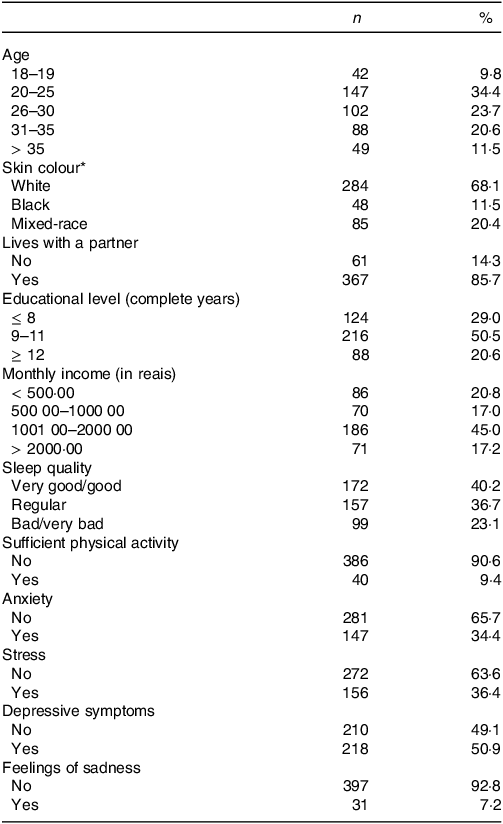
* Yellow and indigenous were excluded (n 5; 1·2 %).
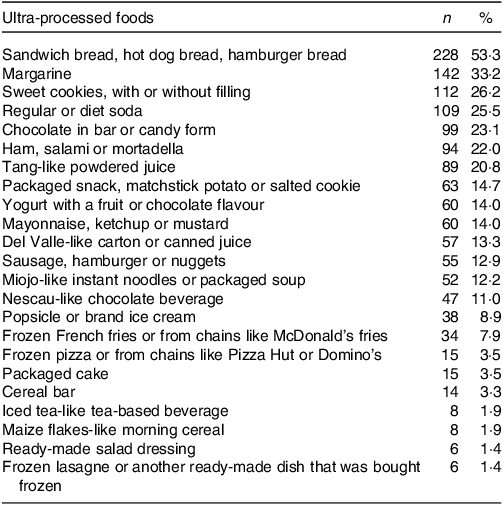
Table 2 presents UPF consumed on the day before the interview. It was found that the most consumed foods were sandwich bread, hot dog bread or hamburger bread (53·3 %), margarine (33·2 %), sweet cookies with or without filling (26·2 %) and regular or diet soda (25·5 %). Conversely, the least consumed foods were frozen lasagne or another ready-made dish bought frozen (1·4 %) and ready-made salad dressing (1·4 %). The score distribution in the sample, presented in Fig. 1, shows that women in the fifth quintile of score distribution consumed six or more UPF items or subgroups the previous day. The prevalence of high consumption of UPF corresponded to 13·8 %.
Prevalence of ultra-processed food consumption on the day before the interview. Criciúma, Brazil, 2022. (n 428)
Distribution of the score of ultra-processed foods in the sample. Criciúma, SC, 2022. (n 428).
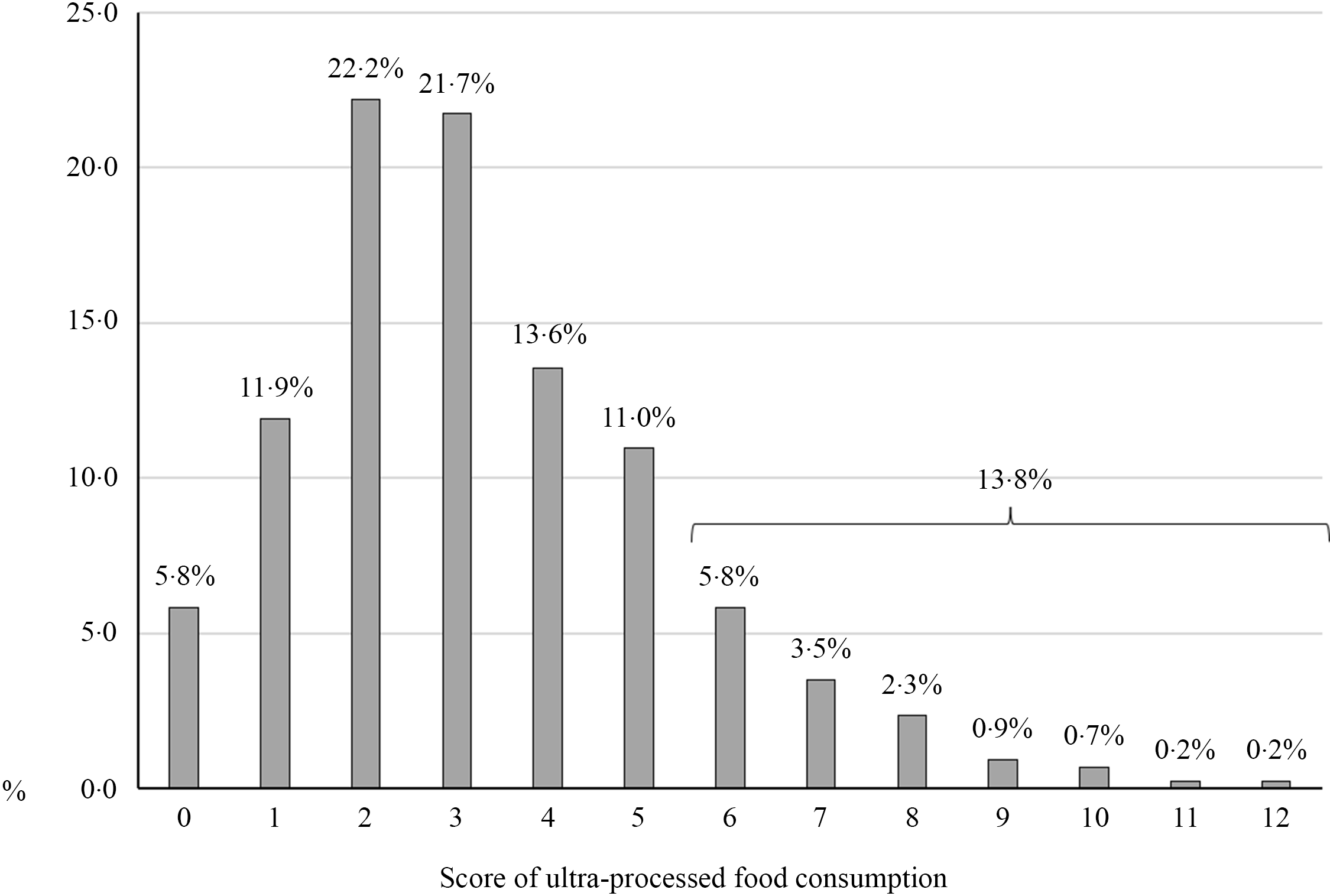
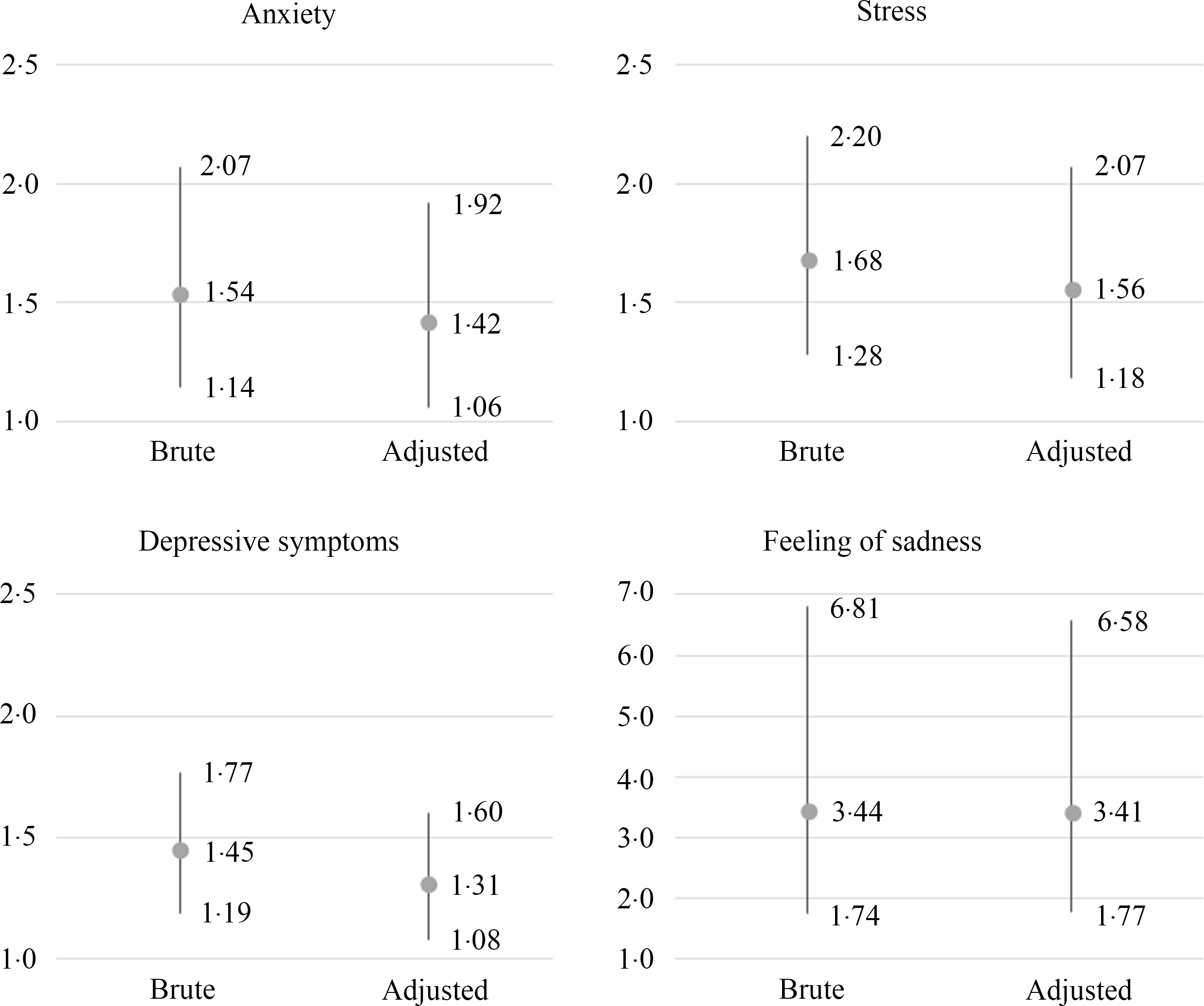
Figure 2 illustrates both the crude and adjusted associations between the high consumption of UPF and the mental health variables. It was found that all mental health outcomes remained associated with high consumption of UPF after an adjustment for potential confounding factors. The pregnant women who presented high consumption of UPF had a 1·42-fold higher prevalence of anxiety (95 % CI 1·06, 1·92) and a 1·56-fold higher prevalence of stress (95 % CI 1·18, 2·07) when compared with those who did not present high consumption. The prevalence of depressive symptoms was 1·31-fold higher among those who presented high consumption of UPF (95 % CI 1·08, 1·60) than their peers. Besides, the prevalence of feelings of sadness was 3·41-fold higher among those with high consumption of UPF (95 % CI 1·77, 6·58).
Crude and adjusted* prevalence ratios of the association between high consumption of ultra-processed foods (six or more items) and mental health variables. Criciúma, SC, 2022. (n 428). *Analysis adjusted for age, skin colour, lives with a partner, educational level, monthly income, quality of sleep and physical activity.
Discussion
This study aimed to assess the relationship between the consumption of UPF and the mental health of pregnant women. It found that all examined mental health conditions, including anxiety, stress, depressive symptoms and feelings of sadness, were associated with high UPF consumption.
In recent years, because of the processes of globalisation and an industrial, social and economic transition, an intense shift in dietary patterns has been seen worldwide(Reference Baker, Machado and Santos21,Reference Singh, Illner and Dokova22) . Consuming homemade meals cooked with in natura or minimally processed products has been replaced by the consumption of UPF, which are rich in fats, sugars, sodium and food additives(Reference Popkin23). These foods are not only promoted with aggressive marketing campaigns, but they are also hyperpalatable and potentially addictive. As a result, they have become a primary source of energy and nutrients for many populations, influencing diets across various life stages(Reference Baker, Machado and Santos21,Reference Popkin23) .
In Latin America, the food and nutritional transition situation is relatively recent. This region shares many common factors with other areas. Factors such as economy, urbanisation and convenience contributed to this scenario. It is known that social, economic and political history aspects significantly contribute to determining UPF consumption(Reference Ablard24). Specifically in Brazil, UPF consumption has been increasing in all social strata(Reference Levy, Andrade and Cruz25).
Gestation is a period when women are more vulnerable, which might worsen their nutrition quality. A study by Gomes et al. (Reference Gomes, Malta and Benício26) showed that 25 %, on average, of the energy consumption of pregnant women in a São Paulo municipality originated from UPF. In the USA, the mean UPF energy contribution reached 52·6 % during pregnancy(Reference Nansel, Cummings and Burger27). Another study in Alagoas, Brazil, showed that women in the highest (fifth) quintile of UPF consumption presented a dietary share of 40·1 % from UPF, almost tenfold higher compared with the lowest (first) quintile (4·9 %)(Reference Gomes, Malta and Benício26). In our study, 14 % of the pregnant women were in the fifth quintile of the distribution, consuming six or more UPF items or subgroups on the day before the interview. A previous study demonstrated that the Nova-UPF score, derived from the tool applied in this study, accurately represented the dietary share of UPF, evaluated through 24-h recalls. The authors found a substantial agreement in ranking individuals into the quintiles of consumption, comparing the Nova–UPF score and the dietary share of UPF. Simultaneously, other studies with adults found the cut-off values for the highest quintile to be four or more(Reference Costa, Santos and Gabe28) and five or more(Reference Costa, Faria and Gabe14,Reference Costa, Sattamini and Steele29,Reference Costa, Steele and Faria30) , which are lower than what we discovered. Therefore, our sample may exhibit both a high consumption of UPF items and a high dietary share of UPF, compared with other adult samples.
This is a particularly concerning scenario because while an increase in the consumption of these products has been observed, there has also been a steady increase in the prevalence of negative mental health outcomes and their consequences in the world population(31). A significant portion of this issue may be attributed to family relationships, social support, economic factors, environmental influences and sex roles(Reference Alegría, NeMoyer and Falgàs Bagué32). During pregnancy, mental health may be strongly influenced by hormonal alterations and concerns and doubts about the future of the mother and child, as well as a lack of social support(Reference Chauhan and Potdar33).
The consequences of the consumption of UPF for the population’s general mental health have been extensively studied(Reference Lane, Gamage and Travica34). However, studies exploring the relationship between consumption of these products and mental health among pregnant women are still scarce. This study found that women with high UPF consumption showed a higher prevalence of anxiety, stress, depressive symptoms and feelings of sadness. Other studies corroborate these findings. Similarly, a study from Ribeirão Preto, Brazil, revealed that being in the second or third tercile for energy consumption from UPF was associated with a higher risk of reporting feelings of depression or sadness during pregnancy(Reference Badanai, Zuccolotto and Crivellenti35). In the USA, a pro-inflammatory diet was linked to depressive symptoms among pregnant women facing economic hardships(Reference Wang, Yim and Lindsay36). In Australia, non-standard eating patterns in pregnant women, characterised by consuming candies, fast food, red meat and soft drinks, were associated with a higher frequency of depressive symptoms(Reference Baskin, Hill and Jacka37). Moreover, in Taiwan, an increased consumption of sugary drinks was linked to rising depressive symptoms throughout pregnancy(Reference Ker, Wu and Lee38).
Given that pregnant women are particularly vulnerable to the effects of UPF consumption during pregnancy, and considering the rising trend in these foods’ consumption, their mental health will likely be severely affected. This turns the association between UPF consumption and mental health into a public health issue, especially considering that a nutritionally balanced diet is crucial for optimal fetal development and growth(Reference Vitolo8). This highlights its significance not only for pregnant women’s mental health but also for the overall health of their children.
The relationship between UPF consumption and mental health is complex. A multi-country study showed that high consumption of these foods detrimentally affected the nutritional quality of diets(Reference Martini, Godos and Bonaccio39). This diet profile has been associated with mental health outcomes through various mechanisms, such as inflammation, oxidative stress and intestinal microbiota imbalance(Reference Marx, Lane and Hockey40). Additionally, the consumption of nutrients like proteins, food fibres, vitamins D, E, the B complex, Zn and Mg, as well as n-3 PUFA, is linked to mothers’ better humour and well-being, reducing the risk of negative psychological conditions such as perceived stress, anxiety and depression, during both prenatal and postnatal periods(Reference Lindsay, Buss and Wadhwa41,Reference Yelverton, Rafferty and Moore42) .
On the other hand, the literature suggests that prenatal psychological stress is associated with less healthy eating behaviours, such as ‘emotional eating’ driven by consuming highly palatable foods(Reference Lindsay, Buss and Wadhwa41). Palatability is a determining factor in food choice. Highly palatable, UPF promote non-homeostatic eating – food consumption without a metabolic need(Reference Popkin23,Reference Morton, Meek and Schwartz43–Reference Contreras-Rodriguez, Solanas and Escorihuela45) . Besides, UPF deliver energy content more quickly because of their easy digestion and altered bioavailability, encouraging overconsumption(Reference Kelly, Baugh and Oster46). UPF consumption also affects the reward system, which is composed of oral and post-oral signals and is highly activated by ingredients like sugar and fat. Although the reward system may not exhibit immediate food preferences following initial consumption, especially with sugary foods, a preference for these foods(Reference Contreras-Rodriguez, Solanas and Escorihuela45–Reference Parnarouskis and Gearhardt47) often develops due to the sense of well-being they provoke(Reference Rolls44,Reference Contreras-Rodriguez, Solanas and Escorihuela45) .
This cycle of food consumption, reward and well-being encourages ongoing UPF consumption and especially overconsumption. It also undermines efforts to avoid such consumption, as it triggers undesirable sensations in individuals and diminishes their ability to control their eating habits(Reference Parnarouskis and Gearhardt47). The inability to control food intake frequently leads to negative feelings, such as guilt and shame(Reference Burton and Abbott48). These feelings may contribute to adverse mental health outcomes, which can be particularly intense in pregnant women. Therefore, there might be a bidirectional relationship between UPF consumption and negative mental health outcomes.
This study has some limitations that must be mentioned. High consumption of UPF was defined from a sample distribution (the highest quintile), according to the previous study methodology(Reference Costa, Faria and Gabe14,49) , but not at a specific cut-off point. Although there is no specific definition for it in the literature, our use of the highest quintile for categorisation aligns with recent meta-analyses. These analyses investigate UPF consumption’s impact on non-communicable diseases and mortality, with many studies employing population distribution as a key parameter(Reference Lane, Gamage and Travica34,Reference Martini, Godos and Bonaccio39) . Consumption data on the day before the interview does not reflect the usual consumption. However, several studies from the above-mentioned meta-analyses(Reference Lane, Gamage and Travica34,Reference Martini, Godos and Bonaccio39) evaluate UPF consumption through 24-h recalls applied on a single occasion. The cross-sectional design does not allow to establish a causal relationship between the observed associations. Moreover, the relationship between UPF consumption and mental health variables may be bidirectional. The findings concerning UPF consumption and mental health issues during pregnancy must be interpreted with caution, as they suggest a worst-case scenario for mother-child health, which requires actions focused on minimising both problems. Depressive symptoms, perceived stress and feelings of sadness were assessed using screening questionnaires rather than diagnostic ones. Nevertheless, these questionnaires are widely used in population studies for their practicality in data collection(Reference Siqueira Reis, Ferreira Hino and Romélio Rodriguez Añez17,Reference Munhoz, Nunes and Wehrmeister50,Reference Schäfer, Santos and Quadra51) . Additionally, anxiety assessment was based on participants’ recollection of a professional diagnosis, without screening or diagnostic questionnaires, which means its prevalence could be overestimated or underestimated. Finally, it is important to highlight that the Nova-UPF screener was initially validated in a sample where the majority (four-fifths) of the participants had completed at least secondary education. In our sample, almost 30 % of respondents had less than 8 years of education. However, a second study evaluating the tool in a broader sample also found a good performance among participants with less than 12 years of education(Reference Costa, dos Santos and Gabe52).
One strength of this study is its assessment of the association between consumption of UPF and mental health among pregnant women – a target audience/topic that is still not extensively studied. The findings presented here are of utmost importance to build scientific evidence on this subject.
Based on these study findings, it can be suggested that diet quality is associated with the mental health of pregnant women. High consumption of UPF was linked to all mental health outcomes, showing an increased prevalence of anxiety, stress, depressive symptoms and feelings of sadness. Thus, the high consumption of UPF during the nutritional transition, coupled with the current state of the population’s mental health, has raised concerns within health sectors. Intersectoral and interdisciplinary efforts are crucial to promote initiatives focused on food and nutrition education for pregnant women and the wider population, as well as mental health care, especially aftermath of the coronavirus disease 2019 pandemic.
Acknowledgements
We would like to acknowledgement the Santa Catarina Research and Innovation Foundation.
This study was funded by the Santa Catarina Research and Innovation Foundation (no. 15/2021).
F. O. M., C. S. C., V. I. A. M. and A. A. S.: substantial contributions to the conception and design, data acquisition, analysis and/or interpretation, drafting the article and critically revising it for important intellectual content. M. R. Q.: drafting the article and critically revising it for important intellectual content. F. D. E., T. J. S. and M. V. R. T.: drafting the article. All authors have approved the final version to be published and agree to be accountable for all aspects of the work, ensuring that questions related to the accuracy or integrity of any part of the work are appropriately investigated and resolved.
The authors declare that there are no conflicts of interest.
This study adhered to the guidelines laid down in the Declaration of Helsinki, and the Ethics Committee of the University of the Extreme South of Santa Catarina approved all procedures involving human subjects in October 2021, under opinion no. 5.053.755. Verbal informed consent was obtained from all subjects, witnessed and formally recorded.
Supplementary material
For supplementary material/s referred to in this article, please visit https://doi.org/10.1017/S0007114524000783.



