




The Descent of Man, and Selection in Relation to Sex (1871) is a complex book, rife with competing arguments and stakes. One explanation for why this should be so has been given in great detail by Adrian Desmond and James Moore in their Darwin's Sacred Cause.Footnote 1 They show how Darwin moved in circles of abolitionists, with his mother's side of the family active for the cause. The authors meticulously reconstruct how the knowledge he gained about genocide and slavery, even with the gruesome outcomes of its abolition, on the five-year voyage of the Beagle around the world (1831–6) radicalized him to a certain degree. Darwin was also aware of the involvement of science in ‘racial’ exploitation and violence, especially with the support that polygenist theories gave such social structures in the American South. These doctrines were strongly contradicted by his observations in South America, especially in Brazil, where ‘whites’, ‘Africans’ and ‘Indians’ had intermixed and graded into each other.
In the course of time, however, Darwin would become more impressed by the constant wars between groups, evidenced by the ‘Kaffir Wars’, for example, than by peoples’ ability to find a way of coexisting. And a Darwin who was losing his religious faith rated ethnicities on the basis of morality and civilization. He compared Europeans to domesticated animals, while ‘the savages’ had remained wild. Such ‘savages’ helped him to imagine ‘our’ progenitors, and ancestral ties between groups might be uncovered through relations between languages or comparisons of parasites. Furthermore, Darwin certainly applied to ‘the human family’ his intuition and knowledge of the British class and gender systems, in which there existed ‘natural’ hierarchies, despite the fact that a lower-class member could theoretically become more civilized and even women might improve themselves through education. Such a paternalistic stance towards the ‘primitives’ was also taken by anthropologists like John Lubbock and Edward Tyler, with whom Darwin clearly felt more aligned than with the craniologists and polygenists.
This certainly amounted to a complex mixture of observations and beliefs for developing a coherent theory of human descent. In addition, according to the transformationist theories like those of Jean-Baptiste Lamarck and Robert Grant, with which Darwin was acquainted, evolution did not amount to diversification from a common origin but consisted in a series of parallel developments through the same pedigree. In this view, rather than humans and monkeys having branched from a common progenitor, humans had passed through the monkey phase on their own line, while monkeys had yet to become human. Some even envisioned such independent phylogenies for the ‘human races’, so that the ‘living races’ did not share a common ancestor. Rather, ‘the whites’ constituted the oldest and highest form on the separate but parallel ladders of progress, a rung black people had not yet achieved.Footnote 2
To this, Darwin's conception of descent stands in stark relief: ‘Common ancestry had been his invention: a chartable pedigree for the whole of life, and not just for the human aristocrats.’Footnote 3 Desmond and Moore suggest that Darwin preferred ‘descent’ over ‘evolution’, a word that came into vogue in the 1870s, because genealogy was more than an analogy in this invention: ‘Human genealogy was more than a metaphor for Darwin's common-descent evolution. It was the prototype explanation.’Footnote 4 And in accordance with this prototype explanation, Darwin worked with the image of the tree. Family genealogy suggested that some branches of the tree of life would flourish while others withered or perished, just like families rose to influential dynasties or died out; similarly, common ‘racial’ descent and ‘racial’ extinction reinforced the notion of a tree of life, with many branches having been wiped out. In fact, Desmond and Moore even propose that it is from Darwin's conception of the relationship between the ‘human races’ that he ventured into the entire animal kingdom. In sum, ‘racial unity was his starting point for explaining the common descent of all life using a pedigree approach’.Footnote 5 If family genealogy and the family tree applied to the ‘racial’ pedigree were metaphors and more in Darwin's theory, then what kind of language and imagery did he use to convey the descent of man?
To begin with, I will argue that in spite of Darwin's strong reliance on genealogy, he was less interested in ‘a chartable pedigree of the whole of life’ than in the mechanisms that shaped that pedigree. Furthermore, where the imagery of relatedness is concerned, Darwin's use of language suggests that he was still strongly influenced by the great chain of being. Indeed, Darwin does not use the word ‘tree’ in the sense of genealogical tree in Descent, and he draws on tree-related metaphors such as ‘branch’ or ‘stem’ very rarely. These are mostly contained to his discussion of primate phylogeny. Does this have anything to do with the fact that Darwin drew a phylogenetic tree of the primates in the context of his work on Descent – an image, as Julia Voss has noted, that he did not include in the book?Footnote 6
That Darwin did not omit his tree of the primates due to a general disregard for the value of images in the generation and communication of knowledge becomes clear from their overall prominence in his work. Scholars like Voss have shown the enormous epistemic power that the production and use of images had for Darwin. They have also brought to light the relations to the arts and the wider context of Darwin's visual culture.Footnote 7 In front of this background, it comes as a surprise that there are no images of humans in Descent, except of a human embryo and ear, even despite the book's main title. The imagery that is mostly taken from publications of other authors – such as Brehm's Tierleben – largely concerns Darwin's reasonings on sexual selection in animals. Regarding Descent, Voss thus mainly focuses on the famous pictures of (the ornaments on) the Argus pheasant's feathers.Footnote 8
Rather than investigating possible reservations Darwin might have had vis-à-vis ethnographic imagery, however, I tackle the question of why the primate tree did not make it into Descent, by bringing this visual expression of the natural human order into communication with the semantic expression of such in the book. I thus engage with a specific kind of genealogical technique: the phylogenetic diagram that takes the shape of a tree.Footnote 9 The omission of the tree seems all the more significant in view of Heather Brink-Roby's argument in the context of Darwin's fold-out diagram in On the Origin of Species (1859) that the seriality of written language made naturalists like Darwin recognize the necessity for diagrams to convey their novel understanding of natural relations as non-linear.Footnote 10 However, as I will discuss, branching structures could still represent mostly linear and progressive models like those of Lamarck and others who actually drew such.Footnote 11 When applied to human evolution, tree thinking and iconography can even be seen as reifying what Darwin is said to have combated: racial hierarchies, racism and polygenism.Footnote 12
The genealogy of man
In the first chapter of Descent, Darwin elaborated from comparative anatomy, comparative embryology and rudimentary organs that man descended from the animal kingdom.Footnote 13 In the process of reconstructing man's genealogy, or pedigree, as he also called it, especially in the first chapters he employed words from the semantic field of the scala naturae. He tried to establish hierarchies of infinite gradations, specifically with regard to mental powers, throughout the animal kingdom and within humankind:
We must also admit that there is a much wider interval in mental power between one of the lowest fishes, as a lamprey or lancelet, and one of the higher apes, than between an ape and man; yet this immense interval is filled up by numberless gradations. Nor is the difference slight in moral disposition … and in intellect, between a savage who does not use any abstract terms, and a Newton or Shakspeare [sic]. Differences of this kind between the highest men of the highest races and the lowest savages, are connected by the finest gradations. Therefore it is possible that they might pass and be developed into each other.Footnote 14
The scala naturae concept and image stem from a time before Darwin and before there was an evolutionary conception of the living world.Footnote 15 But the associated notions of a complete chain, or a series without gap, a hierarchy of infinite gradations, have a strong presence in Darwin's wordings, as is further exemplified in these phrases: ‘the animals which come next to him [man] in the series’; ‘In the vertebrate series’; ‘some animals extremely low in the scale’; ‘the ascending organic scale’.Footnote 16 From reasoning in terms of the scale in matters of instincts and mental powers, Darwin consequently conveyed the evolution of cultural traits such as ‘religion’ along similar lines: ‘The same high mental faculties which first led man to believe in unseen spiritual agencies, then in fetishism, polytheism, and ultimately in monotheism, would infallibly lead him, as long as his reasoning powers remained poorly developed, to various strange superstitions and customs.’Footnote 17
One of the bases of evidence for Darwin's gradual scale of physical, mental and cultural development was the use of ontogeny as an analogy for phylogeny:
In a future chapter I shall make some few remarks on the probable steps and means by which the several mental and moral faculties of man have been gradually evolved. That this at least is possible ought not to be denied, when we daily see their development in every infant; and when we may trace a perfect gradation from the mind of an utter idiot, lower than that of the lowest animal, to the mind of a Newton.Footnote 18
However, the way this parallel between ontogeny and phylogeny was conceptualized had undergone a change. The view of ontogeny of the Prussian Estonian embryologist Carl Ernst von Baer as a process of differentiation and individuation had been analogized to the view of evolution as a system of divergent development.Footnote 19 Thereby, the ideal (Naturphilosophie) and/or non-evolutionary (Georges Cuvier, Richard Owen, von Baer) notion of archetypes of taxonomic groups such as fish, reptiles, birds and mammals had been turned into real common progenitors, even if their fossil bones had not yet been found. Darwin, too, integrated von Baerian embryology and a view of evolution as a process of divergence into a recapitulationist framework. Already in the notebooks of the late 1830s, he had embraced recapitulation theory; in On the Origin of Species (1859) he argued:
As the embryonic state of each species and group of species partially shows us the structure of their less modified ancient progenitors, we can clearly see why ancient and extinct forms of life should resemble the embryos of their descendants, – our existing species … Embryology rises greatly in interest, when we thus look at the embryo as a picture, more or less obscured, of the common parent-form of each great class of animals.Footnote 20
The von Baerian principle of differentiation suggested not a linear scale as the natural system but a tree structure. And this structure could also solve another problem that appeared when adding a time dimension to the animate world: some living animal groups seemed not to have been modified as much as others. As Darwin wrote in Descent, ‘Some old forms appear to have survived from inhabiting protected sites, where they have not been exposed to very severe competition.’ Only within the structure of the tree can such ‘old’ contemporary forms not only be explained, but also provide insights into phylogeny, for ‘these often aid us in constructing our genealogies, by giving us a fair idea of former and lost populations’.Footnote 21 There appeared to be a simultaneity of the non-simultaneous visible in the current organismic diversity, a phenomenon that complicated kinship and could only be accommodated by the tree model.Footnote 22
With these preliminary remarks in mind, I now turn in more detail to Chapter 6 in Descent, in which Darwin treated the affinities and genealogy of man. In the conclusion to this chapter, Darwin once more expressed the importance of von Baerian embryology for his genealogy of the living world:
The best definition of advancement or progress in the organic scale ever given, is that by Von Baer; and this rests on the amount of differentiation and specialisation of the several parts of the same being, when arrived, as I should be inclined to add, at maturity. Now as organisms have become slowly adapted by means of natural selection for diversified lines of life, their parts will have become, from the advantage gained by the division of physiological labour, more and more differentiated and specialised for various functions … But each organism will still retain the general type of structure of the progenitor from which it was aboriginally derived. In accordance with this view it seems, if we turn to geological evidence, that organisation on the whole has advanced throughout the world by slow and interrupted steps.Footnote 23
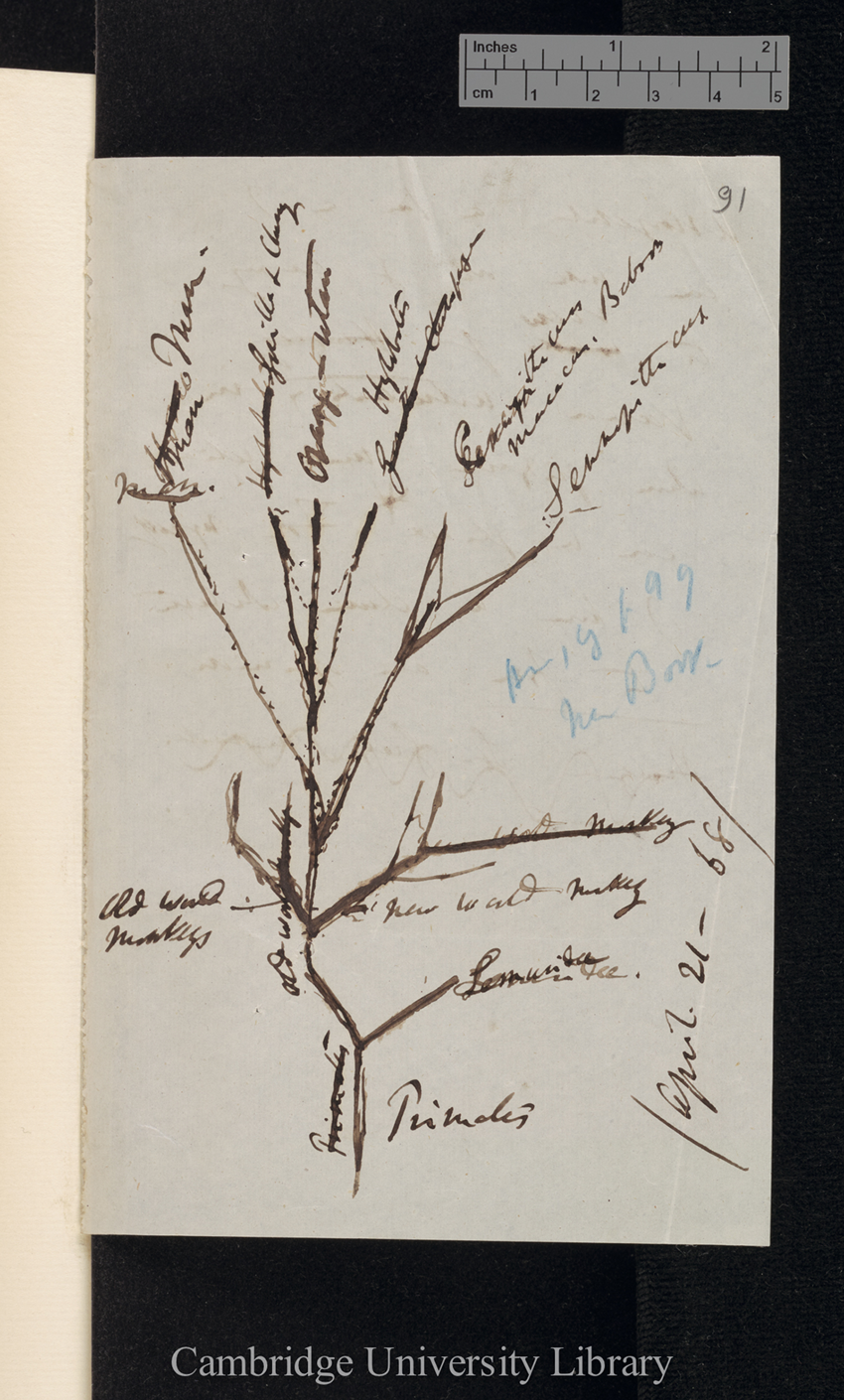
Thus the model of differentiation from the homogeneous to the heterogeneous, from the simple to the complex, though taking the form of a tree, still allowed for progress in the ‘organic scale’. Correspondingly, Chapter 6 is about the ‘Position of man in the animal series’ and at the same time about the proof that ‘The natural system [is] genealogical’.Footnote 24 In fact, despite the renewed reference to the series, this chapter relates to the tree of primates that Darwin drew on 21 April 1868 but did not publish in the book (Figure 1). J. David Archibald provides a close reading of the diagram and reconstructs the steps through which it possibly went.Footnote 25 In my context, however, I am interested in how far it corresponds with the passages in Descent, and it seems that the chapter is the verbal consequence of the drawing experiment with ink on paper.
Tree of primates by Charles Darwin (Cambridge University Library, DAR80.B91r, reproduced by kind permission of the Syndics of Cambridge University Library).
Darwin agreed with Carl Linnaeus and Thomas Henry Huxley that man did not constitute a separate order from the Primates. He suggested that it was a question of how to weigh which characteristics. Following the metaphor of the tree, he could speculate about some branches growing faster than others:
If we imagine three lines of descent proceeding from a common source, it is quite conceivable that two of them might after the lapse of ages be so slightly changed as still to remain as species of the same genus; whilst the third line might become so greatly modified as to deserve to rank as a distinct Sub-family, Family, or even Order. But in this case it is almost certain that the third line would still retain through inheritance numerous small points of resemblance with the other two lines.Footnote 26
Although attaching most importance to the great modifications and thus providing man with a special place would be ‘the safest’, the many little similarities seemed to suggest that integrating man within the primates was ‘the most correct as giving a truly natural classification’.Footnote 27
As he visualized it in Figure 1, Darwin went further than Huxley,Footnote 28 and concluded that ‘under a genealogical point of view it appears that this rank [of a Sub-order] is too high, and that man ought to form merely a Family, or possibly even only a Sub-family’.Footnote 29 Further in agreement with his drawing of the tree, in the book, a group resembling the progenitors of the Lemuridae ‘branched off into two great stems’,Footnote 30 Old World monkeys and New World monkeys. And via the progenitors of the Lemuridae, one could connect the primates to ‘forms standing very low in the mammalian series’.Footnote 31 Again ‘under a genealogical point of view’, man was ‘an offshoot from the Old World Simian stem’.Footnote 32 Man belonged to the branch of the anthropoid apes (in the image labelled Gorilla & Chimp; Orang-utan; Holybates) that was separate from the branch of Semnopithecus on the one hand and that of Macacus (Cercopithecus/Macacas/Baboons on the tree) on the other. ‘[S]ome ancient member of the anthropomorphous sub-group gave birth to man’,Footnote 33 and because – as evident in the tree – the gorilla and chimpanzee were closest to man, one could speculate on an African origin of the human stem.Footnote 34
However, although Darwin verbally drew his tree of the primates, using words such as ‘stock’, ‘common source’, ‘stem’, ‘diverge’, ‘branch (off)’, ‘lines (of descent)’, ‘offshoot’, etc., he simultaneously relied on the metaphor of the chain of being, as when he wrote about ‘[t]he great break in the organic chain between man and his nearest allies, which cannot be bridged over by any extinct or living species’.Footnote 35 This shows how the thinking along the lines of scales and chains that form linear hierarchies was carried over to a certain extent into the novel understanding of evolution as divergent also by Darwin. He certainly used vocabulary denoting progress: ‘In accordance with this view it seems, if we turn to geological evidence, that organisation on the whole has advanced throughout the world by slow and interrupted steps. In the great kingdom of the Vertebrata it has culminated in man.’Footnote 36
At the time of Darwin's writing, the tree image for phylogenies, even phylogenies that included humans, was no longer a novelty. Already prior to this primate family tree, Darwin himself had experimented with tree-like structures on more than a dozen sheets of paper, among them an earlier and more rudimentary version of a primate phylogeny – none of which he published, however, with the exception of the one diagram that entered On the Origin of Species (1859).Footnote 37 Francesca Bigoni and Giulio Barsanti have drawn attention to the primate trees of St. George Mivart that included Homo and pre-dated Darwin's tree in question here.Footnote 38 Finally, Ernst Haeckel had already published eight phylogenies in the form of trees in Generelle Morphologie der Organismen (1866), among them a Stammbaum der Säugetiere (family tree of the mammals) that contained Homo at the upper right hand of the image. This was followed by tree-like genealogies in Natürliche Schöpfungsgeschichte (1868) and, with Anthropogenie (1874), there would soon be the famous Stammbaum des Menschen (family tree of man) in the form of an oak with humans as the crown.Footnote 39
So why did Darwin use words to draw his primate tree but not publish the tree image? It is known that Darwin considered Haeckel's trees too speculative. He wrote to Haeckel in 1866, after reading Generelle Morphologie, ‘Your boldness sometimes makes me tremble but … someone must be bold enough to make a beginning in drawing up tables of descent.’Footnote 40 It is noteworthy that in his letter to his ‘dear Haeckel’, Darwin used the word ‘tables’ instead of ‘trees’, again referring to an older tradition of visualizing natural affinities. As stated at the beginning, the word ‘tree’, in the sense of phylogenetic tree, is absent from Descent, and on the reverse side of the paper on which he drew the primate family tree, Darwin wrote, ‘Arrangement as far as I can make out by comparing the work views of Huxley various naturalists as in whose judgment much reliance can be placed – For myself I have no clues whatever to form an opinion.’Footnote 41
In short, although for Darwin tree drawing obviously constituted an important technique of mental experimentation on evolutionary mechanisms as well as organismic relations, he was cautious with regard to fleshed-out phylogenies and indeed hardly ever entered the names of taxa into his close to twenty unpublished tree-like sketches.Footnote 42 In the context of his paraphrasing the tree of primate phylogeny in Descent, he hinted at his reservations towards attempts at reconstruction beyond the mammals:
In attempting to trace the genealogy of the Mammalia, and therefore of man, lower down in the series, we become involved in greater and greater obscurity. He who wishes to see what ingenuity and knowledge can effect, may consult Prof. Häckel's [sic] works. I will content myself with a few general remarks.Footnote 43
With reference to Haeckel's genealogical diagrams in Generelle Morphologie and, with regard to man, in Natürliche Schöpfungsgeschichte, Darwin here once more brought to the fore the force of the tree as an icon that can combine a dendritic pedigree with serial or linear progress. The imagery in the quote appears geological, with the strata lower in the series being less illuminated. This combines nicely with the notion that Darwin himself would dare only a few remarks on a subject largely in the dark, so that Haeckel's so-called ‘ingenuity’ seems to denote ‘inventiveness’.
But could it be that Darwin also thought of Haeckel's trees as too progressive and teleological, too hierarchical, and in some cases as too focused on man? After all, Haeckel put Darwin's theory on a par with Lamarck's and Goethe's, thus emphasizing the inheritance of acquired characteristics and particularly his biogenetic law, the very strong expression of the notion that ontogeny recapitulates phylogeny. In Haeckel's work, the merging of the scala naturae with the branching structure is obvious in his derivation of the tree from the line: the ontogeny and evolution of one species are progressive and linear processes; the tree form that mirrors the natural classification system only results from comparative embryology and palaeontology – Haeckel referred to this phenomenon as the threefold parallelism, a parallelism in tree structure. It allowed humans to remain the apex of evolutionary history.Footnote 44
To the contrary, if man was the apex of the living world for Darwin, as many passages in Descent suggest, then this was the result of contingence and could only be seen in retrospect, by this very being who had acquired a high degree of intelligence and who tended to form the world in its shape:
Thus we have given to man a pedigree of prodigious length, but not, it may be said, of noble quality. The world, it has often been remarked, appears as if it had long been preparing for the advent of man; and this, in one sense is strictly true, for he owes his birth to a long line of progenitors. If any single link in this chain had never existed, man would not have been exactly what he now is. Unless we wilfully close our eyes, we may, with our present knowledge, approximately recognise our parentage; nor need we feel ashamed of it. The most humble organism is something much higher than the inorganic dust under our feet; and no one with an unbiassed [sic] mind can study any living creature, however humble, without being struck with enthusiasm at its marvellous structure and properties.Footnote 45
While the analogy to family genealogy (of the Victorian aristocracy) seems particularly strong in this passage, we find a cacophony of images and messages: ‘an ignoble pedigree’ versus ‘the ascending links in the chain of being’; ‘there is always one lower down this chain’ versus ‘every organism needs to be valued on its own terms’. But one thing seemed clear: the world had only been prepared for man in man's eyes. Maybe this ‘illusion’ was one of the pitfalls of tree building. Phylogenetic trees focused on the outcome rather than the process or even the history of evolution. They tended to obscure the false starts, stutters, reversals and the criss-crossing. Voss has situated Darwin's diagrams that culminated in the one in On the Origin of Species in the attempts to capture the natural order in drawing during this time, and she emphasizes the importance Darwin put on a visual language for the unpredictability and irregularity of the process that brought about ‘that order’.Footnote 46
Obviously, Darwin had not freed himself entirely from the notion of progress that was associated with the scale of being. At the same time, the phylogenetic trees in circulation might have occurred to him as still too strongly associated with this concept, even if they also expressed the idea of divergence. So while Desmond and Moore are certainly right in that Darwin strongly relied on notions of genealogy, pedigree and descent,Footnote 47 we should not unambiguously place his thinking and imagery within the philosophical, religious, secular or even breeding and natural-history traditions of tree building.Footnote 48 Darwin, it seems, considered phylogenetic trees with caveats – and such caveats are most expedient when the tree icon is used to convey intra-human phylogeny.
The genealogy of the human races
That the tree-like structures that came to be proposed as representations of phylogenies could still encompass the notion of a linear sequence seems to have been particularly true for anthropology where the acceptance of human antiquity and the turn towards evolutionism added the parameters of time and development to a racial hierarchy already in place. Incorporating the new insights from comparative ethnology and prehistoric archaeology, an inevitable series of ever higher cultural and anatomical stages came to be seen as mandatory passages for all ‘human races’ and civilizations.Footnote 49 The ‘savage races’ came to be understood as simultaneously offshoots of the line leading to the ‘modern civilized races’ and stages through which the latter had passed in their evolution. They were projected back in time, so that a scala naturae structure was essentially maintained within the diagram of the tree.Footnote 50
That Darwin shared this conceptualization of a series of steps in a general advancement finds expression in Descent:
The evidence that all civilised nations are the descendants of barbarians, consists, on the one side, of clear traces of their former low condition in still-existing customs, beliefs, language, &c.; and on the other side, of proofs that savages are independently able to raise themselves a few steps in the scale of civilisation, and have actually thus risen.Footnote 51
This progression from ‘savage to civilized’, or ‘primitive to modern’, was again analogized to individual embryonic development, which drew attention to so-called ‘atavisms’. A recapitulationist model of evolution suggested that stagnation or reversion in embryonic development resulted in an individual that in certain aspects represented more primitive phylogenetic stages:
Arrests of Development … It will suffice for our purpose to refer to the arrested brain-development of microcephalous idiots … Their skulls are smaller, and the convolutions of the brain are less complex than in normal men. The frontal sinus, or the projection over the eye-brows, is largely developed, and the jaws are prognathous to an ‘effrayant’ degree; so that these idiots somewhat resemble the lower types of mankind. Their intelligence, and most of their mental faculties, are extremely feeble … They often ascend stairs on all-fours; and are curiously fond of climbing up furniture or trees. We are thus reminded of the delight shewn by almost all boys in climbing trees …Footnote 52
In this discussion of the phenomenon of arrest of development, supposedly phylogenetically and ontogenetically earlier and lower stages, such as ‘non-white races’, children and apes (and the animal in general), are brought in to characterize the arrested or reverted state of ‘microcephalous idiots’. It seems as though the atavistic trait of a microcephalous brain rendered the affected individuals atavistic in morphology and behaviour more generally. Thus von Baerian embryology translated into evolutionary embryology (and the notion of atavism this suggested) functioned as an integrative element between the ‘older’ linear conceptions of the order of beings and the concept of organismic divergence, since there seemed to be evidence that organisms, including humans, could fall from their branches of the family tree, as it were, and land on a lower branch, or rather on a fork. In the atavism and throwback there survived the notion of the missing link that was etymologically as well as conceptually connected to the image of the great chain of being.Footnote 53
Another important element in the turn towards tree thinking and drawing was the research on the history of languages. Darwin wrote in Descent, ‘Languages, like organic beings, can be classed in groups under groups; and they can be classed either naturally according to descent, or artificially by other characters.’Footnote 54 As Simone Roggenbuck has shown, although graphic trees were used in linguistics already in the eighteenth century, it was in the nineteenth century that scholars drew on the methods of botany and anatomy to conceptualize the practices of collection and classification in the comparative study of languages as a way to unravel their genealogy and history.Footnote 55 Like the boom in biological classification, these linguistic practices related to the blossoming of colonial and missionary activities. The introduction of the genealogical tree into linguistics was at first a parallel phenomenon to the emerging field of evolutionary biology. The German philologist August Schleicher published his first language tree in 1853. Subsequently, however, tree building in the separate fields took place under reciprocal influence. Schleicher's impact was especially great on Haeckel, for whom the only natural system consisted in the family tree, in ‘the true phylogeny’. Through Haeckel, Schleicher read Darwin, and Darwin was made aware of Schleicher's notion of the evolution of languages.Footnote 56
In front of this background we may again ask the question why, as far as we know, Darwin never even experimented with drawing a phylogenetic tree that included intra-human differentiation. We have seen above that Darwin considered Haeckel's general phylogenetic trees too speculative and possibly too teleological. To this must be added here that Haeckel's views on the ‘human races’ had already found expression in racist imagery in the form of a series of heads in profile from monkeys, to apes, and ‘primitive and higher races’, up to the Greek form on the frontispiece of Natürliche Schöpfungsgeschichte. This was meant to suggest that the ‘lower human forms’ were much closer to the apes than to the ‘higher human forms’.Footnote 57 Even more to the point, Haeckel included a human family tree in which he positioned the invented Pithecanthropus (ape man) or Alalus (speechless man) as the ancestor of the human branches Lissotriches (plain-haired) and Ulotriches (woolly-haired).Footnote 58
For Haeckel, a tree with branches separating the ‘human races’ was actually an adequate rendition, because he considered them to have the status of different species.Footnote 59 It therefore does not come as a surprise that he referred to his table of the ‘ten species of man’ as indicating Stammesverwandtschaft (phylogenetic kinship).Footnote 60 Even though Haeckel himself noted that his genealogies were hypotheses, the table that culminates in the Caucasians has nothing tentative about it. Haeckel's thought thus also illustrates that trees may convey polygenism. In fact, the analogy to historical linguistics led him to assume that the human branches had developed from different Pithecanthropi and had acquired the human hallmarks neither at the same time nor to the same degree. This conviction culminated in a phylogenetic tree of the twelve species of man that diversified from the Alali and Pithecanthropi all the way up to the highest form, the Indo-Germanic tribes.Footnote 61
With this in mind, I return to Darwin and will argue that to draw a tree for the history and phylogeny of the ‘modern human races’ must have appeared even more risky, because, according to my hypothesis, it would have blatantly contradicted his arguments against polygenism, which, as Desmond and Moore have worked out in detail,Footnote 62 were central to Descent as a whole. In Chapter 7, Darwin worked through all the pro and con arguments regarding the question whether human groups constituted species or subspecies. He found that the most salient argument for their status as races, apart from interbreeding, was that they graded into each other; that is, they did not form clearly demarcated groups: ‘But the most weighty of all the arguments against treating the races of man as distinct species, is that they graduate into each other, independently in many cases, as far as we can judge, of their having intercrossed.’Footnote 63 This is what made it so hard to come up with a sound intra-human classification. There was no character distinctive of any ‘race’. In fact, Darwin observed that even though man was the best-researched animal, the most renowned scientists disagreed vastly on the question, and there existed estimates from one to sixty-three races.Footnote 64
Obviously, if the human groups do not form clearly demarcated units to begin with, then the tree that inevitably creates them as isolated, even pure, and distant entities – as species – is the wrong tool for visualizing human kinship. Given that the tree structure would not have captured Darwin's understanding of intra-human classification adequately, would the fact that, although it suggests a common progenitor, it shows the ‘racial’ lines as having separated in the distant past and as never having crossed again have conformed to his view of the history of human diversification? Trees can correspond to narratives of migration and distribution from a centre across the globe, suggesting a process of differentiation without simultaneous integration. In fact, Haeckel might have been the first to make this obvious when, in his Table 15 in the second edition of Natürliche Schöpfungsgeschichte of 1870, he projected the tree of the twelve species of men discussed above on a map of the world. It indicates that humans originated on the hypothetical continent Lemuria, where they began to wander and branch out, successively splitting and migrating into different regions of the globe, thereby forming ‘the twelve species and thirty-six races of contemporary man’.Footnote 65
In contrast, in Descent, isolation in space through migration plays a relatively small part. Darwin did think that the differentiation of the ‘human races’ would have succeeded their distribution across large parts of the globe.Footnote 66 However, their characteristic differences did not correlate with climate and could not satisfactorily be explained by the direct influence of the conditions of life. Nor could they be explained by the use or disuse of parts or the principle of correlation. Most significantly, natural selection failed as an explanation for the physical differences between ‘the races’, because they were of no advantage.Footnote 67 The latter was not true for the intellectual capacities and moral or social instincts, though. To account for these, Darwin referred to a kind of natural selection that we today call group selection. He argued that in the course of evolution, human groups with a higher degree of cooperation and organization had an advantage in competition with groups whose members acted more selfishly and possessed less sense of community, a process that favoured the development of sociality and morality. The same mechanism of group selection could explain the evolution of other characters, such as general intelligence, inventiveness and courage.Footnote 68
Aggressive group selection constituted the mechanism of ‘racial’ extinction in past and present:
Extinction follows chiefly from the competition of tribe with tribe, and race with race … If from any cause any one of these checks [natural and social factors like famine, illness or conflict] is lessened, even in a slight degree, the tribe thus favoured will tend to increase; and when one of two adjoining tribes becomes more numerous and powerful than the other, the contest is soon settled by war, slaughter, cannibalism, slavery, and absorption. Even when a weaker tribe is not thus abruptly swept away, if it once begins to decrease, it generally goes on decreasing until it is extinct.Footnote 69
The history of European expansion had made clear that ‘[w]hen civilised nations come into contact with barbarians the struggle is short, except where a deadly climate gives its aid to the native race’.Footnote 70 Indeed, ‘The grade of civilisation seems a most important element in the success of nations which come in competition’.Footnote 71 So whether group selection spurred the increase of positive traits or the advance of civilization as such, or whether it eradicated the less fortunate, it interacted with environmental factors. Most importantly for my context, it presupposed group contact. And group selection, though relying on differences between ‘tribes’ in the intellects of community members and social integration, was treated rather as a means of general perfection by Darwin – a means of diffusing these qualities throughout the world – than as a means of differentiation. ‘Racial’ extinction, too, while widening the gap to the nearest non-human taxa, tended to make the human species more homogeneous.Footnote 72
Darwin's main mechanism to explain the physical differences between ‘the races’ was sexual selection. Because he regarded most of these characters, such as skin shade, hair quality and colour, and skull shape, as of no adaptive value, he could not explain them satisfactorily by group or natural selection alone. In Descent he therefore spent most of the space on sexual selection, deriving the mechanism from the animal kingdom: ‘For my own part I conclude that of all the causes which have led to the differences in external appearance between the races of man, and to a certain extent between man and the lower animals, sexual selection has been by far the most efficient.’Footnote 73 Males or, in the more primitive populations to a lesser extent, females, chose their partners according to the aesthetic standards of their group, thereby driving external ‘racial’ differentiation.Footnote 74
Sexual selection was about more than superficial differences, however, and it has been observed by other scholars that, with the mechanism, Darwin naturalized the bodily and intellectual superiority of men over women that his culture produced and upheld.Footnote 75 In the struggle over females as well as in the safeguarding of and providing for females and young, males would have acquired both physical and mental prowess. But because these were reproductively advantageous, it was hard to clearly distinguish the agency of natural from that of this kind of sexual selection: ‘But these latter as well as the former faculties will have been developed in man, partly through sexual selection, – that is, through the contest of rival males, and partly through natural selection, – that is, from success in the general struggle for life’Footnote 76 – and from the above observations we may add: and partly through group selection. Again, though this kind of sexual selection acted more strongly in certain periods of time and in certain communities, it had nonetheless acted on all men in a similar way. It therefore seems that like group selection, it worked towards a general increase in mental and behavioural capacities that, if at all, led to a differentiation of the human ‘races’ along a grade of perfection.
In sum, for ‘racial’ diversification to occur along the lines of a tree, the women of the different ‘races’ had to be chosen according to idiosyncratic aesthetic standards over long periods of time. Therefore this kind of selection seems to be the mechanism most in need of isolation through migration. Darwin wrote:
Let us suppose the members of a tribe, in which some form of marriage was practised, to spread over an unoccupied continent; they would soon split up into distinct hordes, which would be separated from each other by various barriers, and still more effectually by the incessant wars between all barbarous nations … [E]ach isolated tribe would form for itself a slightly different standard of beauty; and then un-conscious selection would come into action through the more powerful and leading savages preferring certain women to others. Thus the differences between the tribes, at first very slight, would gradually and inevitably be increased to a greater and greater degree.Footnote 77
However, if this passage conjures up the image of branching paths of migration on a continental map, the image is flawed. The quote suggests that even in passages that at least approach a picture of human evolution along the lines of the tree structure in foregrounding diversification through diffusion and isolation, Darwin imagined human populations in interaction. There were ‘the incessant wars between all barbarous nations’, which, though strengthening intra-group unity and inter-group isolation, could also result in the ‘absorption’ of the women of the subjected ‘tribe’ by the victorious one. In fact, stealing women from rival groups constituted a common practice, according to Darwin.Footnote 78
We may therefore conclude that Darwin first demonstrated – against the prevalent polygenist thinking – that humans were divided into races or subspecies only. They did not form clearly demarcated entities (as is actually the nature of biological races or subspecies). This he further supported with the assumption of the prevalence of group encounter and intermixture. One concession Darwin did make to the polygenists, however, is that the selection of females had been a much greater factor towards human differentiation in the early stages, when men had been less licentious, and there had as yet been no infanticide, female slavery or child marriage:
Hence we may infer that the races of men were differentiated, as far as sexual selection is concerned, in chief part during a very remote epoch; and this conclusion throws light on the remarkable fact that at the most ancient period, of which we have as yet obtained any record, the races of man had already come to differ nearly or quite as much as they do at the present day.Footnote 79
Unfortunately, for once, there is no footnote, so that we cannot know how ancient the epoch is to which Darwin referred the different ‘races’ back. Taking into consideration his other statements, it would have been subsequent to man's substantial migrations to far-apart regions of the world.Footnote 80
Conclusion
Darwin's explanations in Descent allow some inferences with regard to the issues related to the tree of concern in this paper, of which we find metonyms but no icons. These explanations and Darwin's work at large suggest that he considered a branching structure rightly drawn might in important ways capture the natural order up to the species level. This interpretation is supported by the many tree-like drawings he has left behind. As discussed above, Darwin's tree sketches are rather lines of thinking and experimenting than fleshed-out phylogenies, however, and the diversification of life takes place in all directions and not at constant speed or with regular intensity. The diagram in On the Origin of Species is a diagram in essence in that it represents the understanding and tentative visual capturing of speciation on the basis of natural selection working on the variation within populations, as well as of extinction. In fact, Brink-Roby has noted, even with regard to his only published diagram that in its fold-out materiality could transcend the page of the text, Darwin felt that it appeared too simple and orderly.Footnote 81 When verbally drawing the tree of life in On the Origin of Species, he made the reader see a tree in constant motion to allow the simultaneity of the non-simultaneous to appear in a dynamic fashion.Footnote 82
It is therefore not surprising that Darwin, though at times embracing the tree structure to capture natural relations, also felt its limitations and at times tried to transcend those by coming up with something like a coral or a seaweed.Footnote 83 In the end, Darwin needed language to act together with the image to create the intended meaning. A new way of understanding the natural world – its historicity and its present order – demanded novel ways of communication. This, as we have seen, was even more of a challenge as both language and iconography carried traces of older conceptualizations such as the chain of being. The tree diagram is an image of wide scope in Howard E. Gruber's sense: it is ‘capable of assimilating to itself a wide range of perceptions, actions, and ideas’.Footnote 84 The incredibly manifold and changeful interrelations of organisms – the tangled bank – was the spectacle of present complexity that the tree of life, in historicizing, should not reduce to pure symmetry, regularity, simplicity or cleanliness.
The limitations of tree iconography were more severe in the case of ‘racial’ evolution. Drawn in whichever way, it supported the polygenist cause. In strong opposition to Darwin's insights, it presented human groups as clearly demarcated categories, and though with a common origin (possibly somewhere far down the tree), as having evolved independently from each other – it suggested species status. Where Darwin played into the polygenists’ hands, however, was in referring ‘racial’ differentiation through sexual selection far back in time. Furthermore, Darwin was not free from religious and social preconceptions with respect to hierarchical scales, chains or series, the apex of which was the ‘white civilized man’. With regard to both ‘racial’ and gender relations, his ideas were shaped by current prejudices and inequalities. They entered his view of modern human evolution, which, through a reticulate process, produced clear gradations. As he famously wrote in his last paragraph,
Man may be excused for feeling some pride at having risen, though not through his own exertions, to the very summit of the organic scale; and the fact of his having thus risen, instead of having been aboriginally placed there, may give him hopes for a still higher destiny in the distant future. But we are not here concerned with hopes or fears, only with the truth as far as our reason allows us to discover it. I have given the evidence to the best of my ability; and we must acknowledge, as it seems to me, that man with all his noble qualities, with sympathy which feels for the most debased, with benevolence which extends not only to other men but to the humblest living creature, with his god-like intellect which has penetrated into the movements and constitution of the solar system – with all these exalted powers – Man still bears in his bodily frame the indelible stamp of his lowly origin.Footnote 85
The appearance of man in evolution was thus not an inevitable outcome; rather, some of the bodily and mental qualities he was given on his way by contingent evolution propelled him to ‘the very summit of the organic scale’ and enabled him to conquer the world and beyond. And here, as in many instances in Descent, man really means ‘white human male’. It has proven impossible to separate the question of ‘race’ from the question of ‘sex’. As in the chain of being, they are implicated in the family tree. While Darwin intended to fight polygenism with a genealogical understanding of humankind, his theories were adapted to all kinds of politics, including sexisms and racisms, and despite his prudence in this regard, his name became forever linked to the tree of life and the family tree of man.Footnote 86


 Open access

