

Introduction
Misinformation has prompted a variety of potential solutions from scholars, policymakers and activists. Ranging from news literacy campaigns (Guess et al., Reference Guess, Lerner, Lyons, Montgomery, Nyhan, Reifler and Sircar2020b; Vraga et al., Reference Vraga, Bode and Tully2021) to factual corrections (Porter and Wood, Reference Porter and Wood2021; Irving et al., Reference Irving, Clark, Lewandowsky and Allen2022) to crowd-sourcing (Pennycook and Rand, Reference Pennycook and Rand2019) to ‘pre-bunking’ (Roozenbeek et al., Reference Roozenbeek, Van Der Linden, Goldberg, Rathje and Lewandowsky2022), these interventions are studied for the capacity to both reduce participants' belief in misinformation and their willingness to share it. One class of intervention, modeled on the ‘nudge’ approach pioneered by Thaler and Sunstein (Reference Thaler and Sunstein2008), attempts to curb misinformation through small, non-intrusive changes to the choice architecture of social media platforms (Jahanbakhsh et al., Reference Jahanbakhsh, Zhang, Berinsky, Pennycook, Rand and Karger2021) and/or messages delivered by those platforms (Pennycook et al., Reference Pennycook, Epstein, Mosleh, Arechar, Eckles and Rand2021). In this paper, we evaluate an intervention that takes a divergent approach. Instead of offering a nudge, our intervention is meant to offer a ‘shove’: It overtly appeals to social media users to do their part to help resolve the misinformation problem. Just as bystanders who confront social challenges can be turned into problem-solvers (e.g., Cialdini, Reference Cialdini1984; Fischer et al., Reference Fischer, Krueger, Greitemeyer, Vogrincic, Kastenmüller, Frey, Heene, Wicher and Kainbacher2011; van Bommel et al., Reference van Bommel, van Prooijen, Elffers and Van Lange2012; Abbate et al., Reference Abbate, Ruggieri and Boca2013), our intervention proposes that direct appeals can turn ordinary social media users into active combatants against misinformation.
Across multiple experiments, we observe our intervention reducing belief in misinformation, as well as the willingness to share misinformation that was fact-checked as false by a non-partisan fact-checking organization. These effects are observed across party lines, across a broad range of misinformation topics and when participants are presented with misinformation in more realistic social media environments. In a competitive trial, we do not observe the more subtle accuracy nudge generating similar effects. However, we also find that our intervention can weaken discernment – that is, just as participants become less willing to share misinformation, they also become less willing to share information fact-checked as true and information so innocuous as to not be fact-checked at all.
Two potential explanations are on offer for our mixed results. The first, consistent with dual-processing, holds that the limited time individuals had to consider the stimuli precluded them from deliberating sufficiently. Bago et al. (Reference Bago, Rand and Pennycook2020) show that deliberation can reduce the sharing of misinformation. Our treatment offers no opportunity for deliberation, and in doing so, it reduces the sharing of both misinformation and accurate information. The second explanation can be found in the fuzzy-trace theory (Broniatowski and Reyna, Reference Broniatowski and Reyna2018), which posits that people prefer to make decisions, such as whether or not to share social media, based on mental representations that encode simple categorical contrasts between decision options that encode motivationally relevant social values. In the case of our intervention, the choice to share boils down to contrast between sharing misinformation, possibly risking social opprobrium, or not sharing misinformation and avoiding this negative outcome. In the absence of unambiguous information regarding whether a particular article is true or false, this framing emphasizes the uncertainty associated with sharing and therefore encourages conservative behavior – i.e., not sharing.
By studying an intervention designed to be more aggressive than a subtle accuracy nudge, we are studying an intervention commensurate with the ostensible scope of the misinformation problem. While the prevalence of misinformation can be exaggerated (Guess et al., Reference Guess, Nagler and Tucker2019), it can cause harm, including to public health (Greene and Murphy, Reference Greene and Murphy2021; Larson and Broniatowski, Reference Larson and Broniatowski2021) and democratic functioning (Nyhan, Reference Nyhan2020). One of the architects of nudges has indicated that nudges are likely inappropriate for certain social challenges, particularly when more aggressive approaches are likely to yield more beneficial results (Sunstein, Reference Sunstein2013). Misinformation may be one such challenge. But as our evidence shows, approaching challenges more aggressively than a typical nudge approach has both advantages and disadvantages.
Nudges, shoves and misinformation
The accuracy nudge consists of a ‘minimal’ (Pennycook et al., Reference Pennycook, McPhetres, Zhang, Lu and Rand2020, p. 5) reminder about the importance of accuracy, delivered by asking people to evaluate the accuracy of certain items. In their useful review, Pennycook and Rand (Reference Pennycook and Rand2022b) estimate that such nudges can improve individuals' ability to discern fake from non-fake news by 72%. In the race to offer tools to combat misinformation, accuracy nudges have garnered considerable attention among scholars and the media (e.g., Benkelman and Mantas, Reference Benkelman and Mantas2020), while social media companies have implemented ‘frictions’ meant to nudge users against misinformation (as described in Altay (Reference Altay2022)).
Nudges are not always as effective as their designers intended or as results from controlled experiments suggest. Perhaps owing to a poor understanding of the relevant choice architecture (Sunstein Reference Sunstein2017), some fail outright (e.g., Oreopoulos and Petronijevic, Reference Oreopoulos and Petronijevic2019). Meta-analyses purporting to show reliable effects (Mertens et al., Reference Mertens, Herberz, Hahnel and Brosch2022) have been greeted with statistical skepticism (Gelman, Reference Gelman2022). In a comprehensive comparison between ‘nudge units’ maintained by governments to implement nudges and academic research that evaluates nudges, DellaVigna and Linos (Reference DellaVigna and Linos2022) find that effect sizes observed in studies conducted by the former are typically dwarfed by those found in studies conducted by the latter. The larger effects promised by academic research have not materialized when put into practice by governments, with the difference potentially attributable to publication bias (DellaVigna and Linos, Reference DellaVigna and Linos2022; Maier et al., Reference Maier, Bartoš, Stanley, Shanks, Harris and Wagenmakers2022). To be sure, nudges surely sometimes generate improved outcomes, such as increasing vaccination rates (Milkman et al., Reference Milkman, Gandhi, Patel, Graci, Gromet, Ho, Kay, Lee, Rothschild, Bogard, Brody, Chabris, Chang, Chapman, Dannals, Goldstein, Goren, Hershfield, Hirsch, Hmurovic, Horn, Karlan, Kristal, Lamberton, Meyer, Oakes, Schweitzer, Shermohammed, Talloen, Warren, Whillans, Yadav, Zlatev, Berman, Evans, Ladhania, Ludwig, Mazar, Mullainathan, Snider, Spiess, Tsukayama, Ungar, Van den Bulte, Volpp and Duckworth2022) and participation in retirement plans (Madrian and Shea, Reference Madrian and Shea2001). However, the brief history of nudging is littered with examples of interventions that appear to work in controlled laboratory settings but do not scale effectively when implemented.Footnote 1
For their part, experiments of accuracy nudges have shown impressive effect sizes. In one study, accuracy nudges doubled participants' ability to separate fact from fiction (Pennycook et al., Reference Pennycook, McPhetres, Zhang, Lu and Rand2020). The effects have also replicated across multiple studies and contexts (Pennycook and Rand, Reference Pennycook and Rand2022a). However, some replication efforts have failed (Gavin et al., Reference Gavin, McChesney, Tong, Sherlock, Foster and Tomsa2022) or detected smaller effects than earlier papers, with fluctuations based on participants' political orientation (Roozenbeek et al., Reference Roozenbeek, Freeman and van der Linden2021; Pretus et al., Reference Pretus, Servin-Barthet, Harris, Brady, Vilarroya and Van Bavel2023). In a recent adversarial collaboration (Martel et al., Reference Martel, Rathje, Clark, Pennycook, Van Bavel, Rand and van der Linden2024), the investigators report that, while accuracy nudges work across partisan lines, they do so somewhat differentially, with some evidence showing that Republicans are less affected by accuracy nudges.
Accuracy nudges, of course, are only one potential response to misinformation. Other scholars have studied news literacy campaigns (Guess et al., Reference Guess, Lerner, Lyons, Montgomery, Nyhan, Reifler and Sircar2020b), factual corrections produced by journalists and researchers (Porter and Wood, Reference Porter and Wood2024), corrections produced by peers (Bode and Vraga, Reference Bode and Vraga2021), inoculation or ‘pre-bunking’ (Roozenbeek et al., Reference Roozenbeek, Van Der Linden, Goldberg, Rathje and Lewandowsky2022) and briefer warning labels (Brashier et al., Reference Brashier, Pennycook, Berinsky and Rand2021). All have been shown to be effective, albeit to varying amounts and under certain conditions (see Prike et al. (Reference Prike, Blackley, Swire-Thompson and Ecker2023) for a discussion of the specific conditions under which anti-misinformation interventions can fail to achieve their objectives).
In earlier work on reducing false beliefs, researchers found that interventions that ‘hit [participants] between the eyes’ were most likely to succeed (Kuklinski et al., Reference Kuklinski, Quirk, Jerit, Schwieder and Rich2000). The intervention we describe and test in this paper is closer in spirit to that dictum. Our intervention confronts individuals explicitly and asks them to help address the misinformation problem. Given the low absolute levels of misinformation sharing (Guess et al., Reference Guess, Nagler and Tucker2019), most people are bystanders to the misinformation challenge. Our intervention relies on canonical insights from Cialdini (Reference Cialdini1984) who argues that directly targeting individuals can arouse bystanders from their slumber and solve social problems.
In summarizing research on the bystander effect, wherein people respond to an emergency when others are present by not responding (Darley and Latane, Reference Darley and Latane1968), Cialdini (Reference Cialdini1984) recommended that individuals be directly targeted for their ability to help. Rather than hoping against hope that an individual will stand out from the crowd and take action without prompting, Cialdini (Reference Cialdini1984, pp. 138–139) offers the following:
My advice would be to isolate someone from the crowd: Stare, speak and point directly at that person and no one else … [that person] should understand that he, not someone else, is responsible for providing the aid; and finally, he should understand exactly how to provide it … pick out one person and assign the task to that individual.
Subsequent research has shown that the bystander effect is a common, though not universal, phenomenon (Fischer et al., Reference Fischer, Krueger, Greitemeyer, Vogrincic, Kastenmüller, Frey, Heene, Wicher and Kainbacher2011; Philpot et al., Reference Philpot, Liebst, Levine, Bernasco and Lindegaard2020). Research has also identified cases when the effect can be reversed. For example, van Bommel et al. (Reference van Bommel, van Prooijen, Elffers and Van Lange2012) find that elevating individuals' perceived self-importance in a crowd spurs them to be more helpful. Abbate et al. (Reference Abbate, Ruggieri and Boca2013) demonstrate that pro-social primes can alleviate the bystander effect. Other successful interventions have focused on the potential for future interaction with other bystanders (Gottlieb and Carver, Reference Gottlieb and Carver1980) and the role of shared affiliations between bystanders and victims (Rovira et al., Reference Rovira, Southern, Swapp, Campbell, Zhang, Levine and Slater2021).
Cialdini was writing about effective responses to personal emergencies in crowded urban environments, such as when someone suffers a stroke in the middle of the street. Social problems, of which misinformation is but one example, have similar properties. Most importantly, although they may be generally aware of social problems and personal emergencies, people may not be sure what they can do to address them. They may count on others to step in and take action; they may be uncertain about the scope of the problem and unclear about what they can do. While misinformation has received widespread media attention, individuals are likely unsure about any potential role they could play in solving the problem.
Our treatment ‘shove’ was designed to communicate exactly what such a role would look like. In all experiments, it appeared to participants in treatment as follows:
Misinformation is a serious problem. Around the world, people go on social media to spread fake news and tell lies. Unfortunately, some people believe those lies.
You have the power to make a difference. When you see fake news, you should call it out for what it is: FAKE.
Several features of our intervention are worth remarking upon. Note that the message appeals directly to recipients, communicating that they personally can ‘make a difference’. This builds on prior work on the importance of elevating the salience of individual responsibility to challenge the bystander effect (van Bommel et al., Reference van Bommel, van Prooijen, Elffers and Van Lange2012). The message also echoes findings on the persuasive power of personal appeals that make explicit reference to the recipient (Rogers et al., Reference Rogers, Goldstein and Fox2018) while cuing motivationally relevant social values in order to change behaviors (Broniatowski and Reyna, Reference Broniatowski and Reyna2018). Finally, the intervention describes others – not the recipient – as ‘believ[ing] the lies’ and responsible for the problem. In contrast, recipients are told that they can solve the problem if they so choose. It attempts to empower people, as do some inoculation interventions (Roozenbeek et al., Reference Roozenbeek, Van Der Linden, Goldberg, Rathje and Lewandowsky2022).
Broadly, these features are designed to resemble how Cialdini (Reference Cialdini1984) recommends that people overcome the ‘bystander’ dynamic that can arise when a social problem emerges: Rather than deferring to others and counting on them to intervene, our intervention urges individuals to take it upon themselves to take action. Thus, recipients are presented with a decision to make with options that are relevant to the social values that are cued.
In particular, our intervention frames the decision to share as a choice between:
a. Share the news article and potentially spread misinformation (potentially causing a bad outcome)
b. Do not share the news article and certainly do not share misinformation (avoiding a bad outcome)
Our approach is distinguished by our focus on the capacity of individuals to overcome the bystander effect and mitigate misinformation, thus avoiding a bad outcome. While Bode and Vraga (Reference Bode and Vraga2021) and Pennycook and Rand (Reference Pennycook and Rand2019) offer evidence of the effectiveness of crowd-sourcing to confront misinformation, they do not focus on individuals’ capacity to change their behavior and thus address a social problem. Just as people confronting stroke victims on the street may be tempted to pass by and defer to others, so too might people aware of the misinformation challenge respond by continuing forth, unclear about what their contribution could be. A nudge may not be enough.
In contrast, our approach emphasizes a clear categorical contrast between sharing content (and thus possibly spreading falsehoods) and not sharing content, avoiding this negative outcome. Thus, our stimuli contain stark categorical contrasts between decision outcomes that cue motivationally relevant values stored in long-term memory.
The rest of the paper proceeds as follows. In Study 1, we test our intervention exclusively on content fact-checked as false. Observing its effectiveness, in Study 2, we test it on a broader set of stimuli: not only content fact-checked as false but also content fact-checked as true and innocuous, non-fact-checked content. Then, in Study 3, we test our treatment as well as an accuracy nudge on the same diverse set of content tested in Study 2. We conclude by discussing the implications and limitations of our present work.
Experiments
Study 1
Study 1 (n = 2,971) was conducted in December 2021 on Amazon's Mechanical Turk. After answering pretreatment questions (demographics, party ID and the Cognitive Reflection Test), as well as an attention check (modeled on Berinsky et al. (Reference Berinsky, Margolis and Sances2014)), participants were randomized into either treatment or control. Subjects were randomly assigned with equal probability to either treatment or a pure control – that is, they were either exposed to the treatment and then answered outcome questions, or they only answered outcome questions.Footnote 2 After randomized exposure to treatment or a pure control, all participants were then presented with six social media posts in random order. Three of the posts had been fact-checked as false by the non-partisan fact-checking organization PolitiFact; the remaining three had been fact-checked as true by the same organization. The three false items were selected because they recently had been fact-checked by the organization (enhancing the ecological realism of the study) and because of their political balance. One item denigrated Democrats; another denigrated Republicans; a third was entirely apolitical. The three tested items, which are fact-checked as false, can be glimpsed in Supplementary Figure A1. Summaries of the items appear in Supplementary Table A1. Similar to Pennycook et al. (Reference Pennycook, McPhetres, Zhang, Lu and Rand2020), we restrict our analysis to those who report having a social media account. We also omit respondents who failed our pretreatment attention check.
To measure the effects, after exposure to each post, participants were asked two questions. Following practices in previous work, to assess willingness-to-share, we asked participants ‘If you were to see the above article on Facebook, Instagram or other social media, how likely would you be to share it?’ Responses ranged from ‘extremely likely’ to ‘extremely unlikely’ on a six-point scale. To assess belief accuracy, participants were asked ‘To the best of your knowledge, how accurate is this statement?’ and then presented with a sentence summarizing the content of the post. For example, under a post alleging that Hunter Biden, Joe Biden's son, had been arrested by the military, participants were asked to assess the accuracy of the following sentence: ‘The U.S. military has arrested Hunter Biden’. Potential responses ranged from ‘Not at all accurate’ to ‘Very accurate’ on a 1–4 scale.
Supplementary Table A2 offers descriptive statistics and provides evidence of balance across conditions. The average participant was 39.03 years old (SD = 11.7), had nearly obtained a college degree (7.965, with 8 representing completion of a degree; SD = 1.67), and was a weak Democrat (3.10, with 3 representing standing for not strong Democrat; SD = 2.40).
As described in our pre-registration document, to analyze effects, we created two indices, one for belief accuracy and one for sharing discernment (with the latter understood as willingness to share the false items). (The pre-registration document is available in the Appendix.) The indices were constructed by averaging outcome data pertaining to the three false items. Supplementary Table A3 presents results on belief accuracy. As pre-registered, throughout this paper, we estimate effects via ordinary least squares (OLS) with robust standard errors, sans covariates, with binary variables standing in for condition assignment. On this 1–4 scale, the treatment reduced belief in false items by −0.14 (95% CI: −0.21 to −0.08). Supplementary Table A4 reports results for sharing intention. On a 1–6 scale, the treatment reduced willingness to share false items by −0.25 (95% CI: −0.37 to − −0.13).
Prior research offers reason to believe that these effects may have varied by respondents’ political partisanship and their score on the cognitive reflection test (CRT). We measured partisanship via the standard 7-point scale (with responses ranging from ‘Strong Democrat’ to ‘Strong Republican’) and CRT via three questions (the total cost of a bat and ball, the time required to make 100 widgets and the growth rate of a lily pad). In Supplementary Tables A5 and A6, we present results that account for a partisanship interaction. Consistent with our pre-analysis plan, we interact treatment assignment with a dummy variable for Republican affiliation. We do not observe Republican affiliation interacting with either the sharing or belief accuracy outcomes. We repeat this exercise for responses to CRT. Following our pre-analysis plan, we trichotomize responses and create dummy indicators, which, in turn, interact with treatment assignments. Supplementary Tables A7 and A8 present results. We find no evidence that CRT interacts with responses to our treatment.
Study 2
Next, we investigate whether our intervention reduces intent to share in more realistic environments. While misinformation attracts deserved attention, it represents only a small fraction of the kinds of content people are exposed to in real-world social media environments (Guess et al., Reference Guess, Nyhan and Reifler2020a). With this in mind, the second study exposed participants to a larger and more diverse set of content. Across 16 items, participants were exposed, in random order, to three kinds of items: misinformation fact-checked as false, one item fact-checked as true, and 12 items not fact-checked at all. (In Study 1, our pre-analysis document only included analysis plans for the first category.)
This last category was particularly important for realism reasons. Most content on social media is not subjected to review by professional fact-checkers (see Guess et al. (Reference Guess, Nyhan and Reifler2020a) and Guess et al. (Reference Guess, Nagler and Tucker2019) for evidence of typical content consumed on social media). To develop our set of non-fact-checked content, we relied on CrowdTangle for data on viral items on Facebook in the U.S. at the time the test was fielded. Items in this category included posts featuring a Peanuts cartoon; a picture of Bruce Lee and an inspirational saying. At the time, this experiment was administered, posts like these, not egregious misinformation, represented the most viral items on Facebook. In total, we included 12 non-fact-checked viral items. Supplementary Figure A2 provides examples.
We also included three items that had been fact-checked as false, with our typical mix of one flattering Democrats, one flattering Republican and one non-partisan. The false item that flattered Democrats claimed that Ivanka Trump had been arrested; the false item that flattered Republicans said that Joe Biden had ceased domestic gas production; the non-partisan item presented an obituary of a Ukrainian war hero. Finally, we included an item fact-checked as true, in which it was conveyed that Southwest Airlines would no longer terminate employees who failed to comply with a COVID-19 vaccine mandate. Supplementary Figures A7–A10 display this stimuli; Supplementary Table A1 summarizes the stimuli used here and in the other studies as well.
The study was conducted on Mechanical Turk in March 2022 (n = 2,481). After consenting, answering pretreatment questions and passing an attention check, subjects were randomized with equal probability into either a treatment condition, a placebo or a control. The placebo consisted of a nonpolitical news article used in prior research (Nyhan et al., Reference Nyhan, Porter, Reifler and Wood2019); those in the control group only answered outcome questions. The average respondent was 37.37 years old (SD: 11.01), had obtained a college degree (8.19, with 8 representing completion of a degree; SD: 1.65) and was a weak Democrat (3.17, with 3 representing standing for not strong Democrat; SD: 2.55). More descriptive statistics can be glimpsed in Supplementary Table A9.
For this study, we only measured the effects on willingness to share, as we feared it would have dampened realism and possibly elicited demand effects to repeatedly ask participants to share their beliefs about the innocuous non-fact-checked items. Sharing intention was measured on a 1–6 scale, with choices ranging from ‘Extremely unlikely’ to ‘Extremely likely’.
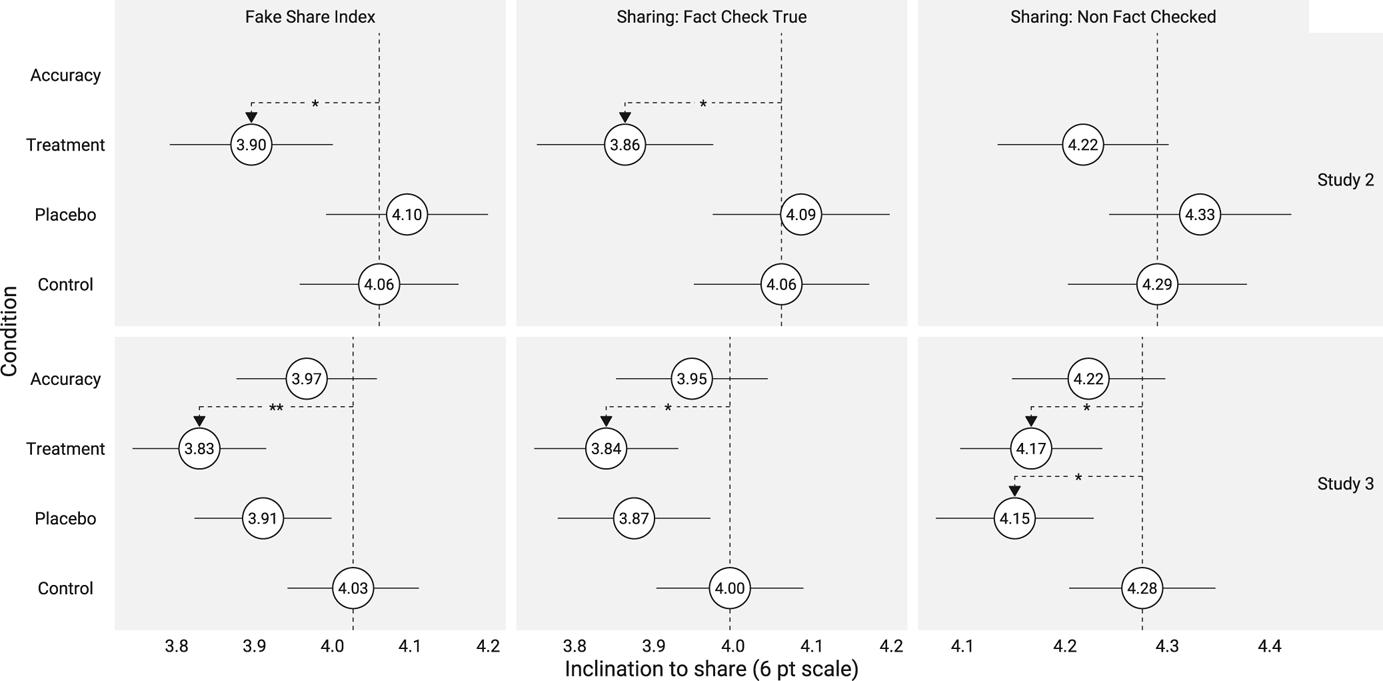
As Supplementary Table A10 shows, the treatment significantly reduced intent to share false content, by 0.16 points on our scale (95% CI: −0.31 to −0.02). The placebo had no similar effects ($\hat{\beta } = 0.04$ ; 95% CI: −0.11 to 0.18). In Supplementary Table A11, we report sharing intention among non-fact-checked articles – in other words, among articles that resemble the lion's share of viral content encountered on social media. We do not find our treatment reducing willingness to share such content ($\hat{\beta } = -0.07$
 ; 95% CI: −0.19 to 0.05). However, as Supplementary Table A12 shows, we do observe participants exposed to our treatment being less willing to share a post that had been fact-checked as true by 0.20 on our scale (95% CI: −0.35 to −0.04). Spillover between our treatment's effects on false and non-false items does occur, but only on a select kind of content. The top row of Figure 1 depicts treatment effects for different content types.
Conditional effects on sharing, studies 2 and 3. *p < 0.05; **p < 0.01.

Figure 1 Long description
The image A showing a dot and whisker plot titled Fake Share Index. The horizontal axis label is Inclination to share (6 pt scale). The horizontal axis range is 3.8 to 4.2. The vertical axis label is Condition. The plotted rows are Accuracy, Treatment, Placebo, Control. The plotted values are: Treatment 3.90, Placebo 4.10, Control 4.06. A dashed bracket with asterisk connects Treatment and Placebo. The image B showing a dot and whisker plot titled Sharing: Fact Check True. The horizontal axis label is Inclination to share (6 pt scale). The horizontal axis range is 3.8 to 4.2. The vertical axis label is Condition. The plotted rows are Accuracy, Treatment, Placebo, Control. The plotted values are: Treatment 3.86, Placebo 4.09, Control 4.06. A dashed bracket with asterisk connects Treatment and Placebo. The image C showing a dot and whisker plot titled Sharing: Non Fact Checked. The horizontal axis label is Inclination to share (6 pt scale). The horizontal axis range is 4.1 to 4.4. The vertical axis label is Condition. The plotted rows are Accuracy, Treatment, Placebo, Control. The plotted values are: Accuracy 4.22, Placebo 4.33, Control 4.29. The image D showing a dot and whisker plot titled Fake Share Index. The horizontal axis label is Inclination to share (6 pt scale). The horizontal axis range is 3.8 to 4.2. The vertical axis label is Condition. The plotted rows are Accuracy, Treatment, Placebo, Control. The plotted values are: Accuracy 3.97, Treatment 3.83, Placebo 3.91, Control 4.03. A dashed bracket with double asterisk connects Treatment and Accuracy. The image E showing a dot and whisker plot titled Sharing: Fact Check True. The horizontal axis label is Inclination to share (6 pt scale). The horizontal axis range is 3.8 to 4.2. The vertical axis label is Condition. The plotted rows are Accuracy, Treatment, Placebo, Control. The plotted values are: Accuracy 3.95, Treatment 3.84, Placebo 3.87, Control 4.00. A dashed bracket with asterisk connects Treatment and Accuracy. The image F showing a dot and whisker plot titled Sharing: Non Fact Checked. The horizontal axis label is Inclination to share (6 pt scale). The horizontal axis range is 4.1 to 4.4. The vertical axis label is Condition. The plotted rows are Accuracy, Treatment, Placebo, Control. The plotted values are: Accuracy 4.22, Treatment 4.17, Placebo 4.15, Control 4.28. A dashed bracket with asterisk connects Treatment and Accuracy. A dashed bracket with asterisk connects Placebo and Treatment.
As before, we also investigate interactions between our treatment and partisanship, as well as our treatment and responses to CRT. Supplementary Tables A14 and A13 show the results. Here, we find some evidence of partisanship moderating treatment effects, with Republicans adversely impacted by the treatment. While we do not observe this in either of the other studies, this result leads us to believe that partisans may sometimes respond differently to our treatment.
Study 3
In a final study, we evaluate both our treatment as well as an accuracy nudge. In doing so, we rely on the same stimuli from Study 2 (summarized in Supplementary Table A1). Participants (n = 4,900) were recruited in August 2022 over Mechanical Turk. Upon the completion of demographic questions and passage of an attention check, they were assigned with equal probability to either our treatment; an accuracy nudge; the same placebo as Study 2 or a control, wherein participants only answered outcome questions. The tested accuracy nudge instructs participants to rate the accuracy of two social media posts on a 1–5 scale, with one post real and implausible and the other fake and implausible. The posts are taken directly from the accuracy nudge used in Study 3 by Pennycook et al. (Reference Pennycook, Epstein, Mosleh, Arechar, Eckles and Rand2021); they can be seen in Supplementary Figures A3 and A4.
The average participant was 37.67 years old (SD: 11.67), had obtained a college degree (8.22, with 8 representing completion of a degree; SD: 1.65) and was a weak Democrat (3.31, with 3 representing standing for not strong Democrat; SD: 2.57). Supplementary Table A15 offers more descriptive statistics and evidence of balance.
Based on evidence from prior studies, we expected our treatment to once again reduce belief in the false items. Whether or not our treatment would be more effective than an accuracy nudge remained an open question.
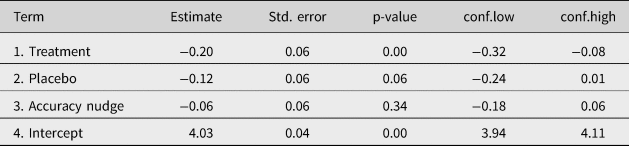
As before, we analyze the effects on both false and non-false content by taking the average effects for both kinds of items. Table 1 presents results for false content. The effect of our treatment is sharply negative, reducing participants’ average willingness to share false viral content by 0.20 points on a six-point scale (95% CI: −0.32 to 0.08). By contrast, the effects of the accuracy prompt on willingness to share false content are not significant, while the point estimate is less than one-third the size of the point estimate generated by our treatment. Even the point estimate from the placebo content is also larger than that from the accuracy nudge. The 0.14 difference between the accuracy nudge and our treatment coefficients is not only sizable but significant (p < 0.05, two-tailed).
Study 3: effects on sharing fake content
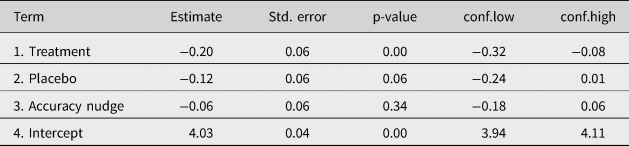
Table 1 Long description
The table is intended to report results from a study about how an intervention affects sharing fake content. However, no rows, columns, labels, or values were provided, so specific outcomes, group comparisons, and trends cannot be described. Without the data, it is not possible to identify the direction or size of any effect, or whether results differ across conditions. Please provide the table entries so the measures, key numbers, and any caveats can be summarized accurately.
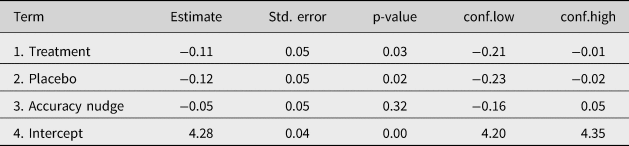
The story is more complicated when we examine the effects on willingness to share non-false content. As before, we look at the average effect of willingness to share across our non-false yet viral items. Our treatment reduces willingness to share non-false content, this time by 0.11 (95% CI: −0.21 to −0.01). This is roughly half the size of the reduction observed for false items, suggesting that our treatment leads people to be somewhat discerning between false and non-false content. The effects of the accuracy nudge on people's willingness to share non-false content, however, are not significant, and the point estimate is half the size of the point estimate for our treatment. Table 2 displays the results. A similar pattern emerges when we focus on the effects on willingness to share items fact-checked as true. As Supplementary Table A16 shows, the treatment reduced the sharing of this item by 0.16 (95% CI: −0.29 to −0.03) along a 1–6 scale; the accuracy nudge did not ($\hat{\beta } = -0.05$ , 95% CI: −0.18 to 0.09). The bottom row of Figure 1 depicts conditional treatment effects for different content types. Again, while only our intervention reduces willingness to share content fact-check as false, we also find it reduces willingness to share content fact-checked as true and content not fact-checked at all.Footnote 3
Study 3: effects on sharing non-fact-checked content
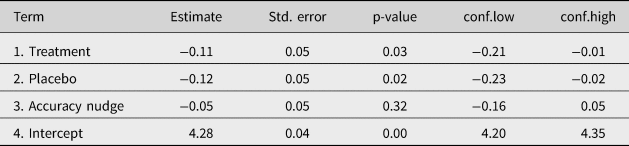
Table 2 Long description
The table is intended to report results from a study about how an intervention affects sharing content that has not been fact checked. However, no rows, columns, labels, or values are included in the provided table data. Because the numerical results and group descriptions are missing, it is not possible to identify key outcomes, compare conditions, or describe trends. Any interpretation about whether sharing increased or decreased would be speculative without the actual entries. Provide the table values and headings to generate an accurate, WCAG compliant description.
As usual, we inspect the extent to which any effects were conditional on partisanship and levels of cognitive reflection. We do not observe evidence for either. Results appear in Supplementary Tables A17 and A18.
Discussion
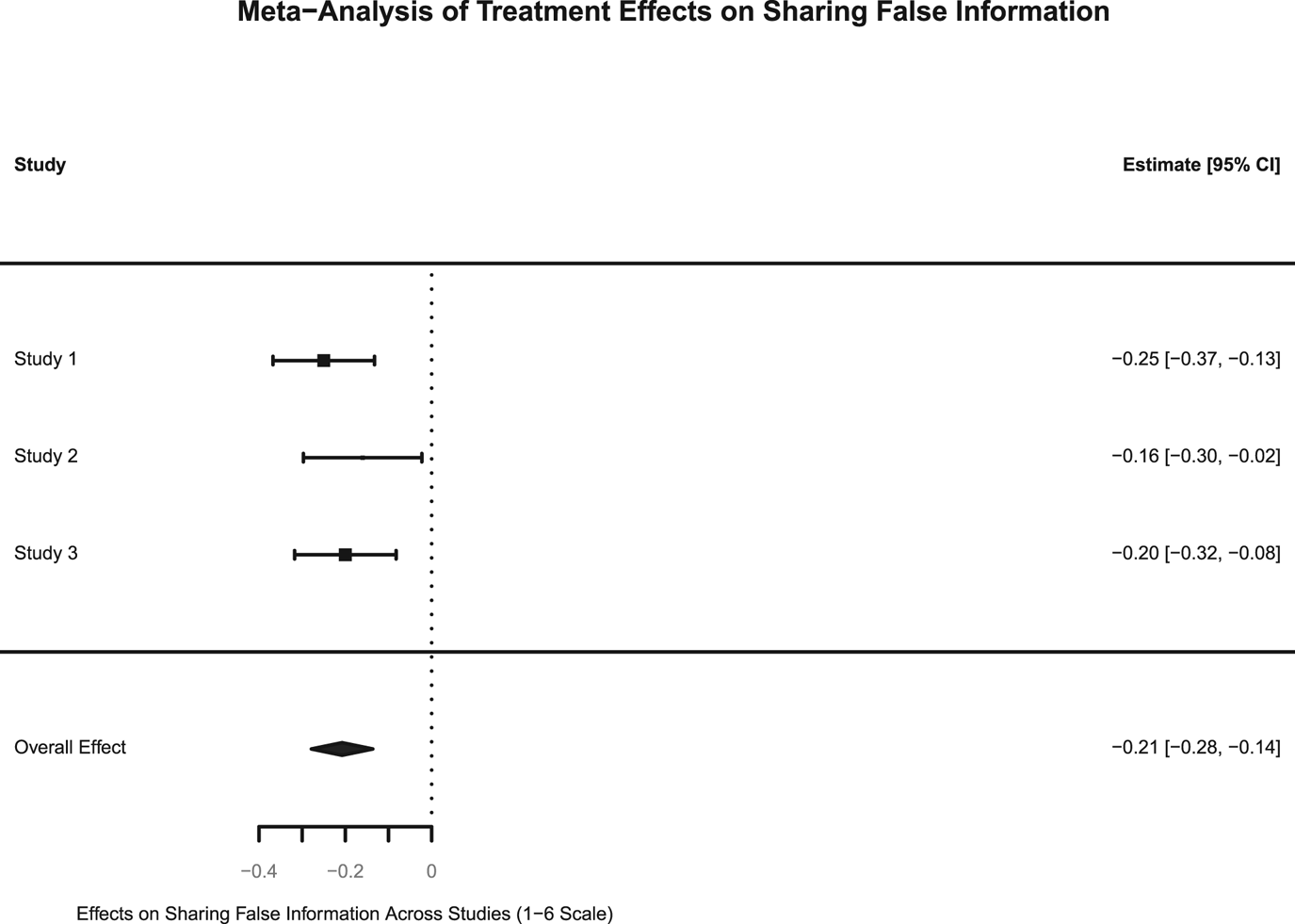
We present evidence documenting the effectiveness of a novel intervention – a shove that draws explicit attention to the social challenge of fake or otherwise misleading news – to combat misinformation. With three pre-registered experiments, we observe our intervention reducing willingness to share and believe in misinformation. While other scholars have shown that gently ‘nudging’ individuals to be more mindful of accuracy can reduce the willingness to share misinformation, our evidence indicates that aggressively targeting individuals can also do the trick. Our treatment urges social media users to be active participants in combating misinformation. Our results show that they generally comply with positive effects on the factual accuracy of their beliefs and their sharing discernment but with spillover effects on the sharing of non-false content. In no study do we observe CRT scores interacting with our treatment; in two of the three, we do not observe interaction effects by partisanship, either. To understand our results in aggregate, we administer a meta-analysis with random effects for the treatment effects on sharing false content for all three studies. We find that, across studies, our treatment reduced willingness to share by −0.21 on a six-point scale (p < 0.05, two-tailed). As Figure 2 shows, we observed consistent effects across studies.
Meta-analysis of our intervention.
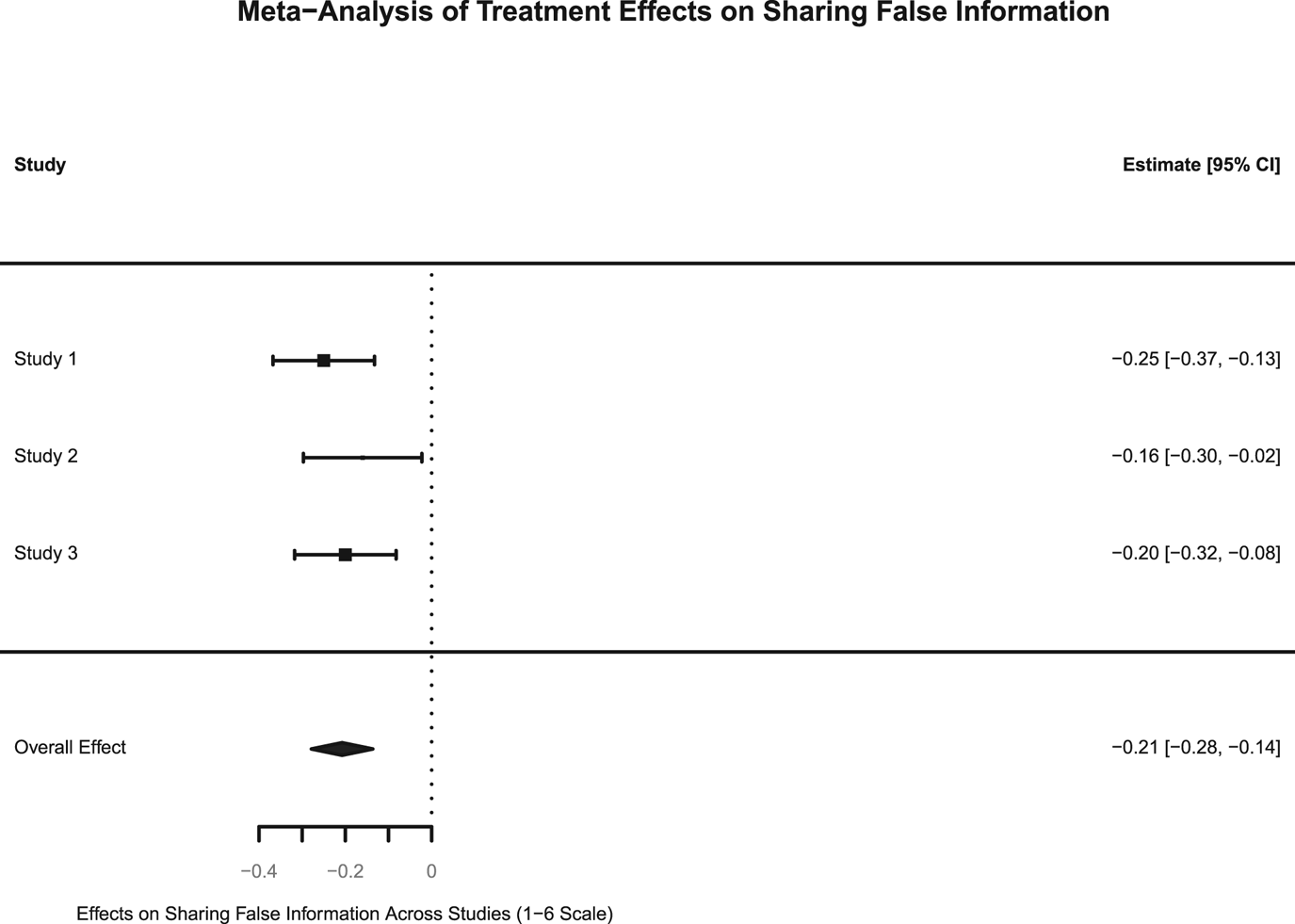
Figure 2 Long description
N/A
Consider our results from the perspective of a resource-constrained policymaker. Whether working in government or a social media company, assume that this policymaker is interested in reducing the spread of misinformation, as well as believing in it. The policymaker can either use the accuracy nudge which, as commonly studied (Pennycook et al., Reference Pennycook, Epstein, Mosleh, Arechar, Eckles and Rand2021), requires individuals to answer survey questions. Survey completion rates on social media are quite low (Zhang et al., Reference Zhang, Mildenberger, Howe, Marlon, Rosenthal and Leiserowitz2020); disseminating the treatment across large numbers of users would thus be cumbersome and costly. In comparison, our intervention can simply be presented to all users, with no survey necessary. When it comes to ease of application, our intervention is thus similar in spirit to the news literacy intervention studied by Guess et al. (Reference Guess, Lerner, Lyons, Montgomery, Nyhan, Reifler and Sircar2020b): All users can be compelled to read it, with no additional action required. And as shown, our intervention is likely to have a larger impact on sharing discernment. If the policymaker wishes to achieve her objectives in their most limited form, our intervention may be less costly than an accuracy nudge. Ultimately, like other anti-misinformation tools (Jigsaw, 2023; Lin et al., Reference Lin, Garro, Wernerfelt, Shore, Hughes, Deisenroth, Barr, Berinsky, Eckles, Pennycook and Rand2024), our intervention could be directly presented to social media users while they spend time on the platform. Users could encounter such interventions at random intervals throughout their time on platforms, while sharing, composing content or just browsing. This small friction would likely positively affect a range of outcomes that social media companies purport to care about.
The results of Study 3 should not be understood to suggest that accuracy nudges are always bound to fail. Although we were unable to detect effects on sharing from accuracy nudges in this experiment, the evidence available in the published literature leads us to believe that accuracy nudges can sometimes work. To be clear, however, our failure to find an effect in Study 3 is not owed to low power; we had 99% power to detect very small effects and 100% power to detect small to medium effects. If we regard misinformation as requiring an ‘all-hands-on-deck’ response, different interventions may be deployed for different ends (consistent with Bak-Coleman et al. (Reference Bak-Coleman, Kennedy, Wack, Beers, Schafer, Spiro, Starbird and West2022)). To achieve larger effects on sharing discernment than a typical accuracy nudge, our intervention may be used. But as we show, our intervention comes with costs. Not only is it intentionally more confrontational, but it does somewhat reduce willingness to share true content as well as entirely innocuous content. In contrast, accuracy nudges do not always achieve their intended objective but also have smaller spillovers too. Our intervention is similar to common anti-misinformation tools that reduce belief in falsehoods while simultaneously increasing skepticism toward true information (Hoes et al., Reference Hoes, Aitken, Zhang, Gackowski and Wojcieszak2024).
Standard dual-process theories of reasoning posit that the very factors that are responsible for the advantages of our intervention are also responsible for its disadvantages. According to these theories, our intervention draws people's attention to the problem of misinformation, but its emphatic nature limits the opportunity for deliberation about what constitutes misinformation. As Bago et al. (Reference Bago, Rand and Pennycook2020) show, offering people the opportunity to deliberate, in ways our intervention does not, reduce belief in inaccurate information without reducing belief in accurate information. To be confronted with one's status as a bystander is to be moved to action without invoking deliberative processes – and a lack of deliberation can lead people astray. This explanation echoes Orchinik et al. (Reference Orchinik, Martel, Rand and Bhui2023), which finds that people's perceptions of the proportion of true and false claims posted online can shift rapidly.
Another explanation for our mixed findings can be found in the fuzzy-trace theory (Broniatowski and Reyna, Reference Broniatowski and Reyna2020), which would view our treatment as offering a stark categorical contrast that consistently favors not sharing (because sharing always contains some risk of spreading misinformation). This, in turn, reduces the sharing of both types of information. Our intervention renders the sharing of misinformation worse than the consequences of not sharing true information, which leads people to take the conservative route and share less of everything. If a version of our intervention were targeted at an issue about which more people have firmer, false beliefs, we would not have much confidence that it would work. For example, a Cialdini-inspired intervention delivered to committed members of the anti-vaccine community would likely not succeed. The strength of pretreatment beliefs and behaviors (Druckman and Leeper, Reference Druckman and Leeper2012; Howe and Krosnick, Reference Howe and Krosnick2017) likely conditions the effectiveness of our intervention. This account suggests that interventions explaining why a specific stimulus is misinformative may be even more effective when combined with our ‘shove’ intervention. Such interventions, focused on changing mental representations, maybe more useful (Reyna et al., Reference Reyna, Broniatowski and Edelson2021) and, because they are based on building understanding beyond the scope of a specific stimulus, may be more effective across contexts.
We also wish to offer a note of caution about our stimuli. We used a smaller set of stimuli than some other papers in this field have used (e.g., Pennycook et al., Reference Pennycook, Epstein, Mosleh, Arechar, Eckles and Rand2021). There may have been variations in the believability and credibility of various headlines, which, in turn, could be impacting our results. Furthermore, all of our stimuli are also dependent on the decisions of fact-checking organizations, which, of course, cannot evaluate every possible viral post. That having been said, PolitiFact does decide which stories to fact-check based on data about popularity (as described in Coppock et al. (Reference Coppock, Gross, Porter, Thorson and Wood2023)), so we do believe our tests concern reasonably popular social media posts. For the sake of reaching generalizable conclusions, additional research on a wider set of stimuli is sorely needed. For now, we offer summaries of all tested stimuli in Supplementary Table A1; readers may make their own evaluations of the believability and credibility of our tested items.
There are three additional limitations of the present study worth remarking upon. First, similar to many studies of accuracy nudges, we do not present evidence on the longitudinal effects of our intervention. As with fact-checking, we expect the effects of our treatment to attenuate but remain detectable with sufficiently powered samples (Porter and Wood, Reference Porter and Wood2021). Second, we cannot speak whether the effects would be obtained on a more representative sample. While prior research has shown that misinformation can be profitably studied on Mechanical Turk (Pennycook et al., Reference Pennycook, Epstein, Mosleh, Arechar, Eckles and Rand2021), with observed effects comparable to those observed in more representative studies (Nyhan et al., Reference Nyhan, Porter, Reifler and Wood2019), more representative samples would offer important further evidence about our intervention. We also cannot rule out demand effects. While Mummolo and Peterson (Reference Mummolo and Peterson2019) offer a good reason to think that demand effects are much less common than assumed, it is possible that participants in our experiments modified their responses in order to satisfy their perceptions of the researchers’ wishes.
These limitations set the stage for future research. Future research should systematically test how different interventions can be used in concert and targeted toward specific individuals and groups. It may be the case that some users would benefit more from accuracy nudges than our intervention, and vice versa. Future experiments using our intervention would also help clarify the replicability of the heterogeneous effect results reported in this paper; are the positive effects consistently concentrated among Democrat and independents, as Study 2 would suggest, or are they largely uniform across party lines, as Studies 1 and 3 would indicate? Simply put, answers to these questions require a larger set of studies, perhaps even similar in number to that evaluated by Martel et al. (Reference Martel, Rathje, Clark, Pennycook, Van Bavel, Rand and van der Linden2024). Future research should also conduct panel studies on anti-misinformation interventions to measure whether their effects persist. If the effects of our intervention endure after exposure, we would regard this as evidence against demand effects.
Last but not least, we would be especially enthused about experiments that modify elements of the treatment text; for example, it may be the case that simultaneously encouraging individuals to call out false information and to promote true information would have the same positive effects we observe but with fewer downsides.
For now, however, we have offered consistent evidence in multiple experiments that directly soliciting individuals’ help in resolving the misinformation challenge can reduce willingness to believe in and share misinformation. Like bystanders in a crowd asked to do their part to help an ailing individual, our participants do their part to help reduce the spread of, and belief in, misinformation.
Conclusion
With insights gleaned from the bystander literature (e.g., Cialdini, Reference Cialdini1984), we show that aggressively confronting individuals about their ability to fight misinformation reduces their willingness to share and believe in misinformation. This effect is consistent across three experiments; in a third experiment, our intervention again reduces the sharing of misinformation, while the tested accuracy nudge does not lead to any such improvements. However, our intervention comes with a downside in that it also reduces the willingness to share accurate information and innocuous information. Our results would likely have been different had we offered participants more time to deliberate about the stimuli (or if we had changed the stimuli). Emphasizing the downside risks of online sharing, as our intervention does, presents individuals with a choice between sharing, and potentially incurring some social risk or not-sharing and therefore incurring no social risk (Broniatowski and Reyna, Reference Broniatowski and Reyna2020). In our studies, this choice leads subjects to behave more conservatively and share less overall.
Supplementary material
To view supplementary material for this article, please visit https://doi.org/10.1017/bpp.2024.42.
Data availability statement
Data and code for Studies 1–3 can be found at OSF here: https://bit.ly/3reBO38.
Acknowledgements
We thank Robert Brauneis and Dawn Nunziato. All mistakes are our own.
Authors’ contributions
E.P., T.J.W., D.A.B. and P.H. conceived of the research, analyzed data and wrote the paper.
Funding statement
This research was supported by the Social Science Research Council and the New America Foundation and approved by the George Washington University IRB (#NCR202850).
Competing interest
The authors declare no competing interests.
Ethics approval and consent to participate
This research was approved by the George Washington University IRB (#NCR202850).
Consent for publication
All participants provided informed consent before submitting.


 Open access

