





Introduction
How segmental phonology and executive functions (EFs) impact word reading and reading comprehension has been of great interest among researchers examining cognitive processes of second language (L2) acquisition. This interest is motivated by the fact that reading is a goal-oriented behavior in which several different linguistic and cognitive skills must be integrated by readers (Butterfuss & Kendeou, Reference Butterfuss and Kendeou2018; Christopher et al., Reference Christopher, Miyake, Keenan, Pennington, DeFries, Wadsworth, Willcutt and Olson2012; Follmer, Reference Follmer2017) and that reading difficulties can arise from either cognitive or phonological deficits (see a review by Peng et al., Reference Peng, Zhang, Wang, Lee, Wang, Wang, Luo and Lin2022). Studies among children have found that the development of reading skills is greatly influenced by the extent to which the fundamental phonological representations of words are intact, and the capacity to recognize and manipulate sound units at the syllable, rhyme, and phoneme levels (Melby-Lervåg & Hulme, Reference Melby-Lervåg and Hulme2013).
Nevertheless, the significance of the interaction between prosodic sensitivity (PS) and EFs should not be underestimated given that PS is important to segmental perception in reading processes. In word reading (i.e., word naming in the present study), this process involves mapping both segmental and suprasegmental aspects of phonology to orthography (Arciuli et al., Reference Arciuli, Monaghan and Seva2010; Goswami et al., Reference Goswami, Mead, Fosker, Huss, Barnes and Leong2013). In reading comprehension, this process involves word and phrase segmentation.
Although prosody provides important cues that help in word reading, EFs may help in directing attention to these cues and inhibiting distractions, allowing the reader to effectively process and integrate prosodic information with the linguistic content of words. Thus, EFs may act as a mediator between prosody and word reading by facilitating the allocation of attention and inhibiting irrelevant information. Prosody also involves the rhythmic and melodic patterns of speech, which aid in segmenting speech into meaningful components, such as words and phrases (Frazier et al., Reference Frazier, Carlson and Clifton2006; Holzgrefe-Lang et al., Reference Holzgrefe-Lang, Wellmann, Petrone and Räling2016). This process requires tracking and integrating skills to effectively map prosodic cues onto the corresponding linguistic units. EFs, particularly working memory and cognitive flexibility, may support the tracking and integration of prosodic information, helping readers to establish the appropriate prosodic structures and interpret boundaries accurately.
Surprisingly, the integration of PS and EFs has not been thoroughly examined to determine their respective contributions and the extent to which they influence reading outcomes. L2 reading among adolescents adds complexity to the issue because L2 readers may be influenced by their first language (L1), particularly when there is considerable linguistic divergence between the two languages. Moreover, adolescent readers with limited proficiency in their L2 exhibit linguistic similarities to monolingual children readers in the early stages of literacy development. However, it is worth noting that EFs among adolescents may be more developed than those of monolingual children readers (Best et al., Reference Best, Miller and Jones2009). Hence, it is not certain that the mechanisms employed for monolingual children or adolescent readers are suitable. Rather, it is possible that learners with relatively weak L2 proficiency may use different EFs during word reading and reading comprehension.
Understanding the roles of EFs and phonological skills in L2 reading among adolescents is crucial, not only from a theoretical perspective but also for practical reasons, as they may inform potential interventions that can be tailored to the specific linguistic and cognitive abilities for struggling L2 readers in middle school. Considering the significant number of middle-school aged learners, estimated by the Chinese Ministry of Education to be around 50,184,400, investigating the impact of PS and EFs on reading abilities of Chinese-English adolescent bilinguals is crucial.
Background
Prosodic sensitivity and reading
PS refers to the ability to perceive and distinguish suprasegmental features such as duration, intensity, pitch, and pause within language (Holliman et al., Reference Holliman, Wood and Sheehy2010a), which is different from phonological awareness, the ability to recognize and manipulate sound segments in words (Share, Reference Share1995). PS plays a role in word reading, as the latter depends on the reader's ability to analyze language sounds. Successful word reading entails transforming written letters into auditory words and retrieving phonological and semantic information from the mental lexicon (Gough et al., Reference Gough, Hoover, Peterson, Cornoldi and Oakhill1996; Holliman et al., Reference Holliman, Wood and Sheehy2010b). Stressed syllables exhibit faster amplitude changes and amplitude enhancement in vowels compared to unstressed syllables (Scott, Reference Scott1998). Sensitivity to stress implies being attuned to both the rate and magnitude of amplitude changes in vowels.
The ability to recognize stress patterns aids readers in differentiating parts of speech and elucidating word meanings. According to Kelly and Bock (Reference Kelly and Bock1988), approximately 90% of noun stress in English falls on the first syllable, while roughly 85% of verb stress is placed on the last syllable. Consequently, readers who possess a sensitivity to stress can rapidly and accurately disambiguate word meanings by attending to stress placement, thereby enhancing comprehension. Furthermore, this skill proves advantageous in discerning compound words and noun phrases. In a study of fourth-grade children, Whalley and Hansen (Reference Whalley and Hansen2006) used stress differentiation tasks to examine the prediction of prosodic sensitivity to word reading. In this task, participants were required to distinguish between compound words and noun phrases or adjective and noun couplets (e.g., ‘BLACKbird’ and ‘black BIRD). Hierarchical multiple regression analyses showed that children’ s prosodic sensitivity was a unique predictor that accounted for an additional 4.2% variance in word reading. This finding indicates its autonomous role in word recognition.
Stress sensitivity assists readers in comprehending the stress patterns of words, offering clues regarding stress allocation and the reduction of related vowels. When a vowel is stressed, it is generally pronounced with full intensity and closely resembles the standard pronunciation (e.g., the first ‘a’ in ‘passage’). Conversely, unstressed vowels often undergo weakening (e.g., the second ‘a’ in ‘passage’) (Wade-Woolley, Reference Wade-Woolley2016). Readers who possess a heightened sensitivity to stress can perceive stress patterns within words, identify syllables that are stressed or unstressed, and consequently, can accurately apply stress to the stressed syllables while reducing vowel strength in unstressed syllables during word recognition. This ability appears to enhance reading accuracy (Clin et al., Reference Clin, Wade-Woolley and Heggie2009; Holliman et al., Reference Holliman, Wood and Sheehy2010a, Reference Holliman, Wood and Sheehy2010b, Reference Holliman, Gutiérrez Palma, Critten, Wood, Cunnane and Pillinger2017). These findings suggest that stress sensitivity plays a notable role in decoding multisyllabic words (Wade-Woolley, Reference Wade-Woolley2016).
In line with the Simple View of Reading, reading comprehension is the outcome of two primary abilities: the skill of decoding written words in a text and understanding spoken language (Gough et al., Reference Gough, Hoover, Peterson, Cornoldi and Oakhill1996). The theory implies that the processes involved in comprehension are similar for both oral language and reading. Prosody is significant in comprehension when listening and therefore has an impact on reading comprehension. This observation is especially true for children, who seem to rely more on prosodic cues compared to adults (Schreiber, Reference Schreiber, Horowitz and Samuels1987). In reading comprehension, readers rely on the inherent prosodic structures and boundaries of language, which are indicated by punctuation, sentence, clause, and phrase structures. These structures help readers to segment and group the language, emphasizing grammar structures and essential information, thereby enhancing text comprehension (Holliman et al., Reference Holliman, Williams, Mundy, Wood, Hart and Waldron2014a; Whalley & Hansen, Reference Whalley and Hansen2006). Studies by Holliman et al. and Whalley and Hansen have confirmed the direct influence of PS on reading comprehension, using measurement tasks such as the DEEdee task. Additionally, Young-Suk and Petscher (Reference Young-Suk and Petscher2016) employed structural equation modeling to examine the relationship between working memory, phonemic awareness, rapid naming, morphological awareness, listening comprehension, PS, and reading in children. The findings underscored the significant impact of PS on reading comprehension. Other studies have found that sensitivity to prosodic boundaries facilitates readers’ processing of syntactic structure (Holliman et al., Reference Holliman, Williams, Mundy, Wood, Hart and Waldron2014a; Nickels & Steinhauer, Reference Nickels and Steinhauer2018; Whalley & Hansen, Reference Whalley and Hansen2006).
Taken together, these findings suggest that at the word-level, prosodic sensitivity facilitates word reading through attuning to the lexical stress, and at the phrase-level, it boosts reading comprehension through the perception of phrase boundaries in sentences.
Experimental findings indicate that the ability to perceive prosodic features is transferable and influences reading proficiency across different languages. For instance, research suggests that Mandarin/Cantonese tone sensitivity plays a unique role in English word reading among Mandarin/Cantonese-English bilingual children (Wang et al., Reference Wang, Perfetti and Liu2005, Reference Wang, Yang and Cheng2009; J. Zhang & McBride-Chang, Reference Zhang and McBride-Chang2014), even though there are significant prosodic differences between the two languages. Chinese characters consist of single-syllable units formed by a combination of consonants and vowels. Each syllable is associated with a tone that plays a crucial role in distinguishing the meaning of a word. For example, the pronunciations of the characters “妈” (mā), “麻” (má), “马” (mǎ), and “骂” (mà) all share the same phonemic combination ([m] + [a]), but their tones differ (Chao, Reference Chao1968; Duanmu, Reference Duanmu2007). These four tones exhibit variations in fundamental frequencies (F0) and contours (Gandour, Reference Gandour1983). Furthermore, they differ in terms of duration, amplitude, and F0 turning points (Blicher et al., Reference Blicher, Diehl and Cohen1990). Unlike Chinese, English words are formed by one or more syllables, and word stress is a vital prosodic characteristic. It plays a crucial role in the pronunciation of words.
The distinct syllabic structures in Chinese and English result in different prosodic patterns in sentences. In Mandarin Chinese, the F0 contour of lexical tones is associated with syllables and remains consistent across various contexts, unaffected by speaking rate or the number of syllables in a sentence (Y. Xu & Wang, Reference Xu and Wang2001). Chinese does not have specific boundary tones at phrase boundaries. In English, intonation contour is influenced by phrase boundaries and has been observed to be contextually influenced by speech rate and syllable length (Silverman & Pierrehumbert, Reference Silverman, Pierrehumbert, Kingston and Beckman1990). Typically, there are boundary tones at phrase boundaries in English. For instance, in the phrase “please pass me the tea, cups, and spoons,” English speakers commonly use a half-rising tone after “tea.”
Additionally, there is a difference in the acquisition sequencing of language skills between L2 learners and native speakers. Native speakers typically start by listening and then progress to reading. The Simple View of Reading theory is rooted in the developmental trajectory of reading acquisition in native-speaking children, who initially acquire oral English vocabulary and listening comprehension through daily communication before transitioning to reading. In the present study, however, the participant sample acquired both written and oral language simultaneously, with a primary emphasis on classroom instruction. The unique Chinese-English teaching context (even distinct from that of Hong Kong, see Tong et al., Reference Tong, He and Deacon2017) implies a scarcity of opportunities for the utilization of oral language, whereas reading becomes the primary avenue for English L2 learning, and thus, poses an important opportunity for examining prosodic transfer.
It is important to note that the studies conducted so far have primarily focused on young children, specifically between the ages of five and seven. It remains uncertain as to whether these findings can be extended to adolescents. The critical period hypothesis suggests that beyond the age of 12 or so, the ability to acquire sound properties may not be as flexible as in younger children (Hartshorne, Reference Hartshorne2022; Lenneberg, Reference Lenneberg1967). Therefore, the mechanisms of phonological acquisition in adolescents may differ significantly from those observed in children. It is crucial to investigate whether the transfer of prosody functions similarly in adolescents as it does in children or whether there are limitations on prosodic transfer.
Furthermore, certain prosodic skills, such as L1 prosodic chunking (i.e., using prosody to identify units in utterances) (Yuen et al., Reference Yuen, Xu Rattanasone, Schmidt, Macdonald, Holt and Demuth2021) and the ability to distinguish compounds (e.g., greenhouse) from separate words (e.g., green, house), continue to develop until the age of 13, even though the ability to use prosodic functions is established around the age of five (Vogel & Raimy, Reference Vogel and Raimy2002; Wells et al., Reference Wells, Peppé and Goulandris2004). The development of prosodic skills may depend on language-specific abilities or other cognitive skills. To gain a better understanding of the factors influencing these skills and to ensure the validity of experimental tasks, it is critical to conduct research involving adolescent participants. Doing so can help shed light on the influential factors and the role of various skills in prosodic development.
Executive functions and reading
Reading is a goal-oriented activity that involves the integration of various cognitive and perceptual processes (Butterfuss & Kendeou, Reference Butterfuss and Kendeou2018; Christopher et al., Reference Christopher, Miyake, Keenan, Pennington, DeFries, Wadsworth, Willcutt and Olson2012; Follmer, Reference Follmer2017). While there are several theoretical frameworks proposing different structures of EFs (Jacob & Parkinson, Reference Jacob and Parkinson2015), in the present study, we adopt the Three-component Model of EFs proposed by Miyake et al. (Reference Miyake, Friedman, Emerson, Witzki, Howerter and Wager2000). This model encompasses inhibition, flexibility, and working memory, and has significantly influenced research investigating the relationship between EFs and reading comprehension. Moreover, it has garnered support across diverse populations and contexts (Garon et al., Reference Garon, Bryson and Smith2008; Huizinga et al., Reference Huizinga, Dolan and Molen2006).
Inhibition functions by suppressing irrelevant, extraneous information to help maintain current goals and relevant stimuli when building an understanding of a word or text (Arrington et al., Reference Arrington, Kulesz, Francis, Fletcher and Barnes2014; Foy & Mann, Reference Foy and Mann2013; Kieffer et al., Reference Kieffer, Vukovic and Berry2013). In some studies on reading development among children, inhibition has been reported to substantially contribute to word decoding, during which it prominently suppresses interference from neighboring words (Locasciao et al., Reference Locasciao, Machone, Eason and Cutting2010; Messer et al., Reference Messer, Henry and Nash2016). However, a study by Protopapas et al. (Reference Protopapas, Archonti and Skaloumbakas2007) compared Stroop effects on reading between a school sample and a clinical sample, and found that inhibition was negatively associated with reading. In other studies, it is argued that inhibition can predict higher-level reading and reading comprehension. For instance, Borella et al. (Reference Borella, Carretti and Pelegrina2010) examined the inhibitory factors affecting reading performance among poor and good readers. The results suggested that poor readers’ performance was impaired in inhibitory tasks with 28 high-Cloze sentences (study 1) and 10 texts of 125–126 words each (study 2), indicating that inhibitory control may contribute to reading difficulties that poor readers face. Although the existing literature presents a contradictory picture of the relationship between inhibition and reading comprehension, further research is needed to elucidate the complex interplay between the two.
Cognitive flexibility, also called shifting, supports readers in switching between different mental representations, such as decoding, extracting word meaning and sentence comprehension (Butterfuss & Kendeou, Reference Butterfuss and Kendeou2018; Follmer, Reference Follmer2017). Cognitive flexibility assists with the integration of top-down information, bottom-up knowledge, various reading strategies (Georgiou & Das, Reference Georgiou and Das2018; Kieffer et al., Reference Kieffer, Vukovic and Berry2013; Latzman et al., Reference Latzman, Elkovitch, Young and Clark2010), and flexible allocation of attention to semantic and phonological information (Cartwright et al., Reference Cartwright, Marshall, Dandy and Isaac2010; Spencer et al., Reference Spencer, Richmond and Cutting2020). In a meta-analysis, Yeniad et al. (Reference Yeniad, Malda, Mesman, Marinus, van Ijzendoorn and Pieper2013) reported a significant relationship between children's cognitive flexibility and their performance on math and reading. Empirically, studies have also detected the contribution of cognitive flexibility to reading. For example, in a large cohort study of 120 fourth graders, attention, shifting, and inhibitory control were directly associated with reading comprehension, even when controlling for working memory, processing speed, and phonological awareness (Kieffer et al., Reference Kieffer, Vukovic and Berry2013). Taken together, the existing literature implicates a predictive role of cognitive flexibility in reading comprehension.
Working memory can facilitate reading comprehension because it helps to maintain and update phonetic, semantic, and orthographic information of words (Christopher et al., Reference Christopher, Miyake, Keenan, Pennington, DeFries, Wadsworth, Willcutt and Olson2012; Messer et al., Reference Messer, Henry and Nash2016). In a meta-analysis examining the relative contribution of working memory to reading comprehension performance, Carretti et al. (Reference Carretti, Borella, Comoldi and Beni2009) found that both domain-specific and general factors of working memory play a role in reading comprehension. Indeed, there are several studies that suggest a relationship between working memory and word reading (Miller et al., Reference Miller, Keenan, Betjemann, Willcutt, Peenington and Oson2013). Pelegrina et al. (Reference Pelegrina, Capodieci, Carretti and Cornoldi2015) measured working memory among elementary school-aged children with and without reading deficits and found that the latter group performed poorer on tasks designed for testing word updating. These studies demonstrate that working memory provides the capacity for temporarily storing, processing, and updating information (Cirino et al., Reference Cirino, Miciak, Gerst, Barnes, Vaughn, Child and Huston-Warren2017; Locasciao et al., Reference Locasciao, Machone, Eason and Cutting2010; Meixner et al., Reference Meixner, Warner, Lensing, Schiefele and Elsner2019; Miller et al., Reference Miller, Davis, Gilbert, Cho, Toste, Street and Cutting2014; Stipeck & Valentino, Reference Stipeck and Valentino2015) while interfacing with other factors, such as background knowledge (Shin et al., Reference Shin, Dronjic and Park2018), in order to promote the development of a mental representation of text (Miller et al.).
It is important to note that the relationship between language skills and EFs and reading vary across developmental stages because the subcomponents of EF develop asynchronously (Cirino et al., Reference Cirino, Romain, Barth, Tolar, Fletcher and Vaughn2013; Oakhill et al., Reference Oakhill, Cain and Bryant2003). For example, predictors of reading comprehension shift from fluency and verbal reasoning in 3rd grade to reasoning by 10th grade (Tighe & Schatschneider, Reference Tighe and Schatschneider2014). Also, in later grades, inference-making, vocabulary, and background knowledge make large contributions to reading comprehension (Ahmed et al., Reference Ahmed, Francis, York, Fletcher, Barnes and Kulesz2016), as reading becomes a primary route for learning new information (Compton et al., Reference Compton, Fuchs, Fuchs, Elleman and Gilbert2008). In other words, the advancement of reading proficiency or the development of subcomponents of EFs influence the intricate interplay among executive functions, reading sub-skills, and subsequent reading performance.
Research gap
Studies have highlighted the significant role of EFs and segmental phonological skills among children in word reading and reading comprehension (Czapka et al., Reference Czapka, Klassert and Festman2019; Follmer, Reference Follmer2017; Peng et al., Reference Peng, Zhang, Wang, Lee, Wang, Wang, Luo and Lin2022). However, the examination of PS, which pertains to suprasegmental phonological skills, in relation to EFs has gone uninvestigated, despite recent findings suggesting its importance in the perception and manipulation of phonemes and syllables, and its substantial contribution to gains in English word reading (Goswami et al., Reference Goswami, Mead, Fosker, Huss, Barnes and Leong2013; Holliman et al., Reference Holliman, Wood and Sheehy2010a). To provide a more comprehensive understanding of reading, it is crucial to examine whether the contributions and roles of segmental perception and EFs in reading also apply to PS. In addition, previous research has predominantly tested the contributions of linguistic and cognitive skills to reading separately, without considering their interaction. Because language skills are domain-specific, whereas cognitive skills are domain-general, it is important to consider potential interactive effects of language and cognitive skills within the context of reading.
Furthermore, the existing studies have primarily focused on children and individuals with special needs, and have largely ignored adolescent groups. As L2 adolescents differ from both children and adults in terms of language proficiency and cognitive development, studying the role of prosodic sensitivity and cognitive skills in reading within this population will help to establish a more comprehensive framework of reading. Therefore, this study aims to examine the role of PS and EFs in reading among adolescent English L2 learners in classroom settings in mainland China. Specifically, we examine these issues among a cohort of adolescent L2 learners by measuring their phonological awareness, Mandarin tone sensitivity, English prosodic sensitivity, and English reading, along with three measures of EFs.
Present study
The present study addresses two research questions:
1. Does Mandarin tone sensitivity transfer to English word reading among L1 (Chinese) - L2 (English) adolescents who are learning English in classroom settings in mainland China? Specifically, does Mandarin Chinese tone sensitivity predict English stress sensitivity, which, in turn, contributes to English word reading?
2. What role does English PS play in English word reading and reading comprehension among L1 (Chinese) - L2 (English) adolescents who are learning English in classroom settings in mainland China?
-
2a. What role does word-level PS play in English word reading? Do EFs modulate this process?
-
2b. What role does word-level PS play in English reading comprehension? Do EFs modulating this process?
-
2c. What role does phrase-level PS play in English reading comprehension? Do EFs modulating this process?
-
Hypotheses
In English word reading, a reader must employ English lexical stress for decoding such that stress sensitivity predicts word reading (Whalley & Hansen, Reference Whalley and Hansen2006). For an L2 reader, the ability of English stress perception can be partially “borrowed” from their tone sensitivity. Accordingly, we hypothesize that Mandarin tone sensitivity also predicts English word reading, but does so via English stress sensitivity. In other words, prosodic sensitivity plays a mediating role between Mandarin tone sensitivity and English word reading. Based on accounts in which prosodic transfer is argued to occur between the L1 and L2 and assumptions that tone sensitivity in the L1 improves L2 reading by enhancing the acquisition and development of L2 stress sensitivity (Tong et al., Reference Tong, He and Deacon2017; van Maastricht et al., Reference van Maastricht, Zee, Krahmer and Swerts2021), we hypothesize that L2 (English) stress sensitivity will mediate the relationship between L1 (Mandarin) tone sensitivity and L2 (English) reading.
Moreover, because EFs, being domain-general and coordinating the cognitive resources for all goal-oriented activities, have been found to be correlated with reading performance (Kieffer & Christodoulou, Reference Kieffer and Christodoulou2020), we anticipate that EFs will have a modulating effect on L2 reading. Unfortunately, previous research on the role of EFs in reading has not considered the aspect of prosody. Hence, building upon the fundamental definition and functionality of EFs (Miyake et al., Reference Miyake, Friedman, Emerson, Witzki, Howerter and Wager2000), we deduced the potential correlation among EFs, PS, and reading outcomes.
Specifically, a reader needs to maintain and update prosodic information in working memory to process and integrate prosodic cues, such as stress and intonation patterns, with other linguistic cues. A reader also needs to filter out irrelevant or misleading prosodic cues and suppress prior expectations to process new information accurately. Additionally, a reader needs to apply prosodic patterns and rules in reading to generate multiple interpretations and consider alternate possibilities. Since PS primarily focuses on perceiving lexical stress in word reading and boundaries in reading comprehension (see “Prosodic sensitivity and reading”), the mechanisms underlying how PS promotes word reading and reading comprehension may vary. Therefore, we examined word-level and phrase-level PS separately in the present study.
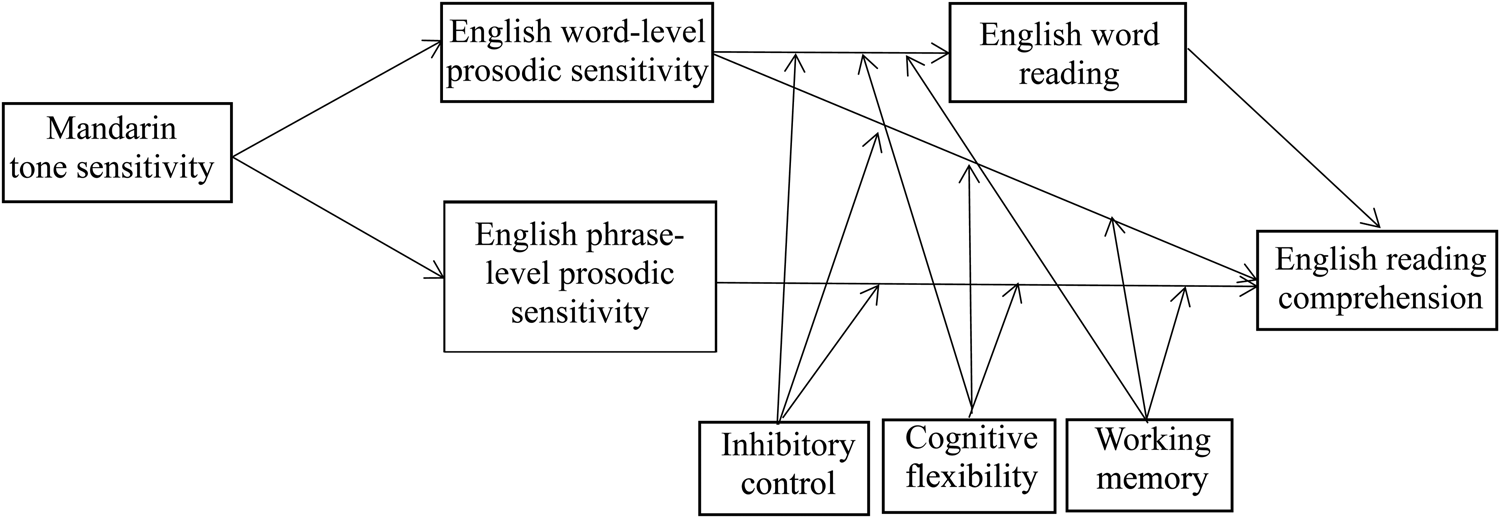
Overall, we formulated four hypotheses, 1) Mandarin Chinese tone sensitivity transfers to English word reading; 2) Word-level English PS (i.e., stress sensitivity) makes a contribution to both word reading and reading comprehension; 3) Phrase-level English PS (boundary perception) makes a contribution to reading comprehension, and 4) EFs facilitate the boosting of reading outcomes by PS. These four hypotheses are illustrated in Figure 1.
Hypothesized L1-L2 Prosodic Transfer Mediation Model as Affected by EFs
Participants
Eighty students (38 females, 42 males) from a public middle school in Guangzhou, China voluntarily participated in the study. The age range of the learners was between 13–14 years (Mage = 13.4 years, SD = .50 years). All participants reported having taken no post-curricular English training courses, and that class instruction was their only source of English learning. The instruction placed primary emphasis on reading and sentence grammar. The participants were right-handed and reported no neurological impairments. According to a teacher report, all participants were native Mandarin speakers and had learned English for more than five years, during which time they attended six one-hour English classes per week. The participants’ L2 vocabulary was tested on http://testyourvocab.com, a measure which estimates vocabulary size relative to an individual's age and education level. The findings showed that the participants’ average L2 vocabulary was 1,681 words (SD = 79.8). According to the new English Curriculum Standard issued by the Ministry of Education of China, the participants’ overall proficiency in English was equivalent to the A1 level (i.e., elementary/novice) of the Common European Framework of Reference for Languages. Prior to taking part in the study, which was approved by the Human Research Ethics Committee, School of Psychology, South China Normal University (IORG 0011738), the legal guardians of all participants provided informed consent for their children to participate.
Measures
In accordance with previous research designs (Tong et al., Reference Tong, He and Deacon2017), our study includes measures of phonological awareness, Mandarin tone sensitivity, English PS, and reading abilities. Regarding EFs, we measured the subdomains of inhibition, working memory, and cognitive flexibility. Descriptions of the specific tasks follow.
Phonological awareness
Phonological awareness was measured using the onset and rhyme oddity tasks and the phoneme oddity task (Bowey et al., Reference Bowey, Cain and Ryan1992). In the onset and rhyme oddity tasks, participants listened to three words and identified which one differed in rhyme by ticking the corresponding item on an answer sheet. For example, when they heard “deck, neck, fit”, they were asked to identify the word “fit,” as it is distinct in rhyme from the other two words. Each set of words was played twice to the participants. In the phoneme oddity task, the same procedure was followed but the participants were asked to identify the word which was different in its word-final phoneme. For instance, when they heard “bet, bit, bin,” they were required to tick “bin” on an answer sheet. Both tasks consisted of three practice trials and twelve experimental trials. One point was assigned to correct responses and zero to incorrect responses.
Mandarin tone sensitivity
We used a receptive Mandarin DEEDEE task (Chung et al., Reference Chung, Jarmulowicz and Bidelman2017) to measure Mandarin tone sensitivity. In the task, a Mandarin word with DEEDEE sequences having two different tone patterns was played twice. The participants were asked to determine with which sequence the presented Mandarin word matched in each trial by ticking the corresponding item on an answer sheet. For example, when they heard the two Mandarin words 汽车 (qi4 che1) ‘car’ with the two sequences of DEE1DEE2 and DEE4DEE1 as a word chunk, they were required to identify the latter “DEE4 DEE1.” The task consisted of three practice trials and 12 experimental trials. One point was assigned to correct responses and zero to incorrect responses.
English prosodic sensitivity
We used two tasks to measure participants’ sensitivity to prosody at the word level (stress assignment task) and phrase level (English DEEdee task). Following Wade-Woolley (Reference Wade-Woolley2016), in the stress assignment task, participants were asked to mark the primary stress of each word on the answer sheet when hearing 20 individually presented words. The English DEEdee task (Kitzen, Reference Kitzen2001) was based on a reiterative speech technique in which each syllable in a phrase was replaced by the same reiterative syllable “dee” to eliminate phonemic information, but the stress, rhythm, and intonational pattern found in the original phrase were retained. “DEE” indicates a stressed syllable and “dee” represents an unstressed syllable. In the task, English phrases (e.g., “Snow White”) and two accompanying DEEdee phrases (e.g., “DEE DEE,” “DEE dee”) were played twice. The participants were then asked to identify which DEEdee phrase matched the original English one by ticking the corresponding response on an answer sheet. The task consisted of three practice trials and 12 experimental trials. All trials consisted of three phrases that each contained two to five syllables. One point was assigned to correct responses and zero to incorrect responses.
Executive functions
Three subdomains of EFs – namely, inhibition, cognitive flexibility, and working memory – were measured by using a color version of the Stroop task (Stroop, Reference Stroop1935), a numeral switching task (Salthouse et al., Reference Salthouse, Fristoe, Mcguthry and Hambrick1998), and a digit recall/backward digit recall task (H. Zhang & Wang, Reference Zhang and Wang1985), respectively. In the Stroop task, a fixation point “+” was first presented on a computer screen followed by individual words shown in four different colors (blue, green, red, yellow). The names of the words sometimes matched the font color and sometimes mismatched. The participants were asked to identify in what color the word appeared by pressing either the 1 (red), 2 (yellow), 3 (blue), or 4 (green) buttons on the keyboard. For example, when they saw the character “红” (“red”) presented in blue ink, they were asked to press the “3” button. The task consisted of 4 practice trials and 16 experimental trials. One point was assigned to correct and zero to incorrect answers.
The numeral switching task was administered to assess cognitive flexibility. In the task, a fixation point “+” was first presented on a computer screen followed by a series of individually presented numbers. The participants were asked to orally name the numbers in Mandarin or English according to a color cue (i.e., numbers appearing in red boxes were named in Mandarin and those in blue boxes were named in English) as quickly and accurately as possible. Color-language associations were counterbalanced across participants. The task consisted of 4 practice trials and 20 experimental trials.
The digit recall/backward digit recall task was used to measure working memory. In this task, a fixation point “+” was first presented on a computer screen followed by a string of numbers that were 3–11 digits in length. Participants were then asked to recall or backward recall the presented numbers until the number with the maximum digits had been presented. There were 18 trials in the test with 4 preceding practice trials. One point was assigned to correct and zero to incorrect answers.
Reading
We included one task measuring English word reading and one measuring English reading comprehension. In the word reading task, participants were asked to read 30 words aloud ranging from two to five syllables. The reading was recorded and then rated by two English teachers working with the school where the participants attended. One point was assigned to the correct reading of words and zero to incorrect readings. The correlation coefficient of the two scores is 1.0. In the reading comprehension test, participants silently read four short passages of text and subsequently answered 20 multiple-choice questions on an answer sheet. They then read one additional passage followed by five fill-in-the-blank questions on the same answer sheet. The readings were selected from an English proficiency test (with the reliability of a = .89) administered by the Guangzhou Metropolis Educational Bureau, with the topics closely related to students’ daily lives and written in narrative form. According to https://languagedata.net/tester, an online English text evaluation and adaptation system (Jin et al., Reference Jin, Lu, Guo, Li, Liu, Deng, Wu and Chen2021), all texts were age- and level- appropriate for this particular sample in terms of vocabulary, syntax, and text construction.
Procedure
We administered the phonological and morphological awareness tasks, the Mandarin tone sensitivity task, the English prosodic sensitivity task, and the reading comprehension task to all participants as a group in a classroom setting. The EF measures and the word reading task were administered to each participant individually in a separate language laboratory. All experiments were run via E-prime 3.0 on a computer.
Results
Correlations Between the nine measures
The original scores of all language and EF tasks are provided in the Appendix. The results of the correlation analyses between variables are shown in Table 1. Mandarin tone sensitivity was significantly correlated with English PS at both the word level (r = .544, p < .001) and phrase level (r = .228, p = .042). English PS at the word level was significantly correlated with word reading (r = .338, p = .003) and reading comprehension (r = .493, p < .001). Word reading was significantly correlated with reading comprehension (r = .606, p < .001). These results provide an initial backdrop for the following analyses on the effect of prosodic transfer between L1 Mandarin and L2 English, as they suggest that word-level English PS (i.e., stress sensitivity) may mediate the relationship between Mandarin tone sensitivity transfer and English reading.
Correlations Between Measures.
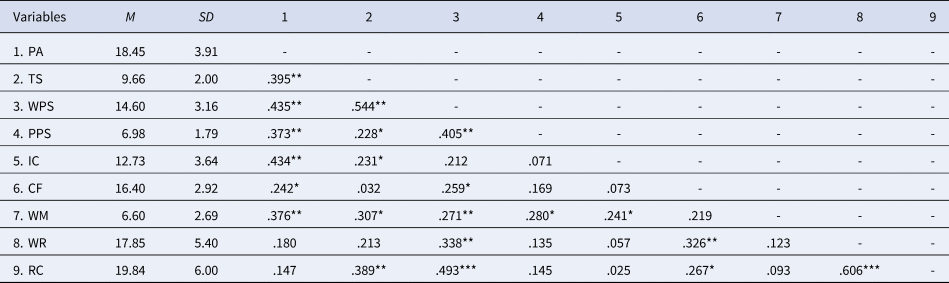
Notes: PA = phonological awareness, WPS = word-level prosodic sensitivity, PPS = phrase-level prosodic sensitivity, TS = Mandarin tone sensitivity, WR = word reading, IC = inhibition control, CF = cognitive flexibility, WM = working memory.
* p < .05, ** p < .01, *** p < .001.
Moderated mediation of EFs between L1-L2 prosodic sensitivity transfer and reading
To explore the role of L1 Mandarin tone sensitivity and L2 PS in reading as moderated by both linguistic and cognitive factors, three subcomponents of EF (inhibition control, cognitive flexibility, and working memory) were added to the analyses as moderators while phonological awareness was set as the control variable. This moderated mediation model tested both the mediation of L1-L2 prosodic transfer in English reading and the moderation of EF in English PS in English reading. The results are presented in Table 2.
Moderated Mediation Effects of EFs on the Relationship Between PS and L2 Reading.
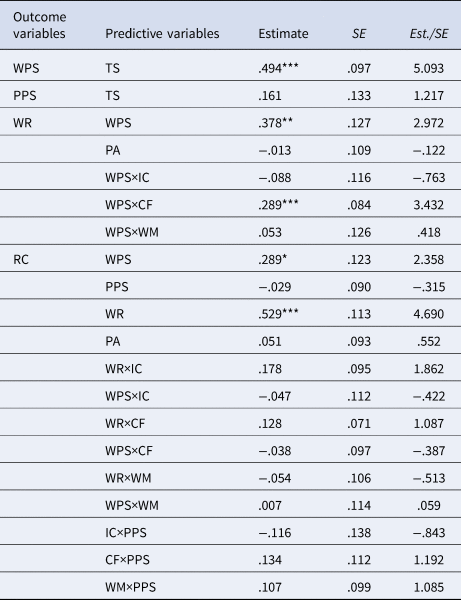
Notes: WPS = word-level prosodic sensitivity, PPS = phrase-level prosodic sensitivity, TS = Mandarin tone sensitivity, WR = word reading, IC = inhibition control, CF = cognitive flexibility, WM = working memory, PA = phonological awareness.
*p < .05, ** p < .01, *** p < .001.
The path analysis of L1-L2 prosodic transfer in English reading revealed a significant mediation effect of English PS in “L1 Mandarin tone sensitivity – L2 English prosodic sensitivity – English reading”. Specifically, in the standardized estimates of path weights, the first path “Mandarin tone sensitivity – word-level English PS – English word reading – English reading comprehension” was significant (Est = .494, p < .001; Est = .378, p = .003; Est = .529, p = .001). In other words, Mandarin tone sensitivity predicted English word reading and reading comprehension via word-level English PS. Likewise, the second path “Mandarin tone sensitivity-word-level English prosodic sensitivity-English reading comprehension” was also significant (Est = .494, p < .001; Est = .289, p = .018). This implies that Mandarin tone sensitivity predicted English reading comprehension via word-level English PS. In sum, these findings demonstrate mediation effects of English PS on the path from L1 Mandarin tone sensitivity to L2 English reading via word-level, but not phrase-level English PS, which appears to facilitate English reading. We illustrate the alignment with these findings with the Mediation Model of L1-L2 Prosodic Transfer in Figure 2.
Results Explained Through the L1-L2 Prosodic Transfer Moderated Mediation Model as Affected by EFs
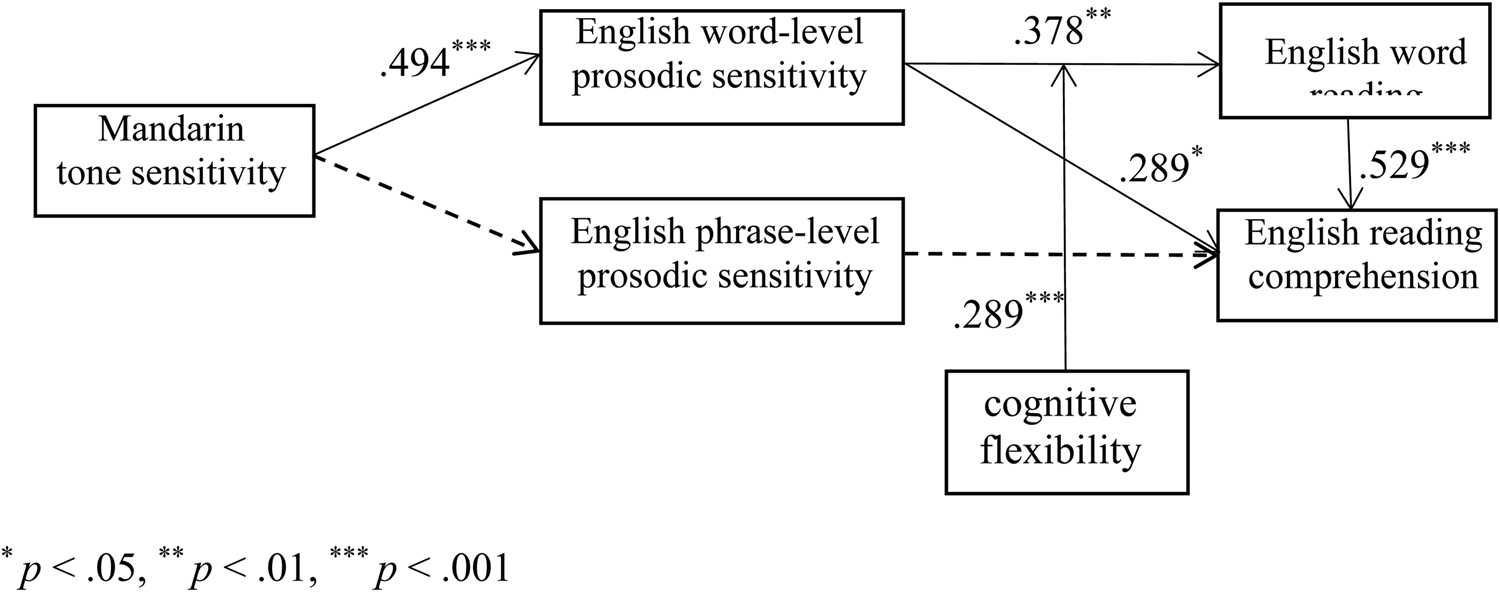
Crucially, the data of moderation analysis of EFs in “Mandarin tone sensitivity – English PS – English reading” suggests that one component of EF moderated the relationship between English PS and English reading (see Figure 2). The interaction between word-level PS and cognitive flexibility (WPS x CF) significantly affected word reading (Est = .289, p = .001). However, the interactions between PS and inhibition control (WPS x IC) (Est = -.088, p = .445) and between PS and working memory (WPS x WM) (Est = .053, p = .676) did not significantly affect word reading. In reading comprehension, interactions were not significant between stress sensitivity and inhibition control (WPS x IC) (Est = -.047, p = .673), cognitive flexibility (WPS x CF) (Est = -.038, p = .698), or working memory (WPS x WM) (Est = .007, p = .953). In sum, among the three EFs explored, the results indicate that cognitive flexibility, but not inhibition control or working memory, significantly moderates the relationship between PS and reading.
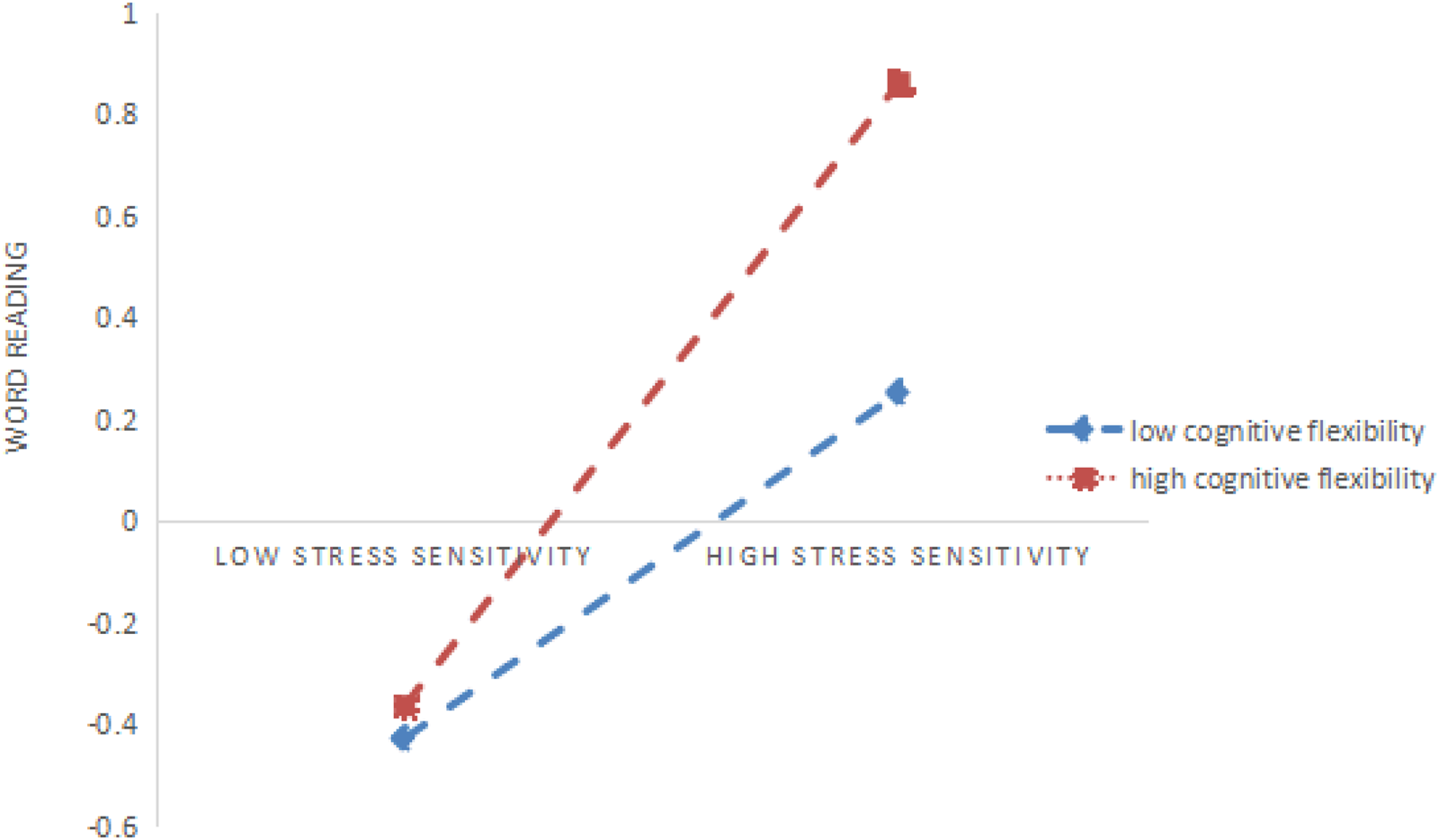
To further examine the effects of cognitive flexibility, we carried out a simple slope analysis. As illustrated in Figure 3, the results showed that PS positively predicted word reading for higher cognitive flexibility (simple slope = .6127, t = 4.0486, p = .0001) but not for lower cognitive flexibility (simple slope = .0678, t = .5573, p = .5791).
Moderation Effects of Cognitive Flexibility Between Prosodic Sensitivity and Word Reading
Discussion
In the present study, we examined the role of L1 PS and three subcomponents of EFs in L2 reading among a group of adolescent L1 Mandarin-L2 English learners. The results showed that Mandarin tone sensitivity affected English reading via English word-level PS, and cognitive flexibility moderated the relationship between English PS and English reading. We further elaborate these results below.
English Prosodic Sensitivity Mediates Mandarin Tone Sensitivity and English Reading
Our analyses revealed that English PS significantly predicted L2 reading and mediated the relationship between Mandarin tone sensitivity and English reading. These patterns are consistent with previous studies (Meng et al., Reference Meng, Zhang, Liu and Wu2020; van Maastricht et al., Reference van Maastricht, Krahmer and Swerts2016, Reference van Maastricht, Zee, Krahmer and Swerts2021; Yoon, Reference Yoon2007) which tested groups of children L2 learners. Despite the age differences between our adolescent participants and those tested in the studies by van Maastricht et al., we obtained similar results supporting L1-L2 prosodic transfer. We believe that this can be at least partially attributed to the prosodic similarities between Mandarin and English. For instance, pitch is a critical acoustic correlate for English stress (Fry, Reference Fry1955) and serves as a crucial acoustic cue for Mandarin tones which is categorized depending on the height and direction of pitch movements (X. M. Xu, Reference Xu2019). This acoustic similarity may facilitate transfer of prosodic competence of Mandarin tones to English stress patterns. These effects are not only unique to our Mandarin–English learners – or to Cantonese–English learners in studies by Choi et al. (Reference Choi, Tong and Cain2016) and Tong et al. (Reference Tong, He and Deacon2017), whose language contains six tones compared to the four found in Mandarin – but also to Spanish learners of Dutch, in which Dutch is syllable-timed but Spanish is stress-timed (van Maastricht et al., Reference van Maastricht, Zee, Krahmer and Swerts2021). The transfer of prosodic competence of Mandarin tones to English stress patterns may result from the general ability for sound processing. Regarding the relationship between word recognition and reading comprehension, individuals with stronger word recognition and larger vocabulary demonstrated an advantage in reading comprehension in that these learners read words quickly by virtue of their sensitivity to word stress, among other things, which benefited their reading comprehension. These findings support a path for Mandarin tone sensitivity – word-level English PS (stress sensitivity) – reading comprehension (see also Choi et al., Reference Choi, Tong and Cain2016). This implies that stress sensitivity not only plays a key role in word recognition, but also has significant consequences for reading comprehension. Indirectly, this path supports the implicit prosody hypothesis regarding L2 acquisition in which reading a sentence or even a text silently may cause readers to perceive the implicit prosody of the given words, phrasal expressions, or sentences. It may also cause readers to mentally hear the corresponding sounds (i.e., inner speech) along with suprasegmental features such as intonation, stress, pause, and rhythm, a finding reported in several studies (Abramson & Goldinger, Reference Abramson and Goldinger1997; Fodor, Reference Fodor and Hirotani2002; Gross et al., Reference Gross, Millet, Bartek, Bredell and Winegard2013). Despite the differences in the participants’ L1s and L2s, and their phonetic and phonological characteristics, our present study has revealed similar effects, specifically that L2 stress transfer affects L2 reading comprehension. For this reason, it is likely that L2 readers who are sensitive to these internal, activated representations may segment and parse sentences in a way that facilitates their L2 reading comprehension.
Our results also showed that the Mandarin tone sensitivity – phrase-level PS – reading comprehension path was not significant. In other words, Mandarin tone sensitivity did not demonstrate an effect on English reading comprehension at the phrase level. Although previous studies have shown that phrase-level PS is a significant predictor of reading comprehension (Holliman et al., Reference Holliman, Williams, Mundy, Wood, Hart and Waldron2014a; Whalley & Hansen, Reference Whalley and Hansen2006), our results may diverge for two possible reasons. First, with regard to the nature of the relationship between Mandarin tones and English phrase-level prosody, Mandarin tones are mostly represented by pitch changes, while phrase-level prosody involves not only pitch changes, but also prosodic boundary cues such as pre-boundary extensions and pauses. Phrase-level prosody also includes sentence-level information, such as sentence segmentation and syntactic analysis. It is possible that transfer of Mandarin tone sensitivity is limited to the stress-level, rather than phrase-level. Second, the other potential factor is the relatively low level of English proficiency among the participants in our study, which could also be a limitation of our prediction about the direct interplay of L1 PS in L2 reading comprehension other than word recognition. Future studies should consider designing and testing a comprehensive model to examine the direct interplay of prosody in L2 reading comprehension at the sentential and textual levels beyond the evidence that word reading mediates the relationship between prosodic awareness and reading comprehension, albeit in L1 readers (Kim & Petscher, Reference Kim and Petscher2015).
Cognitive Flexibility Affects the Relationship Between L2 Prosodic Sensitivity and Reading Comprehension
Because reading is a language activity that requires both language skills and multiple attention-control processes, we also examined whether EFs modulated the relationship between PS and reading comprehension. Inhibition is thought to be important for reading as it limits distracting ambiguous, outdated, or irrelevant information (Arrington et al., Reference Arrington, Kulesz, Francis, Fletcher and Barnes2014; Borella et al., Reference Borella, Carretti and Pelegrina2010; Foy & Mann, Reference Foy and Mann2013; Gernsbacher & Faust, Reference Gernsbacher and Faust1991). Consistent with findings from a study by Christopher et al. (Reference Christopher, Miyake, Keenan, Pennington, DeFries, Wadsworth, Willcutt and Olson2012), we found that inhibition failed to moderate the paths between PS and reading. As noted by Flege (Reference Flege1987), at early stages of L2 learning, L1 and L2 phonological systems may not be integrated and thus, one system does not necessarily activate the other nor require much inhibition. The A1-level learners in the current study appear to align with this explanation.
In contrast to most literature on working memory as a correlate with word recognition and reading comprehension, our findings in the present study did not demonstrate working memory effects on the relationship between PS and reading comprehension. These results align with a study by Chan and Wade-Woolley (Reference Chan and Wade-Woolley2018) in which neither working memory nor inhibitory control predicted reading comprehension. Juffs and Harrington (Reference Juffs and Harrington2011) explain that working memory functions not as a unitary construct in L2 learning, but rather that its role varies with age, task, and linguistic domain. Although we agree with the partial role of working memory in reading comprehension, we argue that the failure of working memory in our model may be attributed to the low level of English proficiency among the participants who participated in our study. Indeed, L2 proficiency level may explain the efficiency of working memory mediating the relation between PS to reading comprehension in that learners at a lower level may employ less working memory for processing prosodic transfer as well as the following reading tasks so that the modulating effect of working memory is not prominent. Findings from a study by Shin et al. (Reference Shin, Dronjic and Park2018) may lend support to this explanation. In their study, intermediate and advanced L2 learners employed working memory and language cues efficiently in L2 reading comprehension, potentially due to their higher level of L2 proficiency (see also Chan & Wade-Woolley, Reference Chan and Wade-Woolley2018).
In contrast to the weak or negative interplay of inhibition and working memory in the relationship between PS and reading comprehension, cognitive flexibility moderated the Mandarin tone sensitivity – word-level prosodic sensitivity – word reading path. This finding supports the argument by Chan and Wade-Woolley (Reference Chan and Wade-Woolley2018) that “performing a prosodic shift imposes additional processing demands in identifying the appropriate syllable to receive stress placement and vowel reduction in surrounding, newly unstressed syllables” (p. 11) because cognitive flexibility is significantly required to master prosodic awareness for segmenting speech. Moreover, we interpret our finding as reflective of the involvement of multiple, simultaneously occurring processes (e.g., decoding, stress assignment, vowel weakening, and word meaning extraction) that occur during word reading (Cartwright, Reference Cartwright, Block and Parris2008). Word-level PS is mainly responsible for primary stress assignment on the correct syllable and vowel reduction in unstressed syllables, while cognitive flexibility modulates the allocation of attentional resources to meet cognitive demands. In our study, the materials used in the word reading task were all multisyllabic words which pose particular demands for cognitive flexibility (i.e., largely responsible for efficiently shifting between mental sets; Butterfuss & Kendeou, Reference Butterfuss and Kendeou2018). Nonetheless, readers with high cognitive flexibility made use of their stronger abilities in attentional allocation and switching between processes during word reading in ways that facilitated the procedure. While a study by Chan and Wade-Woolley (Reference Chan and Wade-Woolley2018) found that cognitive flexibility did not have a significant effect on word reading and reading comprehension among a group of 18–55-year-old English monolinguals, our results, in which adolescents performed the tasks in a much weaker L2, suggest otherwise. Word reading for these novice L2 learners was more challenging given that they were less familiar with English prosodic information than monolingual speakers of English. Consequently, more cognitive flexibility was needed to effectively switch between Mandarin and English.
Finally, a simple slope analysis showed that for learners with higher levels of cognitive flexibility, PS played a positive predictive role in word reading. Word reading requires readers to decode input by recognizing phonemes, segmenting syllables, assigning primary stress, and weakening vowels in unstressed environments. It is likely that higher cognitive flexibility leads to more efficient switching between these various types of acoustic information and, thus, accelerates word reading (Butterfuss & Kendeou, Reference Butterfuss and Kendeou2018). Indeed, learners with higher cognitive flexibility are able to switch between prosodic information of English polysyllabic words whose stressed syllables were not fixed and were often related to their lexical category (e.g., the noun “OBject” vs. the verb “to obJECT”). Higher cognitive flexibility has also been reported to help efficiently distinguish compound words from noun phrases (Whalley & Hansen, Reference Whalley and Hansen2006) (e.g., “BLACKbird” vs. “black BIRD”). In the present study, although learners with higher cognitive flexibility appear to read these types of words more quickly and accurately because they can flexibly switch between these multiple prosodic cues, readers with lower cognitive flexibility may need to consume larger amounts of resources and spend more time doing so, which consequently hampers their reading.
Conclusion
Many studies have illuminated the important role of PS in reading and have offered support for a theory in which transfer of L1 tone sensitivity to L2 stress sensitivity facilitates L2 reading. Our study provides further evidence for this account among adolescent L2 learners. Moreover, we explored whether three EFs – namely, inhibition control, working memory, and cognitive flexibility – modulated these effects. The overall findings demonstrated that PS is a critical factor in L2 reading that is not only affected by L1 prosodic transfer but also by cognitive flexibility. To our knowledge, this study is the first to ecologically examine PS and EFs among adolescent, novice L2 learners, adding to our understanding of the relationship between prosody and reading comprehension. However, there are some limitations to our study. For example, we did not use two or more tasks to measure the subcomponents of EFs whose measures may be specific-oriented (Peng et al., Reference Peng, Zhang, Wang, Lee, Wang, Wang, Luo and Lin2022). Another limitation was that the present research was synchronic. Future studies may wish to engage in diachronic research to track the ongoing development of the relationship between PS, EFs, and reading.
Supplementary Material
For supplementary material accompanying this paper, visit https://doi.org/10.1017/S1366728924000129
Availability of Data
All the data can be found at https://osf.io/jm95c/?view_only=02fdbd92949f4e68ba6bc03a25089242.
Acknowledgements
This research was supported by the Social Science Foundation of the Ministry of Education of China (21YJA740009) and the Guangdong Social Science Association (GD19WXZ11).
We have no conflicts of interest to report.


 Open access

