





1 Introduction
We consider Hessenberg varieties of type A. Given a positive integer n, let ${G=GL_n({\mathbb {C}})}$
and
${G=GL_n({\mathbb {C}})}$
and $B \subseteq G$
be the Borel subgroup of upper triangular matrices. Let
$B \subseteq G$
be the Borel subgroup of upper triangular matrices. Let ${\mathfrak {g}=\mathfrak {gl}_n({\mathbb {C}})}$
and
${\mathfrak {g}=\mathfrak {gl}_n({\mathbb {C}})}$
and $\mathfrak {b}$
be the respective Lie algebras of G and B. We consider the action of G on
$\mathfrak {b}$
be the respective Lie algebras of G and B. We consider the action of G on $\mathfrak {g}$
by conjugation. Given
$\mathfrak {g}$
by conjugation. Given $\mathsf {x} \in \mathfrak {g}$
and a B-invariant subspace
$\mathsf {x} \in \mathfrak {g}$
and a B-invariant subspace $H \subseteq \mathfrak {g}$
, the type A Hessenberg variety
$H \subseteq \mathfrak {g}$
, the type A Hessenberg variety $\mathcal {B}(\mathsf {x},H)$
consists of all
$\mathcal {B}(\mathsf {x},H)$
consists of all $gB$
in the flag variety
$gB$
in the flag variety $\mathcal {B}:=G/B$
satisfying
$\mathcal {B}:=G/B$
satisfying $g^{-1}\mathsf {x}g \in H$
.
$g^{-1}\mathsf {x}g \in H$
.
We assume throughout that H contains the Borel subalgebra $\mathfrak {b}$
, as was assumed by De Mari and Shayman in [Reference De Mari and ShaymanDMS88] and by De Mari et al. in [Reference De Mari, Procesi and ShaymanDMPS92], seminal works on Hessenberg varieties. Under this assumption, there is a unique Hessenberg vector
$\mathfrak {b}$
, as was assumed by De Mari and Shayman in [Reference De Mari and ShaymanDMS88] and by De Mari et al. in [Reference De Mari, Procesi and ShaymanDMPS92], seminal works on Hessenberg varieties. Under this assumption, there is a unique Hessenberg vector ${\mathbf {m}}=({\mathbf {m}}(1),\ldots ,{\mathbf {m}}(n))$
, that is, a weakly increasing sequence from
${\mathbf {m}}=({\mathbf {m}}(1),\ldots ,{\mathbf {m}}(n))$
, that is, a weakly increasing sequence from $[n]$
satisfying
$[n]$
satisfying ${\mathbf {m}}(i) \geq i$
for all
${\mathbf {m}}(i) \geq i$
for all $i \in [n]$
, such that H consists of all matrices
$i \in [n]$
, such that H consists of all matrices $\mathsf {a} = (\mathsf {a}_{ij}) \in \mathfrak {g}$
such that
$\mathsf {a} = (\mathsf {a}_{ij}) \in \mathfrak {g}$
such that $\mathsf {a}_{ij}=0$
if
$\mathsf {a}_{ij}=0$
if $i>{\mathbf {m}}(j)$
. We write
$i>{\mathbf {m}}(j)$
. We write $H=H({\mathbf {m}})$
in this case. We omit the assumption from [Reference De Mari and ShaymanDMS88, Reference De Mari, Procesi and ShaymanDMPS92] that
$H=H({\mathbf {m}})$
in this case. We omit the assumption from [Reference De Mari and ShaymanDMS88, Reference De Mari, Procesi and ShaymanDMPS92] that $\mathsf {x}$
is regular and semisimple.
$\mathsf {x}$
is regular and semisimple.
Of particular interest herein is the case where $H=H({\mathbf m}_{\mathbf {{max}}})$
with
$H=H({\mathbf m}_{\mathbf {{max}}})$
with
 $$ \begin{align*}{\mathbf m}_{\mathbf{{max}}}:=(n-1,n,\ldots,n). \end{align*} $$
Notice that $H({\mathbf m}_{\mathbf {{max}}})$
is the unique maximal proper B-invariant subspace of
$H({\mathbf m}_{\mathbf {{max}}})$
is the unique maximal proper B-invariant subspace of $\mathfrak {g}$
, hence our choice of notation. We observe that if
$\mathfrak {g}$
, hence our choice of notation. We observe that if $\mathsf {x}$
is not scalar, then
$\mathsf {x}$
is not scalar, then $\mathcal {B}(\mathsf {x},H({\mathbf m}_{\mathbf {{max}}}))$
has codimension one in
$\mathcal {B}(\mathsf {x},H({\mathbf m}_{\mathbf {{max}}}))$
has codimension one in $\mathcal {B}$
. Conversely, we showed in [Reference Escobar, Precup and ShareshianEPS21] that if
$\mathcal {B}$
. Conversely, we showed in [Reference Escobar, Precup and ShareshianEPS21] that if $\mathcal {B}(\mathsf {x},H)$
has codimension one in
$\mathcal {B}(\mathsf {x},H)$
has codimension one in $\mathcal {B}$
, then
$\mathcal {B}$
, then $H=H({\mathbf m}_{\mathbf {{max}}})$
or there is some
$H=H({\mathbf m}_{\mathbf {{max}}})$
or there is some $\lambda \in {\mathbb {C}}$
such that
$\lambda \in {\mathbb {C}}$
such that $\mathsf {x}-\lambda I_n$
has rank one. We continue our study of codimension one Hessenberg varieties in this manuscript, concentrating on
$\mathsf {x}-\lambda I_n$
has rank one. We continue our study of codimension one Hessenberg varieties in this manuscript, concentrating on $\mathcal {B}(\mathsf {x},H({\mathbf m}_{\mathbf {{max}}}))$
.
$\mathcal {B}(\mathsf {x},H({\mathbf m}_{\mathbf {{max}}}))$
.
One of our main tools is a result that applies with no condition on codimension and could be of use in other settings. We define as usual the Poincaré polynomial of $\mathcal {B}(\mathsf {x}, H)$
by
$\mathcal {B}(\mathsf {x}, H)$
by
 $$ \begin{align*}\mathsf{Poin}(\mathcal{B}(\mathsf{x},H);q):=\sum_j \dim(H^j(\mathcal{B}(\mathsf{x},H);{\mathbb{C}}))q^j. \end{align*} $$
Given a Hessenberg vector ${\mathbf m}$
, the variety
${\mathbf m}$
, the variety $\mathcal {B}(\mathsf {x},H({\mathbf m}))$
admits an affine paving, as shown by Tymoczko in [Reference TymoczkoTym06b]. It follows that the (singular) cohomology of
$\mathcal {B}(\mathsf {x},H({\mathbf m}))$
admits an affine paving, as shown by Tymoczko in [Reference TymoczkoTym06b]. It follows that the (singular) cohomology of $\mathcal {B}(\mathsf {x},H({\mathbf m}))$
is concentrated in even degrees. So
$\mathcal {B}(\mathsf {x},H({\mathbf m}))$
is concentrated in even degrees. So $\mathsf {Poin}(\mathcal {B}(\mathsf {x},H({\mathbf m}));q^{1/2})$
is a polynomial in q. It follows from the particulars of Tymoczko’s result that, given any
$\mathsf {Poin}(\mathcal {B}(\mathsf {x},H({\mathbf m}));q^{1/2})$
is a polynomial in q. It follows from the particulars of Tymoczko’s result that, given any $\mathsf {x}$
and
$\mathsf {x}$
and $H({\mathbf m})$
as above, there exists an upper triangular integer matrix
$H({\mathbf m})$
as above, there exists an upper triangular integer matrix $\mathsf {x}^\prime $
such that
$\mathsf {x}^\prime $
such that
 $$ \begin{align*}\mathsf{Poin}(\mathcal{B}(\mathsf{x},H({\mathbf m}));q)=\mathsf{Poin}(\mathcal{B}(\mathsf{x}^\prime,H({\mathbf m}));q). \end{align*} $$
We may assume that $\mathsf {x}^\prime $
is in what Tymoczko calls highest form and permuted Jordan form, which will be defined later. In addition, we may assume that the eigenvalues of
$\mathsf {x}^\prime $
is in what Tymoczko calls highest form and permuted Jordan form, which will be defined later. In addition, we may assume that the eigenvalues of $\mathsf {x}^\prime$
are integers. In particular,
$\mathsf {x}^\prime$
are integers. In particular, $\mathsf {x}^\prime $
is the sum of a diagonal integer matrix
$\mathsf {x}^\prime $
is the sum of a diagonal integer matrix ${\mathsf {s}}$
and a strictly upper triangular 0–1 matrix
${\mathsf {s}}$
and a strictly upper triangular 0–1 matrix ${\mathsf {n}}$
. We write
${\mathsf {n}}$
. We write $m_{{\mathsf {s}}}$
for the largest absolute value of an entry of
$m_{{\mathsf {s}}}$
for the largest absolute value of an entry of ${\mathsf {s}}$
. Given any prime p, let
${\mathsf {s}}$
. Given any prime p, let $\bar {\mathsf {x}}^\prime \in \mathfrak {gl}_n({\mathbb F}_p)$
be the matrix obtained from
$\bar {\mathsf {x}}^\prime \in \mathfrak {gl}_n({\mathbb F}_p)$
be the matrix obtained from $\mathsf {x}^\prime $
by reducing each entry modulo p. Let
$\mathsf {x}^\prime $
by reducing each entry modulo p. Let $\bar {G}=GL_n({\mathbb F}_p)$
and let
$\bar {G}=GL_n({\mathbb F}_p)$
and let $\bar {B}$
be the subgroup of
$\bar {B}$
be the subgroup of $\bar {G}$
consisting of upper triangular matrices. The Hessenberg vector
$\bar {G}$
consisting of upper triangular matrices. The Hessenberg vector ${\mathbf m}$
determines a subspace
${\mathbf m}$
determines a subspace $\bar {H}({\mathbf m})$
of the Lie algebra
$\bar {H}({\mathbf m})$
of the Lie algebra $\mathfrak {gl}_n({\mathbb F}_p)$
in the same way it determines
$\mathfrak {gl}_n({\mathbb F}_p)$
in the same way it determines $H({\mathbf m})$
. We define
$H({\mathbf m})$
. We define
 $$ \begin{align*}\mathcal{B}_p(\bar{\mathsf{x}}^\prime ,\bar{H}({\mathbf m})):=\{g\bar{B} \in \bar{G}/\bar{B}\mid g^{-1}\bar{\mathsf{x}}^\prime g \in \bar{H}({\mathbf m})\}. \end{align*} $$
Theorem 1 (The point count heuristic)
If $p>2m_{{\mathsf {s}}}$
, then
$p>2m_{{\mathsf {s}}}$
, then
 $$ \begin{align} \left|\mathcal{B}_p(\bar{\mathsf{x}}^\prime ,\bar{H}({\mathbf m}))\right|=\mathsf{Poin}(\mathcal{B}(\mathsf{x}^\prime,H({\mathbf m}));p^{1/2}). \end{align} $$
We prove Theorem 1 in Section 3 through close examination of Tymoczko’s affine paving construction. The point count heuristic allows us to compute the Poincaré polynomial of $\mathcal {B}(\mathsf {x}, H({\mathbf m}))$
using elementary methods. For example, we obtain a simple formula for the Poincaré polynomial of
$\mathcal {B}(\mathsf {x}, H({\mathbf m}))$
using elementary methods. For example, we obtain a simple formula for the Poincaré polynomial of $\mathcal {B}(\mathsf {x},H({\mathbf m}_{\mathbf {{max}}}))$
for arbitrary
$\mathcal {B}(\mathsf {x},H({\mathbf m}_{\mathbf {{max}}}))$
for arbitrary $\mathsf {x}$
. It is not hard to enumerate
$\mathsf {x}$
. It is not hard to enumerate $\mathcal {B}_p(\mathsf {y},\bar {H}({\mathbf m}_{\mathbf {{max}}}))$
for arbitrary
$\mathcal {B}_p(\mathsf {y},\bar {H}({\mathbf m}_{\mathbf {{max}}}))$
for arbitrary $\mathsf {y} \in \mathfrak {gl}_n({\mathbb F}_p)$
. The following result appears in Section 4 below.
$\mathsf {y} \in \mathfrak {gl}_n({\mathbb F}_p)$
. The following result appears in Section 4 below.
Proposition 2 If $\mathsf {y} \in \mathfrak {gl}_n({\mathbb F}_p)$
fixes exactly k one-dimensional subspaces of
$\mathsf {y} \in \mathfrak {gl}_n({\mathbb F}_p)$
fixes exactly k one-dimensional subspaces of ${\mathbb F}_p^n$
, then
${\mathbb F}_p^n$
, then
 $$ \begin{align*}\left|\mathcal{B}_p(\mathsf{y},\bar{H}({\mathbf m}_{\mathbf{{max}}}))\right|=[n-2]_p!\left([n]_p[n-2]_p+kp^{n-2}\right). \end{align*} $$
The next result follows quickly from Theorem 1 and Proposition 2.
Theorem 3 If $\mathsf {x} \in \mathfrak {g}$
has exactly
$\mathsf {x} \in \mathfrak {g}$
has exactly $\ell $
pairwise distinct eigenvalues
$\ell $
pairwise distinct eigenvalues $\lambda _1,\ldots \lambda _\ell $
and
$\lambda _1,\ldots \lambda _\ell $
and $\dim _{\mathbb {C}}\ker (\mathsf {x}-\lambda _jI_n)=d_j$
for each
$\dim _{\mathbb {C}}\ker (\mathsf {x}-\lambda _jI_n)=d_j$
for each $j \in [\ell ]$
, then the Poincaré polynomial of
$j \in [\ell ]$
, then the Poincaré polynomial of $\mathcal {B}(\mathsf {x},H({\mathbf m}_{\mathbf {{max}}}))$
is
$\mathcal {B}(\mathsf {x},H({\mathbf m}_{\mathbf {{max}}}))$
is
 $$ \begin{align} \mathsf{Poin}(\mathcal{B}(\mathsf{x},H({\mathbf m}_{\mathbf{{max}}}));q)=[n-2]_{q^2}!\left([n]_{q^2}[n-2]_{q^2}+q^{2n-4}\sum_{j=1}^\ell [d_j]_{q^2}\right). \end{align} $$
Our proof of (1.2) using the point count heuristic is much simpler than applying previously known Betti number formulas from, for example, [Reference TymoczkoTym06b, Reference PrecupPre13], which each require multiple cases. Theorem 1 (through Theorem 3) is also helpful in understanding the geometry of $\mathcal {B}(\mathsf {x},H({\mathbf m}_{\mathbf {{max}}}))$
. We obtain the following result in Section 6.
$\mathcal {B}(\mathsf {x},H({\mathbf m}_{\mathbf {{max}}}))$
. We obtain the following result in Section 6.
Theorem 4 For $\mathsf {x} \in \mathfrak {g}$
, the variety
$\mathsf {x} \in \mathfrak {g}$
, the variety $\mathcal {B}(\mathsf {x},H({\mathbf m}_{\mathbf {{max}}}))$
is reducible if and only if there is some
$\mathcal {B}(\mathsf {x},H({\mathbf m}_{\mathbf {{max}}}))$
is reducible if and only if there is some $\lambda \in {\mathbb {C}}$
such that
$\lambda \in {\mathbb {C}}$
such that $\mathsf {x}-\lambda I_n$
has rank one.
$\mathsf {x}-\lambda I_n$
has rank one.
It follows immediately from Theorem 4 that $\mathcal {B}(\mathsf {x},H({\mathbf m}_{\mathbf {{max}}}))$
is reducible if and only if
$\mathcal {B}(\mathsf {x},H({\mathbf m}_{\mathbf {{max}}}))$
is reducible if and only if $\mathsf {x}$
is nilpotent with Jordan decomposition corresponding to the partition
$\mathsf {x}$
is nilpotent with Jordan decomposition corresponding to the partition $(2,1^{n-2})$
or
$(2,1^{n-2})$
or $\mathsf {x}$
is semisimple and conjugate to a diagonal matrix
$\mathsf {x}$
is semisimple and conjugate to a diagonal matrix $\mathrm {diag}(c_1, \ldots , c_1, c_2)$
such that
$\mathrm {diag}(c_1, \ldots , c_1, c_2)$
such that $c_1, c_2\in {\mathbb {C}}$
with
$c_1, c_2\in {\mathbb {C}}$
with $c_1\neq c_2$
.
$c_1\neq c_2$
.
The proof of Theorem 4 relies on Theorem 1 and the examination of affine patches. Let $B_-$
be the Borel subgroup consisting of all lower triangular matrices in G and let
$B_-$
be the Borel subgroup consisting of all lower triangular matrices in G and let $U_-\simeq {\mathbb {C}}^{{n}\choose {2}}$
be the unipotent radical of
$U_-\simeq {\mathbb {C}}^{{n}\choose {2}}$
be the unipotent radical of $B_-$
, consisting of all matrices
$B_-$
, consisting of all matrices $I+{\mathsf {n}}$
with
$I+{\mathsf {n}}$
with ${\mathsf {n}}$
strictly lower triangular. The patch in
${\mathsf {n}}$
strictly lower triangular. The patch in $\mathcal {B}$
centered at a point
$\mathcal {B}$
centered at a point $gB$
is
$gB$
is ${\mathcal N}_g:=gB_-B/B$
. Each coset in this patch has a unique representative of the form
${\mathcal N}_g:=gB_-B/B$
. Each coset in this patch has a unique representative of the form $guB$
with
$guB$
with $u \in U_-$
. It follows that
$u \in U_-$
. It follows that ${\mathcal N}_g$
is open in
${\mathcal N}_g$
is open in $\mathcal {B}$
and isomorphic to affine space
$\mathcal {B}$
and isomorphic to affine space ${\mathbb {C}}^{{n} \choose {2}}$
. Now for
${\mathbb {C}}^{{n} \choose {2}}$
. Now for $gB \in \mathcal {B}(\mathsf {x},H({\mathbf m}_{\mathbf {{max}}}))$
, we see that
$gB \in \mathcal {B}(\mathsf {x},H({\mathbf m}_{\mathbf {{max}}}))$
, we see that ${\mathcal N}_{g,\mathsf {x}}^{{\mathbf m}_{\mathbf {{max}}}}:={\mathcal N}_g \cap \mathcal {B}(\mathsf {x},H({\mathbf m}_{\mathbf {{max}}}))$
is an open neighborhood of
${\mathcal N}_{g,\mathsf {x}}^{{\mathbf m}_{\mathbf {{max}}}}:={\mathcal N}_g \cap \mathcal {B}(\mathsf {x},H({\mathbf m}_{\mathbf {{max}}}))$
is an open neighborhood of $gB$
in
$gB$
in $\mathcal {B}(\mathsf {x},H({\mathbf m}_{\mathbf {{max}}}))$
that is isomorphic to an affine hypersurface in
$\mathcal {B}(\mathsf {x},H({\mathbf m}_{\mathbf {{max}}}))$
that is isomorphic to an affine hypersurface in $U_-$
cut out by a certain determinant. Using this fact, we will show that
$U_-$
cut out by a certain determinant. Using this fact, we will show that $\mathcal {B}(\mathsf {x},H({\mathbf m}_{\mathbf {{max}}}))$
is equidimensional. This allows us to determine whether or not
$\mathcal {B}(\mathsf {x},H({\mathbf m}_{\mathbf {{max}}}))$
is equidimensional. This allows us to determine whether or not $\mathcal {B}(\mathsf {x},H({\mathbf m}_{\mathbf {{max}}}))$
is irreducible by calculating its top Betti number, which Theorem 3 renders easy.
$\mathcal {B}(\mathsf {x},H({\mathbf m}_{\mathbf {{max}}}))$
is irreducible by calculating its top Betti number, which Theorem 3 renders easy.
Examination of patches enables us to determine the singular locus of ${\mathcal {B}(\mathsf {x},H({\mathbf m}_{\mathbf {{max}}}))}$
when
${\mathcal {B}(\mathsf {x},H({\mathbf m}_{\mathbf {{max}}}))}$
when $\mathsf {x}$
is nilpotent. Indeed, the point
$\mathsf {x}$
is nilpotent. Indeed, the point $gB$
is smooth in
$gB$
is smooth in $\mathcal {B}(\mathsf {x},H({\mathbf m}_{\mathbf {{max}}}))$
if and only if it is smooth in
$\mathcal {B}(\mathsf {x},H({\mathbf m}_{\mathbf {{max}}}))$
if and only if it is smooth in ${\mathcal N}_{g,\mathsf {x}}^{{\mathbf m}_{\mathbf {{max}}}}$
. Direct calculation yields the next result, which we prove in Section 5. We remark that this method was used to determine the singular loci of the members of another class of Hessenberg varieties, the Petersen varieties, by Insko and Yong in [Reference Insko and YongIY12]. These patches were also used by Abe et al. in [Reference Abe, De Dieu, Galetto and HaradaADGH18], by Abe et al. in [Reference Abe, Fujita and ZengAFZ20], and by Da Silva and Harada in [Reference Da Silva and HaradaDSH25].
${\mathcal N}_{g,\mathsf {x}}^{{\mathbf m}_{\mathbf {{max}}}}$
. Direct calculation yields the next result, which we prove in Section 5. We remark that this method was used to determine the singular loci of the members of another class of Hessenberg varieties, the Petersen varieties, by Insko and Yong in [Reference Insko and YongIY12]. These patches were also used by Abe et al. in [Reference Abe, De Dieu, Galetto and HaradaADGH18], by Abe et al. in [Reference Abe, Fujita and ZengAFZ20], and by Da Silva and Harada in [Reference Da Silva and HaradaDSH25].
Theorem 5 The singular locus of $\mathcal {B}(\mathsf {x},H({\mathbf m}_{\mathbf {{max}}}))$
is contained in
$\mathcal {B}(\mathsf {x},H({\mathbf m}_{\mathbf {{max}}}))$
is contained in $\mathcal {B}(\mathsf {x},H((1,n-1, \ldots ,n-1,n)))$
. If
$\mathcal {B}(\mathsf {x},H((1,n-1, \ldots ,n-1,n)))$
. If $\mathsf {x}\in \mathfrak {g}$
is nilpotent, then this containment is an equality.
$\mathsf {x}\in \mathfrak {g}$
is nilpotent, then this containment is an equality.
We also consider the scheme-theoretic structure of $\mathcal {B}(\mathsf {x}, H({\mathbf m}_{\mathbf {{max}}})),$
as defined in [Reference Insko, Tymoczko and WooITW20, Section 4]. Use of patches yields the following result, which we prove in Section 8.
$\mathcal {B}(\mathsf {x}, H({\mathbf m}_{\mathbf {{max}}})),$
as defined in [Reference Insko, Tymoczko and WooITW20, Section 4]. Use of patches yields the following result, which we prove in Section 8.
Theorem 6 Suppose $n\ge 3$
. For any
$n\ge 3$
. For any $\mathsf {x} \in \mathfrak {gl}_n({\mathbb {C}}),$
the scheme
$\mathsf {x} \in \mathfrak {gl}_n({\mathbb {C}}),$
the scheme $\mathcal {B}(\mathsf {x},H({\mathbf m}_{\mathbf {{max}}}))\subseteq GL_n({\mathbb {C}})/B$
is reduced.
$\mathcal {B}(\mathsf {x},H({\mathbf m}_{\mathbf {{max}}}))\subseteq GL_n({\mathbb {C}})/B$
is reduced.
Combining Theorems 1, 3, and 5, we settle a problem we studied in [Reference Escobar, Precup and ShareshianEPS21]: we determine which Schubert varieties of codimension one in $\mathcal {B}$
are isomorphic to some Hessenberg variety in
$\mathcal {B}$
are isomorphic to some Hessenberg variety in $\mathcal {B}$
. Write
$\mathcal {B}$
. Write $w_0$
for the longest element in the Weyl group
$w_0$
for the longest element in the Weyl group $W=S_n$
of G. For
$W=S_n$
of G. For $1 \leq i \leq n-1$
, let
$1 \leq i \leq n-1$
, let $s_i$
denote the simple reflection
$s_i$
denote the simple reflection $(i,i+1) \in S_n$
. Given
$(i,i+1) \in S_n$
. Given $w \in S_n$
, the Schubert variety
$w \in S_n$
, the Schubert variety $X_w \subseteq \mathcal {B}$
has codimension one if and only if
$X_w \subseteq \mathcal {B}$
has codimension one if and only if $w=s_iw_0$
for some
$w=s_iw_0$
for some $i \in [n-1]$
. It follows from the work of Tymoczko in [Reference TymoczkoTym06a] that both
$i \in [n-1]$
. It follows from the work of Tymoczko in [Reference TymoczkoTym06a] that both $X_{s_1w_0}$
and
$X_{s_1w_0}$
and $X_{s_{n-1}w_0}$
are Hessenberg varieties in
$X_{s_{n-1}w_0}$
are Hessenberg varieties in $\mathcal {B}$
. We showed in [Reference Escobar, Precup and ShareshianEPS21] that if
$\mathcal {B}$
. We showed in [Reference Escobar, Precup and ShareshianEPS21] that if $3 \leq i \leq n-3,$
then no Hessenberg variety in
$3 \leq i \leq n-3,$
then no Hessenberg variety in $\mathcal {B}$
is isomorphic to
$\mathcal {B}$
is isomorphic to $X_{s_iw_0}$
. (Both Tymoczko’s result and ours do not involve the assumption
$X_{s_iw_0}$
. (Both Tymoczko’s result and ours do not involve the assumption $\mathfrak {b} \subseteq H$
.) In Section 7, we obtain the following extension of these results.
$\mathfrak {b} \subseteq H$
.) In Section 7, we obtain the following extension of these results.
Corollary 7 If $i \in \{2,n-2\},$
then no Hessenberg variety in
$i \in \{2,n-2\},$
then no Hessenberg variety in $\mathcal {B}$
is isomorphic to
$\mathcal {B}$
is isomorphic to $X_{s_iw_0}$
. Therefore, for
$X_{s_iw_0}$
. Therefore, for $j \in [n-1]$
, the three conditions
$j \in [n-1]$
, the three conditions
-
• some Hessenberg variety in $\mathcal {B}$
is isomorphic to
$X_{s_jw_0}$
;
$\mathcal {B}$
is isomorphic to
$X_{s_jw_0}$
; -
•
$X_{s_jw_0}$
is a Hessenberg variety; -
•
$j \in \{1,n-1\}$


are equivalent.
One can compute $\mathsf {Poin}(X_{s_iw_0};q)$
directly and use Theorem 3 to show that, for
$\mathsf {Poin}(X_{s_iw_0};q)$
directly and use Theorem 3 to show that, for $i \in \{2,n-2\}$
,
$i \in \{2,n-2\}$
, $\mathsf {Poin}(\mathcal {B}(\mathsf {x},H({\mathbf m}_{\mathbf {{max}}}));q)=\mathsf {Poin}(X_{s_iw_0};q)$
if and only if
$\mathsf {Poin}(\mathcal {B}(\mathsf {x},H({\mathbf m}_{\mathbf {{max}}}));q)=\mathsf {Poin}(X_{s_iw_0};q)$
if and only if $\mathsf {x}$
is nilpotent of rank two. For such
$\mathsf {x}$
is nilpotent of rank two. For such $\mathsf {x}$
, we compute
$\mathsf {x}$
, we compute $|\mathcal {B}_p(\bar {\mathsf {x}}^\prime ,\bar {H}((1,n-1,\ldots ,n-1,n)))|$
and so determine the Poincaré polynomial of the singular locus
$|\mathcal {B}_p(\bar {\mathsf {x}}^\prime ,\bar {H}((1,n-1,\ldots ,n-1,n)))|$
and so determine the Poincaré polynomial of the singular locus $\mathcal {B}(\mathsf {x},H((1,n-1,\ldots ,n-1,n)))$
of
$\mathcal {B}(\mathsf {x},H((1,n-1,\ldots ,n-1,n)))$
of $\mathcal {B}(\mathsf {x}, {\mathbf m}_{\mathbf {{max}}})$
using Theorems 1 and 5. A beautiful result conjectured by Lakshmibai and Sandhya in [Reference Lakshmibai and SandhyaLS90] and proved, independently, by Manivel in [Reference ManivelMan01], by Kassel–Lascoux–Reutenauer in [Reference Kassel, Lascoux and ReutenauerKLR03], and by Billey–Warrington in [Reference Billey and WarringtonBW03] allows us to determine the singular loci of the two
$\mathcal {B}(\mathsf {x}, {\mathbf m}_{\mathbf {{max}}})$
using Theorems 1 and 5. A beautiful result conjectured by Lakshmibai and Sandhya in [Reference Lakshmibai and SandhyaLS90] and proved, independently, by Manivel in [Reference ManivelMan01], by Kassel–Lascoux–Reutenauer in [Reference Kassel, Lascoux and ReutenauerKLR03], and by Billey–Warrington in [Reference Billey and WarringtonBW03] allows us to determine the singular loci of the two $X_{s_iw_0}$
in question. We complete the proof of Corollary 7 by comparing the Poincaré polynomials of these singular loci with those of
$X_{s_iw_0}$
in question. We complete the proof of Corollary 7 by comparing the Poincaré polynomials of these singular loci with those of $\mathcal {B}(\mathsf {x},H((1,n-1,\ldots ,n-1,n)))$
for
$\mathcal {B}(\mathsf {x},H((1,n-1,\ldots ,n-1,n)))$
for $\mathsf {x}$
nilpotent of rank two.
$\mathsf {x}$
nilpotent of rank two.
2 Notation and preliminaries
We review here various known results about the general linear group, flag varieties, and Hessenberg varieties. A reader familiar with basic facts about these objects can skip most of this section and refer back when necessary, but may wish to consult Remark 2.3 which sets notation for the remainder.
2.1 Basic notation
The symbol ${\mathbb {N}}$
will denote the set of positive integers. For
${\mathbb {N}}$
will denote the set of positive integers. For $n \in {\mathbb {N}}$
, let
$n \in {\mathbb {N}}$
, let $[n]: = \{1, 2, \ldots , n\}$
and
$[n]: = \{1, 2, \ldots , n\}$
and $S_n$
denote the symmetric group on
$S_n$
denote the symmetric group on $[n]$
. For an integer partition
$[n]$
. For an integer partition $\lambda =(\lambda _1,\ldots ,\lambda _\ell )$
,
$\lambda =(\lambda _1,\ldots ,\lambda _\ell )$
, $|\lambda |$
will denote the value
$|\lambda |$
will denote the value $\sum _{j=1}^\ell \lambda _j$
.
$\sum _{j=1}^\ell \lambda _j$
.
2.2 The flag variety
Let $n \in {\mathbb {N}}$
and
$n \in {\mathbb {N}}$
and ${\mathbb F}$
be a field. We use two different models for the flag variety
${\mathbb F}$
be a field. We use two different models for the flag variety $\mathcal {B}=\mathcal {B}(n,{\mathbb F})$
. First,
$\mathcal {B}=\mathcal {B}(n,{\mathbb F})$
. First, $\mathcal {B}$
consists of all full flags
$\mathcal {B}$
consists of all full flags
 $$ \begin{align*}V_\bullet=\{0=V_0 \subset V_1 \subset \dots \subset V_n={\mathbb F}^n \mid \dim_{{\mathbb F}} V_i =i \text{ for all } i\}. \end{align*} $$
Having fixed a basis $\{e_1,\ldots ,e_n\}$
for
$\{e_1,\ldots ,e_n\}$
for ${\mathbb F}^n$
, we define the flag
${\mathbb F}^n$
, we define the flag $E_\bullet \in \mathcal {B}$
by
$E_\bullet \in \mathcal {B}$
by
 $$ \begin{align*}E_j={\mathbb F}\{e_i \mid i \leq j\} \end{align*} $$
for each $j \in [n]$
. We use the basis
$j \in [n]$
. We use the basis $\{e_1,\ldots ,e_n\}$
to coordinatize
$\{e_1,\ldots ,e_n\}$
to coordinatize $GL_n({\mathbb F})$
. So,
$GL_n({\mathbb F})$
. So, $a=(a_{ij}) \in GL_n({\mathbb F})$
maps
$a=(a_{ij}) \in GL_n({\mathbb F})$
maps $e_j$
to
$e_j$
to $\sum _{i=1}^n a_{ij}e_i$
.
$\sum _{i=1}^n a_{ij}e_i$
.
The natural action of $G_{\mathbb F}:= GL_n({\mathbb F})$
on
$G_{\mathbb F}:= GL_n({\mathbb F})$
on ${\mathbb F}^n$
determines a transitive action of
${\mathbb F}^n$
determines a transitive action of $G_{\mathbb F}$
on the set
$G_{\mathbb F}$
on the set $\mathcal {B}$
of full flags. The stabilizer of
$\mathcal {B}$
of full flags. The stabilizer of $E_\bullet $
in this action is the Borel subgroup
$E_\bullet $
in this action is the Borel subgroup $B_{\mathbb F}$
of upper triangular matrices in
$B_{\mathbb F}$
of upper triangular matrices in $G_{\mathbb F}$
. So, the map from the coset space
$G_{\mathbb F}$
. So, the map from the coset space $G_{\mathbb F}/B_{\mathbb F}$
to
$G_{\mathbb F}/B_{\mathbb F}$
to $\mathcal {B}$
sending
$\mathcal {B}$
sending $gB_{\mathbb F}$
to
$gB_{\mathbb F}$
to $g(E_\bullet )$
is a bijection. We make no distinction between
$g(E_\bullet )$
is a bijection. We make no distinction between $\mathcal {B}$
and
$\mathcal {B}$
and $G_{\mathbb F}/B_{\mathbb F}$
, other than referring to the set of flags as the flag model for
$G_{\mathbb F}/B_{\mathbb F}$
, other than referring to the set of flags as the flag model for $\mathcal {B}$
and
$\mathcal {B}$
and $G_{\mathbb F}/B_{\mathbb F}$
as the coset model. We use whichever model suits our purposes at any time.
$G_{\mathbb F}/B_{\mathbb F}$
as the coset model. We use whichever model suits our purposes at any time.
2.3 The symmetric group and Bruhat order
We denote elements of $S_n$
using one-line notation:
$S_n$
using one-line notation:
 $$ \begin{align*}w=[w_1, w_2, \ldots, w_n]\in S_n,\end{align*} $$
where $w_i=w(i)$
in the natural action of w on
$w_i=w(i)$
in the natural action of w on $[n]$
. For
$[n]$
. For $i \in [n-1]$
, we write
$i \in [n-1]$
, we write $s_i$
for the simple reflection exchanging i and
$s_i$
for the simple reflection exchanging i and $i+1$
and fixing all
$i+1$
and fixing all $j \in [n] \setminus \{i,i+1\}$
. Each
$j \in [n] \setminus \{i,i+1\}$
. Each $w \in S_n$
is a product of simple reflections:
$w \in S_n$
is a product of simple reflections:
 $$ \begin{align*}w=s_{i_1}\ldots s_{i_\ell}, \end{align*} $$
with each $i_j \in [n-1]$
. Given such a product with
$i_j \in [n-1]$
. Given such a product with $\ell $
as small as possible, we say that w has length
$\ell $
as small as possible, we say that w has length $\ell $
and write
$\ell $
and write $\ell (w)=\ell $
.
$\ell (w)=\ell $
.
An inversion of w is a pair $(i,j) \in [n] \times [n]$
such that
$(i,j) \in [n] \times [n]$
such that $i<j$
and
$i<j$
and $w_i>w_j$
. We write
$w_i>w_j$
. We write $\mathsf {I}\mathsf {n}\mathsf {v}(w)$
for the set of inversions of w and
$\mathsf {I}\mathsf {n}\mathsf {v}(w)$
for the set of inversions of w and $\mathsf {i}\mathsf {n}\mathsf {v}(w)$
for
$\mathsf {i}\mathsf {n}\mathsf {v}(w)$
for $|\mathsf {I}\mathsf {n}\mathsf {v}(w)|$
. It is well known that
$|\mathsf {I}\mathsf {n}\mathsf {v}(w)|$
. It is well known that $\ell (w)=\mathsf {i}\mathsf {n}\mathsf {v}(w)$
.
$\ell (w)=\mathsf {i}\mathsf {n}\mathsf {v}(w)$
.
An expression of $w \in S_n$
as a product of
$w \in S_n$
as a product of $\ell (w)$
simple reflections is a reduced word for w. The Bruhat order
$\ell (w)$
simple reflections is a reduced word for w. The Bruhat order $\leq _{\mathsf {br}}$
on
$\leq _{\mathsf {br}}$
on $S_n$
is the partial order in which
$S_n$
is the partial order in which $v \leq _{\mathsf {br}} w$
if some reduced word for v is a (not necessarily consecutive) subword of some reduced word for w.
$v \leq _{\mathsf {br}} w$
if some reduced word for v is a (not necessarily consecutive) subword of some reduced word for w.
The tableau criterion gives another characterization of the Bruhat order. Given ${w \in S_n}$
and
${w \in S_n}$
and $1 \leq p \leq q \leq n$
, we write
$1 \leq p \leq q \leq n$
, we write $I_{p,q}(w)$
for the
$I_{p,q}(w)$
for the $p^{th}$
smallest element of
$p^{th}$
smallest element of ${\{w_i \mid i \in [q]\}}$
. So, for example, if
${\{w_i \mid i \in [q]\}}$
. So, for example, if $w=[5,2,3,4,1] \in S_5$
, then
$w=[5,2,3,4,1] \in S_5$
, then $I_{2,4}(w)=3$
, as
$I_{2,4}(w)=3$
, as $3$
is the second smallest element of
$3$
is the second smallest element of $\{5,2,3,4\}$
. The following result of Ehresmann appears as [Reference Björner and BrentiBB05, Theorem 2.6.3].
$\{5,2,3,4\}$
. The following result of Ehresmann appears as [Reference Björner and BrentiBB05, Theorem 2.6.3].
Theorem 2.1 (Tableau criterion)
Let $v,w\in S_n$
. Then
$v,w\in S_n$
. Then $v \leq _{\mathsf {br}} w$
if and only if
$v \leq _{\mathsf {br}} w$
if and only if $I_{p,q}(v) \leq I_{p,q}(w)$
whenever
$I_{p,q}(v) \leq I_{p,q}(w)$
whenever $1 \leq p \leq q \leq n$
.
$1 \leq p \leq q \leq n$
.
2.4 Schubert cells and Schubert varieties
Given $w \in S_n$
, we write
$w \in S_n$
, we write $\dot {w}$
for the element of
$\dot {w}$
for the element of $G_{\mathbb F}$
mapping
$G_{\mathbb F}$
mapping $e_j$
to
$e_j$
to $e_{w_j}$
for each
$e_{w_j}$
for each $j \in [n]$
. Now the Bruhat decomposition states that
$j \in [n]$
. Now the Bruhat decomposition states that $G_{\mathbb F}$
is the disjoint union of
$G_{\mathbb F}$
is the disjoint union of $B_{\mathbb F}-B_{\mathbb F}$
double cosets, each containing exactly one
$B_{\mathbb F}-B_{\mathbb F}$
double cosets, each containing exactly one $\dot {w}$
:
$\dot {w}$
:
 $$ \begin{align*}G_{\mathbb F}=\bigsqcup_{w \in S_n}B_{\mathbb F} \dot{w} B_{\mathbb F}. \end{align*} $$
We obtain a corresponding decomposition of the flag variety
 $$ \begin{align} G_{\mathbb F}/B_{\mathbb F}=\bigsqcup_{w \in S_n}(B_{\mathbb F} \dot{w} B_{\mathbb F})/B_{\mathbb F}. \end{align} $$
The Schubert cell associated with $w \in S_n$
is
$w \in S_n$
is
 $$ \begin{align*}C_w:=(B_{\mathbb F} \dot{w} B_{\mathbb F})/B_{\mathbb F}. \end{align*} $$
The set $C_w$
is isomorphic to affine space
$C_w$
is isomorphic to affine space ${\mathbb F}^{\ell (w)}$
. The Schubert variety associated with w is
${\mathbb F}^{\ell (w)}$
. The Schubert variety associated with w is
 $$ \begin{align*}X_w:=\bigcup_{v \leq_{\mathsf{br}} w}C_v. \end{align*} $$
If ${\mathbb F}$
is algebraically closed, then
${\mathbb F}$
is algebraically closed, then $X_w$
is the Zariski closure of
$X_w$
is the Zariski closure of $C_w$
in
$C_w$
in $\mathcal {B}$
.
$\mathcal {B}$
.
2.5 Hessenberg varieties in the flag and coset models
Having fixed $n \in {\mathbb {N}}$
, we write
$n \in {\mathbb {N}}$
, we write ${\mathfrak g}_{\mathbb F}$
and
${\mathfrak g}_{\mathbb F}$
and ${\mathfrak b}_{\mathbb F}$
, respectively, for the
${\mathfrak b}_{\mathbb F}$
, respectively, for the ${\mathbb F}$
-Lie algebras of all
${\mathbb F}$
-Lie algebras of all $n \times n$
matrices and all
$n \times n$
matrices and all $n \times n$
upper triangular matrices over
$n \times n$
upper triangular matrices over ${\mathbb F}$
. These are the respective Lie algebras of
${\mathbb F}$
. These are the respective Lie algebras of $G_{\mathbb F}$
and
$G_{\mathbb F}$
and $B_{\mathbb F}$
.
$B_{\mathbb F}$
.
The adjoint representation is the action of $G_{\mathbb F}$
on
$G_{\mathbb F}$
on ${\mathfrak g}_{\mathbb F}$
by conjugation. A Hessenberg space is a subspace of
${\mathfrak g}_{\mathbb F}$
by conjugation. A Hessenberg space is a subspace of ${\mathfrak g}_{\mathbb F}$
that is
${\mathfrak g}_{\mathbb F}$
that is $B_{\mathbb F}$
-invariant under this action. Given
$B_{\mathbb F}$
-invariant under this action. Given $\mathsf {x} \in {\mathfrak g}_{\mathbb F}$
and Hessenberg space
$\mathsf {x} \in {\mathfrak g}_{\mathbb F}$
and Hessenberg space $H \subseteq {\mathfrak g}_{\mathbb F}$
, the associated Hessenberg variety is
$H \subseteq {\mathfrak g}_{\mathbb F}$
, the associated Hessenberg variety is
 $$ \begin{align*}\mathcal{B}(\mathsf{x},H):=\{gB_{\mathbb F} \in G_{\mathbb F}/B_{\mathbb F} \mid g^{-1}\mathsf{x}g \in H\}. \end{align*} $$
We assume throughout that ${\mathfrak b}_{\mathbb F}\subseteq H$
. As explained in the Introduction, each such Hessenberg space is of the form
${\mathfrak b}_{\mathbb F}\subseteq H$
. As explained in the Introduction, each such Hessenberg space is of the form $H=H({\mathbf m})$
for some Hessenberg vector
$H=H({\mathbf m})$
for some Hessenberg vector ${\mathbf m}=({\mathbf m}(1),\ldots , {\mathbf m}(n))$
. It is straightforward to see that in the flag model,
${\mathbf m}=({\mathbf m}(1),\ldots , {\mathbf m}(n))$
. It is straightforward to see that in the flag model,
 $$ \begin{align*}\mathcal{B}(\mathsf{x},H({\mathbf m}))=\{V_\bullet \mid \mathsf{x}V_i \subseteq V_{{\mathbf m}(i)} \text{ for all } i \in [n]\}. \end{align*} $$
The flag and coset models of $\mathcal {B}(\mathsf {x}, H({\mathbf m}))$
define the same scheme-theoretic structure on
$\mathcal {B}(\mathsf {x}, H({\mathbf m}))$
define the same scheme-theoretic structure on $\mathcal {B}(\mathsf {x}, H({\mathbf m}))$
by [Reference Insko, Tymoczko and WooITW20, Theorem 10].
$\mathcal {B}(\mathsf {x}, H({\mathbf m}))$
by [Reference Insko, Tymoczko and WooITW20, Theorem 10].
2.6 Conjugation of Lie algebra elements and translation of Hessenberg varieties
We will use without comment that fact that if $g \in G_{\mathbb F}$
,
$g \in G_{\mathbb F}$
, $\mathsf {x} \in \mathfrak {g}_{\mathbb F}$
, and
$\mathsf {x} \in \mathfrak {g}_{\mathbb F}$
, and $H \subseteq \mathfrak {g}_{\mathbb F}$
is a Hessenberg space, then
$H \subseteq \mathfrak {g}_{\mathbb F}$
is a Hessenberg space, then
 $$ \begin{align*}\mathcal{B}(g^{-1}\mathsf{x}g ,H)=g\mathcal{B}(\mathsf{x},H). \end{align*} $$
In particular, $\mathcal {B}(g^{-1}\mathsf {x}g ,H)$
and
$\mathcal {B}(g^{-1}\mathsf {x}g ,H)$
and $\mathcal {B}(\mathsf {x},H)$
are isomorphic varieties.
$\mathcal {B}(\mathsf {x},H)$
are isomorphic varieties.
2.7 The number of points in certain finite varieties
We recall some notation and facts that will be useful when ${\mathbb F}$
is the finite field
${\mathbb F}$
is the finite field ${\mathbb F}_q$
for some prime power q. For each
${\mathbb F}_q$
for some prime power q. For each $n \in {\mathbb {N}}$
, write
$n \in {\mathbb {N}}$
, write $[n]_t$
for the polynomial
$[n]_t$
for the polynomial $\sum _{j=0}^{n-1}t^j$
and set
$\sum _{j=0}^{n-1}t^j$
and set
 $$ \begin{align*}[n]_t!:=\prod_{j=1}^n [j]_t. \end{align*} $$
It is straightforward to compute that for every prime power q,
 $$ \begin{align} |{\mathbb{P}}^n({\mathbb F}_q)|=[n]_q \end{align} $$
and
 $$ \begin{align} |G_{{\mathbb F}_q}/B_{{\mathbb F}_q}|=[n]_q!. \end{align} $$
A consequence of the Bruhat decomposition (2.1) is that
 $$ \begin{align} \mathsf{Poin}(G_{{\mathbb{C}}}/B_{{\mathbb{C}}};q^{1/2}) = \sum_{w\in S_n} q^{\ell(w)} = [n]_q! =|G_{{\mathbb F}_q}/B_{{\mathbb F}_q}|, \end{align} $$
where the second equality is well known (see, e.g., [Reference StanleySta12, Corollary 1.3.13]). Thus, Theorem 1 can be seen as a generalization of this result.
2.8 A remark about nilpotent linear transformations
We require the following straightforward result in the proofs of Theorem 5 and Proposition 7.5 below. Here, ${\mathbb F}$
is an arbitrary field.
${\mathbb F}$
is an arbitrary field.
Remark 2.2 If $\mathsf {x} \in M_n({\mathbb F})$
is nilpotent and
$\mathsf {x} \in M_n({\mathbb F})$
is nilpotent and $V_{n-1} \subseteq {\mathbb F}^n$
is an
$V_{n-1} \subseteq {\mathbb F}^n$
is an $\mathsf {x}$
-invariant
$\mathsf {x}$
-invariant $(n-1)$
-dimensional subspace, then
$(n-1)$
-dimensional subspace, then $V_{n-1}$
contains
$V_{n-1}$
contains $\operatorname {\mathrm {Im}}(\mathsf {x})$
.
$\operatorname {\mathrm {Im}}(\mathsf {x})$
.
Proof Since the hyperplane $V_{n-1}$
is
$V_{n-1}$
is $\mathsf {x}$
-stable and
$\mathsf {x}$
-stable and $\mathsf {x}$
is nilpotent, it is also nilpotent as a linear transformation on
$\mathsf {x}$
is nilpotent, it is also nilpotent as a linear transformation on ${\mathbb F}^n/V_{n-1}\simeq {\mathbb F}$
. Thus, it acts as the zero matrix on the quotient, and we conclude
${\mathbb F}^n/V_{n-1}\simeq {\mathbb F}$
. Thus, it acts as the zero matrix on the quotient, and we conclude $\operatorname {\mathrm {Im}}(\mathsf {x}) \subseteq V_{n-1}$
.
$\operatorname {\mathrm {Im}}(\mathsf {x}) \subseteq V_{n-1}$
.
2.9 The general linear vs. special linear group over
${\mathbb {C}}$

Our main results are all stated and proved under the assumption that $G_{\mathbb {C}}=GL_n({\mathbb {C}})$
. They also hold if we assume
$G_{\mathbb {C}}=GL_n({\mathbb {C}})$
. They also hold if we assume $G_{\mathbb {C}}=SL_n({\mathbb {C}})$
. Recall that
$G_{\mathbb {C}}=SL_n({\mathbb {C}})$
. Recall that $SL_n({\mathbb {C}})$
has Lie algebra
$SL_n({\mathbb {C}})$
has Lie algebra $\mathfrak {sl}_n({\mathbb {C}})$
of
$\mathfrak {sl}_n({\mathbb {C}})$
of $n\times n$
matrices with trace
$n\times n$
matrices with trace $0$
. As
$0$
. As $SL_n({\mathbb {C}})$
acts transitively on the set
$SL_n({\mathbb {C}})$
acts transitively on the set $\{V_\bullet \}$
of all full flags in
$\{V_\bullet \}$
of all full flags in ${\mathbb {C}}^n$
, there is an isomorphism between the flag varieties
${\mathbb {C}}^n$
, there is an isomorphism between the flag varieties $GL_n({\mathbb {C}})/B$
and
$GL_n({\mathbb {C}})/B$
and $SL_n({\mathbb {C}})/(B \cap SL_n({\mathbb {C}}))$
, where B is the group of nonsingular upper triangular complex matrices. Let
$SL_n({\mathbb {C}})/(B \cap SL_n({\mathbb {C}}))$
, where B is the group of nonsingular upper triangular complex matrices. Let ${\mathfrak s}$
be the set of scalar matrices in
${\mathfrak s}$
be the set of scalar matrices in $\mathfrak {gl}_n({\mathbb {C}})$
and let
$\mathfrak {gl}_n({\mathbb {C}})$
and let $\mathfrak {b}$
be the Lie algebra of B. The map sending H to
$\mathfrak {b}$
be the Lie algebra of B. The map sending H to $H \cap \mathfrak {sl}_n({\mathbb {C}})$
is a bijection from the set of B-invariant subspaces of
$H \cap \mathfrak {sl}_n({\mathbb {C}})$
is a bijection from the set of B-invariant subspaces of $\mathfrak {gl}_n({\mathbb {C}})$
containing
$\mathfrak {gl}_n({\mathbb {C}})$
containing $\mathfrak {b}$
to the set of
$\mathfrak {b}$
to the set of $B \cap SL_n({\mathbb {C}})$
-invariant subspaces of
$B \cap SL_n({\mathbb {C}})$
-invariant subspaces of $\mathfrak {sl}_n({\mathbb {C}})$
containing
$\mathfrak {sl}_n({\mathbb {C}})$
containing $\mathfrak {b} \cap \mathfrak {sl}_n({\mathbb {C}})$
. Indeed, the inverse map sends
$\mathfrak {b} \cap \mathfrak {sl}_n({\mathbb {C}})$
. Indeed, the inverse map sends $H^\prime $
to
$H^\prime $
to $H^\prime + {\mathfrak s}$
.
$H^\prime + {\mathfrak s}$
.
One can define Hessenberg varieties in $SL_n({\mathbb {C}})/(B \cap SL_n({\mathbb {C}}))$
as they were defined in
$SL_n({\mathbb {C}})/(B \cap SL_n({\mathbb {C}}))$
as they were defined in $GL_n({\mathbb {C}})/B$
. Given
$GL_n({\mathbb {C}})/B$
. Given $\mathsf {x} \in \mathfrak {gl}_n({\mathbb {C}})$
, there is some scalar
$\mathsf {x} \in \mathfrak {gl}_n({\mathbb {C}})$
, there is some scalar $\lambda $
such that
$\lambda $
such that $\mathsf {x}-\lambda I_n \in \mathfrak {sl}_n({\mathbb {C}})$
. If
$\mathsf {x}-\lambda I_n \in \mathfrak {sl}_n({\mathbb {C}})$
. If $H \subseteq \mathfrak {gl}_n({\mathbb {C}})$
is a Hessenberg space containing
$H \subseteq \mathfrak {gl}_n({\mathbb {C}})$
is a Hessenberg space containing $\mathfrak {b}$
, then
$\mathfrak {b}$
, then
 $$ \begin{align*}\mathcal{B}(\mathsf{x},H)=\mathcal{B}(\mathsf{x}-\lambda I_n,H) \cong \mathcal{B}(\mathsf{x}-\lambda I_n,H \cap \mathfrak{sl}_n({\mathbb{C}})) \subseteq SL_n({\mathbb{C}})/(B \cap SL_n({\mathbb{C}})). \end{align*} $$
Conversely, if $\mathsf {x} \in \mathfrak {sl}_n({\mathbb {C}})$
and
$\mathsf {x} \in \mathfrak {sl}_n({\mathbb {C}})$
and $H^\prime \subseteq \mathfrak {sl}_n({\mathbb {C}})$
is a
$H^\prime \subseteq \mathfrak {sl}_n({\mathbb {C}})$
is a $B \cap SL_n({\mathbb {C}})$
-invariant subspace containing
$B \cap SL_n({\mathbb {C}})$
-invariant subspace containing $\mathfrak {b} \cap \mathfrak {sl}_n({\mathbb {C}})$
, then
$\mathfrak {b} \cap \mathfrak {sl}_n({\mathbb {C}})$
, then
 $$ \begin{align*}\mathcal{B}(\mathsf{x},H^\prime) \cong \mathcal{B}(\mathsf{x},H^\prime+{\mathfrak s}) \subseteq GL_n({\mathbb{C}})/B. \end{align*} $$
The upshot of all of this is that if one considers only Hessenberg spaces containing a Borel subalgebra, then there is a bijection between the set of Hessenberg varieties in $GL_n({\mathbb {C}})/B$
and the set of Hessenberg varieties in
$GL_n({\mathbb {C}})/B$
and the set of Hessenberg varieties in $SL_n({\mathbb {C}})/(B \cap SL_n({\mathbb {C}}))$
under which corresponding varieties are isomorphic. A similar statement holds for any reductive algebraic group with irreducible root system of type
$SL_n({\mathbb {C}})/(B \cap SL_n({\mathbb {C}}))$
under which corresponding varieties are isomorphic. A similar statement holds for any reductive algebraic group with irreducible root system of type $A_{n-1}$
. Matters are more complicated if one does not assume that Hessenberg spaces contain Borel subalgebras but this will not arise in our work below.
$A_{n-1}$
. Matters are more complicated if one does not assume that Hessenberg spaces contain Borel subalgebras but this will not arise in our work below.
We conclude by choosing shorthand notation for the relevant groups for use in Sections 3–8.
Remark 2.3 For the remainder of the article, we use the notation G for $G_{\mathbb {C}}$
and
$G_{\mathbb {C}}$
and $\overline {G}$
for
$\overline {G}$
for $G_{{\mathbb F}_p}$
and similarly for their subgroups and respective Lie algebras. In addition,
$G_{{\mathbb F}_p}$
and similarly for their subgroups and respective Lie algebras. In addition, $\mathcal {B}=G_{\mathbb {C}}/B_{\mathbb {C}}$
and
$\mathcal {B}=G_{\mathbb {C}}/B_{\mathbb {C}}$
and $\mathcal {B}_p:= G_{{\mathbb F}_p}/B_{{\mathbb F}_p}$
throughout. In Section 3 below, we write
$\mathcal {B}_p:= G_{{\mathbb F}_p}/B_{{\mathbb F}_p}$
throughout. In Section 3 below, we write $C_w$
for the Schubert cell
$C_w$
for the Schubert cell $B\dot wB/B$
in
$B\dot wB/B$
in $\mathcal {B}$
and
$\mathcal {B}$
and $C_{w,p}$
for the Schubert cell
$C_{w,p}$
for the Schubert cell $\bar {B}\dot w \bar {B}/\bar {B}$
in
$\bar {B}\dot w \bar {B}/\bar {B}$
in $\mathcal {B}_p$
.
$\mathcal {B}_p$
.
3 Proof of the point count heuristic
A close examination of Tymoczko’s paper [Reference TymoczkoTym06b] will yield a proof of Theorem 1. Given a matrix $\mathsf {x}\in \mathfrak {g}$
we may assume, up to replacing
$\mathsf {x}\in \mathfrak {g}$
we may assume, up to replacing $\mathsf {x}$
with a conjugate, that
$\mathsf {x}$
with a conjugate, that $\mathsf {x}={\mathsf {s}}+{\mathsf {n}}$
, where
$\mathsf {x}={\mathsf {s}}+{\mathsf {n}}$
, where ${\mathsf {s}}, {\mathsf {n}}\in \mathfrak {g}=\mathfrak {gl}_n({\mathbb {C}})$
are commuting matrices with
${\mathsf {s}}, {\mathsf {n}}\in \mathfrak {g}=\mathfrak {gl}_n({\mathbb {C}})$
are commuting matrices with ${\mathsf {n}}$
nilpotent and
${\mathsf {n}}$
nilpotent and ${\mathsf {s}}$
diagonal.
${\mathsf {s}}$
diagonal.
Definition 3.1 Suppose $\lambda =(\lambda ^1, \ldots , \lambda ^r)$
is a list of partitions such that
$\lambda =(\lambda ^1, \ldots , \lambda ^r)$
is a list of partitions such that $|\lambda ^1|+\cdots +|\lambda ^r|=n$
. We say that
$|\lambda ^1|+\cdots +|\lambda ^r|=n$
. We say that $\mathsf {x}={\mathsf {s}}+{\mathsf {n}} \in \mathfrak {g}$
is of type
$\mathsf {x}={\mathsf {s}}+{\mathsf {n}} \in \mathfrak {g}$
is of type $\lambda $
if
$\lambda $
if
-
(1)
${\mathsf {s}}$
has exactly r distinct eigenvalues
$c_1, \ldots , c_r$
, -
(2) if
${\mathsf {s}}_{ii}={\mathsf {s}}_{kk}$
with
$i<k$
, then
${\mathsf {s}}_{jj}={\mathsf {s}}_{kk}$
whenever
$i<j<k$
, -
(3) for each
$i\in [r]$
, the eigenspace
$E_i$
of
${\mathsf {s}}$
associated with eigenvalue
$c_i$
has dimension
$|\lambda ^i|$
, and -
(4) for each
$i\in [r]$
, the Jordan form of the restriction of
${\mathsf {n}}$
to
$E_i$
, denoted herein by
${\mathsf {n}}_{c_i}$
, has Jordan blocks whose sizes are given by the parts of
$\lambda ^i$
.


Matrices of the same type need not have the same eigenvalues and so need not be conjugate. We show below, however, that $\mathsf {Poin}(\mathcal {B}(\mathsf {x},H({\mathbf m}));q)=\mathsf {Poin}(\mathcal {B}(\mathsf {y},H({\mathbf m}));q)$
for every Hessenberg vector
$\mathsf {Poin}(\mathcal {B}(\mathsf {x},H({\mathbf m}));q)=\mathsf {Poin}(\mathcal {B}(\mathsf {y},H({\mathbf m}));q)$
for every Hessenberg vector ${\mathbf m}$
whenever
${\mathbf m}$
whenever $\mathsf {x}$
and
$\mathsf {x}$
and $\mathsf {y}$
have the same type.
$\mathsf {y}$
have the same type.
We describe how to fix a representative of each conjugacy class of $\mathfrak {g}$
, as in [Reference TymoczkoTym06b]. Given
$\mathfrak {g}$
, as in [Reference TymoczkoTym06b]. Given $\mathsf {x}\in \mathfrak {g}$
we say that
$\mathsf {x}\in \mathfrak {g}$
we say that $\mathsf {x}_{ij}$
is a pivot of
$\mathsf {x}_{ij}$
is a pivot of $\mathsf {x}$
if
$\mathsf {x}$
if $\mathsf {x}_{ij}\neq 0$
and if all entries below and all entries to its left vanish. Suppose
$\mathsf {x}_{ij}\neq 0$
and if all entries below and all entries to its left vanish. Suppose ${\mathsf {n}}$
is a nilpotent matrix with Jordan blocks whose sizes are given by the parts of partition
${\mathsf {n}}$
is a nilpotent matrix with Jordan blocks whose sizes are given by the parts of partition $\lambda $
. Take the Young diagram of shape
$\lambda $
. Take the Young diagram of shape $\lambda $
and label the boxes with
$\lambda $
and label the boxes with $[n]$
starting at the bottom of the leftmost column, incrementing by one while moving up, then moving to the lowest box of the next column and so on. The highest form of
$[n]$
starting at the bottom of the leftmost column, incrementing by one while moving up, then moving to the lowest box of the next column and so on. The highest form of ${\mathsf {n}}$
is the matrix with
${\mathsf {n}}$
is the matrix with ${\mathsf {n}}_{ij}=1$
if i labels a box immediately to the left of j and
${\mathsf {n}}_{ij}=1$
if i labels a box immediately to the left of j and ${\mathsf {n}}_{ij}=0$
otherwise. All nonzero entries of the highest form of
${\mathsf {n}}_{ij}=0$
otherwise. All nonzero entries of the highest form of ${\mathsf {n}}$
are pivots, and the highest form is an upper triangular representative for the conjugacy class in which the set of columns containing pivots is right justified. That is, if a pivot appears in column i with
${\mathsf {n}}$
are pivots, and the highest form is an upper triangular representative for the conjugacy class in which the set of columns containing pivots is right justified. That is, if a pivot appears in column i with $i<n$
, then a pivot appears in column
$i<n$
, then a pivot appears in column $i+1$
.
$i+1$
.
If $\mathsf {x}={\mathsf {s}}+{\mathsf {n}} \in \mathfrak {g}$
is in Jordan normal form and of type
$\mathsf {x}={\mathsf {s}}+{\mathsf {n}} \in \mathfrak {g}$
is in Jordan normal form and of type $\lambda = (\lambda ^1, \ldots , \lambda ^r)$
, then we may write
$\lambda = (\lambda ^1, \ldots , \lambda ^r)$
, then we may write $\mathsf {x}=\sum _{i=1}^r ({\mathsf {s}}_i + {\mathsf {n}}_{c_i}),$
where
$\mathsf {x}=\sum _{i=1}^r ({\mathsf {s}}_i + {\mathsf {n}}_{c_i}),$
where ${\mathsf {s}}_i+{\mathsf {n}}_{c_i}$
acts as
${\mathsf {s}}_i+{\mathsf {n}}_{c_i}$
acts as $\mathsf {x}$
does on the eigenspace
$\mathsf {x}$
does on the eigenspace $E_i$
and annihilates
$E_i$
and annihilates $E_j$
when
$E_j$
when $j \neq i$
. Replacing each
$j \neq i$
. Replacing each ${\mathsf {n}}_{c_i}\in \mathfrak {gl}(E_i)$
with its highest form, we obtain a fixed representative for the conjugacy class of
${\mathsf {n}}_{c_i}\in \mathfrak {gl}(E_i)$
with its highest form, we obtain a fixed representative for the conjugacy class of $\mathsf {x}$
. We say that this representative is in highest form and permuted Jordan form (abbreviated below using the acronym HFPJF).
$\mathsf {x}$
. We say that this representative is in highest form and permuted Jordan form (abbreviated below using the acronym HFPJF).
Example 3.1 Suppose $n=6$
and
$n=6$
and $\lambda = ((2,2), (2))$
. Let
$\lambda = ((2,2), (2))$
. Let $c_1=1$
and
$c_1=1$
and $c_2 = -1$
. The highest forms of
$c_2 = -1$
. The highest forms of ${\mathsf {n}}_{c_1}$
and
${\mathsf {n}}_{c_1}$
and ${\mathsf {n}}_{c_2}$
are obtained from the following labelings of the Young diagrams for
${\mathsf {n}}_{c_2}$
are obtained from the following labelings of the Young diagrams for $(2,2)$
and
$(2,2)$
and $(2)$
, respectively.
$(2)$
, respectively.

The first matrix below is in Jordan form and has type $\lambda $
; the second is of type
$\lambda $
; the second is of type $\lambda $
and is the representative for its conjugacy class in HFPJF.
$\lambda $
and is the representative for its conjugacy class in HFPJF.
 $$\begin{align*}\begin{bmatrix} 1 & 1 & 0 & 0 & 0 & 0\\ 0 & 1 & 0 & 0 & 0 & 0\\ 0 & 0 & 1 & 1 & 0 & 0\\ 0 & 0 & 0 & 1 & 0 & 0\\ 0 & 0 & 0 & 0 & -1 & 1\\ 0 & 0 & 0 & 0 & 0 & -1 \end{bmatrix} \quad\quad\quad\quad \begin{bmatrix} 1 & 0 & 1 & 0 & 0 & 0\\ 0 & 1 & 0 & 1 & 0 & 0\\ 0 & 0 & 1 & 0 & 0 & 0\\ 0 & 0 & 0 & 1 & 0 & 0\\ 0 & 0 & 0 & 0 & -1 & 1\\ 0 & 0 & 0 & 0 & 0 & -1 \end{bmatrix}. \end{align*}$$
Notice that in the second matrix, the pivots for each ${\mathsf {n}}_{c_i}$
occur in columns as far to the right as possible in each block.
${\mathsf {n}}_{c_i}$
occur in columns as far to the right as possible in each block.
Given a matrix $\mathsf {x} \in \mathfrak {g}$
in HFPJF, a permutation
$\mathsf {x} \in \mathfrak {g}$
in HFPJF, a permutation $w \in S_n$
, and fixed Hessenberg vector
$w \in S_n$
, and fixed Hessenberg vector ${\mathbf m}$
, we define
${\mathbf m}$
, we define
 $$ \begin{align*} d_{w,\mathsf{x}}^{\mathbf m} &:= \left|\left\{ (i<k) \in \mathsf{Inv}(w^{-1}) \mid \begin{array}{c} {\mathsf{s}}_{ii}={\mathsf{s}}_{kk} \text{ and if } {\mathsf{n}}_{kj} \text{ is a pivot of } \\ {\mathsf{n}}_{{\mathsf{s}}_{ii}}, \text{ then } {\mathbf m}(w^{-1}(j)) \geq w^{-1}(i) \end{array} \right\} \right|\\ &\quad\quad\quad + |\{ (i<k) \in \mathsf{Inv}(w^{-1}) \mid {\mathsf{s}}_{ii}\neq {\mathsf{s}}_{kk} \text{ and } {\mathbf m}(w^{-1}(k)) \geq w^{-1}(i) \}|. \end{align*} $$
The following theorem is [Reference TymoczkoTym06b, Theorem 6.1]. Note that Tymoczko’s conventions for permutation multiplication differ from ours, which is why $w^{-1}$
appears in the formula for
$w^{-1}$
appears in the formula for $d_{w,\mathsf {x}}^{{\mathbf m}}$
above instead of w.
$d_{w,\mathsf {x}}^{{\mathbf m}}$
above instead of w.
Theorem 3.2 (Tymoczko)
Fix a Hessenberg vector ${\mathbf m}$
and suppose
${\mathbf m}$
and suppose $\mathsf {x}={\mathsf {s}}+{\mathsf {n}}$
is in HFPJF. For each
$\mathsf {x}={\mathsf {s}}+{\mathsf {n}}$
is in HFPJF. For each $w \in S_n$
,
$w \in S_n$
, $C_{w}\cap \mathcal {B}(\mathsf {x},H({\mathbf m}))\neq \emptyset $
if and only if
$C_{w}\cap \mathcal {B}(\mathsf {x},H({\mathbf m}))\neq \emptyset $
if and only if $ {\mathsf {n}}\in \dot {w}H({\mathbf m})\dot {w}^{-1}$
, in which case
$ {\mathsf {n}}\in \dot {w}H({\mathbf m})\dot {w}^{-1}$
, in which case $C_w\cap \mathcal {B}(\mathsf {x},H({\mathbf m}))$
is isomorphic to the affine space
$C_w\cap \mathcal {B}(\mathsf {x},H({\mathbf m}))$
is isomorphic to the affine space ${\mathbb {C}}^{d_{w,\mathsf {x}}^{\mathbf m}}$
.
${\mathbb {C}}^{d_{w,\mathsf {x}}^{\mathbf m}}$
.
By Theorem 3.2, each $\mathcal {B}(\mathsf {x},H({\mathbf m}))$
is paved by affines. Such a paving determines the Betti numbers of any variety. A key observation is that if
$\mathcal {B}(\mathsf {x},H({\mathbf m}))$
is paved by affines. Such a paving determines the Betti numbers of any variety. A key observation is that if $\mathsf {x}$
is in HFPJF and
$\mathsf {x}$
is in HFPJF and $w \in S_n$
, then the nonnegative integer
$w \in S_n$
, then the nonnegative integer $d_{w,\mathsf {x}}^{\mathbf m}$
depends on the type of
$d_{w,\mathsf {x}}^{\mathbf m}$
depends on the type of $\mathsf {x}$
but not on the eigenvalues
$\mathsf {x}$
but not on the eigenvalues $c_i$
of
$c_i$
of $\mathsf {x}$
. This yields the following result.
$\mathsf {x}$
. This yields the following result.
Corollary 3.3 Suppose ${\mathbf m}$
is a Hessenberg vector and
${\mathbf m}$
is a Hessenberg vector and $\mathsf {x}\in \mathfrak {g}$
is of type
$\mathsf {x}\in \mathfrak {g}$
is of type $\lambda $
. Let
$\lambda $
. Let ${\mathsf {x}'={\mathsf {s}}+{\mathsf {n}} \in \mathfrak {g}}$
be the representative for
${\mathsf {x}'={\mathsf {s}}+{\mathsf {n}} \in \mathfrak {g}}$
be the representative for $\mathsf {x}$
in HFPJF. Then
$\mathsf {x}$
in HFPJF. Then
 $$\begin{align*}\mathsf{Poin}(\mathcal{B}(\mathsf{x},H({\mathbf m}));q) = \sum_{\substack{w\in S_n\\ {\mathsf{n}} \in \dot{w}H({\mathbf m})\dot{w}^{-1}}} q^{2d_{w,\mathsf{x}'}^{\mathbf m}}. \end{align*}$$
In particular, if $\mathsf {x},\mathsf {y}\in \mathfrak {g}$
have the same type, then for every Hessenberg vector
$\mathsf {x},\mathsf {y}\in \mathfrak {g}$
have the same type, then for every Hessenberg vector ${\mathbf m}$
, the Hessenberg varieties
${\mathbf m}$
, the Hessenberg varieties $\mathcal {B}(\mathsf {x},H({\mathbf m}))$
and
$\mathcal {B}(\mathsf {x},H({\mathbf m}))$
and $\mathcal {B}(\mathsf {y},H({\mathbf m}))$
have the same Poincaré polynomial.
$\mathcal {B}(\mathsf {y},H({\mathbf m}))$
have the same Poincaré polynomial.
We are ready to state and prove a slightly stronger version of Theorem 1 after recalling some notation and introducing some additional objects. Given an integer matrix $\mathsf {x}\in \mathfrak {gl}_n({\mathbb {C}})$
, we write
$\mathsf {x}\in \mathfrak {gl}_n({\mathbb {C}})$
, we write $\bar {\mathsf {x}}$
for the element of
$\bar {\mathsf {x}}$
for the element of $\mathfrak {gl}_n({\mathbb F}_p)$
obtained by reducing each entry of
$\mathfrak {gl}_n({\mathbb F}_p)$
obtained by reducing each entry of $\mathsf {x}$
modulo p,
$\mathsf {x}$
modulo p, $\bar {B}$
for the subgroup of
$\bar {B}$
for the subgroup of $\bar {G}:=GL_n({\mathbb F}_p)$
consisting of upper triangular matrices, and
$\bar {G}:=GL_n({\mathbb F}_p)$
consisting of upper triangular matrices, and $\mathcal {B}_p$
for the flag variety
$\mathcal {B}_p$
for the flag variety $\bar G/\bar B$
. A Hessenberg vector
$\bar G/\bar B$
. A Hessenberg vector ${\mathbf m}$
determines a Hessenberg subspace
${\mathbf m}$
determines a Hessenberg subspace $\bar {H}({\mathbf m})$
of
$\bar {H}({\mathbf m})$
of $\mathfrak {gl}_n({\mathbb F}_p)$
containing the Lie algebra
$\mathfrak {gl}_n({\mathbb F}_p)$
containing the Lie algebra $\bar {\mathfrak {b}}$
of
$\bar {\mathfrak {b}}$
of $\bar B$
, and the Hessenberg variety
$\bar B$
, and the Hessenberg variety $\mathcal {B}_p(\bar {\mathsf {x}},\bar {H}({\mathbf m}))$
consists of those
$\mathcal {B}_p(\bar {\mathsf {x}},\bar {H}({\mathbf m}))$
consists of those $g\bar {B} \in \mathcal {B}_p$
satisfying
$g\bar {B} \in \mathcal {B}_p$
satisfying $g^{-1}\bar {\mathsf {x}}g \in \bar {H}({\mathbf m})$
.
$g^{-1}\bar {\mathsf {x}}g \in \bar {H}({\mathbf m})$
.
Let $U \leq B$
denote the unipotent subgroup of upper triangular matrices with
$U \leq B$
denote the unipotent subgroup of upper triangular matrices with $1$
’s on the diagonal. Set
$1$
’s on the diagonal. Set $U_-: = \dot w_0 U \dot w_0^{-1}$
, the unipotent subgroup of lower triangular matrices with
$U_-: = \dot w_0 U \dot w_0^{-1}$
, the unipotent subgroup of lower triangular matrices with $1$
’s on the diagonal. Write
$1$
’s on the diagonal. Write $\bar {U}$
and
$\bar {U}$
and $\bar {U}_-$
for the analogous subgroups of
$\bar {U}_-$
for the analogous subgroups of $\bar {G}$
. For each
$\bar {G}$
. For each $w \in S_n$
, consider the subgroup
$w \in S_n$
, consider the subgroup $\bar {U}_w:= \bar {U}\cap \dot w \bar {U}_- \dot w^{-1}$
. There is an isomorphism
$\bar {U}_w:= \bar {U}\cap \dot w \bar {U}_- \dot w^{-1}$
. There is an isomorphism
 $$ \begin{align} \bar{U}_w \to C_{w,p} = \bar{B}\dot w\bar{B}/\bar{B},\; u \mapsto u\dot w \bar{B}, \end{align} $$
and $|\bar {U}_{w}| = p^{\ell (w)}$
. Finally, given
$|\bar {U}_{w}| = p^{\ell (w)}$
. Finally, given $i \in [n]$
, let
$i \in [n]$
, let $\bar {U}_i$
be the subgroup of
$\bar {U}_i$
be the subgroup of $\bar {U}$
consisting of all
$\bar {U}$
consisting of all $u \in \bar {U}$
such that
$u \in \bar {U}$
such that $u_{jk}=0$
unless
$u_{jk}=0$
unless $j \in \{i,k\}$
.
$j \in \{i,k\}$
.
The following lemma gives us a finite field version of [Reference TymoczkoTym06b, Lemma 5.2].
Lemma 3.4 Let $g\in \bar {U}$
and
$g\in \bar {U}$
and ${\mathbf m}$
be a Hessenberg vector. Suppose
${\mathbf m}$
be a Hessenberg vector. Suppose $\mathsf {x}={\mathsf {s}}+{\mathsf {n}}\in \mathfrak {g}$
has integer entries and is in HFPJF and
$\mathsf {x}={\mathsf {s}}+{\mathsf {n}}\in \mathfrak {g}$
has integer entries and is in HFPJF and $w\in S_n$
satisfies
$w\in S_n$
satisfies ${\mathsf {n}} \in \dot w H({\mathbf m}) \dot w^{-1}$
. For each
${\mathsf {n}} \in \dot w H({\mathbf m}) \dot w^{-1}$
. For each $i \in [n-1]$
, set
$i \in [n-1]$
, set
 $$ \begin{align*} d_i &:= \left|\left\{ (i<k) \in \mathsf{Inv}(w^{-1}) \mid \begin{array}{@{}c@{}} {\mathsf{s}}_{ii}={\mathsf{s}}_{kk} \text{ and if } {\mathsf{n}}_{kj} \text{ is a pivot of} \\{\mathsf{n}}_{{\mathsf{s}}_{ii}}, \text{ then } w^{-1}(i)\leq {\mathbf m}(w^{-1}(j)) \end{array} \right\} \right|\\ &\quad\quad\quad + |\{ (i<k) \in \mathsf{Inv}(w^{-1}) \mid {\mathsf{s}}_{ii}\neq {\mathsf{s}}_{kk} \text{ and }{\mathbf m}(w^{-1}(k)) \geq w^{-1}(i) \}|. \end{align*} $$
If p is a prime such that no two distinct entries of $\mathsf {x}$
have difference divisible by p, then for each
$\mathsf {x}$
have difference divisible by p, then for each $i,$
the set
$i,$
the set
 $$ \begin{align} \{ u\in \bar{U}_{i}\cap \bar{U}_{w} \mid (u^{-1}g^{-1}\bar{\mathsf{x}} g u)_{ij}=0 \; \text{ for all } j>i,\; {\mathbf m}(w^{-1}(j)) <w^{-1}(i) \} \end{align} $$
is isomorphic to $\mathbb {F}_p^{d_i}$
. In particular, it has cardinality
$\mathbb {F}_p^{d_i}$
. In particular, it has cardinality $p^{d_i}$
.
$p^{d_i}$
.
Proof Our assumptions on the prime p guarantee that ${\mathsf {s}}_{ii}\neq {\mathsf {s}}_{jj}$
if and only if
${\mathsf {s}}_{ii}\neq {\mathsf {s}}_{jj}$
if and only if ${\bar {{\mathsf {s}}}_{ii}\neq \bar {{\mathsf {s}}}_{jj}}$
. Since
${\bar {{\mathsf {s}}}_{ii}\neq \bar {{\mathsf {s}}}_{jj}}$
. Since ${\mathsf {n}}$
is a 0–1 matrix, we furthermore have that
${\mathsf {n}}$
is a 0–1 matrix, we furthermore have that ${\mathsf {n}}$
and
${\mathsf {n}}$
and $\bar {{\mathsf {n}}}$
have the same pivots, and in particular, that
$\bar {{\mathsf {n}}}$
have the same pivots, and in particular, that ${\mathsf {n}}_{{\mathsf {s}}_{ii}}$
and
${\mathsf {n}}_{{\mathsf {s}}_{ii}}$
and $\bar {{\mathsf {n}}}_{{\mathsf {s}}_{ii}}$
have pivots that occur in the rightmost columns. Since
$\bar {{\mathsf {n}}}_{{\mathsf {s}}_{ii}}$
have pivots that occur in the rightmost columns. Since $g\in \bar {U}$
, g is upper triangular with
$g\in \bar {U}$
, g is upper triangular with $1$
’s on the diagonal. We have
$1$
’s on the diagonal. We have
 $$\begin{align*}g^{-1}\bar{\mathsf{x}}g = g^{-1}(\bar{{\mathsf{s}}}+\bar{{\mathsf{n}}})g = \bar{{\mathsf{s}}} + {\mathsf{n}}', \end{align*}$$
where ${\mathsf {n}}':= g^{-1}\bar {{\mathsf {n}}}g + g^{-1}\bar {{\mathsf {s}}}g-\bar {{\mathsf {s}}} \in \mathfrak {gl}_n(\mathbb {F}_p)$
is a nilpotent matrix. Since
${\mathsf {n}}':= g^{-1}\bar {{\mathsf {n}}}g + g^{-1}\bar {{\mathsf {s}}}g-\bar {{\mathsf {s}}} \in \mathfrak {gl}_n(\mathbb {F}_p)$
is a nilpotent matrix. Since $\bar {{\mathsf {s}}}$
is diagonal,
$\bar {{\mathsf {s}}}$
is diagonal, $(g^{-1}\bar {{\mathsf {s}}}g-\bar {{\mathsf {s}}})_{ij}=0$
whenever
$(g^{-1}\bar {{\mathsf {s}}}g-\bar {{\mathsf {s}}})_{ij}=0$
whenever ${\mathsf {s}}_{ii}={\mathsf {s}}_{jj}$
. In particular, we get that nilpotent matrices
${\mathsf {s}}_{ii}={\mathsf {s}}_{jj}$
. In particular, we get that nilpotent matrices ${\mathsf {n}}^{\prime }_{{\mathsf {s}}_{ii}}$
and
${\mathsf {n}}^{\prime }_{{\mathsf {s}}_{ii}}$
and $\bar {{\mathsf {n}}}_{{\mathsf {s}}_{ii}}$
and
$\bar {{\mathsf {n}}}_{{\mathsf {s}}_{ii}}$
and ${\mathsf {n}}_{{\mathsf {s}}_{ii}}$
have pivots in exactly the same entries (cf. [Reference TymoczkoTym06b, Proposition 4.6]).
${\mathsf {n}}_{{\mathsf {s}}_{ii}}$
have pivots in exactly the same entries (cf. [Reference TymoczkoTym06b, Proposition 4.6]).
By definition,
 $$\begin{align*}\bar{U}_{i}\cap \bar{U}_{w} = \left\{ I_n + \sum_{(i\neq\ell)} a_{i\ell}E_{i\ell} \mid a_{i,\ell} \in \mathbb{F}_p,\, a_{i,\ell}=0 \,\text{ unless }\, (i<\ell)\in \mathsf{Inv}(w^{-1}) \right\}. \end{align*}$$
To complete the proof, we argue that the system of equations defining the set (3.2) is consistent and has $d_i$
free variables. Let
$d_i$
free variables. Let $u = I_n + \sum _{(i\neq \ell )} a_{i,\ell }E_{i,\ell }$
be a generic element of
$u = I_n + \sum _{(i\neq \ell )} a_{i,\ell }E_{i,\ell }$
be a generic element of $\bar {U}_{i} \cap \bar {U}_{w}$
. Note that
$\bar {U}_{i} \cap \bar {U}_{w}$
. Note that $u^{-1}= I_n - \sum _{(i\neq \ell )} a_{i,\ell }E_{i,\ell }$
. A straightforward computation now yields
$u^{-1}= I_n - \sum _{(i\neq \ell )} a_{i,\ell }E_{i,\ell }$
. A straightforward computation now yields
 $$ \begin{align*} (u^{-1}g^{-1}\bar{\mathsf{x}} g u)_{ij} &= (u^{-1}\bar{{\mathsf{s}}} u)_{ij} + (u^{-1}{\mathsf{n}}'u)_{ij}\\ &= (\bar{{\mathsf{s}}}_{ii}-\bar{{\mathsf{s}}}_{jj})a_{ij} + {\mathsf{n}}_{ij}' - \sum_{\substack{(i<\ell) \in \mathsf{Inv}(w^{-1})\\ \ell<j}} a_{i\ell}{\mathsf{n}}_{\ell j}'. \end{align*} $$
If ${\mathbf m}(w^{-1}(j)) < w^{-1}(i)$
, then
${\mathbf m}(w^{-1}(j)) < w^{-1}(i)$
, then $(i<j) \in \mathsf {Inv}(w^{-1})$
and using the formula above, we see that each of the linear equations defining the set (3.2) is of the form
$(i<j) \in \mathsf {Inv}(w^{-1})$
and using the formula above, we see that each of the linear equations defining the set (3.2) is of the form
 $$ \begin{align} 0= (\bar{{\mathsf{s}}}_{ii}-\bar{{\mathsf{s}}}_{jj})a_{ij} + {\mathsf{n}}_{ij}' - \sum_{\substack{(i<\ell) \in \mathsf{Inv}(w^{-1})\\ \ell<j}} a_{i\ell}{\mathsf{n}}_{\ell j}'. \end{align} $$
If ${\mathsf {s}}_{ii}\neq {\mathsf {s}}_{jj}$
, then (3.3) has solution
${\mathsf {s}}_{ii}\neq {\mathsf {s}}_{jj}$
, then (3.3) has solution
 $$\begin{align*}a_{ij} = (\bar{{\mathsf{s}}}_{jj}-\bar{{\mathsf{s}}}_{ii})^{-1} \left( {\mathsf{n}}_{i,j}' - \sum_{\substack{(i<\ell) \in \mathsf{Inv}(w^{-1})\\ \ell<j}} a_{i\ell}{\mathsf{n}}_{\ell j}' \right). \end{align*}$$
Now suppose ${\mathsf {s}}_{ii}= {\mathsf {s}}_{jj}$
and (3.3) has at least one nonzero term, namely, there exists
${\mathsf {s}}_{ii}= {\mathsf {s}}_{jj}$
and (3.3) has at least one nonzero term, namely, there exists $\ell $
with
$\ell $
with $i\leq \ell <j$
such that
$i\leq \ell <j$
such that ${\mathsf {n}}_{\ell j}'\neq 0$
. Since
${\mathsf {n}}_{\ell j}'\neq 0$
. Since $\mathsf {x}$
is in HFPJF, all the pivots of
$\mathsf {x}$
is in HFPJF, all the pivots of ${\mathsf {n}}_{{\mathsf {s}}_{ii}}'$
occur in the rightmost columns, so
${\mathsf {n}}_{{\mathsf {s}}_{ii}}'$
occur in the rightmost columns, so ${\mathsf {n}}'$
and therefore
${\mathsf {n}}'$
and therefore ${\mathsf {n}}$
must have a pivot in column j and row k with
${\mathsf {n}}$
must have a pivot in column j and row k with $\ell \leq k<j$
. Equivalently, entry
$\ell \leq k<j$
. Equivalently, entry $(k,j)$
is a pivot of
$(k,j)$
is a pivot of ${\mathsf {n}}_{{\mathsf {s}}_{ii}} = {\mathsf {n}}_{{\mathsf {s}}_{kk}}$
, and our assumption that
${\mathsf {n}}_{{\mathsf {s}}_{ii}} = {\mathsf {n}}_{{\mathsf {s}}_{kk}}$
, and our assumption that ${\mathsf {n}} \in \dot {w}H({\mathbf m})\dot {w}^{-1}$
implies
${\mathsf {n}} \in \dot {w}H({\mathbf m})\dot {w}^{-1}$
implies $w^{-1}(k)\leq {\mathbf m}(w^{-1}(j))$
so
$w^{-1}(k)\leq {\mathbf m}(w^{-1}(j))$
so $w^{-1}(k)< w^{-1}(i)$
. Thus,
$w^{-1}(k)< w^{-1}(i)$
. Thus, $(i<k)\in \mathsf {Inv}(w^{-1})$
and
$(i<k)\in \mathsf {Inv}(w^{-1})$
and ${\mathsf {n}}_{kj}'\neq 0$
so the term
${\mathsf {n}}_{kj}'\neq 0$
so the term $a_{ik}{\mathsf {n}}_{kj}'$
appears in the sum on the RHS of (3.3). This shows that, in the case where
$a_{ik}{\mathsf {n}}_{kj}'$
appears in the sum on the RHS of (3.3). This shows that, in the case where ${\mathsf {s}}_{ii}={\mathsf {s}}_{jj}$
, equation (3.3) is not vacuous if and only if there exists
${\mathsf {s}}_{ii}={\mathsf {s}}_{jj}$
, equation (3.3) is not vacuous if and only if there exists $(i<k)\in \mathsf {Inv}(w^{-1})$
such that
$(i<k)\in \mathsf {Inv}(w^{-1})$
such that ${\mathsf {n}}_{{\mathsf {s}}_{ii}}$
has a pivot in entry
${\mathsf {n}}_{{\mathsf {s}}_{ii}}$
has a pivot in entry $(k,j)$
. Furthermore, in this case, the equation has solution:
$(k,j)$
. Furthermore, in this case, the equation has solution:
 $$\begin{align*}a_{ik} = ({\mathsf{n}}_{kj}')^{-1} \left( {\mathsf{n}}_{i,j}' - \sum_{\substack{(i<\ell) \in \mathsf{Inv}(w^{-1})\\ \ell<j, \ell\neq k}} a_{i\ell}{\mathsf{n}}_{\ell j}' \right). \end{align*}$$
We have now shown that each equation in the system has a solution, and the system must in fact be consistent since each solution corresponds to either a unique pair $(i<j)\in \mathsf {Inv}(w^{-1})$
such that
$(i<j)\in \mathsf {Inv}(w^{-1})$
such that ${\mathsf {s}}_{ii}\neq {\mathsf {s}}_{jj}$
or a unique pair
${\mathsf {s}}_{ii}\neq {\mathsf {s}}_{jj}$
or a unique pair $(i<k)\in \mathsf {Inv}(w^{-1})$
such that
$(i<k)\in \mathsf {Inv}(w^{-1})$
such that ${\mathsf {s}}_{ii}={\mathsf {s}}_{kk}$
and entry
${\mathsf {s}}_{ii}={\mathsf {s}}_{kk}$
and entry $(k,j)$
is a pivot of
$(k,j)$
is a pivot of ${\mathsf {n}}_{{\mathsf {s}}_{ii}}$
(all pivots must occur in distinct rows). The number of free variables in the system is equal to the number of inversions
${\mathsf {n}}_{{\mathsf {s}}_{ii}}$
(all pivots must occur in distinct rows). The number of free variables in the system is equal to the number of inversions $(i<j)$
of
$(i<j)$
of $w^{-1}$
such that
$w^{-1}$
such that ${\mathsf {s}}_{ii}\neq {\mathsf {s}}_{jj}$
and
${\mathsf {s}}_{ii}\neq {\mathsf {s}}_{jj}$
and $w^{-1}(i)\leq {\mathbf m}(w^{-1}(j))$
plus
$w^{-1}(i)\leq {\mathbf m}(w^{-1}(j))$
plus
 $$\begin{align*}\left|\left\{ (i<k) \in \mathsf{Inv}(w^{-1}) \mid \begin{array}{@{}c@{}} {\mathsf{s}}_{ii}={\mathsf{s}}_{kk} \text{ and if } {\mathsf{n}}_{kj} \text{ is a pivot of} \\{\mathsf{n}}_{{\mathsf{s}}_{ii}}, \text{ then } w^{-1}(i)\leq {\mathbf m}(w^{-1}(j)) \end{array} \right\} \right|. \end{align*}$$
The proof of the lemma is complete.
The following implies Theorem 1 and generalizes (2.4), a classical result for the flag variety.
Theorem 3.5 Suppose $\mathsf {x}={\mathsf {s}}+{\mathsf {n}} \in \mathfrak {gl}_n({\mathbb {C}})$
has integer entries and is in HFPJF and let
$\mathsf {x}={\mathsf {s}}+{\mathsf {n}} \in \mathfrak {gl}_n({\mathbb {C}})$
has integer entries and is in HFPJF and let ${\mathbf m}$
be a Hessenberg vector. Let p be a prime such that no two distinct entries of
${\mathbf m}$
be a Hessenberg vector. Let p be a prime such that no two distinct entries of $\mathsf {x}$
have difference divisible by p. Then for each
$\mathsf {x}$
have difference divisible by p. Then for each $w \in S_n$
, the intersection
$w \in S_n$
, the intersection $C_{w,p}\cap \mathcal {B}_p(\bar {\mathsf {x}}, \bar {H})$
is nonempty if and only if
$C_{w,p}\cap \mathcal {B}_p(\bar {\mathsf {x}}, \bar {H})$
is nonempty if and only if $\mathsf {n}\in \dot w H({\mathbf m})\dot w^{-1}$
. If nonempty,
$\mathsf {n}\in \dot w H({\mathbf m})\dot w^{-1}$
. If nonempty, $C_{w,p}\cap \mathcal {B}_p(\bar {\mathsf {x}}, \bar {H})$
is isomorphic to affine space of dimension
$C_{w,p}\cap \mathcal {B}_p(\bar {\mathsf {x}}, \bar {H})$
is isomorphic to affine space of dimension $d_{w,\mathsf {x}}^{{\mathbf m}}$
. In particular, the cardinality of the Hessenberg variety
$d_{w,\mathsf {x}}^{{\mathbf m}}$
. In particular, the cardinality of the Hessenberg variety $\mathcal {B}_p(\bar {\mathsf {x}},\bar {H}({\mathbf m})) \subseteq \mathcal {B}_p$
is
$\mathcal {B}_p(\bar {\mathsf {x}},\bar {H}({\mathbf m})) \subseteq \mathcal {B}_p$
is $\mathsf {Poin}(\mathcal {B}(\mathsf {x},H({\mathbf m})); p^{1/2})$
.
$\mathsf {Poin}(\mathcal {B}(\mathsf {x},H({\mathbf m})); p^{1/2})$
.
Proof Let $w\in S_n$
. Since
$w\in S_n$
. Since ${\mathsf {n}}$
is a 0–1 matrix,
${\mathsf {n}}$
is a 0–1 matrix, $\bar {{\mathsf {n}}}_{ij}\neq 0$
if and only if
$\bar {{\mathsf {n}}}_{ij}\neq 0$
if and only if ${\mathsf {n}}_{ij}\neq 0$
. We therefore have
${\mathsf {n}}_{ij}\neq 0$
. We therefore have ${\mathsf {n}} \in \dot {w} H({\mathbf m})\dot {w}^{-1}$
if and only if
${\mathsf {n}} \in \dot {w} H({\mathbf m})\dot {w}^{-1}$
if and only if $\bar {{\mathsf {n}}}\in \dot {w}\bar {H}({\mathbf m})\dot {w}^{-1}$
. Furthermore, for every
$\bar {{\mathsf {n}}}\in \dot {w}\bar {H}({\mathbf m})\dot {w}^{-1}$
. Furthermore, for every $g\in \bar {U}_{w}$
, we get
$g\in \bar {U}_{w}$
, we get $g^{-1}\bar {{\mathsf {n}}} g = \bar {{\mathsf {n}}} + \mathsf {y}$
, where
$g^{-1}\bar {{\mathsf {n}}} g = \bar {{\mathsf {n}}} + \mathsf {y}$
, where
 $$\begin{align*}\mathsf{y} \in \mathbb{F}_p\{ E_{ij} \mid \text{there exists } (k<\ell) \text{ such that } i<k, j>\ell,\; {\mathsf{n}}_{k\ell}\neq 0 \}. \end{align*}$$
Thus, we may conclude that $g^{-1}\bar {{\mathsf {n}}} g \in \dot {w}\bar {H}({\mathbf m})\dot {w}^{-1}$
implies
$g^{-1}\bar {{\mathsf {n}}} g \in \dot {w}\bar {H}({\mathbf m})\dot {w}^{-1}$
implies $\bar {{\mathsf {n}}} \in \dot {w}\bar {H}({\mathbf m})\dot {w}^{-1}$
since
$\bar {{\mathsf {n}}} \in \dot {w}\bar {H}({\mathbf m})\dot {w}^{-1}$
since $\bar {{\mathsf {n}}}$
and
$\bar {{\mathsf {n}}}$
and $\mathsf {y}$
have disjoint support in
$\mathsf {y}$
have disjoint support in $\mathfrak {gl}_n({\mathbb F}_p)$
. This proves that
$\mathfrak {gl}_n({\mathbb F}_p)$
. This proves that
 $$ \begin{align} {C}_{w,p}\cap \mathcal{B}_p(\bar{\mathsf{x}},\bar{H}({\mathbf m}))\neq \emptyset\Leftrightarrow \bar{{\mathsf{n}}} \in \dot{w}\bar{H}({\mathbf m})\dot{w}^{-1} \Leftrightarrow {\mathsf{n}}\in \dot{w}H({\mathbf m})\dot{w}^{-1}. \end{align} $$
We argue now that any nonempty $C_{w,p}\cap \mathcal {B}_p(\bar {\mathsf {x}},\bar {H}({\mathbf m}))$
is isomorphic with the affine space
$C_{w,p}\cap \mathcal {B}_p(\bar {\mathsf {x}},\bar {H}({\mathbf m}))$
is isomorphic with the affine space ${\mathbb F}_p^{d_{w,{\mathsf x}}^{\mathbf m}}$
.
${\mathbb F}_p^{d_{w,{\mathsf x}}^{\mathbf m}}$
.
We adapt Tymoczko’s proof of Theorem 3.2 to the finite field setting (see [Reference TymoczkoTym06b, Theorem 6.1]). Define
 $$ \begin{align*}Z_i:=\{u \in (\bar{U}_{n}\bar{U}_{n-1} \ldots \bar{U}_{i}) \cap \bar{U}_{w}\mid (u^{-1}\bar{\mathsf{x}}u)_{jk}=0\, \text{ for all }\, k>j\geq i,\; {\mathbf m}(w^{-1}(k))<w^{-1}(j) \}. \end{align*} $$
If $u\in (\bar {U}_{n}\bar {U}_{n-1} \ldots \bar {U}_{i})\cap \bar {U}_{w}$
, then
$u\in (\bar {U}_{n}\bar {U}_{n-1} \ldots \bar {U}_{i})\cap \bar {U}_{w}$
, then
 $$ \begin{align} u = gu'\, \text{ for unique } \,u'\in \bar{U}_{i}\cap \bar{U}_{w}\, \text{ and } g\in (\bar{U}_{n}\bar{U}_{n-1}\dots \bar{U}_{i+1})\cap \bar{U}_{w}. \end{align} $$
Furthermore, since conjugation by an element in $\bar {U}_{i}$
affects only the first i rows of an upper triangular matrix, if
$\bar {U}_{i}$
affects only the first i rows of an upper triangular matrix, if $u=gu'\in Z_i$
, then
$u=gu'\in Z_i$
, then $g\in Z_{i+1}$
. Thus, the factorization from (3.5) yields a well-defined projection
$g\in Z_{i+1}$
. Thus, the factorization from (3.5) yields a well-defined projection $\pi _i: Z_i \to Z_{i+1}$
defined by
$\pi _i: Z_i \to Z_{i+1}$
defined by $\pi _i(u) = g$
. We obtain a sequence of projections
$\pi _i(u) = g$
. We obtain a sequence of projections
 $$ \begin{align*}Z_1 \xrightarrow{\; \pi_1\; }Z_2 \xrightarrow{\; \pi_2 \;} \dots Z_{n-1} \xrightarrow{\; \pi_{n-1}\;} Z_n = \{I_n\} \end{align*} $$
such that for each $g\in Z_{i+1}$
,
$g\in Z_{i+1}$
,
 $$ \begin{align*} \pi_i^{-1}(g) = \{ u\in \bar{U}_{i}\cap \bar{U}_{w} \mid (u^{-1}g^{-1}\bar{\mathsf{x}}gu)_{ik} = 0 \, \text{ for all }\, k>i, {\mathbf m}(w^{-1}(k))<w^{-1}(i) \}. \end{align*} $$
By Lemma 3.4, the fiber $\pi _i^{-1}(g)$
is isomorphic to affine space of dimension
$\pi _i^{-1}(g)$
is isomorphic to affine space of dimension $d_i$
. Furthermore, the system of equations from (3.2) defining
$d_i$
. Furthermore, the system of equations from (3.2) defining $\pi ^{-1}(g)$
varies continuously in g by conjugation, so
$\pi ^{-1}(g)$
varies continuously in g by conjugation, so $\pi _i$
is a fiber bundle. We have an isomorphism
$\pi _i$
is a fiber bundle. We have an isomorphism $Z_{i} \to Z_{i+1}\times \mathbb {F}_p^{d_i}$
defined by sending
$Z_{i} \to Z_{i+1}\times \mathbb {F}_p^{d_i}$
defined by sending $gu'$
to
$gu'$
to $(g, v_{u'})$
, where
$(g, v_{u'})$
, where $v_{u'}$
is the vector in
$v_{u'}$
is the vector in $\mathbb {F}_p^{d_i}$
determined by the free entries in
$\mathbb {F}_p^{d_i}$
determined by the free entries in $u'$
(as defined by the consistent system of equations from (3.2)). Thus,
$u'$
(as defined by the consistent system of equations from (3.2)). Thus, $\pi _i$
is a trivial bundle.
$\pi _i$
is a trivial bundle.
To complete the proof, note that the isomorphism $\bar {U}_{w} \to C_{w,p}$
from (3.1) restricts to an isomorphism
$\bar {U}_{w} \to C_{w,p}$
from (3.1) restricts to an isomorphism $Z_1\to C_{w,p}\cap \mathcal {B}_p(\bar {\mathsf {x}}, \bar {H}({\mathbf m}))$
. Since
$Z_1\to C_{w,p}\cap \mathcal {B}_p(\bar {\mathsf {x}}, \bar {H}({\mathbf m}))$
. Since $Z_n = \{I_n\}$
and each
$Z_n = \{I_n\}$
and each $\pi _i$
is a trivial bundle, we conclude that
$\pi _i$
is a trivial bundle, we conclude that $C_{w,p}\cap \mathcal {B}_p(\bar {\mathsf {x}},\bar {H}({\mathbf m}))$
is isomorphic to affine space of dimension
$C_{w,p}\cap \mathcal {B}_p(\bar {\mathsf {x}},\bar {H}({\mathbf m}))$
is isomorphic to affine space of dimension $d_{w,\mathsf {x}}^{\mathbf m}=\sum _{i=1}^{n-1}d_i$
. This immediately implies
$d_{w,\mathsf {x}}^{\mathbf m}=\sum _{i=1}^{n-1}d_i$
. This immediately implies $|C_{w,p}\cap \mathcal {B}_p(\bar {\mathsf {x}},\bar {H}({\mathbf m}))| = p^{d_{w,\mathsf {x}}^{{\mathbf m}}}$
, as desired.
$|C_{w,p}\cap \mathcal {B}_p(\bar {\mathsf {x}},\bar {H}({\mathbf m}))| = p^{d_{w,\mathsf {x}}^{{\mathbf m}}}$
, as desired.
4 Proofs of Proposition 2 and Theorem 3
Recall that Proposition 2 says that if $\mathsf {y} \in \mathfrak {gl}_n({\mathbb F}_p)$
fixes exactly k one-dimensional subspaces of
$\mathsf {y} \in \mathfrak {gl}_n({\mathbb F}_p)$
fixes exactly k one-dimensional subspaces of ${\mathbb F}_p^n$
, then
${\mathbb F}_p^n$
, then
 $$ \begin{align} \left|\mathcal{B}_p(\mathsf{y},\bar{H}({\mathbf m}_{\mathbf{{max}}}))\right|=[n-2]_p!\left([n]_p[n-2]_p+kp^{n-2}\right). \end{align} $$
To prove (4.1), we count full flags $0\subset V_1\subset \dots \subset V_{n-1}\subset {\mathbb F}_p^n$
in
$0\subset V_1\subset \dots \subset V_{n-1}\subset {\mathbb F}_p^n$
in $\mathcal {B}_p$
satisfying
$\mathcal {B}_p$
satisfying
 $$ \begin{align} \mathsf{y}V_1\subset V_{n-1} \end{align} $$
using formulas (2.2) and (2.3). For each one-dimensional subspace $Z\subset {\mathbb F}_p^n$
, we count the number of flags that satisfy
$Z\subset {\mathbb F}_p^n$
, we count the number of flags that satisfy $V_1=Z$
and (4.2). If Z is an eigenspace for
$V_1=Z$
and (4.2). If Z is an eigenspace for $\mathsf {y}$
, then any flag satisfying
$\mathsf {y}$
, then any flag satisfying $V_1=Z$
satisfies (4.2) and we may pick
$V_1=Z$
satisfies (4.2) and we may pick $V_i$
for
$V_i$
for $i\geq 2$
such that
$i\geq 2$
such that $Z\subset V_2\subset \dots \subset V_{n-1}\subset {\mathbb F}_p^n$
in any way we want. In particular,
$Z\subset V_2\subset \dots \subset V_{n-1}\subset {\mathbb F}_p^n$
in any way we want. In particular, $V_2/Z\subset \dots \subset V_{n-1}/Z\subset {\mathbb F}_p^n/Z \simeq {\mathbb F}_p^{n-1}$
is a complete flag in
$V_2/Z\subset \dots \subset V_{n-1}/Z\subset {\mathbb F}_p^n/Z \simeq {\mathbb F}_p^{n-1}$
is a complete flag in ${\mathbb F}_p^{n-1}$
and every element of the flag variety of
${\mathbb F}_p^{n-1}$
and every element of the flag variety of $GL_{n-1}({\mathbb F}_p)$
arises in this way. It follows that the number of flags satisfying (4.2) in which
$GL_{n-1}({\mathbb F}_p)$
arises in this way. It follows that the number of flags satisfying (4.2) in which $V_1$
is an eigenspace for
$V_1$
is an eigenspace for $\mathsf {y}$
is
$\mathsf {y}$
is
 $$ \begin{align} k[n-1]_p!=[n-2]_p!k[n-1]_p. \end{align} $$
If Z is not an eigenspace for $\mathsf {y}$
, every full flag satisfying (4.2) and
$\mathsf {y}$
, every full flag satisfying (4.2) and $V_1=Z$
is obtained by first picking an
$V_1=Z$
is obtained by first picking an $(n-1)$
-dimensional subspace
$(n-1)$
-dimensional subspace $V\subset {\mathbb F}_p^n$
such that
$V\subset {\mathbb F}_p^n$
such that $Z+\mathsf {y}Z \subseteq V$
, and then picking
$Z+\mathsf {y}Z \subseteq V$
, and then picking $V_i (2 \leq i \leq n-2)$
such that
$V_i (2 \leq i \leq n-2)$
such that $Z\subset V_2\subset \dots \subset V_{n-2}\subset V$
. Picking V amounts to choosing a hyperplane in
$Z\subset V_2\subset \dots \subset V_{n-2}\subset V$
. Picking V amounts to choosing a hyperplane in ${\mathbb F}_p^n/(Z+\mathsf {y}Z) \simeq {\mathbb F}_p^{n-2}$
, so there are
${\mathbb F}_p^n/(Z+\mathsf {y}Z) \simeq {\mathbb F}_p^{n-2}$
, so there are $[n-2]_p$
many choices. By similar reasoning as in the previous case, we get that there are
$[n-2]_p$
many choices. By similar reasoning as in the previous case, we get that there are $[n-2]_p!$
ways to pick the
$[n-2]_p!$
ways to pick the $V_i$
. We see now that the number of flags satisfying (4.2) in which
$V_i$
. We see now that the number of flags satisfying (4.2) in which $V_1$
is not an eigenspace for
$V_1$
is not an eigenspace for $\mathsf {y}$
is
$\mathsf {y}$
is
 $$ \begin{align} \left([n]_p-k\right)[n-2]_p[n-2]_p!. \end{align} $$
Now (4.1) follows from (4.3), (4.4), and straightforward calculation.
Recall also that Theorem 3 says that if $\mathsf {x} \in \mathfrak {g}$
has exactly
$\mathsf {x} \in \mathfrak {g}$
has exactly $\ell $
pairwise distinct eigenvalues
$\ell $
pairwise distinct eigenvalues $\lambda _1,\ldots \lambda _\ell $
and
$\lambda _1,\ldots \lambda _\ell $
and $\dim _{\mathbb {C}}\ker (\mathsf {x}-\lambda _jI)=d_j$
for each
$\dim _{\mathbb {C}}\ker (\mathsf {x}-\lambda _jI)=d_j$
for each $j \in [\ell ]$
, then the Poincaré polynomial of
$j \in [\ell ]$
, then the Poincaré polynomial of $\mathcal {B}(\mathsf {x},H({\mathbf m}_{\mathbf {{max}}}))$
is
$\mathcal {B}(\mathsf {x},H({\mathbf m}_{\mathbf {{max}}}))$
is
 $$ \begin{align} \mathsf{Poin}(\mathcal{B}(\mathsf{x},H({\mathbf m}_{\mathbf{{max}}}));q)=[n-2]_{q^2}!\left([n]_{q^2}[n-2]_{q^2}+q^{2n-4}\sum_{j=1}^\ell [d_j]_{q^2}\right). \end{align} $$
Given such $\mathsf {x}$
, there exist
$\mathsf {x}$
, there exist $\mathsf {x}^\ast \in \mathfrak {g}$
in HFPJF and
$\mathsf {x}^\ast \in \mathfrak {g}$
in HFPJF and $g \in G$
such that
$g \in G$
such that
 $$ \begin{align*}\mathsf{x}^\ast=g^{-1}\mathsf{x}g \end{align*} $$
and thus $\mathcal {B}(\mathsf {x},H({\mathbf m}_{\mathbf {{max}}}))$
and
$\mathcal {B}(\mathsf {x},H({\mathbf m}_{\mathbf {{max}}}))$
and $\mathcal {B}(\mathsf {x}^\ast ,H({\mathbf m}_{\mathbf {{max}}}))$
have the same Poincaré polynomial. Write
$\mathcal {B}(\mathsf {x}^\ast ,H({\mathbf m}_{\mathbf {{max}}}))$
have the same Poincaré polynomial. Write $\mathsf {x}^\ast ={\mathsf {s}}+{\mathsf {n}}$
with
$\mathsf {x}^\ast ={\mathsf {s}}+{\mathsf {n}}$
with ${\mathsf {s}}$
diagonal and
${\mathsf {s}}$
diagonal and ${\mathsf {n}}$
a strictly upper triangular 0–1 matrix. Let
${\mathsf {n}}$
a strictly upper triangular 0–1 matrix. Let ${\mathsf {s}}^\prime $
be the diagonal matrix obtained from
${\mathsf {s}}^\prime $
be the diagonal matrix obtained from ${\mathsf {s}}$
by replacing each entry
${\mathsf {s}}$
by replacing each entry $\lambda _i$
with i, for all
$\lambda _i$
with i, for all ${i \in [\ell ]}$
. Set
${i \in [\ell ]}$
. Set $\mathsf {x}^\prime :={\mathsf {s}}^\prime +{\mathsf {n}}$
. So,
$\mathsf {x}^\prime :={\mathsf {s}}^\prime +{\mathsf {n}}$
. So, $\mathsf {x}^\prime $
has integer entries and is in HFPJF and has eigenvalues
$\mathsf {x}^\prime $
has integer entries and is in HFPJF and has eigenvalues $1,\ldots ,\ell $
with respective multiplicities
$1,\ldots ,\ell $
with respective multiplicities $d_1,\ldots ,d_\ell $
. By Corollary 3.3,
$d_1,\ldots ,d_\ell $
. By Corollary 3.3, $\mathcal {B}(\mathsf {x}^\ast ,H({\mathbf m}_{\mathbf {{max}}}))$
and
$\mathcal {B}(\mathsf {x}^\ast ,H({\mathbf m}_{\mathbf {{max}}}))$
and $\mathcal {B}(\mathsf {x}^\prime ,H({\mathbf m}_{\mathbf {{max}}}))$
have the same Poincaré polynomial. Now fix
$\mathcal {B}(\mathsf {x}^\prime ,H({\mathbf m}_{\mathbf {{max}}}))$
have the same Poincaré polynomial. Now fix $p>2\ell $
and let
$p>2\ell $
and let $\bar {\mathsf {x}}^\prime \in \mathfrak {gl}_n({\mathbb F}_p)$
be as in Theorem 1. We observe that
$\bar {\mathsf {x}}^\prime \in \mathfrak {gl}_n({\mathbb F}_p)$
be as in Theorem 1. We observe that $\bar {\mathsf {x}}^\prime $
has eigenvalues
$\bar {\mathsf {x}}^\prime $
has eigenvalues $1,\ldots ,\ell \in {\mathbb F}_p$
with respective multiplicities
$1,\ldots ,\ell \in {\mathbb F}_p$
with respective multiplicities $d_1,\ldots ,d_\ell $
. It follows that there are exactly
$d_1,\ldots ,d_\ell $
. It follows that there are exactly $\sum _{j=1}^\ell [d_j]_p$
many one-dimensional subspaces of
$\sum _{j=1}^\ell [d_j]_p$
many one-dimensional subspaces of ${\mathbb F}_p$
fixed by
${\mathbb F}_p$
fixed by $\bar {\mathsf {x}}^\prime $
. Now (4.5) follows from Theorem 1 and Proposition 2.
$\bar {\mathsf {x}}^\prime $
. Now (4.5) follows from Theorem 1 and Proposition 2.
5 Proof of Theorem 5
Our aim is to show that if $\mathsf {x} \in \mathfrak {g}$
is nilpotent, then the singular locus of
$\mathsf {x} \in \mathfrak {g}$
is nilpotent, then the singular locus of $\mathcal {B}(\mathsf {x},H({\mathbf m}_{\mathbf {{max}}}))$
is
$\mathcal {B}(\mathsf {x},H({\mathbf m}_{\mathbf {{max}}}))$
is $\mathcal {B}(\mathsf {x},H((1,n-1,\ldots ,n-1,n)))$
. We begin by restating basic facts that were presented in the Introduction. The unipotent radical
$\mathcal {B}(\mathsf {x},H((1,n-1,\ldots ,n-1,n)))$
. We begin by restating basic facts that were presented in the Introduction. The unipotent radical $U_-$
of the Borel subgroup
$U_-$
of the Borel subgroup $B_-$
opposite to B consists of all lower triangular matrices with diagonal entries equal to
$B_-$
opposite to B consists of all lower triangular matrices with diagonal entries equal to $1$
. As a variety,
$1$
. As a variety, $U_-$
is an affine space with coordinates
$U_-$
is an affine space with coordinates $z_{ji}$
,
$z_{ji}$
, $1 \leq i<j \leq n$
.
$1 \leq i<j \leq n$
.
We observe that $U_-B/B$
is open in
$U_-B/B$
is open in $\mathcal {B}$
, as its complement consists of those
$\mathcal {B}$
, as its complement consists of those $gB$
such that some minor of g obtained from a northwest justified submatrix is zero. It follows that for a subvariety
$gB$
such that some minor of g obtained from a northwest justified submatrix is zero. It follows that for a subvariety ${\mathcal V} \subseteq \mathcal {B}$
and
${\mathcal V} \subseteq \mathcal {B}$
and $gB \in {\mathcal V}$
, the intersection
$gB \in {\mathcal V}$
, the intersection $gU_-B/B \cap {\mathcal V}$
is an open neighborhood of
$gU_-B/B \cap {\mathcal V}$
is an open neighborhood of $gB$
in
$gB$
in ${\mathcal V}$
. With this in mind, given
${\mathcal V}$
. With this in mind, given $\mathsf {x} \in \mathfrak {g,}$
we define as in the Introduction
$\mathsf {x} \in \mathfrak {g,}$
we define as in the Introduction
 $$ \begin{align*}{\mathcal N}_{g,\mathsf{x}}^{\mathbf m}:=gU_-B/B \cap \mathcal{B}(\mathsf{x},H({\mathbf m})) \end{align*} $$
for each $gB \in \mathcal {B}(\mathsf {x},H({\mathbf m}))$
. Since smoothness is a local property, we have that given
$gB \in \mathcal {B}(\mathsf {x},H({\mathbf m}))$
. Since smoothness is a local property, we have that given $\mathsf {x} \in \mathfrak {g}$
, the Hessenberg variety
$\mathsf {x} \in \mathfrak {g}$
, the Hessenberg variety $\mathcal {B}(\mathsf {x},H({\mathbf m}))$
is smooth at a point
$\mathcal {B}(\mathsf {x},H({\mathbf m}))$
is smooth at a point $gB$
if and only if the quasiprojective variety
$gB$
if and only if the quasiprojective variety ${\mathcal N}_{g,\mathsf {x}}^{\mathbf m}$
is smooth at
${\mathcal N}_{g,\mathsf {x}}^{\mathbf m}$
is smooth at $gB$
.
$gB$
.
We now aim to understand ${\mathcal N}_{g,\mathsf {x}}^{{\mathbf m}_{\mathbf {{max}}}}$
. Given the set
${\mathcal N}_{g,\mathsf {x}}^{{\mathbf m}_{\mathbf {{max}}}}$
. Given the set
 $$ \begin{align*}{\mathbf z}:=\{z_{ji}\mid1 \leq i<j \leq n\}\end{align*} $$
of variables, we define $u \in M_{n,n}({\mathbb {C}}[{\mathbf z}])$
by
$u \in M_{n,n}({\mathbb {C}}[{\mathbf z}])$
by
 $$ \begin{align} u:=\left[ u_1 | u_2| \dots | u_n \right] \end{align} $$
with columns
 $$ \begin{align*}u_i=e_i+\sum_{j=i+1}^n z_{ji}e_j \end{align*} $$
for each $i\in [n]$
. Any matrix
$i\in [n]$
. Any matrix $a=[a_1|a_2|\dots |a_n] \in U_-$
is obtained from u by substituting some
$a=[a_1|a_2|\dots |a_n] \in U_-$
is obtained from u by substituting some $a_{ji} \in {\mathbb {C}}$
for each
$a_{ji} \in {\mathbb {C}}$
for each $z_{ji}$
.
$z_{ji}$
.
Assume that $gB \in \mathcal {B}(\mathsf {x},H({\mathbf m}_{\mathbf {{max}}}))$
. Given
$gB \in \mathcal {B}(\mathsf {x},H({\mathbf m}_{\mathbf {{max}}}))$
. Given $a \in U_-$
as above, consideration of the flag model for
$a \in U_-$
as above, consideration of the flag model for $\mathcal {B}$
yields quickly that
$\mathcal {B}$
yields quickly that
 $$ \begin{align*}gaB \in \mathcal{B}(\mathsf{x},H({\mathbf m}_{\mathbf{{max}}})) \text{ if and only if } \mathsf{x}ga_1 \in {\mathbb{C}}\{ga_i \mid i \in [n-1]\}. \end{align*} $$
Equivalently,
 $$ \begin{align*}gaB \in \mathcal{B}(\mathsf{x},H({\mathbf m}_{\mathbf{{max}}})) \text{ if and only if } \det([\mathsf{x}ga_1|ga_1|\dots |ga_{n-1}])=0. \end{align*} $$
We define
 $$ \begin{align} A_g:=\left[ \mathsf{x}gu_1|gu_1 | \dots|gu_{n-1}\right] \in M_{n,n}({\mathbb{C}}[{\mathbf z}]) \end{align} $$
and observe that $\det (A_g)\in {\mathbb {C}}[\mathbf {z}]$
. Moreover,
$\det (A_g)\in {\mathbb {C}}[\mathbf {z}]$
. Moreover, $\det (A_g)=0$
if and only if
$\det (A_g)=0$
if and only if ${\mathsf x}$
is a scalar matrix. Our identification of
${\mathsf x}$
is a scalar matrix. Our identification of $gU_-B/B$
with affine space yields the following.
$gU_-B/B$
with affine space yields the following.
Lemma 5.1 Assume ${\mathsf x}$
is not a scalar matrix. If
${\mathsf x}$
is not a scalar matrix. If $gB \in \mathcal {B}(\mathsf {x},H({\mathbf m}_{\mathbf {{max}}})),$
then there is an isomorphism of varieties from
$gB \in \mathcal {B}(\mathsf {x},H({\mathbf m}_{\mathbf {{max}}})),$
then there is an isomorphism of varieties from ${\mathcal N}_{g,\mathsf {x}}^{{\mathbf m}_{\mathbf {{max}}}}$
to the affine hypersurface
${\mathcal N}_{g,\mathsf {x}}^{{\mathbf m}_{\mathbf {{max}}}}$
to the affine hypersurface ${\mathcal V}(\det (A_g))$
, which sends
${\mathcal V}(\det (A_g))$
, which sends $gB$
to the zero vector. Therefore,
$gB$
to the zero vector. Therefore, $gB$
is a smooth point in
$gB$
is a smooth point in $\mathcal {B}(\mathsf {x},H({\mathbf m}_{\mathbf {{max}}}))$
if and only if
$\mathcal {B}(\mathsf {x},H({\mathbf m}_{\mathbf {{max}}}))$
if and only if $(0,\ldots ,0)$
is a smooth point in
$(0,\ldots ,0)$
is a smooth point in ${\mathcal V}(\det (A_g))$
.
${\mathcal V}(\det (A_g))$
.
Now we prove Theorem 5.
Proof of Theorem 5
Fix $gB \in \mathcal {B}(\mathsf {x},H({\mathbf m}_{\mathbf {{max}}}))$
. By Lemma 5.1 and the Jacobian criterion for smoothness,
$gB \in \mathcal {B}(\mathsf {x},H({\mathbf m}_{\mathbf {{max}}}))$
. By Lemma 5.1 and the Jacobian criterion for smoothness, $gB$
is a smooth point if and only if
$gB$
is a smooth point if and only if $\det (A_g)$
has a nonzero linear term. Write
$\det (A_g)$
has a nonzero linear term. Write
 $$ \begin{align*}g=[v_1|\dots |v_n]. \end{align*} $$
So, $v_i=ge_i$
for all
$v_i=ge_i$
for all $i \in [n]$
. Now, for each i, set
$i \in [n]$
. Now, for each i, set
 $$ \begin{align*}v_i^\ast:=\sum_{j=i+1}^nz_{ji}v_j \in M_{n,1}({\mathbb{C}}[{\mathbf z}]). \end{align*} $$
We observe that
 $$ \begin{align*}A_g=[\mathsf{x}v_1+\mathsf{x}v_1^\ast | v_1+v_1^\ast | \dots | v_{n-1}+v_{n-1}^\ast]. \end{align*} $$
Using multilinearity, we write $\det (A_g)$
as the sum of
$\det (A_g)$
as the sum of $2^n$
terms of the form
$2^n$
terms of the form
 $$ \begin{align} \det([t_0 | t_1 | \dots | t_{n-1}]), \end{align} $$
where $t_0 \in \{\mathsf {x}v_1,\mathsf {x}v_1^\ast \}$
and
$t_0 \in \{\mathsf {x}v_1,\mathsf {x}v_1^\ast \}$
and $t_i \in \{v_i,v_i^\ast \}$
for each
$t_i \in \{v_i,v_i^\ast \}$
for each $i \in [n-1]$
. If there exist
$i \in [n-1]$
. If there exist $i,j \in [n-1]$
such that
$i,j \in [n-1]$
such that $t_i=v_i^\ast $
and
$t_i=v_i^\ast $
and $t_j=v_j^\ast $
then the determinant in (5.3) has no linear term. The same holds if
$t_j=v_j^\ast $
then the determinant in (5.3) has no linear term. The same holds if $t_0=\mathsf {x}v_1^\ast $
and there is some
$t_0=\mathsf {x}v_1^\ast $
and there is some $i \in [n-1]$
with
$i \in [n-1]$
with $t_i=v_i^\ast $
. (Indeed, in both these cases, the matrix
$t_i=v_i^\ast $
. (Indeed, in both these cases, the matrix $[t_0 | t_1 | \dots | t_{n-1}]$
contains two columns whose entries are polynomials in
$[t_0 | t_1 | \dots | t_{n-1}]$
contains two columns whose entries are polynomials in ${\mathbb {C}}[{\mathbf z}]$
with no constant term.) If
${\mathbb {C}}[{\mathbf z}]$
with no constant term.) If $t_0=\mathsf {x}v_1$
and
$t_0=\mathsf {x}v_1$
and $t_i=v_i$
for all
$t_i=v_i$
for all $i \in [n-1],$
we have that
$i \in [n-1],$
we have that $\det ([t_0 | t_1 | \dots | t_{n-1}])\in {\mathbb {C}}$
. The remaining terms from (5.3) are
$\det ([t_0 | t_1 | \dots | t_{n-1}])\in {\mathbb {C}}$
. The remaining terms from (5.3) are
 $$ \begin{align*}D_0:=\det([\mathsf{x}v_1^\ast | v_1 | v_2 | \dots | v_{n-1}]) \end{align*} $$
and, for each $i \in [n-1]$
,
$i \in [n-1]$
,
 $$ \begin{align*}D_i:=\det([\mathsf{x}v_1 | v_1 | \dots | v_{i-1} | v_i^\ast | v_{i+1} | \dots | v_{n-1}]). \end{align*} $$
Using multilinearity again, we see that
 $$ \begin{align} D_0=\sum_{j=2}^n z_{j1} \det([\mathsf{x}v_j|v_1| \dots | v_{n-1}]), \end{align} $$
and
 $$ \begin{align} D_i=z_{ni}\det([\mathsf{x}v_1|v_1| \dots | v_{i-1} | v_n | v_{i+1} | \dots | v_{n-1}]) \end{align} $$
for each $i \in [n-1]$
.
$i \in [n-1]$
.
Keeping in mind the bijection from cosets to flags mentioned in Section 2, we see that $gB \in \mathcal {B}(\mathsf {x},H({\mathbf m}_{\mathbf {{max}}}))$
implies
$gB \in \mathcal {B}(\mathsf {x},H({\mathbf m}_{\mathbf {{max}}}))$
implies $\mathsf {x}v_1 \in {\mathbb {C}}\{v_i \mid i \in [n-1]\}$
. Write
$\mathsf {x}v_1 \in {\mathbb {C}}\{v_i \mid i \in [n-1]\}$
. Write
 $$ \begin{align*}\mathsf{x}v_1=\sum_{k=1}^{n-1} \gamma_k v_k, \end{align*} $$
with each $\gamma _i \in {\mathbb {C}}$
. We observe that, for each
$\gamma _i \in {\mathbb {C}}$
. We observe that, for each $i \in [n-1]$
,
$i \in [n-1]$
, $\gamma _i \neq 0$
if and only if
$\gamma _i \neq 0$
if and only if $D_i \neq 0$
. Similarly,
$D_i \neq 0$
. Similarly, $D_0=0$
if and only if
$D_0=0$
if and only if $\mathsf {x}v_j \in {\mathbb {C}}\{v_i\mid i \in [n-1]\}$
whenever
$\mathsf {x}v_j \in {\mathbb {C}}\{v_i\mid i \in [n-1]\}$
whenever $2 \leq j \leq n$
. The only variable that appears more than once in the
$2 \leq j \leq n$
. The only variable that appears more than once in the $D_j$
’s,
$D_j$
’s, $j\in \{0,1,\ldots , n-1\}$
, is
$j\in \{0,1,\ldots , n-1\}$
, is $z_{n1}$
, which appears in both
$z_{n1}$
, which appears in both $D_0$
and
$D_0$
and $D_1$
. We conclude that
$D_1$
. We conclude that $\det (A_g)$
contains a linear term whenever
$\det (A_g)$
contains a linear term whenever $D_i\neq 0$
for some
$D_i\neq 0$
for some $2\leq i\leq n-1$
or whenever
$2\leq i\leq n-1$
or whenever $\det ([\mathsf {x}v_i|v_1| \dots | v_{n-1}])\neq 0$
for some
$\det ([\mathsf {x}v_i|v_1| \dots | v_{n-1}])\neq 0$
for some $2\leq i\leq n-1$
.
$2\leq i\leq n-1$
.
To prove the first statement of the theorem, assume that $gB$
is singular. Since
$gB$
is singular. Since $\det (A_g)$
has no linear term, we have
$\det (A_g)$
has no linear term, we have $D_i=0$
for all
$D_i=0$
for all $2\le i \le n-1$
and it follows that
$2\le i \le n-1$
and it follows that
 $$ \begin{align} \mathsf{x}v_1\in {\mathbb{C}}\{v_1\}. \end{align} $$
We also have that $\det ([\mathsf {x}v_i|v_1| \dots | v_{n-1}])=0$
for all
$\det ([\mathsf {x}v_i|v_1| \dots | v_{n-1}])=0$
for all $2\le i \le n-1$
which, combined with (5.6), implies that for all
$2\le i \le n-1$
which, combined with (5.6), implies that for all $i\in [n-1]$
,
$i\in [n-1]$
,
 $$ \begin{align} \mathsf{x}({\mathbb{C}}\{v_j \mid j\in[i]\})\subseteq {\mathbb{C}}\{v_k \mid k \in [n-1]\}. \end{align} $$
The bijection from cosets to flags gives us that $gB\in \mathcal {B}(\mathsf {x},H((1,n-1,\ldots ,n-1,n)))$
if and only if (5.6) and (5.7) hold. We conclude that
$gB\in \mathcal {B}(\mathsf {x},H((1,n-1,\ldots ,n-1,n)))$
if and only if (5.6) and (5.7) hold. We conclude that $gB\in \mathcal {B}(\mathsf {x},H((1,n-1,\ldots , n-1,n)))$
.
$gB\in \mathcal {B}(\mathsf {x},H((1,n-1,\ldots , n-1,n)))$
.
To prove the second statement of the theorem, assume that $\textsf {x}$
is nilpotent and
$\textsf {x}$
is nilpotent and $gB\in \mathcal {B}(\mathsf {x},H((1,n-1,\ldots ,n-1,n)))$
. Since (5.6) holds and the only eigenvalue of
$gB\in \mathcal {B}(\mathsf {x},H((1,n-1,\ldots ,n-1,n)))$
. Since (5.6) holds and the only eigenvalue of $\mathsf {x}$
is zero,
$\mathsf {x}$
is zero, $\mathsf {x}v_1 = 0$
. It follows that for each
$\mathsf {x}v_1 = 0$
. It follows that for each $i\in [n-1]$
,
$i\in [n-1]$
, $\gamma _i=0$
and thus
$\gamma _i=0$
and thus $D_i=0$
. Equation (5.7) must also hold, so the hyperplane
$D_i=0$
. Equation (5.7) must also hold, so the hyperplane ${\mathbb {C}}\{v_i \mid i \in [n-1]\}$
is
${\mathbb {C}}\{v_i \mid i \in [n-1]\}$
is $\mathsf {x}$
-stable. As
$\mathsf {x}$
-stable. As $\mathsf {x}$
is nilpotent, we have
$\mathsf {x}$
is nilpotent, we have $\mathsf {x}v_n \in {\mathbb {C}}\{v_i\mid i \in [n-1]\}$
by Remark 2.2. We conclude
$\mathsf {x}v_n \in {\mathbb {C}}\{v_i\mid i \in [n-1]\}$
by Remark 2.2. We conclude $D_0=0$
and
$D_0=0$
and $\det (A_g)$
has no linear terms. This concludes the proof of the second statement.
$\det (A_g)$
has no linear terms. This concludes the proof of the second statement.
Example 5.2 Consider $\mathcal {B}(\mathsf {x},H({\mathbf m}_{\mathbf {{max}}}))$
with
$\mathcal {B}(\mathsf {x},H({\mathbf m}_{\mathbf {{max}}}))$
with $\mathsf {x}=\mathrm {diag}(1,0,0)\in \mathfrak {gl}_3({\mathbb {C}})$
. Let g be the identity matrix and note that
$\mathsf {x}=\mathrm {diag}(1,0,0)\in \mathfrak {gl}_3({\mathbb {C}})$
. Let g be the identity matrix and note that $gB$
is a smooth point of this Hessenberg variety since
$gB$
is a smooth point of this Hessenberg variety since
 $$ \begin{align*}\det(A_g)=\det\begin{bmatrix} 1&1&0\\ 0&z_{21}&1\\ 0&z_{31}&z_{32} \end{bmatrix}=z_{21}z_{32}-z_{31} \end{align*} $$
has a nonzero linear term. Since $gB\in \mathcal {B}(\mathsf {x},H((1,n-1,\ldots ,n-1,n))) = \mathcal {B}(\mathsf {x}, H((1,2,3))),$
we see that the nilpotent hypothesis is a necessary assumption in the statement of Theorem 5.
$gB\in \mathcal {B}(\mathsf {x},H((1,n-1,\ldots ,n-1,n))) = \mathcal {B}(\mathsf {x}, H((1,2,3))),$
we see that the nilpotent hypothesis is a necessary assumption in the statement of Theorem 5.
6 Proof of Theorem 4
Here, we prove Theorem 4, which characterizes those $\mathsf {x}$
for which
$\mathsf {x}$
for which $\mathcal {B}(\mathsf {x},H({\mathbf m}_{\mathbf {{max}}}))$
is irreducible. We continue using the notation appearing in the previous section. It is known (see, e.g., [Reference Abe, De Dieu, Galetto and HaradaADGH18]) that the flag variety
$\mathcal {B}(\mathsf {x},H({\mathbf m}_{\mathbf {{max}}}))$
is irreducible. We continue using the notation appearing in the previous section. It is known (see, e.g., [Reference Abe, De Dieu, Galetto and HaradaADGH18]) that the flag variety $\mathcal {B}$
has open cover
$\mathcal {B}$
has open cover
 $$ \begin{align*}\mathcal{B}=\bigcup_{w \in W} \dot{w}U_-B/B. \end{align*} $$
We therefore obtain an open cover:
 $$ \begin{align} \mathcal{B}(\mathsf{x},H({\mathbf m}_{\mathbf{{max}}}))=\bigcup_{w \in W} {\mathcal N}_{\dot{w},\mathsf{x}}^{{\mathbf m}_{\mathbf{{max}}}} \end{align} $$
of $\mathcal {B}(\mathsf {x}, H({\mathbf m}_{\mathbf {{max}}}))$
.
$\mathcal {B}(\mathsf {x}, H({\mathbf m}_{\mathbf {{max}}}))$
.
By the Principal Ideal Theorem [Reference EisenbudEis95, Theorem 10.1], every affine hypersurface in ${\mathbb {C}}^{{n} \choose {2}}$
is equidimensional of codimension one. The Hessenberg variety
${\mathbb {C}}^{{n} \choose {2}}$
is equidimensional of codimension one. The Hessenberg variety $\mathcal {B}(\mathsf {x},H({\mathbf m}_{\mathbf {{max}}}))$
is covered by open neighborhoods, each of which is isomorphic to an affine hypersurface in
$\mathcal {B}(\mathsf {x},H({\mathbf m}_{\mathbf {{max}}}))$
is covered by open neighborhoods, each of which is isomorphic to an affine hypersurface in ${\mathbb {C}}^{{n} \choose {2}}$
by Lemma 5.1. Thus,
${\mathbb {C}}^{{n} \choose {2}}$
by Lemma 5.1. Thus, $\mathcal {B}(\mathsf {x},H({\mathbf m}_{\mathbf {{max}}}))$
is equidimensional.
$\mathcal {B}(\mathsf {x},H({\mathbf m}_{\mathbf {{max}}}))$
is equidimensional.
We conclude that $\mathcal {B}(\mathsf {x},H({\mathbf m}_{\mathbf {{max}}}))$
is reducible if and only if the degree
$\mathcal {B}(\mathsf {x},H({\mathbf m}_{\mathbf {{max}}}))$
is reducible if and only if the degree
 $$ \begin{align*}2\dim \mathcal{B}(\mathsf{x}, H({\mathbf m}_{\mathbf{{max}}})) = n^2-n-2\end{align*} $$
polynomial $\mathsf {Poin}(\mathcal {B}(\mathsf {x},H({\mathbf m}_{\mathbf {{max}}}));q)$
is not monic. Recall from Theorem 3 that if
$\mathsf {Poin}(\mathcal {B}(\mathsf {x},H({\mathbf m}_{\mathbf {{max}}}));q)$
is not monic. Recall from Theorem 3 that if $\mathsf {x}$
has eigenvalues
$\mathsf {x}$
has eigenvalues $\lambda _1,\ldots ,\lambda _\ell $
with respective multiplicities
$\lambda _1,\ldots ,\lambda _\ell $
with respective multiplicities $d_1,\ldots ,d_\ell $
, then
$d_1,\ldots ,d_\ell $
, then
 $$ \begin{align*}\mathsf{Poin}(\mathcal{B}(\mathsf{x},H({\mathbf m}_{\mathbf{{max}}}));q)=[n-2]_{q^2}!\left([n]_{q^2}[n-2]_{q^2}+q^{2n-4}\sum_{j=1}^\ell [d_j]_{q^2}\right). \end{align*} $$
The polynomial $[n-2]_{q^2}![n]_{q^2}[n-2]_{q^2}$
is monic of degree
$[n-2]_{q^2}![n]_{q^2}[n-2]_{q^2}$
is monic of degree $n^2-n-2$
, and
$n^2-n-2$
, and ${[n-2]_{q^2}!q^{2n-4}}$
has degree
${[n-2]_{q^2}!q^{2n-4}}$
has degree $n^2-3n+2$
. It follows that
$n^2-3n+2$
. It follows that $\mathsf {Poin}(\mathcal {B}(\mathsf {x},H({\mathbf m}_{\mathbf {{max}}}));q)$
is not monic if and only if
$\mathsf {Poin}(\mathcal {B}(\mathsf {x},H({\mathbf m}_{\mathbf {{max}}}));q)$
is not monic if and only if
 $$ \begin{align} \max_{j \in [\ell]} (d_j-1)=n-2. \end{align} $$
We observe that (6.2) holds exactly when $x-\lambda _j I$
has rank one for some j, and Theorem 4 follows.
$x-\lambda _j I$
has rank one for some j, and Theorem 4 follows.
7 Proof of Corollary 7
Recall that the simple reflections $s_2$
and
$s_2$
and $s_{n-2}$
act, respectively, as the transpositions
$s_{n-2}$
act, respectively, as the transpositions $(2,3)$
and
$(2,3)$
and $(n-2,n-1)$
in the natural permutation action of
$(n-2,n-1)$
in the natural permutation action of $S_n$
. The longest element
$S_n$
. The longest element $w_0 \in S_n$
maps each
$w_0 \in S_n$
maps each $i \in [n]$
to
$i \in [n]$
to $n+1-i$
. Our aim is to show that if
$n+1-i$
. Our aim is to show that if $i \in \{2,n-2\},$
then no Hessenberg variety in
$i \in \{2,n-2\},$
then no Hessenberg variety in $\mathcal {B}$
is isomorphic to the Schubert variety
$\mathcal {B}$
is isomorphic to the Schubert variety $X_{s_iw_0}$
. We know that
$X_{s_iw_0}$
. We know that $\dim X_{s_iw_0}={{n} \choose {2}}-1$
. Lemma 5.5 of [Reference Escobar, Precup and ShareshianEPS21] says that if
$\dim X_{s_iw_0}={{n} \choose {2}}-1$
. Lemma 5.5 of [Reference Escobar, Precup and ShareshianEPS21] says that if $\mathsf {x} \in \mathfrak {g}$
and Hessenberg space
$\mathsf {x} \in \mathfrak {g}$
and Hessenberg space $H \subseteq \mathfrak {g}$
satisfy
$H \subseteq \mathfrak {g}$
satisfy $\dim \mathcal {B}(\mathsf {x},H)={{n} \choose {2}}-1$
, then at least one of
$\dim \mathcal {B}(\mathsf {x},H)={{n} \choose {2}}-1$
, then at least one of
-
•
$H=H({\mathbf m}_{\mathbf {{max}}})$
or -
•
$\mathsf {x}-\lambda I_n$
has rank one for some
$\lambda \in {\mathbb {C}}$


must hold. It follows immediately from [Reference Escobar, Precup and ShareshianEPS21, Lemma 5.9] that if $i \in \{2,n-2\}$
and
$i \in \{2,n-2\}$
and $\mathsf {x}-\lambda I_n$
has rank one for some
$\mathsf {x}-\lambda I_n$
has rank one for some $\lambda \in {\mathbb {C}}$
, then there is no Hessenberg space
$\lambda \in {\mathbb {C}}$
, then there is no Hessenberg space $H \subseteq \mathfrak {g}$
such that
$H \subseteq \mathfrak {g}$
such that $X_{s_iw_0}$
and
$X_{s_iw_0}$
and $\mathcal {B}(\mathsf {x},H)$
are isomorphic. So, it remains to show that there do not exist
$\mathcal {B}(\mathsf {x},H)$
are isomorphic. So, it remains to show that there do not exist $\mathsf {x} \in \mathfrak {g}$
and
$\mathsf {x} \in \mathfrak {g}$
and $i \in \{2,n-2\}$
such that
$i \in \{2,n-2\}$
such that $B(x,H({\mathbf m}_{\mathbf {{max}}}))$
and
$B(x,H({\mathbf m}_{\mathbf {{max}}}))$
and $X_{s_iw_0}$
are isomorphic. The next result is our first step toward this goal.
$X_{s_iw_0}$
are isomorphic. The next result is our first step toward this goal.
Proposition 7.1 If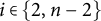 $i {\kern-1pt}\in{\kern-1pt} \{2,n-2\}$
,
$i {\kern-1pt}\in{\kern-1pt} \{2,n-2\}$
, $\mathsf {x} {\kern-1pt}\in{\kern-1pt} \mathfrak {g,}$
and
$\mathsf {x} {\kern-1pt}\in{\kern-1pt} \mathfrak {g,}$
and $\mathsf {Poin}(\mathcal {B}(\mathsf {x},H({\mathbf m}_{\mathbf {{max}}}));q){\kern-1pt}={\kern-1pt}\mathsf {Poin}(X_{s_iw_0};q)$
, then there is some
$\mathsf {Poin}(\mathcal {B}(\mathsf {x},H({\mathbf m}_{\mathbf {{max}}}));q){\kern-1pt}={\kern-1pt}\mathsf {Poin}(X_{s_iw_0};q)$
, then there is some $\lambda \in {\mathbb {C}}$
such that
$\lambda \in {\mathbb {C}}$
such that $\mathsf {x}-\lambda I_n$
is nilpotent of rank two.
$\mathsf {x}-\lambda I_n$
is nilpotent of rank two.
Proof It is shown in [Reference Escobar, Precup and ShareshianEPS21, Example 5.2] that
 $$ \begin{align} \mathsf{Poin}(X_{s_2w_0};q^{1/2})&=\mathsf{Poin}(X_{s_{n-2}w_0};q^{1/2})\\&=[n-2]_q!\left([n]_q[n-1]_q-q^{2n-3}-q^{2n-4}\right).\nonumber \end{align} $$
Combining (7.1) and Theorem 3, we see that if $\mathsf {x} \in \mathfrak {g}$
has eigenvalues
$\mathsf {x} \in \mathfrak {g}$
has eigenvalues $\lambda _1,\ldots ,\lambda _\ell $
with respective multiplicities
$\lambda _1,\ldots ,\lambda _\ell $
with respective multiplicities $d_1,\ldots ,d_\ell $
and
$d_1,\ldots ,d_\ell $
and $i \in \{2,n-2\}$
with
$i \in \{2,n-2\}$
with $\mathsf {Poin}(\mathcal {B}(\mathsf {x},H({\mathbf m}_{\mathbf {{max}}});q))=\mathsf {Poin}(X_{s_iw_0};q),$
then
$\mathsf {Poin}(\mathcal {B}(\mathsf {x},H({\mathbf m}_{\mathbf {{max}}});q))=\mathsf {Poin}(X_{s_iw_0};q),$
then
 $$ \begin{align*}[n]_q[n-2]_q+q^{n-2}\sum_{j=1}^\ell [d_j]_q = [n]_q[n-1]_q-q^{2n-3}-q^{2n-4}, \end{align*} $$
from which it follows that
 $$ \begin{align*}q^{n-1}+q^{n-2}+\sum_{j=1}^\ell[d_j]_q = [n]_q. \end{align*} $$
We see now that if $\mathsf {Poin}(\mathcal {B}(\mathsf {x},H({\mathbf m}_{\mathbf {{max}}}));q)=\mathsf {Poin}(X_{s_iw_0};q)$
under the given conditions on
$\mathsf {Poin}(\mathcal {B}(\mathsf {x},H({\mathbf m}_{\mathbf {{max}}}));q)=\mathsf {Poin}(X_{s_iw_0};q)$
under the given conditions on $\mathsf {x}$
and i, then
$\mathsf {x}$
and i, then $\ell =1$
and
$\ell =1$
and $d_1=n-2$
.
$d_1=n-2$
.
Since $\mathcal {B}(\mathsf {x},H({\mathbf m}_{\mathbf {{max}}}))=\mathcal {B}(\mathsf {x}-\lambda I_n,H({\mathbf m}_{\mathbf {{max}}}))$
for every
$\mathcal {B}(\mathsf {x},H({\mathbf m}_{\mathbf {{max}}}))=\mathcal {B}(\mathsf {x}-\lambda I_n,H({\mathbf m}_{\mathbf {{max}}}))$
for every $\mathsf {x} \in \mathfrak {g}$
and every
$\mathsf {x} \in \mathfrak {g}$
and every $\lambda \in {\mathbb {C}}$
, it suffices now to show that if
$\lambda \in {\mathbb {C}}$
, it suffices now to show that if $\mathsf {x} \in \mathfrak {g}$
is nilpotent of rank two and
$\mathsf {x} \in \mathfrak {g}$
is nilpotent of rank two and $i \in \{2,n-2\}$
, then
$i \in \{2,n-2\}$
, then $\mathcal {B}(\mathsf {x},H({\mathbf m}_{\mathbf {{max}}}))$
and
$\mathcal {B}(\mathsf {x},H({\mathbf m}_{\mathbf {{max}}}))$
and $X_{s_iw_0}$
are not isomorphic. We compare the Euler characteristics of the singular loci of the varieties in question, examining the Schubert varieties first. The next result was conjectured by Lakshmibai and Sandhya in [Reference Lakshmibai and SandhyaLS90] and proved, independently, by Manivel in [Reference ManivelMan01], by Kassel–Lascoux–Reutenauer in [Reference Kassel, Lascoux and ReutenauerKLR03], and by Billey–Warrington in [Reference Billey and WarringtonBW03].
$X_{s_iw_0}$
are not isomorphic. We compare the Euler characteristics of the singular loci of the varieties in question, examining the Schubert varieties first. The next result was conjectured by Lakshmibai and Sandhya in [Reference Lakshmibai and SandhyaLS90] and proved, independently, by Manivel in [Reference ManivelMan01], by Kassel–Lascoux–Reutenauer in [Reference Kassel, Lascoux and ReutenauerKLR03], and by Billey–Warrington in [Reference Billey and WarringtonBW03].
Lemma 7.2 Given $w \in S_n$
, let
$w \in S_n$
, let $Z_w$
consist of all
$Z_w$
consist of all $v \in S_n$
satisfying either
$v \in S_n$
satisfying either
-
(1) There exist
$1 \leq i<j<k<\ell \leq n$
and
$1 \leq i^\prime <j^\prime <k^\prime <\ell ^\prime \leq n$
such that -
(a)
$w_k<w_\ell <w_i<w_j$
; -
(b)
$v_{i^\prime }=w_k$
,
$v_{j^\prime }=w_i$
,
$v_{k^\prime }=w_\ell $
,
$v_{\ell ^\prime }=w_j$
; -
(c) if
$v^\prime $
is obtained from w be replacing
$w_i,w_j,w_k,w_\ell $
with
$w_k,w_i,w_\ell ,w_j$
, respectively, and
$w^\prime $
is obtained from v by replacing
$v_{i^\prime },v_{j^\prime },v_{k^\prime },v_{\ell ^\prime }$
with
$v_{j^\prime },v_{\ell ^\prime },v_{i^\prime },v_{k^\prime }$
, respectively, then (7.2)
$$ \begin{align} v^\prime \leq v \leq w^\prime \leq w \end{align} $$
-
-
(2) There exist
$1 \leq i<j<k<\ell \leq n$
and
$1 \leq i^\prime <j^\prime <k^\prime <\ell ^\prime \leq n$
such that -
(a)
$w_\ell <w_j<w_k<w_i$
; -
(b)
$v_{i^\prime }=w_j$
,
$v_{j^\prime }=w_\ell $
,
$v_{k^\prime }=w_i$
,
$v_{\ell ^\prime }=w_k$
; -
(c) if
$v^\prime $
is obtained from w be replacing
$w_i,w_j,w_k,w_\ell $
with
$w_j,w_\ell ,w_i,w_k$
, respectively, and
$w^\prime $
is obtained from v by replacing
$v_{i^\prime },v_{j^\prime },v_{k^\prime },v_{\ell ^\prime }$
with
$v_{k^\prime },v_{i^\prime },v_{\ell ^\prime },v_{j^\prime }$
, respectively, then (7.3)
$$ \begin{align} v^\prime \leq v \leq w^\prime \leq w \end{align} $$
-


Let $Z_{w, \mathrm {max}}$
be the set of Bruhat maximal elements of
$Z_{w, \mathrm {max}}$
be the set of Bruhat maximal elements of $Z_w$
. Then the singular locus of
$Z_w$
. Then the singular locus of $X_w$
is
$X_w$
is $\bigcup _{v \in Z_{w, \mathrm {max}}}X_v$
.
$\bigcup _{v \in Z_{w, \mathrm {max}}}X_v$
.
Proposition 7.3 Define $v(2)$
and
$v(2)$
and $v(n-2)$
in
$v(n-2)$
in $S_n$
by
$S_n$
by
 $$ \begin{align*}v(2)_i:=\left\{ \begin{array}{@{}ll@{}} n+1-i & 1 \leq i \leq n-4 \\ 2 & i=n-3 \\ 1 & i=n-2 \\ 4 & i=n-1 \\ 3 & i=n \end{array} \right. \end{align*} $$
and
 $$ \begin{align*}v(n-2)_i:=\left\{ \begin{array}{@{}ll@{}} n-2 & i=1 \\ n-3 & i=2 \\ n & i=3 \\ n-1 & i=4 \\ n+1-i & 5 \leq i \leq n. \end{array} \right. \end{align*} $$
Then
-
(1) the singular locus of
$X_{s_2w_0}$
is
$X_{v(2)}$
, and -
(2) the singular locus of
$X_{s_{n-2}w_0}$
is
$X_{v(n-2)}$
.


Proof We begin with (1). Let $w=s_2w_0$
and write
$w=s_2w_0$
and write
 $$ \begin{align*}w=[n,n-1,\ldots,5,4,2,3,1] \end{align*} $$
and
 $$ \begin{align*}v(2)=[n,n-1,\ldots,5,2,1,4,3] \end{align*} $$
in one-line notation. We show first that $v(2) \in Z_w$
. If we set
$v(2) \in Z_w$
. If we set $(i,j,k,\ell )=(i^\prime ,j^\prime ,k^\prime ,\ell ^\prime )=(n-3,n-2,n-1,n),$
we see that Lemma 7.2(2) can be applied, with
$(i,j,k,\ell )=(i^\prime ,j^\prime ,k^\prime ,\ell ^\prime )=(n-3,n-2,n-1,n),$
we see that Lemma 7.2(2) can be applied, with $v^\prime =v=v(2)$
and
$v^\prime =v=v(2)$
and $w^\prime =w$
.
$w^\prime =w$
.
Now assume $v \in Z_w$
. We observe that
$v \in Z_w$
. We observe that $v,w$
must be as in Lemma 7.2(2), with
$v,w$
must be as in Lemma 7.2(2), with $(j,k,\ell )=(n-2,n-1,n)$
. It follows that
$(j,k,\ell )=(n-2,n-1,n)$
. It follows that
 $$ \begin{align*}(v^\prime_{n-2},v^\prime_{n-1},v^\prime_n)=(1,n+1-i,3) \end{align*} $$
for some $i \in [n-3]$
. By the tableau criterion,
$i \in [n-3]$
. By the tableau criterion, $v^\prime \leq v$
implies
$v^\prime \leq v$
implies $1 \in \{v_{n-2},v_{n-1},v_n\}$
. As
$1 \in \{v_{n-2},v_{n-1},v_n\}$
. As $v_{j^\prime }=w_\ell =1$
, we see that
$v_{j^\prime }=w_\ell =1$
, we see that $j^\prime \in \{n-2,n-1,n\}$
. It follows that
$j^\prime \in \{n-2,n-1,n\}$
. It follows that $(j^\prime ,k^\prime ,\ell ^\prime )=(n-2, n-1,n)$
. Therefore,
$(j^\prime ,k^\prime ,\ell ^\prime )=(n-2, n-1,n)$
. Therefore,
 $$ \begin{align*}(v_{n-2},v_{n-1},v_n)=(w_\ell,w_i,w_k)=(1,n+1-i,3), \end{align*} $$
for some $i \in [n-3]$
. Applying the tableau criterion again, we get that
$i \in [n-3]$
. Applying the tableau criterion again, we get that $v \leq v(2)$
. Indeed,
$v \leq v(2)$
. Indeed, $I_{p,q}(v)\le I_{p,q}(w_0) = I_{p,q}(v(2))$
for
$I_{p,q}(v)\le I_{p,q}(w_0) = I_{p,q}(v(2))$
for $(p,q)\notin \{(1,n-3),(1,n-2),(2,n-2), (1,n-1), (2,n-1)\}$
and the remaining cases follow from our analysis. So,
$(p,q)\notin \{(1,n-3),(1,n-2),(2,n-2), (1,n-1), (2,n-1)\}$
and the remaining cases follow from our analysis. So, $Z_{w, \mathrm {max}}=\{v(2)\}$
and (1) follows from Lemma 7.2.
$Z_{w, \mathrm {max}}=\{v(2)\}$
and (1) follows from Lemma 7.2.
The proof of (2) is similar: If we set $w=s_{n-2}w_0,$
we conclude that
$w=s_{n-2}w_0,$
we conclude that $v(n-2) \in Z_w$
by applying Lemma 7.2(2) with
$v(n-2) \in Z_w$
by applying Lemma 7.2(2) with $(i,j,k,\ell )=(1,2,3,4)$
. If
$(i,j,k,\ell )=(1,2,3,4)$
. If $v \in Z_w$
, then
$v \in Z_w$
, then $v,w$
must be as in Lemma 7.2(2) with
$v,w$
must be as in Lemma 7.2(2) with $(i,j,k)=(1,2,3)$
. Now
$(i,j,k)=(1,2,3)$
. Now $(v^\prime _1,v^\prime _2,v^\prime _3)=(n-2,n+1-\ell ,n)$
for some
$(v^\prime _1,v^\prime _2,v^\prime _3)=(n-2,n+1-\ell ,n)$
for some $4 \leq \ell \leq n$
. By the tableau criterion,
$4 \leq \ell \leq n$
. By the tableau criterion, $n \in \{v_1,v_2,v_3\}$
, hence
$n \in \{v_1,v_2,v_3\}$
, hence $(i^\prime ,j^\prime ,k^\prime )=(1,2,3)$
and
$(i^\prime ,j^\prime ,k^\prime )=(1,2,3)$
and $(v_1,v_2,v_3)=(n-2,n+1-\ell ,n)$
. It follows that
$(v_1,v_2,v_3)=(n-2,n+1-\ell ,n)$
. It follows that $v \leq v(n-2)$
, and this implies (2).
$v \leq v(n-2)$
, and this implies (2).
Corollary 7.4 If $i \in \{2,n-2\}$
and
$i \in \{2,n-2\}$
and $v(i)$
is as in Proposition 7.3, then the Euler characteristic of
$v(i)$
is as in Proposition 7.3, then the Euler characteristic of $X_{v(i)}$
satisfies
$X_{v(i)}$
satisfies
 $$ \begin{align*}\chi(X_{v(i)})=(n-2)!(n^2-5n+6). \end{align*} $$
Proof We obtain the Euler characteristic by counting the number of $u \leq v(i)$
in the Bruhat order. Fix
$u \leq v(i)$
in the Bruhat order. Fix $u=[u_1,\ldots , u_n] \in S_n$
. Using the tableau criterion, we see that
$u=[u_1,\ldots , u_n] \in S_n$
. Using the tableau criterion, we see that $u \not \leq v(2)$
if and only if
$u \not \leq v(2)$
if and only if $\{u_{n-1},u_n\} \cap \{1,2\} \neq \emptyset $
and
$\{u_{n-1},u_n\} \cap \{1,2\} \neq \emptyset $
and $u \not \leq v(n-2)$
if and only if
$u \not \leq v(n-2)$
if and only if $\{u_1,u_2\} \cap \{n-1,n\} \neq \emptyset $
. The corollary follows from a straightforward inclusion–exclusion argument.
$\{u_1,u_2\} \cap \{n-1,n\} \neq \emptyset $
. The corollary follows from a straightforward inclusion–exclusion argument.
Proposition 7.5 Assume $\mathsf {x} \in \mathfrak {g}$
is nilpotent of rank two and consider the Hessenberg vector
$\mathsf {x} \in \mathfrak {g}$
is nilpotent of rank two and consider the Hessenberg vector ${\mathbf m}=(1,n-1,\ldots ,n-1,n)$
.
${\mathbf m}=(1,n-1,\ldots ,n-1,n)$
.
-
(1) If
$\mathsf {x}^2=0$
, then
$\chi (\mathcal {B}(\mathsf {x},H({\mathbf m})))=(n-2)!(n^2-5n+8)$
. -
(2) If
$\mathsf {x}^2 \neq 0$
, then
$\chi (\mathcal {B}(\mathsf {x},H({\mathbf m})))=(n-2)!(n^2-5n+7)$
.


Proof We use Theorem 1, assuming without loss of generality that $\mathsf {x}$
is in highest form and permuted Jordan form. So, we fix any prime
$\mathsf {x}$
is in highest form and permuted Jordan form. So, we fix any prime $p>2$
and count flags
$p>2$
and count flags $0=V_0\subset V_1\subset \dots \subset V_n={\mathbb F}_p^n$
satisfying
$0=V_0\subset V_1\subset \dots \subset V_n={\mathbb F}_p^n$
satisfying
-
(a)
$V_1 \subseteq \ker (\bar {\mathsf {x}}),$
and -
(b)
$\operatorname {\mathrm {Im}}(\bar {\mathsf {x}}) \subseteq V_{n-1}$
.


Note that Remark 2.2 allows us to replace $\bar {\mathsf {x}}V_{n-1} \subseteq V_{n-1}$
, implied by our choice of
$\bar {\mathsf {x}}V_{n-1} \subseteq V_{n-1}$
, implied by our choice of ${\mathbf m}$
, with (b) as stated.
${\mathbf m}$
, with (b) as stated.
We observe that $\bar {\mathsf {x}}^2=0$
if and only if
$\bar {\mathsf {x}}^2=0$
if and only if $\mathsf {x}^2=0$
and consider first the case
$\mathsf {x}^2=0$
and consider first the case $\mathsf {x}^2=0$
. We fix one-dimensional
$\mathsf {x}^2=0$
. We fix one-dimensional $Z\subset {\mathbb F}_p^n$
and count flags satisfying (a) and (b) in which
$Z\subset {\mathbb F}_p^n$
and count flags satisfying (a) and (b) in which $V_1=Z$
. If
$V_1=Z$
. If $Z \subseteq \operatorname {\mathrm {Im}}(\bar {\mathsf {x}}),$
then we can choose
$Z \subseteq \operatorname {\mathrm {Im}}(\bar {\mathsf {x}}),$
then we can choose $V_{n-1}$
to be any of the
$V_{n-1}$
to be any of the $[n-2]_p$
hyperplanes in
$[n-2]_p$
hyperplanes in ${\mathbb F}_p^n$
containing the two-dimensional subspace
${\mathbb F}_p^n$
containing the two-dimensional subspace $\operatorname {\mathrm {Im}}(\bar {\mathsf {x}})$
and then choose
$\operatorname {\mathrm {Im}}(\bar {\mathsf {x}})$
and then choose $V_2,\ldots ,V_{n-2}$
in any of
$V_2,\ldots ,V_{n-2}$
in any of $[n-2]_p!$
ways. Since
$[n-2]_p!$
ways. Since $\dim \operatorname {\mathrm {Im}}(\bar {\mathsf {x}})=2,$
there are
$\dim \operatorname {\mathrm {Im}}(\bar {\mathsf {x}})=2,$
there are $[2]_p$
possibilities for Z and it follows that there are
$[2]_p$
possibilities for Z and it follows that there are
 $$ \begin{align*}[2]_p[n-2]_p[n-2]_p! \end{align*} $$
flags satisfying (a) and (b) in which $V_1 \subset \operatorname {\mathrm {Im}}(\bar {\mathsf {x}})$
.
$V_1 \subset \operatorname {\mathrm {Im}}(\bar {\mathsf {x}})$
.
Now consider the case of one-dimensional $Z\subset {\mathbb F}_p^n$
such that
$Z\subset {\mathbb F}_p^n$
such that $Z \subseteq \ker (\bar {\mathsf {x}})$
and
$Z \subseteq \ker (\bar {\mathsf {x}})$
and ${Z \not \subseteq \operatorname {\mathrm {Im}}(\bar {\mathsf {x}})}$
. Since
${Z \not \subseteq \operatorname {\mathrm {Im}}(\bar {\mathsf {x}})}$
. Since $\bar {\mathsf {x}}^2=0$
, we know that
$\bar {\mathsf {x}}^2=0$
, we know that $\operatorname {\mathrm {Im}}(\bar {\mathsf {x}}) \subseteq \ker (\bar {\mathsf {x}})$
. Therefore, there are
$\operatorname {\mathrm {Im}}(\bar {\mathsf {x}}) \subseteq \ker (\bar {\mathsf {x}})$
. Therefore, there are $[n-2]_p-[2]_p$
possibilities for Z. Having fixed one such Z, we can choose
$[n-2]_p-[2]_p$
possibilities for Z. Having fixed one such Z, we can choose $V_{n-1}$
containing
$V_{n-1}$
containing $Z+\operatorname {\mathrm {Im}}(\bar {\mathsf {x}})$
in
$Z+\operatorname {\mathrm {Im}}(\bar {\mathsf {x}})$
in $[n-3]_p$
ways, and then choose
$[n-3]_p$
ways, and then choose $V_2,\ldots ,V_{n-2}$
in
$V_2,\ldots ,V_{n-2}$
in $[n-2]_p!$
ways. We see there are
$[n-2]_p!$
ways. We see there are
 $$ \begin{align*}\left([n-2]_p-[2]_p\right)[n-3]_p[n-2]_p! \end{align*} $$
flags satisfying (a) and (b) in which $V_1 \not \subseteq \operatorname {\mathrm {Im}}(\bar {\mathsf {x}})$
. Direct computation, along with Theorem 1, gives
$V_1 \not \subseteq \operatorname {\mathrm {Im}}(\bar {\mathsf {x}})$
. Direct computation, along with Theorem 1, gives
 $$ \begin{align*}\mathsf{Poin}(\mathcal{B}(\mathsf{x},{\mathbf m});q)=[n-2]_{q^2}!\left([n-2]_{q^2}[n-3]_{q^2}+(1+q^2)q^{2n-6}\right), \end{align*} $$
and (1) follows.
The case $\mathsf {x}^2 \neq 0$
is handled similarly. We observe first that in this case
$\mathsf {x}^2 \neq 0$
is handled similarly. We observe first that in this case
 $$ \begin{align*}\dim(\ker(\bar{\mathsf{x}}) \cap \operatorname{\mathrm{Im}}(\bar{\mathsf{x}}))=1. \end{align*} $$
Arguing as we did above, consider first the case in which $V_1 = \ker (\bar {\mathsf {x}}) \cap \operatorname {\mathrm {Im}}(\bar {\mathsf {x}})$
. Then we calculate that there are
$V_1 = \ker (\bar {\mathsf {x}}) \cap \operatorname {\mathrm {Im}}(\bar {\mathsf {x}})$
. Then we calculate that there are
 $$ \begin{align*}[n-2]_p[n-2]_p! \end{align*} $$
flags satisfying (a), (b), and $V_1 = \ker (\bar {\mathsf {x}}) \cap \operatorname {\mathrm {Im}}(\bar {\mathsf {x}})$
. On the other hand, if
$V_1 = \ker (\bar {\mathsf {x}}) \cap \operatorname {\mathrm {Im}}(\bar {\mathsf {x}})$
. On the other hand, if $V_1\not \subseteq \operatorname {\mathrm {Im}}(\bar {\mathsf {x}}),$
we get
$V_1\not \subseteq \operatorname {\mathrm {Im}}(\bar {\mathsf {x}}),$
we get
 $$ \begin{align*}p[n-3]_p[n-3]_p[n-2]_p! \end{align*} $$
flags satisfying (a) and (b). As above, Theorem 1 now yields
 $$ \begin{align*}\mathsf{Poin}(\mathcal{B}(\mathsf{x},{\mathbf m});q)=[n-2]_{q^2}!\left([n-2]_{q^2}+q^2[n-3]_{q^2}^2\right) \end{align*} $$
and (2) follows.
Propositions 7.4 and 7.5 together imply that the singular loci of the Schubert variety $X_{s_iw_0}$
(for
$X_{s_iw_0}$
(for $i\in \{2, n-2\}$
) and that of the Hessenberg variety
$i\in \{2, n-2\}$
) and that of the Hessenberg variety $\mathcal {B}(\mathsf {x}, H({\mathbf m}_{\mathbf {{max}}}))$
(where
$\mathcal {B}(\mathsf {x}, H({\mathbf m}_{\mathbf {{max}}}))$
(where $\mathsf {x}$
is nilpotent of rank two) are not isomorphic. The proof of Corollary 7 is now complete.
$\mathsf {x}$
is nilpotent of rank two) are not isomorphic. The proof of Corollary 7 is now complete.
8 Proof of Theorem 6
We use Lemma 5.1 to show that for $n\ge 3$
, the Hessenberg variety
$n\ge 3$
, the Hessenberg variety $\mathcal {B}(\mathsf {x},H({\mathbf m}_{\mathbf {{max}}}))$
is a reduced scheme for any
$\mathcal {B}(\mathsf {x},H({\mathbf m}_{\mathbf {{max}}}))$
is a reduced scheme for any $\mathsf {x}\in \mathfrak {g}$
. Recall the definition of
$\mathsf {x}\in \mathfrak {g}$
. Recall the definition of $A_g \in M_{n\times n}({\mathbb {C}}[{\mathbf z}])$
from (5.2). The next result suffices, since
$A_g \in M_{n\times n}({\mathbb {C}}[{\mathbf z}])$
from (5.2). The next result suffices, since $\det (A_g)$
generates the ideal defining each open neighborhood
$\det (A_g)$
generates the ideal defining each open neighborhood $\mathcal {N}_{g,\mathsf {x}}^{{\mathbf m}_{\mathbf {{max}}}}$
of
$\mathcal {N}_{g,\mathsf {x}}^{{\mathbf m}_{\mathbf {{max}}}}$
of $gB\in \mathcal {B}(\mathsf {x}, H({\mathbf m}_{\mathbf {{max}}}))$
(cf. Lemma 5.1).
$gB\in \mathcal {B}(\mathsf {x}, H({\mathbf m}_{\mathbf {{max}}}))$
(cf. Lemma 5.1).
Proposition 8.1 Assume $n\geq 3$
. If
$n\geq 3$
. If $gB \in \mathcal {B}(\mathsf {x},H({\mathbf m}_{\mathbf {{max}}}))$
, then
$gB \in \mathcal {B}(\mathsf {x},H({\mathbf m}_{\mathbf {{max}}}))$
, then $\det (A_g)$
generates a radical ideal in
$\det (A_g)$
generates a radical ideal in ${\mathbb {C}}[{\mathbf z}]$
.
${\mathbb {C}}[{\mathbf z}]$
.
We will need two preliminary lemmas to prove Proposition 8.1. Recall that, given a set S of variables, a term order on S is a total ordering $\preceq $
of the set
$\preceq $
of the set $\mathcal {M}(S)$
of monomials in the elements of S satisfying, for all
$\mathcal {M}(S)$
of monomials in the elements of S satisfying, for all $\mu _1, \mu _2 \in \mathcal {M}(S)$
and all
$\mu _1, \mu _2 \in \mathcal {M}(S)$
and all $s \in S$
, the conditions
$s \in S$
, the conditions
-
•
$\mu _1 \prec \mu _1s$
, and -
•
$\mu _1s \preceq \mu _2s$
whenever
$\mu _1 \preceq \mu _2$
.


We observe that $1$
is the minimum element of
$1$
is the minimum element of $\mathcal {M}(S)$
with respect to any term order.
$\mathcal {M}(S)$
with respect to any term order.
Given a polynomial $f \in {\mathbb {C}}[S]$
, the initial term
$f \in {\mathbb {C}}[S]$
, the initial term ${\text i}{\text n}_\preceq (f)$
of f is the monomial appearing with nonzero coefficient in f that is maximal with respect to
${\text i}{\text n}_\preceq (f)$
of f is the monomial appearing with nonzero coefficient in f that is maximal with respect to $\preceq $
. If
$\preceq $
. If $I=(f_1,\ldots , f_k)$
is an ideal in
$I=(f_1,\ldots , f_k)$
is an ideal in ${\mathbb {C}}[S]$
, the initial ideal
${\mathbb {C}}[S]$
, the initial ideal ${\text i}{\text n}_\preceq (I)$
is
${\text i}{\text n}_\preceq (I)$
is $({\text i}{\text n}_\preceq (g)\mid g \in I)$
. It is straightforward to show that if
$({\text i}{\text n}_\preceq (g)\mid g \in I)$
. It is straightforward to show that if $I=(f)$
is a principal ideal, then
$I=(f)$
is a principal ideal, then ${\text i}{\text n}_\preceq (I)=({\text i}{\text n}_\preceq (f))$
.
${\text i}{\text n}_\preceq (I)=({\text i}{\text n}_\preceq (f))$
.
The next result is well known (see, e.g., [Reference Herzog and HibiHH11, Proposition 3.3.7]).
Lemma 8.2 Let I be an ideal in ${\mathbb {C}}[S]$
. If
${\mathbb {C}}[S]$
. If ${\text i}{\text n}_\preceq (I)$
is square-free with respect to some term order on
${\text i}{\text n}_\preceq (I)$
is square-free with respect to some term order on $\mathcal {M}(S)$
, then I is radical.
$\mathcal {M}(S)$
, then I is radical.
Given a total ordering $<_S$
of the variables in S, the associated lexicographic term order on
$<_S$
of the variables in S, the associated lexicographic term order on $\mathcal {M}(S)$
is obtained by setting
$\mathcal {M}(S)$
is obtained by setting $\mu _1 \preceq \mu _2$
if and only if, when the variables appearing in
$\mu _1 \preceq \mu _2$
if and only if, when the variables appearing in $\mu _1=s_1\ldots s_j$
and
$\mu _1=s_1\ldots s_j$
and $\mu _2=t_1\ldots t_k$
are written in weakly decreasing order, either
$\mu _2=t_1\ldots t_k$
are written in weakly decreasing order, either $j \leq k$
and
$j \leq k$
and $s_i=t_i$
for all
$s_i=t_i$
for all $i \in [j]$
or there is some r such that
$i \in [j]$
or there is some r such that $s_i=t_i$
for all
$s_i=t_i$
for all $i<r$
and
$i<r$
and $s_r<_S t_r$
.
$s_r<_S t_r$
.
The following lemma is the key technical result of this section.
Lemma 8.3 Let $m\geq n\geq 3$
,
$m\geq n\geq 3$
, ${\mathbf z} = \{z_{ji} \mid 1\leq i<j\leq n\} \sqcup \{z_{j1} \mid n+1\leq j \leq m\}$
, and
${\mathbf z} = \{z_{ji} \mid 1\leq i<j\leq n\} \sqcup \{z_{j1} \mid n+1\leq j \leq m\}$
, and $\ell _1, \ldots , \ell _n\in {\mathbb {C}}[z_{21}, \ldots , z_{m1}]$
be (not necessarily homogeneous) linear polynomials. Let
$\ell _1, \ldots , \ell _n\in {\mathbb {C}}[z_{21}, \ldots , z_{m1}]$
be (not necessarily homogeneous) linear polynomials. Let $u\in M_{n,n}({\mathbb {C}}[{\mathbf z}])$
be as in (5.1) and define
$u\in M_{n,n}({\mathbb {C}}[{\mathbf z}])$
be as in (5.1) and define
 $$ \begin{align} &L:=[\ell|u_1|\dots |u_{n-1}] \in M_{n,n}({\mathbb{C}}[{\mathbf z}]) \\ &\qquad \qquad\qquad\qquad \mathrm{where }\ {\ell}:=\sum_{i=1}^n \ell_ie_i \in M_{n,1}({\mathbb{C}}[z_{21}, \ldots, z_{m1}]). \nonumber \end{align} $$
Then
-
(1)
$\det (L)=0$
if and only if
$\ell =cu_1$
for some
$c\in {\mathbb {C}}$
. -
(2) Moreover, there exists a lexicographic term order
$\preceq $
on
$\mathcal {M}({\mathbf z})$
such that
${\text i}{\text n}_\preceq (\det (L))$
is square-free.


Proof The backward direction of (1) is obvious. To prove the forward direction and (2), we proceed by induction on n.
Suppose $n=3$
. Now
$n=3$
. Now
 $$ \begin{align} \det(L) = \det \begin{bmatrix} \ell_1 & 1 & 0 \\ \ell_2 & z_{21} & 1\\ \ell_3 & z_{31} & z_{32} \end{bmatrix} = (z_{32}z_{21}-z_{31})\ell_1 -z_{32}\ell_2+\ell_3. \end{align} $$
Write $\ell _i = a_{i1}+\sum _{j=2}^m a_{ij}z_{j1}$
for
$\ell _i = a_{i1}+\sum _{j=2}^m a_{ij}z_{j1}$
for $1\leq i \leq 3$
. Substituting these expressions into (8.2) and collecting like terms, we obtain the following formula for
$1\leq i \leq 3$
. Substituting these expressions into (8.2) and collecting like terms, we obtain the following formula for $\det (L)$
:
$\det (L)$
:
 $$ \begin{align} & a_{12}z_{32}z_{21}^2+a_{13}z_{32}z_{31}z_{21}+ (a_{11}-a_{22})z_{32}z_{21} -a_{12}z_{31}z_{21}-a_{13}z_{31}^2 \\ \nonumber& \quad\quad\quad\quad -a_{23}z_{32}z_{31} -a_{21}z_{32} +a_{32}z_{21} + (a_{33}-a_{11})z_{31}+a_{31} \\ \nonumber& \quad\quad\quad\quad + \left( \sum_{j=4}^m a_{1j}z_{32}z_{21}z_{j1} - a_{1j}z_{31}z_{j1} -a_{2j}z_{32}z_{j1} +a_{3j}z_{j1}\right). \end{align} $$
If (8.3) is the zero polynomial, then $a_{ij} = 0$
whenever
$a_{ij} = 0$
whenever $i\neq j$
and
$i\neq j$
and $a_{11}=a_{22}=a_{33}$
. The forward direction of (1) now follows. Notice that (8.3) has only two monomial terms containing squares:
$a_{11}=a_{22}=a_{33}$
. The forward direction of (1) now follows. Notice that (8.3) has only two monomial terms containing squares: $z_{32}z_{21}^2$
with coefficient
$z_{32}z_{21}^2$
with coefficient $a_{12}$
and
$a_{12}$
and $z_{31}^2$
with coefficient
$z_{31}^2$
with coefficient $a_{13}$
. If
$a_{13}$
. If $a_{13}=0$
and
$a_{13}=0$
and $a_{12}=0,$
then (2) is immediate, as (8.3) is then a sum of square-free monomials. By inspection, if
$a_{12}=0,$
then (2) is immediate, as (8.3) is then a sum of square-free monomials. By inspection, if $a_{13}\neq 0,$
then the lexicographic term order
$a_{13}\neq 0,$
then the lexicographic term order $\preceq $
associated with a total ordering of
$\preceq $
associated with a total ordering of ${\mathbf z}$
in which
${\mathbf z}$
in which $z_{32}$
is the maximal element and
$z_{32}$
is the maximal element and $z_{31}$
is the maximal element of
$z_{31}$
is the maximal element of ${\mathbf z}\setminus \{z_{32}\}$
yields
${\mathbf z}\setminus \{z_{32}\}$
yields ${\text i}{\text n}_\preceq (\det (L)) = z_{32}z_{31}z_{21}$
. The final case is
${\text i}{\text n}_\preceq (\det (L)) = z_{32}z_{31}z_{21}$
. The final case is $a_{13}= 0$
and
$a_{13}= 0$
and $a_{12}\neq 0$
. Taking the lexicographic term order
$a_{12}\neq 0$
. Taking the lexicographic term order $\preceq $
associated with a total ordering of
$\preceq $
associated with a total ordering of ${\mathbf z}$
in which
${\mathbf z}$
in which $z_{21}$
is the maximal element and
$z_{21}$
is the maximal element and $z_{31}$
is the maximal element of
$z_{31}$
is the maximal element of ${\mathbf z}\setminus \{z_{21}\}$
gives
${\mathbf z}\setminus \{z_{21}\}$
gives ${\text i}{\text n}_\preceq (\det (L)) = z_{31}z_{21}$
. This completes the proof of the base case.
${\text i}{\text n}_\preceq (\det (L)) = z_{31}z_{21}$
. This completes the proof of the base case.
Assume now that $n>3$
. For
$n>3$
. For $i,j \in [n],$
write
$i,j \in [n],$
write $L(i,j)$
for the matrix obtained from L by deleting the
$L(i,j)$
for the matrix obtained from L by deleting the $i^{th}$
row and the
$i^{th}$
row and the $j^{th}$
column. Expanding along the last column, we see that
$j^{th}$
column. Expanding along the last column, we see that
 $$ \begin{align} \det(L) = \pm z_{n,n-1}\det(L(n,n)) \mp \det(L(n-1,n)). \end{align} $$
Let ${\mathbf z}' = \{ z_{ji} \mid 1\leq i<j \leq n-1 \} \sqcup \{ z_{j1} \mid n\leq j \leq m \}$
and note that
${\mathbf z}' = \{ z_{ji} \mid 1\leq i<j \leq n-1 \} \sqcup \{ z_{j1} \mid n\leq j \leq m \}$
and note that $L(n,n) \in M_{n-1,n-1} ({\mathbb {C}}[{\mathbf z}'])$
.
$L(n,n) \in M_{n-1,n-1} ({\mathbb {C}}[{\mathbf z}'])$
.
Suppose first that $\det (L(n,n))=0$
. By the induction hypothesis, there exists
$\det (L(n,n))=0$
. By the induction hypothesis, there exists $c\in {\mathbb {C}}$
such that
$c\in {\mathbb {C}}$
such that $\ell _1 = c $
and
$\ell _1 = c $
and $\ell _i = cz_{i1}$
for
$\ell _i = cz_{i1}$
for $2\leq i \leq n-1$
. We observe that, in this case,
$2\leq i \leq n-1$
. We observe that, in this case, $\det (L) = \pm \det (L(n-1,n))= \pm (\ell _n - cz_{n1})$
. If
$\det (L) = \pm \det (L(n-1,n))= \pm (\ell _n - cz_{n1})$
. If $\det (L)=0,$
then
$\det (L)=0,$
then $\ell _n = cz_{n1}$
, proving (1). Claim (2) follows immediately from the fact that
$\ell _n = cz_{n1}$
, proving (1). Claim (2) follows immediately from the fact that $\ell _n$
is linear.
$\ell _n$
is linear.
Next suppose $\det (L(n,n))\neq 0$
. Since
$\det (L(n,n))\neq 0$
. Since $z_{n,n-1}$
does not appear in any monomial term of
$z_{n,n-1}$
does not appear in any monomial term of $\det (L(n-1,n))$
, we have
$\det (L(n-1,n))$
, we have $\det (L)\neq 0$
and (1) is vacuously true. By the induction hypothesis, there exists a lexicographic term order
$\det (L)\neq 0$
and (1) is vacuously true. By the induction hypothesis, there exists a lexicographic term order $\preceq '$
on
$\preceq '$
on $\mathcal {M}({\mathbf z}')$
such that
$\mathcal {M}({\mathbf z}')$
such that ${\text i}{\text n}_{\preceq '}(\det (L(n,n)))$
is square-free. Let
${\text i}{\text n}_{\preceq '}(\det (L(n,n)))$
is square-free. Let $\preceq $
be the lexicographic term order associated with any total order which respects the total order on
$\preceq $
be the lexicographic term order associated with any total order which respects the total order on ${\mathbf z}'$
corresponding to
${\mathbf z}'$
corresponding to $\preceq '$
and with maximal element
$\preceq '$
and with maximal element $z_{n,n-1}$
. Equation (8.4) now implies
$z_{n,n-1}$
. Equation (8.4) now implies ${\text i}{\text n}_\preceq (\det (L)) = z_{n,n-1}{\text i}{\text n}_{\preceq '}(\det (L(n,n)))$
. The proof is now complete.
${\text i}{\text n}_\preceq (\det (L)) = z_{n,n-1}{\text i}{\text n}_{\preceq '}(\det (L(n,n)))$
. The proof is now complete.
We are now ready to prove Proposition 8.1.
Proof of Proposition 8.1
Set $\mathsf {y}:=g^{-1}\mathsf {x}g$
and
$\mathsf {y}:=g^{-1}\mathsf {x}g$
and
 $$ \begin{align*}A^{\prime}_g:=[\mathsf{y}u_1|u_1|\dots |u_{n-1}]. \end{align*} $$
Comparing $A_g'$
to the definition of
$A_g'$
to the definition of $A_g$
in (5.2), we observe that
$A_g$
in (5.2), we observe that $A_g=gA^{\prime }_g$
, hence
$A_g=gA^{\prime }_g$
, hence $\det (A^{\prime }_g)$
and
$\det (A^{\prime }_g)$
and $\det (A_g)$
generate the same ideal in
$\det (A_g)$
generate the same ideal in ${\mathbb {C}}[{\mathbf z}]$
. Now
${\mathbb {C}}[{\mathbf z}]$
. Now $A^{\prime }_g$
is as in Lemma 8.3, where
$A^{\prime }_g$
is as in Lemma 8.3, where
 $$ \begin{align*} \ell_i = \mathsf{y}_{i1} + \sum_{j=2}^n \mathsf{y}_{ij} z_{j1} \; \text{ for } \; i=1, 2, \ldots, n. \end{align*} $$
The next example demonstrates that the assumption $n\geq 3$
was necessary in the statements of Proposition 8.1 and Lemma 8.3. Indeed, the example shows that
$n\geq 3$
was necessary in the statements of Proposition 8.1 and Lemma 8.3. Indeed, the example shows that $\mathcal {B}(\mathsf {x}, {\mathbf m}_{\mathbf {{max}}})$
is not reduced when
$\mathcal {B}(\mathsf {x}, {\mathbf m}_{\mathbf {{max}}})$
is not reduced when $n=2$
and
$n=2$
and $\mathsf {x}$
is nilpotent.
$\mathsf {x}$
is nilpotent.
Example 8.4 Let $\mathsf {y}=\begin {bmatrix} 0&\mathsf {y}_{12}\\ 0&0 \end {bmatrix}$
, where
$\mathsf {y}=\begin {bmatrix} 0&\mathsf {y}_{12}\\ 0&0 \end {bmatrix}$
, where $\mathsf {y}_{12}\in {\mathbb {C}}^*$
. If
$\mathsf {y}_{12}\in {\mathbb {C}}^*$
. If $A_g'$
is as in the proof of Proposition 8.1, we have that
$A_g'$
is as in the proof of Proposition 8.1, we have that $A_g'=\begin {bmatrix} \mathsf {y}_{12}z_{21}&1\\ 0&z_{21} \end {bmatrix}$
and
$A_g'=\begin {bmatrix} \mathsf {y}_{12}z_{21}&1\\ 0&z_{21} \end {bmatrix}$
and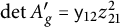 $\det A_{g}'=\mathsf {y}_{12}z_{21}^2$
does not generate a radical ideal.
$\det A_{g}'=\mathsf {y}_{12}z_{21}^2$
does not generate a radical ideal.


 Open access

