





Introduction
The commercialization of glyphosate-resistant (GR) sugar beet in 2007 provided a new chemical option for postemergence weed control in North America (Green Reference Green2009). Prior to its commercialization, research near Scottsbluff, Nebraska, confirmed the use of glyphosate in GR sugar beet improved weed control to about 95% compared with 55% to 90% weed control in non-GR sugar beet, while minimizing crop injury and reducing herbicide cost (Kniss et al. Reference Kniss, Wilson, Martin, Burgener and Feuz2004). Kniss et al. (Reference Kniss, Wilson, Martin, Burgener and Feuz2004) observed that glyphosate applied two times postemergence to a GR sugar beet variety increased net return by US$435 ha−1 compared with conventional and micro-rate (repeated applications of low-dose herbicides with oil adjuvants) weed control practices, although that research did not account for differences in GR seed costs. After commercialization, Kniss (Reference Kniss2010) documented an advantage of US$576 ha−1 with GR sugar beet over conventional weed management programs after accounting for differences in herbicide, tillage, and seed costs.
Given the challenges of conventional herbicide programs and the economic advantage of GR sugar beet, it was not surprising that the adoption of GR sugar beet was rapid after it was commercialized (USDA-ERS 2024). By 2012, 97% of sugar beet grown in the United States was resistant to glyphosate (James Reference James2012). Commercialization of GR sugar beet was an opportunity for growers to switch from intensive herbicide applications to fewer herbicide applications (Morishita Reference Morishita2017). However, the overreliance on glyphosate for weed management in regions where GR sugar beet is grown has resulted in the selection of GR weeds.
By the end of 2008, 10 GR weed species had been reported in 29 states, including Michigan, Minnesota, Nebraska, and North Dakota, all states where sugar beets are grown (Heap Reference Heap2024a, Reference Heap2024b). By 2024, at least one GR weed had been confirmed in sugar beet fields in the western states of Colorado, Idaho, Montana, Oregon, and Wyoming (Heap Reference Heap2024a); and Nebraska (Lawrence and Kniss Reference Lawrence and Kniss2021). Currently, GR waterhemp [Amaranthus tuberculatus (Moq.) Sauer] has also been reported in Idaho and Nebraska (Heap Reference Heap2024a). GR kochia has been reported in Idaho, Oregon, Wyoming (Heap Reference Heap2024a), Nebraska (Lawrence and Kniss Reference Lawrence and Kniss2021), and Colorado (Araujo et al. Reference Araujo, Westra, Shergill and Gaines2024); and GR Palmer amaranth has become especially problematic in Colorado, Idaho (Heap Reference Heap2024b), and Nebraska (Lawrence and Kniss Reference Lawrence and Kniss2021). Dicamba-resistant Palmer amaranth has been reported in Colorado and Nebraska (Araujo et al. Reference Araujo, Westra, Shergill and Gaines2024). In western Nebraska, an average Palmer amaranth density of 0.4 plants m row−1 has been estimated to cause a nearly 50% yield loss of sugar beet (Schultz and Lawrence Reference Schultz and Lawrence2020). Similar to herbicide-resistant Palmer amaranth reported in western states, dicamba-resistant kochia has also been reported in Colorado, Idaho, Montana, Nebraska, and North Dakota (Heap Reference Heap2024b).
Cycloate and ethofumesate are herbicides that inhibit the synthesis of very-long-chain fatty acids (VLCFAs) and are registered for preemergence or early postemergence use on sugar beet (Bayer 2018; Helm Agro Reference Agro2023; HRAC 2025; Shaner Reference Shaner2014). A field experiment in Colorado observed ≤59% control of common lambsquarters, kochia, and redroot pigweed when cycloate and ethofumesate were applied pre-plant incorporated singly at 1.12 kg ai ha−1. When cycloate and ethofumesate were applied as a tank mixture, control increased to 75% (Schweizer Reference Schweizer1979), but in a later experiment in Minnesota and North Dakota, researchers observed ≤81% common lambsquarters, redroot pigweed, and waterhemp control when ethofumesate was applied postemergence at even higher rates (4.42 kg ai ha−1), although crop injury was high (Lystad and Peters Reference Lystad and Peters2023). Despite ethofumesate’s activity on other pigweed (Amaranthus spp.) species such as redroot pigweed and waterhemp, it has no activity on Palmer amaranth (Lawrence and Kniss Reference Lawrence and Kniss2021; Peters and Aberle Reference Peters and Aberle2024). Beiermann et al. (Reference Beiermann, Creech, Knezevic, Jhala, Harveson and Lawrence2021) observed 90% control of cotyledon-size Palmer amaranth with an application of desmedipham + phenmedipham (other VLCFA synthesis inhibitors). However, due to crop injury concerns, these herbicides can be safely applied only after the 2 true-leaf (TL) stage of sugar beet. Acetochlor, dimethenamid-P, and S-metolachlor are other VLCFA synthesis–inhibiting herbicides for controlling not-yet-emerged herbicide-resistant Palmer amaranth, but due to crop injury, the product labels indicate the herbicides should be applied only after the 2 TL stage (Adjesiwor et al. Reference Adjesiwor, Alder and Felix2025; BASF 2019, 2021; Syngenta 2024). As of 2023, no preemergence herbicide options were available that are effective for controlling GR Palmer amaranth in the sugar beet production region of the western United States.
Metamitron (4-amino-3-methyl-6-phenyl-1,2,4-triazin-5(4H)-one) is categorized by the Herbicide Resistance Action Committee (HRAC) as a Group 5 selective herbicide that inhibits the photosystem II process by specifically targeting the D1 protein in the thylakoid membrane of the chloroplasts, thereby destroying the photosynthetic electron transport chain (Shaner Reference Shaner2014). Metamitron applied preemergence at 4.2 kg ha−1 has been reported to provide nearly 90% control of redroot pigweed in a 2-yr trial near Wrocław, Poland (Trajdos et al. Reference Trajdos, Kucharski and Sadowski2014). Metamitron, marketed in Europe and other parts of the world as Goltix Gold (ADAMA, Tahunanui, New Zealand) has not been previously evaluated for broadleaf weed control in sugar beet in the United States. However, given its use outside the United States in sugar beet production and its efficacy on redroot pigweed (Trajdos et al. Reference Trajdos, Kucharski and Sadowski2014), metamitron may be a viable herbicide for controlling herbicide-resistant broadleaf weeds in the United States. Therefore, the objectives of this research were to evaluate the efficacy of metamitron applied preemergence alone, as a tank-mixture partner with ethofumesate, and applied preemergence followed by lay-by applications of soil-active herbicides for control of broadleaf weeds in the western United States sugar beet production region. Our hypothesis was that metamitron-based weed control programs would provide equivalent control of broadleaf weeds as glyphosate applied postemergence.
Materials and Methods
Site Description
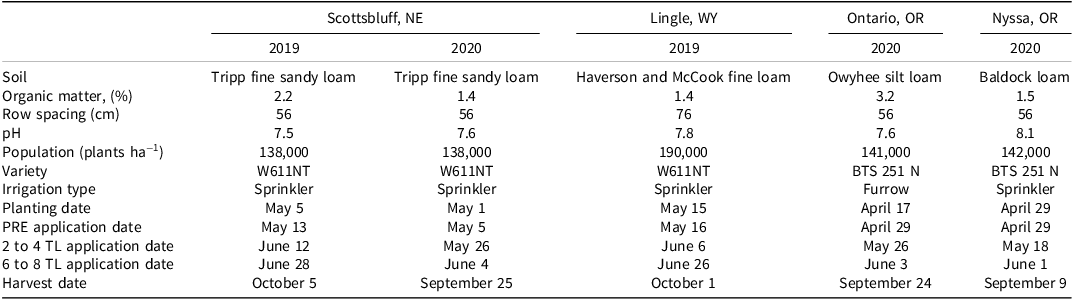
Field trials were conducted at the University of Nebraska-Lincoln Panhandle Research and Extension Center, in Scottsbluff (41.89°N, 103.68°W) and the University of Wyoming James C. Hageman Sustainable Agriculture Research and Extension Center, in Lingle (42.13°N, 104.39°W) in 2019. Trials were repeated in 2020 at the same location in Scottsbluff, and at two locations in Oregon: Nyssa, at the Amalgamated Sugar Company Nyssa Research Station (43.87°N, 116.99°W); and Ontario, at the Oregon State University Malheur Experiment Station (43.98°N, 117.02°W). The soils and organic matter (OM) content of soils across trial locations were a Tripp fine sandy loam (mesic Aridic Haplustolls) with 2.2% OM and 1.4% OM in Scottsbluff in 2019 and 2020, respectively; a Haverson and McCook fine loam (mesic Aridic Ustifluvents) with 1.4% OM in Lingle; Baldock loam (mesic Typic Calciaquolls) with 1.5% OM in Nyssa; and Owyhee silt loam (mesic Xeric Haplocalcids) with 3.2% OM in Ontario (Table 1). All plots were conventionally tilled to control any weed that had emerged before sugar beet planting. Irrigation was necessary for sugar beet production at all locations. At the Ontario location, furrow irrigation was used, while at the remaining locations, overhead irrigation was used (Table 1). The Scottsbluff location had a natural infestation of common lambsquarters and Palmer amaranth in both years. The Lingle and Ontario field sites were naturally infested with common lambsquarters and redroot pigweed, with kochia also present at the Nyssa location. When the experiments were being conducted, Palmer amaranth near Scottsbluff was susceptible to glyphosate, whereas more than 20% of the kochia population near Nyssa was estimated to be resistant to glyphosate.
Site description of trial locations and herbicide application dates a .

a Abbreviations: PRE, preemergence; TL, true-leaf stage of sugar beet
Experimental Design and Herbicide Treatment
The experiment was designed as a randomized complete block design with four replications at the Scottsbluff, Lingle, and Ontario locations, and six replications at the Nyssa location. Sugar beet varieties Crystal W611NT GEM 100 and Beta BTS 251 N (Betaseed Inc., Shakopee, MN) were planted between April 17 and May 15 at densities between 138,000 and 190,000 seeds ha−1, in 56-cm or 76-cm row spacing depending on trial location (Table 1). Planting dates, seeding rates, and plant spacing were within the typical range for sugar beet production in the sugar beet production regions of Idaho, Nebraska, Oregon, and Wyoming (Adjesiwor et al. Reference Adjesiwor, Felix and Morishita2021; Kniss et al. Reference Kniss, Sbatella and Wilson2012; Yonts et al. Reference Yonts, Wilson, Smith, Wilson, Smith and Jasa2013). Based on soil analysis before planting, fertilizers were applied at locally recommended rates (data not shown).
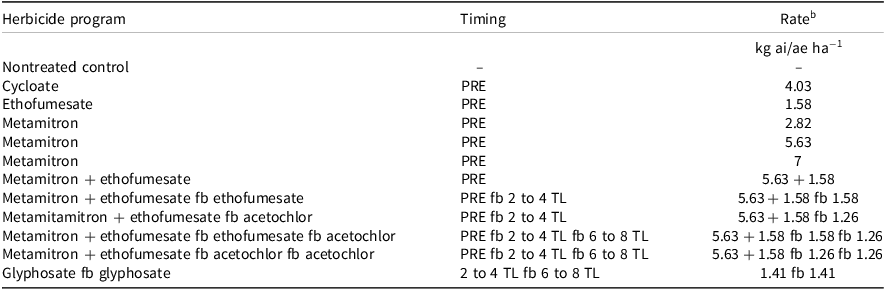
Across all trial locations and years treatments consisted of cycloate (4.03 kg ai ha−1), ethofumesate (1.58 kg ai ha−1), and three different rates of metamitron (2.82 kg ai ha−1, 5.63 kg ai ha−1, and 7 kg ai ha−1) applied alone preemergence; metamitron (5.63 kg ai ha−1) + ethofumesate (1.58 kg ai ha−1) applied preemergence followed by (fb) ethofumesate (1.58 kg ai ha−1) or acetochlor (1.26 kg ai ha−1) applied at the 2 to 4 TL stage of sugar beet; and metamitron (5.63 kg ai ha−1) + ethofumesate (1.58 kg ai ha−1) applied preemergence fb ethofumesate (1.58 kg ai ha−1) or acetochlor (1.26 kg ai ha−1) applied at the 2 to 4 TL stage fb acetochlor (1.26 kg ai ha−1) applied at the 6 to 8 TL stage (Tables 2 and 3). For comparison purposes, a nontreated control plot and plots that received two applications of glyphosate (1.41 kg ae ha−1) at the 2 to 4 TL and 6 to 8 TL stages of sugar beet were included to serve as check plots (Table 2). At each trial location, sugar beet growth stage was determined by hand-counting true leaves on five randomly selected plants in the nontreated control plots.
Herbicide combinations, application times, and herbicide rates evaluated for weed control a .
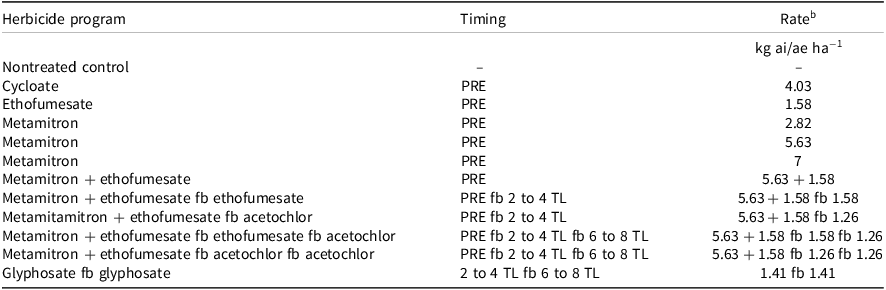
a Abbreviations: fb, followed by; PRE, preemergence; TL, true leaf stage of sugar beet.
b Application rate: glyphosate (1.41 ae ha−1) was applied with ammonium sulfate at 18 g L−1 + a nonionic surfactant at 5 mL L−1.
Herbicides evaluated for weed control a .

a Abbreviations: HRAC, Herbicide Resistance Action Committee; POST, postemergence; PRE, preemergence.
b HRAC categorizes herbicides into groups according to the herbicide’s site of action.
c Manufacturer locations: ADAMA Agricultural Solutions, Raleigh, NC; Albaugh LLC, Ankeny, IA; Bayer CropScience, St. Louis, MO; Helm Agro US, Inc., Tampa, FL.
d Glyphosate was applied with ammonium sulfate at 18 g L−1 + a nonionic surfactant at 5 mL L−1.
At the Scottsbluff location, preemergence applications occurred on May 13 and May 5, in 2019 and 2020, respectively, and on May 16 at the Lingle location in 2019. Preemergence applications occurred on April 29 at both the Nyssa and Ontario locations in 2020 (Table 1). Trial plots were irrigated with 12.6 mm of water within 24 h of preemergence herbicide application to ensure good incorporation. Herbicides applied at the 2 to 4 TL stage occurred on June 6 or June 12 during the first run of the experiment, depending on trial location, and on May 18 and May 26 during the second run of the experiment. When sugar beet was at the 6 to 8 TL stage, herbicides were applied on June 26 or June 28, and between June 1 and June 3 during the first and second run of field experiments, respectively, depending on trial location (Table 1). All soil-active postemergence herbicides were applied with 6.4 mm of irrigation water within 24 h of the application.
All herbicides were sprayed using a CO2-pressurized backpack sprayer with movement at a constant speed of 5 km h−1 with the spray boom maintained 51 cm above the ground. Spray booms used at the Scottsbluff and Ontario locations were equipped with Teejet 11003 AIXR nozzles (TeeJet Technologies, Springfield, IL), while TeeJet DG 8002 and TeeJet DG 11002 nozzles were used at the Lingle and Nyssa locations, respectively. All spray equipment was calibrated to deliver 140 L ha−1 of spray solution.
Data Collection
Densities of common lambsquarters, Palmer amaranth, and redroot pigweed were assessed 11 (±2) wk after the herbicide treatment (WAT) when sugar beet was at the 6 to 8 TL stage, depending on trial location in 2019, and 16 WAT (±2), depending on trial location in 2020. At each assessment timing, two 0.5-m2 quadrats were randomly placed in the center rows of each plot, and weeds were identified by species and counted. At the end of the growing season, aboveground kochia wet biomass was collected at the Nyssa location. Two 0.5-m2 quadrats were randomly placed in the center rows of each plot, and all kochia plants within each quadrat were harvested at the soil surface. Wet biomass was weighed immediately after harvest.
Sugar beet plants were defoliated, and the center rows were mechanically harvested. At the Scottsbluff location, this occurred on October 5 and September 25 in 2019 and 2020, respectively; and at the Lingle location in 2019, this happened on October 1. Sugar beets were mechanically harvested on September 9 and September 24 at the Nyssa and Ontario locations, respectively (Table 1). If sugar beet plants were too small to be picked up with the lifter wheel on the harvester due to weed pressure, a yield of zero was recorded for the plot. A subsample of 11 kg root weight from each treatment plot was collected to evaluate sugar quality. Sugar beet subsamples from the Scottsbluff site were analyzed in a laboratory at the Western Sugar factory in Scottsbluff, whereas subsamples from the Nyssa and Ontario locations were analyzed at the Amalgamated Sugary Beet Quality Laboratory in Paul, Idaho. Sugar beet subsamples from the Lingle location were not analyzed for sugar quality.
Estimated recoverable sugar (ERS), calculated in kilogram per hectare, was calculated using the equation presented by Grove et al. (Reference Grove, Holy, Cattanach and Christenson2007), as follows: $\begin{align}{\rm{ERS}}\,\left( {{\rm{kg}}\, {\rm{h}}{{\rm{a}}^{ - 1}}} \right) =& \left( {{{\% \,{\rm{sucrose\;content}} - \% \,{\rm{SLM}}}}\over{{100}}} \right)\\& \times {\rm{root\;yield}}\,\left( {{\rm{kg}}\, {\rm{h}}{{\rm{a}}^{ - 1}}} \right)\,\;\;\;\;\;\;\;\;\left[ 1 \right]\end{align}$
where SLM is the percent of sucrose lost to molasses.
Statistical Analysis
Data were analyzed using R statistical software (version 4.4.1) (R Core Team 2023). Common lambsquarters, Palmer amaranth, and redroot pigweed density data were analyzed using a generalized mixed-effect model (GLMM) with the glmer function in the lme4 package (version 1.1-37) using the Poisson error distribution and a square-root link function (Bates et al. Reference Bates, Maechler, Bolker and Walker2015). However, back-transformed data are reported for interpretation. Kochia wet biomass was analyzed using a linear mixed-effect model (LMM) with the lmer function in the lme4 package. In the GLMM for common lambsquarters and redroot pigweed density, herbicide treatments were specified as fixed effects, while study locations and blocking criteria were considered random effects. Because Palmer amaranth was present only at the Scottsbluff site in both years, herbicide treatments were considered fixed effects, and study years and blocking criteria were considered as random effects. Herbicide treatment and blocking criteria were set as fixed and random effects, respectively, in LMM for kochia because kochia was present only at the Nyssa location. Treatments with no variations in weed response (all observations equal to zero) were excluded from statistical analysis to improve model estimation.
Sugar beet yield and ERS were analyzed by location using a LMM with the lmer function in the lme4 package (version 1.1-37) (Bates et al. Reference Bates, Maechler, Bolker and Walker2015). Percentages of kochia control were similar across most treatments (data not shown), and this poor control was likely a significant contribution to reductions in sugar beet yield and ERS. Weed population dynamics, particularly those of kochia, varied by location. For example, at the Nyssa location, sugar beet root yield was anticipated to be heavily affected because kochia averaged 25 plants m−2 in nontreated control plots (data not shown). Hence, sugar beet root yield and ERS were expected to respond differently to herbicide combinations depending on location. Pooling yield and ERS data could mask location-specific observations. Therefore, data for sugar beet root yield and ERS are presented by location. Conversely, blocking criteria were specified as random effects within the LMM for sugar beet yield and ERS.
Analysis of variance assumptions of normality of variance for the LMM were tested to assess the model fit (Onofri et al. Reference Onofri, Carbonell, Piepho, Mortimer and Cousens2010). The significant effect of herbicide treatments on response variables at a 5% significance level was determined using the Anova function in the car package (version 3.1-2) (Fox and Weisberg Reference Fox and Weisberg2019) and anova function from the lmerTest package (Kuznetsova et al. Reference Kuznetsova, Brockhoff and Christensen2017) for GLMM and LMM, respectively.
Post hoc mean separation by treatment was conducted at a 5% significant level using the emmeans function in the emmeans package (version 2.0.0) (Lenth and Piaskowski Reference Lenth and Piaskowski2025). Compact letter display was generated using the cld method for emmGrid objects, which applies the Piepho (Reference Piepho2004) algorithm to summarize statistically distinct treatment means based on pairwise comparisons.
Results and Discussion
Palmer Amaranth
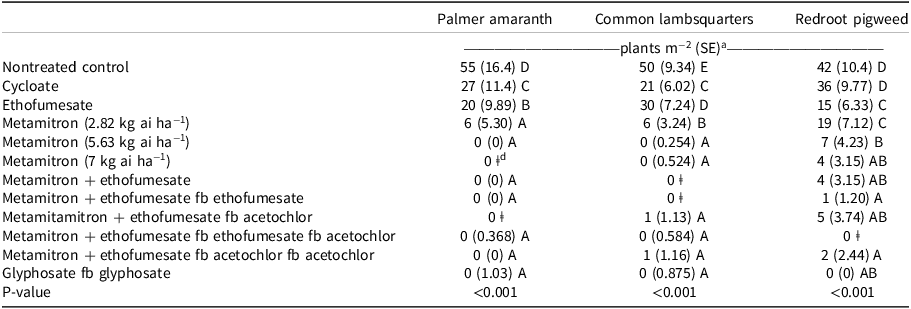
Palmer amaranth density was significantly affected by herbicide treatments (P < 0.001; Table 4). All herbicide treatments reduced Palmer amaranth densities compared with densities in the nontreated checks. Different rates of metamitron applied alone preemergence provided >89% Palmer amaranth density reduction relative to nontreated check plots. Metamitron (5.63 kg ai ha−1) + ethofumesate applied alone preemergence provided 100% control. All treatments containing at least 5.63 kg ai −1 metamitron applied preemergence resulted in Palmer amaranth density reductions of ≥99% compared with nontreated control plots. However, metamitron (2.82 kg ai ha−1) applied preemergence provided 89% Palmer amaranth density reduction relative to nontreated controls.
Palmer amaranth, common lambsquarters, and redroot pigweed density as affected by herbicidesa–c.

a Abbreviations: fb, followed by; SE, standard error.
b Mean weed density followed by the same alphabetical letter within columns are not significantly different at α = 0.05. Weed species density data were analyzed independently; hence columns are not comparable.
c The rate of metamitron in tank mixtures of metamitron + ethofumesate was 5.63 kg ai ha−1.
d Treatments were removed from statistical analysis to improve model fit due to lack of variance.
Although Palmer amaranth control between plots sprayed preemergence with single herbicides and preemergence fb postemergence treatments were not statistically different (Table 4), there is greater potential for subsequent flushes of Palmer amaranth from preemergence-alone treatments. Beiermann et al. (Reference Beiermann, Creech, Knezevic, Jhala, Harveson and Lawrence2021) noted that application of VLCFA-inhibiting herbicides as a layby suppressed GR Palmer amaranth that has not yet emerged, therefore, following the observed soil-residual activity of metamitron applied preemergence, an overlapping application of VLCFA-inhibiting herbicides may extend Palmer amaranth control. In the literature, Miranda et al. (Reference Miranda, Jhala, Bradshaw and Lawrence2024) observed >85% control of acetolactate synthase–resistant Palmer amaranth in dry edible bean (Phaseolus vulgaris L.) by overlapping VLCFA-inhibiting herbicides.
Consistent with the findings of this research, Striegel et al. (Reference Striegel, Eskridge, Lawrence, Knezevic, Kruger, Proctor, Hein and Jhala2020) reported nearly 99% control of Palmer amaranth approximately 40 d after a preemergence application of metribuzin in a tank mixture with other soil-active herbicides when applied to soybean [Glycine max (L.) Merr.]. Metribuzin, an asymmetric triazinone and photosynthesis inhibitor at photosystem II, has a chemical structure that is similar to that of metamitron (Shaner Reference Shaner2014) and has been reported to provide >90% control of plants in the Amaranthaceae family when applied preemergence (Meyers and Shankle Reference Meyers and Shankle2017).
Common Lambsquarters
Any herbicide combination that contained at least 5.63 kg ai ha−1 of metamitron applied preemergence provided ≥98% control of common lambsquarters (P < 0.001; Table 4). Similar to our observations in this research, metamitron + ethofumesate applied preemergence provided nearly 100% control of common lambsquarters in a sugar beet trial in Poland (Miziniak Reference Miziniak2022). We observed a reduction in metamitron’s residual activity when it was applied preemergence at 2.82 kg ai ha−1 compared with rates ≥5.63 kg ai ha−1 (Table 5). Similar to our observation, Trajdos et al. (Reference Trajdos, Kucharski and Sadowski2014) reported 10% greater common lambsquarters control when metamitron (4.2 kg ai ha−1) was applied preemergence relative to metamitron (2.8 kg ai ha−1) applied preemergence. Metamitron applied preemergence is reported to control common lambsquarters by up to 98% when it is activated by rain or irrigation (Deveikyte et al. Reference Deveikyte, Sarunaite, Seibutis, Price, Kelton and Sarunaite2015).
Mixed-model analysis of variance for the effect of herbicide treatment on kochia wet biomass near Nyssa, Oregon, in a weed control trial in 2020a,b .

a Abbreviation: DF, degrees of freedom.
b Treatment effects were evaluated using am F-test with Satterthwaite-adjusted degrees of freedom.
c P-value is based on F-test for kochia wet biomass.
Redroot Pigweed
Compared with nontreated control plots, redroot pigweed density was reduced after all herbicide treatments except cycloate (Table 4). When metamitron was applied alone preemergence at 2.82 kg ai ha−1, redroot pigweed density dropped by 55% relative to nontreated control plots. When metamitron by itself was applied at 5.63 kg ai ha−1, redroot pigweed density dropped by 83% compared with nontreated check plots. A single preemergence application of metamitron (7 kg ai ha−1), and metamitron + ethofumesate reduced redroot pigweed density by 90% compared with nontreated controls. Consistent with our observation, control of common lambsquarters and Palmer amaranth, metamitron (7 kg ai ha−1) applied preemergence or metamitron (5.63 kg ai ha−1) + ethofumesate applied preemergence alone or fb sequential postemergence applications were similar to two applications of glyphosate. Similar to our results, Trajdos et al. (Reference Trajdos, Kucharski and Sadowski2014) reported >90% redroot pigweed early season control with a single application of metamitron (4.2 kg ai ha−1) applied preemergence.
Kochia
The herbicide treatments evaluated in our trials had no significant effect on kochia wet biomass (P = 0.871; Table 5). However, kochia density was reduced by 65% in the glyphosate-treated plots relative to the nontreated control plots (data not shown). The biomass data reflects GR kochia that was present throughout the study, but which constituted only a minority of the kochia population and recovered by the end of the season to have similar biomass as other treatments.
Sugar Beet Root Yield and Estimated Recoverable Sugar
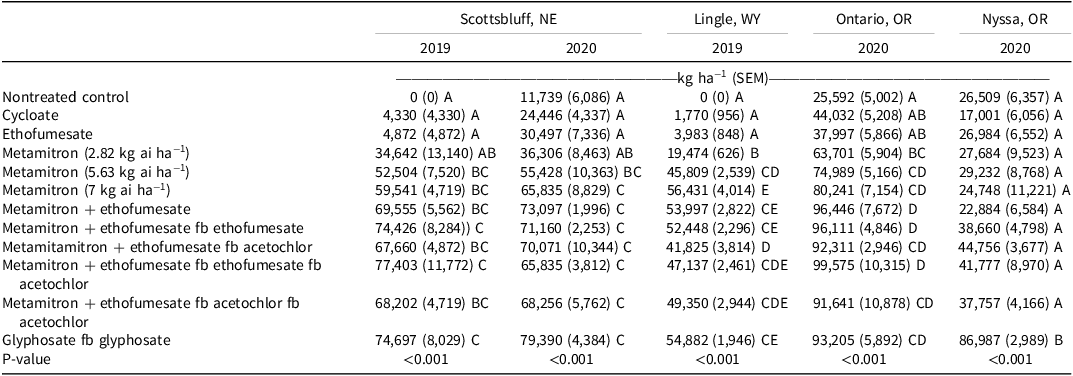
Evaluated herbicide treatments significantly influenced sugar beet root yield and ERS (P < 0.001; Table 6). In Scottsbluff, Lingle, and Ontario, the nontreated control plots produced the lowest sugar beet root yield. In Scottsbluff, Lingle, and Ontario, where kochia was not present, all herbicide treatments resulted in a higher sugar beet root yield than the nontreated control plots. Plots treated with cycloate or ethofumesate provided <45,000 kg ha−1 sugar beet root yield. In Nyssa, sugar beet root yield from treatments that contained metamitron + ethofumesate applied preemergence provided a sugar beet root yield of ≤44,756 kg ha−1. However, in Scottsbluff, Lingle, and Ontario, treatments that contained metamitron + ethofumesate applied preemergence averaged a sugar beet yield of ≥69,000 kg ha−1. Sugar beet yield was significantly greater in the glyphosate check plot at Nyssa. As discussed previously, the glyphosate-treated plots did exhibit a significant reduction in kochia density, which is reflected in the yield data, but the biomass was similar at the end of the season. The critical time of weed removal in sugar beet is estimated to be between 2 and 12 wk after planting (Salehi et al. Reference Salehi, Esfandiari and Mashadi2007), which helps contextualize why the early season to mid-season density reduction was more impactful on yield at Nyssa than the late season biomass data. In Scottsbluff, Lingle, and Ontario, where kochia was not present, sugar beet root yield from treatments that contained a single preemergence application of metamitron + ethofumesate was comparable to that of two postemergence applications of glyphosate.

a Abbreviations: followed by; SEM, standard error of the mean.
b Mean yield figures followed by the same alphabetical letter within columns indicates a nonstatistical difference between treatments at α = 0.05. Sugar beet root yield was analyzed separately by location; hence columns are not comparable.
c The rate of metamitron in tank mixtures of metamitron + ethofumesate was 5.63 kg ai ha−1.
Sugar beet root yield was reduced by ≥70% in the nontreated control plots compared with high-yielding treatments across all locations in both runs of field trials (Table 6). Similar to our observation at all four locations, Soltani et al. (Reference Soltani, Dille, Gulden, Sprague, Zollinger, Morishita, Lawrence, Sbatella, Kniss, Jha and Sikkema2018) estimated 70% sugar beet root yield loss in research plots where no weed control was practiced. However, in Scottsbluff and Lingle in 2019 where weeds averaged ≥90 plants m−2 in the nontreated control plots (data not shown), we observed a sugar beet root yield loss as high as 100%.
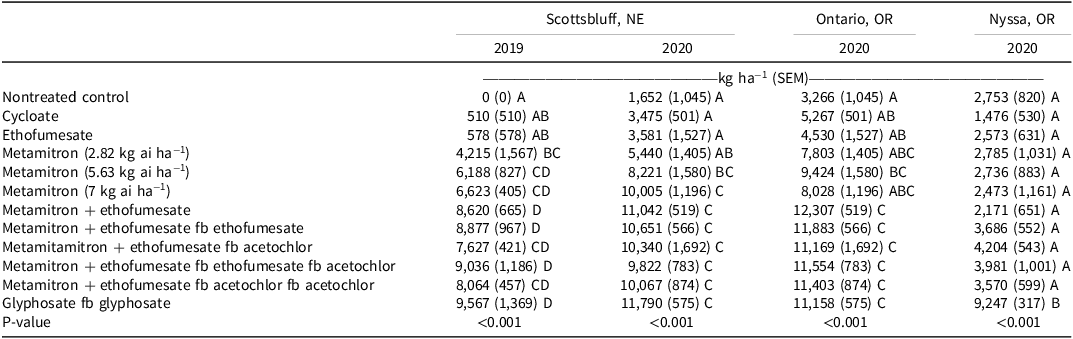
It is important to reiterate that sugar beet subsamples from the experimental site at Lingle, Wyoming, were not subjected to sugar beet quality analysis. Consequently, ERS results are not presented from those plots. ERS was not significantly influenced by cycloate and ethofumesate applied preemergence, compared with the nontreated control ERS (Table 7). This may be due to <66% weed control provided by the aforementioned treatments. Weed interference in sugar beet reduces both root yield and sucrose content. Longden (Reference Longden1989) reported a positive correlation between increasing weed and sugar beet density and a reduction in sucrose levels. Although no statistical differences were observed among preemergence applications of metamitron (2.83 kg ai ha−1), cycloate, and ethofumesate, the ERS values from metamitron (2.83 kg ai ha−1) applied preemergence were between 1,859 to 3,637 kg ha−1 more across most locations, with minimal differences observed in Nyssa. At the Scottsbluff and Ontario sites, where kochia was not present, the ERS from plots sprayed with herbicide combinations that contained metamitron at rates greater than 2.82 kg ai ha−1 was not statistically different from the ERS that resulted from two sequential postemergence applications of glyphosate. This was expected because most treatments with metamitron (≥5.63 kg ai ha−1) provided comparable control of Palmer amaranth, common lambsquarters, and redroot pigweed as repeated applications of glyphosate (Table 4). In Scottsbluff and Ontario, the ERS from plots sprayed with metamitron (5.63 kg ai ha−1) + ethofumesate applied alone preemergence was 31% to 39% higher than metamitron (5.63 kg ai ha−1) applied alone preemergence. This observation was consistent with data showing a 28% increase in sugar beet yield provided by metamitron + ethofumesate relative to metamitron applied alone. At the Scottsbluff and Ontario sites, the ERS for the glyphosate program was between 9,567 and 11,790 kg ha−1, whereas the ERS for herbicide applications that contained metamitron (≥5.63 kg ai ha−1) was between 6,188 and 12,307 kg ha−1, depending on trial location.

a Abbreviations: followed by; SEM, standard error of the mean.
b Mean estimated recoverable sugar followed by the same alphabetical letter within columns indicates a nonstatistical difference between treatments at α = 0.05.Estimated recoverable sugar was analyzed separately by location; hence columns are not comparable.
c The rate of metamitron in tank mixtures of metamitron + ethofumesate was 5.63 kg ai ha−1.
Practical Implications
This research underscores the possibility of including metamitron in sugar beet chemical weed control practices to improve the management of economically important weeds. Although metamitron (5.63 kg ai ha−1) applied preemergence will provide control of Palmer amaranth, common lambsquarters, and redroot pigweed comparable to that of metamitron (5.63 kg ai ha−1) + ethofumesate applied preemergence, including ethofumesate in a tank mixture will reduce the selection for potential metamitron resistance. Metamitron + ethofumesate will provide residual activity to suppress Palmer amaranth, common lambsquarters, and redroot pigweed until VLCFA synthesis–inhibiting herbicides can be applied to sugar beet at the 2 to 4 TL stage, allowing for extended suppression of weed emergence. For stewardship of metamitron herbicide programs and management of kochia, it will be important for sugar beet growers to diversify their weed management practices to include mechanical weed control and crop rotations.
Acknowledgments
Sugar beet seeds for this research were provided by KWS Seeds, Inc.
Funding
Funding for this research was provided by Western Sugar Cooperative.
Competing Interests
The authors declare they have no competing interests.



 Open access

