





Introduction
Speech prosody is essential to communication, helping distinguish questions from statements, signaling conversational turn-taking, emphasizing new or important information, and marking syntactic boundaries. Through variations in pitch, intensity, duration, and rhythm, speakers convey meaning, emotion, and intent beyond the literal words they use. Despite the recognized importance of prosody in speech perception, teaching English prosody is not always incorporated into second language (L2) learning curricula (Lengeris, Reference Lengeris and Romero-Trillo2012; for review of trends in L2 speech perception training see: Ingvalson, Ettlinger, & Wong, Reference Ingvalson, Ettlinger and Wong2014; for discussion on effectiveness of prosody training see: Chun & Levis, Reference Chun, Levis, Gussenhoven and Chen2020) and can be challenging for English language learners (e.g., Polish, Rojczyk & Porzuczek, Reference Rojczyk, Porzuczek and Gabryś-Barker2012; Mandarin Chinese, Yu & Gibbon, Reference Yu and Gibbon2015; French, Frost & Picavet, Reference Frost and Picavet2014; Korean, Shin & Speer, Reference Shin and Speer2012). The relatively lesser emphasis on prosody compared to pronunciation or grammar in teaching English as a foreign language (EFL) may stem from the assumption that prosody only conveys nuanced lexical and phrasal information that is context-specific. By contrast, mispronunciation of individual phonemes can obviously change the intended word’s meaning or referent. Nonetheless, while contextual information may sometimes compensate for misinterpreted or incorrectly produced prosody, prosodic mistakes can lead to communication breakdowns. For example, misplacing a pause in a sentence like “Let’s eat, Grandma!” versus “Let’s eat Grandma!” can mean the difference between a warm invitation and a scenario more akin to 19th-century German fairytales. The relatively limited focus on speech prosody in L2 pedagogy is even more surprising given that very often, intelligible and comprehensible pronunciation is set as a goal for L2 learners. Moreover, accurate prosody is associated with the degree of perceived intelligibility (Kang, Thomson, & Moran, Reference Kang, Thomson and Moran2020), comprehensibility, and nativelikeness (Trofimovich & Baker, Reference Trofimovich and Baker2006).
There has been continued interest in English prosody in second language acquisition research (e.g., Baek, Reference Baek2021, Reference Baek2024; Liu, Reference Liu2021; Sun, Saito, & Tierney, Reference Sun, Saito and Tierney2021; Kachlicka et al., Reference Kachlicka, Symons, Ruan, Saito, Dick and Tierney2025; for discussion about the place of suprasegmentals in EFL teaching see: Wang, Reference Wang2020; for overview of prior work on prosody see: at the word level, Jongman & Tremblay, Reference Jongman, Tremblay, Gussenhoven and Chen2020; at the sentence level, Trouvain & Braun, Reference Trouvain, Braun, Gussenhoven and Chen2020), emphasizing a range of difficulties experienced by learners. What makes understanding prosody in a new language particularly challenging is that acoustic patterns conveying prosody are not uniform across languages. In English, word stress placement is not entirely predictable and must be memorized as a part of each word’s pronunciation (Cutler, Reference Cutler, Reed and Lewis2015). This unpredictability can cause substantial difficulty for L2 English learners, particularly those whose native languages have fixed-stress patterns such as Polish (primary stress on penultimate syllable; Wierzchowska, Reference Wierzchowska1971; Domahs, Knaus, Orzechowska, & Wiese, Reference Domahs, Knaus, Orzechowska and Wiese2012), French (final syllable stress; Peperkamp & Dupoux, Reference Peperkamp, Dupoux, Gussenhoven and Warner2002), Finnish, or Hungarian (initial syllable stress; Peperkamp, Vendelin, & Dupoux, Reference Peperkamp, Vendelin and Dupoux2010). Acoustic cues used to identify word stress also differ across learners from various language backgrounds (for review see: Gordon & Roettger, Reference Gordon and Roettger2017). For instance, while vowel quality was shown to be the strongest cue to perceiving lexical stress for all groups, pitch served as the second strongest cue for native speakers of English and Mandarin Chinese. In contrast, Russian speakers tend to disregard pitch and instead rely more heavily on duration and intensity to determine stress (Chrabaszcz, Winn, Lin, & Idsardi, Reference Chrabaszcz, Winn, Lin and Idsardi2014). Korean speakers also used vowel quality as a primary cue, similarly to native speakers, using F0 and intensity to a lesser degree (Lee, Reference Lee2022).
Similarly at the sentence level, patterns of acoustic prominence in English can signal meaning by bringing information into focus. As a linguistic phenomenon, focus is an integral part of sentences’ semantic structure (Rooth, Reference Rooth1992) and serves to emphasize new or important information (identificational vs. contrastive focus, Kiss, Reference Kiss1998; but see Gussenhoven, Reference Gussenhoven, Lee, Gordon and Buring2008 for a more in-depth discussion describing five additional types of focus in English, namely: corrective, counter-presuppositional, definitional, contingency, and reactivating). However, not all languages utilize prominence in the same way (e.g., Russian vs. English, Ionin, Luchkina, & Goldshtein, Reference Ionin, Luchkina and Goldshtein2024; French vs. English, Vander Klok, Goad, & Wagner, Reference Vander Klok, Goad and Wagner2018; Mandarin vs. English, Chikako et al., Reference Chikako, Kao, Baek, Yeung, Hwang and Broselow2018; Taiwanese Mandarin vs. English, Tseng & Su, Reference Tseng and Su2014), and some languages such as Northern Sotho from Bantu language family lack prosodic focus-marking (Zerbian, Reference Zerbian, Delais-Roussarie, Avanzi and Herment2015). These differences add another level of difficulty to L2 learning and contribute to varied language learning outcomes. For example, Spanish learners of English have trouble perceiving L2 sentence focus, possibly due to the rigidity of the phrasal prominence in their L1 (Lee, Shin, & Martinez Garcia, Reference Lee, Shin and Martinez Garcia2019), while Mandarin Chinese speakers rely more on F0 contour to perceive the prominence (Chen, Reference Chen2025) drawing on the importance of F0 in their L1. Cantonese Chinese speakers also use pitch as a primary cue in production: they produce emphasized words with consistently higher F0, even though they can reliably use duration and intensity cues to signal sentence emphasis (although they use intensity less than L1 English speakers, Ng & Chen, Reference Ng and Chen2011).
Cross-linguistic differences are also evident in how acoustic cues signal phrase boundaries (e.g., perception, English vs. Japanese, Pinter, Mizuguchi, & Tateishi, Reference Pinter, Mizuguchi and Tateishi2014; English vs. Mandarin Chinese, Zhang et al., Reference Zhang, Ding, Zelchenko, Cui, Lin, Zhan and Zhang2018; Kuang, Chan, & Rhee, Reference Kuang, Chan and Rhee2022; Fang, Li, Yu, Schwieter, & Wang, Reference Fang, Li, Yu, Schwieter and Wang2025; English vs. French, Gilbert, Lee, Wolpert, & Baum, Reference Gilbert, Lee, Wolpert and Baum2023; production, English vs. Korean, Baek, Reference Baek2021; English vs. German, O’Brien, Jackson, & Gardner, Reference O’Brien, Jackson and Gardner2014). While phonological phrase-final lengthening is often considered a reliable cue for segmentation, even in unfamiliar languages, its interpretation is not universal. For example, Ordin and colleagues (Reference Ordin, Polyanskaya, Laka and Nespor2017) demonstrated that German and Spanish-Basque native speakers benefited from word-final lengthening when segmenting an artificial language, whereas Italian native speakers showed greater sensitivity to penultimate syllable lengthening. Conversely, antepenultimate lengthening impeded boundary detection by Spanish and Italian speakers, suggesting that prosodic cues are interpreted according to language-specific stress patterns and may hinder segmentation when they conflict with listeners’ native prosodic expectations. Indeed, when comparing the perception of English phrase boundaries by native speakers of English and Mandarin Chinese, clear differences in cue use emerged (Zhang, Reference Zhang2012). English listeners relied predominantly on pauses, using pitch and lengthening of pre-boundary word to a lesser extent, whereas Mandarin Chinese listeners relied more heavily on pitch than on the other two cues. In another study comparing phrase boundary production of native English speakers and Korean learners of English, English L1 speakers used pauses, elevated pitch, and intensity, while Korean learners of English relied mainly on pre-boundary lengthening and pause (Baek, Reference Baek2021).
Given the relatively small selection of tools designed specifically for prosody assessments (for review see: Kalathouttukaren, Purdy, & Ballard, Reference Kalathottukaren, Purdy and Ballard2015), existing studies on prosody acquisition often rely on datasets that comprise large corpora of annotated spontaneous speech, recorded audio-video material, or short story readings (e.g., Aix-MARSEC, Auran, Bouzon, & Hirst, Reference Auran, Bouzon and Hirst2004; LeaP: The Learning the Prosody of a foreign Language, Edalatishams, Reference Edalatishams, O’Brien and Levis2017; Speak & Improve Corpus 2025, Knill, Nicholls, Gales, Qian, & Stroinski, Reference Knill, Nicholls, Gales, Qian and Stroinski2024). Such resources allow researchers to investigate authentic prosodic patterns in real-life scenarios. Since prosody is embedded within the context of longer utterances, they can also explore questions about the overall L2 fluency or L1 transfer effects. Other studies use selections of more experimentally controlled stimuli, for example, lists of words (nouns vs. verbs, Kelly, Reference Kelly1988), pseudowords (Chrabaszcz et al., Reference Chrabaszcz, Winn, Lin and Idsardi2014) or both (Yu & Andruski, Reference Yu and Andruski2009), in which the placement of lexical stress varies. Other types of stimuli include lists of contrastive early and late phrase boundary sentences (Frazier & Rayner, Reference Frazier and Rayner1982—partially used and complemented with new sentences by Peter, McArthur, & Crain, Reference Peter, McArthur and Crain2014; Kjelgaard & Speer, Reference Kjelgaard and Speer1999—partially used and complemented with new sentences by Jasmin, Dick, & Tierney, Reference Jasmin, Dick and Tierney2020). While these resources are invaluable for studying English prosody and can be found in supplementary materials and associated repositories, none of these datasets was designed to systematically capture multiple prosodic contrasts across multiple talkers. They were also not designed to conduct controlled comparisons of specific prosodic features (large corpora, while potentially containing enough examples, require careful and labor-intensive selection to achieve the balanced, controlled sets needed), investigate learners’ ability to generalize prosodic patterns (systematically varied stimuli absent in natural corpora), or cue use for prosodic contrasts (natural corpora do not control for acoustic variability across tokens).
Current study
Here we present and make publicly available the English Prosody Dataset that builds on the existing Multidimensional Battery of Prosody Perception (MBOPP; Jasmin et al., Reference Jasmin, Dick and Tierney2020). Our database includes recordings of three aspects of prosody: phrase boundary examples capturing the differences in phrase transitions in compound sentences, contrastive focus examples capturing the differences in emphasis placed on relevant information within a phrase, and lexical stress examples capturing the differences in syllable prominence within a word. Using speech morphing, we isolated individual acoustic dimensions (pitch and duration) across all stimuli, allowing researchers to measure their relative importance in prosody perception. We chose pitch, as it is an important cue to lexical stress (used as a primary cue by L2 learners, e.g., Japanese, Beckman, Reference Beckman1986; Dutch, Tremblay et al., Reference Tremblay, Broersma, Zeng, Kim, Lee and Shin2021; not used or used less than other cues, e.g., Russian, Chrabaszcz et al., Reference Chrabaszcz, Winn, Lin and Idsardi2014; Korean, Lee, Reference Lee2022) and contrastive focus in English (e.g., Mandarin Chinese, Chen, Reference Chen2025), and duration as it is an important cue to phrase boundaries (used as a primary cue by L2 learners, e.g., Korean, Baek, Reference Baek2021; Mandarin Chinese, Zhang, Reference Zhang2012; German and Spanish-Basque, Ordin et al., Reference Ordin, Polyanskaya, Laka and Nespor2017); importantly, these two dimensions are orthogonal. This contrast is particularly useful for examining English prosody acquisition in tonal language speakers who tend to overweigh pitch information in L2 speech perception and production (Zhang, Nissen, & Francis, Reference Zhang, Nissen and Francis2008) and have trouble disengaging attention from pitch even when explicitly asked to do so (Jasmin, Sun, & Tierney, Reference Jasmin, Sun and Tierney2021). It must be noted, however, that while this selection may be useful for comparing performance across some language groups, for comparing others, morphing stimuli with alternative acoustic manipulations may be needed. The stimuli sample the acoustic space continuously along these dimensions, enabling adjustment of task difficulty as needed.
To enhance generalizability, we provide recordings from six voice actors (three male and three female). In addition, we provide original, unmanipulated recordings and lists of sentences illustrating contrastive examples of phrase boundary placement, contrastive focus, and lexical stress. These materials can be used to develop naturalistic experimental paradigms, L2 prosody training (e.g., high-variability phonetic training), or to elicit production data from L2 and L1 learners. The recordings from the English Prosody Database can also serve as a baseline performance for evaluating English prosody acquisition, as they provide a standard or typical example of how prosody is used by native British English speakers. The provided materials are suitable for testing both prosody perception and production in English across participants from diverse language backgrounds and proficiency levels. The dataset is available in open access and can be downloaded from: https://osf.io/pkrh8/.
The English Prosody Dataset
Materials
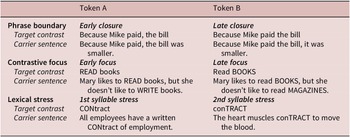
The lists of phrase boundary and linguistic focus sentences were taken from the Multidimensional Battery of Prosody PerceptionFootnote 1 (MBOPP; Jasmin et al., Reference Jasmin, Dick and Tierney2020) dataset. We added a new set of sentences to capture lexical stress contrasts. The final list of stimuli includes 42 pairs of sentences for phrase boundary, 47 for contrastive focus, and 50 for lexical stress. The sentences were arranged into pairs forming target prosodic contrasts (see Table 1).
Examples of Prosodic Contrasts for Phrase Boundaries, Contrastive Focus, and Lexical Stress. Capitalization indicates contrastive stress or emphasis, and commas mark the position of phrase boundaries. Presented here are the lexically identical fragments illustrating the prosodic contrast (target contrast) and the natural context in which they were embedded (carrier sentence)

Table 1. Long description
The table is organized into three main sections.
1. Phrase boundary.
Token A Early closure: Target contrast is ‘Because Mike paid, the bill’. Carrier sentence is ‘Because Mike paid, the bill was smaller.’
Token B Late closure: Target contrast is ‘Because Mike paid the bill’. Carrier sentence is ‘Because Mike paid the bill, it was smaller.’
2. Contrastive focus.
Token A Early focus: Target contrast is ‘READ books’. Carrier sentence is ‘Mary likes to READ books, but she doesn’t like to WRITE books.’
Token B Late focus: Target contrast is ‘Read BOOKS’. Carrier sentence is ‘Mary likes to read BOOKS, but she doesn’t like to read MAGAZINES.’
3. Lexical stress.
Token A 1st syllable stress: Target contrast is ‘CONtract’. Carrier sentence is ‘All employees have a written CONtract of employment.’
Token B 2nd syllable stress: Target contrast is ‘conTRACT’. Carrier sentence is ‘The heart muscles conTRACT to move the blood.’
Phrase boundary
The phrase boundary stimuli are 42 pairs of short sentences with a subordinate clause followed by a main clause. Both carrier sentences in each pair were identical in written form up until the end of the second noun, with the subsequent words forming either an early or late closure of the sentence. In the first type of sentence (“early closure”), the verb in the subordinate clause was intransitive, so that the noun that followed became the subject of a new clause (e.g., “Because Mike paid, the bill is smaller”). In the second type (“late closure”), the verb was transitive and took the following noun as its object, resulting in the phrase boundary falling later in the sentence (“Because Mike paid the bill, it was smaller”). The recordings used for morphing (i.e., target contrasts) were edited such that they included only the lexically identical portions of the two recordings (i.e., “Because Mike paid the bill” and “Because Mike paid, the bill”), with the pause after the comma removed.
Contrastive focus
The contrastive focus stimuli are 47 pairs of compound sentences. Carrier sentences in each pair included two independent clauses separated by a conjunction, forming sentences with early or late contrastive focus. In the first type of the sentence (“early focus”) the first word was emphasized (e.g., “Mary likes to READ books, but she doesn’t like to WRITE books”), whereas in the second type (“late closure”) the second word was emphasized (“Mary likes to read BOOKS, but she doesn’t like to read MAGAZINES”). Here also, to extract target contrasts, the recordings were edited such that they included only the first clause of the sentence that contained identical written words but differed in the placement of contrastive focus (i.e., “READ books” and “read BOOKS”).
Lexical stress
The lexical stress stimuli are 50 pairs of short sentences containing target words with lexical stress placed either on the first or second syllable. Target words were two-syllable words with stress either on the first or second syllable. They were embedded in carrier sentences to capture natural variation in pronunciation. Since the meaning of two contrastive words with lexical stress is always different, it was impossible to create identically sounding sentences. Therefore, pairs of carrier sentences differed in structure and meaning, but were matched in length and included only frequently occurring words and words that are acquired early during L2 learning (all words in carrier sentences were checked against vocabulary profiles; Nation, Reference Nation2006; Cobb, Reference Cobb2012; Table 2). This makes the sentences easily understandable by L2 English learners at various levels of proficiency. However, researchers using any subset of the stimuli should check the vocabulary profile of their specific selection, as lexical frequency and register may vary across items. The target words (i.e., identical words with stress placed either on the first or second syllable) were extracted from carrier sentences for morphing.
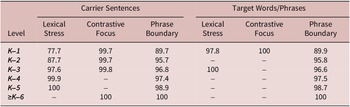
Summary of Vocabulary Profiles of Carrier Sentences and Target Words and Phrases. Values represent cumulative % of words per level

Table 2. Long description
The table is organized into seven columns. The first column lists the Level, followed by three sub-columns under Carrier Sentences and three sub-columns under Target Words and Phrases. The sub-columns for both categories are Lexical Stress, Contrastive Focus, and Phrase Boundary.
* Level K-1: Carrier Sentences show 77.7 percent for Lexical Stress, 99.7 percent for Contrastive Focus, and 89.7 percent for Phrase Boundary. Target Words show 97.8 percent for Lexical Stress, 100 percent for Contrastive Focus, and 89.9 percent for Phrase Boundary.
* Level K-2: Carrier Sentences show 87.7 percent for Lexical Stress, 99.7 percent for Contrastive Focus, and 95.7 percent for Phrase Boundary. Target Words show 95.8 percent for Phrase Boundary with no data for other categories.
* Level K-3: Carrier Sentences show 97.6 percent for Lexical Stress, 99.8 percent for Contrastive Focus, and 96.8 percent for Phrase Boundary. Target Words show 100 percent for Lexical Stress and 96.6 percent for Phrase Boundary.
* Level K-4: Carrier Sentences show 99.9 percent for Lexical Stress and 97.4 percent for Phrase Boundary. Target Words show 97.5 percent for Phrase Boundary.
* Level K-5: Carrier Sentences show 100 percent for Lexical Stress and 98.9 percent for Phrase Boundary. Target Words show 98.7 percent for Phrase Boundary.
* Level greater than or equal to K-6: Carrier Sentences show 100 percent for Contrastive Focus and 100 percent for Phrase Boundary. Target Words show 100 percent for Phrase Boundary.
Voice actors
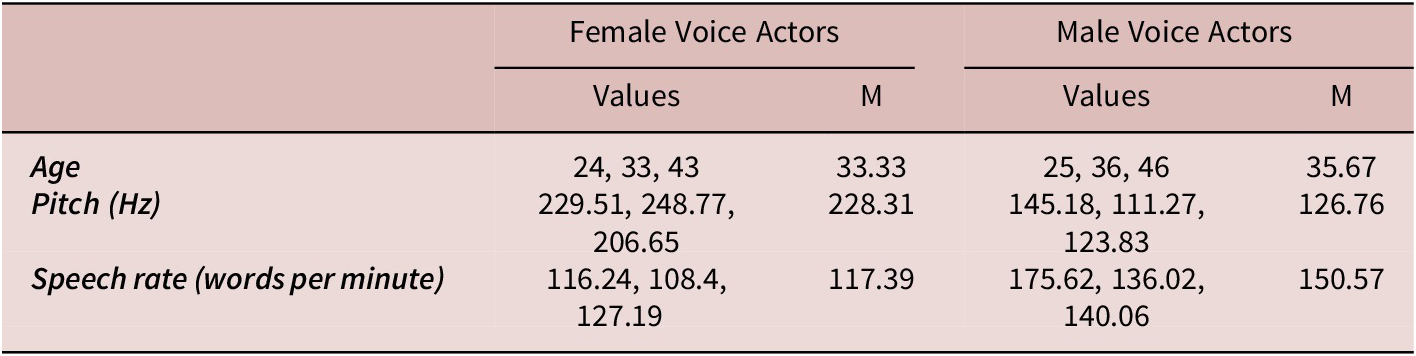
The dataset consists of recordings made by six professional voice actors (three males, three females) speaking with a Standard Southern British English accent. The recordings include a range of talkers of different ages, speaking with different pitch and speech rates (see Table 3).
Summary of Talkers’ Age, Pitch, and Speech Rates Measured in a Single Test Recording

Table 3. Long description
The table is divided into two main categories: Female Voice Actors and Male Voice Actors. Each category includes individual Values and a Mean denoted as M.
Row 1, Age: Female values are 24, 33, and 43 with a mean of 33.33. Male values are 25, 36, and 46 with a mean of 35.67.
Row 2, Pitch in H z: Female values are 229.51, 248.77, and 206.65 with a mean of 228.31. Male values are 145.18, 111.27, and 123.83 with a mean of 126.76.
Row 3, Speech rate in words per minute: Female values are 116.24, 108.4, and 127.19 with a mean of 117.39. Male values are 175.62, 136.02, and 140.06 with a mean of 150.57.
Speech recordings
Recordings of one male actor were the recordings of phrase and focus reported earlier in the MBOPP battery (Jasmin et al., Reference Jasmin, Dick and Tierney2020); the same actor recorded lexical stress stimuli to complement the current dataset. Five additional voice actors recorded stimuli in their home studios following the procedures described in Kachlicka et al. (Reference Kachlicka, Symons, Ruan, Saito, Dick and Tierney2025). To ensure that the audio quality of new recordings was comparable with the original recordings from the MBOPP dataset and consistent across talkers, we evaluated the quality of actors’ audio setup. Actors first recorded a single test stimulus that was carefully examined by the researcher for audio quality (e.g., background noise, volume, proximity to microphone). After completing this step, actors attended an online training session during which the researcher provided them with detailed instructions as to how they should record the stimuli. They were asked to read the sentences aloud using their natural voice and to make sure that their speech sounded as natural as possible while emphasizing the target contrast. After a short rehearsal, actors were provided with a complete list of stimuli to read and record. All samples were recorded as high-resolution two-channel wav files with a sampling rate of 44.1 kHz and 16-bit audio bit depth.
Pre-processing
Pre-processing involved several steps. First, audio files of full carrier sentences were trimmed to remove any silences at the beginning and end of each recording, ramped with 10-ms on/off linear ramp, and downmixed to mono by averaging the existing channels.
Next, to prepare the audio files for acoustic morphing, an additional step involved extracting target words from the carrier sentences for stress stimuli, as well as extracting lexically identical portions of recordings for linguistic focus and phrase boundary stimuli. Furthermore, for phrase boundary stimuli, silent pauses after phrase breaks were also removed. The extracted targets were ramped with 10-ms on/off linear ramp to avoid acoustic transients. Then, all samples (carrier sentences and target contrasts) were normalized to a target loudness level of −20 dB RMS with the “Match loudness” function in Adobe Audition software (Adobe Inc.). Normalization was implemented to equalize the volume across samples coming from different talkers, not to control their output volume.
Morphing
Morphing was performed with STRAIGHT software (Kawahara & Irino, Reference Kawahara, Irino and Divenyi2005). During the procedure, each input audio file was decomposed by STRAIGHT into three high-level acoustic features: F0 contour, spectral envelope, and aperiodicity index. The F0 contour information was used to detect voiced and unvoiced parts of recordings. Next, all the features were dynamically matched along the time dimension to create a similarity matrix between the two contrastive recordings. Then, the two recordings were time-aligned by manually inserting anchor points marking identical portions of both recordings in the created similarity matrix. These markers included onsets of words, syllables, and salient phonemes. Since morphing generates audio by interpolating between the two input recordings, precise alignment ensured that morphing would affect only the differing parts of both recordings, that is, the selected prosodic contrasts. The resulting morphing substrates were then used to warp all the features and re-scale the values along a particular dimension to resynthesize the stimuli. The synthesized audio files represent intermediate versions of the two input recordings, gradually shifting in pitch and duration from one to the other (e.g., from early to late boundary). An experimenter listened to the resulting audio files to ensure they were of good quality and sounded as natural as possible, repeating the process and adjusting anchor points until the audio quality of all synthesized samples was satisfactory. Stimuli that did not meet quality criteria were not included in the dataset. It should be noted that some degree of acoustic distortion is an inevitable consequence of acoustic manipulation. However, all included stimuli were judged to be clearly intelligible and speech-like.
STRAIGHT allows morphing along several dimensions: aperiodicity, spectrum, frequency, time (duration), and F0 (pitch). In our dataset, only duration and pitch information were manipulated. In English, pitch and duration covary such that, for example, longer duration and higher pitch signal emphasis or lexical stress, whereas shorter duration and lower F0 values are associated with lack of emphasis or stress. The other dimensions available in STRAIGHT (i.e., aperiodicity, spectrum, and frequency) were set at 50% such that morphs contained equal amounts of information from the two recordings. However, researchers can synthesize stimuli along any of these dimensions, if needed, using the provided morphing substrates.
For all samples, we generated recordings in which the pitch and duration excursions in the diagnostic segments of the syllables or words were shifted from 0% (pitch or duration information only conveying one interpretation) to 100% (pitch/duration only conveying the other interpretation) in 5% increments. For example, for duration manipulations, the resulting morphs of words “COM-pound” (stress placed fully on the first syllable) and “com-POUND” (stress placed fully on the second syllable) correspond to the two duration endpoints. A stimulus with 0% duration represents one end of the continuum (i.e., the word “COM-pound,” with first stressed syllable longer than the second) and a stimulus with 100% duration represents the other extreme of the continuum (i.e., the word “com-POUND,” with second stressed syllable longer than the first). The stimuli with all the remaining values of duration are perceptually the in-between versions that change smoothly from “COM-pound” to “com-POUND” depending on the available information.
Dataset structure and contents
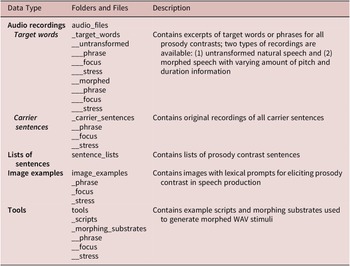
In the English Prosody Database, we provide the original recordings of full carrier sentences in which target prosody contrasts were embedded. We also include the extracted target words (lexical stress), word pairs (contrastive focus), or contrastive phrases (boundary) in their original untransformed form and synthesized morphs. An overview of dataset contents is presented in Table 4.
Overview of English Prosody Database Contents. The underscores represent a folder structure such that “audio_files,” “sentence_lists,” “image_examples,” and “tools” are the main folders, and the number of underscores indicates the number of subdirectories (e.g., a single underscore represents one directory down, a double underscore two)

Table 4. Long description
The table is organized into three columns: Data Type, Folders and Files, and Description.
* Audio recordings: The folder audio underscore files contains two sub-categories.
* Target words: Located in underscore target underscore words folder. It includes double underscore untransformed and double underscore morphed subdirectories. Each of these contains triple underscore phrase, triple underscore focus, and triple underscore stress folders. These contain natural and morphed speech excerpts for prosody contrasts.
* Carrier sentences: Located in underscore carrier underscore sentences folder, containing double underscore phrase, double underscore focus, and double underscore stress folders with original recordings.
* Lists of sentences: The folder sentence underscore lists contains lists of prosody contrast sentences.
* Image examples: The folder image underscore examples contains underscore phrase, underscore focus, and underscore stress subdirectories with lexical prompts for speech production.
* Tools: The folder tools contains underscore scripts and underscore morphing underscore substrates subdirectories. The former includes example scripts, and the latter includes double underscore phrase, double underscore focus, and double underscore stress folders containing morphing substrates used to generate morphed W A V stimuli.
The file naming format for carrier sentences and original untransformed targets is as follows: [voice ID]_[prosodic feature and stimulus number]_[token type]_[stimulus type].wav. For example:
-
• “M01_focus01_early_full.wav” and “M01_focus01_late_full.wav” represent two contrastive recordings of carrier sentences with early and late focus recorded by a male voice actor.
-
• “F01_stress01_early_target.wav” and “F01_stress01_late_target.wav” represent contrastive recordings of extracted target words with lexical stress placed on first and second syllables recorded by a female voice actor.
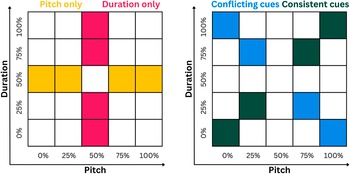
The morphed stimuli folder contains recordings in which both pitch and duration increased from 0% to 100% in 5% increments. We provide synthesized recordings of all combinations of pitch and duration contents, resulting in a full grid of morphs that can be sampled according to the researchers’ needs. The synthesized recordings can be classified into two types depending on their acoustic content. The first type is the recordings where either pitch or duration information is available (i.e., pitch only or duration only; Figure 1). In the pitch-only stimuli, prosody is conveyed by pitch cues alone which vary from 0% (pitch information coming entirely from the first syllable/early focus/early phrase recordings) to 100% (pitch information coming from the second syllable/late focus/late phrase recordings), while duration cues are set at 50% and are perceptually ambiguous. In the duration-only stimuli, prosody is conveyed only by durational cues varying from 0% to 100%, while pitch cues are set at 50%. The second type are the recordings where both pitch and duration are present, but they cue the interpretation of the stimulus either in a consistent or conflicting fashion (i.e., conflicting cues or consistent cues; Figure 1).
Diagrammatic Representation of the Acoustic Stimulus Space. Stimuli sampled a full 21 x 21 acoustic space across duration and F0 contour in 5% increments. For simplicity, the figure represents only the 25% increments, but morphs with all values are provided. (Left) Acoustic space of stimuli where either pitch or duration is available (i.e., pitch or duration only). (Right) Acoustic space of stimuli where both cues are present, but cue the interpretation of the stimulus in either consistent or conflicting way.

Figure 1. Long description
A two-panel attribute space diagram. Both panels feature a five by five grid with a horizontal X axis labeled Pitch and a vertical Y axis labeled Duration. Both axes are marked in increments of 0 percent, 25 percent, 50 percent, 75 percent, and 100 percent.
Left Panel: Pitch only in yellow and Duration only in pink. Yellow cells are concentrated along the horizontal midline at 50 percent Duration, spanning 0 percent, 25 percent, 75 percent, and 100 percent Pitch. Pink cells are concentrated along the vertical midline at 50 percent Pitch, spanning 0 percent, 25 percent, 75 percent, and 100 percent Duration. The center cell at 50 percent for both axes is white.
Right Panel: Conflicting cues in blue and Consistent cues in dark green. Dark green cells representing consistent cues form a diagonal from the bottom-left at 0 percent Pitch and 0 percent Duration to the top-right at 100 percent Pitch and 100 percent Duration. Blue cells representing conflicting cues form an opposing diagonal from the bottom-right at 100 percent Pitch and 0 percent Duration to the top-left at 0 percent Pitch and 100 percent Duration. The center cell at 50 percent for both axes is white.
Additionally, morphs of recordings with consistent cues (e.g., pitch and duration both set to 90%) can be used to manipulate the perceptual difficulty of the contrast, helping to avoid ceiling effects in experimental tasks. Lower percentage values reflect the reduced acoustic difference between stimulus pairs (e.g., first- and second-syllable stress), thereby naturally increasing task difficulty. The lower the percentage, the more perceptually challenging the contrast would be.
The file naming format for carrier sentences and original untransformed targets is as follows: [voice ID]_[prosodic feature and stimulus number]_[pitch morphing rate]_[duration morphing rate].wav. For example:
-
• “M04_focus01_pitch0_duration0.wav” – pitch and duration both cue early contrastive focus interpretation (consistent cues)
-
• “M04_focus01_pitch20_duration20.wav” – pitch and duration both cue early focus (consistent cues), but the contrast is perceptually more challenging
-
• “M04_focus01_pitch100_duration100.wav” – pitch and duration both cue late focus (consistent cues)
-
• “M04_focus01_pitch80_duration80.wav” – pitch and duration both cue late focus (consistent cues), but the contrast is more perceptually challenging
-
• “M04_focus01_pitch100_duration0.wav” – pitch cues late focus and duration cues early focus (conflicting cues)
-
• “M04_focus01_pitch0_duration100.wav” – pitch cues early focus and duration late focus (conflicting cues)
-
• “M04_focus01_pitch50_duration100.wav” – pitch is ambiguous, only duration cues late focus
-
• “M04_focus01_pitch50_duration0.wav” – pitch is ambiguous, only duration cues early focus
-
• “M04_focus01_pitch100_duration50.wav” – duration is ambiguous, only pitch cues late focus
-
• “M04_focus01_pitch0_duration50.wav” – duration is ambiguous, only duration cues early focus
-
• “M04_focus01_pitch50_duration50.wav” – perceptually ambiguous stimulus
Availability
The dataset is available at https://osf.io/pkrh8/ repository and https://sla-speech-tools.com/ website (Mora-Plaza, Saito, Suzukida, Dewaele, & Tierney, Reference Mora-Plaza, Saito, Suzukida, Dewaele and Tierney2022).
Discussion
The English Prosody Database has the potential to reinvigorate research on acquisition of English prosody by offering researchers a rich set of stimuli suitable for exploring a wide range of research questions. In the following section, we provide examples of how the stimuli from the English Prosody Database can be used. We then discuss several limitations of the corpus. Finally, we conclude by outlining future directions for the development of the database and prosody research.
Potential applications in L2 and L1 learning research
One of the key strengths of this dataset lies in its adaptability for studying perceptual cue weighting during prosody perception. With the provided acoustically manipulated stimuli, researchers can explore how listeners use pitch and duration while perceiving contrastive examples of linguistic focus, lexical stress, and phrase boundaries. Several recent studies have used such stimuli to explore these issues. For example, Jasmin et al. (Reference Jasmin, Sun and Tierney2021) examined the perception of phrase boundaries using a 5 × 5 stimulus space that varied across pitch and duration. They found that Mandarin speakers relied more heavily on pitch and less on duration when categorizing phrase boundaries (“If Barbara gives up, the ship” vs. “If Barbara gives up a ship”) compared to native English and Spanish speakers. The same phrase boundary categorization task has been used in a study exploring cue weighting in Mandarin Chinese L2 learners of English. Petrova and colleagues (Reference Petrova, Jasmin, Saito and Tierney2023) investigated how cue weighting strategies shift across L2 learner populations with differing degrees of experience and lengths of residency. By examining how learners adjust their reliance on pitch versus duration, this research contributed to better understanding of how L2 listeners acquire prosodic sensitivity in a new language. The presented dataset can support further investigations into the mechanisms underlying cue weighting during L2 prosody acquisition, such as L1-specific cue-weighting profiles, developmental changes with increased L2 experience, or training-induced cue reweighting. In future research this corpus could also be used to investigate developmental changes in L1 prosodic cue weighting. Although there have been a number of studies of how the weighting of cues to segmental contrasts change with development (Krause, Reference Krause1982; Nittrouer Reference Nittrouer2002; Mayo, Scobbie, Hewlett, & Waters, Reference Mayo, Scobbie, Hewlett and Waters2003; Mayo & Turk, Reference Mayo and Turk2005; Idemaru & Holt, Reference Idemaru and Holt2013; Nittrouer & Lowenstein, Reference Nittrouer and Lowenstein2015), much less is known about how prosody perception strategies change as children develop.
Researchers can also make use of the dataset’s flexibility to evaluate the precision of prosody perception and adjust task difficulty, if needed. In the study by Sun, Saito, and Tierney (Reference Sun, Saito and Tierney2021), for example, the cues to contrastive linguistic focus were scaled to 60% of their original magnitude to avoid ceiling effects and better capture variability in learners’ performance. Another example of difficulty scaling was implemented by Kachlicka et al. (Reference Kachlicka, Symons, Ruan, Saito, Dick and Tierney2025) in their perceptual prosody training. In this longitudinal study, learners practiced categorizing prosodic contrasts with real-time feedback over the course of 6 days. The design used acoustic information gradients as a way to control the perceptual difficulty of the stimuli throughout the training. The training began with “easy stimuli,” where pitch information was either removed (whispered speech) or made perceptually ambiguous (i.e., set at 50% between the contrastive recordings). This way, the only cue learners could use to determine the category of each stimulus was duration (see “duration only” stimuli in the current dataset). As participants progressed through the training, the size of the duration cues gradually decreased, keeping the training perceptually challenging but still manageable depending on each individual’s progress. This training aimed to shift learners’ attention from pitch to duration. However, with our dataset, one could just as easily implement a training that focuses on pitch instead. This ability to adaptively modulate the availability of cues, and consequently the difficulty of prosody perception, enables the creation of training paradigms that are suitable for a wide variety of listeners, including individuals with difficulty perceiving prosody. This could include children with a diagnosis of language impairment (Fisher, Plante, Vance, Gerken, & Glattke, Reference Fisher, Plante, Vance, Gerken and Glattke2007; Mundy & Carroll, Reference Mundy and Carroll2012; Cumming, Wilson, & Goswami, Reference Cumming, Wilson and Goswami2015), as well as individuals from L2 backgrounds who tend to struggle to perceive prosodic features in English, such as L1 speakers of fixed stress languages like French and Polish (Peperkamp et al., Reference Peperkamp, Vendelin and Dupoux2010).
The ability to modify the difficulty of prosody perception tasks can be useful not only to study individuals who struggle to perceive prosodic features but also to avoid ceiling effects when investigating individuals who may be highly proficient at prosody perception. Musical experience, for example, has been linked to better L2 (Kolinsky, Cuvelier, Goetry, Peretz, & Morais, Reference Kolinsky, Cuvelier, Goetry, Peretz and Morais2009) and L1 (Choi, Reference Choi2022) English stress perception, but it is unknown whether this advantage extends to other features. L1 tone language speakers may also display an advantage at perception of certain prosodic features in English. Cantonese-English bilinguals, for example, display superior English lexical stress perception relative to English monolinguals (Choi, Tong, & Samuel, Reference Choi, Tong and Samuel2019), and future work could investigate whether this advantage extends to other prosodic features.
It is also possible to use these stimuli to introduce unknown accents into perceptual tasks. One example is the paradigm developed by Jasmin, Tierney, Obasih, and Holt (Reference Jasmin, Tierney, Obasih and Holt2023), in which participants were exposed to both familiar and unfamiliar accents to test competing hypotheses about how multidimensional speech categories are processed. Authors hypothesized that if a unified prosodic category is activated during exposure to accented speech, then the inconsistent duration information will lead to a down-weighting of that cue in later tasks. If, however, pitch and duration are evaluated independently, then such inconsistency should have no effect on subsequent cue weighting. The stimuli were sampled from a 7 × 7 acoustic space, with either consistent (canonical) or conflicting (accented) distributions of pitch (F0) and duration. The study showed that listeners rapidly down-weighted duration (a secondary cue) when categorizing accented speech, suggesting that they can track short-term speech regularities and dynamically adjust their perceptual strategies.
An additional advantage of this dataset is its inclusion of recordings by multiple voices and a wide variety of examples, which will improve the generalizability of experimental findings. Previous studies of prosodic cue weighting have generally relied on a single stimulus (e.g., “read books” for linguistic focus, Sun et al., Reference Sun, Saito and Tierney2021) recorded by a single male speaker, which does not capture the natural variability present in everyday speech. Such a design also introduces practical issues, including participant fatigue, as repeated exposure to the same word or phrase for 25 minutes can become quite tiresome and negatively affect performance. In contrast, the current dataset offers a wide range of stimuli recorded by six different speakers, allowing researchers to create more engaging and ecologically valid tasks. This diversity will help sustain participant attention, reduce the likelihood of habituation, and support more generalizable conclusions.
The dataset includes carefully curated materials targeting prosodic features, making it suitable for structured testing of L2 prosody production as well. For example, the original recordings of carrier sentences are an excellent resource for designing prosody imitation tasks during which participants first listen to target spoken utterances and then imitate not only the words but also the prosodic intonation. Because the carrier sentences were specifically designed to elicit distinct prosodic contrasts, they provide a controlled and targeted basis for assessing whether learners can perceive and reproduce meaningful prosodic distinctions. These tasks can be used to assess learners’ L2 proficiency (Wu, Tio, & Ortega, Reference Wu, Tio and Ortega2021; for meta-analytic review, see Kostromitina & Plonsky, Reference Kostromitina and Plonsky2022) and their ability to convey prosody in L2 English in a native-like fashion. Whether elicited imitation performance reflects learners’ prosodic knowledge specifically, or if it can tap into automatized grammatical knowledge (Suzuki & DeKeyser, Reference Suzuki and DeKeyser2015) remains an open question, one this dataset is well positioned to help address.
These stimuli could also be used as targets for production training, although there is evidence that training involving self-imitation rather than imitation of native speakers may be comparatively more effective (Kusz, Reference Kusz2022). The provided recordings can also serve as a benchmark for evaluating learners’ performance throughout learning, as they exemplify baseline productions by native English speakers. This can be especially useful in the context of high-level L2 acquisition and identifying which variables predict the attainment of near-nativelike L2 performance. For example, using this dataset, we can precisely compare how closely Chinese listeners (more reliance on pitch) replicate native English listeners’ processing of prosody (equal focus on pitch and duration), and examine which individual factors are associated with such near-native processing patterns.
Limitations
Despite its flexibility, there are limitations to this dataset that researchers may wish to consider before use. First, it reflects only Standard Southern British English pronunciation. While this accent is widely studied and often used as a reference accent in linguistic research, it represents just one variety among the many global forms of English. This narrow focus may limit the generalizability of findings to other dialects, such as American, Australian, Canadian, and other regional or national varieties of English, or large English-speaking populations in countries like India or Nigeria, to name a few. These variants of English are not only widely spoken but also highly visible in media, education, and technology. For example, American English is the dominant variety in international film or digital assistants.
With regard to stimuli, it should be acknowledged that although the recordings capture prosodic contrasts within full sentences which constitute their naturalistic context, the sentences themselves are not necessarily natural or realistic (e.g., it is unlikely that one would hear the sentence “If Barbara gives up, the ship will be plundered” in a casual pub conversation, unless interlocutors happen to discuss a strategic navy game). Additionally, many of the sentences are structurally quite awkward, designed primarily to force the contrast of interest, and often lack relatable meaning. While this is not inherently problematic, learners might question the utility or relevance of such sentences, particularly if the purpose of the task is not clearly explained by the researchers. Although efforts were made to make the stimuli accessible to all listeners, the vocabulary and syntactic structures used may not be appropriate for younger or less experienced learners. This is due to both their linguistic complexity and the potential lack of understanding of the concept of prosody in these groups.
While every effort was made to ensure the morphed stimuli were as intelligible and speech-like as possible, it should be acknowledged that some degree of acoustic distortion is an inevitable consequence of acoustic manipulation, and morphed stimuli cannot be expected to be indistinguishable from natural speech. Formal naturalness ratings were not collected as part of the dataset preparation, and researchers with specific naturalness requirements are encouraged to conduct their own ratings on their chosen subset of stimuli prior to use.
Finally, there are a few limitations related to the acoustic features we selected for morphing. Speech is a highly redundant signal (e.g., voicing of a single consonant can be conveyed with as many as 16 different cues; Lisker, Reference Lisker1986). Therefore, including acoustic variations only along pitch and duration limits the range of research questions that can be addressed. However, since we are not the authors of the STRAIGHT morphing software, we cannot share it here (see Belin & Kawahara, Reference Belin and Kawahara2025 for an updated open-access version of the package). Nevertheless, we have made our scripts and morphing substrates (i.e., time-aligned annotations of contrastive recordings) publicly available. These resources can be used to synthesize new stimuli along other dimensions, if needed.
Future directions
As mentioned earlier, the dataset’s current focus on Standard Southern British English limits its generalizability. One particularly relevant issue is the variation in prosodic patterns across different English dialects. Intonation contours and stress placement can vary substantially between dialects and can be a source of difficulty even for native speakers of English. For example, native speakers of Canadian English have been shown to struggle with prosodic cues when listening to British English, demonstrating response patterns more similar to those of L2 speakers (Arnhold et al., Reference Arnhold, Porretta, Chen, Verstegen, Mok and Järvikivi2020). These findings suggest that different accentuation patterns may lead to distinct mental representations, which may not be equally accessible to speakers of various dialects. Differences between native accents can also negatively affect processing speed under challenging conditions (Adank, Evans, Stuart-Smith, & Scott, Reference Adank, Evans, Stuart-Smith and Scott2009) and may even alter the perceived meaning of words. A study comparing American and British accents, for example, found that the semantically ambiguous word “bonnet” is interpreted differently depending on the accent in which it is spoken (Cai et al., Reference Cai, Gilbert, Davis, Gaskell, Farrar, Adler and Rodd2017). Moreover, substantial individual differences exist even among speakers from notionally homogenous language backgrounds (English speakers from London, UK; Peppé, Maxim, & Wells, Reference Peppé, Maxim and Wells2000). Future versions of the database should aim to incorporate multiple dialects, enabling the construction of a more representative corpus.
Existing research suggests that the expression of focus may depend not only on speakers’ first language (L1), but also on the specific context in which focus is used. For instance, Mandarin speakers, like English speakers, signal focus by manipulating duration, pitch range, and intensity. However, their use of these cues varies depending on both the type of focus (e.g., greater increase in pitch range, mean, and maximum for signaling new-information) and the discourse-pragmatic context of the conversation (e.g., stronger prosodic effects during negotiation than when reporting a past event; Ip & Cutler, Reference Ip and Cutler2016). In another study, speakers of closely related languages like Taiwanese, Taiwan Mandarin, and Beijing Mandarin all raised pitch and intensity of focused words, but only Beijing Mandarin speakers lowered pitch and intensity on post-focus words (Chen, Wang, & Xu, Reference Chen, Wang and Xu2009). The unavailability of a preferred cue was also shown to contribute to lower accuracy in focus recognition (Chen et al., Reference Chen, Wang and Xu2009). Future versions of our dataset could include examples that would allow to test focus in various contexts.
Finally, while studies investigating cue weighting highlight the role of language-specific patterns in prosodic marking, they also point to a bigger challenge: prosodic cues rarely function in isolation. The realizations of focus, stress, and phrase boundaries emerge from the interplay between phonetic and phonological information. Other sources of variation, such as coarticulation (Repp, Reference Repp1983), intonation effects (Peng, Lu, & Chatterjee, Reference Peng, Lu and Chatterjee2009), and systematic interactions between cues for individual phonemes and speech prosody (de Pijper & Sanderman, Reference De Pijper and Sanderman1994; Reinisch, Jesse, & McQueen, Reference Reinisch, Jesse and McQueen2011) can also influence how prosodic categories are realized and interpreted across languages. These factors should be explored in more detail in future investigations of L2 prosody acquisition.
Data availability statement
All data presented in the manuscript are available via a link to OSF: https://osf.io/pkrh8/.
Declaration of competing interests
Authors declare no conflicts of interest.

 Open access

