




The Common Worlds Research Collective (2026) is an interdisciplinary research network made up of educators and researchers that conduct feminist and anticolonial pedagogical and methodological work concerned with our relations with the more-than-human world. This work thinks-with the concepts of commoning, worlding and inheriting as ethico-onto-epistemological (Barad, Reference Barad2007) practices that help us to think differently about how humans live with a climate-changing world. An ethico-onto-epistemological framing appreciates the intertwining of ethics, knowing and being. This helps transform the traditional and western ways of separating the world. This visual essay intentionally thinks with commoning, worlding and inheriting to highlight the pedagogical and methodological potential of an early childhood environmental education that is made up of interconnected and reciprocal ways of knowing, being and doing with worlds (Rooney & Blaise, Reference Rooney and Blaise2023). This understanding of worlds and how humans are always part of these worlds means that an early childhood environmental education that separates out children from nature fails to generate the kinds of human and more-than-human relations that are needed to survive and thrive in a climate-changing world.
The Common Worlds Research Collective (2020) proposes a shift in environmental education: from viewing humans as the sole agents of world-making, to situating humans within more-than-human worlds (Image 1). Much of this scholarship has been influenced by feminism, environmental humanities and Indigenous worldviews and encourages affirmative ways of thinking and doing to make change (Gibson et al., Reference Gibson, Rose and Fincher2015). Feminist thinking enables a creative and expansive approach to pedagogy that sets out to remake more-than-human worlds with others (Blaise & Pacini-Ketchabaw, Reference Blaise and Pacini-Ketchabaw2025; Rooney & Blaise, Reference Rooney and Blaise2023). Affrica Taylor’s (Reference Taylor2013) common worlds framework brings these ideas to early childhood environmental education by recasting childhood as messy and implicated; situated and differentiated; and entangled within real world relations. By approaching early childhood environmental education in this way, common worlding research and pedagogy resists positioning young children as innocent and separate from the common worlds they are all a part of. Common worlding gestures towards pedagogies that attend to the interconnected more-than-human and climate-changing worlds children are living in right now.
Children and educators within stormwater and greenwaste worlds. All photographs courtesy of the artist.

This visual essay experiments with new pedagogical possibilities that are inclusive of more-than-human waste worlds. It builds on the work of several other early childhood researchers and practitioners committed to challenging the “…fatally flawed logic of the nature–culture divide…” Taylor, Reference Taylor2013, 115) that education often upholds (see for example the collaboratories that are part of the Climate Action Childhood Network, n.d.). Readers and viewers are invited to re-view aesthetic images of children’s waste relations by thinking with commoning, worlding and inheriting. Educators are then invited to apply these creative, experimental and feminist approaches in their own contexts.
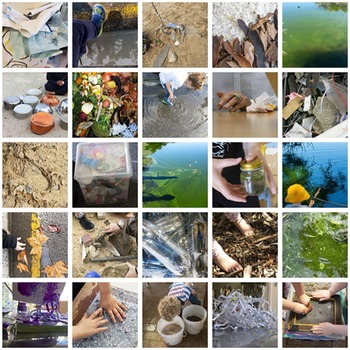
This image-rich essay comes from a project conducted across six early learning sites in Boorloo (Perth), Western Australia that focused on children’s relations with waste (Merewether et al., Reference Merewether, Blaise, Pitchford and Giamminuti2023). Educators conducted pedagogical inquiries into wastepaper, greenwaste, wastewater, waste smells, waste sounds and building waste. As part of these inquiries educators were documenting in their settings and making decisions about how to proceed by analysing the documentation. Photographs of these processes were taken by artist-researcher Annette Nykiel. At the end of the project a public exhibition was held featuring the research done by educators, showing how they and children were rethinking their relations with waste. The exhibition Reduce, Reuse, Recycle: Is It Enough? (Nykiel et al., Reference Nykiel, Blaise, Merewether, Giamminuti, Bushby, Kaiko, Lewer, O’Callaghan, Pitchford and Thompson2020) featured the waste inquiries, including twenty-five photographs that served both as documentation and aesthetic provocation (see Image 2). These images form the basis of this visual essay. The exhibition was held in a University art gallery, where preservice and inservice teachers could engage with artefacts, materials and ideas generated from the project. The exhibition was also part of a professional learning programme where the research team and participating educators shared how the waste inquiries were conducted and the pedagogies that emerged.
Curated documentary photographs in the exhibition Reduce, Reuse, Recycle: Is It Enough? (Nykiel et al., Reference Nykiel, Blaise, Merewether, Giamminuti, Bushby, Kaiko, Lewer, O’Callaghan, Pitchford and Thompson2020).

Image 2. Long description
A 5x5 grid of 25 square photographs. Left to right from top left-discarded pieces of white/coloured paper/drawings, small shoe stepping off kerb into a puddle, see image 8, bark installation in sand pit, close up of algal bloom, battered metal kitchenware, fresh food waste, child standing in puddle, intent upon ripples, adult hand with paper napkin and fruit peel, building rubble close up, child footprint in building sand, plastic container of collected lunch plastic waste, children’s shadows on algal bloom, adult holding a jar of algae in water, child in yellow hat with stick relating to shadowed algal bloom in blue lake, child’s hand reaching for yellow/brown leaves in puddle, children constructing with building waste in situ, see image 3, toes curling in bark mulch, closeup of algal bloom over water plants, purple painted waste paper, hands pressing paper pulp, peering into buckets of soaking paper pulp, pile of shredded paper, children hands pressing mould and deckle.
To help make the shift from learning how to manage, contain and get rid of waste towards learning how to live with more-than-human waste worlds and to do this well, this visual essay begins by briefly defining commoning, worlding and inheriting. This is done to encourage readers and viewers to practice engaging with the exhibition photographs in ways that might open up new understandings about environmental education, rather than getting bogged down in the theories that ground common worlding pedagogies and trying to find definitive answers. It is an intentional move towards making room for thinking expansively; and in ways that are specific to one’s context. Next, re-viewing as a creative, experimental and feminist method is introduced for understanding children’s relations with more-than-human waste worlds through commoning, worlding and inheriting. Readers and viewers are invited to practice re-viewing with a series of exhibition photographs of children’s waste relations. In doing so, they can experience for themselves how humans are interconnected with and part of waste worlds, rather than somehow separate from them. Finally, the visual essay concludes with a set of provocations that encourage educators to take these ideas and practices back to their own settings and see what emerges with others. In doing so, new thinking and doing collectives become possible. It is a way to generate and support affirmative and ongoing practices and methodologies for a climate-changing world.
Re-viewing as a creative, experimental and feminist method
The use of aesthetic visual images played an important role in the waste project because they helped “keep waste ‘in sight and in mind’” (Merewether et al., Reference Merewether, Blaise, Pitchford and Giamminuti2023, 2). This photographic framing helped educators involved in the waste project to re-view and “see” how children are always part of entangled and messy waste worlds, even when trying to keep them away (see Images 1 and 2). For this essay, re-viewing waste exhibition photographs through commoning, worlding and inheriting is an active process that understands the potential of the arts for doing something more. Using photographs as provocations to think and practice otherwise in early childhood education is a strategy that has been employed to encourage more expansive and collective ways of understanding childhoods, teaching and learning. For instance, Mindy Blaise and Veronica Pacini-Ketchabaw (Reference Blaise, Pacini-Ketchabaw, Osgood and Robinson2019) used photographs that children took of their peers’ moving bodies to help educators develop a logic of unknowability. Their paper demonstrates how thinking-with unknowability shifts one’s understanding of gender as two separate entities, such as girl and boy, to understanding and seeing gender as emergence and becoming bodies. As a result, feminist materialist movement pedagogies were developed as a strategy for educators to think and practice without certainty, predetermined boundaries, or a sense of “fix-ness.”
Re-viewing these waste project photographs (for example Image 3) is a creative, experimental and feminist method for thinking and practising differently. Re-viewing takes up Rosi Braidotti’s (Reference Braidotti2013) call to “…leap forward into the complexities and paradoxes of our time” (54) requiring conceptual and practical creativity. Re-viewing is imperfect and there is no one-way to re-view. As an experimental practice, time needs to be made and allocated for such work, which also involves being generous with each other and with time. Therefore, educators should consider practising re-viewing to develop attitudes that embrace unknowability, hybridity, emergence, bringing together and mixing-up. To facilitate experimental re-viewing practices, explanatory captions are not provided with the sets of exhibition photographs. This is meant to cultivate an attitude of unknowing and openness that will be useful for attending to relations, interconnections and difference.
Re-viewing waste relations.

Re-viewing encourages readers and viewers to understand and see childhoods as messy and implicated; situated and differentiated; and entangled within real world relations (Taylor, Reference Taylor2013). For instance, re-viewing Image 3, through common worlding concepts, encourages the reader and viewer to notice how emptied plastic drink bottles are in relation; how they are leaning and touching each other; how surfaces merge and blur; how light, shadows and the smoothness of the bottles conjures up contrasting memories of warm bodies and cool surfaces. This re-viewing actively draws the reader in, encouraging them to give plastics a second, third, or fourth thought. New appreciations of how they (the plastic bottles and the reader and viewer) are in relation together emerge. These re-viewings have the power to set into motion a response-ability, or the ability to respond, that creates everyday political and ethical actions.
Common worlding through commoning, worlding and inheriting
Commoning, worlding and inheriting are three concepts that ground common worlding research and practice (Pacini-Ketchabaw, et al., Reference Pacini-Ketchabaw, Blaise and Kraftl2026). These concepts are active, generative and affirmative. They are also interrelated and impossible to separate. In fact, separating and pulling them apart goes against the common worlding ethos of bringing things and ideas together in multiple ways. However, for the purpose of this essay and for practising re-viewing, the concepts are briefly defined in an attempt to highlight how they each are distinctive. The distinctions are minor, but important. After each concept is defined, readers and viewers are invited to practice re-viewing sets of waste project photographs.
Commoning is a relational practice or activity that involves relationships between humans, and between humans and the worlds around them. This way of thinking about commoning draws from the work of J.K. Gibson-Graham and colleagues (Reference Gibson-Graham, Cameron, Healy, Amin and Howell2016) who are taking the idea of commoning out of exclusively property land ownership and capitalist discourse and instead are emphasising the role of communities in common. In doing so, commoning situates the work of worlding and inheriting with a focus on human and more-than-human communities. As a common worlding concept, commoning is always a doing, not a thing. Commoning is the practice and work of remaining open to difference. Pedagogically, commoning creates the conditions for reconfiguring children’s relations with waste to those that are messy, complex and entangled (Image 4). Commoning does not set out to make everyone the same. Instead, it is about thinking, working and living with difference.
Commoning: food waste communities in common.

Re-viewing while thinking-with commoning
Now we invite you the reader and viewer to try practising re-viewing the set of exhibition photographs in Image 5 while thinking-with commoning:
-
• How are you noticing differences in these communities in common?
-
• How are these waste commons foreshadowing interconnectedness?
-
• How are you attuning to waste differences within a photograph and across this set of photographs?
Commoning.

Image 5. Long description
A 2x2 grid of four square photographs of commoning relations with waste materials. Clockwise from top left, a educator’s hand with silver ring, used paper towel and discarded orange peel resting on a conference table; a child’s hand reaching for wet yellow and brown leaves in a clear shallow roadside puddle; a close-up of bright green algae smothering water weeds through a shiny water surface; a close-up of building material waste including wire, plastic, broken concrete and discarded gloves.
Worlding is the more-than-human-process of making worlds (Haraway, Reference Haraway2008; Reference Haraway2016). It is the practice of making worlds more sustainable and liveable for all. Instead of seeking universal solutions to the ecological challenges we are facing, worlding is happening within everyday relations and multisensory encounters humans are always a part of (Image 6). Humans are a part of worlding from the inside; this means that they do not stand outside of it. Worlding cannot be preplanned, because it is always and already happening. In relation to the waste project, worlding happens within children’s interconnected and reciprocal relations with more-than-human waste worlds.
Worlding from the inside of waste smells and algal bloom.

Re-viewing while thinking-with worlding
Allow yourself to linger with thoughts, wonderings and the unknown. Ask yourself the following:
-
• How can you sense these more-than-human waste worlds worlding?
-
• How might you let yourself wonder wildly about what these worldings look, feel, sound and taste like?
-
• How can you imagine the ways in which these waste worlds are interconnected? Across materials, with you and multiple others?
-
• How might these photographs allow you to put a pause on these waste worlds? And when you are able to pause, what becomes visible?
Inheriting, as framed by the Common Worlds Research Collective (2020), is a situated and ethical practice of “accounting, answering, and risking.” It recognises that “nothing comes into being without its worlds” and invites education to become a space for “circular and complex set[s] of mutualisms” (Rose, Reference Rose2022, 140). Rather than reproducing dominant logics of removing waste “out of sight and out of mind,” inheriting brings relational ethics to the surface by considering the possibility of living well with what remains (Image 8).
Worlding.

Inheriting histories that we find and those that are being created.

Children inherit “damaged worlds” shaped by settler colonialism, extractive capitalism and environmental degradation. These are inherited waste legacies that are active and in spite of our efforts to detach ourselves from more-than-human waste worlds, they “…can never be entirely concealed or forgotten” (Taylor et al., Reference Taylor, Pacini-Ketchabaw, de Finney and Blaise2016, 132).
To inherit waste is to live within what Deborah Bird Rose (Reference Rose2012) describes as the “dense knots of embodied time” (131) where multispecies histories and futures converge. Like worlding, this means that we are never sitting outside of inheriting. Instead, we are in it and we are part of reciprocal relations. In early childhood settings, children inherit not only materials, but also the systems and stories that shape how waste is understood and managed.
Re-viewing while thinking-with inheriting
Although re-viewing positions the reader and viewer as separate from the photographs, we invite you to imagine all the ways you are always in and part of these moments. Ask yourself the following:
-
• How are inheritances surfacing within and across these photographs?
-
• If these inheritances are surfacing, how are you obliged to reciprocate?
-
• How are these materials used, engaged with, transformed and sometimes mourned?
-
• As children engage with these materials, how might pedagogy be reconfigured as caring for, transforming with, remembering, or reciprocity?
An invitation to do more
Instead of presenting a neat and tidy conclusion, we end this visual essay with an invitation. We invite you, readers and viewers, to take these practices back into your settings and share them with others. In doing so, you are enacting a kind of response-ability that is creating everyday political and ethical actions. Reading, wondering, re-viewing and creating with others is a political and ethical action through collective re-viewing and doing.
These practices are not endpoints but beginnings – ways of joining ongoing conversations and actions that are already unfolding in early childhood settings, communities and more-than-human worlds.
You might consider sharing the article with colleagues and families by reading it together and in ways that make space for questions and more to emerge. This might happen by reading it out loud, and pausing along the way, to stumble together. Groups of educators might practice re-viewing through commoning, worlding and inheriting together. Doing and practising together, with each other, children, families and the environment, is a way to shift how we understand and do environmental education. Make your imperfect re-viewing practices transparent (Images 5, 7 and 9). This could happen through dialoguing or creating together. Share with children and families how you are thinking differently about the worlds we are making together. Practice, re-view and repeat. Over and over. In doing so, we continue the work of commoning, worlding and inheriting, practices that invite us to live well with difference, attend to entanglements and reciprocate with care in damaged and flourishing worlds (Image 10).
Inheriting.

Image 9. Long description
A 2x2 grid of four close-up images of children in relation to/inheriting (from top right) a child peering intently into 2 large white buckets of soaking recycled paper/fibre mixture; an bright green algae in a lake with strong shadows of over hanging trees on vivid blue water and ripples, a child with a yellow hat plays with a stick in the foreground; a pile of shredded waste paper-white and coloured on a table; outside on a cememnt path 10 battered metal and wooden pots, pans and bowls usually found in the kitchen, a seated child with a spoon in the top right hand corner.
The expansive possibilities of living within waste.

We invite you to share your own re-viewings, stories and pedagogical experiments with others, so that together, we might expand the possibilities for living and learning in a climate-changing world.
Acknowledgements
The authors acknowledge that this work was done on Whadjuck Noongar boodjar. We also acknowledge that thinking, doing and creating are never done alone. Thank you to the generosity of the teachers and children who took part in this project. We are also appreciative to those academics and artists who came along to “Thinking-along-the-way” seminar series, hosted by the Centre for People, Place and Planet, Edith Cowan University. Your questions, prompts and provocations strengthened our work.
Ethical statement
Ethics was approved (2019-0041) by the Human Research Ethics Committee, Edith Cowan University.
Financial support
This project was funded in part by Perpetual Impact and the Centre for People, Place and Planet, Edith Cowan University.
Author Biographies
Mindy Blaise is a Professor of Education and the Director of the Centre for People, Place, & Planet, at Edith Cowan University, Western Australia. She is a co-founder of the Common Worlds Research Collective and #FEAS Feminist Educators Against Sexism. Mindy is a co-author (with Tonya Rooney) of Rethinking Environmental Education in a Climate Change Era: Weather Learning in Early Childhood (published by Routledge).
Annette Nykiel, PhD is an independent artist-researcher with a keen interest in materiality and the non-human agency of Western Australian non-urban spaces. Her geoscientist background deeply influences her slow-making. As an occasional academic, she collaborates with scientists, educators and artists to acknowledge ongoing complicity in resource extraction. Working across urban and regional areas, Nykiel’s interdisciplinary practice encompasses solo and collaborative projects, publications, exhibitions, residencies and the artist collective UnderFOOT.
Jane Merewether is a Senior Lecturer in Childhood and Environmental Education Studies at Murdoch University, Western Australia. Her research explores children’s relationships within their social and material environments in the context of ecological change. She is particularly interested in cultivating pedagogies and response-abilities that support living well with the world.
Stefania Giamminuti is a Senior Lecturer in Early Childhood Education, Curtin University, Western Australia. Stefania privileges qualitative and post qualitative approaches in pedagogical research, utilising an ethical-political-aesthetic lens to investigate dialogues between the Reggio Emilia educational project and international early years contexts. Her recent book, The role of the pedagogista in Reggio Emilia: Voices and ideas for a dialectic educational experience, (Routledge), co-authored with Claudia Giudici, Paola Cagliari and Paola Strozzi (Reggio Children), and is based on a collaborative research project with Reggio Children and with the Preschools and Infant–toddler Centres, Istituzione of the Municipality of Reggio Emilia.



 Open access

