


One of today’s many conservation challenges is understanding how best to resolve threats to wild mammals. Where in situ conservation is a priority, capture for the deployment of radio-collars facilitates collection of information about demography, movements and habitats (Delgiudice et al., 2001; Kock et al., Reference Kock, Meltzer and Burroughs2006). In a few cases threatened species have also been chemically restrained by ground-darting; for example, bactrian camels Camelus bactrianus and khulans Equus hemionus (Kaczensky et al., Reference Kaczensky, Sheehy, Walzer, Johnson, Lhkagvasuren and Sheehy2006; Walzer et al., Reference Walzer, Kaczensky, Ganbaatar, Lengger, Enkhsaikhan and Lkhagvasuren2008). However, the capture of Central Asia’s typically small or fleet ungulates (Przewalski’s Procapra przewalski and Mongolian Procapra gutturosa gazelles, blue sheep Pseudois nayaur, ibex Capra ibex, saiga Saiga tatarica and chiru Patholops hodgsoni) has been problematic because of the unavailability of helicopters for darting from the air and because chemical restraint on the ground has not proved feasible.
Remoteness, national security concerns about aircraft, and practical issues of census methodology have hindered the establishment of effective monitoring and conservation programmes for these species (Schaller, Reference Schaller1998b; Reading et al., Reference Reading, Mix, Lhagvasuren and Tseveenmyadag1998, Reference Reading, Mix, Lhagvasuren and Blumer1999; Milner-Gulland, Reference Milner-Gulland2009). Saiga are illustrative. Formerly widespread across Central Asian steppes and deserts (Bekenov et al., Reference Bekenov, Grachev and Milner-Gulland1998), the species experienced one of the most tragic declines of a large mammal in the 20th century, from > 1 million individuals to c. 55,000 in < 20 years (Milner-Gulland et al., Reference Milner-Gulland, Kholodova, Bekenov, Bukreeva and Grachev2001). While current efforts focus on the more abundant Critically Endangered S. t. tartarica subspecies (Mallon, Reference Mallon2008b) far less is known about the status of the Endangered Mongolian subspecies S. t. mongolica (Mallon, Reference Mallon2008a; Young et al., Reference Young, Murray, Strindberg, Buuveibaatar and Berger2010).
Hitherto, there has been no established capture methodology for many of Central Asia’s ungulates, including adult saiga. As a consequence it has been difficult to deploy radio collars, a tool useful to garner insights about movements across large landscapes (Ito et al., Reference Ito, Miura, Lhagvasuren, Enkhbileg, Takatsuki, Tsunekawa and Jiang2005). We now know, for instance, that species such as Mongolian gazelles and khulan have spatial requirements of 100,000 km2 or more (Kaczensky et al., Reference Kaczensky, Sheehy, Walzer, Johnson, Lhkagvasuren and Sheehy2006; Mueller et al., Reference Mueller, Olson, Fuller, Schaller, Murray and Leimgruber2008). For saiga, however, as well as for other antelopes, the lack of capture protocols has limited the collection of biological information needed for conservation planning. Additionally, there has been little basis to predict how the chasing of animals by vehicle, for capture and radio-collaring, affects their performance, an issue of concern (Wildlife Conservation Society, 2008).
To enhance saiga conservation by understanding fine-scaled movements and potential impediments to migration (Berger et al. Reference Berger, Berger, Bergen, Bayarbaatar, Fine and Lkhagvasuren2008a,Reference Berger, Young and Bergerb), we elected to radio-collar adult females. Here we present capture and handling methods, descriptions that we believe are important for two reasons. Firstly, although interest in saiga conservation and restoration has grown rapidly throughout Central Asia, as evidenced by support from the Convention on Migratory Species and at numerous workshops, little information is available to practitioners interested in handling techniques. Secondly, although intense vehicle pursuit remains a standard practice for gaining close-up views of desert and steppe ungulates, neither short- nor long-term effects are known, although prolonged chases in other species cause trauma, stress, disruption of social groups and hyperthermia (Kock et al., Reference Kock, Meltzer and Burroughs2006).
Our studies focus on saiga in and adjacent to the 286,900 ha Sharga Nature Reserve at the foot of the Altai Mountains (Gov-Altai Aimag) in Western Mongolia. As a result of harassment and poaching, saiga are highly vigilant, regularly initiating flight at distances of > 1.5 km. Like many ungulates under extreme harvest pressure (Lhagvasuren & Milner-Gulland, Reference Lhagvasuren and Milner-Gulland1997; Reading et al., Reference Reading, Mix, Lhagvasuren and Tseveenmyadag1998), close approach is impossible and occurs only after high-speed chases over long distances. Hence, we used drive nets to facilitate capture, as previously used for Mongolian gazelles (K. Olson, pers. comm.) and argali Ovis ammon (Kenny et al., Reference Kenny, DeNicola, Amgalanbaatar, Namshir, Wingard and Reading2008).
Biological variation among gazelles, argali, and saiga necessitates differing capture techniques. Argali, for instance, can jump nets, whereas gazelles occur in groups that can number in the thousands (Olson et al., Reference Olson, Mueller, Bolortsetseg, Leimgruber, Fagan and Fuller2009). In contrast, Mongolian saiga are generally found in small groups consisting of < 15 animals and have not been observed to leap over objects.
During 6–14 September 2006 we captured saiga by erecting 400 m of woven nylon nets, approximately 3–4 mm thick, with a mesh size of 10 × 10 cm, across a low-lying area between adjacent hills that served as a natural travel or escape route for saiga (Plate 1). One person remained hidden at each end of the net as three vehicles searched for saiga. To minimize pursuit distance, a chase was initiated only if saiga were detected within c. 5 km of the net. Once spotted, animals were herded by vehicle across the roadless landscape toward the concealed net. Vehicle speeds reached 100 km h-1; however, we judged that the saiga did not run in excess of 65–70 km h-1. Captures were during early morning or evening; one midday handling event occurred when skies were overcast. Ambient temperatures during all captures were 10–16° C.
Netting, capture and release of saiga Saiga tatarica mongolica in Western Mongolia.

Upon disentanglement from nets (Plate 1), saiga were blindfolded and restrained by hand. Adult females were fitted with geographical positioning system (GPS; Advanced Telemetry Systems, Isanti, Minnesota, USA) or satellite (Telonics, Mesa, Arizona, USA) collars, checked for evidence of lactation, weighed in a light net and released. Collars were equipped with 8-hour mortality sensors and drop-off mechanisms programmed to release the following summer. Given uncertainty regarding saiga response to handling, their Endangered status, and our desire to release animals as quickly as possible, we elected not to use anaesthesia or tranquilizers, a practice previously employed for the safe capture of pronghorn Antilocapra americana and other ungulates (Berger et al., Reference Berger, Cain and Berger2006).
We recorded chase duration (time between first detected evasive movements until contact with the net), handling time (from initial contact with the net until release), and rectal temperature (at first capture). To determine survival rates, we monitored collared saiga using handheld telemetry equipment for 11 months, until collars released or mortality was confirmed.
Nine of 22 chases yielded successful captures. Median group size when spotted was seven, and we usually tried to isolate 2–3 females and drive them towards the net. The maximum group size of netted saiga was seven. Of our 13 unsuccessful chases, failures occurred because saiga reversed course and could not easily be redirected toward the net, animals outdistanced us over rocky terrain, or we halted the chase because chase times or distances were becoming excessive.
A total of 13 saiga (two adult males, nine adult females and two calves) were captured; only adult females (n = 8) were radio-collared. In addition, one calf was restrained for several minutes so that she could be released simultaneously with her mother. Mean handling time was 6.6 ± SD 2.5 minutes (n = 9, range 3–11), mean chase time 6.10 ± SD 2.5 minutes (range 3–9) and mean body mass of adults 23.4 ± SD 2.93 kg (n = 4, range 20.0–27.0). Chase time and rectal temperature were linearly associated (Fig. 1), although the point at which this relationship breaks down or putatively asymptotes is uncertain.
Relationship between rectal temperature and chase time of female saiga based on empirical measures (dark line) and hypothetical relationships for longer chase times (dotted lines). Equation of the line is Y = 0.3508x + 39.37 (r2 = 0.7412, P < 0.03).
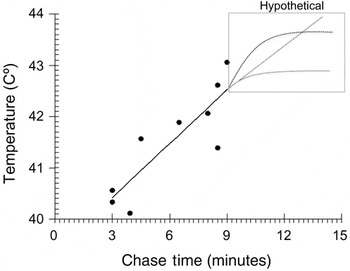
Of the eight collared adults we determined the fates of six. Because two satellite collars failed to transmit locations, we know nothing about the survival of these individuals. Of the remaining six GPS-collared females, one collar was discovered more than 20 km from the capture site 18 days post-capture. Cause of death could not be determined because no carcass was found; however, this animal’s chase time (8 minutes) and body temperature (42.1°C) were lower than that for other captured animals that survived (Fig. 1). The second animal was captured on 7 September, and perished on 16 October from an apparent eagle attack. The remaining saiga all survived for at least 11 months.
The risk of capture myopathy has been well established (Sargeant et al., Reference Sargeant, Eberhardt and Peek1994; Delgiudice et al., Reference Delgiudice, Mangipane, Sampson and Kochanny2001). That we identified a strong relationship between chase time and body temperature (Fig. 1) is evidence of pursuit-induced hyperthermia. We do not know, however, at what point saiga may be unable to recover or when body temperatures will no longer increase. Had our sample been larger or vehicle pursuits longer, rectal temperature would probably have become asymptotic or extended in a linear fashion. We cannot distinguish between these possibilities. It is possible that Mongolian saiga, as a desert-adapted species, may be resilient to long chases. However, we do not advocate longer chases to determine whether an asymptote occurs. Instead, we suggest as a rule of thumb that chases be limited to < 6–7 minutes, at least until more is known of physiological effects.
While the resting body temperature of S. t. mongolica is unknown, for other species body temperatures are lower than those we detected from pursuit, and exercise-induced stress can lead to death. For instance, body temperatures of non-disturbed mule deer Odocoileus hemionus are 37.5–39.7°C (Sargeant et al., Reference Sargeant, Eberhardt and Peek1994), and for white-tailed deer Odocoileus virginianus body temperatures > 39.4°C are considered stressful and cooling is recommended (DelGiuduce et al., Reference Delgiudice, Mangipane, Sampson and Kochanny2001). In argali drive netting produced average body temperatures of 40.8°C without mortality (Kenny et al., Reference Kenny, DeNicola, Amgalanbaatar, Namshir, Wingard and Reading2008) but the practice also carries great risk; for roe deer it resulted in death from acute myopathy and myoglobinaemic nephrosis (Montane et al., Reference Montane, Marco, Manteca, Lopez and Lavin2002).
Our findings for saiga are important for two reasons. Firstly, they illustrate a simple methodology by which wild adult antelopes of open habitats can be successfully captured for scientific research (if chase times are limited). Secondly, they point to the potential danger of chase-induced hyperthermia. We suggest that chase times can be used as a proxy for heat-related stress. Given that rural residents often chase saiga and other desert and steppe-dwelling ungulates, for photography or for amusement, our results offer conservationists and government officials an empirical basis for recommending prudence on chase times and/or for recommending that the practice be prevented. While enforcement of such policy may not realistically be achievable, our results have been communicated to government officials, wildlife managers, law enforcement rangers, scientists, herders and the local public within the range of Mongolian saiga. Our findings on the possible hazards of long chases have been voiced at multi-stakeholder workshops (Wildlife Conservation Society, 2008), and are now being implemented into local planning. As other governments in Central Asia seek to enhance ungulate conservation, the methodology we employed merits consideration. The method also carries a social liability, however. If researchers can pursue animals from vehicles for captures, then some residents may believe ‘safe’ chase times are acceptable.
Acknowledgements
We thank the National Geographic Society, Trust for Mutual Understanding, Mongolian Academy of Sciences, Ministry of Nature, Environment and Tourism, USDA-APHIS-National Wildlife Research Center, the Denver Zoo and the Wildlife Conservation Society. A. Fine, Chi-Unen, J. Hilty, W. Karesh, R. Reading, W.A. Weber and P. Zahler facilitated this project. K. Socie, J. Young, E.J. Milner-Gulland and several anonymous reviewers provided helpful comments.
Biographical sketches
Joel Berger focuses on how best to move science into practical conservation. Kim Murray concentrates on population monitoring and assessment to enhance conservation. Bayarbaatar Buuveibaatar has worked with gazelles, saiga, bears and small mammals to improve the understanding of Mongolia’s fauna. Michael Dunbar has studied pronghorn ecology, physiology and veterinary aspects of animal health. Badamjav Lkhagvasuren incorporates all aspects of biology into studies of Mongolia’s mammals.



