

Introduction
How can we understand the relationship between securitisation and the audience’s acceptance or rejection despite the potential anxiety-inducing implications of securitising moves? We build on existing works on the intersection of securitisation and anxiety to further theorise the audience dimension of the Copenhagen School (CS) of security studies.Footnote 1 The audience is critical in the CS’s formulation of securitisation – theoretically, audience consent determines if an issue transforms into a security issue involving an existential threat requiring emergency measures and justifying actions outside the boundaries of normally accepted political procedures.Footnote 2 Defined as ‘those the securitising act attempts to convince to accept’ such measures,Footnote 3 the audience, however, remains under-theorised despite the theoretical claim that securitisation ‘can never only be imposed’ because it requires this consent.Footnote 4 International Relations (IR) scholars have addressed the role of the audience in the securitisation process but have criticised the theory for its ambiguity in conceptualising an audience.Footnote 5
To address this, we argue that the audience in securitisation possesses another type of agency in addition to political agency. Drawing on Anthony Giddens’s conceptualisation of ontological security that centres the minimisation of disruptions to everyday routines and practices,Footnote 6 we theorise audience agency by introducing the concept of ontological agency. This refers to exercising control over the stability and continuity of one’s everyday routines and practices to minimise disruption, including disruption caused by securitisation. This is based on people’s need for ontological security, or the security of being preserved through the continuous reproduction of coherent narratives about the self and everyday practices that have been routinised over time.
Ontological agency is a way of coping with securitisation, which reminds audiences of the presence of existential threats and thus perpetuates a sense of insecurity. These reminders can threaten ontological security, leading people to exercise ontological agency to preserve and maintain daily activities and practices to bracket out anxiety associated with securitisation. Doing so may entail people not responding or reacting to reminders of threats and insecurity, whether they be ontological or physical. Thus, ontological agency is about inaction as much as action in the face of securitising acts.
Audience agency in securitisation is thus less straightforward than conceptualised in existing works. To exercise agency is not limited to accepting, rejecting, or contesting securitising moves. Rather, whether securitisation is accepted or not is secondary to how the audience exercises ontological agency to pay attention to or ignore securitising moves in the first place. However, ontological agency is not always status-quo-oriented or choosing inaction in the construction of security. It can also manifest as action and contestation if people find securitisation encroaches upon their orderly routines of day-to-day life or threatens the stability and continuity of being. As such, the concept offers a framework for understanding when people choose to act, react, or not act in the face of securitisation.
We illustrate the analytical purchase of the concept of ontological agency in securitisation using within-case variation in the South Korean public’s inaction and reaction under the securitisation of the Korean War, in particular the securitisation of North Korea as posing an immediate and existential threat to South Korea and South Korean people. As one of the most militarised societies in the world, within South Korea there is a juxtaposition of securitisation of the North Korean regime and its ideology in the form of policies and political rhetoric, and actual existential threat caused by North Korea’s provocations. This serves as a useful illustration in understanding how people cope with perennial securitising moves that function as reminders of an immediate threat. We examine South Korean people’s inaction and reaction to South Korea’s missile tests in Gangneung, located on the eastern coast of South Korea, on two occasions: in May and October 2022. We integrate ethnography and textual analysis to illustrate the behavioural manifestations of ontological agency.
The paper proceeds as follows. First, we point out that the nature of the audience in securitisation theory remains under-theorised, with audience agency being reduced to political acceptance, rejection, or contestation. Second, we introduce the concept of ontological agency as a way of understanding the audience’s practices, reactions, and inaction in the face of securitisation. Next, we illustrate ontological agency by describing and analysing public discourse and practices in reaction to missile tests and military facilities in South Korea by casting the Korean War as a securitisation of North Korean threat. Finally, we conclude with implications of ontological agency for understanding the politics of (de)securitisation and existentialism.
Audience agency in securitisation theory
The existing literature on audience agency conceptualises it as political. Political agency refers to the audience’s agency in accepting or rejecting securitising moves. Adam Côté’s meta-synthesis analysis finds that the literature leans towards empirically defining the audience as an ‘active agent’ in the highly intersubjective and iterative process of securitisation. This agency is political, as the audience’s active role relies on their capabilities to authorise and legitimate securitisation through their identity and engagement. At the same time, the analysis reveals the yawning gap between theoretical and empirical understandings of an audience of securitisation.Footnote 7
The conceptualisations of political agency vary in terms of when the audience exercises it. For some, the audience may never exercise their agency in an outright manner because of their lack of power over securitising actors.Footnote 8 For others, the audience exercises their agency in two stages – the framing and the implementation of measures.Footnote 9 The political agency of an audience can also apply to authoritarian or illiberal contexts. Drawing on the case of the failed securitisation of a eugenics programme in Singapore, Pradeep Krishnan argues that the categorisation of audience agency in securitisation can expand beyond a simple acceptance or rejection to include more nuanced reactions such as engaging, interpreting, scrutinising, ridiculing, etc.Footnote 10
Characterising audience agency as political, however, is problematic for two reasons. First, it reduces the audience to passive reactors to securitising actors and their moves. Doing so potentially marginalises those who cannot act or react visibly or audibly, as political agency entails voicing out to be seen or heard. This compounds the challenge of identifying the audience because of their fluid nature and multiplicity,Footnote 11 raising further questions on treating political agency as axiomatic. Much has been written on the debate over the normativity of (de)securitisation, but it ironically marginalises the audience, whose fate under securitisation is first and foremost a normative concern.Footnote 12 Rather than assuming the passivity of an audience, we prefer to question their role as security subjects bound to the power of securitising moves, as they are autonomous decision-makers with the potential to make security choices.Footnote 13 Doing so can help contribute towards developing a general formulation of securitisation theory.Footnote 14
Second, the action–reaction dynamic also hints at an audience’s psychological needs in the face of securitised threats that cannot be captured adequately by political agency. As Eric Van Rythoven points out, securitisation is an emotional process that invokes fear and horror in descriptions of international politics, utterances of security, and visual representations that ‘speak’ security.Footnote 15 Designating an issue or entity as a threat has psychological implications for the audience’s threat perception, generating political processes that cannot be reduced to simple acceptance or rejection.Footnote 16 In other words, can an audience meaningfully deliberate or contest their mortality or existential peril with securitising actors who are justifying emergency measures in the face of existential threats? This is also partly a response to the goal of securitisation theory studies, which is to question the ethico-political decision invoking the construction of security and threats for political purposes and to aim for desecuritisation, which is the ‘optimal long-range option’ of placing countermeasures in the ‘ordinary public sphere’.Footnote 17
Ontological agency
To understand how an audience interacts with securitisation in ways that are not fully captured by the concept of political agency, we introduce the concept of ontological agency, which refers to individuals exercising agency to preserve and maintain their daily routines and protect their everyday lived experiences from disruption that could cause ontological insecurity. Existing works on securitisation and ontological security have focused on the securitisation of subjectivity and identity,Footnote 18 but ontological (in)security under securitisation is not only about securing identity and securitising subjectivity through the reproduction of consistent biographical narratives and developing trust towards the world. We broaden the scope of the nexus between securitisation and ontological security to consider the fundamental role of everyday routinised practices in addition to identity narratives as anchors of ontological security under securitisation. Subjectivity and identity are also securitised or maintained by preserving bodily routines, because who we are is also largely defined by what we do in an unthinking manner.
In building our theoretical concept of ontological agency, we draw on Anthony Giddens’s theory of ontological security but emphasise stability and continuity of everyday practices as being just as important as the (re)production of narratives of self that undergird the behaviour of social actors.Footnote 19 We clarify ontological agency by unpacking its three interrelated features: the centrality of routinised practices, the importance of the feeling of control over one’s existence, and the importance of the physical self.
Routinised practices
The ontological security lens posits that actors, whether individuals or states, seek to maintain a secure sense of self and identity over time by establishing routines and relationships with relevant others or working on the Self through narrative-making processes – at times at the cost of physical security.Footnote 20 Besides the making and reproducing of narratives, routines also serve as an anchor of a social entity’s ontological security needs. Routines in ontological security include practices, or non-verbal articulations of self, that are patterned and reiterated in similar behaviours and with consistent meaning.Footnote 21 Routinised practices are therefore expressions of self crucial to feeling rooted in one’s existence but distinct from the (re)production of identity narratives that are located in verbal expressions. Practices driven by ontological security prioritise the feeling of stability and continuity of the social actor first and foremost rather than social recognition, at which practices are normally aimed.Footnote 22 They are not primarily aimed at communicating with others but are driven in practical consciousness by the need to feel as though oneself exists wholly.
According to Giddens, practices reinforcing ontological security by keeping threats at bay are selected in one’s practical consciousness and repeated regularly. Practical consciousness is socially mutual knowledge required by everyday life, integrated into one’s life and thus routines of daily practices that one hardly notices.Footnote 23 That is, people do not usually cognitively notice their routines or habits.Footnote 24 These routinised practices are ‘natural’ in that they reflect individuals’ background or implicit knowledge and self-understanding of their subjective needs.Footnote 25 They help individuals bracket out questions about themselves, others, and the object-world such that these are taken for granted so that people can go on with their everyday life.Footnote 26 This is because the security of being is anchored by a certainty and predictability marked by everyday activities and life, and in social routines that structure everyday experiences as ‘natural and normal’.Footnote 27 The day-to-day reiteration of practices – the daily commute route, the people one interacts with daily, and the habits to which one has grown accustomed – provides a sense of safety against potential threats to one’s feeling of existence such that the practices function as a ‘protective cocoon’.Footnote 28 The routines of everyday life are therefore ‘rituals’ of coping mechanisms to manage anxiety.
Agency: Having a sense of control
Routinised practices and narratives not only ward off anxiety; they are also given intrinsic meaning. These everyday routines are not only important anchors to maintain ontological security in the face of uncertainty and threats to stability but are also important sites for exercising agency – how to make choices in the pursuit of meaning? This indicates the importance of the maintenance of routines for continuity and stability, as well as the ability to choose which routines to maintain. Agency is also implicated in ontological security because it involves control that a person is expected to maintain over the body in all social interactions and everyday activities. To be seen as a competent agent to avoid giving wrong signals to others is also crucial to ontological security.Footnote 29
The agency in ontological agency is not a blank cheque giving social actors unrestricted agency. Rather, it is a self-imposed restriction in the conservative sense and broadly relates to having ‘answers’ to existential questions facing all human life. Social actors, therefore, seek agency insofar as it reinforces a sense of ontological security. They do what they can and are willing to do to preserve as best as possible their sense of security derived from having a sense of control over something that is immediate to one’s everyday experiences in terms of physical environment, activities, and stability. This agency is, therefore, limited, as it is about having a sense of control over what one thinks is serving one’s ontological security.Footnote 30
Physical self
Ontological security is fundamentally about being able to control or possess a ‘bodily orientation’ in everyday settings that comes with seemingly little effort. The embodied self also supports routine maintenance. The need to feel ‘whole’ is not limited to identity; wholeness also refers to the preservation of the body or feeling whole physically. The body is, as Giddens puts it, ‘at the very origin of the original explorations of the world’ and functions as a conduit that allows for the experience of reality on a day-to-day basis.Footnote 31 Routinised control of the body and the self is essential to maintaining the protective cocoon in everyday situations. Maintaining control over or managing bodily orientation is usually the result of constancy and consistency such that individuals are prone to stress when their competence to perform such easy control and routines breaks down.Footnote 32 Because of this, the possibility of the embodied self being threatened – threats to physical security – may also cause anxiety. Reminders of physical insecurity, therefore, may need to be ignored to allow for the maintenance of ontological security.
Based on these three features, we can therefore understand ontological agency as being in operation or activated 24/7. Driven by the ontological security need to maintain the stability and continuity of being, ontological agency is thus a coping mechanism to keep threats at bay at all times. When ontological security is threatened, the consequences could be ‘disastrous’, as the opposite of day-to-day routines that seem trivial is ‘chaos’.Footnote 33 This chaos, however, is more than disorganisation. It is ‘a loss of the sense of the very reality of things and of other persons’ as a result of a loss of maintenance of ‘time, space, continuity and identity’ that threatens to uproot one’s ‘coherent’ sense of being in the world.Footnote 34 The breakdown of this coping mechanism that we conceptualise as ontological agency is naturally followed by steps to restore continuity and stability by seeking certainty that may manifest in a range of emotions such as fear, shame, anger, and hate alongside discursive reactions.Footnote 35
In their day-to-day life, people may face a wide range of sources of anxiety and potential threats to ontological security; such disruptions may range from the personal to the political to security issues. There may not be only a single potential threat to ontological security to attend to, just as individuals may have a broad set of routines and practices that structure their daily lives. Instead, individuals must always make a series of choices – what to pay attention to or ignore, which routines to prioritise over others, etc. To maintain the routines of everyday life, individuals may willingly choose to ignore or overlook some interventions, including others’ demands, rules, policies, or changes that are disruptive to their sense of being in the world.
Inaction or the lack of reaction may still be an exercise of ontological agency because it entails the desire to avoid becoming aware of or learning about potentially anxiety-inducing things, such as one’s own vulnerability. It may entail cognitively knowing but still refusing to overtly attend to or acknowledge the source of anxiety to minimise the affective consequences and bracket them from awareness.Footnote 36 Ignoring one’s vulnerability to physical or ontological insecurity may be constructed as necessary, but at the same time it gives a sense of control and agency over the structure of one’s everyday life. Therefore, ontological agency entails selectively choosing to see or unsee insecurity for the purpose of preserving routines that are central to one’s stable sense of self. This may also translate into inaction as long as it is necessary to preserve one’s routines.
Ontological agency and the audience in securitisation
When applied to securitisation, the concept of ontological agency directs our attention not only to people as security subjects with agency but also to the importance of their everyday lived experiences to their ontological security vis-à-vis securitising moves by a wide range of securitising actors, including but not limited to political elites, societal actors, and even peers. Central to the nexus between securitisation and ontological agency is anxiety that may be warranted to make a securitising actor’s move successful in designating an issue as an existential threat. Securitisation, however, can produce different effects on individuals and their ontological security based on their subjective security needs and wants. For a security subject, securitisation poses an inherent tension because anxiety can be experienced as normal or manageable or existential.
On the one hand, securitisation can transform anxiety due to uncertainty into knowable, identifiable fears that purportedly can be addressed through emergency measures, which may come at the price of sacrificing prior routines of narratives and practices. Securitisation can thus be considered one way of managing ontological security needs. This is especially pertinent when securitisation is repeated or reiterated through speech acts or practices through an imbalanced power structure favouring securitising actors, such that securitising speech acts and practices are reproduced to become a narrative framework shaping societal discourse. Over time, securitising moves accrete to form a structure of securitisation that may, under certain circumstances, provide certainty and reassurance.
Accepting securitisation is also a way for laypeople to delegate the task of managing their anxiety to political elites, giving the former some sense of breathing room to tend to the demands of their day-to-day activities, while empowering securitising actors. As long as the audience feels confident that the world will continue to exist as it is tomorrow, the day after tomorrow, and so on, they can afford to prioritise what is immediate to them – their daily activity and social interactions. This combination of confidence in the continuity of the world because of the delegation of the security task to securitising actors and the need to preserve routines leads to them choosing to not respond outwardly to potential sources of insecurity. This helps explain how things that may be ‘known’ by the public on one level remain ignored; it is not that securitisation and securitising moves are invisible from the start. Rather, the audience ignores (or at least pays much less attention to) even very obvious securitising moves, choosing instead to attend to everyday routines and practices.
On the other hand, securitisation is a means of governmentality legitimising the exercise of power and authority by implementing emergency measures, leaving little room for intersubjective deliberation and inducing anxiety in three ways. First, the certainty and predictability constructed by securitisation – designating a specific threat requiring emergency measures – are accompanied by fear and anxiety associated with the disruption of routines that were in place prior to securitisation. Designating something as a threat increases uncertainty, leading to security subjects questioning their ability to go on with life without feeling and thinking about the threat. Concomitantly, securitising actors can mobilise the audience’s insecurity and anxiety vis-à-vis a ‘threat’ that is seemingly beyond the audience’s capabilities to manage, to increase the success of securitisation.
Second, securitisation can also be disruptive to ontological security by implementing ‘emergency’ measures that are intrusive to the fundamental daily activities in life. A securitising move will require adjustments to the simplest yet necessary daily routines and practices of the audience that anchor their ontological security, subject to the context of the securitisation. This entails regulating what people can or cannot do in the name of emergency and security. For example, securitising the Covid-19 pandemic was accompanied by significant disruptive emergency measures in the form of lockdowns, physical distancing, and masking that required the audience to make adjustments to the way they went on with their daily routinised rituals of life. Additionally, securitisation is disruptive to people’s sense of stability and continuity of the world by demanding their attention and taking up cognitive and affective ‘space’ that otherwise need not be spent on securitising moves.
Third, securitisation also demands that an audience adapts willingly or unwillingly to the measures. Subsequent emergency measures could also be implemented without seeking the audience’s consent, as securitisation reproduces the power of structure constructed by securitising actors.Footnote 37 Individual securitising moves become part of the larger structure of securitisation, whereby initial speech acts designating a particular issue as a security issue are followed and reinforced by a broad range of potential securitising moves, including subsequent speech acts as well as routinised security practices especially by security professionals.Footnote 38 Such securitising moves are carried out not only by the initial securitising actor but also by functional actors such as the police or military.Footnote 39 In this way, practices carried out within a larger structure of securitisation become securitising moves that may be routinised knowingly or unknowingly, leading to the persistent reproduction of insecurity and hence anxiety. While this anxiety may be bracketed from overt attention, allowing people to focus on their day-to-day lives and routines, such anxiety remains latent, with the potential to be activated in the face of more significant disruptions.
Ontological agency is thus different from political agency, as spelled out in most securitisation works, in three ways. First, it is ‘backstage’ agency, always exercised and activated without people realising it, as it involves constant efforts to maintain routines that simultaneously involve bracketing potential threats, allowing people to go on with their day-to-day life. Political agency, on the other hand, is ‘frontstage’ agency, expressed outwardly and thus more readily observable.
Second, it also entails allowing for (though not necessarily actively or consciously accepting) securitising moves insofar as they do not disrupt stability and order in daily activities. In this sense, it is limited agency as it may allow for the reproduction of securitising practices and the structure of securitisation. It moderates the willingness of groups and individuals to act or react, hence often resulting in inaction as long as routines that reinforce ontological security are preserved. This also means that people are willing to accept (or at least ignore) intersubjectively constructed existential threats as they willingly choose to ignore securitising moves reminding them of insecurity that threatens the continuity and stability of routines. As such, it does not entail the audience exercising political agency to accept, reject, or contest securitisation, which can strengthen, change, or thwart securitisation efforts.
Instead, ontological agency may manifest as interjections or intermittent interventions to securitising moves when routines are disrupted and people’s ontological security is undermined. Often, these largely do not affect changes to the existing structure of the securitisation, and they may constitute a reproduction of power structures that blind people and prevent them from recognising their insecurity or vulnerability.Footnote 40
Third, when exercised as action, unlike political agency that can lead to the contesting of hegemonic narratives of securitisation,Footnote 41 ontological agency often reflects securitisation discourse, reproducing the structure that supports present routines that reinforce one’s sense of ontological security. When activated due to disruptions to everyday routines, individuals’ ontological agency may shift from inaction to explicit discursive action aimed at restoring the disrupted routines within the limits or boundaries of the securitisation and its associated narratives and practices that must be defended. However, these disruptions may also result in the questioning, contestation, or rejection of the securitisation rhetoric and measures. This can happen when disruptions to everyday routines make inaction untenable and activate latent anxiety associated with the securitisation narratives and practices, which then may become the object of individuals’ scrutiny or critique if the securitising moves themselves are seen as the source of threat to everyday routines and practices more so than the actual securitised threat.
From the ontological agency perspective of securitisation, the success or failure of securitising moves cannot be reduced to an audience reacting outwardly by exercising political agency to accept, reject, or contest. Rather, it concerns the extent to which securitising actors are able to reproduce securitising moves, or the securitising moves reproduce themselves, without facing outward contestation from other securitising or functional actors or the audience. These reproductions may take any form, including speech acts, practices, social and material environments, and most importantly, collectively shared discourse and narratives. The audience may choose inaction in the face of these reproductions, or the silent action of knowing but not acknowledging them, and act not out of pure consent or support, but out of prioritising the stability of their everyday activities so long as they are not significantly disrupted.
Centring ontological security in audience agency also illuminates why certain securitising moves require more persuasion and sometimes even coercion than others, because they may be accompanied by significant disruptions to the audience’s routinised practices and narratives. Some securitising moves therefore may appear to attend to the audience’s needs and security through effective persuasion, while others require coercing consent, especially if they are highly disruptive. Coercion can be in different forms, such as by tamping down the disruptiveness of securitisation and blending in with routinised practices and narratives.
The bottom line is that the audience also holds some power over what securitisation looks like or how it evolves. Securitisation may start off as ‘thin’ securitisation that invites constant contestation. But over time it may become ‘thick’ securitisation that is not only ignored but may be accepted to the extent that it is not disruptive. Successful and continuous securitisation thus depends on the extent to which securitising moves fit in with the audience’s routines with minimal disruption.
‘The forgotten war’: The Korean War as securitisation and South Korean people’s ontological agency
To illustrate the analytical purchase of ontological agency in understanding audience action, reaction, or inaction in securitisation, we examine the South Korean people’s ontological agency in light of the ongoing Korean War, which involves the South Korean state securitising North Korea and its threats through decades of military action and practices.Footnote 42 Routinised practices conducted by the military in the name of national security, such as conscription, military exercises, weapons testing, etc., as well as the placing and maintaining of infrastructure in support of such practices, are hence reproductions of the state’s securitisation. Viewed from a physical security perspective, military practices are vital for national security and to protect the territory, citizens, and the overall well-being of the state.
We view military security from a securitisation theory perspective that involves an intersubjective construction of security by designating an enemy among political elites, the military, and the civilian public.Footnote 43 South Korea is a ‘hard case’ for our theory, as securitisation of North Korea and the Korean War by the South Korean state since 1948 has not been limited to speech acts contributing to narratives of the threat of North Korea but has also entailed highly visible security measures such as military exercises and civil defence drills, which are both routinised by the military and the government and disruptive to the everyday routines of civilians and more difficult to ignore, relative to speech acts alone.
Often referred to as ‘the forgotten war’ in American discourse because it was sandwiched between and overshadowed by the Second World War and the Vietnam War, we characterise the Korean War as also having been collectively ‘forgotten’ within contemporary South Korean society.Footnote 44 The Korean War has technically not ended since the 1953 truce, making it a de jure and de facto war. Since Kim Il Sung’s founding, the North Korean regime has been legally designated as a source of existential threat by the South Korean state in its constitution and law. For example, Article 3 of the constitution stipulates that the Korean Peninsula, currently comprising North and South Korea, is its territory, thus claiming legitimacy to govern the population in North Korea.Footnote 45 Similarly, enacted in 1948 after the legal establishment of the Republic of Korea, the expansive National Security Act interprets activities challenging the legitimacy of the Seoul government by individuals or groups, including North Korea’s Kim regime, as illegal and jeopardising ‘the security of the [South Korean] state’.Footnote 46 The war further justified and normalised exceptional state measures, including in the form of military practices, associated with North Korea, even to this day.
In today’s South Korea, it appears that the Korean War is de facto over, at least based on the South Korean people’s day-to-day lived experiences. They have become not only aloof to North Korea’s threats but also desensitised to the fact that the country is still at war. Media reports have alluded to the ‘indifference’, ‘apathy’, and even ‘helplessness’ among the South Korean people when it comes to North Korea’s military provocations in the form of nuclear and missile tests.Footnote 47
A possible explanation for South Korean society’s ability to get on with life despite being under constant threat from North Korea is perhaps because these provocations are seen as empty threats posing no real danger. Yet inter-Korea skirmishes and North Korea’s provocations and terrorism have claimed South Korean lives since the 1953 truce. Military servicemembers were killed in the 2002 skirmish in the West Sea as well as the 2010 torpedoing of a navy frigate, presumably by North Korea. The 2010 Yonpyong Island shelling by North Korea claimed two civilian lives. These are some of the more recent examples of limited Korean War skirmishes to which South Korean people have been exposed.
Research method
To illustrate how South Koreans’ ontological agency manifests under securitisation and actual military threat from North Korea, we compare and contrast South Koreans’ everyday public discourse and practices on two occasions of securitisation of the Korean War and North Korea in the form of South Korea’s missile launches in Gangneung in 2022, which we observed by happenstance on 25 May and 4 October.Footnote 48 Our method is guided by the micro-moves approach to international politics, where we describe the everyday practices and emotions of laypeople, illuminating their agency as security subjects. As such, it brings ‘people back into view’ Footnote 49 empirically in security studies and world politics. More specifically, the micro-moves approach advocates redirecting attention to people’s affect as a combination of emotions and cognition.Footnote 50
To capture everyday security practices and emotions, we use unstructured observation methods in person and virtually to describe the South Korean people’s security discourse, including textual and embodied practices, as observed during the two occasions.Footnote 51 Despite the limitations of ethnography in studying IR and the biases that may be introduced by researchers’ interpretations,Footnote 52 we utilise its strength to observe people’s security experiences as it helps capture the ‘slippery, messy, overdetermined, and contradictory processes of collective meaning making’ which is at the heart of the Copenhagen School of security studies.Footnote 53 We observe people’s practices and discourse from a distance, akin to ‘eavesdropping’, so as not to ‘contaminate’ people’s behaviour through our intervention as researchers. Our observations are also complemented by content analysis of samples of public discourse in the form of social media posts on the X platform, formerly known as Twitter. By integrating different methods of observation, we also avoid ‘armchair analysing’Footnote 54 by describing security experiences observed in real time.
The comparison of people’s behaviour on 25 May and on 4 October demonstrates the observable implications of ontological agency with regard to military practices that securitise North Korea. Both observations involved military practices in Gangneung – a city on the eastern coast of South Korea and a popular tourist destination for South Korean and international visitors – from where the Hyunmoo-2 missiles were launched in response to North Korea’s missile tests. The observation on 25 May also included other forms of securitising practices in the form of military infrastructure.
Direct observation on 25 May: Audience inaction to securitisation
Our in-person, direct observation took place on 25 May 2022, in Gangneung. Here, we observed three forms of practices of securitisation of the Korean War: a retaliatory Hyunmoo-2 surface-to-surface short-range ballistic missile (SRBM) launch, military facilities camouflaged to blend in with the immediate civilian-centred surroundings, and a series of smaller missile launches.
As a likely reaction to US President Joe Biden’s recent visit to Seoul, North Korea had test-launched three ballistic missiles the day before, prompting the United States and South Korea to respond. The launch involved South Korea’s Hyunmoo-2 missile on the morning of 25 May 2022,Footnote 55 which created a loud roar like an aircraft engine, except it lasted much longer and felt out of place. There were no news media reports on a possible military drill near Gangneung that day. Shortly after 11:00 am, a non-mainstream media outlet reported a possible projectile launched by the South Korean military flying over the East Sea as ‘witnessed’ by Gangneung residents.Footnote 56 Other than the loud noise and a visible contrail, there was no visible reaction either in the media, on social media, or on the ground.
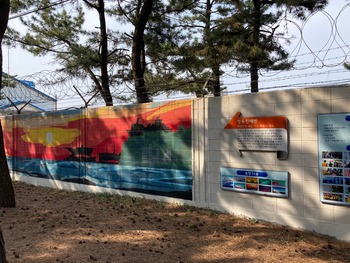
The coastal path was lined with military facilities, functioning as a form of securitisation of the Korean War and North Korea as a source of existential threat to South Korea, on what is an otherwise scenic and leisure-purposed beach lined with pine trees (Figure 1). At the time of observation, there were a handful of people, possibly Gangneung residents, taking a stroll along the beach trail. The military facilities did not appear to be an object of interest to these people, who seemed to pay them little attention.Footnote 57 At the same time, the military’s efforts to ‘disguise’ the facilities by painting popular tourist spots on the walls surrounding the military facilities (Figure 2) were apparent, suggesting efforts to persuade the South Korean public of the necessity of the emergency measures in the form of these military structures that are potential reminders of the threat posed by North Korea.Footnote 58
Military facility on the Gangneung coast with a sign warning people to keep off.

Figure 1 Long description
A small concrete military facility is situated on a coastal path surrounded by pine trees. The structure has a flat roof and a narrow entrance. A warning sign is placed above the entrance, indicating restricted access. The area is covered with pine needles and the sea is visible in the background through the trees.
Colourful mural of scenic spots in the Gangneung area on the wall of a military facility on the beach.
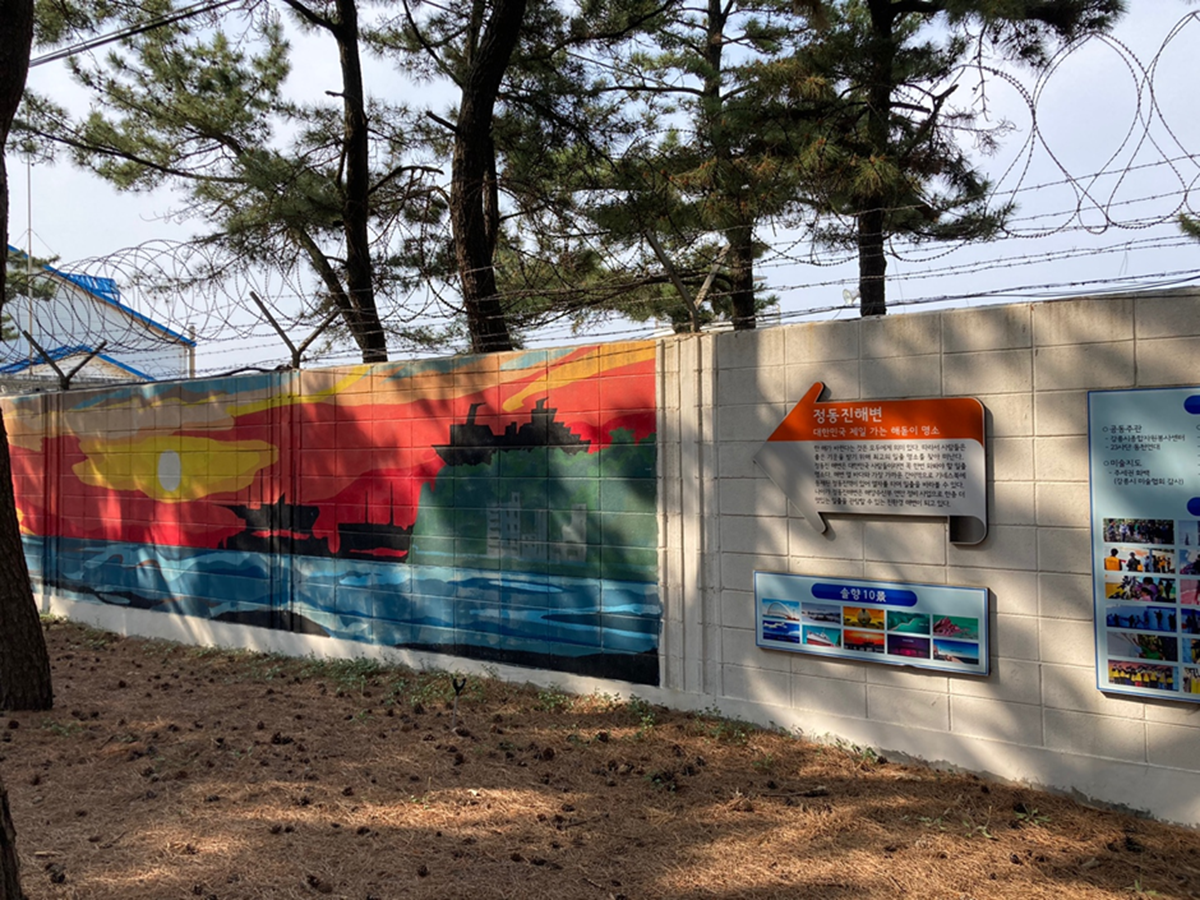
Figure 2 Long description
A mural depicting scenic spots is painted on the wall of a military facility. The mural includes images of a ship and a sunset over water. Adjacent to the mural are informational panels mounted on the wall. The panels contain text and images, possibly providing details about the mural or the area. The wall is topped with barbed wire and pine trees are visible in the background, suggesting a coastal setting.
By doing so, the civilian-friendly appearance of military facilities coerces consent from the public towards these facilities, which function as securitising moves. Despite the Concertina wire and dire warnings, the military facilities were rendered mundane (if colourful), blending in with Gangneung’s tourist sights. Securitisation thus involved a delicate balance between emergency measures as designed and desired by the political elites in the form of military infrastructure, and persuading the audience to accept, or at the very least, not contest or reject them by making them seem aesthetically appealing.
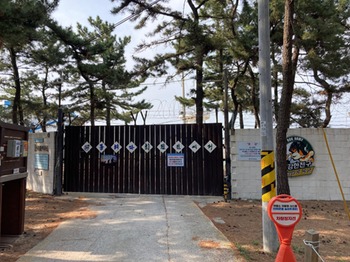
Signage on the main gate to military unit 2191 (Figure 3) reads ‘On the Battlefront of the East Sea Coast’, with a cartoon animal mascot in a military uniform and the words ‘Strong Friend: The ROK Army’ to the side of the gate. The efforts to appear civilian-friendly again suggest efforts to persuade the Korean public of the necessity of the military presence as an emergency measure. The gate presents a stark contrast to the colourful painting of sights, sounds, and tastes of Gangneung on the wall of this military facility that appeared to camouflage the reality of war, national security, and most importantly, South Korea’s physical and national insecurity.
The gate to Korean Army unit 2191 located on the beach.
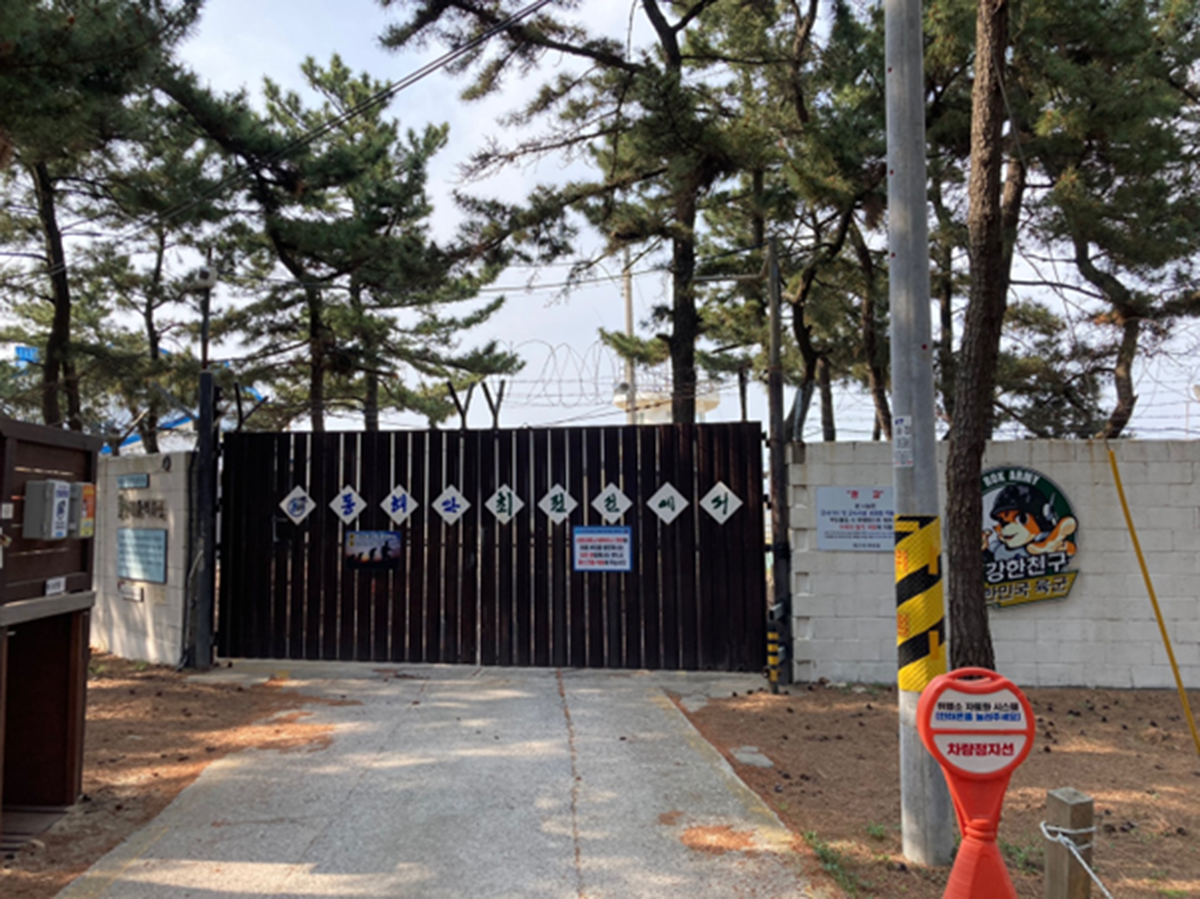
Figure 3 Long description
A gate to Korean Army unit 2191 is shown, located on a beach. The gate features signage reading ‘On the Battlefront of the East Sea Coast’ and a cartoon animal mascot in a military uniform. The words ‘Strong Friend: The ROK Army’ are visible to the side of the gate. The area is surrounded by trees and a paved path leads to the gate. A red and white sign is positioned near the path.
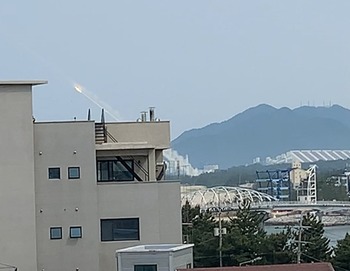
The same afternoon, on 25 May, illustrated how the South Korean public accepts the routinisation of security practices in the form of missile launches in retaliation against North Korea’s missile tests.Footnote 59 Around 2:00 pm, there was a loud noise similar to the roar of an aircraft engine heard approximately every 10 minutes for about an hour. The noise, audible across Gangneung’s beachfront lined with restaurants and cafés, was the result of projectiles being launched from the Gangnueng airbase (located approximately two kilometres away) towards the East Sea. The projectiles themselves were barely visible, but the flame and exhaust from the missiles were clearly visible even in the bright sunlight, as seen in Figure 4.Footnote 60
One of the missiles being launched from the Gangneung Air Base as seen from a cafe.
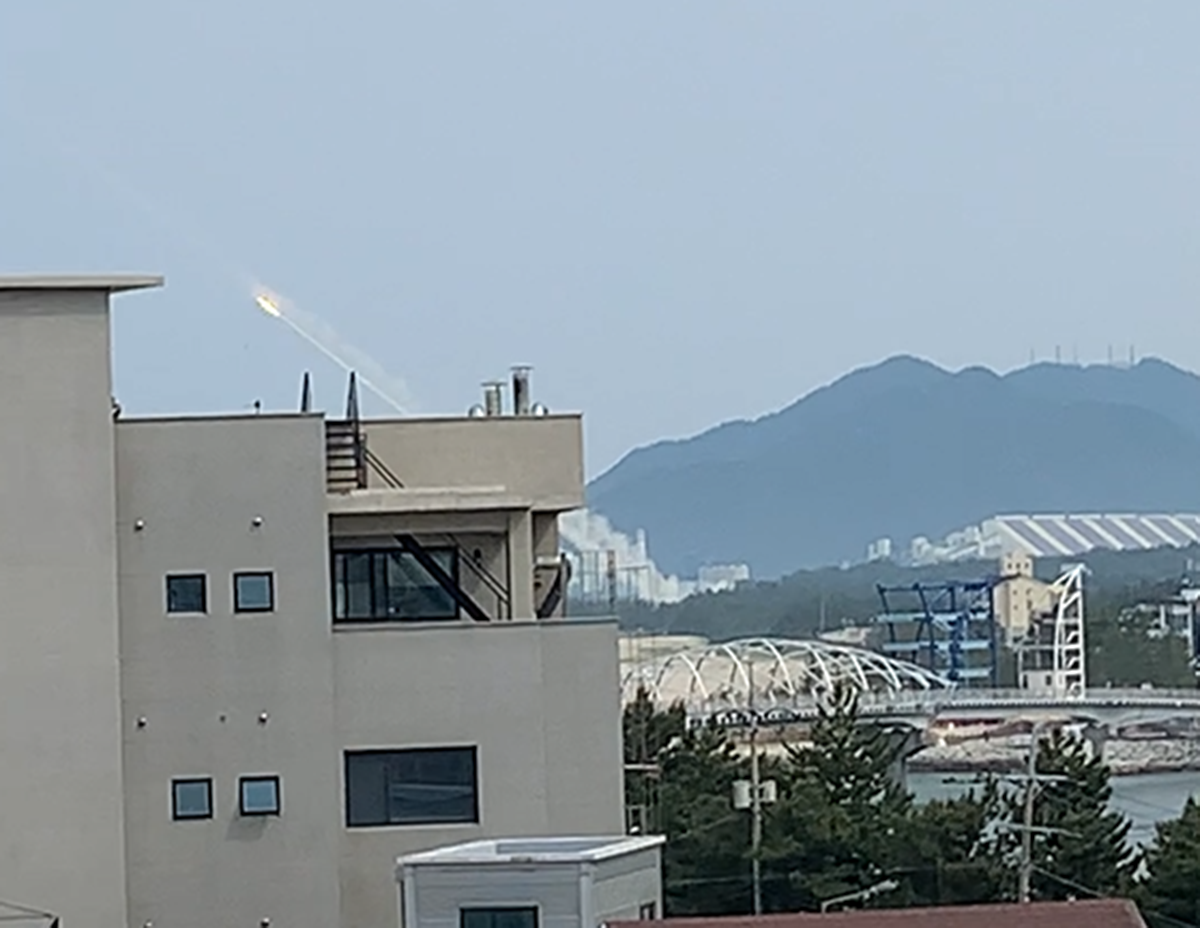
Figure 4 Long description
A missile is being launched, visible from behind a building with multiple windows. The scene includes a mountainous backdrop and some industrial structures. The missile's exhaust trail is visible in the sky, indicating its trajectory.
During the launches, we observed the nearby patrons of the restaurants and cafes, who mostly did not appear to pay much attention to either the sight of the missiles or the loud noise. Most of the people we observed continued conversations or took in the sights while outwardly ignoring the missile launches. One or two people briefly reacted but quickly resumed what they had been doing.
Military drills in South Korea are not uncommon, especially in Gangneung where the airbase is the nearest to the inter-Korea border. It appeared that the South Korean public had learned to live with military practices that were not only visible but also proximate to them, thanks to decades of living with civil defence drills that were inevitable given North Korea’s constant provocations and the ongoing war.Footnote 61 Coping with missile launches by ignoring them perhaps not only ensures South Koreans’ ontological security of their Korea as the more prosperous and ironically more ‘peaceful’ Korea but also minimises their sense of disruption to their immediate everyday routines and hence reinforces their ontological security. By doing so, they wilfully choose to bracket out cognitively and affectively the ever-present possibility of North Korea inflicting death upon civilians.
Direct observation on 4 October: Audience reaction to securitisation
The second instance of securitisation occurred on the night of 4 October 2022, when the South Korean military fired a Hyunmoo-2 missile from the Gangneung airbase during exercises conducted along with US forces in response to North Korea’s launch of a missile demonstrating its capability to reach the US territory of Guam. The Hyunmoo-2 launch, however, resulted in an accident. The missile malfunctioned, blowing up as it fell within a golf course at the airbase, causing panic among both locals and the public elsewhere in South Korea.Footnote 62 Between 11:00 pm on 4 October and 7:00 am on 5 October, when a government press conference was held, there was no official confirmation about what had occurred despite numerous social media posts and speculation online. In the immediate aftermath, the government did not confirm what had occurred, and the media was embargoed from reporting on it.Footnote 63 News articles on the incident were posted only to be taken down minutes later, and we observed that many tweets regarding the incident were deleted in near-real time.Footnote 64 The government’s embargo created an information vacuum, during which the public was left to speculate on what had actually happened.
Because we were not present in Gangneung during the second missile test, we virtually observed and captured the South Korean public’s reactions. We learned about the accident from Korean-language tweets about a large explosion and fire near the Gangneung airbase around midnight local time. We observed the social media discourse in real time for nearly four hours. Starting at roughly 11:00 pm on 4 October, Gangneung-based Twitter users expressed alarm at what sounded like an aircraft crashing, the sound of a massive explosion, and a large, highly visible fire in the vicinity of the airbase, fuelling speculation as to the cause from Twitter users in Gangneung and across South Korea. Some Gangneung residents and users in other parts of South Korea speculated about a possible ‘invasion’ from North Korea. News media and emergency services were silent, leading to even more speculation that South Korea could be under attack.
Indirect observations of reactions to 4 October missile accident
To uncover the public discourse surrounding the accident, we collected the text of social media posts to indirectly observe the production of public discourse and how it evolved, if at all. Under our framework of ontological agency, we would expect the public to see the incident through a securitised lens. Upon seeing visceral images of fire and explosions near a military installation, and in the absence of information, we would expect some portion of the public to speculate that the fire and explosion were somehow related to North Korea.
Using the R package academictwitteR,Footnote 65 we first collected tweets across three samples for 4 October in two phases – first, as the fire from the explosion was active around midnight, and, second, following the government’s press conference regarding the explosion held at 7:00 am on 5 October.Footnote 66 We combined these three samples to form a snapshot of Twitter discourse related to the missile accident. We collected the tweets and analysed them for Korean words like ‘war’ or ‘battle’ or ‘North Korea’.Footnote 67
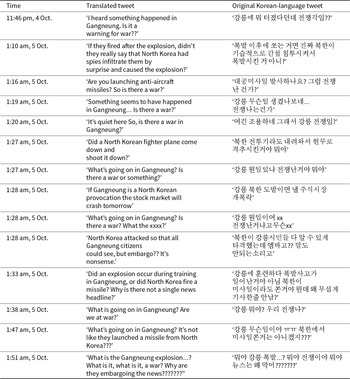
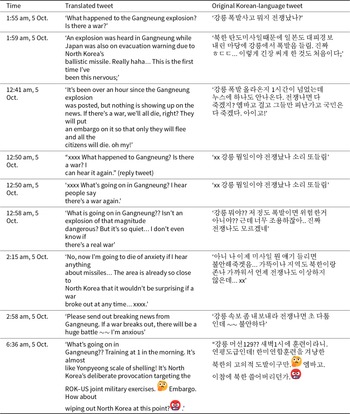
Our data collected in the aftermath of the mysterious explosion reveals two major themes.Footnote 68 The first theme involves speculations about the cause of the explosion (Tables 1 and 2). Much of the discourse centred around uncertainty about whether the incident was an accident or an intentional provocation. In the absence of information, some users expressed anxiety that war had broken out or that North Korea was attacking. Some users expressed emotions of anger and frustration in the form of profanity (censored here as ‘xxxx’).
Tweets in immediate aftermath of 4 October accident expressing concern about North Korea or the outbreak of war
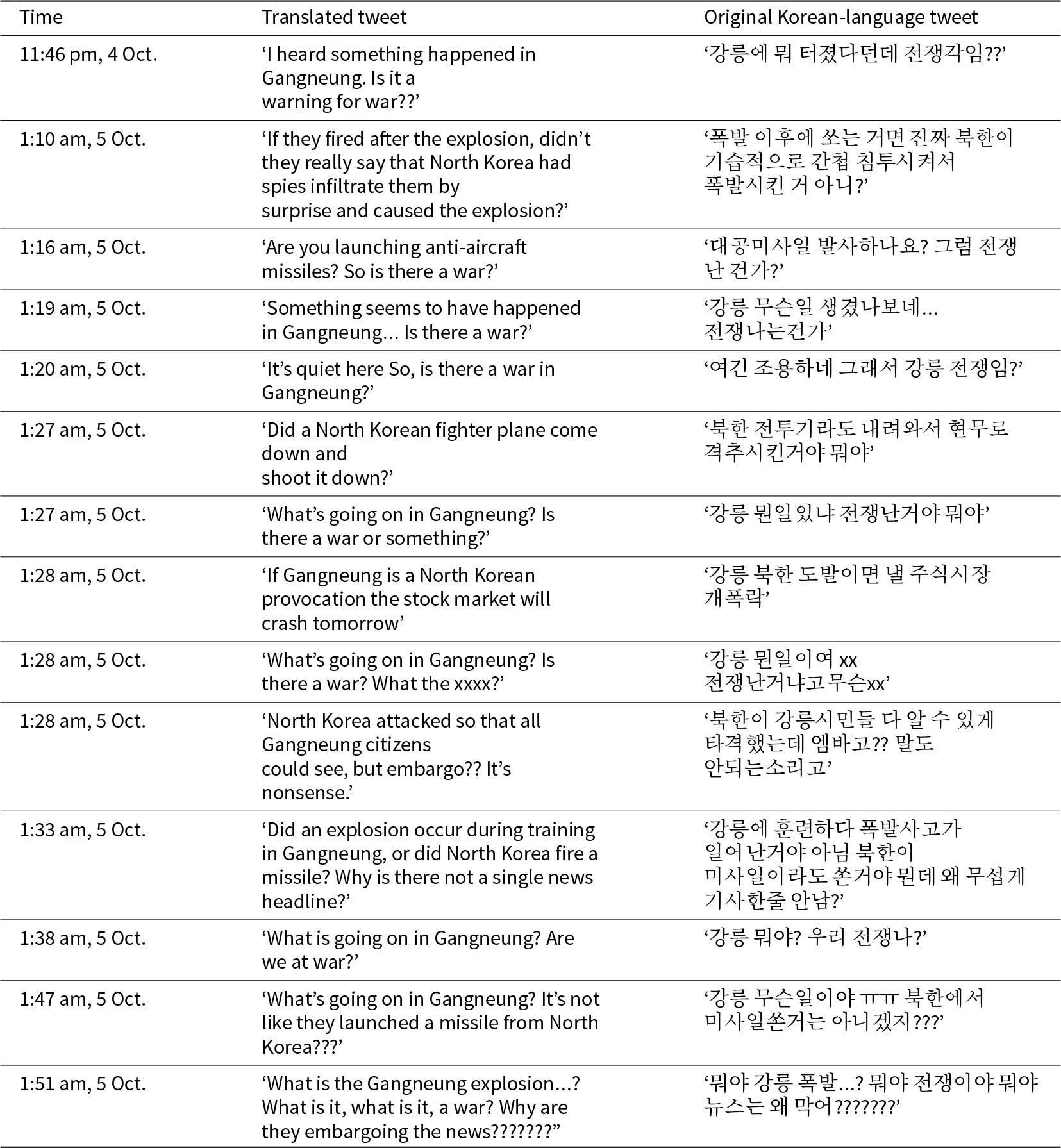
Table 1 Long description
The table presents tweets from the immediate aftermath of an incident in Gangneung on 4-5 October, expressing concerns about North Korea and the possibility of war. Key data points include tweets questioning whether explosions or missile launches occurred, and speculating about North Korean provocations. Several tweets mention the lack of news coverage and express fear about the stock market crashing. The tweets reflect a trend of uncertainty and anxiety among users, with repeated inquiries about the nature of the incident and its implications for war. The data suggests a heightened sense of alarm and speculation among the public, with no official information available at the time.
Tweets in immediate aftermath of 4 October accident expressing concern about North Korea or the outbreak of war (continued)
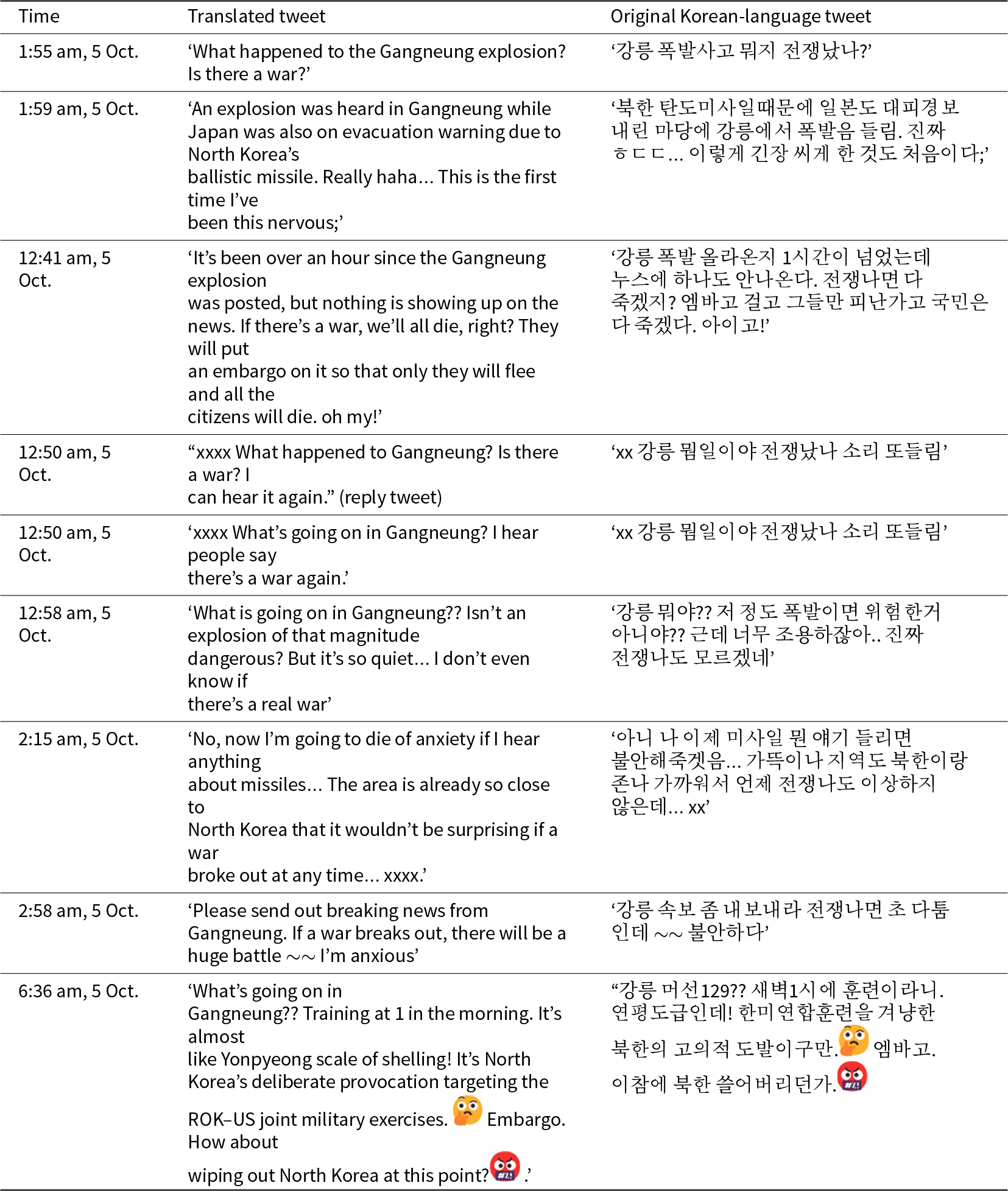
Table 2 Long description
The table presents tweets reacting to an explosion in Gangneung on October 5, expressing fears of war and North Korean provocations. Key data points include tweets questioning the lack of news coverage and expressing anxiety over missile threats. Some tweets mention the proximity to North Korea and speculate on deliberate provocations during ROK-US military exercises. The tweets reflect a trend of increasing concern and urgency, with calls for breaking news updates and fears of embargoes. The data suggests a heightened sense of insecurity among the public, with varying degrees of alarm and speculation about the situation.
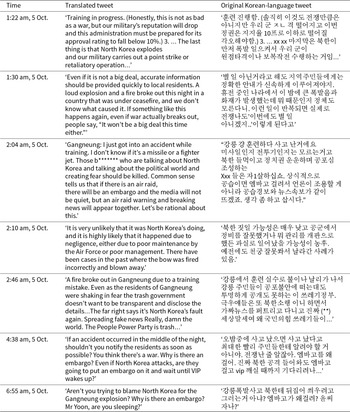
The second theme was the criticism of the military or the administration of President Yoon Suk Yeol, a visible and easy ‘target’ to blame for securitisation of North Korea and the Korean War (Table 3). Some speculated that the explosion may have been caused by an accident resulting from negligence, accusing the government and the military of incompetence in providing security to South Korean citizens. Others criticised the government for a lack of transparency and failing to communicate in a timely manner. Another questioned whether the government would inform the public in the event of war or an attack by North Korea. Many also questioned whether the government could handle an actual attack by North Korea.
Tweets in immediate aftermath of the 4 October accident criticising the government or military
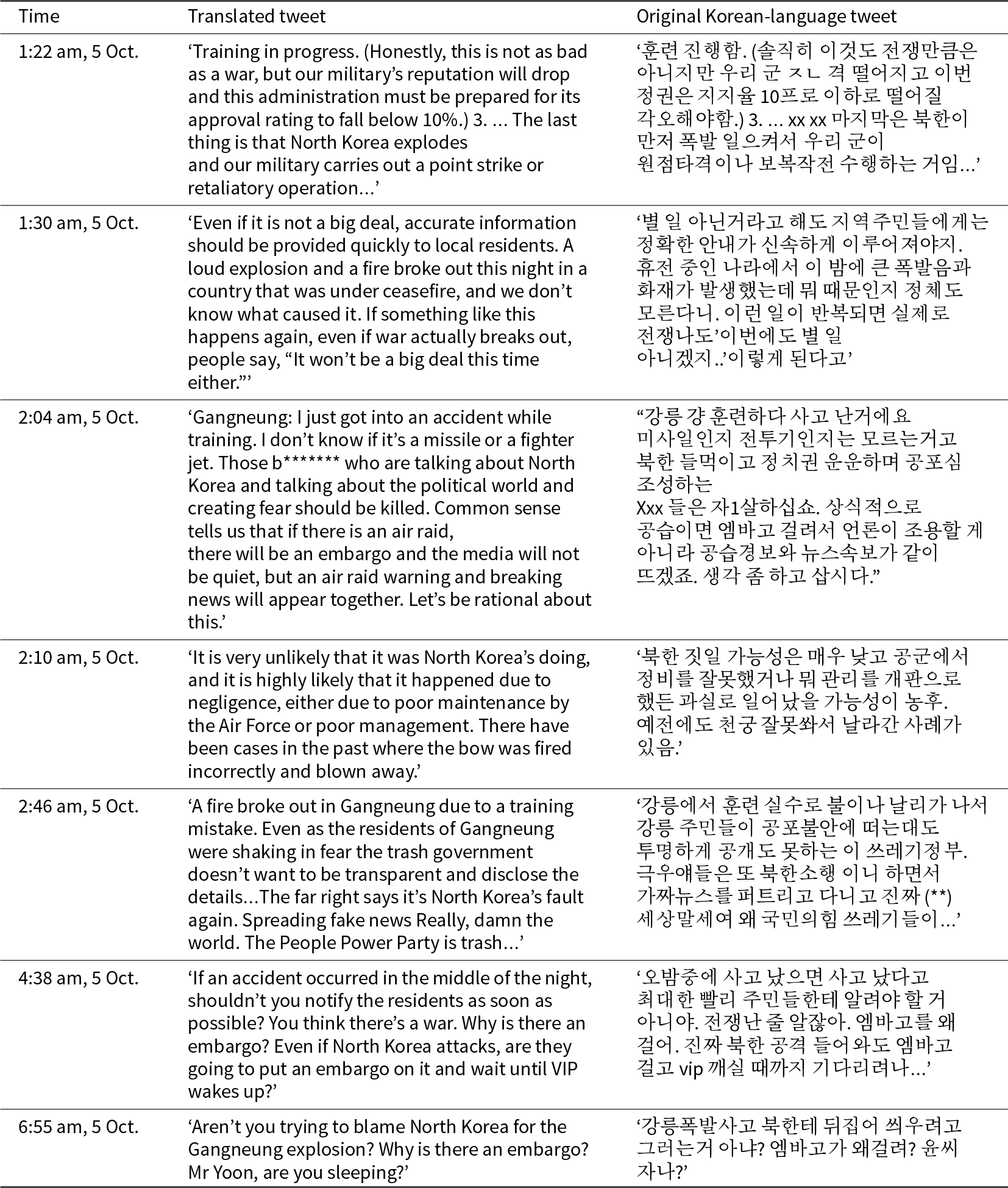
Table 3 Long description
The table presents tweets criticizing the government and military following a training accident in Gangneung on October 5th. Key points include accusations of negligence, lack of transparency, and misinformation about North Korea's involvement. Tweets express fear among residents and frustration with the government's handling of the situation, including delayed communication and embargoes. There is a trend of skepticism towards official narratives and concern over political implications, such as potential drops in approval ratings. The tweets reflect a mix of anger, fear, and distrust towards the authorities and media.
These responses suggest that even if they did not immediately think the 4 October explosion was caused by North Korea, some residents still expressed fear or anxiety about a hypothetical attack by North Korea and the government’s competence in defending the country. Furthermore, some users focused on the ongoing designation of North Korea as a major security threat, criticising the government and the government’s political party and disparaging the ‘far right’ for blaming North Korea. Another user suggested a conspiracy – that President Yoon would try to blame North Korea for the explosion. In other words, some members of the public appeared to specifically criticise moves by the government or other securitising actors to securitise North Korea.
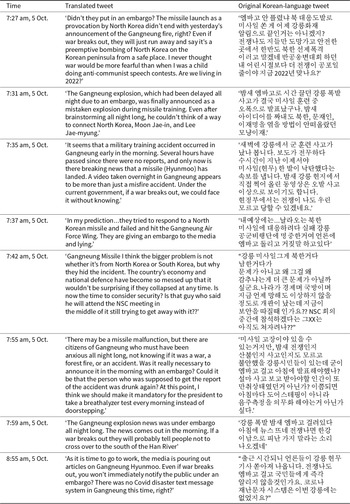
After the press conference clarifying the cause of the explosion and fire, South Korean users continued criticising the government and military.Footnote 69 The public discourse reveals two broad themes, similar to those in the first phase. First, there were criticisms of the media embargo and inadequate government communications (Table 4). Many criticised the government for the long period of information vacuum between the time of the accident and the conference. Others expressed concerns about the embargo and being lied to by the government. An undercurrent among these tweets is anger at the government for failing to inform the public despite the anxiety generated by the obscuration of the cause of the explosion. For example, one post specifically mentioned that the citizens in Gangneung ‘must have been anxious all night long, not knowing if it was a war, a forest fire, or an accident’ in criticising the government for the media embargo.
Tweets after 7:00 am press conference criticising the media embargo and government communications
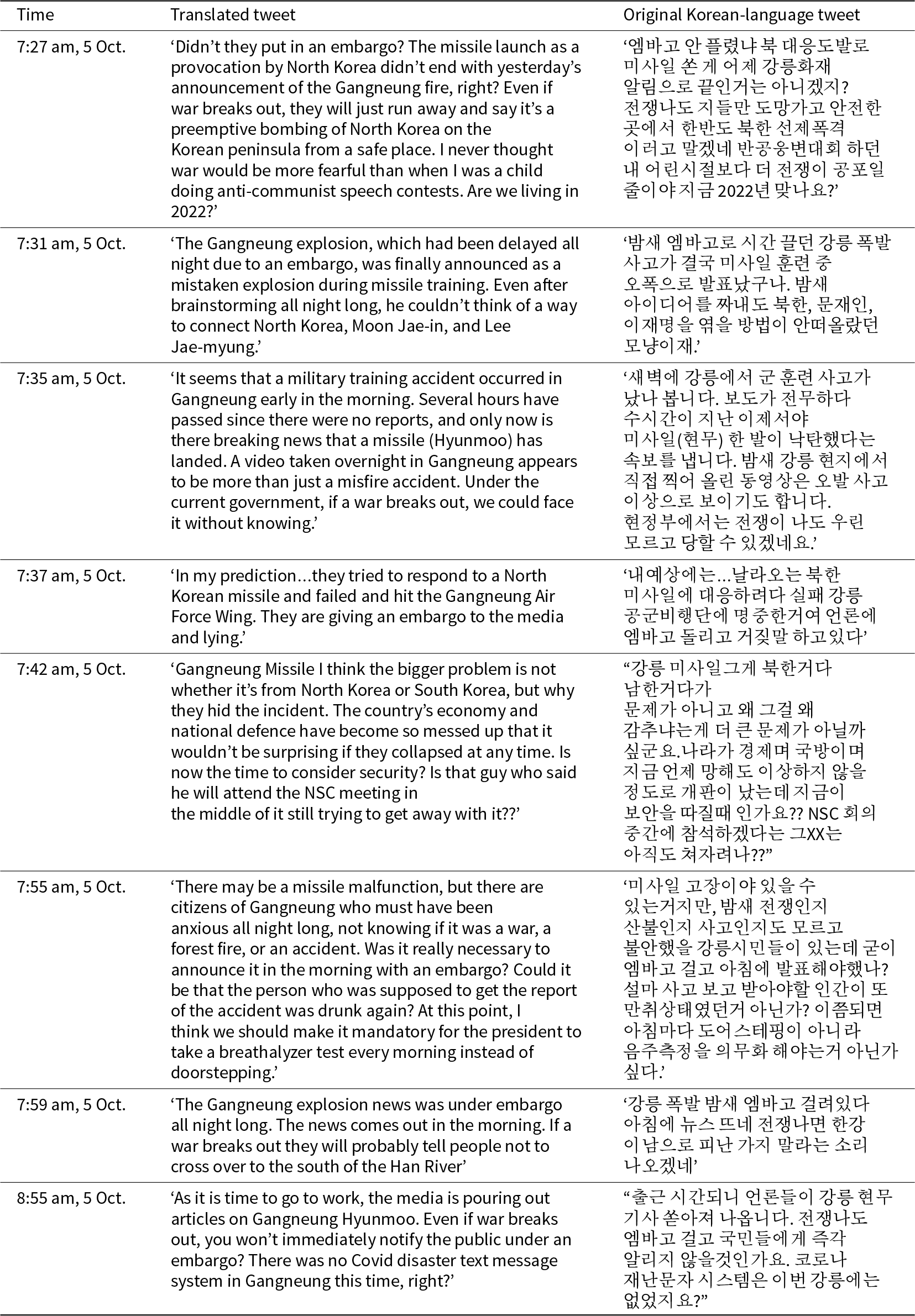
Table 4 Long description
The table presents tweets posted after a press conference, criticizing the media embargo and government communication regarding a missile incident in Gangneung. Key points include concerns about the embargo delaying information, fear of war, and distrust in government actions. Tweets highlight the anxiety of Gangneung citizens due to lack of timely information and speculate on government motives. Comparisons are made between current government actions and past experiences, with a trend of increasing fear and skepticism. The tweets suggest a need for better crisis communication and transparency from authorities.
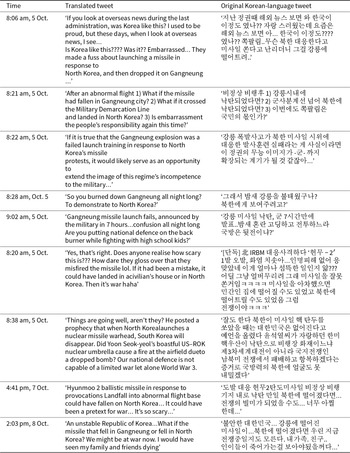
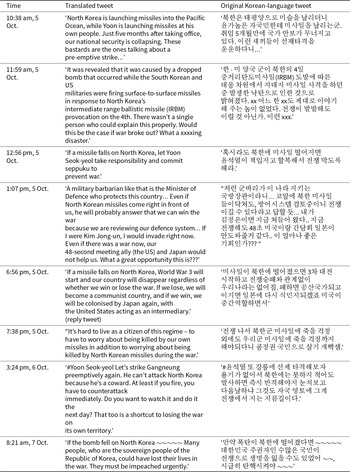
Similar to the first phase, the second theme that emerged on the morning of 5 October was criticisms of the government for failing to adequately provide security (Tables 5 and 6). Many expressed embarrassment at the accident. This embarrassment seems to stem from perceptions that the accident was a result of South Korea’s demonstration of its military prowess in response to North Korea’s missile tests, only to have the missile launch fail and be potentially dangerous to the South Korean people – the very referent objects of securitising North Korea. Others indicated concerns that the missile could have accidentally fallen on North Korea, which could have ironically caused a renewed outbreak of war unintentionally. Others specified that the missile could have fallen into civilian areas.
Tweets after 7:00 am press conference criticising the government for failing to provide security
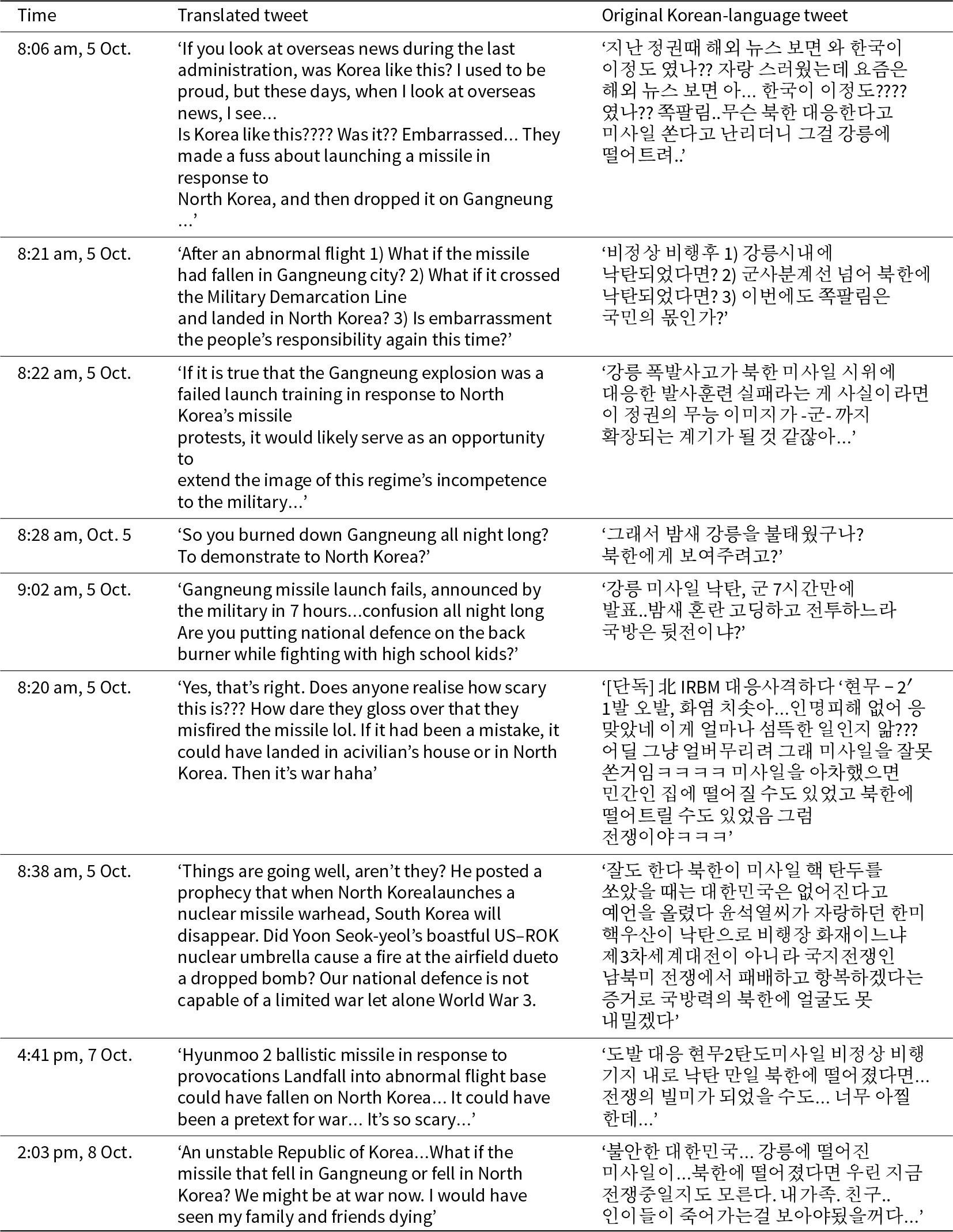
Table 5 Long description
The table presents tweets posted after a press conference criticizing the government's failure to provide security, specifically focusing on missile incidents. Key data points include tweets expressing embarrassment over the government's actions, concerns about missiles potentially landing in civilian areas or North Korea, and fears of war. Comparisons show a consistent theme of public dissatisfaction and anxiety about national defense capabilities. The tweets reflect a trend of increasing public scrutiny and criticism of the government's military responses. Interpretation should consider the emotional tone and potential bias in the tweets, as they represent individual opinions rather than official statements.
Tweets after 7:00 am press conference criticising the government for failing to provide security, continued
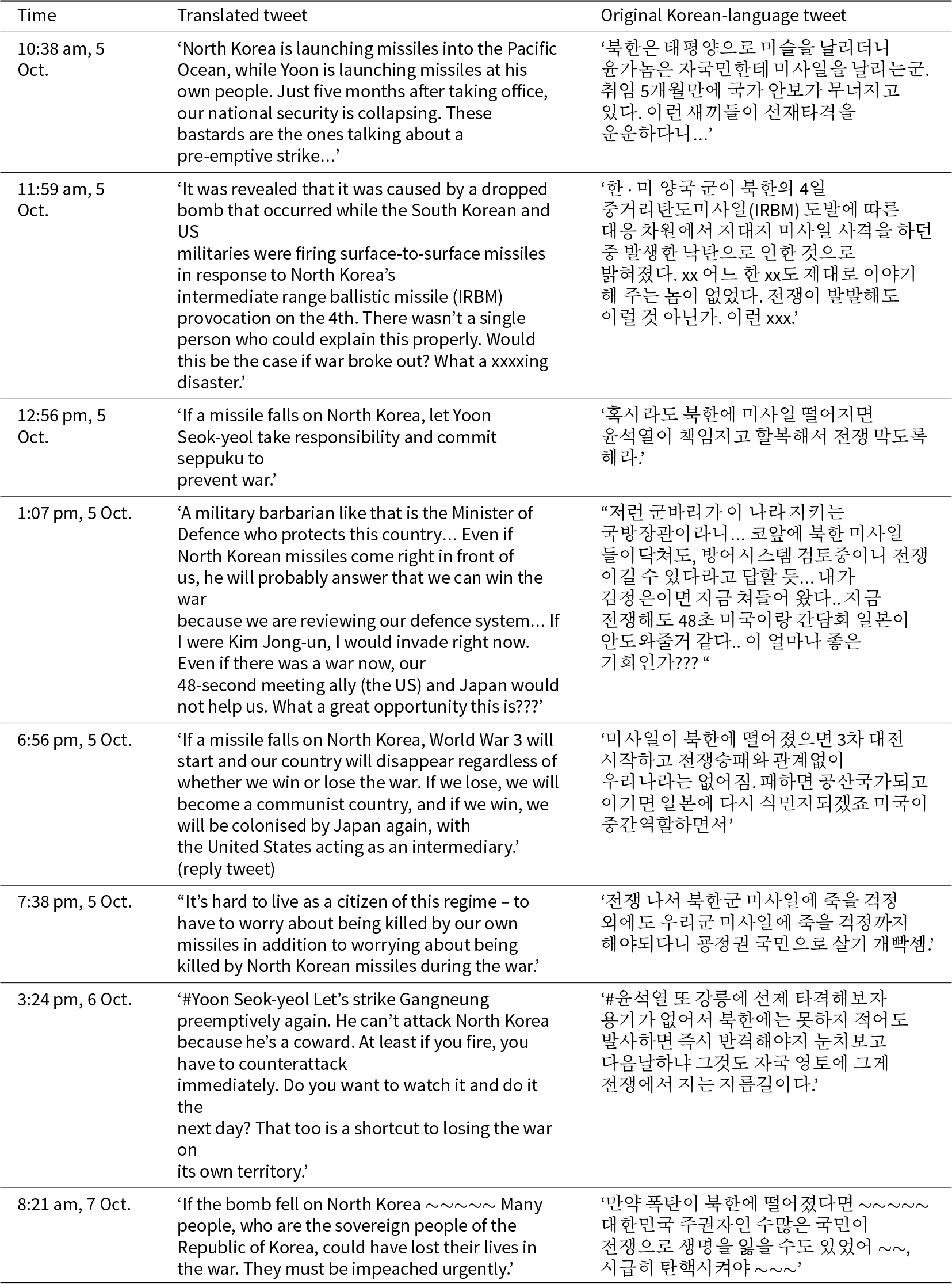
Table 6 Long description
The table presents a series of tweets from October 5 to 7, 2023, criticizing the South Korean government and military actions. Key points include concerns over national security following North Korea's missile launches and South Korea's military response. Tweets express fear of war, criticize President Yoon Seok-yeol's leadership, and question the effectiveness of the defense minister. Some tweets suggest dire consequences if a missile were to fall on North Korea, including potential war and geopolitical shifts. The tweets reflect public dissatisfaction and anxiety over the government's handling of security issues, with some calling for impeachment. The data highlights a trend of increasing public concern and criticism over the government's military strategies and national security policies.
The 4 October missile launch accident reveals that the former mundanity of the missile tests conducted regularly as part of South Korea’s securitisation efforts, which could otherwise be easily ignored and hence would not solicit outward reaction, was replaced by anxiety. The accident and the vivid images that accompanied it raised questions about what was to come, undermining the confidence of those who were witnessing the explosion directly or virtually, to go on with their day-to-day life. The public discourse revealed latent anxiety regarding North Korea and the possibility of South Korea being attacked again. Furthermore, once the accident made it so the public could no longer ‘unsee’ the missile tests and the attendant proof of their vulnerability to North Korea-related policies and military practices, the South Korean people’s latent anxiety related to North Korea became more apparent and even expressive.
Comparing the reactions to the 25 May and 4 October missile launches on social media
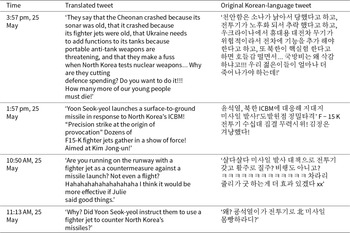
To demonstrate that the public reaction to the 25 May missile launches was different from that to the 4 October missile launch and accident, we collected tweets from the 12-hour period between 4:00 am and 4:00 pm local time on 25 May using the Korean-language keywords for ‘Gangneung’, ‘missile’, ‘explosion’, ‘Hyunmoo’, ‘bomb’, ‘Air Force base’, ‘airport’, and ‘North Korea’. This returned 139,583 tweets (19,630 unique tweets). Of these, only 23 unique tweets mentioned war,Footnote 70 4 of which directly or indirectly discussed the Hyunmoo-2 missile launch (see Table 7). All four tweets criticised the government for the retaliatory missile launch as it could escalate inter-Korea tensions.
The social media analysis reveals that in the face of securitising practices that undermine public ontological security by disrupting their day-to-day life, people react in two ways. First, they blame securitising actors for failing to manage the South Korean people’s ontological security needs. From our theoretical perspective, the South Korean people have delegated to the government the power to ensure that the North Korean threats and the anxiety that flow from them are being managed, so that they can go on with their lives without having to constantly put in effort to bracket or manage the anxiety. In the case of 25 May, many rhetorically blamed the Yoon government for choosing to carry out retaliatory missile launches following North Korea’s missile tests and thus contributing to (re)securitising North Korea. Despite the ‘competent performance’ of defending South Korea’s national security through such retaliatory missile drills, the tweets in Table 7 illuminate the latency of anxiety among South Koreans towards the possibility of renewed warfare.
Tweets from 25 May
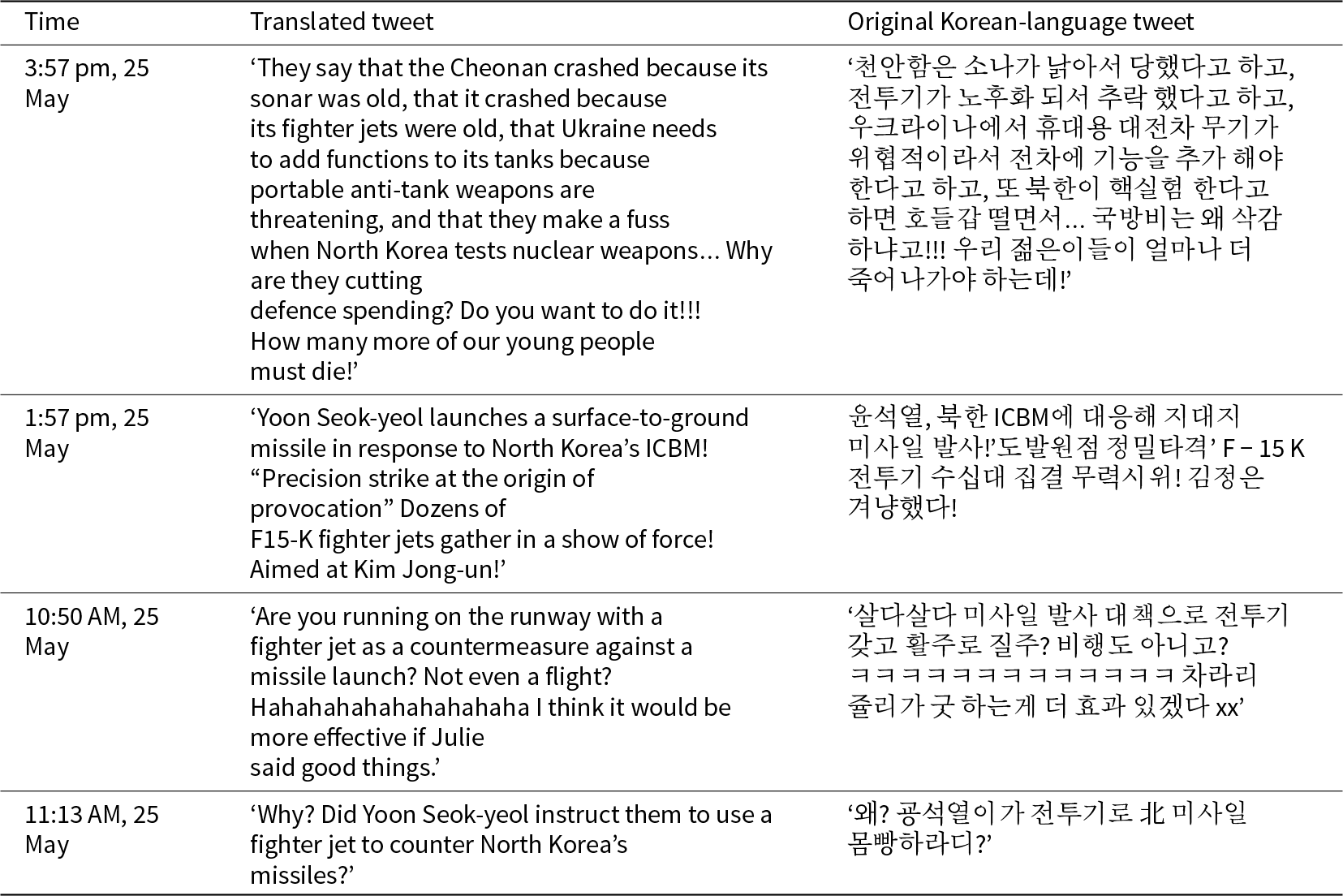
Table 7 Long description
The table presents a collection of translated tweets from May 25, alongside their original Korean versions. The tweets express criticism and skepticism regarding South Korea's defense strategies and resource allocation in response to North Korean missile tests. Some tweets mock the perceived ineffectiveness of countermeasures, such as using fighter jets on runways, while others question the rationale behind defense budget cuts. The tweets also reference specific events, such as Yoon Seok-yeol's response to North Korea's ICBM launch. The translations provide insight into public sentiment and debate surrounding national security issues on social media.
In the case of the 4 October missile accident, South Koreans blamed the Yoon government for not only failing to protect the country competently but also for the information vacuum which added to uncertainty and anxiety about the accident. Furthermore, this shows that the audience to securitisation is more tolerant of emergency measures to the extent that they are implemented with adequate communication and transparency.
Second, and more importantly, the social media analysis of the 4 October reactions highlights the automatic activation and regurgitation of the securitising rhetoric of North Korea as an existential threat to South Korean society. As Tables 1 and 2 show, as uncertainty, unknowability, and unpredictability ensued following the mysterious explosion and fire that was captured and shared on social media, a sense of confidence in going on with life broke down as people sought answers. The undermining of ontological security can spur people to exercise political agency, as evident from calls by politicians and the public demanding an investigation into the accident, as well as for accountability by the military, which was chastised for its lack of transparency.
That the missile launch was also conducted in response to North Korea’s missile tests raised questions about the ability of the military to respond effectively.Footnote 71 Securitising moves in the form of military exercises have come to be questioned as people choose to ‘see’ their insecurity not just from North Korea but from South Korea’s security apparatus, which relies on continued successful securitisation of the Korean War.
That the Korean War and North Korea are raised by some South Korean people regardless of the success of military exercises demonstrates that latent anxiety about North Korea is expressed in degrees rather than in a binary manner. Ontological agency helps account for inaction, or the lack of outward action and reaction, to military security policies and practices even if they are conspicuous to the general civilian public. People can afford to not act and attend to their day-to-day activities because of securitisation and the delegation of authority to the government and the military in carrying out necessary measures that contribute to their ontological security. However, once the day-to-day routines are disrupted, people express their anxiety by blaming the securitising and functional actors and may even more strongly express their anxiety by exercising their political agency.
The capturing of such discourse from across South Korea using social media demonstrates that latent anxiety is not localised to Gangneung residents, because the social media posts were being produced and shared nationwide in real time. The latent anxiety related to North Korea’s attack and the Korean War is demonstrated in other instances as well. For example, the South Korean public complained after a nationwide emergency evacuation alert was sent in error on 31 May 2023, in response to a North Korean satellite launch. Many panicked in fear of a renewed outbreak of war.Footnote 72 While panicking is not an abnormal reaction to such alerts, it suggests the latent anxiety South Koreans have had regarding North Korea for more than seven decades. Yet South Korean people have been able to cope with infinite possibilities of insecurity associated with North Korea because of ontological agency that drives selective bracketing of sources of threats in their day-to-day life.
Conclusion
Despite the intellectual impact of the Copenhagen School’s securitisation theory and its variants, the audience dimension remains under-theorised and under-analysed considering that securitisation processes potentially generate anxiety and disrupt ontological security. Existing works on audience agency conceptualise it as political, contingent upon the audience’s capabilities to accept, reject, or contest securitising moves. This overlooks the psychological aspect of security as a lived experience for the audience, who, as security subjects, may prioritise what is more immediate to them despite the designation of existential threats that may pose physical and ontological threats. Drawing on the ontological security lens emphasising the importance of preserving day-to-day routines in reinforcing people’s sense of stability and control, we argue that an audience in securitisation possesses and exercises ontological agency as a coping mechanism in the face of anxiety induced by securitising moves.
Our concept of ontological agency allows us to better understand and analyse how publics respond to securitising moves in more complicated ways than simply accepting or contesting. The case of South Korean state’s securitisation of the Korean War and North Korea in the form of military practices and facilities in the city of Gangneung, a moderately militarised urban area formerly out of bounds to civilians, illustrates how civilians live and cope with everyday military practices that resecuritise North Korea as a threat. We show through in-person and virtual observations that South Koreans exercise ontological agency by wilfully choosing to go on with their daily lives despite the presence of everyday representations of North Korean threats that induce anxiety. This agency in choosing what to respond to outwardly results in inaction or the lack of outward action or reaction to securitising moves. On the occasion of the failed missile launch that resulted initially in a loud explosion and fire amid an information vacuum, the South Korean public’s latent anxiety related to North Korea was expressed in finger-pointing at the government and the military, who function to assure the stability and continuity of the world such that people can attend to their day-to-day life.
We offer two implications for theoretical and empirical work on securitisation. First, the concept of ontological agency suggests conditions under which (de)securitisation could succeed or fail because of the audience. The vernacular dimension of security experiences hints at how ontological security needs may be prioritised by laypeople who may willingly choose not to see the securitising process as long as it does not undermine their everyday routines which make them feel grounded and anchored. At the same time, it is not security as an issue per se that drives people to act or react but rather anxiety about the potential ontological and physical security disruptions related to that issue that can trigger them to act as they seek ways to restore their sense of stability and a reassurance or confidence that the world will continue as it is.
Second, securitisation often involves framing an issue as an existential threat which in turn can be framed as causing existential anxiety that can be debilitating to the extent that individuals lose the capacity to cope with it. The theoretical axiom of securitisation is the exigency of emergency measures because an issue had been designated and framed as an existential threat. That is, securitisation can be said to be associated with existential anxiety, or anxiety related to existentialism or the human condition or situation as it is lived. As Andrew Hom and Cian O’Driscoll point out, we are living through the ‘Age of Anxiety’, where people are confronted by existential situations and questions demanding answers or responses, or in our theoretical conception, exercising agency in deciding subjectively which security needs must be met or prioritised. The rise of the politics of existentialism shifts the focus to a greater need for a reflective understanding of people’s experiences and their choice of response, which entails a complex struggle over what they are responsible for within their limited means.Footnote 73 Because this is a human condition afflicting all of us, it is a universal experience contextualised by the immediate questions being thrown at us every day.
Supplementary material
The supplementary material for this article can be found at https://doi.org/10.1017/S0260210524000834.
Video Abstract
To view the online video abstract, please visit: https://doi.org/10.1017/S0260210524000834.
Acknowledgements
Previous iterations of the argument were presented at 2022 ISA Midwest, St. Louis, 2023 ISA Northeast, Providence, the Spring 2023 Research in International Politics workshop at the Department of Political Science at The Ohio State University, and 2024 Security Seminar, US Military Academy, West Point. We would like to thank Luke Campbell, Laurie Georges, Karl Gustafsson, Cameron Hunter, Jiyoung Ko, Jack MacLennan, Maria Mälksoo, Brent Steele, and Andrew Szarejko for their comments. We also thank the editors and three anonymous reviewers for their helpful comments.



 Open access

