


How does the threat of a dominant ally withdrawing affect public attitudes toward defense spending and defense cooperation in alliances? In the face of external threats, the public tends to rally both “around the flag” and around collective defense frameworks.Footnote 2 But how do allied publics respond when the dominant power threatens the possibility of withdrawal?
Scholars of transatlantic security have long been interested in whether pressure from the United States has any effect on allies’ defense spending and burden sharing behavior within NATO.Footnote 3 One strand of this literature has primarily focused on burden-sharing preferences at the elite-level in Europe. While recent work has found that NATO leaders were quick to set new spending agendas in response to pressure from the first Trump administration,Footnote 4 other studies have found that aggressive rhetoric from American presidents does not motivate European allies to increase defense spending.Footnote 5
The war between Russia and Ukraine has made both defending the security of NATO member states and signaling cohesion to global adversaries an urgent priority. In addition to these heightened external risks, the threat of a dominant ally withdrawing from alliance commitments will likely impact the preferences of foreign publics. A recent experiment found that rhetorical threats of American abandonment, that is, that the United States would not defend a NATO ally if it were attacked, marginally increased European public support for greater NATO burden sharing.Footnote 6 However, this rhetorical strategy also stoked feelings of anger, annoyance, and distrust toward the United States. While the study offered the first insights into how presidential rhetoric affects burden-sharing preferences in allied states, we argue that the tone of those threats, the credibility of US abandonment, and the associated security risks changed significantly during the 2024 US presidential election.
Until now, no studies have used realistic scenarios to causally examine how threats of withdrawal affect public attitudes toward defense spending and defense cooperation in allied states. To address this pivotal gap, we utilize the novel circumstances surrounding the coin-toss 2024 US presidential election to test how the unprecedented uncertainty of the US commitment to NATO affected public preferences for defense spending and defense cooperation in Europe.
The 2024 election featured two presidential candidates with polar opposite positions toward NATO in a coin-toss race. Kamala Harris’s campaign rhetoric indicated that the Democratic establishment was committed to defend NATO allies and uphold alliance principles. Meanwhile, US President Donald Trump repeatedly questioned the US commitment to NATO and promised his supporters that he would in fact “encourage” Russia to “do whatever the hell they want” to countries that do not “pay their bills.”Footnote 7 By encouraging NATO’s greatest adversary to violently attack NATO allies, the threat of American withdrawal became a more serious and credible reality for two reasons. First, Trump’s promise to abandon allies to a revanchist Russia went beyond the conventional burden sharing rhetoric of American presidents, thus constituting a more serious threat of withdrawal. Second, the likelihood of being the next target of Russian aggression increased significantly after the Russian invasion of Ukraine, making Trump’s threats far more credible.
Our preregistered survey experiment leverages the real-world salience of the 2024 US election to capture the causal effect of threats of withdrawal amid renewed Russian aggression. Our ability to incorporate the uncertainty of the election into our experiment strengthens the realism of our treatments and sets our study apart from others, which have relied on purely hypothetical vignettes in an experimental setting. By fielding our experiment in a unique time window when all major election prognoses were too close to call, we were able to compare the highly realistic threat of American withdrawal with an equally realistic counterfactual: the reassurance of the US commitment to NATO branded by Kamala Harris and the Democratic establishment. We draw on a representative sample of 2,973 respondents from the United Kingdom (n = 992), Sweden (n = 1005), and Germany (n = 976). Respondents were randomly exposed to either the control condition or one of two treatment vignettes. The treatment vignettes paired an election poll (indicating either a likely Trump victory or likely Harris victory), with each candidate’s campaign rhetoric about NATO commitments. All participants reported whether they would support their government’s decision to increase defense spending as a percentage of the national budget, as well as their degree of support for various defense cooperation frameworks.
Our study offers two important contributions to the literature on burden sharing and popular support for military alliances. We find that when the dominant ally threatens to withdraw from its alliance obligations and leave nations vulnerable to Russian aggression, allied publics become more supportive of increasing defense spending. This finding provides empirical evidence that the Trump administration’s targeted criticism of allied defense spending effectively sways European attitudes toward burden sharing.Footnote 8 However, this effect does not coincide with increased support for a European-led NATO alliance. Instead, European citizens become less willing to support continued defense cooperation in NATO when the United States threatens withdrawal. The threat of withdrawal also makes the pursuit of national security autonomy a more attractive option to the European public, and significantly decreases the public’s confidence that NATO allies will come to their defense in the event of a Russian attack. Our empirical findings suggest that by incentivizing decoupling, the United States risks alienating audiences in allied states, whose cooperation is indispensable for pursuing regional competition in a multipolar world.Footnote 9
How Threats of Withdrawal Influence Defense Spending Preferences
NATO is an asymmetric alliance in terms of the varied military and economic strength of its members, both of which are defining attributes of American power within the organization. The economic model of NATO burden sharing posits that larger states tend to contribute disproportionately to providing the collective good of security.Footnote 10 The remaining small states contribute less to the collective good in absolute terms, which might be expected given their relative size and power. After all, the relative size and power of states within the alliance also determine the benefits that they derive from membership.Footnote 11 Nonetheless, the unevenness of contributions to the alliance perpetuates the impression that smaller states free ride on the larger states’ security guarantee. Under the protection of a dominant ally, smaller states have been said to enjoy security without the associated increases to their defense budgets, thus enabling higher investment in domestic expenditures—so-called peace dividends—in many European democracies.Footnote 12
While some scholars have argued that smaller states contribute to the alliance in different ways and do not free ride as much as the economic model suggests,Footnote 13 US presidents from both sides of the aisle have problematized the lack of European burden sharing. Under George W. Bush and Barack Obama, the United States attempted to pressure European allies to amp up defense spending, albeit with limited success.Footnote 14 In fact, a number of studies have demonstrated that pressure from the White House has no significant, long-term effect on European elites’ preferences for burden sharing.Footnote 15
According to some scholars, the dominant ally should be able to alleviate alliance free riding by threatening to withhold military assistance from states that do not contribute adequately to the collective good.Footnote 16 American leaders have accordingly attempted to pressure European states to increase their defense budgets, using rhetorical tactics like naming and shaming.Footnote 17 Donald Trump has arguably been more eager than his predecessors to bring these grievances into the public eye. During the 2024 election, Trump became hostile toward NATO members, deviating from a historically bipartisan willingness to commit US resources to the protection of European allies. Trump’s verbal attacks also went beyond the historical norms of how American presidents use rhetorical pressure against NATO allies. He not only threatened to abandon NATO allies, but also claimed that he would encourage Russia to do whatever the hell they want to states that did not meet defense spending targets.Footnote 18 Conversely, Kamala Harris criticized her opponent for turning NATO into an arena of political gamesmanship and insisted to European audiences that her own commitment to Article 5 was ironclad.Footnote 19
While rhetorical strategies have often been written off as cheap talk,Footnote 20 we argue that attempts by US presidential candidates to galvanize popular support for specific foreign policy promises constitute highly credible threats to allies as well as adversaries. Given the interconnected nature of international news media and the salience of US presidential races, we argue that foreign policy rhetoric is likely to reach both foreign leaders and international public audiences.
The 2024 US election in particular attracted a global audience, ensuring that individuals in other countries would be exposed to US election news and candidates’ rhetoric. Both Trump’s threats and Harris’s reassurances were directed at European audiences and intended to influence their attitudes toward NATO and alliance burden sharing. To foreign audiences, Trump’s claim that he would encourage Russia to attack NATO members constitutes a highly credible promise that under a second Trump administration, the United States would withdraw from alliance principles altogether. Meanwhile, Harris’s address to the Munich Security Conference reassured NATO allies of the US commitment just six days after Trump’s rally speech. Although elite rhetoric is often intentionally targeted toward foreign audiences,Footnote 21 the influence of threats of withdrawal on foreign audiences has been largely overlooked in the literature.
We argue that public opinion toward alliance burden sharing is a central factor shaping how European leaders respond to pressure from the US, because they have an incentive to minimize domestic audience costs.Footnote 22 Until now, we are aware of only one study which has investigated how American rhetoric shapes public opinion in Europe. Blankenship revealed that threats of American abandonment boosted popular support for increased defense spending in two NATO countries. Although reassurance from the United States triggered feelings of moral obligation among some respondents, the overall effect of reassurance on willingness to spend was insignificant.Footnote 23 We thus expect that Donald Trump’s highly credible threats of withdrawal will increase European willingness to raise defense spending, while Kamala Harris’s efforts to reassure allies of the US commitment may have a more marginal effect:
H1: The threat of American withdrawal will increase public willingness to raise defense spending, relative to reassurance of the US commitment.
How Threats of Withdrawal Influence Defense Cooperation Preferences
The threat of American withdrawal may trigger a reconsideration of alliance solidarity and a search for institutional alternatives that are not vulnerable to the whims of American presidents. If the alliance is deemed unreliable as a result of American threats to withdraw, citizens may support increases to the defense budget on the condition that public spending is used either to scale up European security cooperation or their own national security forces.Footnote 24
However, European citizens might prefer to see a European-led NATO in lieu of a reliable US commitment. In fact, as far as public sentiment goes, NATO and European defense integration need not be mutually exclusive. Reviews of public opinion dating back to the early 2000s have shown that the European public has generally held positive attitudes toward both European defense cooperation and NATO. This long-term trend indicates that on the menu card of security and defense frameworks, the average European prefers to have it both ways.Footnote 25 This sentiment has been reinforced by policymakers and scholars who see European defense integration as a mechanism to strengthen European burden sharing within the transatlantic alliance, reducing dependence on the United States and boosting EU strategic autonomy.Footnote 26 If the threat of American withdrawal rallies support for stronger European security cooperation and citizens indeed prefer to have it both ways, we expect to see increased public support for NATO and increased public support for EU defense cooperation. However, if citizens presented with the threat of a declining US commitment become more supportive of NATO cooperation, this would support the interpretation that the public prefers to invest in a European-led NATO.
Previous studies on European attitudes toward the EU Common Security and Defense Policy have also found that preferences for national autonomy remain prevalent across many voter groups in Europe.Footnote 27 This preference often correlates with a desire to become more independent from the United States. However, scaling up national security forces need not be an alternative to EU-level cooperation. Though Euroskeptics clearly prefer to have security and defense autonomy from the EU, other citizens support scaling up national security capabilities as well as enhancing European defense integration. For example, a majority of European poll-takers in 2018 expressed a wish to have it both ways when asked whether foreign and defense policy should be managed at the national or EU-level.Footnote 28 Thus increasing public support for national autonomy would certainly signal a desire to become less dependent on the United States, but it need not exclude support for EU defense integration.
Institutional preferences explain important nuance as to where European defense spending goals are targeted, as well as which types of security structures are deemed viable following threats of a dominant ally withdrawing. We theorize that threats of withdrawal are likely to be a warning sign of bad faith in future defense cooperation with the United States. Thus we expect that when the leader of the transatlantic alliance threatens to withdraw, European public preferences for NATO cooperation will decrease:
H2: The threat of American withdrawal will reduce support for continued cooperation in NATO.
Research Design
To test these hypotheses, we fielded an original, preregistered survey experiment in the United Kingdom, Germany, and Sweden. While these three countries are all military powers with strategic importance to NATO, they also grant interesting empirical variation to our study in terms of their distinct foreign policy traditions and stable trends in public opinion toward transatlantic security and defense.
Historically, the United Kingdom has demonstrated Atlanticist traditions at the level of both foreign policy decisions and public attitudes. The tendency to align British security policy with that of the United States and to view the transatlantic alliance as the primary provider of European security exemplifies the two nations’ special relationship.Footnote 29 Results from nationally representative surveys in the United Kingdom consistently indicate strong public trust in the transatlantic alliance, as well as the belief that the United States is the United Kingdom’s closest and most essential ally.Footnote 30 Including the United Kingdom in our study allows us to examine whether American threats of withdrawal leverage a shock to mass preferences, which are typically shaped by Atlanticism.Footnote 31
German foreign policy traditions, on the other hand, continue to be shaped by the nation’s complicated past. Studies of German foreign policy attitudes have shown that the public largely prefers multilateralism over Atlanticism.Footnote 32 On average, the German public tends to be opposed to maintaining a strong military,Footnote 33 and a NATO-skeptic, Russia-friendly sentiment still lingers among partisans on both the left and the right.Footnote 34 The German public has also traditionally been more supportive of establishing European defense structures independent of the United States.Footnote 35 Including Germany in our study allows us to explore whether American threats of withdrawal trigger greater public support for increased defense spending and institutional alternatives to NATO.
Finally, Sweden’s journey to becoming NATO’s newest member in 2024 makes it a unique case. Joining NATO required a strategic pivot away from the tradition of neutrality, and the process of NATO accession was exceptionally salient due to contestation by both Hungary and Turkey.Footnote 36 The Swedish public became significantly more supportive of military alliances and mutual defense following the invasion of Ukraine.Footnote 37 Although these trends may indicate that Swedes are relatively more willing to spend on defense, favorable attitudes toward NATO membership and support for nonalignment are by no means mutually exclusive—in fact, they tend to coexist.Footnote 38 By including Sweden in our study, we can explore whether public attitudes toward defense spending and cooperation are affected differently by American threats of withdrawal, given the country’s recent pivot.
Experiment
The multiple vignette experiment was fielded between 28 and 29 October 2024 in order to collect data on public perceptions before the US election on 5 November 2024. We report the main results related to the first vignette, which provided European respondents with information about the US presidential election.Footnote 39
Importantly, an overwhelming majority of election polls from trusted American news sources predicted a coin-toss election during this time frame.Footnote 40 Participants were recruited using Cint’s survey panels in Sweden, the United Kingdom, and Germany. We recruited around 1,000 legal adults who are eligible to vote in the national elections of the three countries in this study.
A final sample of 2,973 was obtained after screening out inattentive and nonconsenting respondents. We first randomized respondents into one of three conditions: a control group, the threats of withdrawal condition, and the reassurance condition. All respondents read an introduction text that provided a short description of the transatlantic alliance, its principles, and the 2 percent defense spending target. The control group received no information about the US presidential election, while the two treatment groups received a vignette with polling data predicting either a Trump victory or a Harris victory based on narrow margins in the electoral college.
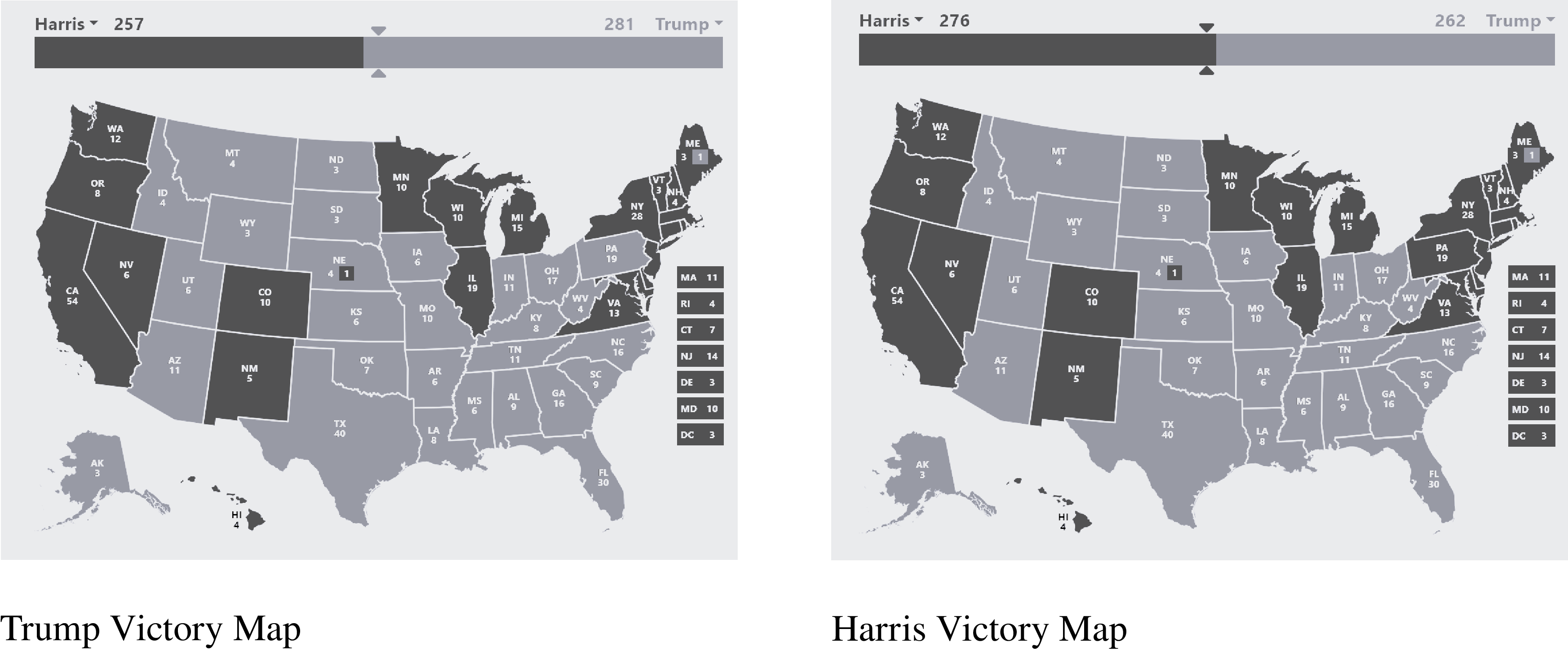
States that polled either consistently Republican or consistently Democrat in the final weeks of the election (up until 28 October 2024) were listed as such across both conditions. However, at the time of fielding, there were seven “toss-up” swing states that were likely to determine the results of the electoral college, which we now know decided the election in Trump’s favor. By looking at small but consistent marginal leads in each state across all three polls, we assigned North Carolina, Georgia, and Arizona as going to Trump and Michigan, Wisconsin, and Nevada as going to Harris. We were left with two nearly identical Electoral College maps (see Figure 1 in black and white; see color versions in Figures 18–19 in the appendix). The only difference between the two treatment maps was whether Pennsylvania, the largest and most coveted swing state, went to either Trump or Harris.
US election treatment: electoral victory maps

Figure 1 Long description
A heat map comparing Trump and Harris victory states in the US election. The map shows states that polled either consistently Republican or consistently Democrat in the final weeks of the election up until 28 October 2024. The map includes two conditions: Trump Victory Map and Harris Victory Map. The Trump Victory Map shows states like California, Washington, Oregon, Nevada, Colorado, New Mexico, Illinois, Minnesota, and others in dark shades, indicating strong Republican support. The Harris Victory Map shows states like Massachusetts, Vermont, New York, New Jersey, Maryland, and others in dark shades, indicating strong Democrat support. The heat map highlights the seven toss-up swing states that likely determined the election results: North Carolina, Georgia, Arizona, Michigan, Wisconsin, and Nevada. The map assigns North Carolina, Georgia, and Arizona to Trump and Michigan, Wisconsin, and Nevada to Harris, resulting in nearly identical Electoral College maps.
Participants in the threats-of-withdrawal condition received the electoral map in which Trump was predicted to win, as well as a short text which contained Trump’s threats that he would encourage Russia to do whatever the hell they want.Footnote 41 Participants in the reassurance condition received the electoral map in which Kamala Harris was predicted to win, as well as her promise that the United States would remain committed to its NATO allies in the face of Russian aggression.Footnote 42 Both conditions paired real quotes from the candidates with additional descriptions about their positions toward NATO to strengthen the treatment. For Trump, we drew on his South Carolina campaign rally speechFootnote 43 from 10 February 2024, and for Harris, her address to the Munich Security ConferenceFootnote 44 just six days later.
The latest polls indicate that Donald Trump will win the US presidential election this November. Trump has made clear that under his leadership, the United States cannot be trusted to cooperate with European countries on defense. Trump has stated that if a NATO country did not meet its defense spending target and was suddenly attacked by Russia, he would not protect them, but rather encourage Russia to do whatever the hell they want.
The latest polls indicate that Kamala Harris will win the US presidential election this November. Harris has made clear that under her leadership, the United States can be trusted to cooperate with European countries on defense. Harris has stated that her commitment to NATO remains ironclad and that she will stand strong with NATO allies against Russian aggression.
The first dependent variable was measured directly after the first vignette, operationalized as respondents’ support for increasing or decreasing defense spending as a percentage of the national budget. Respondents were then asked three questions about their institutional preferences for defense cooperation, each representing three potentially distinct visions for European security: continued cooperation through NATO, strengthened European cooperation, and increased national autonomy. We structured our outcome measure to allow support to overlap all three institutions (NATO, EU, and national autonomy) rather than forcing a single choice. Both dependent variables were measured on a five-point Likert scale and rescaled from 0 to 1 to ease interpretation.
Statistical Models
We test the results of Hypothesis 1 by regressing the dependent variable, willingness to increase national defense spending, on the treatment variable.Footnote 45 Our main models (pooled and country-level) for H1 compare the effect of a Trump victory to a Harris victory on willingness to spend, accounting for a pretreatment measure of defense spending preferences. This follows our preregistered plan to use ordinary least squares (OLS) regression models with standard p < .05 criteria (95 percent confidence level) to determine significance.Footnote 46 To test the robustness of our findings, we compare our main linear regression models with models that include covariates for age, gender, education level, income level, political interest, ideology on a left-right scale, opinions of the United States and NATO, as well as perceptions of the economy and the threat posed by Russia.
We test the results of Hypothesis 2 with one regression model for each institutional preference (three in total). Consistent with our pre-analysis plan, this allows us to treat preferences toward the EU, NATO, and autonomy as three distinct dependent variables. Whereas our models for Hypothesis 1 compare the effect of counterfactual election outcomes, our models for Hypothesis 2 also calculate the coefficients of each treatment condition relative to the control to measure the effect of threats and reassurance against the absence of either rhetoric.Footnote 47
Similar to H1 we first test H2 using OLS models (pooled and country-level), and then check the robustness of our findings when we add controls. We conduct another set of robustness checks in which we compare the size, direction, and significance of the effects identified for Hypotheses 1–2 using ordered logistic regression models.Footnote 48 Finally, to investigate a potential mechanism between threats of withdrawal and changing preferences for defense cooperation, we run three additional regressions to explore the mediating role of a secondary outcome variable: confidence in NATO allies.
Results
How does the threat of American withdrawal from alliance commitments affect public attitudes toward defense spending and defense cooperation in NATO? For Hypothesis 1, we estimate the effect of threats of withdrawal by comparing the effect size of the Trump condition to that of the Harris condition, representing the counterfactual outcome of the election. For Hypothesis 2, we also model the baseline effects of threats and reassurance by comparing both treatments to the control group, which received neither election information nor presidential rhetoric.
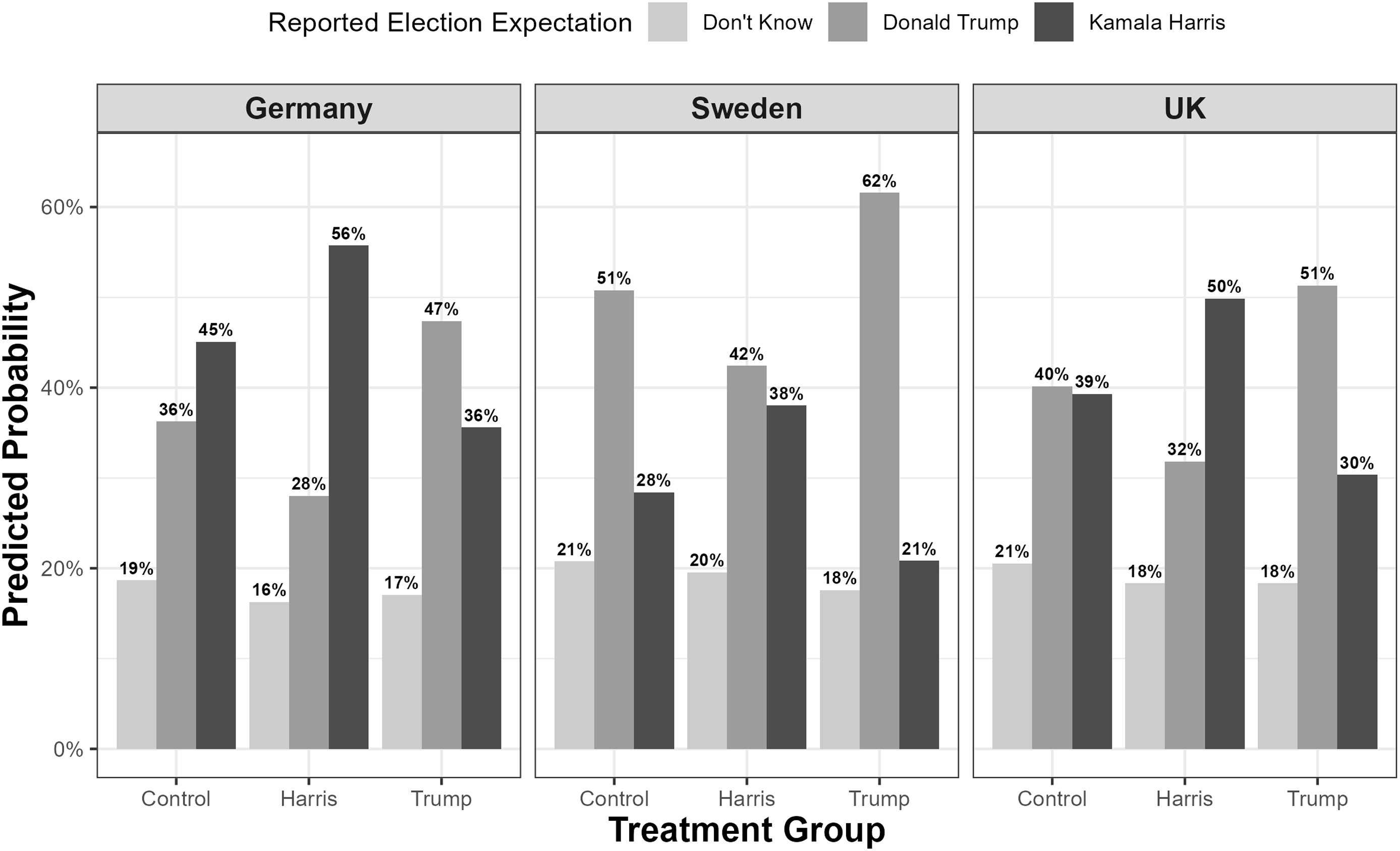
We first assessed the strength of our election treatment through a manipulation check administered at the end of the survey, which asked respondents to report which candidate they expected to win the US presidential election in November 2024. A multinomial logistic regression model was used to calculate the predicted probability of selecting one of three election expectations at the end of the survey. In Figure 2, we see that being exposed to either a Trump or Harris victory prognosis effectively increased the probability of expecting that candidate to win the election.
Predicted probabilities of election expectations
Note: The figure shows predicted probabilities as the likelihood of expecting either a Harris or Trump victory based on treatment group and by country.
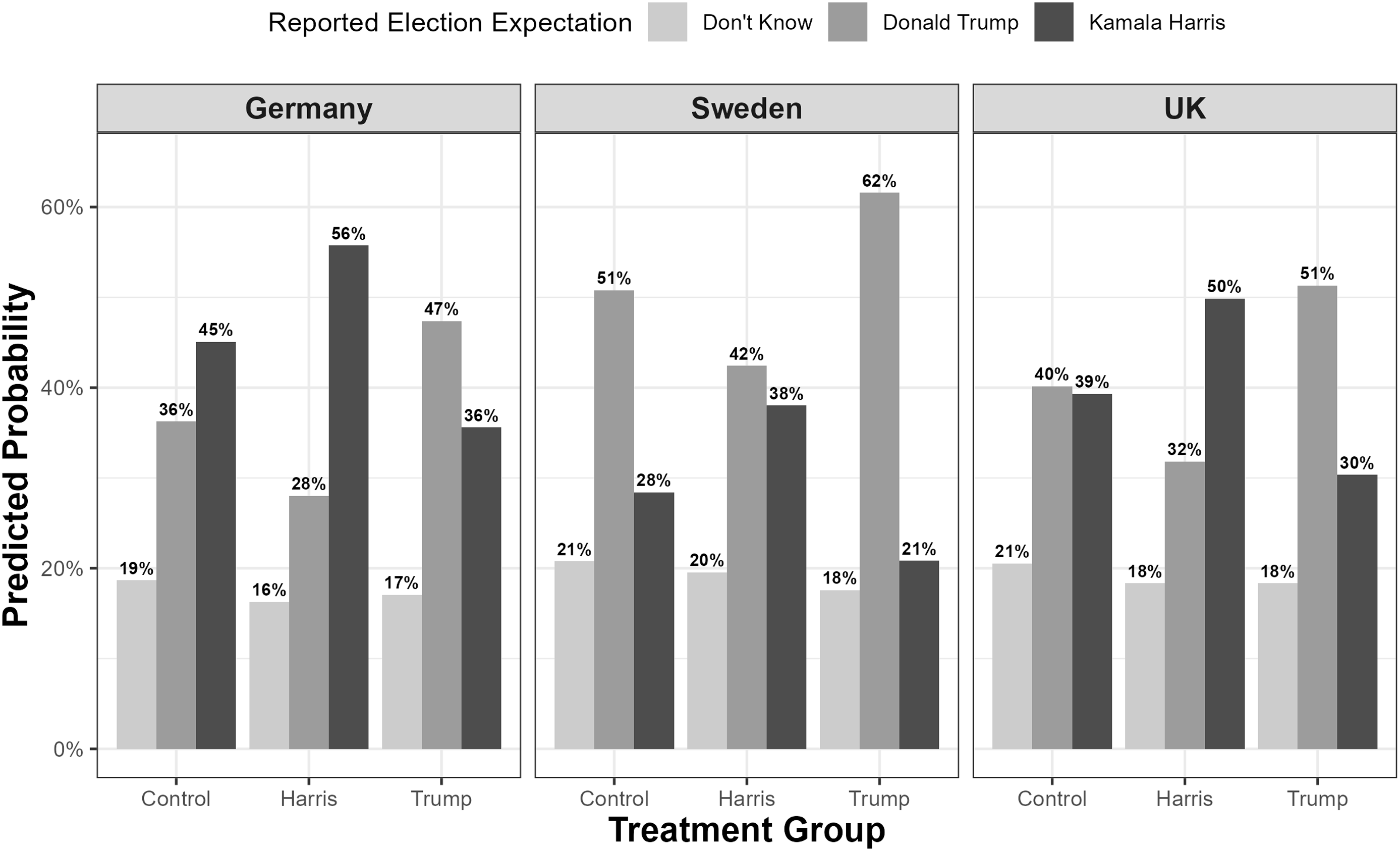
Figure 2 Long description
The bar graph compares predicted probabilities of election expectations across three countries: Germany, Sweden, and the UK. The x-axis represents treatment groups: Control, Harris, and Trump. The y-axis represents predicted probability in percentage. Each country has three bars for each treatment group, color-coded as gray for Don't Know, light gray for Donald Trump, and dark gray for Kamala Harris. In Germany, the Control group shows 19% for Don't Know, 36% for Trump, and 45% for Harris. The Harris group shows 16% for Don't Know, 28% for Trump, and 56% for Harris. The Trump group shows 17% for Don't Know, 36% for Trump, and 47% for Harris. In Sweden, the Control group shows 21% for Don't Know, 28% for Trump, and 51% for Harris. The Harris group shows 20% for Don't Know, 42% for Trump, and 38% for Harris. The Trump group shows 18% for Don't Know, 21% for Trump, and 62% for Harris. In the UK, the Control group shows 21% for Don't Know, 39% for Trump, and 40% for Harris. The Harris group shows 18% for Don't Know, 32% for Trump, and 50% for Harris. The Trump group shows 18% for Don't Know, 30% for Trump, and 51% for Harris. All values are approximated.
The treatments decreased the likelihood of being uncertain about the election outcome and were effective at countering pre-existing expectations about the election. For example, the Harris treatment increased the likelihood of expecting a Harris victory by 10 percent relative to the control group in Sweden, where respondents were initially more likely to expect a Trump victory. A small proportion of respondents in all three countries were still uncertain about who would win the election at the end of the survey. We acknowledge that a marginal amount of election uncertainty is an unavoidable trade-off given that we use the coin-toss election to test the effects of each election outcome relative to its counterfactual. However, because the candidates’ rhetoric toward NATO constitutes our core theoretical and empirical interest, we interpret the results of our experiment with this acknowledgment in mind.
Threats of Withdrawal Increase Willingness to Spend on Defense
We hypothesized that exposure to threats of American withdrawal would make European voters more supportive of increasing defense spending. Our model estimated the effect of Trump’s threats compared to the Harris condition, both of which received the pre-vignette information about NATO and the 2 percent spending obligation. The only differences between these conditions were the predicted election outcome and the candidates’ rhetoric toward NATO: Trump’s threats of withdrawal, and Harris’s reassurance of NATO allies.
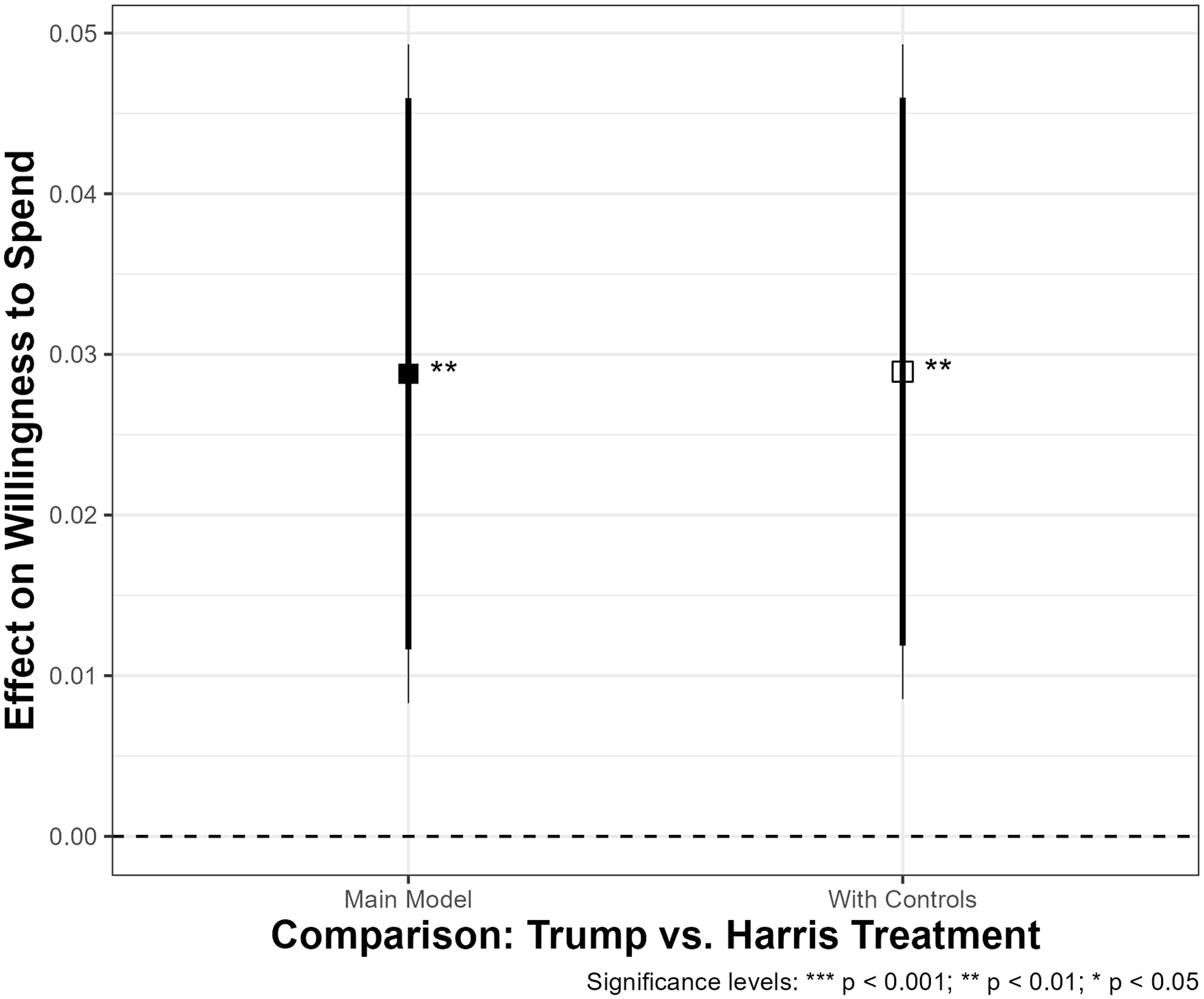
As we see in Figure 3, respondents in the Trump condition were significantly more willing to increase the national defense budget compared to the Harris condition. Those who received the threats of withdrawal treatment were 2.88 percentage points more willing to spend than those in the Harris condition, which is significant at the 99.9 percent confidence level.Footnote 49 Reassurance had an insignificant effect compared to both the Trump condition and the control group, allowing us to rule out that effects were driven by information about NATO membership and spending targets.Footnote 50 Based on these results, we confirm our expectation that when the most powerful state in NATO threatens withdrawal, public support for higher defense spending increases in allied states.
Threats of withdrawal increase willingness to spend on defense
Notes: Thinner bars represent the 95 percent confidence interval, and thicker bars represent the 90 percent confidence interval. The coefficients estimate the effect of Trump’s threats when Harris is used as the reference category.
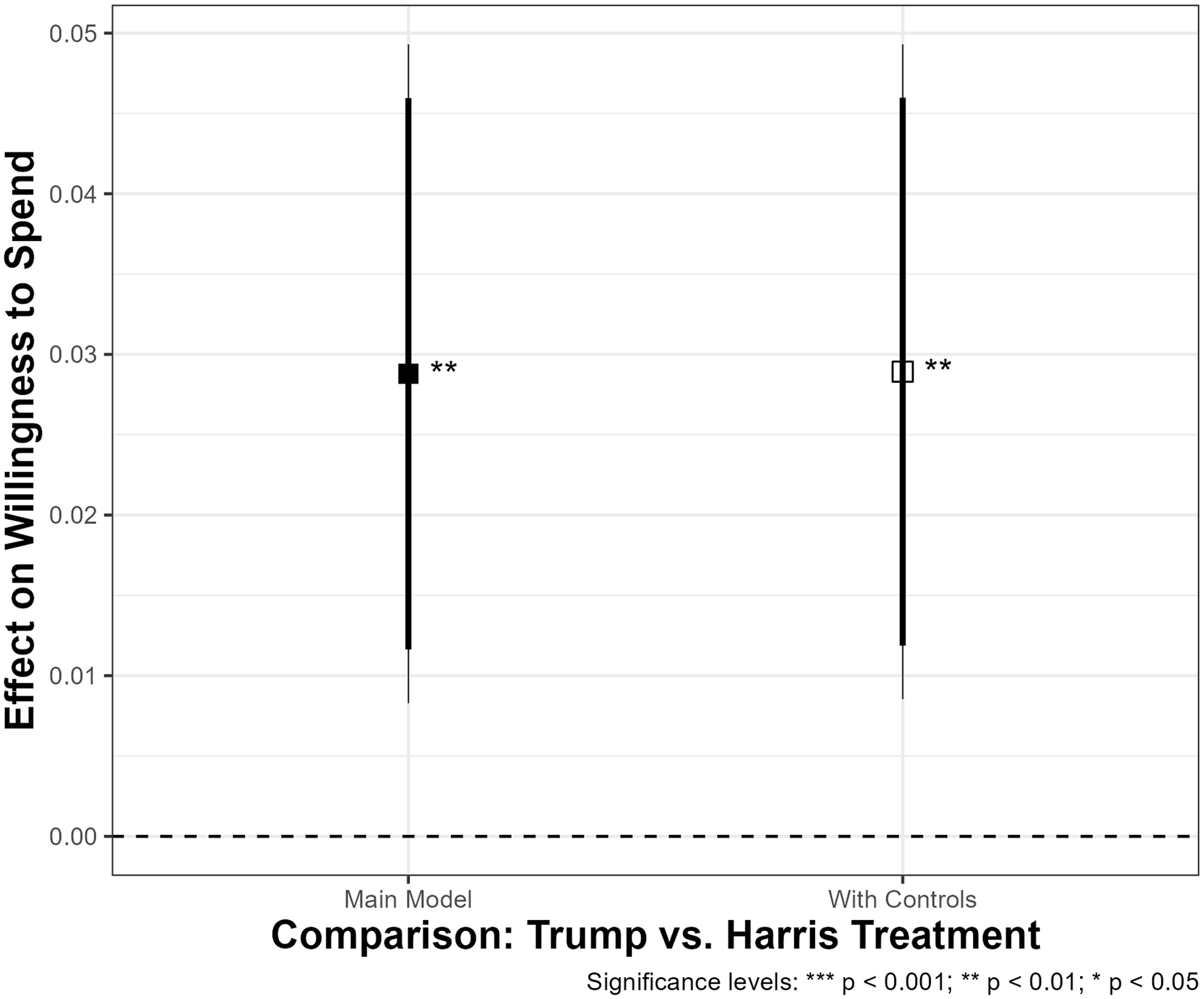
Figure 3 Long description
A line graph compares the effect on willingness to spend on defense between Trump and Harris treatments. The x-axis represents the comparison of Trump versus Harris treatment, with two data points labeled 'Main Model' and 'With Controls'. The y-axis measures the effect on willingness to spend, ranging from 0.00 to 0.05. Each data point is marked with a square and accompanied by vertical lines indicating confidence intervals. The 'Main Model' data point is represented by a filled black square, while the 'With Controls' data point is represented by an open black square. Both data points show a positive effect, approximately around 0.03, and are marked with double asterisks indicating statistical significance at the p < 0.01 level. The thinner bars represent the 95 percent confidence interval, and the thicker bars represent the 90 percent confidence interval. The coefficients estimate the effect of Trump's threats when Harris is used as the reference category. All values are approximated.
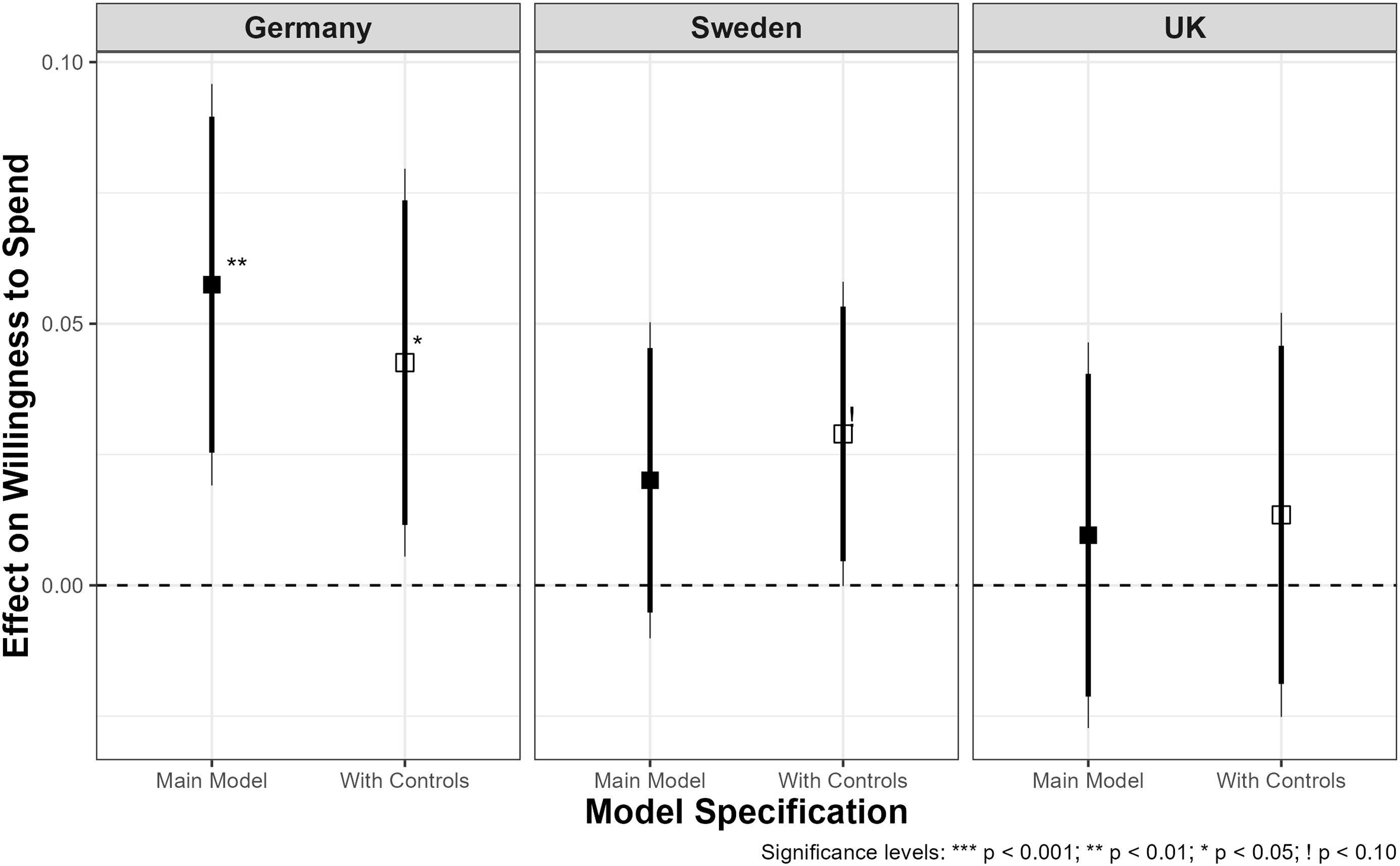
NATO member states are asymmetrically vulnerable,Footnote 51 meaning that their publics may react differently to a declining American commitment to mutual defense. We compare willingness to spend across countries by performing the same regression analyses, this time subsetting the data by country.Footnote 52 Figure 4 depicts the comparison between the Trump and Harris conditions within each of the three country samples. German respondents who received Trump’s threats of withdrawal were 5.7 percent more willing to spend than those who received Harris’s reassurance. In the Swedish sample, the effect of Trump’s threats was positive and in the expected direction, though the estimate did not reach significance in the main model. In the United Kingdom, there is no statistically significant difference between Trump and Harris. However, when we estimate each effect relative to the control, threats of withdrawal and reassurance both have a positive effect on willingness to spend.Footnote 53 Because threats of withdrawal and reassurance were both effective at boosting support for defense spending, we can rule out the potential effect of wanting to increase defense spending to meet NATO spending targets.Footnote 54
Threats of withdrawal and country-level support for defense spending
Notes: Thinner bars represent the 95 percent confidence interval, and thicker bars represent the 90 percent confidence interval. The coefficients estimate the effect of Trump’s threats when Harris is used as the reference category. The significance of the country-level results vary when controls are introduced, though the direction of effects remains stable. Country-level effects were calculated with the same regression formula as the test for H1, using subgrouped data.
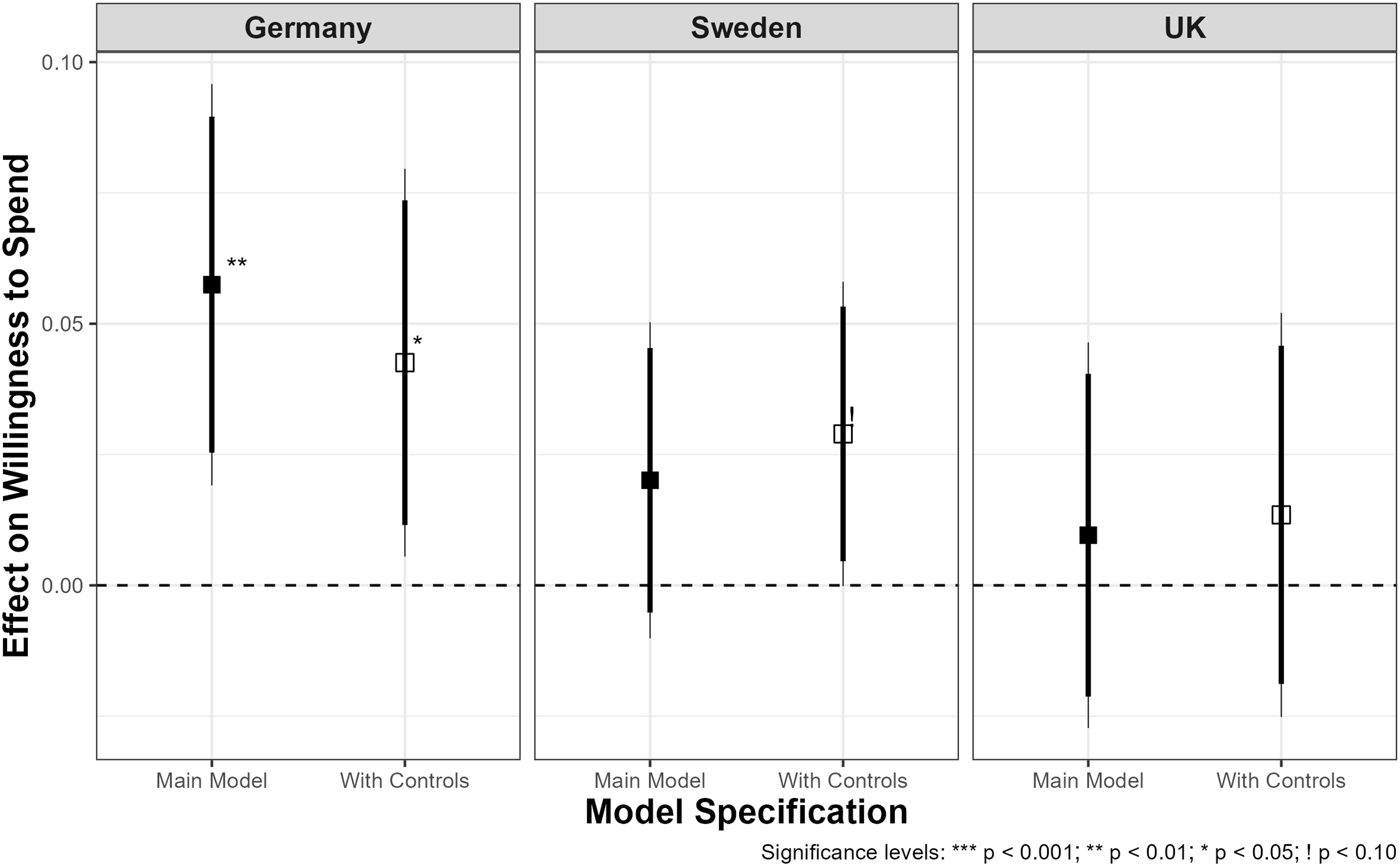
Figure 4 Long description
A box-and-whisker plot compares the effect on willingness to spend across Germany, Sweden, and the UK. The plot features three vertical box plots, each representing a different country: Germany, Sweden, and the UK. The x-axis is labeled 'Model Specification' and includes two categories: 'Main Model' and 'With Controls'. The y-axis is labeled 'Effect on Willingness to Spend' and ranges from 0.00 to 0.10. Each box plot shows the distribution of data points, with the boxes indicating the interquartile range (Q1 to Q3), the line inside the box representing the median (Q2), and the whiskers extending to the minimum and maximum values. Outliers are marked with individual points. In Germany, the 'Main Model' shows a significant effect with a median around 0.05 and a few outliers above 0.05. The 'With Controls' model shows a slightly lower median around 0.04 with fewer outliers. In Sweden, both the 'Main Model' and 'With Controls' show a median close to 0.02 with similar distributions and a few outliers. In the UK, both models show a median close to 0.01 with similar distributions and a few outliers. The significance levels are indicated by asterisks, with ** representing p < 0.01 and * representing p < 0.05. The plot suggests that the effect on willingness to spend varies by country and model specification, with Germany showing the highest effect and the UK the lowest. All values are approximated.
We interpret these results as strong evidence that a dominant ally’s threats of withdrawal boost public willingness to increase defense spending. The threat of American withdrawal associated with a Trump victory clearly made defense spending a more salient concern for respondents who received this treatment. While we are unable to deduce the exact mechanism driving the positive effect of reassurance in the United Kingdom, Harris’s emphasis on cooperation, commitment, and standing up to Russia may have influenced British respondents’ opinions about the importance of defense spending.Footnote 55 Given that the special relationship between the United Kingdom and United States emphasizes stronger transatlantic ties, finding evidence of a positive reassurance effect is more plausible in the United Kingdom than in Germany or Sweden.
Threats of Withdrawal Shape Preferences for Defense Cooperation
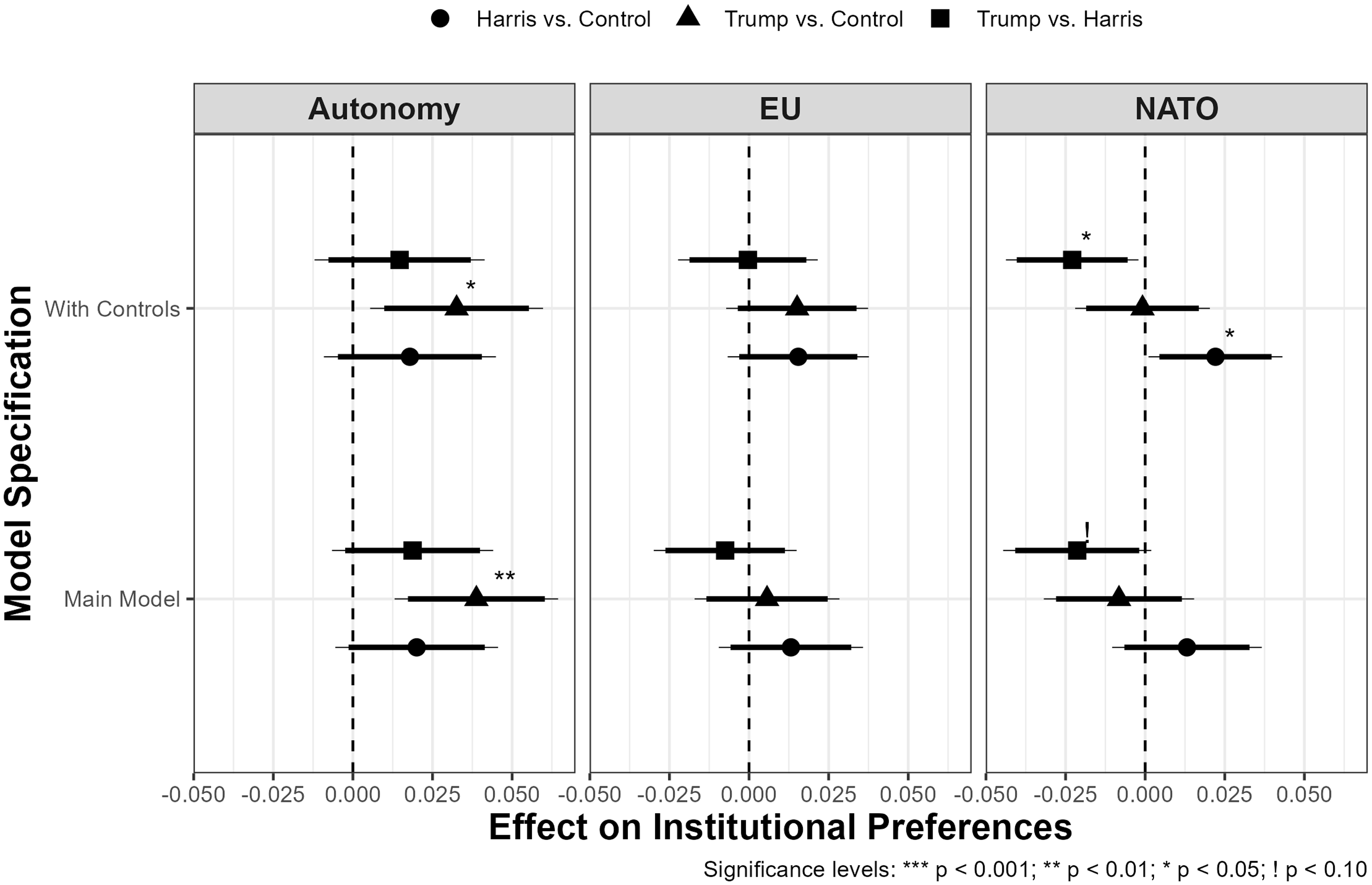
We hypothesized that when NATO’s most powerful state threatens withdrawal, popular support for NATO cooperation would decrease in allied states. To test this hypothesis, we modeled the effects of threats of withdrawal and reassurance on support for three distinct visions of defense cooperation: continued cooperation in NATO, closer cooperation with the EU, and increased national autonomy. The results are depicted in Figure 5.
Threats of withdrawal decrease public support for NATO cooperation
Notes: Effects are calculated by regressing support for three distinct defense frameworks on the presidential rhetoric treatment. The control is used as baseline to calculate the individual effects of reassurance and threats, while the Trump versus Harris estimate tests whether Trump’s threats are significant when the Harris condition is used as the reference.
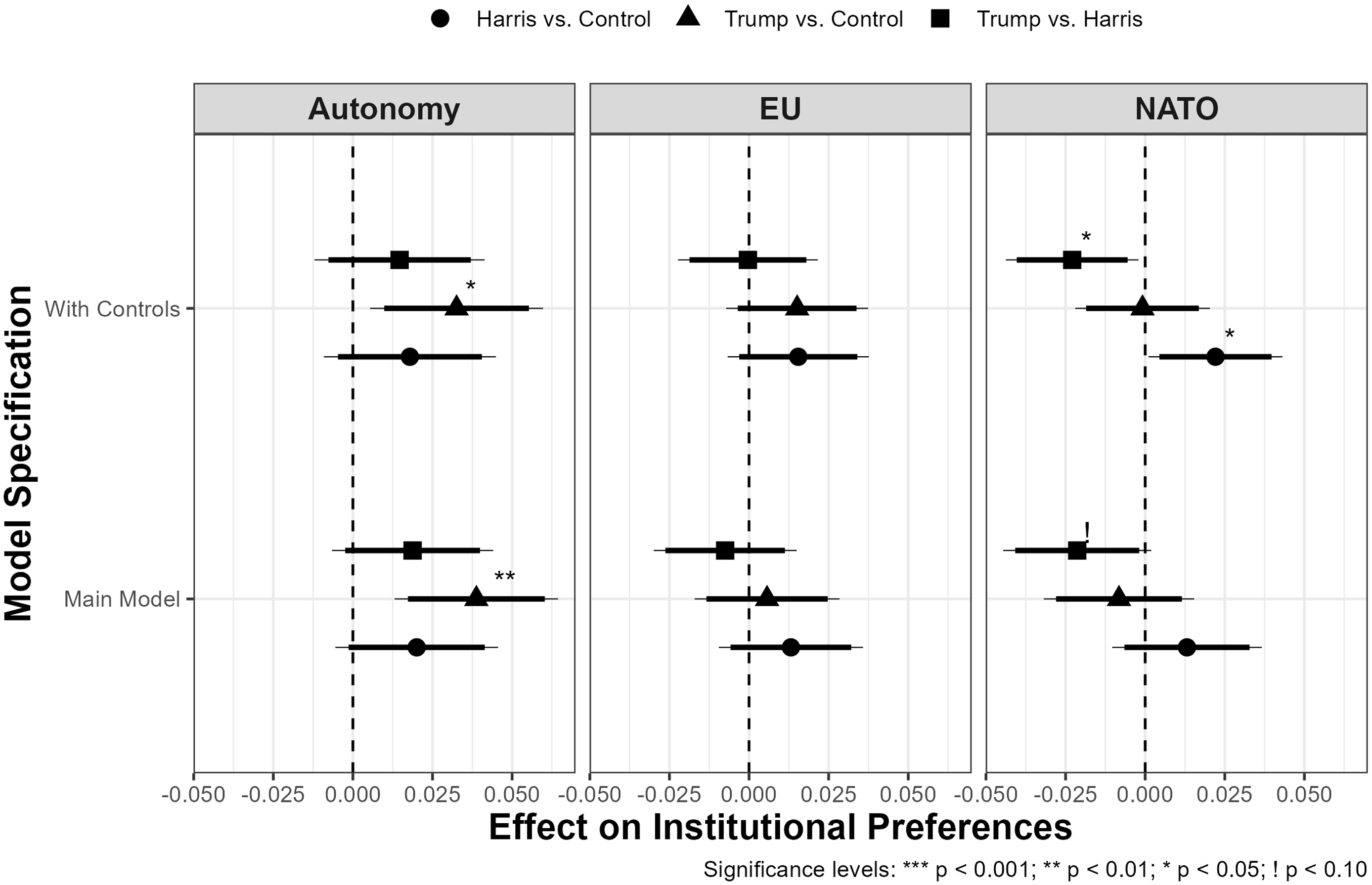
Figure 5 Long description
The image contains three side-by-side graphs comparing the effects of Harris versus Control, Trump versus Control, and Trump versus Harris on institutional preferences for autonomy, EU, and NATO. Each graph is divided into two sections: With Controls and Main Model. The x-axis represents the effect on institutional preferences, ranging from -0.050 to 0.050, while the y-axis lists the model specifications. The graphs use different symbols to represent the comparisons: circles for Harris versus Control, triangles for Trump versus Control, and squares for Trump versus Harris. The autonomy graph shows significant effects for Trump versus Harris in the Main Model and for Trump versus Control in the With Controls section. The EU graph shows no significant effects. The NATO graph shows significant effects for Trump versus Harris in both sections and for Harris versus Control in the With Controls section. All values are approximated.
We find that the threat of American withdrawal has a negative effect on European popular support for cooperation in NATO, relative to reassurance. Respondents treated with threats of American withdrawal were 2.1 percent less supportive of NATO cooperation than respondents in the reassurance condition. Although this estimate is only significant at the 90 percent confidence level, it becomes significant at the 95 percent confidence level when controls are introduced.Footnote 56 By threatening to withdraw, the United States appears a less reliable ally for European security, resulting in a marginal decrease in support for NATO cooperation relative to the reassurance condition. This interpretation contradicts the idea that some European citizens would readily support a European-led NATO in the absence of a reliable US commitment. However, we acknowledge that a more stringent threshold for statistical significance might wash away the negative effect, thus warranting future analysis before reaching a firm conclusion.
Neither threats of withdrawal nor reassurance had a significant effect on popular support for closer EU defense cooperation in either model specification. We assume that attitudes toward EU defense integration are better explained by other political attitudes and the nuances of domestic politics, and are therefore less likely to be influenced by American rhetoric. Interestingly, however, we do detect effects on preferences for national autonomy. Reassurance by NATO’s dominant ally appears to have a slight positive effect on support for national autonomy, making the difference between Trump and Harris insignificant. However, when compared to the control condition, Trump’s threat of withdrawal has a positive and highly significant effect on popular support for national autonomy. The effect of threats compared to the control is a 3.9 percent increase in support for making decisions about defense without consulting other countries, such as the United States.Footnote 57 These results contribute to our interpretation that threats of withdrawal make the United States appear a less reliable alliance partner, resulting in increased public support for autonomy.
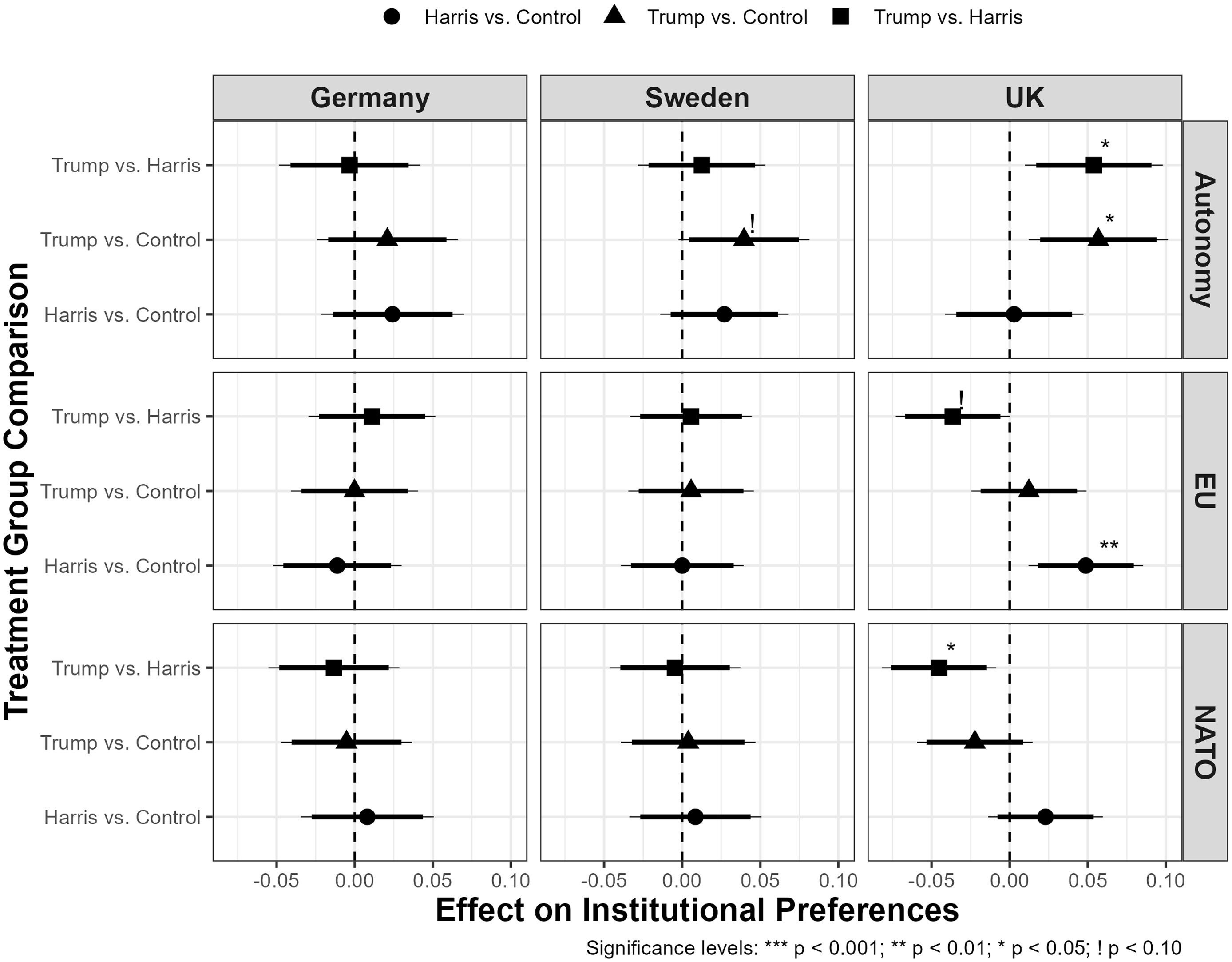
Though the three countries in our analysis are all NATO members, we expect that baseline public attitudes toward NATO cooperation, EU defense integration, and national autonomy differ substantially across countries. In order to compare how our treatments affected public preferences for defense cooperation within these different national contexts, we reran our regression analyses for Hypothesis 2 separately within each country sample. For consistency, we modeled both the Trump versus Harris comparison and the effects of threats and reassurance relative to the control group in Figure 6.
Threats of withdrawal and country-level support for defense cooperation
Notes: Country-level effects were calculated with the same regression formula as the test for H2, using subgrouped data. The control is used as baseline to calculate the individual effects of Harris and Trump, while the Trump versus Harris estimate tests whether Trump’s threats are significant when the Harris condition is used as the reference category.
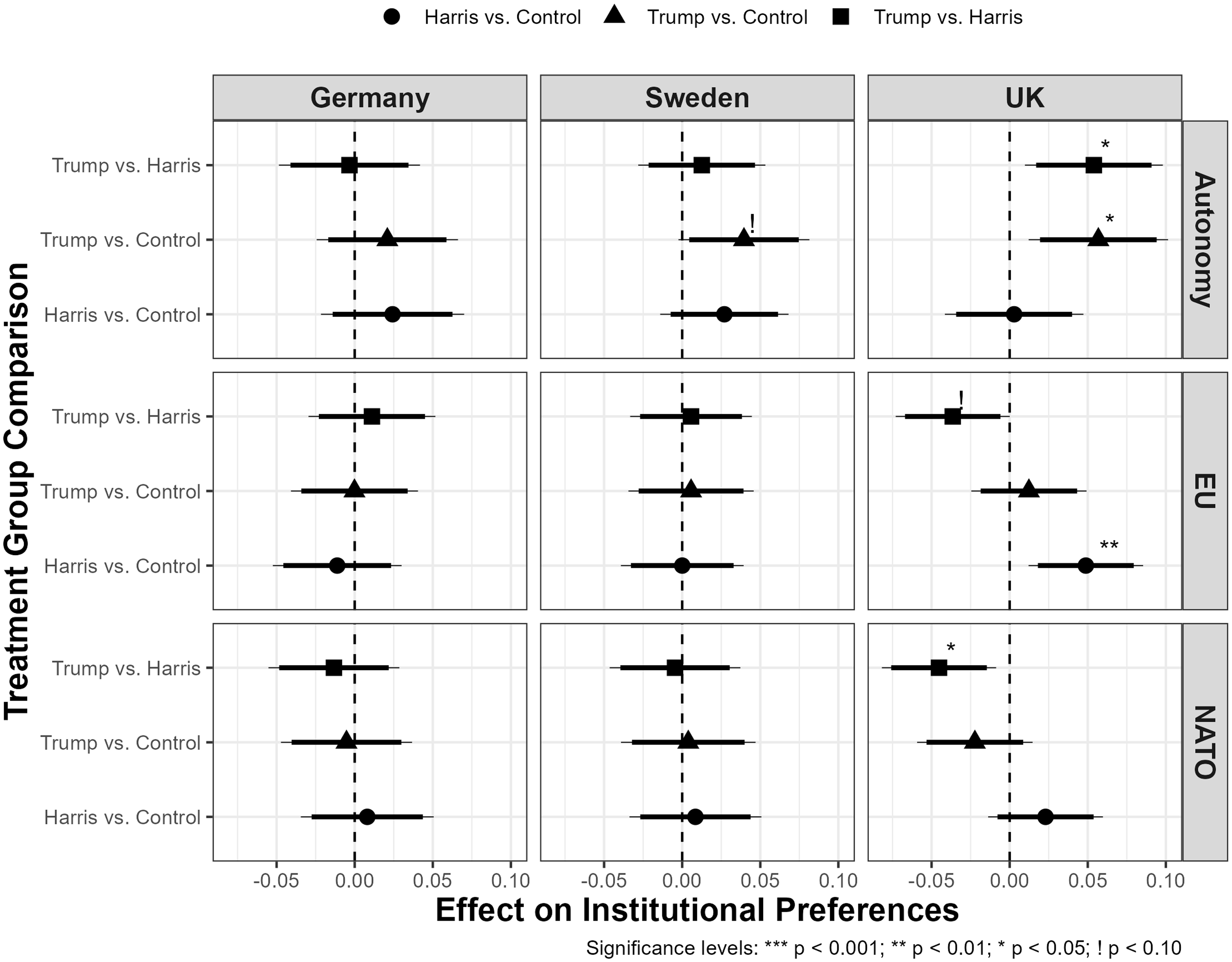
Figure 6 Long description
The box-and-whisker plot compares the effects on institutional preferences across three countries: Germany, Sweden, and the UK. The plot features three rows of box plots, each representing different treatment group comparisons: Trump vs. Harris, Trump vs. Control, and Harris vs. Control. The x-axis represents the effect on institutional preferences, ranging from -0.05 to 0.10. The y-axis lists the treatment group comparisons. Each box plot shows the distribution of effects for autonomy, EU, and NATO preferences. The boxes indicate the interquartile range (Q1 to Q3), with the median (Q2) marked by a line inside the box. Whiskers extend to the minimum and maximum values, and outliers are marked with asterisks. Significant differences are noted with asterisks indicating levels of significance: *** for p < 0.001, ** for p < 0.01, * for p < 0.05, and ! for p < 0.10. The plot reveals variations in public attitudes toward defense cooperation within different national contexts, highlighting how threats of withdrawal affect preferences for NATO cooperation, EU defense integration, and national autonomy.
First, we compared public support for continued cooperation in NATO across the three countries. British respondents who received Trump’s threats of withdrawal were 4.5 percent less supportive of continuing cooperation in NATO than those who received Harris’s reassurance. However, the main model indicates that neither German nor Swedish respondents’ preferences for NATO cooperation were affected by exposure to threats or reassurance. The same pattern occurs for both German and Swedish public attitudes toward closer EU defense cooperation; neither threats nor reassurance have a significant effect. We interpret this result as a sign that German and Swedish attitudes are shaped by other factors at the domestic and individual level, and are unlikely to be affected by US presidential rhetoric.
Meanwhile, UK public opinion toward both institutions may be more malleable to US presidential rhetoric given the special relationship between the countries, as well as the United Kingdom’s unique relationship with the EU after Brexit. British respondents were 3.6 percent less supportive of closer EU–UK cooperation when exposed to the threat of American withdrawal, compared to those exposed to reassurance.Footnote 58
At first, this finding appears counterintuitive. Because the EU tends to be viewed either as an alternative or complementary framework for security cooperation, it is not immediately clear why American withdrawal from NATO would decrease public support for EU defense cooperation.Footnote 59 The interpretation becomes more intuitive when we look at the effect of US presidential rhetoric relative to the control. Because reassurance from Harris actually had a positive and highly significant effect on British public attitudes toward closer EU cooperation, and threats from Trump were insignificant, the difference between Trump and Harris is negative. The positive effect of American reassurance on British opinions toward EU–UK cooperation is more logical when we account for the existence of the special relationship. Furthermore, the reassurance treatment emphasized mutual commitment and the need to stand strong against Russian aggression—complementary issues on which the EU and NATO cooperate.
When it comes to autonomy, the positive coefficients associated with threats of withdrawal suggest that when the United States appears to be an unreliable ally, popular support for going it alone increases. However, significant effects were limited to the British subsample. When compared to the control condition, the threat of withdrawal has a positive and significant effect on British public support for national autonomy, at the 99 percent confidence level.Footnote 60 This pattern is replicated in Sweden, though the estimate reaches only the 90 percent significance level. The pattern reappears when comparing threatening and reassuring rhetoric in the UK subsample. This aligns with our interpretation that threats of withdrawal make the United States appear a less reliable alliance partner, resulting in increased public support for autonomy in the United Kingdom.
Our review of the country-level results indicates that we should be cautious about generalizing the negative effect of threats of withdrawal on public support for NATO cooperation. To further probe our results, we reran the same tests on the subsample of respondents whose post-treatment election expectations aligned with the election vignette they received. When we select respondents from all three countries that were strongly convinced by the election prognosis, we find stronger and highly significant effects in the same direction of the main analysis.Footnote 61 This implies that the effects we modeled here are indeed significant among respondents who were strongly convinced by the election treatment, despite the uncertainty caused by the fifty-fifty election odds that we intentionally leveraged in our experiment. This validation test strengthens our interpretation that highly credible threats of American withdrawal decrease support for cooperation in NATO and increase support for national autonomy.
Exploring Potential Mechanisms
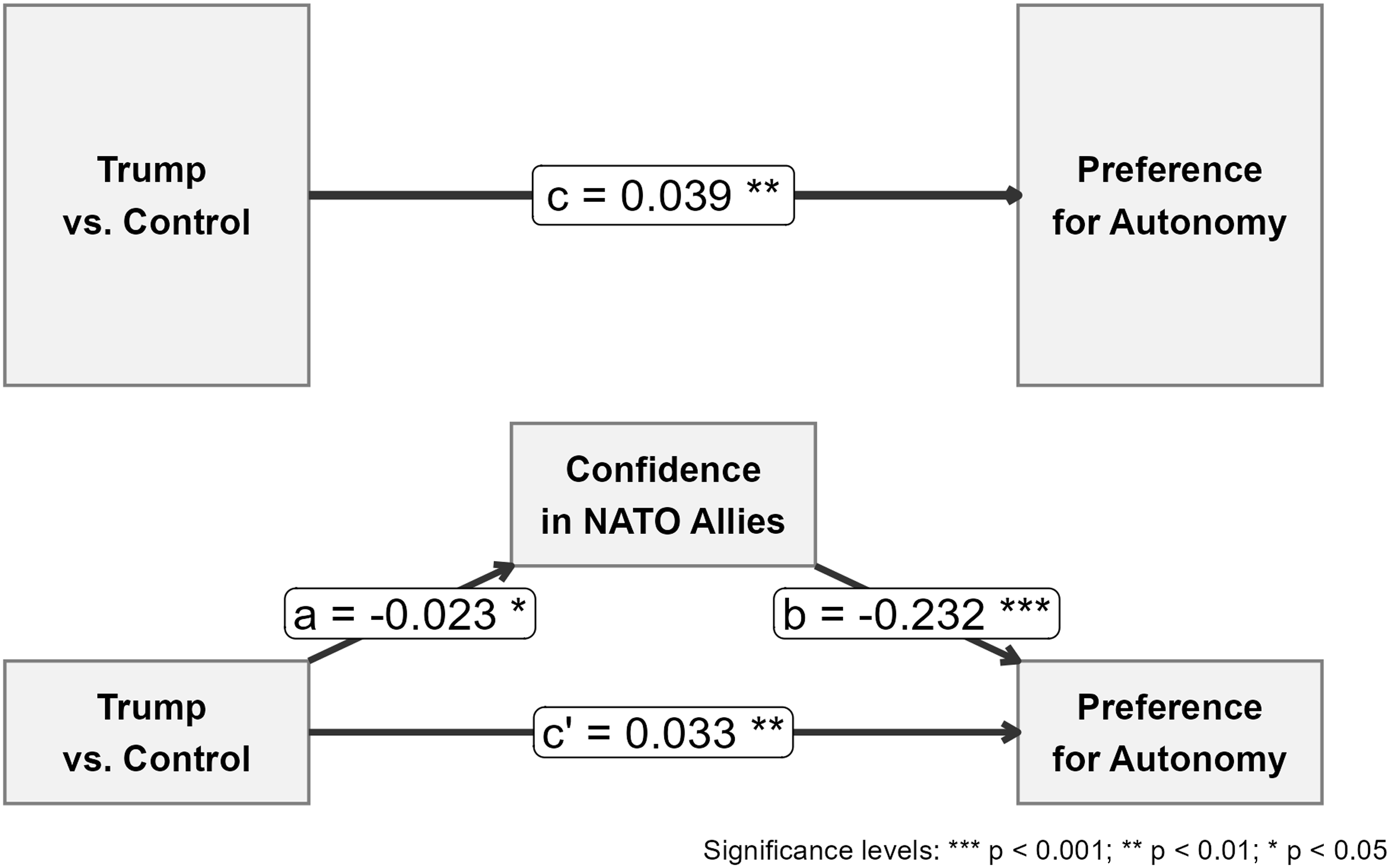
How does the threat of a dominant ally withdrawing from alliance commitments affect support for alternative forms of defense cooperation? In an attempt to dig deeper into the mechanism, we explore how presidential rhetoric toward NATO affects the public’s confidence that NATO allies would come to their country’s defense in the event of a Russian attack. In Figure 7, we investigate the mediating role of confidence in NATO alliesFootnote 62 in the relationship between threats of withdrawal and preferences for national security autonomy.Footnote 63 In Hypothesis 2, we found that threats of withdrawal had a significant and positive effect on preferences for autonomy when compared to respondents in the control condition. Based on these results, we regress confidence in NATO allies on threats of withdrawal, relative to the control condition (a). We then regress preferences for national security autonomy on confidence in NATO allies (b).
Threats of withdrawal reduce confidence in NATO allies
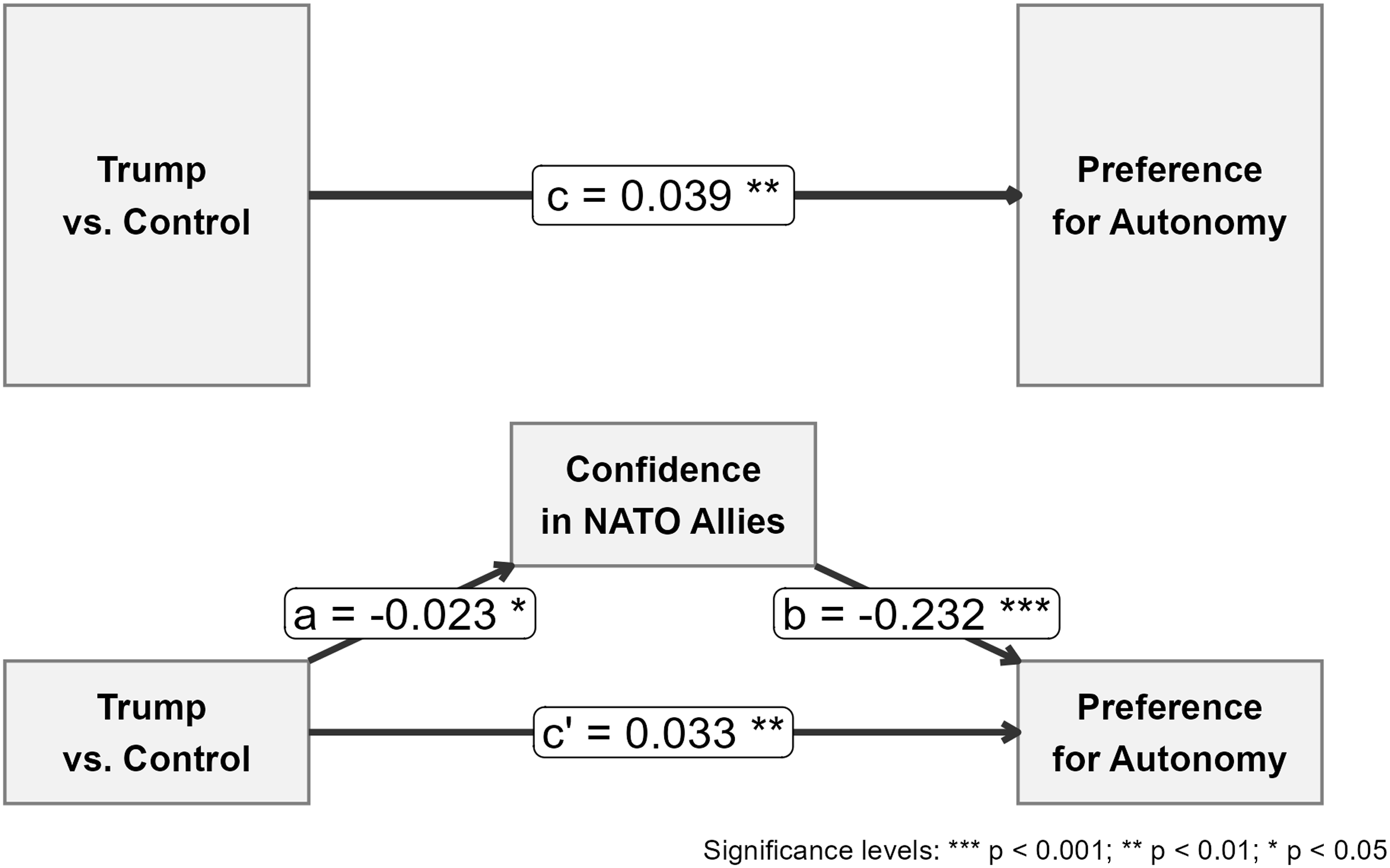
Figure 7 Long description
The line graph presents two pathways showing how presidential rhetoric affects public confidence in NATO allies and preference for autonomy. The top pathway shows a direct relationship between Trump versus Control and Preference for Autonomy with a coefficient of 0.039, indicating a significant positive effect. The bottom pathway introduces Confidence in NATO Allies as a mediator. Here, Trump versus Control negatively affects Confidence in NATO Allies with a coefficient of -0.023, which in turn negatively impacts Preference for Autonomy with a coefficient of -0.232. The direct effect of Trump versus Control on Preference for Autonomy remains significant with a coefficient of 0.033. The significance levels are indicated by asterisks, with three asterisks denoting p < 0.001, two asterisks denoting p < 0.01, and one asterisk denoting p < 0.05. All values are approximated.
First, we found that threats of American withdrawal significantly decrease public confidence in NATO allies. Second, increasing confidence in NATO allies is associated with a highly significant, 23.2 percent decrease of support for national autonomy. This relationship highlights how the presence of trust in international security partners is negatively related to popular support for going it alone. The direct pathway (c) estimates the effect of threats of withdrawal when accounting for the presence of the mediator, confidence in NATO allies. The preliminary results show that while threats of American withdrawal exert a direct effect on preferences for autonomy, a significant portion of this effect may be explained by the fact that these threats decrease confidence in NATO allies.Footnote 64
Our results do not offer doomsday evidence that Swedish, German, and British citizens’ support for NATO has substantially declined as a result of Trump’s election. When we modeled the main analysis of Hypothesis 2 using marginal means, we were able to compare average support for various defense frameworks across countries and treatment groups.Footnote 65 The results show that both NATO and EU defense cooperation receive high levels of support within each country, while national autonomy is the least favored option across the countries surveyed. While declining confidence in NATO allies may explain why some voters develop a preference for national autonomy, we still find public support for both EU and NATO defense cooperation at the country level.Footnote 66
Generalizability
The timing of our experiment offered a unique opportunity to directly test and compare the effects of two US presidential candidates’ widely diverging rhetoric toward NATO commitments. The uncertainty of the race at the time of fielding made both of our election outcome treatments equally realistic, strengthening our ability to estimate a causal effect. However, both the salience and uncertainty of the campaign made it very likely that respondents had heard about the presidential race before participating in our experiment. We thus have to take care when generalizing our results because respondents may have been persuaded to varying degrees about the likelihood of either candidate’s victory, as well as the consequences of their leadership for European security.
By conducting our experiment in three Western European NATO countries, we were able to demonstrate how the publics of two core NATO members and one new NATO member react to threats of American withdrawal. More recent public opinion data corroborates our argument that threats of American withdrawal affect the extent to which European citizens believe they can rely on the United States to defend them. A YouGov pollFootnote 67 from March 2025 revealed that respondents in France, Germany, Italy, Spain, and the United Kingdom were largely pessimistic, or at the very least uncertain, about whether the United States would defend the Baltic states or Poland in the event of an attack by Russia. Meanwhile, the same respondents were only slightly more optimistic that the United States would defend their country if Russia attacked.Footnote 68 We acknowledge that baseline attitudes toward NATO and defense spending are dramatically different in the Baltic states, where direct borders with Russia constitute a much higher threat.Footnote 69 In the context of our study, we might expect threats of American withdrawal to have amplified effects on Eastern European defense spending preferences due to the perilous combination of internal alliance threats and the highly credible threat of Russian aggression. Although we accounted for this potential mechanism with a covariate for the perceived threat posed by Russia, aggregate willingness to spend is likely much higher in more exposed states, regardless of the threat of American withdrawal.
Within international relations research, experiments tend to have remarkably similar cross-case results, even if originally designed with a specific case in mind.Footnote 70 This choice was made with awareness of the trade-offs between experimental realism and external validity. While we focused on the decline of the American commitment to NATO, our results are relevant for theory on alliances in general. From the bargaining perspective of the United States, we found that threats of withdrawal appear to be an effective tool of turning the fear of abandonment into popular support for meaningful increases in defense spending by its European allies.Footnote 71 This finding likely applies to other alliances with an unequal distribution of power, where the withdrawal of a dominant ally could create acute consequences for states that depend on security guarantees. We posit that the combination of an asymmetric balance of power and an increasingly risky security environment are important scope conditions for our findings because national audiences and elites have both been shown to support greater burden sharing in response to threats that highlight a greater need for national security.Footnote 72
Our contribution also provides new ground for research into the drivers of public support for defense cooperation, in the absence of a reliable commitment from security patrons and powerful partners. We were convinced by the robustness of our finding that a dominant ally’s threat to withdraw increases public willingness to spend on defense and shakes public confidence in international partners. Future research could test whether our hypotheses extend to other alliances, perhaps by comparing attitudes toward policies designed either to appease or reduce dependence on a dominant ally. Studies of other alliances could also test the mechanism through which the dominant ally’s threats of withdrawal increase support for alternative defense institutions. We expect that declining confidence in alliance partners would have different consequences for defense preferences depending on the viability of alternative frameworks and the relative power of allied states. We reasonably assert that when the dominant ally threatens to withdraw, popular support for decoupling is more likely to rise in states that can either realistically pursue alternative defense partnerships, or can afford to go it alone.
Conclusion
Since its inception, the transatlantic security relationship has been a complicated, asymmetric balancing act. A successful balancing act requires trust and reliability as a bedrock, and yet, the threat of American withdrawal from alliance commitments has loomed since the end of the Cold War.Footnote 73 The new pressures of a multipolar order combined with the increasing volatility and decreasing reliabilityFootnote 74 of US foreign policy have only served to amplify European fears of abandonment. Although the principle of mutual defense continues to be the primary pillar of transatlantic security, the uncertainty caused by internal and external strains on alliance cohesion places European states at the crossroads of a new foreign policy future.
Our study captures how the threat of American withdrawal affects public opinion in Germany, Sweden, and the United Kingdom within an experimental setting just before the US election. Our experiment took advantage of the timing and uncertainty of the 2024 US election in order to measure and compare the effects of Trump’s threats with the counterfactual offered by Kamala Harris—reassurance of the American security guarantee. We examined how the increasingly realistic threat of American withdrawal influences the degree of popular support for defense spending and defense cooperation in NATO. While securing popular support for defense cooperation has become more urgent due to growing security threats and a declining US commitment, we found that threats of withdrawal significantly decrease the European public’s confidence that NATO allies would readily come to their defense in the event of an attack. In line with our expectations, we found that the threat of American withdrawal was effective in the sense that it increased willingness to raise defense spending. However, the risk of driving a hard bargain is that coercion may undermine its effectiveness by creating incentives for decoupling.Footnote 75 Our research note provides empirical evidence that the Trump administration’s coercive strategy indeed decreases popular support for cooperation in NATO.
Heightened fears of abandonment will likely continue to influence public preferences for a new type of European foreign policy that counterbalances American disengagement and the increasingly perilous geopolitical landscape. Our study found that by decreasing confidence in NATO allies, threats of American withdrawal make pursuing greater national security autonomy a more attractive option to European publics. In the most recent special issue of this journal, Carson, Metz, and Poast argue that by incentivizing decoupling, the Trump administration risks losing access to allied bases, intelligence, and resources, all of which it desperately needs to pursue effective regional power competition in an age of multipolarity.Footnote 76 Although the threat of American withdrawal effectively harnesses uncertainty and stimulates popular support for greater burden sharing, the strategy may ultimately lead to NATO’s most powerful state having fewer friends and less influence in an arena where its dominance was once unquestionable.
Rising political uncertainty in Europe, as evidenced by the recent electoral flux across many domestic spheres and the age-old challenges of European integration, provides political elites with an opportunity to offer competing visions of security. Whether it means rewelding the cracks that currently divide the transatlantic alliance, investing in a self-reliant national security infrastructure, or pursuing European strategic autonomy in earnest, securing the support of the mass public remains a central challenge to building a new future of European security and defense policy.
Data Availability Statement
Replication files for this research note may be found at <https://doi.org/10.7910/DVN/0MWXKD>.
Supplementary Material
Supplementary material for this research note is available at <https://doi.org/10.1017/S0020818326101313>.
Acknowledgments
We gratefully acknowledge the insightful comments and support provided by the reviewers and editorial team at International Organization. Our thanks also go to Derek Beach, Suthan Krishnarajan, Tore Wig, the IR Section at Aarhus University, and members of the MoViCon Project for their valuable feedback. We appreciate Anja Dalsgaard’s assistance with copyediting.
Funding
Support for this research came from the MoViCon Project (314706), funded by the Research Council of Norway.


 Open access

