


Introduction
The Himalayan wolf is a distinct lineage occurring in the Himalayas and on the Tibetan Plateau. Genetic evidence supporting its classification as a separate taxon, Canis (lupus) himalayensis, is accumulating (Sharma et al., Reference Sharma, Maldonado, Jhala and Fleischer2004; Aggarwal et al., Reference Aggarwal, Kivisild, Ramadevi and Singh2007; Werhahn et al., Reference Werhahn, Senn, Kaden, Joshi, Bhattarai and Kusi2017). The distribution range, population status and ecology of this wolf remain poorly known (Fox & Chundawat, Reference Fox, Chundawat, Carbyn, Fritts and Seip1995; Jnawali et al., Reference Jnawali, Baral, Lee, Acharya, Upadhyay and Pandey2011). Potential wolf habitat exists across large parts of the Nepalese Himalayas (> 70%) but the size of the wolf population in the country remains unknown; there are genetically verified records from Mustang, Dolpa and Humla (Subba, Reference Subba2012; Chetri et al., Reference Chetri, Jhala, Jnawali, Subedi, Dhakal and Yumnam2016; Subba et al., Reference Subba, Shrestha, Thapa, Malla, Thapa and Shrestha2017; Werhahn et al., Reference Werhahn, Senn, Kaden, Joshi, Bhattarai and Kusi2017), and sign surveys have indicated wolf presence in Manaslu, Api Nampa and Kanchenjunga Conservation Areas (Subba et al., Reference Subba, Shrestha, Thapa, Malla, Thapa and Shrestha2017; GW & NK, pers. obs., 2016).
The wolf is protected as a priority species in Nepal under the National Parks and Wildlife Conservation Act 2029 (1973) and is categorized nationally as Critically Endangered (GoN, 1973; Jnawali et al., Reference Jnawali, Baral, Lee, Acharya, Upadhyay and Pandey2011). Nepal's wildlife damage relief guidelines include the wolf in the national compensation scheme in its first amendment (GoN, 2015), but this legal basis awaits implementation.
Little is known about the denning ecology of the Himalayan wolf in the remote and rugged high-altitude landscapes of the Himalayas and the Tibetan Plateau (Werhahn et al., Reference Werhahn, Senn, Kaden, Joshi, Bhattarai and Kusi2017) but similarities to the Holarctic grey wolf Canis lupus spp. are expected (Mech & Boitani, Reference Mech and Boitani2003).
Methods
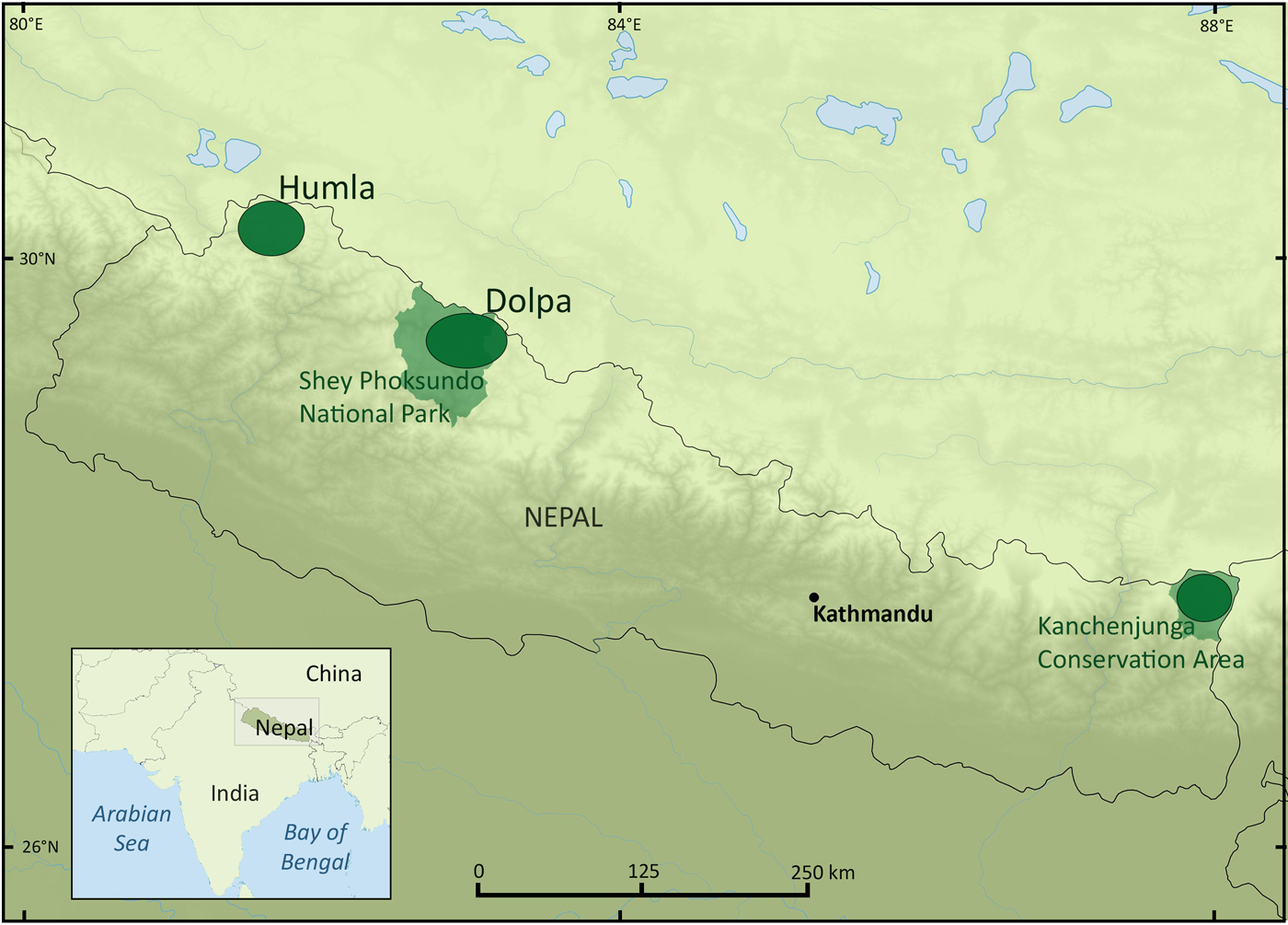
This study was conducted in Humla and Dolpa districts in north-western Nepal, and Kanchenjunga Conservation Area in north-eastern Nepal, during the spring and summer seasons of 2014–2016 (Fig. 1). The Humla site lies outside the protected area system, whereas large parts of the Dolpa site are situated within Shey Phoksundo National Park, and Kanchenjunga Conservation Area is a community-managed conservation area. All three study areas are used seasonally by herders in the late spring and summer to graze yak Bos grunniens, cattle Bos taurus and goats Capra aegagrus hircus (Bauer, Reference Bauer2004). The vegetation in these areas is dominated by alpine grasslands and steppes interspersed with patches of shrubland (Miehe et al., Reference Miehe, Pendry and Chaudhary2016), at 3,600–5,600 m altitude. In Humla we searched 384 km2 for wolves (walking 420 km in 2014 and 605 km in 2015), in Dolpa 1,088 km2 (walking 262 km in 2015 and 810 km in 2016), and in Kanchenjunga Conservation Area 368 km2 (walking 355 km in 2016).
Locations of the three study sites in the Himalayas in Nepal: Humla (outside the protected area network), Dolpa (partly within Shey Phoksundo National Park), and the community-managed Kanchenjunga Conservation Area.
We collected data on wolf packs through direct observations, examination of home sites, and reports of sightings by local people, which were later verified by examining distances between recorded home sites. Home sites, comprising den and rendezvous sites, were characterized by abundant recent scats of pups and adults, along with bones and other food remains. Den sites additionally comprised a den cave (Mech & Boitani, Reference Mech and Boitani2003).
To investigate human–carnivore conflict we conducted semi-structured social surveys during the field work expeditions of 2014–2016, with 72 respondents from the local Buddhist communities (32 (44%) in Humla, 27 (38%) in Dolpa, and 13 (18%) in Kanchenjunga Conservation Area). Respondents comprised herders (67%), monks/lamas (10%), teachers (4%), business people (11%), construction workers (5%) and hoteliers (3%). Respondents were 20–78 years of age and comprised 25% females and 75% males. Survey questions explored perceptions of trends in the wolf population and depredation incidents, and spatial and temporal depredation hotspots, and respondents were asked to rank predators based on the magnitude of depredation problems they cause.
Results
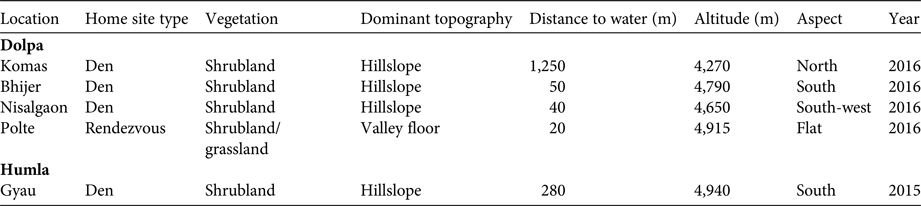
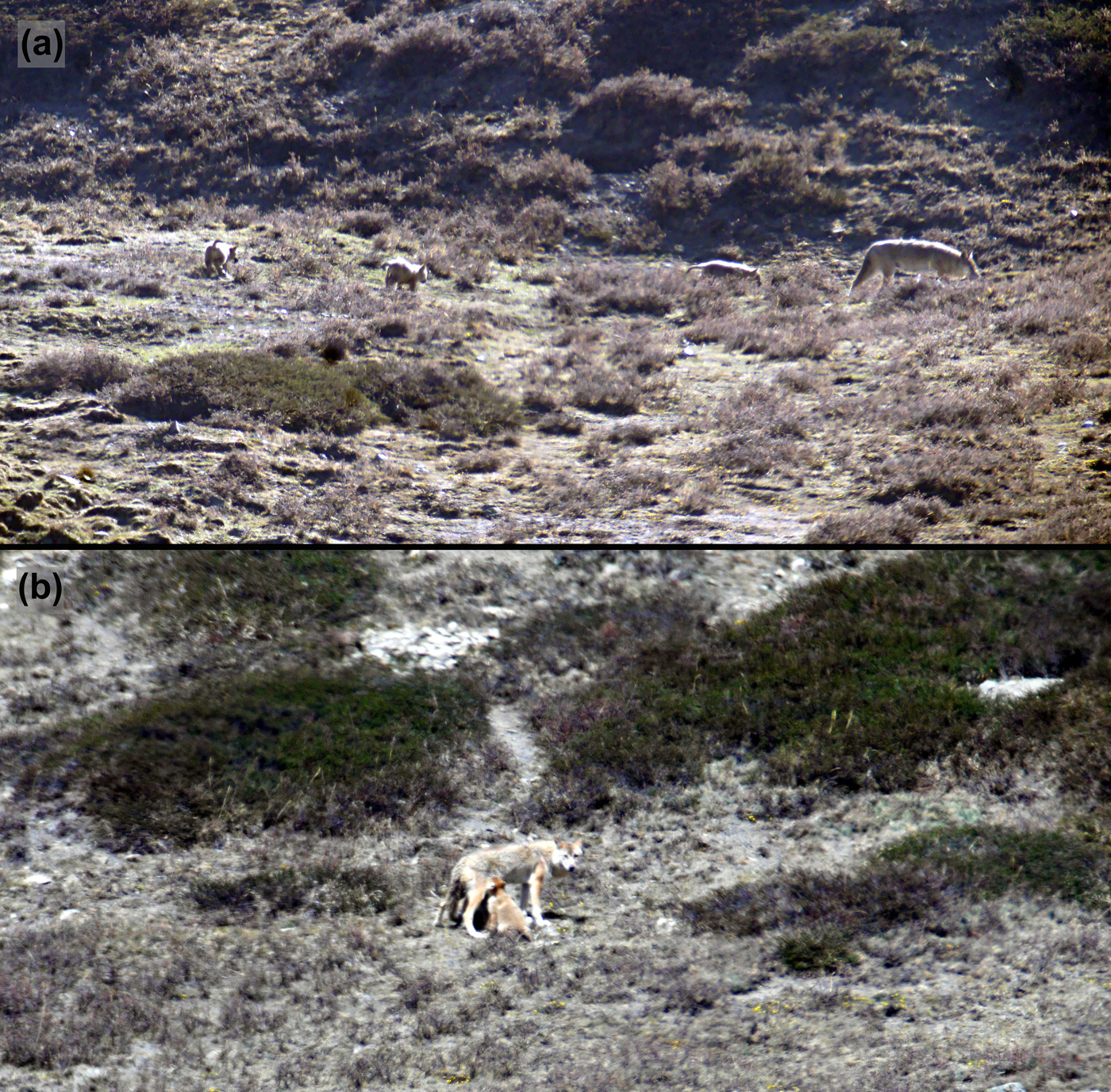
The eight packs encountered in Nepal consisted, on average, of five individuals: an adult pair accompanied by a mean of 2.9 ± SD 0.6 pups of the current year (Table 1, Plate 1). According to our observations, Himalayan wolves in Nepal give birth between mid April and mid May (n = 4). The mean distance between the home sites of four adjacent wolf packs in Dolpa was 19.6 ± SD 5.5 km (n = 4). All home sites were situated in patches of rolling alpine shrubland dominated by Caragana, Lonicera, Astragalus, Salix and Juniperus spp. within alpine grasslands and in proximity to water (Table 2).
Pack composition of eight Himalayan wolf Canis (lupus) himalayensis packs in three areas in Nepal: Dolpa (within and outside Shey Phoksundo National Park), Humla and Kanchenjunga Conservation Area (Fig. 1), with type of evidence, and year recorded.
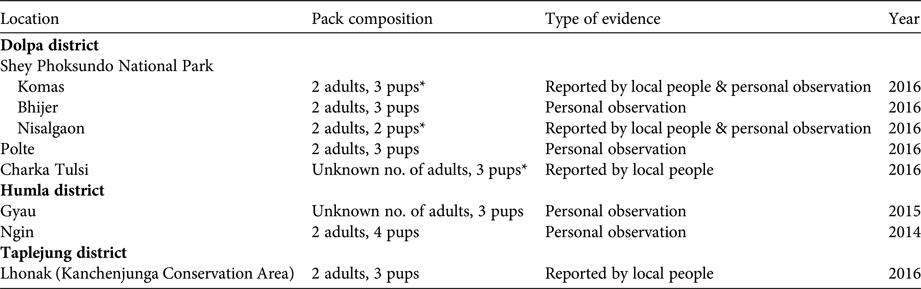
* Pups of the year killed through smoking the den
Characteristics of four den sites and one rendezvous site of Himalayan wolves in Dolpa and Humla districts, Nepal (Fig. 1), with type of vegetation, dominant topography, distance to water, elevation, aspect, year of recording, and district.
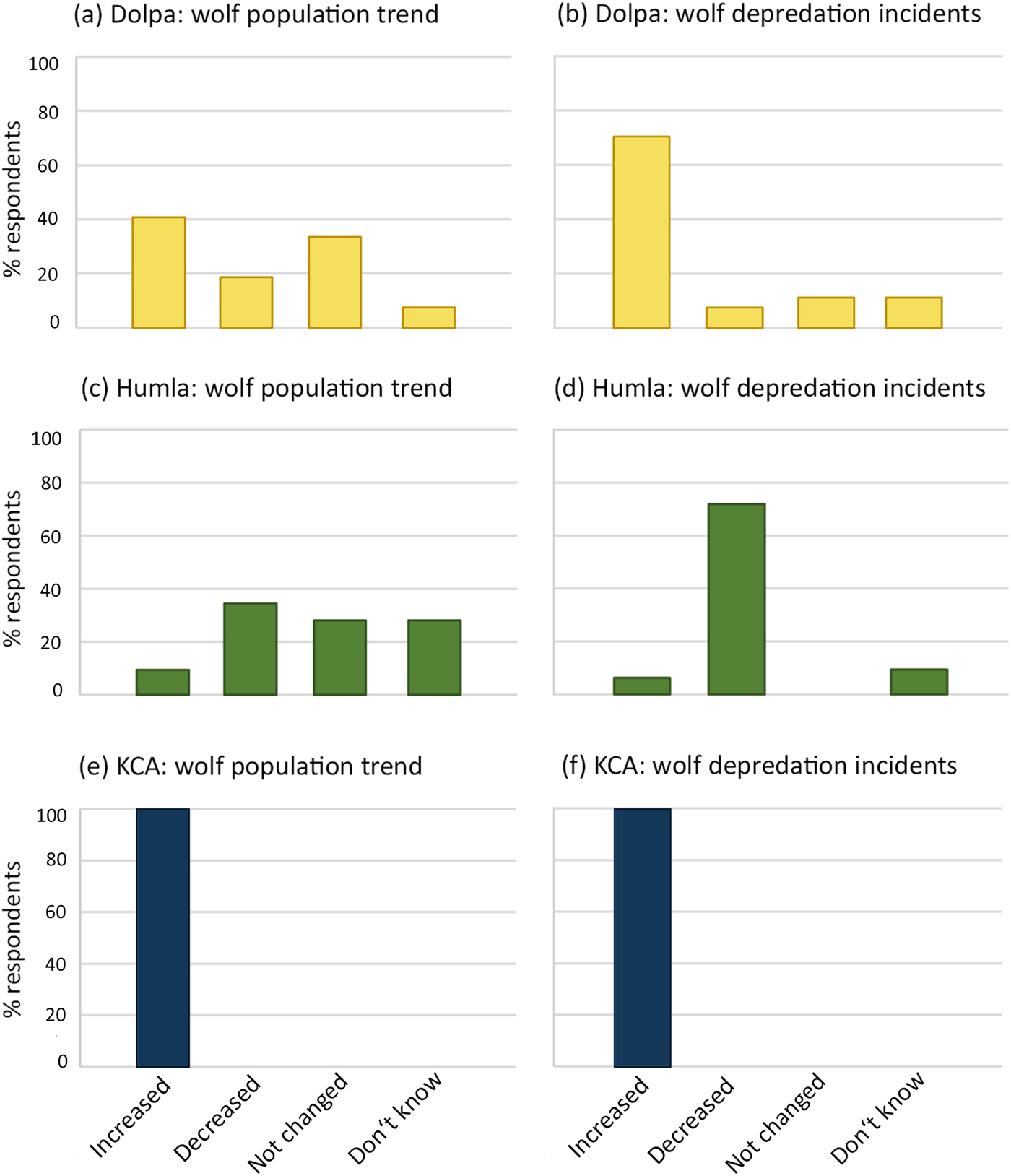
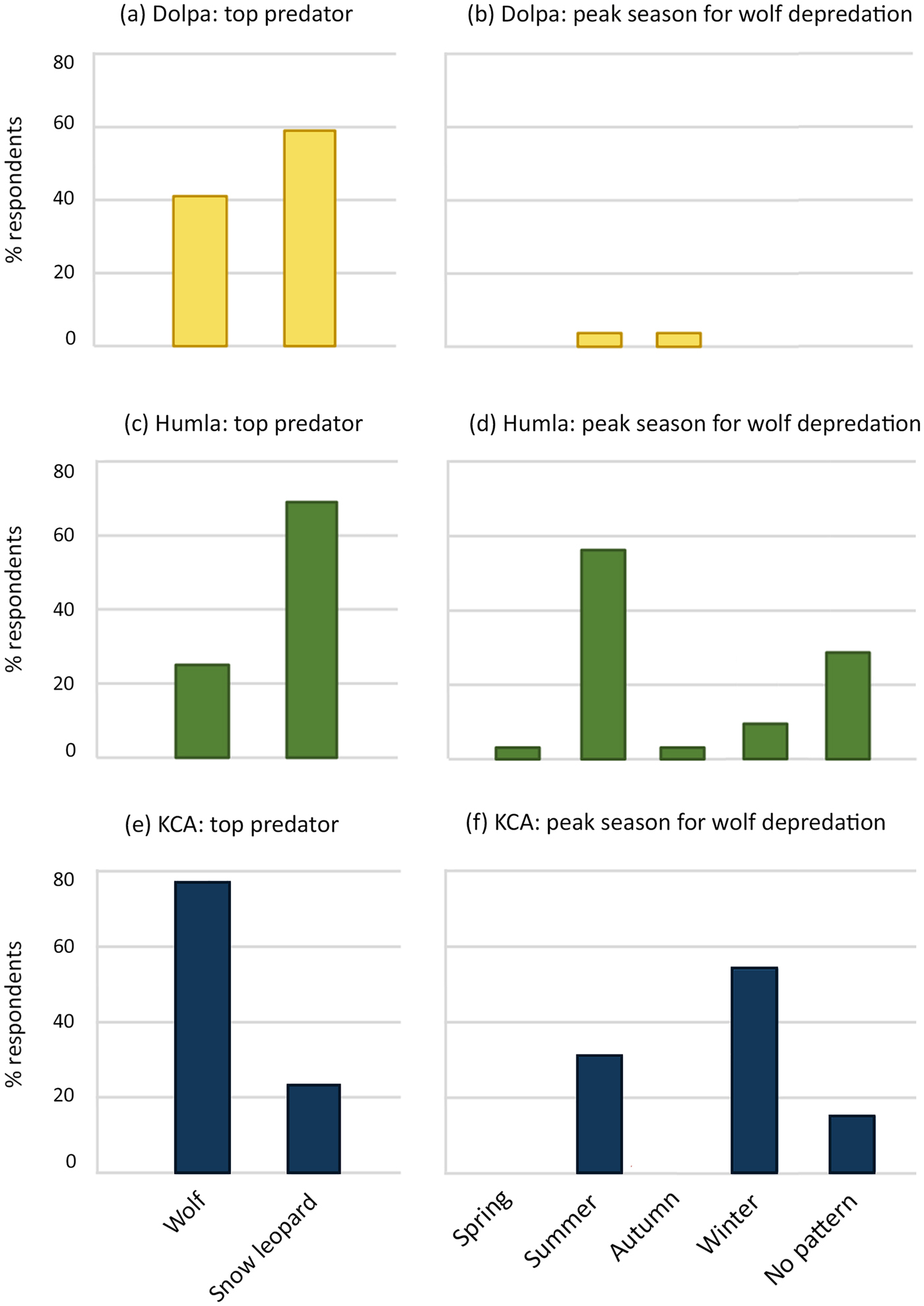
In Dolpa and Kanchenjunga Conservation Area a perceived increase in the wolf population was reflected in a perceived increase in depredation by wolves. In Humla, however, a perceived decrease in the wolf population correlated with a perceived decrease in depredation (Figs 2 & 3); local people attributed this decrease in depredation largely to the lower numbers of livestock kept now compared to the past. In Humla and Dolpa snow leopards were ranked as the most problematic carnivore, followed by wolves, and vice versa in Kanchenjunga Conservation Area. In Humla, depredation by wolves was reported to be at its highest during the summer. Respondents in Kanchenjunga Conservation Area reported the highest depredation rates in winter, followed by spring/summer, whereas no seasonal pattern emerged in Dolpa (Fig. 3).
Wolf Canis (lupus) himalayensis population and depredation trends as reported by local respondents during structured social surveys in Dolpa (n = 27), Humla (n = 32), and Kanchenjunga Conservation Area (KCA; n = 13).
The most problematic predator and the season with the most incidents of wolf depredation, as reported by local respondents during structured social surveys in Dolpa (n = 27), Humla (n = 32) and Kanchenjunga Conservation Area (n = 13), Nepal (Fig. 1).
Discussion
The social life of Himalayan wolves is characterized by small packs (i.e. family groups; Plate 1), similar to packs of Holarctic grey wolves, golden jackals Canis aureus and coyotes Canis latrans (Sillero-Zubiri et al., Reference Sillero-Zubiri, Hoffmann and Macdonald2004). The Himalayan wolf packs observed were comparatively smaller than Holarctic grey wolf packs, which commonly comprise 6–12 individuals (Sillero-Zubiri et al., Reference Sillero-Zubiri, Hoffmann and Macdonald2004). Factors potentially influencing pack size may include prey abundance and size, wolf mortality, and prompt dispersal of yearlings (Fuller, Reference Fuller1989; Jędrzejewski et al., Reference Jędrzejewski, Schmidt, Theuerkauf, Jędrzejewska, Selva, Zub and Szymura2002).
A Himalayan wolf Canis (lupus) himalayensis pack photographed near Bhijer village in Dolpa district of Nepal (Fig. 1) in 2016. (a) A female and her three pups in the morning, and (b) the female suckling her pups. (Photograph by Geraldine Werhahn)
The home sites used by these Himalayan wolf packs were probably chosen for their quality in respect to hiding cover, structural diversity and water accessibility, similar to recorded characteristics of grey wolf den sites (Trapp et al., Reference Trapp, Beier, Mack, Parsons and Paquet2008).
The high-altitude shrublands used by the packs for denning are also used by local people to graze livestock in late spring and summer, a time when the pups are a few weeks old and are restricted to home sites. Pupping packs are less mobile and need ample food. This spatial–temporal overlap of wolf denning with herding, which often involves large numbers of livestock being brought in seasonally, gives rise to human–wolf conflict (Mishra, Reference Mishra1997; GW & NK, pers. obs., 2014–2016). Livestock competes with, and may displace, wild prey species such as blue sheep Pseudois nayaur, kiang Equus kiang and argali Ovis ammon. Consequently human–wolf conflict is intensified during late spring and summer in the pasturelands.
The social surveys indicated that no compensation for wolf depredation was provided in any of the three study sites, whereas compensation for snow leopard depredation is provided in parts of Shey Phoksundo National Park and in Kanchenjunga Conservation Area (Subba et al., Reference Subba, Shrestha, Thapa, Malla, Thapa and Shrestha2017). Killing wolves is often considered to be an act of service towards the entire community, as it is assumed to prevent future livestock depredation.
The entire litters of three out of five wolf packs found in Dolpa in 2016 were killed that same year by local people. The pups were smoked to death by lighting a fire inside the den and blocking the entrance with stones (GW & NK, pers. obs.; local people, pers. comm., 2016). Schaller (Reference Schaller1982) similarly reported persecution of wolves in Dolpa, with local people gathering each spring to look for wolf dens and kill the pups. However, killing wolves is often not an effective means of decreasing livestock depredation and can be counter-productive, because of a perturbation effect (Tuyttens & Macdonald, Reference Tuyttens, Macdonald, Gosling and Sutherland2000) arising from the disrupted pack structure and territorial configuration (Wielgus & Peebles, Reference Wielgus and Peebles2014; Chapron & Treves, Reference Chapron and Treves2016; Treves et al., Reference Treves, Krofel and McManus2016).
To date, carnivore conservation in the Himalayas has focused on snow leopards, with insurance schemes and awareness programmes implemented locally (Mishra et al., Reference Mishra, Allen, McCarthy, Madhusudan, Bayarjargal and Prins2003; Subba et al., Reference Subba, Shrestha, Thapa, Malla, Thapa and Shrestha2017). In Kanchenjunga Conservation Area, where conservation programmes exist for the snow leopard and blue sheep, respondents expressed a positive attitude towards the snow leopard. These communities stated that they would support wolf conservation only if they received similar financial compensation for depredation by wolves. It is therefore crucial for wolf conservation to expand implementation of compensation to cover depredation by wolves, and the legal basis for this is already in place in Nepal's wildlife damage relief guidelines (GoN, 2015). We further recommend that governmental and non-governmental organizations working on carnivore conservation in the Himalayas of Nepal include all conflict-causing carnivores in their conservation programmes. This may involve facilitating self-financed depredation insurance schemes, protecting wild prey populations and managing livestock numbers, improving livestock protection, and increasing conservation awareness (Mishra, Reference Mishra1997). Payments to encourage coexistence can be a useful tool to increase local tolerance towards carnivores (Dickman et al., Reference Dickman, Macdonald and Macdonald2011). The implementation of conservation payments for species that are difficult to monitor and occur in remote areas (e.g. the snow leopard, Himalayan wolf and Eurasian lynx Lynx lynx in the Himalayas) can be tied to tangible performance criteria, such as maintaining the habitat and populations of wild prey species (e.g. blue sheep), with payments being contingent upon communities not killing any predators (Mishra et al., Reference Mishra, Allen, McCarthy, Madhusudan, Bayarjargal and Prins2003; Nelson, Reference Nelson2009).
A first step towards the conservation of the Himalayan wolf in Nepal is to include it in existing conservation programmes, followed by expanding these across the entire region. These programmes can be informed by our insights into Himalayan wolf denning ecology, temporal–spatial wolf depredation patterns, and the associated perceptions of local communities.
Acknowledgements
We thank the Department of National Parks and Wildlife Conservation, Department of Forests, District Forest Office, Humla, Shey Phoksundo National Park, Dolpa and Kanchenjunga Conservation Areas for permits and support for this research. We thank all members of the field research teams, namely Pema Rikjin Lama, Tashi Namgyal Lama, Pemba Dorje Tamang, Kunjok Rangdol Tamang, Pasang Dorje Tamang, Tashi Dondup Lama, Bir Bahadur Sunar and Tshiring L. Lama, and the NGO Friends of Nature Nepal for its support. GW is supported by a Natural Motion Scholarship from the University of Oxford.
Author contributions
GW collected the field data, conducted the data analysis, conceived and designed the study, and drafted the article. NK participated in data collection and analysis, and in drafting the article. CSZ and DWM helped to conceive and design the study, and draft the article.
Biographical sketches
Geraldine Werhahn is studying the phylogeny, ecology and conservation of wolves in the Himalayas and the Tibetan Plateau. Naresh Kusi is a wildlife researcher whose interests include predator–prey dynamics in the higher Himalayas, floral investigations, and exploration of the potential of wildlife tourism. Claudio Sillero-Zubiri is a conservation biologist working on carnivore conservation and human–wildlife conflict, and is the Chair of the IUCN SSC Canid Specialist Group. David W. Macdonald has a background in behavioural ecology, especially of carnivores, and specializes in evidence-based solutions to conservation problems.


 Open access

