Adequate patient information has been defined as a high priority health policy issue. Health education has a high impact on understanding the causes and consequences of illness, protecting health, preventing complications and taking appropriate action towards managing chronic diseases(Reference Coulter, Parsons and Askham1). Health literacy, which is defined by the WHO as ‘the cognitive and social skills which determine the motivation and ability of individuals to gain access to, understand und use information in ways which promote and maintain good health’(Reference Nutbeam2), is a prerequisite for the empowerment of individuals to manage a disease, to prevent a disease or to promote health, independently of diseases. Therefore, health literacy is not only a personal resource, but also an important determinant of the health of a community(Reference Kickbusch3). In fact, both clinical and public health approaches to health literacy have been tested with different implications(Reference Pleasant and Kuruvilla4). Low health literacy is associated with adverse health outcomes, independently of other risk factors(Reference Nutbeam5). It has been argued that health literacy can be regarded as a measurable outcome to health education and is best accessed when the content and context are well defined (e.g. for a person with diabetes mellitus who is or is not receiving patient education)(Reference Nutbeam5). In addition, greater health-related knowledge supports greater autonomy and personal empowerment in health-related decision making(Reference Nutbeam5).
Regarding diabetes mellitus, knowledge and health literacy are important to allow a healthy lifestyle with a sufficient amount of physical activity and healthy nutrition to prevent onset of the disease. For individuals who already suffer from diabetes mellitus, health literacy is a prerequisite to manage the disease with its challenges in lifestyle changes, adherence to the established therapy and navigation through the health-care system. In fact, in patients with diabetes mellitus, diabetes knowledge and health literacy are highly associated with each other and lead to better outcomes in diabetes(Reference Cavanaugh6–Reference Yamashita and Kart10).
Most research regarding health knowledge and health literacy associated with diabetes mellitus has focused on patients with diagnosed and treated diabetes only. Little is known about diabetes-related health knowledge in individuals without known diabetes. This population is however also important, because these individuals can be at high risk for diabetes or even suffer from undiagnosed diabetes. Regarding the high prevalence of diabetes in the general population, there is a good chance to be personally involved in the management of diabetes of relatives or friends.
It was the aim of the present analysis to evaluate the self-assessed knowledge about diabetes mellitus in persons with and without diabetes mellitus. Furthermore, we sought to assess determinants of diabetes-related health knowledge and to evaluate consequences of health knowledge on adequate appraisal of the illness and its consequences in a sample representative for the general Austrian population.
Methods
Sample
The database used for the analysis was a population-based survey carried out by a research institute in August and September 2009. The survey was performed for half of the participants as computer-assisted web interviews and for the other half as a paper-and-pencil survey via post with a structured questionnaire. With this mix of methods an optimal representativeness in all age strata is guaranteed, since Internet-savvy individuals (mostly younger persons) can use the Internet and those who have doubts about the confidentiality of the Internet or are not familiar with it can use the paper-and-pencil version via post (mostly elderly persons). The research institute routinely cooperates with 30 000 panellists online and 20 000 panellists via traditional mail. Both pools are recruited via telephone or personal contact, where no specific screening criteria are used. Both pools cover the entire Austrian population according to regional and demographic parameters. Out of this pool 4350 online panellists and 5200 postal panellists were randomly selected to participate in this specific survey, stratified by region and age. The online panellists received an email containing a personalized questionnaire link to assure that each was able to participate once only, and were reminded up to three times. The postal panellists received a printed questionnaire and one postal reminder. Response rate in the online sample was 46·0 % and in the postal pool 38·4 %. The total sample reached a response rate of 42·1 %. Persons aged 15 years and older were included in the survey. In order to account for the stratification of the sample, the data were weighted by age, sex, country of origin and city size.
Analysed variables
Regarding diabetes mellitus, participants were asked: ‘Have you ever been diagnosed with diabetes mellitus?’. If this was answered ‘yes’, participants were asked to indicate whether they had been diagnosed with type 1 diabetes, type 2 diabetes, gestational diabetes or if they did not know the diabetes classification.
Knowledge about diabetes was assessed with the question: ‘Independently of your own diabetes status, how well do you feel informed about diabetes mellitus?’. Participants were asked to answer ‘very good’, ‘rather good’, ‘rather bad’ or ‘very bad’. Furthermore, participants were asked: ‘Which source of information about diabetes mellitus do you prefer?’. The answer was given in eight categories and ‘other’, where multiple answers were possible. Participants were also asked: ‘Diabetes can, if not treated, lead to other diseases. Which of the following diseases do you know can be caused by diabetes mellitus?’. Nine categories of answers were offered; again, multiple answers were possible. Finally, participants were asked to rate on a 4-point Likert scale (1 = ‘very strong’, 2 = ‘rather strong’, 3 = ‘rather little’, 4 = ‘very little’) restrictions in activities of daily living due to diabetes mellitus with the wording: ‘Think of what you know about living with diabetes mellitus and indicate how the following activities of daily living are influenced in subjects with diabetes mellitus’. Seven different activities of daily living were asked.
As explanatory co-variables in the multivariate regression models, apart from personal diabetes status and age in years, the diabetes status of family members was assessed with the question: ‘Do any of your family members suffer from diabetes mellitus type 1 or type 2?’. Household net income was assessed in eleven categories, education in six categories, city size in four categories and familial status in the categories ‘married or civil union’ and ‘single, divorced, separated, widowed’. BMI was computed as kg/m2 from self-reported data of body weight and body height.
Statistical analysis
Statistical analysis was conducted using the SPSS Statistics 17·0 statistical software package. Bivariate analyses were undertaken by means of cross-tabulations, and group differences were assessed with the Pearson's χ 2 test. For assessment of the influence on diabetes knowledge, a logistic regression analysis was applied. The level of knowledge was used as the dependent variable and was dichotomized as feeling ‘very well’ or ‘rather well’ informed v. ‘very badly’ or ‘rather badly’ informed. The variables ‘being affected by diabetes mellitus’, ‘having a family member with diabetes’, ‘living with a partner’ and ‘educational level’ (primary, secondary and tertiary education) were used as categorical variables, and household net income, city size, BMI and age were used simultaneously as metric variables in the model. The results of the logistic regression model are presented as odds ratios with 95 % confidence intervals. Nagelkerke's R 2 is presented as a measure of model fit. For the ratings of restrictions in activities of daily living due to diabetes mellitus, mean values were computed and Student's t test used to assess differences between those who felt badly informed v. well informed about diabetes mellitus. All results were stratified by sex.
Results
Response rate
The response rate to the survey was 42 %, so a total of 1935 men and 2065 women were eligible for analysis. There were no missing data in the used variables, except for BMI in 1·0 %, ratings of knowledge in 3·1 % and household net income in 19·9 %.
Diabetes prevalence
One hundred and twenty-nine men and 165 women (6·7 % and 8·0 %, respectively) reported that they had been diagnosed with diabetes mellitus. Out of these diabetes patients, 14·0 % of men and 16·2 % of women had been diagnosed with type 1 diabetes (n 18 and 27), 60·1 % of men and 49·6 % of women had a diagnosis of type 2 diabetes (n 78 and 82), and 27·6 % of women (n 46) had been diagnosed with gestational diabetes. Some 24·9 % of male and 8·5 % of female diabetes patients reported that they did not know what kind of diabetes mellitus they had been diagnosed with (n 32 and 14).
Self-rated level of diabetes knowledge
As shown in Fig. 1, in the total population, women tended to rate their level of knowledge about diabetes mellitus better than men. Individuals with diabetes mellitus rated their level of knowledge better than those without diabetes, although still 20·5 % of men and 17·7 % of women (n 26 and 29) with diabetes rated their level of knowledge about diabetes mellitus to be ‘rather bad’ or ‘very bad’.
Level of knowledge about diabetes mellitus ( , ‘very good’;
  , ‘rather good’;
  , ‘rather bad’;
  , ‘very bad’) in men (n 1935) and women (n 2065) with and without diabetes mellitus; Austria, August/September 2009

Factors influencing diabetes knowledge
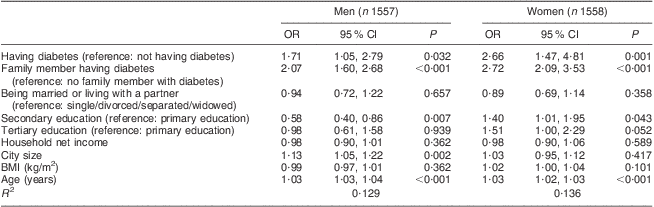
A logistic regression model revealed that positive personal diabetes status had a high influence on being well informed about diabetes. Having a family member with diabetes was associated with a twofold greater chance in men and an almost threefold greater chance in women to have good information status, compared with the population without diabetic relatives. Age was associated with an increasing chance of being well informed about diabetes in both sexes, and in men, city size also had an effect on diabetes knowledge. Men with secondary education rated their level of information on diabetes lower than men with primary education. Women with secondary education, however, rated their level of information higher than women with primary education. Family status, household net income and BMI were not significant predictors of being well informed about diabetes in either sex (Table 1).
Logistic regression results for subjectively feeling very well or rather well informed about diabetes mellitus; all variables are simultaneously included in the model. Men (n 1935) and women (n 2065) with and without diabetes mellitus; Austria, August/September 2009
Knowledge and health consequences
The proportion of the total population who linked diabetes mellitus to impaired wound healing and eye disease was 65·5 % and 62·7 %, respectively, in men and 78·6 % and 76·9 %, respectively, in women. However, the proportion who associated diabetes with vessel diseases, stroke or atherosclerosis was only 39·6 %, 39·3 % and 14·1 %, respectively, in men and 49·5 %, 40·3 % and 15·3 %, respectively, in women. In individuals who subjectively felt better informed about diabetes mellitus, the proportion who correctly knew that diabetes can lead to various diseases was significantly higher compared with those who rated their level of knowledge as low, regardless of personal diabetes status. Women considered all diseases to be a possible consequence of diabetes mellitus more often than men (Table 2).
Percentage of participants who indicated that diabetes mellitus can lead to a certain disease by subjective level of knowledge about diabetes mellitus: men (n 1935) and women (n 2065) with and without diabetes mellitus; Austria, August/September 2009
Restrictions in daily life
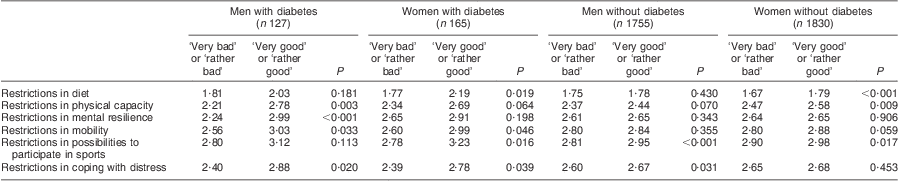
Regarding restrictions in lifestyle due to diabetes, men and women rated diet to be most influenced by diabetes on a scale between 1 (‘very strong’) and 4 (‘very little’) with a mean of 1·82 for both sexes, and restrictions in possibilities to participate in sports least. Men rated restrictions in physical capacity and restrictions in possibilities to participate in sports due to diabetes higher than women (2·57 v. 2·46, P < 0·001 and 3·00 v. 2·93, P = 0·006, respectively). Interestingly, patients with diabetes mellitus rated restrictions in diet, in physical capacity, in mental resilience and in possibilities to participate in sports lower than did individuals without diabetes mellitus (2·05 v. 1·08, P < 0·001; 2·66 v. 2·51, P = 0·005; 2·86 v. 2·68, P < 0·001; and 3·12 v. 2·95, P = 0·001, respectively). Individuals who felt informed about diabetes mellitus tended to indicate that diabetes was associated with restrictions in daily activities and quality of life to a lower extent than did those who indicated not to be well informed about diabetes mellitus (Table 3).
Rating of restrictions due to diabetes mellitus in participants by subjective level of knowledge about diabetes mellitus: men (n 1935) and women (n 2065) with and without diabetes mellitus; Austria, August/September 2009
Mean value on a 4-point Likert scale between 1 = ‘very strong’ and 4 = ‘very little’.
Source of information
Men indicated to consult a doctor and the Internet for information about diabetes more often than women, and women indicated more often than men to consult a pharmacy, newspapers, magazines, folders and brochures, support groups or other sources for diabetes information. Male and female patients with diabetes consulted a doctor for information on diabetes respectively 1·36 times and 1·41 times more often compared with individuals without diabetes, and female diabetes patients got information from support groups more than three times more often than non-diabetic females. Male participants without diabetes got information almost twice as often from the Internet and almost five times more often from other sources compared with diabetic males, and female participants without diabetes got information more than three times as often from the radio than did female diabetes patients (Table 4).
Percentage of participants who indicated a specific source of information about diabetes mellitus by sex and personal diabetes status: men (n 1935) and women (n 2065) with and without diabetes mellitus; Austria, August/September 2009
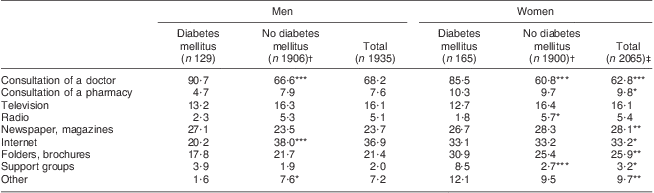
*P < 0·05, **P < 0·01, ***P < 0·001.
†P value between participants with diabetes v. without diabetes.
‡P value between total men and women.
Discussion
Our results show that a large proportion of the general adult population rates its level of knowledge about diabetes mellitus to be low, and even among diabetes patients more than a fifth feel badly informed about diabetes mellitus. A lack of knowledge about diabetes is associated with greater misconceptions about possible restrictions due to the disease and with a greater amount of underestimation of diabetes consequences, both in those with and without diabetes.
Predictors of information level
Significant influences on knowledge about diabetes mellitus were exerted by personal diabetes status, diabetes status of family members, educational level, city size and age. In another Austrian survey, older age, higher educational level and bigger city size were also found to be associated with better knowledge about the cardiovascular risk factor low HDL-cholesterol compared with their opposites(Reference Dorner, Fodor and Lawrence11). A recent study of 200 diabetes patients showed that a higher degree of health knowledge was associated with younger age, a low number of children, educational level and diabetes duration(Reference Guler and Oguz12). Health literacy has also been found to be dependent on educational level, sex and race in another study(Reference Jeppesen, Coyle and Miser13). The fact that educational level has an influence on health literacy is especially important regarding the prevention of diabetes, since a low socio-economic status is associated with a higher risk of diabetes(Reference Dorner, Rathmanner and Lechleitner14, Reference Stein, Rieder and Dorner15). Thus, even in individuals without known diabetes, those with a lower socio-economic status should be considered a special target group for education about diabetes-related issues. As the association of poor health literacy with worse outcomes in diabetes mellitus has been found to be independent of socio-economic status(Reference Marden, Thomas and Sheppard7), information on diabetes should be given disregarding educational status.
Interestingly, in our survey men with secondary education felt to be less informed about diabetes mellitus, while women with secondary education felt better informed than women with primary education. However, men and women with tertiary education did not feel significantly better informed than those with primary education. This could be explained by the fact that higher educated persons might regard their level of experience more critically and might thus consider lack of information more often as a deficit compared with persons with lower education. Income had no influence on the level of feeling informed about diabetes mellitus in our study after adjusting for other predictors.
Diabetes status of family members
For men and women, the diabetes status of a family member was more strongly associated with diabetes knowledge than personal diabetes status, especially in men. An explanation for this finding could be that individuals with diabetic relatives take responsibility for their care and seek information. In another study, it has been shown that family members facilitate health literacy in diabetes patients(Reference Mayberry, Kripalani and Rothman16).
Restrictions in daily life
We found that a higher level of diabetes knowledge was associated with lower ratings of presumed limitations in activities of daily living among men and women, regardless of diabetes status. Thus, health literacy and health knowledge have a high potential to take away some of the fear which might be associated with the diagnosis of diabetes mellitus. This could in turn lead to the perception that diabetes is not necessarily associated with a lower quality of life or potential restrictions. In a correlation study it was shown that learned resourcefulness, which can be understood as a part of health literacy, was associated with better quality of life in patients with diabetes mellitus(Reference Huang, Perng and Chen17).
Source of information
Despite emerging new important sources of health information like the Internet, doctors were still the major source of information on diabetes, regardless of personal diabetes status, among our study participants. Thus doctors should be aware of their role not only in diabetes management, but also in diabetes prevention. Health check-ups in healthy individuals should also be regarded as a window of opportunity to consult towards a healthy lifestyle and measures to prevent diabetes mellitus. However, the Internet is also regarded as an important tool for information about diabetes, especially among men without diabetes. In that regard, a German study has demonstrated the feasibility of a computer-based lifestyle counselling in diabetes patients(Reference Becker, Herzberg and Marsden18).
Health literacy in diabetes patients
Other studies which research health literacy in diabetes mellitus usually focus on persons who are already affected by diabetes and therefore are not concerned with the prevention of diabetes. These studies show that, in patients with diabetes mellitus, health literacy leads to greater diabetes knowledge, is associated with self-efficacy and self-care behaviours and leads to a better glycaemic control(Reference Cavanaugh6–Reference Yamashita and Kart10). Health literacy additionally is associated with improved adherence to diabetes medication(Reference Osborn, Cavanaugh and Wallston19). Another model that links poor health literacy to worse glycaemic control assumes that health literacy is associated with patient satisfaction and patient–provider communication, and in consequence leads to poor glycaemic control(Reference Mayberry, Kripalani and Rothman16). In contrast, a high level of diabetes knowledge is associated with increased medication adherence and better glycaemic control(Reference Al-Qazaz, Sulaiman and Hassali20).
Applications for public health
Health literacy and health knowledge have been argued to have implications not only on individual health outcomes, but also on the health of a community(Reference Kickbusch3–Reference Nutbeam5). In fact, community-based health education to promote a healthy lifestyle has substantial effects on primary and secondary prevention(Reference Aarva, de Haes and Visser21, Reference Kok, van den Borne and Dolan Mullen22). Our study reinforces the necessity for health information targeted towards the healthy population, not only for the prevention of diabetes mellitus but also for the prevention of misconceptions associated with diabetes mellitus. A well-informed public might also take away some of stigmas that are still connected with diabetes mellitus in the perception of the patients concerned(Reference Adams and Carter23).
Strengths and limitations
One of the strengths of our study is that self-perceived health knowledge regarding diabetes mellitus was simultaneously assessed in persons with and without diabetes. This approach is not common in studies assessing diabetes-related health literacy. Another advantage is the large sample size of our study and the representativeness for the general Austrian population, according to geographic and sociodemographic parameters. Due to the selection of participants contacted, generalization of the results to the entire population should be made with care.
A potential limitation may be that we did not use proven and tested tools to assess health literacy, which exist specifically for diabetes patients as well as in generic forms for the general population. Moreover, the self-reported level of feeling informed about diabetes mellitus was not objectified by assessment of actual diabetes knowledge. This might lead to an underestimation of actual lack of diabetes knowledge. However, asking merely the question how informed one feels about diabetes mellitus, which we used as our primary outcome variable, reflects the subjective perception of level of knowledge. The self-perceived level of being informed about diabetes mellitus is, from the patient's point of view, possibly a more valid indicator of health literacy than objective knowledge.
Another possible limitation originates from the self-reported nature of the data and the response rate of just 42 %. Both aspects could affect the assessed diabetes prevalence. So, it could be that undiagnosed diabetes patients were a part of the non-diabetes group, which would result in a false-too-small diabetes prevalence. On the other hand, it could also be that diabetes patients were more likely to respond to the survey than non-diabetic patients, which would result in a false-too-high prevalence. Prevalence rates of diabetes mellitus in the present survey were 6·7 % and 8·0 % of affected men and women, quite similar to the results of the Austrian Health Interview Survey 2006/07 where 5·4 % of men and 6·4 % of women reported to have been diagnosed with diabetes mellitus(24). The main outcomes of the current paper, i.e. health knowledge in individuals with and without diabetes, should however not be affected by these limitations.
Further research based on our study could include prospective studies regarding an increase of diabetes knowledge and health literacy in the general population on the risk of developing diabetes mellitus.
Conclusions
Our study shows that large proportions of patients and non-diabetic individuals do not feel satisfyingly informed about diabetes mellitus. Health knowledge needs to be improved in order to facilitate a sufficient health literacy, which in turn would lead to improved metabolic control of diabetes patients and improved prevention in non-diabetic individuals. Importantly, doctors still are considered the most important resource of health information and should therefore be aware of their responsibility in consulting individuals about diabetes mellitus related issues, especially with a focus on prevention. A high level of knowledge also leads to reduced misconceptions of potential restrictions in areas of life associated with diabetes mellitus. Thus, improving knowledge and health literacy regarding diabetes mellitus must also be considered an important task for public health.
Acknowledgements
Source of funding: Data collection was financially supported by a grant from the company Sanofi Aventis. The data were provided for analysis by the Austrian Diabetes Initiative. Conflicts of interest: The authors declare that they have no conflicts of interest. Authors’ contributions: T.E.D. developed the idea of the manuscript and was responsible for the analysis of the data. T.E.D., K.S. and K.V.S. drafted and wrote the manuscript. C.L., A.R. and B.L. contributed to the interpretation of the data and in revising the manuscript critically. All authors read and approved the final manuscript.