


Introduction
Ascidians (Phylum: Chordata, Subphylum: Tunicata, Class: Ascidiacea) are hermaphroditic, filter-feeding marine invertebrates with a global distribution, inhabiting oceanic regions from tropical to polar latitudes (Lambert, Reference Lambert2005). They occupy diverse benthic habitats, including sandy substrates, rocky shores, coral reefs, and kelp forests (Shenkar and Swalla, Reference Shenkar and Swalla2011). The capacity for both sexual and asexual reproduction contributes to their rapid population expansion (Blanchoud et al., Reference Blanchoud, Rinkevich, Wilson, Kloc and Kubiak2018; Holland, Reference Holland2016). In botryllid ascidians, sexual reproduction produces free-swimming larvae that metamorphose into zooids, and zooids expand to colonies through asexual reproduction by budding (Lauzon et al., Reference Lauzon, Ishizuka and Weissman1992). A typical colonial ascidian is organized into a system that includes three co-existing generations – mature zooids and developing buds – spatially arranged and interconnected through a shared vascular network (Brown et al., Reference Brown, Keeling, Le and Swalla2009). This network ends peripherally in blind extensions known as ampullae (Figure 1). Buds originate either from the atrial epithelium of existing zooids (palleal or peribranchial budding; Berrill, Reference Berrill1941) or from haemocyte aggregates at the base of ampullae (vascular budding; Oka and Watanabe, Reference Oka and Watanabe1957). The blastogenic cycle refers to the asexual reproductive process in botryllid ascidians that occurs via palleal budding, during which aging zooids are replaced by developing buds, and all old zooids are resorbed in a process known as ‘take-over’ (Lauzon et al., Reference Lauzon, Ishizuka and Weissman2002; Manni et al., Reference Manni, Gasparini, Hotta, Ishizuka, Ricci, Tiozzo, Voskoboynik and Dauga2014). The blastogenetic cycle has been described using two main staging approaches. The first approach, introduced by Berrill (Reference Berrill1951) and later revised by Manni et al. (Reference Manni, Gasparini, Hotta, Ishizuka, Ricci, Tiozzo, Voskoboynik and Dauga2014), divides the cycle into 11 stages based on the development of budlets, primary buds, and zooids. The second approach, proposed by Mukai and Watanabe (Reference Mukai and Watanabe1976), defines four main stages (A–D) and serves as the framework adopted in the present study. Stage A starts when the siphons of the zooids open. In stage B, heartbeats begin in the primary buds. Stage C involves the formation of organs in the secondary buds and the accumulation of pigment cells in the outer layer of the primary buds. Stage D, known as the take-over stage. During this stage, primary buds mature into new zooids, budlets become primary buds, and a new set of budlets are formed (Manni et al., Reference Manni, Gasparini, Hotta, Ishizuka, Ricci, Tiozzo, Voskoboynik and Dauga2014). Botryllid ascidians also represent the sole living chordate group capable of whole-body regeneration (WBR). Remarkably, they can regenerate a complete, functional individual from as few as 100–200 haemocytes within approximately 10 days (Brown et al., Reference Brown, Keeling, Le and Swalla2009; Karahan et al., Reference Karahan, Öztürk, Temiz, Blanchoud, Blanchoud and Galliot2022; Rinkevich et al., Reference Rinkevich, Shlemberg and Fishelson1995; Voskoboynik et al., Reference Voskoboynik, Simon-Blecher, Soen, Rinkevich, De, Ishizuka and Weissman2007).
General schematic representation of a botryllid ascidian colony, illustrating the typical organization of a system with co-existing generations, including zooids, buds, budlets and ampullae. Illustrated by Bilge Yüceer Karakuş, used by permission.

Botryllid ascidians preferentially settle in coastal areas where the environment fluctuates rapidly. Species thriving in these dynamic environments, capable of enduring diverse stressors, often exhibit traits that facilitate their invasion into new ecosystems, potentially disrupting native communities, a matter of concern considering climate change reality (Lambert, Reference Lambert, Sawada, Yokosawa and Lambert2001). The spatial distribution and settlement patterns of ascidians are influenced by various environmental and biological factors, such as light, substrate type, hydrodynamics, predation, and competition (Lambert, Reference Lambert2005). Understanding the relative influence of these factors on ascidian recruitment, dispersal, and survival is essential for interpreting their global distribution and assessing their invasive potential (Epelbaum et al., Reference Epelbaum, Herborg, Therriault, Pearce and Pearce2009; Lenz et al., Reference Lenz, da Gama, Gerner, Gobin, Gröner, Harry, Jenkins, Kraufvelin, Mummelthei, Sareyka, de Xavier and Wahl2011; Zhan et al., Reference Zhan, Briski, Bock, Ghabooli and MacIsaac2015). Among these variables, salinity and temperature are considered the most critical in shaping recruitment success (Goodbody, Reference Goodbody2004; Millar, Reference Millar1971). However, existing research has largely focused on solitary ascidian species and colonial groups such as Didemnum (Bae et al., Reference Bae, Lee, Kim, Yi, Choe and Choi2023; Carver et al., Reference Carver, Chisholm and Mallet2003; Malfant et al., Reference Malfant, Coudret, Le Merdy and Viard2017; Therriault and Herborg, Reference Therriault and Herborg2008). In contrast, current knowledge on the responses of botryllid ascidians to these factors remains comparatively limited, despite their global species diversity and ecological importance (Brunetti et al., Reference Brunetti, Beghi, Bressan and Marin1980; Epelbaum et al., Reference Epelbaum, Herborg, Therriault, Pearce and Pearce2009; Malfant et al., Reference Malfant, Coudret, Le Merdy and Viard2017; McCarthy et al., Reference McCarthy, Osman and Whitlatch2007).
Within the Mediterranean context, the presence and potential spread of two botryllid species of interest were documented: Botrylloides niger and Botryllus humilis. The first record of B. niger in the Mediterranean dates to 1952 in Israel (Pérès, Reference Pérès1958), followed by reports in the Suez Canal (Halim and Messeih, Reference Halim and Messeih2016), Italy (Salonna et al., Reference Salonna, Gasparini, Huchon, Montesanto, Haddas-Sasson, Ekins and Gissi2021), and Türkiye (Temiz et al., Reference Temiz, Öztürk, Blanchoud and Karahan2023). Similarly, the first record of B. humilis in the Mediterranean was in Israel as well (Brunetti, Reference Brunetti2009 [=Botrylloides anceps]). Its recent introduction along the Turkish coastline is supported by the absence of prior records before 2012 (Karahan et al., Reference Karahan, Temiz, Öztürk, Douek and Rinkevich2023). Both species are considered non-native to the Mediterranean. The Caribbean (West Atlantic) is suggested as the native range of B. niger, supported by its high genetic diversity and continuous distribution in that region (Sheets et al., Reference Sheets, Cohen, Ruiz and Da Rocha2016). B. humilis was likely introduced from the Indo-Pacific through the Suez Canal (Brunetti, Reference Brunetti2009 [= B. anceps]). Although Virgili et al., (Reference Virgili, Tanduo, Katsanevakis, Terlizzi, Villani, Fontana and Crocetta2022) found no clear evidence of a competition between native species in Miseno Lake, it is known that B. niger has become dominant in fouling populations in both native and non-native areas (Nydam et al., Reference Nydam, Lemmon, Cherry, Kortyna, Clancy, Hernandez and Cohen2021; Ramalhosa et al., Reference Ramalhosa, Gestoso, Rocha, Lambert and Canning-Clode2021; Sheets et al., Reference Sheets, Cohen, Ruiz and Da Rocha2016). In comparison, B. humilis has been observed coexisting with other botryllid species along the Turkish coastline, yet no invasive behaviour has been documented (Karahan et al., Reference Karahan, Temiz, Öztürk, Douek and Rinkevich2023). While both species were initially reported from scattered locations within the Mediterranean, recent observations suggest a broader expansion of their distribution (Karahan et al., Reference Karahan, Temiz, Öztürk, Douek and Rinkevich2023; Sheets et al., Reference Sheets, Cohen, Ruiz and Da Rocha2016).
Given their recent occurrence and expansion in the region, it is critical to investigate how environmental conditions influence key biological processes such as asexual reproduction and regeneration in these species. Studying how environmental conditions influence asexual reproduction and regeneration is essential for understanding the survival and fitness strategies of colonial organisms such as ascidians. Asexual reproduction offers advantages like bypassing the costs of sexual reproduction and enabling indefinite propagation, especially in space-limited habitats (Crow, Reference Crow1994; Jackson and Coates, Reference Jackson and Coates1986). It often shares cellular and molecular mechanisms with regeneration, suggesting a physiological link between the two processes (Agata et al., Reference Agata, Saito and Nakajima2007; Martinez et al., Reference Martinez, Menger and Zoran2005). However, these energetically demanding processes compete with other vital functions, leading to trade-offs under limited resources or other stressful conditions (Adamczuk, Reference Adamczuk2021; Sebestyén et al., Reference Sebestyén, Barta and Tökölyi2018). Understanding how environmental factors shape these trade-offs is crucial for predicting population dynamics, resilience, and adaptation potential in changing ecosystems. This study aims to investigate how varying salinity and temperature regimes in the Mediterranean influence asexual reproduction and WBR in two colonial ascidians, B. humilis and B. niger. To this end, we exposed colonies to two salinity levels and three temperature conditions to examine their biological responses during the blastogenic cycle and WBR. By understanding how environmental factors affect these processes, we aim to gain insight into their roles in environmental adaptation and the potential invasiveness of these species.
Materials and methods
Aquaculture system
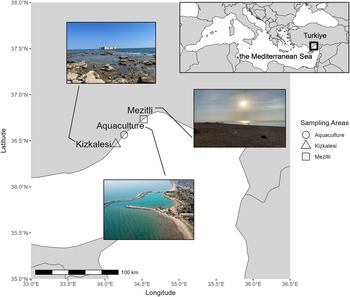
The aquaculture system (AS) was established at the Institute of Marine Sciences (IMS), Middle East Technical University (METU), located on the Turkish Mediterranean coast (Figure 2). Seawater is supplied to the system via a submersible pump from the IMS-METU harbour and initially stored in a 1000 L lightproof tank. It is then sequentially filtered through mechanical filters with pore sizes of 100, 50, 20, 10, and 1 µm into a secondary 500 L lightproof tank before being transferred to plastic cultivation tanks (Supplementary File Figure N1). Before each use, salinity and temperature are measured, and if there is a significant deviation from the conditions at the time of organism collection, manual adjustments are made. The aquaculture room is thermally insulated and maintained at a stable temperature of approximately 26°C year-round using an air conditioner, with a 12-hour light/12-hour dark photoperiod cycle. Colonies are cultivated in aerated plastic tanks, and feeding is performed every two days using approximately 1 mL of a plankton food mixture per litre of water. The colonies used in this study were collected from the Mezitli and Kızkalesi regions, located 30 and 15 km, respectively, from IMS-METU (Figure 2).
IMS-METU aquaculture system and sampling sites in the Northeast Mediterranean coast.

To evaluate the environmental similarity between the (AS) and the natural habitat (NH), physicochemical parameters and bacterial composition of seawater were assessed. Seawater samples were collected from NH and multiple points of AS in June and December 2022 to measure temperature, salinity, nutrient levels, chlorophyll-a, and particulate organic carbon. Additionally, bacterial communities in AS and NH were compared using 16S rRNA gene sequencing of seawater samples collected in December 2022, when colonial ascidian diversity in the NH was highest. Detailed methods and the results are available in the Supplementary File SECTION II.
Blastogenic cycle and WBR staging
The collected colonies were acclimatized to the system and subcloned (i.e., physically divided into smaller, genetically identical fragments) following Karahan et al. (Reference Karahan, Öztürk, Temiz, Blanchoud, Blanchoud and Galliot2022). The subclones were then observed daily under 26ºC and 38 PSU to monitor both the blastogenic cycle and WBR.
The blastogenic cycle was staged according to criteria established for B. schlosseri by Manni et al. (Reference Manni, Gasparini, Hotta, Ishizuka, Ricci, Tiozzo, Voskoboynik and Dauga2014). However, due to the relatively rapid cycle in both species, the stages were designated as A, B, C, and D, following the simplified system of Mukai and Watanabe, (Reference Mukai and Watanabe1976) described in the introduction. WBR was initiated when colonies reached blastogenic stage A, as described for Botrylloides leachii by Zondag et al. (Reference Zondag, Rutherford, Gemmell and Wilson2016) and for B. humilis (=B. anceps) by Karahan et al. (Reference Karahan, Öztürk, Temiz, Blanchoud, Blanchoud and Galliot2022). Colonies were monitored daily after ablation until the first filter-feeding zooid formed. Representative images and data for blastogenic cycle through palleal budding and WBR are provided in the Supplementary File Figures S1–S4 and Tables S1–S3 for each species.
Experimental design
The temperature and salinity levels used in the experimental set-up were selected to reflect the seasonal ranges observed at Mediterranean sampling sites where large and healthy colonies were found (26–31.1°C and 37.5–40 PSU), as well as the conditions under which colonies showed successful survival and maintenance in the laboratory (26–32°C and 35–40.5 PSU). Prior to the main experiment, an initial preliminary experiment was conducted using a range of salinity levels (35.5–38.6 PSU) and temperatures (27–32°C), with three subclones per condition (resulting in 18 combinations in total), to assess species preferences (Supplementary File Tables S4 and S5).
Based on the results of the preliminary experiment, the main experimental set-up was then designed with two salinity levels (36.5 and 39.5 PSU; S36 and S40 in the experimental group, respectively) and three temperature conditions (26 ± 1°C, 28 ± 1°C, and 30 ± 1°C; T26, T28, and T30 in the experimental group, respectively), resulting in six distinct treatment combinations (Table 1). We did not designate any specific group as a control in our experimental design, as we assumed the organism’s adaptation capacity to environmental conditions exists along a spectrum, and no ‘optimum’ condition had been previously established for this species. Temperature was adjusted with 25-watt thermostats for each experimental subgroup. Filtered seawater had a natural salinity of ∼38 PSU (September–December 2023), and the high salinity subgroup was adjusted to 39.5 PSU by adding commercial reef salt, while the low salinity subgroup was adjusted to 36.5 PSU by adding double-distilled, UV-treated water. There was no significant difference in pH values before and after salinity manipulation (pH ∼ 8.1).
Experimental conditions and group codes. Temperature for each subgroup fluctuated during the experiment, and a minimum–maximum observed value was given as interval. Experiment groups codes: S: salinity, T: temperature

For the main experiment, 10–12 subclones of the same colony that were approximately the same size were selected for each of the six experimental conditions for both species. All the colonies were stabilized under the same conditions (26 ºC, 38 PSU) before the start of the blastogenic cycle and WBR experiments. For the blastogenic cycle, after the first observation (day 0), the colonies were placed in their respective experimental conditions while keeping other conditions stable and observed daily for 11 days. For the blastogenic cycle, the growth rate was calculated by dividing the final zooid numbers by the initial zooid numbers of each colony. For the WBR, all the generations were removed from colonies, as explained in Zondag et al. (Reference Zondag, Rutherford, Gemmell and Wilson2016) at blastogenic stage A, then placed in their respective experimental conditions without feeding. Once a colony died (when haemolymph circulation ceased) or completed WBR by producing filter-feeding zooids, it was removed from the experiment to avoid any potential interference, such as changes in the water quality or biological processes, which could affect the remaining colonies. Daily observations on each group were conducted via a stereo microscope (SX16 Olympus stereo microscope equipped with an Olympus DP26 camera).
To evaluate the individual effects of temperature and salinity on colony growth and regeneration in B. niger, as well as the interaction between these two factors, a two-way analysis of variance (ANOVA) was performed. This statistical test allowed us to assess whether each factor significantly influenced the biological responses and whether their interaction had a combined effect. To further explore how changes in one environmental variable affected colony growth and regeneration under fixed conditions of the other, multiple comparisons were carried out using Tukey’s Honestly Significant Difference (HSD) post-hoc test using two-way ANOVA results. In this approach, one factor (either temperature or salinity) was held constant at a specific level, while the other was varied, allowing us to identify statistically significant differences among subgroups with different temperature or salinity levels. These comparisons helped clarify which specific conditions drove the observed variation in growth and regeneration responses. Neither two-way ANOVA nor Tukey’s HSD post-hoc test was applied to the B. humilis experimental data, as the numerical results did not consistently correspond to the same biological process across experimental groups.
Results
Blastogenic cycle and WBR response to salinity and temperature
Botrylloides niger
B. niger colonies were monitored to assess the increase in zooid numbers during the blastogenic cycle under all experimental conditions. No colony exhibited regression or abnormalities in the blastogenic cycle relative to the palleal budding stages determined prior to the experiment (Supplementary File Figure S1 and Table S1). For daily blastogenic staging observations and initial and final zooid counts, see Supplementary Dataset A. Among the six experimental groups, the highest growth rate was recorded in the S40-T28 group (mean = 5.6), followed by S40-T26 (mean = 5). The lowest growth rate was observed in the S40-T30 group (mean = 2.2) (Figure 3 and Supplementary File Figure S5). Two-way ANOVA revealed a statistically significant result pointing an effect of temperature on growth rate (P = 0.0068), while neither salinity nor the interaction between temperature and salinity showed statistically significant effects (P > 0.05). To further investigate the independent effects of each factor, multiple comparison completed across subgroups using Tukey’s HSD post-hoc test. The results revealed that the effect of temperature on the growth rate was dependent on salinity levels. Specifically, within the 39.5 PSU group, temperature had a significant impact: the growth rate at 30 ± 1°C was significantly lower from both 26 ± 1 °C (diff = −2.9, P-adj = 0.035) and 28 ± 1°C (diff = −3.4, P-adj = 0.007) (Table 2). In contrast, no statistically significant differences were detected among temperature treatments within the 36.5 PSU group (P-adj > 0.05 for all comparisons, Table 2), suggesting that colonies may be more sensitive to temperature changes under high salinity conditions during the blastogenic cycle. At 39.5 PSU, there is no significant difference on growth rate between 26 ± 1°C and 28 ± 1°C temperature treatments.
Summary of colony response under different experimental conditions, provided along with mean values of growth (final zooid numbers-fzn/initial zooid numbers-izn) and mean days of whole-body regeneration (WBR) duration. Upward arrows indicate growth (increase in zooid numbers) by palleal budding (blastogenic cycle) downward arrows indicates regression (decrease in zooid numbers). Zooids indicate completion of WBR with creation of filter feeding zooids, cross indicates unsuccessful at WBR completion and death. Red: Highest value for growth and fastest WBR completion. Yellow: Intermediate value. Green: Lowest value for growth and slowest WBR completion. Purple arrow: Maximum value for regression by vascular budding. Blue arrow: Intermediate value for regression.

Multiple comparisons of group mean using Tukey’s Honest Significant Difference (HSD) post-hoc test following two-way ANOVA, separately for growth rate and whole-body regeneration (WBR) duration under different salinity and temperature conditions. The table shows the estimated differences (diff) between group means, and the adjusted P-values (P-adj) accounting for multiple comparisons. Only comparisons with statistical significance (P-adj < 0.05) are shown, non-significant comparisons are omitted for clarity. A negative diff indicates that the first group has a lower mean value than the second group. Results for growth rate and WBR duration were analysed independently; they are presented in the same table for convenience, not for direct comparison. Growth rate: final zooid numbers-fzn/initial zooid numbers-izn

Across all experimental conditions, B. niger colonies successfully completed WBR, with slight variation in regeneration duration and no substantial difference in the number of newly formed zooids (Supplementary File Figure S3 and Table S3). The shortest regeneration duration was recorded in S36-T28, S36-T30, and S40-T30 (minimum = 4 days; means = 5.2, 4.6, and 4.6 days, respectively), while the slowest regeneration occurred in S40-T26 (maximum = 9 days; mean = 8.2 days), excluding outliers (Supplementary File Figure S5). Two-way ANOVA indicated that both temperature and salinity effect is significant on regeneration with different P values (P < 0.001 and P = 0.0256 respectively), but no significant interaction between the two (P > 0.05), indicating independent contributions of each factor. Temperature-driven differences in regeneration duration were statistically significant at both 36.5 and 39.5 PSU (Table 2). At 36.5 PSU, regeneration was significantly faster at 28 ± 1°C (diff = −2.4 days, P-adj = 0.002) and 30 ± 1°C (diff = −3 days, P-adj < 0.001) compared to 26 ± 1°C, while no difference was detected between 28 ± 1°C and 30 ± 1°C (Table 2). Similarly, at 39.5 PSU, 30 ± 1°C significantly accelerated regeneration relative to both 26 ± 1°C (diff = −3.6 days, P-adj < 0.001) and 28 ± 1°C (diff = −2.4 days, P-adj = 0.002), but the latter two did not differ significantly (Table 2). These results indicate that temperature is a key driver of regeneration speed, with acceleration becoming evident from 28°C and peaking at 30°C under both salinity conditions.
When comparing salinity levels at fixed temperatures, a significant difference was only detected at 28 ± 1°C, where regeneration was slower under 39.5 PSU compared to 36.5 PSU (difference = 1.8 days, P = 0.040). No significant differences were found between salinity conditions at 26 ± 1°C and 30 ± 1°C (Table 2). This result indicates that the response to salinity is most pronounced at 28 ± 1°C during the WBR, and 36.5 PSU salinity is more favourable for regenerating colonies comparing to 39.5 PSU.
Botryllus humilis
B. humilis showed various responses to salinity and temperature changes along the blastogenic cycle and the WBR. The highest growth rates are observed in the S36-T26 (mean = 3.57) group followed by S36-T28 (mean = 3.39) and S40-T26 (mean = 2.85) (Figure 3). Regression (decrease in zooid numbers) was observed in three of the six experimental group, with the lowest growth rate observed at S36-T30 (mean = 0.28) followed by S40-T30 (mean = 0.35) and S40-T28 (mean = 0.98). Daily observations on experimental colonies and their zooid number information can be found in the Supplementary Dataset B. Two of the regressed groups, S36-T30 and S40-T30, exhibited disrupted colony synchrony starting from the first day in the experimental environment, compared to the palleal budding stages observed prior to the experiment (Supplementary File Figure S2 and Table S2). The ampullae appeared thickened, and the overall morphology of the colony did not resemble any of the blastogenic stages described in the Supplementary File Figure S2. No palleal buds developing on zooids were detected throughout the entire observation period, and thus blastogenic staging based on palleal budding could not be performed. Despite the absence of clear palleal buds, filter-feeding, regressing, and developing zooid structures were observed within the same colonies (Figure 4A), suggesting that new zooids continued to emerge during the experiment. These zooids were scattered across the colony among the ampullae, lacked any apparent budding structures, and were not arranged in a clear system-like pattern. They also regressed asynchronously (Figure 4A). Furthermore, the number of filtering zooids did not follow a consistent increase or decrease over time. However, by day 12, the total number of zooids in both groups showed an overall decline compared to the initial count at day 0 (Supplementary File Figure S5). This combination of disrupted colonial synchrony, lack of detectable palleal budding, and continued emergence of new zooids led us to interpret this process as indicative of vascular budding. Overall, according to our study B. humilis colonies prefer low salinity over high salinity for growth, and they prefer vascular budding in high temperatures (30 ± 1°C) for asexual reproduction (Supplementary File Figure S5).
(A) Representative image of a B. Humilis colony maintained at high temperature (30 ± 1°C), showing asynchronous formation and regression of zooids under both salinity conditions (36.5 and 39.5 PSU). Functional zooids (yellow arrows), regressing zooids (black arrows), and newly forming zooids (blue arrows), which lack clear palleal bud appearance, are irregularly dispersed among the ampullae. (B–F) Whole-body regeneration (WBR) colony shrinkage process after seventh day for B. Humilis colonies under 39.5 PSU salinity and 30 ± 1°C temperature (S40_T30). Scale bar = 500 µm.

Four of the experimental groups of WBR colonies successfully completed their regeneration by creating filter-feeding zooids with no substantial difference in the number of zooids created (Supplementary File Figure S5 and Table S3). All the colonies within the group S36_T30 died immediately after reaching stage 4 (mean = 13 days). On the other hand, 2 out of 11 subclones under group S40_T30 completed their WBR within 5 and 11 days respectively. The remaining 9 colonies reached stage 4 and stayed there with continuous blood circulation. The colonies’ remaining ampullae shrunk to disappearance and the colonies died within 21 days (Figures 4B–F). No substantial difference was observed between the groups in terms of the duration required to complete WBR, although the fastest WBR completion was observed in the S40_T28 group (mean = 6.2 days) (Supplementary File Figure S5 and Figure 2).
Discussion
Biological response
Botrylloides niger
According to the literature, there is no experimental information on the temperature preferences and responses of B. niger to changes in temperature, and very limited information on its responses to changes in salinity. In a study conducted in Panama, five B. niger colonies were experimentally exposed to five different salinity levels ranging from 20 to 35 PSU. Colonies exposed to lower salinities (20 and 24 PSU) underwent fewer asexual phases, and all colonies at 20 PSU died by the third day (Dijkstra and Simkanin, Reference Dijkstra and Simkanin2016). In the present study, we exposed 10 B. niger colonies to a total of 6 different temperature-salinity conditions and observed them during both the blastogenic cycle and WBR. According to our results, B. niger colonies thrive best at 28 ± 1°C with highest growth rate observation and, to a slightly lesser extent, at 26 ± 1°C, when salinity is 39.5 PSU. These results are consistent with the seasonal changes of Mediterranean coastal water and on-site observations. From December to April (average daily temperature of 2019 = 17.72°C), due to high precipitation (average daily precipitation 2019 = 4.95 kg/m2) salinity decreases as well. However, May to November data fits with our experimental results and on-site observations. During this season, we observe bigger B. niger colonies in the area, the seawater temperature rises (average daily temperature of 2019 = 26.74°C) and due to evaporation and low precipitation (average daily precipitation of 2019 = 0.34 kg/m2), salinity also increases (between 38 and 41 PSU, IMS Data). When the temperature is mild in April to December due to rainfall (ends in April and starts in December), the chance of finding B. niger colonies in the field (coastal areas) decreases (pers. observ.). This indicates that the re-recruitment of the B. niger on the site is dependent on the salinity increase. The salinity dependency was also confirmed by a statistically significant response to temperature changes at 39.5 PSU. In parallel, high salinity (39.5 PSU) is more favourable than low salinity (36.5 PSU) for B. niger during asexual reproduction due to higher growth rates. The experimental study of Dijkstra and Simkanin (Reference Dijkstra and Simkanin2016) shows that high salinity is also favourable for local B. niger colonies within the local annual range (Bocas del Toro, Panama).
Under high salinity conditions (39.5 PSU), the colony growth rate was higher than at 36.5 PSU and showed stronger response to temperature changes. Colonies grew better at moderate temperatures (26 ± 1°C and 28 ± 1°C), while growth decreased at 30 ± 1°C. On the other hand, regeneration was faster at higher temperatures in both salinity levels. Especially at 28 ± 1°C, regeneration was significantly quicker under low salinity (36.5 PSU) than under high salinity. These results suggest that different biological processes in B. niger react differently when two stress factors are combined where WBR initiation is accepted as a stress factor. As described by Fredersdorf et al. (Reference Fredersdorf, Müller, Becker, Wiencke and Bischof2009), organisms become more sensitive to additional stress when the general condition is already not ideal. This was also observed in regenerating colonies, which were more affected by temperature than colonies growing asexually. According to the salinity experiment conducted on B. niger and Botryllus planus (Van Name, 1902), an immediate response was observed in the neural gland (Dijkstra and Simkanin, Reference Dijkstra and Simkanin2016). Studies conducted on ascidian species suggest that the neural gland act as an osmoregulatory organ (Deyts et al., Reference Deyts, Casañe, Vernier, Bourrat and Joly2006; Ruppert, Reference Ruppert1990). In the present study, regenerating colonies, which lack zooids and neural glands, may be unable to perceive changes in salinity and, therefore, may not adjust their responses accordingly. This could explain why the optimal salinity appears to shift from 39.5 PSU during asexual reproduction to 36.5 PSU during regeneration.
Botryllus humilis
While Karahan et al. (Reference Karahan, Temiz, Öztürk, Douek and Rinkevich2023) provided habitat features such as sampling temperature and salinity records, no additional ecological information has been provided to date. The present study is the first to report the effects of salinity and temperature on colony growth. According to our results, the B. humilis colonies prefer low salinity over high salinity in contrast with B. niger, while choosing vascular budding under high temperatures (30 ± 1°C) (Figures 3 and 4A). Vascular budding occurs in botryllid ascidians either simultaneously with palleal budding with induced partial regeneration (Oka and Watanabe, Reference Oka and Watanabe1957; Okuyama and Saito, Reference Okuyama and Saito2001), or independently of palleal budding when the colony emerges from hibernation or WBR (Burighel et al., Reference Burighel, Brunetti and Zaniolo1976). Rinkevich et al. (Reference Rinkevich, Shlemberg and Fishelson1995) reported that vascular budding represents a response of regeneration following damage, which also carries an ecological advantage. Voskoboynik et al. (Reference Voskoboynik, Simon-Blecher, Soen, Rinkevich, De, Ishizuka and Weissman2007) reported that vascular budding in B. schlosseri is only induced by the removal of zooids and buds at a specific blastogenic stage, suggesting that the process of reproduction through vascular budding is a feasible but less preferable pathway. Considering this information, this is the first study to observe vascular budding without the removal of zooids and buds. This may indicate that the high temperature harms zooids and buds therefore initiate an indirect regeneration process via vascular budding as a survival response. The zooids and buds are reported as the source of necessary energy and nutritive material for vascular budding (Manni et al., Reference Manni, Zaniolo, Cima, Burighel and Ballarin2007; Sabbadin, Reference Sabbadin1956, Reference Sabbadin1958). According to our study, colonies from which zooids and buds were removed (i.e., colonies induced to undergo WBR) were unable to complete WBR under high-temperature conditions, unlike those in low-temperature groups. It seems that the colonies could not compensate for the energy lost by zooids and buds for vascular budding under additional stress.
Niche occupation and adaptation
When we compare the two species, B. humilis prefers lower salinity and B. niger prefers higher salinity. These observations complement the seasonal variations in the Mediterranean’s coastal waters for B. niger. Although the origin of B. niger is thought to be the Atlantic Ocean (Sheets et al., Reference Sheets, Cohen, Ruiz and Da Rocha2016), Temiz et al. (Reference Temiz, Öztürk, Blanchoud and Karahan2023) questioned this assumption based on the high morphological diversity in the Mediterranean. Besides, Sheets et al. (Reference Sheets, Cohen, Ruiz and Da Rocha2016) suggested that the widespread and environmentally diverse distribution of B. niger indicates a high tolerance to varying conditions. It is possible that the morphological diversity observed in Mediterranean populations reflects phenotypic plasticity associated with high environmental tolerance. The first record of B. humilis along the Turkish coast of the Mediterranean dates to 2018, based on regular observations extending back to 2012, indicating its relatively recent arrival in the area (Karahan et al., Reference Karahan, Temiz, Öztürk, Douek and Rinkevich2023). This is in line with the suggestion of the origin of B. humilis as the Indo Pacific by Brunetti (Reference Brunetti2009 [=B. anceps]), suggesting a recent east-to-west expansion across the Mediterranean. The divergent responses of the two species to temperature and salinity may reflect their ecological niches in natural environments. B. humilis employs a vascular budding response, while B. niger employs hibernation (Temiz et al., Reference Temiz, Öztürk, Blanchoud and Karahan2023), which may help species to survive in more severe conditions that we did not cover in this study. These distinct responses signify niche differentiation, suggesting both species can coexist without intense competition, a notion supported by our site observation that both species’ colonies co-exist on the same rock (Supplementary File Figure S6). Although there are no current records of these two species being invasive or forming fouling communities along the Turkish coasts (Karahan et al., Reference Karahan, Temiz, Öztürk, Douek and Rinkevich2023; Temiz et al., Reference Temiz, Öztürk, Blanchoud and Karahan2023), their potential impacts on native species should be monitored through regular observations. In particular, the high tolerance of B. niger and its dominance in fouling communities in other regions (Nydam et al., Reference Nydam, Lemmon, Cherry, Kortyna, Clancy, Hernandez and Cohen2021; Ramalhosa et al., Reference Ramalhosa, Gestoso, Rocha, Lambert and Canning-Clode2021; Sheets et al., Reference Sheets, Cohen, Ruiz and Da Rocha2016) highlight the need for close attention to this species.
This is the first experimental study on species B. niger and B. humilis in which the effects of two conditions are observed. The study provides significant insights into the niche occupation and ecological success of both species by analysing their physiological responses during blastogenic cycle and WBR to salinity and temperature variations. The observed growth rates and regeneration under different conditions reveal that B. niger preferences towards high salinity and moderate temperatures, while B. humilis prefers low salinity and displays vascular budding under high temperatures. Notably, our study is the first to document vascular budding in B. humilis without the removal of zooids and buds, highlighting a novel aspect of its biology. Our low-budget seawater filtration system effectively maintained viable ascidian colonies, demonstrating its feasibility for aquaculture. These findings advance our understanding of the biology and adaptability of ascidians to environmental changes, providing valuable information for their management in marine ecosystems.
Supplementary material
The supplementary material for this article can be found at https://doi.org/10.1017/S0025315425100611.
Acknowledgements
The authors are grateful to Esra Öztürk and Begüm Ece Tohumcu for their help during sampling; Hurşit Kip, Mehmet Solmaz, and Öcal Işık for their technical assistance during aquaculture settlement; and Bilge Yüceer Karakuş (https://www.instagram.com/fungiandsnail) for the artwork used in Figure 1.
Author contributions
F.N.O.Ü. contributed to conceptualization, methodology, investigation, visualization, funding acquisition, and writing (original draft). M.K.Ü contributed to conceptualization and methodology. A.K. contributed to conceptualization, supervision, funding acquisition, and writing (review and editing).
Financial support
This research was supported by the Middle East Technical University BAP projects (HDESP-701-2021-10817, TEZ-D-701-2021-10653, and ADEP-701-2023-11278). The aquaculture facility was constructed by the DEKOSIM (BAP-08-11-DPT2012K120880) project. Funding sources are not involved in study design; in the collection, analysis, and interpretation of data; and in the decision to submit the article for publication.
Conflict of interest
The authors declare that they have no known competing financial interests or personal relationships that could have appeared to influence the work reported in this paper.
Data accessibility statement
The authors confirm that the data supporting the findings of this study are available within the article and its supplementary materials.



 Open access

