



Consumers globally are exposed to an abundance of energy-dense, nutrient-poor foods and beverages, which can be referred to as ‘discretionary foods’ or ‘discretionary choices’( Reference Aktas Arnas 1 – 5 ). Examples of such foods are sugar-sweetened beverages, processed meats, fried foods, pastries and cakes. The Australian Dietary Guidelines recommend limiting the intake of (discretionary) foods containing saturated fat, added sugar, salt and alcohol that are not required as part of a dietary pattern that promotes health and well-being( 5 ).
Overconsumption of discretionary choices is associated with increased risk of obesity, CVD, type 2 diabetes, some cancers and dental caries( 5 ). The risk of these chronic conditions and related dietary patterns begin in childhood and track into adult life( 5 , Reference Wang and Lobstein 6 ). This is of particular concern given the sizeable chronic disease burden and high rates of obesity across the lifespan( 7 ). Overconsumption of discretionary choices can also displace core foods (fruit, vegetables, dairy, lean meats, whole grains) from the diet, further increasing the risk of nutrient deficiencies, obesity and chronic disease( 8 , 9 ).
National intake data across the Western world show that the majority of children are not meeting the recommended intakes of core foods and are overconsuming discretionary choices( Reference Krebs-Smith, Guenther and Subar 10 – 13 ). According to US data, 99·9 % of 4–8-year-old children are consuming above the maximum recommended energy allowance from discretionary choices( Reference Krebs-Smith, Guenther and Subar 10 ). This statistic aligns with Australian data, which show that consumption of discretionary choices currently contributes about 36 % of children’s energy intake, with intakes increasing with age from 30·2 % in 2–3-year-olds to 37·5 % in 4–8-year-olds( 11 , 12 ). Early childhood is an opportune time to intervene to moderate intake of discretionary choices and potentially increase core foods to establish healthier dietary patterns.
Individual and environmental factors influence food provision to, and the dietary intake of, young children (Table 1)( Reference Crockett and Sims 14 , Reference Swinburn, Egger and Raza 15 ). A key environmental change across the ages of 4–8 years is the transition from home or child care to formal education settings (pre-school, junior primary school)( Reference Hirst, Jervis and Visagie 16 ). While starting school widens children’s environmental influences( Reference Swinburn, Egger and Raza 15 , Reference Hirst, Jervis and Visagie 16 ), children still rely predominantly on their caregivers for food provision and the home setting remains an important environment influencing food intake. Creating supportive eating environments to minimise children’s intake of discretionary choices, in all settings where children spend their time, will enhance the impact and sustainability of nutrition promotion and obesity prevention efforts.
Environmental influences on children’s dietary intake according to the ANGELO frameworkFootnote *

ANGELO, ANalysis Grid for Environments Linked to Obesity.
* Adapted from Swinburn et al.( Reference Swinburn, Egger and Raza 15 ).
Discretionary choices have received little direct attention in the paediatric nutrition literature. To date, the literature has instead focused on general healthy eating interventions for obesity prevention and management( Reference Birch and Ventura 17 – Reference Waters, de Silva-Sanigorski and Burford 19 ) or nutrition promotion interventions targeting fruit and vegetable intake( Reference Evans, Christian and Cleghorn 20 ). Children’s exposure to food marketing is one area where there is some evidence of an association with discretionary choices intake( Reference Cairns, Angus and Hastings 21 ); however, more research is needed to understand the factors that influence children’s intakes of these nutritionally poor foods and identify other targets for intervention.
The present review aims to identify and map the range of environmental predictors that influence children’s intake of discretionary choices. The review focuses on observational and intervention studies targeting children aged 4–8 years or their caregivers, with a clear emphasis on discretionary choices, measuring children’s intakes of these foods directly or via proxy. The review objectives are:
-
1. To identify and map the current literature on predictors of 4–8-year-old children’s intake of discretionary choices using an ecological framework.
-
2. To provide recommendations for the ‘next steps’ of future research by highlighting gaps in the current body of evidence.
Methods
A systematic review process( Reference Higgins and Green 22 ) was implemented to identify original published studies meeting the inclusion criteria listed below. Studies were then critiqued and synthesised to answer the review objectives. No publication date limit was set to access all literature published in English meeting the review inclusion criteria.
Inclusion and exclusion criteria
Population
The population under review was healthy children, with an age range or mean age between 4·0 and 7·9 years, or their parents/other caregivers (e.g. grandparents, educators). Clinical samples were excluded (e.g. anaemia, cystic fibrosis, diabetes).
Predictors (intervention or comparator)
All correlates modifiable in a nutrition promotion context were included (e.g. child feeding practices, hours of television use). Descriptive studies or studies focusing on non-modifiable correlates (e.g. age, ethnicity) were excluded. Studies that focused on overweight/obesity management were excluded as the focus of the review was on broader public health diet quality and obesity prevention.
Outcome measures
Primary outcomes were children’s intakes (or proxy) of discretionary foods or beverages, or related components (i.e. energy, saturated fat, sugar or sodium). Proxy measures included availability (e.g. food access, parent intake), provision (e.g. parenting control), preferences (e.g. child requests), behaviour (e.g. meal pattern, child feeding practices) and purchasing (e.g. receipts).
Secondary outcomes included knowledge/attitudes/beliefs of the child or carer. Studies with a secondary outcome were included only if they also contained at least one primary outcome measure.
Study design and type
To capture the breadth of work on discretionary choices, observational and intervention studies conducted in any of the settings outlined in Table 1 were included. Non-human (e.g. animal model, laboratory), methodological (e.g. food record tool, protocol only) and non-primary studies (e.g. review papers, commentary) were excluded.
Search strategy and selection process
Search terms were combined under the following headings:
-
1. Population (e.g. child* or preschool), and
-
2. Intervention (e.g. ‘nutrition education’ or ‘behaviour change’ or ‘dietary intake’ or ‘eating pattern*’), and
-
3. Outcomes (e.g. ‘energy-dense’ or ‘non-core food’ or ‘high calories’ or ‘sugar-sweetened beverages’ or ‘fast food’ or ‘saturated fat’ or ‘added sugar’ or ‘salt’ or ‘energy intake’).
-
4. Limits applied: English.
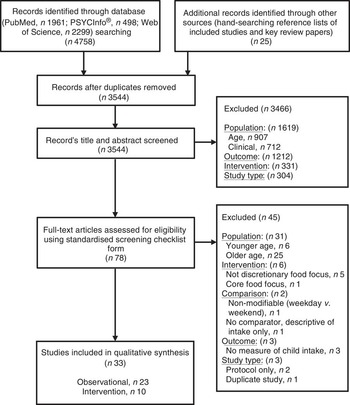
Terms were trialled in PubMed. PubMed, PsycINFO® and Web of Science were systematically searched in February (PubMed, PsycINFO®) and March (Web of Science) 2014, and citations identified from other sources (Fig. 1). Title, abstract and full-text screening was completed by two reviewers; in cases of uncertainty, a third reviewer was consulted and consensus reached.
PRISMA Statement flow diagram indicating number of studies included at each phase of the review (PRISMA, Preferred Reporting Items for Systematic Reviews and Meta-Analyses)
Data extraction
Data extracted included: study details (identification, site, setting, study design, study duration, participants), discretionary choices targeted, exposure/intervention strategies, environmental influences, outcome assessment method, key results and quality assessment tool score. To ensure consistency of data extracted, 10 % of studies were rechecked by the single reviewer. Due to the heterogeneity in the design, exposures/strategies and outcomes of included studies, a meta-analysis was not undertaken. Statistical significance (of P<0·05) was used to guide the review narrative. Results are presented in a narrative summary, with overall direction and confidence of the association of the study findings summarised using the following symbols: significant negative association, −−; non-significant negative association, −; null association, 0; non-significant positive association, +; significant positive association, ++; inconsistent associations, ~ (Tables 3 and 4). Non-significant findings were highlighted to examine whether consistent effect sizes (direction) were present across studies and to consider where an increase in sample size or better study design may have achieved statistical significance.
Study quality
A single reviewer assessed study quality using the standardised Effective Public Health Practice Project (EPHPP) Quality Assessment Tool( Reference Thomas, Ciliska and Dobbins 23 ). The tool scores study quality (strong, moderate, weak) across six areas: selection bias, study design, confounders, blinding, data collection methods, withdrawals and drop-outs( Reference Thomas, Ciliska and Dobbins 23 ). An overall quality rating is assigned: strong (four strong ratings and no weak ratings), moderate (less than four strong ratings and one weak rating) or weak (two or more weak ratings)( Reference Thomas, Ciliska and Dobbins 23 ). In an assessment of 213 quality assessment tools, this tool was identified as useful for systematic reviews that evaluate randomised and non-randomised intervention studies( Reference Deeks, Dinnes and D’Amico 24 ). To enable comparison of study quality across study design, the tool was adapted to allow for use with observational studies, as well as interventions. Adaptations to the tool included description of covariates rather than difference between groups prior to interventions, and adjustments for cross-sectional design with no drop-outs and one data collection time point.
Mapping of environmental influence
Observational study correlates were termed ‘exposures’ and intervention strategies were termed ‘strategies’. Study exposures/strategies were mapped using the ANalysis Grid for Environments Linked to Obesity (ANGELO), an ecological framework that identifies a range of environment sizes (i.e. macro and micro setting) and environment types (e.g. physical, economic, policy, socio-cultural) that likely influence children’s discretionary choices intake, and has been described elsewhere in detail( Reference Swinburn, Egger and Raza 15 ). A coding system was developed in order to systematically assign a type of exposure/strategy to one of the ANGELO framework environments. A single reviewer hand-coded exposures/strategies using Table 1; any uncertainties by the reviewer were discussed with all reviewers. Where one study included multiple exposures/strategies all relevant codes were applied. To simplify the coding process using the ANGELO framework only the primary environment type and size of the exposure/strategy were coded. For example, frequency of meals consumed away from home (termed ‘meal pattern’) was coded as a socio-cultural influence within the community. Another example is kilojoule labelling of food outlet menus, which was coded as a policy influence within the government setting.
Results
Thirty-three studies met the review criteria (Fig. 1). Over half of studies were based in the USA (n 18)( Reference Murashima, Hoerr and Hughes 2 , Reference Musher-Eizenman, Young and Laurene 3 , Reference Andaya, Arredondo and Alcaraz 25 – Reference Dickin, Hill and Dollahite 40 ) or Australia (n 6)( Reference Spurrier, Magarey and Golley 41 – Reference Zask, Adams and Brooks 46 ). Twenty-three were cross-sectional, observational studies( Reference Aktas Arnas 1 , Reference Murashima, Hoerr and Hughes 2 , Reference Andaya, Arredondo and Alcaraz 25 – Reference Wroten, O’Neil and Stuff 35 , Reference Spurrier, Magarey and Golley 41 – Reference Campbell, Hesketh and Silverii 43 , Reference Brown, Ogden and Vogele 47 – Reference Vereecken, Huybrechts and Maes 53 ) (see online supplementary material, Supplementary Table 1), with an average sample size of 563 (range 41( Reference Galst and White 31 )–2074( Reference Gubbels, Kremers and Stafleu 50 )). There were ten interventions (randomised controlled trials, n 8( Reference Musher-Eizenman, Young and Laurene 3 , Reference Tandon, Wright and Zhou 36 , Reference Birch, Johnson and Jones 38 , Reference Arcan, Hannan and Himes 39 , Reference Duncanson, Burrows and Collins 44 – Reference Zask, Adams and Brooks 46 , Reference Bevelander, Anschutz and Engels 54 ); case–control trial, n 1( Reference Stutts, Zank and Smith 37 ); cohort study, n 1( Reference Dickin, Hill and Dollahite 40 ); see online supplementary material, Supplementary Table 2), with an average sample size of 210 participants (range 29( Reference Birch, Johnson and Jones 38 )–560( Reference Zask, Adams and Brooks 46 )). No studies rated high in methodological quality. Several potential sources of bias including participant selection, study design and data collection methods were common across study design. However, intervention studies were more likely to rate highly (60 % moderate, 40 % weak) compared with observational studies (4 % moderate, 96 % weak).
Ecological mapping of studies
For each study, the exposure variables (in observational studies) or strategies (in intervention studies) were coded and mapped against the ANGELO framework (Table 2). In total fifty-five exposures/strategies were mapped, which included thirty-nine exposures from twenty-three observational studies and sixteen strategies from ten intervention studies.
Spread of current literature (observational and intervention studies) on 4–8-year-olds’ intake of discretionary choices by ANGELO framework (environment size and type)Footnote *
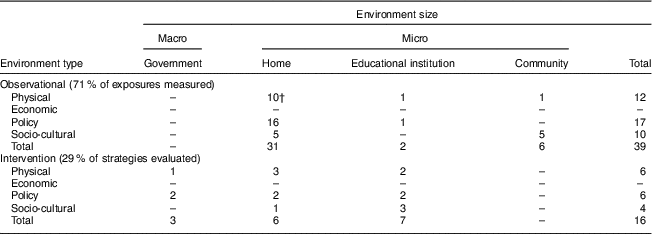
ANGELO, ANalysis Grid for Environments Linked to Obesity Framework.
* Studies may investigate multiple exposures or strategies; therefore one study may represent multiple environments.
† Number of studies including the exposure or strategy.
Studies were mapped against environmental size (i.e. macro and micro setting). There were few studies within the government setting, with only three intervention strategies( Reference Tandon, Wright and Zhou 36 – Reference Birch, Johnson and Jones 38 ) and no observational exposures evaluated in this setting. Most studies were undertaken within the home setting (thirty-seven exposures/strategies out of fifty-five), primarily in observation studies (thirty-one out of thirty-seven). The majority of research within educational institutions has been from intervention studies; seven strategies( Reference Musher-Eizenman, Young and Laurene 3 , Reference Arcan, Hannan and Himes 39 , Reference Zask, Adams and Brooks 46 , Reference Bevelander, Anschutz and Engels 54 ) were identified compared with two exposures from observational studies( Reference Vereecken, Huybrechts and Maes 53 ). A total of six exposures have been examined within the community setting, all from observational research( Reference Erinosho, Dixon and Young 26 , Reference Lopez, Ayala and Corder 27 , Reference Ayala, Rogers and Arredondo 29 , Reference Spurrier, Magarey and Golley 41 , Reference Buck, Bornhorst and Pohlabeln 48 , Reference Kerr, McCrorie and Rennie 51 ).
Studies were also mapped by environment type (i.e. physical, economic, policy, socio-cultural) by study design. Within observational studies, policy-type exposures were most common (seventeen out of thirty-nine), followed by physical (twelve out of thirty-nine) and socio-cultural (ten out of thirty-nine). No economic-type exposures were included in any observational studies. Within interventions, physical (six out of sixteen) and policy-type (six out of sixteen) strategies were most common. Again, economic strategies were not included in any interventions targeting children’s discretionary choices intake.
Ecological view: summary of the relationships in observational studies
Table 3 summarises the results of observational studies by environmental size and type. Six observational studies were conducted within the community setting, five focused on discretionary choices as a whole and one on sugar-sweetened beverages only. Five observational studies focused on meal patterns (socio-cultural influence), of which three reported a significant positive relationship with discretionary choices intake( Reference Lopez, Ayala and Corder 27 , Reference Ayala, Rogers and Arredondo 29 , Reference Spurrier, Magarey and Golley 41 ). That is, higher frequency of meals or snacks consumed out of the home (e.g. fast food, restaurant, home of friends/relatives) was significantly associated with higher intake of discretionary choices( Reference Lopez, Ayala and Corder 27 , Reference Ayala, Rogers and Arredondo 29 , Reference Spurrier, Magarey and Golley 41 ). One community-based observational study focused on food availability (physical influence) and reported no relationship between availability of discretionary choices within the community and children’s intake( Reference Buck, Bornhorst and Pohlabeln 48 ).
Summary of observational studies targeting 4–8-year-olds’ intake of discretionary choices

ANGELO, ANalysis Grid for Environments Linked to Obesity; DC, discretionary choices; TV, television; SSB, sugar-sweetened beverages.
* Study methodology quality is assessed using the Effective Public Health Practice Project Quality Assessment Tool, with an overall quality rating assigned as: strong (four strong ratings and no weak ratings), moderate (less than four strong ratings and one weak rating) or weak (two or more weak ratings)( Reference Thomas, Ciliska and Dobbins 23 ).
† Direction and confidence of the association are summarised using the following symbols: significant negative association, −−; non-significant negative association, − null association, 0; non-significant positive association, +; significant positive association, ++; inconsistent association, ~.
‡ The study covered multiple environmental sizes.
§ Includes more than three discretionary food choices.
|| Includes soft drinks, energy drinks, fruit juice and other flavoured drinks.
¶ Includes salty and high-fat snacks, potato chips and other savoury/packaged snacks.
** Includes confectionery, cakes, biscuits and other sweet snacks.
There was one observational study within the educational setting, which reported that greater food availability (physical influence) was significantly associated with higher intake of discretionary choices( Reference Vereecken, Huybrechts and Maes 53 ). The study also reported that the absence of a nutrition policy was associated with higher intake of discretionary choices, although the result did not reach statistical significance( Reference Vereecken, Huybrechts and Maes 53 ).
Nineteen observational studies measured exposures within the home setting, fourteen of which focused on discretionary foods as a whole, with two targeting snacks, two with a nutrient focus and one focusing only on sugar-sweetened beverages. Within the home setting, sixteen studies examined policy-type exposures, primarily relating to child feeding practices. Four studies found that higher level of parental control (pressure) was related to higher children’s intake of discretionary choices( Reference Aguirre, Hudson and Weber 28 , Reference Arredondo, Elder and Ayala 30 , Reference Campbell, Crawford and Ball 42 , Reference Brown, Ogden and Vogele 47 ). In all four of these studies, more than three discretionary choices were measured. Some studies also noted that higher parental monitoring, a desired feeding practice, was associated with lower intake of discretionary choices( Reference Murashima, Hoerr and Hughes 2 , Reference Lopez, Ayala and Corder 27 , Reference Aguirre, Hudson and Weber 28 , Reference Arredondo, Elder and Ayala 30 , Reference Brown, Ogden and Vogele 47 , Reference Ogden, Reynolds and Smith 52 ). Other policy-type studies in the home focused on television regulation targeting various discretionary choices( Reference Aktas Arnas 1 , Reference Andaya, Arredondo and Alcaraz 25 , Reference Lopez, Ayala and Corder 27 , Reference Galst and White 31 , Reference Isler, Popper and Ward 32 , Reference Taras, Sallis and Patterson 34 ). Of these studies, four out of six found higher discretionary choices intake was significantly associated with higher television use( Reference Lopez, Ayala and Corder 27 , Reference Galst and White 31 , Reference Isler, Popper and Ward 32 , Reference Taras, Sallis and Patterson 34 ). Television access (physical influence) was also observed in the home in nine studies, with six targeting a range of discretionary choices. Higher access to television within the home was associated with significantly higher intake of discretionary choices in five of the studies( Reference Lopez, Ayala and Corder 27 , Reference Galst and White 31 , Reference Isler, Popper and Ward 32 , Reference Taras, Sallis and Patterson 34 , Reference Campbell, Crawford and Ball 42 ).
Ecological view: summary of association from intervention studies
Intervention studies were also categorised by environmental size and type (Table 4). Three interventions were conducted within the government setting; two focused on nutrition labelling, specifically fast-food menu labelling (policy influence), and targeted single discretionary food items (e.g. fast food) rather than a variety of discretionary choices( Reference Tandon, Wright and Zhou 36 – Reference Birch, Johnson and Jones 38 ). One study reported a significant, negative relationship between the policy strategy and intake; that is, the introduction of the policy was associated with a significant reduction in children’s fast-food intake( Reference Tandon, Wright and Zhou 36 ). One intervention focused on food reformulation (physical influence) and reported a negative, but non-significant, association with children’s snack food intake( Reference Birch, Johnson and Jones 38 ).
Summary of intervention studies targeting 4–8-year-olds’ intake of discretionary choices

ANGELO, ANalysis Grid for Environments Linked to Obesity; RCT, randomised controlled trial; SSB, sugar-sweetened beverages; DC, discretionary choices.
* Study methodology quality is assessed using the Effective Public Health Practice Project Quality Assessment Tool, with an overall quality rating assigned as: strong (four strong ratings and no weak ratings), moderate (less than four strong ratings and one weak rating) or weak (two or more weak ratings)( Reference Thomas, Ciliska and Dobbins 23 ).
† Direction and confidence of the association are summarised using the following symbols: significant negative association, −−; non-significant negative association, − null association, 0; non-significant positive association, +; significant positive association, ++; inconsistent association, ~.
‡ Includes confectionery, cakes, biscuits and other sweet snacks.
§ Includes salty and high-fat snacks, potato chips and other savoury/packaged snacks.
|| Includes soft drinks, energy drinks, fruit juice and other flavoured drinks.
¶ Includes more than three discretionary food choices.
Four interventions were set within educational institutions, and three targeted socio-cultural influences (e.g. teacher or parent beliefs and attitudes, influence of peers), two examined policy strategies (e.g. nutrition policy) and two included physical (e.g. food availability) strategies( Reference Musher-Eizenman, Young and Laurene 3 , Reference Arcan, Hannan and Himes 39 , Reference Zask, Adams and Brooks 46 , Reference Bevelander, Anschutz and Engels 54 ). These strategies tended to focus on a smaller number of discretionary choices, such as snack foods, sweet snacks or confectionery( Reference Musher-Eizenman, Young and Laurene 3 , Reference Arcan, Hannan and Himes 39 , Reference Bevelander, Anschutz and Engels 54 ). Two (of four) studies within educational institutions reported a significant reduction in discretionary choices intake, both included policy and socio-cultural strategies( Reference Arcan, Hannan and Himes 39 , Reference Zask, Adams and Brooks 46 ).
Three studies were conducted within the home, all included elements of addressing the physical influence of discretionary choices availability( Reference Dickin, Hill and Dollahite 40 , Reference Duncanson, Burrows and Collins 44 , Reference Fletcher, Wolfenden and Wyse 45 ). All reported favourable results towards a reduction in children’s intake of these foods( Reference Dickin, Hill and Dollahite 40 , Reference Duncanson, Burrows and Collins 44 , Reference Fletcher, Wolfenden and Wyse 45 ); however, only one study reported a significant reduction in discretionary choices( Reference Dickin, Hill and Dollahite 40 ). This latter study focused on food substitution but was limited to specific discretionary foods, for example replacing sugar-sweetened beverages by water or low-fat milk( Reference Dickin, Hill and Dollahite 40 ).
Discussion
The present review evaluated the observational and intervention literature to map the current evidence targeting a reduction in children’s intake of discretionary choices. This aim was focused on children aged 4–8 years due to the expanding environmental influences present during the transition to formal education( Reference Hirst, Jervis and Visagie 16 ).
The review identified only thirty-three studies across the wide range of settings which could potentially influence children’s discretionary choices intake. This was surprising given the health and diet quality concerns regarding discretionary choices( 5 ). When compared with the breadth of literature regarding improving child diet quality through increasing fruit and vegetable intake, it is clear that ways to moderate children’s intake of discretionary choices is an understudied area, requiring further research investment( Reference Evans, Christian and Cleghorn 20 ). For example, a recent systematic review of interventions promoting fruit and vegetables in schools identified twenty-seven interventions( Reference Delgado-Noguera, Tort and Martinez-Zapata 55 ), compared with the four interventions targeting discretionary choices included in the current review. The mapping process undertaken in the present review also highlighted the gap in economic-type influences (such as discretionary choice cost-related initiatives, e.g. government sales tax on discretionary choices) across all settings, with no studies in this area to date. Economic-type influences consequently require consideration in further research, in particular due to the potential for economic strategies at a population level to result in a wide reduction in intakes of discretionary choices. An example in the government setting is a tax on discretionary choices, with revenue raised from the tax redirected into health initiatives or subsidising healthy foods( Reference Mytton, Clarke and Rayner 56 ). Within the home setting economic strategies could be to highlight the cost of packaged or takeaway foods, which could reduce the approximately 30 % of the weekly home food budget spent on takeaway-type foods (e.g. restaurants, clubs, fast food, takeaway)( 57 ).
The frequency of meals away from home, a community-based socio-cultural influence, was significantly associated with higher children’s intake of discretionary choices (60 % of studies)( Reference Erinosho, Dixon and Young 26 , Reference Lopez, Ayala and Corder 27 , Reference Ayala, Rogers and Arredondo 29 , Reference Spurrier, Magarey and Golley 41 ). This highlights an opportunity for interventions to evaluate strategies to support parents at times when meals are consumed away from home; for example, healthy options guide or skills-based resources of nutritious foods to take when likely to consume foods away from home. Perhaps this contrasts with the higher time investment of planning home food availability by the food purchasing process that may mediate consumption, making it easier to limit discretionary choices in the home. Progress in this area will help to support parents to reduce their child’s intake of discretionary choices by providing strategies to choose healthy options when consuming meals away from home, and would further be enhanced by increasing the availability of healthy meal options.
Within the home environment, when observing child feeding practices, there was a trend towards higher parental control linked with higher children’s intake of discretionary choices; however, this was significant in only four out of nine studies( Reference Aguirre, Hudson and Weber 28 , Reference Arredondo, Elder and Ayala 30 , Reference Campbell, Crawford and Ball 42 , Reference Brown, Ogden and Vogele 47 ). The numerous definitions and measures used to describe this feeding practice may have weakened this association and requires further investigation using standardised measures. Parental monitoring (i.e. monitoring of children’s dietary intake), on the other hand, was significantly associated with higher children’s intake of discretionary choices in a majority of studies measuring this exposure( Reference Murashima, Hoerr and Hughes 2 , Reference Lopez, Ayala and Corder 27 , Reference Aguirre, Hudson and Weber 28 , Reference Arredondo, Elder and Ayala 30 , Reference Brown, Ogden and Vogele 47 , Reference Ogden, Reynolds and Smith 52 ). These child feeding approaches are in line with those first described by Satter( Reference Satter 58 ), where the parent’s role is to provide a range of healthy choices and the child’s role is to decide which and how much of these foods he/she will consume. These findings again highlight an important role parents play in this setting. It would be of interest to further explore changes in these practices in future interventions.
Higher children’s intake of discretionary choices was also associated with more frequent television use( Reference Lopez, Ayala and Corder 27 , Reference Galst and White 31 , Reference Isler, Popper and Ward 32 , Reference Taras, Sallis and Patterson 34 ). This association could be influenced by food advertising or through the habits associated with screen-time activities (e.g. snacking) or a combination( Reference Cairns, Angus and Hastings 21 ). Although there has been extensive advocacy work to reduce food advertising during children’s television viewing times( 59 , Reference Al-Farsi, Waly and Al-Sharbati 60 ), change in home policies regarding television use is another possible solution. Based on the findings of the included studies, a change in parents’ television viewing rules (policies) is likely to reduce children’s intake of discretionary choices, as well as to support national guidelines regarding such sedentary activities( 61 ).
Observational and intervention studies in the government setting are lacking. Although there have only been three interventions, these are of particular interest given the ability for enablers at this level to have a greater influence and reach to all groups within the community (e.g. difficult-to-engage and vulnerable populations)( Reference Swinburn, Egger and Raza 15 ). Government strategies would also support other settings by facilitating healthy options to become easy choices for consumers. Two of the three interventions to date evaluated kilojoule labelling of fast-food menus, one finding a significant reduction in kilojoules ordered( Reference Tandon, Wright and Zhou 36 , Reference Stutts, Zank and Smith 37 ). However, a key consideration is the use of a simulated environment, which brings to question if these findings would remain in a practice setting (i.e. when child requests for discretionary choices may influence purchasing).
Intervention strategies in the education setting, such as information workshops (including consequences of discretionary choices intake) targeting either parent or teacher attitudes and beliefs, led to significantly reduced children’s intake or exposure to discretionary choices( Reference Arcan, Hannan and Himes 39 , Reference Zask, Adams and Brooks 46 ). This socio-cultural influence may therefore impact on discretionary choices provision outside the area of child feeding practices (not included in these interventions). Of note, both interventions targeted attitudes and beliefs in combination with other strategies (e.g. implementation of a nutrition policy). This warrants further investigation to see if these findings are replicated when studied alone or if they are only a complementary strategy.
Our ecological mapping found most studies to focus on the home environment, specifically assessing the impact of policy (e.g. family rules) or physical influences (e.g. television access) on the provision of discretionary choices. The vast majority of these studies are observational in nature and although such observational studies have been published since the 1970s( Reference Dickin, Hill and Dollahite 40 ), to date very few interventional studies evaluating strategies have been performed( Reference Galst and White 31 , Reference Dickin, Hill and Dollahite 40 , Reference Duncanson, Burrows and Collins 44 , Reference Fletcher, Wolfenden and Wyse 45 ). Further interventional research is therefore required to provide evidence to support parents who are primarily responsible for the provision of discretionary choices in this setting. For example, numerous observational studies have found that children who watch more television are provided with more discretionary choices( Reference Andaya, Arredondo and Alcaraz 25 – Reference Lopez, Ayala and Corder 27 , Reference Galst and White 31 – Reference Tabak 33 , Reference Campbell, Crawford and Ball 42 ), yet we are lacking the evidence from interventions to implement strategies in public health nutrition initiatives in this area.
It is important to note that discretionary choices encompass more than single groupings, such as sugar-sweetened beverages or fast foods. From the present review it appears targeting the whole discretionary choices group in interventions may be perceived as too challenging, with only three (out of ten) interventions addressing a larger portion of this group. Comparatively, approximately three-quarters of observational studies included numerous discretionary choices. This is a key example where intervention design could be strengthened, as strategies would be more likely to produce the same findings when implemented in practice when controlling for changes within the discretionary choices group.
A key review strength was utilising the ecological approach with a broad search and outcome inclusion to examine the scope of current literature and identify implications for further research. Reviewer error/bias was minimised by the use of two reviewers when possible. When not, a consultative approach with two experienced reviewers was used. The quality of the review was also strengthened by the use of a validated critical appraisal tool and the PRISMA (Preferred Reporting Items for Systematic Reviews and Meta-Analyses) checklist for systematic review reporting( Reference Thomas, Ciliska and Dobbins 23 , Reference Moher, Liberati and Tetzlaff 62 ).
The present review is not without limitations. First, only a small body of lower-quality evidence was available. The variety of outcome measures, discretionary choices targeted and range of exposures and strategies explored did lend the review to a heterogeneous sample. It was therefore not possible to conduct a meta-analysis. It did, however, support the ecological mapping and guidance for future research. The sample heterogeneity and limited detail reported in original studies also restricted the ability to report collective magnitudes of intervention effects. For this reason, only qualitative comparisons were included.
Reporting bias within data collection is a risk, even with the aid of validated and reliable tools. The discretionary choices focus minimised the effect of under-reporting bias on findings presented. Reporting bias was also reduced in several interventions using objective experimenter observations where blinding was not possible. As the review was limited to published information, due to limited resources, publication bias may have affected the quality of assessment with several quality areas rated unknown. Although outside the scope of the current review, it is possible there is a body of practice-based evidence that would add to the findings presented.
In order to enhance the literature in the area, and to take steps towards reducing children’s intake of discretionary choices, several recommendations have been formulated. More high-quality research is required across the ecological framework, but in particular in the gaps identified as noted earlier. In addition, studies that focus on multiple levels of influence would provide valuable insight to interrelated factors within different settings and environment types. Modelling these multiple influences in interventions will also assist in the application of these findings to practice. To support strengthening the quality of future studies, researchers should report findings in line with the STROBE (Strengthening the Reporting of Observational Studies in Epidemiology) or CONSORT (Consolidated Standards of Reporting Trials) statements, for the relevant study design( Reference Vandenbroucke, von Elm and Altman 63 , Reference Moher, Hopewell and Schulz 64 ). To give confidence in findings, prospective longitudinal research designs with appropriate adjustment for confounders (e.g. parental education, socio-economic status, family structure, weight status) should be utilised.
Conclusion
The ecological mapping of the literature in the present review has provided a clear, practical view of the evidence to date relevant to public health nutrition. Although far more research is needed before seeing an influence in public health nutrition practice, the review highlights a step in the right direction, with studies now starting to focus on discretionary choices. The review makes a key contribution to public health nutrition research by identifying the gaps in the literature to ensure future studies address the areas of greatest unmet need. Additionally, the review findings will guide the focus of future interventions to develop multi-target initiatives to make healthy options the easy choices (i.e. through government and economic-type influences) and create a change in culture in order to reduce provision of discretionary choices. It is essential that research continues to explore predictors and potential strategies in this young age group, in order to intervene early and start making meaningful changes to improve diet quality.
Acknowledgements
Financial support: This research received no specific grant from any funding agency in the public, commercial or not-for-profit sectors. R.K.G. is supported by a National Heart Foundation Fellowship. Conflict of interest: None. Authorship: All authors developed the review protocol; B.J.J. conducted the literature review and drafted the manuscript; R.K.G. and G.A.H. were involved in screening and reviewing the literature, and provided guidance throughout. All authors reviewed, edited and approved the final manuscript. Ethics of human subject participation: Ethics approval was not required for this review.
Supplementary Material
To view supplementary material for this article, please visit http://dx.doi.org/10.1017/S1368980015002992



