

Introduction
Global societal trends, such as increasing longevity, declining birth rate and changing family dynamics have led to shortages of available care-givers for the older population, particularly in more economically developed countries (Bourgeault, Parpia and Atanackovic Reference Bourgeault, Parpia and Atanackovic2010). Consequently, the use of migrant workers as live-in carers for older persons has become a common phenomenon, in Europe, North America, the Middle East and Asia (Cohen-Mansfield, Garms-Homolova and Bentwich Reference Cohen-Mansfield, Garms-Homolova and Bentwich2013; Nadash and Shih Reference Nadash and Shih2013; Schmidt et al. Reference Schmidt, Winkelmann, Rodrigues and Leichsenring2016; Shah, Badr and Shah Reference Shah, Badr and Shah2012; Van Hooren Reference Van Hooren2012). In Israel, approximately two-thirds of home care services are provided by live-out home care workers and one-third by live-in migrant care workers – mainly from Asia or Eastern Europe (Iecovich and Doron Reference Iecovich and Doron2012). Eligibility for home care is determined according to age, financial status and functional status, and only the most impaired people are eligible for subsidised live-in home care (Borowski Reference Borowski2015; Natan Reference Natan2011). According to Iecovich and Doron (Reference Iecovich and Doron2012), most migrant live-in care workers come to Israel without formal training, and existing training programmes for these workers are ‘very limited’.
In the context of the increasing worldwide trend for older people to be cared for by live-in migrant care workers, research that contributes to understanding the dynamics of their inter-personal relationships could assist in improving the quality of care provided under this care arrangement. This paper uses quantitative and qualitative data to examine the overarching research question: What is the nature of care relationships between live-in migrant care workers and older people in Israel? It addresses two quantitative research questions: How do the two groups rate the quality of their interpersonal relationships with each other? and What is the correlation between the two groups’ ratings? Qualitative data are used to gain a deeper understanding of the meaning of the quantitative data. Specifically, these data are used to address the question: What is the meaning of good quality care relationships from the perspectives of live-in migrant care workers and older people in Israel?
Relationships between home care workers and older care recipients
Evidence indicates that successful care relationships with older clients can: improve the quality of care (Neysmith and Aronson Reference Neysmith and Aronson1997), assist the delivery of care (Lyonette and Yardley Reference Lyonette and Yardley2003) and facilitate moving beyond task-oriented care delivery (Kitson Reference Kitson1987). Older people tend to depict their relationships with home care workers in terms of patterns that range from informal – where the care worker (hereafter referred to as ‘carer’) is seen as a friend or like a family member – to formal, where the carer is viewed in contractual terms and social interactions are limited (Eustis and Fischer Reference Eustis and Fischer1991; Piercy Reference Piercy2000). Key factors that are perceived by paid carers and community service users to influence the quality of their relationships include: quality of communication, levels of mutual respect and understanding, and coming from similar cultural backgrounds (Beresford and Croft Reference Beresford and Croft2001).
Research involving migrant carers and older home care recipients indicates that close personal relationships commonly develop and that these relationships often extend beyond the usual boundaries of formal care (Timonen and Doyle Reference Timonen and Doyle2010). A qualitative study conducted in Ireland and the United Kingdom (UK) identified four overlapping themes that defined these relationships (Walsh and Shutes Reference Walsh and Shutes2013). These were: need-oriented, friendship and familial-like, reciprocal and discriminatory. The need-oriented theme – in which carers focus on the care requirements of older persons – tended to dominate interactions with high-dependency clients, such as those with Alzheimer's disease. Friendships were more likely to be established with cognitively intact older people, while familial-like connections existed with older people of all dependency levels. Carers described reciprocity in terms of making a difference to the older person's life and feeling appreciated by care recipients and their families. The theme of discrimination highlighted the impact of racism on relationships between older people and migrant carers.
Available evidence suggests that the live-in component in home care creates unique challenges and opportunities in care relationships between migrant carers and older people (Bourgeault, Parpia and Atanackovic Reference Bourgeault, Parpia and Atanackovic2010). Research conducted in Israel has found that although older people commonly perceived relationships with their migrant live-in carers to be close, ‘like one of the family’ (Porat and Iecovich Reference Porat and Iecovich2010: 13), a range of difficulties can arise in this care context. Ayalon (Reference Ayalon2009a), for example, reported that establishment of trusting relationships between older care recipients and migrant carers can be challenging and, in a further study, she found that both groups believed they were victims of varying levels and types of mistreatment (Ayalon Reference Ayalon2011).
Similar benefits and difficulties have been described in other countries. An Italian study found that although strong emotional bonds formed between migrant carers and bedridden older persons, the provision of round-the-clock care also generated strain on relationships, especially when the older person suffered from severe impairment, such as advanced dementia (Degiuli Reference Degiuli2007). Similarly, Lin and Belanger (Reference Lin and Belanger2012) found that employer–employee power struggles remain between Vietnamese live-in carers and Taiwanese older people, despite having close emotional ties and forming ‘social families’.
The literature indicates that language and cultural differences can impact the quality of relationships between migrant carers and older people. A study conducted in England found that social care service users and family carers were concerned about difficulties understanding and being understood by migrant carers with poor English-language skills (Manthorpe, Hussein and Stevens Reference Manthorpe, Hussein and Stevens2012). Walsh and Shutes (Reference Walsh and Shutes2013) observed that older people in the UK perceive lack of a shared language as interfering with communication and social connections. Contrastingly, in Israel, Porat and Iecovich (Reference Porat and Iecovich2010) noted that older people feel that affective relationships with live-in migrant carers can develop despite language differences, and that similarity in personal qualities (e.g. patience) and cultural background are more important factors. Ayalon, Kaniel and Rosenberg (Reference Ayalon, Kaniel and Rosenberg2008) documented the potential for conflicts to arise from cultural discrepancies, such as those relating to different tastes in food. In Jewish communities this can be further complicated when the older person adheres to kosher guidelines that are completely unfamiliar to the migrant carer's culture (Goldstein Reference Goldstein2010).
Since carers and older persons should be equally affected by the aforementioned factors, we hypothesised that there will be a significant relationship between the two groups’ ratings of the quality of the relationship. We also hypothesised that there will be fundamental similarities and specific differences between the two groups’ perceptions of positive care relationships.
Care relationships: the theoretical literature
Literature on the conceptual basis for understanding relationships between live-in migrant carers and older care recipients is sparse. Porat and Iecovich (Reference Porat and Iecovich2010) examined these relationships in Israel through the lens of the ‘Hierarchical Compensatory Theory of Social Support’ (Cantor Reference Cantor1991), which purports that formal support compensates for informal support when it is unavailable. Lin and Belanger (Reference Lin and Belanger2012: 303) adopted the concepts ‘social family’ and ‘global householding’ to understand the dynamics of these relationships in Taiwan. They defined ‘social family’ as the ‘reconfiguration of family in the context of in-home elder care’ and argued that this concept differs from the concept of ‘fictive kin’ because it encompasses power dynamics that operate within the care space. Sussman (Reference Sussman, Shanas and Binstock1976: 226) defined fictive kin as ‘adopted members [of families] who take on obligations, instrumental and affectional ties similar to those of conventional kin’. The concept of ‘global householding’ refers to the ‘global movement of people and transactions among household members originating from or residing in more than one national territory’ (Douglass Reference Douglass2006: 423).
This paper adopts the position that care relationships between migrant live-in carers and older people are theoretically underpinned by the concept of relationship-centred care (RCC). RCC reflects the interdependence between care providers and care receivers, and acknowledges the personhood of everyone in the caring relationship (Wilson Reference Wilson2013). Brechin et al. (Reference Brechin, Walmsley, Katz and Peace1998) argued that the ‘fundamental similarities’ that characterise inter-relationships between carers and care recipients need to be identified. The RCC Senses Framework (Nolan et al. Reference Nolan, Davies, Brown, Keady and Nolan2004) posits that to achieve good care, all participants involved in care relationships need to experience the senses of security, belonging, continuity, purpose (having a goal(s) to aspire to), achievement (making progress towards these goals) and significance (feeling that you matter as a person). Nolan et al. (Reference Nolan, Davies, Brown, Keady and Nolan2004: 50) claimed that ‘although what creates the Senses will vary across differing groups and caring contexts, such “senses” are nevertheless prerequisites for relationships that are satisfying for all parties involved’. Walsh and Shutes (Reference Walsh and Shutes2013: 24) asserted that ‘embedding these aspects [of the Senses Framework] within the care environment would be valuable for migrant care workers and older people’; however, the conditions that could contribute to creating the ‘Senses’ in this care environment have yet to be described in the literature.
Method
Sample
This paper draws on data from a 2014 study in Israel on care for frail older people provided by live-in migrant carers. Households where live-in migrant carers were employed to care for older people in the greater Tel Aviv area and Jerusalem were identified through: letters sent out by the National Insurance Institute to people receiving funds to hire live-in carers (69%); referrals by other interviewees or acquaintances (19%); and other methods such as commercial lists of research participants (12%). The inclusion criteria for all participants were: being able to answer questions in Hebrew or in English, living in Tel Aviv or Jerusalem, and able to provide informed consent. An additional inclusion criterion for live-in migrant carers was working as a full-time carer for an older person. When the older person had died, carer interviews were not held. Older people experiencing cognitive impairment to a degree that did not allow clear communications were excluded from the study. The study had ethics clearance from the Tel-Aviv University's Human Ethics Committee.
Quantitative materials, procedure and statistical approach
An extensive (105-item) survey, administered in face-to-face interviews with 116 carers, encompassed closed-ended and open-ended questions about: the care recipients’ health and functional impairment; and the carers’ living and employment arrangements, job satisfaction, and the quality of and stresses in the care relationship. A survey covering the same topics (with the exception of job satisfaction) was administered to 73 older people. Participants’ socio-demographic characteristics and their ratings of four aspects of the inter-personal relationship were examined using descriptive statistics in SPSS. These four aspects were: (a) feeling close, (b) getting along well, (c) understanding each other, and (d) an overall rating of the quality of the relationship. The first three aspects were measured on a 1 (not at all) to 5 (to a very great extent) Likert scale, while the fourth was measured on a 1 (bad) to 6 (excellent) scale. Paired t-tests and Spearman's correlation coefficients (rho) were used to determine congruence between 55 older person and carer dyads’ ratings of these relational variables.
Qualitative materials, procedure and analytical approach
To understand the meaning of good quality care relationships from the perspectives of carers and older people, we analysed responses to three open-ended questions posed to both groups. Firstly, participants were asked: ‘What are the reasons for your rating of the quality of the relationship?’ (89.0% of older people but only 19.8% of carers responded to this question). The second question was: ‘What are the good things in the relationship between you and the older person/carer?’ (79.5% of older people and 74.5% of carers described one or more positive aspects of the relationship). The third question was: ‘How could your relationship with the older person/carer be improved?’ (31.0% of the carers and 29.1% of the older people expressed views about things that could improve in the relationship; 24.1% of the carers and 43.1% of the older people said there was nothing to improve because they were happy with the relationship; and 37.1% of the carers and 22.1% of the older people did not respond or said ‘don't know’).
Text responses were examined in accordance with guidelines provided by Braun and Clarke (Reference Braun and Clarke2006) for thematic analysis. The first step in the process was familiarisation with the responses to the open-ended questions for each group of respondents. Next, one of the authors highlighted exact words from the text that appeared to capture key concepts and made notes of her first impressions and initial codes. As the process of examining the text continued, codes that reflected more than one key concept emerged and labels for codes, often coming directly from the text, were developed. The third stage involved coding the text data and then clustering similarly coded text into themes based on how different codes were related and linked. All themes were illustrated with specific participant quotations to increase transparency of the interpretation. To highlight similarities and differences between carers’ and older people's views about good quality relationships, the content coded under each theme was compared. In the final stage, the emerging themes were mapped on to the Senses Framework to explore convergence between the Senses and participants’ narratives about their care relationships and to examine the applicability of the framework in this particular care setting. Peer debriefing, a process that involved the co-authors reviewing the links between the data and the themes that one of the authors had arrived at, was used to check the credibility of the data analysis (Creswell Reference Creswell2007).
Results
Demographics
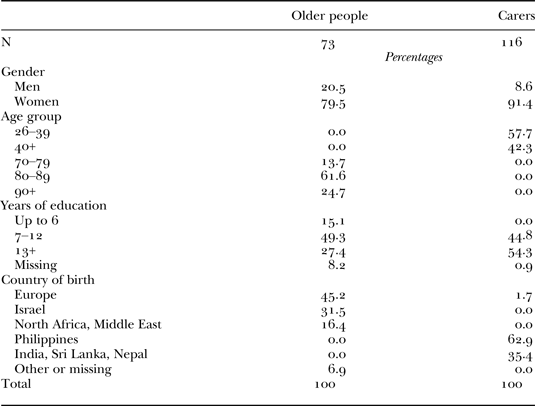
The majority of study participants in both groups were women. The average age was 86 years for older people and 39 years for carers. Nearly half of the older people were born in Europe, and one-third identified as Holocaust survivors. Approximately two-thirds of the carers were born in Philippines, one-third in the Indian sub-continent (India, Sri Lanka and Nepal) and only a few carers were born in Europe. Over half of the older people spoke English with their carers (including those who spoke both Hebrew and English), about a quarter spoke Hebrew only and the rest spoke other languages. These and other demographics are displayed in Table 1.
Socio-demographic characteristics of study participants
Quantitative results
Most older people and carers gave high ratings to four aspects of their interpersonal relationships. Approximately two-thirds of carers and half of all older participants rated the quality of the relationship as ‘very good or excellent’, over a third of older people and over a quarter of carers rated it as ‘good’ and comparatively few participants rated it ‘not so good’ or ‘bad’. The majority of participants also reported feeling close, understanding each other, and getting along well to a ‘great’ or ‘very great extent’ (see Table 2).
Carer and older person ratings of interpersonal relationships
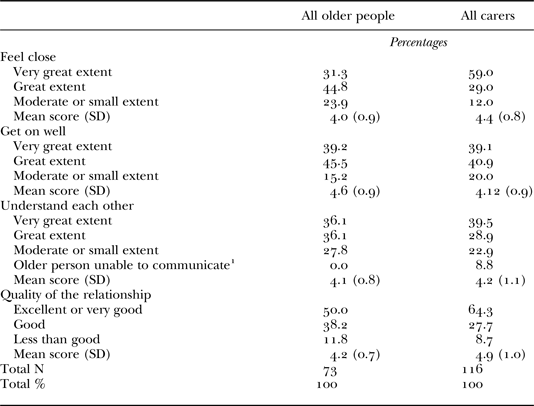
Notes: SD: standard deviation. 1. Item not applicable to older people.
Carers tended to rate the quality of the relationship more positively than older people, though this was statistically significant only for ‘feeling close’ (t = 2.45, two-tailed p < 0.05). Moderately strong and significant correlations were found between mean scores of the 55 carer–older person pairs for quality of the relationship, with Spearman's rho values ranging from 0.39 to 0.42. Paired t-tests indicated that differences in mean scores for these indicators were significant only for getting along well, with higher scores for carers than for the older people (see Table 3).
Dyad ratings of inter-personal relationships: mean scores and correlations
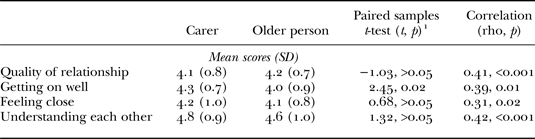
Notes: N = 55. SD: standard deviation. 1. Degrees of freedom = 54.
Qualitative results
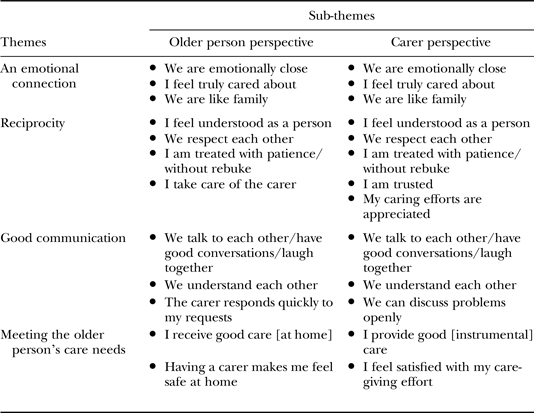
Qualitative data were thematically analysed to provide a deeper understanding of the quantitative results outlined above and to unravel the meaning of positive care relationships in this care setting. Thematic analysis revealed that both groups can experience the care relationship in positive and negative ways. The analysis also identified considerable similarities and important differences in older people's and carers’ perspectives on the meaning of good quality care relationships. The four central and overlapping themes and their associated sub-themes that emerged are summarised in Table 4.
Emerging themes and sub-themes about care relationships
Theme 1: An emotional connection
Theme 1, ‘an emotional connection’, encapsulates affective processes in care relationships and most closely captures the meaning of our quantitative item ‘feeling close’. When asked to elaborate on the positive aspects of the care relationship, carers and older people who gave the highest rating for ‘feeling close’ described their emotional connections to the other person in three main ways. Firstly, they described feeling emotionally close to the other person. This was expressed in words such as loving, liking, caring about and admiring the other person, and being friends. For example, one carer said: ‘We are good friends. I am like her and she is like me. I care about her a lot.’ Similarly, an older person said:
She is my friend. Having her with me makes me very calm. When I go on vacation, I miss her. (Female, age 94, ID number 107)
Participants also described the emotional connections as feeling truly cared about. This was exemplified by carer statements such as: ‘She takes care of me and she worries about me’, ‘He thinks about my needs and he cares about me’ and ‘When I'm tired he asks me if I need anything. He notices and pays attention’; and by comments from older people such as: ‘He cares about me. He always asks me how I am doing and if I need anything.’
Both carers and older people who gave high ratings for the quantitative item ‘feeling close’ frequently described the relationship as ‘family-like’. Carers typically made statements such as: ‘She is like my grandmother. I am very close to her’, ‘She loves me like a daughter’ and ‘I treat her like my mother, and she treat[s] me like I'm her daughter’. Similarly, older people made comments such as: ‘She is like my daughter. I liked her from the start and she likes me.’ In one instance, an older person felt that not only the carer but also the carer's whole family cared about her wellbeing:
She calls me grandma and I call her my grandchild. My family really likes her. We treat her as a member of the family. I also talk to her family on the tablet. Her mother tells her that if I don't feel well, that she should not move from my side. (Female, age 94, ID number 120)
In a few instances older people commented about a lack of emotional connection with the carer, as illustrated below:
I want to feel with her the way I feel for a daughter, and sometimes I do speak to her as [I would to] my daughter, but she's so cold [that] she doesn't give me any warmth in return. (Female, age 91, ID number 65)
Some older people described a family-like connection in terms of caring acts that crossed usual boundaries of client–carer relationships. One person, for example, who described her carer as ‘like one of the family’, explained that the carer often made the Sabbath meals for her family, and another older person described the way her carer responded when she was admitted to hospital. She said:
She [the carer] is like my daughter. When I was in hospital she stayed with me all night. [When I was] in rehabilitation [hospital] she came every morning. (Female, age 80, ID number 120)
For some older people the term family-like appeared to carry a more pragmatic meaning. Statements were made about the carer being ‘like family’ because of the amount of time spent together, for example: ‘We are like family [because] we live together’ and ‘[Because] my daughter comes once a week, while the carer is with me all the time’.
Theme 2: Reciprocity
The second theme ‘reciprocity’, represents the view that mutual respect within the relationship and being understood by the other person are central components of positive care relationships. Comments about mutual respect featured in both groups’ narratives, as exemplified by the older person statement:
I treat her [the carer] with respect and esteem, and she treats me that way too. (Female, age 78, ID number 5)
A few older people felt their own interpersonal skills contributed to reciprocity. This was illustrated by comments such as: ‘It's a matter of personality. I am a very understanding person’ and ‘I treat him like a friend. I was a manager; if you treat someone well, you get treated well’.
Lack of respect, though not often candidly discussed by carers or older people, clearly interfered with some care relationships. This was illustrated by a carer's misgivings about the way an older person treated her, saying: ‘She only says bad things and shows disrespect, especially in front of other people’, and by another carer's subtle suggestion ‘There is a need for a conversation about manners [with the older person]’. Not surprisingly, being spoken to harshly was mentioned by people in both groups as a negative aspect of the care relationship and this was reflected in participants’ ratings of the quantitative items. For example, an older person said:
I am frustrated when she [the carer] yells at me. I come from a good home. How did I get to this situation where she yells at me? Who does she think she is that she can yell at me like that? (Female, age 85, ID number 95)
Some carers described the feeling of being free from rebuke and blame as a positive aspect of the care relationship, as demonstrated by the following comments: ‘If I do [sic] a mistake he is never angry with me. He doesn't care’, ‘When I make mistakes, he explains how not to repeat them’, ‘She doesn't blame me’ and ‘She doesn't shout and she doesn't say, “You do this, you do that!”’
Reciprocity was also described in terms of mutual understanding. Older people tended to focus on carers understanding their care needs. Contrastingly, carers tended to emphasise understanding each other as individuals. For example, one carer said:
We understand each other. We know each other's moods and match our behaviours to that. (Female, age 35, ID number 87)
Lack of understanding between the older person and the carer emerged also from the data. One carer, for example, struggled with the older person's failure to understand how difficult it was for her to be away from home. Another carer, who gave a high rating for the quantitative item ‘understanding each other’, described being annoyed by the older person's difficulty in throwing away old food. This raises the concern that the carer may have lacked information about the older person's life story that could have provided context for understanding the behaviour. The carer said:
She [the older person] eats old food. She doesn't give a chance to throw [it out]. She never throws anything, not even a tiny bit. This is a big problem for me. (Female, age 38, ID number 149)
Several notable differences in carers’ and older people's perspectives on reciprocity emerged. The carers’ perspective incorporated the desire to be appreciated and trusted by the older person. Feeling appreciated for one's caring efforts was illustrated by comments such as: ‘Even in her condition, she will always say thank you’ and ‘If I give her food, especially the bread, she always says, “Thank you, I love you”’. The importance of feeling trusted was illustrated by complaints such as: ‘I want her to trust me because sometimes she doesn't believe me. She thinks I'm lying to her. It hurts me sometimes’ and ‘Sometimes I go shopping, I put the shopping on the table and she checks the bill and what I bring. I don't like this’.
The older persons’ perspective on reciprocity featured the idea of giving back to the carer (in addition to payment) in return for care received. This was demonstrated by comments such as: ‘I give her everything she asks for’, ‘She feels good in my house. I ask her how she is, I pay for her to come to my exercise class so that she will feel good’ and ‘I give my grandchildren 250 shekels for their birthdays and she [the carer] is among my grandchildren’.
Theme 3: Effective communication
Theme 3 highlights effective communication as a positive aspect of the care relationships. This theme converges most closely with the quantitative items ‘understand each other’ and ‘getting along well’. Indeed, participants’ remarks about effective communication and their corresponding scores for the four quantitative items assessed in the present study suggest that effective communication could be more critical for building positive care relationships than emotional connectedness.
From the carers’ perspective, effective communication entailed listening to each other, talking openly and honestly with each other to resolve or prevent issues in the care relationship. Carers’ comments included: ‘I can tell her everything I feel and what's bothering me’, ‘I tell her if she has a problem with me to talk to me’ and ‘I can tell him what I want when I have a problem and the same for him. We are open with each other’. Older people commonly expressed the pragmatic view that effective communication was important for facilitating good care.
Carers and older people also conveyed the idea of good communication fulfilling a social function, which converges with the quantitative item ‘getting along well’. Carers described laughing together, talking about each other's families and telling stories or jokes. Opportunities for learning from each other were also mentioned (e.g. ‘We teach each other cooking’ and ‘He teaches me Hebrew’). For some carers, the older person had become their confidant, as illustrated by the following quotes: ‘She helps me with my personal problems’ and ‘I can talk to him about my personal problems’. Similarly, some older people valued being able to engage in interesting conversations with the carer, as illustrated by the following statements: ‘We are good friends – we talk about all sorts of things’ and ‘I value her because she is an intelligent woman who you can talk to’.
Several barriers to effective communication were mentioned. Carers commonly noted that the progression of dementia over time had hampered communication with the older person. One carer said: ‘When her mind was lucid we used to talk to each other.’ Another carer lamented:
If [only] we could have conversations, because I'd know what's in her heart, what she wanted. (Female, age 28, ID number 98)
Many carers reported that they could not comment on the relationship because the older person could hardly communicate or could not communicate at all. Only a few carers mentioned using non-verbal strategies to communicate with an older person with dementia. One of these carers said: ‘Her [the older person's] actions show me that she is comfortable with me’, and two carers mentioned communicating with the older person through hugging and massage.
Some older people felt that the relationship would be better if the carer was more interested in having a social connection. For example, ‘It's good when she sits and talks to me but that doesn't happen much because she is always busy with herself’. Other older people were bothered by the amount of time the carer spent talking to their family and friends. For example: ‘I would like her to talk to me more but she is always on her phone’ and ‘I can't stand it that is constantly on the phone’. One older person attributed the absence of social interaction in the relationship to a lack of warmth in the carer's personality. She said:
It would be good if she opened up to people more, she is not the type that will cheer me up. There are not many happy things left in my life so at least someone who I can laugh with and get a bit crazy with [would be good]. (Female, age 73, ID number 43)
Not all older people, however, were interested in social interaction with their carer. Two people, for example, commented that what they liked about the relationship was that ‘She doesn't interfere in my life’ and ‘When there's no need, I don't see him and I don't hear him’.
Although most older people in Israel were immigrants themselves and are therefore bilingual or multilingual, some felt that lack of a shared language interfered with communication, ‘Sometimes I don't understand what she is saying’ and ‘Her understanding is limited and she tends not to admit that she didn't understand’. The language barrier interfered with communication both on the social level (e.g. ‘She doesn't talk and I don't either. I would like us to talk to each other. I think she hardly understands me’) and on the practical level (e.g. ‘I can't send her on errands. Only to places where someone speaks Romanian’).
Theme 4: Meeting the older person's care needs
The fourth emerging theme reflected the view that taking care of the older person's needs is a core component of good care relationships, as illustrated by the statement:
I take care of her every day, so I feel that our relationship is very good because of that. (Female, age 33, ID number 33)
Even older people who made no mention of the first three themes indicated that having their care needs met was a positive aspect of their relationship with the carer. This was reflected by statements such as: ‘She does what needs to be done’, ‘She takes care of my needs’ and ‘The best thing is her help, without it I could not manage’. Some older people emphasised that having a live-in carer generated the feeling of physical safety at home. As one person explained:
What's good is that he is beside me and I am not alone. I am afraid to be alone. I am not afraid of death but I am afraid of something happening to me when I am alone. (Female, 86, ID number 55)
Theme 4 also reflected both groups’ perceptions of the quality of the care being central to the quality of the relationship. Some carers expressed a sense of pride in providing the best care possible, sometimes in difficult circumstance, e.g. ‘You feel good if you do the task and you succeed’, ‘The fact that despite the difficulty, I manage to care for her’, ‘I give her my best’, ‘I give my all. I care for her 100 per cent’ and ‘She wants a bit [of care] but I give her a lot’. Carers also described their efforts to create opportunities for enjoyment and happiness through activities such as cooking, baking, exercising and dancing, and the perceived benefits for the older person. Carers commented: ‘I dance with her all the time to cheer her up because she is alone’, ‘When I exercise her, she enjoys it’, ‘The best thing is when I tell her jokes and she laughs’ and ‘I try to entertain her because she always wants to sleep’.
For older people, satisfaction with the way carers performed their care-giving tasks was central to their appraisals of the quality of the care relationships. Older people's statements indicated that they were happy with care relationships when carers were ‘hardworking’, ‘clean’, ‘honest’, ‘organised’, ‘aesthetic’ and ‘punctual’. Older people also expressed satisfaction with the care relationship in terms of the willingness of their carers to perform care-giving tasks. One carer said: ‘The connection between us is excellent. She doesn't refuse anything. Whatever I want she can do. Without a problem she does it willingly.’ The carers’ willingness to go beyond the necessary care-giving tasks was particularly valued. One person said: ‘She [the carer] does things that she doesn't have to do and I haven't asked her to do. For example, she makes fresh squeezed orange juice.’ A few older people complained about needing to refrain from asking too much from the carer. For example, ‘She [the carer] thinks that no one works like her. She's always in pain. I tell her I wouldn't ask her [for help] if I didn't have to.’
Discussion
Quantitative findings indicated that the majority of migrant live-in carers and older care recipients perceived good quality relationships with each other. Carers rated ‘feeling close’ significantly higher than older people. Further, as hypothesised, moderately strong congruency in paired carers’ and older peoples’ perceptions of the quality of their relationship were found with one exception: carers rated the extent to which they got along more positively than did their older clients. A number of explanations for carers casting a more positive light on the quality of the relationship than older people can be offered. Firstly, carers may have emphasised the positive aspects of the relationship out of concern about losing their jobs. Secondly, families in Israel commonly hold closely knit intergenerational ties, in terms of both geographical proximity and interpersonal propinquity (Lowenstein and Daatland Reference Lowenstein and Daatland2006), potentially reducing older Israeli care recipients’ openness in the relationship with their live-in carer. Nonetheless, these explanations merely serve as tentative speculations, calling for future studies to look into these dynamics in more detail.
Thematic analysis of the qualitative data provided a deeper understanding of the quantitative findings described above and contributed to clarifying the underlying meaning of positive care relationships in this care setting. For both groups the meaning of good quality care relationships was encompassed by four major themes: feeling an emotional connection; reciprocity; good communication; and meeting the older person's care needs.
As we hypothesised, there were fundamental similarities and specific differences between the two groups’ perspectives on the four emerging themes, as indicated by the sub-theme list in Table 4. For example, for both groups reciprocity involved being treated with respect and kindness, and feeling understood. From the carers’ perspective, however, ‘reciprocity’ also meant feeling appreciated and for older people it also included looking after the carers through kindness and generosity.
The results of the study are consistent with previous research conducted both in Israel (Porat and Iecovich Reference Porat and Iecovich2010) and elsewhere. Expressions of emotional connectedness (Theme 1) from participants in both groups support previous literature on client–carer relationships (Beresford and Croft Reference Beresford and Croft2001; McGilton and Boscart Reference McGilton and Boscart2007) and conclusions by Eustis and Fischer (Reference Eustis and Fischer1991) about the pull towards informality in co-resident, client–carer relationships. Like previous research, having no shared language caused communication difficulties for some participants in both groups; however, there was little indication that cultural differences between care recipients and migrant live-in carers impacted on interpersonal relationships (Ayalon, Kaniel and Rosenberg Reference Ayalon, Kaniel and Rosenberg2008; Porat and Iecovich Reference Porat and Iecovich2010; Walsh and Shutes Reference Walsh and Shutes2013). In fact, our findings suggest that, in general, despite differences between care recipients and migrant in-home carers in their personal, social and cultural characteristics, the personal connections that develop over time can successfully bridge these differences and fulfil social wellbeing needs for both sides. Some participants’ comments indicated that different cultural backgrounds had created opportunities for learning (e.g. cooking and language). A caveat to this overall finding was illustrated by one carer's struggle with an older person's habit of saving old food. This serves as a reminder that migrant carers may lack the specific historical knowledge critical for understanding interactions with older people who are Holocaust survivors. Previous research highlighted the need for Holocaust awareness among carers who work with Holocaust survivors (Teshuva, Borowski and Wells Reference Teshuva, Borowski and Wells2017; Teshuva and Wells Reference Teshuva and Wells2014). The importance of understanding food-related behaviours among Holocaust survivors (Sindler, Wellman and Stier Reference Sindler, Wellman and Stier2004) may be heightened in co-resident care arrangements, and should be considered when preparing migrant carers to work in Israel.
The global care chain (Hochschild Reference Hochschild, Hutton and Giddens2000) describes a mechanism wherein the gap in available local carers is filled by hiring a migrant carer. Resultant global householding (Douglass Reference Douglass2006) and transnational families (Parreñas Reference Parreñas2005) surface as useful concepts for understanding the dynamics of the care relationships under examination in this study. Our data indicated that some migrant carers struggled emotionally with living apart from their own families and that this affected the quality of care relationships to some extent. This was made evident by complaints from some older people about the difficulty of living with a carer who is depressed about being far away from home and the amount of time some carers spend talking with their family members on electronic devices. It was also illustrated by a carer's concern about the older person failing to understand how she felt being so far from home.
Theme 4, ‘meeting the older person's care needs’, was consistent with the need-oriented theme found by Walsh and Shutes (Reference Walsh and Shutes2013). Notably in our study, carers who were caring for high-dependency clients commonly reported that due to the older person's inability to engage in verbal communication, they had nothing to say about the relationship. These carers presumably focused their attention on providing physical care. This finding raises concerns about whether in-home migrant carers are acknowledging and prioritising the personhood of people with dementia as highly as care tasks, as is advocated in the person-centred dementia care literature (Edvardsson, Winblad and Sandman Reference Edvardsson, Winblad and Sandman2008). A few carers mentioned using non-verbal communication strategies with older people who were no longer able to converse. This finding accords with earlier research conducted in Israel by Ayalon (Reference Ayalon2009b), which found that while Filipino home care workers were not well informed about dementia, their intuitive practices were consistent with current scientific knowledge.
The results of this study indicate that care relationships between migrant live-in carers and older people in Israel can be conceptually located within the RCC paradigm. Mapping the major emerging themes and associated sub-themes on to the Senses Framework (Nolan et al. Reference Nolan, Davies, Brown, Keady and Nolan2004) shows that many of the conditions that contribute to creating positive care relationships align with the Senses. For example, Theme 1 (feeling an emotional connection) converges with the sense of belonging, and the sub-theme ‘feeling truly cared about’ converges with the sense of significance; Themes 2 (reciprocity) and Theme 3 (good communication) converge with the sense of continuity, and the Theme 3 carer sub-theme, ‘feeling appreciated’, aligns with the sense of significance. Theme 4 (providing/receiving good care) aligns with the sense of purpose, and the Theme 4 carer sub-theme, ‘being satisfied with my caring efforts’, aligns with the sense of achievement.
The mapping exercise has implications for theory. Overall, the Sense Framework appears to be sufficiently encompassing to describe care relationships in this care setting, notwithstanding a few gaps in the available data. For example, very little information emerged about the conditions that create a sense of security among the two groups in this study. Similarly, older people did not specifically comment on the role of the carer relationship in helping them to make progress towards care goals (the sense of achievement). In hindsight, these gaps may have been obviated by explicitly questioning study participants about the senses.
The mapping exercise also led the authors to the view that ‘sense of control’ could be a useful addition to the Senses Framework. This position is supported by older people's statements about looking after their carers through kindness and generosity. This behaviour could be interpreted as a way for older people to maintain some control over their lives while being dependent on the carers’ assistance with everyday living tasks. A similar point was made by Lewinter (Reference Lewinter2003), who argued that being able to reciprocate strengthens a person's senses of independence and control in a situation where care is being provided. The sense of control could equally apply to carers who, in this study, seemed pleased to exercise control over their time and the way they provided the care.
The main limitation of this study was the potential for social desirability bias (Paulhus Reference Paulhus, Shaver and Wrightsman1991). Older people's responses could to some extent have reflected concerns that presenting a negative picture would have implications for their care. Carers’ overall reluctance to expand on the negative aspects could to some extent relate to the inherent asymmetrical employer–employee power relationship (Lin and Belanger Reference Lin and Belanger2012) and to a perceived need to portray the work situation positively, despite assurances from the researchers that their responses would be anonymous. Further, due to logistical issues, some interviews were conducted with the older people while their carer was present in the home, and vice versa. This could have resulted in participants understating or withholding complaints or misgivings about the care relationship. Despite this limitation, the study findings contribute new understandings about the nature of care relationships between migrant live-in carers and older people, by identifying similarities and noteworthy differences between the two groups’ perceptions of positive care relationships. The study results call for further research into specific areas of concern, such as how migrant live-in carers interact with people with dementia. Future research could also examine the intra- and inter-personal experiences of family members whose loved ones are being care for by migrant in-home carers.
This study also has important implications for practice. The results indicate the need for professional mentors, such as social workers, who play an important role in intervening in cases of conflicting relationships (Iecovich and Doron Reference Iecovich and Doron2012), to help all involved parties better understand each other's perspectives. These professionals could adopt strategies such as ‘appreciative caring conversations’ (Dewar and Nolan Reference Dewar and Nolan2013: 1251), which aim to help clients, paid carers and family members to ‘work together to shape the way things are done’. Clearly, training programmes that include components on person-centred dementia care and greater support for migrant in-home carers to overcome language barriers would contribute to improving the quality of these interpersonal relationships. This is particularly important when one considers governments’ growing reliance on hiring migrant carers for the provision of live-in home care for frail older persons in industrialised nations. As this phenomenon becomes increasingly common (Browne and Braun Reference Browne and Braun2008), issues such as language and cultural differences and variance in carers’ educational and training backgrounds, due to divergent regulations across nations (Cangiano et al. Reference Cangiano, Shutes, Spencer and Leeson2009), will require greater attention. A global emphasis on training is needed to ensure that live-in migrant carers receive the appropriate knowledge and tools to maximise the quality of relationship with older persons. In addition, those employing migrant carers may require cultural diversity training which sensitises them to the difficulties that migrant carers may face, such as economic instability in their home country or the fragile dynamics carers experience with family members left behind. Such training could help alleviate carers’ emotional burden to some extent and subsequently facilitate improved provision of care to older people.
Acknowledgements
This work was supported in part by the National Insurance Institute of Israel, by the Minerva-Stiftung Foundation and by the Ministry of Senior Citizens in Israel. K. Teshuva's contribution to the study was supported by an international travel scholarship for Emerging Researchers in Ageing provided by the Australian Research Council's Centre of Excellence in Population Ageing Research.



