




Imagine the situation in Vienna, in November 1938: Jewish citizens had to give up their flat with all its contents to a Gestapo officer in a humiliating handover of keys, with men already standing by to completely empty the flat and transport everything away, presumably displaying a mixture of greed, schadenfreude, and indifference.Footnote 1 The clearing of houses in Vienna was a measure of the new Nazi state after introducing the racial laws in Austria, and was effected by a Gestapo enterprise, called VUGESTA, upon short notice. The VUGESTA sold the furniture and interiors sorted by category in low-budget shops to ‘needy fellow citizens’ (which following Nazi ideology had to be ‘Aryan’).Footnote 2 By selling or distributing the loot to German Reich citizens, the objects served as ‘both a reward for political complicity and a mark of belonging in the racially defined national community’.Footnote 3
Some refugees might have been more fortunate and have been able to gather at least a few pieces of furniture and personal belongings and have them transported by lorry to the port of Trieste with the help of a Viennese forwarding agent – as soon as they had visas and tickets for their voyage and it was clear where they were going. However, this did not mean their property could travel with them, as many of them soon discovered. Indeed, the research below is based on the experience of Jewish Austrian citizens who were forced to emigrate under German Nazi occupation from Vienna through the port of Trieste, Italy, to Shanghai, an East Asian port that was accessible without a visa in 1938 and was therefore a comparatively safe destination, losing their citizenship and all their property in the moment they involuntarily crossed the border. This process was, as the survivors had to discover, for the most part irreversible due to restrictive legislation, even after Nazi defeat, when it came to the restitution of both citizenship and property. The article thereby tries to connect the way these Austrian Jews were simultaneously deprived of citizenship and property and what this tells us about the constitution of the ‘refugee polis’ at this time.
This case-study sheds new light at the intersection of the scholarship on global object histories and histories of conflict, with reference to a case of Nazi-era expulsion from Europe to Asia and the subsequent return of refugees. Its innovative approach studies the intersection between citizenship, property, and justice, and makes a case based on Jewish refugees in Shanghai and their return and claim to justice, thereby touching on the right to property as a cornerstone of Western legal systems. This case-study highlights the agency of refugees by exploring two personal stories and cherished musical objects, interweaving this with broader narratives of the reselling of a vast quantity of goods stolen by Nazi authorities. In doing so, it also highlights the crucial relationship between music, culture, and identity.
Forced displacement brings with it the loss of property, belonging, and identity. Objects gain renewed importance as spaces for embodying social and cultural identity. There is a growing field of research on the material culture of objects or ‘things’,Footnote 4 related, for example, to battlefields, camps, and colonial periods.Footnote 5 The interdisciplinary work of projects uniting perspectives from history, ethnology, and archaeology has been fruitful for this piece.Footnote 6 Recent studies on the role of objects, such as the work of historians Leora Auslander and Tara Zahra, as well as that of Katarzyna Nowak on the circulation of objects belonging to displaced persons in Poland, have offered useful methodological tools.Footnote 7
The twentieth century saw unprecedented violence, not only on the battlefields in Europe and Asia, but also against civilians who were subjected to large-scale deportation and forced migration in both the European and the Asian theatres of war.Footnote 8 Since the transnational/global turn in history, historians have placed migration within longer trans-temporal perspectives.Footnote 9 Peter Gatrell, in his seminal study The making of the modern refugee and other works, coined the term ‘refugeedom’ to bridge the divide between the fields of history and migration studies.Footnote 10
Scrutinizing objects as sites of the nexus between citizenship, property, and sense of belonging offers a productive strategy for studying refugeedom. Objects and ‘belonging’ are strongly intertwined, as they can define where we feel (re)settled and ‘at home’. When looking into looted objects during refugeedom, those objects which have had their social meaning restored no longer represent a coercively extracted abstract exchange value alone but are, as anthropologist Arjun Appadurai notes, markers of kinship.Footnote 11
By delving into a case-study of Austrian Jewish citizens, we are dealing with an interesting facet of imperial crisis. The long aftermath of dissolution of the Habsburg empire in 1919 is particularly visible when it comes to the issue of citizenship. After the First World War, most parts of the defunct Habsburg empire formed new nation-states. This case-study, in its focus on citizenship and property, is dealing with Austria as the place of residence for the individuals I examine, and the port of Trieste as a hub of displacement, which was the main Habsburg port until 1919 but was now in the territory of Italy. With its focus on post-imperial geography, this article asks what happens to this geography as Nazi Germany (which annexes Austria) and fascist Italy form their war-time alliance and subsequence occupation in 1943. What happens then to Jewish actors and their property? This leads us to the post-1945 period and another moment of imperial crisis, if we see post-war Austria and Western Germany, as well as Italy, as the successor states of Nazi/fascist empires with colonial tendencies. Although we expect post-war states to respect their citizens and property rights better than the former imperial or fascist empires, this case-study highlights ongoing problems, as they continue to marginalize minority actors, like the Jewish actors as seen in the restitution practices.
While examining cases of the migration of objects across cultures and temporalities, this case-study scrutinizes legal frameworks as well as building on the scholarship of Arjun Appadurai, who introduced the concept of ‘cultural flows’, and Benedict Anderson, in relation to ‘imagined communities’Footnote 12 – the latter inspiring scholars to seemingly contradictorily refer to the ‘non-communities’ of refugees.Footnote 13
From a legal perspective, there was an explicit connection between theft of property and removal of citizenship. The eleventh ordinance to the Reich Citizenship Act of 25 November 1941 states that people of Jewish faith who ‘were abroad’ lost their German citizenship and became stateless.Footnote 14 At the same time, that is, with the withdrawal of citizenship or made possible by it, they lost all their property which fell to the German Reich. In an additional circular, this provision was also extended to people of the Jewish faith deported to the ghettos and concentration camps. In practice, this meant that all houses and flats, cars, shops, and assets which could not be carried in small suitcases onto a ship to freedom went to the Nazi state, as the refugees became stateless overnight.
The Nazis were not the first to combine genocidal policy with issues of identity and property, as, for example, Andrew Fitzmaurice has shown in the context of his research on European empires in the modern age.Footnote 15 What was new, however, was that such exclusion took place in the heart of Europe and was directed at upright German (and Austrian) citizens who had a strong national identity, were fully assimilated, and were loyal servants of the state, be it in administration or within the military, as medals and honours testified. Although there are other precedents (for example, the treatment of minorities in the interwar years in Eastern Europe), the Nazis were likely inspired by the concept of property for settlers only within the system of colonialism, and especially interested in the Italian example in Abyssinia and Libya.Footnote 16 As Lauren Benton has argued in her work, colonialism represents not only an era of imperial politics, economic encounters, and violence, but also of the emergence of global legal regimes, producing new means of rule and subjugation with regard to the creation of legal and political space in which to operate.Footnote 17 A key marker of colonial legality is the denial of full citizenship and full property rights to conquered territories and their inhabitants.
After the Second World War, German settlers became victims of the same mechanism, for example, in Poland, the Czech Republic, Hungary, and Romania, when ethnic Germans were expelled from their homes and had to leave everything behind.Footnote 18 It was only in Western Germany that these ethnic Germans were covered by the right to citizenship, due to Basic Law Article 116, which allowed for restoration of their former citizenship to the German Reich.Footnote 19 Austria, on the contrary, did not follow this example, as it did not see itself as a successor state of the German Reich and therefore claimed it could not take the burden of integrating ethnic German refugees into its own post-war state. This is all the more surprising as many of the ethnic Germans came from regions within the defunct Habsburg empire, for example in the Balkans, Hungary, and Romania, thus having had a Habsburg subject status for centuries. Only with the State Treaty of 1955 was this policy rectified and citizenship granted to those ethnic Germans who were still in the country and had not yet been transferred to Western Germany. This restrictive policy stemmed from the economic considerations of a war-torn state – Austria was also reluctant to return citizenship to their former Jewish citizens, especially those from Vienna. In short, while West Germany did return Jewish citizens their citizenship, as it gave it to ethnic Germans, the Austrian state did not.
Using objects as a point of departure, this case-study analyses the different strategies the Nazis used to deprive Jewish citizens of the Reich of both property and citizenship, and how legal measures covered the theft, as well as the machinery which was developed to effect the expulsion and expropriation in a relatively short period of time. First, it analyses Nazi laws and political discourses. Next, it discusses the impact of the forced movement of Jews and the expropriation and reuse of objects. Finally, the article considers the legal problem posed for the post-war Austrian nation-state by the return of both people and objects and the Austrian state’s approach to the policy of redress.
As a caveat, it should be noted here that although today we speak of ‘Jewish victims’ of the Holocaust and the displacement and resettlement campaign caused by the Nazis, many of these victims saw themselves simply as Catholic or Protestant Austrians until the day of Hitler’s arrival, and were quite surprised to find themselves categorized as Jews under the definition of the Nuremberg racial laws.Footnote 20 For the sake of consistency, this case-study speaks of ‘Jews’, although we must surmise that not all of them would have defined themselves as such.
I
Citizenship is a negotiated concept. Since antiquity, rulers have used citizenship as a tool to welcome settlers in order to strengthen trade and commerce as well as to exclude undesired minorities and ethnic groups, and this was especially true for Jewish settlers. Austria has been no exception; the history of ‘emancipation’, granting Jews the same rights as other settlers, was a centuries-long process.Footnote 21 The annexation of Austria by Nazi Germany in 1938, the so-called Anschluss, created an interesting legal situation regarding property and citizenship. The Weimar Constitution, which was in force when the Nazis came to power in Germany in 1933, displays a bourgeois-liberal model of constitutionalism, as it states in Article 153: ‘Property is guaranteed by the constitution. Its content and its limits are derived from the laws. Expropriation can only be carried out for the common good and on a legal basis. It shall be effected against compensation, unless an imperial law provides otherwise.’Footnote 22 The constitution was valid for those holding German citizenship. It is apparent that German public law underwent a shift in its treatment of constitutional property rights in the 1920s as the Great War, as well as the pressing economic necessities of the 1920s, had expanded the justifications for expropriation.Footnote 23 The most extensive commentary on the constitution, edited by Hans Carl Nipperdey in 1930,Footnote 24 includes legal explanations of what the constitutional guarantee meant for the individual in terms of their relationship with the state under a modern, liberal constitution.Footnote 25
As a consequence of such a legal rule, one of the heinous mechanisms of Nazi policy against Jews and political opponents was to strip them of or deny them citizenship in order to pave the way for one of the biggest campaigns of theft in human history, under the so-called ‘Aryanization’ of the German economy.Footnote 26 Under the Nuremberg racial laws, issued in 1935, ordinances regulated, first, racial belonging, and, second, citizenship within the Nazi Reich. For those defined as Jews, holding citizenship, and also property, was no longer possible. According to the regulations of the Reich Citizenship Law issued under the Nuremberg racial laws, a person was considered a Jew if they were of the Jewish faith, married to a Jew, or had a Jewish parent or grandparent.Footnote 27 The associated ordinances stipulated that Jews defined under these rules (even if they were baptized) could not be considered citizens of the Reich. They were also prohibited from voting and holding public office. Jewish civil servants had to retire after 31 January 1935 in Germany. In Austria, this process was even quicker:Footnote 28 within weeks of the Anschluss in spring 1938, civil servants were expelled from office or lost their pensions, and flats were openly looted.Footnote 29
After the Anschluss and the anti-Jewish measures also introduced in Austria in quick succession, many people were forced to leave the country within a few weeks, as life became impossible after professional bans, expulsion from schools and universities, forced closure of medical practices and law firms, theft of assets, and blocking of bank accounts.Footnote 30 In a villainous process of taxation, Jews were literally plundered of all their assets; in Vienna, the Central Office for Jewish Immigration under a certain Adolf Eichmann, and its subdivision on taxation, the Vermögensverkehrsstelle, co-ordinated the theft.Footnote 31 Key among Nazi measures against Jewish property were forced sales of all kinds of businesses to drive Jews out of the country.Footnote 32 Historians Auslander and Zahra underline how expropriation facilitated the eradication of entire populations: ‘The gradual theft of possessions that made Jews part of the national culture – dwellings and their contents, radios, clothing, the tools needed to practice their trades and professions – was the first step of their dehumanization and ultimate annihilation.’Footnote 33
At first, most refugees tried to take as much property as possible with them, or to transfer it either into foreign countries or to trusted friends, or to sell as much as they could in Vienna, in order to have enough financial capital for the escape. Feelings of belonging and (professional) identity were also affected by these procedures. One very telling surviving account which illustrates the connection between objects and (professional) identity came from social worker Else Leichter, who could not return to her desk at the Municipal Viennese Youth Welfare Office on the Monday after the Anschluss because Gestapo men were blocking entry to the town hall for Jews. Even decades later, she admitted in an interview that she still had nightmares about her desk not being tidied up, as on the Friday she had left a bit earlier for a weekend in the mountains. Interestingly, at the forefront of her resentment was not her own loss but the feeling that she had abandoned her young protégés and left unfinished business.Footnote 34
II
The port of Trieste played an important role in refugee escape routes. Many Viennese Jews attempted the escape to Shanghai.Footnote 35 Their property is labelled in the research by the name the loot had acquired in official documents concerning the port warehouses of Trieste: ‘Masse Adria’.Footnote 36
As examples, we follow two men boarding a vessel of the Italian shipping company Lloyd Triestino with their most cherished objects: Ferdinand Adler and Fritz Hungerleider, each carrying a small suitcase in their hands.Footnote 37
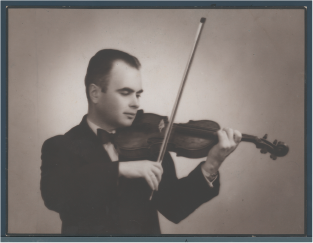
Violinist Ferdinand Adler, famous for his concerts in the summer resort town of Bad Ischl conducted by Franz Lehár, boarded the ship Conte Verde on 4 June 1939 not only with his wife, Gertrude, but also with his violin. Although he had converted to Catholicism early on, he was stripped of all his assets in Vienna in 1938 and banned professionally, so he was unable to earn a living from his music. He hoped for a new beginning in Shanghai.
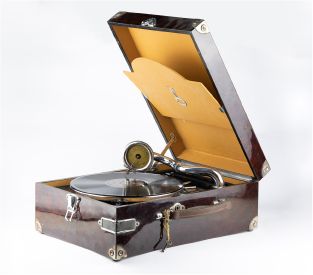
The other object we see boarding the ship was a gramophone of the then famous Telraphon brand from Austria, which young Fritz Hungerleider did not want to part with. It was his favourite gift from his bar mitzvah in 1933, and he grabbed it when being forced to leave the family apartment in 1938. Together with his parents, young Fritz (born 1920) fled to Shanghai, and music became the family’s comfort. They had the gramophone with them, on which they listened to music on the ship, and also a cherished small bust of Beethoven which they had brought from their Viennese home in their suitcase (Figure 1).
Gramophone of Fritz Hungerleider. Photo: Sebastian Gansrigler, in Daniela Pscheiden and Danielle Spera, eds., Die Wiener in China: Fluchtpunkt Shanghai/ Little Vienna in Shanghai, catalogue of the exhibition within the Jewish Museum Vienna (Amalthea Publishing House, Vienna, 2020), p. 196.
From these two examples, we can see how music became a signifier of the Hungerleider family’s’ former bourgeois life and identity in Vienna. The objects they carried from Vienna, such as the violin, the gramophone, and the Beethoven bust, were not only objects which reminded them of home but placeholders for their sense of self, and a symbol of resilience against those who had deprived them of a decent life in Vienna by forcing them to migrate to Shanghai. Forced displacement, in this reading, brings with it the loss of property, belonging, and identity, whereby customs or objects become important to retaining a sense of social and cultural identity and kinship in new, possibly exotic, locations.
Their objects were also with them in their first abodes in Shanghai.Footnote 38 Upon arrival, Ferdinand Adler set about making a career for himself: he was soon to become Konzertmeister with the Shanghai Municipal Orchestra, also performing as a soloist. In 1941, he was promoted to the position of professor, teaching the violin at the conservatory of Shanghai to both European and Chinese students. Thanks to the enthusiasm for music of the Japanese occupiers, the Adlers did not have to settle in the ghetto in Hongkew like most other European refugees but lived in a flat in another part of Shanghai, in Tifeng Road (Figure 2).
Ferdinand Adler and his violin, cover of a Shanghai concert leaflet, probably 1939. In Daniela Pscheiden and Danielle Spera, eds., Die Wiener in China: Fluchtpunkt Shanghai/ Little Vienna in Shanghai, catalogue of the exhibition within the Jewish Museum Vienna (Amalthea Publishing House, Vienna, 2020), p. 154.
The Hungerleider family made a new start, first within the ‘French settlement’, and then within the ghetto at Ward Road. Here, they met their neighbours, the Mannheimer family from Frankfurt. Fritz married the family’s daughter, Ingeborg, in 1943. In Shanghai, Fritz’s family established a small textile business sewing shirts, and could make a living from that, but music was the centrepiece of their exile world.
Most other belongings of the Adler and Hungerleider families, such as furniture, clothing, and household goods, were stored in a container within the premises of the free port of Trieste. They were never to be reunited with their owners. The start of the war in 1939 blocked all private ship transport, especially for goods. As passengers arrived with property at the port which then later could not be transported with them, the goods piled up in port warehouses.
III
From autumn 1943 onwards, supposedly ‘abandoned Jewish lift goods’ (a Nazi term) piled up in Trieste in the free port, which came from an estimated 120,000 Holocaust refugees from various European countries, that is, not only from Austria, but also from Poland, Czechoslovakia, and Hungary.Footnote 39 Italian authorities, in a desperate attempt to empty the overcrowded warehouses in the port and to make a profit in the process, in May 1943 declared the assets of German Jews as ‘enemy property’ which could be confiscated. German authorities strongly objected to this policy, pointing out that the Jews were still German citizens (a fact which had been clearly denied in the eleventh ordinance of November 1941), but the motivation for such an objection was clear: the Nazis wanted to plunder the assets themselves, not leave them to the Italians for profit.Footnote 40
The situation changed when the area came under German occupation in 1943, and two operational zones were established as ‘buffer zones’ to the border with the Reich. Hitler had these zones established in response to Italy’s withdrawal from the war on 9 September 1943, and gave them a special status, in order to achieve subsequent Gleichschaltung with the Reich, which resulted in socio-economic and political room for manoeuvre.Footnote 41 The operational zones in upper Italy, which was occupied by the German Wehrmacht in autumn of 1943, were constituted as follows:Footnote 42 the ‘Alpine Foreland’ operational zone encompassed the provinces of Bolzano, Trento, and Belluno, and was under the leadership of the Tyrolean Gauleiter Franz Hofer, and the operational zone ‘Adriatic Coast’ comprised the provinces of Udine, Gorizia, Trieste, Pola, Fiume/Rijeka, and Ljubljana, and was administered by the Carinthian Gauleiter Friedrich Rainer.
The operational zones are an interesting construct of National Socialist rule in a border area. On the one hand, they show the Reich’s urge to expand its geostrategic and national, völkisch, interests, but on the other hand, they also indicate the instability of a regime in decline. From 1944, there was an incredible tussle for authority between the military and the Reich’s civil administration agencies and between two relatively autonomous, originally Austrian, Gauleiters, as well as between smaller party agencies.Footnote 43 In Trieste, Walter Frodl, a young art historian from Klagenfurt/Carinthia was granted the role of co-ordinating issues relating to cultural objectsFootnote 44 and the process euphemistically termed ‘cultural safeguarding’ (Sicherstellung).Footnote 45 Clearly, the intention was not to safeguard these objects for their legitimate owners but instead for the Nazi Reich.
Frodl made sure that his department was always consulted when Judenpluenderungen (plunder of Jewish assets) was underway in Trieste, and got a special permit from the Gauleiter to make use of these objects or dispatch them to Austrian museums.Footnote 46 However, an interesting conversation on the connection between citizenship and property has survived in the files, which shows the Nazis pledged to at least formally stay within their own legal frames. Frodl regretted that Jewish assets from citizens of Trieste were difficult to access, as they were formally Italian citizens, but at least he was able to transfer their collections of paintings into museums, if they were defined as ‘German or Austrian heritage’.Footnote 47 While cultural objects from museums were redistributed and tucked away in depots and mountain valleys, the port of Trieste became a collection point for goods.
Research has shown that Nazi functionaries from Austrian museums, such as Frodl and Erika Hanfstaengl, an art curator and photographer, ‘formed the rearguard of “Aktion Reinhard”’,Footnote 48 the plunder following large-scale murder of Jews in the Generalgouvernement in Poland and Lemberg/Ukraine. In ‘Aktion Reinhard’, between 1942 and 1943, around 1.3 million people died, which is about a quarter of the overall number of Holocaust victims. The leader of ‘Aktion Reinhard’, Odilo Globocnik, a friend of Gauleiter Rainer, was transferred with his staff to Italy as SS and police leader, and subsequently entrusted with partisan warfare, persecution of the Jews, confiscation of their property, and the construction of a new concentration camp in an old rice factory at San Sabba near Trieste.Footnote 49 And so we must assume that the practice of Holocaust murder, and also the accompanying property dimension, was transferred to Trieste.
The Jewish refugees were given the impression that they could take their belongings with them, and so furniture, clothing, and household goods arrived in containers at the port of Trieste, on the premise that they would be shipped to their new homes. The majority of the removal loads, however, were blocked in the free port of Trieste with the outbreak of war in 1939 under Nazi ‘trusteeship’ and were not allowed to be shipped anywhere. As a result, a huge stockpile of containers accumulated, storage charges for which added up during the war years. The Italian port administration complained several times, unsuccessfully, about them to the Reich.
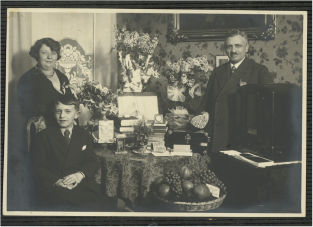
The Adlers’ and the Hungerleiders’ furniture was supposedly within this pile.Footnote 50 A photograph of Fritz Hungerleider’s bar mitzvah has survived, which gives us a glimpse of the dimension of loss. Here, we see proud young Fritz in front of the table with gifts (among them the gramophone to the right) with his parents in their living room in a bourgeois Viennese flat. The room is filled with antiques and ornaments, such as paintings and vases, and an oriental carpet; to the right, a radio is recognizable in the dark, as is a cabinet with porcelain (Figure 3). We might surmise that some of these belongings were also tucked away in a warehouse in Trieste.
Bar mitzvah of Fritz Hungerleider, 1933. In Daniela Pscheiden and Danielle Spera, eds., Die Wiener in China: Fluchtpunkt Shanghai/ Little Vienna in Shanghai, catalogue of the exhibition within the Jewish Museum Vienna (Amalthea Publishing House, Vienna, 2020), p. 196.
After the occupation of upper Italy in autumn 1943, Trieste, and with it the gigantic stock of goods, had now come to the Reich, so to speak, and thus into the area of application of the eleventh ordinance, according to which a Jewish refugee lost all his assets the moment he crossed the border. The theft could begin. The euphemistic Nazi term for this kind of reuse is Verwertung, which means ‘recycling’.
Supposedly German or ‘alt-österreichisch’ (literally: ‘old Austrian’, a label invented by Austrian Nazi functionaries to stake their claim on this part of the loot) cultural property was thus taken over, distributed, and utilized by passing it on to ‘needy fellow citizens’. We see here the perversion of the idea of trusteeship: by using the so-called ‘trustee takeover’ of Jewish property to requisition cultural assets and valuables in ‘trustee offices’ or through a ‘general trustee’, the looting was officially legitimized and elevated to the interest of the state. The examples described show the National Socialist reinterpretation of the term, which clearly excluded loyalty to the original Jewish owner, who had been expelled from the Nazi community, the Volksgemeinschaft. In addition, the propagandistic exaggeration and identity-forming dimension of the term, which was applied above all with regard to cultural assets recognized as German or old Austrian, that is, to be protected, is evident. The redistribution of goods created not only a considerable circulation of objects but also a hierarchy of cultural assets that were suddenly in the national interest.
From 1944 onwards, it was decided to transport the Jewish removal goods by lorry to Klagenfurt in order to create space in the free port. The value of goods was estimated in the warehouses in Trieste, and the subsequent transport organized.Footnote 51 Above all, the ‘utilization’ of these goods was to begin, for they were considered by Austrian Nazis as belonging to Austria and thus being ‘old Austrian property’.Footnote 52 In this vein, it was a project of claiming imperial continuity. The ideal partner for such an undertaking was quickly found: the then state-owned Austrian auction house Dorotheum, with a branch in Klagenfurt.Footnote 53 In several convoys, countless lorries, some of them even from the same forwarding companies that had taken the removals out of Vienna, brought the cultural goods to Klagenfurt.
What happened next is only dimly discernible from the files. Apparently, the containers were opened in Klagenfurt and the stock was sorted according to categories of goods: paintings, furniture, clothing, jewellery, watches.Footnote 54 From photographs, we have evidence of a warehouse full of chairs, and another of wristwatches, apparently already marked with the lot numbers of the Austrian auction house Dorotheum, which contained the price estimates necessary for an auction. The freight company Adria (Güterverkehrsgesellschaft Adria, GVGA) was founded to co-ordinate the sale of the acquired goods.Footnote 55 Everything that the Dorotheum’s valuers thought could not be auctioned was subsequently given to the NSV (National Social Welfare Organization) to help bombed-out (Aryan) families in the Reich with furniture and clothing. In the summer of 1944, however, the railway transport space for such goods was almost non-existent, thus large stocks of these remained in the Carinthian depots, for example, in Silberegg Castle. There, they were looted by locals when the British occupation troops moved in during spring 1945,Footnote 56 so that only debris was found when the Allies were finally able to bring peace.
Through the process of sorting and valuing items, provenance was generally completely lost. Later, attribution to individual removal loads and thus to the victims of the Holocaust and possible survivors who asserted their claims was only possible in a very few cases – for example, in the case of paintings that could be clearly identified.
IV
The surrender and dissolution of the German Reich brought about a division of Germany and Austria into two separate countries again, and each in four separate occupation zones headed by the Allies. In Austria, British troops took over administration in Styria, Eastern Tyrol, and Carinthia, and thus found themselves confronted with looted warehouses full of ‘ownerless property’.Footnote 57 The British occupation zone administration was unable to identify the origins of the looted goods, and obviously the Austrian officials were not eager to tell them.Footnote 58 Thus, Officer John Bryan Ward-Perkins of the Subcommission for Monuments, Fine Arts, and Archives encouraged the head of the auction house Dorotheum, Hans Fink, to sell the ‘ownerless goods’, after some minor attempts had been made to identify legal owners, which soon proved impossible, due in part to the sorting of the goods, but also to the nature of the auctions, which did not register the name of the vendor.Footnote 59
This involved the apparent deception of the Allies by local Austrian officials. The British officer Ward-Perkins, following a briefing by the Klagenfurt Dorotheum director, Fink, assumed that there were ‘nine boxes of looted goods’, all ‘second rate stuff’. Instead, the loot was much greater.Footnote 60 According to the figures – the files on this are in the Austrian State Archive (Oesterreichisches Staatsarchiv) – almost 8,000 loads (‘colli’) from almost 2,000 households ended up in Carinthia, where they were distributed and re-sorted.Footnote 61 Around 3,000 colli initially remained in Trieste and were then transferred to the Silberegg depots. A total of 314 boxes actually reached Berlin, with 300 tons going to the NSV Salzburg, which donated the goods to people in need. The British encouragement to also hold auctions in Vienna then finally led to a brisk trade, and a large part of these goods being auctioned off, unfortunately without documentation about the buyers; the Dorotheum netted around 78,845 Reichsmarks from these ‘Masse Adria’ sales.Footnote 62 Since the files are incomplete, as the perpetrators covered up the traces of their theft, a complete reconstruction is not possible.
After the conflict ended in the European and Pacific theatres of war, the refugees were eager to move on. China, war-torn and shaken by an ongoing civil war, had asked all foreign nationals and stateless people to leave the country by early 1948. United Nations Relief and Rehabilitation Administration (UNRRA) helped in resettling many of the ‘Shanghailanders’ by ship to the United States, Australia, Palestine, and even back to their home towns in Europe, if they so wished.Footnote 63 The tragedy is particularly evident in photographs of the time showing returning Jewish refugees, and although we cannot distinguish individuals in the images, we know that Adler and Hungerleider were amongst them: Viennese survivors who, in November 1947, were brought by train in cattle cars from Naples to Vienna after a passage by ship from Shanghai to Genoa,Footnote 64and were greeted at the Westbahnhof by Mayor Theodor Körner, who later became the first federal president of Austria. Survivors literally came back to Vienna with a small carry-on suitcase, and there was hardly any governmental help for them, let alone apartments, furniture, or clothing, as the reports of the Austrian History Commission in the early 2000s testify.Footnote 65
What no one knew at the time was that some of the victims’ removal goods were still stored in the warehouses taken over in trust by the Republic of Austria from 1951 onwards, and it was not until the end of the 1950s that the last of the stocks were sold.Footnote 66 After the State Treaty of 1955, Article 26, Paragraph 2, it was regulated at least that these ‘ownerless’ assets had to be sold for the benefit of the Nazi victims.Footnote 67
Returning to our case-studies, we see a mixed result concerning restitution.Footnote 68 Ferdinand Adler restored his reputation as an artist. He founded the ‘Adler Quartet’ in 1947 as soon as he returned, and by 1950 was promoted to Konzertmeister again, in the Vienna state opera. Unfortunately, in 1952 he suffered a heart attack during a rehearsal at the opera, and died with his violin in his hand, aged only forty-eight. As property and pensions had not been restored, his widow had to leave Vienna to settle with relatives and sold for financial reasons the violin which had saved the family’s income so many times. The poor conditions forced the widow to move to relatives in Kufstein with her young daughter Christina, born in 1945, and the archival correspondence on her modest widow’s pension shows her distress, and the absence of recognition of the period of exile in Shanghai.Footnote 69
Of the approximately 100,000 Jews expelled from Vienna, only 8,000 returned in the first post-war decade. To regain property and citizenship, however, one needed to make the request from Austrian soil, and be living in the country again. As most refugees had arrived in their new destinations abroad nearly penniless, they could not afford to travel back to Europe after the war to reclaim Austrian citizenship. But to reclaim property, one needed to be an Austrian citizen. It was a vicious circle. Thus, the overall story of redress in Austria is a sad one.Footnote 70 Through a legal framework where restitution law protects the former legislators, the post-imperial Austrian nation-state remained callous towards Austrian Jews, replicating their former exclusion from basic citizens’ rights. In this regard, Austria compares with other case-studies highlighted in this special issue, for example Banerjee’s case-study on India after Partition and its behaviour towards Bengali refugees, or Yang’s case-study on the Dachen islanders’ treatment by China.
Fritz Hungerleider, together with his wife Ingeborg, was also on the ship Marine Falcon which returned to Europe from Shanghai in January 1947. After a fierce legal battle, the Hungerleider family regained their house within the 3rd district of Vienna and their bank assets. When looking at the files, survivor activism and agency becomes especially apparent: attorneys specializing in restitution law offered their help, and the Fonds zur Abgeltung von Vermögensverlusten politisch Verfolgter, in short Abgeltungsfonds (compensation funds), did intensive research into old property files for houses and at banks or the state finance department, to procure papers lost during refugeedom. Only these concentrated efforts helped to bring about a positive result (in Karoline Hungerleider’s case, as late as in 1972, which is twenty-three years after their return from exile in Shanghai, and thirty-three years after their expulsion from Vienna). That was however lucky: Ingeborg Hungerleider’s parents and brother resettled in the US, never obtaining their property back.
Very few of the returnees succeeded in regaining their homes and businesses, practices, or law firms in the years that followed as they rebuilt their lives in Vienna.Footnote 71 Restitution policy in Austria was a very onerous process, with a lot of considerable obstacles to reclaiming property.Footnote 72 The first restitution law, for example, dealt only with objects in the possession of the Republic of Austria, which could be reclaimed – goods acquired by individuals were excluded from restitution processes.Footnote 73 This wrong was rectified by the third restitution law in 1947, which finally dealt with looted Jewish property; however, claimants needed to launch their claim from Austria. Only in the mid-1960s was this practice changed, as a result of the signing of the State Treaty of 1955. Article 26, Paragraph 1, imposed an obligation on Austria to return property and restore legal rights and interests which had been forcibly transferred, sequestrated, confiscated, or controlled since 13 March 1938 based on the racial origin or religion of the owner.Footnote 74
When looking into the files at the Austrian State Archive, we can see evidence of fierce legal battles for redress. The Hungerleider family was lucky to get at least some of their property in Vienna back, namely the house and sequestered bank accounts. The files show that they first received a rejection in 1956 due to ‘missing information’,Footnote 75 but then received compensation by way of appeal. Karoline Hungerleider received the bank accounts of her deceased husband back only in January 1972.Footnote 76 An interesting detail of the Hungerleider case is that the house was immediately restituted in 1949 – but only on the grounds that Karoline, the wife of a Viennese Jew, was Catholic and she was the owner of the house.Footnote 77 And if there was no atonement in the sense of restitution of property under civil law from the victims’ point of view, what about atonement under criminal law? Neither the auction house nor the cultural employees who were later to make careers in Austria – Walter Frodl is the best-known example of thisFootnote 78 – ever stood trial for their complicity in the theft.Footnote 79
So, while the Viennese returnees from Shanghai had to climb out of their train which was an unheated cattle wagon and improvise a new start in spartanly furnished flats, their furniture and carpets lay in huge warehouses in Klagenfurt, Vienna, and Trieste. They were gradually, and rather quietly, emptied, with the state auction house transferring the profits to a state account in Carinthia until 1951. In this regard, Austria compares with the behaviour of India when trying to make a profit from refugee property, as scrutinized by Shuvrati Dasgupta in her contribution to this special issue, ‘Indian women, refugees, and decolonization across India, British Malaya, and China, 1940–1953’. Such patterns show clearly the limitations of imperial dissolution and decolonization of administrative practice in post-imperial societies.
A particular obstacle to retrieving Jewish assets from the ‘Masse Adria’ loot was the fact that they were sold in an auction house, and the names of vendors were often no longer identifiable. The issue of ‘bona fide acquisition’ during a public auction posed additional difficulty: in legal terms, the Dorotheum auction house was not responsible for the looting, only for the selling.Footnote 80 Thus, neither the Dorotheum nor the individual who bought the object could be held liable, and so no light was shed on state law protecting companies, and the role of auction houses fostering Nazism was never engaged with. The legal hurdles over compensation and restitution from the Dorotheum were still pressing in the 2000s, with claims raised in the US courts against the auction house by Jewish owners or their descendants, e.g. Anderman v. Federal Republic of Austria (2003)Footnote 81 and Whiteman v. Dorotheum GMBH (2005).Footnote 82
There were few Austrian post-war trials for the theft that occurred under Aryanization laws, and only two against VUGESTA officials, and these were for fraud.Footnote 83 In Italy, on the other hand, there were several criminal proceedings for the theft that took place in Trieste, especially from Jews there.Footnote 84 The trials reveal, however, not so much an interest in the return of objects to victims of the Holocaust, but more in national narratives of ‘belonging’ and a kind of reckoning with the past by punishing collaborators. Interestingly, many women were targeted in this. These included Cecilia Villeni and Augusta Reis, who worked as interpreters in these property raids, as well as the secretary of the Gauleiter, Erminia Schellander.
In essence, Italian post-war justice in Trieste targeted three women, who had probably been born in Trieste during the Habsburg period and lived as upright citizens until the end of the Great War, and had been given low-paid jobs in the German occupation administration in the Second World War because of their language skills, and were then punished for this by Italian society. By scrutinizing these cases, we see how women in subaltern positions, as secretaries or translators, were particularly vulnerable to being targeted as traitors. The post-imperial nation-states seemed to invent new forms of criminalizing actors in order to create stable and monolingual national identities. This strategy is also highlighted in the contribution by Dina Gusejnova to this special issue, ‘Loyalty and allegiance in Baltic German political thought after the First World War’, which centres on the tension between pluricultural identities and monolingual nation-states.
V
This article has shown how global refugee history can benefit from a consideration of the materiality of objects, and highlighted the relationship between citizenship/law, property, and emotions across these connected and divergent geographies of people and objects and their transnational moves. As we have seen, there is a tension between the forced mobility of people (the refugees) and the forced mobility of objects (the refugees’ assets and property) where they do not actually travel together.
Is restitution or redress an answer for the emotional and material loss refugees had to endure? Since the adoption of the Austrian Art Restitution Act of 1998 prescribing the return to the original owners or their heirs of art objects from federal museums and collections (sections 1 and 2),Footnote 85 and following considerable pressure from Jewish organizations who were backed by the US government, and the legendary court battle in 2006 over Klimt’s painting known as the ‘Woman in Gold’, which had to be restored to the victims, Austria has been at the forefront of a movement which understands property as creating identity. In accordance with this shift in perception, Austrian laws of redress have also been modified.
A clear shift in perspective is discernible in international discussions, at least with regard to Holocaust crimes. What in 1945 was apparently of little concern to anyone, not least due to continuities in authorities and unbroken post-war careers of the beneficiaries, namely the continuing deprivation of rights and the lack of effort to give the victims back their property, as well as their dignity, has since changed. From a practical point of view, however, regaining Austrian citizenship was a difficult and protracted process, and many victims died in the course of the lengthy proceedings. Today, the opposite is the case; even grandchildren of Holocaust victims are welcome to apply for Austrian citizenship. During the first half of 2022, Austrian citizenship was granted to 8,158 people, of which 2,421 (of whom 2,396 live abroad) were granted Austrian citizenship under §58c (for survivors), which corresponds to 29.7 per cent of all naturalizations.Footnote 86
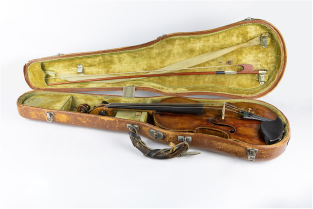
Many objects have been restituted since the ‘Woman in Gold’ left Austria in 2006, although provenance research remains a very cumbersome business, as there is scant archival evidence for the context of the thefts. Therefore, claims are being raised to strengthen research (and staff) for retrieving such objects.Footnote 87 If restitution is possible, objects are handed over in public ceremonies, thus restoring – albeit belatedly – a bit of family history and dignity to survivors and their families. During an exhibition in the Jewish Museum in Vienna in 2020 on the Viennese refugees in Shanghai, the violin of Ferdinand Adler was offered back to the museum, which was a great joy for his daughter in terms of healing a wound (Figure 4). The truth is, however, that outside of exceptional cases, most of the personal property remains undiscovered and will never be restituted to its owners.
Violin of Ferdinand Adler at the Jewish Museum Vienna. Photo: Sebastian Gansrigler, Daniela Pscheiden and Danielle Spera, eds., Die Wiener in China: Fluchtpunkt Shanghai/ Little Vienna in Shanghai, catalogue of the exhibition within the Jewish Museum Vienna (Amalthea Publishing House, Vienna, 2020), p. 155.
In scrutinizing Jewish memoirs and recollections, we get a glimpse of how the victims felt about their lost property. What does loss of property mean in terms of national identity, culture, etc., and what effect does restitution policy have on this? Perhaps surprisingly, it seems that it is not the loss of the large possessions and assets, in particular houses and bank accounts, which leaves the greatest wounds, even decades after the event. Identity relevance is constructed through personal belongings, such as special china, lost toys, and musical instruments, to offer just a few examples.
If we think of Else Leichter and her nightmare about leaving an untidy desk, we have a representation of being torn from one’s business in the midst of work – and being able to transfer only knowledge to the new lands, not files and the recorded experience of decades. Many refugees did not cope with that symbolic loss and were never to regain a comparable professional position. Else was a transmitter of knowledge between Europe and North America, as through her exile she became a pioneer of youth welfare policy in the United States.Footnote 88 Long after the war, she returned to Austria, to become an honoured guest speaker and honorary citizen of Vienna. Only then did she eventually stop having the nightmare, she admitted in a later interview.Footnote 89
The process is ongoing. Recently, paintings from the ‘Masse Adria’ loot have been identified and restitution is underway. These items were only identifiable as they showed family portraits – and those had been excluded at the time from the Dorotheum auctions. Invitations to Vienna and letters from the government issued to survivors’ families constitute another tool of redress.
By scrutinizing the musical objects of Ferdinand and Fritz and their circulation, these two examples have sketched a wide geography of dissolution, focusing on how Nazi Germany reclaimed the Habsburg (seen as ‘old Austria’) legacy to claim Jewish property. The article has further highlighted the tensions between the Nazi and fascist Italian empires during the war over claims to this landscape of property; and has shown, finally, how the post-imperial Austrian nation-states cheated the former Jewish citizens of the Habsburg empire by failing to give them back citizenship, property, and belonging – a failure that has only very slowly begun to be overcome through transnational legal action.
On another level, we see through this lens the failures of post-imperial nation-states to ensure the well-being of people who had become refugees as a result of their predecessor’s state policy. Post-imperial Austria may thus be compared here with the post-colonial Indian state and the Kuomintang state in Taiwan.Footnote 90 This study has also shown the agency of refugees in addressing these failures through various forms of political and legal collective action, until a gramophone or a violin was returned to its rightful owner, thereby centring refugee voices and polis in the very long story of post-war resettlement.
Funding statement
Research stays for this project were partly funded by the European Union (ERC GLORE, ECGA Nr 101053242). Views and opinions expressed are however those of the author only and do not necessarily reflect those of the European Union or the European Research Council Executive Agency. Neither the European Union nor the granting authority can be held responsible for them.


 Open access

