


1 Introduction
Traditionally, successful automobile design is characterized by a combination of technical manufacturing quality and customer-oriented perceived quality (PQ); see, e.g., Petiot et al. (Reference Petiot, Salvo, Hossoy, Papalambros and Gonzalez2009). While the viewpoint of manufacturing quality as a ‘conformance to specification’ (Juran Reference Juran1993) is straightforward and quantifiable, perceived quality refers to customers’ cognitive and emotional responses to a particular design (Norman Reference Norman2013). In industrial and academic practice perceived quality is often also associated with craftsmanship (Hossoy et al. Reference Hossoy, Papalambros, Gonzales and Aitken2004).
Identification and evaluation of attributes mapped to PQ are ongoing challenges in design research and industry (Yumer et al. Reference Yumer, Chaudhuri, Hodgins and Kara2015; Burnap et al. Reference Burnap, Hartley, Pan, Gonzalez and Papalambros2016; Stylidis et al. Reference Stylidis, Rossi, Wickman and Söderberg2016; Ma et al. Reference Ma, Ding, Qin, Li, Yan, Xiao and Yang2017; Lin & Tseng Reference Lin and Tseng2018). Designing a new generation of a product is an additional challenge when we aim to maintain the balance between novelty and perceived quality. Billion-dollar decisions in the automotive industry often rely on predictions and assumptions about how a customer will perceive and evaluate a new automobile. Industry requires a product development methodology that is able to evaluate a degree of novelty for the new product generations and control the desired level of perceived quality conforming to the market target. In this context, Product Generation Engineering (PGE) is a conceptual framework describing product development processes related to the creation of new product generations (Albers, Bursac & Wintergerst Reference Albers, Bursac and Wintergerst2015), and Perceived Quality Framework (PQF) is a classification system that reflects human perceptual processing to delineate, test and explore product designs (Stylidis, Wickman & Söderberg Reference Stylidis, Wickman and Söderberg2015). The Perceived Quality Attributes Importance Ranking (PQAIR) method is tailored to assist a designer in the assessment of relative importance of PQ attributes for the final product, by capturing subjective customer preferences and subsequently translating them into importance score measures (Stylidis, Wickman & Söderberg Reference Stylidis, Wickman and Söderberg2018).
The challenge for the automotive industry is to find a balance for perceived quality that accounts for existing technologies, product development time, capacity of production systems, and financial limitations. For this reason, perceived quality has to be predicted and controlled during all stages of the product development process. In this brief we look at the use of the PQF and PQAIR methods in combination with PGE as a holistic approach for designing new generations of products with a desired level of perceived quality. We analysed a retrospective case from the premium market segment of the automotive industry, specifically the development of haptic input systems in the centre console for the Porsche Panamera automobile. At this point engineers and designers usually face questions of balancing the importance of perceived quality attributes: Which components of the vehicle convey ‘premiumness’ and ‘high quality’? Where should money be spent and which PQ attributes make a difference for the customer (Law & Evans Reference Law and Evans2007)? And, which PQ attributes have to be improved, disregarded or carried over to the next generation of the vehicle? To address these questions, we combine the PQF and PGE methods to assess product quality for a new generation of products.
The remainder of this brief is as follows: Section 2 introduces the background regarding the evolution of perceived quality concepts, PGE, PQF and PQAIR; Section 3 describes a retrospective case scenario regarding use of PQF and PQAIR in PGE; Section 4 discusses perceived quality in the context of the next generation of a product, product quality and paradigm change, and offers limitations and recommendations for further research.
2 Background
The multidimensional nature of perceived quality is widely recognized. A considerable amount of research, including a variety of perceived quality definitions, has been conducted in the past (Shapiro Reference Shapiro1970; Olson & Jacoby Reference Olson and Jacoby1972; Gilmore Reference Gilmore1974; Crosby Reference Crosby1980; Garvin Reference Garvin1984; Zeithaml Reference Zeithaml1988; Steenkamp Reference Steenkamp1990; Reeves & Bednar Reference Reeves and Bednar1994; Mitra & Golder Reference Mitra and Golder2006; Aaker Reference Aaker2009). Two major viewpoints on quality can be noticed: a customer-centric marketing research and a manufacturing approach to quality known as ‘conformance to requirements’. Both approaches share a common agreement – they see perceived quality as the antagonistic entity to ‘real’ or ‘objective’ quality (i.e., not quantifiable, imaginary, subjective). Only recently an erratic shift towards ‘objectification’ of the perceived quality concept has been spotted, with some scholars proposing quantification approaches to perceived quality (Golder, Mitra & Moorman Reference Golder, Mitra and Moorman2012; Quattelbaum et al. Reference Quattelbaum, Knispel, Falk and Schmitt2013; Amini et al. Reference Amini, Falk, Hoth and Schmitt2016).
The important methodology for measuring the impact of certain products on the customer is Kansei Engineering (Nagamachi Reference Nagamachi1995). Kansei follows the ‘classic’ definitions of product quality and focuses on the subjective or emotional factors of product quality, with the main purpose of quantifying these factors. Notably, ‘whereas classic car engineering would focus mostly on manufacturing ability, performance, and usability, Kansei Engineering (especially the Type I) initiates its process based on providing the user with a targeted impression and then processing the entire project around this intention’ (Levy Reference Levy2013). Previous research introduced the ‘engineering’ approach to perceived quality (Stylidis et al. Reference Stylidis, Wickman and Söderberg2015).
In contrast to a rigid, formal definition of manufacturing quality as ‘fitness for use’ – engineering tradition regarding perceived quality is to produce events that make a customer aware of how things are done (e.g., craftsmanship). Initially an ‘engineering’ notion of perceived quality appeared as a part of bigger models, i.e., in the field of Robust Design and particularly in the area of Geometrically Robust Design (Soderberg & Lindkvist Reference Soderberg and Lindkvist1999). These research methodologies recognized PQ as a consequence of the manufacturing processes (Wickman & Söderberg Reference Wickman and Söderberg2007; Wagersten et al. Reference Wagersten, Forslund, Wickman and Söderberg2011). Recent advancements in the area of Robust Design also integrated perceived quality into industrial applications (Howard et al. Reference Howard, Eifler, Pedersen, Göhler, Boorla and Christensen2017; Pedersen, Howard & Eifler Reference Pedersen, Howard and Eifler2017). To sum up, the interdisciplinary approach to perceived quality appeared only recently, likely in response to the industry needs. Hitherto, no methodology has been presented that focuses on perceived quality as a vantage point for product development. The perceived quality evaluation process is often performed in the industry as a ‘hit or miss’ action.
2.1 Product generation engineering
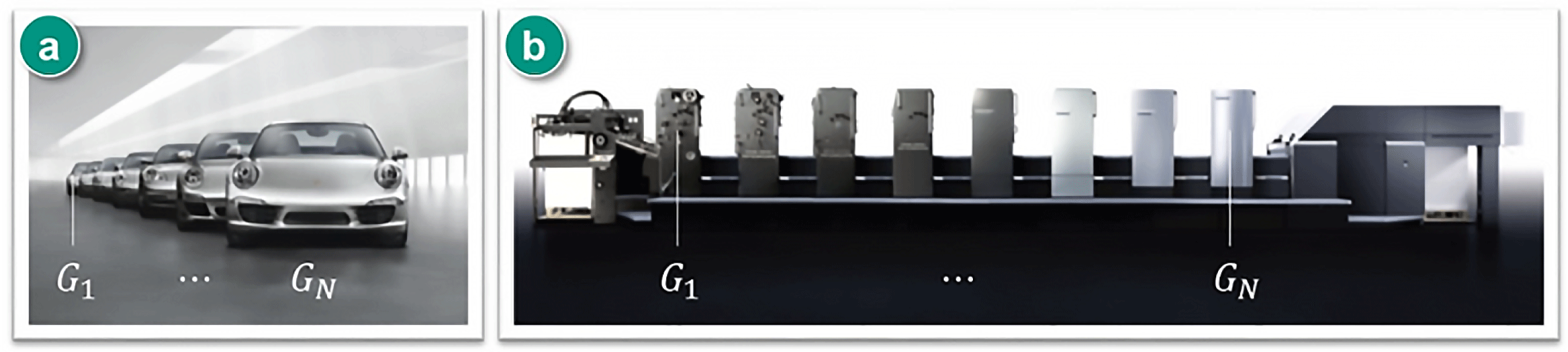
A new product today is rarely an outcome of new developments. The focused modification of existing proved solutions to realize new product functions and attributes seems more practicable due to the economic risks (Deubzer & Lindemann Reference Deubzer and Lindemann2009; Eckert, Alink & Albers Reference Eckert, Alink and Albers2010). The development of a new generation of technical products by combining specific variations of subsystems, in order to carryover from existing products on the one hand and to develop a new product on the other, is understood as PGE. The new development of subsystems can be further distinguished in the activities of embodiment variation and principle variation, which describe the use of new solution principles for the considered subsystem. Principal variation is always accompanied by embodiment variation. The new product generation is based on one or more existing reference products, which can be precursory products or products from competitors. Reference products are used as the basis for the development of the new product generation and serve the fundamental product structure. Newly developed subsystems of a new product generation should create functions and attributes that enable differentiation of the new product from the reference product(s) and therefore efficiently improve customer value (Albers et al. Reference Albers, Bursac and Wintergerst2015). Examples of PGE are the Porsche 911 and printing machines by Heidelberger Druckmaschinen AG, as shown in Figure 1.
PGE from $G_{1}$
to
$G_{1}$
to $G_{n}$
using the example of products from Porsche (a) and Heidelberger-Druck (b).
$G_{n}$
using the example of products from Porsche (a) and Heidelberger-Druck (b).
2.2 Perceived quality framework
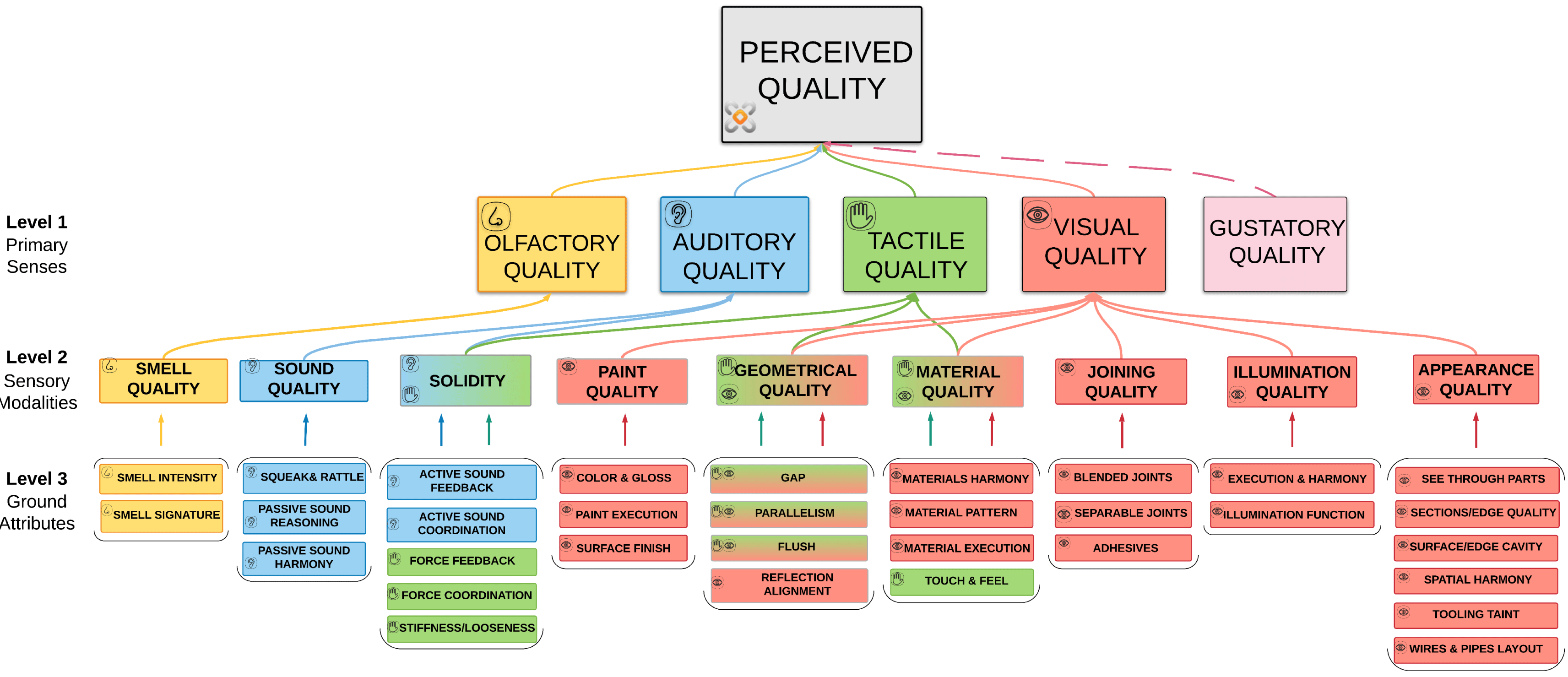
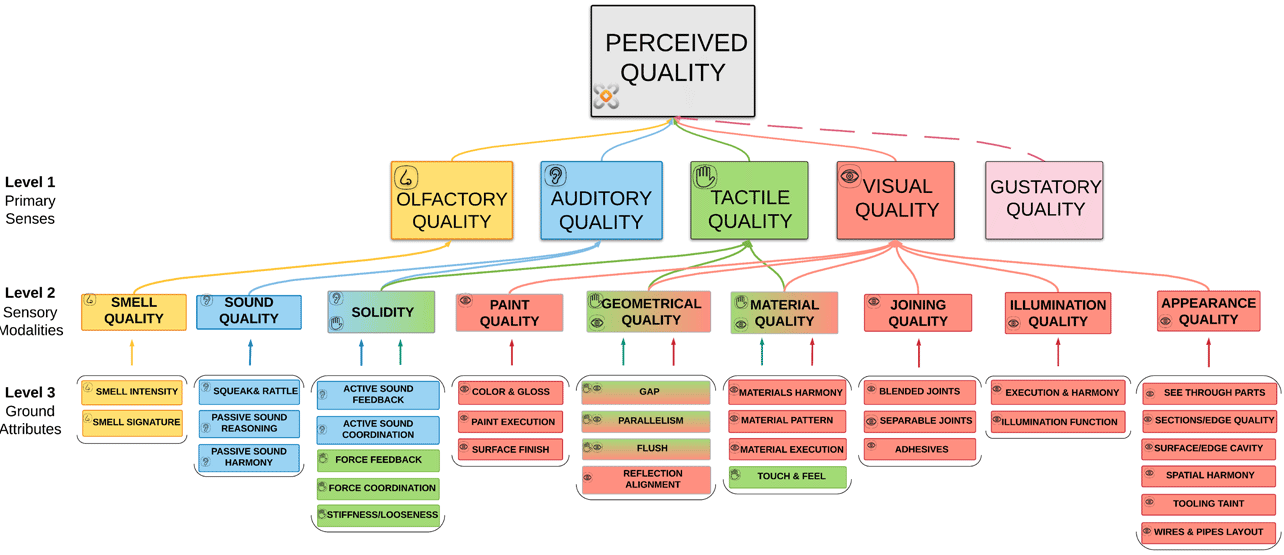
In practice, the vehicle design space is described by product attributes. Product attributes are responsible for the requirements definition. The quality perception process is a physical and cognitive event, usually triggered by a physical signal received by our sensory apparatus. The information obtained through the human senses forms the basis of human experience. Thus, it is possible to communicate the quality of product attributes as a customer’s sensorial experience. The majority of perceived quality attributes can be described by one of the sensory categories, or by several in combination. Therefore, the PQF reflects human perceptual processing to delineate, test and explore product designs (Stylidis et al.
Reference Stylidis, Wickman and Söderberg2015). Quality perception based on primary senses forms the first level of perceived quality attributes; Visual Quality, Tactile Quality, Auditory Quality, Olfactory Quality, and Gustatory Quality. The second attributes level of PQF is organized into sensory modalities. Sensory modalities are the nine distinctive sets of perceived quality attributes encoded for presentation to customers. The baseline of PQF is the ‘ground’ attributes – a ‘lowest point’ where designers are still able to communicate technical details to customers and receive meaningful feedback. To avoid ambiguity, every ground attribute is coherent to a customer’s experience so that the PQF can stand as a meaningful frame of reference for both the designer and customer. The sensory modalities ( $m=9$
) and ground attributes (
$m=9$
) and ground attributes ( $n=32$
) are also colour-coded, depicting a human sensory system involved in their assessment (see Figure 2).
$n=32$
) are also colour-coded, depicting a human sensory system involved in their assessment (see Figure 2).
Attributes levels of the PQF.
Eventually, a customer must be able not only to understand the meaning of each ground attribute but to rank these attributes and prioritize their importance among the others. Such customer feedback is critical in the search for equilibrium for a quality equation within the Original Equipment Manufacturer (OEM) design and assessment activities regarding perceived quality.
2.3 Perceived quality attributes importance ranking method
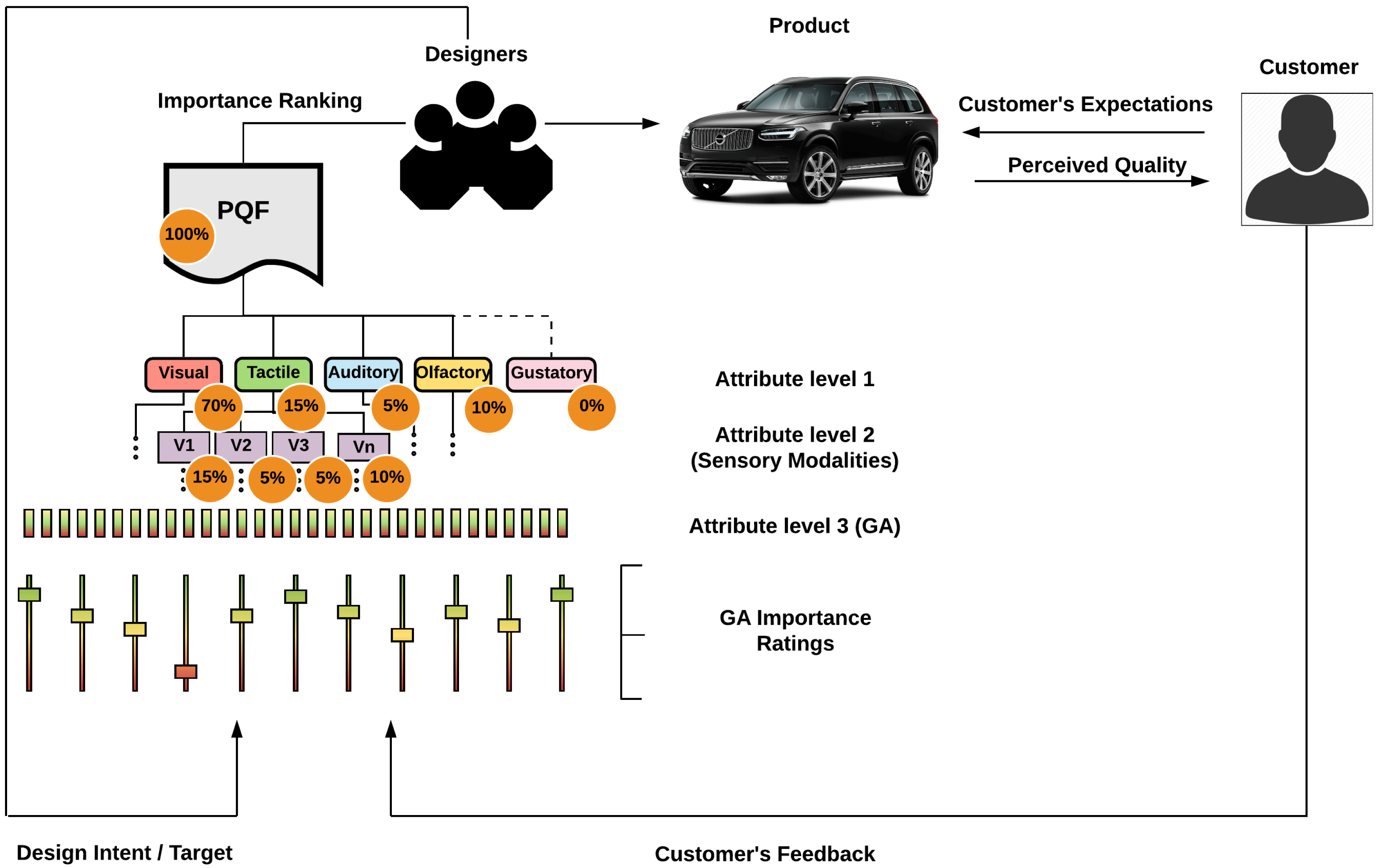
Perceived Quality Attributes Importance Ranking (PQAIR) method is designed to assist in the decision-making process regarding evaluation of the perceived quality attributes relative importance for the final product design (i.e., a complete vehicle or part of it). The core idea of the method is that all identified ground attributes are ranked regarding their importance to the customer. Eventually, aggregated rank-order information from customers is augmented with the impact factors (assigned at variance to the ranking of each ground attribute), and integrated into the PQF, resulting in an importance score for each branch, at all levels (see Figure 3).
Each identified ground attribute is mapped in the PQF and importance ratings are calculated per attribute on each level.
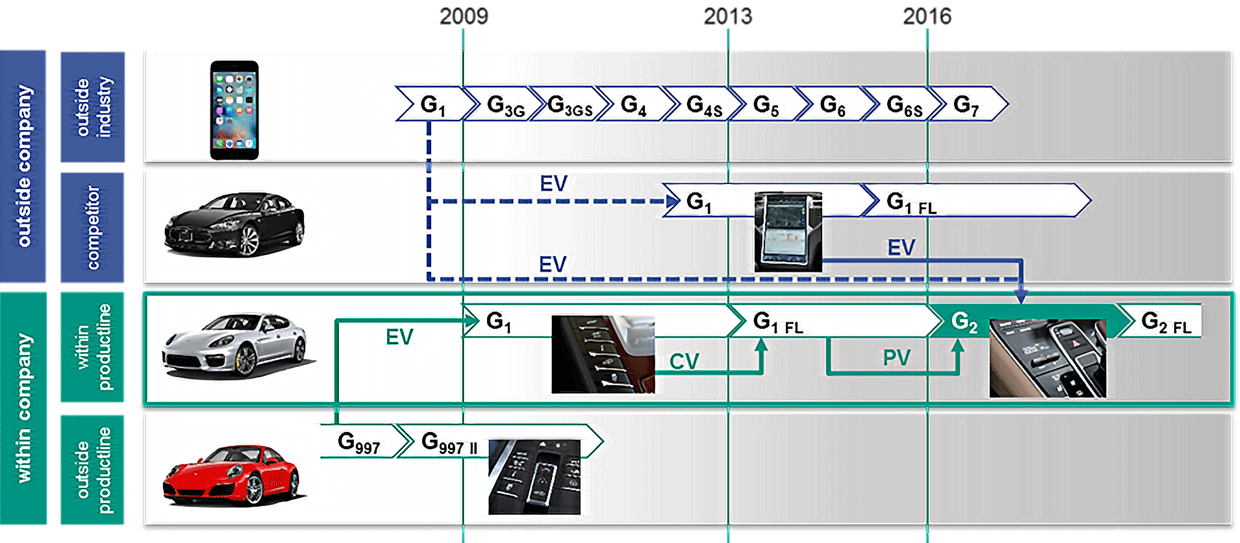
Origin of reference products in the example of centre console development (Pictures from Apple, Porsche and Tesla).

The choice of methodology regarding obtaining initial rankings of ground attributes must consider the company’s needs, goals, and available resources. For example, to rank attributes a company can utilize either internal knowledge inside the OEM (e.g., customer clinics, interviews, internal customer-related feedback, natural language processing, and big data) or use quantitative methods to measure customer preferences for perceived quality attributes (e.g., conjoint analysis and its derivatives). As a result, the company receives the importance score for each perceived quality attribute considering the PQF as a reference model for perceived quality assessment (Stylidis et al. Reference Stylidis, Striegel, Rossi, Wickman and Söderberg2019). The modalities with the highest score indicate product areas where engineers have to focus in order to achieve the desired level of perceived quality. Overall, the process can be ‘single stage’ or iterative until the OEM is satisfied with the outcomes.
3 Application of PQF in the context of PGE: development of haptic input devices
To illustrate perceived quality assessment during the development of different product generations, we present the retrospective study of the Porsche Panamera centre console haptic input devices design.
Typically, the product portfolio of an OEM consists of several model series. These are related to the brand. Targets for future product generations must therefore also be aligned with the brand strategy. To leverage maximum synergy effects, subsystems are used across model series. Both carryover and embodiment variations are used for this purpose. The development of systems of objectives is orientated towards competitors. The development of competitors is anticipated for the period of the market entry for the considered product generation. It is also necessary to react to technological innovations by competitors in the later stages of the development process. New technologies can also be developed outside the industry. The different boundary conditions must be taken into account, in particular for the integration of subsystems across industries. Of central importance is the diversity in the product life cycles, as well as requirements regarding safety use cases.
Different reference products for the subsystem of the central console are depicted in Figure 4. These reference products can be found in the company, such as the predecessor, and outside the company. In this case, with regard to the smartphone, even a reference product from another industry can be found.
In the first generation ( $\text{G}_{1}$
) of the Panamera, operational keys were implemented in an ascending central console according to the brand strategy. This conveys the brand-defining sports car icon Porsche 911 as a current generation at that time. The keys were built as hard keys with a mechanical pressure point. The surface was made of plastic. Evaluating the development of facelifts (
$\text{G}_{1}$
) of the Panamera, operational keys were implemented in an ascending central console according to the brand strategy. This conveys the brand-defining sports car icon Porsche 911 as a current generation at that time. The keys were built as hard keys with a mechanical pressure point. The surface was made of plastic. Evaluating the development of facelifts ( $\text{G}_{1}$
FL), there are, for the most part, carryover variations related to the basic design of the interior. This is typical in the development of facelifts for cost and production reasons and can be observed with most manufacturers. Therefore, the keys in the centre console were designed as carryover parts.
$\text{G}_{1}$
FL), there are, for the most part, carryover variations related to the basic design of the interior. This is typical in the development of facelifts for cost and production reasons and can be observed with most manufacturers. Therefore, the keys in the centre console were designed as carryover parts.
The second generation of the Panamera ( $\text{G}_{2}$
), introduced in 2016, was altered in shape and function. Competitors were increasingly using wide touch displays, which was also been implemented in this generation. Capacitive buttons were implemented to convert the operating sensitivity and degrees of freedom similar to smartphones. An entirely new design of the centre console was established, which differentiated the haptic and optical perception of the product in comparison to previous product generations.
$\text{G}_{2}$
), introduced in 2016, was altered in shape and function. Competitors were increasingly using wide touch displays, which was also been implemented in this generation. Capacitive buttons were implemented to convert the operating sensitivity and degrees of freedom similar to smartphones. An entirely new design of the centre console was established, which differentiated the haptic and optical perception of the product in comparison to previous product generations.
Retrospectively we examined a scenario of the Panamera ( $\text{G}_{2}$
) centre console design using PQF. This case is a compilation of the authors’ experience with real cases from the automotive industry. The current scenario answers the following question: ‘What if the product developers at the early development phase had information regarding the customers’ assessments and importance of perceived quality attributes that are responsible for high perceived quality of the vehicle’s centre console?’
$\text{G}_{2}$
) centre console design using PQF. This case is a compilation of the authors’ experience with real cases from the automotive industry. The current scenario answers the following question: ‘What if the product developers at the early development phase had information regarding the customers’ assessments and importance of perceived quality attributes that are responsible for high perceived quality of the vehicle’s centre console?’
Retrospective scenario for the product development process of the Panamera second generation centre console using PQF in the context of PGE (Pictures from Porsche and Tesla).
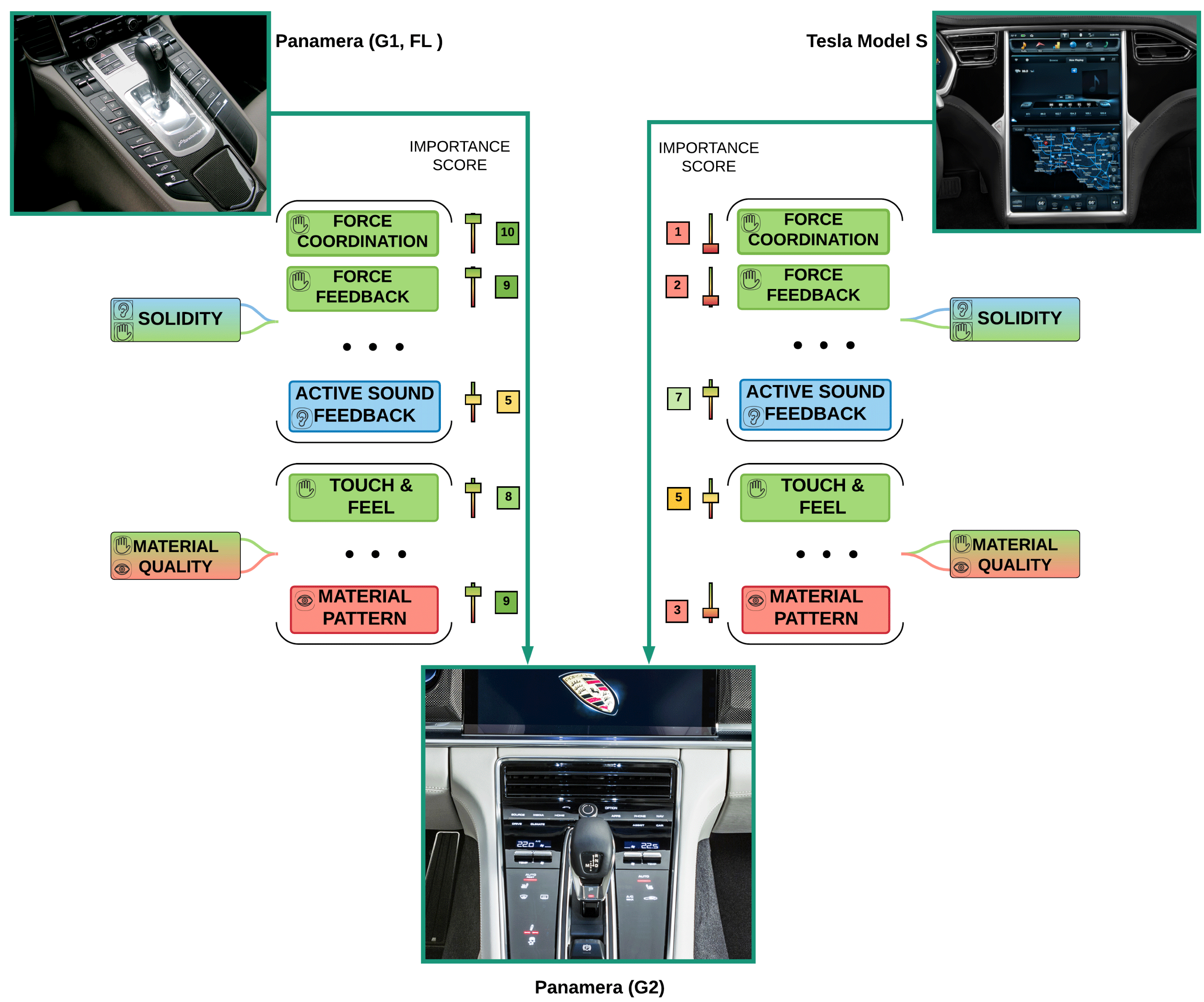
In this case, the Panamera ( $\text{G}_{1}$
FL) centre console was assessed with regard to the sensory modalities ‘Solidity’ and ‘Material Quality’ (see Figure 5). The same type of assessment was performed for the competitors – the Tesla Model S. The importance relative ranking for ground attributes provides information to the designers regarding the customer’s perception for both types of interfaces. It is known (Stylidis et al.
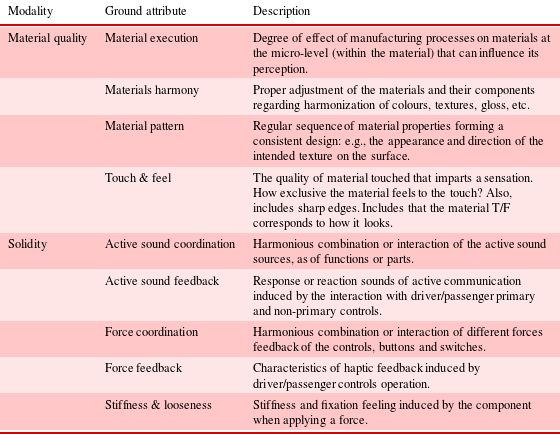
Reference Stylidis, Hoffenson, Wickman, Söderman and Söderberg2014) that force coordination, force feedback of controls, and material quality communicate brand core values to the customers. This process is usually accompanied with the design of certain tactile and visual ‘signatures’ (i.e., intended sensory feedback of the command knobs in the console). It is hard to convey such ‘signatures’ using only a touchscreen that cannot express complex haptic sensations. A similar approach was applied to ‘Material Quality’. A touchscreen, as a physical component, can offer only a low score regarding ground attributes such as Touch & Feel or Material Pattern due to limited variability of the available materials and a lack of possibility to express exclusivity and craftsmanship. Table 1 provides descriptions for the ground attributes involved in the evaluation of the second generation of the centre console.
$\text{G}_{1}$
FL) centre console was assessed with regard to the sensory modalities ‘Solidity’ and ‘Material Quality’ (see Figure 5). The same type of assessment was performed for the competitors – the Tesla Model S. The importance relative ranking for ground attributes provides information to the designers regarding the customer’s perception for both types of interfaces. It is known (Stylidis et al.
Reference Stylidis, Hoffenson, Wickman, Söderman and Söderberg2014) that force coordination, force feedback of controls, and material quality communicate brand core values to the customers. This process is usually accompanied with the design of certain tactile and visual ‘signatures’ (i.e., intended sensory feedback of the command knobs in the console). It is hard to convey such ‘signatures’ using only a touchscreen that cannot express complex haptic sensations. A similar approach was applied to ‘Material Quality’. A touchscreen, as a physical component, can offer only a low score regarding ground attributes such as Touch & Feel or Material Pattern due to limited variability of the available materials and a lack of possibility to express exclusivity and craftsmanship. Table 1 provides descriptions for the ground attributes involved in the evaluation of the second generation of the centre console.
List and description of perceived quality ground attributes involved in the assessment
The dilemma of choice – which hard keys stand as a carryover part from the reference products, how many have to be replaced with capacitive buttons as part of the new design without compromising brand core values has remained a highly subjective task until now. With the implementation of PQF in PGE this conundrum becomes quantifiable, even reasonable. Designers can estimate a customer’s appreciation of the particular design. The Porsche Panamera ( $\text{G}_{2}$
) centre console layout can convey balanced design intent, harmoniously combining hard keys, capacitive buttons, and touchscreen displays. The design of discrete-choice experiments can achieve the quantification of the individual subjective preferences. To understand the relative importance of ground attributes involved in the study, PQAIR method usually utilizes a technique initially developed by Louviere (Reference Louviere1993), called Best–Worst Scaling. However, other methodologies can be used to rank ground attributes, e.g., choice-based conjoint is another popular discrete-choice experiment method for acquiring information on customer preferences for individual product attributes (Louviere & Islam Reference Louviere and Islam2008; Sawtooth Software, Inc. 2008). We suggest the choice of strategy for the methodology to obtain rankings of ground attributes determined by the current company needs and available resources. In the case of luxury automotive manufacturers the data obtained from the relatively small group of car experts or car distributors (e.g., Delphi study) can be more informative compared to survey data (Stylidis et al.
Reference Stylidis, Rossi, Wickman and Söderberg2016). This way a quantitative connection between the product design space and customers’ perceptions can be established.
$\text{G}_{2}$
) centre console layout can convey balanced design intent, harmoniously combining hard keys, capacitive buttons, and touchscreen displays. The design of discrete-choice experiments can achieve the quantification of the individual subjective preferences. To understand the relative importance of ground attributes involved in the study, PQAIR method usually utilizes a technique initially developed by Louviere (Reference Louviere1993), called Best–Worst Scaling. However, other methodologies can be used to rank ground attributes, e.g., choice-based conjoint is another popular discrete-choice experiment method for acquiring information on customer preferences for individual product attributes (Louviere & Islam Reference Louviere and Islam2008; Sawtooth Software, Inc. 2008). We suggest the choice of strategy for the methodology to obtain rankings of ground attributes determined by the current company needs and available resources. In the case of luxury automotive manufacturers the data obtained from the relatively small group of car experts or car distributors (e.g., Delphi study) can be more informative compared to survey data (Stylidis et al.
Reference Stylidis, Rossi, Wickman and Söderberg2016). This way a quantitative connection between the product design space and customers’ perceptions can be established.
4 Conclusion
Consideration of the reference product as a central element in product development, the share of carry over, and newly developed subsystems enable a systematic view of the design process. The PQF in the context of PGE provides not only taxonomy of perceived quality attributes and related information about the product but also extends the capacity of PGE. The identification of differentiation characteristics for the development of initial systems objectives becomes quantifiable. Hence, a transparent selection of subsystems and their associated variations is supported. This is extremely important for the automotive industry where production systems are becoming highly complex with an automobile being a system of systems embedded in a digital environment.
The PGE and PQF methods are not limited to the automotive industry alone. For example, PGE was used for the development of portal-type scraper reclaimers (Bursac, Albers & Schmitt Reference Bursac, Albers and Schmitt2016) and machine tools for flexible sheet processing (Albers et al. Reference Albers, Rapp, Birk and Bursac2017). Forslund, Karlsson & Söderberg (Reference Forslund, Karlsson and Söderberg2013) showed that misaligned or improperly positioned split lines negatively influence customer perception of a product. Hoffenson, Dagman & Söderberg (Reference Hoffenson, Dagman and Söderberg2015) demonstrated a quantitative understanding of the customer-value split lines phenomena when evaluating cell phones. Therefore, the PQAIR method with the same or modified set of ground attributes can be used in various areas of product development.
Systematic decomposition of perceived quality into manageable areas can bridge the gap between engineering design intent and the customer’s appreciation of the product. PQF is a core for the methodology intended to help designers to link technical characteristics of the product and the customer’s perceptions (see Figure 3). The PQAIR method, by capturing the importance of perceived quality attributes, translates the subjective opinions of individuals into quantifiable measures. This highlights which perceived quality attributes require attention while designing a new product or new product generation. Analysis of the reference products for the product generation in the context of the initial development of the system of objectives shows which attributes have to be improved, disregarded or carried over. The corresponding subsystems of the product that are critically responsible for realizing these attributes can be identified. Furthermore, reference products indicate critical aspects of perceived quality.
Acknowledgment
This work was supported by the Swedish Governmental Agency for Innovation Systems (VINNOVA). That support is gratefully acknowledged.




 Open access

