





Introduction
Social camouflaging (SC) has been defined as the process whereby autistic behaviors are masked or compensated for, allowing autistic individuals to cope within their social world (Cook et al., Reference Cook, Hull, Crane and Mandy2021b; Hull et al., Reference Hull, Petrides, Allison, Smith, Baron-Cohen, Lai and Mandy2017). SC in autistic people is of particular relevance for clinicians and researchers, as much of the existing relevant literature has demonstrated negative mental health outcomes associated with SC, as well as missed or delayed autism diagnosis (Cassidy et al., Reference Cassidy, Bradley, Shaw and Baron-Cohen2018; Hull et al., Reference Hull, Mandy, Lai, Baron-Cohen, Allison, Smith and Petrides2019, Reference Hull, Levy, Lai, Petrides, Baron-Cohen, Allison, Smith and Mandy2021a, Reference Hull, Petrides and Mandy2021b; Tint and Weiss, Reference Tint and Weiss2018).
The classification of SC behaviors is continuously evolving. A frequently used conceptual framework to describe SC behavior specifies three domains: 1) masking, defined as hiding autistic traits, 2) compensation, defined as behaviors used to compensate for social difficulties, and 3) assimilation, defined as behaviors used to fit into social environments in which one feels uncomfortable by playing a social role (Hull et al., Reference Hull, Petrides, Allison, Smith, Baron-Cohen, Lai and Mandy2017, Reference Hull, Mandy, Lai, Baron-Cohen, Allison, Smith and Petrides2019).
Hull et al. (Reference Hull, Petrides, Allison, Smith, Baron-Cohen, Lai and Mandy2017) developed a model to depict the process underlying SC, which has three main components; (1) “Motivations for Camouflaging”; (2) “What is Camouflaging?”; and (3) “Consequences of Camouflaging”. Since the development of this model in 2017, a surge of research has investigated each of these areas. Hull et al.s’ (Reference Hull, Petrides, Allison, Smith, Baron-Cohen, Lai and Mandy2017) research indicated that motivators for SC include a desire for connection, protecting oneself from judgement or harm, and attempting to assimilate to external expectations. The “What is Camouflaging ‘’ component of Hull et al.s’ (Reference Hull, Petrides, Allison, Smith, Baron-Cohen, Lai and Mandy2017) model has been described as masking by concealing autistic expression or compensating by using social scripts. Lastly, the potential “Consequences of Camouflaging’’ (Hull et al., Reference Hull, Petrides, Allison, Smith, Baron-Cohen, Lai and Mandy2017) have included exhaustion, identity struggles, and anxiety.
More recent research has identified additional factors related to SC. For example, certain cognitive traits may be associated with SC in domains such as executive functions (EF), intelligence (IQ), and theory of mind (ToM). However, research on these cognitive associations has yielded inconsistent results (Hull et al., Reference Hull, Levy, Lai, Petrides, Baron-Cohen, Allison, Smith and Mandy2021a; Livingston et al., Reference Livingston, Shah and Happé2019a; Schuck et al., Reference Schuck, Flores and Fung2019). Additionally, research has suggested that masking personal interests and compensating by using peer imitation are also commonly used SC behaviors (Cook et al., Reference Cook, Crane, Bourne, Hull and Mandy2021a). Also, the use of SC behavior has largely been associated with female gender identity (Milner et al., Reference Milner, Mandy, Happé and Colvert2023; Schuck et al., Reference Schuck, Flores and Fung2019). Moreover, additional associations have been found between mental health struggles and SC, with SC being significantly associated with generalized anxiety, social anxiety, depression (Hull et al., Reference Hull, Petrides and Mandy2021b), and an increased risk of lifetime suicidality (Cassidy et al., Reference Cassidy, Bradley, Shaw and Baron-Cohen2018).
Most of the research cited above has involved autistic adults and the exclusion of autistic youth from SC research is a notable limitation in the field. Emerging evidence suggests that autistic youth may experience motivations to camouflage similar to adults, particularly to form connections with their peers (Bernardin et al., Reference Bernardin, Lewis, Bell and Kanne2021a, Reference Bernardin, Mason, Lewis and Kanne2021b; Howe et al., Reference Howe, Hull, Sedgewick, Hannon and McMorris2023). Similar to autistic adults, autistic youth may also experience depression, anxiety, and stress associated with SC (Bernardin et al., Reference Bernardin, Lewis, Bell and Kanne2021a, Reference Bernardin, Mason, Lewis and Kanne2021b). Notably, youth seem more motivated to camouflage at school than at home (Anderson et al., Reference Anderson, Marley, Gillespie-Smith, Carter and MacMahon2020; Cook et al., Reference Cook, Ogden and Winstone2018). While this research provides preliminary insights into SC in youth, most of the research has focused on autistic girls, making it difficult to generalize results to youth of other gender identities (Cook et al., Reference Cook, Ogden and Winstone2018; Halsall et al., Reference Halsall, Clarke and Crane2021; Tierney et al., Reference Tierney, Burns and Kilbey2016). Another limitation is that no quantitative SC measurement tools have been validated for youth.
Previous reviews
Along with the recent surge of literature related to SC, eight systematic reviews have been conducted describing various aspects of SC. Allely (Reference Allely2019) reviewed SC behavior in autistic females, and Tubío-Fungueiriño et al. (2021) completed a brief review on the process of SC from motivations to consequences in autistic females, both finding that SC may contribute to poor mental health outcomes for this population. A narrative review by Hull et al. (Reference Hull, Lai, Baron-Cohen, Allison, Smith, Petrides and Mandy2020a, Reference Hull, Petrides and Mandy2020b), provided evidence for a female-specific autistic phenotype that included SC behaviors. In 2021, Cook and colleagues completed a systematic review of SC in formally diagnosed and self-diagnosed autistic children and adults, and found that SC was associated with autistic traits, identifying as female, and negative mental health outcomes. Libsack et al. (Reference Libsack, Keenan, Freden, Mirmina, Iskhakov, Krishnathasan and Lerner2021) published a review synthesizing the demographic details of papers focused on social “passing” in autistic adults and youth, and found internalizing symptoms were associated with SC. Alaghband-Rad et al. (Reference Alaghband-Rad, Hajikarim-Hamedani and Motamed2023) published a review focused exclusively on autistic adults, finding social motivators for SC as well as associations with certain cognitive traits and mental health issues. Zhuang et al. (Reference Zhuang, Tan, Reddrop, Dean, Maybery and Magiati2023) completed a review exploring psychosocial correlates and consequences of SC, finding that social factors motivate SC, and may also be negatively impacted by SC behavior. Lastly, Ridgway et al. (Reference Ridgway, Cooke, Demmer, Hooley, Westrupp and Stokes2024) conducted a qualitative review focused on SC and friendships, finding that many autistic individuals used SC to obtain friendships. However, this behavior could feel inauthentic, and the quality of these relationships varied between individuals.
While these reviews have provided important insights into SC, the generalizability of the findings are limited by a large focus on autistic women (Hull et al., Reference Hull, Lai, Baron-Cohen, Allison, Smith, Petrides and Mandy2020; Tubio-Fungueiriño et al., Reference Tubío-Fungueiriño, Cruz, Sampaio, Carracedo and Fernández-Prieto2020). Additionally, some existing reviews have conflated individuals measured for autistic traits with formally diagnosed autistic people (Cook et al., Reference Cook, Crane, Bourne, Hull and Mandy2021a, Reference Cook, Hull, Crane and Mandy2021b; Libsack et al., Reference Libsack, Keenan, Freden, Mirmina, Iskhakov, Krishnathasan and Lerner2021; Zhuang et al., Reference Zhuang, Tan, Reddrop, Dean, Maybery and Magiati2023), and these populations may differ in important ways. Moreover, these reviews have had a limited scope with regard to their exploration of associated factors with SC; most have not synthesized the behaviors associated with social camouflaging (Cook et al., Reference Cook, Crane, Bourne, Hull and Mandy2021a, Reference Cook, Hull, Crane and Mandy2021b; Hull et al., Reference Hull, Lai, Baron-Cohen, Allison, Smith, Petrides and Mandy2020; Libsack et al., Reference Libsack, Keenan, Freden, Mirmina, Iskhakov, Krishnathasan and Lerner2021; Tubio-Fungueiriñ0 et al., 2021; Zhuang et al., Reference Zhuang, Tan, Reddrop, Dean, Maybery and Magiati2023), nor identified the relevant contexts, interpersonal associations or identity-related consequences (Allely, Reference Allely2019; Cook et al., Reference Cook, Crane, Bourne, Hull and Mandy2021a, Reference Cook, Hull, Crane and Mandy2021b; Hull et al., Reference Hull, Lai, Baron-Cohen, Allison, Smith, Petrides and Mandy2020; Libsack et al., Reference Libsack, Keenan, Freden, Mirmina, Iskhakov, Krishnathasan and Lerner2021; Tubio-Fungueiriño et al., Reference Tubío-Fungueiriño, Cruz, Sampaio, Carracedo and Fernández-Prieto2020). Many previous reviews have additionally not synthesized previous research on cognitive correlates of SC (Hull et al., Reference Hull, Lai, Baron-Cohen, Allison, Smith, Petrides and Mandy2020; Ridgway et al., Reference Ridgway, Cooke, Demmer, Hooley, Westrupp and Stokes2024; Zhuang et al., Reference Zhuang, Tan, Reddrop, Dean, Maybery and Magiati2023). Further, previous reviews have only reported on autistic adults (Alaghband-Rad et al., Reference Alaghband-Rad, Hajikarim-Hamedani and Motamed2023), have conflated findings of both adults and youth without offering critical comparison between age groups (Allely, Reference Allely2019; Hull et al., Reference Hull, Lai, Baron-Cohen, Allison, Smith, Petrides and Mandy2020; Ridgway et al., Reference Ridgway, Cooke, Demmer, Hooley, Westrupp and Stokes2024; Zhuang et al., Reference Zhuang, Tan, Reddrop, Dean, Maybery and Magiati2023) or have focused their synthesis on either qualitative or quantitative data (Alaghband-Rad et al., Reference Alaghband-Rad, Hajikarim-Hamedani and Motamed2023; Cook et al., Reference Cook, Crane, Bourne, Hull and Mandy2021a, Reference Cook, Hull, Crane and Mandy2021b, Ridgway et al., Reference Ridgway, Cooke, Demmer, Hooley, Westrupp and Stokes2024; Zhuang et al., Reference Zhuang, Tan, Reddrop, Dean, Maybery and Magiati2023). The integration of both sources of data and both of these populations is critical for a more nuanced and holistic understanding of camouflaging motivations, processes, and outcomes. Lastly, the primary focus of most previous reviews have been to synthesize/summarise previous literature, without using this data to build further theory (Alaghband-Rad et al., Reference Alaghband-Rad, Hajikarim-Hamedani and Motamed2023; Allely, Reference Allely2019; Cook et al., Reference Cook, Crane, Bourne, Hull and Mandy2021a, Reference Cook, Hull, Crane and Mandy2021b; Hull et al., Reference Hull, Lai, Baron-Cohen, Allison, Smith, Petrides and Mandy2020; Libsack et al., Reference Libsack, Keenan, Freden, Mirmina, Iskhakov, Krishnathasan and Lerner2021; Tubio-Fungueiriño et al., Reference Tubío-Fungueiriño, Cruz, Sampaio, Carracedo and Fernández-Prieto2020; Ridgway et al., Reference Ridgway, Cooke, Demmer, Hooley, Westrupp and Stokes2024).
The current review
Using Hull et al.s’ (Reference Hull, Petrides, Allison, Smith, Baron-Cohen, Lai and Mandy2017) framework, the current review explores factors related to SC to build on existing literature on the SC process in the following categories: (1) predictors, (2) phenotypes, and (3) consequences of SC. This framework will allow us to provide an expanded exploration of current research on the topic of SC that includes behavioral presentations, socio-contextual factors, gender analyses, cognitive associations and risk for mental health difficulties across both adult and youth stages of development.
We operationalized SC as the use of social behaviors to mask autism, compensate for autism, or actively assimilate into a neurotypical social world. The current review fills a gap in the research literature by including all gender identities, studies of both autistic adults and youth, and both qualitative and quantitative research studies. We included only studies of individuals with formal autism diagnoses (or those who had high levels of autistic traits confirmed with formal diagnostic measures) to both distinguish our results from previous reviews, and to mitigate confounds that come with including a self-identified autistic population.
Methods
Search strategy/Inclusion
This review was completed using Preferred Reporting Items for Systematic Reviews and Meta-Analyses (PRISMA) guidelines (2020; was pre-registered with the international prospective register of systematic reviews (PROSPERO; CRD42022343544)). Medline (Ovid), PsycInfo (EBSCO) and ERIC (EBSCO) were searched using keywords and terms generated by adapting the search strategy used by Cook et al. (Reference Cook, Hull, Crane and Mandy2021b). The search was completed and uploaded to Covidence online software (2022) on July 29th, 2022.
Titles and abstracts for each paper were independently screened within Covidence (2022) by two reviewers. Inclusion criteria was as follows: quantitative, qualitative or mixed-methods designs, written in English, published after 1994 (when the current clinical definition of autism was solidified in the Diagnostic and Statistical Manual of Mental Disorders (4th ed.; DSM–4; American Psychiatric Association, 1994), and used a formal SC assessment within their methodology or direct reports of SC within results. Papers where some or all participants self-identified as autistic were excluded, as were opinion pieces, dissertations, systematic reviews, and theoretical papers. Disagreements on paper inclusion were resolved using a third reviewer.
Data extraction
Data was extracted across research methodologies into Excel under the following categories: study objectives, statistical analyses, demographic information, participant characteristics, intellectual ability, language ability, diagnostic information, measures, and study results. Lumivero (2020) was used to code data line-by-line. Key qualitative themes were identified and agreed upon by two authors. Data was synthesized and reported using a convergent integrated approach (Stern et al., Reference Stern, Lizarondo, Carrier, Godfrey, Rieger, Salmond, Apóstolo, Kirkpatrick and Loveday2020), wherein quantitative data was qualitized and written narratively in conjunction with qualitative data. This approach was chosen to synthesise data efficiently and effectively across research methodologies (Ray et al., Reference Ray, Sniehotta, McColl and Ells2022).
Quality assessment
The Mixed Methods Appraisal Tool (MMAT) was used to assess the quality of the included articles (Hong et al., Reference Hong, Pluye, Fàbregues, Bartlett, Boardman, Cargo, Dagenise, Gagnonf, Griffithsc, O.’Cathaing, Rousseauh and Vedel2018), given that quantitative, qualitative, and mixed-method papers were included in this review, and to remain consistent with the quality assessment methodology used in previous reviews (Cook et al., Reference Cook, Hull, Crane and Mandy2021b). Tallies of quality errors were calculated for every study. Quality assessment was completed independently in Excel by two reviewers, and any disagreements regarding quality errors were resolved via consensus.
Results
Included studies
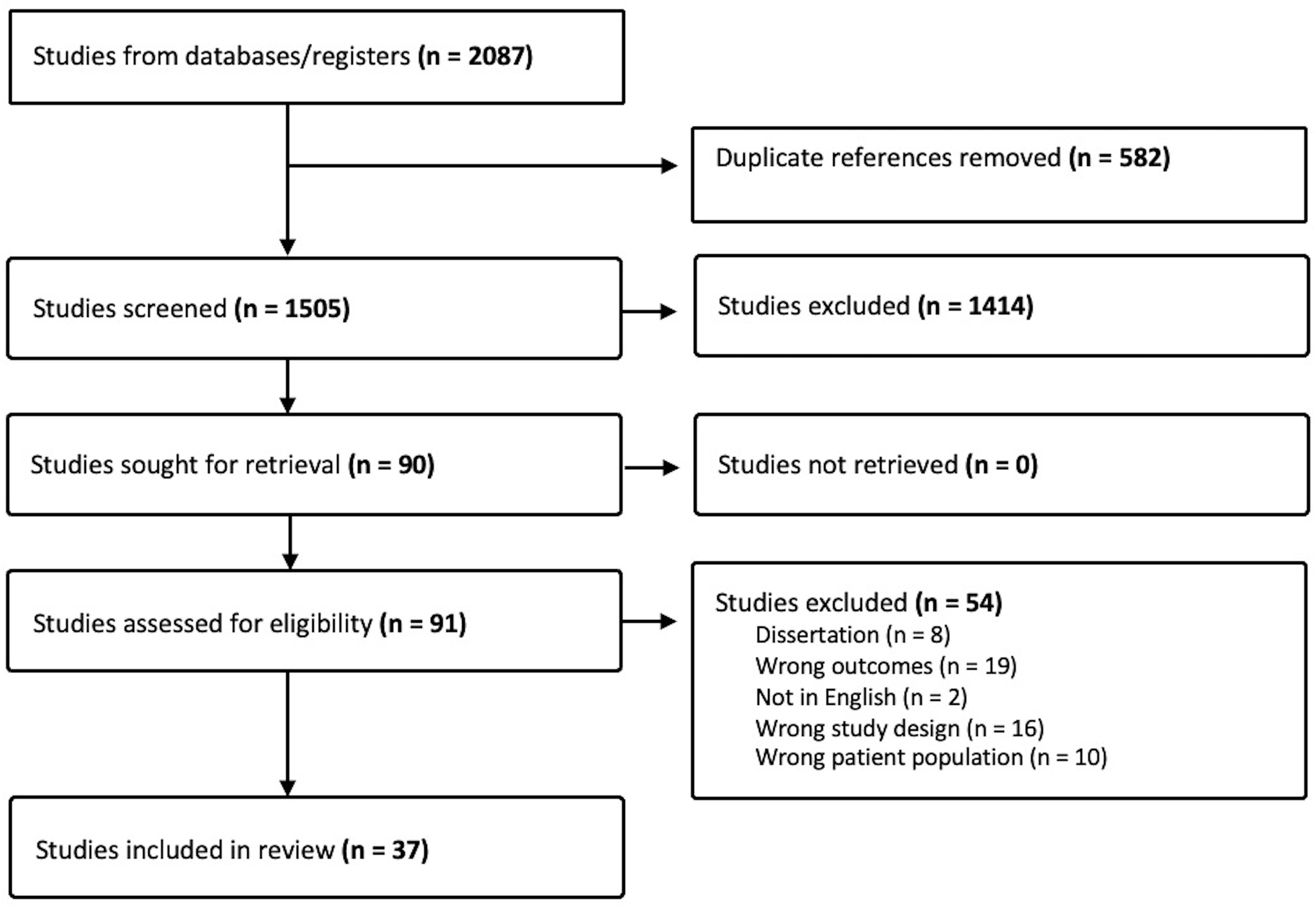
Covidence (2022) was used for article screening. Studies initially imported from databases totaled at 2,087. After duplicates were removed, 1,505 articles were imported for screening. Following abstract screening, 91 full texts were screened for eligibility, and 37 studies were ultimately included in the review (see PRISMA diagram in Figure 1). Five studies met inclusion criteria but were excluded based on quality for the following reasons: 1) four quantitative studies were excluded because the authors did not directly assess SC per our operationalization, but instead assessed related constructs (e.g., behavioral impressions, linguistic presentations, and repetitive behaviors) (Cola et al., Reference Cola, Plate, Yankowitz, Petrulla, Bateman, Zampella, de Marchena, Pandey, Schultz and Parish-Morris2020; Collis et al., Reference Collis, Gavin, Russell and Brosnan2022; Dean et al., Reference Dean, Harwood and Kasari2016; Parish-Morris et al., Reference Parish-Morris, Liberman, Cieri, Herrington, Yerys, Bateman, Donaher, Ferguson, Pandey and Schultz2017; Rynkiewicz et al., Reference Rynkiewicz, Schuller, Marchi, Piana, Camurri, Lassalle and Baron-Cohen2016); and 2) one study was excluded because the data that was reported within the autistic group did not relate to our research topic (Livingston et al., Reference Livingston, Shah, Milner and Happé2020).
In total, 19 of the included studies were quantitative, 15 were qualitative, and three were mixed methods. 14 studies focused on autistic youth, whereas 23 focused on autistic adults (ages 18 years and above). One of the qualitative studies included data from only the parents of autistic children (Anderson et al., Reference Anderson, Marley, Gillespie-Smith, Carter and MacMahon2020). This study was ultimately included, as the data was consistent with our SC operationalization and was deemed important in articulating the perspectives of children.
Research quality
The MMAT (2018) elicited multiple quality errors. The most common quality error across qualitative and quantitative studies was that non-binary genders were under-represented or not included (n = 37 studies). For quantitative articles, the next most common quality error was that participant physical/mental health comorbidities were not specified (n = 14). Other common quality errors in quantitative articles included underrepresentation of males (n = 13), online assessments (n = 10), use of measures not standardized for autistic populations (n = 10), missing data (n = 7), underrepresentation of females (n = 6), and exclusion of individuals with intellectual disabilities (IDs) (which may lead to a participant sample that doesn’t represents the full range of the autism spectrum) (n = 5). Additionally, some studies reported inconsistent participant totals in different sections of their paper (n = 3).
Within qualitative studies, quality errors included lack of specification of physical and mental health comorbidities (n = 9), exclusion of participants with an intellectual disability (n = 4), and insufficient descriptive statistics (n = 2). For mixed-methods articles, the most common quality errors were underrepresentation of male genders (n = 2) followed by missing data (n = 1).
Participant characteristics
Autistic participants (n = 4,359), as well as parents/educators (n = 148), were drawn from 37 studies and included in this review. Although there were inconsistencies in some studies with respect to the reported participant gender breakdown compared to the figure reported for total participants included in the study (n = 3), they were included in this review because of their strong research quality overall. In these studies, participant analyses were done using the total participants reported within the gender breakdown of the study, rather than the overall n reported. The gender breakdown of the autistic participants is as follows: (52.6%) female, (43.5%) male, (3.4%) non-binary, (0.4%) undisclosed, and (0.1%) transgender. A total of 86% of participants were adults, whereas 14% of participants were youth. In 10.8% of the studies, autism diagnosis confirmation was not directly specified and in 43.2% of the studies, participants self-reported their autism diagnosis. In 35.1% of the studies, researchers used a diagnostic measure (i.e., ADOS-2, ADIR) to confirm autism diagnosis and in 2.7% of the studies, written confirmation of participant diagnosis was provided by healthcare providers. Lastly, in 8.1% of the studies, alternative measures for ascertaining diagnosis were used, such as participants providing written documentation of their diagnosis, researchers conducting interviews with family members, or researchers confirming diagnosis through past medical records.
PRISMA study inclusion diagram. Note. PRISMA diagram of study selection and screening.
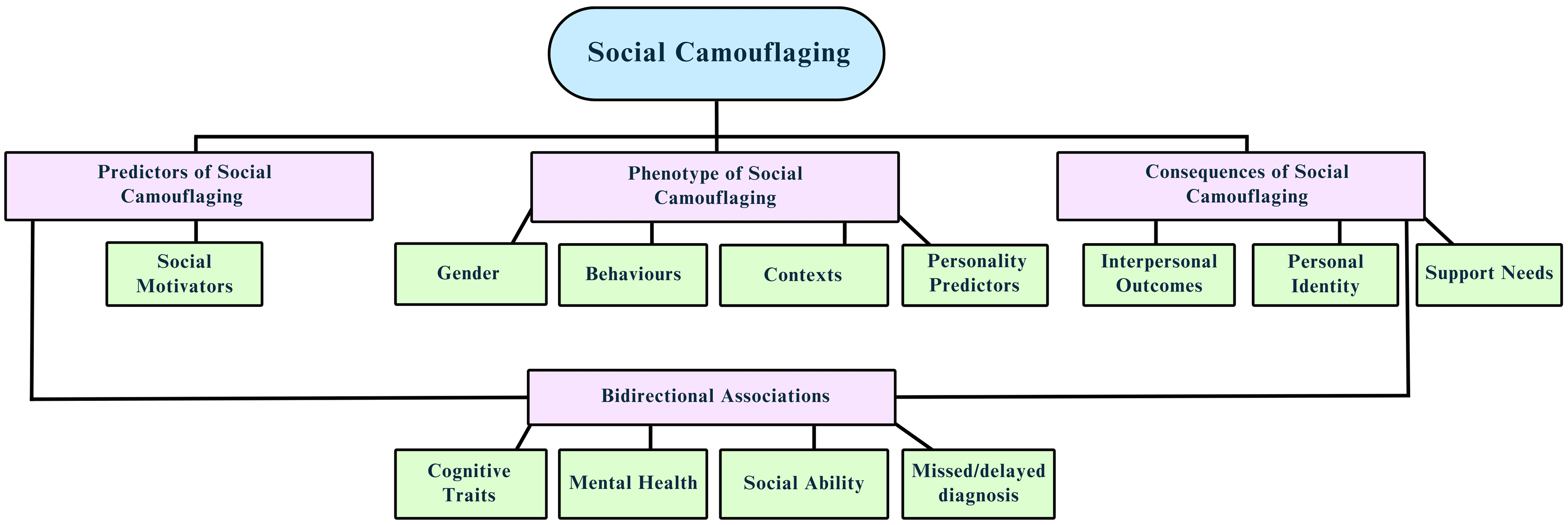
The process of social camouflaging for autistic individuals. Note. This model depicts the various factors related to social camouflaging existing in current literature. The directionality of these associations is based on qualitative/narrative reports from the studies included in this review. Note. Adapted from “Putting on my best normal”: Social camouflaging in adults with autism spectrum conditions. Hull, L., Petrides, K. V., Allison, C., Smith, P., Baron-Cohen, S., Lai, M.-C., & Mandy, W., 2017, Journal of Autism Spectrum Disorders, 47(8), 2519–2534 (https://doi.org/10.1007/s10803-017-3166-5). Copyright 2017 by Springer Nature. Open-access under the Creative Commons Attribution 4.0 International License (http://creativecommons.org/licenses/by/4.0/).
Findings
A variety of factors related to SC were identified and were subsequently sorted into the following themes: (1) Social Motivators; (2) Contexts; (3) Behaviors; (4) Gender; (5) Personality Traits; (6) Interpersonal Outcomes; (7) Identity; (8) Support Needs; (9) Cognitive/Neural Traits; (10) Mental Health and; (11) Social Ability (12) Age of Diagnosis. These themes were then integrated into an expanded version of the “Process of Social Camouflaging” model developed by Hull et al. (Reference Hull, Petrides, Allison, Smith, Baron-Cohen, Lai and Mandy2017) (see Figure 2).
These themes were then organized into the following sub-groups: (1) Predictors of Social Camouflaging; (2) Phenotype of Social Camouflaging; (3) Consequences of Social Camouflaging and; (4) Bidirectional Associations in Camouflaging. The “Predictors of Social Camouflaging’’ category encompasses specific motivations indicated by participants in direct reference to SC. Each factor included under the umbrella of “Phenotype of Social Camouflaging” helps to give an overall impression of what SC behavior looks like, where it takes place, and which people display this behavior. The themes placed under “Consequences of Social Camouflaging” are outcomes directly attributed to the use of SC behavior through participant reports. Finally, we discovered throughout the review process that certain factors may have a bidirectional relationship with SC and could not be easily assigned to either Predictors or Consequences. Therefore, a “Bidirectional Associations” section was created to describe factors that could both be predictors or consequences of SC. Themes included under this section either had results indicating both a predictive and consequential relationship with camouflaging, or results that were mostly correlational wherein directionality could not be ascertained (see Table 1).
Themes were identified both a-priori and throughout the review process. The general themes of “Motivators for SC”, “Phenotype of SC” and “Consequences of SC” were established prior to review. Subsequent themes, along with potential bidirectional associations, were identified after all papers were reviewed. These themes were discussed and agreed upon by multiple reviewers. One area of research not included in this review was the relationship between autistic traits and SC behavior. Though the authors deem this to be an important area of research, we ultimately decided that it was not within the scope of the present review given our focus on SC within formally diagnosed autistic individuals. Moreover, all information relevant to SC available in the papers reviewed was considered within the scope of this review and was subsequently included in the analysis under one or more of each theme.
Predictors of social camouflaging
Social motivators
Adults. Maintaining the comfort of others was reported as a motivation for SC by autistic adults (Baldwin & Costley, Reference Baldwin and Costley2016; Cage & Troxell-Whitman, Reference Cage and Troxell-Whitman2019; Hull et al., Reference Hull, Petrides, Allison, Smith, Baron-Cohen, Lai and Mandy2017; Livingston et al., Reference Livingston, Shah and Happé2019a, Reference Livingston, Colvert, Bolton and Happé2019b; Sullivan, Reference Sullivan2021). Additionally, evidence suggested that autistic adults camouflage to achieve social acceptance (Cage & Troxell-Whitman, Reference Cage and Troxell-Whitman2019; Cook et al., Reference Cook, Crane, Bourne, Hull and Mandy2021a; Hull et al., Reference Hull, Petrides, Allison, Smith, Baron-Cohen, Lai and Mandy2017; Livingston et al., Reference Livingston, Shah and Happé2019a, Reference Livingston, Colvert, Bolton and Happé2019b; Sullivan, Reference Sullivan2021) or meet social expectations (Cage & Troxell-Whitman, Reference Cage and Troxell-Whitman2019; Hull et al., Reference Hull, Petrides, Allison, Smith, Baron-Cohen, Lai and Mandy2017; Livingston et al., Reference Livingston, Shah and Happé2019a, Reference Livingston, Colvert, Bolton and Happé2019b). Autistic adults indicated beliefs that they had to change themselves to assimilate into wider society (Cook et al., Reference Cook, Crane, Bourne, Hull and Mandy2021a; Hull et al., Reference Hull, Petrides, Allison, Smith, Baron-Cohen, Lai and Mandy2017; Sullivan, Reference Sullivan2021), avoid social rejection/negative perception (Cook et al., Reference Cook, Crane, Bourne, Hull and Mandy2021a, Hull et al., Reference Hull, Petrides, Allison, Smith, Baron-Cohen, Lai and Mandy2017, Livingston et al., Reference Livingston, Shah and Happé2019a, Reference Livingston, Colvert, Bolton and Happé2019b; Schneid & Raz, Reference Schneid and Raz2020; Sullivan, Reference Sullivan2021) and protect their safety and well-being from verbal, emotional, and physical attacks (Cage & Troxell-Whitman, Reference Cage and Troxell-Whitman2019; Hull et al., Reference Hull, Petrides, Allison, Smith, Baron-Cohen, Lai and Mandy2017; Livingston et al., Reference Livingston, Shah and Happé2019a, Reference Livingston, Colvert, Bolton and Happé2019b; Sullivan, Reference Sullivan2021). Similarly, social stigma was qualitatively reported by some autistic individuals as a motivator for SC (Cage & Troxell-Whitman, Reference Cage and Troxell-Whitman2019 Hull et al., Reference Hull, Petrides, Allison, Smith, Baron-Cohen, Lai and Mandy2017; Schneid & Raz, Reference Schneid and Raz2020).
Another social motivator endorsed by autistic adults was to increase connections both for platonic and romantic relationships (Cook et al., Reference Cook, Crane, Bourne, Hull and Mandy2021a; Hull et al., Reference Hull, Petrides, Allison, Smith, Baron-Cohen, Lai and Mandy2017). A desire to obtain employment, educational opportunities and achievements were additionally identified as motivators (Hull et al., Reference Hull, Petrides, Allison, Smith, Baron-Cohen, Lai and Mandy2017; Livingston et al., Reference Livingston, Shah and Happé2019a, Reference Livingston, Colvert, Bolton and Happé2019b; Sullivan, Reference Sullivan2021). Cage and Troxell-Whitman (Reference Cage and Troxell-Whitman2019) noted that participants reported SC for ‘conventional reasons’ (i.e., SC that serves a practical function such as at school or work) more frequently than for ‘relational reasons’ (i.e., SC that helps in facilitating relationships and socializing), and females were more likely to SC for conventional reasons than males. The same study suggested that SC was potentially conditioned from childhood.
Youth. Researchers found that autistic youth camouflage to avoid negative perceptions and experiences (Bernardin et al., Reference Bernardin, Mason, Lewis and Kanne2021b; Cook et al., Reference Cook, Ogden and Winstone2018), worrying that being their authentic selves would lead to rejection, bullying, humiliation, being labeled, and/or being treated differently than their non-autistic peers (e.g., being talked down to, or not being listened to) (Bernardin et al., Reference Bernardin, Mason, Lewis and Kanne2021b; Halsall et al., Reference Halsall, Clarke and Crane2021). Bernardin et al. (Reference Bernardin, Mason, Lewis and Kanne2021b) and Jedrzejewska and Dewey (Reference Jedrzejewska and Dewey2022) found that SC in autistic youth was a response to stigma and allowed for a sense of control about how one is perceived in social contexts. Youth also reported SC to make one’s social partner more comfortable (Bernardin et al., Reference Bernardin, Mason, Lewis and Kanne2021b; Jedrzejewska & Dewey, Reference Jedrzejewska and Dewey2022). Additionally, autistic youth were found to camouflage to be perceived positively/be taken seriously (Bernardin et al., Reference Bernardin, Mason, Lewis and Kanne2021b). Camouflaging was perceived as a strategy for overcoming social barriers to developing and maintaining friendships (Bernardin et al., Reference Bernardin, Mason, Lewis and Kanne2021b; Cook et al., Reference Cook, Ogden and Winstone2018; Tierney et al., Reference Tierney, Burns and Kilbey2016). Bernardin et al. (Reference Bernardin, Mason, Lewis and Kanne2021b) found gender differences in the motivations to SC, where males were more likely to camouflage to make friends, and females were more likely to camouflage to avoid teasing and bullying. One study suggested possible gender role expectations for girls influencing SC (Anderson et al., Reference Anderson, Marley, Gillespie-Smith, Carter and MacMahon2020). Additionally, while some autistic youth reported that SC strategies came intuitively (Halsall et al., Reference Halsall, Clarke and Crane2021; Tierney et al., Reference Tierney, Burns and Kilbey2016) others felt that SC was learned from peers or teachers (Halsall et al., Reference Halsall, Clarke and Crane2021; Jedrzejewska & Dewey, Reference Jedrzejewska and Dewey2022).
Phenotype of social camouflaging
Contexts
Adults. Camouflaging behavior was found to be influenced by an individuals’ social environment (Cook et al., Reference Cook, Ogden and Winstone2018; Hull et al., Reference Hull, Petrides, Allison, Smith, Baron-Cohen, Lai and Mandy2017; Livingston et al., Reference Livingston, Colvert, Bolton and Happé2019b). For example, less pressure to camouflage was felt when the conversation partner held less personal stigma towards autism (Cook et al., Reference Cook, Ogden and Winstone2018) or when conversing with trusted individuals (Cook et al., Reference Cook, Ogden and Winstone2018; Hull et al., Reference Hull, Petrides, Allison, Smith, Baron-Cohen, Lai and Mandy2017). Alternatively, more SC was reported with strangers (Cook et al., Reference Cook, Ogden and Winstone2018; Hull et al., Reference Hull, Petrides, Allison, Smith, Baron-Cohen, Lai and Mandy2017). Individuals in one study reported more pressure to SC when interacting with extraverted people, and less pressure when interacting with other autistic individuals (Livingston et al., Reference Livingston, Colvert, Bolton and Happé2019b). The same study highlighted that autistic adults felt less pressure to SC in environments where presenting overly friendly social traits was not necessarily a cultural norm, referencing British culture (Livingston et al., Reference Livingston, Colvert, Bolton and Happé2019b). Lastly, Cage and Troxell-Whitman (Reference Cage and Troxell-Whitman2019) identified two common contexts of SC: interpersonal, referring to between friends and family, and formal, referring to work colleagues or medical professionals.
Youth. Autistic youth reported feeling less need to camouflage with trusted individuals (Bernardin et al., Reference Bernardin, Lewis, Bell and Kanne2021a, Reference Bernardin, Mason, Lewis and Kanne2021b; Jedrzejewska & Dewey, Reference Jedrzejewska and Dewey2022; Tierney et al., Reference Tierney, Burns and Kilbey2016) and when interacting with other neurodiverse individuals (Cook et al., Reference Cook, Crane, Bourne, Hull and Mandy2021a; Halsall et al., Reference Halsall, Clarke and Crane2021). Moreover, youth reported more SC behavior at school rather than at home (Anderson et al., Reference Anderson, Marley, Gillespie-Smith, Carter and MacMahon2020; Cook et al., Reference Cook, Ogden and Winstone2018; Halsall et al., Reference Halsall, Clarke and Crane2021; Moyse & Porter, Reference Moyse and Porter2014). Halsall et al. (Reference Halsall, Clarke and Crane2021) found that participants reported less SC in their school’s resource center or special education classrooms within a school (Halsall et al., Reference Halsall, Clarke and Crane2021). Autistic youth in one study reported less SC on social media; they found it was easier to bond over genuine interests and to present oneself authentically when social interactions were online (Jedrzejewska & Dewey, Reference Jedrzejewska and Dewey2022).
Behaviors
Adults. Masking behaviors reported included stopping behavioral presentations of autism (e.g., suppressing stimming or sensory overload) (Cage et al., Reference Cage, Di Monaco and Newell2018, Cook et al., 2021a, Cook et al., 2022; Hull et al., Reference Hull, Petrides, Allison, Smith, Baron-Cohen, Lai and Mandy2017; Sullivan, Reference Sullivan2021). Four studies reported forced eye contact in social situations (Cook et al., 2022, Cook et al., 2021a, ; Hull et al., Reference Hull, Petrides, Allison, Smith, Baron-Cohen, Lai and Mandy2017; Tint and Weiss, Reference Tint and Weiss2018). Additionally, autistic adults reported continuous monitoring of social interactions (Cook et al., Reference Cook, Crane, Bourne, Hull and Mandy2021a; Hull et al., Reference Hull, Petrides, Allison, Smith, Baron-Cohen, Lai and Mandy2017; Livingston et al., Reference Livingston, Colvert, Bolton and Happé2019b) and deliberate concealment of personal interests, sharing only selective interests (Cook et al., 2021a, Reference Cook, Crane, Hull, Bourne and Mandy2022; Hull et al., Reference Hull, Petrides, Allison, Smith, Baron-Cohen, Lai and Mandy2017), or adapting voice tone (Cook et al., 2021a, Reference Cook, Crane, Hull, Bourne and Mandy2022). Autistic adults further reported concealing the need for extra support due to autism (Schneid & Raz, Reference Schneid and Raz2020; Sullivan, Reference Sullivan2021). Faking interest on another person’s conversational topic or deliberately focusing on interests that were not of interest were also reported (Cook et al., Reference Cook, Crane, Hull, Bourne and Mandy2022; Hull et al., Reference Hull, Petrides, Allison, Smith, Baron-Cohen, Lai and Mandy2017). Further, autistic adults reported faking positive affect, interest, and emotion during conversations (Baldwin & Costley, Reference Baldwin and Costley2016; Cook et al., Reference Cook, Crane, Hull, Bourne and Mandy2022). Divulging little personal information was also described by autistic adults (Hull et al., Reference Hull, Petrides, Allison, Smith, Baron-Cohen, Lai and Mandy2017), including deliberately not disclosing one’s autistic status (Cook et al., Reference Cook, Crane, Hull, Bourne and Mandy2022; Schneid & Raz, Reference Schneid and Raz2020). Finally, hiding emotion was reported by one study (Schneid & Raz, Reference Schneid and Raz2020) as a behavior associated with SC, as was not disclosing honest information about oneself (Cook et al., Reference Cook, Crane, Hull, Bourne and Mandy2022).
Compensation behaviors were reported in several studies (Baldwin & Costley, Reference Baldwin and Costley2016; Cook et al., 2021a,; Hull et al., Reference Hull, Petrides, Allison, Smith, Baron-Cohen, Lai and Mandy2017; Livingston et al., Reference Livingston, Colvert, Bolton and Happé2019b; Schneid & Raz, Reference Schneid and Raz2020). Some studies found that autistic adults practised scripted responses prior to conversing (Baldwin & Costley, Reference Baldwin and Costley2016; Cook et al., 2021a, Reference Cook, Crane, Hull, Bourne and Mandy2022; Hull et al., Reference Hull, Petrides, Allison, Smith, Baron-Cohen, Lai and Mandy2017). Autistic adults also disclosed making an active effort to ask their conversation partner personal questions during conversations (Cook et al., Reference Cook, Crane, Bourne, Hull and Mandy2021a; Hull et al., Reference Hull, Petrides, Allison, Smith, Baron-Cohen, Lai and Mandy2017), in addition to imitating peers’ non-verbal and verbal communicative behaviors (Cook et al., Reference Cook, Crane, Bourne, Hull and Mandy2021a; Hull et al., Reference Hull, Petrides, Allison, Smith, Baron-Cohen, Lai and Mandy2017). Livingston et al. (Reference Livingston, Colvert, Bolton and Happé2019b) reported two different types of imitation behavior. When imitation occurred without regard for context, it was classified as shallow compensation, and when imitation was produced from internal algorithms that analyzed contexts, it was classified as deep compensation (Livingston et al., Reference Livingston, Colvert, Bolton and Happé2019b). Additional findings were that autistic adults allowed conversational partners to guide the conversation and disclosed personal information as an intentional strategy to socially camouflage. They also exerted energy monitoring conversations with a focus on balancing listening and responding, forcing laughter in conversations, intentionally expressing vulnerability, telling well-practised jokes, and prioritizing small talk (Cook et al., Reference Cook, Crane, Hull, Bourne and Mandy2022). Hull et al. (Reference Hull, Petrides, Allison, Smith, Baron-Cohen, Lai and Mandy2017) described autistic individuals as creating social rules to help guide interactions and Schneid and Raz (Reference Schneid and Raz2020) reported that participants would intentionally talk about topics with a connection to the current conversation.
Finally, assimilation behaviors were reported (Cook et al., 2021a, Reference Cook, Crane, Hull, Bourne and Mandy2022; Hull et al., Reference Hull, Petrides, Allison, Smith, Baron-Cohen, Lai and Mandy2017; Schneid & Raz, Reference Schneid and Raz2020). Autistic adults reported that they would over-exaggerate body language to appear interested in conversation (Cook et al., Reference Cook, Crane, Bourne, Hull and Mandy2021a; Hull et al., Reference Hull, Petrides, Allison, Smith, Baron-Cohen, Lai and Mandy2017) or would deliberately play a social role (Hull et al., Reference Hull, Petrides, Allison, Smith, Baron-Cohen, Lai and Mandy2017; Schneid & Raz, Reference Schneid and Raz2020). In one study, autistic adults reported apologizing for social errors, intentionally attempting to gain validation from others, and avoiding confrontation or rudeness (Cook et al., Reference Cook, Crane, Hull, Bourne and Mandy2022).
Youth. Evidence indicated compensation behaviors in youth are used to camouflage (Anderson et al., Reference Anderson, Marley, Gillespie-Smith, Carter and MacMahon2020; Cook et al., Reference Cook, Ogden and Winstone2018; Halsall et al., Reference Halsall, Clarke and Crane2021; Tierney et al., Reference Tierney, Burns and Kilbey2016), including various types of imitation (Anderson et al., Reference Anderson, Marley, Gillespie-Smith, Carter and MacMahon2020; Cook et al., Reference Cook, Ogden and Winstone2018; Tierney et al., Reference Tierney, Burns and Kilbey2016) such as copying facial expressions, posture, tone of voice, topic of conversation and choice of interests (Tierney et al., Reference Tierney, Burns and Kilbey2016). One study reported that autistic youth observed/researched the behavior of others and imitated these behaviors (Anderson et al., Reference Anderson, Marley, Gillespie-Smith, Carter and MacMahon2020). Related to this, researching the interests of others was also reported (Halsall et al., Reference Halsall, Clarke and Crane2021), along with memorizing social patterns to compensate for autistic traits in a social environment (Tierney et al., Reference Tierney, Burns and Kilbey2016).
Autistic youth additionally reported masking behaviors (Bernardin et al., Reference Bernardin, Lewis, Bell and Kanne2021a, Reference Bernardin, Mason, Lewis and Kanne2021b; Halsall et al., Reference Halsall, Clarke and Crane2021; Tierney et al., Reference Tierney, Burns and Kilbey2016). They reported faking positive affect or faking understanding throughout conversations (Bernardin et al., Reference Bernardin, Lewis, Bell and Kanne2021a, Reference Bernardin, Mason, Lewis and Kanne2021b; Halsall et al., Reference Halsall, Clarke and Crane2021; Tierney et al., Reference Tierney, Burns and Kilbey2016), and hiding personal interests that might have appeared immature to their conversation partner (Halsall et al., Reference Halsall, Clarke and Crane2021).
Lastly, assimilation behaviors were reported in youth (Cook et al., Reference Cook, Ogden and Winstone2018; Jedrzejewska & Dewey, Reference Jedrzejewska and Dewey2022). Autistic youth described “acting likeable” with their peers (Bernardin et al., Reference Bernardin, Lewis, Bell and Kanne2021a, Reference Bernardin, Mason, Lewis and Kanne2021b; Jedrzejewska & Dewey, Reference Jedrzejewska and Dewey2022), changing their personality with certain individuals (Cook et al., Reference Cook, Ogden and Winstone2018; Jedrzejewska & Dewey, Reference Jedrzejewska and Dewey2022), and changing the type of language they used to suit certain conversation partners (Jedrzejewska & Dewey, Reference Jedrzejewska and Dewey2022).
Gender
Adults. The quantitative data was variable with respect to gender identity and SC behaviors. In five studies, females reported significantly more SC behavior than males on the CAT-Q (Bowri et al., Reference Bowri, Hull, Allison, Smith, Baron-Cohen, Lai and Mandy2021; Hull et al., Reference Hull, Lai, Baron-Cohen, Allison, Smith, Petrides and Mandy2020; McQuaid et al., Reference McQuaid, Lee and Wallace2022; Milner et al., Reference Milner, Mandy, Happé and Colvert2023; Perry et al., Reference Perry, Mandy, Hull and Cage2022). A similar result was found in two studies which used the discrepancy method (the difference between observed SC behavior and self-reported internal state/theory of mind ability) (Lai et al., Reference Lai, Lombardo, Ruigrok, Chakrabarti, Auyeung, Szatmari, Happé and Baron-Cohen2017; Schuck et al., Reference Schuck, Flores and Fung2019). Conversely, five studies found no significant difference between genders and self-reports of SC frequency (Belcher et al., Reference Belcher, Morein-Zamir, Mandy and Ford2022; Cage et al., Reference Cage, Di Monaco and Newell2018; Cage & Troxell-Whitman, Reference Cage and Troxell-Whitman2019; Hull et al., Reference Hull, Lai, Baron-Cohen, Allison, Smith, Petrides and Mandy2020; Perry et al., Reference Perry, Mandy, Hull and Cage2022). Further, Cassidy et al. (Reference Cassidy, Bradley, Shaw and Baron-Cohen2018) found that there was no significant difference between genders regarding likelihood to self-report SC with their self-developed SC questionnaire. However, of the participants that indicated engaging in SC behavior, females reported increased SC as compared to males.
Qualitatively, autistic adults in some studies reported personal impressions that autistic females camouflage more than autistic males (Baldwin & Costley, Reference Baldwin and Costley2016; Hull et al., Reference Hull, Petrides, Allison, Smith, Baron-Cohen, Lai and Mandy2017; Livingston et al., Reference Livingston, Colvert, Bolton and Happé2019b). Further, autistic females reported “learning social behaviour” as a means of counteracting social exclusion more so than autistic males (Baldwin & Costley, Reference Baldwin and Costley2016).
Moreover, there was some quantitative evidence that non-binary genders may be more likely to SC than males. Gender diverse adults reported significantly elevated SC on the compensation subscale compared to cisgender adults (McQuaid et al., Reference McQuaid, Lee and Wallace2022). Hull et al. (Reference Hull, Lai, Baron-Cohen, Allison, Smith, Petrides and Mandy2020a, Reference Hull, Petrides and Mandy2020b) found that non-binary genders scored higher on the CAT-Q overall when controlling for age, though this result was not upheld when controlling for autistic traits (Hull et al., Reference Hull, Lai, Baron-Cohen, Allison, Smith, Petrides and Mandy2020). In Perry et al. (Reference Perry, Mandy, Hull and Cage2022), non-binary groups reported more SC on the CAT-Q.
Youth. Within autistic youth, there was evidence for female gender being associated with SC; Simcoe et al. (Reference Simcoe, Gilmour, Garnett, Attwood, Donovan and Kelly2022) used the Questionnaire for Autism Spectrum Conditions (Q-ASC) survey and found that, compared to autistic males, autistic females scored higher on subscales associated with SC (“social masking” and “imitation”). Jorgenson et al. (Reference Jorgenson, Lewis, Rose and Kanne2020) found that female participants reported higher overall levels of SC as determined by the CAT-Q, but only when age was not accounted for. Conversely, Livingston and colleagues (2019a) classified participants into four groups (High (good ADOS + poor ToM), Low (poor ADOS + poor ToM), Deep (good ADOS + good ToM), and Unknown (poor ADOS + good ToM) compensation) and found no significant difference between genders when measuring compensation as the discrepancy between observable autistic presentation and neurodevelopmental ability. Using the same four quadrant model for compensation, Corbett et al. (Reference Corbett, Schwartzman, Libsack, Muscatello, Lerner, Simmons and White2021) found that autistic males were more likely than autistic females to be high compensators, whereas females were more likely to be unknown compensators.
Finally, two qualitative studies (Anderson et al., Reference Anderson, Marley, Gillespie-Smith, Carter and MacMahon2020; Jedrzejewska & Dewey, Reference Jedrzejewska and Dewey2022) reported that autistic participants held the personal belief that females were more likely to use SC behaviors.
Personality
Adults. Robinson et al. (Reference Robinson, Hull and Petrides2020) explored SC in relation to Big Five personality traits in both autistic and non-autistic adults and found that SC, as measured by the CAT-Q, was negatively correlated with openness to experience, and positively correlated with neuroticism in autistic adults. Additionally, extraversion was positively correlated with the assimilation category in the CAT-Q in autistic adults, but not with masking or compensation. Conscientiousness and agreeableness were not significantly correlated with SC behavior on the CAT-Q (Robinson et al., Reference Robinson, Hull and Petrides2020). Robinson et al. (Reference Robinson, Hull and Petrides2020) suggest that non-autistic people may be more likely to camouflage due to individual differences such as personality, while autistic people may be more influenced by situational pressures such as social stigma. Schuck et al. (Reference Schuck, Flores and Fung2019) found that SC was negatively correlated with emotional expressivity and positive expressivity in females. In males, SC did not correlate with emotional or positive expressivity. Similarly, negative expressivity and impulse strength were not significant predictors of SC in either gender. Lastly, Schuck et al. (Reference Schuck, Flores and Fung2019) found no statistically significant association between SC and social phobia.
Youth. No studies that met our inclusion criteria reported on personality traits associated with SC in autistic youth.
Consequences of social camouflaging
Interpersonal outcomes
Adults. Livingston et al. (Reference Livingston, Colvert, Bolton and Happé2019b) found that compensation helped with fostering confidence and developing feelings of connectedness to others. Autistic adults in two other studies reported that SC helped them build relationships (Cook et al., Reference Cook, Crane, Bourne, Hull and Mandy2021a; Hull et al., Reference Hull, Petrides, Allison, Smith, Baron-Cohen, Lai and Mandy2017). In contrast, two studies found that while SC helped autistic adults build social connections, these relationships were reported as unstable, inauthentic, or not satisfying (Hull et al., Reference Hull, Petrides, Allison, Smith, Baron-Cohen, Lai and Mandy2017; Livingston et al., Reference Livingston, Colvert, Bolton and Happé2019b). Across three studies, autistic adults reported that they developed superficial connections because of SC (Cook et al., Reference Cook, Crane, Bourne, Hull and Mandy2021a; Hull et al., Reference Hull, Petrides, Allison, Smith, Baron-Cohen, Lai and Mandy2017; Livingston et al., Reference Livingston, Colvert, Bolton and Happé2019b). Moreover, one study reported that SC impacted autistic adults’ ability to fully engage and communicate during social interactions (Cook et al., Reference Cook, Crane, Bourne, Hull and Mandy2021a). Additionally, Cook et al. (Reference Cook, Crane, Bourne, Hull and Mandy2021a) found that SC limited feelings of closeness and connectedness with others. In addition to this, one quantitative study found that the intent to SC did not significantly predict first impressions (Belcher et al., Reference Belcher, Morein-Zamir, Mandy and Ford2022). Finally, one study found that SC wasn’t related to misuse of alcohol or the likelihood of increased alcohol consumption (Bowri et al., Reference Bowri, Hull, Allison, Smith, Baron-Cohen, Lai and Mandy2021).
Four studies found that SC was perceived by autistic adults as helping them to meet their professional goals (Hull et al., Reference Hull, Petrides, Allison, Smith, Baron-Cohen, Lai and Mandy2017; Livingston et al., Reference Livingston, Colvert, Bolton and Happé2019b; Sullivan, Reference Sullivan2021). Autistic adults reported experiencing a sense of relief when they felt SC went well (Hull et al., Reference Hull, Petrides, Allison, Smith, Baron-Cohen, Lai and Mandy2017) and attained success professionally (Livingston et al., Reference Livingston, Colvert, Bolton and Happé2019b; Sullivan, Reference Sullivan2021). However, although some participants reported that SC helped them professionally, this was not always sufficient for them to successfully maintain their employment (Livingston et al., Reference Livingston, Colvert, Bolton and Happé2019b).
Youth. Two qualitative studies found that despite camouflaging, autistic youth were unable to build and maintain meaningful social connections (Cook et al., Reference Cook, Ogden and Winstone2018; Halsall et al., Reference Halsall, Clarke and Crane2021). One study reported a related finding that autistic youth who camouflaged experienced lower levels of acceptance from their peers (Corbett et al., Reference Corbett, Schwartzman, Libsack, Muscatello, Lerner, Simmons and White2021).
Moreover, two studies found that when autistic youth formed social connections, they described them as feeling superficial (Bernardin et al., Reference Bernardin, Mason, Lewis and Kanne2021b; Halsall et al., Reference Halsall, Clarke and Crane2021). With respect to positive impacts, three studies found that SC was perceived by autistic youth as helping them achieve their interpersonal goals (Bernardin et al., Reference Bernardin, Mason, Lewis and Kanne2021b; Cook et al., Reference Cook, Ogden and Winstone2018; Halsall et al., Reference Halsall, Clarke and Crane2021). Two studies reported that through SC, autistic youth felt they were able to avoid being bullied (Bernardin et al., Reference Bernardin, Mason, Lewis and Kanne2021b; Halsall et al., Reference Halsall, Clarke and Crane2021). Likewise, two studies found that camouflaging helped autistic youth with building and maintaining friendships, as well as feeling included (Bernardin et al., Reference Bernardin, Mason, Lewis and Kanne2021b; Cook et al., Reference Cook, Ogden and Winstone2018). Results suggest that young autistic males may perceive SC more positively than autistic females, with males being more likely to report SC as easy, positive, or neutral, and females being more likely to report SC as difficult, draining, and resulting in negative feelings (Bernardin et al., Reference Bernardin, Mason, Lewis and Kanne2021b).
Personal identity
Adults. As a result of SC, autistic adults reported experiencing feelings of inauthenticity (Cook et al., Reference Cook, Crane, Bourne, Hull and Mandy2021a, Reference Cook, Hull, Crane and Mandy2021b; Hull et al., Reference Hull, Petrides, Allison, Smith, Baron-Cohen, Lai and Mandy2017; Livingston et al., Reference Livingston, Colvert, Bolton and Happé2019b; Schneid & Raz, Reference Schneid and Raz2020; Sullivan, Reference Sullivan2021) and that they had lost their sense of self (Hull et al., Reference Hull, Petrides, Allison, Smith, Baron-Cohen, Lai and Mandy2017). One study reported on an individual who felt they were deceiving themselves regarding their identity (Schneid & Raz, Reference Schneid and Raz2020). Cook et al. (Reference Cook, Ogden and Winstone2018) found that through SC, autistic adults felt they were being superficial or portraying themselves as someone else. Furthermore, autistic adults experienced identity confusion after camouflaging (Hull et al., Reference Hull, Petrides, Allison, Smith, Baron-Cohen, Lai and Mandy2017; Sullivan, Reference Sullivan2021). Lastly, Cook et al. (Reference Cook, Crane, Bourne, Hull and Mandy2021a) found that as SC decreased and autistic socializing increased, autistic adults reported a greater sense of personal authenticity.
Youth. Two studies reported that autistic youth experienced identity confusion because of their camouflaging, specifically, not feeling like their true selves (Halsall et al., Reference Halsall, Clarke and Crane2021), or feeling like they don’t know who they are anymore (Tierney et al., Reference Tierney, Burns and Kilbey2016). Moreover, one study found that autistic youth felt inauthentic to themselves after SC. Particularly, they felt misunderstood by others and stated that no one understood their true selves (Bernardin et al., Reference Bernardin, Mason, Lewis and Kanne2021b). In one study, autistic youth described conflicting feelings around changing themselves to meet others’ expectations (Jedrzejewska & Dewey, Reference Jedrzejewska and Dewey2022).
Support needs
Adults. Four studies found that due to their camouflaging, autistic adults’ support needs were either overlooked or inadequately met (Baldwin & Costley, Reference Baldwin and Costley2016; Hull et al., Reference Hull, Petrides, Allison, Smith, Baron-Cohen, Lai and Mandy2017; Livingston et al., Reference Livingston, Colvert, Bolton and Happé2019b; Tint & Weiss, Reference Tint and Weiss2018). Similarly, in one study SC led to lack of support and accommodations while at work (Livingston et al., Reference Livingston, Colvert, Bolton and Happé2019b). Two studies found that autistic adults refrained from seeking help due to shame, difficulty finding proper support, or simply disbelief from others (Sullivan, Reference Sullivan2021; Baldwin & Costley, Reference Baldwin and Costley2016; Tint & Weiss, Reference Tint and Weiss2018).
Youth. Three studies (Anderson et al., Reference Anderson, Marley, Gillespie-Smith, Carter and MacMahon2020; Cook et al., Reference Cook, Ogden and Winstone2018; Halsall et al., Reference Halsall, Clarke and Crane2021) found themes surrounding unmet support needs resulting from SC in youth. Additionally, two studies found that because these youths masked their learning needs, they were not receiving proper supports in school (Cook et al., Reference Cook, Ogden and Winstone2018; Halsall et al., Reference Halsall, Clarke and Crane2021). Moreover, one study found that autistic youth avoided certain topics that may expose their autistic traits and concealed their learning challenges, resulting in unmet needs and lack of support (Halsall et al., Reference Halsall, Clarke and Crane2021).
Bidirectional associations
Factors related to SC included in this section were placed here because: 1) qualitative reports by participants suggested that some of these factors may both motivate and be a consequence of SC and/or 2) the relevant quantitative papers ran analyses that were exclusively correlational and directionality of the relationship between these factors and SC could not be ascertained.
Cognitive and neural traits
Adults. Cognitive and neural traits related to SC were largely framed as predictors of SC in the written reports of study findings. However, quantitative relationships between SC and cognitive/neural factors were exclusively correlational, and some qualitative reports suggested possible post-SC cognitive effects. One study found an association between “female-typical” brain connectivity patterns and SC levels as measured by the CAT-Q in autistic females (Walsh et al., Reference Walsh, Pagni, Monahan, Delaney, Smith, Baxter and Braden2022). Gender atypical functional connectivity associations with SC were found in the precuneus and hypothalamus for both males and females (Walsh et al., Reference Walsh, Pagni, Monahan, Delaney, Smith, Baxter and Braden2022). Using a discrepancy approach for SC assessment, Lai et al. (Reference Lai, Lombardo, Chakrabarti, Ruigrok, Bullmore, Suckling, Auyeung, Happé, Szatmari, Baron-Cohen, Bailey, Bolton, Carrington, Catani, Craig, Daly, Deoni, Ecker, Henty, Jezzard, Johnston, Jones, Madden, Mullins, Murphy, Murphy, Pasco, Sadek, Spain, Stewart, Wheelwright and Williams2019) found higher levels of SC behavior in autistic females was associated with greater activity in brain regions responsible for self-representation (Lai et al., Reference Lai, Lombardo, Chakrabarti, Ruigrok, Bullmore, Suckling, Auyeung, Happé, Szatmari, Baron-Cohen, Bailey, Bolton, Carrington, Catani, Craig, Daly, Deoni, Ecker, Henty, Jezzard, Johnston, Jones, Madden, Mullins, Murphy, Murphy, Pasco, Sadek, Spain, Stewart, Wheelwright and Williams2019). Using the discrepancy approach in autistic females, Lai et al. (Reference Lai, Lombardo, Ruigrok, Chakrabarti, Auyeung, Szatmari, Happé and Baron-Cohen2017) found that SC behaviors were positively associated with higher signal detection sensitivity (Lai et al., Reference Lai, Lombardo, Ruigrok, Chakrabarti, Auyeung, Szatmari, Happé and Baron-Cohen2017). The same study found that smaller gray matter volumes in cerebellar, occipital, and medial temporal structures were associated with higher SC in autistic females when compared with autistic males. However, no association was found between SC and gray matter volumes in autistic males (Lai et al., Reference Lai, Lombardo, Ruigrok, Chakrabarti, Auyeung, Szatmari, Happé and Baron-Cohen2017). No significant correlations were found between verbal and full-scale IQ, and SC as measured with the discrepancy approach (Lai et al., Reference Lai, Lombardo, Ruigrok, Chakrabarti, Auyeung, Szatmari, Happé and Baron-Cohen2017). Moreover, functional connectivity associated with increased SC was correlated with higher EF abilities in autistic females, yet lower EF abilities in autistic males (Lai et al., Reference Lai, Lombardo, Ruigrok, Chakrabarti, Auyeung, Szatmari, Happé and Baron-Cohen2017). Two more studies found the converse, with one showing no significant correlation between EF or ToM and CAT-Q SC scores (Belcher et al., Reference Belcher, Morein-Zamir, Mandy and Ford2022), and one study finding no significant correlation between SC and working memory when using the discrepancy approach (Schuck et al., Reference Schuck, Flores and Fung2019).
In qualitative reports, cognition was reportedly affected post-SC. More specifically, aspects of SC were reported as cognitively taxing for autistic adults, which they felt ultimately impacted both their daily living skills and energy levels (Cook et al., Reference Cook, Crane, Bourne, Hull and Mandy2021a; Livingston et al., Reference Livingston, Colvert, Bolton and Happé2019b). Furthermore, Cook et al. (Reference Cook, Crane, Bourne, Hull and Mandy2021a) discovered that participants experienced difficulties when learning as a result of the cognitive fatigue attributed to SC.
Youth. Similarly to adults, all correlations between SC and cognitive traits were correlational. Further, impacts on cognition post-SC were also indicated qualitatively in autistic youth. There was some evidence that EF ability may be associated with SC behaviors (Hull et al., Reference Hull, Levy, Lai, Petrides, Baron-Cohen, Allison, Smith and Mandy2021a; Livingston et al., Reference Livingston, Shah and Happé2019a). Hull et al. (Reference Hull, Levy, Lai, Petrides, Baron-Cohen, Allison, Smith and Mandy2021a) found that SC composite scores on the CAT-Q, as well compensation subscale scores, were associated with stronger EF. Conversely, EF had a negative predictive association with SC on the masking and assimilation subscales. Livingston et al. (Reference Livingston, Shah and Happé2019a) found that high social compensators performed better on a battery of EF tasks when compared to low compensators. However, there was no significant difference in EF ability between deep and unknown compensators. One study also found that high compensators had higher IQ scores than low compensators, but no association was found between any other group of compensators (unknown/deep compensators) (Livingston et al., Reference Livingston, Shah and Happé2019a). Conversely, two more studies found that IQ was not associated with SC behavior (Corbett et al., Reference Corbett, Schwartzman, Libsack, Muscatello, Lerner, Simmons and White2021; Hull et al., Reference Hull, Levy, Lai, Petrides, Baron-Cohen, Allison, Smith and Mandy2021a). Finally, one study found no significant relation between ToM and SC using the CAT-Q (Hull et al., Reference Hull, Levy, Lai, Petrides, Baron-Cohen, Allison, Smith and Mandy2021a).
Similar to with adults, youth found SC to be cognitively taxing. Two studies found that autistic youth masked their learning challenges within the classroom, which ultimately affected their ability to access support and learn (Cook et al., Reference Cook, Ogden and Winstone2018; Halsall et al., Reference Halsall, Clarke and Crane2021). Two studies found that the exhaustion and burnout resulting from SC had a negative impact on youth’s learning (Anderson et al., Reference Anderson, Marley, Gillespie-Smith, Carter and MacMahon2020; Halsall et al., Reference Halsall, Clarke and Crane2021). In Halsall et al. (Reference Halsall, Clarke and Crane2021), autistic youth reported avoiding topics in school that might expose their autistic traits. Moreover, the combination of both SC and the demands of school negatively impacted youth academic performance. Autistic youth showed improved learning when they were in a resource or special education classroom and didn’t feel the need to camouflage as much (Halsall et al., Reference Halsall, Clarke and Crane2021).
Mental health and well-being
Adults. In quantitative research, the correlations between SC and mental health/well-being were non-directional, whereas qualitative reports suggested that mental health concerns may stem directly from SC. One study found that SC significantly predicted suicidality in autistic individuals (Cassidy et al., Reference Cassidy, Bradley, Shaw and Baron-Cohen2018). Livingston et al. (Reference Livingston, Colvert, Bolton and Happé2019b) found that SC led to reports of suicidal ideation, depression, and self-isolation. Additionally, Milner et al. (Reference Milner, Mandy, Happé and Colvert2023) found that SC was significantly correlated with loneliness. Camouflaging was additionally found to be associated with overall depressive symptoms (Cage & Troxell-Whitman, Reference Cage and Troxell-Whitman2019; Hull et al., Reference Hull, Levy, Lai, Petrides, Baron-Cohen, Allison, Smith and Mandy2021a, Reference Hull, Petrides and Mandy2021b; Bowri et al., Reference Bowri, Hull, Allison, Smith, Baron-Cohen, Lai and Mandy2021). Cage and Troxell-Whitman (Reference Cage and Troxell-Whitman2019) found that spontaneous reports of SC (i.e., individuals who spontaneously reported SC within a text response to questions regarding mental health and acceptance) were associated with increased depression. Another study found that higher SC was associated with higher depressive symptoms in males but not females (Lai et al., Reference Lai, Lombardo, Ruigrok, Chakrabarti, Auyeung, Szatmari, Happé and Baron-Cohen2017). Additionally, two studies reported that SC negatively impacted autistic adults’ self-esteem/self-concept (Hull et al., Reference Hull, Petrides, Allison, Smith, Baron-Cohen, Lai and Mandy2017; Livingston et al., Reference Livingston, Shah and Happé2019a, Reference Livingston, Colvert, Bolton and Happé2019b).
Camouflaging was found to induce stress in autistic individuals (Hull et al., Reference Hull, Petrides, Allison, Smith, Baron-Cohen, Lai and Mandy2017; Livingston et al., Reference Livingston, Colvert, Bolton and Happé2019b) and one study reported that distress is directly associated with perceived success of SC (Hull et al., Reference Hull, Petrides, Allison, Smith, Baron-Cohen, Lai and Mandy2017). Cage and Troxell-Whitman (Reference Cage and Troxell-Whitman2019) found that autistic individuals who reported infrequent SC experienced less stress compared to those who reported SC at both moderate and high levels. Cage et al. (Reference Cage, Di Monaco and Newell2018) found that SC was correlated with overall Depression scores. Two studies documented a significant relationship between generalized social anxiety and SC in autistic individuals (Bowri et al., Reference Bowri, Hull, Allison, Smith, Baron-Cohen, Lai and Mandy2021; Hull et al., Reference Hull, Petrides and Mandy2021b). Autistic adults additionally reported that SC increased their anxiety levels (Cook et al., Reference Cook, Crane, Bourne, Hull and Mandy2021a; Hull et al., Reference Hull, Petrides, Allison, Smith, Baron-Cohen, Lai and Mandy2017; Livingston et al., Reference Livingston, Colvert, Bolton and Happé2019b; Sullivan, Reference Sullivan2021). One study analyzed the mental health impacts across three sets of individuals grouped according to the amount they reported camouflaging (Cage & Troxell-Whitman, Reference Cage and Troxell-Whitman2019). Here, a significant difference was observed between those with consistently low SC behaviors and those with high SC behaviors, with the high and moderate SC experiencing greater anxiety.
Various forms of fatigue among autistic individuals were found to be related to SC (Baldwin & Costley, Reference Baldwin and Costley2016; Cook et al., Reference Cook, Crane, Bourne, Hull and Mandy2021a; Hull et al., Reference Hull, Petrides, Allison, Smith, Baron-Cohen, Lai and Mandy2017; Livingston et al., Reference Livingston, Colvert, Bolton and Happé2019b; Sullivan, Reference Sullivan2021; Tint & Weiss, Reference Tint and Weiss2018). Camouflaging was challenging and draining to sustain, and led to complete exhaustion (Cook et al., Reference Cook, Crane, Bourne, Hull and Mandy2021a; Hull et al., Reference Hull, Petrides, Allison, Smith, Baron-Cohen, Lai and Mandy2017; Sullivan, Reference Sullivan2021; Tint & Weiss, Reference Tint and Weiss2018). Camouflaging was a significant contributor to burnout, (as defined using the conceptualization posited by Raymaker et al. (Reference Raymaker, Alan, Teo, Steckler, Lentz, Delos Santos, Kapp, Hunter, Joyce and Nicolaidis2020)) including exhaustion, decreased tolerance of stimuli, and decreased function (Cage & Troxell-Whitman, Reference Cage and Troxell-Whitman2019; Livingston et al., Reference Livingston, Colvert, Bolton and Happé2019b; Raymaker et al., Reference Raymaker, Alan, Teo, Steckler, Lentz, Delos Santos, Kapp, Hunter, Joyce and Nicolaidis2020; Tint & Weiss, Reference Tint and Weiss2018). Additionally, participants felt they needed to be alone to recover after camouflaging (Hull et al., Reference Hull, Petrides, Allison, Smith, Baron-Cohen, Lai and Mandy2017; Livingston et al., Reference Livingston, Colvert, Bolton and Happé2019b). Lastly, one study found that greater SC predicted lower social quality of life (Milner et al., Reference Milner, Mandy, Happé and Colvert2023). In terms of improving mental health outcomes, Cook et al. (Reference Cook, Crane, Bourne, Hull and Mandy2021a) found that less SC and more socializing with autistic social partners lead to better reported mental health.
In contrast, Perry et al. (Reference Perry, Mandy, Hull and Cage2022) examined the association between stigma and well-being and found that SC did not have a mediating effect. Lai et al. (Reference Lai, Lombardo, Ruigrok, Chakrabarti, Auyeung, Szatmari, Happé and Baron-Cohen2017) found no significant associations between anxiety and SC. In Cage and Troxell-Whitman’s (Reference Cage and Troxell-Whitman2019) study, they found depression levels were high across all three SC groups (low, moderate, high) compared to a non-autistic sample, however, they did not find any significant differences in the level of depression across levels of SC. Further, Cage and Troxell-Whitman (Reference Cage and Troxell-Whitman2019) found that spontaneous reports of SC were not associated with increased stress or anxiety, and Cage et al. (Reference Cage, Di Monaco and Newell2018) found no significant association between SC and the anxiety subscale on the DASS.
Youth. In qualitative research, mental health issues were reported as both potential motivators for, and consequences of, SC behavior in autistic youth. Autistic youth who display comorbid mental health difficulties report a desire to camouflage their mental health concerns along with their autistic traits, thus motivating camouflaging behavior (Anderson et al., Reference Anderson, Marley, Gillespie-Smith, Carter and MacMahon2020; Moyse & Porter, 2015; Jedrzejewska & Dewey, Reference Jedrzejewska and Dewey2022; Tierney et al., Reference Tierney, Burns and Kilbey2016). Conversely, some youth reported higher levels of anxiety and depression as a result of SC (Cook et al., Reference Cook, Ogden and Winstone2018; Halsall et al., Reference Halsall, Clarke and Crane2021; Tierney et al., Reference Tierney, Burns and Kilbey2016).
Non-directional quantitative associations between various mental health outcomes were also found. Bernardin et al. (Reference Bernardin, Lewis, Bell and Kanne2021a) discovered there was a significant quantitative association between SC and both anxiety and depression using the CAT-Q. When using the discrepancy approach, Corbett et al. (Reference Corbett, Schwartzman, Libsack, Muscatello, Lerner, Simmons and White2021) and Livingston et al. (Reference Livingston, Colvert, Bolton and Happé2019b) analysed the four quadrants (High (good ADOS + poor ToM), Low (poor ADOS + poor ToM), Deep (good ADOS + good ToM), and Unknown (poor ADOS + good ToM) of compensation and mental health impacts. Participants in one study reported feeling of suicidality related to SC (Tierney et al., Reference Tierney, Burns and Kilbey2016), and reported participating in self-harming behavior in another (Bernardin et al., Reference Bernardin, Lewis, Bell and Kanne2021a). Corbett et al. (Reference Corbett, Schwartzman, Libsack, Muscatello, Lerner, Simmons and White2021) found that in contrast to the high-compensation group, the low-compensation group had significantly higher rates of social anxiety. Additionally, when comparing high versus unknown compensators, the unknown compensators had greater social and state anxiety. Conversely, Corbett et al. (2019) found no differences between the high and low-compensation group’s scores on trait anxiety scales. Finally, Livingston et al. (Reference Livingston, Colvert, Bolton and Happé2019b), found that individuals in the high-compensation group had greater anxiety compared to the low-compensation group. Further, Bernardin et al. (Reference Bernardin, Lewis, Bell and Kanne2021a, Reference Bernardin, Mason, Lewis and Kanne2021b) found that higher SC levels were associated with higher stress levels in females only. Additionally, Halsall et al. (Reference Halsall, Clarke and Crane2021) found that autistic youth felt distress and uncertainty over whether their SC attempts were successful.
Similarly to adults, there was evidence that camouflaging may cause fatigue in autistic youth (Anderson et al., Reference Anderson, Marley, Gillespie-Smith, Carter and MacMahon2020; Bernardin et al., Reference Bernardin, Mason, Lewis and Kanne2021b; Halsall et al., Reference Halsall, Clarke and Crane2021; Tierney et al., Reference Tierney, Burns and Kilbey2016). One study reported that autistic youth felt they needed to be alone after camouflaging (Bernardin et al., Reference Bernardin, Mason, Lewis and Kanne2021b). Similarly, resulting from their camouflaging, autistic youth in two studies reported feeling lonely (Halsall et al., Reference Halsall, Clarke and Crane2021; Tierney et al., Reference Tierney, Burns and Kilbey2016). An additional study reported that because of camouflaging, autistic youth developed a negative self-esteem/concept (Halsall et al., Reference Halsall, Clarke and Crane2021). Extending from this, one study found that mental health challenges due to SC caused perceptual distortions (e.g., hearing voices; Tierney et al., Reference Tierney, Burns and Kilbey2016). Masking of other mental health difficulties predicted somatic symptoms in one study (Cook et al., Reference Cook, Ogden and Winstone2018).
Conversely, Corbett et al. (2022) found there was no difference between positive affect when comparing deep and unknown compensators, and no high versus low compensation-based group differences across state or trait anxiety. Lastly, Bernardin et al. (Reference Bernardin, Mason, Lewis and Kanne2021b) found certain gender differences in mental health outcomes related to SC: autistic boys reported feeling neutral to positive, whereas autistic girls reported feeling more negative.
Social skills
Adults. No studies included in this review reported the relationship between social skills and SC in autistic adults.
Youth. In autistic youth, one study found that deep compensators had better vocal expression and rapport than unknown compensators, high compensators had better social communication and rapport than low compensators, and high compensators had better use of gestures/asking questions than deep compensators (Corbett et al., Reference Corbett, Schwartzman, Libsack, Muscatello, Lerner, Simmons and White2021). In contrast, there was no difference between gestures used, or overall social involvement when comparing deep and unknown compensators (Corbett et al., Reference Corbett, Schwartzman, Libsack, Muscatello, Lerner, Simmons and White2021). These associations were correlational and non-directional.
Age of diagnosis
Adults. Three studies that used qualitative methodologies found that SC was associated with late diagnosis or wrong diagnosis (Baldwin & Costley, Reference Baldwin and Costley2016; Hull et al., Reference Hull, Petrides, Allison, Smith, Baron-Cohen, Lai and Mandy2017; Livingston et al., Reference Livingston, Colvert, Bolton and Happé2019b). Another study discovered an association between late diagnosis and increased SC (Perry et al., Reference Perry, Mandy, Hull and Cage2022). Similarly, one study found that higher assimilation and compensation scores on the CAT-Q, were associated with later (adult) autism diagnoses (McQuaid et al., Reference McQuaid, Lee and Wallace2022). In contrast, two quantitative studies did not find an association between age at autism diagnosis and SC (Belcher et al., Reference Belcher, Morein-Zamir, Mandy and Ford2022; Cassidy et al., Reference Cassidy, Bradley, Shaw and Baron-Cohen2018). As all of the quantitative studies were correlational, it is possible that late diagnosis may contribute to and/or be a consequence of SC.
Youth. Qualitative reports indicated that SC may be associated with late/wrong diagnosis in youth (Anderson et al., Reference Anderson, Marley, Gillespie-Smith, Carter and MacMahon2020; Cook et al., Reference Cook, Ogden and Winstone2018; Halsall et al., Reference Halsall, Clarke and Crane2021). Similarly to adults, direction of this association cannot be ascertained.
Discussion
The process of SC has been previously described by Hull et al. (Reference Hull, Petrides, Allison, Smith, Baron-Cohen, Lai and Mandy2017) as consisting of the following categories: 1) “Motivations for Social Camouflaging”, 2) “What is Social Camouflaging?” and 3) “Consequences of Social Camouflaging”. This systematic review described studies with quantitative, qualitative, and mixed-method approaches from both the adult and youth literature to expand on Hull’s model to inform theory and research on SC. Specifically, the current review explored a range of factors related to SC and categorized them into: (1) Predictors of Social Camouflaging, (2) Phenotype of Social Camouflaging; (3) Consequences of Social Camouflaging and; (4) Bidirectional Associations. Comparisons between adults and youth as well as implications are discussed.
Predictors of social camouflaging
This review provided evidence suggesting that social factors may motivate an increase in SC behaviors. For both youth and adults, these motivations include a desire for connection with others, wanting to fit in, and protecting oneself from harm (Bernardin et al., Reference Bernardin, Lewis, Bell and Kanne2021a, Reference Bernardin, Mason, Lewis and Kanne2021b; Cage et al., Reference Cage, Di Monaco and Newell2018; Cage and Troxell-Whitman, Reference Cage and Troxell-Whitman2019; Cook et al., 2018, 2021a; Halsall et al., Reference Halsall, Clarke and Crane2021; Hull et al., Reference Hull, Petrides, Allison, Smith, Baron-Cohen, Lai and Mandy2017; Livingston et al., Reference Livingston, Colvert, Bolton and Happé2019b; Sullivan, Reference Sullivan2021). Furthermore, longitudinal studies of SC from early in development have not been conducted and are critical to inform future research in this area.
Phenotype of social camouflaging
The phenotype of SC was found to be largely consistent across youth and adult populations; SC behaviors for both age groups could be categorized into compensation, masking, and assimilation categories (Anderson et al., Reference Anderson, Marley, Gillespie-Smith, Carter and MacMahon2020; Baldwin & Costley, Reference Baldwin and Costley2016; Bernardin et al., Reference Bernardin, Lewis, Bell and Kanne2021a, Reference Bernardin, Mason, Lewis and Kanne2021b; Cage et al., Reference Cage, Di Monaco and Newell2018; Cook et al., Reference Cook, Ogden and Winstone2018; Cook et al., Reference Cook, Crane, Bourne, Hull and Mandy2021a, Reference Cook, Hull, Crane and Mandy2021b; Cook et al., Reference Cook, Crane, Hull, Bourne and Mandy2022; Halsall et al., Reference Halsall, Clarke and Crane2021; Hull et al., Reference Hull, Petrides, Allison, Smith, Baron-Cohen, Lai and Mandy2017; Jedrzejewska & Dewey, Reference Jedrzejewska and Dewey2022; Livingston et al., Reference Livingston, Shah and Happé2019a, Reference Livingston, Colvert, Bolton and Happé2019b; Schneid & Raz, Reference Schneid and Raz2020; Sullivan, Reference Sullivan2021; Tierney et al., Reference Tierney, Burns and Kilbey2016; Tint et al., Reference Tint and Weiss2018). Similarly to the results of Zhuang et al. (Reference Zhuang, Tan, Reddrop, Dean, Maybery and Magiati2023) both adults and youth reported less SC behavior with trusted individuals or conversation partners who are also neurodiverse (Bernardin et al., Reference Bernardin, Lewis, Bell and Kanne2021a, Reference Bernardin, Mason, Lewis and Kanne2021b; Cook et al., Reference Cook, Ogden and Winstone2018; Cook et al., Reference Cook, Crane, Bourne, Hull and Mandy2021a, Reference Cook, Hull, Crane and Mandy2021b; Corbett et al., 2020; Halsall et al., Reference Halsall, Clarke and Crane2021; Hull et al., Reference Hull, Petrides, Allison, Smith, Baron-Cohen, Lai and Mandy2017; Livingston et al., Reference Livingston, Shah and Happé2019a, Reference Livingston, Colvert, Bolton and Happé2019b; Jedrzejewska & Dewey, Reference Jedrzejewska and Dewey2022). By comparing youth and adults, the current review expands on these results by finding that specific location for SC behavior differed between age groups; youth reported more SC in their classrooms (as opposed to in their home or school resource centers) (Anderson et al., Reference Anderson, Marley, Gillespie-Smith, Carter and MacMahon2020; Cook et al., Reference Cook, Ogden and Winstone2018; Halsall et al., Reference Halsall, Clarke and Crane2021; Moyse & Porter, Reference Moyse and Porter2014; Tierney et al., Reference Tierney, Burns and Kilbey2016), whereas adults indicated they camouflage more frequently in professional environments (Hull et al., Reference Hull, Petrides, Allison, Smith, Baron-Cohen, Lai and Mandy2017; Sullivan, Reference Sullivan2021). Only one study found that youth reported decreased SC during online interactions (Jedrzejewska & Dewey, Reference Jedrzejewska and Dewey2022), and further empirical exploration is necessary to ascertain whether this applies to adults as well.
Additionally, there is consistent qualitative, and some quantitative, evidence that SC is correlated with female gender identity for both autistic youth and adults (Anderson et al., Reference Anderson, Marley, Gillespie-Smith, Carter and MacMahon2020; Bowri et al., Reference Bowri, Hull, Allison, Smith, Baron-Cohen, Lai and Mandy2021; Milner et al., Reference Milner, Mandy, Happé and Colvert2023; Cassidy et al., Reference Cassidy, Bradley, Shaw and Baron-Cohen2018; Hull et al., Reference Hull, Lai, Baron-Cohen, Allison, Smith, Petrides and Mandy2020; Lai et al., Reference Lai, Lombardo, Ruigrok, Chakrabarti, Auyeung, Szatmari, Happé and Baron-Cohen2017; McQuaid et al., Reference McQuaid, Lee and Wallace2022; Schuck et al., Reference Schuck, Flores and Fung2019; Jorgensen et al., Reference Jorgenson, Lewis, Rose and Kanne2020; Simcoe et al., Reference Simcoe, Gilmour, Garnett, Attwood, Donovan and Kelly2022). This is consistent with findings from a previous review that summarized quantitative research findings (Cook et al., Reference Cook, Crane, Bourne, Hull and Mandy2021a, Reference Cook, Hull, Crane and Mandy2021b).
Personality traits associated with SC were only explored in autistic adults. In autistic females, emotional expressivity (Schuck et al., Reference Schuck, Flores and Fung2019), increased neuroticism, openness to experience and extraversion was correlated with SC behavior (Robinson et al., Reference Robinson, Hull and Petrides2020). On the other hand, agreeableness and conscientiousness had no significant correlation with SC (Robinson et al., Reference Robinson, Hull and Petrides2020). Research in this area is limited for other gender identities and in youth, and contrasts with previous research on personality. For example, previous research has suggested that autistic females are more likely to camouflage (Cook et al., Reference Cook, Hull, Crane and Mandy2021b) and that agreeableness and conscientiousness are associated with the female gender (Weisberg et al., Reference Weisberg, Deyoung and Hirsh2011). Further empirical exploration is needed to understand which personality factors co-occur with SC behavior.
Consequences of social camouflaging
Consequences of SC were found to be largely similar for both youth and adults across social, personal identity, and support-needs outcomes. First, evidence in this review suggests that unfulfilling social connections, inauthentic behavior, and identity confusion are consequences of SC for adults and youth (Bernardin et al., Reference Bernardin, Mason, Lewis and Kanne2021b; Cook et al., Reference Cook, Ogden and Winstone2018; Halsall et al., Reference Halsall, Clarke and Crane2021; Hull et al., Reference Hull, Petrides, Allison, Smith, Baron-Cohen, Lai and Mandy2017; Jedrzejewska & Dewey, Reference Jedrzejewska and Dewey2022; Livingston et al., Reference Livingston, Colvert, Bolton and Happé2019b; Schneid & Raz, Reference Schneid and Raz2020; Sullivan, Reference Sullivan2021; Tierney et al., Reference Tierney, Burns and Kilbey2016). This supports previous research suggesting that a stronger sense of autistic identity leads to less camouflaging behavior over time (Zhuang et al., Reference Zhuang, Tan, Reddrop, Dean, Maybery and Magiati2023). However, this review also revealed certain positive consequences for SC, including using SC as a means to fulfill certain interpersonal goals for youth and adults and professional goals for adults (Bernardin et al., Reference Bernardin, Mason, Lewis and Kanne2021b; Cook et al., 2018, 2021a; Halsall et al., Reference Halsall, Clarke and Crane2021; Hull et al., Reference Hull, Petrides, Allison, Smith, Baron-Cohen, Lai and Mandy2017; Livingston et al., Reference Livingston, Colvert, Bolton and Happé2019b; Sullivan, Reference Sullivan2021). Ridgway et al (Reference Ridgway, Cooke, Demmer, Hooley, Westrupp and Stokes2024) found similar contrasting results within their review of SC and friendship; some participants reported that SC behavior both led to feelings of inauthenticity and superficial relationships, while other reports suggested that SC was helpful for participants to establish social connection. These findings suggest that while SC has been studied more from the perspective of debilitating consequences, autistic individuals may hold varied personal perspectives regarding the effect SC has had on their lives and some individuals may experience positive consequences from SC.
Bidirectional associations
The associations between cognitive traits and SC were similar across studies of autistic adults and youth. Some studies did not find an association between stronger EF and SC (Belcher et al., Reference Belcher, Morein-Zamir, Mandy and Ford2022; Corbett et al., Reference Corbett, Schwartzman, Libsack, Muscatello, Lerner, Simmons and White2021; Hull et al., Reference Hull, Levy, Lai, Petrides, Baron-Cohen, Allison, Smith and Mandy2021a; Livingston et al., Reference Livingston, Shah and Happé2019a; Schuck et al., Reference Schuck, Flores and Fung2019), whereas others did (Hull et al., Reference Hull, Levy, Lai, Petrides, Baron-Cohen, Allison, Smith and Mandy2021a; Livingston et al., Reference Livingston, Shah and Happé2019a; Walsh et al., Reference Walsh, Pagni, Monahan, Delaney, Smith, Baxter and Braden2022). This discrepancy may be due to variations in EF definitions and measurement, in addition to methodological differences across studies. Furthermore, possible neural contributors to SC were found, including larger grey matter volume in women, higher signal detection sensitivity in women and female-typical brain connectivity (Lai et al., 2017, 2019; Walsh et al., Reference Walsh, Pagni, Monahan, Delaney, Smith, Baxter and Braden2022). There were no studies focused on neural connectivity in autistic youth, and as such, no conclusions related to potential similarities or differences in neural connectivity between these age groups can be drawn.
Though cognition has been largely framed as a predictor of SC, our findings suggest that the relationship between cognition and SC may be bidirectional; cognitive traits may influence the presentation of SC behavior, and SC may also deplete cognitive resources (Anderson et al., Reference Anderson, Marley, Gillespie-Smith, Carter and MacMahon2020; Cook et al., 2018, 2021a; Halsall et al., Reference Halsall, Clarke and Crane2021; Livingston et al., Reference Livingston, Colvert, Bolton and Happé2019b). Mental health concerns may also have a bidirectional relationship with SC. Reported mental health outcomes include increased risk for anxiety, depression, loneliness, stress, low self-esteem and burnout for both autistic youth and adults (Anderson et al., Reference Anderson, Marley, Gillespie-Smith, Carter and MacMahon2020; Baldwin & Costley, Reference Baldwin and Costley2016; Bernardin et al., Reference Bernardin, Lewis, Bell and Kanne2021a, Reference Bernardin, Mason, Lewis and Kanne2021b; Cook et al., Reference Cook, Crane, Bourne, Hull and Mandy2021a, Reference Cook, Hull, Crane and Mandy2021b; Halsall et al., Reference Halsall, Clarke and Crane2021; Hull et al., Reference Hull, Petrides, Allison, Smith, Baron-Cohen, Lai and Mandy2017; Livingston et al., Reference Livingston, Shah and Happé2019a, Reference Livingston, Colvert, Bolton and Happé2019b; Moyse & Porter., 2015; Raymaker et al., Reference Raymaker, Alan, Teo, Steckler, Lentz, Delos Santos, Kapp, Hunter, Joyce and Nicolaidis2020; Sullivan, Reference Sullivan2021; Tierney et al., Reference Tierney, Burns and Kilbey2016; Tint & Weiss, Reference Tint and Weiss2018), and suicidality in autistic adults (Livingston et al., Reference Livingston, Shah and Happé2019a, Reference Livingston, Colvert, Bolton and Happé2019b). However, symptoms of anxiety or depression may also function as a motivator for SC; autistic individuals may be motivated to conceal their mental health struggles along with their autistic traits (Raymaker et al., Reference Raymaker, Alan, Teo, Steckler, Lentz, Delos Santos, Kapp, Hunter, Joyce and Nicolaidis2020).
Measured associations between SC and social skills are exclusively correlational (Corbett et al., 2022); therefore, it is not possible to determine whether SC improves social skills in certain ways, or if improved social skills lead to increased camouflaging. By the same token, delays in receiving a diagnosis may be a consequence of SC in both autistic youth and adults (Anderson et al., Reference Anderson, Marley, Gillespie-Smith, Carter and MacMahon2020; Baldwin & Costley, Reference Baldwin and Costley2016; Cook et al., Reference Cook, Ogden and Winstone2018; Halsall et al., Reference Halsall, Clarke and Crane2021; Hull et al., Reference Hull, Petrides, Allison, Smith, Baron-Cohen, Lai and Mandy2017; Livingston et al., Reference Livingston, Colvert, Bolton and Happé2019b), though it may also be possible that delayed diagnosis leads to increased camouflaging.
Limitations
This review has several limitations. First, some of the included studies did not corroborate autism diagnosis and included individuals based solely on their report of having an autism diagnosis. Second, many studies excluded participants with IDs. As a result, these papers may be biased towards the experiences of autistic individuals with fewer support needs. Third, most of the studies reviewed were conducted with white, English-speaking individuals (Cook et al., Reference Cook, Hull, Crane and Mandy2021b). Similarly, non-binary genders were under-represented among individuals within the studies included in this review, meaning much of the evidence presented here may not be representative of this demographic. Fourth, this systematic review relied solely on the population of autistic participants who have formal autism diagnosis. While this was done to reduce confounds, the exclusion of data from self-identified autistic individuals potentially limits the scope of the review. Future studies may benefit from including samples of self-diagnosed autistic individuals. Additionally, many of the studies that were reviewed did not consult with the autistic community throughout the process, despite recent recommendations that autism research include autistic research partners to ensure the research is rigorous and relevant to the autistic community (Yu & Xu, Reference Yu and Xu2022). Lastly, our convergent synthesis approach for qualitizing and reporting data (Ray et al., Reference Ray, Sniehotta, McColl and Ells2022; Stern et al., Reference Stern, Lizarondo, Carrier, Godfrey, Rieger, Salmond, Apóstolo, Kirkpatrick and Loveday2020) limited our reports of quantitative evidence to “significant/non-significant”. As a result, there may be certain nuances regarding effect sizes that are not presented in this review.
Implications/Future directions
The current review, including limitations identified, indicate several priority areas for research on SC; inclusion of autistic participants with IDs and non-binary or trans gender identities, as well as cross-cultural research (Bowri et al., Reference Bowri, Hull, Allison, Smith, Baron-Cohen, Lai and Mandy2021; Cage & Troxell-Whitman, Reference Cage and Troxell-Whitman2019; Cage et al., Reference Cage, Di Monaco and Newell2018; Cook et al., 2021a, Reference Cook, Crane, Hull, Bourne and Mandy2022; Hull et al., 2017, 2020, Reference Hull, Petrides and Mandy2021b; Jedrzejewska & Dewey, Reference Jedrzejewska and Dewey2022; Livingston et al., Reference Livingston, Colvert, Bolton and Happé2019b; Perry et al., Reference Perry, Mandy, Hull and Cage2022; Schneid & Raz, Reference Schneid and Raz2020). Furthermore, future studies should prioritize the consultation with autistic partners to maximize the inclusion and validity of SC research (Yu & Xu, Reference Yu and Xu2022).
Moreover, this review unearthed certain related factors to SC with limited quantitative empirical exploration, such as personality traits (Robinson et al., Reference Robinson, Hull and Petrides2020), contextual factors (Bernardin et al., Reference Bernardin, Lewis, Bell and Kanne2021a, Reference Bernardin, Mason, Lewis and Kanne2021b; Cook et al., 2018, 2021a; Halsall et al., Reference Halsall, Clarke and Crane2021; Hull et al., Reference Hull, Petrides, Allison, Smith, Baron-Cohen, Lai and Mandy2017; Livingston et al., Reference Livingston, Colvert, Bolton and Happé2019b; Jedrzejewska & Dewey, Reference Jedrzejewska and Dewey2022), identity confusion (Cook et al., Reference Cook, Crane, Bourne, Hull and Mandy2021a, Reference Cook, Hull, Crane and Mandy2021b; Halsall et al., Reference Halsall, Clarke and Crane2021; Schneid & Raz, Reference Schneid and Raz2020; Tierney et al., Reference Tierney, Burns and Kilbey2016) and burnout (Anderson et al., Reference Anderson, Marley, Gillespie-Smith, Carter and MacMahon2020; Cage & Troxell-Whitman, Reference Cage and Troxell-Whitman2019; Halsall et al., Reference Halsall, Clarke and Crane2021; Livingston et al., Reference Livingston, Colvert, Bolton and Happé2019b; Raymaker et al., Reference Raymaker, Alan, Teo, Steckler, Lentz, Delos Santos, Kapp, Hunter, Joyce and Nicolaidis2020; Tint & Weiss, Reference Tint and Weiss2018). Additional evidence that is quantitative in nature is needed to further explore these outcomes. More research is needed in the domains of mental health, cognition, social skills, and age of diagnosis regarding the directionality of their associations with SC. Further exploration on cognitive associations is especially necessary, given that SC may deplete cognitive function and put autistic individuals at risk for learning difficulties (Belcher et al., Reference Belcher, Morein-Zamir, Mandy and Ford2022; Hull et al., Reference Hull, Levy, Lai, Petrides, Baron-Cohen, Allison, Smith and Mandy2021a; Livingston et al., Reference Livingston, Shah and Happé2019a; Schuck et al., Reference Schuck, Flores and Fung2019). Furthermore, none of the reviewed studies addressed the developmental factors related to SC, including when across development SC occurs, or what early interventions may be contributing to SC behavior. Longitudinal research is needed on the relationship between these factors and SC throughout development.
Additionally, this review found similar outcomes across predictors, phenotypes, and consequences of SC between youth and adult populations. There may also be a larger variation of outcomes between autistic adults and a younger youth population than was represented in this review. Standardizing SC tools for younger autistic individuals is therefore an important next step for research in this area to capture the experiences of this population.
Further, results in this review indicated a relationship between anxiety and SC (Bernardin et al., Reference Bernardin, Lewis, Bell and Kanne2021a, Reference Bernardin, Mason, Lewis and Kanne2021b; Cook et al., Reference Cook, Crane, Bourne, Hull and Mandy2021a; Hull et al., Reference Hull, Petrides, Allison, Smith, Baron-Cohen, Lai and Mandy2017; Livingston et al., Reference Livingston, Colvert, Bolton and Happé2019b, Sullivan, Reference Sullivan2021), though the directionality of this association is unclear. It may be that SC has an especially complex relationship with social anxiety, as masking and impression management have been shown to potentially have a stronger relationship with social anxiety symptoms compared to autistic traits (Lei et al., Reference Lei, Leigh, Charman, Russell and Hollocks2024). These findings suggest that the use of SC behaviors in autism may in part be mediated by social anxiety, and that non-autistic individuals may also use SC behavior to compensate for or mask their own social difficulties. Further research is necessary to tease apart the relationship between SC behaviors, autism, and social anxiety.
In addition to research directions, these results have various clinical considerations. SC has been suggested to delay or confound autism diagnosis and affect the accessibility of support tools (Baldwin & Costley, Reference Baldwin and Costley2016; Hull et al., Reference Hull, Petrides, Allison, Smith, Baron-Cohen, Lai and Mandy2017; Livingston et al., Reference Livingston, Colvert, Bolton and Happé2019b). Consequently, clinicians should consider how SC may impact the accuracy of current diagnostic tools and the ability of clients to access supports.
Finally, there is some evidence present in this review that SC may be inadvertently encouraged by teachers or peers (Cage & Troxell-Whitman, Reference Cage and Troxell-Whitman2019; Halsall et al., Reference Halsall, Clarke and Crane2021; Jedrzejewska & Dewey, Reference Jedrzejewska and Dewey2022). A previous systematic review focused on SC indicated similar results, with participants reporting that they received explicit instructions from teachers or parents to mask autistic traits (Zhuang et al., Reference Zhuang, Tan, Reddrop, Dean, Maybery and Magiati2023). Clinicians, parents, and educators may need to consider the socio-developmental context in educational and therapeutic settings for autistic youth, and how this may play a role in the development of SC behavior. Additionally, stigma against autistic individuals is evident in both the interpersonal motivations for SC, as well as the contexts in which SC most frequently occurs (Bernardin et al., Reference Bernardin, Lewis, Bell and Kanne2021a, Reference Bernardin, Mason, Lewis and Kanne2021b; Cook et al., Reference Cook, Ogden and Winstone2018; Jedrzejewska & Dewey, Reference Jedrzejewska and Dewey2022). Future policy should consider ways to mitigate stigma related to the autism spectrum to create social environments wherein autistic individuals feel more comfortable and less motivated to SC.
Summary of review themes. From Klein, J., Krahn, R., Howe., S, Lewis, J., McMorris., C., & Macoun, S. J. (2024) A Systematic Review of Social Camouflaging in Adults and Youth: Implications and Theory. Development and Psychopathology. https://doi.org/10.1017/S0954579424001159. Copyright 2024 by Cambridge Press
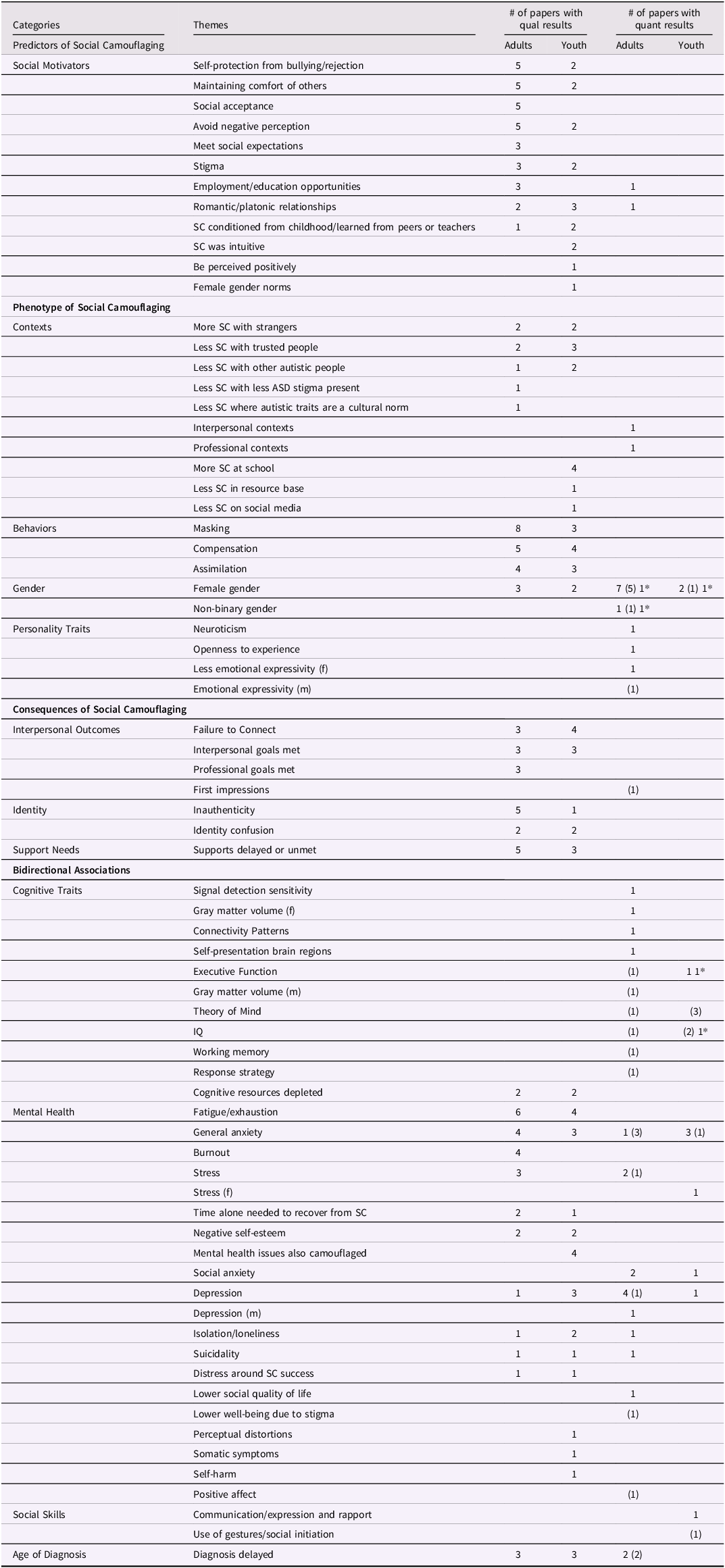
(#) = Numbers in brackets represent the number of papers with non-significant results for that theme.
#* = Numbers with asterisks represent a study with both significant and non-significant results related to the theme.
SC = Social Camouflaging.
f = Results are specific to females only.
m = Results are specific to males only.
Conclusion
This review aimed to outline the process of SC for autistic adults and youth. Overall, it was found that both autistic adults and youth are motivated to socially camouflage to achieve interpersonal goals and protect oneself from harm. In practice, SC appears more with strangers than trusted individuals for both youth and adults, and at schools or work more than at home. SC behaviors fell under categories of masking, compensation, and assimilation for all age groups. Additionally, female gender identity was associated with SC behavior. Consequences of SC for both age groups include superficial connections, achieving interpersonal goals/professional goals, lost personal identity, and inability to access support needs were also found. Additionally, possible bidirectional associations may exist between SC and cognition, mental health, social skills, and age of diagnosis. Expanding on the process of SC based on current research in this way has shown a need for future empirical exploration regarding directional associations. Further, certain positive outcomes from SC found in this review suggest that camouflaging research may benefit from a more nuanced perspective regarding possible positive and negative outcomes for autistic people. More work is needed to understand how camouflaging may develop in youth and change overtime, as well as how autistic individuals with varying intersecting identities may experience or engage in camouflaging differently. Further work as to how to ensure autistic people can live authentically is needed.
Supplementary material
The supplementary material for this article can be found at https://doi.org/10.1017/S0954579424001159.
Acknowledgements
No acknowledgements to declare.
Funding statement
This research received no specific grant from any funding agency, commercial, or not-for-profit sectors.
Competing interests
The authors declare none.


 Open access

