





Introduction
Waterhemp and common lambsquarters are the two most problematic broadleaf weeds in soybean fields in Minnesota (Van Wychen Reference Van Wychen2019). Waterhemp that competes with soybean throughout the growing season at a density of 8 plants m−1 row length could reduce crop yield by 56% (Bensch et al. Reference Bensch, Horak and Peterson2003). Similarly, common lambsquarters interference at a density of 64 plants m−2 could reduce soybean yield by 61% (Conley et al. Reference Conley, Stoltenberg, Boerboom and Binning2003). Moreover, in an experiment conducted in Minnesota, Uscanga-Mortera et al. (Reference Uscanga-Mortera, Clay, Forcella and Gunsolus2007) reported that waterhemp emerging with soybean could produce more than 180,000 seeds plant−1. Although a majority of waterhemp seeds lose their viability after 4 yr of burial in the soil, a field seedbank experiment in Nebraska reported that 1% to 3% of waterhemp seeds were viable after 17 yr (Burnside et al. Reference Burnside, Wilson, Weisberg and Hubbard1996). Waterhemp is a late-emerging species compared to other common summer annual weeds in the Midwest, and continues to emerge over an extended period, whereas common lambsquarters emerges early in the season (Leon and Owen Reference Leon and Owen2006; Werle et al. Reference Werle, Sandell, Buhler, Hartzler and Lindquist2014). Management of these species is further complicated by the prevalence of herbicide-resistant accessions. A recent study in Minnesota identified waterhemp accessions that were resistant to six herbicide sites of action, leaving glufosinate as the only effective postemergence herbicide option for controlling these accessions (Singh et al. Reference Singh, Peters, Miller, Naeve and Sarangi2024).
Soybeans with traits of multiple herbicide resistance allow growers to spray effective postemergence herbicides for controlling glyphosate-resistant weeds. One such soybean, Enlist E3® (Corteva Agriscience, Indianapolis, IN, and M.S. Technologies, West Point, IA), is resistant to 2,4-D, glyphosate, and glufosinate, and allows over-the-top application of these herbicides along with other soybean herbicides. Field experiments conducted in Indiana reported that 2,4-D applied at 0.56 kg ae ha−1 tank-mixed with glyphosate provided >97% and 100% control of waterhemp and common lambsquarters, respectively (Robinson et al. Reference Robinson, Simpson and Johnson2012). A greenhouse experiment also reported that glufosinate applied at 0.74 kg ai ha−1 reduced the aboveground biomass of multiple herbicide–resistant waterhemp by 92% (Sarangi et al. Reference Sarangi, Stephens, Barker, Patterson, Gaines and Jhala2019).
To avoid substantial yield reduction, researchers recommend minimizing weed interference when soybean is between the V2 and R1 growth stages (Mulugeta and Boerboom Reference Mulugeta and Boerboom2000; Soltani et al. Reference Soltani, Nurse, Jhala and Sikkema2019). Therefore, preemergence herbicides are considered the cornerstone of early-season weed management in soybean because they can delay the critical time for weed removal up to the V4 to R1 growth stages (Knezevic et al. Reference Knezevic, Pavlovic, Osipitan, Barnes, Beiermann, Oliveira, Lawrence, Scott and Jhala2019). A study conducted in Nebraska reported that preemergence followed by postemergence herbicide applications resulted in 84% waterhemp control at harvest, whereas control was 42% when a postemergence-only herbicide was applied (Sarangi et al. Reference Sarangi, Sandell, Kruger, Knezevic, Irmak and Jhala2017). Although research indicates that applying both preemergence and postemergence herbicides consistently provides better weed control than a postemergence-only application, Midwest farmers often face challenges in applying preemergence herbicides due to environmental constraints, time limitations, higher costs, and labor shortages during the spring (ACES News 2021). Weeds that emerge later in the season may not affect crop yield, but they should be managed using a postemergence herbicide to reduce the weed seedbank. For example, Hartzler et al. (Reference Hartzler, Battles and Nordby2004) reported that waterhemp that emerges at the V4 soybean growth stage was unlikely to affect soybean yield but the weed still produced 17,000 seeds plant−1.
The efficacy of postemergence herbicides depends on multiple factors, including the presence of herbicide-resistant weeds, the selection of herbicides, herbicide coverage, the weed and crop growth stages, and the sequence of herbicides applied (Bhaskar et al. Reference Bhaskar, Reiners, Westbrook and Ditommaso2021; Chauhan and Abugho Reference Chauhan and Abugho2012; Inman et al. Reference Inman, Jordan, Vann, Hare, York and Cahoon2020; Knoche Reference Knoche1994). Delays in postemergence herbicide application can result in reduced herbicide efficacy, severe weed competition, and a decrease in soybean yield. Field experiments conducted in Wisconsin reported that the glyphosate dose required to reduce common lambsquarters shoot biomass by 50% was 1.9 to 3.0 times higher for 20-cm-tall plants than for 10-cm-tall plants (Sivesind et al. Reference Sivesind, Gaska, Jeschke, Boerboom and Stoltenberg2011). Similarly, 2,4-D applied at 0.84 kg ae ha−1 to 10- to 15-cm-tall waterhemp plants resulted in 95% control at 3 wk after treatment, while control dropped to 67% when applied to plants that were 30 to 35 cm tall (Craigmyle et al. Reference Craigmyle, Ellis and Bradley2013a).
Several studies conducted in the United States and Canada (Craigmyle et al. Reference Craigmyle, Ellis and Bradley2013b; Sarangi et al. Reference Sarangi, Sandell, Kruger, Knezevic, Irmak and Jhala2017; Striegel and Jhala Reference Striegel and Jhala2022) have compared the efficacy of preemergence followed by (fb) postemergence herbicide applications with single-pass preemergence-only or postemergence-only approaches for weed management in soybean. Research on herbicide application timing has largely focused on the effectiveness of a single postemergence application at various crop and weed growth stages. In Enlist E3 soybean, postemergence applications of 2,4-D, glufosinate, and glyphosate can occur sequentially or as tank mixes up to the R1 or R2 soybean growth stages, depending on the herbicide used (Anonymous 2021, 2023, 2024). However, limited information exists on the optimal timing, sequence, and intervals of postemergence herbicide applications to Enlist E3 soybean. Thus the objectives of this research were to evaluate the effect of the timing and sequence of postemergence herbicide applications, with or without preemergence treatment, on control of waterhemp and common lambsquarters, biomass reduction, crop yield, and economic returns in Enlist E3 soybean crops.
Materials and Methods
Sites and Crop Description
Field experiments were conducted in 2021 and 2022 at the University of Minnesota’s Research and Outreach Center near Rosemount (44.712°N, 93.086°W), and in a farmer’s field in Franklin, MN (44.579°N, 94.875°W). The soil in Rosemount was a Waukegan silt loam (20% sand, 45% silt, 35% clay, and 4.8% organic matter; pH 7.7). At the Franklin location the soil was a Clarion-Swanlake (12.6% sand, 47.5% silt, 40% clay, and 4.5% organic matter; pH 6.6). The selected fields were dominated by naturally occurring waterhemp and common lambsquarters, though the field in Rosemount had higher weed density than the field in Franklin. Waterhemp at both sites was resistant to herbicides that inhibit acetolactate synthase, and additionally, waterhemp at the Rosemount site showed reduced sensitivity to glyphosate in recent years. At both sites, a conventional tillage system was used for field preparation, consisting of chisel plowing (20 cm deep) in the fall followed by disking and field cultivation in the spring 2 to 3 d before planting. Enlist E3 soybean was seeded at a rate of 345,800 seeds ha−1 with row spacings of 76 cm in Rosemount and 56 cm in Franklin. Soybean variety information, specific planting, and other field operation dates are provided in Table 1. In the previous season, all the sites were planted with corn (Zea mays L.). Based on soil testing and University of Minnesota Extension recommendations (Kaiser et al. Reference Kaiser, Fernandez, Wilson and Piotrowski2023), no fertilizer was applied. Additionally, due to the absence of significant insect or pathogen infestations, no insecticides or fungicides were used.

a Abbreviations: POST, postemergence; PRE, preemergence; V1, V3, and R1 refer to soybean growth stages.
b Field experiments were conducted in Rosemount and Frankin, Minnesota, in 2021 and 2022.
c Soybean suppliers: S17-E3, NK Seeds, Syngenta Seeds Inc, Downers Grove, IL; 17EE32, Stine Seed Company, Adel, IA; 5PQNK08, Pioneer Seeds, Johnston, IA.
Herbicide Treatments
Treatments were arranged in a two-factor randomized complete block design with four replications, with treatment factors including the application of a preemergence herbicide (preemergence and no-preemergence) and postemergence herbicide treatments. Details of herbicide treatments, application rates, timing, and sequence are included in Tables 2 and 3. Experimental plots were 3 m wide and 9 m long in Rosemount, and 2.2 m wide and 9 m long in Franklin. While preemergence herbicides were applied within 3 d after soybean planting, postemergence herbicides were sprayed early postemergence at the first-trifoliate (V1) stage, as mid-postemergence at the third-trifoliate (V3) stage, and as late postemergence at the initiation of soybean flowering (R1 stage). Two subsequent herbicide applications occurred at least 7 d apart. Herbicides were applied using a CO2-pressurized backpack sprayer equipped with a 2-m boom fitted with four AIXR110015 flat-fan nozzles (TeeJet Technologies, Glendale Heights, IL) calibrated to deliver 140 L ha−1 at 276 kPa.
Herbicide active ingredient, trade name, application rate, manufacturer, and adjuvant information.

a Manufacturer locations: BASF Corporation, Research Triangle Park, NC; Bayer CropScience, St. Louis, MO; Corteva Agriscience LLC, Indianapolis, IN; Syngenta Crop Protection, Greensboro, NC.
b Herbicide and adjuvant retail prices in 2022 were averaged from three different sources: Farmward Cooperative, Danube, MN; Crop Protection Price list by WinField United, Arden Hills, MN; and North Dakota State University’s Weed Control Guide (Ikley et al. Reference Ikley, Christoffers, Dalley, Enfres, Howatt, Jenks, Keene, Law, Ostlie, Peters, Robinson, Thostenson and Valenti2022). A retail price of US$13.38 ha−1 for ammonium sulfate was used for herbicide applications containing glufosinate and glyphosate.
c A micro-encapsulated formulation of acetochlor was used in this experiment.
d Ammonium sulfate (N-Pak® AMS Liquid, Winfield United, LLC., St. Paul, MN) at 25 mL L−1 was added to glufosinate and glyphosate treatments.
Herbicide program and application timing for control of waterhemp and common lambsquarters. a,b,c
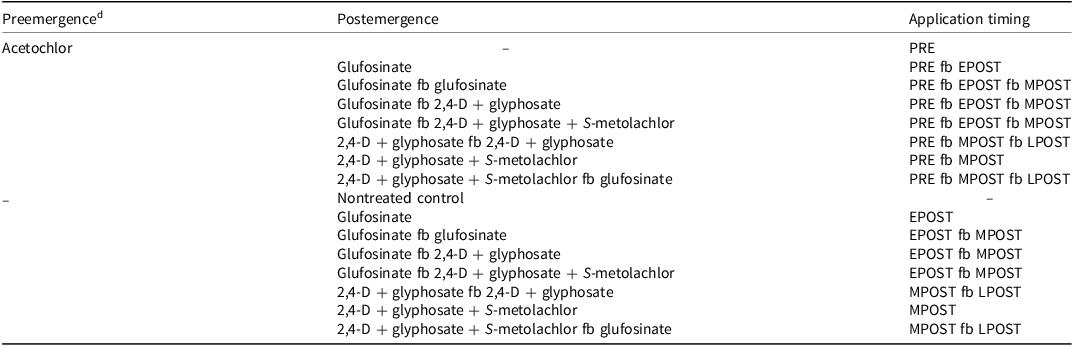
a Abbreviations: EPOST, early postemergence; fb, followed by; LPOST, late postemergence; MPOST, mid-postemergence.
b Field experiments were conducted in Rosemount and Frankin, Minnesota, in 2021 and 2022 in fields of Enlist E3 soybean.
c EPOST, MPOST, and LPOST applications were completed at the V1, V3, and R1 soybean growth stages, respectively.
d A microencapsulated formulation of acetochlor was used in the preemergence experiment.
Data Collection
Waterhemp and common lambsquarters control was visually assessed at 21 d after preemergence, 28 d after late postemergence, and at soybean harvest on a scale of 0% to 100%, with 0% representing no control and 100% representing complete control of the weeds. Weed density was recorded at 21 d after preemergence and 28 d after late postemergence by counting weeds in two 0.25-m2 quadrats placed randomly between two center soybean rows in each plot, and density data were later adjusted to plants per square meter. Soybean plant stand was estimated by counting the number of plants in a 1-m row length from two center soybean rows at 21 d after preemergence. Soybean injury from preemergence and postemergence herbicide applications was recorded on a scale of 0% to 100% at 21 d after preemergence and 7 to 10 d after each postemergence application, with 0% representing no soybean injury and 100% representing plant death. Aboveground biomass was collected for waterhemp at 40 d after late postemergence by cutting the plants at the soil surface from one 0.25-m2 quadrat per plot, and the samples were oven-dried at 60 C for 4 d and weighed. Aboveground biomass for each plot was converted to percent biomass reduction for comparison with the nontreated control using Equation 1:
 $${\text{Aboveground}}\;{\text{biomass}}\;{\text{reduction}}\;(\% ) = \left[ {\frac{{C - B}}{C}} \right] \times 100$$
where C is the aboveground biomass of nontreated control and B is the biomass of a treated plot.
Soybean height was measured by averaging the plant height from the ground to the top of the main stem for five random soybean plants in a plot at 28 d after late postemergence. Soybean yield was estimated by harvesting the middle two soybean rows of each plot at the Rosemount site and the middle three rows at the Franklin site using a small-plot harvester (Wintersteiger Inc., Salt Lake City, UT) in early to mid-October, and final yield data were adjusted to 13% moisture content.
Partial Economic Returns
Herbicide and adjuvant retail prices for 2022 were obtained from three different sources (Farmward Cooperative, Danube, MN; Crop Protection Price list by WinField United, St. Paul, MN; and the North Dakota Weed Control Guide, Fargo; Ikley et al. Reference Ikley, Christoffers, Dalley, Enfres, Howatt, Jenks, Keene, Law, Ostlie, Peters, Robinson, Thostenson and Valenti2022) and averaged to estimate the cost of herbicide programs. A custom application fee of US$19.20 per hectare was added for each herbicide application based on the average cost of the ground-based broadcast application with a self-propelled sprayer (Plastina and Johanns Reference Plastina and Johanns2022). The costs of herbicide programs and applications were summed up to estimate weed management costs. No efforts were made to account for any rebates, long-term costs, or the price of biotech traits. Gross revenue was calculated by multiplying soybean yield (kg ha−1) with the average grain price received in December 2022 [US$0.63 kg−1 (USDA-AMS 2022)]. The partial return was calculated using Equation 2:
 $${\rm Partial \;return \;(US \unicode{x0024})} = GR - WMC$$
Where GR denotes gross revenue and WMC is the weed management cost. Because other production costs such as soil cultivation and seed costs remained constant across treatments, these costs were ignored when the partial returns were calculated.
Statistical Analysis
Replications nested within years were considered random effects, while preemergence and postemergence herbicide treatment factors and their interactions were considered fixed effects. Statistical analyses were performed using R statistical software (R Core Team 2022). At 21 d after preemergence, densities of waterhemp and common lambsquarters in preemergence and no-preemergence treatments were compared using a two-tailed, two-sample Student’s t-test. Generalized linear mixed models were fit to the weed control and aboveground biomass reduction data using “beta” distribution and the logit link function (glmmtmb package 1.1.5; Brooks et al. Reference Brooks, Kristensen, Benthem, Magnusson, Berg, Nielsen, Skaug, Mächler and Bolker2017). Similarly, generalized linear mixed models were fit to the weed density data using “Poisson” distribution and the log link function and evaluated for overdispersion using nonparametric dispersion tests with the DHARMa package 0.4.6 (Hartig Reference Hartig2022). If an overdispersion was detected, a generalized linear mixed model was fit using the “negative binomial” distribution and the log link function. Model assumptions were verified by plotting simulated residuals and estimating goodness-of-fit using DHARMa package 0.4.6 (Hartig Reference Hartig2022). Linear mixed models were fit to crop height, yield, and partial return data using the lme4 package 1.1-31 (Bates et al. Reference Bates, Maechler, Bolker and Walker2021). Assumptions of normality and homogeneity of variance were evaluated using Shapiro-Wilk and Bartlett tests, respectively. For linear mixed models, Type III ANOVAs were conducted using Satterthwaite’s method (lmertest package 3.1-3; Kuznetsova et al. Reference Kuznetsova, Brockhoff and Christensen2017), and for generalized linear mixed models, Type III Wald chi-square tests were performed. Mean separation was obtained using Fisher’s protected LSD at P < 0.05 (emmeans package 1.8.2; Lenth Reference Lenth2021).
Results and Discussion
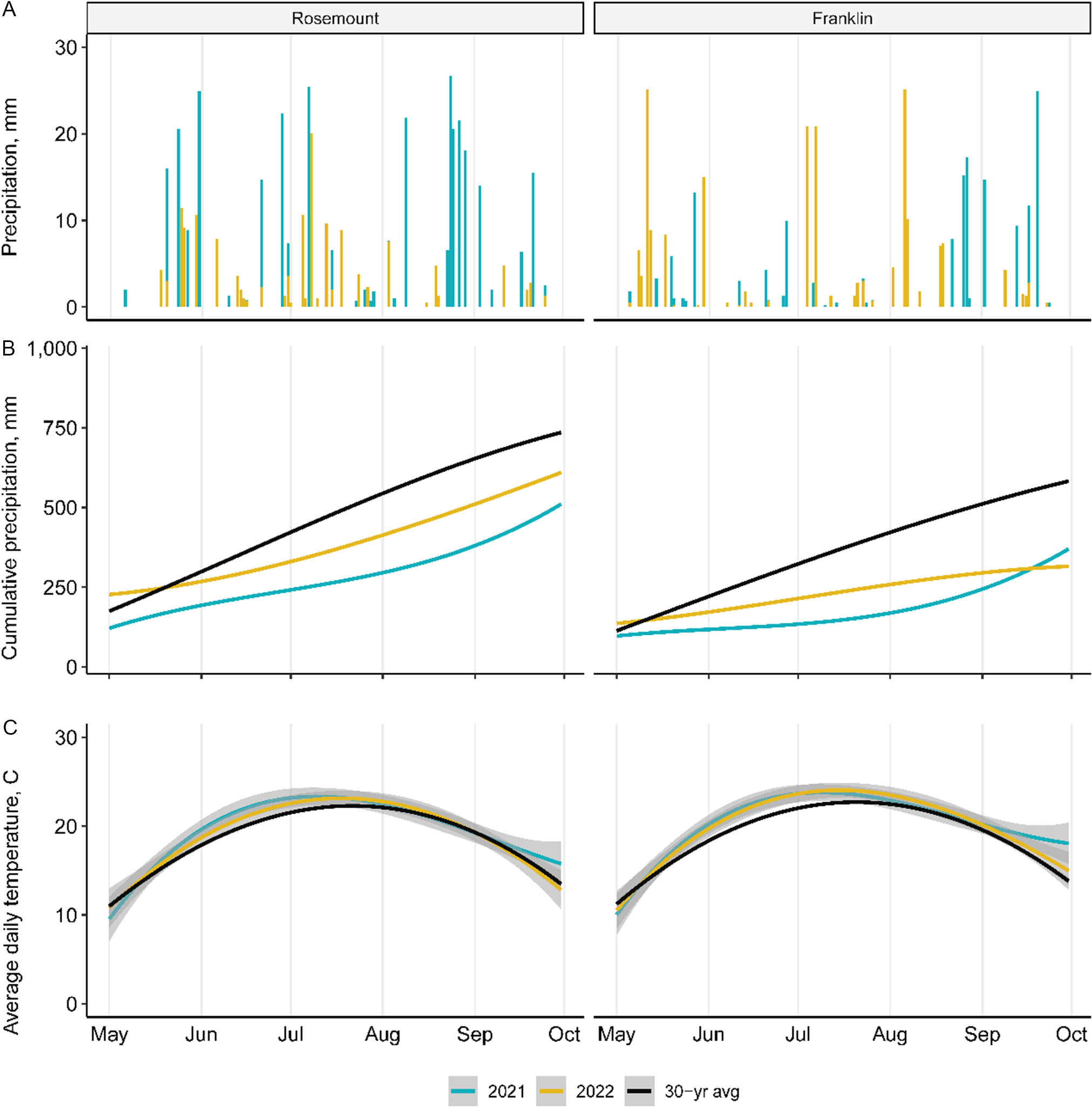
Year-by-treatment interactions were nonsignificant (P ≥ 0.05) within experimental sites; therefore, years within sites were combined, but data from both sites were analyzed separately due to differences in the environment and weed density between the sites. Cumulative precipitation in May was close to normal, but a drought persisted in 2021 and 2022, resulting in cumulative precipitation in both season being lower than the 30-yr average (Figure 1). The daily average temperature was near normal (30-yr average) at the beginning of the season, but in June and July in both years, the daily average temperature was slightly higher than the 30-yr average.
Weather data for Rosemount and Franklin, MN. A) Daily precipitation (mm) for 2021 and 2022. B) Cumulative precipitation (mm). C) Average daily air temperature in Celsius in 2021, 2022, and the 30-yr average. Weather data for the Rosemount Research and Outreach Center station and Franklin (Redwood Falls station) were obtained from the National Weather Service.
Waterhemp Control, Density, and Biomass Reduction
Application of micro-encapsulated acetochlor as a preemergence herbicide resulted in 2% to 5% crop injury at both sites, whereas crop injury from the rest of the herbicides was <3% (data not shown). At Rosemount when early-postemergence herbicides were applied, waterhemp plants measured 4 and 7 cm in height in preemergence fb postemergence and postemergence-only treatments, respectively, and 7 and 12 cm at Franklin for the corresponding treatments (data not shown). At both sites, when mid-postemergence herbicides were applied, waterhemp height was <8 cm in the plots that received an early postemergence treatment, regardless of the preemergence herbicide application. However, for treatments without an early-postemergence application, waterhemp was 17 and 24 cm high in Franklin and 9 and 14 cm in Rosemount for the preemergence fb postemergence and postemergence-only treatments, respectively (data not shown).
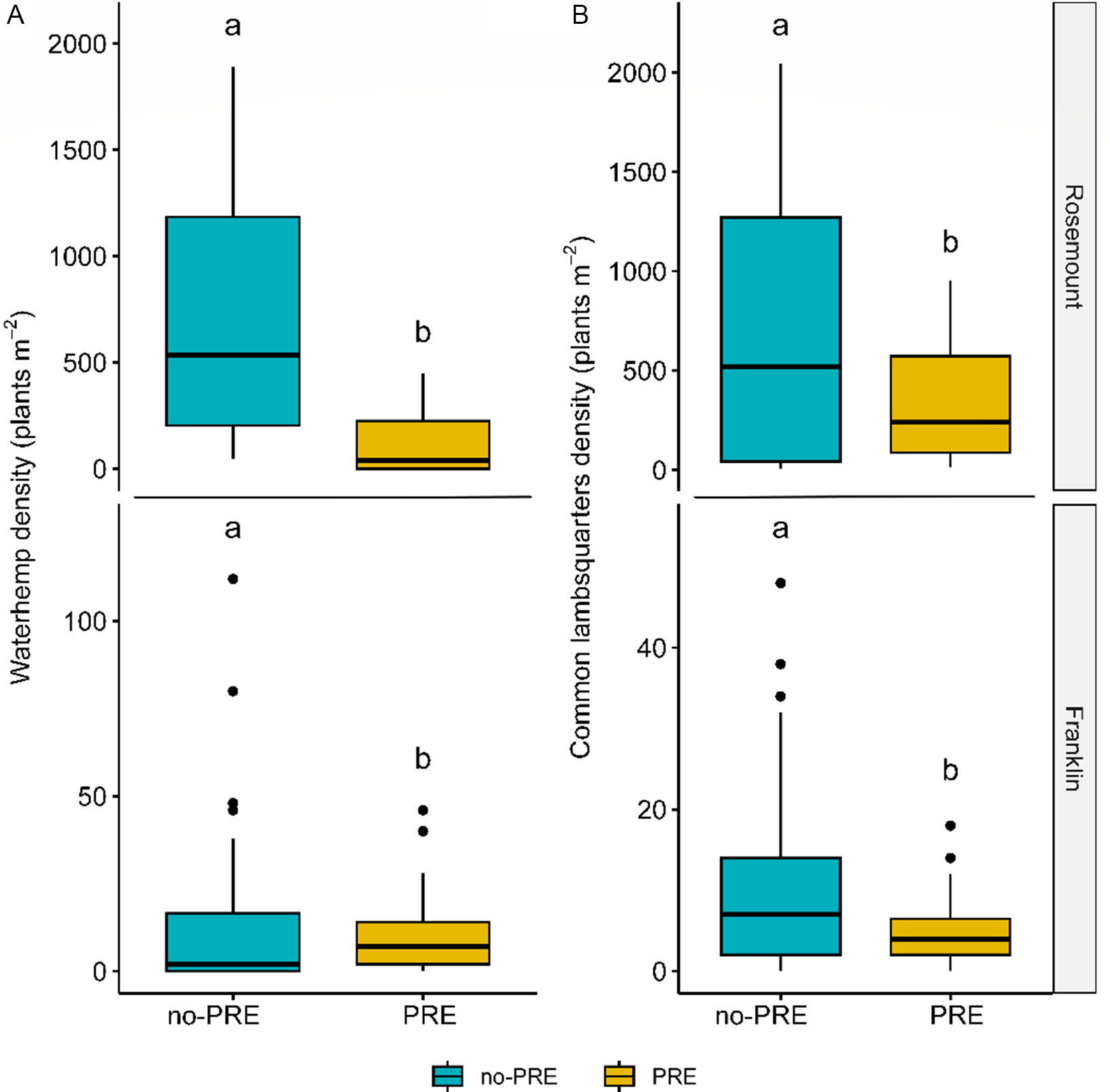
Micro-encapsulated acetochlor applied preemergence at 1,260 g ai ha−1 provided ≥85% waterhemp control at both sites at 21 d after preemergence (data not shown). In Rosemount, waterhemp density was reduced from 715 plants m−2 in the no-preemergence plots to 115 plants m−2. In Franklin waterhemp density was reduced from 14 plants m−2 to 6 plants m−2 (Figure 2). Similarly, in an experiment conducted in Illinois on a down south silt loam soil, the preemergence application of micro-encapsulated acetochlor at 1,300 g ai ha−1 resulted in 87% control of waterhemp and a 77% reduction in density compared with the nontreated control at 28 d after preemergence (Strom et al. Reference Strom, Jacobs, Seiter, Davis, Riechers and Hager2022).
Box-and-whiskers plots showing (A) waterhemp and (B) common lambsquarters density at 21 d after preemergence (PRE) in Enlist E3 soybean in field experiments conducted in Rosemount and Franklin, MN, in 2021 and 2022. Within the site and species, no common letters indicates a significant difference in mean based on a two-sample Student’s t-test. The solid black line within each box represents the median.
A herbicide program that consists of a preemergence-only treatment provided ≤77% waterhemp control at both sites (Table 4). A study conducted in Nebraska on silty clay loam soil reported 80% and 30% waterhemp control at 60 d and 100 d, respectively, after micro-encapsulated acetochlor was applied at a rate of 1,680 g ai ha−1 (Jhala et al. Reference Jhala, Malik and Willis2015). In Rosemount, following a preemergence herbicide application, glufosinate fb 2,4-D + glyphosate (with or without S-metolachlor at mid-postemergence a tank mix) and two-pass 2,4-D + glyphosate resulted in the greatest waterhemp control (97% at 28 d after late postemergence and 96% at harvest) (Table 4). The control from these treatments at harvest was similar to the control (92% to 94%) obtained from preemergence fb 2,4-D + glyphosate + S-metolachlor (mid-postemergence) fb glufosinate (late postemergence), and postemergence-only treatments of glufosinate (early postemergence) fb 2,4-D + glyphosate + S-metolachlor (mid-postemergence), and 2,4-D + glyphosate (mid-postemergence) fb 2,4-D + glyphosate (late postemergence) at that time. In Franklin, at 28 d after late postemergence regardless of the preemergence treatment, two-pass postemergence programs that included 2,4-D + glyphosate with or without S-metolachlor applied at mid-postemergence resulted in ≥97% waterhemp control, which was similar to that achieved when acetochlor was applied preemergence fb 2,4-D + glyphosate + S-metolachlor applied mid-postemergence (Table 4). It is believed that the systemic nature of 2,4-D and glyphosate improved waterhemp control than that of glufosinate at both sites, and waterhemp at the Franklin site was sensitive to glyphosate. Similarly, a study conducted in Ontario, Canada, reported that a postemergence application of 2,4-D and glyphosate resulted in 39% greater waterhemp control than that from glufosinate (Duenk et al. Reference Duenk, Soltani, Miller, Hooker, Robinson and Sikkema2023).
Waterhemp control as influenced by herbicide application timing and sequence at 28 d after late postemergence and at harvest. a,b
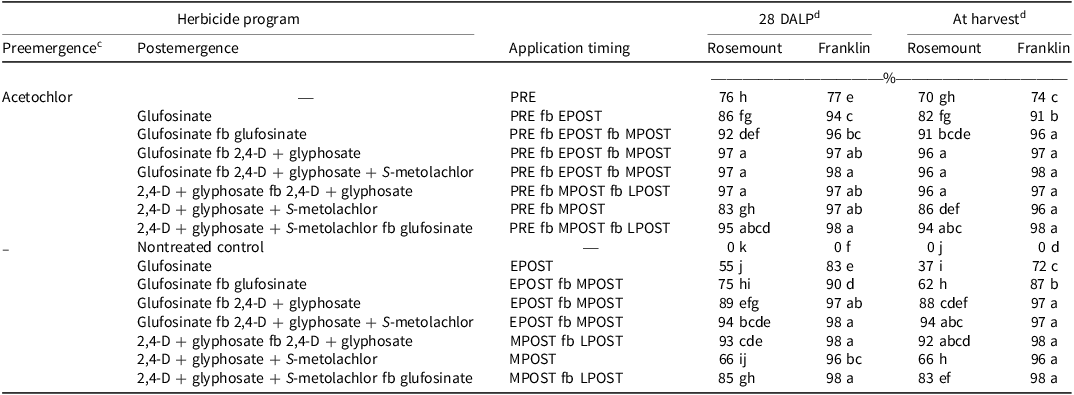
a Abbreviations: DALP, days after postemergence; EPOST, early postemergence; fb, followed by; LPOST, late postemergence; MPOST, mid-postemergence.
b Field experiments were conducted in Rosemount and Frankin, Minnesota, in 2021 and 2022 in fields of Enlist E3 soybean.
c A micro-encapsulated formulation of acetochlor was used as the preemergence herbicide.
d Data assessed at 28 DALP and at harvest were analyzed using a generalized linear mixed model with “beta” distribution and logit link function; interpretations are based on the logit scale; however, back-transformed estimated mean values are presented. Means within the same column with no common letter(s) are significantly different based on Fisher’s protected LSD (P < 0.05).
At 28 d after late postemergence, one-pass (early postemergence) or two-pass (early postemergence fb mid-postemergence) glufosinate postemergence-only programs provided ≤75% and ≤90% waterhemp control in Rosemount and Franklin, respectively. However, when preceded by preemergence herbicides, the aforementioned programs provided 86% to 92% and 94% to 96% waterhemp control in Rosemount and Franklin, respectively (Table 4). Lower waterhemp control with glufosinate applications in the absence of a preemergence application is likely due to an increase in waterhemp height at Franklin (7 cm and 12 cm at preemergence fb postemergence and postemergence-only, respectively) and Rosemount (4 cm and 7 cm at preemergence fb postemergence and postemergence-only, respectively, data not shown). Previous research also documented <85% waterhemp control with sequential glufosinate applications (Aulakh and Jhala Reference Aulakh and Jhala2015; Jhala et al. Reference Jhala, Sandell, Sarangi, Kruger and Knezevic2017).
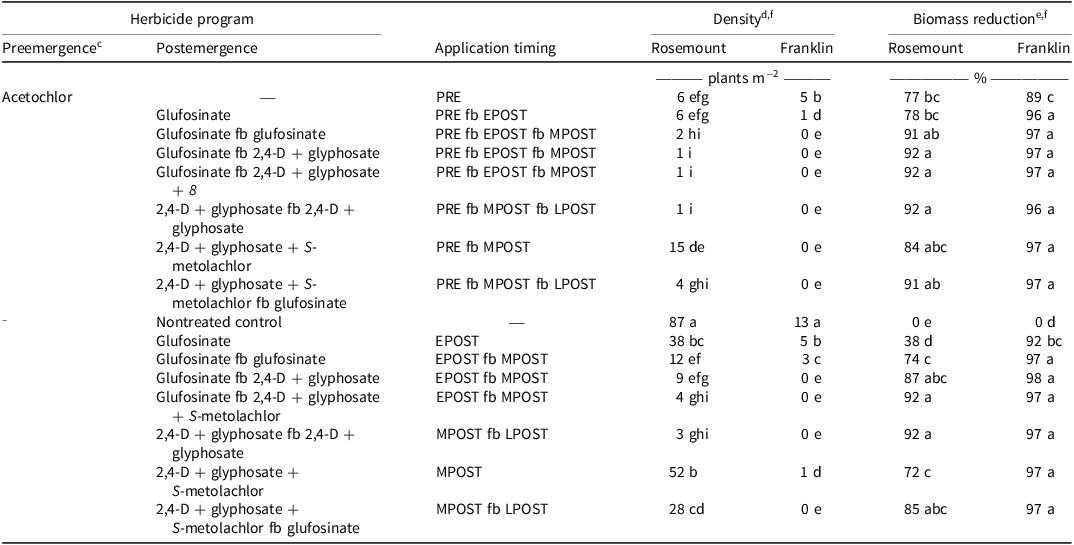
At both research sites, the preemergence-only herbicide treatment reduced waterhemp density to ≤6 plants m−2 at 28 d after late postemergence compared with 87 and 13 plants m−2 in the nontreated control in Rosemount and Franklin, respectively (Table 5). In Rosemount, waterhemp density was reduced to ≤4 plants m−2 after the preemergence fb two-pass postemergence treatment, which is similar to the density reduction that occurred with postemergence-only programs of glufosinate (early postemergence) fb 2,4-D + glyphosate + S-metolachlor (mid-postemergence) and 2,4-D + glyphosate (mid-postemergence) fb 2,4-D + glyphosate (late postemergence). An experiment conducted in Arkansas reported that preemergence fb sequential dicamba (another auxin mimic herbicide) applications reduced Palmer amaranth (Amaranthus palmeri S. Watson) density by 94% in soybean at 14 d after a late postemergence application (Houston et al. Reference Houston, Barber, Norsworthy and Roberts2020). In Franklin, regardless of preemergence treatment, all two-pass postemergence programs with the exception of early postemergence fb mid-postemergence applications of glufosinate, reduced waterhemp density to 0 plants m−2, which was comparable to the drop in density achieved with preemergence fb mid-postemergence applications of 2,4-D + glyphosate + S-metolachlor as measured at 28 d after late postemergence (Table 5). The slight discrepancy between waterhemp control and density in Rosemount was likely due to density being assessed from only two 0.25-m2 quadrats, representing only a portion of the entire plot.
Waterhemp density and biomass reduction as influenced by herbicide application timing and sequence. a,b
a Abbreviations: DALP, days after postemergence; EPOST, early postemergence; fb, followed by; LPOST, late postemergence; MPOST, mid-postemergence.
b Field experiments were conducted in Rosemount and Frankin, Minnesota, in 2021 and 2022 in fields of Enlist E3 soybean.
c A micro-encapsulated formulation of acetochlor was used as the preemergence herbicide.
d Density data were assessed at 28 DALP and were analyzed using a generalized linear mixed model with “negative binomial: quadratic parameterization” or “poisson” distribution and log link function; interpretations are based on the log scale; however, back-transformed estimated mean values are presented.
e Biomass reduction data were assessed at 40 DALP and analyzed using a generalized linear mixed model with “beta” distribution and logit link function; interpretations are based on the logit scale; however, back-transformed estimated mean values are presented.
f Means within the same column with no common letter(s) are significantly different based on Fisher’s protected LSD (a = 0.05).
When assessed at 40 d after late postemergence, compared with the nontreated control, waterhemp biomass was reduced by 77% in Rosemount and by 89% in Franklin after acetochlor had been applied preemergence (Table 5). In Rosemount, all two-pass postemergence programs resulted in a reduction in waterhemp aboveground biomass of ≥85%, regardless of preemergence application or the timing or sequence of herbicide treatments, with the exception of postemergence-only two-pass glufosinate, and was similar to that of the preemergence fb 2,4-D + glyphosate + S-metolachlor (mid-postemergence) application. In Franklin, all treatments except acetochlor alone as a preemergence application or glufosinate-only as an early postemergence, resulted in a ≥96 reduction in waterhemp biomass% (Table 5).
Common Lambsquarters Control and Density
When assessed at 21 d after preemergence, acetochlor applied preemergence provided 52% and 76% control of common lambsquarters in Rosemount and Franklin, respectively (data not shown). The preemergence application reduced the density of common lambsquarters from 687 plants m−2 when no preemergence herbicide was applied to 330 plants m−2 in preemergence in Rosemount, and from 12 to 5 plants m−2 in Franklin (Figure 2). A study conducted on Fort Collins clay loam in Montana reported <66% common lambsquarters control with acetochlor applied preemergence (Jha et al. Reference Jha, Kumar, Garcia and Reichard2015). Similarly, another study with acetochlor applied preemergence reported a variable control of common lambsquarters that ranged between 50% and 100% (Chomas and Kells Reference Chomas and Kells2004). The results of our study may have differed if a preemergence herbicide with greater efficacy against common lambsquarters had been used.
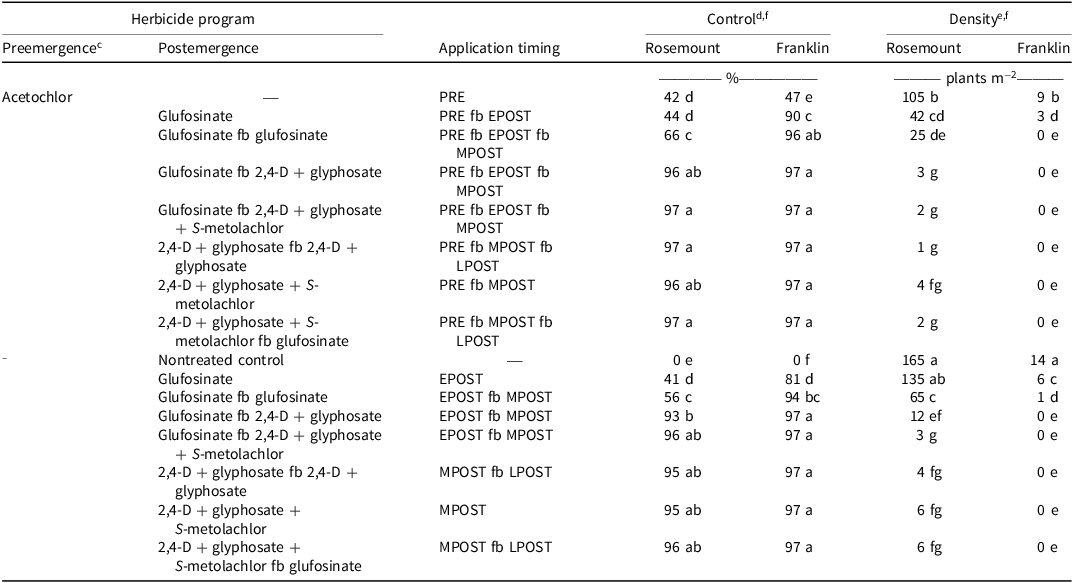
At 28 d after late postemergence, the preemergence-only program resulted in ≤47% control of common lambsquarters and 36% density reduction compared with the nontreated controls at both sites (Table 6). In Rosemount, regardless of preemergence application, the treatments that included a mid-postemergence application of 2,4-D + glyphosate with or without S-metolachlor, with the exception of the postemergence-only treatment of glufosinate (early postemergence) fb 2,4-D + glyphosate (mid-postemergence), resulted in ≥95% control of common lambsquarters and reduced the density of common lambsquarters to ≤6 plants m−2 compared with 165 plants m−2 in the nontreated control. In Franklin, irrespective of preemergence application, all herbicide programs that included a postemergence application of 2,4-D + glyphosate with or without S-metolachlor provided 97% control of common lambsquarters and density was reduced to 0 plants m−2. This result is comparable to that of the preemergence fb two-pass glufosinate (early postemergence fb mid-postemergence) treatment when assessed at 28 d after the late postemergence application (Table 6). A greenhouse experiment conducted in Indiana reported 45% greater control of common lambsquarters with glyphosate + 2,4-D compared with a glufosinate-only treatment (Chahal and Johnson Reference Chahal and Johnson2012). In Rosemount, the applications of acetochlor (preemergence) fb two-pass glufosinate (early postemergence and mid-postemergence) resulted in 66% control of common lambsquarters, which was better than the control obtained with acetochlor fb one-pass glufosinate (44% control) but similar to that (56%) obtained with the postemergence-only two-pass glufosinate (early postemergence fb mid-postemergence) program. The lower control of common lambsquarters by glufosinate was possibly due to greater common lambsquarters density at the Rosemount site, resulting in moderate herbicide coverage. In a multiyear experiment, Tharp and Kells (Reference Tharp and Kells2002) reported 76% to 93% control of common lambsquarters with glufosinate-only treatments and attributed the lower control to higher weed density in one of the years. Furthermore, in our experiment, the addition of S-metolachlor as a part of a layered residual program at mid-postemergence in the preemergence fb glufosinate (early postemergence) fb 2,4-D + glyphosate (mid-postemergence) program did not improve control of common lambsquarters at either site (Table 6). Past studies have reported lower and variable control of common lambsquarters with preemergence applications of S-metolachlor (Chomas and Kells Reference Chomas and Kells2004; Myers and Harvey Reference Myers and Harvey1993; Oliveira et al. Reference Oliveira, Feist, Eskelsen, Scott and Knezevic2017).
Common lambsquarters control and density as influenced by herbicide application timing and sequence at 28 d after late postemergence. a,b
a Abbreviations: EPOST, early postemergence; fb, followed by; LPOST, late postemergence; MPOST, mid-postemergence.
b Field experiments were conducted in Rosemount and Frankin, Minnesota, in 2021 and 2022, in fields of Enlist E3 soybean.
c A micro-encapsulated formulation of acetochlor was used as the preemergence herbicide.
d Control data were analyzed using a generalized linear mixed model with “beta” distribution and logit link function; interpretations are based on the logit scale; however, back-transformed estimated mean values are presented.
e Density data were analyzed using a generalized linear mixed model with “negative binomial: quadratic parameterization” or “poisson” distribution and log link function; interpretations are based on the log scale; however, back-transformed estimated mean values are presented.
f Means within the same column with no common letter(s) are significantly different based on Fisher’s protected LSD (P < 0.05).
Soybean Height and Yield
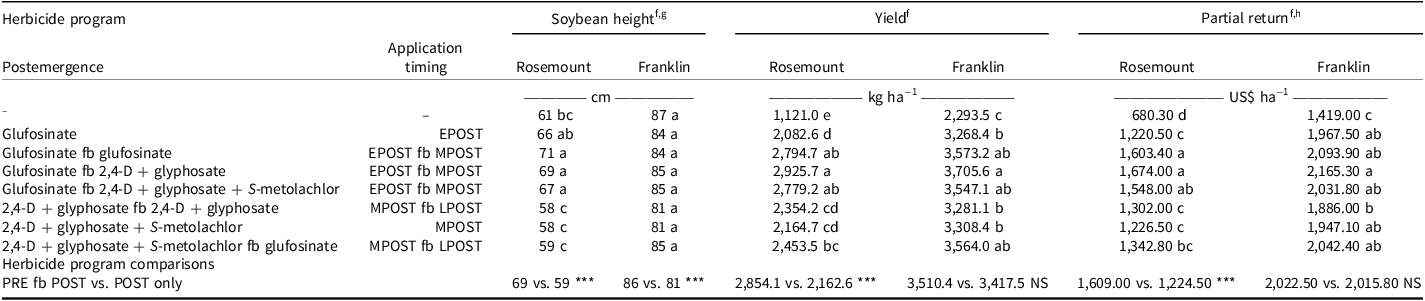
The interactions of preemergence and postemergence treatments were nonsignificant (P ≥ 0.05) for soybean height and yield; therefore, the main effects are presented. Results showed that soybean height was greater after the preemergence fb postemergence treatments (measuring 69 and 86 cm tall in Rosemount and Franklin, respectively), compared with soybean height after the postemergence-only treatments (59 cm in Rosemount and 81 cm in Franklin) at 28 d after late postemergence (Table 7). In Rosemount, including an early postemergence application of glufosinate in two-pass postemergence programs improved soybean height over the two-pass postemergence programs without an early postemergence treatment. Early-season crop-weed competition in the absence of an early postemergence treatment resulted in ≥10.6% soybean height reduction in the high weed density conditions in Rosemount. Similarly, another study reported that soybean height was reduced by 5.5% and 14% when weed interference was extended by 14 d and 28 d, respectively (Daramola Reference Daramola2020). Similarly, in the sequential glufosinate + dicamba fb a postemergence directed-spray program, delaying the initial glufosinate application by 7 d resulted in a 7% height reduction in cotton (Gossypium hirsutum L.) (Vann et al. Reference Vann, York, Cahoon, Buck, Askew and Seagroves2017). Soybean height was not affected (P ≥ 0.05) by the postemergence applications in Franklin (Table 7).
Enlist E3 soybean height, yield, and economic returns as influenced by herbicide application timing and sequence.a–e
a Abbreviations: DALP, days after late postemergence; EPOST, early postemergence; fb, followed by; LPOST, late postemergence; MPOST, mid-postemergence; POST, postemergence; PRE, preemergence.
b Field experiments were conducted in Rosemount and Frankin, Minnesota, in 2021 and 2022,
c Data were analyzed using a linear mixed model without adopting any transformation.
d Means within the same column with no common letter(s) are significantly different based on Fisher’s protected LSD (P < 0.05).
e Asterisks indicate P-value significance: * = P < 0.05; ** = P < 0.01; *** = P < 0.001; NS, nonsignificant (P ≥ 0.05).
f The interaction between PRE and POST program was not significant at α = 0.05; therefore, POST program data were averaged across the PRE treatments.
g Soybean height was measured at 28 DALP.
h Partial return was calculated by subtracting the weed management cost from gross revenue, where gross revenue was calculated by multiplying soybean yield (kg ha−1) with the grain price (US$ 0.63 kg−1) and weed management cost was calculated based on herbicide and adjuvant price and custom application cost per herbicide application.
i There was no POST herbicide application, thus values are averaged over PRE-only and nontreated treatments.
Soybean yield in Rosemount improved by 691.5 kg ha−1 following the preemergence fb postemergence program over the postemergence-only treatment; however, yield was not affected by preemergence application at the Franklin location (Table 7). An experiment conducted in Nebraska for glyphosate-resistant waterhemp control in soybean reported 613.0 kg ha−1 higher soybean yield after preemergence fb postemergence treatments compared with postemergence-only treatments (Jhala et al. Reference Jhala, Sandell, Sarangi, Kruger and Knezevic2017). Another study conducted in Nebraska also reported an increase of >32% in soybean yield by including a preemergence fb postemergence treatment over a postemergence-only treatment (Sarangi et al. Reference Sarangi, Sandell, Kruger, Knezevic, Irmak and Jhala2017). In this research, glufosinate applied early postemergence fb 2,4-D + glyphosate applied mid-postemergence resulted in the greatest soybean yield (2,925.7 and 3,705.6 kg ha−1 in Rosemount and Franklin, respectively), which was similar to yield after early postemergence fb mid-postemergence applications of glufosinate fb glufosinate, and glufosinate fb 2,4-D + glyphosate + S-metolachlor at both sites. Additionally, 2,4-D + glyphosate + S-metolachlor applied mid-postemergence fb glufosinate applied late postemergence resulted in a similar yield (3,564.0 kg ha−1) as the aforementioned treatments in Franklin (Table 7). In Rosemount, where weed density was higher than in Franklin, applying glufosinate as an early postemergence fb a mid-postemergence treatment improved soybean yield; however, including glufosinate as the late postemergence herbicide in a mid-postemergence fb late postemergence treatment did not prevent yield loss. Past research on the critical period of weed removal reported that soybean must stay weed-free from planting through the V2 growth stage to prevent substantial yield loss (Soltani et al. Reference Soltani, Nurse, Jhala and Sikkema2019; Van Acker et al. Reference Van Acker, Swanton and Weise1993). Field experiments in Ontario, Canada, reported that a delay in an initial postemergence herbicide application to the V1 growth stage could lead to a reduction in soybean yield of 10% when weed density is high (>143 plants m−2) (Soltani et al. Reference Soltani, Shropshire and Sikkema2022).
Economics
The interactions of preemergence and postemergence treatments were nonsignificant (P ≥ 0.05) for partial returns; therefore, the main effects are presented. In Rosemount, the preemergence application of acetochlor in preemergence fb postemergence treatments improved partial returns by 31% over postemergence-only treatments; however, the partial returns were similar in Franklin irrespective of preemergence application (Table 7). In this scenario, partial returns followed a similar trend as soybean yield. In Rosemount, glufosinate applied early postemergence fb 2,4-D + glyphosate applied mid-postemergence produced the highest partial return (US$1,674.00), which was similar to other early postemergence fb mid-postemergence programs (≥US$1,548.00). In Franklin, all of the treatments except no-postemergence resulted in similar (≥US$1,886.00 ha−1) partial returns (Table 7). Therefore, the application of a preemergence herbicide is recommended for better economic returns, especially in a field infested with a high density of weeds. Another study also observed that the inclusion of a preemergence herbicide improved partial returns more than postemergence-only herbicides (Sarangi and Jhala Reference Sarangi and Jhala2019).
Practical Implications
Weed management in fields planted with Enlist E3 soybean can vary depending on the weed density, herbicide selection, and herbicide application timing and sequence. This research concluded that preemergence fb two-pass postemergence herbicide applications were critical for season-long waterhemp control when weed density is high. In Rosemount, where waterhemp was present at a higher density, waterhemp control was greater when glufosinate was replaced with 2,4-D + glyphosate in the acetochlor (preemergence) fb two-pass glufosinate (applied early postemergence and mid-postemergence) program. Additionally, implementing a preemergence fb glufosinate fb 2,4-D + glyphosate treatment would enhance herbicide sites of action, thereby diversifying the program. The early postemergence application of glufosinate in two-pass postemergence programs improved Enlist E3® soybean yield. Glufosinate applied late postemergence (as a rescue treatment) in a mid-postemergence fb late postemergence program led to lower yield compared with the early postemergence application of glufosinate in Rosemount, but in Franklin (a site with relatively lower weed density), these treatments produced similar yields. Some studies have reported improved control of pigweed species with tank-mix applications of glufosinate and 2,4-D (Craigmyle et al. Reference Craigmyle, Ellis and Bradley2013a; Joseph et al. Reference Joseph, Marshall and Sanders2018), but that combination was not evaluated in this study. The results also showed that in Franklin, where weed density was lower and glyphosate-resistant weeds were absent, avoiding a preemergence herbicide application did not reduce Enlist E3 soybean yield. However, omitting preemergence treatments is not recommended, because the variability in weed control may increase and potentially promote resistance evolution in weed species (Landau et al. Reference Landau, Bradley, Burns, Flessner, Gage, Hager, Ikley, Jha, Jhala, Johnson, Johnson, Lancaster, Legleiter, Lingenfelter and Loux2023). This research focused on the “integrated herbicide management” approach in growing Enlist E3 soybean; however, integrated weed management that includes combinations of at least two methods from the chemical, cultural, physical, and biological weed control strategies should be incorporated for herbicide-resistant weed management.
Acknowledgments
We thank Joe Sullivan and the Sullivan Family Farm in Franklin, Minnesota, for providing the land for on-farm research trials and assisting with establishing the project. Assistance from Datta Chiruvelli, Eric Yu, Ian Tuma, Mark Timper, and Ryan Mentz, members of the University of Minnesota Weeds Laboratory is greatly appreciated. We also thank Dave Nicolai and Steve Quiring for their help in establishing the project, collecting data, and crop harvesting, and Ian Rogers for copyediting the manuscript.
Funding
The Minnesota Soybean Research and Promotion Council provided financial support for the graduate research assistant who worked on this research.
Competing Interests
The authors declare they have no competing interests.


 Open access

