


Introduction
Human destruction of tropical forests is estimated to contribute up to 17% of global carbon dioxide emissions, resulting in accelerated global warming (Achard et al., Reference Achard, Eva, Mayaux, Stibig and Belward2004; Gullison et al., Reference Gullison, Frumhoff, Canadell, Field, Nepstad and Hayhoe2007; IPCC, Reference Solomon, Qin, Manning, Chen, Marquis, Tignor and Miller2007; Van der Werf et al., Reference Van der Werf, Morton, DeFries, Olivier, Kasibhatla and Jackson2009). One mechanism proposed to mitigate these emissions is Reducing Emissions from Deforestation and Forest Degradation in Developing Countries, otherwise known as Reducing Emissions from Deforestation and Forest Degradation (REDD). The recently agreed REDD+ is the original concept of REDD, plus sustainable management of forests and the conservation and enhancement of forest carbon stocks. The proposed REDD+ mechanism forms part of an international move to include emissions from habitat change (especially the loss of carbon-rich ecosystems such as forests) in a more comprehensive agreement under the UN Framework Convention on Climate Change (UNFCCC), which it is hoped will become operational in 2012.
At the UNFCCC meeting (CoP 15) in Copenhagen, Denmark, in December 2009, some of the parties developed a draft decision known as the Copenhagen Accord. This accord provides the basis for REDD+ in paragraph 8: ‘scaled up, new and additional, predictable and adequate funding as well as improved access shall be provided to developing countries, in accordance with the relevant provisions of the Convention, to enable and support enhanced action on mitigation, including substantial finance to reduce emissions from deforestation and forest degradation (REDD+)’ (UNFCCC, 2009a). It is unclear whether these draft commitments will be met by signatory countries as the accord was noted but not adopted by the meeting. The drafting of text on REDD+ continues under the Convention’s Ad Hoc Working Group on Long-Term Cooperative Action, which formally broadened the scope of negotiations from REDD to REDD+ at CoP 15. Although various issues are still being debated, there is widespread agreement on principles, the need for environmental and other safeguards, and a phased approach to implementation.
If an international REDD+ mechanism is to be successful, with minimal displacement of greenhouse gas emissions between countries (known as international leakage), it is important that developing countries hosting a large proportion of the world’s forest are ready to participate shortly after its launch. Existing UNFCCC decisions on REDD+ encourage developing countries to prepare for an eventual agreement on the topic and developed countries to support them in doing so. National activities to prepare for REDD may involve building of institutional commitment and capacity, design and planning of REDD+ programmes and pilot activities to test the effectiveness of REDD+ measures.
Tanzania currently benefits from donor funding to help it establish REDD+ actions in the country. These include a 100 million NOK (c. USD 80 million) commitment from the Government of Norway to support national REDD strategy development, sub-national pilot projects, research and capacity building, investments in measuring, reporting and verification, private sector engagement, and the establishment and piloting of a Trust Fund (Milledge, Reference Milledge2009). It is also receiving USD 4.28 million from the UN-REDD Programme, also largely funded by Norway, which is a collaborative partnership between three UN agencies (the Food and Agriculture Organization (FAO), the United Nations Development Programme (UNDP) and the United Nations Environment Programme (UNEP)), that operates in nine pilot countries (UN-REDD, 2009). Other donor support includes preparatory funding for the development of a Readiness Preparation Proposal from the World Bank’s Forest Carbon Partnership Facility, for the development of a national forest monitoring system (Government of Finland, c. USD 5 million) and for improving forest management in the Eastern Arc Mountains from the German Climate Change Initiative (c. USD 3.5 million).
Here, we focus on the UN-REDD Programme. This has the overall goal to test whether carefully structured payment mechanisms, and relevant capacity building, can create incentives to ensure actual, lasting, achievable, reliable and measurable emission reductions whilst also maintaining and improving the other ecosystem services that forests usually provide. Proposed interventions under the UN-REDD Programme are coordinated with other REDD+ activities through the national REDD+ Task Force.
Here we outline the challenges facing Tanzania in implementing REDD+. Existing summary data are presented on the forests of Tanzania, focusing on issues of greatest relevance to the facilitation of REDD+: amounts of forest remaining, rates of forest loss from deforestation, levels of forest degradation and the consequences for carbon sequestration and storage. Ways to address challenges in implementing REDD+ are summarized and linkages at the field level between REDD+ and existing forest management programmes, for example the Participatory Forest Management Programme, are summarized. Although this case study relates to Tanzania it has relevance for other tropical developing nations preparing for REDD+.
Tanzanian forest data in relation to the needs of REDD+
The outline REDD+ process requires participating developing countries to calculate their area of forest and rates of deforestation and degradation, and hence reference baseline emission levels. The number of guidance documents for calculating emissions is rapidly increasing (e.g. Penman et al., Reference Penman, Gytarsky, Hiraishi, Krug, Kruger and Pipatti2003a,Reference Penman, Gytarsky, Krug, Kruger, Pipatti and Buendiab; IPCC, Reference Penman, Gytarsky, Krug, Kruger, Pipatti and Buendia2006; GOFC-GOLD, 2009; UNFCCC, 2009b,c). There is common agreement that a country participating in the REDD+ mechanism will be recompensed based on positive changes to its forest carbon stocks but no decision has been taken under UNFCCC on whether the financial mechanism involved will be market-and/or fund-based. Tanzania favours a fund-based system (Otsyina et al., Reference Otsyina, Kilahama, Kamwenda and Nashanda2008; URT, 2009). Available national information, summarized below, indicates what still needs to be done in Tanzania and illustrates the scale of the challenge facing tropical developing countries preparing to implement REDD+.
Forest area
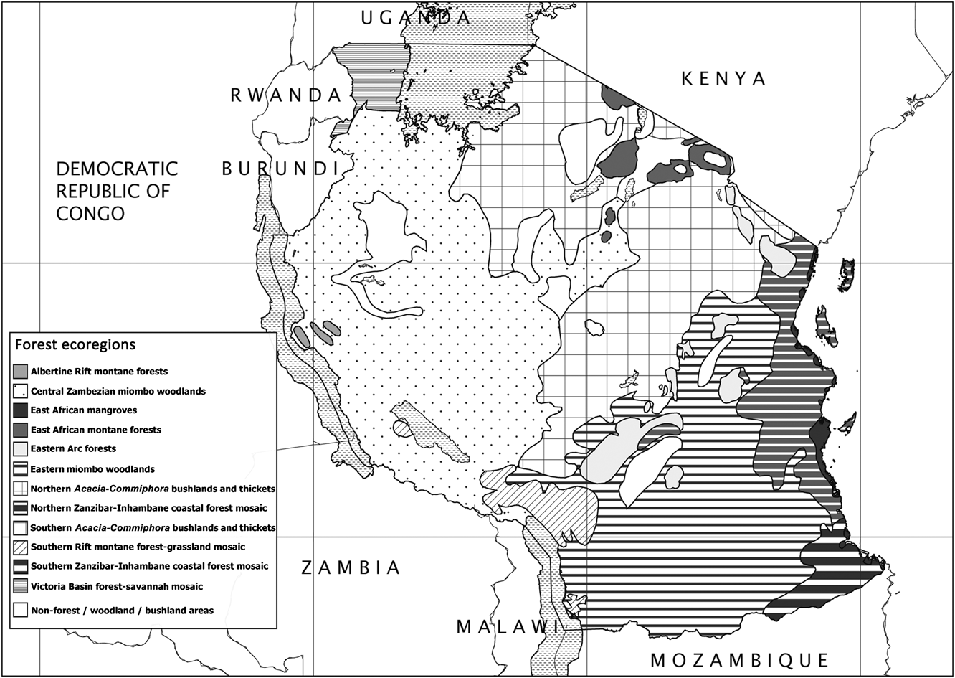
Tanzania has c. 35 million ha of evergreen forests and deciduous woodlands, extending across > 38% of the terrestrial mainland (MNRT, 1998, 2001; FAO, 2006; Zahabu et al., Reference Zahabu, Eid, Kajembe, Mbwambo, Mongo and Sangeda2009). Forest in Tanzania is defined in the Tanzanian Forest Act (URT, 2002) as an ‘area of land with at least 10% tree crown cover, naturally grown or planted, and/or 50% or more shrub and tree regeneration cover; and includes all forest reserves of whatever kind declared or gazetted under this Act and all plantations’. The total forest area can be divided into a number of different ecological forest types according to the WWF ecoregions classification (Burgess et al., Reference Burgess, D’Amico Hales, Underwood, Dinerstein, Olson and Itoua2004; Table 1, Fig. 1). The different forest types contain carbon in different densities (FBD, 2007) and also vary in their biological significance and value to people’s livelihoods (Burgess & Clarke, Reference Burgess and Clarke2000; Burgess et al., Reference Burgess, Butynski, Cordeiro, Doggart, Fjeldså and Howell2007; Campbell et al., Reference Campbell, Chenery, Coad, Kapos, Kershaw, Scharlemann and Dickson2008; FBD, 2008; Kapos et al., Reference Kapos, Ravilious, Campbell, Dickson, Gibbs and Hansen2008).
The forest ecoregions of Tanzania (after Burgess et al., Reference Burgess, D’Amico Hales, Underwood, Dinerstein, Olson and Itoua2004).
The nine main forest types in Tanzania, with a brief description of their structure, height and biological values, historical (pre-1850) area, area in 1990 and 2000 (where known), percentage loss from 1990 to 2000, estimates of carbon (stem, branches and roots; not soil carbon) in pristine and degraded forest, and indicative loss through degradation.

1 FBD (2007)
2 Estimated from land cover maps
3 From a partial sample of miombo in eastern Tanzania (FBD, 2005)
4 Based on plots studied by P.K. Munishi & D. Shirima
5 FBD (2005); Hall et al. (Reference Hall, Burgess, Lovett, Mbilinyi and Gereau2009)
6 Munishi & Shear (Reference Munishi and Shear2004)
7 Tabor et al. (Reference Tabor, Burgess, Mbilinyi, Kashigali and Steininger2010)
8 GEF Cross Borders Project (2000–2004)
9 Wang et al. (Reference Wang, Bonynge, Nugranad, Traber, Ngusaru and Tobey2003)
Deforestation
Deforestation in UNFCCC terms involves a permanent change to another land use (Penman et al., Reference Penman, Gytarsky, Hiraishi, Krug, Kruger and Pipatti2003a). The forest area in Tanzania is declining as a result of agricultural expansion, uncontrolled wild fires, intense livestock grazing, illegal mining and charcoal making (FBD, 2008). The official Tanzanian deforestation rate is contained in the Global Forest Resources Assessment of 2005 (FAO, 2006). For this, Tanzania used data interpreted from 1984 satellite imagery (Millington & Townsend, Reference Millington and Townsend1989) and compared these with 1995 data (Hunting Technical Services, 1997) for the determination of land cover changes. The annual deforestation was calculated as 412,279 ha for forest cover and for woodlands as 1,174,538 ha. More detailed and more recent deforestation rates are only known for some forest types, typically over the period 1990–2000 (FBD, 2005; Table 1). As an example, the area of closed canopy forest in the Eastern Arc Mountains declined by 1% over 10 years, whereas coastal forests declined by 7% and miombo woodland by 13% over the same period (FBD, 2005). Several forest types in Tanzania have no reliable estimate of their area or rate of loss (Table 1).
Degradation
The UNFCCC definition of forest degradation is ‘direct human-induced long-term loss (persisting for X years or more) of at least Y per cent of forest carbon stocks (and forest values) since time (T) and not qualifying as deforestation’ (Penman et al., Reference Penman, Gytarsky, Hiraishi, Krug, Kruger and Pipatti2003a). Therefore, even an area that is temporarily devoid of trees may still qualify as degraded forest if those trees are likely to grow back.
Tanzanian forests are being degraded because of unsustainable pole-cutting, logging and firewood collection, overgrazing and wildfires. Around towns, forests are being heavily affected by charcoal harvesting (Ahrends, Reference Ahrends2005; Milledge et al., Reference Milledge, Gelvas and Ahrends2007). However, the extent of degradation and its impact on the carbon stored in Tanzanian forests has mainly been presented in unpublished case studies (FBD, 2007; Malimbwi et al., Reference Malimbwi, Zahabu and Mchome2007; Van Beukering et al., Reference Van Beukering, Kahyarara, Massey, di Prima, Hess and Geofrey2007). Great effort is required to develop a robust understanding of the level of degradation in the woodland and forest resources of Tanzania. Moreover, a better understanding and analysis of the drivers of forest degradation is required as part of developing mitigation interventions at local and national levels to ensure improved land-use change. This kind of understanding is also crucial for subsequent development of management techniques for ecological restoration (Marshall, Reference Marshall2008).
Carbon storage and loss
Amounts of carbon stored in different forest types in Tanzania are only partly known (FBD, 2007; Table 1), the carbon density of many tree species is not known, and robust forest-specific equations to convert standard tree diameter and height measurements to biomass carbon have only been established for some forest types (Malimbwi & Luoga, Reference Malimbwi and Luoga1994; Mattia & Malimbwi, Reference Mattia and Malimbwi1998; Chamshama et al., Reference Chamshama, Mugasha and Zahabu2004; Munishi & Shear, Reference Munishi and Shear2004; Malimbwi et al., Reference Malimbwi, Zahabu, Madadi, Monela, Misana, Jambiya and Maliondo2005). First-order, field-survey based carbon density estimates are lacking for several forest ecoregions (see Burgess et al., Reference Burgess, D’Amico Hales, Underwood, Dinerstein, Olson and Itoua2004 for terminology): East Africa montane forests, Albertine rift forests, southern rift forests, mangrove forest, Victoria Basin forest–savannah mosaic, and northern and southern Acacia–Commiphora bushlands and thickets (Fig. 1). Because of these gaps in knowledge, global data sets have been used to generate a preliminary map of carbon density across Tanzania (Fig. 2).
Initial map of biomass carbon in Tanzania (from Miles et al., Reference Miles, Kabalimu, Bahane, Ravilious, Dunning and Bertzky2009). The above ground biomass was derived from a model for tropical Africa, which uses remotely sensed MODIS NBAR data from 2000–2003 (Baccini et al., Reference Baccini, Laporte, Goetz, Sun and Dong2008), and below ground biomass estimated using ecosystem-specific conversion factors. There were no model data for zones with < 9 t of above ground biomass per ha. Values from a global biomass carbon map (Ruesch & Gibbs, Reference Ruesch and Gibbs2008) were substituted in these zones.

Tanzania currently only has sufficient data to calculate carbon loss approximately from deforestation for a limited number of its forest types. For the Eastern Arc Mountains the past 20 years of deforestation have resulted in the loss of c. 34 million t of carbon, c. 1.7 million t per annum (Table 1). Much of this comes from the woodlands and forests outside the network of government-, village- or co-managed reserved areas (FBD, 2007; Hall et al., Reference Hall, Burgess, Lovett, Mbilinyi and Gereau2009; Scharlemann et al., Reference Scharlemann, Kapos, Campbell, Lysenko, Burgess and Hansen2010).
The impact of degradation on carbon storage is even less well known and for most forest types there are no data on the impacts of degradation on carbon storage (Table 1). In the Eastern Arc forests degradation is estimated to reduce carbon storage by 65 million t from the network of 150 reserves within that ecoregion (Table 1). Enhanced management of the government, village and partnership reserves, which contain at least 85% of the remaining forest and are often degraded, could reverse most of these losses.
Forest management regimes in Tanzania
The forested land is under various management regimes (Zahabu et al., Reference Zahabu, Eid, Kajembe, Mbwambo, Mongo and Sangeda2009). More than half the remaining forest is within village or general land categories (Fig. 3). The remainder is within various forms of protected area, including national parks, game reserves, nature reserves and various kinds of forest reserves (Fig. 3). The Forestry and Beekeeping Division of the Ministry of Natural Resources and Tourism and District Council Natural Resources Departments manage > 600 reserves covering almost 10 million ha. These agencies have inadequate budgets and lack equipment, and many of the reserves are not actively managed or patrolled and hence often become degraded. More funding and training in the management of these areas could reverse degradation and improve their sequestration and storage of carbon. The same is also true to some extent for the national parks and game reserves, although the agencies managing these areas tend to have better funding and capacity, and hence degradation within their reserves is lower, especially within the national parks. However, most forest loss occurs outside reserves in the village and general lands, where the expanding human population lives (FBD, 2005; Hall et al., Reference Hall, Burgess, Lovett, Mbilinyi and Gereau2009; Tabor et al., Reference Tabor, Burgess, Mbilinyi, Kashigali and Steininger2010).
The reserve network and the surrounding village and general lands of Tanzania (modified from WDPA, 2009).

Conceptual background to the UN-REDD Programme in Tanzania
The development of the UN-REDD Programme for Tanzania was based on a conceptual diagram of how REDD+ could work in Tanzania (termed the REDD+ production chain; Fig. 4). The four quadrants of this production chain are described below. The programme aims to address key gaps and needs in this production chain to start it working.
Proposed national structure of REDD+ implementation in Tanzania (termed the REDD+ production chain). For explanation of the four quadrants, see text.

Quadrant 1: Sustainable forest management at field level
The first quadrant (Fig. 4, bottom right) outlines the importance of sustainable management of forests in the implementation of REDD+. To be able to plan for sustainable management it is necessary to identify forest areas and quantify carbon pools and have a detailed knowledge of land ownership and governance at the district, village and private sector levels.
Quadrant 2: Regulation and governance
The second quadrant (Fig. 4, top right) focuses on the national-level regulations and governance structures that provide the overall credibility, sustainability and scale of economics in support of potential REDD+ interventions. Important elements in Tanzania are: (1) cross-sectoral coordination to avoid undue competition over land-use allocations, (2) development of a legal framework for the ownership of carbon and emission reductions and payment distribution systems, and (3) development of cost-efficient measuring, reporting and verification systems that fulfil REDD+ needs (Penman et al., Reference Penman, Gytarsky, Hiraishi, Krug, Kruger and Pipatti2003a).
Quadrant 3: Market or fund access
The third quadrant (Fig. 4, top left) contains the key elements for positioning Tanzania in a potential international REDD+ market or as a credible recipient of funds from a potential REDD+ fund. However, these requirements are not yet clear because the mechanisms for a market-based or fund-based approach have not yet been finalized. It is also possible that a potential market or fund for carbon sales will place requirements on forest managers marketing potential emission reductions.
Quadrant 4: Funds transfer and management
The fourth quadrant (Fig. 4, bottom left) highlights the key elements for contracting, funds transfer, equitable payment distribution and funds management. Different solutions for contracting can be taken depending on the set-up of the national REDD+ framework and whether a national or sub-national (project-based) approach has been established. Emissions reductions may be sold by national-level operators (private or governmental) that have bundled emissions reductions from many sites, or directly by the site-scale producers of reductions depending on what is agreed by national and international negotiations. The Tanzanian government would prefer to use the existing forest management devolution programme to implement REDD+, as detailed below.
Development of the UN-REDD Programme in Tanzania
The UN-REDD Programme aims to address the issues identified in the REDD+ production chain (Fig. 4) to help Tanzania become ready to enter the official and voluntary CO2 emission trading systems, reverse deforestation and degradation, and conserve and enhance forest carbon stocks. The main challenges faced are: (1) a lack of relevant data to set REDD+ baselines (see above), (2) a lack of capacity within the various agencies in Tanzania to implement REDD+ and carry out robust monitoring of carbon stock change, (3) a need for REDD+ mechanisms to be tested, and (4) a widespread lack of understanding of the issues surrounding REDD+.
These challenges have been translated into four outcomes in the UN-REDD National Joint Programme document, which has received USD 4.28 million in funding from the UN-REDD Multi-Donor Trust Fund. This support will be channelled to the three UN agencies working in Tanzania (UNDP, FAO and UNEP) under the so-called one UN approach. These three UN agencies are working together with the Forestry and Beekeeping Division under the coordination of the REDD+ Task Force. UN-REDD support has been fully aligned to existing forest laws and the national REDD+ framework of 2009 (REDD Tanzania Initiative, 2009). It has also taken on board the views of bilateral and multilateral donors, international and local NGOs and representatives of Tanzanian indigenous peoples who sit on the UN-REDD Policy Board.
Proposed outcomes of the UN-REDD Programme in Tanzania (2009–2011)
The first proposed outcome of the Programme is a national governance framework for REDD+ and strengthened institutional capacities. Within Tanzania climate change is treated as a cross-cutting issue and hence involves various government sectors. The Vice President’s Office, Department of Environment, and the Forestry and Beekeeping Division have established a National REDD Task Force to assist coordination. This task force also aims to develop a national strategy for REDD+ and promote the voluntary carbon market. UN-REDD support aims to build capacity to implement REDD+ within the Forestry and Beekeeping Division. It will also help finalize the national REDD+ framework and strategy for the country and will clarify roles, structures and social safeguards for effective implementation of REDD+ in Tanzania.
The second outcome is increased capacity for capturing REDD+ elements within national measuring, reporting and verification systems. This component aims to assist in the development of a system for measuring and monitoring forest cover, forest change, carbon stocks and carbon emission levels, building on a new national forest resource and monitoring assessment project. Potential co-benefits of REDD+ (biodiversity, ecosystem services and social benefits) will also be assessed. Capacity building will be provided in the form of training on remote sensing and mapping. UN-REDD measuring, reporting and verification work will be linked to an existing national forest inventory project and to Norwegian government support to carbon mapping through universities and civil society. A nationwide system of sampling clusters will be measured to assess forest condition and degradation. Current and historic extent of forest resources will also be mapped.
The third outcome is improved capacity to manage REDD+ and provide other forest ecosystem services at district and local levels. This component aims to build the capacity of the decentralized forest sector to implement REDD+. Pilot activities will be initiated in different forest types. These will be aligned to the broader support for piloting REDD+ projects being funded by the Norwegian Embassy to civil society organizations in Tanzania. Work will primarily be undertaken at the village level and outside formal government-managed reserves but some effort will also be made to test ways to improve reserve management, including where reserves are co-managed with communities, and hence allow forest condition to improve and capture more carbon.
The fourth outcome is broad-based stakeholder support for REDD+ in the country. As REDD+ is a new, rapidly evolving concept there is a need to inform Tanzanian stakeholders about the practicalities of this new approach to forest conservation. This relates particularly to payment systems for avoided deforestation and degradation as this is unfamiliar to local and village governments and to communities. The mechanism of making and monitoring payments is perhaps the most difficult part of REDD+ to implement at the field level.
Implementation and monitoring
One viable approach for implementing REDD+ in Tanzania would be to work with the protected area authorities and invest in better law enforcement and management of the existing forest reserves and game reserves. These two categories of state-managed reserves suffer from degradation and a reduction in biomass, especially the forest reserves. Improved management would lead to substantial increases in biomass within the reserves over time, and hence they could function as significant carbon stores while also continuing to provide their other ecosystem services and biodiversity conservation functions (Marshall, Reference Marshall2008).
Another existing forest management strategy in Tanzania provides a good example of how to build upon existing forest management approaches to implement REDD+. During the past 20 years Tanzania has become one of the leading countries in developing forest management practices based on local participation (Blomley, Reference Blomley2006; Blomley & Ramadhani, Reference Blomley and Ramadhani2006; Lund & Treue, Reference Lund and Treue2008; Blomley & Iddi, Reference Blomley and Iddi2009). Participatory forest management in Tanzania builds on the country’s local government institutional framework, which formalizes the role of local communities through elected village councils and village assemblies. It also builds upon the country’s legal framework for land tenure, which vests these village governance organs with responsibility for managing the village lands within their boundaries.
Tanzanian participatory forest management is of two basic forms. Joint Forest Management involves the co-management of forest reserves between forest-adjacent villages and government managers, from either the Forestry and Beekeeping Division or district councils. Community-Based Forest Management is where local villages, or subgroups within the village, are the sole forest manager by virtue of establishing communally reserved forests on village lands. These types of management are defined and described in the Tanzanian National Forestry Policy (MNRT, 1998), Forest Programme (MNRT, 2001) and Forest Act (URT, 2002).
By 2008 participatory forest management covered c. 4.1 million ha, with c. 1.7 million ha under Joint Forest Management and 2.4 million ha under Community-Based Forest Management (Blomley et al., Reference Blomley, Pfliegner, Isango, Zahabu, Ahrends and Burgess2008). In total c. 13% of all the forest in Tanzania was under participatory forest management arrangements by 2008, involving more than 2,300 villages. The area and the number of villages involved continue to expand.
REDD+ piloting in Tanzania seeks to build on the participatory forest management experience and to test ways to transfer benefits from the national government to communities managing forests. The lessons learned will be critical with regard to designing and implementing REDD+ in Tanzania and other developing countries (Murdiyarso & Skutsch, 2006; Chhatre & Agrawal, Reference Chhatre and Agrawal2009). However, the participatory forest management system has limitations, largely because of (1) governance deficiencies at the national, district and village levels, (2) insufficient government incentives and benefits to local people to continue their forest management work, (3) slow and inefficient work practices and (4) occasional corruption at various levels. The challenges are reviewed by Meshack et al. (Reference Meshack, Adhikari, Doggart and Lovett2006), Blomley & Iddi (Reference Blomley and Iddi2009) and Persha & Blomley (Reference Persha and Blomley2009). The REDD+ system needs to build upon these lessons and become more efficient and targeted, and, if distributed equitably, REDD-generated funds have the potential to increase the success of participatory forest management by providing the financial incentive necessary to create permanence.
Community monitoring of REDD+ in Tanzania
The monitoring of the implementation of REDD+ in Tanzania will need to operate at two levels. The national baseline and calculation of reference emission levels and potential emission reductions will be developed using remote sensing and a network of forestry plots, as outlined in Outcome 2 of the UN-REDD project. However, this approach will struggle to provide the detail required to assess the implementation of community-level forest conservation interventions. In these cases, alternative locally based or community forest management approaches are more likely to be successful.
Locally based monitoring involves local people or local government staff directly in data collection and interpretation and employs methods that are relatively simple and cheap and require few other resources (Danielsen et al., Reference Danielsen, Burgess and Balmford2005, Reference Danielsen, Burgess, Balmford, Donald, Funder and Jones2008; Van Laake et al., Reference Van Laake, Skutsch, McCall, Achard, Brown, DeFries, Grassi, Herold and Schiller2009). It has been shown that local people can count trees, measure their girth and identify the species accurately (Skutsch et al., Reference Skutsch, Van Laake, Zahabu, Karky, Phartiyal, Angelsen, Brockhaus, Kanninen, Sills, Sunderlin and Wertz-Kanounnikoff2009) and cost-effectively, thus allowing the collection of large volumes of data conforming to Intergovernmental Panel on Climate Change guidelines (Penman et al., Reference Penman, Gytarsky, Hiraishi, Krug, Kruger and Pipatti2003a; KTGAL, 2010). Locally based monitoring can also help build capacity and cooperation between local people and outside authorities and can thereby stimulate local action and result in rapid forest management interventions (Danielsen et al., Reference Danielsen, Burgess, Balmford, Donald, Funder and Jones2008). These approaches can also monitor social and governance aspects of community-based natural resource management (Stuart-Hill et al., Reference Stuart-Hill, Diggle, Munali, Tagg and Ward2005). This includes the extent to which funds are fairly distributed within communities, thereby addressing equity and poverty issues. Using locally based monitoring methods can help to address the concerns of local people that their existing forest use rights and benefits will be undermined by top-down REDD+ implementation.
However, there will also, as with monitoring by scientists, be a need for a cost-effective system of verification or auditing of community-based monitoring as part of the measuring, reporting and verification process, such as through spot checks of the data. This is to ensure that the results from community monitoring can be trusted for the purposes of a payment scheme based on verified emissions reductions. A further challenge will be to ensure that community monitoring in community-managed areas is also integrated with wider monitoring to assess net changes in deforestation and degradation across large areas and to ensure that there is no leakage of deforestation and degradation outside community-managed areas.
Discussion
The implementation of REDD+ in Tanzania faces a number of challenges: a lack of data and technical capacity, the need for coordination at the national level and, if international negotiations render it necessary, guidelines and assistance on how to instigate a market-orientated approach to REDD+ within both centralized and decentralized government agencies. These challenges will need to be overcome if REDD+ is to succeed.
In addition to the ongoing Tanzanian National Forestry Assessment, and the carbon management and measurement projects that will be supported by the Royal Norwegian Embassy, additional relevant data may come from global sources on deforestation and carbon stocks (Gibbs et al., Reference Gibbs, Brown, Niles and Foley2007; Hansen et al., Reference Hansen, Stehman, Potapov, Loveland, Townshend and DeFries2008; Schmitt et al., Reference Schmitt, Belokurov, Besançon, Boisrobert, Burgess and Campbell2009). Techniques are also rapidly being developed to assist countries to develop reliable regional to sub-national data (Baccini et al., Reference Baccini, Laporte, Goetz, Sun and Dong2008; Mitchard et al., Reference Mitchard, Saatchi, Woodhouse, Nangendo, Ribeiro and Williams2009; Tabor et al., Reference Tabor, Burgess, Mbilinyi, Kashigali and Steininger2010). Ground-based surveys will be needed to evaluate these assessments (Lewis et al., Reference Lewis, Lopez-Gonzalez, Sonke, Affum-Baffoe, Baker and Ojo2009). In addition to the forest-based carbon in Tanzania there is also organic carbon stored in wetlands, for example in the localized peatlands found in the Southern Highlands, particularly Sao Hill, and in Ukinga (Nshubemuki, Reference Nshubemuki, Kamukala and Crafter1993).
In terms of coordination, one of the key activities is the development of a national REDD+ strategy in anticipation of a post-2012 climate change agreement that will include a new global facility for REDD+ (REDD Tanzania Initiative, 2009). This work is being coordinated by the Tanzanian REDD+ Task Force, which is also compiling a list of all known REDD+ projects in the country.
It is not yet known what financial mechanism will be used to receive and disperse REDD+ incentive payments in Tanzania. The Tanzanian government favours a fund-based approach, which would potentially reduce the opportunities for the private sector but would fit with the realities of the land ownership system in Tanzania, where there are few privately managed forest areas. The voluntary carbon market and the seed funding from the Norwegian government and UN-REDD will provide ways to test financial mechanisms for REDD+ in Tanzania.
In Tanzania there are four main ways that sustainable forest management aspects of REDD+ may be implemented (Fig. 1, bottom right quadrant). Firstly, through the State-owned protected areas (avoiding and reducing deforestation and, especially, degradation in reserves). Secondly, through community forestry approaches. In particular, the participatory forest management approach could provide ways to pilot REDD+ and, if the trials are successful, the approach could be spread rapidly across the country at the community level, especially if the capacity of the districts is improved. Incorporating this prior experience of implementing participatory forest management (Meshack et al., Reference Meshack, Adhikari, Doggart and Lovett2006) into the development of REDD+ projects could improve implementation in Tanzania. Thirdly, through the promotion of agroforestry and conservation agriculture, as unsustainable subsistence agriculture and expanding commercial agriculture are major threats to the forests. Fourthly, through State-owned plantations and private forestry, the expansion of which may be spurred by REDD+ incentives. The latter also highlight the need to consider carefully biodiversity conservation prerogatives.
The ownership and control over land and thus forest are of importance for the implementation of REDD+ in Tanzania. All land in the country is held in trust by the President on behalf of the nation. The two Land Acts (1999) divide land resources into three categories: reserved, village and general land (URT, 1999a,b). The ‘Land Act’ deals with the management of reserved land and general land whereas the ‘Village Land Act’ is concerned with village land. Sixteen million of the 35 million ha of forest land in Tanzania are unreserved, and most of these forests are on village lands. Village land is occupied by people and organizations, either through a Granted Right of Occupancy or through a Customary Right of Occupancy. But occupancy does not mean that the occupant owns the land: they only hold rights over it (Wily, Reference Wily2003). There is no freehold in Tanzania and land cannot be bought or sold outright; only the derivative rights to occupy the land can be sold. With Granted Rights of Occupancy, this right is bound to a designated lease period of a maximum of 99 years (Lovett, Reference Lovett, Chaytor and Gray2003; Wily, Reference Wily2003). In contrast, Customary Rights of Occupancy apply only to village land and may be held indefinitely. In this context, forest land tenure in Tanzania is defined as a combination of legally or customarily defined forest ownership rights and arrangements for the management and use of forest resources. This provides further challenges for the implementation of REDD+.
Tanzania is implementing a national forest inventory that will generate remote sensing and plot data on the forests. This national system will provide input to the development of the measuring, reporting and verification system and enable the relevant calculations of forest cover, forest loss and hence emissions levels. In addition, the country has also developed pilot systems of locally based monitoring that involve communities in the collection of data on forest condition and also contribute to securing local forest livelihoods (Topp-Jørgensen et al., Reference Topp-Jørgensen, Poulsen, Lund and Massao2005; Verplanke & Zahabu, Reference Verplanke and Zahabu2009). These approaches are being tested scientifically (Monitoring Matters, 2010) and at a small cost could potentially deliver forest data from community-managed forest lands to monitor implementation of REDD+ field projects.
In conclusion, Tanzania has made significant efforts to prepare for REDD+ and, despite shortages of data and limited technical capacity, and some governance shortfalls, will be embarking on pilot projects in 2010. The relevant government agencies are hopeful that REDD+ will be able to assist in solving the problems of deforestation and degradation and in particular that it will build upon an existing national programme of participatory forest management. A number of significant challenges still need to be overcome if the programme is to be successfully implemented in Tanzania, and capacity building and monitoring will be required, but the Tanzanian government is working with NGOs and communities to address these issues, supported by donor funding.
Acknowledgements
We thank the many foresters and biologists who have contributed to knowledge on Tanzanian forests, which forms the base of the REDD+ programmes in that country, and the UN-REDD Programme for its support. The institutions of the various authors are thanked for allowing their staff to work on the preparation of this article.
Biographical sketches
The UN-REDD team includes staff of the Forestry and Beekeeping Division in Tanzania, of the three UN-REDD participating organizations (UNEP, UNDP and FAO) and a number of consultants and forestry experts from Tanzania and elsewhere. In collaboration they have helped Tanzania develop the basic outline of the UN-REDD National Joint Programme and have assisted work on details of how the programme (and other REDD+ projects) could be implemented and monitored at the operational scale of management: the village or area of reserved land.



