





1. Introduction
1.1. Outline of the article
The Calderón problem for a Schrödinger operator, also known as the Gel’fand-Calderón problem, asks for the reconstruction of a potential from the knowledge of certain boundary measurements of the solutions to the corresponding Schrödinger equation; see [Reference Calderón16, Reference Calderón17] and [Reference Gelfand29]. In this article, we are interested in the fixed-energy version of this problem: given an open, bounded domain  $\Omega\subset\mathbb{R}^d$, $d\geq2$, with $\mathcal{C}^1$ boundary, an energy $\kappa\in\mathbb{C}$ and a real-valued potential q, consider the elliptic boundary-value problem for the Helmholtz equation
 \begin{equation}
\left\{
\begin{array}{rll}
-\Delta u(x) + q(x) u(x) -\kappa u(x) &=0, \quad x\in\Omega,\\
u|_{\partial\Omega} &= f.
\end{array}\right.
\end{equation}
\begin{equation}
\left\{
\begin{array}{rll}
-\Delta u(x) + q(x) u(x) -\kappa u(x) &=0, \quad x\in\Omega,\\
u|_{\partial\Omega} &= f.
\end{array}\right.
\end{equation} The Dirichlet-to-Neumann (DtN) map associates the boundary value f with the normal derivative on  $\partial\Omega$ of the corresponding solution u to (1.1). Whenever κ is not a Dirichlet eigenvalue of $-\Delta+q$, this produces a well-defined linear operator
 \begin{equation}
\begin{array}{cccc}
\Lambda_{q,\kappa}: & \mathcal{C}^\infty(\partial\Omega) &\longrightarrow&\mathcal{C}^\infty(\partial\Omega) \\
& f &\longmapsto & \partial_\nu u|_{\partial\Omega},
\end{array}
\end{equation}
\begin{equation}
\begin{array}{cccc}
\Lambda_{q,\kappa}: & \mathcal{C}^\infty(\partial\Omega) &\longrightarrow&\mathcal{C}^\infty(\partial\Omega) \\
& f &\longmapsto & \partial_\nu u|_{\partial\Omega},
\end{array}
\end{equation} where ν is the vector field of exterior unit vectors normal to  $\partial\Omega$.
The Gel’fand-Calderón problem, in its simplest form, consists in reconstructing q from the knowledge of  $\Lambda_{q,\kappa}$ for some fixed $\kappa\in\mathbb{C}$. Since it is known that $\Lambda_{q,\kappa}-\Lambda_{0,\kappa}$ is always an operator that is bounded in $L^2(\partial\Omega)$ (see for instance Section 2), it is convenient to encode the inverse problem using the nonlinear map
 \begin{equation}
\begin{array}{cccc}
\Phi^{\kappa}: & \mathcal{X} &\longrightarrow& \mathcal{L}^2(L^2(\partial\Omega)) \\
& q &\longmapsto & \Lambda_{q,\kappa}-\Lambda_{0,\kappa},
\end{array}
\end{equation}
\begin{equation}
\begin{array}{cccc}
\Phi^{\kappa}: & \mathcal{X} &\longrightarrow& \mathcal{L}^2(L^2(\partial\Omega)) \\
& q &\longmapsto & \Lambda_{q,\kappa}-\Lambda_{0,\kappa},
\end{array}
\end{equation} where  $\mathcal{X}$ is a class of admissible potentials for which the DtN map is defined. In this article $\mathcal{X}$ will be a subset of $L^p(\Omega)$ for p > 1 and $p \ge d/2$. The main issues one is interested in are:
i) Uniqueness. Is every $q\in \mathcal{X}$ uniquely determined by
$\Lambda_{q,\kappa}$? This amounts to showing that
$\Phi^{\kappa}$ is injective.
$q\in \mathcal{X}$ uniquely determined by
$\Lambda_{q,\kappa}$? This amounts to showing that
$\Phi^{\kappa}$ is injective.ii) Stability. Is the reconstruction process stable? That is, find a modulus of continuity for
$\Phi^{\kappa}$. This is not possible in general, since
$(\Phi^{\kappa})^{-1}$ is not continuous (see, for example, [Reference Alessandrini1, Reference Alessandrini and Cabib2, Reference Faraco, Kurylev and Ruiz26]). This is, therefore, an ill-posed inverse problem. Nevertheless, one can ask for conditional stability when additional requirements of regularity and boundedness are imposed on the class of admissible potentials.Footnote 1iii) Reconstruction. Find an effective procedure to reconstruct q from
$\Lambda_{q,\kappa}$, in other words, compute
$(\Phi^{\kappa})^{-1}$. This is related to the problem of characterization of the range
$\Phi^{\kappa}(\mathcal{X})$.


The uniqueness for  $d \ge 3$ was proved in [Reference Sylvester and Uhlmann59], and later in [Reference Nachman46, Reference Novikov48] with particular emphasis on the case of fixed energy (see also [Reference Caro and Rogers18, Reference Haberman31]). The two-dimensional case was solved in [Reference Astala and Päivärinta4, Reference Nachman47] for conductivities and [Reference Blåsten, Imanuvilov and Yamamoto13, Reference Bukhgeim15] for potentials. These results are proved using the notion of Complex Geometric Optics solutions (CGO) from [Reference Faddeev25] ( $d\geq 3$) or different families of exponentially growing solutions of the equations when d = 2.
Conditional stability was proved in dimensions  $d\ge 3$ by [Reference Alessandrini1] with a logarithmic-type modulus on continuity, which was shown to be optimal in [Reference Mandache43] (see also [Reference Koch, Rüland and Salo37] for a more detailed account of this issue). In dimension 2 it was proved in [Reference Barceló, Barceló and Ruiz7, Reference Clop, Faraco and Ruiz19] (see also [Reference Faraco and Prats27]). Improved stability at fixed energy was established in [Reference Isakov34, Reference Isakov, Lu and Xu35, Reference Novikov49] in dimension three and [Reference Santacesaria53, Reference Santacesaria54] in two dimensions. The instability estimates of [Reference Mandache43] have been improved in the κ ≠ 0 case in [Reference Isaev33, Reference Kow, Uhlmann and Wang39].
Reconstruction is a difficult issue in general, both from analytical and numerical points of view. The classical approach to uniqueness, based on exponentially growing families of solutions, leads to reconstruction strategies that involve analyzing a certain scattering transform (see, for instance, [Reference Astala, Faraco and Rogers3, Reference Nachman46, Reference Nachman47]), that can be transformed into numerical algorithms (see, among many others, [Reference Delbary, Hansen and Knudsen24, Reference Knudsen, Lassas, Mueller and Siltanen36, Reference Siltanen, Mueller and Isaacson56]). A different type of strategy, sometimes combined with the previous one, is based on linearization. This serves as the basis of one-step linearization methods (see [Reference Harrach and Seo32]), the so-called Calderón method (see, for example, [Reference Bikowski and Mueller11, Reference Shin and Mueller55]), the algorithm described in [Reference Bikowski, Knudsen and Mueller10], and has also been applied in deep learning approaches to the Calderón problem; see [Reference Martin and Choi45]. This kind of linearization methods are successful from the numerical point of view, but seem hard to justify rigorously. The main difficulty lies in proving the existence of a certain Born-type approximation for the inverse problem.
In this work, we address this question, showing the existence of a Born approximation for the inverse problem for radially symmetric potentials, and we analyze how this leads to interesting uniqueness, stability, and characterization results. This approach does not use any CGO-type construction.
This approach was initiated in [Reference Barceló, Castro, Macià and Meroño8, Reference Barceló, Castro, Macià and Meroño9] in the context of the Calderón problem, and is based on the notion of approximation in inverse scattering that can be traced back to the work of Born [Reference Born14]. It was successfully applied in [Reference Daudé, Macià, Meroño and Nicoleau23] to the Gel’fand-Calderón problem at zero energy; and a systematic exposition of this approach, which in principle applies to any inverse problem, was given in [Reference Maciá and Meroño41]. In the present context, it can be described as follows. The map  $\Phi^{\kappa}$ is Fréchet differentiable and satisfies $\Phi^{\kappa}(0)=0$; if for every $q\in \mathcal{X}$ it is possible to find $q^{\mathrm{B}}_{\kappa}\in \mathcal{B}$ in some space $\mathcal{B}$ of functions or distributions solving
 \begin{equation}
\mathrm{d}\Phi^{\kappa}_0(q^{\mathrm{B}}_{\kappa}) = \Phi^{\kappa}(q)= \Lambda_{q,\kappa}-\Lambda_{0,\kappa},
\end{equation}
\begin{equation}
\mathrm{d}\Phi^{\kappa}_0(q^{\mathrm{B}}_{\kappa}) = \Phi^{\kappa}(q)= \Lambda_{q,\kappa}-\Lambda_{0,\kappa},
\end{equation} then one has in fact obtained a factorization of  $\Phi^{\kappa}$ into a linear and a nonlinear map:

The objective is to exploit this factorization to obtain uniqueness, stability, reconstruction and characterization results for the inverse problem. The main difficulty in implementing this strategy is to show that there exists a solution of equation (1.4). In this work we show that (1.4) can be solved and that the factorization (1.5) exists for the Gel’fand-Calderón problem at fixed energy  $\kappa\in\mathbb{R}$, assuming radial symmetry on the potentials.
In the radial case, the existence of  $q^{\mathrm{B}}_{\kappa}$ for κ = 0 has already been proved in [Reference Daudé, Macià, Meroño and Nicoleau23], a result that also implies a partial characterization of the set of DtN maps. A key step in the proof involves the tools introduced by Simon [Reference Simon57] in the context of inverse spectral theory of Schrödinger operators on the half-line, especially the notion of A-amplitude. In [Reference Maciá and Meroño41], the authors show that, in fact, the A-amplitude coincides with the notion of Born approximation for this one-dimensional inverse spectral problem.
Here, the proof of the existence of  $q^{\mathrm{B}}_{\kappa}$ relies again on the analysis of a one-dimensional inverse spectral problem, the difficulty being that the corresponding Born approximation is no longer Simon’s A-amplitude. The existence of such a Born approximation, which we call the Aκ-amplitude, is an important part of this work. The main results of this article are:
i) Explicit description of
$\mathrm{d}\Phi^{\kappa}_0$ and its inverse. We show that
$\mathrm{d}\Phi^{\kappa}_0$ maps potentials to operators that are rotationally invariant, and whose eigenvalues are certain moments of the potential. Also, we give an explicit formula for
$(\mathrm{d}\Phi^{\kappa}_0)^{-1}$. This is presented in Theorem 3.1 and Proposition 2.4.ii) Existence of the Born approximation. This is stated in Theorem 1. Using the explicit formula for
$(\mathrm{d}\Phi^{\kappa}_0)^{-1}$ and tools of spectral theory of Schrödinger operators on the half-line, most particularly the existence of an Aκ-amplitude (Theorem 4.4), we prove that
$q^{\mathrm{B}}_{\kappa}$, the Born approximation at energy κ, exists as a radial distribution. We also present explicit formulas for
$q^{\mathrm{B}}_{\kappa}$.iii) Regularity of
$q^{\mathrm{B}}_{\kappa}$. In Theorem 2 we prove that
$q^{\mathrm{B}}_{\kappa}$ coincides with an integrable function outside the origin, that
$q^{\mathrm{B}}_{\kappa}-q$ is one derivative smoother than q, and that
$q^{\mathrm{B}}_{\kappa} =q$ at the boundary.iv) Injectivity of
$\Phi_{\mathrm{B}}^{\kappa}$ and stability of
$(\Phi_{\mathrm{B}}^{\kappa})^{-1}$. The map
$\Phi_{\mathrm{B}}^{\kappa}: q \mapsto q^{\mathrm{B}}_{\kappa}$ is injective in a strong sense: two potentials coincide in a neighborhood of the boundary if and only if their Born approximations at energy κ coincide in that same neighborhood. In addition,
$(\Phi_{\mathrm{B}}^{\kappa})^{-1}$ is Hölder continuous, under mild a priori conditions on the potentials, with respect to the L 1 norm in the complement of any arbitrarily small ball centered in the origin. This is the scope of Theorem 3, which is derived from its one-dimensional analogue Theorem 4.5.v) High-energy/semiclassical limit. In Theorem 4 we show that the Born approximation at energy κ converges to the potential q in the high-energy limit
$\kappa\to-\infty$. The analogous result for the direct problem, namely that
$\Phi^{\kappa}(q)-\mathrm{d}\Phi^{\kappa}_0(q)$ converges to zero in the same regime, is proved in Proposition 2.5.


In (1.5), the maps  $\mathrm{d}\Phi_0^{\kappa}$ and $\Phi^{\kappa}$ are continuous, but the ranges of each of them are not closed. Hence $(\mathrm{d}\Phi_0^{\kappa})^{-1}$ and $\Phi^{\kappa}$ are both discontinuous and only conditionally stable. Therefore, an important consequence of iv) is that the bad behavior of the inverse of $\Phi^{\kappa}$ is captured by the linear approximation $\mathrm{d}\Phi^{\kappa}_0$, since the non-linear map $(\Phi_{\mathrm{B}}^{\kappa})^{-1}$ is Hölder stable.
1.2. Statement of the main results
From now on, we denote by  $L^{p}_{\mathrm{rad}}([{\mathbb{B}}^d,\mathbb{R})$ the closed subspace of radial functions that belong to $L^p({\mathbb{B}}^d,\mathbb{R})$. We will assume that $d\ge 2$ and that
 \begin{equation}
p \in \mathbb{R} \text{ is admissible }\quad \iff \quad 1 \lt p \le \infty ,\; \text{and }\; p \ge d/2.
\end{equation}
\begin{equation}
p \in \mathbb{R} \text{ is admissible }\quad \iff \quad 1 \lt p \le \infty ,\; \text{and }\; p \ge d/2.
\end{equation}Also, we define
 \begin{equation*}
\quad \nu_d := \frac{d-2}{2},\qquad {\mathbb{N}}_0:=\mathbb{N}\cup\{0\}.
\end{equation*}
\begin{equation*}
\quad \nu_d := \frac{d-2}{2},\qquad {\mathbb{N}}_0:=\mathbb{N}\cup\{0\}.
\end{equation*} Recall that the Dirichlet spectrum of  $-\Delta$ on the ball $\mathbb{B}^d$ can be expressed in terms of the zeros of certain Bessel functions. The operator $\Lambda_{q,\kappa}$ is well defined as soon as $q\in L^{p}_{\mathrm{rad}}(\mathbb{B}^d,\mathbb{R})$, with p admissible, and $\kappa\in\mathbb{C}\setminus\operatorname{Spec}_{H^1_0}(-\Delta+q)$. Since q is radial, the DtN operator commutes with the action of $\operatorname{SO}(d)$ on $\mathbb{S}^{d-1}$; as a consequence, its eigenfunctions are spherical harmonics (see Appendix B for the definition and properties of spherical harmonics). More precisely, if $\mathfrak{H}^d_{\ell}$ denotes the subspace of spherical harmonics of degree $\ell\in\mathbb{N}_0$ on $\mathbb{S}^{d-1}$, then
 \begin{equation}
\Lambda_{q,\kappa}|_{{\mathfrak{H}}^d_{\ell}}= \lambda_{\ell}[q,\kappa] \operatorname{\mathrm{Id}}_{{\mathfrak{H}}^d_{\ell}}.
\end{equation}
\begin{equation}
\Lambda_{q,\kappa}|_{{\mathfrak{H}}^d_{\ell}}= \lambda_{\ell}[q,\kappa] \operatorname{\mathrm{Id}}_{{\mathfrak{H}}^d_{\ell}}.
\end{equation} When q = 0, the spectrum of  $\Lambda_{0,\kappa}$ can be explicitly computed. If κ = 0 then $\lambda_{\ell}[0,0] = \ell$ for every $\ell\in\mathbb{N}_0$, and, if $\kappa\in\mathbb{C}\setminus\operatorname{Spec}_{H^1_0}(-\Delta)$ with κ ≠ 0, then
 \begin{equation}
\lambda_{\ell}[0,\kappa]=
\ell - \sqrt{\kappa}\dfrac{J_{\ell+1+\nu_d}(\sqrt{\kappa})}{J_{\ell+\nu_d}(\sqrt{\kappa})}, \qquad \forall \ell \in \mathbb{N}_0,
\end{equation}
\begin{equation}
\lambda_{\ell}[0,\kappa]=
\ell - \sqrt{\kappa}\dfrac{J_{\ell+1+\nu_d}(\sqrt{\kappa})}{J_{\ell+\nu_d}(\sqrt{\kappa})}, \qquad \forall \ell \in \mathbb{N}_0,
\end{equation} where Jν is the Bessel function of the first kind of index  $\nu\in\mathbb{C}$ (see Lemma 4.2).
Given  $\ell\in\mathbb{N}_0$, the holomorphic function
 \begin{equation}
\varphi_{\ell}(z):=\frac{J_{\ell+\nu_d}(z)}{z^{\nu_d}}=\frac{z^\ell}{2^{\ell+\nu_d}}\sum_{n=0}^\infty \frac{(-1)^n}{n!\Gamma(\ell+\nu_d+n+1)}\left(\frac{z}{2}\right)^{2n},\qquad z\in\mathbb{C},
\end{equation}
\begin{equation}
\varphi_{\ell}(z):=\frac{J_{\ell+\nu_d}(z)}{z^{\nu_d}}=\frac{z^\ell}{2^{\ell+\nu_d}}\sum_{n=0}^\infty \frac{(-1)^n}{n!\Gamma(\ell+\nu_d+n+1)}\left(\frac{z}{2}\right)^{2n},\qquad z\in\mathbb{C},
\end{equation} will play an important role throughout this work. For  $\kappa\in\mathbb{C}$, the κ-moments of q are:
 \begin{equation}
\sigma_{\ell}[q,\kappa] := \frac{1}{|\mathbb{S}^{d-1}|} \int_{\mathbb{B}^d} q(x) \varphi_{\ell}(\sqrt{\kappa}|x|)^2 \, \mathrm{d}x, \qquad \forall \ell \in \mathbb{N}_0.
\end{equation}
\begin{equation}
\sigma_{\ell}[q,\kappa] := \frac{1}{|\mathbb{S}^{d-1}|} \int_{\mathbb{B}^d} q(x) \varphi_{\ell}(\sqrt{\kappa}|x|)^2 \, \mathrm{d}x, \qquad \forall \ell \in \mathbb{N}_0.
\end{equation} Note that the functions  $\kappa\mapsto\sigma_{\ell}[q,\kappa]$ are holomorphic in $\mathbb{C}$.
The κ-moments appear in the expression of the Fréchet differential of  $\Phi^{\kappa}$ at q = 0. In Proposition 2.4 we prove that, as soon as κ is not a Dirichlet eigenvalue of $-\Delta$ in the ball, $\mathrm{d}\Phi^{\kappa}_0(q)$ is a bounded operator on $L^2(\mathbb{S}^{d-1})$ for every $q\in L^{\infty}_{\mathrm{rad}}(\mathbb{B}^d,\mathbb{R})$. These operators turn out to be invariant by the action of $\operatorname{SO}(d)$ and are characterized by their restriction on spherical harmonics, which is precisely given by
 \begin{equation}
\varphi_{\ell}(\sqrt{\kappa})^{2}\mathrm{d}\Phi^{\kappa}_0 (q)|_{{\mathfrak{H}}^d_{\ell}} = \sigma_{\ell}[q,\kappa] \operatorname{\mathrm{Id}}_{{\mathfrak{H}}^d_{\ell}}, \qquad \forall \ell \in \mathbb{N}_0.
\end{equation}
\begin{equation}
\varphi_{\ell}(\sqrt{\kappa})^{2}\mathrm{d}\Phi^{\kappa}_0 (q)|_{{\mathfrak{H}}^d_{\ell}} = \sigma_{\ell}[q,\kappa] \operatorname{\mathrm{Id}}_{{\mathfrak{H}}^d_{\ell}}, \qquad \forall \ell \in \mathbb{N}_0.
\end{equation} Therefore, by (1.7), that a function  $q^{\mathrm{B}}_{\kappa}$ satisfies $\mathrm{d}\Phi^{\kappa}_0 (q^{\mathrm{B}}_{\kappa})=\Lambda_{q,\kappa}-\Lambda_{0,\kappa}$ is formally equivalent to the fact that $q^{\mathrm{B}}_{\kappa}$ solves the following moment problem:
 \begin{equation}
\sigma_{\ell}[q^{\mathrm{B}}_{\kappa},\kappa] = (\lambda_{\ell}[q,\kappa]-\lambda_{\ell}[0,\kappa])\varphi_{\ell}(\sqrt{\kappa})^2, \qquad \qquad \forall \ell \in \mathbb{N}_0.
\end{equation}
\begin{equation}
\sigma_{\ell}[q^{\mathrm{B}}_{\kappa},\kappa] = (\lambda_{\ell}[q,\kappa]-\lambda_{\ell}[0,\kappa])\varphi_{\ell}(\sqrt{\kappa})^2, \qquad \qquad \forall \ell \in \mathbb{N}_0.
\end{equation} Note right away that, by (1.8) and (1.9), the left-hand side of the identity (1.12) is well defined as soon as  $\kappa\in\mathbb{C}\setminus \operatorname{Spec}_{H^1_0}(-\Delta+q)$ even if $ \kappa\in \operatorname{Spec}_{H^1_0}(-\Delta)$.
The existence of a solution for (1.12) is not guaranteed. In order to prove that a solution exists, we need to allow for the possibility of  $q^{\mathrm{B}}_{\kappa}$ being a distribution. Let $U\subseteq \mathbb{R}^d$ be an open set. We denote by $\mathcal{E}'(U)$ the space of distributions with compact support in U, and $\mathcal{E}'_{\mathrm{rad}}(U) \subset \mathcal{E}'(U)$ the subset of radially symmetric distributions.
The definition (1.10) can be extended from  $L^{\infty}_{\mathrm{rad}}(\mathbb{B}^d,\mathbb{R})$ to the space $\mathcal{E}_{\mathrm{rad}}'(\mathbb{R}^d)$ as follows: for $f\in \mathcal{E}_{\mathrm{rad}}'(\mathbb{R}^d)$, $\kappa\in\mathbb{C}$ and $\ell\in\mathbb{N}_0$ define
 \begin{equation}
\sigma_{\ell}[f,\kappa]:= \frac{1}{\left\lvert \mathbb{S}^{d-1} \right\rvert}\left \langle f, (\varphi_{\kappa,\ell})^2 \right \rangle_{\mathcal{E}'\times\mathcal{C}^\infty},\quad \text{where }\varphi_{\kappa,\ell}(x):=\varphi_{\ell}(\sqrt{\kappa}|x|),
\end{equation}
\begin{equation}
\sigma_{\ell}[f,\kappa]:= \frac{1}{\left\lvert \mathbb{S}^{d-1} \right\rvert}\left \langle f, (\varphi_{\kappa,\ell})^2 \right \rangle_{\mathcal{E}'\times\mathcal{C}^\infty},\quad \text{where }\varphi_{\kappa,\ell}(x):=\varphi_{\ell}(\sqrt{\kappa}|x|),
\end{equation} where  $\left \langle \cdot, \cdot \right \rangle_{\mathcal{E}'\times\mathcal{C}^\infty}$ denotes the duality pairing in $\mathcal{E}'(\mathbb{R}^d)$. This makes sense since $(\varphi_{\kappa,\ell})^2\in\mathcal{C}^\infty(\mathbb{R}^d)$.
To state our first result, we define
 \begin{equation*}
\mathcal{B}_d := L^1_{\mathrm{rad}}(\mathbb{B}^d) + \mathcal{E}'_{\mathrm{rad}}(\mathbb{B}^d).
\end{equation*}
\begin{equation*}
\mathcal{B}_d := L^1_{\mathrm{rad}}(\mathbb{B}^d) + \mathcal{E}'_{\mathrm{rad}}(\mathbb{B}^d).
\end{equation*} The elements of  $\mathcal{B}_d$ are radial distributions in $\mathbb{B}^d$ that coincide with L 1 functions in a neighborhood of the boundary of $\mathbb{B}^d$. This implies that the extension by zero of a distribution in $\mathcal{B}_d $ is an element of $\mathcal{E}'_{\mathrm{rad}}(\mathbb{R}^d)$. In this way, when convenient, $\mathcal{B}_d$ can be identified with a subset of $\mathcal{E}'_{\mathrm{rad}}(\mathbb{R}^d)$. We adopt this perspective in a few points in this work, for example, to define the moments and the Fourier transform of elements of $\mathcal{B}_d$ using (1.13) and (1.14). Note that (1.11) allows us to extend $\mathrm{d}\Phi^{\kappa}_0$ to $\mathcal{B}_d$.
Let
 \begin{equation*}
X_{p,\kappa}(\mathbb{B}^d):=\{q\in L^p_{\mathrm{rad}}(\mathbb{B}^d,\mathbb{R})\,:\,\kappa\not\in\operatorname{Spec}_{H^1_0}(-\Delta+q)\}.
\end{equation*}
\begin{equation*}
X_{p,\kappa}(\mathbb{B}^d):=\{q\in L^p_{\mathrm{rad}}(\mathbb{B}^d,\mathbb{R})\,:\,\kappa\not\in\operatorname{Spec}_{H^1_0}(-\Delta+q)\}.
\end{equation*} We show, for potentials  $X_{p,\kappa}$ with p satisfying (1.6), the existence of $q^{\mathrm{B}}_{\kappa}$ as an element of $\mathcal{B}_d$ and establish a formula for its Fourier transform that shows, in particular, that $q^{\mathrm{B}}_{\kappa}$ is uniquely determined by (1.12) in $\mathcal{B}_d$ (see also Theorem 3.1). The Fourier transform of $f\in\mathcal{E}_{\mathrm{rad}}'(\mathbb{R}^d)$ is defined as
 \begin{equation}
\mathcal{F} (f)(\xi) := \left \langle f,e_{-i\xi} \right \rangle_{\mathcal{E}'\times\mathcal{C}^\infty}, \qquad e_\zeta(x):=e^{\zeta\cdot x},\qquad x,\xi \in \mathbb{R}^d,\; \zeta\in\mathbb{C}^d.
\end{equation}
\begin{equation}
\mathcal{F} (f)(\xi) := \left \langle f,e_{-i\xi} \right \rangle_{\mathcal{E}'\times\mathcal{C}^\infty}, \qquad e_\zeta(x):=e^{\zeta\cdot x},\qquad x,\xi \in \mathbb{R}^d,\; \zeta\in\mathbb{C}^d.
\end{equation} We denote by  $Z_{\ell,d}$, $\ell\in\mathbb{N}_0$, the zonal functions, which are characterized in terms of $\mathcal{P}_{\ell,d}:L^2(\mathbb{S}^{d-1})\longrightarrow\mathfrak{H}_{\ell}^d$, the orthogonal projection onto $\mathfrak{H}^d_{\ell}$, by
 \begin{equation*}
\mathcal{P}_{\ell,d}u(x)=\int_{\mathbb{S}^{d-1}}Z_{\ell,d}(x\cdot y)u(y)\, \mathrm{d}y,\qquad u\in L^2(\mathbb{S}^{d-1}).
\end{equation*}
\begin{equation*}
\mathcal{P}_{\ell,d}u(x)=\int_{\mathbb{S}^{d-1}}Z_{\ell,d}(x\cdot y)u(y)\, \mathrm{d}y,\qquad u\in L^2(\mathbb{S}^{d-1}).
\end{equation*}The zonal functions are directly related to the Legendre polynomials; more details are given in Appendix B.
Theorem 1.
Let  $\kappa\in\mathbb{R}$ and p be admissible. For every $q \in X_{p,\kappa}(\mathbb{B}^d)$ there exists a unique $q^{\mathrm{B}}_{\kappa} \in \mathcal{B}_d$ such that
 \begin{equation}
\sigma_{\ell}[q^{\mathrm{B}}_{\kappa},\kappa] = (\lambda_{\ell}[q,\kappa]-\lambda_{\ell}[0,\kappa]) \varphi_{\ell}(\sqrt{\kappa})^2, \qquad \text{for all } \, \ell \in \mathbb{N}_0.
\end{equation}
\begin{equation}
\sigma_{\ell}[q^{\mathrm{B}}_{\kappa},\kappa] = (\lambda_{\ell}[q,\kappa]-\lambda_{\ell}[0,\kappa]) \varphi_{\ell}(\sqrt{\kappa})^2, \qquad \text{for all } \, \ell \in \mathbb{N}_0.
\end{equation}The Fourier transform of this distribution can be obtained from the expression:
 \begin{equation}
\mathcal{F} (q^{\mathrm{B}}_{\kappa})(\xi) =
(2\pi)^d \sum_{\ell=0}^\infty (\lambda_{\ell}[q,\kappa] - \lambda_{\ell}[0,\kappa])\varphi_{\ell}(\sqrt{\kappa})^2 Z_{\ell,d}\left(1-\frac{\left\lvert \xi \right\rvert^2}{2\kappa}\right).
\end{equation}
\begin{equation}
\mathcal{F} (q^{\mathrm{B}}_{\kappa})(\xi) =
(2\pi)^d \sum_{\ell=0}^\infty (\lambda_{\ell}[q,\kappa] - \lambda_{\ell}[0,\kappa])\varphi_{\ell}(\sqrt{\kappa})^2 Z_{\ell,d}\left(1-\frac{\left\lvert \xi \right\rvert^2}{2\kappa}\right).
\end{equation} If we further assume  $\kappa \notin \operatorname{Spec}_{H^1_0}(-\Delta)$ then it also holds that
 \begin{equation}
\mathcal{F} (q^{\mathrm{B}}_{\kappa})(\xi) = \left\langle \overline{e_{\zeta_1}} ,(\Lambda_{\kappa,q}-\Lambda_{\kappa,0})e_{\zeta_2}\right\rangle_{L^2(\mathbb{S}^{d-1})},
\end{equation}
\begin{equation}
\mathcal{F} (q^{\mathrm{B}}_{\kappa})(\xi) = \left\langle \overline{e_{\zeta_1}} ,(\Lambda_{\kappa,q}-\Lambda_{\kappa,0})e_{\zeta_2}\right\rangle_{L^2(\mathbb{S}^{d-1})},
\end{equation} with  $\zeta_1,\zeta_2\in \mathbb{C}^d$ satisfying $\zeta_1+\zeta_2=-i\xi$ and $\zeta_1\cdot\zeta_1 =\zeta_2\cdot\zeta_2=-\kappa$.
We will refer to  $q^{\mathrm{B}}_{\kappa}$ as the Born approximation of q at energy κ. Its explicit reconstruction formula (1.16) can be used to numerically approximate q; see Section 1.3 below. On the other hand, the identity (1.17) shows that $q^{\mathrm{B}}_{\kappa}$ can also be obtained by complex geometrical optics solutions as was done for κ = 0 in [Reference Barceló, Castro, Macià and Meroño8].
Our next result shows, among other properties, that  $q^{\mathrm{B}}_{\kappa}$ always coincides with a locally integrable function outside the origin. In fact, the Born approximation is as singular as the potential is, except possibly at the origin.
We define the weighted L 1-space  $L^1_s(\mathbb{B}^d): = \{f\in L^1_{\mathrm{loc}}(\mathbb{B}^d\setminus\{0\}) : \; \left\lVert f \right\rVert_{L^1_s(\mathbb{B}^d)} \lt \infty\}$ where $s \in \mathbb{R}$ and
 \begin{equation}
\left\lVert F \right\rVert_{L^1_s(\mathbb{B}^d)} := \int_{\mathbb{B}^d} |F(x)| |x|^{2(s-\nu_d)} \, \mathrm{d}x.
\end{equation}
\begin{equation}
\left\lVert F \right\rVert_{L^1_s(\mathbb{B}^d)} := \int_{\mathbb{B}^d} |F(x)| |x|^{2(s-\nu_d)} \, \mathrm{d}x.
\end{equation}Theorem 2.
Let  $\kappa \in \mathbb{R} $ and p be admissible. For every $q\in X_{p,\kappa}(\mathbb{B}^d)$, there exists an $\ell_q\geq0$ and a real and radial function $q^s_{\kappa} \in L^1_{\ell_q}(\mathbb{B}^d)$ such that $q^{\mathrm{B}}_{\kappa}|_{\mathbb{B}^d\setminus \{0\}} = q^s_{\kappa}$. In fact,
 \begin{equation}
q^{\mathrm{B}}_{\kappa} - q\in \mathcal{C}(\overline{\mathbb{B}^d}\setminus \{0\}),\qquad (q^{\mathrm{B}}_{\kappa} - q)|_{\mathbb{S}^{d-1}} =0,
\end{equation}
\begin{equation}
q^{\mathrm{B}}_{\kappa} - q\in \mathcal{C}(\overline{\mathbb{B}^d}\setminus \{0\}),\qquad (q^{\mathrm{B}}_{\kappa} - q)|_{\mathbb{S}^{d-1}} =0,
\end{equation} and  $q^{\mathrm{B}}_{\kappa}- q$ belongs to $\mathcal{C}^{m+1}(\overline{\mathbb{B}^d} \setminus \{0\})$ if $q \in \mathcal{C}^{m}(\overline{\mathbb{B}^d} \setminus \{0\})$ for any $m\in \mathbb{N}_0$.
If in addition,  $p \gt d/2$, $\kappa \lt (j_{0,1})^2$, and $q-\kappa \ge 0$ $a.e.$ in $\mathbb{B}^d$, then $q^{\mathrm{B}}_{\kappa} \in L^1_{\mathrm{rad}}(\mathbb{B}^d)$.
Remark 1.1. The identity  $q^{\mathrm{B}}_{\kappa}|_{\mathbb{B}^d\setminus \{0\}} = q^s_{\kappa}$ holds in the sense of distributions and shows that $q^{\mathrm{B}}_{\kappa}$ can be identified with a locally integrable function on $\mathbb{B}^d\setminus\{0\}$. In other words, $q^{\mathrm{B}}_{\kappa}$ is a regularization of the singular function $q^s_{\kappa}$ in the sense of [Reference Gel’fand and Shilov28, Chapter 1]. Note that (1.19) implies that $q|_{\mathbb{S}^{d-1}}=q^{\mathrm{B}}_{\kappa}|_{\mathbb{S}^{d-1}}$ when q has a well-defined trace on the boundary. See Proposition 4.6 for a more precise estimate of the pointwise behavior of $|q^{\mathrm{B}}_{\kappa}-q|$ on $\mathbb{B}^d\setminus\{0\}$.
We prove two important properties of the map  $(\Phi_{\rm B}^{\kappa})^{-1}$: a strong local form of injectivity and Hölder continuity under uniform $L^p(\mathbb{B}^d)$ bounds for the potentials.
Theorem 3.
Let  $\kappa \in \mathbb{R}$, p be admissible and $b\in(0,1)$. Let $U_b:= \{x\in\mathbb{B}^d: b \lt |x| \lt 1\}$.
i) For every
$q_1,q_2\in X_{p,\kappa}(\mathbb{B}^d)$ let
$q_{1,\kappa}^{\mathrm{B}}$ and
$q_{2,\kappa}^{\mathrm{B}}$ the respective Born approximations. Then
\begin{equation*}
q_{1,\kappa}^{\mathrm{B}}(x) = q_{1,\kappa}^{\mathrm{B}}(x) \; a.e. \text{in } \, U_b \; \iff \; q_1(x) = q_2(x)\; a.e. \text{in } \, U_b.
\end{equation*}ii) For every K > 0 there exist
$\varepsilon(b,\kappa) \gt 0$ and
$C(b,\kappa,K) \gt 0$ such that, for every
$q_1,q_2\in X_{p,\kappa}(\mathbb{B}^d)$ satisfying
\begin{equation*}
\max_{j=1,2} \left\lVert q_j \right\rVert_{L^p(U_b)} \lt K,\qquad \left\| q^{\mathrm{B}}_{1,\kappa} - q^{\mathrm{B}}_{2,\kappa} \right\|_{L^1(U_b)} \lt \varepsilon(b,\kappa),
\end{equation*}one has
(1.20)\begin{equation}
\left\| q_1 - q_2 \right\|_{L^1(U_b)} \lt C(b,\kappa,K)
\left(\left\| q^{\mathrm{B}}_{1,\kappa} - q^{\mathrm{B}}_{2,\kappa} \right\|_{L^1(U_b)}\right)^{1/(p'+1)},
\end{equation}where pʹ is the Hölder conjugate exponent of p.


We finally show that in the high-energy limit  $\kappa\to-\infty$, the Born approximation at energy κ recovers the potential.
Theorem 4.
Let  $q\in L^\infty(\mathbb{B}^d,\mathbb{R})$, $\kappa\in\mathbb{R}$, $\xi\in\mathbb{R}^d$, and $\zeta_1,\zeta_2\in \mathbb{C}^d$ be such that $\zeta_1+\zeta_2=-i\xi$, and $ \zeta_1\cdot\zeta_1 =\zeta_2\cdot\zeta_2=-\kappa$. Then, locally uniformly in ξ, we have
 \begin{equation}
\lim_{\kappa\to-\infty}\left\langle \overline{e_{\zeta_1}} ,(\Lambda_{q,\kappa}-\Lambda_{0,\kappa})e_{\zeta_2}\right\rangle_{L^2(\mathbb{S}^{d-1})}=\mathcal{F} q(\xi).
\end{equation}
\begin{equation}
\lim_{\kappa\to-\infty}\left\langle \overline{e_{\zeta_1}} ,(\Lambda_{q,\kappa}-\Lambda_{0,\kappa})e_{\zeta_2}\right\rangle_{L^2(\mathbb{S}^{d-1})}=\mathcal{F} q(\xi).
\end{equation} In particular, whenever  $q\in L^\infty_{\mathrm{rad}}(\mathbb{B}^d,\mathbb{R})$, in which case $q^{\mathrm{B}}_{\kappa}$ is always defined when $\kappa\leq -\left\lVert q \right\rVert_{L^\infty(\mathbb{B}^d)}$, we have
 \begin{equation}
\lim_{\kappa\to-\infty}\mathcal{F} q^{\mathrm{B}}_{\kappa}(\xi)=\mathcal{F} q(\xi),\qquad \text{for all }\xi\in\mathbb{R}^d.
\end{equation}
\begin{equation}
\lim_{\kappa\to-\infty}\mathcal{F} q^{\mathrm{B}}_{\kappa}(\xi)=\mathcal{F} q(\xi),\qquad \text{for all }\xi\in\mathbb{R}^d.
\end{equation}i) Notice that the statement (1.21) is valid even if q is not radial. Moreover, it will be clear from the proof of (1.21) that the analogous result holds for any bounded domain
$\Omega\subseteq\mathbb{R}^d$ with
$\mathcal{C}^1$ boundary.ii) The convergence in (1.22), which involves entire functions, takes place in Fourier space. At this moment, it is not clear that this convergence can be expressed in a natural way in physical space; however, this should be possible at least for some classes of potentials.
iii) The following is proved in Proposition 2.5:
\begin{equation*}
\lim_{\kappa \to -\infty}\mathrm{Tr} |\Phi^{\kappa}(q)- \mathrm{d}\Phi^{\kappa}_0(q)|=\lim_{\kappa \to -\infty}\mathrm{Tr} |\Lambda_{q,\kappa}-\Lambda_{0,\kappa}-\mathrm{d}\Phi^{\kappa}_0(q)|=0.
\end{equation*}This relation complements (1.22), to actually show that the non-linear map
$\Phi^{\kappa}$ is asymptotically linear in the high-energy limit and that
$\Phi_{\rm B}^{\kappa}$ converges to the identity as
$\kappa\to-\infty$.


The local uniqueness phenomenon proved in the first part of Theorem 3 is illustrated in Fig. 4, whereas the phenomenon of recovery of singularities in Theorem 2 is illustrated in Figs. 1, 3 and 4. Evidence for the convergence of the Born approximations to the potential in physical space is presented in Fig. 3 below.
Plots of  $q(x)=2-\chi_{(\frac{1}{3},\frac{2}{3})}(\left\lvert x \right\rvert)$ (blue) and $(q+\kappa)^{\mathrm{B}}_{\kappa}-\kappa$ (orange). a) κ = 0, $\left\lVert \,\cdot\, \right\rVert_{L^1(\mathbb{B}^3)}=0.66066$. b) $\kappa=-2$, $\left\lVert \,\cdot\, \right\rVert_{L^1(\mathbb{B}^3)}=0.12155$. c) $\kappa=-1.5$, $\left\lVert \,\cdot\, \right\rVert_{L^1(\mathbb{B}^3)}=0.05551$. d) $\kappa=\kappa_*=-1.73614$, $\left\lVert \,\cdot\, \right\rVert_{L^1(\mathbb{B}^3)}=0.05084$.

Plots of  $q(x)=\cos(4\pi\left\lvert x \right\rvert)-5$ (blue) and $(q+\kappa)^{\mathrm{B}}_{\kappa}-\kappa$ (orange). a) κ = 0, $\left\lVert \,\cdot\, \right\rVert_{L^1(\mathbb{B}^3)}=16.4772$. b) κ = 4, $\left\lVert \,\cdot\, \right\rVert_{L^1(\mathbb{B}^3)}=0.51683$. c) κ = 5, $\left\lVert \,\cdot\, \right\rVert_{L^1(\mathbb{B}^3)}=0.07038$. d) $\kappa=\kappa_*=4.96727$, $\left\lVert \,\cdot\, \right\rVert_{L^1(\mathbb{B}^3)}=0.07200$.

Plots of  $q(x)=2-\chi_{(\frac{1}{3},\frac{2}{3})}(\left\lvert x \right\rvert)$ (blue) and $q^{\mathrm{B}}_{\kappa}$ (orange). a) κ = 0, $\left\lVert \,\cdot\, \right\rVert_{L^1(\mathbb{B}^3)}=0.66066$. b) $\kappa=-10$, $\left\lVert \,\cdot\, \right\rVert_{L^1(\mathbb{B}^3)}=0.56134$. c) $\kappa=-100$, $\left\lVert \,\cdot\, \right\rVert_{L^1(\mathbb{B}^3)}=0.35731$. d) $\kappa=-1000$, $\left\lVert \,\cdot\, \right\rVert_{L^1(\mathbb{B}^3)}=0.17218$.

Plots of qi (solid) of  $q_3(x):= 3$, $q_2(x):= q_3(x)-\chi_{(0,\frac{2}{3})}(\left\lvert x \right\rvert)$, $q_1(x):= q_2(x)-\chi_{(0,\frac{1}{3})}(\left\lvert x \right\rvert)$ and their respective Born approximations $q_{i,\kappa}^{\mathrm{B}}$ (dashed) at $\kappa=-1$.

Theorems 1 to 4 are proved in Section 5. The analogues of Theorems 1, 2 and 3 in the case κ = 0 have been proved in [Reference Daudé, Macià, Meroño and Nicoleau23]. These results can be recovered from the ones in this work in the limit κ → 0. For instance, the classical Hausforff moments, which played the same role as the κ-moments here, can be obtained from  $\sigma_{\ell}[q,\kappa]$ by
 \begin{equation}
4^{\ell+\nu_d} \Gamma(\ell+d/2)^2\lim_{\kappa\to 0}\frac{\sigma[q,\kappa]}{\kappa^\ell }=\frac{1}{|\mathbb{S}^{d-1}|} \int_{\mathbb{B}^d} q(x) |x|^{2\ell} \, \mathrm{d}x, \qquad \forall \ell \in \mathbb{N}_0.
\end{equation}
\begin{equation}
4^{\ell+\nu_d} \Gamma(\ell+d/2)^2\lim_{\kappa\to 0}\frac{\sigma[q,\kappa]}{\kappa^\ell }=\frac{1}{|\mathbb{S}^{d-1}|} \int_{\mathbb{B}^d} q(x) |x|^{2\ell} \, \mathrm{d}x, \qquad \forall \ell \in \mathbb{N}_0.
\end{equation}The proofs of the main results in [Reference Daudé, Macià, Meroño and Nicoleau23] rely on tools from the inverse spectral theory of Schrödinger operators on the half-line, mainly results involving the notion of A-amplitude of a Schrödinger operator introduced by Simon in [Reference Simon57], and further developed in [Reference Avdonin, Mikhaylov and Rybkin6, Reference Gesztesy and Simon30, Reference Ramm and Simon51, Reference Remling52], among many other works. In our case, these tools are not directly applicable, which leads us to introduce and prove the existence of an Aκ-amplitude that encodes spectral information in a similar way as Simon’s A-amplitude does, but is better adapted to our setting. The main results on the Aκ-amplitude are stated in Section 4.2 and proved in Section 6.
We note that the approach based on one-dimensional inverse spectral theory has been applied in the context of the Steklov problem for warped product manifolds in [Reference Daudé, Helffer and Nicoleau20–Reference Daudé, Kamran and Nicoleau22]. In particular, the results in [Reference Daudé, Kamran and Nicoleau22] imply stability and uniqueness results for the radial Calderón problem, both for the conductivity and Schrödinger cases. We also mention that spectral theory methods had already been used in the context of the radial Calderón problem in [Reference Kohn and Vogelius38, Reference Sylvester58].
1.3. Numerical reconstruction
In this subsection, we show the capabilities of the Born approximation as an effective tool to approximate the potential; numerical methods based on this strategy are described in [Reference Barceló, Castro, Macià and Meroño9] in the case κ = 0. The key remark is that the Fréchet differential  $\mathrm{d}\Phi^{\kappa}_0$ coincides with the differential of Φ0 around the constant function $-\kappa\in\mathbb{R}\setminus\operatorname{Spec}_{H^1_0}{\Delta}$, and that $\Lambda_{q,0}=\Lambda_{q+\kappa,\kappa}$. Therefore, for such κ, given $q\in L^\infty_{\mathrm{rad}}(\mathbb{B}^d,\mathbb{R})$ such that 0 is not a Dirichlet eigenvalue of $-\Delta+q$, one should have:
 \begin{equation*}
q\approx -\kappa + \mathrm{d}\Phi^0_{-\kappa}(\Lambda_{q,0} - \Lambda_{0,\kappa}) = -\kappa + (q+\kappa)^{\mathrm{B}}_{\kappa}.
\end{equation*}
\begin{equation*}
q\approx -\kappa + \mathrm{d}\Phi^0_{-\kappa}(\Lambda_{q,0} - \Lambda_{0,\kappa}) = -\kappa + (q+\kappa)^{\mathrm{B}}_{\kappa}.
\end{equation*} When κ is chosen appropriately, so that  $q +\kappa$ is small in some norm, one can expect this function to be well-approximated by $(q+\kappa)^{\mathrm{B}}_{\kappa}$. Recall that, by Theorem 1, the Born approximation $(q+\kappa)^{\mathrm{B}}_{\kappa}$ is constructed solely in terms of $\operatorname{Spec}(\Lambda_{q,0})$ (the dependence on κ being explicit). A possible choice of κ that can be implemented numerically consists in ensuring that $\int_{\mathbb{B}^d}(q+\kappa)^{\mathrm{B}}_{\kappa} \mathrm{d}x=\mathcal{F}(q+\kappa)^{\mathrm{B}}_{\kappa}(0)$, which is a quantity that depends only on $\operatorname{Spec}(\Lambda_{q,0})$ and κ, is the smallest possible. It is therefore natural to choose $\kappa=\kappa_*$ defined by the equation
 \begin{equation*}\mathcal{F}(q+\kappa_*)^{\mathrm{B}}_{\kappa_*}(0)=0.\end{equation*}
 Numerical experiments suggest that if  $\kappa_*$ exists, it can be obtained by the iterative fixed point scheme
 \begin{equation*}\kappa_{n+1}=\kappa_n-\frac{\mathcal{F}(q+\kappa_{n})^{\mathrm{B}}_{\kappa_n}(0)}{|\mathbb{B}^d|}.\end{equation*}
 We illustrate these ideas in Figs. 1 and 2 where we plot the radial profiles of  $q:\mathbb{B}^3\to\mathbb{R}$ and the corresponding $(q+\kappa)^{\mathrm{B}}_{\kappa}-\kappa$ for
 \begin{equation*}\kappa=0,\qquad\kappa=-q|_{\mathbb{S}^{d-1}},\qquad\kappa=-\frac{1}{2}\left(\sup_{\mathbb{B}^3} q+ \inf_{\mathbb{B}^3} q\right),\qquad\kappa=\kappa_*.\end{equation*}
 In the caption of each plot, we include the  $L^1(\mathbb{B}^3)$ norm of the difference of the functions plotted. Notice that in all eight plots, except for Fig. 2 (A) where the Gibbs phenomenon is too strong, $(q+\kappa)-(q+\kappa)^{\mathrm{B}}_{\kappa}$ is a continuous function outside x = 0 that vanishes at $\mathbb{S}^{2}$, as stated in Theorem 2.
The Julia code used to produce these figures can be found in [Reference Macià, Meroño and Sánchez-Mendoza42].
2. Radial Dirichlet-to-Neumann maps
We start by deriving some simple properties of the DtN map associated to a radial potential q. Let  $\kappa\in \mathbb{C}$ and consider the Dirichlet problem:
 \begin{equation}
\left\{
\begin{array}{rll}
-\Delta v + qv -\kappa v &=0 \quad\text{in } \mathbb{B}^d,\\
v|_{\mathbb{S}^{d-1}} &=f\in\mathcal{C}^\infty(\mathbb{S}^{d-1}).
\end{array}\right.
\end{equation}
\begin{equation}
\left\{
\begin{array}{rll}
-\Delta v + qv -\kappa v &=0 \quad\text{in } \mathbb{B}^d,\\
v|_{\mathbb{S}^{d-1}} &=f\in\mathcal{C}^\infty(\mathbb{S}^{d-1}).
\end{array}\right.
\end{equation} This problem has a unique solution provided that  $q\in L^p_{\mathrm{rad}}(\mathbb{B}^d,\mathbb{R})$, with p admissible, and κ is not a Dirichlet eigenvalue of $-\Delta+q$. In addition, the radiality of q implies that
 \begin{equation*}
\mathcal{E}_{\ell}:=L^2_{\mathrm{rad}}(\mathbb{B}^d)\otimes \mathfrak{H}_{\ell}^d\subset L^2(\mathbb{B}^d),
\end{equation*}
\begin{equation*}
\mathcal{E}_{\ell}:=L^2_{\mathrm{rad}}(\mathbb{B}^d)\otimes \mathfrak{H}_{\ell}^d\subset L^2(\mathbb{B}^d),
\end{equation*} is an invariant subspace of  $-\Delta+q$.Footnote 2 More precisely, the following result holds.
Lemma 2.1. Let p be admissible and  $q\in L^p_{\mathrm{rad}}(\mathbb{B}^d)$. Let $\ell\in\mathbb{N}_0$
 \begin{equation*}
\kappa \in \mathbb{C} \setminus \operatorname{Spec}_{H^1_0}((-\Delta+q)|_{\mathcal{E}_{\ell}}),
\end{equation*}
\begin{equation*}
\kappa \in \mathbb{C} \setminus \operatorname{Spec}_{H^1_0}((-\Delta+q)|_{\mathcal{E}_{\ell}}),
\end{equation*} and  $f\in\mathfrak{H}^d_{\ell}$. Then (2.1) has a unique solution $v\in H^1(\mathbb{B}^d)$, that is of the form
 \begin{equation}
v(x)=b_{\ell}(|x|,\kappa)f(\widehat{x}), \qquad \forall x\in\mathbb{B}^d.
\end{equation}
\begin{equation}
v(x)=b_{\ell}(|x|,\kappa)f(\widehat{x}), \qquad \forall x\in\mathbb{B}^d.
\end{equation} In particular, when q = 0,  $\operatorname{Spec}_{H^1_0}(-\Delta|_{\mathcal{E}_{\ell}})=\{j_{\ell+\nu_d,k}^2\,:\,k\in\mathbb{N}\}$ where $(j_{\ell+\nu_d,k})_{k\in\mathbb{N}}$ is the set of zeros of $J_{\ell+\nu_d}$ and
 \begin{equation}
b_{\ell}(r,\kappa)=\frac{\varphi_{\ell}(\sqrt{\kappa} r)}{\varphi_{\ell}(\sqrt{\kappa})},\qquad r\in\mathbb{R}_+.
\end{equation}
\begin{equation}
b_{\ell}(r,\kappa)=\frac{\varphi_{\ell}(\sqrt{\kappa} r)}{\varphi_{\ell}(\sqrt{\kappa})},\qquad r\in\mathbb{R}_+.
\end{equation} Moreover, when  $\kappa \leq 0 $ one has
 \begin{equation}
\int_{\mathbb{B}^d}|\varphi_{\ell}(\sqrt{\kappa} r)|^2\,\mathrm{d}x \leq \frac{|\mathbb{S}^{d-1}||\varphi_{\ell}(\sqrt{\kappa})|^2}{2(\ell+\nu_d+1)}.
\end{equation}
\begin{equation}
\int_{\mathbb{B}^d}|\varphi_{\ell}(\sqrt{\kappa} r)|^2\,\mathrm{d}x \leq \frac{|\mathbb{S}^{d-1}||\varphi_{\ell}(\sqrt{\kappa})|^2}{2(\ell+\nu_d+1)}.
\end{equation}Proof. After writing  $q(x)=q_0(|x|)$ and changing (2.1) to polar coordinates, one finds that, if a function in $H^1(\mathbb{B}^d)$ of the form (2.2) is a solution of (2.1), then $b_{\ell}$ must solve
 \begin{align}
-\frac{1}{r^{d-1}}\frac{\mathrm{d}}{\mathrm{d}r}\left(r^{d-1} \frac{\mathrm{d}}{\mathrm{d}r} b_{\ell}(r,\kappa)\right)+ \left(\frac{\ell(\ell+d-2)}{r^2}+q_0(r)-\kappa\right)b_{\ell}(r,\kappa)=0,\quad r\in (0,1),\nonumber\\
\end{align}
\begin{align}
-\frac{1}{r^{d-1}}\frac{\mathrm{d}}{\mathrm{d}r}\left(r^{d-1} \frac{\mathrm{d}}{\mathrm{d}r} b_{\ell}(r,\kappa)\right)+ \left(\frac{\ell(\ell+d-2)}{r^2}+q_0(r)-\kappa\right)b_{\ell}(r,\kappa)=0,\quad r\in (0,1),\nonumber\\
\end{align} with  $b_{\ell}(1,\kappa)=1$. The Liouville change of variables $w_{\ell}(t):=b_{\ell}(e^{-t},\kappa)e^{-\nu_d t}$ (see, for instance, [Reference Birkhoff and Rota12, Chapter 10.9]) transforms (2.5) into a one-dimensional Schrödinger equation on the half-line:
 \begin{equation*}
(-\partial_t^2+Q(t))w_{\ell}(t)=-(\ell+\nu_d)^2w_{\ell}(t),\qquad Q(t)=e^{-2 t}(q_0(e^{-t})-\kappa),\quad t\in\mathbb{R}_+,
\end{equation*}
\begin{equation*}
(-\partial_t^2+Q(t))w_{\ell}(t)=-(\ell+\nu_d)^2w_{\ell}(t),\qquad Q(t)=e^{-2 t}(q_0(e^{-t})-\kappa),\quad t\in\mathbb{R}_+,
\end{equation*} with  $w_{\ell}(0)=1$, which is uniquely solvable in $L^2(\mathbb{R}_+)$. See Lemma 4.1 for a proof of this and Lemma 4.2 for a proof of (2.3). We now prove (2.4). First, note that this is an identity when κ = 0. For κ < 0, (1.9) implies
 \begin{equation*}
\int_{\mathbb{B}^d}\left|\frac{\varphi_{\ell}(\sqrt{\kappa} |x|)}{\varphi_{\ell}(\sqrt{\kappa})}\right|^2\,\mathrm{d}x =|\mathbb{S}^{d-1}|\int_0^1\left|\frac{I_{\ell+\nu_d}(\sqrt{|\kappa|}r)}{I_{\ell+\nu_d}(\sqrt{|\kappa|})}\right|^2 r \,\mathrm{d}r.
\end{equation*}
\begin{equation*}
\int_{\mathbb{B}^d}\left|\frac{\varphi_{\ell}(\sqrt{\kappa} |x|)}{\varphi_{\ell}(\sqrt{\kappa})}\right|^2\,\mathrm{d}x =|\mathbb{S}^{d-1}|\int_0^1\left|\frac{I_{\ell+\nu_d}(\sqrt{|\kappa|}r)}{I_{\ell+\nu_d}(\sqrt{|\kappa|})}\right|^2 r \,\mathrm{d}r.
\end{equation*}The conclusion follows from the identity
 \begin{equation*}
\frac{I_\nu(r)}{I_\nu(s)} \lt \left(\frac{r}{s}\right)^\nu,
\end{equation*}
\begin{equation*}
\frac{I_\nu(r)}{I_\nu(s)} \lt \left(\frac{r}{s}\right)^\nu,
\end{equation*} valid as soon as  $\nu \gt -1/2$ and $0 \lt r \lt s$ (see [Reference Paris50]).
i) By uniqueness of solutions of (2.1) with Dirichlet condition
$ b_{\ell}(1,\kappa)=1$ one necessarily must have:
(2.6)\begin{equation}
b_{\ell}(\cdot,\overline{\kappa})=\overline{b_{\ell}(\cdot,\kappa)}.
\end{equation}ii) Identity (2.2) implies
(2.7)\begin{equation}
\Lambda_{q,\kappa} f = \partial_r b_{\ell}(1,\kappa) f,\qquad \forall f\in\mathfrak{H}^d_{\ell}.
\end{equation}In other words, the spectrum of
$\Lambda_{q,\kappa}$ consists of the eigenvalues:
\begin{equation*}
\lambda_{\ell}[q,\kappa]= \partial_r b_{\ell}(1,\kappa),\qquad \forall\ell\in\mathbb{N}_0.
\end{equation*}iii) When
$\kappa\in\mathbb{R}$, it is possible to give a meaningful definition of the eigenvalues
$\lambda_{\ell}[q,\kappa]$ for every
$\ell$ large enough, even when κ is a Dirichlet eigenvalue of
$-\Delta+q$, see [Reference Daudé, Macià, Meroño and Nicoleau23, Definition 2.4]. In [Reference Daudé, Macià, Meroño and Nicoleau23, Lemma 2.1] it is shown that (2.1) has a unique solution of the form (2.2) that belongs to
$H^1_{\rm loc}(\mathbb{B}^d\setminus\{0\})\cap L^2_{\nu_d-1/2}(\mathbb{B}^d)$.


Integration by parts shows the following important result, known as Alessandrini’s identity.
Lemma 2.3. Let p be admissible and  $\kappa\in\mathbb{C}\setminus \operatorname{Spec}_{H^1_0}(-\Delta)$. If $q\in L^p(\mathbb{B}^d,\mathbb{R})$ is such that κ is not a Dirichlet eigenvalue of $-\Delta+q$ then, for every $f,g\in L^2(\mathbb{S}^{d-1})$,
 \begin{equation}
\left\langle g ,(\Lambda_{q,\kappa} - \Lambda_{0,\kappa}) f\right\rangle_{L^2(\mathbb{S}^{d-1})} = \int_{\mathbb{B}^d} q(x)\,\overline{u(x)}\,v(x)\,\mathrm{d}x,
\end{equation}
\begin{equation}
\left\langle g ,(\Lambda_{q,\kappa} - \Lambda_{0,\kappa}) f\right\rangle_{L^2(\mathbb{S}^{d-1})} = \int_{\mathbb{B}^d} q(x)\,\overline{u(x)}\,v(x)\,\mathrm{d}x,
\end{equation}where
 \begin{equation}
\left\{
\begin{array}{rll}
(-\Delta +q-\kappa) v &=0, &\text{in } \mathbb{B}^d,\\
v &=f, &\text{on } \mathbb{S}^{d-1},
\end{array}\right.\qquad \left\{
\begin{array}{rll}
-\Delta u -\overline{\kappa} u &=0, &\text{in } \mathbb{B}^d,\\
u &=g, &\text{on } \mathbb{S}^{d-1}.
\end{array}\right.
\end{equation}
\begin{equation}
\left\{
\begin{array}{rll}
(-\Delta +q-\kappa) v &=0, &\text{in } \mathbb{B}^d,\\
v &=f, &\text{on } \mathbb{S}^{d-1},
\end{array}\right.\qquad \left\{
\begin{array}{rll}
-\Delta u -\overline{\kappa} u &=0, &\text{in } \mathbb{B}^d,\\
u &=g, &\text{on } \mathbb{S}^{d-1}.
\end{array}\right.
\end{equation}Proof. First take  $f,g\in H^{1/2}(\mathbb{S}^{d-1})$. Green’s formula, when applied to a solution v of (2.9) and any function $u\in H^{1}(\mathbb{B}^d)$ with $u|_{\mathbb{S}^{d-1}}=g$, gives:
 \begin{equation*}
\left\langle g ,\Lambda_{q,\kappa} f\right\rangle_{L^2(\mathbb{S}^{d-1})} = \int_{\mathbb{B}^d} (q(x)-\kappa)\,\overline{u(x)}\,v(x)\,\mathrm{d}x + \int_{\mathbb{B}^d} \overline{\nabla u(x)}\,\nabla v(x)\,\mathrm{d}x.
\end{equation*}
\begin{equation*}
\left\langle g ,\Lambda_{q,\kappa} f\right\rangle_{L^2(\mathbb{S}^{d-1})} = \int_{\mathbb{B}^d} (q(x)-\kappa)\,\overline{u(x)}\,v(x)\,\mathrm{d}x + \int_{\mathbb{B}^d} \overline{\nabla u(x)}\,\nabla v(x)\,\mathrm{d}x.
\end{equation*}This yields, as soon as q is real-valued,
 \begin{equation*}
\left\langle g ,\Lambda_{q,\kappa} f\right\rangle_{L^2(\mathbb{S}^{d-1})}=\left\langle \Lambda_{q,\overline{\kappa}}g , f\right\rangle_{L^2(\mathbb{S}^{d-1})}.
\end{equation*}
\begin{equation*}
\left\langle g ,\Lambda_{q,\kappa} f\right\rangle_{L^2(\mathbb{S}^{d-1})}=\left\langle \Lambda_{q,\overline{\kappa}}g , f\right\rangle_{L^2(\mathbb{S}^{d-1})}.
\end{equation*} Formula (2.8) then follows by particularizing those identities to q = 0 and subtracting. In addition, (2.8) shows that  $\Lambda_{q,\kappa} - \Lambda_{0,\kappa}$ is bounded on $L^2(\mathbb{S}^{d-1})$: for some $C=C_{q,d} \gt 0$,
 \begin{align*}
\left\langle g ,(\Lambda_{q,\kappa} - \Lambda_{0,\kappa}) f\right\rangle_{L^2(\mathbb{S}^{d-1})} &\leq \left\lVert q \right\rVert_{L^{\infty}(\mathbb{B}^d)}\left\lVert u \right\rVert_{H^{1/2}(\mathbb{B}^d)}\left\lVert v \right\rVert_{H^{1/2}(\mathbb{B}^d)}\\ &\leq C\left\lVert f \right\rVert_{L^2(\mathbb{S}^{d-1}}\left\lVert g \right\rVert_{L^2(\mathbb{S}^{d-1})},
\end{align*}
\begin{align*}
\left\langle g ,(\Lambda_{q,\kappa} - \Lambda_{0,\kappa}) f\right\rangle_{L^2(\mathbb{S}^{d-1})} &\leq \left\lVert q \right\rVert_{L^{\infty}(\mathbb{B}^d)}\left\lVert u \right\rVert_{H^{1/2}(\mathbb{B}^d)}\left\lVert v \right\rVert_{H^{1/2}(\mathbb{B}^d)}\\ &\leq C\left\lVert f \right\rVert_{L^2(\mathbb{S}^{d-1}}\left\lVert g \right\rVert_{L^2(\mathbb{S}^{d-1})},
\end{align*} and therefore (2.8) holds for  $f,g\in L^2(\mathbb{S}^{d-1})$ as claimed.
Using Lemma 2.1 and Lemma 2.3, it is not difficult to compute the Fréchet differential of  $\Phi^{\kappa}$ at q = 0.
Proposition 2.4. Let  $q\in L^{\infty}_{\mathrm{rad}}(\mathbb{B}^d,\mathbb{R})$ and $\kappa\in \mathbb{C} \setminus \operatorname{Spec}_{H^1_0}(-\Delta)$. The Fréchet differential $\mathrm{d}\Phi^{\kappa}_0$ applied to q is a bounded operator $\mathrm{d}\Phi^{\kappa}_0(q): L^2(\mathbb{S}^{d-1}) \longrightarrow L^2(\mathbb{S}^{d-1})$ invariant under rotations that satisfies:
 \begin{equation*}
\varphi_{\ell}(\sqrt{\kappa})^2\mathrm{d}\Phi^{\kappa}_0 (q)|_{{\mathfrak{H}}^d_{\ell}} = \sigma_{\ell}[q,\kappa] \operatorname{\mathrm{Id}}_{{\mathfrak{H}}^d_{\ell}}, \qquad \forall \ell \in \mathbb{N}_0.
\end{equation*}
\begin{equation*}
\varphi_{\ell}(\sqrt{\kappa})^2\mathrm{d}\Phi^{\kappa}_0 (q)|_{{\mathfrak{H}}^d_{\ell}} = \sigma_{\ell}[q,\kappa] \operatorname{\mathrm{Id}}_{{\mathfrak{H}}^d_{\ell}}, \qquad \forall \ell \in \mathbb{N}_0.
\end{equation*}Proof. From Lemma 2.3 one can check that
 \begin{equation*}
\left \langle g,\mathrm{d}\Phi^{\kappa}_0 (q) f \right \rangle_{L^2(\mathbb{S}^{d-1})}
= \int_{\mathbb{B}^d}q (x)\,\overline{u(x)}\,w(x)\,\mathrm{d}x,
\end{equation*}
\begin{equation*}
\left \langle g,\mathrm{d}\Phi^{\kappa}_0 (q) f \right \rangle_{L^2(\mathbb{S}^{d-1})}
= \int_{\mathbb{B}^d}q (x)\,\overline{u(x)}\,w(x)\,\mathrm{d}x,
\end{equation*} where u is the same as in (2.9), and w satisfies that  $ (-\Delta -\kappa) w =0$ on $\mathbb{B}^d$ and $w|_{\mathbb{S}^{d-1}} = f$. Note that the previous expression ensures that $\mathrm{d}\Phi^{\kappa}_0(q)$ is a bounded linear operator on $L^2(\mathbb{S}^{d-1})$. Taking $f=g= Y_{\ell}$ with $Y_{\ell} \in \mathfrak{H}_{\ell}^d$ normalized in $L^2(\mathbb{S}^{d-1})$, by Lemma 2.1 and (2.6) we find that $w(x) = b_{\ell}(|x|,\kappa)Y_{\ell}(\hat{x})$ and $\overline{u(x)} = b_{\ell}(|x|,\kappa)\overline{Y_{\ell}(\hat{x})}$, where $b_{\ell}$ satisfies (2.3), since we are in the case q = 0. Therefore, we have
 \begin{equation*}
\left \langle Y_{\ell},\mathrm{d}\Phi^{\kappa}_0 (q) Y_{\ell} \right \rangle_{L^2(\mathbb{S}^{d-1})}
=\int_{\mathbb{B}^d}q(x)\overline{b_{\ell}(|x|,\overline{\kappa}) } b_{\ell}(|x|,\kappa) |Y_{\ell}(\hat{x})|^2 \, \mathrm{d}x = \frac{\sigma_{\ell}[q,\kappa]}{\varphi_{\ell}(\sqrt{\kappa})^2},
\end{equation*}
\begin{equation*}
\left \langle Y_{\ell},\mathrm{d}\Phi^{\kappa}_0 (q) Y_{\ell} \right \rangle_{L^2(\mathbb{S}^{d-1})}
=\int_{\mathbb{B}^d}q(x)\overline{b_{\ell}(|x|,\overline{\kappa}) } b_{\ell}(|x|,\kappa) |Y_{\ell}(\hat{x})|^2 \, \mathrm{d}x = \frac{\sigma_{\ell}[q,\kappa]}{\varphi_{\ell}(\sqrt{\kappa})^2},
\end{equation*}by (1.10), since q is radial and the integral in the angular variable is 1.
In the next result we show that asymptotically as  $\kappa \to -\infty$ the spectrum of $\Lambda_{q,\kappa}-\Lambda_{0,\kappa}$ converges uniformly to the rescaled moments of q.
Proposition 2.5. Let  $q\in L^\infty_{\rm rad}(\mathbb{B}^d;\mathbb{R})$. For every $\kappa\leq -\left\lVert q \right\rVert_{L^\infty(\mathbb{B}^d)}$ and $\ell\in\mathbb{N}_0$, we have
 \begin{equation*}
\left\lvert \lambda_{\ell}[q,\kappa]-\lambda_{\ell}[0,\kappa]-\varphi_{\ell}(\sqrt{\kappa})^{-2}\sigma_{\ell}[q,\kappa] \right\rvert\leq\frac{\left\lVert q \right\rVert^2_{L^\infty(\mathbb{B}^d)}}{2(\ell+\nu_d)((\ell+\nu_d)^2-\left\lVert q \right\rVert_{L^\infty(\mathbb{B}^d)}-\kappa)} .
\end{equation*}
\begin{equation*}
\left\lvert \lambda_{\ell}[q,\kappa]-\lambda_{\ell}[0,\kappa]-\varphi_{\ell}(\sqrt{\kappa})^{-2}\sigma_{\ell}[q,\kappa] \right\rvert\leq\frac{\left\lVert q \right\rVert^2_{L^\infty(\mathbb{B}^d)}}{2(\ell+\nu_d)((\ell+\nu_d)^2-\left\lVert q \right\rVert_{L^\infty(\mathbb{B}^d)}-\kappa)} .
\end{equation*}Proof. Let  $Y_{\ell} \in \mathfrak{H}_{\ell}^d$ be normalized. We apply (2.8), (2.9) with $f=g=Y_{\ell}$, so that $\overline{u(x)} = b_{\ell}(|x|,\kappa)\overline{Y_{\ell}(\hat{x})}$ by Lemma 2.1 and (2.6), since now $\kappa= \overline{\kappa}$. Thus we have
 \begin{align*}
\lambda_{\ell}[q,\kappa]-\lambda_{\ell}[0,\kappa]&=\left\langle Y_{\ell} ,(\Lambda_{q,\kappa}-\Lambda_{0,\kappa})Y_{\ell}\right\rangle_{L^2(\mathbb{S}^{d-1})}=\int_{\mathbb{B}^d}q(x) b_{\ell}(|x|,\kappa) \overline{Y_{\ell}(\widehat{x})}v(x)\,\mathrm{d}x,
\end{align*}
\begin{align*}
\lambda_{\ell}[q,\kappa]-\lambda_{\ell}[0,\kappa]&=\left\langle Y_{\ell} ,(\Lambda_{q,\kappa}-\Lambda_{0,\kappa})Y_{\ell}\right\rangle_{L^2(\mathbb{S}^{d-1})}=\int_{\mathbb{B}^d}q(x) b_{\ell}(|x|,\kappa) \overline{Y_{\ell}(\widehat{x})}v(x)\,\mathrm{d}x,
\end{align*} where v satisfies (2.9) with  $f=Y_{\ell}$. Let $h(x):=v(x)-b_{\ell}(|x|,\kappa) Y_{\ell}(\widehat{x})$. Inserting this in the previous identity and using that $Y_{\ell}$ is normalized, yields
 \begin{align*}
\lambda_{\ell}[q,\kappa]-\lambda_{\ell}[0,\kappa]
= \varphi_{\ell}(\sqrt{\kappa})^{-2}\sigma_{\ell}[q,\kappa]+\int_{\mathbb{B}^d} q(x)\,b_{\ell}(|x|,\kappa)\overline{Y_{\ell}(\widehat{x})}h(x)\,\mathrm{d}x.
\end{align*}
\begin{align*}
\lambda_{\ell}[q,\kappa]-\lambda_{\ell}[0,\kappa]
= \varphi_{\ell}(\sqrt{\kappa})^{-2}\sigma_{\ell}[q,\kappa]+\int_{\mathbb{B}^d} q(x)\,b_{\ell}(|x|,\kappa)\overline{Y_{\ell}(\widehat{x})}h(x)\,\mathrm{d}x.
\end{align*}The function h satisfies
 \begin{equation*}
\begin{cases}
(-\Delta+q(x)-\kappa)h(x)=-q(x)b_{\ell}(|x|,\kappa)Y_{\ell}(\widehat{x}),&x\in \mathbb{B}^d,\\
h\vert_{\mathbb{S}^{d-1}}=0.
\end{cases}
\end{equation*}
\begin{equation*}
\begin{cases}
(-\Delta+q(x)-\kappa)h(x)=-q(x)b_{\ell}(|x|,\kappa)Y_{\ell}(\widehat{x}),&x\in \mathbb{B}^d,\\
h\vert_{\mathbb{S}^{d-1}}=0.
\end{cases}
\end{equation*} Denoting by  $\mathcal{R}_q(\kappa)$ the Dirichlet resolvent $(-\Delta+q-\kappa)^{-1}$, we can write $h=-\mathcal{R}_q(\kappa)(qg_{\kappa})$ with $g_{\kappa}(x):=b_{\ell}(|x|,\kappa)Y_{\ell}(\widehat{x})$. Since $-\Delta+q$ and $\mathcal{R}_q(\kappa)$ leave invariant the subspace $\mathcal{E}_{\ell}$ we have
 \begin{equation*}
\|\mathcal{R}_q(\kappa)|_{\mathcal{E}_{\ell}}\|_{\mathcal{L}(L^2(\mathbb{B}^d))}\leq\frac{1}{\mathrm{dist}(\kappa, \operatorname{Spec}(-\Delta+q)|_{\mathcal{E}_{\ell}})},
\end{equation*}
\begin{equation*}
\|\mathcal{R}_q(\kappa)|_{\mathcal{E}_{\ell}}\|_{\mathcal{L}(L^2(\mathbb{B}^d))}\leq\frac{1}{\mathrm{dist}(\kappa, \operatorname{Spec}(-\Delta+q)|_{\mathcal{E}_{\ell}})},
\end{equation*} Using that  $qg_{\kappa}\in\mathcal{E}_{\ell}$ we can estimate
 \begin{align*}
\left\lvert \lambda_{\ell}[q,\kappa]-\lambda_{\ell}[0,\kappa]-\varphi_{\ell}(\sqrt{\kappa})^{-2}\sigma_{\ell}[q,\kappa] \right\rvert&=\vert\left\langle qg_{\kappa} ,\mathcal{R}_q(\kappa)(qg_{\kappa})\right\rangle_{L^2(\mathbb{B}^d)}\vert\\
&\leq \frac{\left\lVert q g_{\kappa} \right\rVert_{L^2(\mathbb{B}^d)}^2}{\mathrm{dist}(\kappa, \operatorname{Spec}(-\Delta+q)|_{\mathcal{E}_{\ell}})}\\
&\leq \frac{\left\lVert q \right\rVert^2_{L^\infty(\mathbb{B}^d)}\int_{\mathbb{B}^d}|\varphi_{\ell}(\sqrt{\kappa}|x|)|^2\mathrm{d}x}{|\varphi_{\ell}(\!\sqrt{\kappa})|^{2}\left\lvert \mathbb{S}^{d-1} \right\rvert\mathrm{dist}(\kappa, \operatorname{Spec}(-\Delta\,{+}\,q)|_{\mathcal{E}_{\ell}})}.
\end{align*}
\begin{align*}
\left\lvert \lambda_{\ell}[q,\kappa]-\lambda_{\ell}[0,\kappa]-\varphi_{\ell}(\sqrt{\kappa})^{-2}\sigma_{\ell}[q,\kappa] \right\rvert&=\vert\left\langle qg_{\kappa} ,\mathcal{R}_q(\kappa)(qg_{\kappa})\right\rangle_{L^2(\mathbb{B}^d)}\vert\\
&\leq \frac{\left\lVert q g_{\kappa} \right\rVert_{L^2(\mathbb{B}^d)}^2}{\mathrm{dist}(\kappa, \operatorname{Spec}(-\Delta+q)|_{\mathcal{E}_{\ell}})}\\
&\leq \frac{\left\lVert q \right\rVert^2_{L^\infty(\mathbb{B}^d)}\int_{\mathbb{B}^d}|\varphi_{\ell}(\sqrt{\kappa}|x|)|^2\mathrm{d}x}{|\varphi_{\ell}(\!\sqrt{\kappa})|^{2}\left\lvert \mathbb{S}^{d-1} \right\rvert\mathrm{dist}(\kappa, \operatorname{Spec}(-\Delta\,{+}\,q)|_{\mathcal{E}_{\ell}})}.
\end{align*} Clearly,  $\operatorname{Spec}_{H^1_0}((-\Delta+q)|_{\mathcal{E}_{\ell}})\subseteq \operatorname{Spec}_{H^1_0}(-\Delta|_{\mathcal{E}_{\ell}})+[-\left\lVert q \right\rVert_{L^\infty(\mathbb{B}^d)},\left\lVert q \right\rVert_{L^\infty(\mathbb{B}^d)}]$ which implies the bound:
 \begin{equation*}
\mathrm{dist}(\kappa, \operatorname{Spec}(-\Delta+q)|_{\mathcal{E}_{\ell}})\geq j_{\ell+\nu_d,1}^2-\left\lVert q \right\rVert_{L^\infty(\mathbb{B}^d)}-\kappa \gt (\ell+\nu_d)^2-\left\lVert q \right\rVert_{L^\infty(\mathbb{B}^d)}-\kappa,
\end{equation*}
\begin{equation*}
\mathrm{dist}(\kappa, \operatorname{Spec}(-\Delta+q)|_{\mathcal{E}_{\ell}})\geq j_{\ell+\nu_d,1}^2-\left\lVert q \right\rVert_{L^\infty(\mathbb{B}^d)}-\kappa \gt (\ell+\nu_d)^2-\left\lVert q \right\rVert_{L^\infty(\mathbb{B}^d)}-\kappa,
\end{equation*} the last estimate following from the inequality  $\nu \lt j_{\nu,1}$ on the first zero of Jν for ν > 0, [Reference Laforgia and Muldoon40, Equation (2.4)]. The result then follows taking (2.4) into account.
3. Fourier representation formulas
In this section we prove an explicit formula to reconstruct a distribution from its moments. The result below can be viewed as an explicit formula for  $(\mathrm{d}\Phi^{\kappa}_0)^{-1}|_{\mathcal{E}_{\mathrm{rad}}'(\mathbb{R}^d)}$. In particular, it implies that, as soon as $q^{\mathrm{B}}_{\kappa}\in\mathcal{B}_d$ exists, it is uniquely determined by (1.12) in $\mathcal{B}_d$.
Theorem 3.1. Let  $f\in \mathcal{E}_{\mathrm{rad}}'(\mathbb{R}^d)$ and let $\kappa\in\mathbb{C}\setminus \{0\}$. Then for $\xi\in\mathbb{R}^d$ we have
 \begin{equation}
\mathcal{F} f(\xi) =
(2\pi)^d \sum_{\ell=0}^\infty \sigma_{\ell}[f,\kappa] Z_{\ell,d}\left(1-\frac{\left\lvert \xi \right\rvert^2}{2\kappa}\right),
\end{equation}
\begin{equation}
\mathcal{F} f(\xi) =
(2\pi)^d \sum_{\ell=0}^\infty \sigma_{\ell}[f,\kappa] Z_{\ell,d}\left(1-\frac{\left\lvert \xi \right\rvert^2}{2\kappa}\right),
\end{equation}where the series are absolutely convergent.
Note that taking the limit κ → 0 in (3.1) recovers the representation for κ = 0 that was obtained in [Reference Barceló, Castro, Macià and Meroño8, Reference Daudé, Macià, Meroño and Nicoleau23], see (1.23).
Proof. We first assume that  $f\in L^1_{\mathrm{rad}}(\mathbb{R}^d)$ has compact support. Then we can choose R > 0 such that f is identically 0 outside $R\mathbb{B}^d$. Fix $\xi\in \mathbb{R}^d$ and let $\zeta_1,\zeta_2\in\mathbb{C}^d$ be such that
 \begin{equation}
\zeta_1+\zeta_2=-i\xi,\qquad \zeta_1\cdot\zeta_1 =\zeta_2\cdot\zeta_2=-\kappa.
\end{equation}
\begin{equation}
\zeta_1+\zeta_2=-i\xi,\qquad \zeta_1\cdot\zeta_1 =\zeta_2\cdot\zeta_2=-\kappa.
\end{equation} Writing  $f(x)=f_0(|x|)$, we have
 \begin{align*}
\mathcal{F} f(\xi)&=\int_0^R f_0(r) r^{d-1}\left\langle \overline{e_{r\zeta_1}} ,e_{r\zeta_2}\right\rangle_{L^2(\mathbb{S}^{d-1})}\mathrm{d}r\\
&=\int_0^R f_0(r) r^{d-1}\left(\sum_{\ell=0}^\infty\left\langle \mathcal{P}_{\ell,d}\overline{e_{r\zeta_1}} ,\mathcal{P}_{\ell,d}e_{r\zeta_2}\right\rangle_{L^2(\mathbb{S}^{d-1})}\right)\mathrm{d}r\\
&=\sum_{\ell=0}^\infty \int_0^R f_0(r) r^{d-1}\left\langle \overline{\mathcal{P}_{\ell,d}e_{r\zeta_1}} ,\mathcal{P}_{\ell,d}e_{r\zeta_2}\right\rangle_{L^2(\mathbb{S}^{d-1})}\mathrm{d}r,
\end{align*}
\begin{align*}
\mathcal{F} f(\xi)&=\int_0^R f_0(r) r^{d-1}\left\langle \overline{e_{r\zeta_1}} ,e_{r\zeta_2}\right\rangle_{L^2(\mathbb{S}^{d-1})}\mathrm{d}r\\
&=\int_0^R f_0(r) r^{d-1}\left(\sum_{\ell=0}^\infty\left\langle \mathcal{P}_{\ell,d}\overline{e_{r\zeta_1}} ,\mathcal{P}_{\ell,d}e_{r\zeta_2}\right\rangle_{L^2(\mathbb{S}^{d-1})}\right)\mathrm{d}r\\
&=\sum_{\ell=0}^\infty \int_0^R f_0(r) r^{d-1}\left\langle \overline{\mathcal{P}_{\ell,d}e_{r\zeta_1}} ,\mathcal{P}_{\ell,d}e_{r\zeta_2}\right\rangle_{L^2(\mathbb{S}^{d-1})}\mathrm{d}r,
\end{align*} where  $\mathcal{P}_{\ell,d}$ denotes the orthogonal projection of $L^2(\mathbb{S}^{d-1})$ onto $\mathfrak{H}_{\ell}^d$. The exchange of series and integral is justified by Fubini’s Theorem and the bound:
 \begin{align*}
\sup_{r\in[0,R]}\sum_{\ell=0}^\infty\left\lvert \left\langle \mathcal{P}_{\ell,d}\overline{e_{r\zeta_1}} ,\mathcal{P}_{\ell,d}e_{r\zeta_2}\right\rangle_{L^2(\mathbb{S}^{d-1})} \right\rvert\leq \sup_{r\in[0,R]}\left\lVert e_{r\zeta_1} \right\rVert_{L^2(\mathbb{S}^{d-1})}\left\lVert e_{r\zeta_2} \right\rVert_{L^2(\mathbb{S}^{d-1})} \lt \infty.
\end{align*}
\begin{align*}
\sup_{r\in[0,R]}\sum_{\ell=0}^\infty\left\lvert \left\langle \mathcal{P}_{\ell,d}\overline{e_{r\zeta_1}} ,\mathcal{P}_{\ell,d}e_{r\zeta_2}\right\rangle_{L^2(\mathbb{S}^{d-1})} \right\rvert\leq \sup_{r\in[0,R]}\left\lVert e_{r\zeta_1} \right\rVert_{L^2(\mathbb{S}^{d-1})}\left\lVert e_{r\zeta_2} \right\rVert_{L^2(\mathbb{S}^{d-1})} \lt \infty.
\end{align*} Then, (3.1) follows for  $\mathcal{E}_{\mathrm{rad}}'(\mathbb{R}^d)\cap L^1_{\mathrm{rad}}(\mathbb{B}^d)$ from $ 2(\zeta_1\cdot\zeta_2)=-(\left\lvert \xi \right\rvert^2-2\kappa)$, and the identity
 \begin{equation*}
\left\langle \overline{\mathcal{P}_{\ell,d}e_{r\zeta_1}} ,\mathcal{P}_{\ell,d}e_{r\zeta_2}\right\rangle_{L^2(\mathbb{S}^{d-1})} = (2\pi)^d \varphi_{\kappa,\ell}\left(\sqrt{\kappa} r\right)^{2}Z_{\ell,d}\left(\frac{\zeta_1\cdot\zeta_2}{\kappa}\right),
\end{equation*}
\begin{equation*}
\left\langle \overline{\mathcal{P}_{\ell,d}e_{r\zeta_1}} ,\mathcal{P}_{\ell,d}e_{r\zeta_2}\right\rangle_{L^2(\mathbb{S}^{d-1})} = (2\pi)^d \varphi_{\kappa,\ell}\left(\sqrt{\kappa} r\right)^{2}Z_{\ell,d}\left(\frac{\zeta_1\cdot\zeta_2}{\kappa}\right),
\end{equation*}which is a consequence of Lemma B.3.
We now prove (3.1) for  $f\in \mathcal{E}_{\mathrm{rad}}'(\mathbb{R}^d)$ by a density argument. Let $N\in\mathbb{N}_0$ be the order of f as a distribution, and let R > 0 be such that $\operatorname{supp} f\subseteq R\mathbb{B}^d$. Also, choose any $\eta \in \mathcal{C}^\infty_{c,\mathrm{rad}}(\mathbb{R}^d,\mathbb{R}_+)$ with $\int_{\mathbb{R}^d} \eta (x)\mathrm{d}x=1$ and construct the approximate identity $\eta_\varepsilon(x):=\varepsilon^{-d}\eta(x/\varepsilon)$ for $\varepsilon\in(0,1)$. Then $f * \eta_\varepsilon\in \mathcal{C}^\infty_{c,\mathrm{rad}}(\mathbb{R}^d)$ with
 \begin{equation*}\operatorname{supp} (f* \eta_\varepsilon)\subseteq \operatorname{supp} f+ \varepsilon\operatorname{supp} \eta\subseteq \operatorname{supp} f + \varepsilon\left(\max_{x\in \operatorname{supp} \eta}\left\lvert x \right\rvert\right)\overline{\mathbb{B}^d},\end{equation*}
 and  $\displaystyle\lim_{\varepsilon\to0}f* \eta_\varepsilon=f$ in $\mathcal{E}'(\mathbb{R}^d)$. Therefore,
 \begin{align*}
\mathcal{F} f(\xi)&=\left \langle f,e_{-i\xi} \right \rangle_{\mathcal{E}'\times\mathcal{C}^\infty}=\lim_{\varepsilon\to0}\left \langle f* \eta_\varepsilon,e_{-i\xi} \right \rangle_{\mathcal{E}'\times\mathcal{C}^\infty}=\lim_{\varepsilon\to0} \mathcal{F} (f* \eta_\varepsilon)(\xi)\\
&= \lim_{\varepsilon\to0} (2\pi)^d \sum_{\ell=0}^\infty \sigma_{\ell}[f* \eta_\varepsilon,\kappa] Z_{\ell,d}\left(1-\frac{\left\lvert \xi \right\rvert^2}{2\kappa}\right).
\end{align*}
\begin{align*}
\mathcal{F} f(\xi)&=\left \langle f,e_{-i\xi} \right \rangle_{\mathcal{E}'\times\mathcal{C}^\infty}=\lim_{\varepsilon\to0}\left \langle f* \eta_\varepsilon,e_{-i\xi} \right \rangle_{\mathcal{E}'\times\mathcal{C}^\infty}=\lim_{\varepsilon\to0} \mathcal{F} (f* \eta_\varepsilon)(\xi)\\
&= \lim_{\varepsilon\to0} (2\pi)^d \sum_{\ell=0}^\infty \sigma_{\ell}[f* \eta_\varepsilon,\kappa] Z_{\ell,d}\left(1-\frac{\left\lvert \xi \right\rvert^2}{2\kappa}\right).
\end{align*} We wish to apply the dominated convergence theorem to conclude the proof. To this end we bound the terms of the series separately. For the moments  $\sigma_{\ell}[f* \eta_\varepsilon,\kappa]$ we have
 \begin{multline*}
\left\lvert \sigma_{\ell}[f* \eta_\varepsilon,\kappa] \right\rvert
=\frac{1}{\left\lvert \mathbb{S}^{d-1} \right\rvert}\left\lvert \left \langle f,\eta_\varepsilon* \varphi_{\kappa,\ell}^2 \right \rangle_{\mathcal{E}'\times\mathcal{C}^\infty} \right\rvert
\leq \frac{C_{f,R}}{\left\lvert \mathbb{S}^{d-1} \right\rvert}\left\lVert \eta_\varepsilon* \varphi_{\kappa,\ell}^2 \right\rVert_{\mathcal{C}^N(R \overline{\mathbb{B}^d})} \\
\leq C_{f,R,d}\left\lVert \varphi_{\kappa,\ell}^2 \right\rVert_{\mathcal{C}^N(R \overline{\mathbb{B}^d})}.
\end{multline*}
\begin{multline*}
\left\lvert \sigma_{\ell}[f* \eta_\varepsilon,\kappa] \right\rvert
=\frac{1}{\left\lvert \mathbb{S}^{d-1} \right\rvert}\left\lvert \left \langle f,\eta_\varepsilon* \varphi_{\kappa,\ell}^2 \right \rangle_{\mathcal{E}'\times\mathcal{C}^\infty} \right\rvert
\leq \frac{C_{f,R}}{\left\lvert \mathbb{S}^{d-1} \right\rvert}\left\lVert \eta_\varepsilon* \varphi_{\kappa,\ell}^2 \right\rVert_{\mathcal{C}^N(R \overline{\mathbb{B}^d})} \\
\leq C_{f,R,d}\left\lVert \varphi_{\kappa,\ell}^2 \right\rVert_{\mathcal{C}^N(R \overline{\mathbb{B}^d})}.
\end{multline*} From the definition of  $\varphi_{\ell}$ in (1.9) immediately follows that $\mathbb{C}^d\ni z\longmapsto \varphi_{\ell}(\sqrt{\kappa (z\cdot z)})^2$ is an entire function bounded by $\left\lvert z \right\rvert^{2\ell}e^{\left\lvert \kappa \right\rvert\left\lvert z \right\rvert^2}$. Hence, a Cauchy estimate with poly-discs of unit radius gives
 \begin{equation*}
\left\lVert \varphi_{\kappa,\ell}^2 \right\rVert_{\mathcal{C}^N(R \overline{\mathbb{B}^d})}\leq N! \left(R+d\right)^{2\ell}e^{\left\lvert \kappa \right\rvert\left(R+d\right)^{2}}=C_{f,R,\kappa,d}(R+d)^{2\ell}.
\end{equation*}
\begin{equation*}
\left\lVert \varphi_{\kappa,\ell}^2 \right\rVert_{\mathcal{C}^N(R \overline{\mathbb{B}^d})}\leq N! \left(R+d\right)^{2\ell}e^{\left\lvert \kappa \right\rvert\left(R+d\right)^{2}}=C_{f,R,\kappa,d}(R+d)^{2\ell}.
\end{equation*} The definition of the Legendre polynomial  $P_{\ell,d}$ (see Appendix B) implies that the complex phases of all its terms align when we evaluate it at $i\mathbb{R}$; therefore
 \begin{align*}
\left\lvert Z_{\ell,d}(z) \right\rvert=\frac{N_{\ell,d}}{\left\lvert \mathbb{S}^{d-1} \right\rvert}\left\lvert P_{\ell,d}(z) \right\rvert\leq C_d \ell^{d-2}\left\lvert P_{\ell,d}(i\left\lvert z \right\rvert) \right\rvert&\leq C_d \ell^{d-2}(\left\lvert z \right\rvert+1)^\ell\left\lvert P_{\ell,d}(i) \right\rvert,\\ &\qquad\qquad\qquad\qquad z\in\mathbb{C}.
\end{align*}
\begin{align*}
\left\lvert Z_{\ell,d}(z) \right\rvert=\frac{N_{\ell,d}}{\left\lvert \mathbb{S}^{d-1} \right\rvert}\left\lvert P_{\ell,d}(z) \right\rvert\leq C_d \ell^{d-2}\left\lvert P_{\ell,d}(i\left\lvert z \right\rvert) \right\rvert&\leq C_d \ell^{d-2}(\left\lvert z \right\rvert+1)^\ell\left\lvert P_{\ell,d}(i) \right\rvert,\\ &\qquad\qquad\qquad\qquad z\in\mathbb{C}.
\end{align*} To estimate  $\left\lvert P_{\ell,d}(i) \right\rvert$ we use again its definition from Appendix B and the Cauchy integral formula with $\gamma=\{z\in\mathbb{C} : \left\lvert z-i \right\rvert=1\}$ to obtain
 \begin{align*}
\left\lvert P_{\ell,d}(i) \right\rvert&=\frac{2^{-\frac{d-3}{2}}R_{\ell} \ell!}{2\pi}\left\lvert \int_\gamma\frac{(1-z^2)^{\ell+\frac{d-3}{2}}}{(z-i)^{\ell+1}}\mathrm{d}z \right\rvert\\
&\leq 2^{-\frac{d-3}{2}}R_{\ell} \ell!(1+2^2)^{\ell+\frac{d-3}{2}}=\frac{\Gamma(\frac{d-1}{2})\ell!}{\Gamma(\ell+\frac{d-1}{2})}\left(\frac{5}{2}\right)^{\ell+\frac{d-3}{2}}\leq C_d\,\ell\left(\frac{5}{2}\right)^{\ell}.
\end{align*}
\begin{align*}
\left\lvert P_{\ell,d}(i) \right\rvert&=\frac{2^{-\frac{d-3}{2}}R_{\ell} \ell!}{2\pi}\left\lvert \int_\gamma\frac{(1-z^2)^{\ell+\frac{d-3}{2}}}{(z-i)^{\ell+1}}\mathrm{d}z \right\rvert\\
&\leq 2^{-\frac{d-3}{2}}R_{\ell} \ell!(1+2^2)^{\ell+\frac{d-3}{2}}=\frac{\Gamma(\frac{d-1}{2})\ell!}{\Gamma(\ell+\frac{d-1}{2})}\left(\frac{5}{2}\right)^{\ell+\frac{d-3}{2}}\leq C_d\,\ell\left(\frac{5}{2}\right)^{\ell}.
\end{align*} Putting all these bounds together, we see that we can indeed apply the dominated convergence theorem in order to exchange limit and series. The proof is then finished by the convergence of  $f* \eta_\varepsilon$ to f in $\mathcal{E}'(\mathbb{R}^d)$.
4. Weyl-Titchmarsh functions and the Born approximation
4.1. Weyl-Titchmarsh functions and DtN maps
Let us start by providing a description of  $\Lambda_{q,\kappa}$ that is well-suited for our purposes. We will relate $\Lambda_{q,\kappa}$ to the Dirichlet-to-Neumann map of a one-dimensional Schrödinger operator on the half-line:
 \begin{equation}
\left\{\begin{array}{rll}
(-\partial_t^2 + Q(t) ) v_z(t) &= -z^2 v_z(t), &\text{in } \mathbb{R}_+,\\
v_z (0) &= 1.&
\end{array}\right.
\end{equation}
\begin{equation}
\left\{\begin{array}{rll}
(-\partial_t^2 + Q(t) ) v_z(t) &= -z^2 v_z(t), &\text{in } \mathbb{R}_+,\\
v_z (0) &= 1.&
\end{array}\right.
\end{equation} When the potential  $Q\in L^1_{\mathrm{loc}}(\mathbb{R}_+)$ is in the limit-point case, for instance, when
 \begin{equation}
Q\in A^1(\mathbb{R}_+)\quad \iff \quad {\left\vert\kern-0.25ex\left\vert\kern-0.25ex\left\vert Q
\right\vert\kern-0.25ex\right\vert\kern-0.25ex\right\vert} : = \sup_{x\in \mathbb{R}_+} \int_{x}^{x+1} |Q(t)| \, \mathrm{d}t \lt \infty,
\end{equation}
\begin{equation}
Q\in A^1(\mathbb{R}_+)\quad \iff \quad {\left\vert\kern-0.25ex\left\vert\kern-0.25ex\left\vert Q
\right\vert\kern-0.25ex\right\vert\kern-0.25ex\right\vert} : = \sup_{x\in \mathbb{R}_+} \int_{x}^{x+1} |Q(t)| \, \mathrm{d}t \lt \infty,
\end{equation} there exists  $\beta_Q \gt 0$ such that, when $z\in\mathbb{C}_+\setminus [0,\beta_Q]$, problem (4.1) has a unique solution $v_z\in L^2(\mathbb{R}_+)$. One then defines the Weyl-Titchmarsh function as:
 \begin{equation}
m_Q(-z^2) := \partial_t v_z(0).
\end{equation}
\begin{equation}
m_Q(-z^2) := \partial_t v_z(0).
\end{equation} The connection of mQ with radial Dirichlet-to-Neumann maps is as follows. Given a potential  $q\in L^p_{\mathrm{rad}}(\mathbb{B}^d, \mathbb{R})$, with p admissible, and $f\in\mathfrak{H}^d_{\ell}$ then, provided that $\kappa \in \mathbb{C}\setminus \operatorname{Spec}_{H^1_0}(-\Delta+q)$, the unique solution $u\in H^1(\mathbb{B}^d)$ of
 \begin{equation}
\left\{\begin{array}{rll}
(-\Delta +q-\kappa) u &=0, &\text{in } \mathbb{B}^d,\\
u &=f, &\text{on } \mathbb{S}^{d-1},
\end{array}\right.
\end{equation}
\begin{equation}
\left\{\begin{array}{rll}
(-\Delta +q-\kappa) u &=0, &\text{in } \mathbb{B}^d,\\
u &=f, &\text{on } \mathbb{S}^{d-1},
\end{array}\right.
\end{equation}can be written in the form
 \begin{equation}
u(x)= |x|^{-\nu_d}v_{\ell+ \nu_d}(-\log|x|)f(\widehat{x}), \quad\text{with }\hat{x} = x/|x|,
\end{equation}
\begin{equation}
u(x)= |x|^{-\nu_d}v_{\ell+ \nu_d}(-\log|x|)f(\widehat{x}), \quad\text{with }\hat{x} = x/|x|,
\end{equation} where  $v_z\in L^2(\mathbb{R}_+)$ solves the boundary value problem (4.1) for the potential Q given by
 \begin{equation}
Q(t) := e^{-2t}(q_0(e^{-t}) -\kappa),\quad q(x)=q_0(|x|),
\qquad x\in \mathbb{R}_+.
\end{equation}
\begin{equation}
Q(t) := e^{-2t}(q_0(e^{-t}) -\kappa),\quad q(x)=q_0(|x|),
\qquad x\in \mathbb{R}_+.
\end{equation} It turns out that mQ completely characterizes  $\Lambda_{q,\kappa}$.
Lemma 4.1. Let p be admissible,  $q \in L^p_{\mathrm{rad}}(\mathbb{B}^d;\mathbb{R})$ and $ \kappa \in \mathbb{C} \setminus \operatorname{Spec}_{H^1_0}(-\Delta+q)$. Then the potential Q given by (4.6) is in $A^1(\mathbb{R}_+)$, and, if in addition $p \gt d/2$, then $Q\in L^1(\mathbb{R}_+)$. Therefore, (4.1) has a unique solution that is in $L^2(\mathbb{R}_+)$, and the spectrum of $\Lambda_{q,\kappa}$ can be expressed in terms of the Weyl-Titchmarsh function of Q as
 \begin{equation*}
\lambda_{\ell}[q,\kappa] = -m_Q\left ( -(\ell +\nu_d)^2 \right )-\nu_d,\qquad \ell\in\mathbb{N}_0.
\end{equation*}
\begin{equation*}
\lambda_{\ell}[q,\kappa] = -m_Q\left ( -(\ell +\nu_d)^2 \right )-\nu_d,\qquad \ell\in\mathbb{N}_0.
\end{equation*}Proof. That  $Q\in A^1(\mathbb{R}_+)$ can be checked by noticing that, since (1.6) implies $2p-d\geq 0$
 \begin{equation*}
\frac{\left\lVert q-\kappa \right\rVert_{L^p(\mathbb{B}^d)}^p}{|\mathbb{S}^{d-1}|} = \int_0^\infty |Q(t)|^p e^{(2p-d) t} \mathrm{d}t \geq \int_{0}^\infty |Q(t)|^p \mathrm{d}t \geq \left(\int_x^{x+1} |Q(t)| \mathrm{d}t\right)^p.
\end{equation*}
\begin{equation*}
\frac{\left\lVert q-\kappa \right\rVert_{L^p(\mathbb{B}^d)}^p}{|\mathbb{S}^{d-1}|} = \int_0^\infty |Q(t)|^p e^{(2p-d) t} \mathrm{d}t \geq \int_{0}^\infty |Q(t)|^p \mathrm{d}t \geq \left(\int_x^{x+1} |Q(t)| \mathrm{d}t\right)^p.
\end{equation*} When  $2p-d \gt 0$ one can improve this to:
 \begin{equation}
\frac{\left\lVert q-\kappa \right\rVert_{L^p(\mathbb{B}^d)}^p}{|\mathbb{S}^{d-1}|}=\int_0^\infty |Q(t)|^p e^{(2p-d) t} \mathrm{d}t \geq \left(\frac{2p-d}{p-1}\right)^{p-1}\|Q\|_{L^1(\mathbb{R}_+)}^p.
\end{equation}
\begin{equation}
\frac{\left\lVert q-\kappa \right\rVert_{L^p(\mathbb{B}^d)}^p}{|\mathbb{S}^{d-1}|}=\int_0^\infty |Q(t)|^p e^{(2p-d) t} \mathrm{d}t \geq \left(\frac{2p-d}{p-1}\right)^{p-1}\|Q\|_{L^1(\mathbb{R}_+)}^p.
\end{equation} This ensures that Q satisfies the condition (4.2), that (4.1) has a unique square-integrable solution, and that mQ is well defined. Let  $f\in \mathfrak{H}^d_{\ell}$, and let $v_{\ell+\nu_d}\in L^2(\mathbb{R}_+)$ solve (4.1), so that u given by (4.5) solves (4.4). Then $\Lambda_{q,\kappa}f=\lambda_{\ell}[q,\kappa]f$ where
 \begin{equation*}
\lambda_{\ell}[q,\kappa] = \partial_r \left[r^{-\nu_d}v_{\ell}(-\log r)\right ]\bigg |_{r=1} = -\partial_t v_{\ell+\nu_d}(0) -\nu_d = -m_Q(-(\ell+\nu_d)^2) -\nu_d,
\end{equation*}
\begin{equation*}
\lambda_{\ell}[q,\kappa] = \partial_r \left[r^{-\nu_d}v_{\ell}(-\log r)\right ]\bigg |_{r=1} = -\partial_t v_{\ell+\nu_d}(0) -\nu_d = -m_Q(-(\ell+\nu_d)^2) -\nu_d,
\end{equation*}as claimed.
Let us apply the preceding result to the potential
 \begin{equation}
Q_{\kappa}(t) := -\kappa e^{-2t},\qquad \kappa \in \mathbb{R},
\end{equation}
\begin{equation}
Q_{\kappa}(t) := -\kappa e^{-2t},\qquad \kappa \in \mathbb{R},
\end{equation} which corresponds via (4.6) to the constant potential  $-\kappa$. When κ = 0, it is not difficult to check that its Weyl-Titchmarsh function equals $m_0(-z^2)=-z$. When κ ≠ 0, $m_{Q_{\kappa}}$ can be explicitly computed as well.
Lemma 4.2. Suppose  $\kappa \in \mathbb{C} \setminus\{0\}$. For every $z\geq 0$ such that $J_z(\sqrt{\kappa})\neq 0$,Footnote 3 the problem
 \begin{equation*}
(-\partial_t^2 + Q_{\kappa})v_z=-z^2v_z,\qquad v_z(0)=1,
\end{equation*}
\begin{equation*}
(-\partial_t^2 + Q_{\kappa})v_z=-z^2v_z,\qquad v_z(0)=1,
\end{equation*} has a unique solution  $u_z(\cdot,\kappa)\in L^2(\mathbb{R}_+)$. This solution and the Weyl-Titchmarsh function of Qκ are, respectively,
 \begin{equation}
u_z(t,\kappa) := \frac{J_z(\sqrt{\kappa}e^{-t})}{J_z(\sqrt{\kappa})},\qquad m_{Q_{\kappa}}\left ( -z^2 \right ) = -z + \sqrt{\kappa}\dfrac{J_{z+1}(\sqrt{\kappa})}{J_z(\sqrt{\kappa})}.
\end{equation}
\begin{equation}
u_z(t,\kappa) := \frac{J_z(\sqrt{\kappa}e^{-t})}{J_z(\sqrt{\kappa})},\qquad m_{Q_{\kappa}}\left ( -z^2 \right ) = -z + \sqrt{\kappa}\dfrac{J_{z+1}(\sqrt{\kappa})}{J_z(\sqrt{\kappa})}.
\end{equation} In particular, for every  $\ell\in\mathbb{N}_0$ such that $\kappa\in\mathbb{C}\setminus \operatorname{Spec}_{H^1_0}(-\Delta|_{\mathcal{E}_{\ell}})$, the radial profile in (4.5) of the corresponding solution of (4.4) with q = 0 and $f\in\mathfrak{H}^d_{\ell}$ is
 \begin{equation}
\frac{1}{r^{\nu_d}}u_z(-\log r,\kappa)= \dfrac{\varphi_{\ell}(\sqrt{\kappa} r)}{\varphi_{\ell}(\sqrt{\kappa})},
\end{equation}
\begin{equation}
\frac{1}{r^{\nu_d}}u_z(-\log r,\kappa)= \dfrac{\varphi_{\ell}(\sqrt{\kappa} r)}{\varphi_{\ell}(\sqrt{\kappa})},
\end{equation} and, provided that  $\kappa\in\mathbb{C}\setminus\operatorname{Spec}_{H^1_0}(-\Delta)$, the spectrum of $\Lambda_{0,\kappa}$ is the sequence
 \begin{equation*}
\dfrac{\partial_r\varphi_{\ell}(\sqrt{\kappa})}{\varphi_{\ell}(\sqrt{\kappa})}=\ell - \sqrt{\kappa}\dfrac{J_{\ell+1+\nu_d}(\sqrt{\kappa})}{J_{\ell+\nu_d}(\sqrt{\kappa})} ,\qquad\ell\in\mathbb{N}_0.
\end{equation*}
\begin{equation*}
\dfrac{\partial_r\varphi_{\ell}(\sqrt{\kappa})}{\varphi_{\ell}(\sqrt{\kappa})}=\ell - \sqrt{\kappa}\dfrac{J_{\ell+1+\nu_d}(\sqrt{\kappa})}{J_{\ell+\nu_d}(\sqrt{\kappa})} ,\qquad\ell\in\mathbb{N}_0.
\end{equation*}Proof. The solution  $u_z(t,\kappa)$ can be explicitly computed as follows. Since κ ≠ 0, we can set $u_z(t, \kappa)=w_z(\sqrt{\kappa}e^{-t},\kappa)$, and direct computation gives that $w_z(\cdot, \kappa)$ is a solution of Bessel’s equation
 \begin{equation*}
s^2 w_{z}''(s,\kappa) + s w_{z}'(s,\kappa) +\left(s^2-z^2\right) w_{z}(s, \kappa) = 0,\qquad s\in\mathbb{C}.
\end{equation*}
\begin{equation*}
s^2 w_{z}''(s,\kappa) + s w_{z}'(s,\kappa) +\left(s^2-z^2\right) w_{z}(s, \kappa) = 0,\qquad s\in\mathbb{C}.
\end{equation*} The condition  $u_{z}(0,\kappa)=1$ translates into $w_z(\sqrt{\kappa},\kappa)=1$; and this forces
 \begin{equation*}
w_z(s,\kappa)=\frac{J_z(s)}{J_z(\sqrt{\kappa})},
\end{equation*}
\begin{equation*}
w_z(s,\kappa)=\frac{J_z(s)}{J_z(\sqrt{\kappa})},
\end{equation*} which gives the claimed formula for  $u_z(\cdot,\kappa)$. This is well defined due to the assumption on κ. The expression for $m_{Q_{\kappa}}(-z^2)=\partial_t u_z(0,\kappa)$ can be obtained using that, for $\nu\geq 0$,
 \begin{equation*}
sJ_\nu'(s)=\nu J_\nu(s)-sJ_{\nu+1}(s),\qquad \forall s\in\mathbb{C}.
\end{equation*}
\begin{equation*}
sJ_\nu'(s)=\nu J_\nu(s)-sJ_{\nu+1}(s),\qquad \forall s\in\mathbb{C}.
\end{equation*} Identity (4.10) follows by taking into account that  $\operatorname{Spec}_{H^1_0}(-\Delta|_{\mathcal{E}_{\ell}})$, the spectrum of the restriction of the Dirichlet Laplacian $-\Delta$ on $\mathbb{B}^d$ to functions with angular component in $\mathfrak{H}^d_{\ell}$, is precisely the set of solutions of $\varphi_{\ell}(\sqrt{\kappa}) =0$. Finally, the calculation of the spectrum of $\Lambda_{0,\kappa}$ is obtained by (4.9) and the last identity of Lemma 4.1.
4.2. Fixed energy Aκ-amplitude
For  $s\in\mathbb{R}$, we introduce the space $L^1_s(\mathbb{R}_+)$ consisting of those functions $F\in L^1_{\mathrm{loc}}(\mathbb{R}_+)$ such that
 \begin{equation*}
\left\lVert F \right\rVert_{L^1_s(\mathbb{R}_+)} := \int_0^\infty |F(x)| e^{-2st} \, \mathrm{d}t.
\end{equation*}
\begin{equation*}
\left\lVert F \right\rVert_{L^1_s(\mathbb{R}_+)} := \int_0^\infty |F(x)| e^{-2st} \, \mathrm{d}t.
\end{equation*} In his seminal paper [Reference Simon57], Simon proved that for all  $Q \in L^1(\mathbb{R}_+)$ there is a $z_Q \gt 0$ and a function $A_Q \in L^1_{z_Q}(\mathbb{R}_+)$ such that
 \begin{equation}
m_Q(-z^2) -m_{0}(-z^2) = \int_0^\infty A_Q(t) e^{-2zt} \, \mathrm{d}t,
\end{equation}
\begin{equation}
m_Q(-z^2) -m_{0}(-z^2) = \int_0^\infty A_Q(t) e^{-2zt} \, \mathrm{d}t,
\end{equation} for all z such that  $\operatorname{\mathrm{Re}}(z) \ge z_Q$. The function AQ is known as the A-amplitude of the potential Q. The class of potentials for which this holds was later widened to $Q \in L^\infty(\mathbb{R}_+)$ by Gesztesy and Simon in [Reference Gesztesy and Simon30]. Finally Avdonin, Mikhaylov and Rybkin extended this result in [Reference Avdonin, Mikhaylov and Rybkin6] for potentials in $L^1_{\mathrm{loc}}(\mathbb{R}_+)$ such that (4.2) holds. In particular, they proved the existence of $A_Q \in L^1_{z_Q}(\mathbb{R}_+)$ with
 \begin{equation}
z_Q := 2e({\left\vert\kern-0.25ex\left\vert\kern-0.25ex\left\vert Q
\right\vert\kern-0.25ex\right\vert\kern-0.25ex\right\vert} +\sqrt{{\left\vert\kern-0.25ex\left\vert\kern-0.25ex\left\vert Q
\right\vert\kern-0.25ex\right\vert\kern-0.25ex\right\vert}}),
\end{equation}
\begin{equation}
z_Q := 2e({\left\vert\kern-0.25ex\left\vert\kern-0.25ex\left\vert Q
\right\vert\kern-0.25ex\right\vert\kern-0.25ex\right\vert} +\sqrt{{\left\vert\kern-0.25ex\left\vert\kern-0.25ex\left\vert Q
\right\vert\kern-0.25ex\right\vert\kern-0.25ex\right\vert}}),
\end{equation}such that (4.11) holds.
We will generalize the notion of A-amplitude to obtain a similar representation formula to (4.11) when m 0 is replaced by  $m_{Q_{\kappa}}$ for the same class of potentials used in [Reference Avdonin, Mikhaylov and Rybkin6]. This will lead to the notion of Aκ-amplitude, whose existence we prove and analyze some of its properties (local uniqueness and stability, among others). This will allow us to prove the existence of the Born approximation for the fixed-energy Calderón problem and obtain many of its properties.
Let us start by analyzing the Weyl-Titchmarsh function of the potentials Qκ defined in (4.8).
Lemma 4.3. For every  $\kappa \in \mathbb{R} \setminus\{0\}$ there exists a function $A_{Q_{\kappa}} \in L^1_{z_{\kappa}}(\mathbb{R}_+)$ such that
 \begin{equation*}
m_{Q_{\kappa}}(-z^2) -m_{0}(-z^2) = \int_0^\infty A_{Q_{\kappa}}(t) e^{-2zt} \, \mathrm{d}t,
\end{equation*}
\begin{equation*}
m_{Q_{\kappa}}(-z^2) -m_{0}(-z^2) = \int_0^\infty A_{Q_{\kappa}}(t) e^{-2zt} \, \mathrm{d}t,
\end{equation*} for all  $z\in \mathbb{C}_+$ satisfying $\operatorname{\mathrm{Re}}(z) \ge z_{\kappa}$, where zκ is any real number such that
 \begin{equation}
z_{\kappa} \ge 0, \qquad z_{\kappa} \gt \frac{\kappa}{\sqrt{|\kappa|}} -j_{0,1}.
\end{equation}
\begin{equation}
z_{\kappa} \ge 0, \qquad z_{\kappa} \gt \frac{\kappa}{\sqrt{|\kappa|}} -j_{0,1}.
\end{equation}Proof. This follows from the fact that  $J_z(\sqrt{\kappa})$ has no non-negative zeros for κ fixed if κ < 0. If κ > 0, then the largest zero zL satisfies $ j_{z_L,1} = \sqrt{\kappa}$, and there are no zeros when z is in the region determined by the condition $ j_{z,1} \gt \sqrt{\kappa}$. Since from [Reference Laforgia and Muldoon40, Equation (2.4)] we have the lower bound $j_{z,1} \ge z + j_{0,1}$ when $z\ge 0$, it follows that $J_z(\sqrt{\kappa})$ has no zeros if $ z + j_{0,1} \gt \sqrt{\kappa} $ and $z\ge 0$. In other words, non-negative zeros are contained in the interval $[0,\sqrt{\kappa}-j_{0,1}]$ when $\sqrt{\kappa} \ge j_{0,1}$, and there are no zeros in $[0,\infty)$ if $\sqrt{\kappa} \lt j_{0,1}$. By [Reference Ramm and Simon51, Theorem 1.3] we conclude the existence of $A_{Q_{\kappa}}\in L^1_{z_{\kappa}}(\mathbb{R}_+)$ where zκ is defined in the statement.
Define
 \begin{equation}
\alpha_Q(t) := \int_0^t |Q(s)| \, \mathrm{d}s.
\end{equation}
\begin{equation}
\alpha_Q(t) := \int_0^t |Q(s)| \, \mathrm{d}s.
\end{equation}The main properties of the Aκ-amplitude that are proved in this article are contained in the following two theorems.
Theorem 4.4. Let  $Q \in A^1(\mathbb{R}_+)$ and $\kappa \in \mathbb{R}$. There exists a unique function $A_{Q,\kappa} \in L^1_{s}(\mathbb{R}_+)$, where $s:= \max (z_Q, z_{\kappa} )$, such that
 \begin{equation*}
m_Q(-z^2) -m_{Q_{\kappa}}(-z^2) = \int_0^\infty A_{Q,\kappa}(t) u_z(t,\kappa)^2 \, \mathrm{d}t,
\end{equation*}
\begin{equation*}
m_Q(-z^2) -m_{Q_{\kappa}}(-z^2) = \int_0^\infty A_{Q,\kappa}(t) u_z(t,\kappa)^2 \, \mathrm{d}t,
\end{equation*} for all  $z\in \mathbb{C}$ with $\operatorname{\mathrm{Re}}(z) \ge s$, with $u_z(\cdot,\kappa)$ given by (4.9). The function $A_{Q,0}$ coincides with AQ, the usual A-amplitude of Q. Moreover,
i)
$A_{Q,\kappa} - Q\in \mathcal{C}(\mathbb{R}_+)$ and
$\lim_{t\to 0^+}(A_{Q,\kappa} - Q)(t)=0$.ii) There exists
$C_{\kappa} \gt 0$ such that, for every
$x\in\mathbb{R}_+$, the following estimate holds:
(4.15)\begin{align}
|A_{Q,\kappa}(t) + Q_{\kappa}(t) - Q(t)| \le C_{\kappa}(1+\alpha_Q(t)) e^{t(\alpha_{Q}(t) +|\kappa|) } \int_{0}^t |Q(s)-Q_{\kappa}(s)|\, \mathrm{d}s .\nonumber\\
\end{align}iii) If
$Q \in \mathcal{C}^{m}([0,\infty))$ for some
$m\in \mathbb{N}_0$, then
$A_{Q,\kappa} - Q$ belongs to
$\mathcal{C}^{m+1}([0,\infty))$.iv) If
$Q\ge 0$
$a.e.$ in
$\mathbb{R}_+$,
$Q(1+|\cdot|) \in L^1(\mathbb{R}_+)$, and
$\kappa \lt (j_{0,1})^2$, then
$A_{Q,\kappa} \in L^1(\mathbb{R}_+)$.


The function  $A_{Q,\kappa}$ will be called the Aκ-amplitude of Q. We also prove that the correspondence that maps a potential to its Aκ-amplitude is injective, and that its inverse is locally Hölder continuous.
Theorem 4.5. For every a > 0 the following statements hold.
i) Let
$Q_1,Q_2 \in A^1(\mathbb{R}_+)$.
\begin{equation*}
A_{Q_1,\kappa}|_{(0,a)} = A_{Q_2,\kappa}|_{(0,a)} \; \iff \; Q_1|_{(0,a)} = Q_2|_{(0,a)} .
\end{equation*}ii) For every
$1 \lt p\le \infty$ and M > 0 there exist
$\varepsilon(\kappa,a,p), C_1(\kappa,a,p,M) \gt 0$ such that for every
$Q_1,Q_2 \in A^1(\mathbb{R}_+)$ satisfying
(4.16)\begin{equation}
\left\lVert Q_j \right\rVert_{L^p((0,a))} \lt M, \; j=1,2,\qquad \int_0^a \left| A_{Q_1,\kappa}(t) - A_{Q_2,\kappa}(t) \right| \, \mathrm{d}t \lt \varepsilon(\kappa,a,p),
\end{equation}one has
\begin{equation*}
\int_0^{a} \left| Q_1(t)-Q_2(t) \right| \,\mathrm{d}t \lt C_1(\kappa,a,p,M)
\left(\int_0^a \left| A_{Q_1,\kappa}(t) - A_{Q_2,\kappa}(t) \right| \, \mathrm{d}t\right)^{1/(p'+1)}.
\end{equation*}


The proofs of these results will be presented in Section 6.
4.3. From the Aκ-amplitude to the Born approximation
Some rather straightforward consequences of Theorem 4.4 in the context of the Calderón problem are gathered in the next result. Recall our convention:
 \begin{equation}
q(x) -\kappa = |x|^{-2}Q(-\log |x|), \qquad x\in \mathbb{R}_+.
\end{equation}
\begin{equation}
q(x) -\kappa = |x|^{-2}Q(-\log |x|), \qquad x\in \mathbb{R}_+.
\end{equation}Proposition 4.6. Let  $ \kappa \in \mathbb{R}$ and p be admissible. Take $q\in X_{p,\kappa}(\mathbb{B}^d)$, and let Q be given by (4.6). Denote by $A_{Q,\kappa}$ the Aκ-amplitude of Q and write
 \begin{equation}
q^s_{\kappa}(x) : =
\frac{A_{Q,\kappa}(-\log |x|)}{|x|^2}, \qquad x\in \mathbb{B}^d\setminus\{0\}.
\end{equation}
\begin{equation}
q^s_{\kappa}(x) : =
\frac{A_{Q,\kappa}(-\log |x|)}{|x|^2}, \qquad x\in \mathbb{B}^d\setminus\{0\}.
\end{equation}The following statements hold.
i)
$q^s_{\kappa} \in L^1_{\ell_q}(\mathbb{B}^d)$, where
$\ell_q := \max \left\{0,\max (z_Q, z_{\kappa} ) -\nu_d \right\}$ (zκ and zQ were defined in (4.13) and (4.12), respectively, and the space
$ L^1_{\ell_q}(\mathbb{B}^d)$ in (1.18)).ii) For all
$\ell \in \mathbb{N}_0$ with
$\ell \ge \ell_q$,
(4.19)\begin{align}
\sigma_{\ell}[q^s_{\kappa},\kappa] = \frac{1}{\left\lvert \mathbb{S}^{d-1} \right\rvert}\int_{\mathbb{B}^d} q^s_{\kappa}(x) \varphi_{\ell}(\sqrt{\kappa}\left\lvert x \right\rvert)^2 \, \mathrm{d}x = (\lambda_{\ell}[q,\kappa] -\lambda_{\ell}[0,\kappa])\varphi_{\ell}(\sqrt{\kappa})^2 . \nonumber\\
\end{align}iii)
$q^s_{\kappa} - q\in \mathcal{C}(\overline{\mathbb{B}^d}\setminus\{0\})$ and
$q^s_{\kappa}-q=0$ in
$\partial \mathbb{B}^d$. If
$q \in \mathcal{C}^{m}(\overline{\mathbb{B}^d} \setminus \{0\})$ for some
$m\in \mathbb{N}_0$ then
$q^s_{\kappa} - q$ belongs to
$\mathcal{C}^{m+1}(\overline{\mathbb{B}^d} \setminus \{0\})$.iv) Let
$p \gt d/2$. There exist constants
$C_{q,\kappa} \gt 0$ and
$\beta_{q,\kappa} \gt 0$ such that
(4.20)\begin{equation}
|q^s_{\kappa}(x)-q(x)| \le C_{q,\kappa}\frac{1}{|x|^{\beta_{q,\kappa}}} \int_{|x| \lt |y| \lt 1} |q(y)| \, \mathrm{d}y.
\end{equation}v) If
$p \gt d/2$,
$\kappa\le (j_{0,1})^2$, and
$q-\kappa \ge 0$
$a.e.$ in
$\mathbb{B}^d$, then
$ q^s_{\kappa} \in L^1_{\mathrm{rad}}(\mathbb{B}^d)$.


Proof. To check (i) simply note that  $A_{Q,\kappa} \in L^1_{s}(\mathbb{R}_+)$ with $s= \max(z_Q,z_{\kappa})$, then $q^s_{\kappa} \in L^1_{\ell_q}(\mathbb{B}^d)$, by Theorem 4.4. Changing variables $t=-\log r$ gives:
 \begin{equation}
\int_{\mathbb{R}_+} |A_{Q,\kappa}(t)| e^{-2st} \, \mathrm{d}t = \frac{1}{\left\lvert \mathbb{S}^{d-1} \right\rvert}\int_{\mathbb{B}^d} |q^s_{\kappa}(x)| |x|^{2(s-\nu_d)} \, \mathrm{d}x.
\end{equation}
\begin{equation}
\int_{\mathbb{R}_+} |A_{Q,\kappa}(t)| e^{-2st} \, \mathrm{d}t = \frac{1}{\left\lvert \mathbb{S}^{d-1} \right\rvert}\int_{\mathbb{B}^d} |q^s_{\kappa}(x)| |x|^{2(s-\nu_d)} \, \mathrm{d}x.
\end{equation} Let us prove (ii). Assume first that, in addition,  $\kappa \in \mathbb{R} \setminus \operatorname{Spec}_{H^1_0}(-\Delta)$. Lemma 4.2 ensures that
 \begin{equation*}
e^{-\nu_d t} \varphi_{\ell}(\sqrt{\kappa}e^{-t})=u_{\ell+\nu_d}(t,\kappa)\varphi_{\ell}(\sqrt{\kappa}).
\end{equation*}
\begin{equation*}
e^{-\nu_d t} \varphi_{\ell}(\sqrt{\kappa}e^{-t})=u_{\ell+\nu_d}(t,\kappa)\varphi_{\ell}(\sqrt{\kappa}).
\end{equation*} If Q is given by (4.6) and  $\ell \ge \ell_q$ then, by Lemma 4.1 and Theorem 4.4,
 \begin{multline*}
\lambda_{\ell}[q,\kappa] -\lambda_{\ell}[0,\kappa]
= -m_Q\left ( -(\ell +\nu_d)^2 \right ) + m_{Q_{\kappa}}\left ( -(\ell +\nu_d)^2 \right ) \\
= -\int_0^\infty A_{Q,\kappa}(t) u_{\ell+\nu_d}(t,\kappa)^2 \, \mathrm{d}t
= -\int_0^\infty A_{Q,\kappa}(t) e^{-2\nu_d t} \frac{\varphi_{\ell}(\sqrt{\kappa}e^{-t})^2}{\varphi_{\ell}(\sqrt{\kappa})^2} \, \mathrm{d}t.
\end{multline*}
\begin{multline*}
\lambda_{\ell}[q,\kappa] -\lambda_{\ell}[0,\kappa]
= -m_Q\left ( -(\ell +\nu_d)^2 \right ) + m_{Q_{\kappa}}\left ( -(\ell +\nu_d)^2 \right ) \\
= -\int_0^\infty A_{Q,\kappa}(t) u_{\ell+\nu_d}(t,\kappa)^2 \, \mathrm{d}t
= -\int_0^\infty A_{Q,\kappa}(t) e^{-2\nu_d t} \frac{\varphi_{\ell}(\sqrt{\kappa}e^{-t})^2}{\varphi_{\ell}(\sqrt{\kappa})^2} \, \mathrm{d}t.
\end{multline*} Changing variables via (4.5) and  $t= -\log r$ we obtain
 \begin{equation*}
\lambda_{\ell}[q,\kappa] -\lambda_{\ell}[0,\kappa]
= \int_0^1 \frac{A_{Q,\kappa}(-\log r)}{r^2} \frac{\varphi_{\ell}(\sqrt{\kappa}r)^2}{\varphi_{\ell}(\sqrt{\kappa})^2} r^{d-1} \, \mathrm{d}r,
\end{equation*}
\begin{equation*}
\lambda_{\ell}[q,\kappa] -\lambda_{\ell}[0,\kappa]
= \int_0^1 \frac{A_{Q,\kappa}(-\log r)}{r^2} \frac{\varphi_{\ell}(\sqrt{\kappa}r)^2}{\varphi_{\ell}(\sqrt{\kappa})^2} r^{d-1} \, \mathrm{d}r,
\end{equation*}which yields
 \begin{align*}
\left( \lambda_{\ell}[q,\kappa] -\lambda_{\ell}[0,\kappa] \right) \varphi_{\ell}(\sqrt{\kappa})^2& = \frac{1}{\left\lvert \mathbb{S}^{d-1} \right\rvert}\int_{\mathbb{B}^d} \frac{A_{Q,\kappa}(-\log |x|)}{|x|^2} \varphi_{\ell}(\sqrt{\kappa}|x|)^2 \, \mathrm{d}x, \\ &\qquad\qquad\qquad\qquad\qquad\qquad\qquad\qquad \forall\ell \ge \ell_q,
\end{align*}
\begin{align*}
\left( \lambda_{\ell}[q,\kappa] -\lambda_{\ell}[0,\kappa] \right) \varphi_{\ell}(\sqrt{\kappa})^2& = \frac{1}{\left\lvert \mathbb{S}^{d-1} \right\rvert}\int_{\mathbb{B}^d} \frac{A_{Q,\kappa}(-\log |x|)}{|x|^2} \varphi_{\ell}(\sqrt{\kappa}|x|)^2 \, \mathrm{d}x, \\ &\qquad\qquad\qquad\qquad\qquad\qquad\qquad\qquad \forall\ell \ge \ell_q,
\end{align*} which proves (4.19) when  $\kappa \notin\operatorname{Spec}_{H^1_0}(-\Delta)$. To see that the result holds only under the assumption that κ is not a Dirichlet eigenvalue of $-\Delta+q$ notice that both sides of the above equations can be extended continuously to $\operatorname{Spec}_{H^1_0}(-\Delta)$ by (1.9) and Lemma 4.2.
Property (iii) follows from Theorem 4.4 (i) and (iii):  $A_{Q,\kappa}-Q$ is continuous on $\mathbb{R}_+$ and can be extended continuously by zero to $[0,\infty)$. Then $q^s_{\kappa} -q$ is continuous on $\mathbb{B}^d\setminus\{0\}$, and can be continuously extended by zero to $\overline{\mathbb{B}^d}\setminus\{0\}$.
Part (iv) follows from estimate (4.15) by (4.17) and a change of variables. To see this, recall that  $Q\in L^1(\mathbb{R}_+)$ when $p \gt d/2$ (see Lemma 4.1), then $\alpha_Q(t) \le \left\lVert Q \right\rVert_{L^1(\mathbb{R}_+)}$ for all $t\in \mathbb{R}$. Hence, there exists $\beta_{q,\kappa} \gt 0$ such that $|x|^{-(2\alpha_{Q}(-\log|x|) +|\kappa|) } \le |x|^{-\beta_{q,\kappa}} $.
We now prove (v). Using a similar estimate to (4.7), one can verify that, if  $q \in L_{\mathrm{rad}}^p(\mathbb{B}^d;\mathbb{R})$ with $p \gt d/2$, then $Q(1+|\cdot|)^\alpha \in L^1(\mathbb{R}_+)$ for all $\alpha \ge 0$. Also if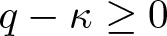 $q-\kappa \ge 0$ and $\kappa \lt (j_{0,1})^2$, then $Q \ge 0$ $a.e.$ in $\mathbb{R}_+$. Thus, by Theorem 4.4 (iv) we obtain that $A_{Q,\kappa} \in L^1(\mathbb{R}_+)$. Using (4.21) with s = 0, it follows that $ q^s_{\kappa} \in L^1_{\mathrm{rad}}(\mathbb{B}^d)$.
5. Proof of the main theorems
5.1. Proof of Theorem 1 and Theorem 2
Consider the function  $q^s_{\kappa}$ defined in Proposition 4.6. Since $q^s_{\kappa}\in L^1_{\ell_0}(\mathbb{B}^d)$, this function might have an algebraic singularity at the origin. Here we identify $q^s_{\kappa}$ with its extension by zero to all $\mathbb{R}^d$.
Let  $F\in\mathcal{E}'_{\mathrm{rad}}(\mathbb{R}^d)$ be a regularization of the function $q^s_{\kappa}$ in the sense of [Reference Gel’fand and Shilov28, Proposition 1 p. 11] (since $q^s_{\kappa}$ is radial, F can also be chosen to be radial). By definition, the distribution F satisfies
 \begin{equation}
\left \langle F,\phi \right \rangle_{\mathcal{E}'\times\mathcal{C}^\infty} = \left \langle q^s_{\kappa}, \phi \right \rangle_{\mathcal{E}'\times\mathcal{C}^\infty}, \qquad \text{for all } \, \phi \in \mathcal{C}_c^\infty(\mathbb{R}^d\setminus\{0\}).
\end{equation}
\begin{equation}
\left \langle F,\phi \right \rangle_{\mathcal{E}'\times\mathcal{C}^\infty} = \left \langle q^s_{\kappa}, \phi \right \rangle_{\mathcal{E}'\times\mathcal{C}^\infty}, \qquad \text{for all } \, \phi \in \mathcal{C}_c^\infty(\mathbb{R}^d\setminus\{0\}).
\end{equation} It turns out that there exists  $N\in \mathbb{N}$, such that $N\ge \ell_q$ andFootnote 4
 \begin{equation}
\sigma_{\ell}[F,\kappa] = \sigma_{\ell}[q^s_{\kappa},\kappa] , \qquad \text{for all } \ell \ge N.
\end{equation}
\begin{equation}
\sigma_{\ell}[F,\kappa] = \sigma_{\ell}[q^s_{\kappa},\kappa] , \qquad \text{for all } \ell \ge N.
\end{equation} To see why (5.2) holds, write  $w_\alpha(x):=|x|^\alpha$ and note that $w_{2\ell_q}q^s_{\kappa} \in L^1(\mathbb{B}^d)$, so in particular $w_{2\ell_q}q^s_{\kappa}\in \mathcal{E}_{\mathrm{rad}}'(\mathbb{R}^d)$. The identity (5.1) implies that
 \begin{equation*}
w_{2\ell_q}F - w_{2\ell_q}q^s_{\kappa} = \mu\in \mathcal{E}_{\mathrm{rad}}'(\mathbb{R}^d),
\end{equation*}
\begin{equation*}
w_{2\ell_q}F - w_{2\ell_q}q^s_{\kappa} = \mu\in \mathcal{E}_{\mathrm{rad}}'(\mathbb{R}^d),
\end{equation*} and µ is a distribution supported in  $\{0\}$. Since µ must be a finite linear combination of Dirac deltas and its derivatives, there exists $N\ge \ell_q$ such that $ w_{2\ell}F = w_{2\ell}q^s_{\kappa}$ for all $\ell \ge N$. Since ${\varphi_{\kappa,\ell}}(|x|)^2 \sim |\sqrt{\kappa}x|^{2\ell}$ as $|x|\to 0$ by (1.9), we conclude that
 \begin{equation*}
\varphi_{\kappa,\ell}^2F = \varphi_{\kappa,\ell}^2q^s_{\kappa}, \qquad \text{for all }\ell\ge N,
\end{equation*}
\begin{equation*}
\varphi_{\kappa,\ell}^2F = \varphi_{\kappa,\ell}^2q^s_{\kappa}, \qquad \text{for all }\ell\ge N,
\end{equation*}in the sense of distributions. This proves (5.2).
As a consequence of (5.2) and (4.19) we have
 \begin{equation*}
\sigma_{\ell}[F,\kappa] = (\lambda_{\ell}[q,\kappa] - \lambda_{\ell}[0,\kappa])\varphi_{\ell}(\sqrt{\kappa})^2, \qquad \text{for all } \ell \ge N.
\end{equation*}
\begin{equation*}
\sigma_{\ell}[F,\kappa] = (\lambda_{\ell}[q,\kappa] - \lambda_{\ell}[0,\kappa])\varphi_{\ell}(\sqrt{\kappa})^2, \qquad \text{for all } \ell \ge N.
\end{equation*}Therefore, by Theorem 3.1 we must have that
 \begin{equation*}
\mathcal{F} (F)(\xi) = (2\pi)^d \sum_{\ell=0}^\infty (\lambda_{\ell}[q,\kappa] - \lambda_{\ell}[0,\kappa])\varphi_{\ell}(\sqrt{\kappa})^2 Z_{\ell,d}\left(1-\frac{\left\lvert \xi \right\rvert^2}{2\kappa}\right) +P_N(|\xi|^2),
\end{equation*}
\begin{equation*}
\mathcal{F} (F)(\xi) = (2\pi)^d \sum_{\ell=0}^\infty (\lambda_{\ell}[q,\kappa] - \lambda_{\ell}[0,\kappa])\varphi_{\ell}(\sqrt{\kappa})^2 Z_{\ell,d}\left(1-\frac{\left\lvert \xi \right\rvert^2}{2\kappa}\right) +P_N(|\xi|^2),
\end{equation*} where PN is a polynomial. This identity implies that the first term in the right-hand side is the Fourier transform of a tempered distribution that we denote  $q^{\mathrm{B}}_{\kappa}$, so that we get the identity $ \mathcal{F} (q^{\mathrm{B}}_{\kappa})(\xi) = \mathcal{F} (F)(\xi)-P_N(|\xi|^2)$. Since $P_N(|\xi|^2)$ is the Fourier transform of a distribution supported in the origin, $q^{\mathrm{B}}_{\kappa}$ is also supported in $\overline{\mathbb{B}^d}$. Also, $q^{\mathrm{B}}_{\kappa}$ coincides with $q^s_{\kappa}$ outside the origin:
 \begin{equation}
q^{\mathrm{B}}_{\kappa}|_{\mathbb{B}^d\setminus \{0\}} = q^s_{\kappa},
\end{equation}
\begin{equation}
q^{\mathrm{B}}_{\kappa}|_{\mathbb{B}^d\setminus \{0\}} = q^s_{\kappa},
\end{equation} which implies that  $q^{\mathrm{B}}_{\kappa} \in \mathcal{B}_d$ (here we are using the identification of elements of $\mathcal{B}_d$ extended by zero, with elements of $\mathcal{E}'_{\mathrm{rad}}(\mathbb{R}^d)$). Finally, again by Theorem 3.1, $q^{\mathrm{B}}_{\kappa}$ satisfies (1.15). Note that once the existence of the Born approximation at energy κ has been established, Theorem 2 follows from Proposition 4.6 and (5.3).
The proof of Theorem 1 will be concluded once we prove identity (1.17). The conditions on κ and q in the statement guarantee that the operator  $\Lambda_{\kappa,q}-\Lambda_{\kappa,0}$ is well defined. Recall that $\mathcal{P}_{\ell,d}$ denotes the orthogonal projection of $L^2(\mathbb{S}^{d-1})$ onto $\mathfrak{H}_{\ell}^d$, and that $\mathcal{P}_{\ell,d} \overline{f} = \overline{\mathcal{P}_{\ell,d}f} $. Therefore we have that
 \begin{align}
\left\langle \overline{e_{\zeta_1}} ,(\Lambda_{\kappa,q}-\Lambda_{\kappa,0})e_{\zeta_2}\right\rangle_{L^2(\mathbb{S}^{d-1})}
=\sum_{\ell=0}^\infty(\lambda_{\ell}[q,\kappa]-\lambda_{\ell}[0,\kappa])\left\langle \overline{\mathcal{P}_{\ell,d}{e_{\zeta_1}}} ,\mathcal{P}_{\ell,d}e_{\zeta_2}\right\rangle_{L^2(\mathbb{S}^{d-1})}.\nonumber\\
\end{align}
\begin{align}
\left\langle \overline{e_{\zeta_1}} ,(\Lambda_{\kappa,q}-\Lambda_{\kappa,0})e_{\zeta_2}\right\rangle_{L^2(\mathbb{S}^{d-1})}
=\sum_{\ell=0}^\infty(\lambda_{\ell}[q,\kappa]-\lambda_{\ell}[0,\kappa])\left\langle \overline{\mathcal{P}_{\ell,d}{e_{\zeta_1}}} ,\mathcal{P}_{\ell,d}e_{\zeta_2}\right\rangle_{L^2(\mathbb{S}^{d-1})}.\nonumber\\
\end{align} The absolute convergence of this series is immediate from the boundedness in  $L^2(\mathbb{S}^{d-1})$ of $\Lambda_{\kappa,q}-\Lambda_{\kappa,0}$ and the estimate
 \begin{align*}\sum_{\ell=0}^\infty\left\lvert \left\langle \mathcal{P}_{\ell,d}\overline{e_{\zeta_1}} ,\mathcal{P}_{\ell,d}e_{\zeta_2}\right\rangle_{L^2(\mathbb{S}^{d-1})} \right\rvert\leq \left\lVert e_{\zeta_1} \right\rVert_{L^2(\mathbb{S}^{d-1})}\left\lVert e_{\zeta_2} \right\rVert_{L^2(\mathbb{S}^{d-1})} \lt \infty.
\end{align*}
\begin{align*}\sum_{\ell=0}^\infty\left\lvert \left\langle \mathcal{P}_{\ell,d}\overline{e_{\zeta_1}} ,\mathcal{P}_{\ell,d}e_{\zeta_2}\right\rangle_{L^2(\mathbb{S}^{d-1})} \right\rvert\leq \left\lVert e_{\zeta_1} \right\rVert_{L^2(\mathbb{S}^{d-1})}\left\lVert e_{\zeta_2} \right\rVert_{L^2(\mathbb{S}^{d-1})} \lt \infty.
\end{align*} Since  $2(\zeta_1\cdot\zeta_2)=-(\left\lvert \xi \right\rvert^2-2\kappa)$, Lemma B.3 shows that the series in the right-hand side of (5.4) coincides exactly with the series given in (1.16) which concludes the proof of (1.17).
5.2. Proof of Theorem 3
Recall  $U_b:= \{x\in\mathbb{B}^d: b \lt |x| \lt 1\}$. By (4.18), (4.17) and (5.3) we have
 \begin{equation*}
q_j(x) -\kappa = |x|^{-2}Q_j(-\log |x|),\qquad q_{j,\kappa}^{\mathrm{B}}(x) =
|x|^{-2} A_{Q_j,\kappa}(-\log |x|),
\qquad x\in \mathbb{B}^d.
\end{equation*}
\begin{equation*}
q_j(x) -\kappa = |x|^{-2}Q_j(-\log |x|),\qquad q_{j,\kappa}^{\mathrm{B}}(x) =
|x|^{-2} A_{Q_j,\kappa}(-\log |x|),
\qquad x\in \mathbb{B}^d.
\end{equation*} Then the uniqueness result follows immediately from Theorem 4.5(i) with  $a = -\log b$.
For the stability notice that if  $\max_{j=1,2} \left\lVert q_j \right\rVert_{L^p(U_b)} \lt K$, then one can choose a constant M > 0 (dependent on κ) such that (4.16). Applying Theorem 4.5(ii), and letting $a = -\log b$, we obtain
 \begin{equation*}
\int_{b \lt |x| \lt 1} | q_1(x)- q_2(x)| |x|^{2-d} \, \mathrm{d}x = \int_0^a | Q_1(t)- Q_2(t)| \, \mathrm{d}t,
\end{equation*}
\begin{equation*}
\int_{b \lt |x| \lt 1} | q_1(x)- q_2(x)| |x|^{2-d} \, \mathrm{d}x = \int_0^a | Q_1(t)- Q_2(t)| \, \mathrm{d}t,
\end{equation*} as well as the analogous identity for the difference of the Born approximations and the Aκ amplitudes. Bounding above and below the weight  $|x|^{2-d}$ finishes the proof of the theorem.
5.3. Proof of Theorem 4
We assume from the start that  $\kappa \lt -\left\lVert q \right\rVert_{L^\infty(\mathbb{B}^d)}$, so that
 \begin{equation*}q(x)-\kappa=q(x)+\left\lvert \kappa \right\rvert \gt 0
,\qquad x\in\mathbb{B}^d.\end{equation*}
\begin{equation*}q(x)-\kappa=q(x)+\left\lvert \kappa \right\rvert \gt 0
,\qquad x\in\mathbb{B}^d.\end{equation*} Let  $\zeta_1,\zeta_2\in \mathbb{C}^d$ satisfy (3.2). Then $(-\Delta-\kappa)e_{\zeta_i}=0$ for $i=1,2$ and by Alessandrini’s identity (2.8) we have
 \begin{equation*}
\left\langle \overline{e_{\zeta_1}} ,(\Lambda_{q,\kappa}-\Lambda_{0,\kappa})e_{\zeta_2}\right\rangle_{L^2(\mathbb{S}^{d-1})}=\int_{\mathbb{B}^d} q(x)\,e_{\zeta_1}(x)\,v(x)\,\mathrm{d}x,
\end{equation*}
\begin{equation*}
\left\langle \overline{e_{\zeta_1}} ,(\Lambda_{q,\kappa}-\Lambda_{0,\kappa})e_{\zeta_2}\right\rangle_{L^2(\mathbb{S}^{d-1})}=\int_{\mathbb{B}^d} q(x)\,e_{\zeta_1}(x)\,v(x)\,\mathrm{d}x,
\end{equation*} where v satisfies the equation on the right of (2.9) with  $f= e_{\zeta_2}$. Notice that $v-e_{\zeta_2}$ satisfies the equation
 \begin{equation*}
\left\{
\begin{array}{rll}
(-\Delta + q-\kappa) (v-e_{\zeta_2}) &=-q e_{\zeta_2} &\text{in } \mathbb{B}^d,\\
v &=0, &\text{on } \mathbb{S}^{d-1},
\end{array}\right.
\end{equation*}
\begin{equation*}
\left\{
\begin{array}{rll}
(-\Delta + q-\kappa) (v-e_{\zeta_2}) &=-q e_{\zeta_2} &\text{in } \mathbb{B}^d,\\
v &=0, &\text{on } \mathbb{S}^{d-1},
\end{array}\right.
\end{equation*}so can rewrite the previous equality as
 \begin{equation*}
\left\langle \overline{e_{\zeta_1}} ,(\Lambda_{q,\kappa}-\Lambda_{0,\kappa})e_{\zeta_2}\right\rangle_{L^2(\mathbb{S}^{d-1})}-\mathcal{F} q(\xi)=-\left\langle q\overline{e_{\zeta_1}} ,\mathcal{R}_q(\kappa)(q e_{\zeta_2})\right\rangle_{L^2(\mathbb{B}^{d})}.
\end{equation*}
\begin{equation*}
\left\langle \overline{e_{\zeta_1}} ,(\Lambda_{q,\kappa}-\Lambda_{0,\kappa})e_{\zeta_2}\right\rangle_{L^2(\mathbb{S}^{d-1})}-\mathcal{F} q(\xi)=-\left\langle q\overline{e_{\zeta_1}} ,\mathcal{R}_q(\kappa)(q e_{\zeta_2})\right\rangle_{L^2(\mathbb{B}^{d})}.
\end{equation*} Since  $q-\kappa \gt 0$, we have that $\mathcal{R}_q(\kappa)(q e_{\zeta_2})=\int_0^\infty e^{- t(-\Delta + q-\kappa)}(q e_{\zeta_2})\mathrm{d}t$. Writing the semigroup via the Feynman–Kac formula [Reference Sznitman60, Section 1.3] and exchanging integral and expectation (which is justified by Fubini and $\left\lVert qe_{\zeta_2} \right\rVert_{L^\infty(\mathbb{B}^d)} \lt \infty$) we obtain
 \begin{equation*}\mathcal{R}_q(\kappa)(q e_{\zeta_2})(x)=\frac{1}{2}\mathbb{E}_x\left[\int_0^{\tau_{\mathbb{B}^d}}(q e_{\zeta_2})(W_t)\exp\left(-\int_0^t \frac{q(W_s)+\left\lvert \kappa \right\rvert}{2}\mathrm{d}s\right)\mathrm{d}t\right],\end{equation*}
 where Wt is a standard d-dimensional Brownian motion and  $\tau_{\mathbb{B}^d}$ is the exit time of $\mathbb{B}^d$. Therefore
 \begin{align*}
\left\lvert \mathcal{R}_q(\kappa)(q e_{\zeta_2})(x) \right\rvert&\leq
\frac{\left\lVert q \right\rVert_{L^\infty(\mathbb{B}^d)}}{2}\mathbb{E}_x\left[\int_0^{\tau_{\mathbb{B}^d}}\left\lvert e_{\zeta_2}(W_t) \right\rvert\exp\left(-\frac{t}{2}\left(\left\lvert \kappa \right\rvert-\left\lVert q \right\rVert_{L^\infty(\mathbb{B}^d)}\right)\right)\mathrm{d}t\right]\\
&\leq \frac{\left\lVert q \right\rVert_{L^\infty(\mathbb{B}^d)}}{2}\mathbb{E}_x\left[\int_0^{\infty}(\chi_{\mathbb{B}^d}e_{\operatorname{\mathrm{Re}}\zeta_2})(W_t)\exp\right.\\ &\quad\times\left.\left(-\frac{t}{2}\left(\left\lvert \kappa \right\rvert-\left\lVert q \right\rVert_{L^\infty(\mathbb{B}^d)}\right)\right)\mathrm{d}t\right]\\
&=\left\lVert q \right\rVert_{L^\infty(\mathbb{B}^d)}\mathcal{R}^{\mathbb{R}^d}_{0}\left(-\left\lvert \kappa \right\rvert+\left\lVert q \right\rVert_{L^\infty(\mathbb{B}^d)}\right)(\chi_{\mathbb{B}^d}e_{\operatorname{\mathrm{Re}}\zeta_2})(x),
\end{align*}
\begin{align*}
\left\lvert \mathcal{R}_q(\kappa)(q e_{\zeta_2})(x) \right\rvert&\leq
\frac{\left\lVert q \right\rVert_{L^\infty(\mathbb{B}^d)}}{2}\mathbb{E}_x\left[\int_0^{\tau_{\mathbb{B}^d}}\left\lvert e_{\zeta_2}(W_t) \right\rvert\exp\left(-\frac{t}{2}\left(\left\lvert \kappa \right\rvert-\left\lVert q \right\rVert_{L^\infty(\mathbb{B}^d)}\right)\right)\mathrm{d}t\right]\\
&\leq \frac{\left\lVert q \right\rVert_{L^\infty(\mathbb{B}^d)}}{2}\mathbb{E}_x\left[\int_0^{\infty}(\chi_{\mathbb{B}^d}e_{\operatorname{\mathrm{Re}}\zeta_2})(W_t)\exp\right.\\ &\quad\times\left.\left(-\frac{t}{2}\left(\left\lvert \kappa \right\rvert-\left\lVert q \right\rVert_{L^\infty(\mathbb{B}^d)}\right)\right)\mathrm{d}t\right]\\
&=\left\lVert q \right\rVert_{L^\infty(\mathbb{B}^d)}\mathcal{R}^{\mathbb{R}^d}_{0}\left(-\left\lvert \kappa \right\rvert+\left\lVert q \right\rVert_{L^\infty(\mathbb{B}^d)}\right)(\chi_{\mathbb{B}^d}e_{\operatorname{\mathrm{Re}}\zeta_2})(x),
\end{align*} where  $\mathcal{R}^{\mathbb{R}^d}_{0}(-z^2)$ is the inverse of $-\Delta+z^2$ defined in $L^2(\mathbb{R}^d)$. This operator in the whole space has the Green function
 \begin{equation*}G_{-z^2}(r):=(2\pi)^{-\frac{d}{2}}\left(\frac{z}{r}\right)^{\nu_d}K_{\nu_d}\left(z r\right),\qquad z \gt 0,\end{equation*}
 where Kν is the modified Bessel function of order ν. Hence, with  $z=\sqrt{\left\lvert \kappa \right\rvert-\left\lVert q \right\rVert_{L^\infty(\mathbb{B}^d)}} \gt 0$, we have
 \begin{align*}
\left\lvert \left\langle q\overline{e_{\zeta_1}} ,\mathcal{R}_q(\kappa)(q e_{\zeta_2})\right\rangle_{L^2(\mathbb{B}^{d})} \right\rvert &\leq \left\langle \left\lvert q\overline{e_{\zeta_1}} \right\rvert ,\left\lvert \mathcal{R}_q(\kappa)(q e_{\zeta_2}) \right\rvert\right\rangle_{L^2(\mathbb{B}^{d})}\\
&=\left\langle \left\lvert q \right\rvert e_{-\operatorname{\mathrm{Re}}\zeta_2} ,\left\lvert \mathcal{R}_q(\kappa)(q e_{\zeta_2}) \right\rvert\right\rangle_{L^2(\mathbb{B}^{d})}\\
&\leq \left\lVert q \right\rVert^2_{L^\infty(\mathbb{B}^d)}\int_{\mathbb{B}^d}e_{-\operatorname{\mathrm{Re}}\zeta_2}(x)\int_{\mathbb{B}^d}G_{-z^2}(\left\lvert y-x \right\rvert)e_{\operatorname{\mathrm{Re}}\zeta_2}(y)\\ &\quad\times\mathrm{d}y \mathrm{d}x\\
&=\left\lVert q \right\rVert^2_{L^\infty(\mathbb{B}^d)}\int_{\mathbb{B}^d}\int_{-x+\mathbb{B}^d}G_{-z^2}(\left\lvert y \right\rvert)e_{\operatorname{\mathrm{Re}}\zeta_2}(y)\mathrm{d}y \mathrm{d}x\\
&\leq\left\lVert q \right\rVert^2_{L^\infty(\mathbb{B}^d)}|\mathbb{B}^d|\int_{2\mathbb{B}^d}G_{-z^2}(\left\lvert y \right\rvert)e_{\operatorname{\mathrm{Re}}\zeta_2}(y)\mathrm{d}y.
\end{align*}
\begin{align*}
\left\lvert \left\langle q\overline{e_{\zeta_1}} ,\mathcal{R}_q(\kappa)(q e_{\zeta_2})\right\rangle_{L^2(\mathbb{B}^{d})} \right\rvert &\leq \left\langle \left\lvert q\overline{e_{\zeta_1}} \right\rvert ,\left\lvert \mathcal{R}_q(\kappa)(q e_{\zeta_2}) \right\rvert\right\rangle_{L^2(\mathbb{B}^{d})}\\
&=\left\langle \left\lvert q \right\rvert e_{-\operatorname{\mathrm{Re}}\zeta_2} ,\left\lvert \mathcal{R}_q(\kappa)(q e_{\zeta_2}) \right\rvert\right\rangle_{L^2(\mathbb{B}^{d})}\\
&\leq \left\lVert q \right\rVert^2_{L^\infty(\mathbb{B}^d)}\int_{\mathbb{B}^d}e_{-\operatorname{\mathrm{Re}}\zeta_2}(x)\int_{\mathbb{B}^d}G_{-z^2}(\left\lvert y-x \right\rvert)e_{\operatorname{\mathrm{Re}}\zeta_2}(y)\\ &\quad\times\mathrm{d}y \mathrm{d}x\\
&=\left\lVert q \right\rVert^2_{L^\infty(\mathbb{B}^d)}\int_{\mathbb{B}^d}\int_{-x+\mathbb{B}^d}G_{-z^2}(\left\lvert y \right\rvert)e_{\operatorname{\mathrm{Re}}\zeta_2}(y)\mathrm{d}y \mathrm{d}x\\
&\leq\left\lVert q \right\rVert^2_{L^\infty(\mathbb{B}^d)}|\mathbb{B}^d|\int_{2\mathbb{B}^d}G_{-z^2}(\left\lvert y \right\rvert)e_{\operatorname{\mathrm{Re}}\zeta_2}(y)\mathrm{d}y.
\end{align*} Once again, the conditions (3.2) on  $\zeta_1,\zeta_2$ imply that they must be of the form
 \begin{equation*}\zeta_\frac{1}{2}=-\frac{i}{2}\xi\mp\sqrt{-\kappa+\frac{\left\lvert \xi \right\rvert^2}{4}}\widehat{\xi}_\perp=-\frac{i}{2}\xi\mp\sqrt{\left\lvert \kappa \right\rvert+\frac{\left\lvert \xi \right\rvert^2}{4}}\widehat{\xi}_\perp,\end{equation*}
 where  $\widehat{\xi}_\perp\in\mathbb{R}^d$ is any unit vector perpendicular to ξ. Since our last integral is invariant under rotations of $\operatorname{\mathrm{Re}}\zeta_2=\sqrt{\left\lvert \kappa \right\rvert+\frac{\left\lvert \xi \right\rvert^2}{4}}\widehat{\xi}_\perp$, we can choose $\widehat{\xi}_\perp$ to be $\widehat{x}_1$, so that when using polar coordinates we obtain
 \begin{align*}
\int_{2\mathbb{B}^d}G_{-z^2}&(\left\lvert y \right\rvert)e_{\operatorname{\mathrm{Re}}\zeta_2}(y)\mathrm{d}y\\
&=\frac{2\pi^\frac{d-1}{2}}{\Gamma(\frac{d-1}{2})}\int_0^2\int_0^\pi G_{-z^2}(r)e^{\left\lvert \operatorname{\mathrm{Re}}\zeta_2 \right\rvert r\cos\theta}(\sin\theta)^{d-2}r^{d-1}\mathrm{d}\theta\mathrm{d}r\\
&=(2\pi)^\frac{d}{2}\int_0^2 \frac{G_{-z^2}(r)I_{\nu_d}(\left\lvert \operatorname{\mathrm{Re}}\zeta_2 \right\rvert r)r^{d-1}}{(\left\lvert \operatorname{\mathrm{Re}}\zeta_2 \right\rvert r)^{\nu_d}}\mathrm{d}r\\
&=\left(\frac{z}{\left\lvert \operatorname{\mathrm{Re}}\zeta_2 \right\rvert}\right)^{\nu_d}\int_0^2 K_{\nu_d}(z r)I_{\nu_d}(\left\lvert \operatorname{\mathrm{Re}}\zeta_2 \right\rvert r)r \mathrm{d}r\\
&=\frac{1}{\left\lvert \operatorname{\mathrm{Re}}\zeta_2 \right\rvert^2-z^2}\left(\frac{z}{\left\lvert \operatorname{\mathrm{Re}}\zeta_2 \right\rvert}\right)^{\nu_d}\\
&\qquad\times\Bigg( -\left(\frac{\left\lvert \operatorname{\mathrm{Re}}\zeta_2 \right\rvert}{z}\right)^{\nu_d}+2\left\lvert \operatorname{\mathrm{Re}}\zeta_2 \right\rvert K_{\nu_d}(2z)I_{\nu_d+1}(2\left\lvert \operatorname{\mathrm{Re}}\zeta_2 \right\rvert)\\ &\qquad +2 z K_{\nu_d+1}(2z)I_{\nu_d}(2\left\lvert \operatorname{\mathrm{Re}}\zeta_2 \right\rvert)\Bigg).
\end{align*}
\begin{align*}
\int_{2\mathbb{B}^d}G_{-z^2}&(\left\lvert y \right\rvert)e_{\operatorname{\mathrm{Re}}\zeta_2}(y)\mathrm{d}y\\
&=\frac{2\pi^\frac{d-1}{2}}{\Gamma(\frac{d-1}{2})}\int_0^2\int_0^\pi G_{-z^2}(r)e^{\left\lvert \operatorname{\mathrm{Re}}\zeta_2 \right\rvert r\cos\theta}(\sin\theta)^{d-2}r^{d-1}\mathrm{d}\theta\mathrm{d}r\\
&=(2\pi)^\frac{d}{2}\int_0^2 \frac{G_{-z^2}(r)I_{\nu_d}(\left\lvert \operatorname{\mathrm{Re}}\zeta_2 \right\rvert r)r^{d-1}}{(\left\lvert \operatorname{\mathrm{Re}}\zeta_2 \right\rvert r)^{\nu_d}}\mathrm{d}r\\
&=\left(\frac{z}{\left\lvert \operatorname{\mathrm{Re}}\zeta_2 \right\rvert}\right)^{\nu_d}\int_0^2 K_{\nu_d}(z r)I_{\nu_d}(\left\lvert \operatorname{\mathrm{Re}}\zeta_2 \right\rvert r)r \mathrm{d}r\\
&=\frac{1}{\left\lvert \operatorname{\mathrm{Re}}\zeta_2 \right\rvert^2-z^2}\left(\frac{z}{\left\lvert \operatorname{\mathrm{Re}}\zeta_2 \right\rvert}\right)^{\nu_d}\\
&\qquad\times\Bigg( -\left(\frac{\left\lvert \operatorname{\mathrm{Re}}\zeta_2 \right\rvert}{z}\right)^{\nu_d}+2\left\lvert \operatorname{\mathrm{Re}}\zeta_2 \right\rvert K_{\nu_d}(2z)I_{\nu_d+1}(2\left\lvert \operatorname{\mathrm{Re}}\zeta_2 \right\rvert)\\ &\qquad +2 z K_{\nu_d+1}(2z)I_{\nu_d}(2\left\lvert \operatorname{\mathrm{Re}}\zeta_2 \right\rvert)\Bigg).
\end{align*}The proof is finished by the asymptotics [Reference Watson61, Section 7.23]
 \begin{equation*}K_\nu(x)=\sqrt{\frac{\pi}{2x}}e^{-x}(1+o(1)),\qquad I_\nu(x)=\sqrt{\frac{1}{2\pi x}}e^{x}(1+o(1)),\qquad x\to\infty.\end{equation*}
6. Proof of Theorem 4.4 and Theorem 4.5
In this section we present the proofs of our two main auxiliary results.
Proof of Theorem 4.4
Start by noticing that, by (4.11) and Lemma 4.3, for all  $z \ge s =\max\left(z_Q, z_{\kappa} \right)$ one has
 \begin{align*}
m_Q(-z^2) -m_{Q_{\kappa}}(-z^2) &= m_Q(-z^2) -m_0(-z^2) -(m_{Q_{\kappa}}(-z^2)-m_0(-z^2))
\\ &= \int_{0}^{\infty} \left (A_Q(t)-A_{Q_{\kappa}}(t)\right) e^{-2zt} \, \mathrm{d}t,
\end{align*}
\begin{align*}
m_Q(-z^2) -m_{Q_{\kappa}}(-z^2) &= m_Q(-z^2) -m_0(-z^2) -(m_{Q_{\kappa}}(-z^2)-m_0(-z^2))
\\ &= \int_{0}^{\infty} \left (A_Q(t)-A_{Q_{\kappa}}(t)\right) e^{-2zt} \, \mathrm{d}t,
\end{align*} where  $A_Q-A_{Q_{\kappa}}$ belongs to $L^1_s(\mathbb{R}_+)$. Let $\psi_z(\cdot;\kappa)\in L^2(\mathbb{R}_+)$ denote the Jost solution of (A.1). This solution is characterized by identities (A.2) and (A.3). Using Lemma A.3 iv) we can write
 \begin{equation*}
m_Q(-z^2) -m_{Q_{\kappa}}(-z^2) = \frac{1}{\psi_z(0;\kappa)^2} \int_{0}^{\infty} \mathcal{T}_{\kappa} \left (A_Q-A_{Q_{\kappa}}\right) (t) e^{-2zt} \, \mathrm{d}t,
\end{equation*}
\begin{equation*}
m_Q(-z^2) -m_{Q_{\kappa}}(-z^2) = \frac{1}{\psi_z(0;\kappa)^2} \int_{0}^{\infty} \mathcal{T}_{\kappa} \left (A_Q-A_{Q_{\kappa}}\right) (t) e^{-2zt} \, \mathrm{d}t,
\end{equation*} for all  $z \ge s$. Then, by Lemma A.2 iv), we have
 \begin{equation*}
m_Q(-z^2) -m_{Q_{\kappa}}(-z^2) =\int_{0}^{\infty} \mathcal{G}_{\kappa}^{-1} \mathcal{T}_{\kappa} \left (A_Q-A_{Q_{\kappa}}\right) (t) \frac{\psi_z(t;\kappa)^2}{\psi_z(0;\kappa)^2} \, \mathrm{d}t,
\end{equation*}
\begin{equation*}
m_Q(-z^2) -m_{Q_{\kappa}}(-z^2) =\int_{0}^{\infty} \mathcal{G}_{\kappa}^{-1} \mathcal{T}_{\kappa} \left (A_Q-A_{Q_{\kappa}}\right) (t) \frac{\psi_z(t;\kappa)^2}{\psi_z(0;\kappa)^2} \, \mathrm{d}t,
\end{equation*} for all  $z \ge s$. This identity can be analytically extended for all $z\in\mathbb{C}$ such that $\operatorname{\mathrm{Re}}(z) \ge s$, which proves the first statement of the theorem with
 \begin{equation}
A_{Q,\kappa} := \mathcal{G}_{\kappa}^{-1} \mathcal{T}_{\kappa} \left (A_Q-A_{Q_{\kappa}}\right).
\end{equation}
\begin{equation}
A_{Q,\kappa} := \mathcal{G}_{\kappa}^{-1} \mathcal{T}_{\kappa} \left (A_Q-A_{Q_{\kappa}}\right).
\end{equation} On the one hand by [Reference Simon57] we have always that  $A_Q-Q \in \mathcal{C}(\mathbb{R}_+)$, and that $A_Q-Q \in \mathcal{C}^{m+2}(\mathbb{R}_+)$ if $Q\in \mathcal{C}^{m}(\mathbb{R}_+)$ for all $m\in \mathbb{N}_0$.
On the other hand, by Lemma A.2 and Lemma A.3,  $\mathcal{G}_{\kappa}^{-1} -\operatorname{\mathrm{Id}}$ and $\mathcal{T}_{\kappa}-\operatorname{\mathrm{Id}}$ are both Volterra operators with a smooth kernel on D, and thus satisfy the conditions of Lemma A.1. Therefore $A_{Q,\kappa} - (A_Q - A_{Q_{\kappa}})$ belongs to $\mathcal{C}([0,\infty))$ always and to $\mathcal{C}^{m+1}([0,\infty))$ if $Q \in \mathcal{C}^{m}([0,\infty))$ with $m\in \mathbb{N}_0$; the analogous result for $A_{Q,\kappa} -Q$ follows immediately (recall that Qκ, and hence $A_{Q_{\kappa}}$, are smooth). The fact that $A_{Q,\kappa}-Q$ can be extended continuously by zero to $[0,\infty)$ follows from estimate (4.15) that we now prove.
 \begin{equation}
|\left(\mathcal{G}_{\kappa}^{-1}\mathcal{T}_{\kappa} -\operatorname{\mathrm{Id}}\right)F (t)| \le |\kappa| C_{\kappa} \int_0^t |F(s)| \, \mathrm{d}s ,
\end{equation}
\begin{equation}
|\left(\mathcal{G}_{\kappa}^{-1}\mathcal{T}_{\kappa} -\operatorname{\mathrm{Id}}\right)F (t)| \le |\kappa| C_{\kappa} \int_0^t |F(s)| \, \mathrm{d}s ,
\end{equation} for some  $C_{\kappa} \gt 0$. Applying this with $F =A_Q-A_{Q_{\kappa}}$ yields the estimate
 \begin{equation}
|A_{Q,\kappa}(t) - (A_Q(t)-A_{Q_{\kappa}}(t))| \le |\kappa| C_{\kappa} \int_0^t |A_Q(s)-A_{Q_{\kappa}}(s)| \, \mathrm{d}s .
\end{equation}
\begin{equation}
|A_{Q,\kappa}(t) - (A_Q(t)-A_{Q_{\kappa}}(t))| \le |\kappa| C_{\kappa} \int_0^t |A_Q(s)-A_{Q_{\kappa}}(s)| \, \mathrm{d}s .
\end{equation} Estimate (4.15) follows adding and subtracting  $Q_{\kappa}-Q$ in the LHS of (6.3) and using the estimate
 \begin{equation}
\left |A_{Q_1}(t) -Q_1(t) - \left( A_{Q_2}(t) -Q_2(t) \right) \right | \ \ \ \ \ \ \ \ \ \ \ \ \ \ \ \ \ \ \ \ \ \ \ \
\end{equation}
\begin{equation}
\left |A_{Q_1}(t) -Q_1(t) - \left( A_{Q_2}(t) -Q_2(t) \right) \right | \ \ \ \ \ \ \ \ \ \ \ \ \ \ \ \ \ \ \ \ \ \ \ \
\end{equation} \begin{equation*}\ \ \ \ \ \ \ \ \ \\ \ \ \ \ \ \ \ \ \ \ \ \ \ \ \ \ \
\le (\alpha_{Q_1}(t) + \alpha_{Q_2}(t)) e^{t(\alpha_{Q_1}(t) + \alpha_{Q_2}(t))} \int_{0}^t |Q_1(s)-Q_2(s)|\, \mathrm{d}s ,
\end{equation*}
\begin{equation*}\ \ \ \ \ \ \ \ \ \\ \ \ \ \ \ \ \ \ \ \ \ \ \ \ \ \ \
\le (\alpha_{Q_1}(t) + \alpha_{Q_2}(t)) e^{t(\alpha_{Q_1}(t) + \alpha_{Q_2}(t))} \int_{0}^t |Q_1(s)-Q_2(s)|\, \mathrm{d}s ,
\end{equation*}twice, which can be found in [Reference Daudé, Macià, Meroño and Nicoleau23, Section 4.1] (recall that αQ was defined in (4.14)).
It remains to prove property (iv). If Q is positive, the operator  $H_Q = (-\partial_t^2 + Q(t) )$ has no negative eigenvalues nor a zero resonance, as remarked in [Reference Ramm and Simon51]. Then it follows from [Reference Ramm and Simon51, Theorem 3] that $A_Q \in L^1(\mathbb{R}_+)$. Also, we have $A_{Q_{\kappa}} \in L^1(\mathbb{R}_+)$ if $\kappa \lt (j_{0,1})^2$ by Lemma 4.3, since zκ can be taken to be 0. It follows that $A_{Q,\kappa} \in L^1(\mathbb{R}_+)$ by (6.1), since $\mathcal{G}_{\kappa}^{-1} \mathcal{T}_{\kappa} $ is bounded on $L^1(\mathbb{R}_+)$ by Lemmas Appendix A.2 and Appendix A.3. This finishes the proof of the Theorem.
Proof of Theorem 4.5
The first statement was proved by Simon in [Reference Simon57, Theorem 1.5] for the case κ = 0. The case κ ≠ 0 follows from this and (6.1) by the local injectivity of the operators  $\mathcal{G}_{\kappa}^{-1}\mathcal{T}_{\kappa} $, which satisfy that $\mathcal{G}_{\kappa}^{-1}\mathcal{T}_{\kappa}F|_{(0,a)}$ vanishes iff $F|_{(0,a)}$ vanishes due to $\mathcal{G}_{\kappa}$, $\mathcal{G}_{\kappa}^{-1}$, $\mathcal{T}_{\kappa}$, $\mathcal{T}_{\kappa}^{-1}$ being Volterra operators (see Appendix A).
We now prove the stability estimate. Under the assumptions for Qj  $j =1,2$ in the statement, by [Reference Daudé, Macià, Meroño and Nicoleau23, Theorem 5.1] we have that
 \begin{equation}
\int_0^{a} \left| Q_1(t)-Q_2(t) \right| \,\mathrm{d}t \lt C(a,M)
\left(\int_0^a \left| A_{Q_1}(t) - A_{Q_2}(t) \right| \, \mathrm{d}t\right)^{1/(p'+1)},
\end{equation}
\begin{equation}
\int_0^{a} \left| Q_1(t)-Q_2(t) \right| \,\mathrm{d}t \lt C(a,M)
\left(\int_0^a \left| A_{Q_1}(t) - A_{Q_2}(t) \right| \, \mathrm{d}t\right)^{1/(p'+1)},
\end{equation}provided that
 \begin{equation*}
\int_0^a \left| A_1(t) - A_2(t) \right| \, \mathrm{d}t \lt \min(1,a)^{(1+p')/p'}.
\end{equation*}
\begin{equation*}
\int_0^a \left| A_1(t) - A_2(t) \right| \, \mathrm{d}t \lt \min(1,a)^{(1+p')/p'}.
\end{equation*} By (6.1) we have that  $ A_{Q_1}- A_{Q_2} = \mathcal{T}_{\kappa}^{-1} \mathcal{G}_{\kappa} \left ( A_{Q_1,\kappa} - A_{Q_2,\kappa}\right)$, and therefore it follows that
 \begin{equation*}
\int_0^a \left| A_{Q_1}(t) - A_{Q_2}(t) \right| \, \mathrm{d}t \le C(a,\kappa) \int_0^a \left| A_{Q_1,\kappa}(t) - A_{Q_2,\kappa}(t) \right| \, \mathrm{d}t,
\end{equation*}
\begin{equation*}
\int_0^a \left| A_{Q_1}(t) - A_{Q_2}(t) \right| \, \mathrm{d}t \le C(a,\kappa) \int_0^a \left| A_{Q_1,\kappa}(t) - A_{Q_2,\kappa}(t) \right| \, \mathrm{d}t,
\end{equation*} by Lemma A.3 and the boundedness of  $\mathcal{G}_{\kappa}$ in $L^1(\mathbb{R}_+)$ (see Lemma A.2). Inserting this in (6.5) finishes the proof of the theorem.
Acknowledgments
This research has been supported by the grant PID2021-124195NB-C31 from the Agencia Estatal de Investigación (Spain). The authors thank Thierry Daudé and François Nicoleau for many insightful conversations on the inverse spectral theory of Schrödinger operators on the half-line.
Appendix A. Jost solutions and intertwining operators
In this Appendix, we gather some properties of Jost solutions and related operators that are used in the proofs of Theorem 4.4 and Theorem 4.5. Given  $\kappa\in\mathbb{R}$ set $Q_{\kappa}(x):=-\kappa e^{-2x}$. For every $z\in \mathbb{C}_+$, the problem
 \begin{equation}
(-\partial_x^2 + Q_{\kappa} ) u_z = -z^2 u_z, \qquad \text{on } \mathbb{R}_+,
\end{equation}
\begin{equation}
(-\partial_x^2 + Q_{\kappa} ) u_z = -z^2 u_z, \qquad \text{on } \mathbb{R}_+,
\end{equation} possesses a unique solution  $\psi_z(\cdot;\kappa)\in L^2(\mathbb{R}_+)$ satisfying the asymptotics:
 \begin{equation}
\psi_z(x;\kappa) = e^{-zx} (1+ o(1)) \qquad \text{as } \, x\to \infty.
\end{equation}
\begin{equation}
\psi_z(x;\kappa) = e^{-zx} (1+ o(1)) \qquad \text{as } \, x\to \infty.
\end{equation}These solutions are called the Jost solutions of equation (A.1), and are known to satisfy the identity
 \begin{equation}
\psi_z(x;\kappa) = e^{-zx} + \int_{x}^\infty K_{\kappa} (x,t) e^{-zt} \, \mathrm{d}t,
\end{equation}
\begin{equation}
\psi_z(x;\kappa) = e^{-zx} + \int_{x}^\infty K_{\kappa} (x,t) e^{-zt} \, \mathrm{d}t,
\end{equation}where
 \begin{equation*}
K_{\kappa}\in\mathcal{C}^\infty(\{(x,t)\in\mathbb{R}^2 : 0\leq x\leq t\})
\end{equation*}
\begin{equation*}
K_{\kappa}\in\mathcal{C}^\infty(\{(x,t)\in\mathbb{R}^2 : 0\leq x\leq t\})
\end{equation*}is the Gelfand-Levitan kernel associated to the smooth potential Qκ, see for instance [Reference Marchenko44, Chapter 3]. By [Reference Marchenko44, Lemma 3.3.1], this kernel satisfies the estimate
 \begin{equation}
|K_{\kappa}(x,t)|\leq \frac{|\kappa|e^{\frac{|\kappa|}{4}}}{4}e^{-(x+t)} ,\qquad \text{for all } 0\leq x\leq t.
\end{equation}
\begin{equation}
|K_{\kappa}(x,t)|\leq \frac{|\kappa|e^{\frac{|\kappa|}{4}}}{4}e^{-(x+t)} ,\qquad \text{for all } 0\leq x\leq t.
\end{equation} Set  $D := \{(x,t)\in\mathbb{R}^2 : 0\leq t \leq x\}$, let $G_{\kappa}\in\mathcal{C}^\infty(D)$ be given by
 \begin{equation}
G_{\kappa}(x,t) := 4K_{\kappa}(t,2x-t)
+ 2\int_{t}^{2x-t} K_{\kappa}(t,s)K_{\kappa}(t,2x-s) \,\mathrm{d}s,
\end{equation}
\begin{equation}
G_{\kappa}(x,t) := 4K_{\kappa}(t,2x-t)
+ 2\int_{t}^{2x-t} K_{\kappa}(t,s)K_{\kappa}(t,2x-s) \,\mathrm{d}s,
\end{equation} and define, for  $F\in L^1_{\mathrm{loc}}(\mathbb{R}_+)$:
 \begin{equation}
\mathcal{G}_{\kappa} F (x) := F(x) + \int_0^x G_{\kappa}(x,t) F(t)\, \mathrm{d}t.
\end{equation}
\begin{equation}
\mathcal{G}_{\kappa} F (x) := F(x) + \int_0^x G_{\kappa}(x,t) F(t)\, \mathrm{d}t.
\end{equation} This is a Volterra integral operator. In the next result, we gather some simple properties of this class of operators. Recall that, for  $s\in\mathbb{R}$, $L^1_s(\mathbb{R}_+)$ stands for the $F\in L^1_{\mathrm{loc}}(\mathbb{R}_+)$ such that
 \begin{equation*}
\left\lVert F \right\rVert_{L^1_s(\mathbb{R}_+)}:=\int_0^\infty|F(x)|e^{-2sx}\,\mathrm{d}x \lt \infty.
\end{equation*}
\begin{equation*}
\left\lVert F \right\rVert_{L^1_s(\mathbb{R}_+)}:=\int_0^\infty|F(x)|e^{-2sx}\,\mathrm{d}x \lt \infty.
\end{equation*}Lemma A.1. Let  $H\in\mathcal{C}^\infty(D)$; the Volterra operator of kernel H is defined as
 \begin{equation*}
\mathcal{T}_H F(x) := \int_0^x H(x,t) F(t) \, \mathrm{d}t,\qquad F\in L^1_{\mathrm{loc}}(\mathbb{R}_+).
\end{equation*}
\begin{equation*}
\mathcal{T}_H F(x) := \int_0^x H(x,t) F(t) \, \mathrm{d}t,\qquad F\in L^1_{\mathrm{loc}}(\mathbb{R}_+).
\end{equation*} For every  $x\in \mathbb{R}_+$, it satisfies
 \begin{equation*}
\|\mathcal{T}_H F\|_{L^1((0,x))} \leq \left(\int_0^x\sup_{t\in(0,y)} |H(y,t)|\,\mathrm{d}y \right)\|F\|_{L^1((0,x))}.
\end{equation*}
\begin{equation*}
\|\mathcal{T}_H F\|_{L^1((0,x))} \leq \left(\int_0^x\sup_{t\in(0,y)} |H(y,t)|\,\mathrm{d}y \right)\|F\|_{L^1((0,x))}.
\end{equation*} Moreover,  $\mathcal{T}_H$ maps $L^1_{\mathrm{loc}}(\mathbb{R}_+)$ into $\mathcal{C}([0,\infty))$, and $\mathcal{C}^{m}([0,\infty))$ into $\mathcal{C}^{m+1}([0,\infty))$ for every $m\in \mathbb{N}_0$. If, in addition, there exist $C_H \gt 0$ and $g\in L^1_{1/2}(\mathbb{R}_+)$ such that
 \begin{equation*}
|H(x,t)| \le C_H e^{-(x-t)}|g(x-t)|,\qquad \text{for all }(x,t)\in D;
\end{equation*}
\begin{equation*}
|H(x,t)| \le C_H e^{-(x-t)}|g(x-t)|,\qquad \text{for all }(x,t)\in D;
\end{equation*} then  $\mathcal{T}_H$ maps $L^1_{z_0}(\mathbb{R}_+)$ for all $z_0 \geq 0$ into itself, and
 \begin{equation*}
\|\mathcal{T}_H F\|_{L^1_{z_0}(\mathbb{R}_+)} \leq C_H\|g\|_{L^1_{1/2}(\mathbb{R}_+)} \| F \|_{L^1_{z_0}(\mathbb{R}_+)}, \quad \text{for all }F\in L^1_{z_0}(\mathbb{R}_+).
\end{equation*}
\begin{equation*}
\|\mathcal{T}_H F\|_{L^1_{z_0}(\mathbb{R}_+)} \leq C_H\|g\|_{L^1_{1/2}(\mathbb{R}_+)} \| F \|_{L^1_{z_0}(\mathbb{R}_+)}, \quad \text{for all }F\in L^1_{z_0}(\mathbb{R}_+).
\end{equation*}Note that  $\mathcal{G}_{\kappa}: L^1_{\mathrm{loc}}(\mathbb{R}_+) \longrightarrow L^1_{\mathrm{loc}}(\mathbb{R}_+)$ is bounded by the preceding result, since the kernel Gκ is smooth on D. In fact, $\mathcal{G}_{\kappa}$ enjoys more precise mapping properties.
First, let  $z_0\ge 0$ and define the linear functional
 \begin{equation}
\mathcal{J}_{\kappa}(F)(z) := \int_0^\infty F(x) \psi_z(x;\kappa)^2 \, \mathrm{d}x, \qquad F \in L^1_{z_0}(\mathbb{R}_+).
\end{equation}
\begin{equation}
\mathcal{J}_{\kappa}(F)(z) := \int_0^\infty F(x) \psi_z(x;\kappa)^2 \, \mathrm{d}x, \qquad F \in L^1_{z_0}(\mathbb{R}_+).
\end{equation} This integral is well defined for all  $\kappa \in \mathbb{R}$ and $z\ge z_0$ by (A.2).
Lemma A.2. Let  $\kappa\in\mathbb{R}$.
i) The kernel Gκ satisfies the estimate
(A.8)\begin{equation}
\sup_{0 \lt t \lt x} |G_{\kappa}(x,t)| \le |\kappa|C_{\kappa} e^{-x}, \quad\text{for all }x\in\mathbb{R}_+,
\end{equation}where
$C_{\kappa} = e^{\frac{|\kappa|}{4}}(1+|\kappa|\frac{e^{\frac{|\kappa|}{4}}}{4})$.ii) For every
$z_0\geq 0$,
\begin{equation*}
\mathcal{G}_{\kappa} : L^1_{z_0}(\mathbb{R}_+)\longrightarrow L^1_{z_0}(\mathbb{R}_+)
\end{equation*}is a bounded isomorphism.
iii)
$\mathcal{G}_{\kappa}^{-1}-\operatorname{\mathrm{Id}}$ is a Volterra operator whose integral kernel
$\tilde{G}_{\kappa}$ is smooth on D and satisfies
\begin{equation*}
\sup_{0 \lt t \lt x}|\tilde{G}_{\kappa}(x,t)|\leq |\kappa|C_{\kappa} e^{|\kappa|C_{\kappa}} e^{-x}, \quad\text{for all }x\in\mathbb{R}_+.
\end{equation*}In particular, for every
$F\in L^1_{\mathrm{loc}}(\mathbb{R}_+)$ and
$x\in \mathbb{R}_+$,
(A.9)\begin{equation}
|\mathcal{G}_{\kappa}^{-1}(F)(x)-F(x)|\leq |\kappa|C_{\kappa} e^{|\kappa|C_{\kappa}} e^{-x}\int_0^x|F(t)|\,\mathrm{d}t.
\end{equation}iv) For every
$z_0\geq 0$ and
$F\in L^1_{z_0}(\mathbb{R}_+)$,
\begin{equation*}
\mathcal{J}_{\kappa}(F)(z) = \int_0^\infty \mathcal{G}_{\kappa} (F)(x) e^{-2zx} \, \mathrm{d}x, \qquad \text{for all }z\ge z_0.
\end{equation*}


Proof. To prove (i) use (A.4) to find
 \begin{equation*}
4\sup_{0 \lt t \lt x} |K_{\kappa}(t,2x-t)| \le
|\kappa|e^{\frac{|\kappa|}{4}} e^{-2x} ,
\end{equation*}
\begin{equation*}
4\sup_{0 \lt t \lt x} |K_{\kappa}(t,2x-t)| \le
|\kappa|e^{\frac{|\kappa|}{4}} e^{-2x} ,
\end{equation*}and
 \begin{align*}
2\sup_{0 \lt t \lt x} \int_{t}^{2x-t} |K_{\kappa}(t,s)K_{\kappa}(t,2x-s)| \,\mathrm{d}s &\le
\frac{(|\kappa|e^{\frac{|\kappa|}{4}})^2}{4} \sup_{0 \lt t \lt x} (x-t) e^{-2(t+x)}
\\ &\le c_{\kappa} |\kappa|e^{\frac{|\kappa|}{4}} e^{-x},
\end{align*}
\begin{align*}
2\sup_{0 \lt t \lt x} \int_{t}^{2x-t} |K_{\kappa}(t,s)K_{\kappa}(t,2x-s)| \,\mathrm{d}s &\le
\frac{(|\kappa|e^{\frac{|\kappa|}{4}})^2}{4} \sup_{0 \lt t \lt x} (x-t) e^{-2(t+x)}
\\ &\le c_{\kappa} |\kappa|e^{\frac{|\kappa|}{4}} e^{-x},
\end{align*} where the last estimate follows from the inequality  $x \leq e^{x}$ for $x\geq0$, with $c_{\kappa}:=\frac{|\kappa|}{4}e^{\frac{|\kappa|}{4}}$. This proves (A.8) with $C_{\kappa} = e^{|\kappa|/4}(1+c_{\kappa})$.
The fact that  $\mathcal{G}_{\kappa}$ is bounded in $L^1_{z_0}(\mathbb{R}_+)$ follows from (i) and Lemma A.1, and the existence of its inverse follows from the convergence of the Neumann series, which implies that:
 \begin{equation}
\mathcal{G}_{\kappa}^{-1}=\sum_{n=0}^\infty (-1)^n (\mathcal{G}_{\kappa} -\operatorname{\mathrm{Id}})^{n}.
\end{equation}
\begin{equation}
\mathcal{G}_{\kappa}^{-1}=\sum_{n=0}^\infty (-1)^n (\mathcal{G}_{\kappa} -\operatorname{\mathrm{Id}})^{n}.
\end{equation} In order to check that the Neumann series converges, note that  $(\mathcal{G}_{\kappa} -\operatorname{\mathrm{Id}})^{n}$ is a Volterra operator whose integral kernel,
 \begin{equation*}
G_{\kappa}^n(x,t)=\int_0^x \int_0^{x_1} \dots \int_0^{x_{n-1}} G_{\kappa}(x,x_1)G_{\kappa}(x_1,x_2) \dots G_{\kappa}(x_{n-1},t)\, \mathrm{d}x_{n-1} \dots \mathrm{d}x_2 \mathrm{d}x_1,
\end{equation*}
\begin{equation*}
G_{\kappa}^n(x,t)=\int_0^x \int_0^{x_1} \dots \int_0^{x_{n-1}} G_{\kappa}(x,x_1)G_{\kappa}(x_1,x_2) \dots G_{\kappa}(x_{n-1},t)\, \mathrm{d}x_{n-1} \dots \mathrm{d}x_2 \mathrm{d}x_1,
\end{equation*}satisfies
 \begin{equation}
|G_{\kappa}^n(x,t)|\leq \frac{C_{\kappa}^{n-1} |\kappa|^{n-1}}{(n-1)!} |\kappa|C_{\kappa} e^{-x}.
\end{equation}
\begin{equation}
|G_{\kappa}^n(x,t)|\leq \frac{C_{\kappa}^{n-1} |\kappa|^{n-1}}{(n-1)!} |\kappa|C_{\kappa} e^{-x}.
\end{equation}To see this, use (A.8) to estimate
 \begin{equation*}
|G_{\kappa}^n(x,t)|\leq C_{\kappa}^n |\kappa|^n e^{-x}
\int_0^x e^{-x_1} \dots \int_0^{x_{n-2}} e^{-x_{n-1}} \, \ \mathrm{d}x_{n-1} \dots \mathrm{d}x_1=C_{\kappa}^n|\kappa|^n e^{-x} T^n(1),
\end{equation*}
\begin{equation*}
|G_{\kappa}^n(x,t)|\leq C_{\kappa}^n |\kappa|^n e^{-x}
\int_0^x e^{-x_1} \dots \int_0^{x_{n-2}} e^{-x_{n-1}} \, \ \mathrm{d}x_{n-1} \dots \mathrm{d}x_1=C_{\kappa}^n|\kappa|^n e^{-x} T^n(1),
\end{equation*} where  $T(f) (x) := \int_0^x e^{-t} f(t) \, \mathrm{d}t$. One can show by induction that
 \begin{equation}
T^{n}(1)(x) = \frac{1}{n!}(1-e^{-x})^n \le \frac{1}{n!}.
\end{equation}
\begin{equation}
T^{n}(1)(x) = \frac{1}{n!}(1-e^{-x})^n \le \frac{1}{n!}.
\end{equation} Therefore,  $\mathcal{G}_{\kappa}^{-1}-\operatorname{\mathrm{Id}}$ exists and it is a Volterra operator whose kernel $\tilde{G}_{\kappa}$ is smooth on D and satisfies:
 \begin{equation*}
|\tilde{G}_{\kappa}(x,t)|\leq \sum_{n=1}^{\infty}|G_{\kappa}^n(x,t)|\leq |\kappa|C_{\kappa} e^{|\kappa|C_{\kappa}} e^{-x}.
\end{equation*}
\begin{equation*}
|\tilde{G}_{\kappa}(x,t)|\leq \sum_{n=1}^{\infty}|G_{\kappa}^n(x,t)|\leq |\kappa|C_{\kappa} e^{|\kappa|C_{\kappa}} e^{-x}.
\end{equation*}This completes the proofs of (ii) and (iii). Finally, (iv) follows from (A.3) and (A.7) by straightforward computation.
Recall the definition of the Laplace transform:
 \begin{equation*}
\mathcal{L}(f)(z) : = \int_0^\infty f(x) e^{-zx} \, \mathrm{d}x.
\end{equation*}
\begin{equation*}
\mathcal{L}(f)(z) : = \int_0^\infty f(x) e^{-zx} \, \mathrm{d}x.
\end{equation*} For  $\kappa\in\mathbb{R}$, define $ r_{\kappa}(t) : = 2K_{\kappa} (0,2t)$; by (A.3) we have that
 \begin{equation*}
\psi_z(0;\kappa) = 1+ \mathcal{L} (r_{\kappa})(2z).
\end{equation*}
\begin{equation*}
\psi_z(0;\kappa) = 1+ \mathcal{L} (r_{\kappa})(2z).
\end{equation*} Given  $f,g \in L^1(\mathbb{R}_+)$ we denote
 \begin{equation*}
f \star g (x) = \int_{0}^x f(x-t)g(t) \, \mathrm{d}t.
\end{equation*}
\begin{equation*}
f \star g (x) = \int_{0}^x f(x-t)g(t) \, \mathrm{d}t.
\end{equation*}Recall that  $\mathcal{L} g(z) \mathcal{L} f(z) = \mathcal{L} (f \star g) (z) $.
Let  $\tau_{\kappa} := 2 r_{\kappa} + r_{\kappa}\star r_{\kappa}$ and define the Volterra operators
 \begin{equation}
\mathcal{T}_{\kappa} g(x) = g(x) + \int_0^x \tau_{\kappa}(x-t) g(t) \, \mathrm{d}t.
\end{equation}
\begin{equation}
\mathcal{T}_{\kappa} g(x) = g(x) + \int_0^x \tau_{\kappa}(x-t) g(t) \, \mathrm{d}t.
\end{equation}Lemma A.3. Let  $\kappa\in\mathbb{R}$.
i) For every
$g\in L^1_{\mathrm{loc}}(\mathbb{R}_+)$ it holds that
(A.14)\begin{equation}
|\mathcal{T}_{\kappa} g(x) -g(x) |
\le C_{\kappa} |\kappa| \int_0^x |g(t)| \, \mathrm{d}t.
\end{equation}ii) For every
$z_0\geq 0$,
$(\mathcal{T}_{\kappa}-\operatorname{\mathrm{Id}}):L^1_{z_0}(\mathbb{R}_+)\longrightarrow L^1_{z_0}(\mathbb{R}_+)$ is bounded with norm bounded by
$|\kappa|C_{\kappa}$.iii) The inverse operator
$\mathcal{T}_{\kappa}^{-1}$ exists and satisfies, for every
$x\in\mathbb{R}_+$ and
$F\in L^1_{\mathrm{loc}}(\mathbb{R}_+)$:
(A.15)\begin{equation}
\left\lVert \mathcal{T}_{\kappa}^{-1} F \right\rVert_{L^1((0,x))} \le e^{x C_{\kappa}} \left\lVert F \right\rVert_{L^1((0,x))}.
\end{equation}iv) Let
$z_0\geq0$. For every
$g\in L^1_{z_0}(\mathbb{R}_+)$ it holds that
(A.16)\begin{equation}
\mathcal{L} (\mathcal{T}_{\kappa} g)(2z) = \psi_z(0,\kappa)^2 \mathcal{L} g(2z),\qquad\text{for all }z\geq z_0 .
\end{equation}


Proof. The function  $r_{\kappa} (x)$ is smooth on $\mathbb{R}_+$ and by (A.7),
 \begin{equation}
|r_{\kappa} (x)| \le |\kappa| \frac{e^{\frac{|\kappa|}{4}}}{2} e^{-2x},
\end{equation}
\begin{equation}
|r_{\kappa} (x)| \le |\kappa| \frac{e^{\frac{|\kappa|}{4}}}{2} e^{-2x},
\end{equation}and
 \begin{equation*}
|r_{\kappa}\star r_{\kappa} (x)| \le \int_0^{x} |r_{\kappa}(x -s)||r_{\kappa}(s)| \, \mathrm{d}s \\
\le \kappa^2 \frac{e^{\frac{|\kappa|}{2}}}{4} \int_0^{x} e^{-2x} \, \mathrm{d}s = \kappa^2 \frac{e^{\frac{|\kappa|}{2}}}{4} xe^{-2x}.
\end{equation*}
\begin{equation*}
|r_{\kappa}\star r_{\kappa} (x)| \le \int_0^{x} |r_{\kappa}(x -s)||r_{\kappa}(s)| \, \mathrm{d}s \\
\le \kappa^2 \frac{e^{\frac{|\kappa|}{2}}}{4} \int_0^{x} e^{-2x} \, \mathrm{d}s = \kappa^2 \frac{e^{\frac{|\kappa|}{2}}}{4} xe^{-2x}.
\end{equation*}These estimates imply that
 \begin{equation}
\tau_{\kappa}(x) \le |\kappa| C_{\kappa} (x+1) e^{-2x}.
\end{equation}
\begin{equation}
\tau_{\kappa}(x) \le |\kappa| C_{\kappa} (x+1) e^{-2x}.
\end{equation} Estimate (A.14) is a direct consequence of this. Property (ii) follows from (A.18) and Lemma A.1. To prove (iii) denote  $\mathcal{M}_{\kappa} g= \tau_k \star g$, we show that the Neumann series
 \begin{equation}
\sum_{n=0}^\infty (-1)^n\mathcal{M}_{\kappa}^{n}
\end{equation}
\begin{equation}
\sum_{n=0}^\infty (-1)^n\mathcal{M}_{\kappa}^{n}
\end{equation} converges in operator norm. For  $n\ge 1$, the integral kernel of $\mathcal{M}_{\kappa}^{n}$ is given by
 \begin{equation*}
m_{\kappa}^n(x,t):= \int_0^{x_1} \tau_{\kappa}(x-x_1) \dots \int_0^{x_{n-1}} \tau_{\kappa}(x_{n-1}-t) \, \mathrm{d}x_{n-1} \dots \mathrm{d}x_1.
\end{equation*}
\begin{equation*}
m_{\kappa}^n(x,t):= \int_0^{x_1} \tau_{\kappa}(x-x_1) \dots \int_0^{x_{n-1}} \tau_{\kappa}(x_{n-1}-t) \, \mathrm{d}x_{n-1} \dots \mathrm{d}x_1.
\end{equation*} Since by (A.14)  $|\tau_{\kappa}(x)| \le C_{\kappa} |\kappa|$ for all $x\in \mathbb{R}_+$, one has the estimate:
 \begin{equation*}
|m_{\kappa}^n(x,t)|\le (|\kappa| C_{\kappa})^n \frac{x^{n}}{n!},\qquad \text{for all } (t,x)\in D.
\end{equation*}
\begin{equation*}
|m_{\kappa}^n(x,t)|\le (|\kappa| C_{\kappa})^n \frac{x^{n}}{n!},\qquad \text{for all } (t,x)\in D.
\end{equation*} This shows that the series (A.19) converges in operator norm in  $L^1((0,x))$ for every $x\in\mathbb{R}_+$, as claimed, and that (A.15) holds. Finally, property (iv) is a straightforward computation:
 \begin{equation*}
\psi_z(0,\kappa)^2 \mathcal{L} g(2z) = \mathcal{L} g(2z) + 2 \mathcal{L} (g \star r_{\kappa})(2z) + \mathcal{L} (g \star r_{\kappa} \star r_{\kappa})(2z) \\
= \mathcal{L} (\mathcal{T}_{\kappa} g)(2z).
\end{equation*}
\begin{equation*}
\psi_z(0,\kappa)^2 \mathcal{L} g(2z) = \mathcal{L} g(2z) + 2 \mathcal{L} (g \star r_{\kappa})(2z) + \mathcal{L} (g \star r_{\kappa} \star r_{\kappa})(2z) \\
= \mathcal{L} (\mathcal{T}_{\kappa} g)(2z).
\end{equation*}Appendix B. Spherical harmonics and projectors
In this appendix, we present some explicit computations involving spherical harmonics. Recall that a d-dimensional spherical harmonic of degree  $\ell\in\mathbb{N}_0$ is the restriction to the sphere $\mathbb{S}^{d-1}\subset \mathbb{R}^d$ of a complex homogeneous polynomial P in d variables of degree $\ell$ that is harmonic, i.e.
 \begin{equation*}
\Delta P(x)=0,\qquad x\in\mathbb{R}^d.
\end{equation*}
\begin{equation*}
\Delta P(x)=0,\qquad x\in\mathbb{R}^d.
\end{equation*} These functions form a vector space that we denote by  $\mathfrak{H}_{\ell}^d$, of dimension
 \begin{equation*}
N_{\ell,d}:=\dim \mathfrak{H}_{\ell}^d=\binom{\ell+d-1}{\ell} - \binom{\ell+d-3}{\ell-2}=\frac{(\ell+d-2)! + \ell(\ell+d-3)!}{\ell! (d-2)!}.
\end{equation*}
\begin{equation*}
N_{\ell,d}:=\dim \mathfrak{H}_{\ell}^d=\binom{\ell+d-1}{\ell} - \binom{\ell+d-3}{\ell-2}=\frac{(\ell+d-2)! + \ell(\ell+d-3)!}{\ell! (d-2)!}.
\end{equation*} Spherical harmonics of different degrees are orthogonal in  $L^2(\mathbb{S}^{d-1})$. In fact,
 \begin{equation*}
L^2(\mathbb{S}^{d-1})=\bigoplus_{\ell\in\mathbb{N}_0}\mathfrak{H}_{\ell}^d,
\end{equation*}
\begin{equation*}
L^2(\mathbb{S}^{d-1})=\bigoplus_{\ell\in\mathbb{N}_0}\mathfrak{H}_{\ell}^d,
\end{equation*}and, moreover, spherical harmonics diagonalize the Laplacian on the sphere:
 \begin{equation*}
-\Delta_{\mathbb{S}^{d-1}}|_{\mathfrak{H}_{\ell}^d}=\ell(\ell+d-2)\operatorname{\mathrm{Id}}_{\mathfrak{H}_{\ell}^d},\qquad \forall\ell\in\mathbb{N}_0.
\end{equation*}
\begin{equation*}
-\Delta_{\mathbb{S}^{d-1}}|_{\mathfrak{H}_{\ell}^d}=\ell(\ell+d-2)\operatorname{\mathrm{Id}}_{\mathfrak{H}_{\ell}^d},\qquad \forall\ell\in\mathbb{N}_0.
\end{equation*} Important examples of spherical harmonics are the restrictions to  $x\in\mathbb{S}^{d-1}$ of the functions:
 \begin{equation*}
(x\cdot\zeta)^\ell, \qquad \text{provided }\;\zeta\in\mathbb{C}^d,\;\zeta\cdot\zeta=0.
\end{equation*}
\begin{equation*}
(x\cdot\zeta)^\ell, \qquad \text{provided }\;\zeta\in\mathbb{C}^d,\;\zeta\cdot\zeta=0.
\end{equation*}This follows from:
 \begin{equation*}
\Delta(x\cdot\zeta)^\ell=\ell(\ell-1)(x\cdot\zeta)^{\ell-2}(\zeta\cdot\zeta)=0,\qquad x\in\mathbb{R}^d.
\end{equation*}
\begin{equation*}
\Delta(x\cdot\zeta)^\ell=\ell(\ell-1)(x\cdot\zeta)^{\ell-2}(\zeta\cdot\zeta)=0,\qquad x\in\mathbb{R}^d.
\end{equation*} The orthogonal projector  $\mathcal{P}_{\ell,d}:L^2(\mathbb{S}^{d-1})\longrightarrow \mathfrak{H}_{\ell}^d$ is given by
 \begin{equation*}
\mathcal{P}_{\ell,d}f(x)= \frac{N_{\ell,d}}{\left\lvert \mathbb{S}^{d-1} \right\rvert}\int_{\mathbb{S}^{d-1}} P_{\ell,d}(x\cdot y)f(y)\mathrm{d}y,\qquad f\in L^2(\mathbb{S}^{d-1}),
\end{equation*}
\begin{equation*}
\mathcal{P}_{\ell,d}f(x)= \frac{N_{\ell,d}}{\left\lvert \mathbb{S}^{d-1} \right\rvert}\int_{\mathbb{S}^{d-1}} P_{\ell,d}(x\cdot y)f(y)\mathrm{d}y,\qquad f\in L^2(\mathbb{S}^{d-1}),
\end{equation*} where  $P_{\ell,d}$ are the generalized Legendre polynomials
 \begin{equation*}
P_{\ell,d}(t)=(-1)^\ell R_{\ell}(1-t^2)^{-(\nu_d-\frac{1}{2})}\left(\dfrac{\mathrm{d}}{\mathrm{d}t}\right)^\ell(1-t^2)^{\ell+\nu_d-\frac{1}{2}},
\end{equation*}
\begin{equation*}
P_{\ell,d}(t)=(-1)^\ell R_{\ell}(1-t^2)^{-(\nu_d-\frac{1}{2})}\left(\dfrac{\mathrm{d}}{\mathrm{d}t}\right)^\ell(1-t^2)^{\ell+\nu_d-\frac{1}{2}},
\end{equation*}and
 \begin{equation*}
\nu_d:=\frac{d-2}{2},\quad R_{\ell}:=\frac{\Gamma\left(\frac{d-1}{2}\right)}{2^\ell\Gamma\left(\ell+\frac{d-1}{2}\right)}, \quad|\mathbb{S}^{d-1}|=\frac{2\pi^{d/2}}{\Gamma(d/2)}.
\end{equation*}
\begin{equation*}
\nu_d:=\frac{d-2}{2},\quad R_{\ell}:=\frac{\Gamma\left(\frac{d-1}{2}\right)}{2^\ell\Gamma\left(\ell+\frac{d-1}{2}\right)}, \quad|\mathbb{S}^{d-1}|=\frac{2\pi^{d/2}}{\Gamma(d/2)}.
\end{equation*}In particular, the function
 \begin{equation}
Z_{\ell}(x\cdot y):=\frac{N_{\ell,d}}{|\mathbb{S}^{d-1}|} P_{\ell,d}(x\cdot y)
\end{equation}
\begin{equation}
Z_{\ell}(x\cdot y):=\frac{N_{\ell,d}}{|\mathbb{S}^{d-1}|} P_{\ell,d}(x\cdot y)
\end{equation} is a reproducing kernel for  $\mathfrak{H}_{\ell}^d$. The normalization in the definition of $P_{\ell,d}$ ensures that $P_{\ell,d}(1)=1$, and ([Reference Atkinson and Han5, Equation 2.67])
 \begin{equation}
\frac{|\mathbb{S}^{d-2}|}{|\mathbb{S}^{d-1}|}\int_{-1}^{1}P_{m,d}(t)P_{n,d}(t)(1-t^2)^{\nu_d-\frac{1}{2}}\mathrm{d}t=\frac{1}{N_{m,d}}\delta_{m,n}.
\end{equation}
\begin{equation}
\frac{|\mathbb{S}^{d-2}|}{|\mathbb{S}^{d-1}|}\int_{-1}^{1}P_{m,d}(t)P_{n,d}(t)(1-t^2)^{\nu_d-\frac{1}{2}}\mathrm{d}t=\frac{1}{N_{m,d}}\delta_{m,n}.
\end{equation}It also follows from the definition that
 \begin{equation}
P_{\ell,d}(-t)=(-1)^\ell P_{\ell,d}(t).
\end{equation}
\begin{equation}
P_{\ell,d}(-t)=(-1)^\ell P_{\ell,d}(t).
\end{equation}A spherical harmonic  $Y_{\ell}\in\mathfrak{H}_{\ell}^d$ is invariant by all rotations that fix $\xi\in\mathbb{S}^{d-1}$ if and only if it is a multiple of $P_{\ell,d}(x\cdot\xi)$.
Recall that, given any  $\zeta\in\mathbb{C}^d$ such that $\zeta\cdot\zeta\neq 0$, we write:
 \begin{equation*}
\widehat{\zeta}:=\frac{1}{\sqrt{\zeta\cdot\zeta}}\zeta.
\end{equation*}
\begin{equation*}
\widehat{\zeta}:=\frac{1}{\sqrt{\zeta\cdot\zeta}}\zeta.
\end{equation*}Lemma B.1. The following statements hold.
i) Let
$f:\mathbb{C}\to\mathbb{C}$ be holomorphic and let
$x,z\in\mathbb{C}^{d}$ satisfy
$x\cdot x\neq 0\neq z\cdot z$, then
(B.4)\begin{align}
\int_{\mathbb{S}^{d-1}} P_{\ell,d}\left(\widehat{x}\cdot y\right)f\left(y\cdot \widehat{z}\right)\mathrm{d}y&=\left\lvert \mathbb{S}^{d-2} \right\rvert P_{\ell,d}\left(\widehat{x}\cdot \widehat{z}\right)\int_{-1}^1 P_{\ell,d}(t) f(t)(1-t^2)^{\nu_d-\frac{1}{2}}\mathrm{d}t\nonumber\\
&=\left\lvert \mathbb{S}^{d-2} \right\rvert R_{\ell} P_{\ell,d}\left(\widehat{x}\cdot \widehat{z}\right)\int_{-1}^1 \partial_t^\ell f(t)(1-t^2)^{\ell+\nu_d-\frac{1}{2}}\mathrm{d}t.
\end{align}ii) Let
$f_{\ell}\in\mathfrak{H}^d_{\ell}$ and
$z\in\mathbb{C}^d$, then
(B.5)\begin{equation}
\int_{\mathbb{S}^{d-1}} f_{\ell}(y)\left(y\cdot z\right)^\ell\mathrm{d}y=\frac{2^{1-\ell}\pi^{d/2}\ell!}{\Gamma(\ell+\frac{d}{2})} f^{\mathbb{C}}_{\ell}(z),
\end{equation}where
$f^{\mathbb{C}}_{\ell}$ stands for the analytic extension of
$f_{\ell}$ to
$\mathbb{C}^d$.


i) We start by noting that the second equality follows directly from the definition of
$P_{\ell,d}$ and integration by parts l times. For
$x,z\in\mathbb{R}^d\setminus\{0\}$ the first equality is known as the Funk–Hecke Formula [Reference Atkinson and Han5, Theorem 2.22], since both sides are complex analytic on
$x,z$ whenever
$x\cdot x\notin(-\infty,0]$ and
$z\cdot z\notin(-\infty,0]$, then they are equal on the same set. Continuity extends the equality to
$x\cdot x\neq 0\neq z\cdot z$.ii) For
$z\in\mathbb{S}^{d-1}$ this is a special case of the Funk–Hecke Formula [Reference Atkinson and Han5, Equation 2.65]. Homogeneity of degree
$\ell$ of both sides extends the equality to
$z\in\mathbb{R}^d$, and analyticity to
$z\in\mathbb{C}^d$.


The next result gives an explicit expression of the orthogonal projection onto spherical harmonics of the function
 \begin{equation*}
e_\zeta(x):=e^{\zeta\cdot x},\qquad \zeta\in\mathbb{C}^d.
\end{equation*}
\begin{equation*}
e_\zeta(x):=e^{\zeta\cdot x},\qquad \zeta\in\mathbb{C}^d.
\end{equation*}Lemma B.2. Let  $\zeta \in \mathbb{C}^d$ and $\ell\in\mathbb{N}_0$, then
 \begin{equation*}
\mathcal{P}_{\ell,d} e_\zeta(x)=
\begin{cases}
\displaystyle\Gamma(d/2)N_{\ell,d}\left(\frac{2}{\sqrt{\zeta\cdot\zeta}}\right)^{\nu_d}I_{\ell+\nu_d}\left(\sqrt{\zeta\cdot\zeta}\right) P_{\ell,d}\left(x\cdot\widehat{\zeta}\right),&\zeta\cdot\zeta\neq 0,\\
\\
\displaystyle\frac{(x\cdot\zeta)^\ell}{\ell!},& \zeta\cdot\zeta= 0.
\end{cases}
\end{equation*}
\begin{equation*}
\mathcal{P}_{\ell,d} e_\zeta(x)=
\begin{cases}
\displaystyle\Gamma(d/2)N_{\ell,d}\left(\frac{2}{\sqrt{\zeta\cdot\zeta}}\right)^{\nu_d}I_{\ell+\nu_d}\left(\sqrt{\zeta\cdot\zeta}\right) P_{\ell,d}\left(x\cdot\widehat{\zeta}\right),&\zeta\cdot\zeta\neq 0,\\
\\
\displaystyle\frac{(x\cdot\zeta)^\ell}{\ell!},& \zeta\cdot\zeta= 0.
\end{cases}
\end{equation*}Proof. Assume  $\zeta\cdot\zeta\neq0$ and set $\displaystyle g(t)=e^{\sqrt{\zeta\cdot\zeta}\,t}$, then by (B.4) we have
 \begin{align*}
\mathcal{P}_{\ell,d}e_\zeta(x)&=\frac{N_{\ell,d}}{\left\lvert \mathbb{S}^{d-1} \right\rvert}\int_{\mathbb{S}^{d-1}} P_{\ell,d}(x\cdot y)e_\zeta(y)\mathrm{d}y=\frac{N_{\ell,d}}{\left\lvert \mathbb{S}^{d-1} \right\rvert}\int_{\mathbb{S}^{d-1}}P_{\ell,d}(x\cdot y)g\left(y\cdot \widehat{\zeta}\right)\mathrm{d}y\\
&=\frac{\left\lvert \mathbb{S}^{d-2} \right\rvert N_{\ell,d}R_{\ell}}{\left\lvert \mathbb{S}^{d-1} \right\rvert} P_{\ell,d}\left(x\cdot \widehat{\zeta}\right)\int_{-1}^1 g^{(\ell)}(t)(1-t^2)^{\ell+\nu_d-\frac{1}{2}}\mathrm{d}t\\
&= \frac{\left\lvert \mathbb{S}^{d-2} \right\rvert N_{\ell,d}R_{\ell}}{\left\lvert \mathbb{S}^{d-1} \right\rvert} P_{\ell,d}\left(x\cdot \widehat{\zeta}\right)\left(\sqrt{\zeta\cdot\zeta}\right)^\ell\int_{-1}^1 e^{\sqrt{\zeta\cdot\zeta}\,t}(1-t^2)^{\ell+\nu_d-\frac{1}{2}}\mathrm{d}t.
\end{align*}
\begin{align*}
\mathcal{P}_{\ell,d}e_\zeta(x)&=\frac{N_{\ell,d}}{\left\lvert \mathbb{S}^{d-1} \right\rvert}\int_{\mathbb{S}^{d-1}} P_{\ell,d}(x\cdot y)e_\zeta(y)\mathrm{d}y=\frac{N_{\ell,d}}{\left\lvert \mathbb{S}^{d-1} \right\rvert}\int_{\mathbb{S}^{d-1}}P_{\ell,d}(x\cdot y)g\left(y\cdot \widehat{\zeta}\right)\mathrm{d}y\\
&=\frac{\left\lvert \mathbb{S}^{d-2} \right\rvert N_{\ell,d}R_{\ell}}{\left\lvert \mathbb{S}^{d-1} \right\rvert} P_{\ell,d}\left(x\cdot \widehat{\zeta}\right)\int_{-1}^1 g^{(\ell)}(t)(1-t^2)^{\ell+\nu_d-\frac{1}{2}}\mathrm{d}t\\
&= \frac{\left\lvert \mathbb{S}^{d-2} \right\rvert N_{\ell,d}R_{\ell}}{\left\lvert \mathbb{S}^{d-1} \right\rvert} P_{\ell,d}\left(x\cdot \widehat{\zeta}\right)\left(\sqrt{\zeta\cdot\zeta}\right)^\ell\int_{-1}^1 e^{\sqrt{\zeta\cdot\zeta}\,t}(1-t^2)^{\ell+\nu_d-\frac{1}{2}}\mathrm{d}t.
\end{align*}Using now the integral representation for the modified Bessel functions:
 \begin{equation*}
I_\nu(z)=\frac{1}{\sqrt{\pi}\Gamma\left(\nu+\frac{1}{2}\right)}\left(\frac{z}{2}\right)^\nu\int_{-1}^1 e^{zt}(1-t^2)^{\nu-\frac{1}{2}}\mathrm{d}t,
\end{equation*}
\begin{equation*}
I_\nu(z)=\frac{1}{\sqrt{\pi}\Gamma\left(\nu+\frac{1}{2}\right)}\left(\frac{z}{2}\right)^\nu\int_{-1}^1 e^{zt}(1-t^2)^{\nu-\frac{1}{2}}\mathrm{d}t,
\end{equation*}and
 \begin{equation*}
\frac{|\mathbb{S}^{d-2}|}{|\mathbb{S}^{d-1}|}=\frac{\Gamma(d/2)}{\sqrt{\pi}\Gamma((d-1)/2)},
\end{equation*}
\begin{equation*}
\frac{|\mathbb{S}^{d-2}|}{|\mathbb{S}^{d-1}|}=\frac{\Gamma(d/2)}{\sqrt{\pi}\Gamma((d-1)/2)},
\end{equation*}we find that the above computation simplifies to
 \begin{align*}
\mathcal{P}_{\ell,d}e_\zeta(x) = \Gamma(d/2)N_{\ell,d}\left(\frac{2}{\sqrt{\zeta\cdot\zeta}}\right)^{\nu_d}I_{\ell+\nu_d}\left(\sqrt{\zeta\cdot\zeta}\right) P_{\ell,d}\left(x\cdot \widehat{\zeta}\right).
\end{align*}
\begin{align*}
\mathcal{P}_{\ell,d}e_\zeta(x) = \Gamma(d/2)N_{\ell,d}\left(\frac{2}{\sqrt{\zeta\cdot\zeta}}\right)^{\nu_d}I_{\ell+\nu_d}\left(\sqrt{\zeta\cdot\zeta}\right) P_{\ell,d}\left(x\cdot \widehat{\zeta}\right).
\end{align*} Now assume  $\zeta\cdot\zeta= 0$. In this case, for every $n\in\mathbb{N}_0$, the function $\mathbb{S}^{d-1}\ni x\mapsto(x\cdot\zeta)^n\in\mathbb{C}$ is an element of $\mathfrak{H}_n^d$. The result now follows from the fact that
 \begin{equation*}
e_\zeta(x)=\sum_{n=0}^\infty \frac{(x\cdot \zeta)^n}{n!}.
\end{equation*}
\begin{equation*}
e_\zeta(x)=\sum_{n=0}^\infty \frac{(x\cdot \zeta)^n}{n!}.
\end{equation*}These tools allow us to prove the following result.
Lemma B.3. Let  $\zeta_1,\zeta_2\in\mathbb{C}^d$ such that $\zeta_1\cdot\zeta_1 =\zeta_2\cdot\zeta_2=-\kappa\in\mathbb{C}$ and $r\in\mathbb{R}_+$. Then:
 \begin{equation*}
\left\langle \overline{\mathcal{P}_{\ell,d}e_{r\zeta_1}} ,\mathcal{P}_{\ell,d}e_{r\zeta_2}\right\rangle_{L^2(\mathbb{S}^{d-1})} =
\begin{cases}
\displaystyle
(2\pi)^d \frac{J_{\ell+\nu_d}(\sqrt{\kappa} r)^2}{(\sqrt{\kappa} r)^{2\nu_d}}Z_{\ell,d}\left(\frac{\zeta_1\cdot\zeta_2}{\kappa}\right)
,&\kappa\neq 0\\
\displaystyle 2\pi^{d/2} \frac{r^{2\ell}}{\Gamma(\ell+\frac{d}{2})\ell!}\left(\frac{\zeta_1\cdot \zeta_2}{2}\right)^\ell,&\kappa=0.
\end{cases}
\end{equation*}
\begin{equation*}
\left\langle \overline{\mathcal{P}_{\ell,d}e_{r\zeta_1}} ,\mathcal{P}_{\ell,d}e_{r\zeta_2}\right\rangle_{L^2(\mathbb{S}^{d-1})} =
\begin{cases}
\displaystyle
(2\pi)^d \frac{J_{\ell+\nu_d}(\sqrt{\kappa} r)^2}{(\sqrt{\kappa} r)^{2\nu_d}}Z_{\ell,d}\left(\frac{\zeta_1\cdot\zeta_2}{\kappa}\right)
,&\kappa\neq 0\\
\displaystyle 2\pi^{d/2} \frac{r^{2\ell}}{\Gamma(\ell+\frac{d}{2})\ell!}\left(\frac{\zeta_1\cdot \zeta_2}{2}\right)^\ell,&\kappa=0.
\end{cases}
\end{equation*}Proof. Assume first that κ ≠ 0. By Lemma B.2 it follows that
 \begin{align*}
\left\langle \overline{\mathcal{P}_{\ell,d}e_{r\zeta_1}} ,\mathcal{P}_{\ell,d}e_{r\zeta_2}\right\rangle&_{L^2(\mathbb{S}^{d-1})}\\
=\Gamma(d/2)^2&N_{\ell,d}^2\left(\frac{2}{r\sqrt{-\kappa}}\right)^{2\nu_d}I_{\ell+\nu_d}\left(r\sqrt{-\kappa}\right)^2 \int_{\mathbb{S}^{d-1}}P_{\ell,d}\left(x\cdot\widehat{\zeta_1}\right)\\ & \times P_{\ell,d}\left(x\cdot\widehat{\zeta_2}\right)\mathrm{d}x\\
=\Gamma(d/2)^2&N_{\ell,d}^2\left(\frac{2}{r\sqrt{\kappa}}\right)^{2\nu_d}(-1)^\ell J_{\ell+\nu_d}\left(r\sqrt{\kappa}\right)^2 \int_{\mathbb{S}^{d-1}}P_{\ell,d}\left(x\cdot\widehat{\zeta_1}\right)\\ & \times P_{\ell,d}\left(x\cdot\widehat{\zeta_2}\right)\mathrm{d}x,
\end{align*}
\begin{align*}
\left\langle \overline{\mathcal{P}_{\ell,d}e_{r\zeta_1}} ,\mathcal{P}_{\ell,d}e_{r\zeta_2}\right\rangle&_{L^2(\mathbb{S}^{d-1})}\\
=\Gamma(d/2)^2&N_{\ell,d}^2\left(\frac{2}{r\sqrt{-\kappa}}\right)^{2\nu_d}I_{\ell+\nu_d}\left(r\sqrt{-\kappa}\right)^2 \int_{\mathbb{S}^{d-1}}P_{\ell,d}\left(x\cdot\widehat{\zeta_1}\right)\\ & \times P_{\ell,d}\left(x\cdot\widehat{\zeta_2}\right)\mathrm{d}x\\
=\Gamma(d/2)^2&N_{\ell,d}^2\left(\frac{2}{r\sqrt{\kappa}}\right)^{2\nu_d}(-1)^\ell J_{\ell+\nu_d}\left(r\sqrt{\kappa}\right)^2 \int_{\mathbb{S}^{d-1}}P_{\ell,d}\left(x\cdot\widehat{\zeta_1}\right)\\ & \times P_{\ell,d}\left(x\cdot\widehat{\zeta_2}\right)\mathrm{d}x,
\end{align*} where we have used the identity  $I_\nu(i\cdot)=i^\nu J_\nu$, and the fact that $\sqrt{-\kappa}=-\mathrm{sign}(\operatorname{\mathrm{Im}}\kappa)i\sqrt{\kappa}$. Taking into account (B.4), (B.2), and (B.3) we find that
 \begin{align*}
\int_{\mathbb{S}^{d-1}}P_{\ell,d}\left(y\cdot\widehat{\zeta_1}\right)P_{\ell,d}\left(y\cdot\widehat{\zeta_2}\right)\mathrm{d}y&=\left\lvert \mathbb{S}^{d-2} \right\rvert P_{\ell,d}\left(\widehat{\zeta_1}\cdot\widehat{\zeta_2}\right)\int_{-1}^1 P_{\ell}(t)^2(1-t^2)^{\nu_d-\frac{1}{2}}\mathrm{d}t\\
&=\frac{(-1)^\ell\left\lvert \mathbb{S}^{d-1} \right\rvert}{N_{\ell,d}}P_{\ell,d}\left(\frac{\zeta_1\cdot\zeta_2}{\kappa}\right).
\end{align*}
\begin{align*}
\int_{\mathbb{S}^{d-1}}P_{\ell,d}\left(y\cdot\widehat{\zeta_1}\right)P_{\ell,d}\left(y\cdot\widehat{\zeta_2}\right)\mathrm{d}y&=\left\lvert \mathbb{S}^{d-2} \right\rvert P_{\ell,d}\left(\widehat{\zeta_1}\cdot\widehat{\zeta_2}\right)\int_{-1}^1 P_{\ell}(t)^2(1-t^2)^{\nu_d-\frac{1}{2}}\mathrm{d}t\\
&=\frac{(-1)^\ell\left\lvert \mathbb{S}^{d-1} \right\rvert}{N_{\ell,d}}P_{\ell,d}\left(\frac{\zeta_1\cdot\zeta_2}{\kappa}\right).
\end{align*}Hence, we obtain
 \begin{align*}
\left\langle \overline{\mathcal{P}_{\ell,d}e_{r\zeta_1}} ,\mathcal{P}_{\ell,d}e_{r\zeta_2}\right\rangle_{L^2(\mathbb{S}^{d-1})}
=&|\mathbb{S}^{d-1}|\Gamma(d/2)^2 N_{\ell,d} \left(\frac{2}{r\sqrt{\kappa}}\right)^{2\nu_d}J_{\ell+\nu_d}\left(r\sqrt{\kappa}\right)^2\\ &\times P_{\ell,d}\left(\frac{\zeta_1\cdot\zeta_2}{\kappa}\right)\\
=&|\mathbb{S}^{d-1}|^2\Gamma(d/2)^2 4^{\nu_d} \frac{J_{\ell+\nu_d}(\sqrt{\kappa} r)^2}{(\sqrt{\kappa} r)^{2\nu_d}} Z_{\ell,d}\left(\frac{\zeta_1\cdot\zeta_2}{\kappa}\right)\\
=&(2\pi)^d\frac{J_{\ell+\nu_d}(\sqrt{\kappa} r)^2}{(\sqrt{\kappa} r)^{2\nu_d}} Z_{\ell,d}\left(\frac{\zeta_1\cdot\zeta_2}{\kappa}\right).
\end{align*}
\begin{align*}
\left\langle \overline{\mathcal{P}_{\ell,d}e_{r\zeta_1}} ,\mathcal{P}_{\ell,d}e_{r\zeta_2}\right\rangle_{L^2(\mathbb{S}^{d-1})}
=&|\mathbb{S}^{d-1}|\Gamma(d/2)^2 N_{\ell,d} \left(\frac{2}{r\sqrt{\kappa}}\right)^{2\nu_d}J_{\ell+\nu_d}\left(r\sqrt{\kappa}\right)^2\\ &\times P_{\ell,d}\left(\frac{\zeta_1\cdot\zeta_2}{\kappa}\right)\\
=&|\mathbb{S}^{d-1}|^2\Gamma(d/2)^2 4^{\nu_d} \frac{J_{\ell+\nu_d}(\sqrt{\kappa} r)^2}{(\sqrt{\kappa} r)^{2\nu_d}} Z_{\ell,d}\left(\frac{\zeta_1\cdot\zeta_2}{\kappa}\right)\\
=&(2\pi)^d\frac{J_{\ell+\nu_d}(\sqrt{\kappa} r)^2}{(\sqrt{\kappa} r)^{2\nu_d}} Z_{\ell,d}\left(\frac{\zeta_1\cdot\zeta_2}{\kappa}\right).
\end{align*}For κ = 0,
 \begin{equation*}
\left\langle \overline{\mathcal{P}_{\ell,d}e_{r\zeta_1}} ,\mathcal{P}_{\ell,d}e_{r\zeta_2}\right\rangle_{L^2(\mathbb{S}^{d-1})}=\frac{r^{2\ell}}{(\ell!)^2} \int_{\mathbb{S}^{d-1}}(y\cdot\zeta_1)^\ell(y\cdot \zeta_2)^\ell\mathrm{d}y.
\end{equation*}
\begin{equation*}
\left\langle \overline{\mathcal{P}_{\ell,d}e_{r\zeta_1}} ,\mathcal{P}_{\ell,d}e_{r\zeta_2}\right\rangle_{L^2(\mathbb{S}^{d-1})}=\frac{r^{2\ell}}{(\ell!)^2} \int_{\mathbb{S}^{d-1}}(y\cdot\zeta_1)^\ell(y\cdot \zeta_2)^\ell\mathrm{d}y.
\end{equation*} Since  $(y\cdot\zeta_1)^\ell\in \mathfrak{H}_{\ell}^d$, we can use (B.5) to obtain
 \begin{align*}
\int_{\mathbb{S}^{d-1}}(y\cdot\zeta_1)^\ell(y\cdot \zeta_2)^\ell\mathrm{d}y=\frac{2\pi^{d/2}\ell!}{\Gamma(\ell+\frac{d}{2})}\left(\frac{\zeta_1\cdot \zeta_2}{2}\right)^\ell,
\end{align*}
\begin{align*}
\int_{\mathbb{S}^{d-1}}(y\cdot\zeta_1)^\ell(y\cdot \zeta_2)^\ell\mathrm{d}y=\frac{2\pi^{d/2}\ell!}{\Gamma(\ell+\frac{d}{2})}\left(\frac{\zeta_1\cdot \zeta_2}{2}\right)^\ell,
\end{align*}and the result follows.


 Open access

