





Introduction
Three main factors drive the need to promote organic soil nutrient management among smallholder farmers in sub-Saharan Africa (SSA): (1) excessive nutrient mining and related soil change factors, including erosion, loss of soil organic matter and biodiversity (Tittonell and Giller, Reference Tittonell and Giller2013; Atakora et al., Reference Atakora, Fosu, Safo, Tuffour and Tetteh2014), (2) lack of access to sufficient quantities of mineral fertilizers and (3) the quest to develop organic fertilizer markets as cost-effective systems of urban waste disposal.
Due to decades of soil nutrient mining through continuous crop removal, Africa's soil is the poorest worldwide (Tittonell and Giller, Reference Tittonell and Giller2013). AfDB (2006) estimates that the continent loses over US$4 billion worth of soil nutrients each year, thus eroding its ability to produce enough food to feed itself. Depletion of soil nutrients through crop removal (i.e., NPK >60 kg per ha per season, according to Gregory and Bumb, Reference Gregory and Bumb2006), and other factors such as leaching and erosion have degraded agricultural lands in the savannah areas of SSA (Tittonell and Giller, Reference Tittonell and Giller2013). Furthermore, the subsistence farming population is also rapidly growing in the region (FAO, 2015), whereas arable land available to farm households continues to decline (Awoonor, Reference Awoonor2012; Bellwood-Howard, Reference Bellwood-Howard2013). This situation compels farmers to practice continuous and intensive cropping regimes instead of fallowing lands to restore soil health (Bellwood-Howard, Reference Bellwood-Howard2013; Atakora et al., Reference Atakora, Fosu, Safo, Tuffour and Tetteh2014; Danquah et al., Reference Danquah, Twumasi and Asare2019; Owusu et al., Reference Owusu, Yigini, Olmedo and Omuto2020). Yield, which has fallen to about a sixth of that of advanced agriculture (AfDB, 2006), is still on a downward trend for many staple crops (Tittonell and Giller, Reference Tittonell and Giller2013). Thus, adoption and increased application of mineral fertilizers are critical for farmers in the region to sustain output levels and food security. Mineral fertilizers contain high amounts of the macro and micronutrients lacking in most African soils, in a readily accessible manner to crops (Tittonell and Giller, Reference Tittonell and Giller2013; Sudradjat et al., Reference Sudradjat, Hidayat, Purwanto and Apriliani2018).
However, SSA countries face considerable challenges in accessing mineral fertilizers, amid poorly developed markets (Tittonell and Giller, Reference Tittonell and Giller2013; Sheahan and Barrett, Reference Sheahan and Barrett2017). Due to high freight and distribution costs, nearly all mineral fertilizers are expensive imports in the region. Thus, increasing fertilizer import under current national fertilizer subsidy programs raises public sector expenditure and, consequently, piles foreign exchange deficits (Gregory and Bumb, Reference Gregory and Bumb2006). Despite government subsidies, the cost of mineral fertilizer is relatively high for the average farm household to acquire without compromising some consumption needs (Sheahan and Barrett, 2017; and Zingore et al., Reference Zingore, Murwira, Delve and Giller2007). Also, physical access limitations in remote areas often impede timely procurement and efficient utilization of the input to ensure increased returns (Thelma et al., Reference Thelma, Roy and Jayne2017).
Even though conventional literature suggests a very low rate of mineral fertilizer use in SSA, recent evidence suggests that farmers in northern Ghana, for instance, are increasingly reliant on mineral fertilizers (Sheahan and Barrett, Reference Sheahan and Barrett2017). The quantities of fertilizer applied in staple grain fields, in particular, seem economically sufficient (Liverpool-Tasie et al., Reference Liverpool-Tasie, Omonona, Sanou and Ogunleye2017). The next most crucial aspect of mineral fertilizer usage to consider is balancing the benefits of increased application with negative environmental consequences that may arise. Generally, continuous but unregulated use of mineral fertilizer affects soil health negatively by hampering functions of the useful soil microbial community (Prashar and Shah, Reference Prashar and Shah2016). Already, scientific evidence (e.g., Atakora et al., Reference Atakora, Fosu, Safo, Tuffour and Tetteh2014) points to soil acidification and structural damages at locations where farmers have repeatedly applied the same formulation of mineral fertilizers for years without balancing with organic matter. Such soils have become so impoverished that experts fear they no longer respond to fertilizer increase; hence, do not give farmers the expected benefits of their investment in high-value inputs (Tittonell and Giller, Reference Tittonell and Giller2013; Atakora et al., Reference Atakora, Fosu, Safo, Tuffour and Tetteh2014).
Meanwhile, organic fertilizers play a significant role in reducing the risks associated with mineral fertilizer use. Organic fertilizers provide natural carbon essential for improving and sustaining the physical, chemical and biological properties of the soil under continuous and intensive cultivation (Sudradjat et al., Reference Sudradjat, Hidayat, Purwanto and Apriliani2018). Besides, increasing the use of organic fertilizer presents opportunities to manage public waste and greenhouse gas emissions through controlled decomposition. Hence, experts recommend that farmlands be used as carbon sinks of the biodegradable fraction of urban waste (Galgani et al., Reference Galgani, Van Der Voet and Korevaar2014 and the Republic of Ghana, 2015).
However, adopting organic fertilizer use is also not without setbacks. The input is currently not on the market for farmers to buy. They have to generate/source raw material and produce it by themselves or make arrangements with sources where some readily useable forms exist (Tittonell and Giller, Reference Tittonell and Giller2013). Such types of organic fertilizers generally contain low levels of essential soil nutrients (NPK), are slow in releasing the nutrients and, to the extent that organic matter sources are limiting, farmers are unable to secure quantities sufficient to meet their needs (Harris, Reference Harris2001; Tittonell and Giller, Reference Tittonell and Giller2013). These challenges stress further the need to combine organic with mineral fertilizers not only as complements but also as supplements.
For these reasons, farmers are being encouraged by the government and other agricultural agencies (e.g., the Presbyterian Agricultural Stations-PAS) to apply organic in combination with mineral fertilizers on their land. These agencies have so far been supporting smallholder farmers to prepare and use compost to fertilize cereal fields. However, smallholder farmers are heterogeneous regarding their traditional organic soil practices (Pandey, Reference Pandey2010), and a lack of alternatives to cater for their preference and different resource settings is a major limitation to the uptake of the technology (Tittonell et al., Reference Tittonell, Vanlauwe, Leffelaar, Rowe and Giller2005; Zingore et al., Reference Zingore, Murwira, Delve and Giller2007; Giller et al., Reference Giller, Tittonell, Rufino, Wijk, Zingore, Mapfumo, Adjei-Nsiah, Herrero, Chikowo, Corbeels, Rowe, Baijukya, Mwijage, Smith, Yeboah, van der Burg, Sanogo, Misiko and Vanlauwe2011). Hence, promoting only compost use among farmers will not achieve the desired rate of organic fertilizer use.
An attractive organic fertilizer policy should include options that are compatible with, and exploit pre-existing organic fertilizer use knowledge, motives, practices, kills and other legacy resources of target farmers (Quansah et al., Reference Quansah, Drechsel, Yirenkyi and Asante-Mensah2001). Designing such policy requires that policymakers take into account essential differences/similarities of existing organic fertilizer use practices among targeted farmers. However, such information is lacking, and the literature on organic fertilizer adoption is silent about how smallholder farmers take pragmatic decisions/actions to secure and use organic fertilizers. Though policy planners often gather such information through participatory appraisals involving farmers prior to policy design, recent scientific evidence (i.e., Henning et al., Reference Henning, Aßmann, Hedtrich, Ehrenfels and Krampe2019) revealed that donor and research interests rather than those of farmers drive donor project design in developing countries. Thus, empirically objective information regarding how smallholder farmers decide to use organic soil amendments remains unavailable.
As a contribution to fill this gap, this paper operationalized Mowo et al.'s (Reference Mowo, Bert, Oene, Laura, German, Mrema and Riziki2006) farmer decision-framework and collected observational data on farmer practices to identify typologies of organic fertilizer decisions/practices. First, an exploratory factor analysis (EFA) was performed on a data set of organic fertilizer use decisions. Four typologies, hereafter called organic fertilizer management (OFM) approaches, were identified. The approaches were characterized by farmers' socio-economic/plot characteristics in a further analysis using a seemingly unrelated regression (SUR) system of equations.
This study extends the organic fertilizer adoption literature by providing empirical descriptions of management approaches that smallholder farmers adopt to use organic fertilizer. To the extent that policy planning requires information on background practices under specific farming conditions, the results of this study have significant implications for organic fertilizer policy design in SSA and Ghana, in particular.
Organic soil amendment in northern Ghana
Two strands of previous studies on organic fertilizer use in Ghana exist in the literature. The first is a set of studies focusing on the feasibility of using certain kinds of biomass such as urban biodegradable waste or refuse and sewage materials as fertilizers (e.g., Cofie et al., Reference Cofie, Kranjac-Berisavjevic and Drechsel2005; Nimoh et al., Reference Nimoh, Kwasi, Kofi, Flemming and Robert2014). The second strand, which is more relevant to the current study, includes studies that examined organic soil maintenance practices of farmers, particularly in the northern part of the country (e.g., Quansah, et al., Reference Quansah, Drechsel, Yirenkyi and Asante-Mensah2001).
Evidence from the latter strand suggests that smallholder farmers in northern Ghana are historically aware of the declining trend in soil fertility, its causes and its impact on crop yields (Dittoh, Reference Dittoh1999; Bellwood-Howard, Reference Bellwood-Howard2013). Many farmers, therefore, adopted some traditional ways to manage their soils judiciously. When there was plenty of unused arable land in the area, natural nutrients recycling, such as fallowing by shifting cultivation, was used to improve soil conditions of farmlands (Quansah et al., Reference Quansah, Drechsel, Yirenkyi and Asante-Mensah2001). For fields around farmers' homes, biomass transfer strategies such as composting and application of manure found in the vicinity were used to sustain soil nutrient levels (Quansah et al., Reference Quansah, Drechsel, Yirenkyi and Asante-Mensah2001; Saïdou et al., Reference Saïdou, Kuyper, Kossou, Tossou and Richards2004). Because of the increasing scarcity of arable land and the need to intensify cultivation, the natural recycling processes are no longer feasible nowadays. Farmers now rely on external sources of nutrients, either near their homes or further afield (Saïdou et al., Reference Saïdou, Kuyper, Kossou, Tossou and Richards2004). Although the majority of farmers now use mineral fertilizer as the primary external nutrient source, a significant proportion of them combine mineral fertilizers with organic soil amendments.
When Quansah et al. (Reference Quansah, Drechsel, Yirenkyi and Asante-Mensah2001) surveyed farmers' perceptions of organic matter and reviewed previous studies on traditional methods of organic soil management in northern Ghana, many of the strategies (e.g., shifting cultivation, land rotation and slash-and-plant) they found were internal soil nutrient recycling processes. Fallowing land to restore soil fertility is no longer feasible in that area because the growing farmer-population has increased demand for, and thus scarcity of, arable land. Concerning the use of organic fertilizer as an external input, they focused on the primary materials that farmers use and discussed constraints related to the use of such materials. They, however, noted that farmer support agencies were promoting modern organic technologies (e.g., green manuring and agroforestry) even though farmers rarely practiced them. As Saïdou et al. (Reference Saïdou, Kuyper, Kossou, Tossou and Richards2004) and Dionys et al. (Reference Dionys, Noah, Monika, Lukas, Brian, Beate, Urs, Bhullar and Bhullar2013) indicated for similar settings, farmers in northeastern Ghana anecdotally adapt to declining crop yields due to poor soils by modernizing their traditional soil amendment practices to maintain productivity. However, their effort is of limited effectiveness because of a lack of adequate organic materials exacerbated by their competing use for fuel and construction. Hence, there is a need to build farmers' capacity to enable them to scale-up the input use (Government of Ghana, 2015). In support of farmers toward this end, the government and other agricultural agencies (e.g., the PAS) have been sensitizing and building farmers' capacity to source, process and use biodegradable materials as organic fertilizer. However, these efforts have so far focused on compost preparation and efficient methods of field application, whereas evidence from studies suggests that several other options could be developed (Cofie et al., Reference Cofie, Kranjac-Berisavjevic and Drechsel2005, Reference Cofie, Adeoti, Nkansah-Boadu and Awuah2010; Nimoh et al., Reference Nimoh, Kwasi, Kofi, Flemming and Robert2014).
Methodology
Common tools for typological studies
Studies of farming systems, which addressed objectives similar to those of the current study, have used typological analysis to classify prevailing practices among farmers and identified farmer characteristics that determine their tendency to engage in those sets of practices (e.g., Vanclay, Reference Vanclay2005; Chikowo et al., Reference Chikowo, Zingore, Snapp and Johnston2014). Such analyses usually employ multivariate statistical approaches using a variety of techniques (Richarme, Reference Richarme2002). The most commonly applied techniques in this regard include factor analysis (FA), principal component analysis and cluster analysis (McBride and Johnson Reference McBride and Johnson2006; Todde et al., Reference Todde, Murgia, Caria and Pazzona2016; Kamau et al., Reference Kamau, Till, Lisa and Christian2018).
The usefulness of each of these techniques is situation dependent. If the analyst believes that certain underlying constructs influence the covariations among the variables (latent variables), EFA is an appropriate technique to identify the constructs. EFA segregates the variables into parsimonious groups of few inter-correlated ones, influenced by the supposed latent constructs called factors. More specifically, if there is prior evidence of the number and nature (correlated variables) of factors expected to emerge from the analysis, confirmatory factor analysis should be applied (Fabrigar et al., Reference Fabrigar, Wegener, MacCallum and Strahan1999; O'Rourke and Hatcher, Reference O'Rourke and Hatcher2013).
The above classification techniques have generally used a wide range of variables, including farm enterprise structural physical, managerial and financial performance data to identify typologies, which the analysts further characterize using household characteristics, resource endowment, institutional/social capital and farm characteristic variables (see Jha et al., Reference Jha, Gupta and Pandey2000; McBride and Johnson, Reference McBride and Johnson2006; Pandey, Reference Pandey2010).
We defined OFM descriptively as a set of related decisions/actions that a farmer takes at the household level to obtain the input for use (McConnell and Dillon, Reference McConnell and Dillon1997). From the literature and validation by farmers, we identified a universal set of observable organic fertilizer use decisions (see Lagerkvist et al., Reference Lagerkvist, Shikuku, Okello, Karanja and Ackello-Ogutu2015) to support possible sub-sets of decisions by farmers in the study area. Since there is no prior information about how farmers take organic fertilizer decisions, we could not assume any number or nature of expected factors. Hence, we applied EFA on observed decisions/actions of farmers to identify common factors as OFM approaches.
Conceptual framework
Since the 1960s, farms in developing countries are noted to be complex sets of inter-related components, including crop and/or livestock production enterprises as well as farm management. The components function together as a purposeful and open stochastic dynamic system with the various components as subsystems. One cannot deduce the total value of the system function by considering components in isolation (i.e., using the reductionists approach) (McConnell and Dillon, Reference McConnell and Dillon1997). Besides the complexity of the systems, such farms are also managed implicitly: farmers do not formalize what they do by keeping records or institute operational systems. They are, however, able to provide self-reported information on management decisions and practices during formal farm surveys (Norman et al., Reference Norman, Worman, Siebert and Modiakgotla1995). Therefore, farm management studies seeking a full understanding of how farmers manage such systems or any of their components should adopt a systems approach to analyzing farm-level data.
Within a broader context of sustainable soil management, this study examines organic fertilizer use management approaches under conditions where the farm-household cannot buy the input from the market, but must instead generate it through a farm-input generation subsystem. The subsystem becomes a backwardly integrated enterprise that must be managed to produce (McConnell and Dillon, Reference McConnell and Dillon1997) organic fertilizer for use in cereal production enterprise of smallholder farm households.
In order to identify the approaches farmers adopt to manage the subsystem, we assumed they manage the subsystem implicitly according to Mowo et al.'s (Reference Mowo, Bert, Oene, Laura, German, Mrema and Riziki2006) soil fertility decision-framework (see Fig. 1) within which smallholder farmers operate. Under this framework, the farmer plays a triple role: entrepreneurial, managerial and craftsmanship (laborer). As an entrepreneur, he or she defines his/her organic fertilizer use goals and devises strategies to meet the goals. The farmer allocates resources, as a manager, toward implementing the plan to achieve the goals. Systematically, he or she also manages the input generation process following the five-stage soil management decision-cycle shown in Figure 1. A farmer implicitly analyses his/her organic soil fertility needs and thereby decides on specific objectives for using organic fertilizer. He/she then chooses from available alternatives the type of organic fertilizer to use and therefore selects materials needed to process it.
Smallholder-farmers' decision framework of managing soil nutrients.
Source: Modified after Mowo et al. (Reference Mowo, Bert, Oene, Laura, German, Mrema and Riziki2006).

These decisions feed into plans to source the materials. The farmer executes the plans by procuring the input or its raw materials and processing them. As a craftsperson, the farmer employs skills (own or hired) to carry out and monitor activities required to obtain the input for a given cropping season (Mowo et al., Reference Mowo, Bert, Oene, Laura, German, Mrema and Riziki2006). The process and its performance are, at the end of each season, implicitly evaluated to inform the need for changes in the strategy. Each stage of the operations management-cycle shown in Figure 1 involves several alternative decisions/actions from which a farmer can choose.
Farmers' goals influence their organic fertilizer use strategies (Norman et al., Reference Norman, Worman, Siebert and Modiakgotla1995), which, in turn, influence the decisions/actions taken within the management cycle. A set of decisions/actions taken at the various stages of the cycle forms a trajectory of management, depicting a latent construct underlying farmer's decisions. Different constructs that influence various trajectories of observed organic fertilizer use decisions, in our case, are the equivalence of Mowo et al.'s (Reference Mowo, Bert, Oene, Laura, German, Mrema and Riziki2006) strategies that farmers employ to meet their organic fertilizer use goals. We shall subsequently refer to these strategies as OFM approaches.
The preceding discussion implies that the OFM approach adopted by a farmer is a construct and cannot be observed by the researcher. The analyst, however, does observe a set of decisions/actions that a farmer took. This set of decisions/actions is a manifestation of the underlying approach and therefore identifies a farmers' OFM approach (McBride and Johnson, Reference McBride and Johnson2006). However, it is practically not possible and even needless to identify an individual approach of farmers. Instead, groups of farmers may take the same trajectory of decisions/actions, for that matter, one OFM approach. This implies that observation of a wide range of farmer-decision sets from a population of farmers manifests existing OFM approaches adopted by farmers. One can identify the approaches through a typological analysis of the observed management decisions/actions (see Table 1) (McBride and Johnson, Reference McBride and Johnson2006; Chikowo et al., Reference Chikowo, Zingore, Snapp and Johnston2014; Todde et al., Reference Todde, Murgia, Caria and Pazzona2016).
OFM decision/practice variables used in EFA to identify OFM approaches
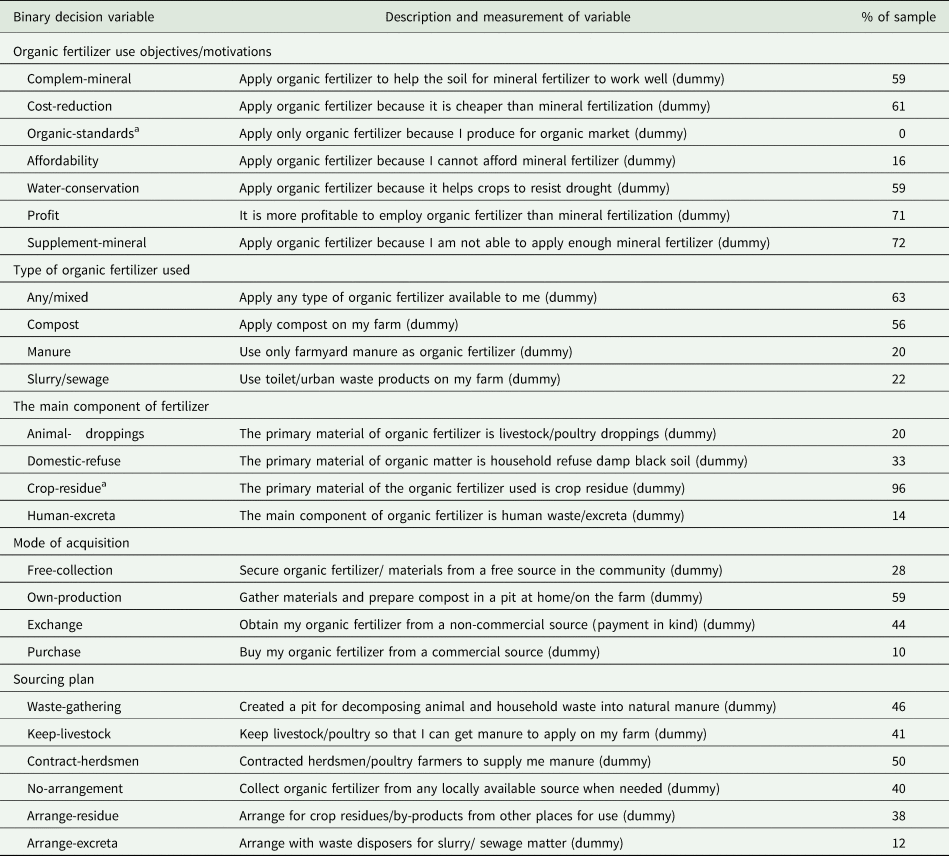
a These are variables with almost constant values observed among the surveyed farmers. Thus, they were not included in the analysis.
It is well established in the literature (e.g., Mowo et al., Reference Mowo, Bert, Oene, Laura, German, Mrema and Riziki2006; Kamanga et al., Reference Kamanga, Waddington, Robertson and Giller2009; Shiferaw et al., Reference Shiferaw, Okello and Ratna Reddy2009; Mulwa et al., Reference Mulwa, Paswel, Dil and Menale2017) that farmers' background factors influence their OFM decisions. These factors include inter alia human capital status, physical resource endowment characteristics, farming environment (soil and biodiversity) and the external environment (institutional and social capital, political, technological and economic context). These factors shape their farm objectives, perceptions about cost/benefits associated with various OFM decisions, and set constraints within which the decisions are made.
Assuming, therefore, that a farmer chooses to adopt an OFM approach that maximizes the expected benefit from organic fertilizer use under the constraints set by his/her background factors, a function that characterizes the relationship between the adopted approach and the farmer's background factors can be derived to explain the uptake of the latent approaches (Abdulai and Huffman, Reference Abdulai and Huffman2014; Abdulai, Reference Abdulai2016; Tambo and Wünscher, Reference Tambo and Wünscher2017; Danquah et al., Reference Danquah, Twumasi and Asare2019). Following McBride and Johnson (Reference McBride and Johnson2006), we assumed that the latent OFM approaches are characterized by a set of observed farmer characteristics and farming context variables (see Table 2).
Farmer/plot variables used in SUR characterization model
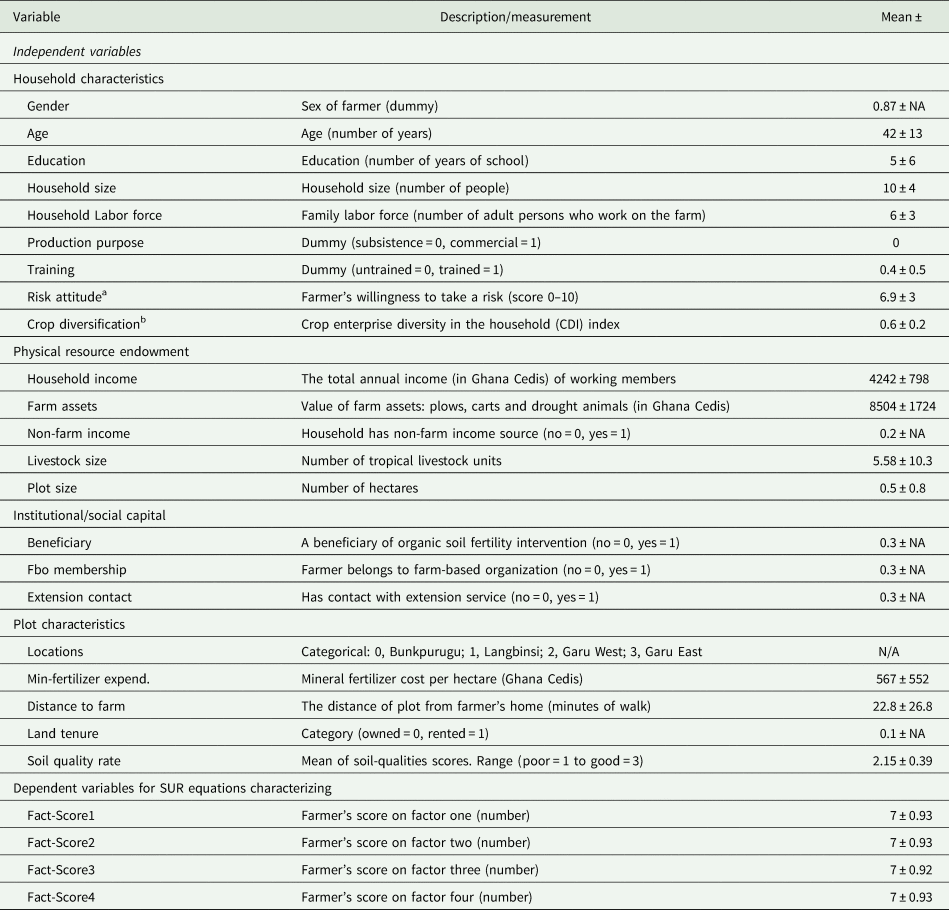
Factor scores of farmers on approaches were obtained by Stata's post-FA command ‘Score.’
a As in Xiaohao et al. (Reference Xiaohao, Hartog and Sun2010) and Dohmen et al. (Reference Dohmen, Huffman, Schupp, Falk, Sunde and Wagner2011), risk willingness scores were obtained by asking farmers to grade themselves on an eleven-point scale of their readiness to take a risk in general. To validate the scores, farmers were presented with a hypothetical lottery case to make choices, during which they could attempt to play more than once. Options with higher levels of pay-off are associated with fewer numbers of trials possible. Choosing an option with more rounds of trials implies the avoidance of risky situations.
b We estimated crop diversification as an index by subtracting the Herfindahl index (HI) from one (1 − HI), where HI was calculated as follows: ${\rm HI} = \sum\nolimits_{i = 1}^n {s_i^2 }$ , where S i is the proportion of ith crop, given as $S_i = \lpar A_i/\mathop \sum \nolimits_{i = 1}^n A_i\rpar$
 and, Ai = area under ith crop, $\sum\nolimits_{i = 1}^n {A_i = {\rm Total}\,{\rm cropped}\,{\rm area}}$
 , and i = 1, 2, 3, 4,…, n, the number of crops considered. In this study, we used eight crops common in the study areas to calculate the index. The ranges from 0 (specialization) to 1 (complete diversification). Any value above zero signifies diversification. Precisely, we estimated the index.
Data and description of variables
This study used an observational data set of the 2017/18 crop season, obtained from a multistage random sample of 250 smallholder cereal farmers in northeastern Ghana. The farmers provided the data in response to a set of structured questions during computer-assisted personal interviews (CAPI) with enumerators. The questionnaire solicited two main categories of variables. The first category is the list of organic fertilizer decision variables in Table 1 (referred to as decisions/actions). Many of these decisions have been promoted in the study area by policy agents such as NRGP, AGRA and PAS (Martey, Reference Martey2018). Based on a literature review (e.g., Lagerkvist et al., Reference Lagerkvist, Shikuku, Okello, Karanja and Ackello-Ogutu2015), the questionnaire captured 35 organic fertilizer decisions, but only 25 of these decisions, listed in Table 1, were observed during the face-to-face CAPI with sampled farmers. These are grouped under the five phases (stages) of the decision-cycle in Figure 1.
Variables include organic fertilizer use objectives at phase 1, organic fertilizer types chosen at phase 2 and the main material component used, also at phase 2. Other decision variables indicate the sourcing plan/arrangement(s) a farmer adopts at phase 3 and the alternative model(s) of acquisition used at phase 4. Decisions taken at the monitoring stage (phase 5) have no observable outcomes; hence they are not empirically represented by any observed variable. They, however, directly affect phase 1 decision outcomes.
The second category of variables solicited by the study questionnaire includes farmer background factors, which we shall subsequently refer to as farmer/plot characteristics. These are classified further under four latent background variables. The first is household characteristics, which include gender, age, education of the farmer, household size, family labor force and production purpose. Other household characteristics are participation in organic soil management (training), farmer's risk attitude and diversity of crops on the farm (CDI) (Mulwa et al., Reference Mulwa, Paswel, Dil and Menale2017). We specify these variables to capture the effect of human capital on farmers' tendency to adopt the various OFM approaches (Shiferaw et al., Reference Shiferaw, Okello and Ratna Reddy2009). The second class of background variables comprises the total value of farm assets, non-farm income work, livestock size and plot size measured in hectares. These together represent a farmer's physical resource endowment. The third class of variables captures social capital and information access. These include whether a farmer has benefited from some soil fertility management policy, whether a farmer belongs to a farmer-based organization and whether he/she has contact with extension services. Finally, we also included farm-specific and geographical location variables, which include the cost of mineral fertilizer used per hectare, the distance (walking minutes) to cereal plot from a farmer's home, tenure of farmland, mean score of soil-quality and geographical location (zone) of a farmer/farm. Table 2 provides the list, description and summary statistics of all farmer/plot variables used in this study.
We used the observed OFM decision data for EFA to identify common OFM approaches whereas using the farmer/plot characteristic variables as independent variables in the second-step characterization regressions to identify farmer characteristics that explain the uptake of each of the OFM approaches. We used post-FA factor scores of farmers to represent the OFM approaches as dependent variables in the characterization regressions. In the next section, we present the empirical models and procedure for the two-step multivariate analysis (i.e., EFA and the characterization regressions).
Empirical EFA model and procedure
Assuming that some underlying but unknown number of constructs (latent factors) influence patterns of decisions and actions farmers take to secure organic fertilizer for their plots, EFA can be applied to the data set of observed farmer decisions to identify the latent factors, here referred to as OFM approaches (O'Rourke and Hatcher, Reference O'Rourke and Hatcher2013). The EFA model expresses each OFM decision variable as a linear combination of the underlying OFM approaches to be identified. With J decision variables, J multivariate regressions on an unknown set of management approaches as covariates are specified as (O'Rourke and Hatcher, Reference O'Rourke and Hatcher2013):

where V is an observed OFM decision variable with j = 1, …, J, and F = 1,…, k are the latent factors (underlying OFM approaches) influencing the variables V = 1, …, j, β is a matrix of linear coefficients, known as estimated factor loading of factors 1, …, k on V = 1, …, j, and μ = 1, …, j is a vector of residuals know as unique factors, analogous to regression error terms (Timm, Reference Timm2002; McBride and Johnson, Reference McBride and Johnson2006; O'Rourke and Hatcher, Reference O'Rourke and Hatcher2013).
If the data are normally distributed, the factors are best extracted (i.e., the system of equations is estimated) by maximum likelihood. However, we could not assume a multivariate normal distribution of the data because all variables included in the analysis are binary. We thus applied principal axis factoring (PAF) to extract the factors—a method that does not require normally distributed data. The number of factors obtained from the initial extraction equals the number of OFM approaches. However, only a few of these could be meaningfully interpreted and met other criteria for inclusion in the final extraction (McBride and Johnson, Reference McBride and Johnson2006; O'Rourke and Hatcher, Reference O'Rourke and Hatcher2013; Osborne, Reference Osborne2015). We applied the four criteria in selecting the factors recommended by Beavers et al. (Reference Beavers, Lounsbury, Richards, Huck, Skolits and Esquivel2013) and O'Rourke and Hatcher (Reference O'Rourke and Hatcher2013): (1) Kaiser's (eigenvalue ⩾1) rule, (2) the graphical scree-test, (3) the proportion of total variance explained by a factor and (4) the interpretability (meaningfulness) of factor rules.
The first four of the initial factors met at least three of the criteria and were retained. As recommended for analyses involving human behavior (Osborne, Reference Osborne2015), we expected that some form of correlation exists between potential OFM approaches (the factors). Hence, we rotated the factors by the oblique Promax algorithm, which captures such potential correlation, to arrive at a simple structure. The simple structure, in this case, had each factor loading significantly on only several (3–5) decision/action variables. Following McBride and Johnson (Reference McBride and Johnson2006) and O'Rourke and Hatcher (Reference O'Rourke and Hatcher2013), we considered factor loadings of ⩾0.4 significant for interpreting the results, even though a factor loading of 0.3, under the ideal condition that the factor explains about 50% of the variables' variance, has been suggested (Beavers et al., Reference Beavers, Lounsbury, Richards, Huck, Skolits and Esquivel2013). We labeled each factor (OFM approach) by the description of the OFM decision on which the factor loaded most significantly and described it using all decisions on which the factor loaded.
Characterization using seemingly unrelated regression (SUR) analysis
After EFA identified the OFM approaches, the next objective was to characterize the approaches by farmer/plot characteristics that explain their adoption. Assuming farmers' tendency to adopt a given OFM approach is driven by their background variables (Table 2), we expressed each OFM approach as a function of observed farmer/plot variables to identify characteristics that empirically affect adoption. In this case, the OFM approaches, as dependent variables, are not observed but can be represented by their factor scores. We therefore evaluated each farmer's score on each of the four factors (OFM approaches) following the EFA. These are used as dependent variables, representing the approaches in the characterization regression model.
However, we had to be sure that indeterminacy in the factor-score variables is low enough to allow estimation of empirically reliable characterization equations for the OFM approaches. We thus assessed the degree of factor score determinacy by calculating squared correlation coefficients (ρ 2) of factor score estimates of split samples (Green, Reference Green1976) obtained by regression method and by Barttlet's (Reference Bartlett1937) method. In each case, the ρ 2 obtained was higher than 0.75, indicating that factor score indeterminacy is low (<0.25). Since the Barttlet factor score estimates are most likely the true factor scores (DiStefano et al., Reference DiStefano, Min and Diana2009) and produce unbiased regression parameters (Devlieger et al., Reference Devlieger, Mayer and Rosseel2016), we used them as the dependent variables for the characterization analysis. Furthermore, since factor-score estimates are equivalent to z-scores, they should be regressed on z-score standardized values of the independent variables; otherwise, the resultant model estimates cannot be interpreted (Zuccaro, Reference Zuccaro2010). Accordingly, we z-standardized the socio-economic variables in Table 2 before using them as regressors. The characterization model involves K approaches, each to be regressed on (i.e., characterized by) the same set of x = 1, 2, …., m farmer/plot characteristic variables of N = i, …, n observations, forming K = 1, …, k simultaneous equation system:

where Ski is the farmer ith score on factor (OFM approach) k, which is to be explained by the kth equation, ɛki is a random error term associated with the ith farmer in the kth equation, whereas α 1 to αm are vectors of coefficients (effects) of farm/farmer characteristics on farmers' tendency to adopt the kth OFM approach.
Equation (2) shows that for every ith farmer (observation), there are ɛ 1i to ɛki random errors (i.e., one for each kth equation) to be estimated. Each of these equations can be efficiently and consistently estimated by ordinary least squares (OLS) (e.g., Jha et al., Reference Jha, Gupta and Pandey2000; Pandey, Reference Pandey2010) in a situation where the factor scores (i.e., Sks) are obtained from orthogonal factors (Osborne, Reference Osborne2015) such that they are uncorrelated, having a mean of E[ɛk|x 1, …, x m] = 0 and a variance $E [ \varepsilon _k{\varepsilon }^{\prime}_k\vert x_1\comma \;\ldots \comma \;x_m] = \sigma _{kk}I_N$ . These conditions imply normal distribution and homoskedasticity of error terms. For oblique factors, as in this case, however, some of the factors (OFM approaches) may not be entirely distinct, i.e., correlated with each other (Gorsuch, Reference Gorsuch1983). Once factor scores are correlated, the error terms associated with farmer i across equations will also correlate with each other. Therefore, the use of oblique factor scores as dependent variables of equation (2) implies correlated cross-equation ɛks of observations. Hence, estimation by OLS will give consistent but not efficient αs (Greene, Reference Greene2018). To obtain consistent and efficient estimates of αs, an econometric setup that captures and isolates the error correlation terms must be employed. We adopted the SUR framework, which, by means of the generalized least squares (GLS) estimation, isolates between-equation error correlation coefficients to obtain efficient parameters. In the SUR setup, we stacked the observations data sets and obtained a compactly specified model as (Rao et al., Reference Rao, Toutenburg and Shalabh2008; Greene, Reference Greene2018):

where XK is a matrix of observed farmer characteristics, αK is a vector of coefficients associated with equation k to be estimated, ${\bi \varepsilon } = \left[{\matrix{ {{{\varepsilon }^{\prime}}_1\comma \;} & \ldots & {{{\varepsilon }^{\prime}}_K} \cr } } \right]^{\prime}$ is a KN × 1 vector of measurement errors with conditional expectation, E[ɛ| X1, …., XK] = 0. The errors are uncorrelated across observations but are correlated across equations, such that E[ɛkiɛkn|X1, …, X K]) = σ in, if i = n, and 0 if i ≠ n. The entire model error matrix is given as (Rao et al., Reference Rao, Toutenburg and Shalabh2008; Greene, Reference Greene2018):

where $\sum = \left[{\matrix{ {\sigma_{11}} & \ldots & {\sigma_{1K}} \cr \vdots & \ddots & \vdots \cr {\sigma_{K1}} & \ldots & {\sigma_{KK}} \cr } } \right]$ is an M × M error covariance matrix for the ith observation, ⊗ is the Kronecker product operator and I is a K × K identity matrix.
After estimation, if empirical σ in equals zero for i ≠ n, then the equations are truly unrelated, and there is no efficiency gain in αk by the use of a GLS estimator over OLS. On the other hand, if for any pair of the equations (i.e., OFM approaches), σ in is significantly different from zero, the approaches are related through some common OFM decisions/actions. Previous studies (e.g., McBride and Johnson, Reference McBride and Johnson2006) have used the SUR framework in similar circumstances, but only for testing differences in coefficients of paired regressions. Even though we found very weak correlations between the factors, since we assumed correlated factors (OFM approaches) in EFA, we applied the SUR estimator mainly to obtain efficient estimates by correcting any bias arising from such correlations.
Results and discussion
Identification of OFM approaches
We extracted initial factors by PAF after ascertaining that all variables had Cronbach's α ⩾ 0.85, the test of sphericity was significant at 1%, and Kaiser–Meyer–Olkin measure of sampling adequacy is about 0.83. An assessment of the results in Table 3 using the eigenvalue ⩾1 (mineigen) criterion, scree test and supported by the interpretability criterion, revealed that four latent factors together explain the variation in organic fertilizer decisions/actions data. The first factor accounted for about 37% of the total variance, the second for about 29%, the third for roughly 17% and the fourth for approximately 8%. Together, they explained about 92% of the total variance in the data. The fifth factor, although explaining up to 5% of the total variance, had an eigenvalue of less than 1, and only two-variable significant loadings with no meaningful interpretation.
Eigenvalues of initial factors

LR test: independent vs saturated: (253) = 2605.52, Prob ≥0.000.
Bold factors & values are the retained factors and their indexes respectively.
The results in Table 4 show that, except for two unique variables (Domestic-Refuse and Cost Reduction) on which no factor loaded and one complex (Exchange) variable on which two factors loaded, each variable is loaded on highly by only one factor, with the remaining factors being insignificant. Similarly, each factor loaded highly on a few (5–6) variables whereas loading insignificantly on many remaining variables. Following the convention of labeling factors by the most significant variable the factor loads on, we name and describe the factors (i.e., the identified OFM approaches) as follows:
(1) OFM approach 1 (Augmentary Compost Use Approach): Table 4 shows that the first factor loads on six of the OFM variables: Prepare compost in a pit. Apply compost on my farm. Create a pit for decomposing animal and household waste into natural manure. Apply organic because it supports the soil for mineral fertilizer to work well. Apply organic fertilizer because I am not able to apply enough mineral fertilizer. Arrange for crop residues from other places after harvesting, which add to mine for use. These actions/decisions together describe planned preparation of compost under controlled decomposition of biomass in constructed pits. The most critical variable (lead determinant) on this factor is Complement-mineral—Apply organic fertilizer to help the soil for mineral fertilizer to work well. It means that farmers who adopt this approach mostly aim at strengthening soil physical properties to enhance the uptake of nutrients from mineral fertilizers. They are also influenced by the need to supplement mineral fertilizer. Thus, the motivation for using organic fertilizer here is both to complement and supplement mineral fertilizer use. Farmers in this category seem to know that the quantity of mineral fertilizer they apply is insufficient; hence, they add compost as a supplement as well as to support soil health.
(2) OFM approach 2 (Urban Human Waste Organic Fertilizer Approach): Five response variables of farmers' decisions/actions loaded on the next (2nd) factor. These are: Use toilet/urban waste products on my farm. Buy my organic fertilizer from a commercial source. The main component of organic fertilizer is human waste/excreta. Buy my organic fertilizer from a commercial source. Apply organic fertilizer because it helps crops to resist drought. Arrange with waste disposers to supply me domestic/human waste matter. The lead decision variable here is Human-Excreta—Use toilet/urban waste products on my farm, meaning that this OFM approach is best identified by the decision to use toilet/sewage matter obtained from urban waste disposal agents; hence, the name ‘Urban Human Waste Organic Fertilizer Approach.’ The decision/action variables on which this factor (approach) loaded together describe efforts to fertilize cereal plots with urban/human waste. Farmers in this category arrange with dump truck drivers to dispose of the contents of their trucks on their cereal plot at a fee. These farmers seem to know or have had the experience that organic fertilizer enhances the soil's water-holding capacity and thus helps crops to resist drought. Thus, their primary objective of applying organic fertilizer, as indicated by the organic fertilizer use objective named water conservation, is to adapt their crop to environmental shocks, particularly droughts.
(3) OFM approach 3 (Integrated Livestock Manure Approach): Five decision variables characterize this approach: Use only farmyard manure as organic fertilizer. The primary material of my organic fertilizer is livestock/poultry droppings. Obtain my organic fertilizer/materials from non-commercial sources by payment in kind. Keep livestock/poultry so that I can get manure to apply on my farm. Contracted herdsmen/poultry farmers to supply me manure. Together, the variables describe farmers' efforts to maintain regular supply and use of farmyard manure on their cereal plots either by integrating livestock enterprise or establishing supply agreement with reliable manure sources. Being dominated by a sourcing plan decision variable called Keep-Livestock—Keep livestock/poultry so that I can get manure to apply on my farm, we labeled the factor, ‘Integrated Livestock Manure Approach.’ Farmers in this category keep livestock (mostly small ruminants) as a source of farmyard manure besides income generation, whereas those without livestock establish some relationship with livestock owners who can supply them manure. However, no organic fertilizer use objective is uniquely associated with this management approach.
(4) OFM approach 4 (Mineral Fertilizer Cost Constraint Organic Approach): This OFM approach loaded on six variables, including Profit—It is more profitable to employ organic soil amendment than mineral fertilization—on which the approach loaded negatively. The other variables are: Apply any type of organic fertilizer available to me. Secure organic fertilizer/materials from a free source in the community. Obtain organic fertilizer/materials from a non-commercial source (payment in kind). Apply organic fertilizer because I cannot afford mineral fertilizer. Collect organic fertilizer from any locally available source when needed. These variables are ad-hoc decisions/actions taken by farmers to use organic fertilizer even though they believe that organic fertilizer is less profitable than mineral fertilizer. Farmers adopt this approach mainly because they cannot buy mineral fertilizer; thus, we labeled this approach, ‘Mineral Fertilizer Cost Constraint Organic Approach.’ The approach is naturally untenable since it is characterized by unplanned use of the input, relying on free sources because the farmer cannot afford mineral fertilizer. For a comparison of how popular these OFM approaches are among farmers, we refer the reader to Table 6.
The table shows the relative percentage spatial distribution of observed practices associated with the four OFM approaches.
Rotated factor pattern of loadings on variables of OFM approaches

Note: variables: organic-standards and crop-residue were not used in the FA because their observed response was zero (constant) for all respondents. Correlation between factors: 1, 2 = 0.38, 1, 3 = 0.23, 1, 4 = −0.01, 2, 3 = −0.17, 2, 4 = 0.0 and 3, 4 = 0.23.
LR test: independent vs saturated by pf factoring: (253) = 2393.21, Prob ≥0.0000.
Bold values in highlight significant loadings of factors on the various practices (Variables).
Characteristics of OFM approaches
We present the results of the characterization regressions in Table 5. The table shows the socio-economic variables that affect the belonging of farmers to one of the four OFM approaches (factors). In all, the variables explained 25–58% of the variance in factor scores of the OFM approaches. The urban human waste organic fertilizer approach (approach 2) is least explained (R 2 = 0.25), whereas the fertilizer cost constraint organic approach (approach 4) is most explained (R 2 = 0.58) by the socio-economic characteristics. Coefficients of the equations (factors 1–4) are jointly significant at 1, 1, 5 and 1%, respectively. Equation (1) has a weak but positive correlation (0.3) with equations (2) and (3) (see correlation matrix at the bottom of Table 5). Equations (2) and (3) are also weakly but negatively correlated (−0.3), whereas equation (4) is uncorrelated with any other. A positive correlation means some OFM decisions/actions are common to the approaches such that the adoption of one implies an increased tendency toward the other. A negative correlation indicates opposing OFM decisions/actions; thus, a high tendency to adopt one approach means less to the other.
SUR model estimates of characteristics of OFM approaches

Note: Age squared is a quadratic term for age. Observed production purpose was a (0) constant whereas household income, Fbo membership and extension contact were found to correlate strongly (0.95, 0.98) with farm assets and beneficiary, respectively, and were consequently dropped from the analysis. Zone 0 (Bunkpurugu) is the reference location (location without technology center).
B-P test of independence: (6) = 63.147, Prob ≥0.0000. Note: Standard errors are in parentheses. ***P < 0.01, **P < 0.05, *P < 0.1. F-statistic tested the joint statistical significance of coefficients in each equation on both OLS and SUR estimates. Differences between coefficients of paired SUR equations were also tested using the Chows test executed by the suest command.
At least two human capital (household characteristic) variables are statistically significant in each of the estimated factor score regressions. The gender of the household head significantly affects two factors—the urban human waste organic fertilizer (approach 2) and the integrated livestock manure (approach 3) approaches, but with different signs of the effect. Though not statistically significant, the same opposite signs are observed between the augmentary compost use (approach 1) and the mineral fertilizer cost constraint (approach 4) approaches. Although being a male household head is positively related to approach 2 scores, it is negatively associated with approach 3 scores. This means male-headed households are more likely to engage in practices related to the urban human waste organic fertilizer approach than female-headed households, whereas the reverse is valid for the integrated livestock manure approach. It makes sense because, in a male-dominated society, men always are at the forefront when it comes to households' interactions with external parties (Sexsmith et al., Reference Sexsmith, Smaller and Speller2017). By contrast, women generally lack the required social leverage to arrange and source waste from disposal companies. That means small livestock operations, which prevail in the study area, are mostly run by women, even in male-headed households (Kahan, Reference Kahan2013). Hence, female farmers are better placed to exploit livestock manure than urban waste for organic soil amendment.
Except for age being significant at 10% and negatively related to only approach 4, education and household size have no significant relationship in any of the regressions. Family labor force is statistically significant at 1% and positively related only to approach 1. It means that households with more farm workforce are more likely to adopt organic fertilizer practices associated with the augmentary compost use approach than those with less workforce.
Participation in OFM-related training is statistically significant and positively related to all OFM approaches. The magnitude of the relationship, however, is greatest in the augmentary compost use approach. Being significant in all the regressions means that training of farmers on OFM is a critical step in promoting organic fertilizer use. The proportion of sample farmers who have had some training related to OFM is least in the study zone without farm technology center (zone 0). The presence of technology centers generally enhances farmers' access to both formal and informal training. Nevertheless, an individual's willingness to innovate and attitude toward risk determine whether he/she makes use of available opportunities. Farmers' attitude toward risk is statistically significant at 1% and positively affects OFM approach 1, but it is not significant in the remaining three regressions. This means that farmers who are risk-takers are more likely to adopt the augmentary compost use approach than their more risk-averse colleagues. As noted above, willingness to take risks is closely linked to the desire to innovate, which in turn influences the self-selection of farmers who exploit training opportunities and learn to adopt related OFM practices.
The household crop enterprise diversity index is significant but negatively associated with approaches 2 and 4, both at 10%. It implies that farm households that cultivate many crops are less likely to engage in practices under the urban human waste organic fertilizer and the mineral fertilizer cost constraint organic approaches compared to those who cultivate few crops.
The value of farm assets, though with positive coefficient in all factor regressions, is statistically significant (at 5%) only in approach 1 regression. This result affirms previous study findings (e.g., Al-hassan, Reference Al-Hassan2009; Kombiok et al., Reference Kombiok, Buah and Sogbedji2012; Bellwood-Howard, Reference Bellwood-Howard2013) that capital endowment, especially ownership of farm equipment such as donkey or bullock carts, bi/tricycles, soil rippers, wheelbarrows and shovels/spades increases the ability of farmers to adopt compost use. Owning donkeys and their carts, in particular, give farmers tremendous leverage over sourcing and transporting materials for compost preparation (Bellwood-Howard, Reference Bellwood-Howard2013) and might trigger interest in learning how to prepare the input. Off-farm work participation and farm size, as endowment variables, are not statistically significant in any of the regressions. Livestock size is statistically significant, with a positive effect in approach 3 regression only. Thus, farmers with higher livestock numbers will tend to engage in organic fertilizer practices related to the integrated livestock manure approach than those with fewer animals. Participation in soil management policy has positive, but no statistically significant relationship with any of the management approaches.
Some of the plot characteristics (mineral fertilizer, farm distance and zones) are statistically significant determinants of factor scores in some regressions. The monetary value of mineral fertilizer applied per hectare has a statistically significant (at 1%) negative influence in approach 3 and 4 regressions, but no significant effect on approach 1 and 2 scores. The implication is that farmers who can apply significant amounts of mineral fertilizer on their cereal plots are less likely to engage in practices under both the integrated livestock manure approach and the mineral fertilizer cost constraint organic approach. The distance of a plot from a farmer's home is statistically significant at 10% only in approach 4 regression with a positive sign. Contrary to the assertion that organic fertilizer is usually applied on plots closer to farmers' homes (e.g., Quansah et al., Reference Quansah, Drechsel, Yirenkyi and Asante-Mensah2001; Giller et al., Reference Giller, Tittonell, Rufino, Wijk, Zingore, Mapfumo, Adjei-Nsiah, Herrero, Chikowo, Corbeels, Rowe, Baijukya, Mwijage, Smith, Yeboah, van der Burg, Sanogo, Misiko and Vanlauwe2011), our result indicates that farmers may send organic fertilizer to distant plots for cereal crop production, under compound land and mineral fertilizer constraints. More precisely, cereal plots located far away from a farmer's home are likely to receive organic fertilizer if lack of access to mineral fertilizer compels the farmer to use only organic fertilizer for subsistence production. It is more so in situations where the farmers lack access to home plots.
The geographical location of a farm has a strong relationship with the choice of OFM approach. Relative to zone 0 (control zone with no organic fertilizer technology center), a farm located within any of the other zones has a highly significant (at 1%) and positive effect on approach 1 regression. By the magnitude of estimated coefficients, farmers located in zone 1, followed by those in zones 2 and 3, respectively, have the highest tendency to adopt the augmentary compost use approach (approach 1). Approaches 2 and 3 are positively associated (at 5%) with Zones 2 and 3, respectively, whereas no zone is statistically more related to the mineral fertilizer cost constraint organic approach than zone 0. It means that except for the augmentary compost use approach, each OFM approach identifies with a particular zone, making the location of a farmer a better determinant of the choice of OFM approach than any other farmer characteristic variable. Thus, based on location (i.e., zones 1–4), we showed the prevailing tendency of farmers to harness the various OFM approaches by computing the percentage of farmers of each zone who used practices found under each approach. Table 6 shows the relative percentage distribution, by location, of farmers using practices classified under the various OFM approaches. This information can help target organic fertilizer use policies to particular zones.
Percentage spatial distribution of OFM practices by farm location (zone)
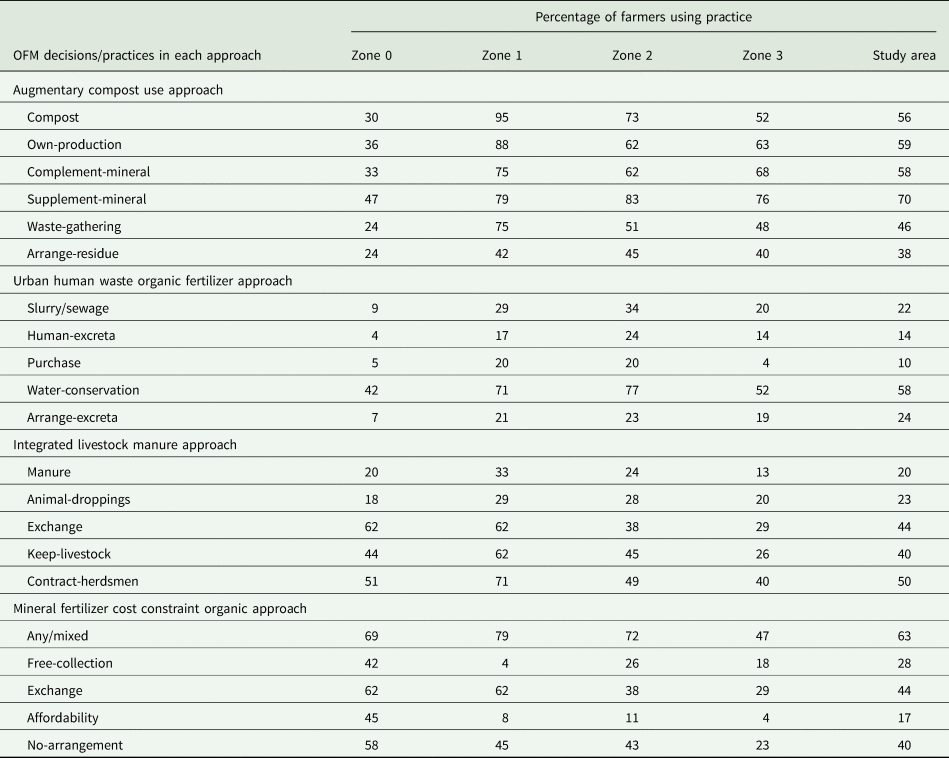
Note: Numbers under zones are percentages of respective zonal sub-samples.
The numbers in the table indicate that practices of OFM approach 1 dominate in all zones except in zone 0. Next to OFM approach 1 practices, the use of OFM approach 2 practices dominate among farmers in zone 2. Similarly, after OFM approach 1, farmers in zone 1 adopt more of the practices in OFM approach 3. By contrast, unsustainable practices of OFM approach 4 are the most dominant among zone 0 farmers.
Conclusion and recommendations
The main objectives of this typological study were to identify OFM approaches adopted by smallholder farmers in northeastern Ghana and to characterize these approaches by farmer/farming factors that favor their adoption. We used EFA to identify the approaches, after which we characterized the approaches using SUR analysis. EFA identified and named four approaches: (1) augmentary compost use approach, (2) urban human waste organic fertilizer approach, (3) integrated livestock manure approach and (4) mineral fertilizer cost constraint organic approach. Although a set of strategic OFM decisions/actions represents each of management approaches 1–3, mineral fertilizer cost constraint organic approach 4 is identified by ad-hoc decisions/actions regarding organic fertilizer use.
The characterization regressions showed that household labor force, risk attitude and the total value of farm assets favor the adoption of the augmentary compost use approach. All geographical locations covered by the study, except for the Bunkpurugu zone, also favor this approach. The urban human waste organic fertilizer approach is a male-farmer driven and tends to be adopted by farmers specializing in cereal crop production. OFM decisions/actions representing this approach are more likely to be adopted in areas close to city populations like the Garu West. The integrated livestock manure approach is a livestock enterprise-driven approach and is more favorable to female farmers than male farmers. It is negatively related to the value of mineral fertilizer applied per hectare and has a higher prevalence among farmers located in Langbensi zone than those in other zones. Compared to the other approaches, mineral fertilizer cost constraint organic approach 4 appears less strategic: decisions/actions taken by farmers are unplanned and are driven by an inability to access mineral fertilizer. It is widely used in areas where farmers have the least access to training on organic fertilizer use. Contrary to common findings in organic fertilizer literature, this approach is adopted for farm plots further away from farmers' homes.
Although the first three approaches are worthy of policy support, we note that, with the exception of the augmentary compost use approach, which is dominant in all zones, the potentials of the approaches to increase organic fertilizer adoption among farmers differ from one location to another.
Though the augmentary compost use approach has been widely adopted by the majority of farmers in all zones except for zone 0, we recommend that policies focus on supporting farmers to access labor-saving farm equipment for biomass collection, transportation and pit construction to reduce labor requirement for compost preparation. Besides the augmentary compost use approach, policy planners should consider supporting the urban human waste organic fertilizer approach in the zones within the Sudan Savannah are and should target male-headed households with social network capacity programs to link them to waste disposal agencies.
Policies seeking to promote organic fertilizer use through the integrated livestock manure approach should consider supporting farmers, especially females, to increase their livestock (poultry and small ruminants) herds, and to develop skills and techniques for enhanced collection of manure and other by-products. For such interventions, the farmers should also be educated on the complementary roles organic and mineral fertilizers play in soil health so that they do not substitute one for the other. Finally, policy designers need to note that training of farmers on OFM practices enhances uptake of organic fertilizer practices under all four OFM approaches. Hence, training of farmers should be a part of any organic fertilizer promotion policy. It is more critical for farmers at places where there is no farm-technology center, and farmers do not have access to any capacity building program.
Finally, a caveat of this study is that it could not identify any organic fertilizer use motivations associated with the integrated livestock manure approach. This is probably due to the exclusion of some relevant motives known to only farmers from the objective space presented to the respondents. We suggest widening the space of objectives in future research to include motives such as substituting mineral fertilizer with organic as well as food safety motives. Another way to deepen the research on organic fertilizer use practices in subsequent studies is to assess farmers' behavioral disposition to engage in specific practices characterizing the various management approaches.
Acknowledgements
This research is part of the first author's doctoral research work at the Christian-Albrecht University under the Ghanaian-German Postgraduate Training Scholarship Program by Deutscher Akademischer Austauschdienst (DAAD). The authors are therefore grateful to DAAD for the scholarship, which enabled the author to study and conduct the research.
Financial support
This research did not receive any specific grant from funding agencies in public, commercial or not-for-profit sectors.


 Open access

