


Introduction
Trees are of high ecological, socio-economic and cultural importance. As the principal component of forest ecosystems they support at least half of the Earth's terrestrial biodiversity (Millennium Ecosystem Assessment, 2005), providing habitat for 80% of amphibian, 75% of bird and 68% of mammal species (Vié et al., Reference Vié, Hilton-Taylor and Stuart2009). Tree species richness is a major driver of richness in other species groups (Novotny et al., Reference Novotny, Drozd, Miller, Kulfan, Janda, Basset and Weiblen2006). Forest ecosystems play an important role in the Earth's biogeochemical processes, influencing hydrological, nutrient and carbon cycles as well as global climate (Millennium Ecosystem Assessment, 2005). Forests contain c. 50% of terrestrial carbon stocks (Millennium Ecosystem Assessment, 2005; FAO, 2010) and are therefore important for mitigation of climate change. Trees provide a wide range of other benefits to people, including production of timber, fuelwood and fibre, maintenance of water yields and quality, flood protection, and prevention of soil erosion, as well as being of cultural and spiritual value (Millennium Ecosystem Assessment, 2005; UNEP, 2009). The ecosystem services provided by forests have an estimated annual value of USD 4.7 trillion, or 38% of the terrestrial total (Costanza et al., Reference Costanza, d'Arge, de Groot, Farber, Grasso and Hannon1997). Circa 1.6 billion people depend to some degree on trees for their livelihoods (World Bank, 2004). The total contribution of forest industries to the global economy is c. USD 468 billion annually, with products valued at c. USD 122 billion harvested from forests each year (FAO, 2011).
The widespread loss and degradation of native forests is recognized as an environmental crisis. During 2000–2012 global forest area decreased by c. 2.3 million km2 (Hansen et al., Reference Hansen, Potapov, Moore, Hancher, Turubanova and Tyukavina2013). During 2000–2010 the area of undisturbed primary forest declined by an estimated 4.2 million ha (0.4%) per year, largely because of logging and other forms of human disturbance (FAO, 2010). The conversion and degradation of forest ecosystems are major causes of biodiversity loss (Millennium Ecosystem Assessment, 2005; UNEP, 2009; Vié et al., Reference Vié, Hilton-Taylor and Stuart2009). Their impacts on the decline and loss of tree species are largely unknown, however, because the status of tree species has not been comprehensively assessed.
We believe that a complete global assessment of the conservation status of tree species is an urgent priority. Recent analyses of extinction risk in selected animal groups, namely birds, mammals and amphibians, have demonstrated the value of such a comprehensive assessment approach. As a consequence of such efforts, it is now known that 14, 33 and 22% of bird, amphibian and mammal species, respectively, are either threatened with extinction or are extinct (Vié et al., Reference Vié, Hilton-Taylor and Stuart2009). The status of the world's tree species is less well understood. In 1998 an initial assessment involving c. 300 experts was conducted, which evaluated 14,000 taxa, of which 7,886 were found to be globally threatened (Oldfield et al., Reference Oldfield, Lusty and MacKinven1998). As the total number of extant tree species is uncertain, it is difficult to assess the coverage of this assessment with any precision. Based on the estimate of 60,000 tree species provided by Tudge (Reference Tudge2005), some 84% of tree species currently await assessment. As of November 2014 some 9,543 assessments of tree taxa were included in the IUCN Red List database (IUCN, 2014), representing slightly less than half of all plant species listed. Of these, 7,087 submissions were contributed by Oldfield et al. (Reference Oldfield, Lusty and MacKinven1998), which now need to be updated. However, a number of additional assessments have been conducted since 1998, focusing on specific geographical regions or taxonomic groups, which have not yet been added to the IUCN Red List database (Newton & Oldfield, Reference Newton and Oldfield2008).
Implementation of a Global Tree Assessment
Implementation of a comprehensive Global Tree Assessment (Fig. 1) could follow the approaches adopted in recent assessments of vertebrate groups, which have successfully mobilized global data sets and expertise. The Global Amphibian Assessment, for example, involved inputs from > 500 specialists, who evaluated the extinction risk of 5,743 species over a 3-year period (Stuart et al., Reference Stuart, Chanson, Cox, Young, Rodrigues, Fischman and Waller2004). Similarly, the Global Mammal Assessment was undertaken as a collaborative effort of > 1,700 experts in 130 countries, with 5,487 species assessed over 5 years (Schipper et al., Reference Schipper, Chanson, Chiozza, Cox, Hoffmann and Katariya2008). Both of these assessments were undertaken as contributions to the IUCN Red List (IUCN, 2014), which is widely recognized to be the most authoritative global assessment of the conservation status of species (Mace et al., Reference Mace, Collar, Gaston, Hilton-Taylor, Akçakaya and Leader-Williams2008). Red List assessments involve the application of quantitative criteria based on population size, distribution area and rate of decline, to assign species to different categories of relative extinction risk (IUCN, 2001). Information from the Red List has been widely used to inform conservation policies and legislation, as a tool for environmental monitoring and reporting, and to prioritize areas for conservation action (Lamoreux et al., Reference Lamoreux, Akçakaya, Bennun, Collar, Boitani and Brackett2003; Rodrigues et al., Reference Rodrigues, Pilgrim, Lamoreux, Hoffmann and Brooks2006; Mace et al., Reference Mace, Collar, Gaston, Hilton-Taylor, Akçakaya and Leader-Williams2008); it has also been used at the global scale to monitor biodiversity loss (Butchart et al., Reference Butchart, Walpole, Collen, van Strien, Scharlemann and Almond2010). Although the approach can be applied successfully to tree species (Newton & Oldfield, Reference Newton and Oldfield2008), most plant groups are grossly underrepresented in the Red List at present.
Schematic illustration of a four-stage global tree assessment process, which could inform policy implementation at national and international scales. (1) Taxonomic authentication, involving identification of robust nomenclature for the taxa being assessed, through reference to bibliographies, monographs, checklists and taxonomic databases (e.g. The Plant List). (2) Distribution mapping, involving compilation of species distribution data from a range of sources, including databases (e.g. GBIF), national data centres, and networks of forest inventory and field survey plots. (3) Analysis of population trends, including compilation of abundance data from field observations, inventory data and other sources; and their integration with remote sensing data of trends in forest extent and condition, estimates of deforestation rates, etc. This integration could be supported by species distribution modelling approaches, which could be used to identify areas of potential distribution, allowing the impacts of climate change and other threats to be explored. (4) Application of Red List criteria and categories. Typically this would be undertaken by experts familiar with the taxa, supported by available maps, data and models. The engagement of such specialists throughout the process would be key to its success. Formally, responsibility for quality control during the process would lie with IUCN networks, such as the Global Tree Specialist Group of the IUCN Species Survival Commission.
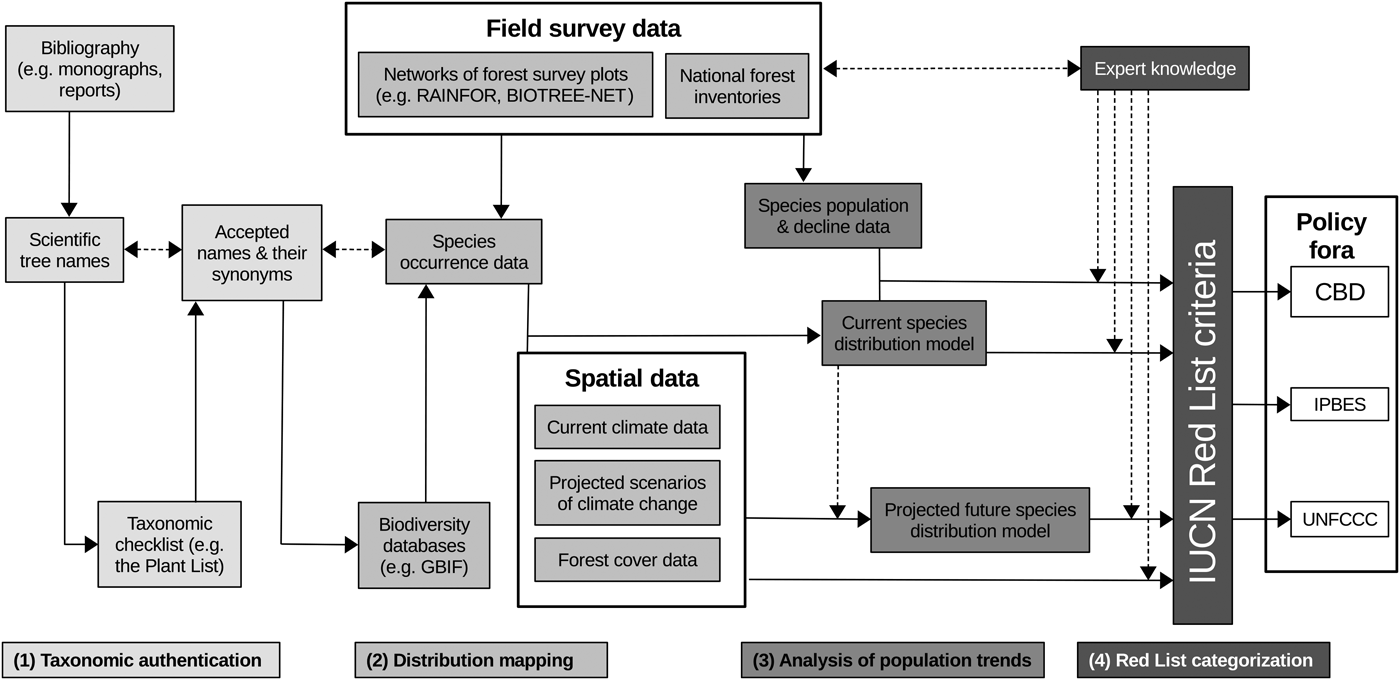
A Global Tree Assessment will represent a more substantial challenge than previous vertebrate assessments, given the much larger number of species involved. The Assessment will undoubtedly require the development of an extensive global collaborative partnership, involving the coordinated effort of many institutions and individuals. However, a number of recent developments have significantly increased the feasibility of undertaking such an assessment. Initiatives such as the Catalogue of Life (2014), The Plant List (2013) and the World Checklist of Selected Plant Families (WCSP, 2015) provide detailed catalogues of plant species, including digital links to regional and national floras and nomenclatural databases. Although these resources are not fully comprehensive and will continue to evolve in the light of ongoing taxonomic revisions, they will be useful in overcoming many problems of taxonomy and synonymy, which have hindered Red List assessments of plant species in the past (Nic Lughadha et al., Reference Nic Lughadha, Baillie, Barthlott, Brummitt, Cheek and Farjon2005). These resources could be used to produce the first list of all tree species, as a first stage of the proposed assessment (Fig. 1).
A second key objective is the production of distribution maps of individual species, as part of the minimum supporting information required for an assessment to be published on the Red List. The Global Biodiversity Information Facility (GBIF, 2015) greatly facilitates production of species distribution maps, through an open access, globally distributed network of interoperable databases containing species location data. While it is recognized that these data are incomplete and spatially biased (Beck et al., Reference Beck, Bőller, Erhardt and Schwanghart2014; Hjarding et al., Reference Hjarding, Tolley and Burgess2014), they can be integrated with other spatial databases, such as Tropicos (Missouri Botanical Garden, 2015), and information derived from expert knowledge. Integration of multiple sources of evidence should strengthen the overall quality of assessments. Such integration could be supported by the recent development of online tools for species mapping, such as the Map of Life initiative (Jetz et al., Reference Jetz, McPherson and Guralnick2011), GeoCAT (Bachman et al., Reference Bachman, Moat, Hill, de la Torre and Scott2011) and the IUCN Red List Threat Mapping Application (CEES, 2012). Other initiatives focus on the use of citizen science to support species mapping, for example iNaturalist and iSPOT. Such uses of Web 2.0 technologies offer new approaches to collecting, mapping and sharing geocoded data (Hudson-Smith et al., Reference Hudson-Smith, Batty, Crooks and Milton2009) and may facilitate a more participatory approach to Red List assessments. Location data can be explored using species distribution modelling approaches to produce distribution maps of large numbers of tree species, which can inform analyses of extinction risk (Feeley & Silman, Reference Feeley and Silman2009; Golicher et al., Reference Golicher, Cayuela and Newton2011). In addition, high-resolution maps of changes in forest extent and condition over time, based on analysis of satellite remote sensing imagery, are increasingly becoming available (Wang et al., Reference Wang, Qi and Cochrane2005; Hansen et al., Reference Hansen, Stehman, Potapov, Loveland, Townshend and DeFries2008, Reference Hansen, Stehman and Potapov2010, Reference Hansen, Potapov, Moore, Hancher, Turubanova and Tyukavina2013; Scholes et al., Reference Scholes, Mace, Turner, Geller, Jürgens and Larigauderie2008). Developments in web technologies now make it possible for remote sensing data to be integrated with species distribution data and displayed as interactive maps accessible via the internet, which can further inform the analysis of range dynamics of tree species. Such integrative approaches can facilitate a more precise evaluation of changes in the distribution and population size of tree species (Buermann et al., Reference Buermann, Saatchi, Smith, Zutta, Chaves, Milá and Graham2008).
At the national scale, some countries with large numbers of tree species have made notable efforts to collect and review relevant data. For example, in 2007 the database compiled by the National Commission of Biodiversity of Mexico (CONABIO) contained 691,181 records of 28,085 species of vascular plants (Soberón et al., Reference Soberón, Jiménez, Golubov and Koleff2007), which are available for Red List assessments. Emerging networks of forest plot data, such as RAINFOR (Malhi et al., Reference Malhi, Phillips, Lloyd, Baker, Wright and Almeida2002) and BIOTREE (Cayuela et al., Reference Cayuela, Gálvez-Bravo, Pérez, de Albuquerque, Golicher and Zahawi2012), and the national forest inventories that have been established by many countries are additional potential sources of information. As an illustration of the value of plot networks, ter Steege et al. (Reference ter Steege, Pitman, Sabatier, Baraloto, Salomão and Guevara2013) recently used data from 1,170 plots distributed across the Amazon basin to produce the first robust estimate of the total number of tree species in the region (c. 16,000). Such data provide a valuable potential resource for conducting conservation assessments of tree species, which has been little used to date.
Although access to species distribution data and forest maps is improving, these alone are not sufficient for conducting Red List assessments, and expert knowledge is therefore likely to remain an important contributor to the process (Nic Lughadha et al., Reference Nic Lughadha, Baillie, Barthlott, Brummitt, Cheek and Farjon2005). International networks of specialists have been established to support assessments of Mexican and Andean cloud forest trees (González-Espinosa et al., Reference González-Espinosa, Meave, Lorea-Hernández, Ibarra-Manríquez and Newton2011; Tejedor Garavito et al., Reference Tejedor Garavito, Álvarez, Arango Caro, Araujo Murakami, Baldeón and Beltran2015), providing a potential model for use in other regions. For many taxa, species distribution data are lacking, and therefore there is a need to strengthen field data collection efforts and local capacity, particularly in developing countries (Pereira & Cooper, Reference Pereira and Cooper2006; Simons, Reference Simons2011). Tools are also available to assist conducting Red List assessments with uncertain data (Newton, Reference Newton2010) but these have not been widely applied to date.
We propose to implement a Global Tree Assessment using a phased approach. A series of targeted assessments would be undertaken, focusing on specific plant families with a high representation of trees, such as Aquifoliaceae, Fabaceae, Fagaceae, Lauraceae, Meliaceae and Myrtaceae (> 20,000 species in total). This would build on assessments of Betulaceae and Ebenaceae that are currently in progress, led by Botanic Gardens Conservation International and Missouri Botanical Garden, respectively. Themed assessments of important groups of species, such as fuelwood species, ecological keystone species and forest dominants, would also be undertaken. Work on assessing timber, medicinal and crop wild relative species has been initiated recently as part of the Plants for People initiative led by IUCN. Assessments would also prioritize species at most risk from climate change, such as montane and island trees (Hawkins et al., Reference Hawkins, Sharrock and Havens2008), and from other threats such as overharvesting. The ultimate objective would be to assess the conservation status of all species, using this phased approach.
It is recognized that implementation of these proposals would represent a significant advance over current assessment efforts. Since 1998 only 2,456 tree species have been added to the Red List database, although many thousands of additional assessments have been made that have not yet been incorporated into the database (Newton & Oldfield, Reference Newton and Oldfield2008; Botanic Gardens Conservation International, unpubl. data). However, to mark the 50th anniversary of the Red List, IUCN recently initiated an accelerated process to increase the number of species assessed, with an aim of reaching 160,000 taxa by 2020 (IUCN, 2015). This requires a significant increase in the number of experts trained to carry out Red List assessments, as well as provision of sufficient resources, for which targeted fundraising is in progress (IUCN, 2015). A Global Tree Assessment could make a substantial contribution to this initiative, if sufficient financial resources were available.
Few data are available on the cost of undertaking Red List assessments. Martinelli & Moraes (Reference Martinelli and Moraes2013) suggested that such costs vary widely (USD 26−440 per taxon) depending on the species involved. IUCN (2015) estimates a cost of USD 250 per taxon, which seems realistic for tree species, based on recent experience (Newton & Oldfield, Reference Newton and Oldfield2008). However, improvements in data availability, digital applications and associated tools, and adoption of the participatory assessment approach outlined here should help make the process more cost efficient. This is illustrated by the example of the South African flora, which was assessed at a cost of USD < 30 per taxon. This was achieved by establishing a centralized team of ecologists to develop Red Lists, collaborating with a wide range of botanical experts, streamlining the assessment process via automation, and establishing an appropriate data management system (Raimondo et al., Reference Raimondo, von Staden and Donaldson2013). This approach facilitated the assessment of 20,456 vascular plants within 5 years, suggesting that substantial progress towards a Global Tree Assessment could be achieved by 2020 using similar methods if sufficient resources were made available.
Outcomes
Key outcomes of the assessment would include improved targeting of conservation resources specifically for tree conservation, improved design of forest conservation, restoration and management programmes, and strengthened capacity for sustainable forest management and land planning. Re-evaluation of tree species will facilitate estimation of trends in extinction risk, for example through calculation of the Red List Index (Butchart et al., Reference Butchart, Walpole, Collen, van Strien, Scharlemann and Almond2010; Kew, 2010), providing timely and useful policy-relevant information on biodiversity trends, and contributing to the ‘Barometer of Life’ proposed by Stuart et al. (Reference Stuart, Wilson, McNeely, Mittermeier and Rodríguez2010).
A global Red List assessment of tree species would support a variety of policy initiatives, including the Convention on Biological Diversity (CBD) and the UN Framework Convention on Climate Change (UNFCCC). The Strategic Plan for Biodiversity agreed at the Tenth Meeting of the Conference of the Parties to the CBD (COP10) in Nagoya, Japan, identified trends in distribution and extinction risk of species as key operational indicators. Target 2 of the Global Strategy for Plant Conservation, a cross-cutting initiative of the CBD, refers to ‘an assessment of the conservation status of all known plant species, as far as possible, to guide conservation action’ by 2020. A Global Tree Assessment would be an important contributor to this target. In addition, it would support implementation of the UN Framework Convention on Climate Change, which aims to tackle greenhouse gas emissions from deforestation and forest degradation through the REDD+ (Reducing Emissions from Deforestation and Forest Degradation) programme. Recognizing the potential for social and environmental risks and benefits from this programme (Miles & Kapos, Reference Miles and Kapos2008; Ghazoul et al., Reference Ghazoul, Butler, Mateo-Vega and Koh2010), the UN has agreed a set of broad safeguards, specifically focusing on the conservation of natural forests and biodiversity. Improved information on the conservation status of tree species would help to focus REDD+ activities and enhance the conservation impacts of these activities.
Red List assessments would also help prioritize tree species for conservation action. The urgency of conducting a Global Tree Assessment is highlighted by current concerns regarding large-scale die-back of trees, in both temperate and tropical forests, resulting from emerging threats such as the rapid spread of pests, disease and drought, and their interactions with global climate change (Breshears et al., Reference Breshears, Cobb, Rich, Price, Allen and Balice2005; Huntingford et al., Reference Huntingford, Fisher, Mercado, Booth, Sitch and Harris2008; Kurz et al., Reference Kurz, Stinson, Rampley, Dymond and Neilson2008; Raffa et al., Reference Raffa, Aukema, Bentz, Carroll, Hicke, Turner and Romme2008; Allen, Reference Allen2009; van Mantgem et al., Reference van Mantgem, Stephenson, Byrne, Daniels, Franklin and Fulé2009). Concerns have also been expressed regarding ‘peak timber’ in the tropics, reflecting widespread overexploitation of timber (Shearman et al., Reference Shearman, Bryan and Laurance2012), and a global decline in large, old trees, which may threaten ecosystem integrity (Lindenmayer et al., Reference Lindenmayer, Laurance and Franklin2012). Such factors, together with the ongoing loss and degradation of forest, can potentially threaten large numbers of tree species. As illustration, of 762 species evaluated in a recent assessment of Mexican cloud forest tree species, > 60% were found to be threatened with extinction (González-Espinosa et al., Reference González-Espinosa, Meave, Lorea-Hernández, Ibarra-Manríquez and Newton2011). This highlights the urgent need to identify threatened tree species worldwide and take immediate steps to prevent their extinction.
Conclusions
We believe that the timing is right for launching a Global Tree Assessment. Achievement of this ambitious goal will require the development of an unprecedented global network of botanical specialists, conservation practitioners, naturalists and plant ecologists with interests in tree conservation. We believe that recent developments in computing and web technologies will greatly facilitate the building of such an alliance, by providing tools for accessing and sharing information about the status of individual species. In this way, undertaking tree conservation assessments can become a more open, transparent and participatory process, in which contributors from anywhere in the world can become involved. Nevertheless, for this vision to be achieved a high level of commitment will be required from the global conservation community, which will need to be sustained over a number of years. There is also a need for the provision of sufficient financial support to ensure that the assessment can be conducted successfully. We invite individuals and organizations who are concerned about the status of tree species to contribute to this process, to help conserve this vitally important element of global biodiversity.
Acknowledgements
We thank Steven Bachman, Mario Gonzalez Espinosa, Valerie Kapos, Nicholas King, Gustavo Martinelli, Jane Smart and Simon Stuart for their comments on a draft version of the text.
Biographical sketches
Adrian Newton, Jennifer Mark, Natalia Tejedor Garavito, Elena Cantarello, Duncan Golicher and Luis Cayuela are forest conservation ecologists with particular interests in tree species. Sara Oldfield and Adrian Newton are co-chairs of the IUCN SSC Global Trees Specialist Group, responsible for Red List assessments of the world's tree species, and Malin Rivers is Secretary of the group. George Schatz has research interests in plant systematics and conservation assessments, with a particular focus on East Africa and Madagascar. Lera Miles is a specialist on global forest policy.



