





Introduction
Cover crops offer several soil and agronomic benefits, such as helping increase the amount of soil organic matter, conserving soil moisture, suppressing weeds, and reducing soil erosion (Blanco-Canqui Reference Blanco-Canqui2023; Ramesh et al. Reference Ramesh, Bolan, Kirkham, Wijesekara, Kanchikerimath, Srinivasa Rao, Sandeep, Rinklebe, Ok, Choudhury, Wang, Tang, Wang, Song and Freeman2019; Schipanski et al. Reference Schipanski, Barbercheck, Douglas, Finney, Haider, Kaye, Kemanian, Mortensen, Ryan, Tooker and White2014). The area planted with cover crops in the United States was approximately 6.2 million hectares in 2017 (Wallander et al. Reference Wallander, Smith, Bowman and Claassen2021) and is expected to reach 40 million hectares by 2025 (Hamilton et al. Reference Hamilton, Mortensen and Allen2017).
Cover crops such as cereal rye (Secale cereale L.), wheat (Triticum aestivum L.), and barley (Hordeum vulgare L.) have the potential to reduce weed emergence by up to 90% (Putnam et al. Reference Putnam, Defrank and Barnes1983) and shorten the critical period for weed control in corn (Zea mays L.) and soybean [Glycine max (L.) Merr] (Kumari et al. Reference Kumari, Price, Korres, Gamble and Li2023a, Reference Kumar, Singh, Flessner, Reiter, Kuhar and Mirsky2023b). Cover crops also decrease the survival success of herbicide-resistant weed populations (Cholette et al. Reference Cholette, Soltani, Hooker, Robinson and Sikkema2018; Wallace et al. Reference Wallace, Curran and Mortensen2019). However, the extent of weed control provided by cover crops is often variable and inconsistent (Nichols et al. Reference Nichols, Martinez-Feria, Weisberger, Carlson, Basso and Basche2020; Osipitan et al. Reference Osipitan, Dille, Assefa and Knezevic2018). Cover crops alone do not provide full-season weed control; therefore, herbicides are often used in conjunction with cover crops as part of an integrated weed management program (Gallagher et al. Reference Gallagher, Cardina and Loux2003; Kumar et al. Reference Kumar, Obour, Jha, Liu, Manuchehri, Dille, Holman and Stahlman2020). Comparatively, cereal rye and crimson clover (Trifolium incarnatum L.) cover crops without any herbicide treatment resulted in greater weed biomass compared to the use of preemergence and postemergence herbicides in soybean (Reddy et al. Reference Reddy, Zablotowicz, Locke and Koger2003). Moreover, cover crops vary in their weed suppression ability; some provide more weed suppression than others (Nichols et al. Reference Nichols, Martinez-Feria, Weisberger, Carlson, Basso and Basche2020; Smith et al. Reference Smith, Warren and Cordeau2020). In a meta-analysis and modeling study from the midwestern United States, Nichols et al. (Reference Nichols, Martinez-Feria, Weisberger, Carlson, Basso and Basche2020) found a 68% reduction in weed biomass accumulation with grass cover crop species, whereas other cover crop species and mixtures resulted in a 33% reduction. Similarly, Agarwal et al. (Reference Agarwal, Schutte, Idowu, Steiner and Lehnhoff2022) found less weed biomass in sweet corn (Zeamays convar. saccharata var. rugosa) planted in rotation with a barley and mustard [Brassica juncea (L.) Czern.] cover crop as compared to Austrian winter pea (Lathryrus hirsutus L.).
Biomass amount produced by cover crop species also affects the extent of weed suppression (Baraibar et al. Reference Baraibar, Mortensen, Hunter, Barbercheck, Kaye, Finney, Curran, Bunchek and White2018; Kumar et al. Reference Kumar, Singh, Thapa, Yadav, Blanco-Canqui, Wortman, Taghvaeian and Jhala2025; Mirsky et al. Reference Mirsky, Ryan, Teasdale, Curran, Reberg-Horton, Spargo, Wells, Keene and Moyer2017; Nichols et al. Reference Nichols, Martinez-Feria, Weisberger, Carlson, Basso and Basche2020). Biomass accumulation by cover crops depends on various factors, including the time of cover crop termination (Blanco-Canqui et al. Reference Blanco-Canqui, Ruis, Proctor, Creech, Drewnoski and Redfearn2020). If cover crops are allowed to stay in the field for an extended period to accumulate more growing degree days, then the amount of biomass produced by the cover crops will increase. However, cover crops that continue to grow after the flowering stage do not typically exhibit a significant increase in biomass production (Wayman et al. Reference Wayman, Cogger, Collins, Bary, Benedict and Burke2015). Various factors contribute to the timing of termination but are not limited to the sowing time of the next crop, the growth stage of the cover crop, and the availability of equipment, soil moisture, and temperature (Balkcom et al. Reference Balkcom, Duzy, Kornecki and Price2015).
Cover crop termination timing also affects the yield of succeeding cash crops. Delaying cereal rye termination by 4 wk reduced corn yield by 5% to 10% in Pennsylvania (Reed et al. Reference Reed, Karsten, Curran, Tooker and Duiker2019). Similarly, soybean yield decreased by 21% when cereal rye termination was delayed by 2 wk in Illinois (Liebl et al. Reference Liebl, Simmons, Wax and Stoller1992). However, studies suggest both positive (Denton et al. Reference Denton, Raper, Stewart and Dodds2023; Duiker and Curran Reference Duiker and Curran2005) and negative effects (Marcillo and Miguez Reference Marcillo and Miguez2017; Overmyer et al. Reference Overmyer, Looker, Dorrance, Tilmon and Lindsey2023) of delaying cover crop termination on cash crop yield. The yield of the succeeding crop can also vary from location to location, as observed by Overmyer (Reference Overmyer2020).
The method of terminating cover crops is also important because poorly terminated cover crops can regrow and act as a weed among the succeeding cash crop plants and negatively affect its yield (Nascente et al. Reference Nascente, Crusciol, Cobucci and Velini2013; Teasdale et al. Reference Teasdale, Brandsaeter, Calegari, Neto, Upadhyaya and Blackshaw2007). Using herbicides is one of the most common termination methods practiced by cover crop growers (Whalen et al. Reference Whalen, Bish, Young, Conley, Reynolds, Norsworthy and Bradley2019a). Of the different herbicides available for cover crop termination, glyphosate, is widely adopted by cover crop growers (Oliveira et al. Reference Oliveira, Butts and Werle2019). Glyphosate is an effective herbicide option for the termination of grass-cover crop species such as cereal rye, wheat, oats (Avena sativa L.), barley, and triticale (Triticosecale rimpaui C. Yen & J. L. Yang). However, the termination of broadleaf species such as hairy vetch (Vicia villosa Roth), crimson clover, and rapeseed (Brassica napus L.) requires the addition of other herbicides such as 2,4-D for greater efficacy (Askew et al. Reference Askew, Cahoon, Flessner, VanGessel, Langston and Ferebee2019; Palhano et al. Reference Palhano, Norsworthy and Barber2018a; Whalen et al. Reference Whalen, Bish, Young, Conley, Reynolds, Norsworthy and Bradley2019a). On the contrary, 2,4-D or dicamba have plant-back intervals for different cash crops that might delay their planting, which compels farmers to terminate the cover crops early, leading to less biomass accumulation. Mechanical tools like roller-crimpers are also a potential option for cover crop termination (Wortman et al. Reference Wortman, Francis, Bernards, Blankenship and Lindquist2017). Mirsky et al. (Reference Mirsky, Curran, Mortensen, Ryan and Shumway2009) reported that the efficacy of roller-crimping for cover crop termination depends on various factors such as cover crop species and the crop’s growth stage at termination. Previously, studies evaluated either different cover crops with the same termination timing or different termination timings with a single cover crop species. However, limited information is available on the effect of termination timings and various cover crop species evaluated simultaneously for weed control and corn yield.
Therefore, the objectives of this study are to 1) evaluate the impact of wheat, cereal rye, hairy vetch, and rapeseed cover crop and their termination timing on biomass production, weed control, and yield of a succeeding corn crop; and 2) evaluate the effectiveness of roller-crimping for terminating these four cover crop species 1 d before corn planting.
Material and Methods
Cover Crop Planting
All field experiments were conducted at Virginia Tech - Eastern Shore Agricultural Research and Extension Center, Painter, VA (37.5889°N, 75.8234°W) between November 2020 and September 2022 on a Bojac sandy loam soil (coarse-loamy, mixed, semiactive, thermic Typic Hapludults) with water pH 5.7 and soil organic matter <1%. The experiment was conducted in a split-plot experimental design with cover crop species (cereal rye, winter wheat, hairy vetch, and rapeseed) as the main plot factor and different termination timings [4, 2, 1, and 0 wk before corn planting (WBP)] as a subplot factor with four replications. Main plot dimensions were 4.6 m by 48 m, while subplots were 4.6 m by 12 m. Cover crops were planted with a grain drill (No-till drill, model 3P606NT; Great Plains Ag, Salina, KS) at a depth of 2.5 cm with rows spaced at 19 cm on November 5, 2020, and October 15, 2021. Information about the seeding rate and variety of each respective cover crop species is provided in Table 1. Average temperature (C) and precipitation (cm) during the study period are provided in supplementary figures.

a Abbreviations: PRE, preemergence (applied 1 d after corn planting); POST, postemergence (applied 5–6 wk after corn planting).
b Experiments were carried out in 2021 and 2022 in Painter, Virginia.
c Corn seed rate equates to 70,000 seeds ha–1.
d Values in parentheses following the herbicide represent the rate of herbicide in ai g ha–1 (glufosinate, atrazine, S-metolachlor, and mesotrione) or ae g ha–1 (glyphosate and 2,4-D).
e Ammonium sulphate (15 mL L–1) was used as an adjuvant with glyphosate.
f Crop oil concentrate (10 mL L–1)+ ammonium sulphate (15 mL L–1) were used as adjuvants with 2,4-D + glufosinate.
g A nononionic surfactant (2.5 mL L–1) + ammonium sulphate (15 mL L–1) was used as an adjuvant with POST herbicide applications.
Cover Crop Termination
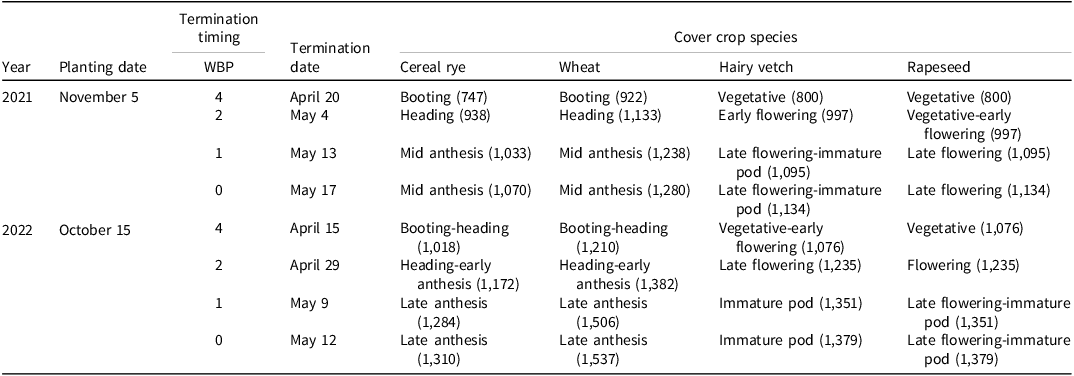
Glyphosate (Roundup PowerMax®, 575 g ae L–1; Bayer Crop Science, St. Louis, MO) at 1,268 g ae ha–1 was used to terminate wheat and cereal rye at 4, 2, and 1 WBP. A mixture of 2,4-D (2,4-D/LV4, 455 g ae L–1; Winfield Solutions, St. Paul, MN) at 534 g ae ha–1 and glufosinate (Liberty® 280 SL, 280 g ai L–1; BASF Corporation, Research Triangle Park, NC) at 657 g ai ha–1 was used to terminate rapeseed and hairy vetch 4, 2, and 1 WBP (Table 1). Our previous studies showed that these herbicide treatments were most effective for terminating those plants (Kumar et al. Reference Kumar, Singh, Flessner, Haymaker, Reiter and Mirsky2023a). Herbicide treatments were applied with a CO2-pressurized backpack sprayer equipped with a 3.05-m-wide boom containing five flat-fan XR8002 nozzles (TeeJet Technologies, Glendale Heights, IL) spaced 51 cm apart delivering 187 L ha–1 of spray volume at 207 kPa. A V-bar roller-crimper (I&J Manufacturing LLC, Gordonville, PA) was used for rolling-crimping cover crops. The roller-crimper was 2.4 m in length, with 38 cm diameter, 9.5 mm of cylindrical thickness, and weighed 1,002 kg. The rolling-crimping was conducted on the same day as the herbicide application, at all termination timings except 0 WBP. At 0 WBP, a roller-crimper was used to terminate all cover crop species without any herbicide application. Herbicide was not applied in combination with roller-crimping because 2,4-D has a plant-back interval of 7 d for corn when used at 534 g ae ha–1 (2,4-D LV4; Winfield Solutions LLC). Therefore, the application of 2,4-D with roller-crimping could restrict planting and delay operations if used. The date of termination and cover crop growth stage at termination for both years are shown in Table 2.
Planting date, termination date and growth stages, and accumulated growing degree days for cover crops at respective termination timings. a,b
a Abbreviation: WBP, weeks before planting corn.
b Values shown in parentheses after cover crop growth stages are growing degree days for respective cover crop species. Base temperatures were 4.4, 4.0, 4.0, and 3.1 C for cereal rye, hairy vetch, rapeseed, and wheat, respectively.
Corn Planting
Dekalb DKC64-64RIB corn (Bayer Crop Science) was planted at 13.5 kg ha–1 (70,000 seeds ha–1) on May 17, 2021, and on May 13, 2022, using a four-row (76-cm spacing) planter at 3.8 cm depth. Corn was fertilized with liquid urea-ammonium nitrate (UAN; 300 g N kg–1) fertilizer at a rate of 135 kg N ha–1 at the V2 growth stage. The fertilizer was surface banded 2.5 cm away from the corn rows. The experimental area received standard preemergence and postemergence herbicide treatments (Table 1). The preemergence herbicide treatment was applied 1 d after corn planting, and postemergence herbicide was applied 5 to 6 wk after corn planting.
Data Collection
Aboveground biomass was collected for all cover crop species at each termination timing. For each plot, biomass was collected from a randomly placed 1-m2 quadrat. The fresh biomass was dried in a hot-air dryer at 65 C for 1 wk and recorded as dry biomass in kilograms per hectare (kg ha–1). Growing degree days (GDDs) were calculated for all the cover crop species for each day, starting from the day of planting to the respective termination day using Equation 1:
 $$GDD = {{{\left( {{T_{max}} + {T_{min}}} \right)}}\over{2}}{\rm{\;}} - {T_{base}}$$
where T max and T min are the daily maximum and minimum temperatures, respectively, while T base is the base temperature. Base temperatures of 4.4, 3.1, 4.0, and 4.0 C were used for cereal rye (Mirsky et al. Reference Mirsky, Curran, Mortensen, Ryan and Shumway2009), wheat (Salazar-Gutierrez et al. Reference Salazar-Gutierrez, Johnson, Chaves-Cordoba and Hoogenboom2013), hairy vetch (Lawson et al. Reference Lawson, Fortuna, Cogger, Bary and Stubbs2013; Teasdale et al. Reference Teasdale, Devine, Mosjidis, Bellinder and Beste2004), and rapeseed (Björkman et al. Reference Björkman, Lowry, Shail, Brainard, Anderson and Masiunas2015), respectively. GDDs for each day were added to calculate accumulated GDD (AGDD), and AGDD for all cover crop species at each termination timing is listed in Table 2.
Cover crop termination efficacy was observed visually on a scale of 0% to 100% where 0% = no termination, and 100% = complete necrosis at 21 d after termination for the treatment in which cover crops were terminated using only a roller-crimper (0 WBP). Weed density was recorded in two random 0.5-m2 quadrats in each plot at 28 d after preemergence herbicide application (DAPR) and 28 d after postemergence herbicide application (DAPO). The weed densities from both quadrats were then combined for each plot to obtain the weed density from a 1-m2 area. Because weed species distribution was not uniform across the field, the weed species were grouped into four major categories: grasses, small-seeded broadleaves (SSB), large-seeded broadleaves (LSB), and sedges, to reduce complexity in data analysis (Table 3). These categories follow reference information from Mohler et al. (Reference Mohler, Teasdale and DiTommaso2021), and are listed in Table 3.
Categorization of weed species observed in the experiment.
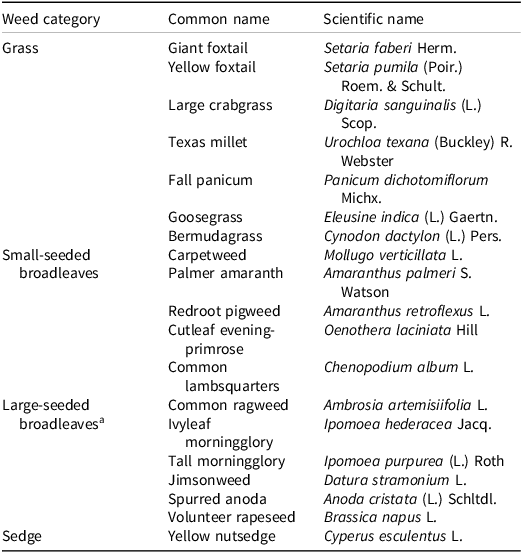
a Volunteer rapeseed was observed in 0 and 1 weeks before corn planting rapeseed plots only.
Corn yield was determined by harvesting the center four rows of corn from each six-row plot using a Zurn 160-plot combine (Zürn Harvesting, Schöntal-Westernhausen, Germany). Corn yield data were adjusted at 15.5% moisture content before further analysis. Two control treatments, no cover crop-no till (NC-NT) and no cover crop-tilled (NCT) were planted right next to the experimental area to compare the conventional grower practices with cover crops. Both the control plots were replicated four times each, and the size of each control plot was 4.6 m by 12 m. These treatments were not a part of the experimental design and therefore not included in the data analysis. For the NC-NT control, glyphosate (1,268 g ae ha–1) was used as a burndown treatment a week before corn planting to manage the weedy vegetation growing in the plots. On the other hand, tillage was performed in the NCT control plot using a disc plow a week before corn planting. The data from these control treatments were not a part of the experimental design and, therefore, were not included in the data analysis (data shown in supplementary Table 1).
Statistics and Data Analysis
Data were analyzed using the GLIMMIX procedure in SAS software (v. 9.4; SAS Institute, Cary, NC), and means were separated using Tukey’s honestly significant difference post hoc test at α < 0.05. ANOVA was performed to estimate the effect of cover crop treatments and termination timing on cover crop biomass, weed density, and yield. A Shapiro-Wilk test and quantile-quantile plots were used to test the normality of data. Data were transformed (log for weed biomass and square root for weed counts) for response variables that were not normally distributed; then back-transformed to show original means. Poisson distribution was considered for weed counts. The interaction of year with cover crops and termination timings was not significant, so data from both years were pooled. Cover crop treatments, termination timings, and their interactions were considered as fixed factors in the model, while replications, and replication by cover crop treatments (interaction) were considered as random effects. Regression analysis was performed for AGDD and weed density with cover crop biomass using JMP PRO software (v. 16.0.0; SAS Institute). The effect of cover crop termination timing was significant for grass and SSB weed density at 28 DAPR (Table 4). Therefore, regression curves and coefficient of determination (R 2) values for cover crop biomass and grass and SSB weed density at 28 DAPR were determined using SigmaPlot software (v. 13.0; Systat Software, San Jose, CA).
P-values for the effect of year, cover crop species and termination timing on cover crop biomass accumulation, weed density reduction and corn yield. a,b

a Abbreviations: CCS, cover crop species; DAPO, days after postemergence herbicide application; DAPR, days after preemergence herbicide application; LSB, large-seeded broadleaves; SSB, small-seeded broadleaves; TT, termination timing.
b P-values were generated using the GLIMMIX procedure with SAS software (v. 9.4; SAS Institute, Cary, NC).
Results and Discussion
Cover Crop Biomass Accumulation
Cover crop biomass varied by cover crop species (P < 0.001). When averaged across termination timings, hairy vetch produced the greatest biomass (5,021 kg ha–1) among the cover crop species but it was similar to that of cereal rye (Table 5). Hairy vetch produced 30% and 95% more biomass than wheat and rapeseed, respectively (Table 5). Previously published studies have indicated conflicting comparisons of biomass produced by hairy vetch and other cover crop species. Whalen et al. (Reference Whalen, Shergill, Kinne, Bish and Bradley2019b) found 114% to 207% and 187% to 217% more biomass accumulation by hairy vetch than cereal rye and wheat, respectively, depending on the termination timing. Conversely, Duiker (Reference Duiker2014) found 60% and 23% greater biomass accumulation in cereal rye and wheat compared to hairy vetch, while Zhou et al. (Reference Zhou, Roosendaal and Van Eerd2020) did not find any difference between hairy vetch and cereal rye biomass accumulation in a study conducted in Ontario, Canada.
Effects of cover crop and termination timing on weed density in corn at 28 d after preemergence and postemergence herbicide application. a,b
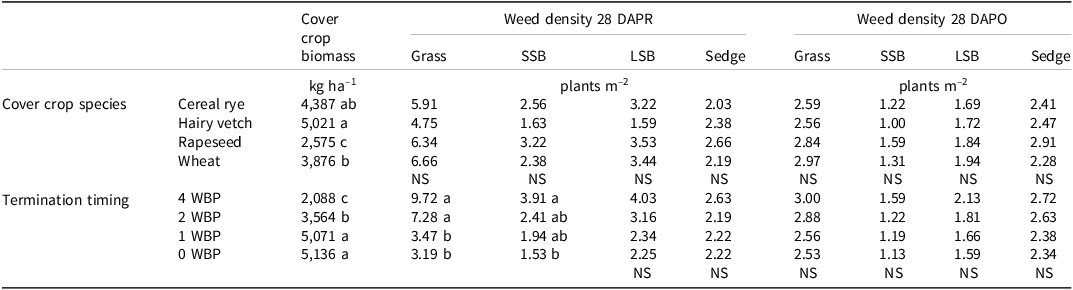
a Abbreviations: DAPO, days after post-emergence herbicide application; DAPR, days after pre-emergence herbicide application; LSB, large-seeded broadleaves; NS, nonsignificant based on Tukey’s HSD at α < 0.05; SSB, small-seeded broadleaves; WBP, weeks before planting corn.
b Values followed by same alphabet for a weed group within cover species or termination timing, are not statistically significant based on Tukey’s HSD at α < 0.05.
The effect of cover crop termination timing was also significant (P < 0.001) for biomass accumulation (Table 4). When averaged across cover crops, 0 WBP (5,136 kg ha–1) and 1 WBP (5,071 kg ha–1) treatments resulted in similar biomass (Table 5). Biomass at 0 WBP was 44% and 146% greater than the 2 and 4 WBP termination timings, respectively (Table 5). Other researchers have also reported increased cover crop biomass when cover crop termination is delayed. In a study carried out in Pennsylvania, Mirsky et al. (Reference Mirsky, Curran, Mortensen, Ryan and Shumway2011) reported a 2,000 kg ha–1 increase in cereal rye biomass with every 10-d delay in termination between May 1 and June 1. Similarly, Schramski et al. (Reference Schramski, Sprague and Renner2020) found an increase of 212% to 272% in cereal rye and winter wheat biomass by delaying the termination by 4 wk in Michigan.
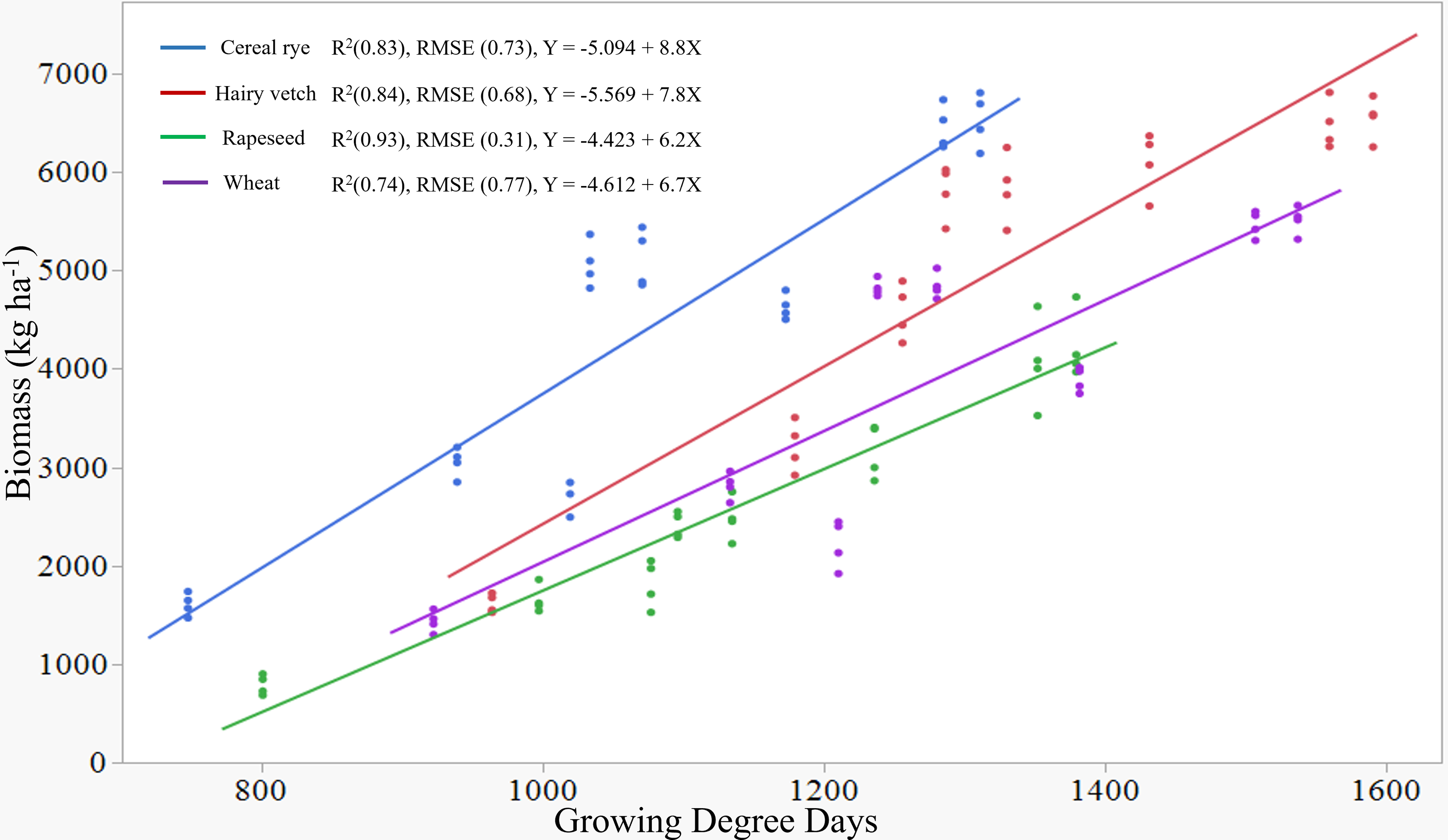
A linear model was the best fit for cover crop biomass with AGDD. The coefficient of determination (R 2) for linear regression of cover crop biomass with AGDD was 0.83, 0.74, 0.84, and 0.93 for cereal rye, wheat, hairy vetch, and rapeseed, respectively (Figure 1). Results from the linear regressions also indicate that with every 100 unit increase in AGDD, cereal rye, hairy vetch, rapeseed, and wheat biomass increased by 808, 780, 620, and 670 kg ha–1, respectively (Figure 1). AGDD for all cover crop species increased with delaying the cover crop termination timing (Table 2), which explained the increase in cover crop biomass from 4 and 2 WBP to 1 and 0 WBP. Other researchers also reported similar findings (Mirsky et al. Reference Mirsky, Curran, Mortensen, Ryan and Shumway2009; Teasdale et al. Reference Teasdale, Devine, Mosjidis, Bellinder and Beste2004). In a study conducted in New York and Maryland, Teasdale et al. (Reference Teasdale, Devine, Mosjidis, Bellinder and Beste2004) found an increase of 37% to 95% in hairy vetch biomass by delaying the termination 3 to 4 wk and reported that hairy vetch biomass increased by 410 kg ha–1 with every 100 AGDD.
Cover crop biomass (kg ha–1) fitted against growing degree days. For growing degree days calculation base temperature was 4.4, 2.8, 4.0, and 3.1 C for cereal rye, hairy vetch, rapeseed, and wheat, respectively.
Weed Density
Weed density at 28 DAPR did not vary across cover crop species (Table 4) for any weed group (grass, SSB, LSB, and sedge). Greater broadleaf weed control by growing cereal rye and winter wheat compared to hairy vetch has been reported when cereal rye and winter wheat had more biomass accumulation than hairy vetch (Carr et al. Reference Carr, Horsley, Gunderson, Winch and Martin2013). Palhano et al. (Reference Palhano, Norsworthy and Barber2018b) reported a 245%, 162%, and 21% reduction in Palmer amaranth (Amaranthus palmeri S. Wats.) emergence with 55%, 29%, and 3.5% greater biomass production by cereal rye compared to hairy vetch, rapeseed, and wheat, respectively. On the contrary, Mirsky et al. (Reference Mirsky, Curran, Mortensen, Ryan and Shumway2011) did not discern any difference between a cereal rye and cereal rye/hairy vetch mixture for broadleaf weed suppression when the cereal rye and cereal rye/hairy vetch mix produced similar biomass. Similarly, Reddy (Reference Reddy2001) did not find any difference in prickly sida (Sida spinosa L.) control when cereal rye, wheat, and hairy vetch produced similar biomass.
There was an effect of cover crop termination timing on grass and SSB weed density (Table 4). At 28 DAPR, the 0 WBP termination timing resulted in the lowest density for both grass (3.19 plants m–2), and SSB (1.53 plants m–2) weeds. Grass weed density with the 0 WBP termination timing was 56%, and 67% less than the 2 and 4 WBP termination timing, respectively (Table 5). Similarly, the 0 WBP termination timing provided 36% and 61% less SSB weed density than the 2 and 4 WBP termination timings, respectively. Less weed density with late termination (0 WBP) might be attributed to greater biomass production than the 2 and 4 WBP timings. Cover crop biomass acts as a physical barrier to weeds and can block sunlight from reaching the soil surface, thereby reducing weed seed germination (Rosario-Lebron et al. Reference Rosario-Lebron, Leslie, Yurchak, Chen and Hooks2019).
A three-parametric logistic equation (Equation 2) was the best fit for cover crop biomass and grass weed density at 28 DAPR (Figure 2A):
 $$y={\alpha }\over{{1 + {{({\rm{\;}}{{x}\over{{xo}}})}^\beta }}}$$
where y is the grass weeds density at 28 DAPR, x is the cover crop biomass, x o is the inflection point, α is the asymptote, and β is the slope of the curve.
Regression curves for cover crop biomass fitted with (A) grass, and (B) small-seeded broadleaf weeds density at 28 d after preemergence herbicide application.
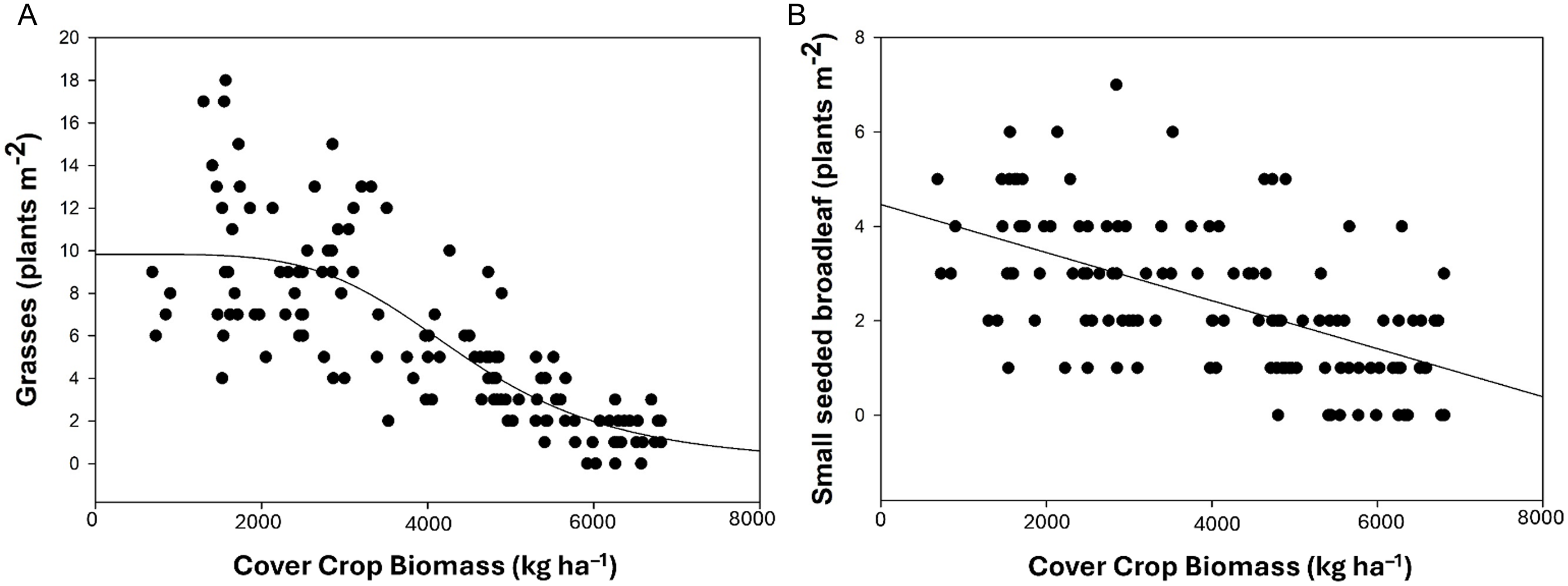
The linear equation (Equation 3) was the best fit for cover crop biomass and SSB weed density at 28 DAPR (Figure 2B):
 $$y=\alpha + \;\beta x$$
where y is the SSB weed density at 28 DAPR, x is the cover crop biomass, α is the asymptote, and β is the slope of the curve.
For both equations, all coefficients (Table 6) were significant (P < 0.001), indicating a decrease in grass and SSB weed density with increasing cover crop biomass. Rosa et al. (Reference Rosa, Creech, Elmore, Rudnick, Lindquist, Fudolig, Butts and Werle2021) observed approximately 100% greater weed density reduction due to more biomass accumulation with the termination of a cover crop mixture comprised of winter triticale, winter barley, hairy vetch, and daikon radish at corn planting as compared to 2 WBP termination. Mirsky et al. (Reference Mirsky, Curran, Mortensen, Ryan and Shumway2011) reported 37% to 50% greater weed density reduction in response to a termination date of May 30 for cereal rye or cereal rye/hairy vetch mixture compared to termination on May 10 or May 1. Schramski et al. (Reference Schramski, Sprague and Renner2020) also found a 70% to 194% reduction in horseweed density by delaying cereal rye and wheat termination by 2 wk.
Value of coefficient, standard error, and P-value for regression equation between cover crop biomass and grass and small-seeded broadleaf weed density at 28 d after preemergence herbicide application. a
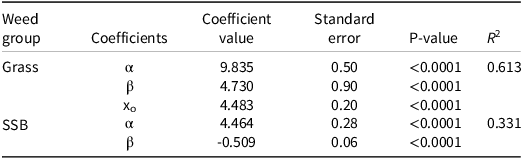
a Abbreviations: R 2, coefficient of determination; SSB, small-seeded broadleaf weeds.
Cover crop termination timing did not affect LSB or sedge weed density at 28 DAPR (Table 4). Other researchers have also reported that cover crop residues are more effective on small-seeded annuals than large-seeded annuals (Mohler and Teasdale Reference Mohler and Teasdale1993; Teasdale and Mohler Reference Teasdale and Mohler1993). For example, Mirsky et al. (Reference Mirsky, Curran, Mortensen, Ryan and Shumway2011) found that delaying cover crop termination from May 1 to May 20 reduced the density of the SSB common lambsquarters (Chenopodium album L.) but not common ragweed (Ambrosia artemisiifolia L.), a relatively large-seeded broadleaf weed. Kruidhof et al. (Reference Kruidhof, Gallandt, Harmoto and Bastiaans2010) reported that weed suppression with cover crop residues depends on the weed seed biomass, when large-seeded weeds have more reserve food energy and can germinate through cover crop mulch. Similarly, yellow nutsedge germinates from energy-rich tubers and can penetrate through residue cover (Mirsky et al. Reference Mirsky, Curran, Mortensen, Ryan and Shumway2011). The results from this research were consistent with those reported by Reddy (Reference Reddy2001) and Mirsky et al. (Reference Mirsky, Curran, Mortensen, Ryan and Shumway2011), who found that cover crop, termination timing, and biomass amount did not affect yellow nutsedge density.
The effect of cover crop species on weed density reduction at 28 DAPO application was insignificant. This is likely due to a combination of corn canopy closure, which can inhibit weed seed germination, and the use of a diverse herbicide mixture consisting of S-metolachlor, mesotrione, and glyphosate for postemergence weed control.
Termination of Cover Crops with Roller-Crimper at 0 WBP
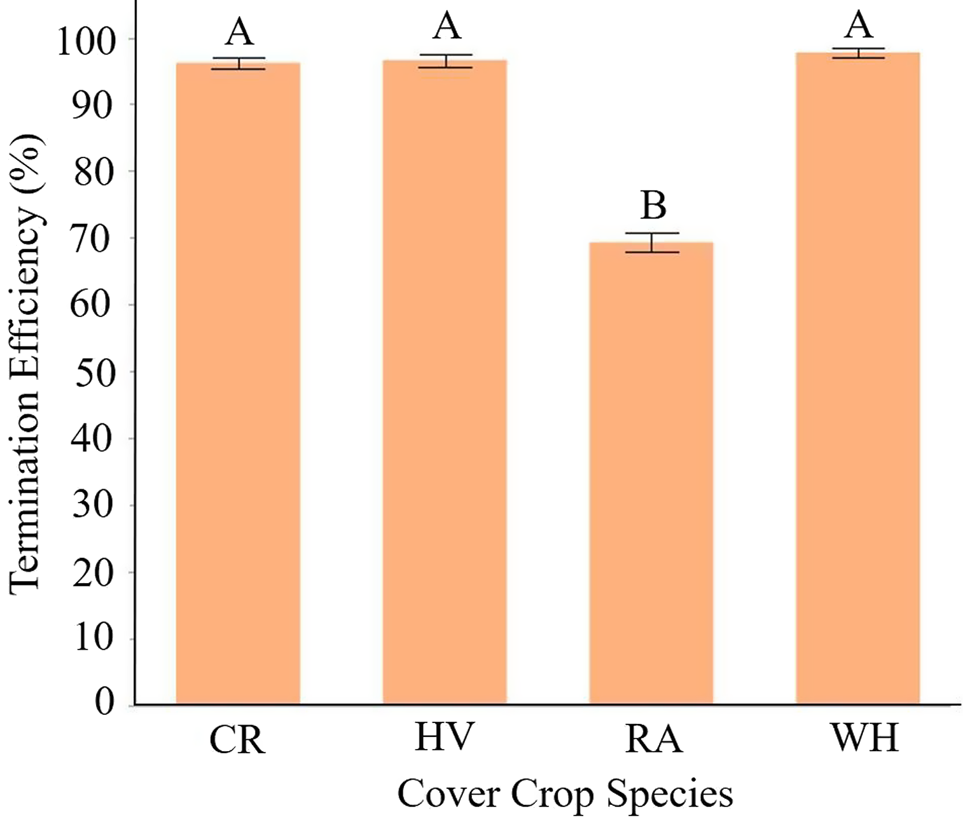
The effect of roller-crimping at 0 WBP followed by a preemergence application of S-metolachlor + atrazine at planting was significant for terminating different cover crop species. Corn was planted the next day after roller-crimping, and preemergence herbicides were applied 1 d after corn planting. The efficacy of roller-crimping plus preemergence herbicides for terminating wheat, cereal rye, and hairy vetch was greater than 95%, while rapeseed control was only 69% (Figure 3) at 21 d after termination. Better termination of cereal rye, wheat, and hairy vetch with roller-crimping at later growth stages is consistent with previously reported results (Ashford and Reeves Reference Ashford and Reeves2003; Mirsky et al. Reference Mirsky, Curran, Mortensen, Ryan and Shumway2009; Mischler et al. Reference Mischler, Duiker, Curran and Wilson2010). Ashford and Reeves (Reference Ashford and Reeves2003) reported 81% wheat termination with the use of roller-crimping alone at the anthesis stage, and the preemergence application of atrazine in our experiment likely improved the termination efficacy because atrazine also has postemergence activity. Mischler et al. (Reference Mischler, Duiker, Curran and Wilson2010) reported 89% to 100% hairy vetch control with roller-crimping at the late flowering to the late pod stage, while Mirsky et al. (Reference Mirsky, Curran, Mortensen, Ryan and Shumway2009) found more than 90% cereal rye termination efficacy with using a roller-crimper at the plant’s reproductive stages. However, Kumar et al. (Reference Kumar, Singh, Flessner, Reiter, Kuhar and Mirsky2023b) observed low termination efficacy when roller-crimping rapeseed even at the reproductive growth stage.
Cover crop termination efficacy at 21 d after roller-crimper + atrazine use. Cover crops were roller-crimped 1 d before corn planting and preemergence herbicides were applied 1 d after corn planting. Bars with different letters are statistically different at a 5% level of significance. Abbreviations: CR, cereal rye; HV, hairy vetch; RA, rapeseed; WH, wheat.
Corn Yield
There was a significant effect of cover crop species and termination timings on corn yield (Table 4). The greatest corn yield was observed with hairy vetch terminated 2 WBP, followed by 4 WBP and 1 WBP, while rapeseed terminated 0 WBP resulted in the least corn yield (Table 7). The interaction effect of termination timing and cover crop species on corn yield was significant (Table 4). In general, rapeseed terminated at either termination timing recorded lower corn yield than the highest corn yield recorded. Corn yield (3,046 kg ha–1) was lowest when rapeseed was terminated at 0 WBP. The lowest corn yield for rapeseed terminated at 0 WBP was likely due to the fact that the roller-crimping followed by a preemergence application of atrazine could not adequately terminate rapeseed (Figure 3). In general, poor termination of cover crops results in regrowth and competition with cash crops for nutrients, sunlight, and soil moisture. These findings emphasize the need for timely and effective termination of rapeseed to avoid potential yield penalties in a subsequent corn crop.
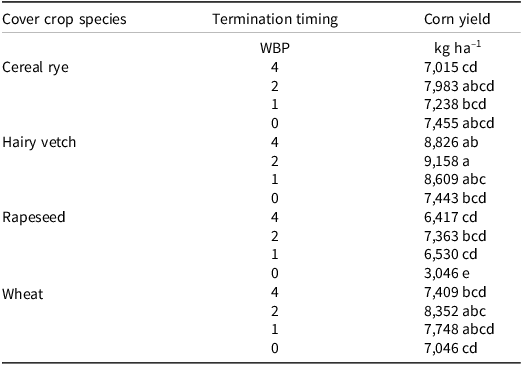
For hairy vetch, corn yield was greater when the cover crop was terminated at 2 WBP as opposed to 0 WBP. The improved corn yield at the earlier termination timing could be due to reduced competition during corn establishment and the gradual release of nitrogen from decomposing hairy vetch residues (Lawson et al. Reference Lawson, Cogger, Bary and Fortuna2015; Vaughan and Evanylo Reference Vaughan and Evanylo1998). Whereas delaying termination to 0 WBP may have introduced competition for soil moisture (Alonso-Ayuso et al. Reference Alonso-Ayuso, Gabriel and Quemada2014), it reduced the beneficial effects of this cover crop. Termination timing of cereal rye and wheat did not affect corn yield, most probably due to effective termination even at 0 WBP that prevented competition with corn plants.
Practical Implications
Among cover crops, hairy vetch accumulated the greatest biomass, followed by cereal rye, wheat, and rapeseed, indicating that hairy vetch and cereal rye are well suited for the mid-Atlantic region and can fit into the fallow season of common cash crop (corn, soybean, cotton) rotations in this region. Cover crops can potentially suppress weeds, but termination timing is an important factor to consider, because late termination results in greater biomass. Early termination of cover crops resulted in greater weed density in corn compared to no-cover-crop tilled plots, and late termination resulted in lower weed density. Therefore, growers are advised to practice late termination of cover crops to increase the weed control benefits as long as proper termination of the cover crops is warranted. However, when soil moisture is low or forecasted to be low during corn planting and emergence, cover crops should be terminated earlier to reduce cover crop–imposed transpirational water loss. Termination of rapeseed was poor, and it competed with the corn crop, resulting in a yield penalty. The sole use of a roller-crimper was ineffective for terminating rapeseed and required application of effective herbicides such as glyphosate, glufosinate, and 2,4-D in combination for acceptable termination efficacy.
Supplementary material
To view supplementary material for this article, please visit https://doi.org/10.1017/wet.2025.39
Acknowledgments
We thank Milton Sturgis, Tommy Custis, and Andrew Fletcher for their help in establishing this study and collecting data.
Funding
Funding for this research was provided by the Virginia Grain Producers Association (Virginia Corn Board), and by U.S. Department of Agriculture-National Institute for Food and Agriculture Hatch Project 1025479.
Competing interests
The authors declare they have no conflicts of interest.


 Open access

