


Introduction
Conventional methods for dietary assessment emerged in the 20th century, and the first written records date back to the 1930s in the United States and European countries, especially in the United Kingdom. With the increase in dietary records, technological progress has facilitated computer access since the 1970s and allowed nutritional calculations through dietary assessment incorporated into computerised systems(Reference Stumbo1). Innovations that retrieve dietary data from the population were established, including software with online and offline functionality, personal digital assistants (PDAs), web-based technologies (WBTs), apps for mobile data collection devices, barcode readers, digital cameras and sensors coupled to clothing(Reference Eldridge, Piernas and Illner2).
Despite all this technological progress, many tools are still based on traditional methods that consider self-reported food intake, such as 24-hour recall (24HR), food records (FR) and the food frequency questionnaire (FFQ)(Reference Willett3,Reference Illner, Freisling and Boeing4) . Thus, inherent errors in the traditional dietary assessment are also found in the technologies, such as underestimating food intake(Reference Crispim, Samofal, Ferreira, Marchioni, Gorgulho and Steluti5). Meanwhile, increasingly more technological innovations that operate independently of conventional methods and self-report, such as barcode readers, technologies based on digital cameras, and sensors are emerging(Reference Illner, Freisling and Boeing4). Even so, all technological tools are subject to measurement and estimation errors, and validation studies increasingly aim to quantify such errors(Reference Sharman, Skouteris and Powell6).
Especially in childhood dietary assessment, these errors may be magnified by the child's cognitive capacity limitation, requiring a parent's assistance in reporting the diet(Reference Sharman, Skouteris and Powell6) and potentially expanding the possibility of food intake estimation errors, such as under- or overreporting(Reference Kouvari, Mamalaki and Bathrellou7). However, the investigation of children's dietary intake is essential in assessing their nutritional status and predicting their health status in subsequent life stages. Eating habits established in the early decades of life are known to significantly affect the risk of developing chronic diseases, especially overweight and obesity, in childhood and at future ages(Reference Kartiosuo, Ramakrishnan and Lemeshow8). Studies have thus developed technologies that minimise errors in childhood dietary assessment and automate and standardise data collection, integrating technological and digital resources that facilitate food measurement, reducing costs and increasing individuals’ participation rates, facilitating data collection(Reference Kouvari, Mamalaki and Bathrellou7).
This context underscores the relevance of knowing the existing technological tools for assessing children's food intake, including the tools’ characteristics and validity. Such knowledge is essential for assisting the choice of available tools, verifying populations in which these technological resources are still scarce, and identifying trends and possibilities for improving and developing innovations applied to dietary assessment technologies. Thus far, seven reviews have shown technologies for obtaining data on children's food intake(Reference Eldridge, Piernas and Illner2,Reference Sharman, Skouteris and Powell6,Reference Kouvari, Mamalaki and Bathrellou7,Reference Cade9–Reference Timon, van den Barg and Blain12) . Still, some reviews failed to follow standard methodologies for reviews based on international guidelines(Reference Cade9,Reference Timon, van den Barg and Blain12) , addressed different age groups, not specific to children(Reference Eldridge, Piernas and Illner2,Reference Sharman, Skouteris and Powell6,Reference Kouvari, Mamalaki and Bathrellou7,Reference Cade9–Reference Pedraza, Queiroz and Gama11) , and only retrieved validation studies(Reference Kouvari, Mamalaki and Bathrellou7,Reference Ortiz-Andrellucchi, Henríquez-Sánchez and Sánchez-Villegas10) , or were limited to one type of dietary assessment method(Reference Sharman, Skouteris and Powell6,Reference Timon, van den Barg and Blain12) . Therefore, the principal question in the present study was the following: Which technologies are used to assess children's food intake? A scoping review was used to answer this question to identify and characterise the technological tools used to assess children's food intake.
Methods
Study design
A scoping review was conducted per the Joanna Briggs Institute Reviewer Manual (Reference Peters, Godfrey, McInerney, Munn, Tricco, Khalil, Aromataris and Munn13) and with additional methodological guidelines(Reference Peters, Marnie and Tricco14). The review followed the PRISMA-ScR verification list (Preferred Reporting Items for Systematic Reviews and Meta-Analyses Extension for Scoping Reviews) (Supplementary Table S1)(Reference Tricco, Lillie and Zarin15). The protocol was registered with the Open Science Framework (https://doi.org/10.17605/OSF.IO/WMBFZ)(Reference Freitas, de Souza Mata and Araujo16) on 14 April 2021. The principal question that gave rise to the search strategy was formulated with the mnemonic PCC (Population, Concept and Context)(Reference Peters, Godfrey, McInerney, Munn, Tricco, Khalil, Aromataris and Munn13), where the population was defined as children 0–9 years of age, the concept as technological tools and context as food intake assessment.
Eligibility criteria
The eligibility criteria were established a priori (Supplementary Table S2). Studies were eligible if they assessed the food intake of children 0–9 years of age using technology. Studies that assessed other age groups and included children 0–9 years were included. Articles on validation and calibration of technological tools were also considered. Studies with objectives other than assessment of children's food intake but which at some stage performed and described the technology used were also included. The review excluded studies that exclusively used traditional dietary assessment tools or technologies that were only used in the data analysis or for some purposes other than assessing food intake, such as dietary education, food preferences, promotion of healthy eating habits (mainly clinical trials), body weight control and exclusive assessment of breastfeeding. The review also excluded review studies, protocols, abstracts and posters published in congress proceedings, articles written in languages other than Portuguese, English and Spanish, and studies that did not present sufficient information for data extraction.
Search strategy
The systematized search process was conducted in five databases and oriented by a librarian with experience in synthesis studies (DM). The first database explored was MEDLINE (Medical Literature Analysis and Retrieval System Online) via PubMed. The strategy was subsequently customised for the databases Scopus, Web of Science, LILACS (Latin American and Caribbean Literature in Health Sciences) via BVS and the Cochrane Library. The search was performed up to 26 October 2021, in all the databases. A complementary search was performed in the gray literature and explored in the OpenGrey source. Studies were also identified by cross-referencing selected relevant studies in contact with authors. No restrictions were imposed on the date of publication or languages. The complete search strategy is shown in Supplementary Table S3.
Article selection and data extraction
Initial selection (Reading titles and abstracts)
All the identified references were organised as a dataset in the Endnote software, version x7 for reading the titles and abstracts, and duplicates were removed.
Three researchers read the studies’ titles and abstracts individually (GSI, JSM and MBM), and the article selection followed the eligibility criteria. The study coordinator, a fourth member (MCA), evaluated any disagreements in the article selection process.
Final selection (Reading full texts and data extraction)
The potentially relevant studies in the first stage were retrieved for reading the full texts via PubMed (https://pubmed.ncbi.nlm.nih.gov/) and Google Scholar (https://scholar.google.com.br/) websites. Some articles that remained inaccessible were requested from the authors via e-mail, but this method was unsuccessful. Full-text reading was performed pairwise, but two researchers joined one of the pairs and shared the reading (GSI and JSM + GF). Divergences in the articles were resolved by another researcher (MCA).
The extraction table created to compile the critical information on the technological tools retrieved the following data: characteristics of the technological tools (brand name; type of technology; food intake assessment method; administration method; data entry method; age group; language displayed by the software; country of origin; data collection environment and references), details on the technologies (number of foods/preparations/beverages available in the database; search format/food insertion in the technology; assessing amounts consumed; method for estimating portions; nutrient intake assessment; supplement consumption report; person reporting the child's food intake; food composition database) and technology validation (reference method; the number of participants; statistical analysis used; participants’ characteristics – age group, sex and study location; and principal results and conclusions).
Data analysis and synthesis
A qualitative synthesis of the selected studies was used to map the literature, as designed in the research question. Absolute and relative frequencies were calculated to synthesise some information, using Microsoft Excel and R (version 4.2.0) to analyse the data.
Results
A total of 15 119 studies were retrieved from the databases, yielding 10 919 articles after excluding duplicates. Then, titles and abstracts were read, and the inclusion and exclusion criteria were applied, resulting in 279 articles eligible for full-text reading. Ninety-three studies finally met the eligibility criteria (Fig. 1). The principal reasons for exclusion were the use of traditional dietary assessment methods or technology exclusively for data analysis (n 96) and technology applied to nutritional education, promotion of healthy habits, body weight control and analysis of eating behaviours or dietary preferences (n 20) (Supplementary Table S4).
Flowchart describing the scoping review process.

A total of forty-six technologies were identified in the ninety-three studies analysed, in which the most widely studied technologies were Web-DASC, addressed by nine articles (9⋅7 %)(Reference Andersen, Biltoft-Jensen and Christensen17–Reference Kjeldsen, Hjorth and Andersen25), Nutrition Data System for Research (NDSR), cited in seven articles (7⋅5 %)(Reference Bonuck, Avraham and Lo26–Reference Thompson, Ferry and Cullen32), and EPIC-Soft(Reference De Boer, Slimani and Van't Veer39–Reference Trolle, Amiano and Ege43) and Web-CAAFE(Reference Kupek, de Assis and Bellisle44–Reference Segura48), each mentioned in five articles (5⋅7 %). Most of the technologies were developed in Europe (37 %)(Reference Andersen, Biltoft-Jensen and Christensen17–Reference Kjeldsen, Hjorth and Andersen25,Reference Copperstone, McNeill and Aucott33,Reference De Boer, Slimani and Van't Veer39–Reference Trolle, Amiano and Ege43,Reference Medin, Astrup and Kåsin49–Reference Jacques, Bussien and Descloux72) , North America (32⋅6 %)(Reference Bonuck, Avraham and Lo26–Reference Thompson, Ferry and Cullen32,Reference Aflague, Boushey and Leon Guerrero73–Reference Wallace, Kirkpatrick and Darlington94) and Oceania (10⋅9 %)(Reference Davison, Quigg and Skidmore38,Reference Eyles, Bhana and Lee95–Reference Sanigorski, Bell and Swinburn98) . The most widely used traditional dietary assessment method used in the tools was 24HR (56⋅5 %; n 26)(Reference Andersen, Biltoft-Jensen and Christensen17–Reference Davies, Kupek and de Assis37,Reference De Boer, Slimani and Van't Veer39–Reference Segura48,Reference Carvalho, Baranowski and Foster52,Reference Lahoz-García, García-Hermoso and Milla-Tobarra60,Reference Lahoz-García, García-Hermoso and Sánchez-López61,Reference Baranowski, Islam and Baranowski77–Reference Baranowski, Islam and Douglass81,Reference Derr, Mitchell and Brannon85,Reference Diep, Hingle and Chen86,Reference Lee, Yang and Wang89,Reference Shakur, Tarasuk and Corey90,Reference Wallace, Kirkpatrick and Darlington94–Reference Thomson, McLachlan and Parnell97,Reference Caswell, Talegawkar and Dyer99–Reference Htet, Fahmida and Do107) . Thirty technologies (65⋅2 %) were self-administered(Reference Andersen, Biltoft-Jensen and Christensen17–Reference Kjeldsen, Hjorth and Andersen25,Reference Copperstone, McNeill and Aucott33–Reference Davison, Quigg and Skidmore38,Reference Kupek, de Assis and Bellisle44–Reference Carvalho, Baranowski and Foster52,Reference Cadenas-Sanchez, Henriksson and Henriksson54–Reference Lahoz-García, García-Hermoso and Sánchez-López61,Reference López-Sobaler, Aparicio and González-Rodríguez65,Reference Moore, Ells and McLure67,Reference Moore, Hillier and Batterham68,Reference Oliver, Baños and Cebolla70–Reference Deierlein, Bihuniak and Nagi84,Reference Diep, Hingle and Chen86–Reference Kilanowski, Trapl and Kofron88,Reference Matthiessen, Steinberg and Kaiser91,Reference Wallace, Kirkpatrick and Darlington94,Reference Engel, Assis and Lobo100,Reference Börnhorst, Bel-Serrat and Pigeot102–Reference Svensson, Larsson and Eiben105,Reference Htet, Fahmida and Do107–Reference Norman, Kjellenberg and Arechiga110) , while 11 (23⋅9 %) were administered by an interviewer(Reference Bonuck, Avraham and Lo26–Reference Thompson, Ferry and Cullen32,Reference De Boer, Slimani and Van't Veer39–Reference Trolle, Amiano and Ege43,Reference Moore, Tapper and Dennehy69,Reference Derr, Mitchell and Brannon85,Reference Lee, Yang and Wang89,Reference Shakur, Tarasuk and Corey90,Reference Eyles, Bhana and Lee95,Reference Thomson, McLachlan and Parnell97–Reference Caswell, Talegawkar and Dyer99,Reference Freisling, Ocké and Casagrande101,Reference Clifton, Chan and Moss106) and 4 (10⋅9 %) had some other form of administration or did not provide this information(Reference Ambroszkiewicz, Rowicka and Chełchowska53,Reference Lambert, Plumb and Looise62–Reference Lambert, Plumb and Looise64,Reference Luszczki, Sobek and Bartosiewicz66,Reference Nicklas, O'Neil and Stuff92,Reference Taylor, Yon and Johnson93) . The primary data collection settings were home and school. Approximately 27 % of the technologies were used exclusively at home(Reference Andersen, Biltoft-Jensen and Christensen17–Reference Thompson, Ferry and Cullen32,Reference Davison, Quigg and Skidmore38–Reference Trolle, Amiano and Ege43,Reference Cadenas-Sanchez, Henriksson and Henriksson54–Reference Parekh, Henriksson and Delisle Nyström57,Reference López-Sobaler, Aparicio and González-Rodríguez65,Reference Moore, Ells and McLure67,Reference Moore, Hillier and Batterham68,Reference Johansson, Venables and Öhlund71,Reference Deierlein, Bihuniak and Nagi84,Reference Derr, Mitchell and Brannon85,Reference Bischoff, Portella and Paquet87–Reference Matthiessen, Steinberg and Kaiser91,Reference Sanigorski, Bell and Swinburn98,Reference Caswell, Talegawkar and Dyer99,Reference Freisling, Ocké and Casagrande101,Reference Clifton, Chan and Moss106,Reference Htet, Fahmida and Do107) , 22⋅6 % at school(Reference Copperstone, McNeill and Aucott33–Reference Davies, Kupek and de Assis37,Reference Kupek, de Assis and Bellisle44–Reference Carvalho, Baranowski and Foster52,Reference Lahoz-García, García-Hermoso and Milla-Tobarra60–Reference Lambert, Plumb and Looise64,Reference Luszczki, Sobek and Bartosiewicz66–Reference Moore, Tapper and Dennehy69,Reference Baranowski, Islam and Baranowski77–Reference Baranowski, Islam and Baranowski80,Reference Matthiessen, Steinberg and Kaiser91,Reference Wallace, Kirkpatrick and Darlington94,Reference Eyles, Bhana and Lee95,Reference Engel, Assis and Lobo100,Reference Börnhorst, Bel-Serrat and Pigeot102–Reference Svensson, Larsson and Eiben105) and 6⋅5 % in both settings(Reference Kristiansen, Bjelland and Himberg-Sundet58,Reference Kristiansen, Bjelland and Himberg-Sundet59,Reference Beltran, Dadabhoy and Chen82,Reference Beltran, Dadabhoy and Ryan83,Reference Nicklas, O'Neil and Stuff92,Reference Taylor, Yon and Johnson93,96,Reference Thomson, McLachlan and Parnell97,Reference Chia, Chew and Tan108–Reference Norman, Kjellenberg and Arechiga110) . The leading types of technology were web-based software programs (37 %; n 17)(Reference Andersen, Biltoft-Jensen and Christensen17–Reference Kjeldsen, Hjorth and Andersen25,Reference Copperstone, McNeill and Aucott33–Reference Davies, Kupek and de Assis37,Reference Kupek, de Assis and Bellisle44–Reference Carvalho, Baranowski and Foster52,Reference Kristiansen, Bjelland and Himberg-Sundet58,Reference Kristiansen, Bjelland and Himberg-Sundet59,Reference Moore, Ells and McLure67,Reference Moore, Hillier and Batterham68,Reference Baranowski, Islam and Baranowski80,Reference Baranowski, Islam and Douglass81,Reference Deierlein, Bihuniak and Nagi84,Reference Diep, Hingle and Chen86,Reference Bischoff, Portella and Paquet87,Reference Wallace, Kirkpatrick and Darlington94,Reference Eyles, Bhana and Lee95,Reference Engel, Assis and Lobo100,Reference Chia, Chew and Tan108) and offline programs (30⋅4 %; n 14)(Reference Bonuck, Avraham and Lo26–Reference Thompson, Ferry and Cullen32,Reference De Boer, Slimani and Van't Veer39–Reference Trolle, Amiano and Ege43,Reference Ambroszkiewicz, Rowicka and Chełchowska53,Reference Lahoz-García, García-Hermoso and Milla-Tobarra60,Reference Lahoz-García, García-Hermoso and Sánchez-López61,Reference López-Sobaler, Aparicio and González-Rodríguez65,Reference Moore, Tapper and Dennehy69,Reference Baranowski, Islam and Baranowski77–Reference Cullen, Zakeri and Pryor79,Reference Derr, Mitchell and Brannon85,Reference Kilanowski, Trapl and Kofron88–Reference Shakur, Tarasuk and Corey90,96,Reference Thomson, McLachlan and Parnell97,Reference Caswell, Talegawkar and Dyer99,Reference Freisling, Ocké and Casagrande101–Reference Svensson, Larsson and Eiben105) . Digital cameras were only used in 11 % of the technologies (n 6)(Reference Cadenas-Sanchez, Henriksson and Henriksson54–Reference Parekh, Henriksson and Delisle Nyström57,Reference Johansson, Venables and Öhlund71,Reference Beltran, Dadabhoy and Chen82,Reference Beltran, Dadabhoy and Ryan83,Reference Matthiessen, Steinberg and Kaiser91–Reference Taylor, Yon and Johnson93,Reference Erkilic and Pekcan109,Reference Norman, Kjellenberg and Arechiga110) . More than 80 % of the studies were conducted in the age group over 6 years(Reference Andersen, Biltoft-Jensen and Christensen17–Reference Kjeldsen, Hjorth and Andersen25,Reference Lanctot, Klesges and Stockton30,Reference Copperstone, McNeill and Aucott33–Reference Carvalho, Baranowski and Foster52,Reference Lahoz-García, García-Hermoso and Milla-Tobarra60–Reference Oliver, Baños and Cebolla70,Reference Aflague, Boushey and Leon Guerrero73,Reference Polfuss, Moosreiner and Boushey74,Reference Baranowski, Islam and Baranowski77–Reference Baranowski, Islam and Baranowski80,Reference Beltran, Dadabhoy and Chen82–Reference Matthiessen, Steinberg and Kaiser91,Reference Taylor, Yon and Johnson93,Reference Eyles, Bhana and Lee95–Reference Clifton, Chan and Moss106,Reference Chia, Chew and Tan108–Reference Norman, Kjellenberg and Arechiga110) (Table 1).
Basic characteristics of technologies used to assess children's dietary intake

FR, Food Records; 24HR, 24-hour dietary recall; App, Application; USA, United States of America; FFQ, Food Frequency Questionnaire.
As for the technologies’ details, the principal means for data entry were text format based on a list of names or predefined categories of foods (32⋅6 %)(Reference da Costa, Schmoelz and Davies34–Reference Davies, Kupek and de Assis37,Reference Kupek, de Assis and Bellisle44–Reference Segura48,Reference Carvalho, Baranowski and Foster52,Reference Lambert, Plumb and Looise62–Reference Lambert, Plumb and Looise64,Reference Baranowski, Islam and Baranowski77–Reference Baranowski, Islam and Baranowski80,Reference Bischoff, Portella and Paquet87,96–Reference Freisling, Ocké and Casagrande101) , image capture of foods (17⋅4 %)(Reference Davison, Quigg and Skidmore38,Reference Cadenas-Sanchez, Henriksson and Henriksson54–Reference Parekh, Henriksson and Delisle Nyström57,Reference Aflague, Boushey and Leon Guerrero73–Reference Fialkowski, Ng-Osorio and Kai76,Reference Beltran, Dadabhoy and Chen82,Reference Beltran, Dadabhoy and Ryan83,Reference Matthiessen, Steinberg and Kaiser91–Reference Taylor, Yon and Johnson93) and free text (15⋅2 %)(Reference Bonuck, Avraham and Lo26–Reference Thompson, Ferry and Cullen32,Reference Medin, Astrup and Kåsin49–Reference Medin, Hansen and Astrup51,Reference Moore, Ells and McLure67,Reference Moore, Hillier and Batterham68,Reference Baranowski, Islam and Baranowski80,Reference Wallace, Kirkpatrick and Darlington94) . The data entry method was not informed in 17⋅4 % of the studies(Reference Copperstone, McNeill and Aucott33,Reference Ambroszkiewicz, Rowicka and Chełchowska53,Reference Lahoz-García, García-Hermoso and Milla-Tobarra60,Reference Lahoz-García, García-Hermoso and Sánchez-López61,Reference Lee, Yang and Wang89,Reference Shakur, Tarasuk and Corey90,Reference Börnhorst, Bel-Serrat and Pigeot102–Reference Svensson, Larsson and Eiben105) . Most of the technologies were quantitative (87⋅0 %)(Reference Andersen, Biltoft-Jensen and Christensen17–Reference Copperstone, McNeill and Aucott33,Reference De Boer, Slimani and Van't Veer39–Reference Trolle, Amiano and Ege43,Reference Medin, Astrup and Kåsin49–Reference Moore, Hillier and Batterham68,Reference Oliver, Baños and Cebolla70,Reference Johansson, Venables and Öhlund71,Reference Aflague, Boushey and Leon Guerrero73–Reference Diep, Hingle and Chen86,Reference Kilanowski, Trapl and Kofron88–Reference Caswell, Talegawkar and Dyer99,Reference Freisling, Ocké and Casagrande101–Reference Svensson, Larsson and Eiben105,Reference Erkilic and Pekcan109,Reference Norman, Kjellenberg and Arechiga110) , in which 17⋅4 % of the tools used photo albums and standardised household measures to estimate amounts(Reference Bonuck, Avraham and Lo26–Reference Thompson, Ferry and Cullen32,Reference De Boer, Slimani and Van't Veer39–Reference Trolle, Amiano and Ege43,Reference Medin, Astrup and Kåsin49–Reference Carvalho, Baranowski and Foster52,Reference Lambert, Plumb and Looise62–Reference López-Sobaler, Aparicio and González-Rodríguez65,Reference Baranowski, Islam and Baranowski80,Reference Baranowski, Islam and Douglass81,Reference Deierlein, Bihuniak and Nagi84,Reference Kilanowski, Trapl and Kofron88,96–Reference Caswell, Talegawkar and Dyer99,Reference Freisling, Ocké and Casagrande101–Reference Svensson, Larsson and Eiben105) ; 8⋅7 % only used photo albums(Reference Andersen, Biltoft-Jensen and Christensen17–Reference Kjeldsen, Hjorth and Andersen25,Reference Kristiansen, Bjelland and Himberg-Sundet58,Reference Kristiansen, Bjelland and Himberg-Sundet59,Reference Oliver, Baños and Cebolla70,Reference Johansson, Venables and Öhlund71,Reference Derr, Mitchell and Brannon85) and 26⋅1 % used analysis of food photographs by participants(Reference Cadenas-Sanchez, Henriksson and Henriksson54–Reference Parekh, Henriksson and Delisle Nyström57,Reference Johansson, Venables and Öhlund71,Reference Aflague, Boushey and Leon Guerrero73–Reference Fialkowski, Ng-Osorio and Kai76,Reference Beltran, Dadabhoy and Chen82,Reference Beltran, Dadabhoy and Ryan83,Reference Matthiessen, Steinberg and Kaiser91–Reference Taylor, Yon and Johnson93) . Most of the technologies allowed estimating energy and nutrient intake (56⋅5 %) (Reference De Boer, Slimani and Van't Veer39–Reference Trolle, Amiano and Ege43,Reference Lahoz-García, García-Hermoso and Milla-Tobarra60,Reference Lahoz-García, García-Hermoso and Sánchez-López61,Reference López-Sobaler, Aparicio and González-Rodríguez65,Reference Deierlein, Bihuniak and Nagi84–Reference Bischoff, Portella and Paquet87,Reference Lee, Yang and Wang89,Reference Shakur, Tarasuk and Corey90,Reference Nicklas, O'Neil and Stuff92–Reference Thomson, McLachlan and Parnell97,Reference Freisling, Ocké and Casagrande101–Reference Svensson, Larsson and Eiben105,Reference Erkilic and Pekcan109,Reference Norman, Kjellenberg and Arechiga110) , but only 17⋅4 % described the assessment of food supplement consumption(Reference López-Sobaler, Aparicio and González-Rodríguez65,Reference Lee, Yang and Wang89,Reference Shakur, Tarasuk and Corey90,96,Reference Thomson, McLachlan and Parnell97,Reference Freisling, Ocké and Casagrande101,Reference Erkilic and Pekcan109,Reference Norman, Kjellenberg and Arechiga110) . Approximately 54⋅6 % of the articles did not report whether the technological tool presented a food composition database(Reference Andersen, Biltoft-Jensen and Christensen17–Reference Thompson, Ferry and Cullen32,Reference De Boer, Slimani and Van't Veer39–Reference Trolle, Amiano and Ege43,Reference Medin, Astrup and Kåsin49–Reference Carvalho, Baranowski and Foster52,Reference Cadenas-Sanchez, Henriksson and Henriksson54–Reference Parekh, Henriksson and Delisle Nyström57,Reference Lahoz-García, García-Hermoso and Milla-Tobarra60,Reference Lahoz-García, García-Hermoso and Sánchez-López61,Reference López-Sobaler, Aparicio and González-Rodríguez65,Reference Moore, Ells and McLure67,Reference Moore, Hillier and Batterham68,Reference Baranowski, Islam and Baranowski80,Reference Beltran, Dadabhoy and Chen82,Reference Beltran, Dadabhoy and Ryan83,Reference Bischoff, Portella and Paquet87,Reference Lee, Yang and Wang89–Reference Matthiessen, Steinberg and Kaiser91,Reference Wallace, Kirkpatrick and Darlington94,96,Reference Thomson, McLachlan and Parnell97,Reference Caswell, Talegawkar and Dyer99) . Children were the informants in approximately 35 % of the tools(Reference Copperstone, McNeill and Aucott33–Reference Davison, Quigg and Skidmore38,Reference Kupek, de Assis and Bellisle44–Reference Segura48,Reference Carvalho, Baranowski and Foster52,Reference Lambert, Plumb and Looise62–Reference Lambert, Plumb and Looise64,Reference Oliver, Baños and Cebolla70,Reference Aflague, Boushey and Leon Guerrero73–Reference Deierlein, Bihuniak and Nagi84,Reference Diep, Hingle and Chen86,Reference Eyles, Bhana and Lee95,Reference Engel, Assis and Lobo100) , against 26⋅1 % for parents and guardians(Reference Bonuck, Avraham and Lo26–Reference Thompson, Ferry and Cullen32,Reference Cadenas-Sanchez, Henriksson and Henriksson54–Reference Kristiansen, Bjelland and Himberg-Sundet59,Reference López-Sobaler, Aparicio and González-Rodríguez65,Reference Johansson, Venables and Öhlund71,Reference Bischoff, Portella and Paquet87,Reference Kilanowski, Trapl and Kofron88,Reference Wallace, Kirkpatrick and Darlington94,Reference Sanigorski, Bell and Swinburn98,Reference Caswell, Talegawkar and Dyer99) (Fig. 2).
Detailed summary classification of technological tools to assess children's food consumption.

A total of 47⋅8 % (n 22) of the technologies analysed were validated. The tools with most validation studies were Web-DASC with four articles(Reference Biltoft-Jensen, Hjorth and Trolle21–Reference Biltoft-Jensen, Damsgaard and Andersen24), followed by Web-FR(Reference Medin, Astrup and Kåsin49–Reference Medin, Hansen and Astrup51) and Web-CAAFE(Reference Davies, Kupek and de Assis37,Reference Kupek, de Assis and Bellisle44,Reference Jesus, Assis and Kupek45) with three validation studies each. The most widely used reference method for comparing with the technologies in the validation studies was direct observation (38⋅7 %)(Reference Biltoft-Jensen, Damsgaard and Andersen23,Reference Davies, Kupek and de Assis37,Reference Kupek, de Assis and Bellisle44,Reference Jesus, Assis and Kupek45,Reference Medin, Astrup and Kåsin49,Reference Carvalho, Baranowski and Foster52,Reference Lambert, Plumb and Looise62,Reference Baranowski, Islam and Baranowski77,Reference Diep, Hingle and Chen86,Reference Taylor, Yon and Johnson93,Reference Wallace, Kirkpatrick and Darlington94,Reference Engel, Assis and Lobo100) , followed by 24HR (25⋅8 %)(Reference Copperstone, McNeill and Aucott33,Reference Delisle Nystrom, Forsum and Henriksson55,Reference Moore, Ells and McLure67,Reference Baranowski, Islam and Baranowski77,Reference Baranowski, Islam and Baranowski80,Reference Matthiessen, Steinberg and Kaiser91,Reference Erkilic and Pekcan109,Reference Norman, Kjellenberg and Arechiga110) . The number of participants analysed in the validation studies ranged from 21 to 834. Eighteen studies (58 %) concluded that the validation studies were satisfactory(Reference Biltoft-Jensen, Hjorth and Trolle21–Reference Biltoft-Jensen, Damsgaard and Andersen24,Reference Copperstone, McNeill and Aucott33,Reference Davison, Quigg and Skidmore38,Reference Kupek, de Assis and Bellisle44,Reference Jesus, Assis and Kupek45,Reference Medin, Carlsen and Andersen50,Reference Delisle Nystrom, Forsum and Henriksson55,Reference Lambert, Plumb and Looise62,Reference Moore, Ells and McLure67,Reference Johansson, Venables and Öhlund71,Reference Baranowski, Islam and Baranowski77,Reference Matthiessen, Steinberg and Kaiser91,Reference Taylor, Yon and Johnson93,Reference Engel, Assis and Lobo100,Reference Norman, Kjellenberg and Arechiga110) . In contrast, 10 (32 %) found that the tools required improvement(Reference Davies, Kupek and de Assis37,Reference Trolle, Amiano and Ege42,Reference Medin, Astrup and Kåsin49,Reference Medin, Hansen and Astrup51,Reference Carvalho, Baranowski and Foster52,Reference Moore, Tapper and Dennehy69,Reference Baranowski, Islam and Baranowski80,Reference Deierlein, Bihuniak and Nagi84,Reference Börnhorst, Bel-Serrat and Pigeot102,Reference Erkilic and Pekcan109) , and only 3 (10 %) concluded that the tool needed to be adequate for assessing food intake in the study population(Reference Henriksson, Bonn and Bergström56,Reference Diep, Hingle and Chen86,Reference Wallace, Kirkpatrick and Darlington94) (Table 2).
Characteristics of validation studies for technologies to assess children's food intake
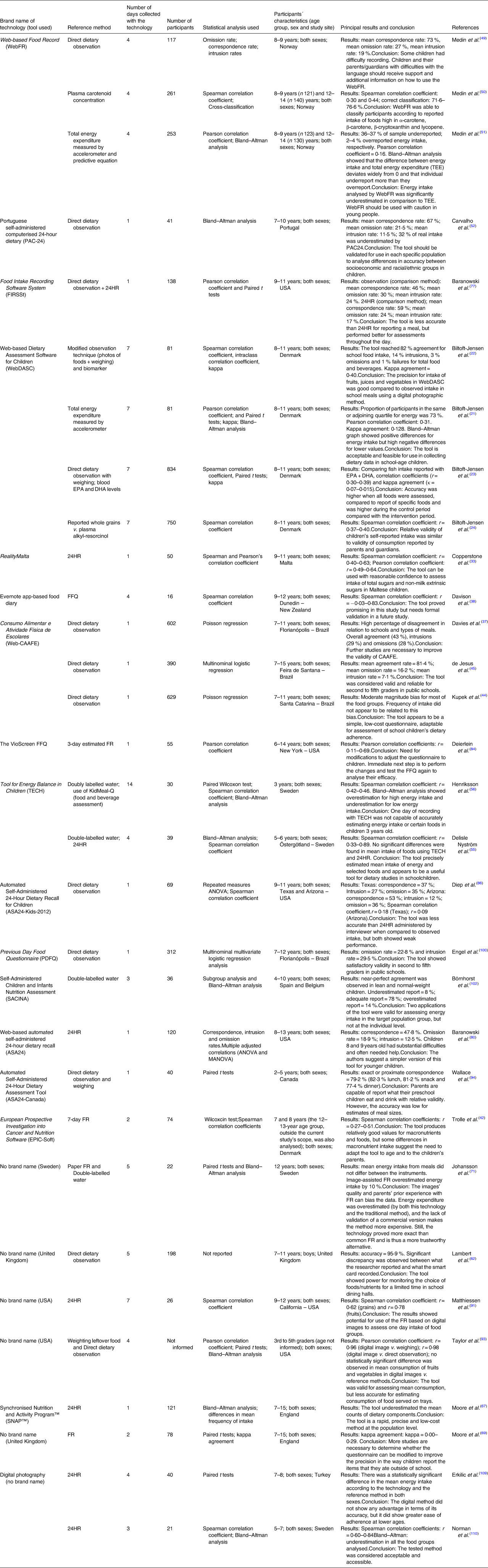
FR, Food Records; 24HR, 24-hour dietary recall; App, Application; USA, United States of America; FFQ, Food Frequency Questionnaire; ANOVA, Analysis of Variance; MANOVA, Multivariate Analysis of Variance.
Discussion
As far as we know, the present study was the first scoping review on technologies developed to assess children's food intake. Most of the technologies analysed had the following characteristics: web-based software packages; developed for children over 6 years of age; assessed food intake with 24HR and collected data at home. Most were self-administered; used text-based data entry based on a list of predefined names/categories of foods; published in English; allowed assessing the amount consumed; estimated food portions with photographs of foods; assessed energy and nutrient intake; did not report assessment of supplement intake and did not report whether they included a food composition database. These results corroborate the review by Eldridge et al., which found that of fourteen technological tools used only to assess children's food intake, 50 % were based on 24HR; 50 % were web-based and 43 % were developed in Europe(Reference Eldridge, Piernas and Illner2). Meanwhile, a systematic review by Kouvari et al. found that 91 % of the eleven technologies used for the same purpose were web-based(Reference Kouvari, Mamalaki and Bathrellou7).
The Danish software Web-DASC was the most widely analysed technology in the publications, totalling nine studies referring to the tool(Reference Andersen, Biltoft-Jensen and Christensen17–Reference Kjeldsen, Hjorth and Andersen25), with four of these studies assessing its validation(Reference Biltoft-Jensen, Hjorth and Trolle21–Reference Biltoft-Jensen, Damsgaard and Andersen24). Web-DASC is a web-based software featuring a list of foods and beverages with around 1300 items self-administered by children with or without help from parents or guardians. The age group cited by all the studies involving this technology was 8–11 years(Reference Andersen, Biltoft-Jensen and Christensen17–Reference Kjeldsen, Hjorth and Andersen25). The second most frequently cited technology in the studies was NDSR, from the USA, mentioned in seven studies(Reference Bonuck, Avraham and Lo26–Reference Thompson, Ferry and Cullen32), and no study that assessed its validation was found. This software has an offline feature, and unlike Web-DASC, the food intake report is obtained with an interview. The list of foods and beverages in this technology is longer, with 1800 food items, and the age group mentioned by the various studies ranged from 0 months to 11 years of age(Reference Bonuck, Avraham and Lo26–Reference Thompson, Ferry and Cullen32). Other technologies frequently mentioned in the studies were Web-CAAFE and EPIC-Soft. The former, developed in Brazil, was cited in five articles(Reference Kupek, de Assis and Bellisle44–Reference Segura48), including three validation studies(Reference Davies, Kupek and de Assis37,Reference Kupek, de Assis and Bellisle44,Reference Jesus, Assis and Kupek45) . This software is web-based, self-administered by children 7–15 years of age, and features a list of 300 groups of foods and beverages(Reference Kupek, de Assis and Bellisle44–Reference Segura48). Meanwhile, the EPIC-Soft version for children was developed jointly between Denmark and the Basque region. It is software with offline functionality, in which data are collected via an interview with the child and a parent or guardian(Reference De Boer, Slimani and Van't Veer39–Reference Trolle, Amiano and Ege43). As with Web-CAAFE, five studies cited EPIC-Soft(Reference De Boer, Slimani and Van't Veer39–Reference Trolle, Amiano and Ege43), and one focused on its validity(Reference Trolle, Amiano and Ege42). No information was found on the amounts of foods and beverages in this software, and three age groups were analysed: 4–5, 7–8 and 12–13 years(Reference De Boer, Slimani and Van't Veer39–Reference Trolle, Amiano and Ege43).
Although our review identified technological resources that are currently no longer applied to the methodology for assessing children's food intake, such as digital cameras, which are now integrated into smartphones, providing much simpler digital food item image snapshots(Reference Eldridge, Piernas and Illner2), other tools caused a stir because of the innovations employed as assessment methods. Two studies reported technologies with smartcard systems. Lambert et al. (Reference Lambert, Plumb and Looise62–Reference Lambert, Plumb and Looise64) performed three simultaneous studies to develop and validate the use of cards that functioned with the same principle as a debit card, in which the foods purchased by the children were recorded in a databank. Luszczki et al. (Reference Luszczki, Sobek and Bartosiewicz66) used cards with barcodes to identify children that used the card to purchase fruits and vegetables at school. None of the studies that approached these technologies named the tools. No validation study was retrieved on the technology analysed by Luszczki et al. (Reference Luszczki, Sobek and Bartosiewicz66). Another technological innovation presented by Beltran et al. (Reference Beltran, Dadabhoy and Chen82,Reference Beltran, Dadabhoy and Ryan83) was on eButton. This portable device was attached to children's clothing at chest level, using a multi-sensor camera to capture data on the foods and beverages consumed. The foods were identified by nutritionists using images obtained by the device, and a three-dimensional digital mesh procedure quantified the portions. No validation study was found for this technology either.
An essential aspect in the technologies’ development was that most failed to inform whether the technological resources presented databases on the foods’ nutritional composition integrated into the tool. However, most allowed estimating energy and nutrient intake, which suggests that the estimates are performed separately by the technology via data analysis using information from foods’ nutritional composition tables. The children's diverse diets could hinder the automatic integration of data on the foods’ nutritional composition into these technological tools. Still, automated information would facilitate data analysis and the elaboration of real-time feedback on energy and nutrient intake from children or guardians(Reference Amoutzopoulos, Steer and Roberts111). Of the technologies assessed in the present study, TECH(Reference Delisle Nystrom, Forsum and Henriksson55), Web-DASC(Reference Andersen, Biltoft-Jensen and Christensen17), NDSR(Reference Bonuck, Avraham and Lo26) and Button(Reference Beltran, Dadabhoy and Chen82) have food composition databases integrated into the tool.
Another apparently non-trivial aspect revealed by our study is the analysis of children's food intake in their respective settings, namely at school and home. We should ideally analyse both settings to have a reliable measure of children's dietary intake, contrary to the current review, in which fewer than 10 % of the studies analysed both settings. Studies in only one of the food settings pose a limitation for a more comprehensive and detailed understanding of the sample (so that it does not actually represent 24-hour intake)(Reference Davies, Kupek and de Assis37). The setting may also be limited in terms of the variety of foods offered, while parents’ control of their children's diet influences the children's food choices(Reference Kupek, de Assis and Bellisle44) in different food contexts.
The search identified only one technology developed for a Latin American population group, called Web-CAAFE, a software for qualitative assessment of Brazilian children's dietary intake(Reference Kupek, de Assis and Bellisle44). Furthermore, only one technology was found for children's food intake in Africa: Zambia Tablet-based 24 h Recall Tool. These findings may be explained by the shortage of funding for the development of this kind of tool in low- and middle-income countries(Reference Caswell, Talegawkar and Dyer99).
Since the use of a technology developed for a different population is limited by language and the cultural eating specificities, the current review highlights the need for funding to develop tools to assist data collection on children's dietary intake, thus fomenting studies in food, nutrition and nutritional epidemiology, which also emphasises the need to investigate the usability of these technological tools in specific population groups, such as economically underprivileged children and their parents or those with low schooling(Reference Caswell, Talegawkar and Dyer99).
The current scoping review has some limitations regarding accessing specific studies that still need to be retrieved despite attempts to contact the authors. Another issue was the data extraction stage. We observed a need for more information on some characteristics of the respective technological tools obtained in some situations through cross-references. On the other hand, the scoping review was designed and conducted according to the Joanna Briggs Institute Reviewer Manual (Reference Freitas, de Souza Mata and Araujo16) to minimise potential biases. We also opted for a high-sensitivity search strategy, allowing an expanded search for relevant articles.
Conclusions
We believe that the current review provided relevant and sufficient information on the existing technologies for assessing children's food intake, allowing us to summarise helpful information for studies that are intended to use the existing tools and those intended to develop or validate tools with several innovations and targeted to places with a shortage of such technologies.
Supplementary material
To view supplementary material for this article, please visit https://doi.org/10.1017/jns.2023.27.
Acknowledgements
The scoping review was conducted with the support of the Sergio Arouca National School of Public Health/Oswaldo Cruz Foundation (FIOCRUZ) (grant ENSP: 25388.000497/2017-46), Brazilian National Council for Scientific and Technological Development (CNPq) (grant: 409933/2018-0) and the Rio de Janeiro State Research Support Foundation (FAPERJ) (grant: 201.960/2018).
J. S. M. and M. C. A. conceptualised and designed the study. D. M. T. P. F., G. S. I. and M. B. M. critically revised the design. J. S. M. and J. V. F. drafted the manuscript. All authors reviewed and commented on subsequent drafts of the manuscript and approved the final manuscript.
The authors have no conflict of interests.
The lead author affirms that this manuscript is an honest, accurate and transparent account of the study being reported. There are no important aspects of the study have been omitted and that any discrepancies from the study as planned have been explained. This work was reported according to the Preferred Reporting Items for Systematic Reviews and Meta-Analyses Extension for Scoping Reviews (PRISMA-ScR verification list).


 Open access

