


The Communist International recognized in April 1922 that “the Spanish counterrevolution has surpassed the darkest years of Russian absolutism” and singled out the White Terror in Spain as the “most frightful” in Europe.Footnote 1 Spain saw unprecedented levels of social conflict from 1917 to 1923, and the epicentre of the associated violence was Barcelona, the most industrialized city in the country.
During those years, revolutionary upheaval in Spain was often synonymous with the anarcho-syndicalist CNT (Confederación Nacional del Trabajo, National Confederation of Labour), which, in December 1919, could boast almost 800,000 members, more than half of whom were concentrated in Catalonia. The CNT's centralized structure, which amalgamated entire industries into single unions, the Sindicatos Únicos, proved a formidable weapon for large-scale strike action. The police, army, and state-sponsored paramilitary formations locked horns with the anarcho-syndicalist trade unions and their armed action groups, in what amounted to a low-intensity war that claimed hundreds of lives over a five-year period. Social conflict culminated in General Primo de Rivera's coup d’état in September 1923, which inaugurated a six-year military dictatorship.
The most peculiar, and for some time the most successful, anti-CNT force was the Sindicatos Libres (free trade unions), a violently anti-anarchist organization espousing a workerist form of corporatism. In many ways, it represented a proletarian forerunner to fascism. Although the Libres are often remembered for the anti-anarchist terror exercised by their armed detachments, they also constituted an attempt to build a conservative labour organization and to provide some response to a working-class base. While the Spanish state and employers supported the Libres, they never fully controlled them, so that the view of them as a police stalking horse, expounded in much of the historiography, is oversimplistic. In fact, the right-wing unions attempted to attain genuine popularity among workers through a radical although not revolutionary approach to industrial dispute.
By July 1922, the Libres movement numbered 175,000. It had acquired footholds in other regions, but most of its members were concentrated in Catalonia and their victories were ephemeral, largely predicated on the brutal crackdown on their anarcho-syndicalist bête noire. The Libres relied on both revulsion at the CNT's strong-arm tactics among sectors of an exhausted workforce and on active – albeit uneven – support from the state and employers. By mid-1922, their influence had begun to wane until, under Primo de Rivera, they were co-opted into the regime's trade union apparatus, even managing under the protective influence of Rivera's dictatorship to increase their number to 200,000 members. But those gains were unimpressive when set against the consistent state support they received. With the coming of the Second Republic in 1931, their members melted away.Footnote 2
This article explores the rise and fall of the Libres during their early years, from 1919 to 1923, the most complex and eventful in their history. From its study of the Libres, this article will shed light on the patterns of modernization of reactionary politics throughout early-twentieth-century Europe. Reactionary movements revamped their repertoire of action and began to utilize mass mobilization, including on the industrial front, in order to engage with and better combat the rising challenge of the revolutionary left.Footnote 3 The article also raises questions about “yellow” unionism and industrial vigilantism. At the same time, the uneven development of the Sindicatos Libres reveals the difficulties of organizing a reaction among the working class in a setting of explosive industrial relations, and, conversely, the difficulties faced by the anarcho-syndicalists in galvanizing a stable revolutionary alliance among a heterogeneous workforce that was divided by age, income, and working conditions, as well as by gender, and religious and national identity.
The literature on the Sindicatos Libres remains fragmentary. Problematically, labour historians of the 1960s and 1970s tended to define it as a yellow union, and most devoted only passing attention to it.Footnote 4 In 1985, the American Hispanist Colin Winston wrote a revisionist monograph on the Sindicatos Libres, based on original sources. His work was an attempt to refute the notion that the Libres were a yellow union, instead arguing that they were a popular movement and that they drew their cues from deep-rooted Catalan traditions of moderate trade unionism.Footnote 5 However, although Winston's account is valuable it is intensely partisan and his findings must be qualified. For one thing, for his monograph, he relied heavily on the official history of the organization, which was written in 1927 by Feliciano Baratech.Footnote 6 Baratech's document is useful, but its propagandistic character means it must be taken with a large pinch of salt.
Light has been shed on the trade unions in more recent works on industrial conflict in Barcelona by historians such as Eduardo González Calleja, Fernando del Rey Reguillo, Soledad Bengoechea, Angel Smith, and Paco Ignacio Taibo II.Footnote 7 However, a detailed and up-to-date account of their social and political history is still to be written. Joan Pubill has situated the Sindicatos Libres in the cosmos of the Spanish anti-liberal right. Pubill saw them as part of a broader trend towards the emergence of a “populist right” that included figures such as Antonio Maura and Alejandro Lerroux. Yet, the Libres stood out because of their proletarian support base and their shop-floor organization. However, Pubill relied on a narrow source base and drew heavily from Winston, tending to reproduce Winston's partial vision of the Libres.Footnote 8
This article explores new source material, including the Libre and CNT press, protagonists’ memoirs, and reports by the Spanish government. Through that new information we have been able to arrive at a more nuanced understanding of an atypical labour movement. Comparisons will be drawn with right-wing labour organizations in France and Italy to better situate the Libres in the polarized politics of interwar Europe. Although vested with Spanish particularities, the Libres movement is representative of a pan-European trend towards crystallization of right-wing dissidence in the labour movement under the duress of war, crisis, and revolution in the early twentieth century.
In Europe, the role of strikebreaking, right-wing workers’ associations, and private employer armies has often been downplayed. It has been counterposed to the “exceptionality” of violent industrial conflict in the United States.Footnote 9 The most notable exception is the substantial corpus on the anti-socialist French Syndicats Jaunes (Yellow Unions).Footnote 10 Recent comparative studies have begun to fill the gaps.Footnote 11 However, the new historiography has focused on pre-1914 case studies, leaving the emergence of more complex anti-strike movements after the war somewhat neglected. Moreover, most contemporary scholars have tended to regard organized strikebreaking and vigilantism as employer-driven, and a politically rudimentary phenomenon. In Catalonia, employers often mobilized strike breakers, although their deep-seated mistrust of any form of workers’ organization stunted the development of religious and “yellow” unions that might have rivalled the CNT.Footnote 12 Initially, the Libres received only sporadic support from employers. However, that afforded the Libres significant independence, and industrial leaders never entirely tamed them. The Libres thus serve as an important counterpoint to the existing literature on strikebreaking and industrial vigilantism.
CARLISM AND SYNDICALISM
The CGT–USL (Corporación General del Trabajo–Unión de Sindicatos Libres, General Corporation of Labour–Association of Free Unions) was officially established on 21 December 1919.Footnote 13 Its founding cadre was a core of a few dozen religious workers with a Carlist background (Figure 1). Carlism was a deeply conservative movement that called for the restoration of medieval laws and opposed centralized government and liberal capitalism from a reactionary standpoint. Opposed to the official monarchy, the Carlists supported a rival branch of the Bourbon family in a long-standing dynastic dispute. The movement was launched in the 1830s by claimant Charles V in his bid to unseat the regent Maria Christina and the liberal camarilla around her. In the nineteenth century, Carlists waged a number of wars against liberal governments in Madrid from their strongholds in the Basque Country, Valencia, Aragon, and Catalonia, where social conservatism overlapped with regionalist sentiments, and their bloody history imbued the movement with a cult of violence and war. In 1909, the Carlist mantle was taken on by Don Jaime III, great-grandson of Charles. By then, Carlism had become, in the words of Martin Blinkhorn, “the oldest continuously existing popular movement of the extreme right in Europe”.Footnote 14
Meeting of the leaders of the Sindicatos Libres in Barcelona. From La Acción (Madrid, 17 March 1922).

Most of the leading activists in the Libres had arrived in Barcelona only recently. World War I saw an unprecedented expansion of Catalan industry, as neutral Spain cashed in handsomely on the war by exporting to both sides of the conflict. Thousands of peasants flocked to the city, where jobs were plentiful. Many of them hailed from the conservative rural interior of Catalonia, an old stamping ground of Carlism. Profoundly Catholic and espousing a traditionalist, patriarchal worldview, these workers resented the alienation, materialism, and injustice of urban capitalism. They were antagonized, too, by what they saw as the opportunism of urban, middle-class Carlism, which entered into what they considered unprincipled dealings with bourgeois liberalism. In 1907, Catalan Carlists joined an electoral bloc dominated by the liberal Regionalist League, which had close connections with Barcelona's industrialists. That generated much controversy among rank-and-file jaimistas, as Carlists were now often called.Footnote 15 The Jaimista Party held onto nineteenth-century elitist, demophobic visions of politics that incurred the impatience of its younger and more working-class members. A schism along generational and class lines loomed.
As middle-class traditionalists were increasingly co-opted into the Restoration regime, proletarian Carlists were becoming radicalized by the experience of exploitation and industrial conflict in Barcelona. In so far as official Carlism was concerned with the plight of the working class, it prescribed charity, mutual aid, and participation in Catholic trade unions. Despite concerted efforts by the Church and wealthy philanthropists to organize a Christian labour movement, it never gained much traction in urban Catalonia. Catholic unions were typically reviled by most workers for their amicability towards employers.Footnote 16 A small but vocal dissident Carlist subculture emerged in Barcelona around the newspaper La Trinchera. The activists organized around La Trinchera were relatively unconcerned with dynastic quarrels, religious doctrine, or the small and cowardly Catholic unions. Instead, they drew their cues from Carlism's anti-liberal, anti-bourgeois mentality and its cult of violence.Footnote 17 They created an armed organization, the Requeté, whose militants engaged leftists in pitched battles throughout the 1910s. The young Carlists’ violent identity was cemented by cultural practices such as mass funerals, the remembrance of martyrs, aplecs (outings to the countryside), and the commemoration of past battles. In the city, the nineteenth-century Carlist tradition of rural guerrilla activity evolved into urban paramilitarism.Footnote 18
Like most of their workmates, in 1918, many working-class Carlists gravitated towards the anarcho-syndicalist CNT. In neutral Spain, but above all in Catalonia, uneven and inequitable economic growth had given a powerful impetus to industrial conflict during the war, which the CNT was able to channel successfully. Such was the pull of the Confederation at the time that a congress of jaimista youths held in Barcelona, in June 1918, formally resolved to enter those unions.Footnote 19 Eighteen months later, those activists would become the germ of the Libres.
The Sindicatos Libres experienced explosive growth in 1921–1922, but their leading cadre was small and remained relatively stable over the years.Footnote 20 Most of its leaders, including its architect and undisputed caudillo, Ramón Sales, but others too, such as Domènec Farrell, Antonio Oliveres, and Juan Laguía, had been active in Carlist youth organizations like Crit de Pàtria and in the paramilitary Requetés. Like other leading activists, such as Josep Baró and Rupert Lladó, Ramón Sales was from the conservative Catalan hinterland, a hotbed of Carlism during the nineteenth century. Others, such as Juan Laguía, had been active in Catholic trade unions, but in 1918–1919, when they saw the radicalization of labour conflict in Barcelona, their disillusion with the moderation of the Catholic unions drove them into the arms of the CNT. However, they rapidly became disenchanted with the CNT's anarchist ideology and general truculence. Most of the leading cadre of the Libres did not belong to blue-collar trades; many were white-collar employees in retail, administration, the liberal professions, and the public sector, where anarcho-syndicalist ideas had not percolated deeply.Footnote 21
THE ANARCHO-SYNDICALIST MOVEMENT SPLINTERS
It is impossible to disentangle the emergence of the Libres from the evolution of its adversary, the CNT. Anarchists had exerted a decisive influence on it since its creation in 1910, but in its first years the Confederation embraced a broad-church, eclectic form of syndicalism, inspired by the French CGT (Confédération Générale du Travail, General Confederation of Labour). It prioritized workers’ unity and direct action over ideological hair-splitting. In 1916–1918, the pragmatic, moderate leadership of Salvador Seguí reorganized the movement. High demand for Spanish industrial goods during the war meant employers were quick to make concessions so as to avoid disruption of production. During those years, the CNT was able to grow into a mass force, attracting a broad constituency of workers. A minority were motivated by revolutionary anarchism, but most responded to its effectiveness in fighting for bread-and-butter demands.Footnote 22 Yet, by late 1918, Seguí was becoming increasingly marginalized by hard-line libertarians who were enthused by the Russian Revolution and bent on driving the CNT down the revolutionary road.
In December 1919, the CNT, in a lurch to the left, formally enshrined libertarian communism as its ideology and provisionally joined the Communist International. The intransigence of the Spanish state further undercut Seguí's moderation. Economic crisis after the end of the war hardened the stance of employers. In such conditions, industrial conflict became increasingly drawn-out and acrimonious.Footnote 23 The brutalization of social conflict in 1919 radicalized many workers, especially unskilled young people, and rendered them receptive to anarchist extremism. Conversely, however, it also sapped the resolve of less combative sectors of the workforce. Skilled and white-collar workers, as well as those with socially conservative or religious views, began to resent the militancy of the CNT and its doctrinaire outlook. Breadwinners who had families to feed became weary of the endless strikes forced on them by feisty greenhorns.Footnote 24
The prolonged lockout of Catalan industry in the winter of 1919–1920, intended to demoralize and humiliate the CNT, was especially taxing for ordinary workers. While anarchist militants attempted to use the conflict as a revolutionary lever, it drove thousands of rank-and-file cenetistas to utter despair.Footnote 25 Increasingly, anarchists had to resort to coercive methods to gather union dues and to ensure strikes went ahead. The mood in factories became increasingly polarized. Repression and intimidation, economic downswing, anarchist ideological intolerance, and the exhaustion brought about by years of struggle, opened cracks in the broad alliance galvanized by Salvador Seguí in 1918. The end of the Barcelona lockout in January 1920 coincided with a ban on the Catalan branch of the CNT. The movement was forced underground, where moderate union organizers were rapidly displaced by armed extremists.Footnote 26
In so far as trade union activity continued after 1919, it acquired more brutal forms. Pistol-toting anarcho-syndicalists cajoled workers to either pay their dues or down tools (Figure 2). A conservative worker forced to belong to the CNT wrote in protest to the Interior Minister: “I am poor, but honest and a lover of my homeland and of social order. At risk of losing my life and that of my six children, I have been obliged by force to belong to the syndicalist organization, even if I hate it.”Footnote 27 Another anonymous worker complained in 1921: “I belonged [to the CNT] because of brute force; by force I was obliged to follow the whims of their crooked leaders. I paid two-peseta dues a few times because I was repeatedly threatened by them.”Footnote 28 The International Labour Organization (ILO) reported: “To drop out of the union, or even to have ideological differences with it, or to refuse to pay subs, was punishable with death.”Footnote 29
“—How are you, my dear enemy? —Well, life goes on…”. The Browning and the Basque-manufactured Star pistols were considered the weapons of choice of Barcelona's gunmen, becoming the classical symbol of “pistolerismo”. From La Esquella de la Torratxa (Barcelona, 27 August 1920).

The Libres hoped to drive a wedge into the cracks. “No one”, noted a Libre organizer, “can defend the righteousness of a doctrine that cannot convince and willingly attract new members, but has to be imposed violently.”Footnote 30 Another activist commented in 1923: “we rebelled against the so-called Sindicato Único […] because of the dishonesty of their men and because of their sectarian, narrow, and thought-enslaving ideology.”.Footnote 31 Ramón Sales was even more explicit: “we had gone to the Único thinking it was a truly proletarian organization; but it proved it was not, because, instead of perfecting the constructive role of the professional unions, it devoted itself to strikes, riots, and mutinies.”Footnote 32 The Carlist workers who gathered on 21 December were some of the first to defect from the CNT. In their founding manifesto they promised workers they would “respect the particular and private ideas and convictions of each individual”, offered protection both against “the tyranny of the bosses” and that of the anarchist “bullies”, promised to reduce membership dues, and resolved to adopt more conciliatory trade union tactics.Footnote 33 Ramón Sales was eager to maintain the organization's independent profile and to turn it into a genuine trade union force, to which end he was also wont to conceal their Catholic and Carlist kernel, which he saw would be an obstacle to growth among the largely anti-clerical proletariat of Barcelona.Footnote 34
The project elicited the sympathy of certain sectors of the state and of various capitalists.Footnote 35 However, many historians have exaggerated the early rapprochement between the Libres and the powers that be. According to Soledad Bengoechea and Fernando del Rey, the creation of the organization was sponsored by the army, the unions being established by “Commander Bartolomé de Roselló” in February 1919, before the strike at La Canadiense began.Footnote 36 Their claim is based on a private report sent to the liberal notable Count Romanones in 1923. However, the existing source material casts doubts on such claims, not least because no such Commander Bartolomé de Roselló existed.Footnote 37 He was really a cavalry captain named Pedro Roselló Aixet, who, in April 1919, was on secondment to the Ministry of Supply in Barcelona. In that capacity he intervened in a strike in the port during the summer to ensure the provision of wheat to the city,Footnote 38 and his skilful handling of the negotiations earned him the respect of businessmen, trade unionists, and local authorities.Footnote 39 In May 1920, he was appointed head of a local Labour Board (Negociado de Trabajo) created by Barcelona's Civil Governor.Footnote 40 In light of that trajectory, it is highly questionable that Roselló (or the army) was the creator of the Sindicatos Libres, especially before the La Canadiense strike. Roselló did establish connections with the Libres at a later stage, however, after General Martínez Anido was appointed Civil Governor.Footnote 41 Arguably, by pointing to a direct connection between the army and the new organization, Bengoechea and Del Rey underestimated the social causes that facilitated the rise of the CGT–USL.
Episodes of grass-roots backlash against left-wing militancy were not unique to Catalonia. Across Europe, rank-and-file exhaustion in the face of protracted industrial conflict provided opportunities for reformist, Christian, and right-wing trade unionism to grow at the expense of more radical leftist tendencies.Footnote 42 The most remarkable forerunners of the Libres were undoubtedly the French Syndicats Jaunes. In the early 1900s, unremitting industrial conflict commonly led by CGT syndicalists generated revulsion among sectors of the working class. Makeshift anti-CGT unions opposed to strikes, some with connections to religious, anti-Semitic, and monarchist groups, cropped up in many places. Dissident labour associations coalesced into the Fédération Nationale des Jaunes de France, created in April 1902 by ex-socialist clockmaker Pierre Biétry. Four years later, the French Interior Ministry estimated their membership at 100,000. The Jaunes developed a “national socialist” political approach that gave working-class demands a corporatist, patriotic, and racist articulation. Although sponsored by employers and conservative politicians, Biétry initially sought to give the movement an independent profile. He also adopted secular rhetoric and kept official Christian unionism at arm's length. Yet, the French experiment was short-lived. The CGT remained popular, and became more moderate as the World War I approached. From 1906 to 1908, Biétry abandoned his apolitical stance and gravitated to the world of far-right politics, narrowing his potential social base. By late 1909, after numerous splits and internal squabbles, the Fédération had ceased to exist.Footnote 43
FROM TERROR TO MASS MOVEMENT
For the first months of their existence, the Sindicatos Libres failed to grow significantly. Although they were formally constituted in December 1919 their activities began in earnest only in July 1920, when they fully regularized their legal status.Footnote 44 The assertion by Feliciano Baratech that the Libres were set up in October 1919 and began recruiting en masse in November, which Colin Winston takes as true, is most likely to have been a propaganda ruse.Footnote 45 The claim that they were formed before the Catalan lockout in November gives an impression of greater organicity. Conversely, a formation date in December suggests that they were a knee-jerk response to the chaos unleashed by the lockout, and the difficulties that befell the cenetistas during the conflict.
In the first half of 1920, the organization was wandering in the wilderness. Indeed, until July it was no more than a small, semi-clandestine grouping, so that Baratech's epic account of a rapid outbreak of proletarian civil war in the spring of 1920 is unconvincing.Footnote 46 The early months of 1920 were certainly violent, seeing a number of cenetistas murdered by disgruntled workers and gangs connected with employers. In turn, anarchist action groups claimed the lives of a number of workers and foremen who disapproved of their methods. But there is little evidence connecting such assassinations with the Libres, and, certainly, anti-anarchist violence coming from different quarters predated their creation and consolidation. In June, state repression against the CNT abated as a new government in Madrid under Eduardo Dato sought reconciliation with the libertarians. That gave the CNT breathing space to reorganize themselves after the traumatic experience of the lockout. Yet, it frequently met with disbelief and trepidation as it tried to re-recruit former members. Some resisted the anarchists. The payment of union dues became an especially thorny affair that escalated into violent clashes at times. In some industries, makeshift anti-anarchist unions appeared.Footnote 47
The success of the libreños (CGT–USL militants) lay in their capacity to gradually co-opt and bring into their fold the budding opposition to the anarchists that was emerging in certain sectors of the working class. One of the early bastions for the CGT–USL, the waiters and cooks’ union, is paradigmatic of that trend. Strong opposition to the CNT's strong-arm tactics had emerged in late 1919 within the hospitality industry. That led to a split in January 1920 and to the formation of a dissident union of waiters and cooks’ which the Libres were able to co-opt when the splinter group sought their protection after enduring a summer of harassment by the CNT. Those waiters and cooks who had remained loyal to the anarcho-syndicalists then became locked in violent struggle with their workmates. Restaurants and cafés became battlegrounds as cenetistas and libreños attacked each other armed with kitchen knives.Footnote 48 Something similar occurred with the union of foremen, which the anarchists distrusted for their connection with employers. The foremen were integrated into the CNT in 1919 but a year later attempted to split and form an independent union, resulting in a confrontation that pushed foremen into the arms of the Libres.Footnote 49 In smaller industrial towns, such as Terrasa and Igualada, the new movement absorbed the pre-existing cosmos of Catholic unionism, which was weak in the city but had more traction in the Catalan hinterland.Footnote 50
The CGT–USL would remain primarily a Catalan phenomenon and enjoyed only limited success in expanding into other Spanish regions. Its ascendancy in Catalonia resulted from the peculiar combination of violent social conflict, especially in Barcelona, the preponderance of syndicalist forms of organization – pioneered by anarchists but emulated by their opponents – and the catalyst of militant Catalan Carlism. Only in January 1924 did the Libres acquire a significant power base in the Basque Country, Navarre, and Old Castile. This was not a response to the spread of their Catalan model, however, but rather a co-opting of the pre-existing Catholic labour movement in those regions.Footnote 51
The Libres were assisted in their efforts to capitalize on anti-anarchist sentiment by certain industrialists with links to Carlism. One example is the tycoon Lluís Argemí, whose chemical factory became an early stamping ground for the new trade union as compulsory membership with the Libre was enforced.Footnote 52 In the autumn of 1920, a number of employers’ associations began to procure systematic support for the new trade unions. Unsurprisingly, one of the first such associations to do so was the builders’ cartel, which dealt with one of the rowdiest workforces in Barcelona, and which came together in late August, when they resolved to prioritize the employment of libreños.Footnote 53
Despite tensions with the Jaimista Party leaders, the Libres enjoyed the support of traditionalist politicians, such as local councillor Salvador Anglada, and of middle-class Carlist journalists and lawyers, such as Estanislao Rico and Francisco Aizcorbe.Footnote 54 For some time, the organization's headquarters was located in the Workers’ Legitimist (i.e. jaimista) Athenaeum, where its leading cadres had established close personal relationships through their Carlist militancy. Many of its would-be founders had participated in a Carlist aplec on 12 October 1919, during which it is likely that the project of a conservative alternative to the CNT was discussed at length.Footnote 55 Yet, while the Carlist Party provided the necessary networks and organizational scaffolding for the movement in its early stages, the initiative clearly came from below, from rank-and-file jaimista workers. Catholic labour organizers, such as the Dominican priest Father Gafo, who were dissatisfied with the moderation of official Christian unionism, also lent assistance to the new movement, but the CGT–USL remained independent of the Church. That the new movement should have emerged from outside the official structures of both the Carlist Party and the Catholic Church is unsurprising, given that repeated attempts in the 1900s and 1910s to give Christian trade unionism a more militant profile had met with opposition from the fearful hierarchies of both.Footnote 56
In July 1920, the Libres rapidly emerged as a significant force. By the end of the month, the Civil Governor admitted, “there is a struggle between the trade unions to see which one prevails and which one gathers more subs”.Footnote 57 In December 1920, the ILO put their membership at 20,000 – so, although still dwarfed by the CNT, they were by then a real factor on the ground.Footnote 58 In the autumn of 1920, the early skirmishes of the summer between libreños and cenetistas spiralled into open warfare. On 3 September, the local committee of the CNT, led by hotheads Camilo Piñón and David Rey, openly declared war on the libreños and called for the creation of “Committees of Public Safety” (a euphemism for armed action groups).Footnote 59 At the same time, the Libres developed their own formidable terrorist apparatus that would eventually claim the lives of hundreds of CNT militants. An attempt to assassinate anarcho-syndicalist leader Salvador Seguí on 30 October dramatically raised the stakes.Footnote 60
The Libres’ frightful record as murderers of anarchists has often overshadowed their efforts at shop-floor organization, lending colour to the impression that the Sindicatos were simply police stooges. But in the first year of the Libres’ existence, police support was intermittent and, according to Baratech, Civil Governor Julio Amado refused to recognize their charter, while Amado's successor Count Salvatierra was no friendlier to them.Footnote 61 As a Libres sympathizer complained in early November 1920, in a letter to the Minister of the Interior about the lack of state backing:
If you, the rulers, were not so cowardly you would throw all your weight behind [the Libres] and many workers who do not want to shed blood and who do not want anarchism would join them and with your support would be able to settle scores with the red tyrants, who, if unchecked, will turn Spain into Russia.Footnote 62
Seeking legal cover for their criminal activities many of their activists joined the somatén, a state-sponsored Catalan paramilitary formation used in those years as a middle-class battering ram against anarcho-syndicalism.Footnote 63 Somatenistas were legally allowed to carry rifles and had the status of police officers.Footnote 64 Simultaneous membership of the Libres and the somatén was common.Footnote 65
Yet, despite limited state support, it is clear that the authorities applied double standards to libreños and cenetistas. For instance, the Civil Governor complained in a report to the government in the summer of 1923 that judges “constantly” freed terrorists belonging to the Libres “because they sympathize with them”.Footnote 66 Indeed, since their inception the Libres had had connections with certain army and police officers.Footnote 67
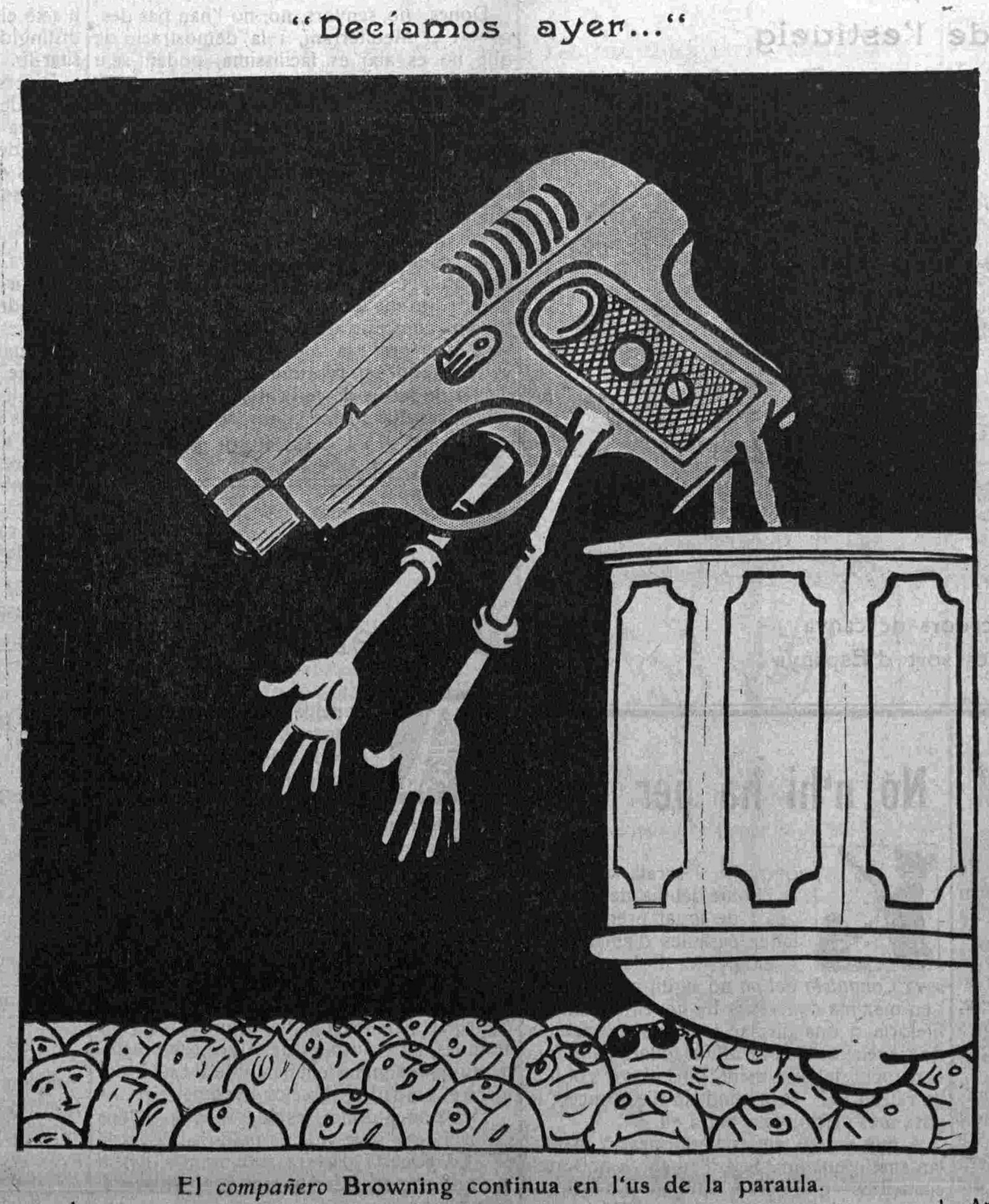
The poor performance of the organization in its early stages reflected not only the paucity of state assistance, but also the continued mass appeal of the CNT. Although their hegemony was facilitated by violence, the cenetistas continued to enjoy enormous popularity. In 1919, 895 strikes took place in Spain; in 1920, 1,060 – most led by anarcho-syndicalists.Footnote 68 In October 1920, the disheartened libreños even debated their own dissolution, but a Panglossian Ramón Sales urged them to continue.Footnote 69 The turning point came a month later, on 8 November 1920, when the hawkish General Martínez Anido was appointed Civil Governor of Barcelona with a programme for the physical extermination of the CNT. He established close relations with the CGT–USL, giving them free rein and consistent material support. The new governor operated with virtual autonomy from the central government in Madrid. Unencumbered by constitutional trappings and in league with the Barcelona garrison, the somatén, and the Employers’ Federation, Anido imposed his will ruthlessly. In the words of historian Angel Smith, under Martínez Anido “Catalonia was basically to function as an autonomous military dictatorship within the Spanish liberal state”.Footnote 70 In fact, by that time, the Spanish state was becoming increasingly disjointed. Τhe Libres struck an alliance, not with the rickety central administration in Madrid but with Civil Governor Martínez Anido and his “counterrevolutionary coalition” (Figure 3).Footnote 71 The relationship between the Libres and the powers that be was therefore not one of subservience, but rather, a strategic partnership in which they retained significant independence.
“‘As we were saying yesterday…’ Comrade Browning takes the floor again.” The struggle between the CNT and the Libres during the summer of 1920 contributed to the failure of the policy of conciliation pursued by Eduardo Dato's government. As a result, Dato eventually adopted a hard line against the CNT and appointed the hawkish General Severiano Martínez Anido as Civil Governor of Barcelona. From La Campana de Gràcia (Barcelona, 31 July 1920).
The dirty war that broke out after the creation of the new organization was waged according to the Libres’ furious anti-anarchist programme. At the same time, in the turbulent context of Barcelona any attempt to eat into the CNT's trade union base would inevitably have met armed resistance by anarchist factory organizers. In Barcelona, trade unionism was a highly militarized affair, especially after 1919.Footnote 72 What had become a proletarian turf war saw factories turned into battlefields as libreños and cenetistas brawled at factory gates or even on the shop floor itself. Caught on their own, members of one or other union were bullied and harassed by the majority. Although some attacks were carried out by well-organized hit squads of semi-professional terrorists, there were instances of spontaneous mob violence. Death threats, fist fights, and abuse against members of enemy unions were extremely common. For instance, tiler Pedro Llanentós was arrested in October 1920 “for uttering death threats” to a fellow worker “whose wife had dropped out of the red union and joined the Libres”.Footnote 73 In the Can Girona foundry, tensions ran so high that employees repeatedly exchanged shots during working hours.Footnote 74 On another occasion, “two individuals approached [worker] Juan Bardina Flores and asked him what union he belonged to. When he replied he belonged to the Único, they beat him about the head”.Footnote 75 In the Cascuberta silk factory, CNT members downed tools “refusing to work with members of the Sindicato Libre”.Footnote 76
The Libres emerged as a mass force in the course of 1921. In conspiracy with the police and the somatén, generously armed and funded by Martínez Anido, their terror campaign intensified and pushed back the CNT in many factories, allowing the new organization to fill the vacuum left by the battered anarcho-syndicalists. To some degree, the rapid expansion of the Libres resulted from the desire of many workers for a legal, reformist trade union movement to defend their day-to-day interests. Affiliation with them came with many perks, for employers were more willing to make concessions to the men of Ramón Sales. Their organization along craft lines, rather than branch of industry, appealed to skilled workers such as printers and those in textile finishing trades, who tended to dislike the centralized CNT model of the industrial Sindicato Único.Footnote 77
The CGT–USL also appealed to white-collar workers alienated by the “rabble-rousing” anti-intellectual attitudes of the CNT. “To debase the work of the intellect to a second-rate position is a thing of zealots and illiterates”, said leading libreño Augusto Lagunas.Footnote 78 On that basis, they recruited heavily among clerks, foremen, accountants, and shop assistants. It is noteworthy, however, that the main trade union of retail workers, the CADCI, where Catalan nationalists were dominant, proved impregnable to the Libres until the late 1920s.Footnote 79 Although its leaders tried to make light of their Carlist and Catholic background, they also appealed to the minority of religious workers who were antagonized by the aggressive atheism of the anarchists. “We are neutral in politics and religion”, said activist Juan Laguía, “and are respectful of the views of all our members”.Footnote 80 They also adopted an ambivalent position on national identity. While they boasted about their Spanish patriotism, their Carlist ideology was anti-centralist and had strong Catalan regionalist undercurrents. That allowed them to appeal both to Spanish nationalist sentiments and to the “idiosyncrasy of the Catalan people”.Footnote 81 In contrast to the CNT, much of their propaganda was in the Catalan language.Footnote 82
More fundamentally, the Libres offered protection to workers disenchanted with the anarcho-syndicalists and who were neglected by the state and their employers. The Catalan industrialists’ traditional lack of interest in yellow unions and the inefficiency of the Barcelona police force rendered blacklegs vulnerable to the violence of strikers and trade union militants. In the fraught conditions of 1919–1921, violent attitudes were ratcheted up to the point where the mildest forms of anti-union dissidence could incite retaliation.Footnote 83 Workers wishing to leave the CNT, or who wanted to end strikes, frequently needed armed protection.Footnote 84 The Libres stepped in as strike-breakers’ police.Footnote 85 “I am an enemy of strikes because I am a friend of the worker”, said Augusto Lagunas. He accused the CNT of launching “one strike after another with no justification, just for the sake of it”.Footnote 86 Although on certain occasions the Libres posed as defenders of blacklegs, they also proved willing to endorse industrial action when it responded to the sentiments of most of the workforce. For instance, in October 1920, they participated in the Barcelona metalworkers’ strike.Footnote 87
The CGT–USL took up (and perfected) the anarcho-syndicalist tactic of forceful unionization and collection of subscriptions. Veteran cenetista Adolfo Bueso recalled that he was given an ultimatum to join the Libres, “if in two days [you] don't get the membership card, we'll give you a card of lead”.Footnote 88 Compulsory unionization was often abetted by the employers.Footnote 89 Catalan industrialists studied and replicated the organizational effectiveness of the CNT so that they could better combat it.Footnote 90 At times, workers had no choice but to carry membership cards of both the CNT and the CGT–USL, as they were cajoled to join one of them (or both) against their will.Footnote 91
PROTO-FASCISM
The Libres would try to maintain a secular, workerist, and combative profile. Trade union independence, productivism, and patriotism, peppered with Carlist tropes, were the ideological hallmarks of the CGT–USL. The Libres affirmed that their ultimate goal was a form of communism based on “the Guild, [the basis for] the future social organization of industry”. Yet, the road to corporatist communism was to be gradual and unrevolutionary, “without calls for violence, without revolutionary and brutal ways”.Footnote 92 They justified worker demands and “accepted the existence of the class struggle” but did not seek the total destruction of “the existing order of the world” or the “paralysis” of industry.Footnote 93 Their form of Spanish nationalism was compatible with Catalan regionalist (but not secessionist or republican) sentiments. However, their multi-layered national identity was riddled with tension. Under the Primo de Rivera dictatorship, Ramón Sales drifted towards increasingly centralist positions that would pit him against the more regionalist factions in the movement.Footnote 94 In many ways, their cult of the will and of violence; their male chauvinism; their hatred of bourgeois liberalism, of anarchism and socialism; and their patriotism and corporatism, adumbrated fascism.
The Libres drew inspiration both from incipient Italian fascism and from Christian labour movements in Europe. Their name was probably borrowed from the Belgian Syndicats Libres (Free Unions), a mass Catholic organization that had been carefully studied by Father Gafo. The CGT–USL press frequently celebrated the advances of Christian labour in Germany, France, Belgium, and Austria.Footnote 95 At the same time, many libreños expressed admiration for Italian fascism. However, reactions to the March on Rome were uneven. Officially, the CGT–USL denied any fascist sympathies; in March 1923, Ramón Sales branded the Blackshirts “reactionaries”.Footnote 96 Colin Winston has taken such anti-fascist statements at face value, believing they prove that the CGT–USL “cannot be adequately described as either a Fascist or a right radical movement”.Footnote 97 However, there was a clear ideological overlap between them and the Blackshirts, and while certain libreños expressed scepticism towards fascism others, most notably Augusto Lagunas, were explicit in their praise.Footnote 98
Winston does not deny that certain features of Libre ideology were cognate with fascism. Indeed, in the years 1929–1931, the movement would move towards explicitly fascist positions.Footnote 99 However, in Winston's opinion, the absence of a powerful fascist party in Spain from 1919 to 1923 blocked an early evolution towards the far right, as occurred with pro-war, nationalist syndicalists in Italy, such as Edmondo Rossoni, Amilcare de Ambris, and Cesare Rossi.Footnote 100 By contrast, Winston claims, the Libres developed as an independent and eclectic labour movement.Footnote 101 There is little question that Libres ideology was hazier than Mussolini's, and retained vestiges of conservative Carlism. Moreover, in Italy and later in Germany with the Nazi-controlled German Labour Front, fascist trade unions were ancillary to the party and subordinate to it. Far-right organizations could not compete on the shop floor with socialists, communists, and anarcho-syndicalists. It was not the unions, but the party, with its paramilitary wing, that was the battering ram of fascism. In Barcelona, however, as Soledad Bengoechea explains, the crushing power of anarcho-syndicalism decisively shaped the tactics of its opponents, for whom the industrial front became the key locus for political investment.Footnote 102 Thus, unlike in Italy, far-right politics in Barcelona largely revolved around the trade union, and even paramilitary violence emerged as an offshoot of industrial conflict. While the tactics of fascists and libreños differed, they shared a common essence. Both represented modernization of reactionary politics, which became attuned to an urban industrial setting, embracing plebeian forms of mass mobilization and elements of anti-capitalist rhetoric in response to the rising challenge of left-dominated working-class militancy.Footnote 103
Furthermore, the sources point to a close behind-the-scenes rapport after October 1922 between the libreños and Rome. According to a confidential report by the Spanish government, which had eavesdropped on Sales's telephone conversations, the movement received the staggering sum of 500,000 pesetas from Italy in July 1923.Footnote 104 In comparison, during that same period communist-aligned unions in Biscay received the much more modest subsidy of 15,000 pesetas from Soviet Russia.Footnote 105 A few months earlier, leading libreño Juan Laguía had travelled to Italy on a political mission, officially to liaise with the popolari, Catholic trade unionists. Laguía admitted that he had entered into discussions with both the fascist labour movement and the Italian government, although he tried to insist that, “at least at the present moment we have fundamental differences of principle”.Footnote 106 However, it is likely that Laguía under emphasized the level of affinity of the Libres with Mussolini. There is little doubt that the tremendous donation they received in July was negotiated by Laguía while he was in Rome in March. In April 1923, the CNT organ Solidaridad Obrera leaked an adulatory letter sent by Laguía from Genoa in which he affirmed that “fascism is a grandiose thing”.Footnote 107 According to sources cited by Bengoechea and Del Rey, far-right army officers regarded the Sindicatos Libres as the “basis” for Spanish fascism.Footnote 108 Those officers saw Laguía's mission to Rome as an important stepping stone towards the creation of a fascist movement in Spain. All this came after Carlist claimant Don Jaime and a delegation of libreños had reportedly conferred with an Italian fascist senator in Paris.Footnote 109 Perhaps the Blackshirts regarded the Libres as supporters in their international proselytizing.Footnote 110 According to the Spanish police, in the summer of 1923, the libreños received 500,000 pesetas from Belgium, probably sent by the Catholic unions.Footnote 111 Such various international allies reveal the Libres’ two souls, halfway between fascism and conventional Christian labour.
Most remarkably, however, the Libres drew many cues from the CNT itself, where many of its founders had cut their teeth as trade union activists in 1918. The Libres’ intransigent, workerist discourse certainly owed much of its tone to that of their adversaries,Footnote 112 but in that they were no different from fascist trade unionists in Italy who had originated in the pro-war wing of revolutionary syndicalism. Some of the leading cadre of the CGT–USL claimed the mantle of revolutionary syndicalism, which, they believed, had been corrupted in Spain by anarchism. In the words of Baratech, “Spanish syndicalism is not the same thing as European syndicalism, it has rather provided a workerist disguise for anarchism”.Footnote 113 Juan Laguía meanwhile boasted: “we use the strike and the boycott against the enemy as legitimate weapons”, and affirmed that “we have purged our organization of any form of servile yellowism [amarillismo]”. Their proud “indifference to party politics” echoed the rhetoric of the anarchists.Footnote 114 Augusto Lagunas posed as “a true syndicalist” and a “true revolutionary” against the “cowardly” leaders of the CNT.Footnote 115 Lagunas even took up the cudgels for the Russian Revolution in its early years, although he gave it a spiritual, anti-Marxist interpretation.Footnote 116
In short, the ideology of the libreños was extraordinarily eclectic. It was a mishmash of inchoate fascism, Catalan Carlism, and revolutionary syndicalism. The CGT–USL is an instance of “hybridization”, where elements of “ideal-type” fascist ideology were syncretized with other political traditions.Footnote 117 In part, its eclecticism was an opportunistic attempt to cater to different audiences,Footnote 118 but it also partly reflected the evolution of Carlism, fundamentally a Catholic rural conservative movement directed against bourgeois liberalism but in a new urban industrial setting. There, it was gradually modernized and divested of its religious and agrarian components, exposed to workerist and anti-capitalist ideas and to a new proletarian and semi-proletarian social base, and was pitted in violent struggle against anarchism. The hybridity of Barcelona's Sindicatos Libres responded to the combined and uneven development of reactionary thought in Spain, where fascism emerged only haphazardly from pre-modern right-wing movements.Footnote 119 The country's neutrality during World War I also slowed down, but did not stop, the pan-European tendency for the violent radicalization of reactionary thought.Footnote 120
FALLING BETWEEN STOOLS
By late 1921, Barcelona had been largely pacified and the authorities and capitalists rejoiced at their working-class allies. In July 1922, the Libres claimed 175,000 members,Footnote 121 doubtless an exaggeration but reflecting their genuine evolution into a mass force. Even a leading cenetista admitted that numbers of Libres at the time were in the region of 100,000, a figure that included workers from a variety of trades and social backgrounds.Footnote 122 However, thanks to a number of contributing factors and not least by virtue of their very growth, the right-wing unions found themselves under pressure from below to confront the capitalists. Now that the CNT had been virtually destroyed, the cenetista bogeyman was insufficient to rally workers to the Libres and so a more positive and proactive approach was needed. At the same time, the Libres had recruited from the CNT thousands of workers who had been imbued with the truculent spirit of anarcho-syndicalism and now imported it into the Libres.Footnote 123 Moreover, the economic situation had begun to improve, encouraging workers to stand up to employers.
“Did you really think we were idiots, crooks, or sell-outs?”, the Libres warned their bosses.Footnote 124 In the spring of 1922, they launched a “great offensive”, staging important strikes that alienated many of their former patrons.Footnote 125 According to a sympathetic author, they led 500 partial conflicts during that period.Footnote 126 However, the overriding fear of the CNT now exorcized, employers began to grow sceptical of their working-class allies. The Employers’ Federation complained in August that it found itself “pinned between two fires”, that of the libreños and that of the cenetistas. “Today there are two militant syndicalisms, two proletarian forces vying for control that are targeting the bourgeoisie”, they lamented.Footnote 127 Yet, Civil Governor Martínez Anido continued to back them throughout 1922, convinced that some concessions would have to be made to the workers in the interest of genuine social peace.Footnote 128
The growing assertiveness of the Libres in 1922 and the tension between them and the capitalists reveals the difficulty of building a proletarian base for reaction in Barcelona. The reasons were structural. Lack of reliable energy sources, absence of a modern capital market, and dependence on an overwhelmingly rural Spanish internal market that fluctuated unpredictably depending on the outcome of the harvest stunted the emergence of economies of scale in Catalan industry. It remained fragmented into myriad relatively small sweatshops with narrow profit margins, where managers had little leeway to negotiate with workers. The result was explosive industrial relations, all of which helps to explain the sustained hold of anarchism over the labour movement of Barcelona. Any labour organization seeking an authentic working-class base would eventually find itself at loggerheads with the employers,Footnote 129 which is precisely what happened to the Libres in 1922.
The removal of Martínez Anido as Civil Governor in November 1922 was a blow to the CGT–USL. They lost much of their institutional support, while the CNT was given space to reorganize itself under a more congenial governor. Over the winter of 1922–1923, the Libres lost thousands of members to the anarcho-syndicalists, who, under the level-headed leadership of Salvador Seguí, had now adopted a more pragmatic stance. A number of prominent ex-cenetistas recruited by the Libres in 1920–1921 now went full circle and returned to the CNT. One such was Adolfo Domingo Calanda, secretary of the painters’ union.Footnote 130 The rapid decline of the Libres reveals the fragility of their support base.
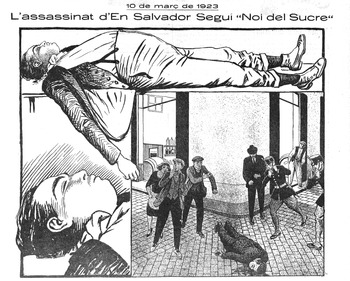
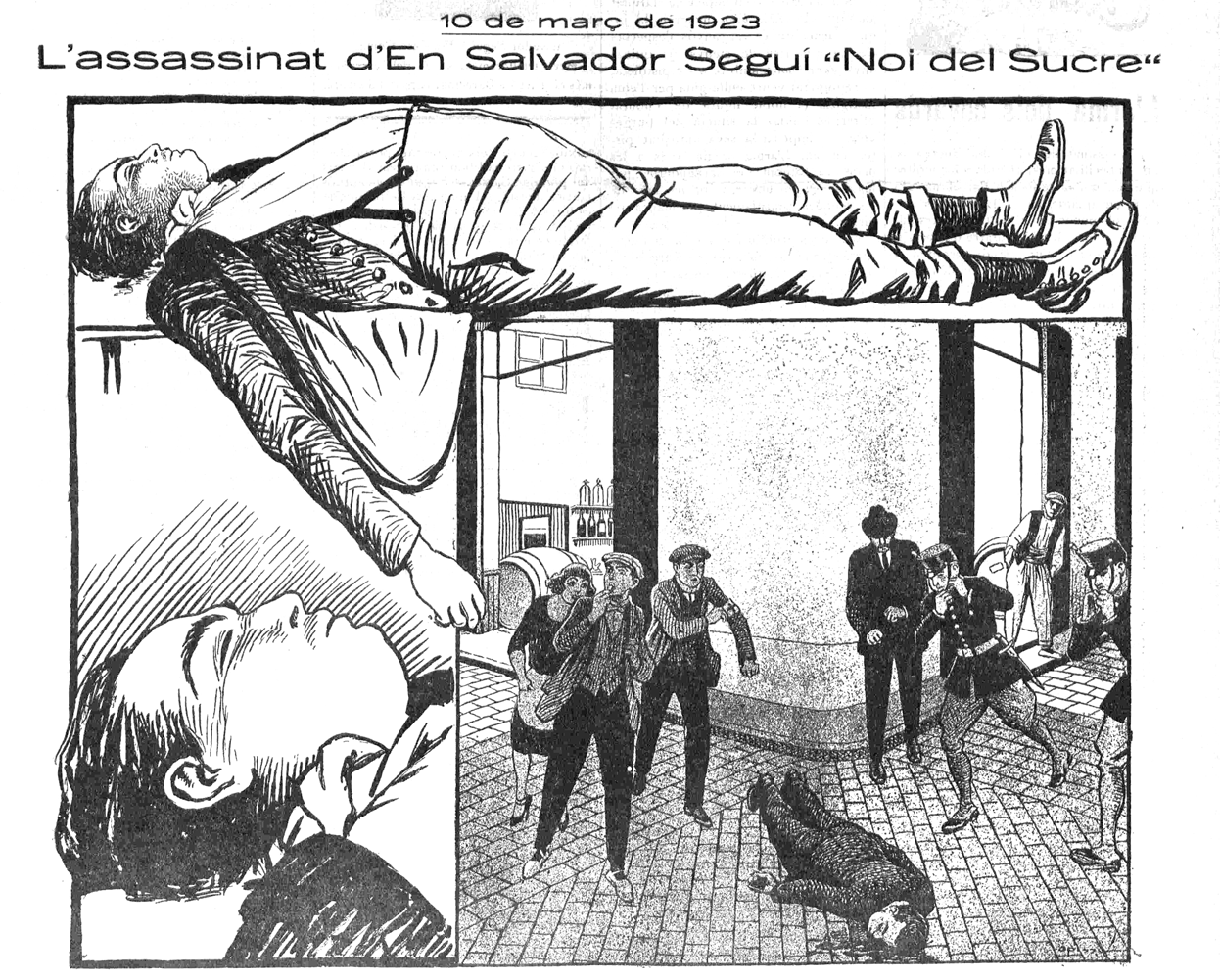
Faced with rapid decline, the libreños resumed their dirty war against the CNT in March 1923 by assassinating Seguí (Figure 4). Violence against the anarchists was combined with more aggressive trade union tactics intended to seduce CNT sympathizers. Ultimately, however, they fell between two stools, for in the eyes of most workers they were too compromised by their close connection with the military, economic, and religious establishments, while for the state, capitalists, and the most conservative sectors of the workforce the appeal of the Libres was reduced by their attempt to use militant industrial action to compete with the CNT. As the Civil Governor complained in July 1923: “The Red unions […], are frankly and fundamentally revolutionary [towards the left…]. The White unions, or Libres, are jaimistas and revolutionary towards the right. Both desire to rule the city by terror”.Footnote 131 The final debacle of the Libres came with a disastrous strike by bank clerks in Madrid in the summer of 1923. Despite generous Italian and Belgian funding, faced with the obduracy of employers, the Libres found that their lack of experienced organizers outside Catalonia left them with inadequate organization to rouse support from a reluctant rank and file. The result was a resounding defeat for the Libres.Footnote 132
“10 March 1923. The murder of Salvador Seguí, Noi del Sucre (Sugar Boy)”. Salvador Seguí was one of the most prominent victims of the war between the CNT and the Libres. His death was a severe blow for the CNT, depriving the organization of one of its most skilled and charismatic leaders. From La Campana de Gràcia (Barcelona, 17 March 1923).
Under the dictatorship of Primo de Rivera, the demise of the CGT–USL stalled but was not entirely reversed, and they were absorbed into the state-controlled trade union machinery. At the peak of their fortunes, under the dictatorship, they claimed almost 200,000 members, but the forces the Libres had managed to muster under the regime's protection were rapidly lost after the fall of de Rivera in 1930 and the rapid resurgence of the CNT. From 1929 to 1931, their rhetoric veered to the right and acquired an overtly fascist timbre. As the 1930s wore on, most Libre activists gravitated towards far-right groups, and then, in 1935, Sales relaunched the Sindicatos Libres, although, in Winston's words, they abandoned “pretensions to serious syndical activity, [and] the union became totally politicized”.Footnote 133 Although anarcho-syndicalist hegemony over Catalan organized labour was contested at the time, competition came not from the libreños, but from the communist and Social Democratic left.Footnote 134 On the eve of the Spanish civil war, the Libres were active in the civilian wing of Franco's Movimiento. In Republican-controlled areas they were brutally repressed after the failure of the putsch.
CONCLUSION
The spectacular rise and fall of the Libres in Barcelona in 1919–1923 reveals the difficulties of building a conservative labour movement in the explosive Catalan milieu. The emergence of the Libres as a mass force in the winter of 1921–1922 would have been impossible without both the violent destruction of their anarchist adversary and the substantial, though irregular, state backing they enjoyed. While they had genuine support among the working class, this owed more to rejection of the extremist tactics of the CNT in 1919–1920 than to any positive endorsement of their own reactionary agenda. The Libres unseated the CNT from its position at the helm of the Catalan working class through violence, but, having taken its place and wishing to consolidate their power, the Libres found themselves under similar pressure to adopt an equally militant trade union strategy. In the course of 1922, the Libres’ aggressive strike activity both alienated their conservative backers and failed to garner any real popularity among most workers. When, in late 1922, the CNT was given breathing space, it rose phoenix-like from its own ashes and largely displaced the Libres until the beginning of the Primo de Rivera dictatorship.
Labour historians today often emphasize that the continued success of the CNT in Catalonia owed its effectiveness to its fight for bread-and-butter demands, rather than to support for its libertarian ideas. Its relatively small cadre of activists might have been motivated by anarchism, but to the mass of its members such ideology was largely unimportant.Footnote 135 Arguably, a similar utilitarian argument may be applied to the Libres. Many former cenetistas joined them because they saw the Libres as an instrument to improve wages and conditions, without sharing the Carlist outlook of the leaders. At the same time, the example of the CGT–USL also helps qualify this (broadly correct) utilitarian paradigm. The transfer of workers from the CNT to the Libres was noticeable but, overall, limited. At the peak of its fortunes, in December 1919, the CNT claimed 790,948 members; the Libres, at its zenith, in July 1922 before the dictatorship, could boast only 175,000. This indicates that only a small minority of cenetistas defected to the CGT–USL, despite the patronage of the state and employers. Under Primo de Rivera, the Libres claimed a maximum of 200,000 members across all of Spain – an unimpressive figure considering that the CNT had been virtually destroyed by the regime. In fact, the real beneficiary of the debacle of anarcho-syndicalism during the dictatorship was the Social Democratic UGT, which collaborated with the authorities and by the late 1920s could boast almost 300,000 members.Footnote 136
It may be argued that, by dint of their greater combativeness, left-wing trade unions saw more of their economic demands bear fruit. But there is no automatic firewall between utilitarianism and idealism. The belief that the CNT and the UGT were more effective than the Libres in confronting employers could easily acquire an ideological subtext and solidify into conscious loyalty to a particular organization or political tendency. Although most Catalan workers were essentially pragmatic in their trade union affiliation, their choices were underpinned by a hazy sympathy for anarchism (or left-wing politics) that had been cemented by decades of industrial conflict and exposure to anarcho-syndicalist propaganda.
It should be noted that the impression that ordinary workers were fundamentally unrevolutionary and interested primarily in piecemeal reform is also inaccurate. The case study of Barcelona in 1919–1923 reveals that the views of workers might fluctuate sharply, with the same individuals swinging from conservatism to militancy – and back. Yet, a combative predisposition could not endure indefinitely, and after prolonged conflict exhaustion and demoralization set in. The fluctuations were, in turn, shaped by cultural and economic divisions among the working class, between skilled and unskilled, white collar and blue collar, the religious and the irreligious, and, perhaps most importantly, the youth and the older generations. While building a revolutionary alliance among the city's heterogeneous working class proved difficult, establishing a lasting, mass reactionary movement among its ranks turned out to be quite impossible. As an ILO report sagely predicted in late 1920, the Libres “have been born out of extraordinary circumstances […] once these circumstances change, they will disappear”.Footnote 137
The CGT–USL is also a case study of the modernization of the right's repertoire of action. Although a leaven of Italian ideological yeast was important for the raising of fully fledged fascist movements across Europe in the 1920–1930s, it found plenty of dough among radicalized factions of pre-existing reactionary movements, such as the working-class Carlists of Barcelona. By adopting elements of syndicalist tactics and ideas, Carlists expanded their influence and mobilizing power, although their ideology failed to percolate fully through the working class. As social polarization intensified in the 1930s, the Sindicatos Libres swung further rightwards. But as its ideology hardened and became more articulate, and evolved towards unadulterated fascism, its social base narrowed dramatically.