





Introduction
Delaying cover crop termination until at or after cash crop planting, referred to as “planting green” (Reed et al. Reference Reed, Karsten, Curran, Tooker and Duiker2019), is an emerging practice in conservation agriculture that can improve weed-suppression potential due to extended plant competition and greater biomass accumulation (Ficks et al. Reference Ficks, Karsten and Wallace2023; Grint et al. Reference Grint, Arneson, Arriaga, DeWerff, Oliveira, Smith, Stoltenberg and Werle2022; Nunes et al. Reference Nunes, Wallace, Arneson, Johnson, Young, Norsworthy, Ikley, Gage, Bradley, Jha, Lancaster, Kumar, Legleiter and Werle2024). Planting green is also likely to mediate the fate of herbicides that provide soil-residual activity due to cover crop effects on herbicide interception, in planta degradation, sorption and desorption, leaching, and soil microbe–mediated degradation in no-till production systems (Alletto et al. Reference Alletto, Coquet, Benoit, Heddadj and Barriuso2010; Locke and Bryson Reference Locke and Bryson1997). In a planting green scenario, increased cover crop biomass production at the time of herbicide application is known to significantly increase interception of soil-residual herbicides (Maia et al. Reference Maia, Armstrong, Kladivko, Young and Johnson2025; Nunes et al. Reference Nunes, Arneson, Wallace, Gage, Miller, Lancaster, Mueller and Werle2023a, Reference Nunes, Wallace, Arneson, Johnson, Young, Norsworthy, Ikley, Gage, Bradley, Jha, Lancaster, Kumar, Legleiter and Werle2024; Smith et al. Reference Smith, Brunharo, Elkin, Flessner, VanGessel and Wallace2025). However, there is limited knowledge of how the interaction between physiochemical properties of cover crops and sorption properties of herbicides influence the wash-off potential of residual herbicides from living cover crops and aged cover crop residues.
The amount of herbicide that is intercepted and then subsequently washed off from crop residues is influenced by (1) the mass, orientation, and physiochemical properties of cover crops at the time of herbicide application; (2) the sorption properties of the herbicide; and (3) the timing, frequency, and quantity of rainfall relative to herbicide application timing (Alletto et al. Reference Alletto, Coquet, Benoit, Heddadj and Barriuso2010; Khalil et al. Reference Khalil, Flower, Siddique and Ward2018, Reference Khalil, Flower, Siddique and Ward2019). Interception rates can exceed 50% as cover crop biomass production approaches 5 Mg ha−1 (Nunes et al. Reference Nunes, Arneson, Wallace, Gage, Miller, Lancaster, Mueller and Werle2023a; Smith et al. Reference Smith, Brunharo, Elkin, Flessner, VanGessel and Wallace2025), which is often referenced as a biomass target associated with enhanced weed-suppression potential of cover crop surface residues (Nichols et al. Reference Nichols, Martinez-Feria, Weisberger, Carlson, Basso and Basche2020; Weisberger et al. Reference Weisberger, Bastos, Sykes and Basinger2023). Roll-crimping or mowing residue stubble can further increase herbicide interception rates relative to leaving crops standing (Nunes et al. Reference Nunes, Arneson, DeWerff, Ruark, Conley, Smith and Werle2023b; Smith et al. Reference Smith, Brunharo, Elkin, Flessner, VanGessel and Wallace2025). Consequently, cover crop management practices that result in high biomass surface residues rely on rainfall to transport herbicides to soil.
In planting green management scenarios, co-application of soil-residual herbicides with herbicides used to terminate cover crops at or shortly after cash crop planting is a common practice. Several herbicide modes of action commonly used in preemergence programs to provide soil-residual weed control contain active ingredients that also display postemergence foliar activity, such as inhibitors of photosystem II, hydroxyphenyl-pyruvate dioxygenase, protoporphyrinogen oxidase, and acetolactate synthase. Consequently, it is likely that when these herbicides are applied into a living cover crop, a proportion of intercepted spray will be unavailable for wash-off to the soil surface due to foliar uptake and translocation to their molecular targets (Krähmer et al. Reference Krähmer, Walter, Jeschke, Haaf, Baur and Evans2021). In comparison, chloroacetamides (very-long-chain fatty acid-inhibitors) and dinitroanilines (microtubule assembly inhibitors) are nonpolar herbicides commonly used in corn (Zea mays L.) and soybean [Glycine max (L.) Merr.] that provide only soil-residual activity but are readily absorbed across plant cuticles, which can limit desorption and wash-off via rainfall if intercepted by living foliage (Krutz et al. Reference Krutz, Koger, Locke and Steinriede2007). Absorption and desorption rates in living foliage are likely to be a function of a herbicide’s lipophilicity (log K ow) and acid strength (pKa), which mediate diffusion or active transport across lipophilic membranes (Takano et al. Reference Takono, Patterson, Nissen, Dayan and Gaines2019). As a function of lipophilicity, permeation rates through plasma membranes may result in a bell-shaped pattern, with peak permeation rates observed at intermediate log K ow values (1 to 3) and lower rates observed for less lipophilic (<1) or more lipophilic (>3) herbicides (Bromilow et al. Reference Bromilow, Chamberlain and Evans1990).
Several commonly used herbicides that also provide soil-residual activity have a long application window relative to cash crop growth stages, which allows for their use in preemergence and postemergence herbicide programs to provide overlapping residual activity for control of weed species that have prolonged emergence windows (Chahal et al. Reference Chahal, Ganie and Jhala2018; Sarangi and Jhala Reference Sarangi and Jhala2019). As a result, these herbicides may be applied at various stages of cover crop decomposition (i.e., aged residues) when integrated in planting green systems. In general, herbicide sorption capacity is higher on decomposing crop residues compared with soil due to higher organic carbon content and external surface area, which can result in adsorption to exposed chemical functional groups (Gaston et al. Reference Gaston, Boquet and Bosch2001; Reddy et al. Reference Reddy, Locke, Wagner, Zablotowicz, Gaston and Smeda1995) or absorption into decomposing plant tissues (Dao Reference Dao1991). Controlled studies that have aimed to model herbicide sorption potential suggest that sorption capacity is most strongly correlated with lignin and neutral detergent fiber fractions of residues (Aslam et al. Reference Aslam, Garnier, Rumpel, Parent and Benoit2013). Herbicide absorption inside decomposing cover crop tissue can lead to physical entrapment within cell wall structures, such as cellulose microfibrils embedded in a lignin–hemicellulose matrix, resulting in a non-extractable fraction during desorption processes (Dao Reference Dao1991). Previous studies have demonstrated that the effect of residue decomposition on herbicide sorption and desorption via wash-off varies among herbicide active ingredients (Aslam et al. Reference Aslam, Garnier, Rumpel, Parent and Benoit2013; Cassigneul et al. Reference Cassigneul, Alletto, Benoit, Bergheaud, Etievant, Dumeny, Le Gac, Chuette and Rumpel2015).
The relative effects of precipitation timing, frequency, and amount on herbicide washoff potential also vary based on herbicide properties. For example, Khalil et al. (Reference Khalil, Flower, Siddique and Ward2019) found that a onetime rainfall event less than 1 d after application of pyroxasulfone to wheat (Triticum aestivum L.) residue maximized wash-off, but the amount and duration of rainfall had limited impact. Wash-off of S-metolachlor from aged wheat residues has been found to be more limited than acetochlor wash-off, which is attributed to comparatively greater sorption capacity (Banks and Robinson Reference Banks and Robinson1986).
In this study, we aim to quantify the interactive effects between living or aged cereal rye (Secale cereale, L.) and herbicide lipophilicity (K ow) on herbicide wash-off potential. Cereal rye is a commonly used cover crop species in planting green systems (Reed et al. Reference Reed, Karsten, Curran, Tooker and Duiker2019). Our study builds on previous field experiments that evaluated the effect of planting green management tactics on the relationship between interception and wash-off rates from cover crop residues using a single active ingredient, pyroxasulfone (Smith et al. Reference Smith, Brunharo, Elkin, Flessner, VanGessel and Wallace2025). We hypothesized that wash-off potential from living and aged cereal rye residues would be a function of herbicide lipophilicity, measured as log K ow at pH 7, with greater wash-off potential observed in herbicides with intermediate polarity (log K ow 1 to 3). In addition, we hypothesized that wash-off potential would decline as cereal rye residues aged because of greater availability of lignin to interact with herbicides, but the magnitude of change would vary by herbicide active ingredient.
Materials and Methods
A field experiment was conducted in 2022 at the Pennsylvania State University Russell E. Larson Agricultural Research Center (RELARC) near Rock Springs, PA, and was replicated in 2023. In each year, the soil texture consisted of Hagerstown silt loam (fine, mixed, semiactive, mesic Typic Hapludalfs). Cereal rye was established in the fall preceding each experimental growing season using a no-till grain drill (Great Plains, Salina, KS, USA) with a seeding rate of 67 kg ha−1.
Planting Green Wash-Off Assay
The experimental design was a two-factor complete block arranged in a split-plot treatment structure with four replicates. Main plots were cover crop management strategy with two treatment levels and split plots were residual herbicide active ingredient with six treatment levels. Main plots included cereal rye (1) left standing or (2) roll-crimped just before termination at the anthesis stage (Zadoks 69; Zadoks et al. Reference Zadoks, Chang and Konzak1974). This treatment comparison was included in the experimental design because residue management is often limited by equipment availability (i.e., roller-crimper implements), resulting in planting green scenarios where cover crops are left standing at the time of residual herbicide applications (Sias et al. Reference Sias, Bamber and Flessner2024; Wallace et al. Reference Wallace, Mazzone and Larson2023). Roll-crimping treatments were imposed with a front-mounted 3-m roll-crimper (I&J Manufacturing, Gordonville, PA, USA) 4 h before herbicide treatments.
Split-plot treatments included residual herbicides that differed in lipophilicity and ionic charge and were applied at standard labeled rates for medium-textured soils, including mesotrione (Callisto®, Syngenta Crop Protection, Greensboro, NC, USA), pyroxasulfone (Zidua® SC, BASF, Research Triangle Park, NC, USA), atrazine (Aatrex® 4L, Syngenta Crop Protection), S-metolachlor (Dual II Magnum®, Syngenta Crop Protection), pendimethalin (Prowl H2O®, BASF), and an untreated control (UTC; Table 1). Each residual herbicide application was applied with glyphosate (Roundup PowerMax®, Bayer CropScience, St Louis, MO, USA) at 1.27 kg ae ha−1, ammonium sulfate (2.5% v/v), and a non-ionic surfactant (0.25% v/v) to terminate the cereal rye, thereby simulating a planting green scenario in which preemergence herbicides are tank mixed with a foliar product necessary to terminate (kill) cereal rye. Split-plot size was 3 by 6 m in 2022 and 3 by 9 m in 2023. Herbicides were applied using a CO2-pressurized backpack sprayer and 3-m boom designed with 51-cm spacing, equipped with 110015 AIXR (TeeJet®, Spraying Systems, Wheaton, IL, USA) nozzles, and a carrier rate of 140 L ha−1 to simulate common application parameters.
Product, application rate, and properties of herbicide treatments in planting green and aged residue wash-off assays.

a Application rates based on label recommendations for soil texture.
b Shaner (Reference Shaner2014).
Cover crop biomass was sampled 4 h after herbicide application by harvesting a 45-cm length of row in two adjacent cereal rye rows, resulting in a sample area of 0.17 m2 per plot. The fresh sample was weighed and divided by 14 to reach equivalent biomass per area for Buchner funnels (0.012 m2) that were employed for subsequent wash-off assays. To reach the target sample weight, cereal rye samples were cut into 7.6-cm-long pieces and assembled with equal representation of leaf, stem, and seedhead. Samples were stored in the cooler (4 C) and under dark conditions for 20 h.
Wash-off assays were initiated 24 h after application by placing samples in Buchner funnels with a 500-ml bottle placed below each funnel to collect wash-off from simulated rainfall. The rainfall simulator applied 19.0 mm of simulated precipitation over the course of 25 min using cone-shaped irrigation nozzles. We chose this rainfall target (19 mm) because it is generally recognized as the amount needed to incorporate most soil-residual herbicides into soil so they become available for plant uptake in soil water.
Each 500-ml bottle was collected when the targeted volume had been reached, transferred from 500-ml to 250-ml bottles to reduce headspace, and then placed in a −7 C freezer to minimize enzymatic herbicide degradation. A 1-ml sample of solution from each water sample using a 0.45-µm filter and was then expelled in a 1.5-ml glass vial.
Aged Residue Wash-Off Assay
Wash-off assays from aged surface residues were conducted with use of the roll-crimping and UTC herbicide treatment combination in the field experiment described previously. The assay was designed as a two-factor complete block imposed using a split-plot treatment structure with four replicates. The main plot factor was cereal rye decomposition stage with four treatment levels, including (1) 0 d after termination (DAT), (2) 14 DAT, (3) 42 DAT, and (4) 84 DAT, which is a range previously used in studies measuring herbicide fate as a function of residue age (Aslam et al. Reference Aslam, Iqbal, Deschamps, Recous, Garnier and Benoit2015). The split-plot factor was residual herbicide treatment with five treatment levels (Table 1), including (1) mesotrione, (2) pyroxasulfone, (3) atrazine, (4) S-metolachlor, and (5) pendimethalin.
Cereal rye was collected from roll-crimped plots receiving no soil-activated residual herbicide (UTC) approximately 4 h after roll crimping by harvesting a 45-cm length of row from two rows. Samples were then placed into a 50 by 25 cm decomposition bag. Eight decomposition bags were prepared for each treatment replicate and secured to the soil surface using landscape staples in the same area the biomass sample was taken from. Two bags were collected at each decomposition stage (0, 14, 42, and 84 DAT) and replicate block, placed in a dryer for 3 d at 65 C, and then stored at room temperature.
After collection of all decomposition bags, paired samples were homogenized. The remaining biomass was weighed and divided into 14 subsamples consisting of equal portions (7.6-cm length) of leaf, stem, and seedhead. To adjust for mass loss of the biomass from decomposition during the growing season, biomass samples were adjusted to the amount present at the lowest amount (84 DAT). Standardizing biomass levels across decomposition stages isolates treatments effects on interactions between herbicide properties and lignin (%) of the cereal rye residue. Following preparation of experimental units, cereal rye samples were fully submerged in deionized water for 24 h for the rehydration of the biomass. The samples were then emptied into trays composed of hardware cloth that were equal to the area of the Buchner funnel. Biomass samples were allowed to drip dry for 30 min before herbicide treatment application. Khalil et al. (Reference Khalil, Flower, Siddique and Ward2018) reported that the effect of initial moisture level of aged residues on wash-off potential varied by herbicide, where wet residues reduced wash-off potential for herbicides with greater lipophilicity (i.e., trifluralin) but had limited effects on wash-off potential of pyroxasulfone when compared with dry residues. Given the climate and rainfall patterns in the Mid-Atlantic region in late spring, we judged that cover crop residues would likely contain some soil moisture at the time of residual herbicide application under field conditions and thus chose to rehydrate aged residue samples.
Herbicide treatments, sample preparation, and simulated rainfall procedures were completed in adjacent laboratory and greenhouse facilities at Penn State University. Herbicide treatments were applied using a laboratory-based pneumatic track sprayer with a carrier rate of 140 L ha−1 equipped with TeeJet® 110015 AIXRE nozzles. Sprayed trays were then placed in a dark growth chamber at 5 C and a relative humidity of 85% to reduce moisture loss. Biomass samples were removed from the trays and placed in Buchner funnels 24 h after the herbicide treatment, with 500-ml bottles located beneath each funnel, and arranged on greenhouse benches by randomizing treatments within each experimental block (replicate). Simulated rainfall (19.0 mm) was applied using overhead JetRain (Dramm Corporation, Manitowoc WI) nozzles, which was achieved over a 35-min period. A 1-ml subsample was extracted from each water sample using 0.45-µm filters and expelled into a 1.5 ml glass vial.
Lignin (%) in Aged Cereal Rye Residue
An oven-dried 10 g subsample of equal part leaf, head, and stem was taken from each block, decomposition level, and year. Subsamples were ground and sent to Cumberland Valley (Waynesboro, PA) Analytical Services for analysis. Near-infrared wet chemistry was used to quantify lignin content, which was expressed as the percentage of mass.
Herbicide Detection in Water
Preliminary experiments showed that water samples contained high enough concentrations to be detected using high-performance liquid chromatography. Preliminary tests were also conducted with known concentrations of each herbicide standard using different solvents (acetone, methanol) to observe the differences in percentage recovery. Acetone (Fisher Scientific, Waltham, MA, USA) optimized herbicide recovery among test herbicides. Herbicide concentrations were quantified using a Dionex™ ICS-6000+ HPIC™ System (ThermoFisher, Sunnyvale, CA, USA) coupled with a Q Exactive Orbitrap™ mass spectrometer (ThermoFisher, Bremen, Germany) through heated electrospray ionization in positive ion mode at the USDA-ARS Pasture Systems and Watershed Management facility in University Park, PA. The limit of detection (LOD) was 1 µg L−1, whereas the limit of quantification (LOQ) was 2 µg L−1. First- and second-order metabolites were not quantified.
Statistical Analysis
Wash-off data for both planting green and aged residue assays were expressed as a proportion of total recovery from water samples in which herbicide active ingredients were added at a volume equivalent to the standard rate applied within the sample area of Buchner funnels. Wash-off data from planting green and aged residue assays were analyzed separately using generalized linear mixed-effects models (GLMMs) with a beta distribution (glmmTMB package; Brooks et al. Reference Brooks, Kristensen, van Benthem, Magnusson, Berg, Nielsen, Skaug, Maechler and Bolker2017) in R (R Core Team 2021). Use of a beta distribution within GLMMs allows for analysis of continuous proportion data using the original scale, thereby producing less-biased estimates relative to transformation-based statistical approaches (Douma and Weedon Reference Douma and Weedon2019).
Based on preliminary analysis of the planting green assay, we concluded that the range of cereal rye biomass levels within each site-year was insufficient for regression analysis. Therefore, wash-off data were analyzed using cover crop treatment (n = 2; CC), herbicide (n = 5), and their interaction as fixed effects, excluding the UTC treatment. Wash-off and lignin (%) data from aged residue assays were analyzed using decomposition stage (n = 4), herbicide (n = 5), and their interaction as fixed effects. We also constructed analysis of covariance (ANCOVA) models using herbicide, lignin (%), and their interaction as predictors of wash-off proportion. Year, block nested within year, and main plots nested within block were fit as random effects for ANOVA models. Year was fit as a random effect for ANCOVA models. The significance of fixed effects in all models was evaluated using log-likelihood ratio tests (Wald χ2) to compare full versus reduced models using the anova function. Pairwise comparisons at either the main effect level or interaction level for ANOVA models were conducted using Tukey’s contrasts within the emmeans function (Lenth Reference Lenth2025).
Results and Discussion
Herbicide Wash-Off in a Planting Green Scenario
Mean cereal rye biomass at the time of termination and residual herbicide application was 5.1 ± 2.1 Mg ha−1 in 2022 and 4.9 ± 2.6 Mg ha−1 in 2023. Therefore, cereal rye performance was representative of biomass production targets that have been associated with meaningful weed-suppression benefits (Nichols et al. Reference Nichols, Martinez-Feria, Weisberger, Carlson, Basso and Basche2020; Weisberger et al. Reference Weisberger, Bastos, Sykes and Basinger2023) as well as significant levels (>50%) of herbicide interception (Nunes et al. Reference Nunes, Arneson, DeWerff, Ruark, Conley, Smith and Werle2023b; Smith et al. Reference Smith, Brunharo, Elkin, Flessner, VanGessel and Wallace2025).
Herbicide (χ2 = 73.6; P < 0.001) and cover crop management (χ2 = 5.7; P = 0.02) influenced wash-off, but no interaction was detected. Wash-off from pyroxasulfone and atrazine, which have intermediate log K ow values, was greater than for other herbicide treatments (Figure 1A). Wash-off was lower for S-metolachlor than mesotrione. Wash-off of pendimethalin was lower than for all other herbicide treatments.
Effect of (A) herbicide and (B) herbicide by residue management interactions on wash-off proportion from assays conducted 1 day after herbicide treatment using a simulated, onetime rainfall (19.0-mm) event. Estimated marginal means and 95% confidence intervals are plotted over raw data. Means with the same letter are not statistically different (P > 0.05) based on Tukey’s contrast. Abbreviations: MESO, mesotrione; PYRO, pyroxasulfone; ATZ, atrazine; SMOC, S-metolachlor; PEND, pendimethalin.

Residual herbicides applied into roll-crimped cereal rye residue resulted in greater wash-off compared with standing cereal rye, with similar patterns found among herbicides within residue management treatments (Figure 1B). Although not measured in this study, it is likely that roll-crimped cover crops resulted in higher herbicide interception rates in comparison to standing cover crops and therefore had greater wash-off potential (Nunes et al. Reference Nunes, Arneson, DeWerff, Ruark, Conley, Smith and Werle2023b; Smith et al. Reference Smith, Brunharo, Elkin, Flessner, VanGessel and Wallace2025).
Our results suggest that herbicide lipophilicity (log K ow) may be a useful indicator of wash-off potential in planting green scenarios, where herbicides with intermediate log K ow values (1 to 3) have greater wash-off potential from living plants than more (>3 K ow) or less (<1 K ow) lipophilic herbicides. Patterns observed in our herbicide wash-off assay results are supported by less manipulated experiments conducted in the field. In a multiregional study, Nunes et al. (Reference Nunes, Arneson, Wallace, Gage, Miller, Lancaster, Mueller and Werle2023a) found that pyroxasulfone and flumioxazin soil concentrations were higher at 7 d after application than at 1 d after application in planting green scenarios within some site-years, which may be attributed to wash-off events that moved herbicide that was first intercepted by cereal rye surface residue to the soil surface. Pyroxasulfone and flumioxazin have comparable lipophilicity (2.39 to 2.55 log K ow) and water solubility (<5 mg L−1) properties. In a similar study, we detected observable levels (∼15% of applied dose) of pyroxasulfone that could be attributed to wash-off from cereal rye or rye–legume cover crop residues after cumulation of 12.5 mm of precipitation when applied into 5 Mg ha−1 of living cereal rye that was either roll-crimped or left standing (Smith et al. Reference Smith, Brunharo, Elkin, Flessner, VanGessel and Wallace2025).
Herbicide Wash-off from Aged Cereal Rye Residues
In 2022, mean cereal rye surface mass at the time of termination (0 DAT) was 5.1 Mg ha−1, and mass loss was 21%, 23%, and 46% at 14, 42, and 84 DAT, respectively. In 2023, mean cereal rye surface mass was 4.9 Mg ha−1 at the time of termination (0 DAT), and mass loss was 11%, 16%, and 51% at 14, 42, and 84 DAT, respectively. The percentage of lignin in cereal rye residues differed by decomposition stage (χ2 = 63.3; P < 0.001), but the rank order of treatments differed by year (χ2 = 8.3; P = 0.03; Table 2). In 2022, lignin (%) did not differ between 0 and 42 DAT, but significantly increased at 84 DAT. A similar trend was observed in 2023, where lignin (%) did not differ between 0 and 14 DAT, but then increased at 42 and 84 DAT.
Effect of cereal rye surface residue aging on lignin (%) by experimental year.

a Residues were aged using decomposition bag assays with four timings (0, 14, 42, 84 d after termination [DAT]), which correspond to potential herbicide application timings within field crop production systems.
b Data are estimated marginal means (95% confidence interval). Means followed by the same letter within experimental year are not significantly different (P > 0.05; Tukey’s honest significant difference).
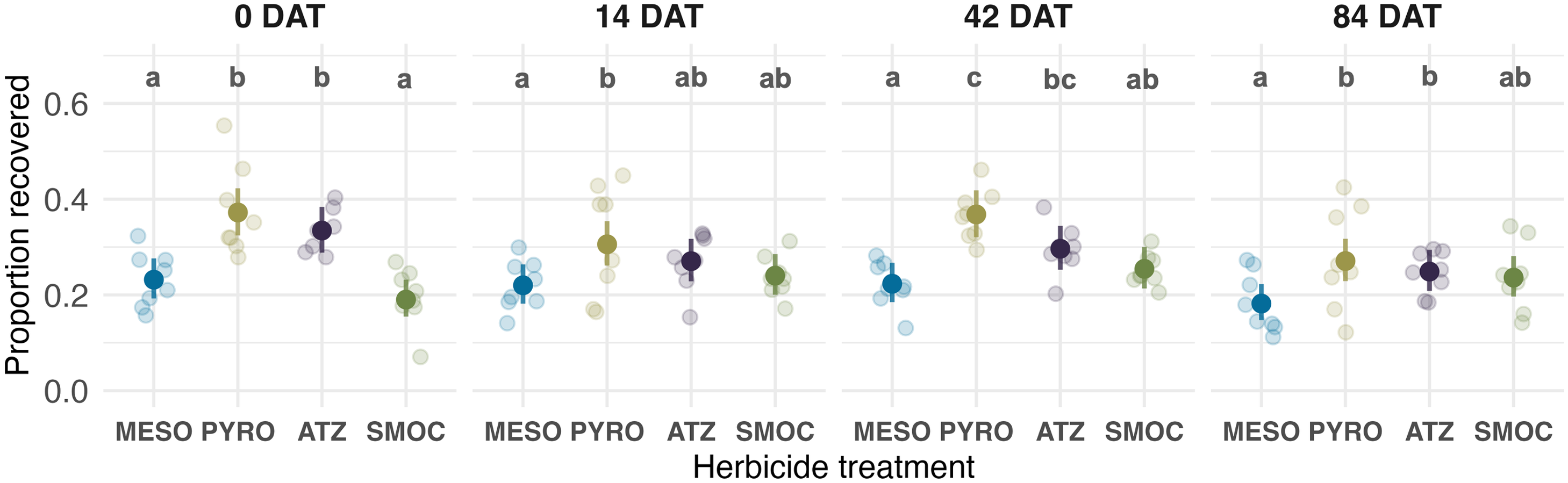
In both experimental years, recovery of pendimethalin in wash-off assays was below the quantification limit (0.02 µg L−1) and thus was excluded from model fitting. A significant interaction between herbicide treatment and cereal rye decomposition stage was observed in analysis of wash-off proportion (χ2 = 9.5; P = 0.02; Figure 2). A similar pattern was observed among herbicide treatment effects, but the rank order of treatments differed among decomposition stage (DAT). Higher levels of wash-off were observed in pyroxasulfone and atrazine treatments, which did not differ in comparison at each decomposition stage. Lower levels of wash-off were observed in mesotrione and S-metolachlor treatments, which did not differ in comparison at each decomposition stage. Pyroxasulfone wash-off was greater than mesotrione wash-off at each decomposition stage and was greater than S-metolachlor wash-off at 0 and 42 DAT. Atrazine wash-off was greater than mesotrione wash-off at 0, 42, and 84 DAT.
Effect of herbicide treatment by cereal rye residue age (0, 14, 42 and 84 d after termination [DAT]) on the proportion of herbicide recovered in wash-off assay using a simulated onetime rainfall (19-mm) event. Estimated marginal means and 95% confidence intervals are plotted over raw data. Means with the same letter are not statistically different (P > 0.05) based on Tukey’s contrast within residue age treatments (panels). Abbreviations: MESO, mesotrione; PYRO, pyroxasulfone; ATZ, atrazine; SMOC, S-metolachlor; PEND, pendimethalin.

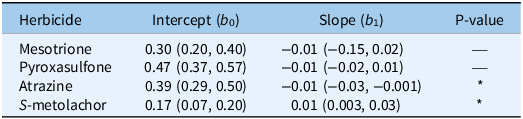
The relationship between cereal rye residue lignin (%) and wash-off differed by herbicide treatment (χ2 = 9.5; P = 0.02; Figure 3). Wash-off was negatively correlated with lignin (%) for mesotrione, pyroxasulfone, and atrazine. Slope coefficients did not differ among these herbicides, although due to differences in variance estimates, only atrazine resulted in a slope coefficient that was significantly different than zero (Table 3). In comparison, wash-off was positively correlated with lignin (%) based on fitted estimates for S-metolachlor, which was significantly different than zero. Inspection of model fits indicate that the greatest differences in wash-off among herbicides occurred at lower lignin levels (Figure 3), which correspond to fresh residues collected earlier in growing season.
Linear relationship between lignin (%) in aged cereal rye residues and the proportion of herbicide recovered in wash-off assays using a simulated onetime rainfall (19.0-mm) event. Models were fit for mesotrione (y = 0.3 – 0.01x), pyroxasulfone (y = 0.47 – 0.01x), atrazine (y = 0.39 – 0.01x), and S-metolachlor (y = 0.17 + 0.01x). Models and 95% prediction intervals (shaded band) are plotted over raw data.

Analysis of covariance (ANCOVA) results relating proportion of herbicide recovered in wash-off as a function of cereal rye residue lignin (%) by herbicide. a

a Coefficients are population-level estimates from fitted model presented with 95% confidence intervals (Wald’s Chi-Square Test). Slope coefficients followed by significant P-values (*P < 0.05) indicate statistical difference from zero (i.e., linear relationship).
Our results suggest that herbicide sorption properties have a comparatively greater effect on wash-off potential than the lignin (%) found in aged cereal rye residues within herbicide application windows in no-till production systems. The lignin (%) and decomposition rate of cereal rye observed in our study are similar to what was reported in previous studies of crop residue decomposition in which changes in herbicide sorption were documented. For example, lignin (%) within maize residue increased from 9% to 14% from 0 to 84 d in both low- and high-rainfall scenarios (Aslam et al. Reference Aslam, Iqbal, Deschamps, Recous, Garnier and Benoit2015). The moderate changes in wash-off potential across aged residues in our study may be attributed, in part, to our management scenario in which cereal rye was terminated at advanced growth stages. Decomposition rates vary based on interactions between intrinsic (soil, weather) and extrinsic (management) factors (Thapa et al. Reference Thapa, Tully, Reberg-Horton, Cabrera, Davis, Fleisher, Gaskin, Hitchcock, Poncet, Schomberg, Seehaver, Timlin and Mirsky2022). Managing cereal rye for high biomass (∼ 5 Mg ha−1) and advanced growth stages (i.e., anthesis) results in increased surface residue mass, as well as increased C:N, residue holo-cellulose concentration, and lignin:N compared with earlier termination or use of grass–legume mixtures (Finney et al. Reference Finney, White and Kaye2016; Pittman et al. Reference Pittman, Barney and Flessner2020). Decomposition rates would also likely increase in planting green systems within more southern latitudes in temperate regions, because relative humidity and number of rainy days are intrinsic factors that are positively correlated with cover crop decomposition rates (Thapa et al. Reference Thapa, Tully, Reberg-Horton, Cabrera, Davis, Fleisher, Gaskin, Hitchcock, Poncet, Schomberg, Seehaver, Timlin and Mirsky2022).
Our results are partially supported by previous field studies that have assessed herbicide sorption and wash-off from maize or small grain crop residues. For example, Khalil et al. (Reference Khalil, Flower, Siddique and Ward2018) found that the effect of wheat residue age on interception and wash-off potential of pyroxasulfone was small and variable relative to the effects of residue mass. Khalil et al. (Reference Khalil, Flower, Siddique and Ward2019) also found that an early (1 d after application) onetime rainfall event resulted in increased pyroxasulfone wash-off and weed control potential in wheat stubble, whereas wash-off was negligible for trifluralin, a microtubule inhibitor in the dinitroaniline family with sorption properties similar to those of pendimethalin. Banks and Robinson (Reference Banks and Robinson1986) reported that S-metolachlor formed stronger and less reversible bonds with crop residues compared with acetochlor. Previous studies have reported that S-metolachlor sorption potential is related to lignin content in crop residues (Aslam et al. Reference Aslam, Garnier, Rumpel, Parent and Benoit2013), and dissipation is enhanced in the presence of wheat straw mulch (Crutchfield et al. Reference Crutchfield, Wicks and Burnside1985) or incorporated cover crop residues (Cassigneul et al. Reference Cassigneul, Alletto, Benoit, Bergheaud, Etievant, Dumeny, Le Gac, Chuette and Rumpel2015). No studies, to our knowledge, have directly compared the wash-off potential of S-metolachlor and pyroxasulfone, which have similar weed control spectra and use patterns in corn and soybean production systems. Finally, previous studies have documented that a significant portion of atrazine that is intercepted by wheat stubble can be washed off with 12.5 mm of rainfall, with little additional wash-off occurring with additional rainfall (Ghadiri et al. Reference Ghadiri, Shea and Wicks1984), which was similarly observed in studies of metribuzin (Banks and Robinson Reference Banks and Robinson1982). No studies, to our knowledge, have quantified wash-off potential of mesotrione from crop residues.
Results of our study partially support the hypothesis that herbicide lipophilicity, measured via log K ow values, can be a useful indicator of wash-off potential among residual herbicides used in cover crop systems. Herbicides with intermediate log K ow values (pyroxasulfone, atrazine) had greater wash-off potential from a cereal rye cover crop than less (mesotrione) or more (pendimethalin) lipophilic herbicides regardless of management scenario, which ranged from applications into living cereal rye when planting green or simulated postemergence applications into aging surface residues. High permeation rates through plant membranes allow herbicides with intermediate lipophilicity to both enter and leave a cell via passive diffusion along a concentration gradient, increasing herbicide wash-off potential (Takano et al. Reference Takono, Patterson, Nissen, Dayan and Gaines2019).
Results of our study partially support the hypothesis that wash-off potential declines as cover crop residues age, using lignin (%) as indicator of decomposition stage. Wash-off declined as lignin (%) increased in cereal rye residues for mesotrione, pyroxasulfone, and atrazine, whereas wash-off of S-metolachlor was positively correlated with lignin (%). In general, herbicide properties were a stronger indicator of wash-off potential than lignin (%) within fresh and aged cereal rye residues. However, this observation may be limited to management scenarios where a cereal rye monoculture is terminated at anthesis. Biochemical properties of grass–legume mixtures or cereal rye terminated at earlier growth stages may have a greater impact on wash-off processes of residual herbicides due to greater decomposition rates within herbicide application windows. Further research should be conducted to explore wash-off potential of herbicides in these alternative cover crop management scenarios.
In summary, our results indicate that herbicide wash-off potential differs among herbicide sorption properties (log K ow) in a predictable way. Future research may consider evaluation of herbicide active ingredients that have similar weed control spectra and use patterns but differ in herbicide lipophilicity (i.e., S-metolachlor vs. pyroxasulfone) to determine whether there is a consistent weed control benefit from use of active ingredients that are more compatible with cover crop surface residues due to greater wash-off potential. However, such efforts will need to consider the numerous interacting factors that affect herbicide fate, and therefore weed control potential, in cover crop systems, such as (1) effects of surface mass and persistence on herbicide interception; (2) timing, frequency, and quantity of incorporating rainfall events; and (3) other dissipation pathways (i.e., photolysis, hydrolysis, microbial degradation, leaching) that may be directly or indirectly mediated by cover crop management in no-till production systems.
Acknowledgment
The authors thank Tosh Mazzone, Jared Adam, Megan Czekaj, Kevin Bamber, and Barb Scott for assisting the in the completion of this project.
Funding statement
This research was supported by USDA-NIFA Crop Performance and Pest Management (CPPM) program grant award (no. 2021-04906).
Competing interests
No conflicts of interest have been declared.




 Open access

