

Introduction
Around 20,000 patients in the United States annually undergo kidney transplants from living or deceased donors. However, in the same period, approximately 9,000 patients either pass away while waiting for a transplant or become too sick to receive one (Hart et al., Reference Hart, Smith, Skeans, Gustafson, Wilk, Castro, Foutz, Wainright, Snyder, Kasiske and Israni2018). While a kidney market could help address this unmet demand (Becker and Elías, Reference Becker and Elías2007), most people oppose the idea, arguing that such markets cause impermissible moral harm and expose sellers to physical riskFootnote 1 (Schilke and Rossman, Reference Schilke and Rossman2018). In contrast, proponents of kidney markets contend that non‑remunerated donors face comparable risks to their well-being but without compensation. They further argue that the moral costs of prohibiting kidney markets, particularly the deaths of patients on transplant waiting lists, should not be overlooked (Reese and Pies, Reference Reese and Pies2023).
The case of kidney sales exemplifies a wider moral controversy over the commodification of certain goods and services, which we refer to as contested commodities (CCs) in contrast to non‑contested commodities (non-CCs). CC transactions, also known as ‘taboo transactions’ (Fiske and Tetlock, Reference Fiske and Tetlock1997), include practices such as commercial surrogacy, sex work, and the sale of human organs, each of which has provoked debates about whether market exchange is an appropriate mode of allocation. On one side, pro‑market advocates argue that voluntary transactions of CCs can expand opportunities, satisfy urgent needs (including survival in the case of kidneys), and benefit all parties involved (Brennan and Jaworski, Reference Brennan and Jaworski2021, Reference Brennan and Jaworski2015). On the other side, critics contend that introducing markets for such goods corrodes social values, entrenches inequalities, and risks turning vulnerable individuals into instruments of others’ gain (Radin and Sunder, Reference Radin and Sunder2004; Sandel, Reference Sandel1998; Satz, Reference Satz2010). Despite extensive discussion, the commodification debate remains at a point of stalemate, with each side appealing to fundamentally different understandings of how markets shape people and societies.
One angle of this divide is the welfarist question: whether transactions of CCs are seen as mutually beneficial exchanges or as one party improving their situation at the expense of another (Arrow, Reference Arrow1951; Harsanyi, Reference Harsanyi1955). Although prior research has shown that people often regard CC transactions as repugnant (Cserne, Reference Cserne2023; Dekker and Gradoz, Reference Dekker and Gradoz2023; Roth, Reference Roth2007) or immoral (Elías et al., Reference Elías, Lacetera and Macis2019; Elías et al., Reference Elias, Lacetera and Macis2022), understanding who they believe benefits from them adds necessary depth to our understanding of people’s moral evaluations of CC markets. While not the only lens through which the controversy can be understood, people’s welfarist intuition of who gains and who loses can be a key driver of the kinds of regulations they support.
Scholars in the commodification debate have advanced clear positions on whether CC transactions are mutually beneficial, exploitative, or socially undesirable, yet we know far less about how ordinary people evaluate these exchanges. Recent work in experimental psychology offers a promising entry point: Johnson and colleagues (Reference Johnson, Zhang, Keil and Johnson2021) developed an experimental framework to study how people evaluate market transactions. Their approach makes it possible to test not only whether people reject win–win views of exchange in favour of market-sceptical interpretations but also who they believe benefits when they judge a transaction as zero-sum (i.e., one transaction partner wins, and the other one loses). Building on this framework, our study examines contested-commodity transactions to determine whether people perceive them as win–win or zero-sum, with the aim of providing new insights into the commodification debate.
Harm and benefit of commodification
Within the commodification debate, scholars who defend CC markets typically do so on the grounds of mutual benefit. Brennan and Jaworski (Reference Brennan and Jaworski2021, Reference Brennan and Jaworski2015) argue that, setting aside instances of coercion, deception, or significant negative externalities to third parties, voluntary exchanges are presumptively beneficial to both sides. On this view, restricting CC markets on grounds of symbolic expressionFootnote 2 wrongfully denies individuals access to opportunities.Footnote 3 Economically, proponents stress that CC markets expand opportunities and improve the allocation of scarce goods, echoing the Smithian mutual benefit principle. Morally, they invoke a principle of permissibility symmetry: transactions that are acceptable without monetary payment should also be acceptable when money is involved (Krawiec, Reference Krawiec2023).
Critics of CC markets often describe them as exploitative arenas in which buyers’ gains come at the expense of sellers (as in Titmuss’s 1972 account of how commercial blood markets disproportionately draw from the poor). Satz (Reference Satz2010) develops this concern through her framework of ‘noxious markets,’ which identifies conditions under which exchanges exploit participants, namely when individuals face extreme vulnerability, hold weak agency, or participate under circumstances that generate significant harm to both individuals and society. Radin (Reference Radin1996) similarly emphasizes that unequal bargaining power exposes the poor to exploitation in markets for body parts or reproductive labour. Sandel (Reference Sandel1998, Reference Sandel2012) frames such arguments in terms of fairness, arguing that background inequalities make seemingly voluntary CC transactions effectively coercive.
Other opponents of CC markets concede that CC markets may generate benefits for both parties, yet still regard them as exploitative. Marx (Miller, Reference Miller1987) articulated this idea in the broader context of labour markets: wage labour seems mutually beneficial, workers receive wages and capitalists obtain labour, but the extraction of surplus value ensures that the exchange is structured to systematically advantage capital over labour. Wertheimer (Reference Wertheimer1996) offered a systematic account of exploitation where even consensual and mutually advantageous transactions can be exploitative when one party captures a disproportionate share of the benefits or takes advantage of background vulnerabilities that limit genuine choice.
Zwolinski (Reference Zwolinski2007) and Guzmán and Munger (Reference Guzmán and Munger2020) contend that while exchanges under conditions of economic desperation reflect deeper injustices in background structures, the transactions themselves should not be condemned as wrongful or made illegal, since they nonetheless represent improvements for both parties. Hodgson (Reference Hodgson2021) cautions that the transition from gift to market exchange may alter the meaning of an act and, in some cases, create moral concerns that were absent in its non-monetary form. Nevertheless, Hodgson, as well as the other proponents of the win–win view, argues that even when acknowledging such concerns, these are outweighed by the beneficial effects of markets, which they see as enabling mutually advantageous arrangements that improve welfare while respecting the agency of participants.
Beyond exploitation, some anti-commodification stances hold that CC markets are troubling because they corrupt social goods (Jonker, Reference Jonker2026), eroding trust (Satz, Reference Satz2010), weakening solidarity (Cohen, Reference Cohen2010), or crowding out altruism (Titmuss, Reference Titmuss1972). Sandel (Reference Sandel2012) captures this concern in his corruption objection, which emphasizes how introducing markets redefines the meaning of civic practices, such as paying for votes, commercial surrogacy, or queue-jumping. Radin (Reference Radin1996) similarly stresses that commodification threatens personhood, arguing that certain goods, such as babies, cannot be sold without misrepresenting their moral value. Anderson (Reference Anderson1993) provides a systematic foundation for these arguments in her expressive theory of value: goods have proper modes of valuation, and treating them as commodities conveys the wrong kind of meaning.
In contrast to such corruption-based objections, market advocates argue that markets can sustain, and even cultivate, positive moral relationships, noting that commercial exchange is often embedded in norms of cooperation and civility (Storr and Choi, Reference Storr and Choi2019) and that market societies can foster virtues such as honesty, reciprocity, and responsibility (McCloskey, Reference McCloskey2010, Reference McCloskey2013, Reference McCloskey2020). Rothbardian ethics (Rothbard, Reference Rothbard1978) advance a more radically libertarian defense, which grounds the legitimacy of market exchange in the principles of self-ownership, voluntary transfer, and the nonaggression norm. On this view, individuals fully own their bodies, labour, and legitimately acquired property, and any consensual exchange between adults is morally valid. Because voluntariness is the sole criterion of legitimacy, concerns about the social meaning of certain goods do not affect the moral standing of a transaction, whereas legal prohibitions on such exchanges are regarded as violations of personal liberty.
Zero-sum thinking and public perceptions of exchange
Alongside these normative debates about how commodification affects welfare, a growing empirical literature examines how the public evaluates contested commodity exchanges. CCs consistently elicit what Roth (Reference Roth2007) refers to as repugnance: a visceral aversion to certain exchanges that can shape public attitudes and regulatory choices (Cserne, Reference Cserne2023; Dekker and Gradoz, Reference Dekker and Gradoz2023). Beyond feelings of repugnance, people express moral discomfort with engaging in such transactions (Leuker et al., Reference Leuker, Samartzidis and Hertwig2021), objecting not only to policy design but to the very idea of treating certain goods as tradable (Leider and Roth, Reference Leider and Roth2010). Consistent with this pattern, Elías and colleagues (Reference Elías, Lacetera and Macis2019) show that moral opposition to kidney markets is rooted in polarized moral schemasFootnote 4 and peaks when direct payments are salient. This opposition persists even when efficiency gains, such as higher transplant rates, are made explicit (Elías et al., Reference Elias, Lacetera and Macis2022). In line with this, Schilke and Rossman (Reference Schilke and Rossman2018) find that disreputable exchanges are judged more acceptable when their transactional nature is obscured. Taken together, this empirical work indicates that public attitudes express many of the moral objections emphasized in anti-commodification theory (Lacetera, Reference Lacetera2016). However, despite the evidence on why people find such transactions troubling, we remain uncertain about the complementary question of who they believe benefits when these exchanges occur.
While there is no empirical evidence on who people believe benefits from CC transactions, research on everyday exchanges reveals a clear divide between economists and the public. Economists have long regarded ordinary, non-CC exchanges as mutually beneficial (Horan and Booth-Butterfield, Reference Horan and BoothButterfield2010). By contrast, the public’s evaluations of trade frequently follow a zero-sum logic, the belief that one party’s gain necessarily entails another’s loss (Davidai and Tepper, Reference Davidai and Tepper2023). This mindset undermines cooperation by fostering rivalry and distrust, leading individuals to overlook the potential gains from exchange (Fearon et al., Reference Fearon, Gotz, SeraipioGarcia and Good2021). In turn, zero-sum perceptions are linked to polarization, social division, and protectionist economic preferences (Davidai and Ongis, Reference Davidai and Ongis2019; Fajgelbaum et al., Reference Fajgelbaum, Goldberg, Kennedy and Khandelwal2020). Chinoy and colleagues (Reference Chinoy, Nunn, Sequeira and Stantcheva2023) combine survey evidence across domains of race, trade, immigration, and class to show that zero-sum thinking is both pervasive and politically consequential, shaping views on redistribution and immigration across partisan lines.
In their above-mentioned study on zero-sum thinking in the evaluation of market transactions, Johnson and colleagues (Reference Johnson, Zhang, Keil and Johnson2021) find that rather than recognizing mutual benefit, respondents frequently judged such trades as zero-sum, with one side improving their situation while the other party is made worse off by the transactions. More strikingly, these judgements followed a consistent pattern: participants systematically believed that sellers benefit at buyers’ expense. After experimentally ruling out alternative psychological explanations, the authors concluded that this perception reflects what they call mercantilist attitudes: the assumption that money carries more value than the goods or services exchanged, such that the party receiving money is thought to come out ahead. This suggests that zero-sum thinking in everyday transactions operates not as a diffuse scepticism about trade but as a systematic perception that sellers benefit at the expense of buyers.
These findings provide a baseline for how people interpret everyday exchanges, but they also expose a striking contrast to the commodification debate. While transactions of non-CCs are typically seen either as mutually beneficial or as a zero-sum situation in which sellers systematically benefit at buyers’ expense, the CC debate suggests a different pattern: Here, arguments suggest that exchanges are either seen as mutually beneficial or as instances of buyers exploiting vulnerable sellers, yet rarely as sellers taking advantage of buyers. This raises the questions: To what extent do people perceive CC transactions as mutually beneficial? Does the public think buyers of CCs benefit at the expense of the seller? And, could CC sellers also be regarded as being taken advantage of by buyers? Without systematic evidence on these questions, the commodification debate risks overlooking a central dimension of how the public evaluates market transactions.
Study objectives and conjectures
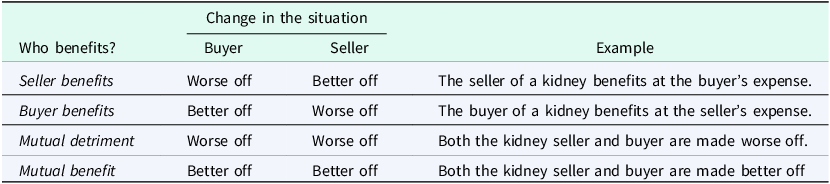
To address these open questions, the objective of this study is to provide empirical evidence on who people believe benefits from contested-commodity transactions, without attempting to capture broader moral concerns like fairness or the expressive meaning of market norms. This welfarist reconstruction of contested commodity transactions focuses on whether people think the parties improve or worsen their situation through exchange. If two parties engage in trade, possible outcome options are both the seller and buyer benefit from the transaction, the seller benefits and the buyer is made worse off, the buyer benefits and the seller is made worse off, or both transaction parties are made worse off. This focus on welfare outcomes is central to the normative views of authors who ground the moral permissibility of a transaction in the favourable outcomes evaluated by the transaction partners themselves (see, e.g., Brennan and Jaworski, Reference Brennan and Jaworski2015). Yet welfarist evaluations of transactions also play a crucial role in most non-consequentialist approaches, as only a small minority of principle-based ethical theories fully disregard consequences as ethically relevant (Jackson and Smith, Reference Jackson and Smith2006; Jauernig et al., Reference Jauernig, Uhl and Waldhof2023).
Our aim is to contribute to the commodification debate by investigating lay perceptions of welfare outcomes in CC markets. While various arguments are based on the assumption that sellers benefit while buyers do not, it remains an open question whether the public shares this view. If lay perceptions of who gains fundamentally diverge from the theoretical assumptions underpinning normative and even legislative views, the debate becomes disconnected from social reality. This can violate participatoryethics principles and jeopardize the incorporation of a moral objective into legislation. Our contribution, therefore, is to provide evidence on these specific welfare perceptions, which directly addresses the core assumptions underpinning both legislative design and theoretical frameworks.
Moreover, our welfarist approach allows for a meaningful connection to work in institutional analysis. Institutions derive their legitimacy from shared beliefs (Güth and Ockenfels, Reference Güth and Ockenfels2005) and evolve, or stagnate, in response to changes in those beliefs (Hodgson, Reference Hodgson2015). Institutional economics rests on the assumption of rationality (i.e., that individuals are utility-maximizing), whereby voluntary exchange is understood to produce mutual benefit. Societal perceptions of who gains and who loses are thus central to whether markets are regarded as legitimate and whether their governing institutions retain public support (Buchanan and Tullock, Reference Buchanan and Tullock1962). Accordingly, investigating people’s welfarist evaluations of contested commodity transactions contributes to understanding the relationship between theoretical economic assumptions and the current social legitimacy of markets.
Methodologically, we adapt Johnson and colleagues’ (Reference Johnson, Zhang, Keil and Johnson2021) experimental framework to capture how respondents evaluate the change in well-being of buyers and sellers in both non-CC and CC transactions. Through an online survey presenting transaction scenarios to US participants, we classify their views of the welfare changes of sellers and buyers into four basic patterns: mutual benefit, only buyer benefits (henceforth short: buyer benefits), only seller benefits (henceforth short: seller benefits), and mutual detriment (see Table 2 in Section Measures and analysis for further details). We formulate two main conjectures that capture our objectives. Whereas Conjecture 1 compares how people perceive CC and non-CC transactions, Conjecture 2 examines how people interpret CC transactions when they are not seen as mutually beneficial.
-
Conjecture 1: People perceive CC transactions as mutually beneficial to a lesser extent than non-CC transactions.
-
Conjecture 2a: When people reject CC transactions as mutually beneficial, they more often do so based on buyer benefits than seller benefits beliefs.
-
Conjecture 2b: When people reject CC transactions as mutually beneficial, they more often do so based on mutual detriment than on seller benefits beliefs.
-
Conjecture 2c: When people reject CC transactions as mutually beneficial, they more often do so based on buyer benefits than on mutual detriment beliefs.
Study design and methods
Design
To examine the study’s conjectures, we ask participants to evaluate how buyers’ and sellers’ situations change across 14 transactions involving both contested and non-CCs, as classified in a pre-test. See Appendix A Footnote 5 for the complete list and the motivation behind our selection of the goods and services involved in these transactions.
At the start of the study, participants are presented with the following explanatory text: ‘You will now be presented with a series of different transactions. For each transaction, you will be asked whether each participant is better off, worse off, or the same, relative to how they were before the transaction.’ Afterward, participants are presented with the 14 transactions.Footnote 6 E.g.,
Charlotte goes to Isabella’s clothing store. She pays Isabella $35 for a shirt
-
– How well off do you think Charlotte is now?
-
– How well off do you think Isabella is now?
Possible answers to both questions are ‘worse than before,’ ‘same as before,’ and ‘better than before’ (on a −5, 0, +5 Likert scale). The prices used in the transaction scenarios are average values for the United States at the time of the data collection (U.S. Bureau of Labor Statistics, 2023; USDA, 2022) to avoid an overvalued or undervalued price of a good or service to skew participants’ evaluations.Footnote 7 Each participant is presented with the 14 transaction scenarios randomly to avoid order or anchoring effects. Finally, we elicit self-reported information on gender, age, economic knowledge, and political orientation. See Appendix F for the complete transcript of the study.
Pre-test: classifying commodities as contested (CC) or non-contested (non-CC)
To ensure that our classification of commodities reflects participants’ opinions rather than normative assumptions, we conduct an online Pre-test (N = 242) to classify the transactions to be used in the main study as contested or non-contested. In the Pre-test, each participant is presented with eight random goods and services out of 21 and asked (7-point Likert scale) to indicate their assessment of the statement ‘It is morally permissible to buy and sell …?’. For the item surrogacy, we elicit two items, bearing a child and raising a child, and average them into a composite ‘surrogate maternity’ measure. Additionally, we present participants with six other statements as control classifications that could influence their view of who benefits from transactions. These statements contain irreplaceability, intrinsic value, status, deservedness, moral acceptability of gifting, and everydayness (see Appendix C, Table 1). Finally, we elicit attention control and demographic questions for gender, age, years of education, economic knowledge, positions towards abortion, surrogated maternity, and political positioning. The complete transcript of the Pre-test can be found in Appendix F.
Operationalization of who benefits from transactions
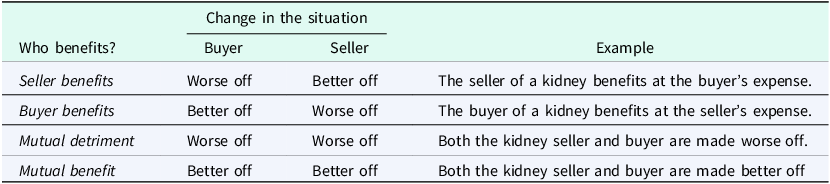
Note: Participants could also judge that one or both parties were unchanged by the transaction.
This yields five additional combinations: buyer better/seller same; buyer same/seller better; buyer worse/seller same; buyer same/seller worse; and both same, which are excluded from our analysis.
If participants’ average evaluation on the moral permissibility of trading a particular good or service is higher than 0.5 points (re-scaled from a 7-point Likert scale to a 0 to 1 scale), we consider it a CC. Vice versa, if participants’ average evaluation of the moral permissibility of trading a particular good or service is lower than 0.5 points, we consider it a non-CC. Following this rule, warehouse labour, kidney exchange, surrogate maternity, and sex work were classified as CC (Appendix C, Table C2).Footnote 8 Additionally, regression results show that higher levels of education are associated with a lower likelihood of judging goods and services as morally permissible to trade (R 2 = −0.016 ± 0.006, p < .01). This suggests that more educated participants drew stricter moral boundaries around what they considered tradable. By contrast, no other demographic variable had a significant effect on participants’ evaluations of the moral permissibility of trade (see Appendix E, Table 2).
Sampling procedures and exclusion of participants
We recruited 276 participants for the Pre-test, three were excluded for not accepting the data protection form, and another three for failing the attention control. Additionally, 24 participants were excluded for protest behaviour (i.e., answering all questions as ‘in-between’), leaving an effective sample of 242 participants. Because each participant evaluated only eight randomly selected items out of 21, the number of responses per item was lower (on average ≈ 105). A priori sample size calculations for mean comparisons (Kang, Reference Kang2021) indicate that 105 responses per item provide 91% power for within-subject effect sizes (d < 0.33) using G*Power (Faul et al., Reference Faul, Erdfelder, Lang and Buchner2007). The final sample had an average participant age of 44 years (SD = 16.49), 64% female, and a median income between USD 25,000 and USD 50,000.
For the primary data collection, we recruited 129 participants in the United States. Per our exclusion criteria, we removed all participants who failed the attention check (n = 22) and those who did not accept the data-protection notice (n = 2), yielding a final effective sample of N = 105. A priori calculation of sample sizes (Kang, Reference Kang2021) indicates that 100 participants would sustain a 90% power for within-subjects effect sizes (using G*Power at d < 0.33, Faul et al., Reference Faul, Erdfelder, Lang and Buchner2007).
Conjectures, study design, and processing methods of the main study and the Pre-test are pre-registered at Aspredicted.Footnote 9 We use QualtricsFootnote 10 to program our surveys, and distribute them without demographic stratification via prime panels from CloudResearchFootnote 11 due to their diverse demographics (Chandler et al., Reference Chandler, Rosenzweig, Moss, Robinson and Litman2019). CloudResearch Prime Panels select participants from vetted partner panels and filter out fraud answers, bots, and duplicate accounts before routing eligible respondents to our Qualtrics survey. All participants are compensated with $1.50 for participation. Participants must consent to our data handling in both the Pre-test and the main study according to the General Data Protection Regulation (European Parliament and Council, 2016).
Measures and analysis
To test our first conjecture, we compare the frequency of evaluations that reject versus those that do not reject mutual benefit by computing an inferential test (Welch’s t-test). To address conjectures 2a, 2b, and 2c, we explore participants’ attitudes when rejecting contested transactions as mutually beneficial. We compare seller benefits, buyer benefits, and mutual detriment evaluations using additional Welch’s t-tests. We assess participants’ evaluations of how they perceive the parties’ situations to change as a result of the transactions as follows:
In addition to the categorical classification of responses as seller wins, buyer wins, and mutual detriment, we also created a more fine-grained measure that compares the average evaluation of buyers relative to sellers. For this purpose, we develop a measure called ‘Benefit Index’ (BI), which captures the average evaluation of buyers relative to sellers on a continuous scale. After analysing the frequency distributions, we normalize the measure to a scale from minus 1 to 1. The BI is magnitude and sign-sensitive, with negative values reflecting a better situation for sellers and positive values indicating a better situation for buyers. $BI = {{\;\mu \;buyer\;evaluations - \mu \;seller\;evaluations\;} \over {11\;( - 5,0, + 5\;Likert\;scale)}}$
Results
Main study participants averaged 49 years of age (SD = 16.54); 61% were female (SD = 0.49), and the median income fell between USD 25,000 and 50,000. Additional demographic and ideological information is presented in Appendix B.
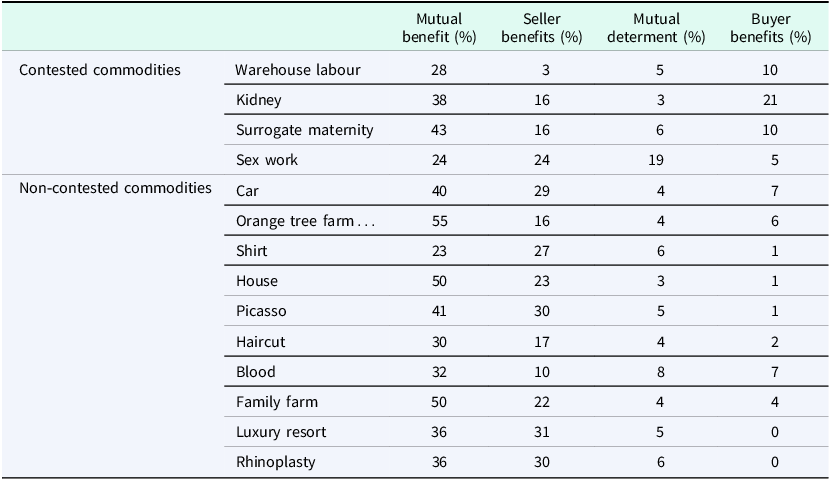
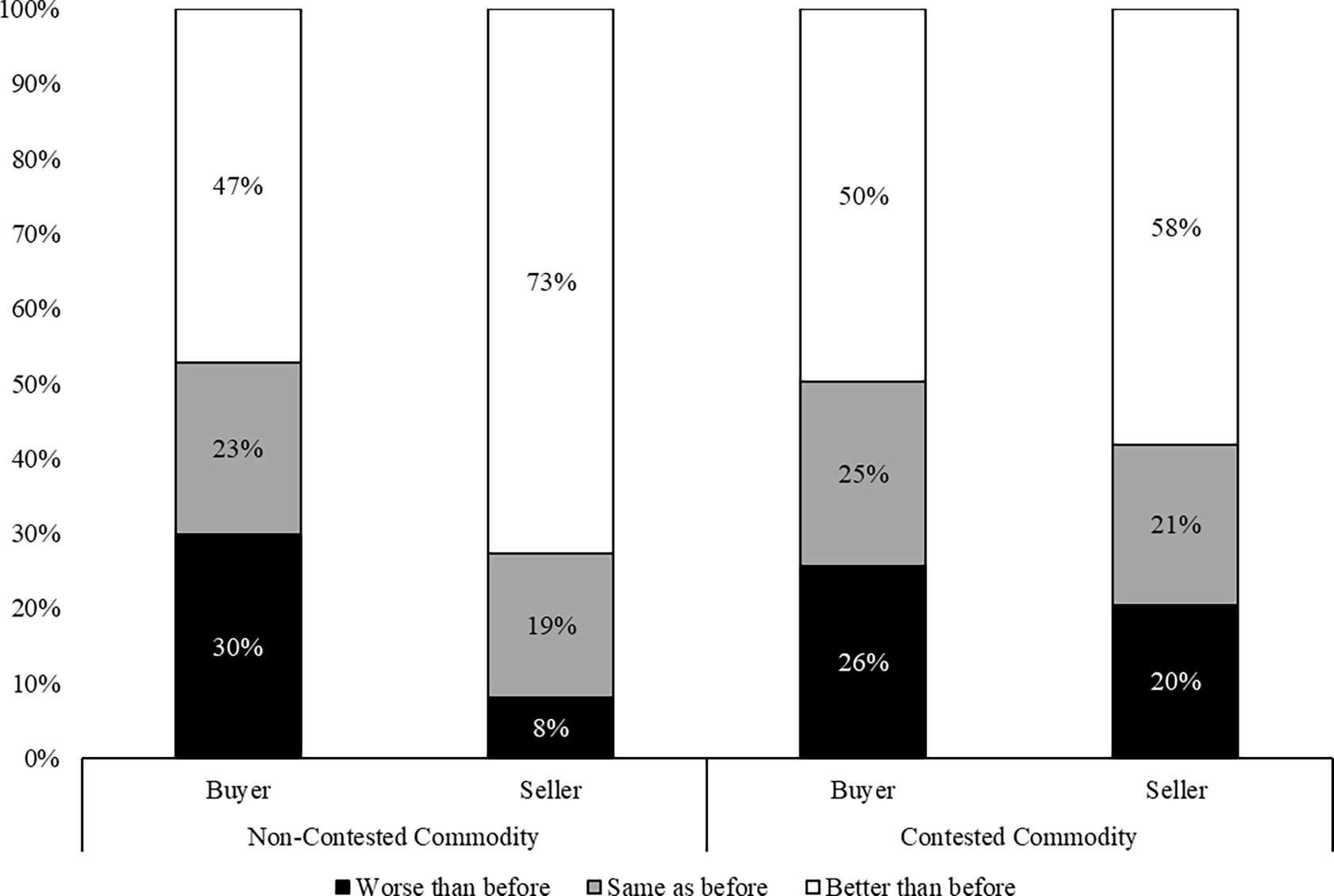
To address Conjecture 1, we compare mutual benefit perceptions of CCs and non-CCs. When participants faced CC transactions, they rejected the mutual benefit 66% of the time; when faced with non-CC transactions, they rejected the mutual benefit 61% of the time.Footnote 12 This difference is not statistically significant (MCC = 0.66, SD = 0.07; Mnon-CC = 0.61; SD = 0.10; t(5) = 2.015, p = .444). When participants rejected the mutual benefits, buyer benefits judgements were more common for CCs (12%, SD = 0.02) than for non-contested ones (3%, SD = 0.07). By contrast, seller benefits evaluations were more prevalent in non-contested exchanges (23%, SD = 0.09) than in contested ones (15%, SD = 0.06), suggesting that contested markets attenuate – though do not reverse – the general tendency to view sellers as the primary beneficiaries (see Appendix C, Table 3 and Figure 1). As participants did not exhibit differences in how often they reject the mutually beneficial nature of CC and non-CC transactions, we reject Conjecture 1.
Result 1: People don’t see contested-commodities transactions as less mutually beneficial than non-contested-commodities transactions.
To test Conjectures 2a, 2b, and 2c, we examined whether participants were more likely to report seller benefits, buyer benefits, or mutual detriment when rejecting CC transactions as mutually beneficial. On average, participants identified seller benefits significantly more often (M = 25%, SD = 0.07) than buyer benefits (M = 14%, SD = 0.12; t (537) = 3.115, p < .001). Rates of buyer benefits (14%, SD = 0.12) and mutual detriment (12%, SD = 0.081) did not differ significantly (t (541) = 0.388, p = .713). Finally, seller benefits judgements (25%, SD = 0.07) were significantly more frequent than mutual detriment (12%, SD = 0.081; t (522) = 3.859, p < .0001). These results provide the following answers to Conjectures 2a, 2b, and 2c:
Result 2a: Participants rejected the mutual benefit of contested-commodity transactions more frequently based on seller benefits than buyer benefits beliefs.
Result 2b: Participants rejected the mutual benefit of contested-commodity transactions more frequently based on seller benefits than on mutual detriment beliefs.
Result 2c: Participants did not reject the mutual benefit of contested-commodity transactions due to mutually detrimental beliefs more frequently than they did based on buyer benefits beliefs.
However, we observed an important caveat when comparing participants’ average evaluations of buyers and sellers in CC versus non-CC transactions (Figure 1). Notably, participants were less likely to judge CC sellers as improving their situation compared to non-CC sellers (M = 0.58, SD = 0.06 vs. M = 0.72, SD = 0.11; t (10) = 3.086, p = .011). Consistent with this, Welch’s t-tests show that when goods and services were classified as non-CC in the Pre-test, sellers were significantly more often judged to improve (M = 72.7% vs. 58.3%; t (10) = 3.121, p = .011) and less often judged to worsen their situation (M = 8.3% vs. 20.5%; t(4) = −4.360, p = .013) than when they were rated as CCs (Appendix E, Table 1). Accordingly, sellers of CC were perceived to worsen their situation more often than sellers of non-CC (M = 20%, SD = 0.05 vs. M = 0.08, SD = 0.03; t (4) = −4.580, p = .010). We do not find similar results when comparing CC and nonCC buyers. Participants’ evaluations did not significantly differ between how often they perceived buyers of CC and buyers of non-CC to be improving (M = 0.50, SD = 0.15 vs. M = 0.47, SD = 0.12; t(5) = –0.300, p = .775) or worsening their situation (M = 0.26, SD = 0.14 vs. M = 0.30, SD = 0.07; t (4) = 0.537, p = .619). Hence, the data reveal that participants’ seller benefits beliefs were less pronounced in CC transactions than in non-CC ones, mainly due to their perceptions of the sellers’ situation.
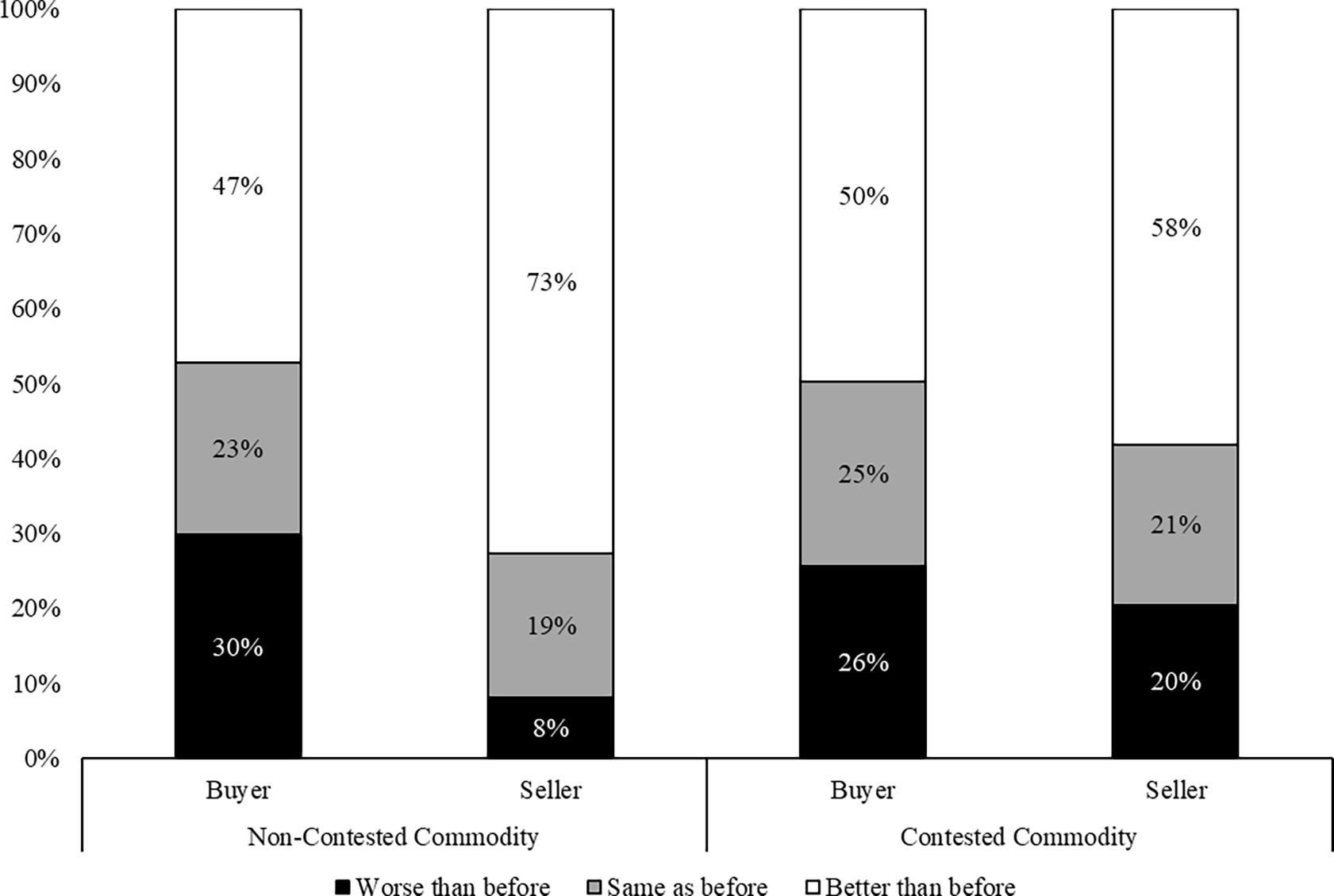
The BI supports the caveat to the previous seller benefits finding: Overall, participants viewed sellers as benefiting more often than buyers, but less so in CC transactions than in non-CC ones. As described in Appendix D, Table 1, participants perceived sellers as benefiting more than buyers in both CC and non-CC transactions (average BI for CC = 0.04, SD = 0.10; average BI for non-CC = −0.19, SD = 0.09). However, seller benefits attitudes were significantly weaker in CC transactions than in non-CC transactions (t(5) = 2.322, p = .067), supporting the previous caveat that participants viewed CC sellers as less likely to improve their situation than non-CC sellers.
In summary, when participants rejected the mutual benefit of a transaction, they more often judged sellers to benefit at buyers’ expense than they made buyer benefit or mutual detriment judgements. This pattern was present for both contested and non-CCs, but it was less pronounced for contested ones.
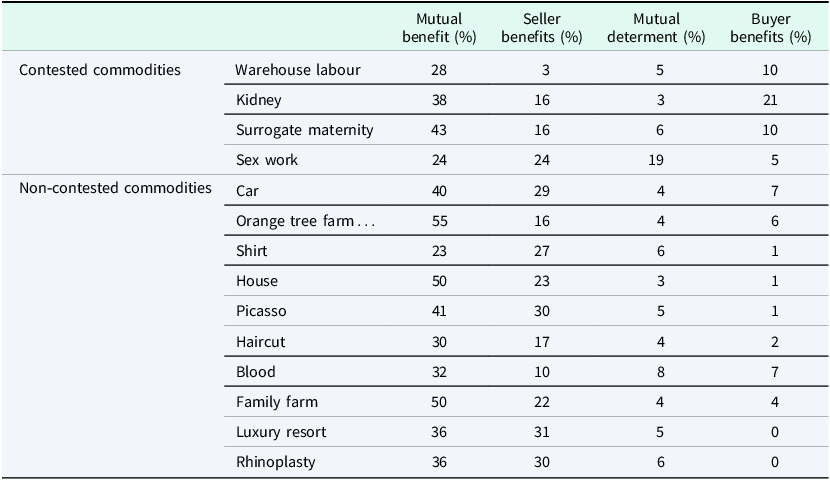
To complement the aggregate CC versus non-CC comparison, we also examine participants’ responses separately for each of the 14 commodities:
When analysed separately, warehouse labour and kidneys are the only commodities for which participants more often judge buyers to benefit than sellers. Other transactions central to the commodification debate, surrogacy, sex work, and blood donation show the opposite pattern: sellers are more often perceived as benefiting than buyers. Notably, sex work also yielded a high share of mutual detriment evaluations, suggesting that respondents frequently view it as harmful to both parties. For all other goods and services, including ordinary market items such as cars, shirts, or haircuts, sellers are consistently judged to benefit more often than buyers. Taken together, these results indicate that the perception of sellers benefiting at the expense of buyers is not limited to non-CCs but also extends to CCs.
Discussion
Our study examined how observers evaluate third-party transactions involving contested and non-CCs in welfarist terms. By classifying participants’ judgements into mutual benefit, buyer benefit, seller benefit, and mutual detriment, we provide systematic evidence of who people think gains or loses in these transactions. Across both types of commodities, participants frequently declined to view exchanges as mutually beneficial. Contrary to the traditional anti-commodification claim that buyers take advantage of vulnerable sellers, our findings show that people often see sellers of CCs as the main beneficiaries, though less so than in non-CC markets. This pattern highlights underexplored attitudes in public opinion and raises questions about how such perceptions should inform the regulation and ethical evaluation of contested commodity markets.
Limitations and directions for future research
Our study has several limitations that also point the way to future work. First, the sample is modest, though in line with established practices in moral psychology, where smaller groups can still provide adequate precision for identifying systematic patterns in cognitive evaluations (Finkel et al., Reference Finkel, Eastwick and Reis2015; Knobe, Reference Knobe2016). Our aim was to detect recurring structures in people’s judgements; larger, probability-based, and cross-national samples that control for additional demographic variables such as religion and ethnicity are needed to assess the generalizability of seller-benefit beliefs. Focusing on only one aspect, the welfarist question of how people perceive CCs, our study enhances internal validity but leaves aside the social and cultural context in which transactions occur. Further experimental studies and qualitative follow-ups could provide richer insight into how such judgements are situated in everyday reasoning. Future work should also broaden the set of commodities tested and incorporate ethnically diverse names in the transaction cues, since such name diversity has shown to vary third-party economic evaluations (Bertrand and Mullainathan, Reference Bertrand and Mullainathan2004; Max and Uhl, Reference Max and Uhl2021).
Because previous research has demonstrated the importance of context in shaping people’s views of taboo transactions – both when justifying their own participation and when evaluating others (Fiske and Tetlock, Reference Fiske and Tetlock1997; Khalil and Marciano, Reference Khalil and Marciano2018), future research could refine welfarist accounts by examining additional contextual factors. These include people’s perceptions of the parties’ pre-transaction wealth (Andrejević et al., Reference Andrejević, Feuerriegel, Turner, Laham and Bode2020), bargaining and general power (Guzmán and Munger, Reference Guzmán and Munger2020; Jauernig et al., Reference Jauernig, Uhl and Pies2025)Footnote 13 , access to information (Bicchieri and Maras, Reference Bicchieri and Maras2022), and the legal status of the transaction in the respondent’s jurisdiction. These contextual factors could also be explored by examining permissibility symmetry (i.e., the idea that what is acceptable to give should also be acceptable to sell, Brennan and Jaworski, Reference Brennan and Jaworski2021), by testing additional commodities such as so-called demerit goods (e.g., gambling or drugs), and by probing labour transactions more deeply, given that they appear to be the only case in which participants more often judge buyers to benefit than sellers.
A related question concerns the disentanglement between zero-sum thinking and perceptions of unfairness based on unequal utility gains. Our design allowed respondents to express asymmetric positive utility gains (i.e., both parties may improve, but one more than the other), and we coded zero-sum judgements only when participants explicitly indicated that a party was made worse off. However, a targeted experimental manipulation could more clearly distinguish between two possibilities: whether voluntary transactions are perceived as zero-sum – implying that at least one transaction partner is assumed to act irrationally by entering the trade according to economic theory – or whether the transaction is generally seen as a win-win situation but the distribution of the surplus between the respective reservation prices is perceived as unfair. This disentanglement has implications for debates about banning or regulating markets.
Welfarist perceptions in the commodification debate
We expected that CCs would be evaluated differently from non-contested ones, which people regularly perceive as a win for the seller and a loss for the buyer (Johnson et al., Reference Johnson, Zhang, Keil and Johnson2021). Yet our results show that the trend persists in exchanges involving goods such as organs or surrogacy, albeit less pronounced. This striking finding that sellers such as sex workers, surrogate mothers, organ or blood suppliers are seen as getting the longer end of the stick as compared to the patron, the biological parents, or the organ or blood receivers underscores how deeply rooted the intuition that money counts for more than what it purchases remains. It may be that framing the scenarios as specific third-party economic transactions, rather than as questions about the moral rightness of commodification, enables respondents to recognize the utility sellers derive from the exchange (Fiske and Tetlock, Reference Fiske and Tetlock1997; Khalil and Marciano, Reference Khalil and Marciano2018). Our findings, thus, extend earlier arguments that people routinely undervalue the benefits buyers derive from transactions (Caplan, Reference Caplan2002) and instead attribute profit-seeking motives to sellers while casting buyers as comparatively well-intentioned (Vitell and Muncy, Reference Vitell and Muncy1992). In short, the belief that ‘getting the money’ is more advantageous than receiving the good or service proves remarkably pervasive, persisting even in domains where such judgements might have seemed a priori counterintuitive.
Welfare outcomes figure prominently in normative positions within the commodification debate. Anti-commodification arguments often highlight the seller’s vulnerability, whereas pro-commodification views typically assume that, given appropriate regulation, both parties benefit. Our findings show that respondents’ evaluations of CC transactions do not align neatly with either framing. If normative arguments rely on consequentialist reasoning or incorporate participatory-ethics considerations, these folk beliefs should be addressed by both sides. This is particularly relevant for discussions at the intersection of normative theory and policy, where the practical implementation of normative commitments is at stake.
Examining individual CCs reveals how competing narratives about who comes out worse off shape these evaluations. Respondents tended to view both buyers and sellers in sex work as ending up worse off, though not equally, reflecting common perceptions of sex-work as a precarious sector linked to coercion and trafficking. At the same time, newer developments complicate this narrative: online platforms such as OnlyFans highlight autonomy and entrepreneurial agency, while legal approaches differ in who is to blame – for example, both parties may be prosecuted in the United States, whereas Swedish law targets only buyers (Ekberg, Reference Ekberg2004), assigning them primary responsibility. Surrogacy debates similarly emphasize economically vulnerable women bearing physical and emotional burdens for wealthier intended parents (Lundström and Twine, Reference Lundström and Twine2011), yet our findings suggest that narratives in which intended parents do not clearly benefit may also shape public judgements. Growing visibility of sexual minorities, including same-sex couples seeking genetic parenthood, may contribute to more favourable views of commissioning surrogacy (Smietana, Reference Smietana2017), consistent with policy variation across U.S. states, where commercial surrogacy is banned in several Republican-led states but permitted in others, such as California and New York. Finally, debates on kidney markets often focus on protecting sellers from exploitation (Greasley, Reference Greasley2014; Reese and Pies, Reference Reese and Pies2023). Although respondents more often viewed buyers as benefiting, nearly as many saw sellers benefiting at buyers’ expense, possibly reflecting awareness of transplant recipients’ urgent medical needs. While only a few countries, such as Iran and Pakistan, allow regulated kidney markets, many Western countries continue debating opt-in versus opt-out systems for post-mortem donation, raising questions about how people balance concerns about exploitation with recognition of patients’ urgent needs.
Among the commodities that participants evaluated as contested, warehouse labour stands out as the clearest departure from seller benefits beliefs observed in non-CCs (Johnson et al., Reference Johnson, Zhang, Keil and Johnson2021). In this case, respondents more often judged the buyer to benefit, suggesting that employment relations may invert the usual intuition that money outweighs goods or services. Participants valuing labour above money echo Polanyi’s (Reference Polanyi1944) concept of labour as a ‘fictitious’ commodity, suggesting that exchanges involving labour are judged by standards different from those applied to ordinary markets. Judgements about labour may thus invoke a dignity-sensitive perception, concerned with rights and standing (Berg et al., Reference Berg, Dutton and Wrzesniewski2013), in tension with the idea that such relations can be straightforwardly exchanged for money.
An additional implication for the commodification debate concerns whether a welfarist framing alone can morally justify contested exchanges (Qizilbash, Reference Qizilbash2019; Semrau, Reference Semrau2017). In the Pre-test, participants echoed previous research by judging many such transactions as morally unacceptable (Elías et al., Reference Elías, Lacetera and Macis2019; Elias et al., Reference Elias, Lacetera and Macis2022; Leider and Roth, Reference Leider and Roth2010), yet few of our main study respondents believed that kidney donors, sex workers, or surrogate mothers were made worse off by the exchange. This may indicate that people’s moral opposition to contested transactions does not exclusively depend on perceiving one party as losing out in welfarist terms. Such a viewpoint would be more aligned with those voices in the commodification debate that hold that welfare outcomes alone cannot determine the moral acceptability of a transaction (Anderson, Reference Anderson1993; Sandel, Reference Sandel2012; Satz, Reference Satz2010).
Institutional and legal implications
For markets to be successful, they not only need to be a place for people to effectively maximize their utility through exchange, but also to be seen as legitimate institutions by the public whose participation sustains them (Fourcade and Healy, Reference Fourcade and Healy2017). Therefore, market legitimacy emerges from the shared beliefs through which people interpret them. Since these beliefs shape how regulatory arrangements develop and persist, they warrant consideration – even when, or particularly when, we do not share them. Among these beliefs are welfarist intuitions about who is seen to benefit from an exchange. For CCs, perceptions of who benefits shape how people think these exchanges should be governed and thus how legitimate they appear in practice.
How people perceive CCs therefore has implications for how specific industries are legislated. In the case of sex work, our respondents judged sellers to benefit more often than buyers, yet also reported high levels of mutual detriment and low levels of mutual benefit. Such perceptions may help explain why regulators have historically adopted paternalistic and seller-criminalizing legislative frameworks, which have proven disadvantageous for sex workers by increasing exposure to violence and reducing access to health and social services (Cunningham and Shah, Reference Cunningham and Shah2016; Della Giusta et al., Reference Della Giusta, Di Tommaso, Jewell and Bettio2021).
A similar tension arises, for example, in the case of blood markets and the contested question of whether compensation should be permitted. A far larger share of respondents perceived sellers to be the winners, while only a small minority judged buyers as coming out ahead. This perception may help explain why compensation remains controversial, since viewing sellers as the primary beneficiaries can raise concerns that payment would crowd out the altruistic norms underpinning the blood donations (Jaworski, Reference Jaworski2024; Thomas and Thomas, Reference Thomas and Thomas2018; Titmuss, Reference Titmuss1972).
Institutional debates combining deliberation about societal objectives and the analysis of economic constraints can fall short if they overlook the beliefs held by the individuals who constitute the polity. Empirical research in moral and economic psychology can systematically examine these beliefs and thereby integrate them into normative and policy discussions by debating their validity or recognizing them as legitimate concerns. This study contributes to a broader research agenda by providing evidence on how people understand the welfare consequences of contested-commodity exchanges, insights that help illuminate the public beliefs shaping the legitimacy of market institutions.
Supplementary material
The supplementary material for this article, with all Appendices, can be found at: https://doi.org/10.1017/S174413742610054X
AI declaration
Parts of this document were prepared with the assistance of AI tools, which were used strictly for drafting and editing. All analysis, interpretation, and final decisions reflect the authors’ own work.


 Open access

