





Introduction
Horseweed is a broadleaf weed from the Asteraceae family. In 1996, the introduction of glyphosate-resistant (GR) crops helped to facilitate no-till or reduced-till practices (Dill Reference Dill2005; Givens et al. Reference Givens, Shaw, Kruger, Johnson, Weller, Young, Wilson, Owen and Jordan2009). By 2012, approximately 93%, 85%, and 82% of soybean, corn (Zea mays L.), and cotton (Gossypium hirsutum L.) in the United States, respectively, were seeded to GR cultivars/hybrids (ERS 2013). The adoption of no-till crop production practices and GR crop cultivars/hybrids and the concomitant rise in glyphosate use created the ideal confluence of events for intense selection intensity for the evolution of GR horseweed. Four years after the introduction of GR soybean, GR horseweed was documented in the state of Delaware (VanGessel Reference VanGessel2001). Currently, GR horseweed has been confirmed in 13 countries (Heap Reference Heap2020).
Horseweed has a prolonged emergence period. The lack of seed dormancy allows for germination under favorable conditions year-round (Buhler and Owen Reference Buhler and Owen1997); however, most plants emerge during the fall or the spring (Weaver Reference Weaver2001). Fall-emerged horseweed has a competitive advantage over weed species and annual crops that emerge in the spring (Main et al. Reference Main, Steckel, Hayes and Mueller2006; Regehr and Bazzaz Reference Regehr and Bazzaz1976). Horseweed may emerge after the initial preplant (PP) burndown application in a no-tillage system; if so, an in-crop postemergence herbicide would be required for control. The variable emergence pattern can make it difficult to achieve acceptable control of GR horseweed in identity-preserved and GR soybean.
Horseweed can produce greater than 1 million seeds per plant (Davis et al. Reference Davis, Kruger, Stachler, Loux and Johnson2009), although when in competition with soybean, horseweed has been reported to produce approximately 30,000 to 72,000 seeds per plant (Davis and Johnson Reference Davis and Johnson2008). Horseweed seeds measure approximately 1 to 2 mm, with an attached pappus measuring approximately 3 to 5 mm (Frankton and Mulligan Reference Frankton and Mulligan1987). The pappus is made up of a plumose crown of hairs that can mimic a parachute when airborne (Andersen Reference Andersen1993). The seeds may travel from a few meters (Dauer et al. Reference Dauer, Mortensen and Humston2006) or up to hundreds of kilometers (Shields et al. Reference Shields, Dauer, VanGessel and Neumann2006) from the mother plant via wind dissemination, which results in the spread to adjacent and distant fields.
GR horseweed is difficult to control in soybean. Studies have reported up to 93% yield loss due to GR horseweed interference in soybean (Byker et al. Reference Byker, Soltani, Robinson, Tardif, Lawton and Sikkema2013a). Postemergence applications of glyphosate or cloransulam-methyl were once effective for GR horseweed control, but the evolution of biotypes resistant to Group 2 and 9 herbicides made these herbicides ineffective in soybean (Byker et al. Reference Byker, Soltani, Robinson, Tardif, Lawton and Sikkema2013b). Byker et al. (Reference Byker, Soltani, Robinson, Tardif, Lawton and Sikkema2013b) reported that current postemergence herbicides registered for use in identity-preserved and GR soybean do not provide greater than 95% control. Control of GR horseweed must precede soybean emergence to prevent yield loss.
Glufosinate-ammonium is a glutamine synthetase–inhibiting herbicide that belongs to the organophosphorus chemical family (WSSA Group 10) (Zhou et al. Reference Zhou, Luo, Chen, Zhang and Gao2020). Commercial glufosinate formulations contain a combination of D and L stereoisomers from the natural product L-phosphinothricin. Only the L-isomer inhibits glutamine synthetase, but commercial formulations include the racemic mixture because of the cost of production (Green and Gradley Reference Green and Gradley2018). Glufosinate primarily has contact activity, though it has limited translocation in the apoplast (Coetzer et al. Reference Coetzer, Al-Khatib and Loughin2001; Dröge-Laser et al. Reference Dröge-Laser, Siemeling, Pühler and Broer1994). The fast phytotoxic action of glufosinate is dependent on light to generate reactive oxygen species, resulting in cell membrane lipid peroxidation and ultimately plant death (Takano et al. Reference Takano, Beffa, Preston, Westra and Dayan2019). Thorough spray coverage is crucial for effective weed control, especially when weed densities are high (Eubank et al. Reference Eubank, Poston, Nandula, Koger, Shaw and Reynolds2008). Glufosinate is most efficacious when applied under warm air temperatures (Kumaratilake and Preston Reference Kumaratilake and Preston2005), high relative humidity (Coetzer et al. Reference Coetzer, Al-Khatib and Loughin2001), and full-sunlight conditions (Takano and Dayan Reference Takano and Dayan2020; Takano et al. Reference Takano, Beffa, Preston, Westra and Dayan2019). Glufosinate is nonselective and provides control of susceptible young annual grass and broadleaf weeds.
Glufosinate applied alone has provided variable GR horseweed control. Zimmer et al. (Reference Zimmer, Young and Johnson2018) observed a 59% control of 3- to 33-cm-tall GR horseweed with glufosinate (594 g ai ha–1) applied PP to soybean at 5 WAA. In this study, the average air temperature and relative humidity at the time of application were 19 C and 61%, respectively (Zimmer et al. Reference Zimmer, Young and Johnson2018). Eubank et al. (Reference Eubank, Poston, Nandula, Koger, Shaw and Reynolds2008) reported a minimum of 90% control of 25- to 30-cm-tall GR horseweed with glufosinate (590 g ai ha–1) applied PP to soybean at 4 WAA; air temperature and relative humidity at the time of application were 27 C and 53%, respectively. Only a few studies have investigated GR horseweed control with glufosinate-based mixtures. Byker et al. (Reference Byker, Soltani, Robinson, Tardif, Lawton and Sikkema2013a) reported that glufosinate (500 g ai ha–1) plus glyphosate (900 g ae ha–1) provided 35% to 91% control of GR horseweed up to 11 cm tall at 4 WAA; 35% control was reported at a site with a high GR horseweed density (158 to 184 plants m–2) at application, and 91% control was reported at sites with a low GR horseweed density (7 to 81 plants m–2) at application. In another study, when dicamba (280 g ae ha–1), 2,4-D ester (840 g ae ha–1), or metribuzin (420 g ai ha–1) were added to glufosinate (470 g ai ha–1), up to 96%, 97%, and 96% control of 25- to 30-cm GR horseweed, respectively, was reported at 4 WAA (Eubank et al. Reference Eubank, Poston, Nandula, Koger, Shaw and Reynolds2008); air temperature and relative humidity at the time of application were 27 C and 53%, respectively. Budd et al. (Reference Budd, Soltani, Robinson, Hooker, Miller and Sikkema2016a) observed the addition of saflufenacil (25 g ai ha–1) to glyphosate (900 g ae ha–1) plus glufosinate (500 g ai ha–1) provided 93% control of up to 14-cm-tall GR horseweed at 8 WAA. Complete control of 15-cm-tall GR horseweed was reported with glufosinate (494 g ha–1) plus a 1:1 ratio mixture of water and 28% urea ammonium nitrate (UAN) (total carrier volume of 187 L ha–1) and 28% UAN (187 L ha–1) in a growth-room study (M Cowbrough, personal communication). Glufosinate-based mixtures have provided acceptable control of GR horseweed applied PP in soybean, though research is limited.
Control of GR horseweed has been variable with glufosinate alone, but based on the available research, glufosinate-based mixtures have provided improved control of GR horseweed. There is a need to explore additional glufosinate-based mixture options to control GR horseweed in soybean applied PP. Therefore, the objectives of this study were to determine if the level and consistency of GR horseweed control applied PP to soybean can be improved with (i) adding herbicides labeled for PP to soybean that are known to have herbicidal activity on GR horseweed: halauxifen-methyl, 2,4-D ester, saflufenacil, metribuzin, or dicamba to glufosinate; (ii) increasing the rate of glufosinate from 500 to 1,000 g ai ha–1, and (iii) adding 28% UAN as the carrier solution, which has been observed to have activity on GR horseweed.
Materials and Methods
Experimental Methods
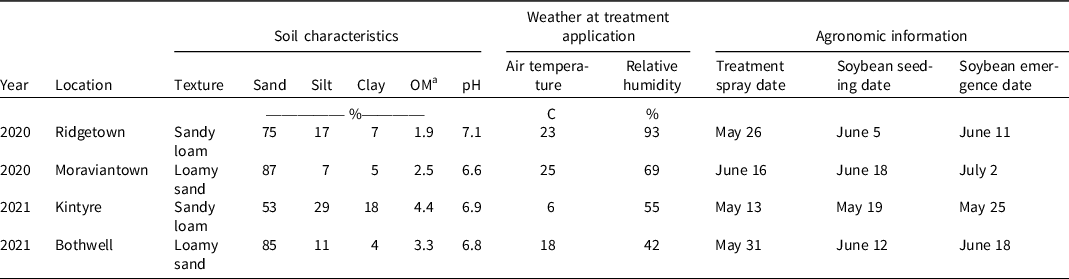
Field trials were conducted in 2020 and 2021 on four commercial farms in southern Ontario. In 2020, the trials were located near Ridgetown (42.27° N; 81.51° W) and Moraviantown (42.3304° N; 81.50194° W), and in 2021 the trials were located near Kintyre (42.33549° N; 81.46226° W) and Bothwell (42.37043° N; 81.54457° W). The year, location, soil characteristics, air temperature, and relative humidity at the time of treatment application, treatment application dates, and soybean seeding and emergence dates are listed in Table 1.
Year, location, soil characteristics, air temperature, and relative humidity at the time of treatment application, treatment spray date, and soybean seeding and emergence dates for four field trials conducted in southern Ontario in 2020 and 2021.
a Abbreviations: OM, organic matter.
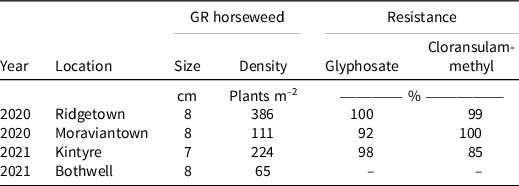
Horseweed size and density at the PP application and the resistance profile of the populations at each location are listed in Table 2. The resistance profile of the horseweed populations from each location was determined in greenhouse screenings. Horseweed seed was collected randomly from multiple plants at each location. Square transplanting flats (25 cm × 25 cm × 5 cm) were filled with potting mix (Berger Growing Media with sphagnum peat moss, perlite, wetting agent, dolomitic, and calcitic limestone) and were watered until the soil was completely saturated. Horseweed seeds (approximately 300) were sprinkled onto the soil surface. Approximately 0.3 mm of the potting mix was used to cover the seed on the soil surface. The trays remained in the greenhouse (16-h photoperiod with 26 C day and 17 C night temperatures) and were watered with approximately 20 ml of water daily. Once the seedlings had at least four leaves, 100 horseweed plants from each population were transplanted into individual circular pots 10 cm diam. When horseweed reached 10 cm in height, 40 horseweed plants from each population were sprayed with glyphosate (900 g ae ha–1), and another 40 were sprayed with cloransulam-methyl (17.5 g ai ha–1). The horseweed was sprayed in a spray chamber equipped with flat-fan nozzles calibrated to deliver 205 L ha–1 at 2.6 km h–1 and 280 kPa. Two untreated checks for every 10 horseweed plants were used as comparisons to conduct the visible control ratings. Visible control ratings were completed at 1, 3, and 5 WAA with a 0 to 100% scale; 0% represented no control, 100% represented complete necrosis (Canadian Weed Science Society 2018). The values in Table 2 represent the percentage of horseweed resistant to glyphosate and cloransulam-methyl at each location at 5 WAA. The seed was not collected at the Bothwell site, and therefore resistance screening was not conducted for this location.
Year, location, glyphosate-resistant (GR) horseweed size and density at the preplant treatment applications, and resistance profile at each location at 5 wk after application for four field trials conducted in southern Ontario in 2020 and 2021.
A randomized complete block design was used in this study. There were four blocks within each trial. Each block had a weedy and weed-free control. The plots measured 2.25 m wide (equivalent to three soybean rows, 0.75 m apart) by 8 m in length. The treatments (Tables 3 and 4) were applied PP with a CO2-pressurized backpack sprayer calibrated to 200 L ha–1 at 240 kPa once the average horseweed height in each plot was approximately 10 cm. Glyphosate (900 g ae ha–1) was applied to the weedy control, and glyphosate (900 g ae ha–1) plus saflufenacil (25 g ai ha–1) plus metribuzin (400 g ai ha–1) plus the non-ionic surfactant Merge (1 L ha–1) was applied to the weed-free control; both treatments were applied PP. A postemergence application of the premix glyphosate/dicamba (240/120 g ae ha–1) was applied to the weed-free treatment. The entire experimental area was treated with a postemergence application of glyphosate (450 g ae ha–1) to eliminate weeds not being studied.
Herbicides and surfactants used in this study conducted in southern Ontario, Canada in 2020 and 2021.

a Two treatments with glufosinate included 28% urea ammonium nitrate.
b Treatments with halauxifen-methyl included the surfactant methylated seed oil (1.0% v/v).
c Treatments with saflufenacil included the surfactant Merge (1.0 L ha–1).
Treatment means of glyphosate-resistant (GR) horseweed control 2, 4, and 8 wk after application (WAA), density, biomass, and soybean yield from four field trials conducted in southern Ontario, Canada in 2020 and 2021.a,b

a Letters next to control means in a column (a–f) that differ from one another are statistically significant based on Tukey-Kramer’s LSD (P = 0.05).
b Abbreviation: UAN, 28% urea ammonium nitrate.
c Each treatment included 900 g ae ha–1 of glyphosate.
d Density and biomass were collected 8 WAA.
e Treatments with halauxifen-methyl included the surfactant methylated seed oil (1.0% v/v).
f Treatments with saflufenacil included the surfactant Merge (1.0 L ha–1).
Control ratings were visually determined at 2, 4, and 8 WAA for each treatment based on the estimated percentage biomass reduction of horseweed relative to the weedy control within each block. The ratings were completed with a 0 to 100% scale; 0% represented no control, 100% represented complete necrosis (Canadian Weed Science Society 2018). At 8 WAA, two 0.25-m2 quadrats were set randomly in each plot for density and biomass data collection. Density was determined by counting all GR horseweed in each quadrat. Biomass was determined by cutting each plant at the base of its stem, organized in bags labeled by treatment, and stored in a dryer to dry to steady moisture. Once dry, the samples were weighed to determine biomass.
Glyphosate/dicamba-resistant soybean (DKB10-20) was seeded 2 to 12 d after the PP treatment applications, at about 416,000 seeds ha–1 to a 3.75-cm depth. Soybean injury was assessed 2 and 4 wk after emergence using a 0 to 100% scale, with 0% representing no soybean injury, and 100% complete soybean necrosis (Canadian Weed Science Society 2018). Once soybean reached harvest maturity, a plot combine harvested two soybean rows per plot; soybean yield and moisture content were recorded.
Statistical Analysis
PROC GLIMMIX in SAS 9.4 (SAS, Cary, NC) was utilized for the data analyses. Variances were organized as the fixed effects (treatment) and random effects (block, block-within-environment, and treatment-by-environment). Normality assumptions were met after conducting the Shapiro-Wilk test and reviewing residual plots. No treatment-by-environment interaction was detected, so the data were analyzed together. GR horseweed control 2, 4, and 8 WAA was analyzed using an arc-sine distribution with the link identity; soybean yield was analyzed using a normal distribution. GR horseweed density and biomass data were analyzed with a log-normal distribution with the link identity; the omega procedure was used to back-transform the treatment means from the log-scale format (M Edwards, Ontario Agricultural College Statistician, University of Guelph, personal communication). The Tukey-Kramer’s multiple-range test (P = 0.05) was used for the treatment means separation. The coefficient of variation (CV) was calculated for each least square mean to determine the consistency of the data.
Results and Discussion
Soybean Injury
Soybean injury was ≤10% at all sites in 2020 and 2021 (data not presented).
Glyphosate-Resistant Horseweed Control
Glufosinate (500 g ai ha–1) controlled GR horseweed 65%, 66%, and 63% at 2, 4, and 8 WAA, respectively, and did not reduce density or biomass relative to the weedy control (Table 4). Eubank et al. (Reference Eubank, Poston, Nandula, Koger, Shaw and Reynolds2008) observed up to 96% control of 25- to 30-cm-tall GR horseweed with glufosinate (470 g ae ha–1) at 4 WAA; air temperature and relative humidity at the time of application was 27 C and 53%, respectively. The high level of control in this study could be attributed to the high air temperature and low GR horseweed density (22 plants m–2) at the time of application (Eubank et al. Reference Eubank, Poston, Nandula, Koger, Shaw and Reynolds2008). Byker et al. (Reference Byker, Soltani, Robinson, Tardif, Lawton and Sikkema2013a) observed 35% to 91% control of GR horseweed up to 11 cm tall and up to a 96% reduction in GR horseweed biomass at 4 WAA with glufosinate (500 g ai ha–1) applied PP in soybean.
GR horseweed control was not improved when the rate of glufosinate was increased from 500 to 1,000 g ai ha–1 or when glufosinate was applied with 28% UAN (50% or 100%) as the carrier solution (Table 4). Reports of increased herbicidal activity and injury on weed species have been reported when nitrogen fertilizer is added (Anonymous 2011); however, some studies have found this to be species-specific (Fielding and Stoller Reference Fielding and Stoller1990). Complete control of 15-cm-tall horseweed was reported with glufosinate (494 g ha–1) plus a 1:1 ratio mixture of water and 28% UAN (total carrier volume of 187 L ha–1) and 28% UAN (187 L ha–1) in a growth-room study (M Cowbrough, personal communication). In the current study, there was no improvement in GR horseweed control when 28% UAN was used as the herbicide carrier.
There was no benefit of adding halauxifen-methyl to glufosinate for the control of GR horseweed, and there was no reduction in density or biomass relative to glufosinate (500 g ai ha–1). Previous research also reported no improvement in GR horseweed control from the addition of halauxifen-methyl to other herbicides applied PP to soybean (Zimmer et al. Reference Zimmer, Young and Johnson2018).
There was no benefit of adding 2,4-D ester to glufosinate for the control of GR horseweed, and there was no reduction in density or biomass relative to glufosinate (500 g ai ha–1). In contrast to the present study, Eubank et al. (Reference Eubank, Poston, Nandula, Koger, Shaw and Reynolds2008) observed that glufosinate (470 g ai ha–1) plus 2,4-D (840 g ae ha–1), applied PP to soybean, controlled 25- to 30-cm-tall GR horseweed 97% at 4 WAA and reduced GR horseweed density by a minimum of 99%. Chahal and Johnson (Reference Chahal and Johnson2012) reported 100% control of 3- to 4-cm-tall GR horseweed with glufosinate (530 g ai ha–1) plus 2,4-D (560 g ae ha–1) at 3 WAA in a greenhouse experiment.
There was no benefit of mixing saflufenacil with glufosinate for the control of GR horseweed and no reduction in biomass; however, there was a 30% reduction in GR horseweed density relative to glufosinate (500 g ai ha–1). In contrast to this study, Budd et al. (Reference Budd, Soltani, Robinson, Hooker, Miller and Sikkema2016a) observed 93% control of up to 14-cm-tall GR horseweed with glufosinate (500 g ai ha–1) plus saflufenacil (25 g ai ha–1) plus glyphosate (900 g ae ha–1) applied PP to soybean 8 WAA; GR horseweed density and biomass were reduced 96% and 89%, respectively. Waggoner et al. (Reference Waggoner, Mueller, Bond and Steckel2011) reported 83% GR horseweed control with glufosinate (450 g ai ha–1) plus saflufenacil (25 g ai ha–1) applied PP in cotton approximately 4 WAA, similar to the current study, and a 90% reduction in density.
There was a benefit of adding metribuzin to glufosinate for the control of GR horseweed, and there was a reduction in GR horseweed density and biomass relative to glufosinate (500 g ai ha–1). When metribuzin was tank-mixed with glufosinate, GR horseweed control improved 22%, 22%, and 28% at 2, 4, and 8 WAA and further reduced density and biomass 50% and 54%, respectively, compared to glufosinate (500 g ai ha–1). Eubank et al. (Reference Eubank, Poston, Nandula, Koger, Shaw and Reynolds2008) reported slightly higher GR horseweed control of 93% to 96% control with glufosinate (470 g ai ha–1) plus metribuzin (420 g ai ha–1) at 4 WAA; GR horseweed density was reduced up to 99%, similar to this study. Loux and Johnson (Reference Loux and Johnson2014) suggest that glufosinate plus metribuzin is an efficacious PP option to control GR horseweed in the spring.
There was a benefit of adding dicamba to glufosinate for the control of GR horseweed, and there was a reduction in GR horseweed density and biomass relative to glufosinate (500 g ai ha–1). When dicamba was mixed with glufosinate, GR horseweed control improved by 19%, 26%, and 30% at 2, 4, and 8 WAA, respectively, and further reduced density and biomass 47% and 60%, respectively, compared to glufosinate (500 g ai ha–1). Similarly, Eubank et al. (Reference Eubank, Poston, Nandula, Koger, Shaw and Reynolds2008) reported 90% to 96% GR horseweed control with glufosinate (470 g ai ha–1) plus dicamba (280 g ae ha–1) applied PP in soybean 4 WAA and a minimum density reduction of 86%. In cotton, glufosinate (470 g ae ha–1) plus dicamba (280 g ae ha–1) applied PP controlled GR horseweed 90% at 8 WAA, similar to this study, and reduced density 79%, which was lower than the 93% density reduction in the present study (Steckel et al. Reference Steckel, Craig and Hayes2006). Although there was a benefit of adding dicamba to glufosinate for the control of GR horseweed, it is not recommended to tank-mix glufosinate with dicamba (Anonymous 2018), as the ammonium ions in glufosinate can enhance dicamba volatility and subsequent off-target movement (Castner et al. Reference Castner, Norsworthy, Zaccaro, Priess, Brabham and Bourland2020).
Glyphosate-Resistant Horseweed Consistency in Control
GR horseweed consistency of control was indicated by the CV. A lower CV indicates greater consistency in control (Shechtman Reference Shechtman2013). The consistency of GR horseweed control at 2, 4, and 8 WAA was improved from the addition of all herbicide tankmix partners to glufosinate, when the rate of glufosinate was increased, and when 28% UAN was used as the carrier solution, as indicated by the lower CV values relative to glufosinate (500 g ai ha–1) (Table 5). Glufosinate plus dicamba or metribuzin consistently reduced the CV more than the other treatments, indicating improved consistency of GR horseweed control. Similarly, Budd et al. (Reference Budd, Soltani, Robinson, Hooker, Miller and Sikkema2016b) reported improved consistency in GR horseweed control when metribuzin (400 g ai ha–1) was added to glyphosate (900 g ae ha–1) plus saflufenacil (25 g ai ha–1).
The consistency of glyphosate-resistant (GR) horseweed control 2, 4, and 8 wk after application (WAA) with dicamba-based mixtures from four field trials conducted in southern Ontario, Canada in 2020 and 2021. a

a Abbreviation: UAN, 28% urea ammonium nitrate.
b Each treatment included 900 g ae ha–1 of glyphosate.
c Treatments with halauxifen-methyl included the surfactant methylated seed oil (1.0% v/v).
d Treatments with saflufenacil included the surfactant Merge (1.0 L ha–1).
Despite the low CV values for all treatments relative to glufosinate (500 g ai ha–1), the CV values in this study were fairly high (Table 5). Glufosinate is most efficacious when applied at warm air temperatures (Kumaratilake and Preston Reference Kumaratilake and Preston2005) and when relative humidity is high (Coetzer et al. Reference Coetzer, Al-Khatib and Loughin2001). Steckel et al. (Reference Steckel, Craig and Hayes2006) reported inconsistent control of GR horseweed when applied when temperatures were cold. In the present study, PP applications were applied when the air temperature and relative humidity were 6 to 25 C and 42% to 93%, respectively (Table 5). At some locations, particularly the Kintyre location, conditions were not optimal at the time of application, which could have contributed to the higher CV values reported in the present study. Because glufosinate is a contact herbicide, thorough spray coverage is essential to achieve acceptable weed control (Anonymous 2011). Previous research reported poor weed control with glufosinate when applied to high weed densities (Steckel et al. Reference Steckel, Wax, Simmons and Phillips1997; Tharp and Kells Reference Tharp and Kells2002). The high GR horseweed densities, especially at the Ridgetown and Kintyre locations, could have contributed to the higher CV values in the present study.
Soybean Yield
Soybean yield was reduced 450 kg ha–1 from GR horseweed interference relative to the weed-free control (Table 4). All herbicide treatments had similar soybean yields. Eubank et al. (Reference Eubank, Poston, Nandula, Koger, Shaw and Reynolds2008) reported soybean yields comparable to the present study with glufosinate-based mixtures. In contrast, Quinn et al. (Reference Quinn, Ashigh, Soltani, Hooker, Robinson and Sikkema2021) reported that interference from GR horseweed reduced soybean yield in the weedy control by 1500 kg ha–1 relative to the weed-free control.
This study concludes that GR horseweed control was not improved by increasing the rate of glufosinate from 500 to 1,000 g ai ha–1, and there was no benefit from using 28% UAN (50% or 100%) as the carrier solution. In addition, GR horseweed control was not improved with glufosinate plus halauxifen-methyl, 2,4-D ester, or saflufenacil. In contrast, adding dicamba or metribuzin to glufosinate improved GR horseweed control and reduced GR horseweed density and biomass compared to glufosinate (500 g ai ha–1). However, mixing glufosinate with dicamba is not recommended, because it may enhance dicamba volatility and subsequent off-target movement. There was an improvement in the consistency of GR horseweed control for all treatments 2, 4, and 8 WAA compared to glufosinate alone. This study concludes that the addition of metribuzin to glufosinate improves the level and consistency of GR horseweed control.
Acknowledgments
This study was funded in part by the OMAFRA Alliance program, Grain Farmers of Ontario, and the agricultural products companies: BASF Canada Inc., Bayer CropScience Inc., Nufarm Canada, and Dow AgroSciences Canada Inc. No other conflicts of interest are declared.


 Open access

