




Introduction
In Western Eurasia from 3500 cal BC, if not earlier, goods were mostly transported by heavy vehicles with disc wheels, pulled by bovids (Burmeister Reference Burmeister, Stockhammer and Maran2017: 69–71). For the entire third millennium BC, the nomadic and semi-nomadic pastoralists of the Yamnaya Culture and subsequent Catacomb Culture used such four- and occasionally two-wheeled vehicles on the Eastern European Steppe (Kaiser Reference Kaiser, Blečić, Črešnar, Hänsel, Hellmuth, Kaiser and Metzner-Nebelsick2007, Reference Kaiser2010: 141–51). Around 2000 cal BC, a cluster of settlements (some heavily fortified) of the Sintashta-Petrovka cultural complex emerged between the Southern Trans-Urals and northern Kazakhstan (Zdanovich & Batanina Reference Zdanovich, Batanina, Jones-Bley and Zdanovich2002: 121–38, fig. 1; Koryakova & Epimakhov Reference Koryakova and Epimakhov2007: 66–98). Here, modes of transport diversified, with the introduction of light, two-wheeled carts with spoked wheels, pulled by domesticated horse teams. First attested in cemeteries at Sintashta moglia (or Sintashta SM), Krivoe Ozero or Kamennyj Ambar-5 (KA-5) of the Sintashta-Petrovka cultural complex (Figure 1), these vehicles, designed specifically to transport humans rather than goods, underwent major changes to become horse-drawn chariots in Eastern Europe's Middle Bronze Age (c. 2500–1800 BC; Gening et al. Reference Gening, Zdanovič and Gening1992; Anthony & Vinogradov Reference Anthony and Vinogradov1995). To date, the bulk of research concerning the evolution of light and fast vehicles has concentrated on the ancient Near East (e.g. Littauer & Crouwel Reference Littauer and Crouwel1979, Reference Littauer and Crouwel1996). This article uses radiocarbon-dating models of burial contexts to demonstrate the importance of looking to the region farther north in order to understand the wider context of these technological developments.
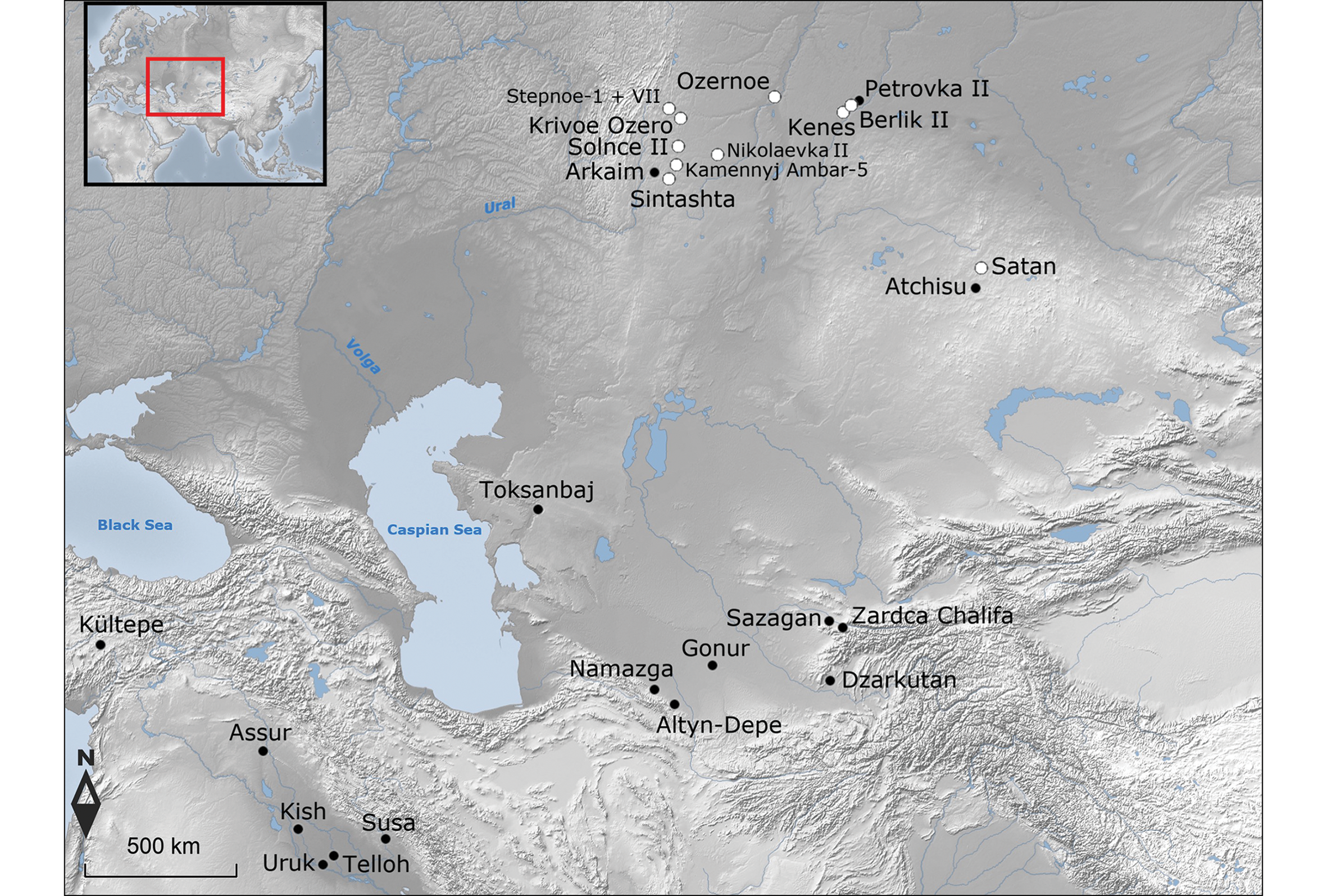
Burials with evidence of Sintashta-Petrovka Culture chariots and cheekpieces (white dots), and other sites of importance for different innovations in transport (black dots) during the late third and early second millennia BC (figure by the author).
There are currently three main Old World regions with archaeological evidence for such early chariots around the turn of the second millennium BC: the ancient Near East with its Bactrian periphery, the Central Eurasian Steppe and the Carpathian Basin. This article concentrates on evidence from the northern part of the Central Eurasian Steppe, examining archaeological, stratigraphic and radiocarbon data in order to produce a more accurate chronological framework for the emergence of early chariots and the use of horses as traction animals in the Central Eurasian Steppe. To accomplish this, a Bayesian model is presented to refine previously published radiocarbon dates for the Sintashta Culture from the Kamennyj Ambar-5 kurgan cemetery, located in Chelyabinsk Oblast in southern Russia.
Early Eurasian chariots and absolute chronology
Determining the chronological limits and phases of the Sintashta-Petrovka cultural complex has been challenging because of the very wide chronological range of the initial radiocarbon dates (between the early third and first half of the second millennium BC) returned from Sintashta and other sites concentrated between the south-eastern foothills of the Ural Mountains and northern Kazakhstan (Figure 1; Trifonov Reference Trifonov1997; Kuz'mina Reference Kuz'mina2007: 459 & 467). The same problem has characterised attempts to achieve a more accurate dating for the introduction of early horse-drawn chariots in the region (Anthony Reference Anthony2007: 374–76, tab. 15.1). A revision to an early second-millennium BC date seemed in general more convincing, especially when comparing organic (e.g. bone, horn or antler) horse bits from the Volga-Ural region to the very similar but later organic disc-shaped cheekpieces found in Late Helladic Mycenae. In the past, it was commonly assumed that these surviving bridle parts found in graves (c. 1650 BC), along with other bone objects exhibiting spiral motif decorations, were prototypes for similar artefacts found in Eastern Europe. Furthermore, the aforementioned initial radiocarbon dates from sites with Sintashta materials did not support an earlier date. Finally, more recently reported absolute dates (see below) helped to confirm previous arguments made in Russian research that the objects from Late Bronze Age Greece did, in fact, derive from the older and more diverse psalia (or cheekpiece) of the Volga-Ural region, and therefore represent the lower chronological limit for the use of that particular discoid cheekpiece type (see Teufer Reference Teufer1999: 100; Kuz'mina Reference Kuz'mina2007: 461–62; Boroffka Reference Boroffka, Fokkens and Harding2013: 886–87).
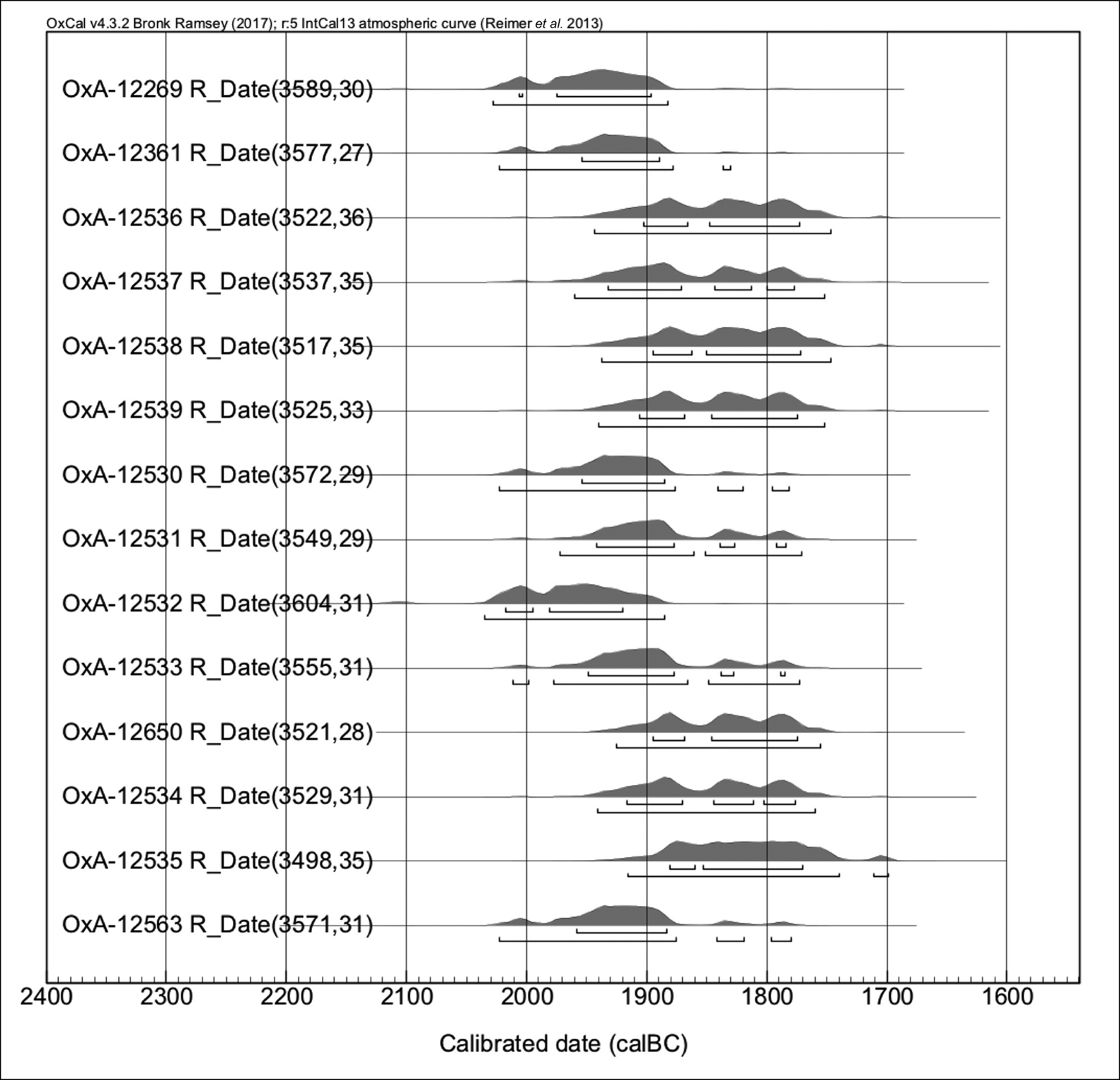
The publication of new radiocarbon data series from selected burial sites in the South-eastern Urals has helped to establish a much more accurate chronology for the late Middle Bronze Age Sintashta-Petrovka complex (Hanks et al. Reference Hanks, Epimakhov and Renfrew2007: 362, fig. 3). This chronology situates the Sintashta stage in the Trans-Ural region between c. 2040 and 1730 cal BC (at 95.4% confidence; Figure 2). Furthermore, a relatively earlier date for the Sintashta period before the emergence of the Petrovka type is indicated by the stratigraphy of settlements and burial sites throughout the region (Koryakova & Epimakhov Reference Koryakova and Epimakhov2007: 82). Indeed, a new radiocarbon series has confirmed the position of the Petrovka stage in the nineteenth to eighteenth centuries BC (Krause et al. Reference Krause, Epimakhov, Kupriyanova, Novikov and Stolarcyk2019). Recent research at the enclosed settlement of Kamennyj Ambar in the Karagajly Ajat River valley (Chelyabinsk Oblast) supports this stratigraphic evidence, based on the existence of different occupation phases. The settlement was first built and occupied by a Sintashta-Petrovka population in the late Middle Bronze Age and, following a hiatus, was reoccupied in the Late Bronze Age, as evidenced by the presence of material of the Srubnaya-Alakul Culture (Krause & Koryakova Reference Krause and Koryakova2013).
Calibrated radiocarbon-dated series of sampled Sintashta burials in the Southern Trans-Urals (dates from Hanks et al. Reference Hanks, Epimakhov and Renfrew2007; dates calibrated with OxCal v4.3.2 (Bronk Ramsey (Reference Bronk Ramsey2017) using the IntCal13 calibration curve (Reimer et al. Reference Reimer2013)).
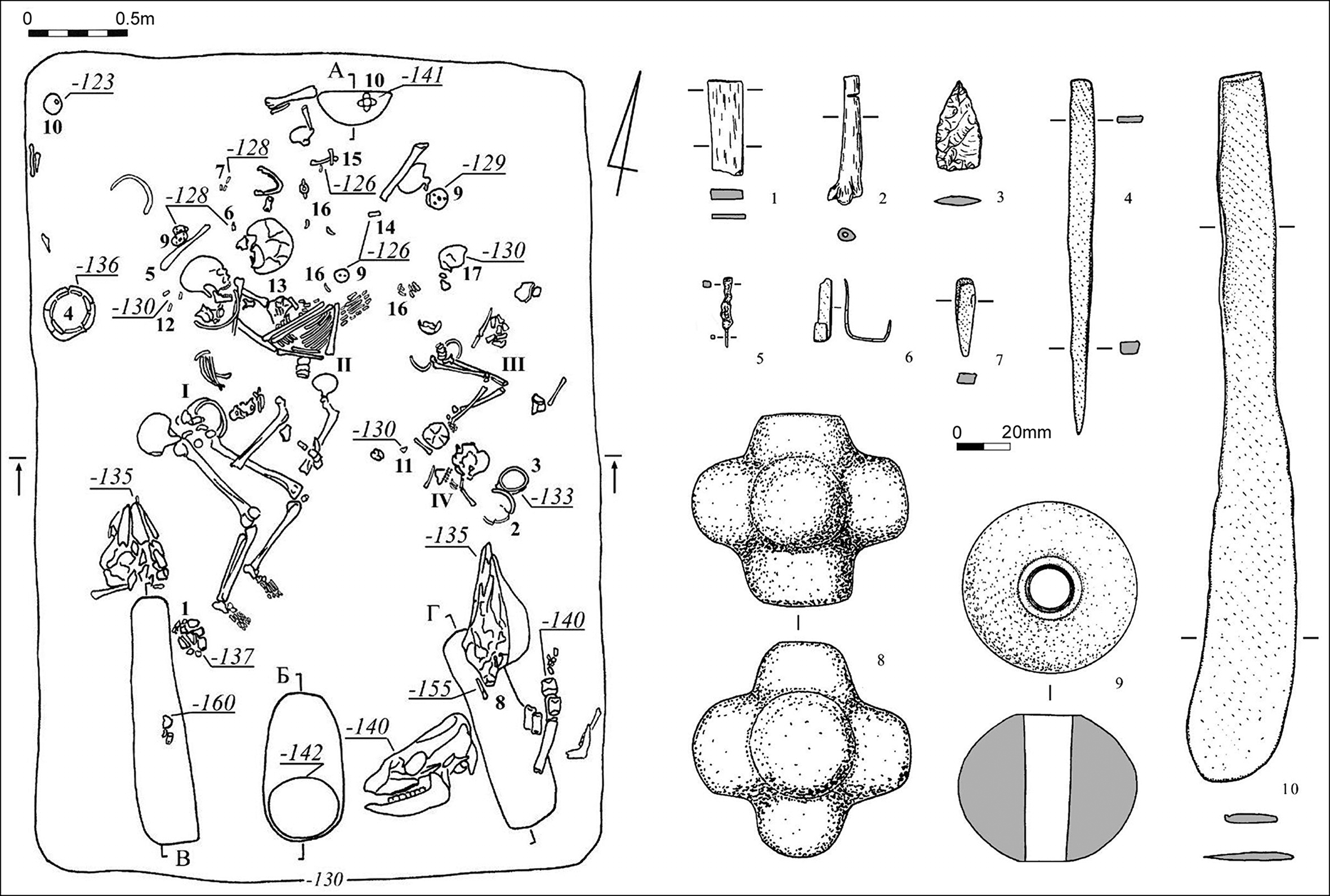
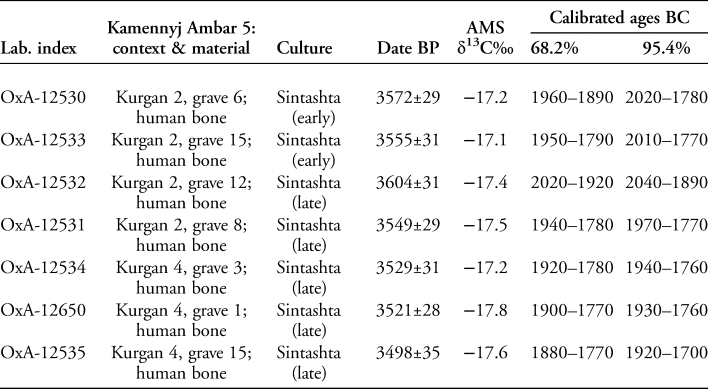
The associated kurgan cemetery, KA-5, is located on the right bank of the Karagajly Ajat river, opposite the settlement (Figure 1; Kostyukov et al. Reference Kostyukov, Epimachov, Nelin and Vasil'ev1995). Kurgans 2, 3 and 4 are contemporaneous with the Sintashta-Petrovka phase of the neighbouring Kamennyj Ambar settlement, while kurgans 7, 9 and 10 date to the Late Bronze Age (Epimakhov Reference Epimakhov2005). The discovery of parallel wheel pits and horse bones in grave 8 of kurgan 2 and grave 9 of kurgan 4 (Epimakhov Reference Epimakhov2005: 32–39, 116–20), along with other artefacts including several studded horse cheekpieces, suggest that early horse-drawn chariots formed part of the KA-5 mortuary tradition (Figure 3). Human bone from burial 8 has provided a radiocarbon date of 1970–1770 cal BC at 95.4% confidence (3549±29 BP; OxA-12531; Hanks et al. Reference Hanks, Epimakhov and Renfrew2007: 360; Table 1).
Kamennyj Ambar-5 cemetery in the South-eastern Urals: left) plan of grave 8 in kurgan 2 containing four individuals, with parallel wheel pits; right) examples of grave goods from the same grave (after Epimakhov Reference Epimakhov2005: figs 29 & 30).
Radiocarbon-dated burials in kurgans 2 and 4 at Kamennyj Ambar 5 in the Southern Trans-Urals. Radiocarbon dates by Hanks et al. (2007: fig. 3), calibrated with OxCal v4.3, using the IntCal13 calibration curve (Bronk Ramsey Reference Bronk Ramsey2009; Reimer et al. Reference Reimer2013). For stable carbon and nitrogen isotope values for human remains from graves in kurgans 2 and 4, see Hanks et al. (2018: tabs 1–2).
Certain problems, however, arise even with the newer radiocarbon dates. Exactly when, for instance, did the early chariots of the Sintashta-Petrovka Culture emerge? Grave 8 of kurgan 2 at KA-5 contained parallel wheel pits (the chariot itself possibly removed from the grave in a symbolic act), horse skulls and a horse bridle, and appears to date roughly to the same early horizon (or even earlier) as that containing the very first depictions of wagons with spoked wheels on ancient Near Eastern cylinder seals. The seals from Kültepe (Karum Kanesh; Figure 1) in central Anatolia, for example, are generally dated to the late twentieth and early nineteenth centuries BC, based on their position in stratum II during the Old Assyrian Colony Period (in the Mesopotamian Middle Chronology; Newton & Kuniholm Reference Newton and Kuniholm2004: 165–66; Anthony Reference Anthony2007: 403–404, fig. 15.15b–c).
The possible span of dates for grave 8 in kurgan 2 (between 1970 and 1770 cal BC at 95.4% confidence) is somewhat unsatisfactory and could lead to opposing interpretations. Knowledge of how to construct these new and fast vehicles could either have been developed in the Southern Urals (if we take the upper boundary of the date range) or may have been a later adoption from outside (lower boundary). A later date for the appearance of fast vehicles on the northern steppe compared to Anatolian visual representations is hypothetically possible. In that case, the early chariots of the Southern Urals, and the concept of an original Eurasian chariot complex as a whole (see Epimakhov et al. Reference Epimakhov, Kupriyanova, Berseneva and Bersenev2017: 42–44), could have derived from older West Asian prototypes. The interpretation of the radiocarbon dates discussed here, however, is influenced by a plateau in the calibration curve at around 3500 BP, which distorts the ranges of probable ages by almost two centuries (Epimakhov & Krause Reference Epimakhov, Krause, Krause and Koryakova2013: 137, fig. 7).
Another potential problem with radiocarbon dating human remains can be prehistoric diet, as revealed by bone-chemistry analyses. Palaeodietary research in the Southern Trans-Ural area using stable isotope analysis shows a broad variability in Sintashta Culture diet. Although dominated by pastoralism with livestock herding and the processing of secondary products, Sintashta subsistence practices also included the gathering of wild plants, along with hunting and fishing (Hanks et al. Reference Hanks, Miller, Judd, Epimakhov, Razhev and Privat2018). The latter is demonstrated by the presence of fish bones at the Kamennyj Ambar settlement, along with fish hooks and harpoons at other contemporaneous Sintashta Culture settlements (Stobbe et al. Reference Stobbe, Rühl, Nekrasov, Kosintsev, Krause and Koryakova2013: 235–36). Elevated δ15N levels suggest that aquatic resources, presumably from the Karagajly Ayat River, may have provided an occasional protein source for the inhabitants of Kamennyj Ambar who were subsequently buried in the KA-5 cemetery (Hanks et al. Reference Hanks, Miller, Judd, Epimakhov, Razhev and Privat2018: 20, tabs 1–2). Hence, it is possible that the Freshwater Reservoir Effect could have affected radiocarbon dating (Olsen et al. Reference Olsen, Heinemeier, Lübke, Lüth and Terberger2010), potentially resulting in a considerably older date for the human remains at KA-5. Recently acquired AMS radiocarbon dates on short-lived wood and charcoal species at the Kamennyj Ambar settlement, however, help to verify that the conventional ages of the KA-5 burials are not affected by a freshwater reservoir effect.
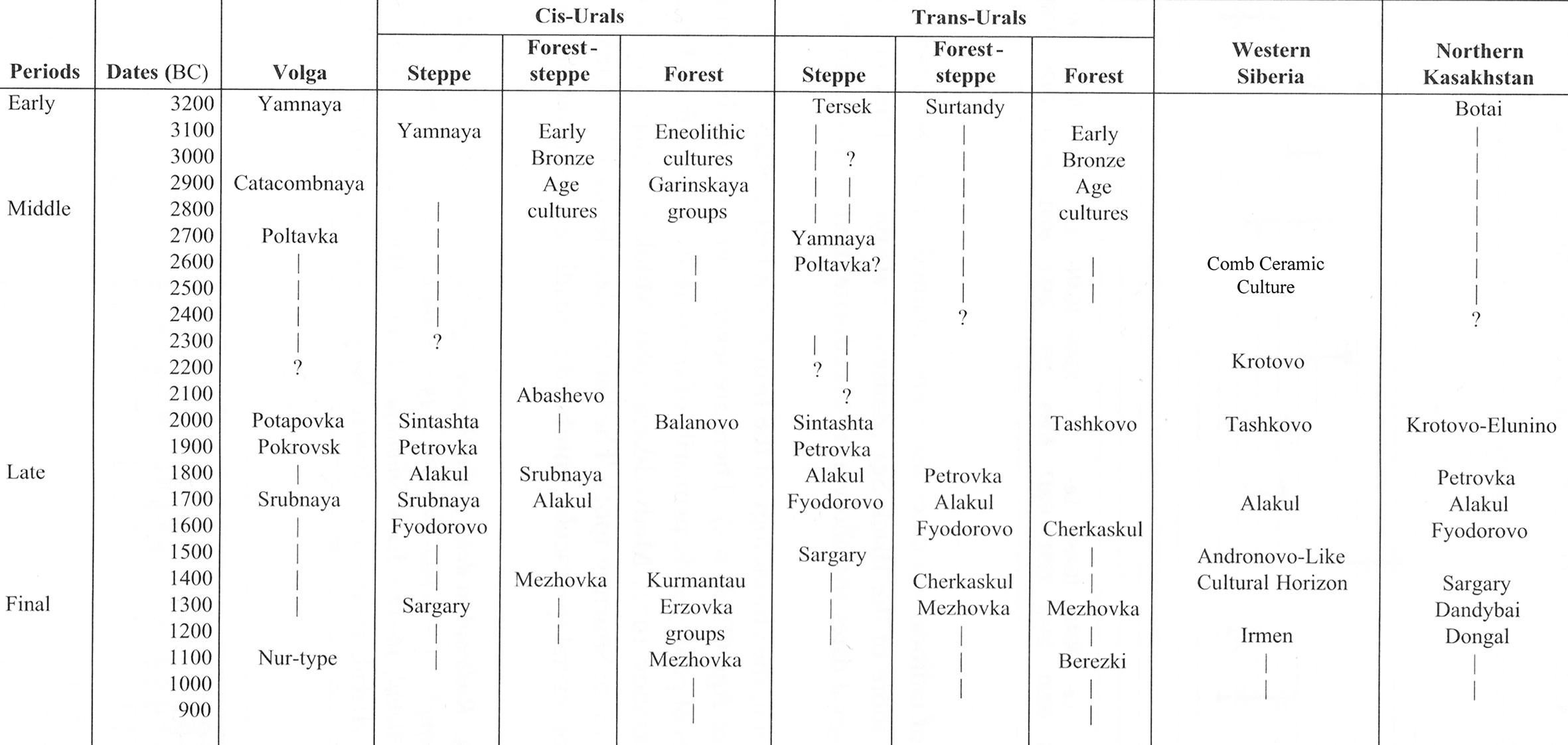
The 12 calibrated radiocarbon dates belonging to the Sintashta horizon range between 2050 and 1760 cal BC (at 95.4% confidence; Epimakhov & Krause Reference Epimakhov, Krause, Krause and Koryakova2013: 137). These dates correlate well with the seven AMS-sampled Sintashta graves in the associated KA-5 cemetery, which date to 2040–1730 cal BC (95.4% confidence; Table 1). Overall, the absolute chronology and stratigraphy of the enclosed settlement of Kamennyj Ambar and its associated cemetery situate the entire Sintashta-Petrovka cultural complex (twenty-first to eighteenth centuries BC) in a sequence together with other Eastern European Middle Bronze Age communities (Molodin et al. Reference Molodin, Epimakhov and Marchenko2014; Krause et al. Reference Krause, Epimakhov, Kupriyanova, Novikov and Stolarcyk2019; Figure 4). These include, for example, the Abashevo Culture located to the west of the Urals, and sites in western Siberia attributed to the Eurasian Seima-Turbino phenomenon (Marchenko et al. Reference Marchenko, Svyatko, Molodin, Grishin and Rykun2017: 1393).
Eastern European chronological scheme of archaeological cultures of the Bronze Age east and west of the Ural Mountains and western Siberia (after Koryakova & Epimakhov Reference Koryakova and Epimakhov2007: 42, tab. 0.4).
This article presents a Bayesian modelling approach to understand better the timing of the emergence of early chariots in the Southern Trans-Urals. Probabilistic models applied to the calibration of radiocarbon dates enable the incorporation of additional archaeological information. Stratigraphic or typological data, for example, can be used to modify the probability distribution. Here, the Bayesian method will be applied to limit considerably the probable upper and lower ranges of the calibrated radiocarbon dates, to provide a more precise chronology for grave 8 in kurgan 2 at KA-5. Before a Bayesian model can be calculated, the relative order for its corresponding radiocarbon dates must be established by using specific information about their relative positions within a stratigraphic sequence, from earliest to latest. For the Sintashta-Petrovka cultural complex, it is possible to distinguish between an early and a late phase within the Sintashta period by studying the development of specific types of ceramic vessels and cheekpieces from the burials.
Chronology of the Sintashta material in the Southern Trans-Urals
In Russian and Kazakh research, Sintashta-Petrovka Culture ceramic vessels and round or oval cheekpieces made of bone, found between the Southern Trans-Urals and east of the Ural Mountains, are generally distinguished into a Sintashta type, followed chronologically by a similar Petrovka type (Figure 1). The Petrovka Culture originated in present-day northern Kazakhstan (Koryakova & Epimakhov Reference Koryakova and Epimakhov2007: 66–98, fig. 2.19; Panteleyeva Reference Panteleyeva, Krause and Koryakova2013: 185, figs 1–2). The excavators of the Krivoe Ozero cemetery in Chelyabinsk Oblast, for example, separated material from the kurgans into a Sintashta horizon and a Petrovka horizon (Vinogradov Reference Vinogradov2003: 22). Such a distinction was also made for the grave goods from the Bronze Age mounds at KA-5 (Kostyukov et al. Reference Kostyukov, Epimachov, Nelin and Vasil'ev1995: 173–74; Epimakhov Reference Epimakhov2005: 161–62). This article concentrates on selected material from the earlier Sintashta phase within the Sintashta-Petrovka cultural complex.
The stratigraphic sequence documented by recent excavations at the enclosed settlement of Kamennyj Ambar near the KA-5 cemetery attests to two main phases of occupation. Ceramic fragments of the Sintashta type were recovered from the ditch and lowest levels of the houses investigated to date, while fragments of the more recent Srubnaya-Alakul type ceramics were found in the upper settlement layers (Koryakova et al. Reference Koryakova2011: 70–71, tab. 1). Establishing the stratigraphic position of Petrovka-type vessels at Kamennyj Ambar—which should directly post-date the Sintashta phase—is more challenging. The majority of Petrovka vessels were only assigned to this phase on typological grounds. They were recovered from the lower levels but also redeposited in later strata. This may suggest a short Petrovka phase of settlement activity towards or after the end of the oldest Sintashta period, but probably still before the beginning of the final Srubnaya-Alakul occupation at Kamennyj Ambar. The Late Bronze Age Srubnaya-Alakul phase probably began a few decades after a hiatus in activity (Epimakhov & Krause Reference Epimakhov, Krause, Krause and Koryakova2013: 139–41).
Teufer (Reference Teufer1999) has studied the ceramic vessels and disc-shaped cheekpieces of the Sintashta horizon within the Sintashta-Petrovka cultural complex. By cross-referencing the assemblages with their locations within cemeteries, he was able to obtain more detailed chronological information, particularly for the earlier Sintashta Culture. The probabilistic-chronological model used in the present study refers to Teufer's research, as the underlying radiocarbon dates (Table 1) suggest that the first use of light chariots in the Eurasian Steppe occurred within the Sintashta stage. The typological analysis of ceramics and cheekpieces and the evaluation of their temporal implications presented here are based on Teufer's work on assemblages from the Sintashta SM cemetery and several other similar Middle Bronze Age sites in the Volga-Urals region. This study built on the previous typological research of Kuz'mina (Reference Kuz'mina1994: 407, fig. 11) and Hüttel (Reference Hüttel1981).
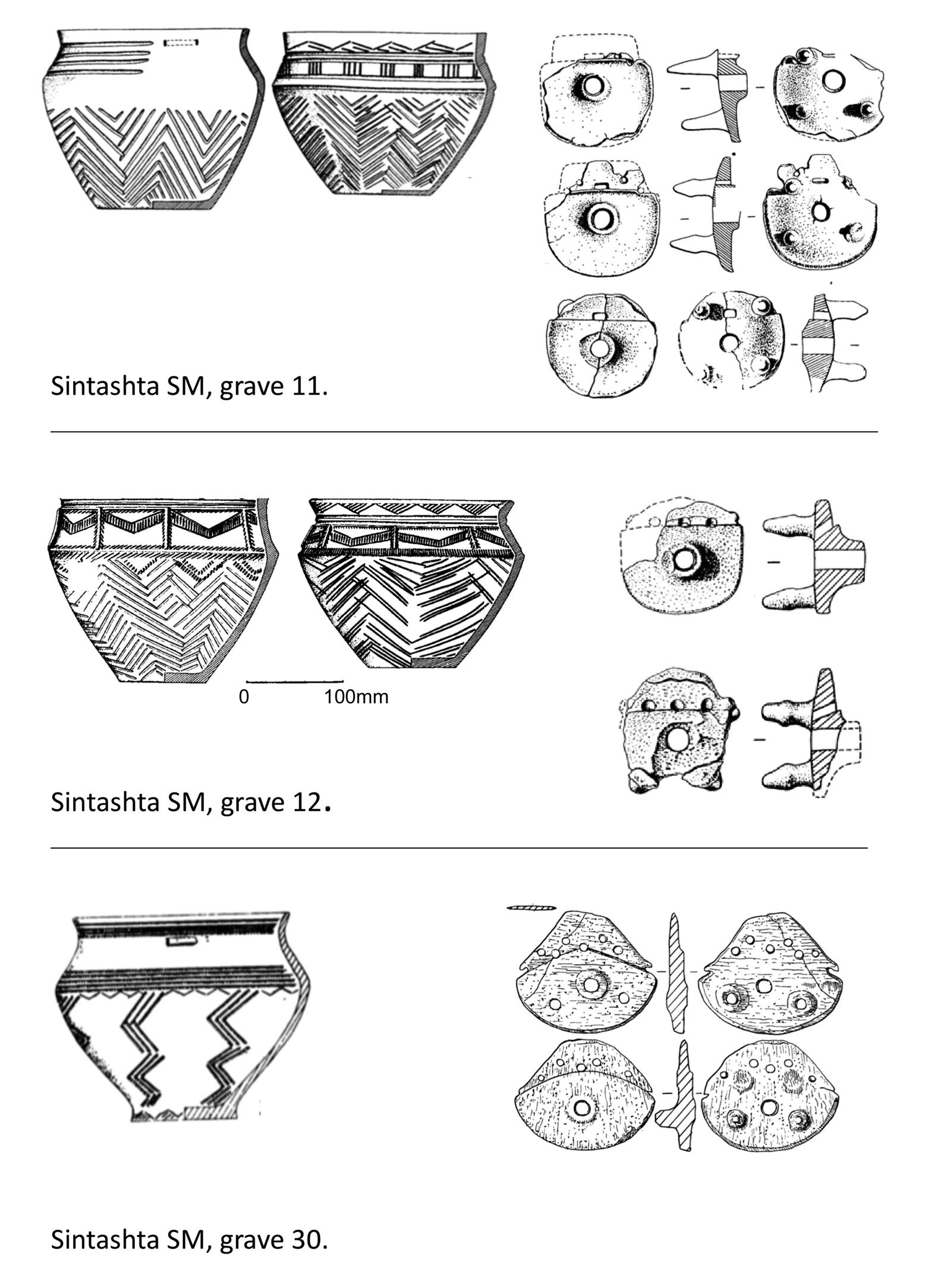
At Sintashta SM (Figure 1), the presence of early chariots is mostly only indicated by parallel pits or slots containing the preserved remains of spoked wheels. It is possible to divide the burials by the typology of the grave artefacts into northern and southern groups (Teufer Reference Teufer1999: fig. 27). Large conical pots with a rounded rim, and the body richly decorated with fishbone patterns, line-filled triangles or stitched zig-zags characterise vessels from the early phase of the Sintashta Culture. These are located mostly in the northern half of the cemetery (Teufer Reference Teufer1999: fig. 25). In addition, both small, edged pots (exhibiting rims with hard, straight edges) and fully decorated shallow pots were also found in association with earlier, large, fishbone-decorated pots. In several graves in the northern part of Sintashta SM, disc-like or semi-circular cheekpieces with an additional fitting and carved spikes of Teufer's type A2a (type A = with rigid spikes; 2a refers to a morphological variant of type A) were associated with these earlier ceramic forms (Figure 5: graves 11–12; Teufer Reference Teufer1999: figs 15–17) as well as at KA-5 (Figure 6: grave 5). In contrast, vessels found in the southern grave group at Sintashta SM differ in style and decoration: they have a more rounded or bulbous appearance, are more gently curved, with a sinuous neck, and are decorated with vertical patterns (Teufer Reference Teufer1999: fig. 24). In the southern burials, ceramics of this type either complement vessels of older types that are still in existence, or they replace them entirely. Moreover, the appearance of A2b- and B2-type oval cheekpieces (type B = with replaceable spikes) in the southern Sintashta SM group indicates recent and evolved types of horse-bits (Teufer Reference Teufer1999: 107; Figure 5: burial 30).
The Sintashta SM cemetery in the Southern Trans-Urals: top and middle) assemblages of ceramics with cheekpieces of the early phase type A2a (graves 11 & 12); bottom) the late phase types A2b; B2c (grave 30) of the Sintashta Culture (modified after Gening et al. Reference Gening, Zdanovič and Gening1992; types according to Teufer Reference Teufer1999).
Kamennyj Ambar-5 (KA-5), kurgan 2, in the Southern Trans-Urals: top) assemblage of vessels and cheekpieces of the early type A2a (grave 5, selection); assemblage of later vessels with the developed types A2b; A/B (grave 8, selection) of the Sintashta Culture at KA-5. Scales in centimetres (modified after Epimakhov Reference Epimakhov2005: figs 21, 22, 31 & 32; types according to Teufer Reference Teufer1999).
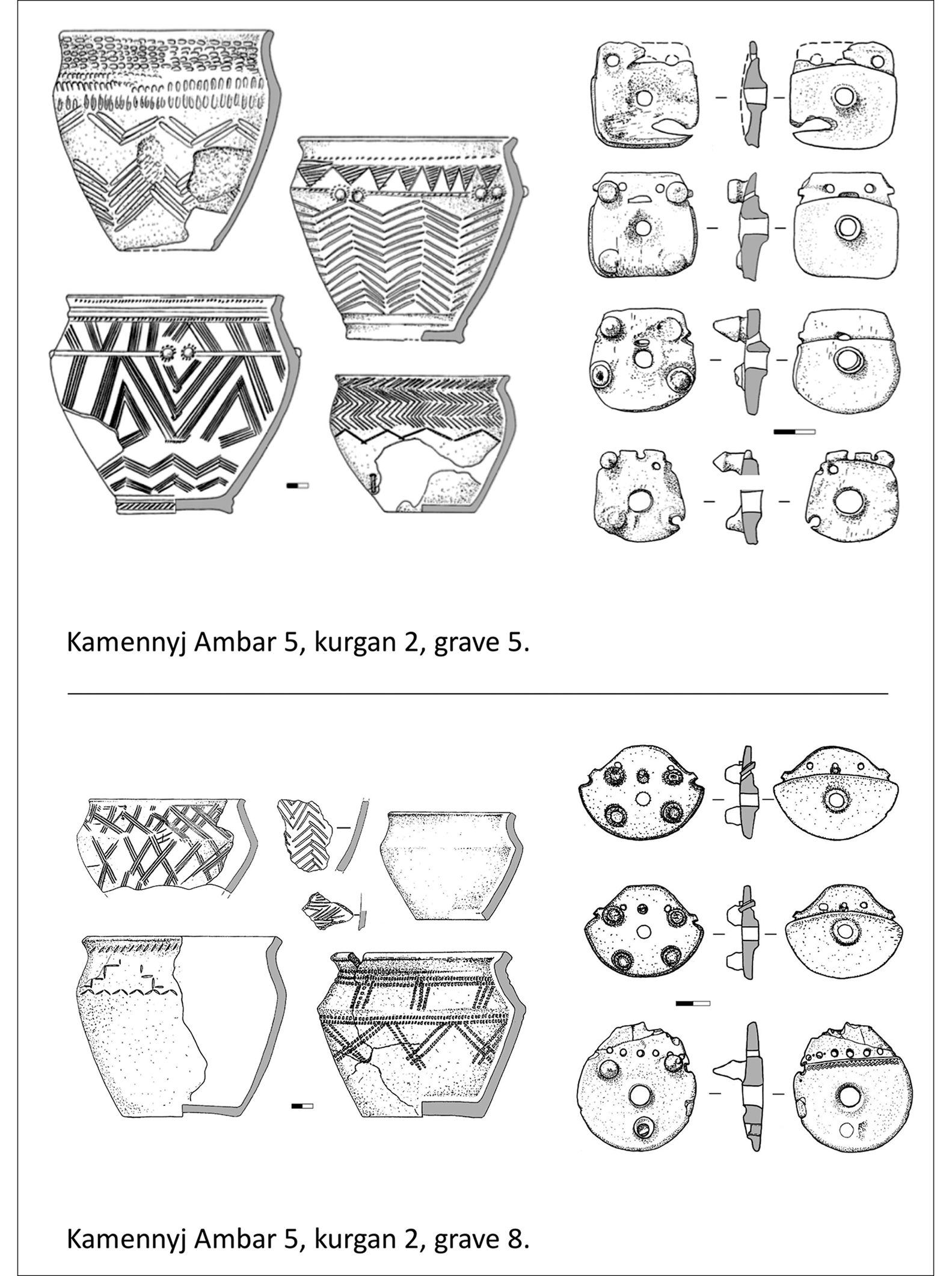
These typological combinations can be compared with other Sintashta cemeteries and assemblages from contemporaneous sites of the closely related Abashevo and Potapovka Cultures found to the west of the Ural Mountains. The aforementioned large pots with fishbone decoration, the smaller fully decorated vessels, and type A2a cheekpieces were found in the earliest graves at Sintashta SM in central burials, or closely set around them, or were limited to a specific kurgan segment. Graves with later ceramic forms and more evolved cheekpiece types were located away from the older burials (Teufer Reference Teufer1999: 108–25; Usachuk Reference Usachuk2013). Typologically later vessels at other Sintashta sites may differ in form from contemporaneous finds from the Sintashta SM cemetery. At KA-5 or Krivoe Ozero (Figure 1), for example, biconical and bulbous pots were found in the later burials, alongside horse-bits of developed type A2b (Figure 6: grave 8). The combination of specific ceramic forms with different types of bridle in the Sintashta SM burials probably reflects diachronic developments in material culture. Following Teufer (Reference Teufer1999: 107, fig. 27), it is likely that both groups of graves originated independently: first the older burials in the north (early phase), followed by later graves (late phase) in the south.
A Bayesian model for kurgans 2 and 4 at Kamennyj Ambar-5
In addition to the Sintashta SM cemetery and several other sites (Figure 1), the burial mounds at KA-5 also provide information for addressing questions concerning the first use of chariots on the Eurasian Steppe. At KA-5, such horse-drawn vehicles are recorded in graves by the presence of paired wheel pits (grave 8 in kurgan 2 and central grave 9 in kurgan 4), finds of different types of bridle, and horse bones (Epimakhov Reference Epimakhov2005). After establishing a chronological model for the KA-5 graves based on Teufer's (Reference Teufer1999) typological indications and the location of the sampled burials, a Bayesian model for the AMS-dated graves in kurgans 2 and 4 is presented. Dates are calibrated and modelled using OxCal v4.3.2 and the IntCal13 calibration curve (Bronk Ramsey Reference Bronk Ramsey2009; Reimer et al. Reference Reimer2013). In order to reduce errors, the radiocarbon dates are calibrated as an entire dataset.
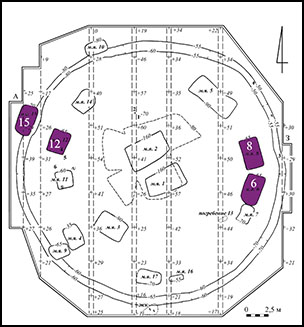
Two consecutive phases are defined to distinguish the sampled kurgan 2 (earlier) burials from sampled kurgan 4 (later) burials, the aim being to assess the relative chronological position of the Sintashta-phase graves (Figure 7). The burials in kurgan 2 (with the exception of grave 15) are located in the first circle surrounding central graves 1 and 2 (Epimakhov Reference Epimakhov2005: 28–60). For kurgan 4, all radiocarbon-dated burials (1, 3 and 15) are concentrated on the southernmost periphery of the kurgan. Moreover, graves 1 and 15 are positioned in the mound's probable entrance, in line with grave 2, which cuts the older ditch surrounding the original kurgan. A late chronological position for these graves seems likely (Epimakhov Reference Epimakhov2005: 85–86 & 89–139, fig. 66). In short, these burials contained assemblages of different pots and types of bridle elements, which suggest a chronological sequence, and were therefore used as prior information for the Bayesian model.
Kamennyj Ambar-5: plans of kurgans 2 and 4. AMS-sampled graves are colourised (modified after Epimakhov Reference Epimakhov2005: figs 6 & 63).
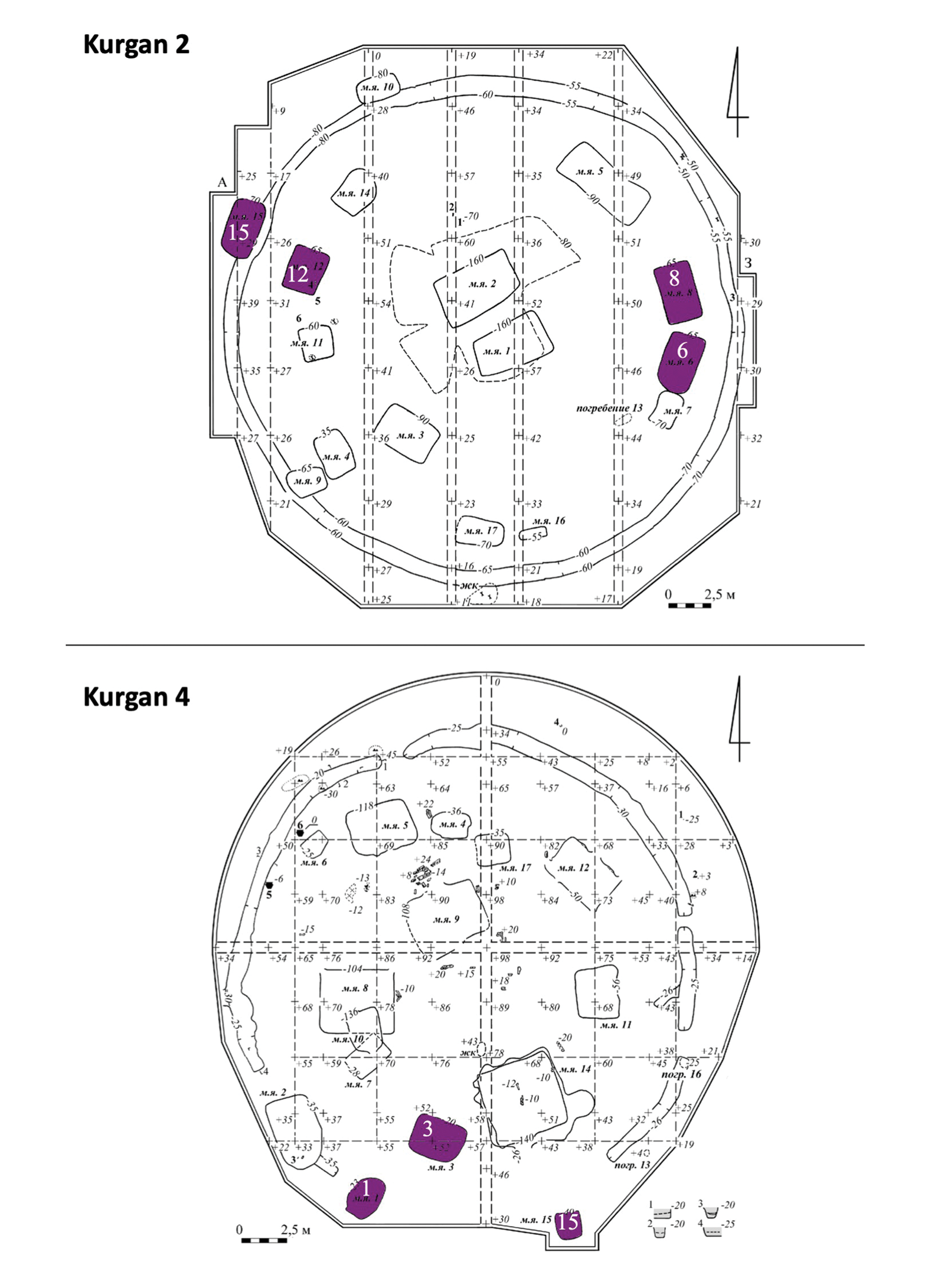
Grave 5 in the eastern half of kurgan 2 probably dates to the beginning of the Sintashta Culture (Figure 6). It contained the remains of up to eight individuals (Teufer Reference Teufer1999: 110–11). Although these individuals were probably not buried at the same time, all seven vessels associated with them represent older forms, as do the three type A2a semi-circular cheekpieces from that grave. Hence, at KA-5, there is a similar combination of artefacts to that observed in the northern, older part of the Sintashta SM cemetery (Figure 5: burials 11–12). Burials 6 and 15 in kurgan 2 may occupy a chronological position between burials of the early and late phases, as they contain either early (grave 6) or typologically mixed assemblages (grave 15) comprising older, fully decorated pots and later decorated, biconical or bulbous vessels (Epimakhov Reference Epimakhov2005: figs 26 & 49). Moreover, they are followed by graves 12 and 8 with typologically later ceramic vessels (Epimakhov Reference Epimakhov2005: figs 32 & 43–44). Grave 8 also yielded two later type A2b oval cheekpieces, complemented by a transitional type A/B piece with a mixture of fixed and replaceable spikes (Figures 3 & 6). Compared with those of graves 5 or 6, the assemblages from burials 8 and 12 date to the late phase of the Sintashta Culture. The relatively closely ranked AMS-dated graves 1, 3 and 15 on the southernmost periphery of kurgan 4 suggest a relatively later position in the mound, an observation supported by the burials’ assemblages. All these graves yielded sparsely decorated biconical or round forms of vessels characteristic of the late phase of the Sintashta Culture (Epimakhov Reference Epimakhov2005: figs 71: 1.3.5 & 104: 1–3). In terms of the presence of objects associated with horses, the later type A2b cheekpieces were found in kurgan 4 (Epimakhov Reference Epimakhov2005: figs 67.5 & 85.10–11).
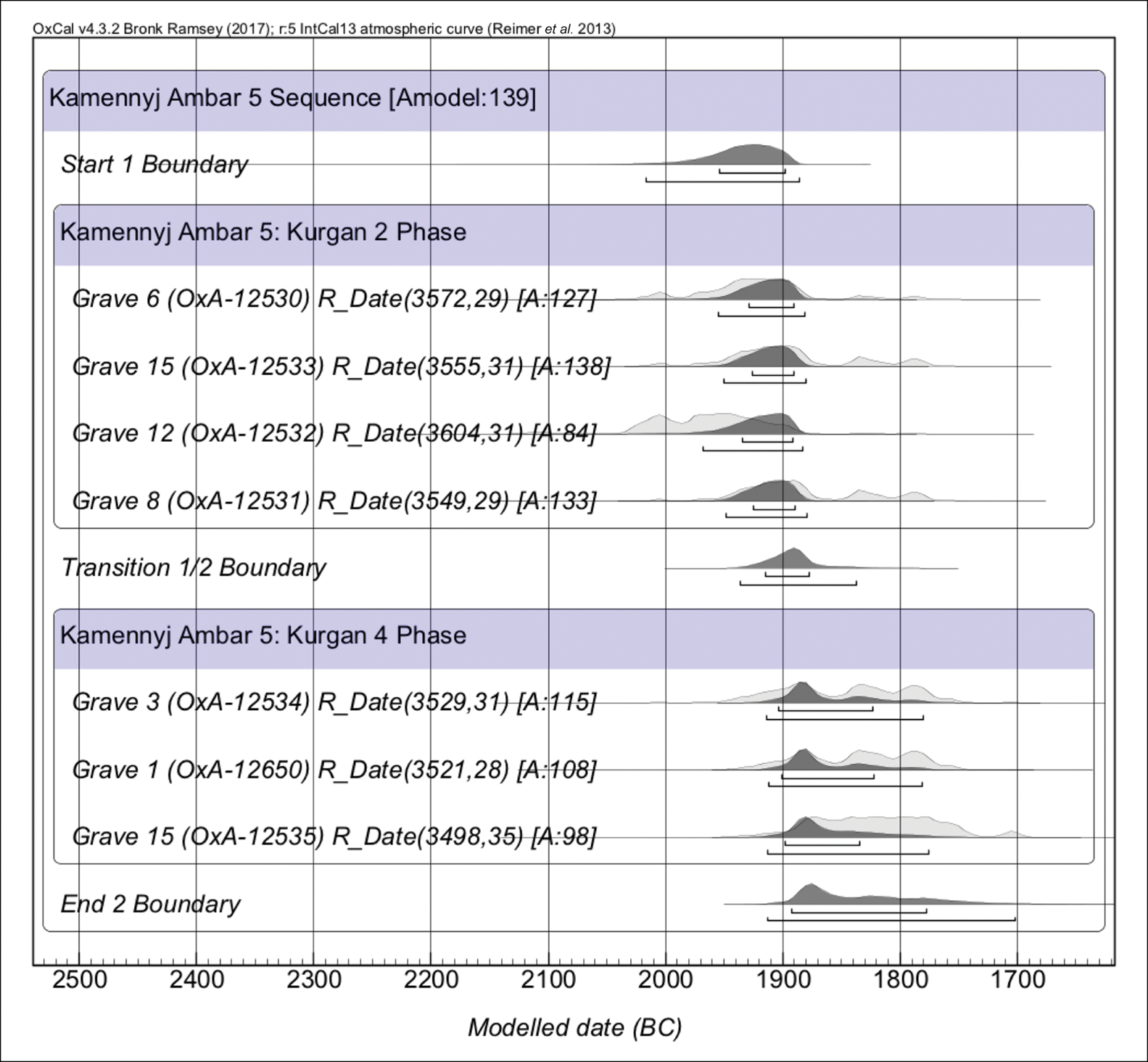
The graves of kurgan 2 (6, 8, 12, 15) sampled for radiocarbon dating contained typologically earlier and later vessels; grave 8 also contained later type A2b cheekpieces. Graves 6, 12 and 15 were therefore placed in the model's first phase. Grave 8, with a chariot, was allocated a late position in this early phase, given the grave's relatively late assemblage. The peripheral concentration of the graves and presence of only later ceramic types in the AMS-dated burials of kurgan 4 helps to place them in the second phase. The graves’ corresponding conventional radiocarbon dates were then put into the respective phase of the sequence (Table 1).
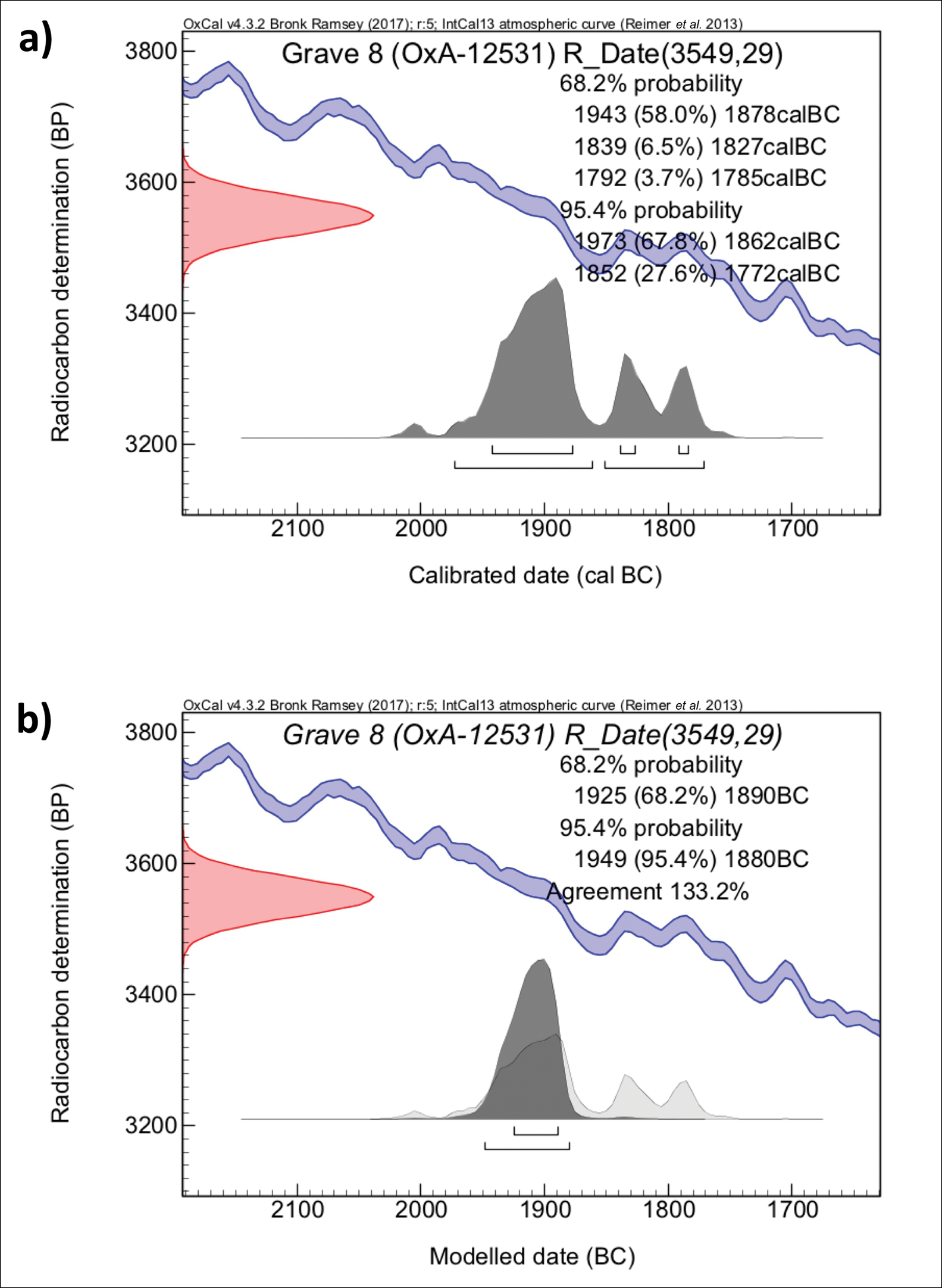
The model calculates the respective start and end boundaries of the two phases within the ordered radiocarbon series of the Sintashta Culture at KA-5 with an overall good agreement (Figure 8). The model suggests a probable span for the whole sequence between 2020 and 1700 cal BC at 95.4% confidence (1960–1800 cal BC at 68.2% confidence) for all the sampled burials. Grave 8 of kurgan 2, with its wheel pits, cheekpieces, horse bones and the remains of four individuals of different age and sex (Figures 3 & 6), plays a key part in establishing more precisely when the use of light chariots within the Sintashta Culture began. The Bayesian model, using additional archaeological information, for grave 8 of kurgan 2 (OxA-12531), gives an age range of 1950–1880 cal BC at 95.4% confidence (1930–1890 cal BC at 68.2% confidence) with a good agreement index (Figure 9b). Using the probabilistic method reduces the broad span of almost two centuries for the calibrated date (1970–1770 cal BC at 95.4% confidence) to the second half of the twentieth century BC (Figure 9a). It is not necessary to observe kurgans 2 and 4 in a direct chronological relationship to one another, as a model that contains the ordered radiocarbon dates of KA-5 within one phase also provides satisfactory results. Although the probability is a little less precise compared to the model imposing a prior belief for both kurgans, the probable age of grave 8 can still be limited to between 1950 and 1820 cal BC (at 95.4% confidence) or 1920 and 1880 cal BC (at 68.2% confidence). A visual comparison of the two models can be found in the online supplementary material (OSM).
A Bayesian model with two phases for kurgans 2 and 4 at Kamennyj Ambar-5. The order of the radiocarbon-dated burials from early to late is based on the development of ceramic vessels and discoid cheekpieces of the Sintashta Culture, and on burial location (figure by the author; dates calibrated with OxCal v4.3.2 (Bronk Ramsey (Reference Bronk Ramsey2017) using the IntCal13 calibration curve (Reimer et al. Reference Reimer2013)).
a) Calibrated conventional radiocarbon date of 1970–1770 cal BC (at 95.4% confidence); and b) modelled date 1950–1880 cal BC (at 95.4% confidence) of grave 8, kurgan 2, with the indication of an early chariot and horse tack at Kamennyj Ambar-5. Stated dates have been rounded to the closest ten (figure by the author; dates calibrated with OxCal v4.3.2 (Bronk Ramsey (Reference Bronk Ramsey2017) using the IntCal13 calibration curve (Reimer et al. Reference Reimer2013)).
Discussion
The combination of type A2b studded cheekpieces (Teufer Reference Teufer1999) and biconical pots or less decorated ceramic vessels places grave 8 of kurgan 2 into the late phase of the Sintashta Culture at KA-5. Grave 8, with its Bayesian-modelled age of between 1950 and 1880 cal BC (at 95.4% confidence), can be placed alongside other later Sintashta burials associated with evidence of light chariots and horse tack. Grave 30 in the southern, later half of the Sintashta SM cemetery, for example, contained parallel wheel pits (Figure 5) and a bulbous pot with vertical zig-zag decoration, as well as type A2b and B2c cheekpieces (Gening et al. Reference Gening, Zdanovič and Gening1992: 207–19, figs 114 & 115.3; Teufer Reference Teufer1999; 2b and 2c refer to morphological variants of types A and B, respectively). Grave 1 in kurgan 9 at Krivoe Ozero in the northern Chelyabinsk Oblast (Anthony & Vinogradov Reference Anthony and Vinogradov1995; Figure 1) probably also belongs to the vehicle burials of the late Sintashta phase. It contained surviving wood from a chariot and an assemblage consisting of earlier and later vessels, two more recent type A2b cheekpieces and two putative fragments of an early type A2a cheekpiece (Vinogradov Reference Vinogradov2003: 82–88, fig. 34).
It is notable that light chariots of the Sintashta Culture's early phase must have been in existence before grave 8 of kurgan 2 at KA-5. Grave 12 of the Sintashta SM cemetery, for example, yielded early, richly decorated pots and type A2a cheekpieces, alongside imprints of spoked wheels within the wheel pits (Gening et al. Reference Gening, Zdanovič and Gening1992: 162–68, fig. 78). Grave 11 also contained a very similar combination of artefacts (Figure 5). Both graves are located in the earlier, northern part of the Sintashta SM cemetery (Teufer Reference Teufer1999: fig. 27). Grave 12 thus provides evidence of light chariots at the very beginning of the Sintashta-Petrovka cultural complex. It is therefore highly probable that the construction of early horse-drawn chariots with spoked wheels began towards the end of the third millennium BC.
Conclusion
This article has evaluated the available radiocarbon dates from the Southern Trans-Urals region in order to explore the hypothesis that the region was a possible centre of technological innovation. The first chariots depicted on cylinder seals from the Karum II period at Kültepe in central Anatolia date to c. 1900 BC. Within the Bayesian model of the AMS radiocarbon dates for the sampled burials of kurgans 2 and 4 at KA-5, the date of the chariot-grave 8 in kurgan 2 is of particular significance. The radiocarbon model provides a more probable date range for this burial as 1950–1880 cal BC (at 95.4% confidence). Although the grave 8 assemblage suggests a late phase within the Sintashta Culture, its date (in the second half of the twentieth century BC, according to the Bayesian model) is not later than the first pictorial sources from the Karum II period (generally dated to the late twentieth and early nineteenth centuries BC). Furthermore, there is strong evidence for the use of light chariots in the early phase of the Sintashta Culture in the form of pits for spoked wheels and typologically older types of ceramics and horse tack from, for instance, graves 11 and 12 in the Sintashta SM cemetery. Early chariots and horse teams in the Sintashta-Petrovka cultural complex are therefore likely to have emerged in the decades around the turn of the second millennium BC, just as the range of radiocarbon dates indicate.
Despite the considerable increase in archaeological and absolute chronological data concerning the development of early horse-drawn chariots in the Central Eurasian Steppe region, the heated debate about the chariots’ place of origin, their diffusion or even the presence of evidence for the technological capability to build functioning chariots in the Eastern European Middle Bronze Age is ongoing. The key question remains as to whether this innovation derived directly from older Mesopotamian traditions, first with wagons on solid disc wheels in the early third millennium BC and then complemented by cross-bar wheels in the late third millennium BC (Littauer & Crouwel Reference Littauer and Crouwel1996). Third-millennium BC iconographic sources from the Near East depict two- or four-wheeled wagons in military contexts. Some of these are also assumed to have been used as vehicles for prestigious display (Littauer & Crouwel Reference Littauer and Crouwel1979: 68–69). Such wagons were sometimes equipped with metal tyre segments for the disc wheels, as noted at several late third- and early second-millennia BC sites between the Near East and Bactria (Figure 1; Crouwel Reference Crouwel2012). Light horse-drawn vehicles with spoked wheels, however, could also have emerged independently of such older traditions as a new mode of transport in response to specific mobility or functional needs in the late third and early second millennia BC (Piggott Reference Piggott1992: 48–49). This article offers the examples from Sintashta SM and Kamennyj Ambar-5, along with Bayesian modelling of radiocarbon dates from KA-5's kurgan burials, as new information for debate over both the timing of the introduction of light vehicles on the Eurasian Steppe and, more generally, technological innovations across Eurasia.
Acknowledgements
I would like to express my gratitude to Elke Kaiser for comments on a draft of the text. The article has also benefited from discussions with colleagues from the Institut für Prähistorische Archäologie der Freien Universität Berlin, and especially with Wolfram Schier. I thank the two anonymous reviewers for their careful reading of the manuscript and their helpful suggestions. Finally, a sincere thank you to Katy Derbyshire for her diligent proofreading of the text.
Supplementary material
To view supplementary material for this article, please visit https://doi.org/10.15184/aqy.2020.37


 Open access

