

The burials of emperors formed an important part of Byzantine imperial ideology throughout the empire's history. One of Constantinople's most famous and symbolic monuments, the church of the Holy Apostles, was an imperial mausoleum, said to have been established by the founder of the imperial capital himself, Constantine the Great.Footnote 1 Indeed, the Holy Apostles housed the remains of most Byzantine emperors until the eleventh century and was one of the most revered sites of the city.Footnote 2 After it stopped receiving new imperial burials, emperors such as Romanos III Argyros (1028-1034) established monasteries that served as their own burial places.Footnote 3 This remained the case even during the Komnenian period, when the Pantokrator monastery served as the dynastic monument of the ruling house.Footnote 4 However, each of these establishments did not continue beyond a few generations and they were often terminated by a change in the ruling family that entailed the creation of a new burial site.
Regarding the Palaiologan period, the sources provide relatively accurate information on most of the burials of the Palaiologan emperors, and archaeologists have tried to match the textual evidence with the material remains of Late Byzantine monuments, especially the Lips and Pantokrator monasteries. However, not a single imperial Palaiologan burial site has been accurately identified: the dry entries of short chronicles, the repetitive commonplaces in funeral orations, and the heavily altered monuments converted into mosques provide only general or even ambiguous information. The present article will attempt to identify the burial places of all emperors who ruled between 1259 and 1453 by re-examining the available sources (histories, short chronicles, orations, and other texts) and to assess the role of imperial tombs in the Palaiologan period based on findings from archaeological research into the monuments of Constantinople and other cities of the Late Byzantine sphere.
According to Alice-Mary Talbot, it is possible that Michael VIII Palaiologos (1259-1282), the restorer of Constantinople and founder of the last dynasty of Byzantium, was planning to revive the practice of imperial burials in the Holy Apostles: this would agree with his general policy of restoring monuments connected with the empire's glorious past and the importance of the mausoleum in his building projects.Footnote 5 Klaus-Peter Matschke and Teresa Shawcross have suggested that Michael may have thought of the monastery of Saint Demetrios, the family monastery of the Palaiologoi, as the most suitable burial ground.Footnote 6 The latter monument occupied a central position in the family's dynastic ideology, as it had been founded by a twelfth-century ancestor, thus serving as a link with the past; during the reign of Andronikos II Palaiologos it welcomed the remains of the last Laskarid emperor, John IV (1258-1261), within the framework of the policy of reconciliation with the pro-Laskaris faction pursued by Michael VIII's son.Footnote 7 In any case, the sources provide no indication of Michael's wishes concerning his burial.
In fact, when Michael died on 11 December 1282 (at the age of fifty-seven) while on campaign in Thrace, he was denied a proper burial in Constantinople, owing to his unpopularity as a result of his ecclesiastical policy.Footnote 8 Instead, he was laid to rest in a monastery called Nea Mone in the region of Rhaidestos (modern Tekirdağ). However, Pachymeres and one of the so-called short chronicles specify that his body was transported three years later, in 1285, to the monastery of Christ in Selymbria (καὶ ἐτάφη εἰς τὴν Σηλυμβρίαν ἐν τῇ μονῇ τοῦ Χριστοῦ).Footnote 9 Since Michael had earlier arranged for Basil II's body to be deposited there,Footnote 10 he thus ultimately received a burial that connected him with an emperor of the illustrious past, although a tomb outside the capital was probably not what he had in mind. The information about Michael's burial in Selymbria is confirmed by a fourteenth-century author, Philotheos, metropolitan of Selymbria, in an encomium to saint Agathonikos, the patron saint of Selymbria: κατὰ τὴν τοῦ Σωτῆρος καὶ πανελεήμονος Χριστοῦ μονήν, τὸ ἐαυτοῦ σῶμα κατακείμενον καθορᾶται.Footnote 11 The monastery is attested up to 1481, but, unfortunately, it cannot be identified with any of the known Byzantine monuments of the city (modern Silivri). Accordingly, no trace of Michael's tomb has survived, nor is there any information available concerning its appearance or exact location in the monument.
Michael VIII's grandson, Michael IX Palaiologos (1294/95-1320), predeceased his father, Andronikos II Palaiologos, without having reigned alone. His death occurred on 12 October 1320, in Thessalonike, at the age of forty-three. He has been identified as the addressee of a funerary oration composed in Thessalonike by the apparently local scholar John Staphidakes.Footnote 12 However, it is impossible to speculate about the location of the tomb; if Michael was indeed buried in Thessalonike, the church of Saint Demetrios, which had been renovated by the Palaiologoi and was dedicated to their patron saint, appears to be a possibility.Footnote 13 Alexandros Sideras has argued that, after the funeral was performed in Thessalonike, a commemorative oration by Theodore Hyrtakenos was delivered in Constantinople in the presence of Andronikos II and Andronikos III; there is no indication in the latter text that this occurred at the tomb.Footnote 14
Andronikos II Palaiologos (1282-1328) died on 12 February 1332, four years after his removal from the throne; he was the first Palaiologan emperor to die in the imperial capital.Footnote 15 Gregoras explicitly states that Andronikos was buried in the monastery of Lips, where the author delivered a funerary oration in honour of the deceased emperor.Footnote 16 The monastery, founded in 907, had been re-founded in approximately 1285 by Theodora Palaiologina, Andronikos’ mother, who added a church dedicated to Saint John the Baptist to the south of the pre-existing Middle Byzantine church of the Virgin.Footnote 17 The typikon that Theodora drafted for the re-established monastic foundation can help determine the location of Andronikos’ tomb within the monastery. The text stipulates that the founder would be buried in a tomb in the church of Saint John (the Palaiologan addition), situated ‘to the right after one enters the church’, that is to say most probably in the south part, and continues by adding that Andronikos should himself decide what was to be done with the area opposite Theodora's tomb, to the left of the passage leading from the church of St. John to that of the Virgin, the Middle Byzantine church to the north (τὸ δ’αὖ ἀντικρὺ καὶ ἐξ εὐωνύμων τῷ πρὸς τὸν παλαιὸν ἐντεῦθεν ἀπιόντι τῆς Θεοτόκου σηκὸν).Footnote 18
The two churches that once formed the nucleus of the monastery survive as the Fenari Isa Camii in Istanbul. Based on the information supplied by the typikon, Theodora's tomb can accurately be placed in the south aisle of the south church and should be identified with one of the arcosolia detected in that area during investigations carried out in the monument.Footnote 19 At the opposite side of the same church, in front of the diakonikon, there is indeed an arched passage leading to the north church. The area to the left of that doorway must therefore be the part of the church assigned to Andronikos by the typikon. Since Gregoras clearly states that Andronikos II was ultimately interred in the Lips monastery, and given the overall funerary character of the south church, it is reasonable to suggest that Andronikos chose to use the north arm of the ambulatory church of Saint John as his final resting place.
It is difficult to study this part of the monument, since it was completely altered in Ottoman times.Footnote 20 The descriptions of the findings of Theodore Macridy, who investigated the building in the 1920s, are laconic with respect to this area, but Ernst Mamboury's plan, which illustrates Macridy's report, shows a sarcophagus in exactly this position. Moreover, it is clear that the layout of this part of the complex was the result of extensive Palaiologan interventions to the pre-existing building: the pilasters at the south side of the earlier church were reinforced with masonry in order to provide support for the vaulting of the north part of Theodora Palaiologina's church. As a consequence, the north arm of the ambulatory is markedly narrower compared to those to the west and south and appears to have been specially configured to accommodate the sarcophagus. This construction reveals the importance of this section of the building complex, which accords well with the use of the space for the burial of a former emperor who also happened to be the son of the monastery's patron.
In the typikon, Theodora Palaiologina explicitly designates the church of Saint John as a burial place for the members of her family. Nevertheless, the monastery never became what one might call an imperial mausoleum, since only one emperor was ever buried there, Theodora's son Andronikos II Palaiologos.Footnote 21 In fact, the section of the typikon that deals with the burials foresees the installation of tombs for ‘Theodora herself and her mother. . . her children . . . and her sons- and daughters-in-law, her grandchildren, and their spouses’.Footnote 22 Nowhere is there any terminology appropriate to an imperial monument or mausoleum; on the contrary, the whole section is centred on Theodora and her family within a span of three generations (four, if one includes her mother). This would hardly have been the case if she had it in mind to inaugurate a series of imperial burials. The provisions for all her grandchildren and all her sons-in-law and daughters-in-law instead indicate that her focus was the family and not the imperial office.
Modern scholarship has often emphasised the similarity between Theodora's typikon and that of John II Komnenos for the monastery of the Pantokrator (drawn up in 1136).Footnote 23 The imperial character of the Pantokrator is evident in the section dealing with tombs and commemorations, which is replete with references to the royal identity of the occupants of the tombs.Footnote 24 On the contrary, Theodora's typikon does not contain a vocabulary related to imperial or royal monuments (apart from the reference to Andronikos as ‘her son, the basileus’) and, as has correctly been emphasized, certainly no mention of the founder of the Palaiologan dynasty (contrary to the commemoration of Alexios I Komnenos in the Pantokrator typikon);Footnote 25 thus it lacks the solemn tone that would befit an imperial mausoleum. In short, the Palaiologan Lips monastery was not meant to be and never became an imperial mausoleum; it housed the tombs of the empress's family, including her son, the emperor Andronikos II Palaiologos. Nevertheless, it is worth noting that the space reserved for the emperor's tomb was accorded special attention in terms of architectural planning.
The monastery of Lips was consistently used for the burials of the Palaiologoi throughout the Late Byzantine period.Footnote 26 It is thus evident that, although no other emperor was buried in Theodora's monastery, it was still reserved for the burials of members of the immediate circle of the imperial family. It therefore preserved the family character Theodora had envisaged and, at the same time, functioned as a secondary imperial mausoleum. It is possible that the unidentified burials mentioned in the archaeological reports, especially those detected in the perambulatory, belonged to close relatives of emperors and empresses.Footnote 27
Andronikos III Palaiologos (1328-1341) was the first Palaiologan emperor to die in Constantinople while still in office. The available sources state that he spent his last days in the monastery of the Hodegoi, dying there aged forty-four on 15 June 1341, and one short chronicle adds that he was interred in the monastery (ἀπῆγεν ὁ βασιλεὺς εἰς τὴν Ὁδηγήτριαν . . . ἐτάφη ἐν τῇ αὐτῇ μονῇ), which is known to have been one of his favourite shrines in Constantinople.Footnote 28 Andronikos’ son, John V Palaiologos (1341-1391), was only the second Palaiologan emperor to die while still in power in Constantinople (on 15 February 1391, at the age of fifty-nine), because between 1341 (the year of Andronikos III's death) and 1391 two emperors had usurped the throne and had died after being overthrown. John V followed the example set by his father and chose the Hodegon monastery as his final resting place.Footnote 29 The information is provided by one of the short chronicles: ‘καὶ ἐτάφη ἐν τῇ μονῇ τῶν Ὁδηγῶν’.Footnote 30 John Barker has shown that the imperial tomb seen by the Spanish ambassadors who visited the Hodegon monastery in the early years of the fifteenth century must have been that of John V.Footnote 31
It appears that the connection between his father's memory and the monastery was a crucial factor in John's decision to be buried there: it may have been a conscious attempt to follow his father's precedent, reinforce the family and dynastic ideology, and emphasize its continuity. In fact, this would have been the first father-and-son set of tombs in Byzantine imperial history since the time of John II and Manuel I of the Komnenos dynasty in the Pantokrator. However, it is strange that Clavijo mentions only one imperial tomb in the Hodegon church in his account; this could mean that the two funerary monuments were not in the same place and that Andronikos’ tomb was located in a different part of the monastic complex. A double burial in the church is also a possibility, although Clavijo would probably not have failed to mention such a monument. In any case, it is worth noting that Andronikos III and John V were not buried, like Andronikos II, in a family monastery, but in one of the most revered imperial foundations of Constantinople. Nevertheless, even within this context, the family factor and the relationship between father and son played a crucial role, reminiscent of Komnenian practices. For example, John II Komnenos had been buried together with his son Alexios in the Pantokrator.
All that is known about the monastery of the Hodegoi derives from textual sources. Its foundation, surrounded by legends and hagiographic traditions, can be attributed to Constantine V (741-775) and its reconstruction to the ninth century.Footnote 32 In the fourteenth century, its status was raised to equal that of other important shrines of the Virgin, those of the Blachernai and of the Chalkoprateia. Footnote 33 In addition to housing the famous Hodegetria icon, to which the Palaiologoi had a special attachment, and to its fame as a healing shrine,Footnote 34 the monastery was the location of a scriptorium producing manuscripts for the imperial family and it was closely associated with both the Palaiologos and Kantakouzenos families.Footnote 35 Although the monastic complex was an important imperial foundation and played a central role in Komnenian Constantinople, this was the first time it was used for imperial burials. Andronikos III's choice appears to form part of the Palaiologan dynasty's plans to enhance the site's place in public life. Unfortunately, nothing remains of the Hodegon monastery and it is therefore not possible to comment on the form or location of these two imperial tombs within the building complex, apart from Clavijo's statement that the imperial burial he saw was inside the monastic church (‘en esta iglesia’).Footnote 36 None of the texts dealing with the monastery add any other element regarding the setting of the burials of the Palaiologoi in the Hodegon.Footnote 37
It is probably not without significance that the monastery lay close to Hagia Sophia and to another imperial monastery, that of Saint George of Mangana, which had been favoured by John VI and was later renovated by John VIII Palaiologos (1425-1448). The continuous interest in this area of the city, close to the old palace and the original civic centre, betrays a constant concern with the symbolism of the imperial ideals connected with this region.Footnote 38 George Majeska has emphasized the sacred character of this corner of the city during the Palaiologan period, due to the double nature of its topography combining the religious and political elements. Paul Magdalino and Ruth Macrides have demonstrated that the Komnenoi continued to be attached to the area of the Great Palace and Palaiologan emperors also frequented the area, despite the emergence of the Blachernai Palace as an imperial residence in the twelfth century.Footnote 39 Therefore, the significance of the Hodegon monastery as a prestigious religious foundation and imperial burial ground could be viewed as part of this sanctified political landscape.
John VI Kantakouzenos (1347-1354), John V's father-in-law and regent, had died a few years earlier, on 15 June 1383 (he was approximately eighty-eight years old). Like Andronikos II, John did not die while in office, but as a former emperor who became a monk; unlike Andronikos, however, he died away from Constantinople.Footnote 40 Moreover, he had been a usurper and, although he generally remained on good terms with John V for the rest of his life after abandoning the throne, he would probably not have been buried in any of the Constantinopolitan monasteries housing imperial tombs, the Lips or the Hodegon; in fact, he chose to withdraw and end his life in the despotate of Mistra, where his son Manuel had ruled.Footnote 41 There is no record concerning John VI's burial in the Peloponnese; εἰς τὸν Μορέαν καὶ ἐτάφη ἐκεῖ is all that Short Chronicle 7 says but, as Donald Nicol has suggested, it is possible that he was buried in one of the monastic foundations established by his son, the despot of Mistra.Footnote 42
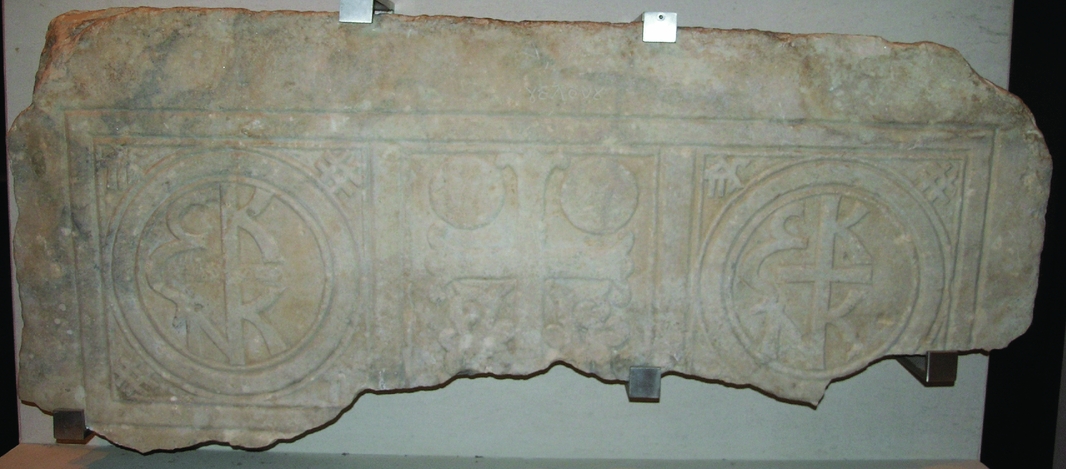
Manuel Kantakouzenos was the patron of two foundations in the city of Mistra, both of which bear traces of the fact that they were conceived as dynastic shrines: these were the monasteries of the Virgin Peribleptos and of Christ Zoodotes; the latter is often identified with the monument now known as Saint Sophia.Footnote 43 According to a no longer extant inscription recorded in the eighteenth century by Fourmont, portraits of the despot Manuel Kantakouzenos and of his parents, John VI and Eirene, adorned the entrance of Saint Sophia and it is possible that the despot Manuel was buried inside the church: fragments of sarcophagus slabs decorated with the monograms of the Kantakouzenos and Palaiologos families in the museum of Mistras have been attributed to Saint Sophia and to the tomb of Manuel (fig. 1).Footnote 44
Mistras, Museum: sarcophagus fragment with monograms of Kantakouzenos and Palaiologos families. (Photo: Nicholas Melvani)
This indirect evidence could mean that the former emperor was also buried in the same monument, but it cannot be determined in which part of the monastery the tombs of John and his son were actually situated.Footnote 45 A series of tombs has been excavated under the pavement of the two chapels to the northwest of the main church. An additional tomb has been detected in the northeastern parekklesion and has been attributed to a princess, on the basis of the textiles preserved within it.Footnote 46 Accordingly, all three chapels were funerary and Manuel's and John's tombs could have been located in any of them. Saint Sophia was also used for the burials of members of the Palaiologos family during the fifteenth centuryFootnote 47 and this later phase may have entailed alterations to the original Kantakouzenian mausoleum.Footnote 48 However, very little can be said until further material from the chapels is published. In any case, the single Palaiologan emperor who did not belong to the Palaiologos family was laid to rest far from the imperial capital, in a family mausoleum; a tomb within a dynastic monument of the ruling house of a semi-autonomous region was undoubtedly more prestigious than most tombs of other aristocratic families, but it was without aspirations to be an imperial burial.
John V's elder son, Andronikos IV, who reigned between 1376 and 1379 by briefly overthrowing his father, died on 28 June 1385 in Selymbria (he was thirty-seven years old), during a revolt against John V. He died as a former emperor, just as Andronikos II and John VI had, although unlike them he had not been tonsured: in fact, he was still active and struggling to regain the throne. His burial is recorded in two short chronicles: ‘καὶ ἐτάφη ἐν τῇ μονῇ τοῦ Παντοκράτορος’, ‘καὶ ἐτέθη εἰς τὴν ἁγίαν καὶ σεβασμίαν μονὴν Χριστοῦ τοῦ Θεοῦ ἡμῶν τοῦ Παντοκράτορος’.Footnote 49 The reference to the monastery of Pantokrator has prompted modern scholars to ascribe his tomb to the famous Komnenian monastery of Constantinople.Footnote 50 However, it must be recalled that Andronikos died in Selymbria as a usurper, so such an attribution is not self-evident: it is difficult to accept that his body was transferred to Constantinople and laid to rest in one of the imperial monasteries of the capital while John V was still in power. Moreover, it seems that such an event would not pass unrecorded in the sources. In the case of Theodore Palaiologos, son of Manuel II Palaiologos, who died in 1448, both Sphrantzes and a Short Chronicle explicitly state that the former despot of Mistras was carried from the Thracian city to the Byzantine capital after his death.Footnote 51
On the other hand, there was a monastery of Christ the Saviour in Selymbria, Andronikos’ place of death, which, incidentally, was also the territory he administered. This was where Michael VIII Palaiologos had been buried in 1282, having been refused burial in a Constantinopolitan shrine. It is therefore conceivable that the body of Andronikos IV was treated in a similar manner and that he was interred in the monastery of Christ in Selymbria, which may have been known as the Pantokrator. One of the two manuscripts containing Short Chronicle 7 does give a different account of the story: it mentions that Andronikos was buried specifically in the monastery of the Pantokrator in Constantinople (ὃν καὶ ἔθαψον εἰς τὴν μονὴν τοῦ Παντοκράτορος Χριστοῦ ἐν Κωνσταντινουπόλει). However, given that the text in question was written around 1425-1435, that is to say almost half a century after the event, it is conceivable that the author erred, perhaps misled by the fact that during his time the Constantinopolitan Pantokrator had just received the remains of Manuel II Palaiologos (in 1425), as well as those of his son Andronikos Palaiologos, despot of Thessalonike (and Andronikos IV's namesake).Footnote 52 Therefore, the reference to Constantinople may be an addition made by the author, who amended an entry in the older version of this text (datable to the years between 1392 and 1407).Footnote 53
Andronikos IV's son, John VII, died in September 1408, aged approximately thirty-eight, in Thessalonike, from where, according to an arrangement with Manuel II, he had reigned as despot, while preserving the imperial title, which he appropriated during his usurpation in 1390.Footnote 54 None of the sources make any allusion as to where he was laid to rest.Footnote 55 The most likely place would be Thessalonike itself, where he appears to have been very popular and where his memory was preserved over the following decades. This is corroborated by the fact that John has been identified as the addressee of a funeral oration attributed to the Thessalonian scholar Theodore Potamios; according to Panagiotis Agapitos, the text's contents suggest that the oration was delivered at the emperor's funeral and that the event took place in Thessalonike.Footnote 56 John may have been interred in the same monument as Michael IX, the other Palaiologan emperor who died in Thessalonike; perhaps in the church of Saint Demetrios.
Of the last three Byzantine emperors, two, Manuel II (1391-1425) and John VIII (1425-1448), were buried in the Pantokrator monastery in Constantinople. Manuel became a monk at Pantokrator under the name Matthew and died there on 21 July 1425, aged seventy-five.Footnote 57 The date is given by a variety of sources,Footnote 58 but the burial place is mentioned only in two short chronicles, nos. 7 (κατατεθέντος τοῦ ἁγίου λειψάνου αὐτοῦ ἐν τῷ πανσέπτῳ καὶ θείῳ ναῷ τῆς ἱερᾶς βασιλικῆς μονῆς τοῦ Παντοκράτορος Χριστοῦ) and 13 (καὶ ἐτάφη . . . ἐν τῇ σεβασμίᾳ καὶ περικαλλεῖ βασιλικῇ μονῇ τοῦ Παντοκράτορος).Footnote 59 However, the texts are silent about the location and form of the tomb. A funeral oration composed by Makarios Makres similarly adds nothing to our knowledge regarding the tomb, apart from the commonplace fact that the body was covered with a stone — σοῦ τάφος ἀληθῶς λίθος ὁ πικρὸς οὑτοσί — perhaps an allusion to an actual slab, though this is hardly surprising.Footnote 60
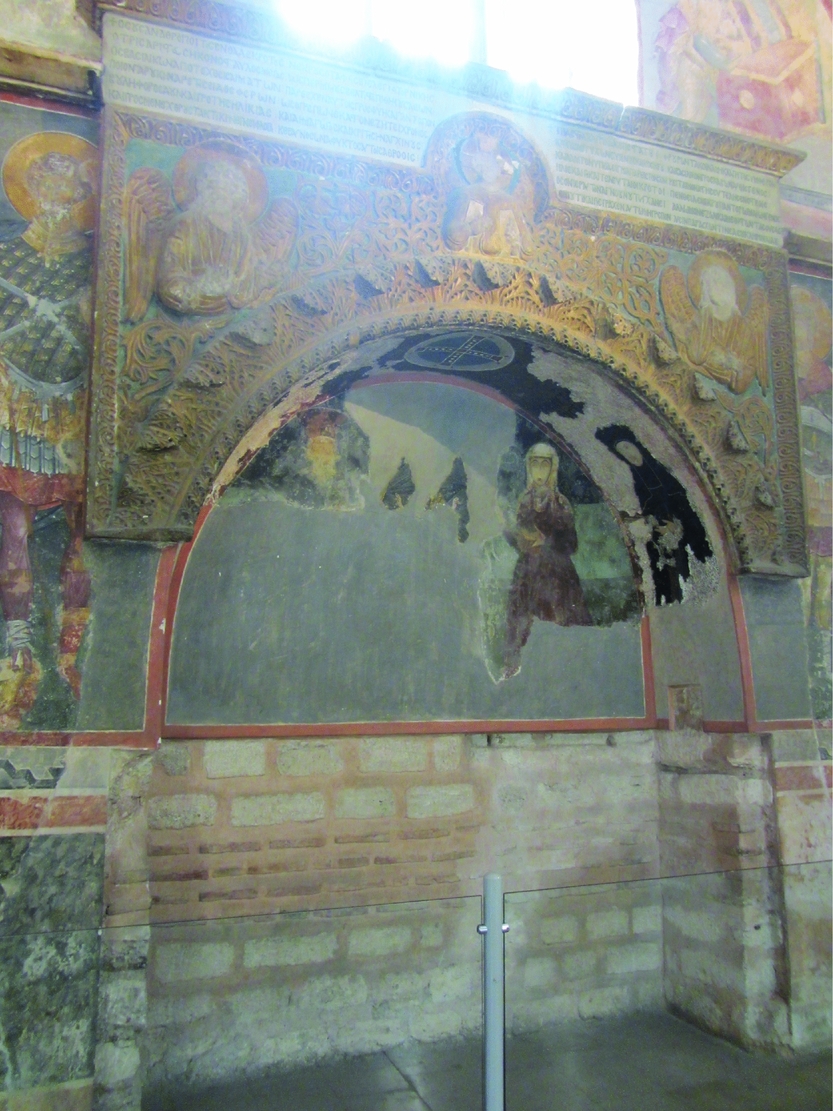
A short chronicle records the fact that ten years after the emperor's death, in 1435, his son Theodore II Palaiologos of Mistras embellished the tomb with a golden stele.Footnote 61 Theodore also commissioned two epigrams composed by the famous scholar Bessarion to be inscribed on a set of textiles, which may have been destined for the tomb, perhaps as hangings.Footnote 62 According to the poem's title, the cloths in question were adorned with double portraits of Manuel and his wife Helena in secular and monastic dress (πέπλοις διπλοῖς ἐν σχήματι κοσμικῶν καὶ μοναστῶν). It cannot be proved that the commemorative textiles in question were made for the tomb in the Pantokrator: the emperor and his wife are referred to as dead (ἀοιδίμους βασιλεῖς), but there is no mention of the tomb; nevertheless, it is reasonable to assume that double portraits like the ones mentioned in the epigram actually existed on the imperial monument, because such images are well known from surviving monuments in Constantinople and elsewhere (fig. 2).Footnote 63 Manuel's portrait as a layman would probably have depicted him as an emperor, wearing a crown, sakkos and gold loros, and holding a cross and akakia, equivalent to his representation in manuscripts Par. Suppl. Gr. 309 (f. VI) and Louvre, Ivoires 100 (f. 2r). In the latter case, Helena and the couple's children are also included.Footnote 64
Constantinople, Chora monastery, parekklesion, south wall: general view of Tomb of Tornikes with portraits of Michael Tornikes and his wife. (Photo: Nicholas Melvani)
The death of John VIII Palaiologos on 31 October 1448 (he was fifty-six) is recorded in the main narrative sources of the time.Footnote 65 However, the emperor's burial is mentioned only by Sphrantzes (καὶ ἐτάφη . . . εἰς τὴν μονὴν τοῦ Παντοκράτορος) and in two of the short chronicles (καὶ ἐτάφη ἐν τῇ σεβασμίᾳ μονῇ τοῦ κυρίου καὶ θεοῦ καὶ σωτῆρος ἡμῶν Ἰησοῦ Χριστοῦ τοῦ Παντοκράτορος; καὶ ἐτάφη εἰς τὸν Παντοκράτορα).Footnote 66 Again, there is no indication regarding the form and location of the tomb, although it would be reasonable to assume that it was close to that of John's father. In fact, it seems that the Pantokrator acquired an increased importance for the family of Manuel II, since it housed the burials of two more of Manuel's sons, Andronikos and Theodore, as well as that of his wife Helena, who was buried with the late emperor in 1450. To these, Maria Palaiologina, third wife of John VIII, and Eirene Palaiologina, widow of John VII,Footnote 67 must be added.
The monastery of Christ Pantokrator had been founded by John II Komnenos in approximately 1118-1124 and was the principal mausoleum of the Komnenos imperial family. Michael VIII Palaiologos had taken special care to revitalise the monastery after the reconquest of Constantinople in 1261, but in the early 1420s there seems to have been a more conscious effort to revive the Pantokrator. Manuel II, with the help of George Sphrantzes, summoned the erudite monk Makarios Makres from Mount Athos to Constantinople and entrusted him with the specific task of giving new life to the historic foundation.Footnote 68 From that point, the Pantokrator became the focal point of several events and developments: both Manuel II and John VIII visited it frequently and held meetings there with the patriarch Joseph II; its importance in public life increased significantly, as some of George Scholarios' anti-Union orations were delivered there in the presence of the emperor John VIII.Footnote 69 It is therefore clear that the Pantokrator became a foundation of central importance to the policy and ideology of the last Palaiologoi. Makarios Makres must have played a part in this revival and it appears that resuming imperial burial in the Pantokrator was part of the process. It may not be a coincidence that Makres composed an epitaphios logos for Manuel Palaiologos and was himself also buried in the Pantokrator.Footnote 70 The continuous embellishment of Manuel II's tomb, even after his death, and the burials of Manuel and John VIII with their wives reveal the systematic efforts of the last Palaiologoi to promote the Pantokrator as a burial space. Indeed, the fifteenth-century Pantokrator is the only case where emperors’ wives were interred in the same monastery as their spouses: until then, they were buried separately, either in the Lips or Kyra-Martha convents.Footnote 71
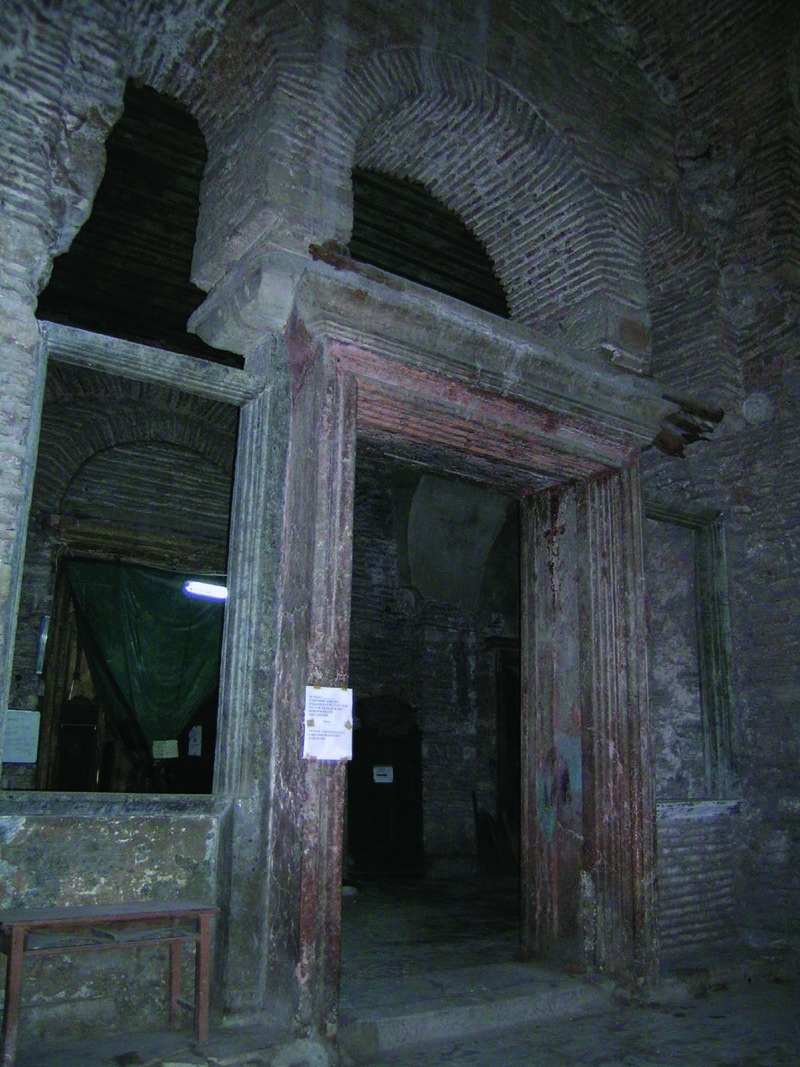
The history of the Palaiologan construction at the Pantokrator (the complex now known as the Zeyrek Camii) has not been elucidated in detail. Robert Ousterhout has detected a number of interventions to the original twelfth–century complex, which probably date to the Late Byzantine period.Footnote 72 The modifications made to the narthexes, especially the arcade connecting the outer narthex to the south part of the inner narthex, may date from the fifteenth century and could be connected with the burials of the last Palaiologoi (fig. 3). As it was common in Palaiologan times to adjust narthexes to receive arcosolium niches, it is possible that the inner narthex that connects all three churches was modified accordingly in order to accommodate the tombs of the last emperors of Byzantium, especially the northern part, which remains largely unexplored. The afore-mentioned arcade could be an indication that the work supervised by Makarios Makres, with the approval of Manuel II, was conceived as an act of monumentalizing the area and emphasizing its solemn character. In any case, the large number of Palaiologan burials mentioned in the Pantokrator are an indication that some of these may have been located in chapels and other structures in other parts of the monastic complex, beyond the surviving cluster of churches that form the present-day Zeyrek Camii.
Constantinople, Pantokrator monastery: inner narthex, view from outer narthex of south church. (Photo: Robert Ousterhout)
Only the Komnenian tombs in the church of Saint Michael (the middle church of the complex, also referred to as the Heroon) have been studied and it is clear that the tombs of the Palaiologoi were not in this part of the building complex.Footnote 73 It must be noted, however, that the tombs of the Komnenian emperors and their families must have been visible in the middle church during the late period, serving as a link between the two phases of the monument. These monumental tombs must have been of considerable importance for the ideology of the Palaiologan emperors. Curiously enough, however, the Komnenian tombs are not mentioned by any of the Late Byzantine visitors to the monastery, although the Russian pilgrims and the Castilian ambassadors clearly entered the middle chapel, as they describe the stone of the Unction, which was next to the tomb of Manuel I.Footnote 74
The death and burial site of the last Palaiologan emperor, Constantine XI Palaiologos, have been the subject of a vast amount of literature, ranging from folk tales and popular stories to scholarly attempts to solve one of the greatest puzzles of Byzantine history. Although it is certain that Constantine perished during the final Ottoman assault on Constantinople on 29 May 1453 (aged forty-eight), the exact circumstances of his death are not known.Footnote 75 He was probably killed in the vicinity of the gate of Saint Romanos (which is now known as the Topkapı gate in the Land Walls), where he was stationed and last seen.Footnote 76 Contemporary accounts of the siege and fall of Constantinople mention nothing about his burial; the silence of George Sphrantzes, who was a close friend of the emperor and spent some time in Constantinople after 1453, is indicative. Local Greeks and foreign visitors in the sixteenth century were unaware of the existence of such a tomb. Marios Philippides and Walter Hanak have analysed legends regarding the tomb of the last emperor and have demonstrated that these started circulating only in the nineteenth century and should therefore be dismissed.Footnote 77 Although it is possible that the Ottoman sultan Mehmed II wanted to arrange a burial, as Turkish sources seem to imply, it is impossible to propose any site based on the available evidence. On the other hand, Greek elite circles in early Ottoman Istanbul, which revolved around the patriarch Gennadios Scholarios and his immediate successors, would probably have been unwilling to pay tribute to an emperor whom they had fiercely opposed during his reign because of his Unionist policy.Footnote 78 This unwillingness, or even hostility, on behalf of the patriarchate may have also contributed to the lack of any record or commemoration of a tomb of Constantine Palaiologos in the Greek sources.
It is difficult to distinguish between a family and an imperial mausoleum in the Late Byzantine period, since the burials of the Palaiologan emperors exhibit elements of both tendencies. Family burials were well known in imperial and aristocratic foundations since the Middle Byzantine period, as the Komnenian dynastic tombs in the Pantokrator indicate. Theodora Palaiologina was probably trying to imitate this practice, in the absence of her husband, and this model was also followed by members of the aristocracy, often in connection with the re-foundation of an older monastery, as is well attested by monasteries such as Saint John of Petra and the Virgin Bebaias Elpidos.Footnote 79
As the additional space in the perambulatory of the Lips monastery is approximately contemporary with the south church, there would have been enough space to accommodate the tomb of Andronikos III, had he wished to continue Theodora's plans for a family foundation. Instead, he chose to be buried in the more conspicuous and publicly visible Hodegon monastery. Moreover, Andronikos III and his son John V do not appear to have been active in founding or re-founding monasteries. Their focus on the Hodegon accords well with the dynasty's favour towards the revered shrine and should be viewed together with their other interventions in the old civic centre of Constantinople. The burials in the Hodegon were therefore part of the continuing plan to revive the imperial image of Constantinople, a project Michael VIII had inaugurated a few decades earlier.
The family tombs of the last Palaiologan emperors with their wives within the imperial Pantokrator, especially the focus on Manuel II's immediate family, embody the dual character of Palaiologan imperial tombs and exemplify the double tendency mentioned above. This combination of imperial and family mausoleum had already been present in the Komnenian Pantokrator, where characteristics of traditional imperial monuments were blended with practices commonly observed in private foundations. This double nature must have served as the model for the last imperial burials of Byzantium.
In order to contextualise the imperial burials, it is useful to compare the above data with material evidence from preserved tombs from the Palaiologan period. The best-preserved examples from Palaiologan Constantinople are those in the Chora church, four in the parekklesion, three in the outer narthex, and one in the inner narthex (fig. 2).Footnote 80 Analogous examples have been detected in other monuments, such as the narthex of the parekklesion of the Pammakaristos,Footnote 81 and the Lips monastery (as already mentioned, in the south part of the south church and in the perambulatory). The standard type is that of the arcosolium tomb: an arched niche opened into the wall of a chapel or other type of annex, its bottom part with the burial blocked by a pseudo-sarcophagus front and covered by a slab functioning as a lid. The back wall of the niche is often decorated with frescoes or mosaics showing portraits of the deceased, occasionally with their families, in supplication to sacred personages.Footnote 82 The luxurious dresses and headgear carrying eloquent attributes such as monograms and status symbols were a means of praising the dead. The most lavish cases were adorned with sculpture decoration, such as marble facings enhancing the arches, supporting corbels or small capitals with reliefs.Footnote 83 Inscriptions, often long epigrams written in elaborate script, also played a role in the visual character of these tombs.Footnote 84
The imperial burials appear unusual by these standards. None of the Palaiologan imperial tombs have survived, but the burial of Andronikos II in the Lips monastery can provide some clues about its place and function within the monument, since it has been shown that it was probably situated in the vaulted area connecting the two churches of the monastic complex. Robert Ousterhout has suggested that the tombs of Manuel II and John VIII may have been installed in the north part of the inner narthex connecting the Pantokrator churches, which is also distinguished by its arches. If this hypothesis is correct, it seems that in both cases represented by surviving monuments the emperors were buried in specially designed vaulted areas of the buildings, which were the result of Palaiologan re-modelling of pre-existing Middle Byzantine churches. Indeed, this arched configuration would help monumentalise the area and provide a grandiose setting for the burials. As Ousterhout has shown, the popularity of the theme of the Holy Women at the Tomb for vaults and lunettes above rulers’ tombs might provide some idea of the iconographic context.Footnote 85
What is known about the architectural setting of the tomb of Andronikos II in the Lips monastery indicates that the Palaiologan imperial tombs would have been more lavish compared to the standard type of arcosolium niches known from aristocratic burials.Footnote 86 Regarding the preferred types of the actual tomb monuments, one would expect sarcophagi, most probably composite ones (instead of the pseudo-sarcophagi of aristocratic arcosolia), consisting of three or four slabs covered by a lid. Those of the Serbian kings might serve as a comparable example, if Slobodan Ćurčić is correct in assuming that the latter reflected Byzantine practices.Footnote 87 A sarcophagus from the Stoudios monastery reconstructed by Urs Peschlow confirms that this type was indeed in use during Palaiologan times.Footnote 88 Canopied tombs, such as the one suggested by Nancy Ševčenko for Manuel I Komnenos in the Pantokrator, are also a possibility; the monumental tomb of Alexios IV Grand Komnenos (1417-1429) at the Chrysokephalos in Trebizond may be cited as a comparable example from the Late Byzantine period,Footnote 89 while re-used early Byzantine sarcophagi cannot be excluded either, given the Palaiologan predilection for remnants of the past.
Little can be said about the decoration of the imperial tombs of the Palaiologoi. The textual evidence suggests that Manuel II's funerary monument in the Pantokrator was luxuriously adorned with a variety of polychrome materials, including precious metals and textiles. Images of the ruler and his wife appear to have been an important part of the iconography. Manuel's imperial and monastic portraits, emphasizing the contrast between imperial majesty and monastic humility, must have been analogous to the portraits of John VI Kantakouzenos in manuscript Par. Gr. 1242 (fol. 123v), where the emperor is represented in office and as a monk on the same page.Footnote 90
Hans Belting has suggested that the iconography of John VI's portraits in the Paris manuscript was borrowed from actual funerary portraits.Footnote 91 It may be legitimate to add, based on the indirect evidence concerning Manuel II's portrait, that imperial portraits were a standard feature of imperial funerary decoration. Imperial attire, emblems and insignia would have conveyed the greatness of the imperial image and created a strong visual impact. Accompanying inscriptions alluding to the emperors’ official titles and noble lineage, as known from surviving works associated with Palaiologan emperors, would have reinforced the impact of the imperial imagery.Footnote 92 Other visual aspects of arcosolium tombs of aristocrats, including those belonging to members of, or personages connected with, the Palaiologos family, might provide some further hints about the imperial tombs: family monograms would probably be among the main features, as indicated by the sarcophagus slabs of Manuel Kantakouzenos in Mistras (with monograms of the Palaiologos and Kantakouzenos families) and a sarcophagus fragment with monograms of imperial families (the Angeloi and Komnenoi) from the Lips monastery (fig. 4).Footnote 93 Monograms of the Palaiologoi also appear on the garments worn by the personages depicted in the frescoes of the arcosolia in the Chora.Footnote 94
Istanbul, Archaeological Museum: sarcophagus fragment from Lips monastery with monogram of Angelos family. (Photo: Nicholas Melvani)
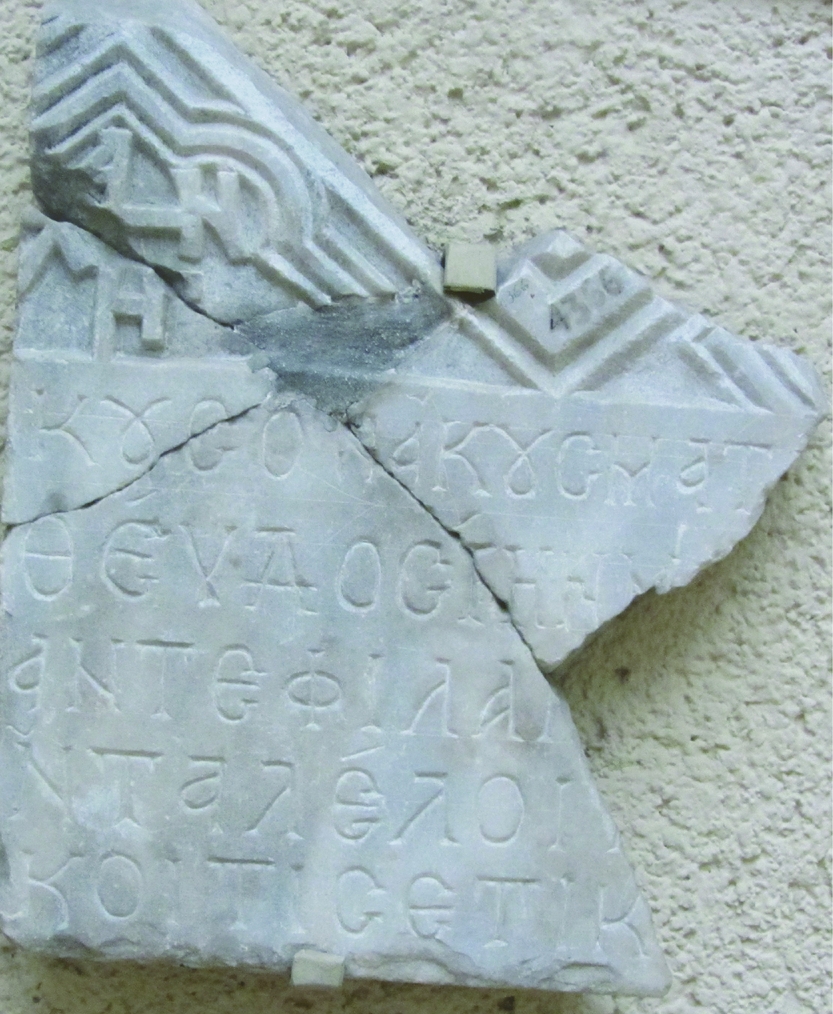
Klaus-Peter Matschke has noted that there was no cult of imperial tombs in this periodFootnote 95 and the evidence seems to confirm his remarks, although the importance of these tombs cannot be doubted. Imperial burials and funerals are frequently mentioned in the sources. It is true that the funerals of emperors attracted large crowds and were occasions for the populace of Constantinople to venerate and pay tribute to deceased rulers. In the case of Andronikos III, his corpse was placed in Hagia Sophia for public veneration; from there it was moved to the Hodegon monastery.Footnote 96 In his funeral oration for Manuel II, Bessarion reports that crowds took to the streets of the capital, apparently in order to pay their last respects to the emperor, but it is not clear from the text whether they actually went to the burial site in the Pantokrator or if the corpse was first exhibited in Hagia Sophia for public veneration.Footnote 97 After all, the size of the Great Church would have been more suitable for such an event, compared to the limited space of the monastic Pantokrator churches. Some of the surviving funeral or commemorative orations composed in honour of Palaiologan emperors were delivered on the day of the burial, whereas others were pronounced during commemorative services at the tombs afterwards, most often on the 3rd or 9th day after the deceased's death. As the epitaphioi logoi dedicated to Manuel II contain direct references to the tomb, it seems probable that they were pronounced in the Pantokrator.Footnote 98 The language of the one attributed to the burial of Andronikos III, delivered in the Hodegon monastery, with its strong imperial imagery, reinforces the solemnity of the event.Footnote 99
However, the absence of any reference to imperial tombs in the Late Byzantine court treatise, that of Pseudo-Kodinos, might be an indication that they were not an important part of imperial court culture and ceremonial. Both the Lips and the Pantokrator monasteries appear in Pseudo-Kodinos as destinations of the emperor's visits on specific feasts, but there is no reference to the tombs of the Palaiologoi in the former nor of the Komnenoi in the latter.Footnote 100 On the other hand, the text of Pseudo-Kodinos does not contain references to earlier imperial tombs either: those of the Komnenoi in the Pantokrator, of Romanos III Argyros and Nikephoros Botaneiates in the Peribleptos, and of Constantine IX Monomachos at Mangana are not mentioned in the respective entries, nor are those in the Holy Apostles, except that of Constantine I.Footnote 101 This silence is in contrast with the place the mausoleum of the Holy Apostles occupies in the Middle Byzantine De Cerimoniis.Footnote 102 This different approach may be an indication that the cult of imperial tombs was much weaker in Late Byzantine times, although the notable differences in the nature of the two texts call for caution in drawing such a conclusion.Footnote 103
Indeed, the Russian visitors to Constantinople do not include any tombs of Palaiologan emperors in their accounts of their visits to the shrines of the city, although the designation ‘emperor's monastery’ for the Lips monastery found in the so-called Russian Anonymous may be due to the presence of the tomb of Andronikos II.Footnote 104 This absence is not very surprising, since the Russian pilgrims were explicitly interested in reporting on the relics preserved in the churches and monasteries. Yet, the amount of information on the imperial tombs in the Holy Apostles, which were apparently still visible up to the fifteenth century, is overwhelming.Footnote 105 The Spanish travellers’ accounts are slightly more informative about imperial tombs, but again the Palaiologan burials receive less attention in their texts as well: Clavijo, besides the imperial burial he saw in the Hodegon, only mentions the eleventh-century tombs of Romanos III Argyros and Nikephoros Botaneiates in the Peribleptos.Footnote 106 Only Pero Tafur mentions the imperial burials in the Pantokrator (although it is admittedly unclear whether he is referring to the Komnenian or Palaiologan tombs).Footnote 107 Bertrandon de la Broquière's confusion over the burial site of Constantine the Great — he places it in the Pantokrator — may reflect the elevated status of the Pantokrator during the last decades of Byzantium.Footnote 108 In any case, even up to the fifteenth century, the main site associated with imperial burials, albeit of the distant past, was the great church of the Holy Apostles, as is confirmed by an anonymous fifteenth-century description of Constantinople: the text elaborates on the sarcophagi in the church, but says nothing about tombs in the Pantokrator.Footnote 109
To summarise, the Palaiologan emperors were consistently buried in monastic foundations. Unlike Andronikos II, who was buried in his mother's monastery, his successors were interred in symbolic imperial monasteries directly linked to their general policies. The dynasty's attachment to the Hodegon and its icon, and the revitalisation of the Pantokrator under Manuel II and his family, suggest that the respective burial sites had a special importance within the framework of Palaiologan Constantinople. Accordingly, the burials of Andronikos III and John V in the former and of the last Palaiologoi in the latter may be viewed as conscious choices that served ideological ends. Other monasteries with imperial or quasi-imperial status accommodated the tombs of emperors’ wives, members of various branches of the ruling family and other aristocratic lineages connected with them, thus forming a web of funerary monuments commemorating the Palaiologoi that was spread throughout the cityFootnote 110. The evidence on usurpers (John VI, Andronikos IV, and John VII) is inconclusive, but it seems that they were not buried in the capital; they were instead relegated to monasteries in Thessalonike, Selymbria, and Mistras, a fact not unrelated to the role of those cities within the network of Palaiologan appanages.Footnote 111
The fate of the afore-mentioned Constantinopolitan monuments was a major factor in the subsequent disappearance of the tombs of the Palaiologan emperors: the Pantokrator and Lips monasteries were converted into Islamic religious foundations within a few years of the Ottoman conquest, whereas the Hodegon found itself within range of the Topkapı palace and was soon demolished.Footnote 112 Sixteenth-century visitors to the Pantokrator — by then transformed into the Zeyrek complex — record nothing about the imperial tombs there.Footnote 113 All traces of Palaiologan imperial tombs had thus disappeared at a very early stage from Constantinople/Istanbul.Footnote 114



