





Metabolic dysfunction-associated steatotic liver disease (MASLD), previously known as non-alcoholic fatty liver disease(Reference Rinella, Lazarus and Ratziu1), encompassed a range of hepatic disorders characterised by the accumulation of fat deposits in the liver not related to alcohol consumption(Reference Angulo2). The global incidence of MASLD was rising rapidly, with approximately 30 % of adults in the USA affected(Reference Le, Devaki and Ha3). MASLD was also defined as the influence of metabolic syndrome on liver metabolism. So, CVD, obesity, diabetes and hypertension were considered risk factors for MASLD(Reference Li, Gu and Wu4–Reference Targher, Byrne and Lonardo6). Several studies indicated that smoking, alcohol consumption, physical activity and dietary intake were changeable lifestyle factors related to MASLD(Reference Chang, Zhang and Zhang7). Socio-economic status (SES) was also considered as an influencing factor for MASLD, with primary risk factors such as obesity, lipid metabolic disorder and insulin resistance being linked to SES(Reference Cho, Lee and Park8). Fortunately, these risk factors of MASLD might be improved by changing lifestyle with diet and SES.
In recent years, accumulating evidence has highlighted the relationship between dietary factors and the prevalence of MASLD(Reference Vahid, Hekmatdoost and Mirmajidi9,Reference Aktary, Eller and Nicolucci10) . The Mediterranean diet was widely recommended, emphasising the consumption of fruits, fish, olive oil and nuts and legumes, while reducing the intake of red and processed meats and sugars(Reference Mascaró, Bouzas and Montemayor11). Epidemiological research indicated that diet modifications were a safe and effective strategy for improving MASLD(Reference Montemayor, García and Monserrat-Mesquida12). As a result, numerous natural dietary compounds have been explored for their potential to prevent and treat MASLD. Among these, carotenoids were among the most extensively studied, with their primary sources being fruits and vegetables(Reference Yilmaz, Sahin and Bilen13). Previous study demonstrated that individuals in the highest quartile of carotenoid intake had the lowest risk of developing MASLD(Reference Christensen, Lawler and Mares14). Current epidemiological evidence showed that a diet rich in carotenoids, along with elevated circulating levels, offered protective benefits against the incidence of MASLD(Reference Clugston15). However, population-based research on the effect of provitamin A carotenoid-rich foods intake on MASLD was scarce. Thus, investigating the impact of provitamin A carotenoid-rich foods intake on MASLD was worthwhile.
To the best of our knowledge, healthy lifestyle and SES were increasingly recognised as crucial factors in the treatment and management of MASLD. Healthy lifestyle and SES were a comprehensive approach that encompasses various lifestyle and socio-economic elements. Several studies were utilising this approach to explore the connection of lifestyle and SES with MASLD(Reference Cho, Lee and Park8,Reference Yu, Gao and Ge16) . However, the mediating and moderating roles of healthy lifestyle and SES on the association between provitamin A carotenoid-rich foods intake and the risk of MASLD remained unclear. In addition, there were no specially designed randomised placebo-controlled trials to examine the effect of vitamin A or provitamin A carotenoid on the incidence of MASLD. A number of large-scale randomised placebo-controlled trials investigated vitamin A or β-carotene supplementation primarily for cancer prevention or other endpoints, but none reported liver fat accumulation or NAFLD/MASLD as a prespecified outcome(17,Reference Omenn, Goodman and Thornquist18) . Therefore, we performed a cross-sectional analysis using nationally representative survey data to examine the hypothesis that the relationship of provitamin A carotenoid-rich foods intake with MASLD risk. Furthermore, we measured healthy lifestyle and SES and explored their mediated effects.
Materials and methods
Study design and participants
This cross-sectional study analysed data from four consecutive two-year cycles of the National Health and Nutrition Examination Survey (NHANES) (2007–2008, 2009–2010, 2011–2012 and 2013–2014). The survey utilised a multistage, stratified sampling design to obtain a representative sample of the noninstitutionalised civilian population of the USA(Reference Choi, Ford and Curhan19). Data collection involved conducting household interviews with participants along with medical examinations to obtain blood and urine samples. Specimens were collected during household visits for participants unable to attend medical examinations due to health limitations(Reference Choi, Ford and Curhan19). The NHANES dataset initially included 40 617 participants (20 180 males and 20 437 females), and we focused on 23 482 individuals aged 20 years or older. After excluding participants without the USA Fatty Liver Index (USFLI; n 13 728), 9754 participants remained for subsequent analyses. The study also excluded 200 participants who tested positive for hepatitis B surface antigen or hepatitis C virus antibodies. The study also excluded participants who consumed alcohol at a rate of more than 10 g/d for women and more than 20 g/d for men (n 1535). Participants who were pregnant (n 94) had unreliable or incomplete dietary recall data (n 1224), were missing weight data (n 8) or had an average energy intake that was more than or less than three standard deviations from the mean (n 80) were also excluded (online Supplementary Figure S1). The final analysis included 6613 participants (3067 males and 3546 females). The NHANES study protocol was approved by the National Center for Health Statistics Research Ethics Review Board, and all participants provided written informed consent. The cross-sectional study strictly adhered to the Strengthening the Reporting of Observational Studies in Epidemiology reporting guideline.
Assessment of metabolic dysfunction-associated steatotic liver disease
The USFLI, with a cut-off value of 30, assessed MASLD based on age, race, waist circumference, fasting glucose, γ-glutamyl transferase and fasting insulin(Reference Ruhl and Everhart20). As previously reported, the USFLI was a reliable, noninvasive measure of MASLD and served as an independent predictor of liver-related and all-cause mortality(Reference Kim, Kim and Adejumo21–Reference Meffert, Baumeister and Lerch23).
Assessment of provitamin a carotenoid-rich foods
Provitamin A carotenoid-rich foods were quantified using two 24-h dietary recall interviews(Reference Zhang, Sun and Guo24). These recalls were utilised to assess intakes of nutrients, energy and other food components. We conducted the initial recall at the mobile examination centre and conducted the second recall by telephone 3–10 d later. For these analyses, the average value of the total estimated provitamin A carotenoid-rich foods intake was calculated across the two recall periods. Detailed methodologies of dietary recall interviews were available in previous publications(Reference Sun, Sun and Wang25). Based on specific food codes, we identified the sources of provitamin A carotenoid-rich foods such as legumes, nuts, seeds, fruits and vegetables. The intake of provitamin A carotenoid-rich foods was expressed as retinol activity equivalents, calculated using the following equation: 1 retinol activity equivalents (mcg) = 1/12 beta-carotene (mcg) + 1/24 other provitamin A carotenoids (mcg)(26). This metric reflected the vitamin A activity derived from provitamin A carotenoids and did not encompass non-provitamin A carotenoids such as lycopene, lutein or zeaxanthin.
Assessment of socio-economic status and healthy lifestyle
According to previous studies, SES was assessed using education level and annual household income(Reference Du, Dai and Liu27). Educational level was classified as less than high school, high school and post-high school. Annual household income was categorised as < $20 000, $20 000–$44 999, $45 000–$74 999 and ≥ $75 000. Healthy lifestyle was evaluated using smoking status (yes or no), drinking status (yes or no) and physical activity (yes or no)(Reference Tian, Shuai and Li28). To construct composite measures that reflected the multidimensional nature of SES and lifestyle, we applied latent class analysis using the ‘poLCA’ package in R. Latent class analysis has been commonly employed to estimate the unobserved variable by making use of multiple measured categorical variables(Reference Du, Dai and Liu27,Reference Tian, Shuai and Li28) . For SES, we fitted models with one to five latent classes and selected the two-class solution based on the lowest Bayesian Information Criterion. The two classes were interpreted as ‘low SES’ and ‘high SES’ according to item-response probabilities. For healthy lifestyle, the same procedure yielded a two-class solution, labelled ‘unhealthy’ and ‘healthy’ lifestyle.
Covariates
Researchers used the FFQ, known for its validity and reliability, to assess average dietary intakes(Reference Feskanich, Rimm and Giovannucci29,Reference Hu, Rimm and Smith-Warner30) , which included those from milk and milk products, meat, poultry, fish, mixed dishes, eggs, legumes, nuts, seeds, grain products, fruits and vegetables. Multiple potential factors were assessed, which included sex (male and female), age, race/ethnicity (Mexican-Americans, other Hispanics, non-Hispanic Whites, non-Hispanic Blacks and other races), marital status (married or living with partner and other), BMI categories (normal: < 25 kg/m2; overweight: 25 to < 30 kg/m² and obese: ≥ 30 kg/m²), diabetes status (yes or no), hypertension status (yes or no) and biochemical parameters including total cholesterol, uric acid, energy consumption and provitamin A carotenoid-rich foods intake. Diabetes was defined as fasting blood glucose levels ≥ 7·0 mmol/l-and 2-h plasma glucose levels ≥ 11·1 mmol/l, using diabetes medicines or insulin, or self-reported physician-diagnosed diabetes(Reference Menke, Casagrande and Geiss31). Hypertension was characterised by a mean systolic blood pressure ≥ 130 mmHg and/or a mean diastolic blood pressure ≥ 80 mmHg, the utilisation of antihypertensive medication or self-reported physician-diagnosed hypertension(Reference Whelton, Carey and Aronow32).
Statistical analysis
Continuous variables were analysed using student’s t test, whereas categorical variables were assessed with χ 2 test. Categorical variables were depicted as percentages (%) and continuous variables as mean (sd). Provitamin A carotenoid-rich foods intake was classified into four quartiles. Logistic regression models estimated crude and adjusted OR with 95 % CI for MASLD risk across provitamin A carotenoid-rich foods intake quartiles. Linear regression models generated β-coefficients with standard errors to quantify exposure–outcome associations. Covariate adjustments were implemented in three progressive models to validate result robustness. In model 1, we employed a crude model that did not involve any adjustments. In model 2, we adjusted for sex and age. In model 3, we additionally adjusted for race, marital status, BMI, hypertension, diabetes, total cholesterol and uric acid. The mediation model (R package ‘mediation’) was used to estimate the potential mediating effects of SES or healthy lifestyle on the association between provitamin A carotenoid-rich foods intake and MASLD risk. Mediation analyses employed the quasi-Bayesian Monte Carlo method with 1000 simulations based on normal approximation. The direct effect referred to the impact of provitamin A carotenoid-rich foods intake on MASLD risk without the involvement of a mediator. The indirect effect indicated the influence of provitamin A carotenoid-rich foods intake on MASLD risk through the mediator. The proportion of mediation was calculated by dividing the indirect effect by the total effect. We additionally carried out a stratified analysis based on the latent class of SES and healthy lifestyle to explore the correlations between provitamin A carotenoid-rich foods intake and MASLD risk among adults within diverse SES subgroups. To examine the robustness and possible variations in different subgroups, we replicated all analyses with stratification by gender (male and female) and age groups (< 45 and ≥ 45). Moreover, we assessed the associations of provitamin A carotenoid-rich foods intake with the USFLI (as a continuous score) and with MASLD defined using a stricter cut-off of USFLI ≥ 60 as sensitivity analyses. All the analyses were conducted using R software version 4·5·2 (R Foundation for Statistical Computing). We regarded two-sided P values less than 0·05 as significant.
Results
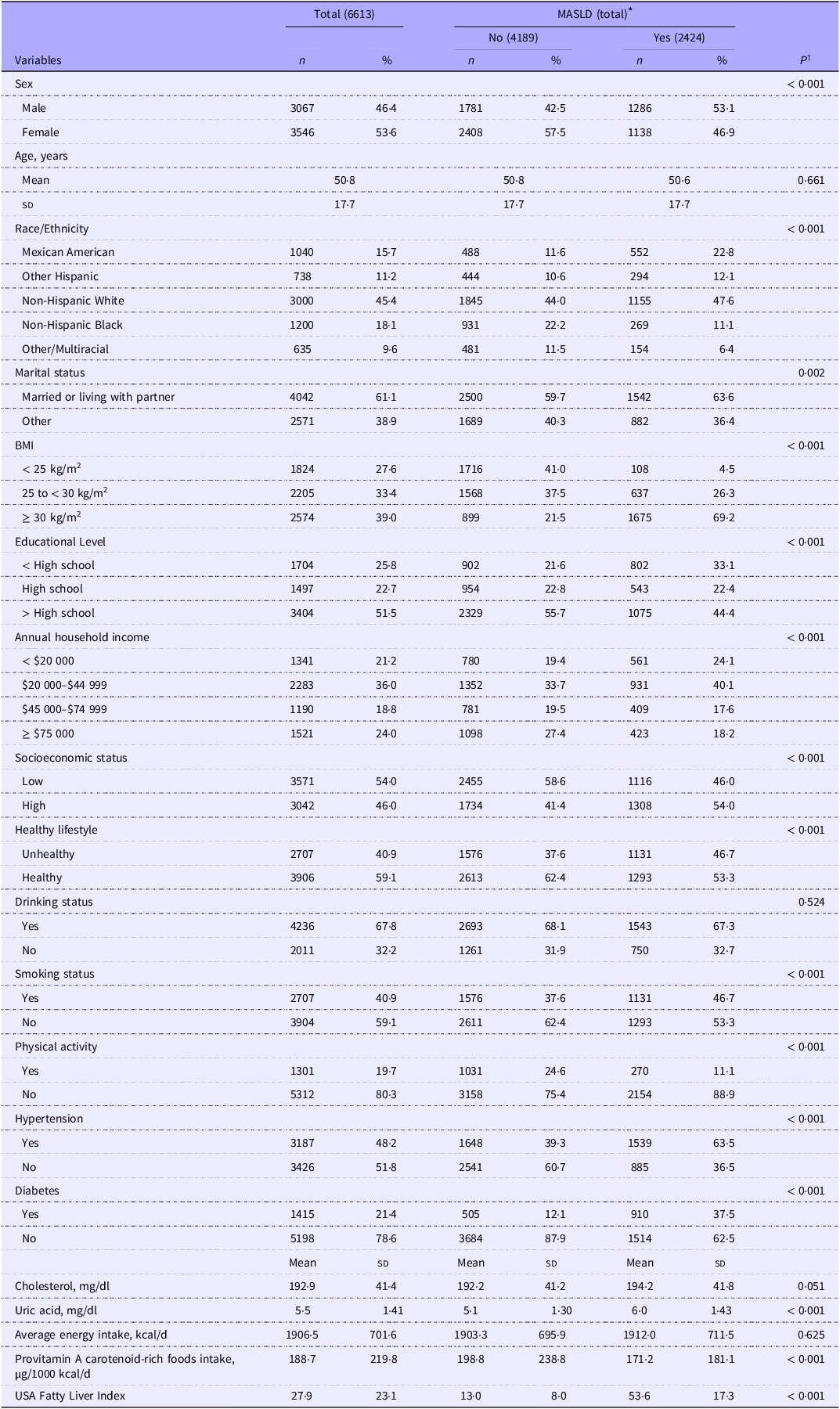
Table 1 presented the baseline characteristics of the respondents from the NHANES. Out of 6613 participants in the NHANES (mean age 50·8 years, 53·6 % female), 3571 (54·0 %) were in the low SES group and 3042 (46·0 %) were in the high SES group and 2707 (40·9 %) were in the unhealthy lifestyle group and 3906 (59·1 %) were in the healthy lifestyle group. The participants with MASLD were more likely to be male, married or living with partner, Non-Hispanic White and to had hypertension and diabetes and a lower proportion of them were smoker, no drinker and physically active individuals. Additionally, respondents with MASLD tended to have higher BMI, education level, uric acid level, USFLI score and lower annual household income, provitamin A carotenoid-rich foods intake.
Characteristics of the study individuals based on MASLD

Table 1. Long description
The table presents baseline characteristics of 6613 NHANES respondents, comparing those with and without MASLD. It includes variables such as sex, age, race/ethnicity, marital status, BMI, educational level, annual household income, socioeconomic status, healthy lifestyle, drinking status, smoking status, physical activity, hypertension, diabetes, cholesterol, uric acid, average energy intake, provitamin A carotenoid-rich foods intake, and USA Fatty Liver Index. The table has 22 rows and 10 columns, with column headers including Total, No MASLD, Yes MASLD, and P-value. Notable trends include higher proportions of males, married individuals, Non-Hispanic Whites, and those with hypertension and diabetes among MASLD respondents. Additionally, MASLD respondents tend to have higher BMI, education level, uric acid level, and USFLI score but lower annual household income and provitamin A carotenoid-rich foods intake.
MASLD, metabolic dysfunction-associated steatotic liver disease.
* Data are presented as No. (%) of participants, unless otherwise noted. Percentages have been rounded and may not add up to 100.
† The means of continuous variables were compared using independent 2-sample t tests. The distribution of categorical variables was compared using Pearson χ2 tests.
Association between provitamin a carotenoid-rich foods intake and metabolic dysfunction-associated steatotic liver disease
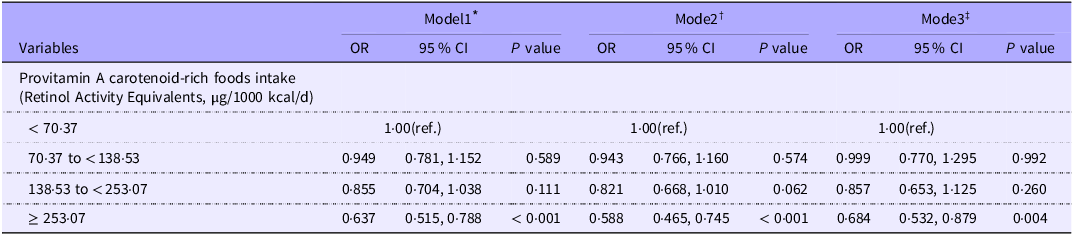
Table 2 and online Supplementary Figure S2 presented OR and 95 % CI for the occurrence of MASLD as a binary outcome. In adjusted logistic models, the provitamin A carotenoid-rich foods intake (OR = 0·684, 95 % CI: 0·532, 0·879) was negatively associated with the risk of MASLD adjusting for potential covariates (Table 2, model 3).
Association between provitamin a carotenoid-rich foods intake and MASLD risk

Table 2. Long description
The table presents the association between provitamin A carotenoid-rich foods intake and the risk of metabolic associated steatohepatitis (MASLD) across three models. It includes four rows and eight columns, detailing odds ratios (OR), 95% confidence intervals (CI), and P values for different intake levels of provitamin A carotenoid-rich foods. The intake levels are categorized as less than 70.37 micrograms per 1000 kilocalories per day, 70.37 to less than 138.53, 138.53 to less than 253.07, and 253.07 or more. Each model adjusts for different covariates. Model 1 shows ORs ranging from 1.00 (reference) to 0.637 with varying CIs and P values. Model 2 presents similar data with ORs from 1.00 (reference) to 0.588. Model 3 includes ORs from 1.00 (reference) to 0.684. Notable trends indicate a negative association between higher intake of provitamin A carotenoid-rich foods and MASLD risk, particularly in Model 3, where the OR for the highest intake category is 0.684 with a 95% CI of 0.532 to 0.879 and a P value of 0.004.
MASLD, metabolic dysfunction-associated steatotic liver disease.
* Crude model.
† The model included covariates (i.e. sex and age).
‡ The model included covariates (i.e. sex, age, race, marital status, BMI, hypertension, diabetes, TC and UA).
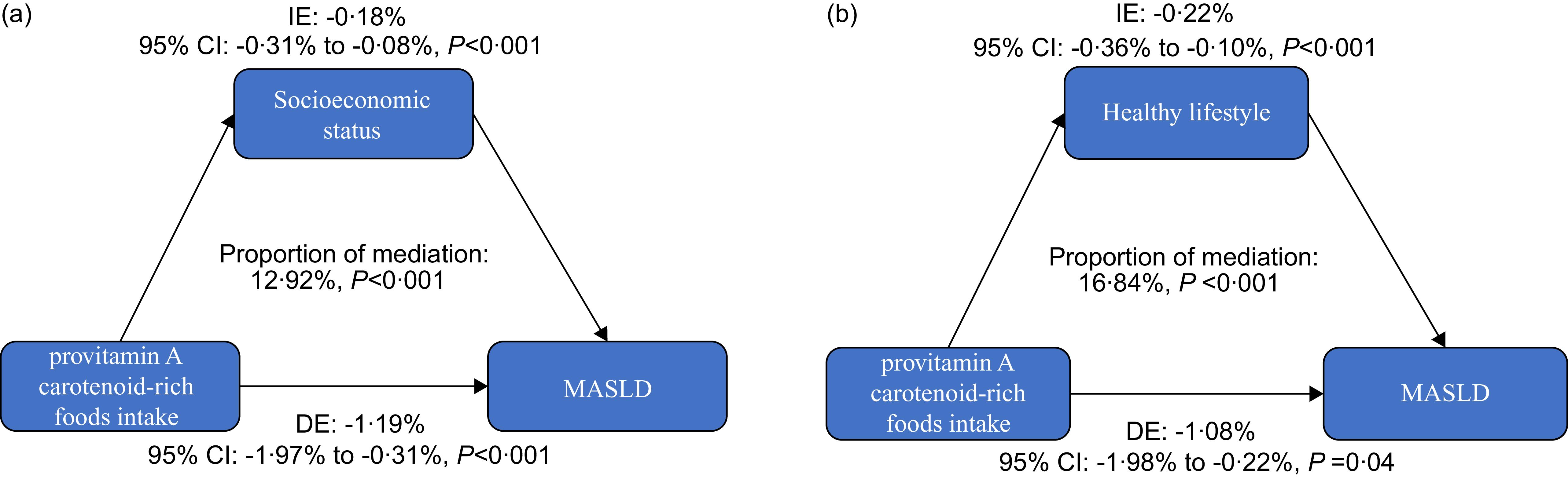
Mediation analyses were conducted to assess the potential mediating effects of SES and healthy lifestyle on the relationships between provitamin A carotenoid-rich foods intake and the risk of MASLD. Both SES and healthy lifestyle exerted significant mediation effects (all P < 0·05). The mediated effects of SES and healthy lifestyle on the association between provitamin A carotenoid-rich foods intake and the risk of MASLD were −0·18 % and −0·22 %. The corresponding proportion of mediation was 12·92 % and 16·84 %, respectively (Figure 1).
Estimated proportion of the association between provitamin A carotenoid-rich foods intake and MASLD risk mediated by socio-economic status (a), healthy lifestyle (b). Covariates were as follows: gender, age, race, marital status, BMI, hypertension, diabetes, TC and UA. IE, the estimate of the indirect effect; DE, the estimate of the direct effect; Proportion of mediation = IE/(DE + IE). IE, indirect effect; MASLD, metabolic dysfunction-associated steatotic liver disease; TC, total cholesterol; UA, uric acid.

Figure 1. Long description
The diagram consists of two parts labeled (a) and (b). In part (a), socioeconomic status mediates the relationship between provitamin A carotenoid-rich foods intake and MASLD risk, with an indirect effect (IE) of negative 0.18 percent, a 95 percent confidence interval (CI) ranging from negative 0.31 to negative 0.08 percent, and a P value of less than 0.001. The direct effect (DE) is negative 1.19 percent with a 95 percent CI from negative 1.97 to negative 0.31 percent, and a P value of less than 0.001. The proportion of mediation is 12.92 percent with a P value of less than 0.001. In part (b), a healthy lifestyle mediates the relationship between provitamin A carotenoid-rich foods intake and MASLD risk, with an IE of negative 0.22 percent, a 95 percent CI from negative 0.36 to negative 0.10 percent, and a P value of less than 0.001. The DE is negative 1.08 percent with a 95 percent CI from negative 1.98 to negative 0.22 percent, and a P value of 0.04. The proportion of mediation is 16.84 percent with a P value of less than 0.001.
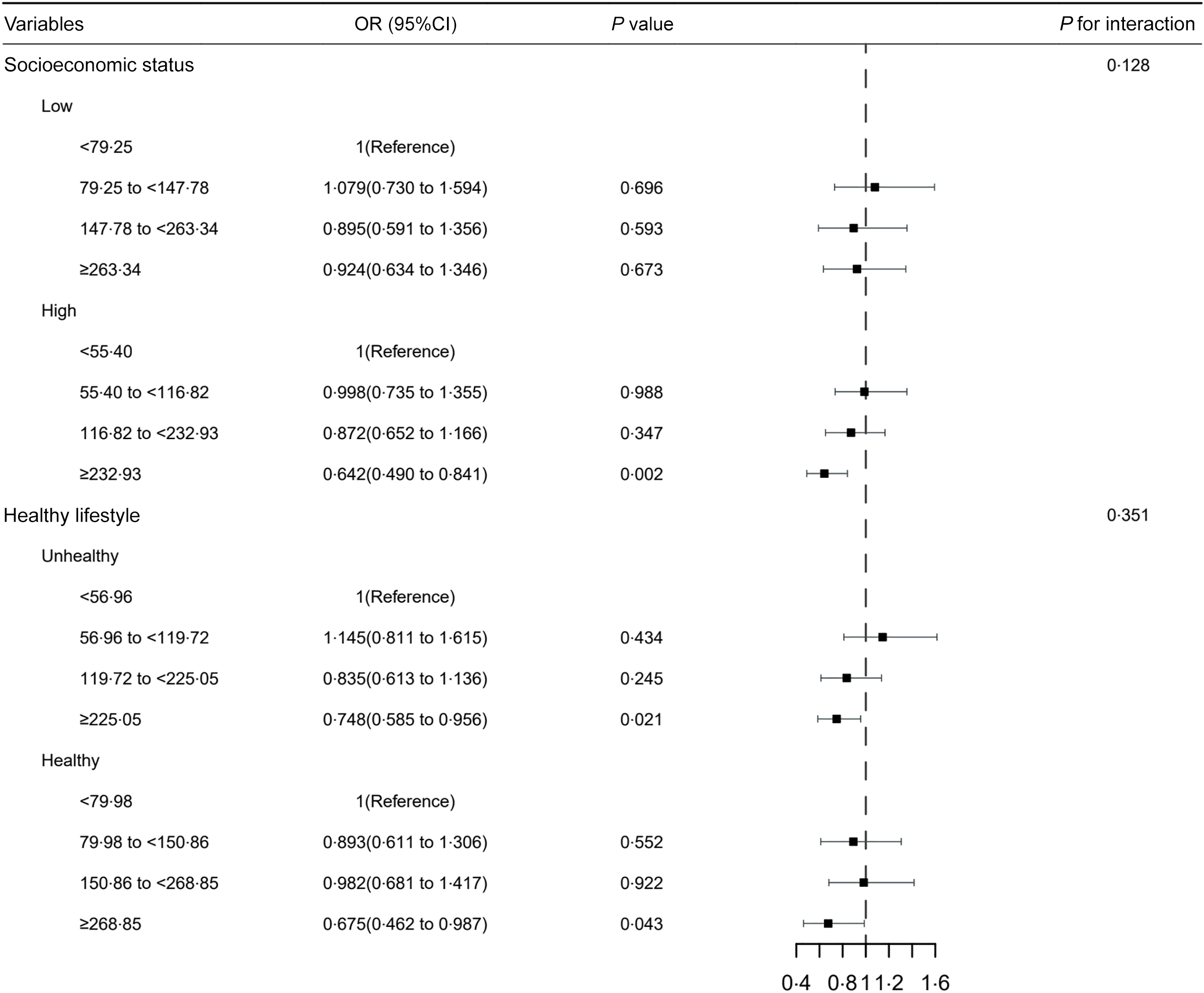
After adjusting for potential covariates, provitamin A carotenoid-rich foods intake was negatively associated with MASLD risk in the subgroup of high SES (OR = 0·642, 95 % CI: 0·490, 0·841). However, no significant differences were observed in the healthy lifestyle subgroup (Figure 2). The interaction results showed that the association between provitamin A carotenoid-rich foods intake and the risk of MASLD did not differ by SES and healthy lifestyle. Moreover, provitamin A carotenoid-rich foods intake was negatively associated with the risk of MASLD in the subgroups of female (OR = 0·572, 95 % CI: 0·406, 0·805) and age < 45 years (OR = 0·519, 95 % CI: 0·367, 0·734), adjusted for potential covariates. Notably, the negative association of provitamin A carotenoid-rich foods intake with MASLD risk was stronger in respondents aged 45 years or younger, compared with those aged over 45 years (P for interaction = 0·015) (online Supplementary Figure S3).
Association between provitamin A carotenoid-rich foods intake and MASLD risk in subgroups. OR and 95 % CI (error bars) were calculated using covariate-adjusted method. Covariates were as follows: sex, age, race, marital status, BMI, hypertension, diabetes, TC and UA. MASLD, metabolic dysfunction-associated steatotic liver disease; TC, total cholesterol; UA, uric acid.

Figure 2. Long description
The table presents the association between provitamin A carotenoid-rich foods intake and the risk of metabolic dysfunction-associated steatotic liver disease (MASLD) in different subgroups. It includes data on socioeconomic status and healthy lifestyle, with odds ratios (OR) and 95% confidence intervals (CI) calculated using a covariate-adjusted method. The table is divided into two main categories: socioeconomic status and healthy lifestyle, each with subgroups. For socioeconomic status, the low category includes age ranges less than 79.25, 79.25 to less than 147.78, 147.78 to less than 263.34, and 263.34 or more. The high category includes age ranges less than 55.40, 55.40 to less than 116.82, 116.82 to less than 232.93, and 232.93 or more. For healthy lifestyle, the unhealthy category includes age ranges less than 56.96, 56.96 to less than 119.72, 119.72 to less than 225.05, and 225.05 or more. The healthy category includes age ranges less than 79.98, 79.98 to less than 150.86, 150.86 to less than 268.85, and 268.85 or more. The table also includes P values for interaction.
To verify the robustness of the findings, two sensitivity analyses were performed. Similar results were observed in linear models for USFLI as a continuous variable and MASLD defined using a stricter cut-off of USFLI ≥ 60 (online Supplementary Table S1, Table S2, Table S3, Table S4, Figure S4).
Discussion
In this large and nationally representative study, two novel results were provided based on the USA adult population. First, provitamin A carotenoid-rich foods intake conferred hepatic protection against MASLD development. Moreover, SES and healthy lifestyle mediated the protective associations between provitamin A carotenoid-rich foods intake and both MASLD risk and USFLI score. These findings hold clinical significance given the current lack of approved pharmacotherapies for MASLD. The dietary strategy of boosting carotenoid consumption offered a potential avenue for both preventing and alleviating a common chronic health issue(Reference Christensen, Lawler and Mares14).
These results contributed to a growing body of evidence linking carotenoid levels to lipid metabolism and obesity, aligning with other epidemiological studies that showed the protective effect of provitamin A carotenoid-rich foods against MASLD(Reference Yilmaz, Sahin and Bilen13,Reference Christensen, Lawler and Mares14,Reference Murillo, DiMarco and Fernandez33) . A cross-sectional study indicated that individuals in the highest consumption group of carotenoids were at the lowest risk of developing MASLD(Reference Christensen, Lawler and Mares14). The existing evidence demonstrated that a diet rich in carotenoids, along with elevated circulating levels of carotenoids, had positive effects on reducing the incidence of MASLD(Reference Clugston15). Lastly, a review study showed that consuming a diet rich in carotenoid-containing foods was associated with a remarkably decreased risk of suffering from MASLD(Reference Elvira-Torales, García-Alonso and Periago-Castón34). To the best of our knowledge, this current study identified a significant negative relationship between provitamin A carotenoid-rich foods intake and both MASLD risk and USFLI score, which aligned with a reduced risk of MASLD. Our findings were further supported by animal research showing that the administration of carotenoids mitigated hepatic lipid accumulation on a high-fat diet and enhanced SIRT1 expression, a key regulator of fatty acid oxidation(Reference Christensen, Lawler and Mares14). Higher provitamin A carotenoid-rich foods intake might lower the risk of MASLD, particularly in preventing the progression from simple hepatic steatosis to NASH, by several different mechanisms, including the alleviation of oxidative stress in hepatocytes, with downstream effects on the secretion of pro-inflammatory cytokines by hepatic macrophages, insulin sensitivity and immune cell infiltration(Reference Murillo, DiMarco and Fernandez33).
Interestingly, our research focused on SES and healthy lifestyle as an increasing number of studies highlighted the role of SES and healthy lifestyle in the association of provitamin A carotenoid-rich foods intake with the risk of MASLD. Previous research indicated that socio-economic disparities might affect the intake of carotenoid-rich foods. Higher income neighbourhoods typically had more access to healthy food options, such as fresh vegetables and fruits, compared with lower income areas(Reference Nicklett, Szanton and Sun35). Goodman et al. indicated that compared with individuals with a lower SES, those with a higher SES possess a lower BMI and decreased insulin resistance, which were the main risk factors for MASLD(Reference Cho, Lee and Park8). In addition, the level of carotenoids was elevated among women who consumed large amounts of vegetables and fruits, had a moderate alcohol intake and attained a high level of education. Other studies also noted the lowest plasma levels of β-carotene in current smokers(Reference Wawrzyniak, Hamułka and Friberg36). Yu et al. found that adhering to a healthy lifestyle (such as quitting smoking and alcohol, staying physically active and maintaining a nutritious diet) had a protective effect on reducing the risk of MASLD(Reference Yu, Gao and Ge16). Based on the above-mentioned findings, we further conducted mediation analyses. We found significant mediated effects of SES and healthy lifestyle on the negative association between provitamin A carotenoid-rich foods intake and MASLD risk, among which the mediated proportion of SES was 12·92 % and healthy lifestyle was 16·84 %. Therefore, a possible explanation for our findings was that individuals with higher SES were more likely to adopt a healthy lifestyle, including regular exercise, abstinence from alcohol and tobacco and consumption of vitamins and phytochemicals through a healthier diet. These factors might help prevent or mitigate MASLD by decreasing inflammation and oxidative stress(Reference Chang, Zhang and Zhang7,Reference Mascaró, Bouzas and Montemayor11) .
When comparing the association of provitamin A carotenoid-rich foods intake with the risk of MASLD stratified by sex and age, we found that the negative associations between provitamin A carotenoid-rich foods intake and MASLD risk in the subgroups of female and age < 45 years remained significant. These findings were similar to previous epidemiology studies that individuals with MASLD had higher dietary ɑ-carotene and β-carotene intake in women compared with that in men(Reference Kimura, Mikami and Endo37), and that an inverse association of dietary carotenoids intake with the risk of MASLD was observed in individuals aged 45 years or younger(Reference Liu, Sun and Peng38). However, as noted by Peto et al. (Reference Peto, Doll and Buckley39), epidemiological associations with provitamin A carotenoids could not distinguish between causal effects of carotenoids themselves and confounding by other bioactive compounds present in the same foods (e.g. dietary fibre, flavonoids and phytosterols)(Reference Kaulmann and Bohn40). Thus, our findings should be interpreted as evidence for a protective association with a carotenoid-rich dietary pattern, rather than proof of a causal role for specific carotenoids. Mechanistically, the benefits might arise from the combined effects of multiple nutrients and phytochemicals in these foods, including but not limited to provitamin A carotenoids.
Our study provided the unique ability to evaluate the relationships by utilising NHANES, a sizable, nationally representative survey, and the findings could be more widely extrapolated to the USA population. Additionally, we reported the mediated effects of SES and healthy lifestyle on the association of provitamin A carotenoid-rich foods intake with the risk of MASLD. More importantly, given there was currently no pharmaceutical treatment for MASLD, the results could be very readily translated into clinical practice(Reference Mascaró, Bouzas and Montemayor11).
However, the present study also included some limitations. First, the cross-sectional design obstructed the establishment of a causal relationship between provitamin A carotenoid-rich foods intake and MASLD risk. Second, the application of self-reported dietary data might lead to recall bias. Third, residual and unmeasured confounding factors as well as measurement errors might introduce bias to our analyses. Finally, the current study was confined to the USA population, which might limit the applicability of the findings to individuals of different ethnic and racial backgrounds. In addition, the definition of MASLD using the USFLI with a cut-off of ≥ 30 might have introduced misclassification bias, as values between 30 and 60 represented an indeterminate range for hepatic steatosis. Although we conducted a sensitivity analysis using a stricter cut-off (≥ 60) and observed consistent protective trends (OR < 1) that supported the robustness of our findings, the potential for misclassification could not be entirely ruled out. Future studies employing more definitive diagnostic methods were warranted to confirm our results.
Conclusions
Our findings reported the negative association of provitamin A carotenoid-rich foods intake with MASLD risk. Moreover, mediation analyses indicated that the relationship between provitamin A carotenoid-rich foods intake and MASLD risk might be mediated by SES and healthy lifestyle. These results were encouraging given the limitation of therapeutic options for treating MASLD, as pinpointing changeable lifestyle with diet and SES factors offered a chance to limit or prevent the disease and its development. From a public health perspective, increasing provitamin A carotenoid-rich foods intake was a low-risk, potentially beneficial dietary strategy. Future research should determine whether relevant data on MASLD incidence have already been collected – but not yet analysed – in the numerous large-scale randomised placebo-controlled trials of provitamin A carotenoids that were originally designed for cancer endpoints. Additionally, renewed follow-up of these completed trials to capture MASLD outcomes could provide high-quality causal evidence more efficiently than launching new trials. Such efforts would help clarify whether the protective effect was specifically attributable to provitamin A carotenoids and/or vitamin A and/or other potentially beneficial constituents of provitamin A carotenoid-rich foods.
Supplementary material
For supplementary material/s referred to in this article, please visit https://doi.org/10.1017/S0007114526107582
Acknowledgements
All authors express their gratitude to the National Center for Health Statistics of the Centers for Disease Control and Prevention for providing the data of the National Health and Nutrition Examination Survey.
This study was supported by the National Natural Science Foundation of China (82373688, 81773541) and funded by the Priority Academic Program Development of Jiangsu Higher Education Institutions at Soochow University and was funded by the Project of Jiangsu Province Engineering Research Center of Molecular Target Therapy and Companion Diagnostics in Oncology (SGK1202407).
J. C. and Z. T.: conceptualisation. C. L.: writing – original draft preparation. L. Q. and X. T.: writing – reviewing and editing. Y. S. and C. L.: formal analysis and validation. J. H. and D. Y.: data curation and validation. Z. T. and J. C.: supervision. All authors read and approved the final manuscript.
The authors declare that there is no conflict of interest.


 Open access

