





1. Introduction
Why is it that we ought to believe that the climate crisis is real and that we should not believe that the earth is flat? Presumably, this has something to do with the available evidence. But why should we believe with the evidence? Put more philosophically, one might ask: What is the source of epistemic normativity? Why or in virtue of what is it that we ought to believe something? We’ll call this the source question of epistemic normativity.
Answers to the source question can be divided into two theories or families of theories.Footnote 1 Epistemic intrinsicalists claim that it’s simply a brute normative fact that we ought to or have reason to believe with our evidence. Epistemic instrumentalists claim that we have a reason to believe with the evidence if doing so promotes our aims, wants, needs, or ends.
A prominent objection against epistemic instrumentalism is due to Kelly (Reference Kelly2003). Kelly claims that there are cases of so-called ‘epistemic indifference’ where there’s evidence that p that’s accessible to an agent yet believing that p wouldn’t promote any of the agent’s aims. Still, Kelly thinks, the intuition is that the agent in these cases has reason or ought to believe that p. In turn, instrumentalists have come forward with a host of replies to Kelly’s objection and have modified the original instrumentalist view in various ways.
The debate initially started by Kelly, even after having surpassed its 20th birthday, is still going strong. Whilst we think many valuable contributions are still appearing, we also take it that this calls for a methodological shake-up. An important part of the debate concerns laypeople’s judgements or ‘intuitions’ on Kelly’s cases of epistemic indifference and how to explain them. This is the focus of this paper. In two studies, we investigated both whether laypeople agree with Kelly’s verdict in cases of epistemic indifference as well as the key ideas behind some of the most prominent instrumentalist replies to those cases. Our findings indicate that (i) a significant amount of participants found it hard to ‘buy into’ cases of epistemic indifference as Kelly has constructed them, (ii) participants did generally share Kelly’s verdict in cases of epistemic indifference (i.e. that there’s reason to believe) and (iii) some instrumentalist replies are well suited to explain participants’ judgements in cases of epistemic indifference, particularly those we coined normative epistemic instrumentalism.
Experimental work on the folk ethics of belief – how laypeople think they and others ought to form their beliefs – is still nascent and has, so far, focused on how moral considerations impact belief formation (Cusimano and Lombrozo Reference Cusimano and Lombrozo2021; Reference Cusimano and Lombrozo2023). In contrast, we here turn to purely evidential considerations: We investigate how people think others should form their beliefs in light of the available evidence. The work done here differs from other experimental work in meta-epistemology (see, e.g., Andow Reference Andow2017; Roberts, Andow, and Schmidtke Reference Roberts, Andow and Ann Schmidtke2018) in its focus on the debate between instrumentalists and intrinsicalists. However, we hope our findings will be relevant to (meta-)epistemology more generally.Footnote 2
The structure of the paper is as follows: In Section ‘2’, we’ll introduce the two positions in the debate – epistemic intrinsicalism and epistemic instrumentalism in more detail. Section ‘3’, introduces Kelly’s objection to epistemic instrumentalism. Section ‘4’ then samples some of the most prominent replies and modifications to epistemic instrumentalism brought forward until this day. Section ‘5’ sets out the two studies we’ve conducted and analyses their results. Section 6. ‘Upshot and Outlook’ discusses the upshots of Section 5 and concludes.
2. Epistemic Intrinsicalism and Epistemic Instrumentalism
As mentioned, two main theories are currently trying to answer the source question: epistemic intrinciscalism and epistemic instrumentalism. Both usually formulate their theory in terms of what we have normative reason to believe.Footnote 3
Epistemic intrinsicalism claims that epistemic normativity is a sui-generis domain of normativity that is intrinsically related to the nature of belief.Footnote 4 In this way, epistemic normativity is supposed to be similar to moral normativity, which is also often, though of course not uncontroversially, taken to be a standalone domain of normativity. On the intrinsicalist view, it is just a brute normative fact that we ought or have reason to believe the truth or with our evidence.
Epistemic instrumentalism claims that epistemic normativity is a species of instrumental normativity, the kind of normativity associated with means-ends relations.Footnote 5 Though there’s great variety in the positions people actually advocate (see section ‘4’), the basic idea is that we ought or have reason to believe that p in virtue of the fact that believing that p would help to promote or realise our aims, wants, desires, or ends. So, roughly put, a consideration C is reason to believe that p for a subject S if and only if doing so is conducive to promoting an aim of S.Footnote 6 Such a position explains why we have reasons to form true beliefs or believe in line with the evidence: Doing so helps us to promote our aims.
Going back to Quine (Reference Quine1969), people have been attracted to epistemic instrumentalism because of naturalistic considerations: It solely evokes means-ends relations, which are, from a naturalistic point of view, supposedly unproblematic. Another virtue is theoretical simplicity: instrumentalist views promise to unify different kinds of normativity pertaining to means-ends relations.
To sum up, intrinsicalists claim that epistemic normativity is a sui-generis domain of normativity, while instrumentalists claim that epistemic normativity is a species of instrumental normativity. Thus, instrumentalism and intrinsicalism are incompatible with each other.
3. Kelly’s objection to epistemic instrumentalism
One prominent objection against epistemic instrumentalism is due to Kelly (Reference Kelly2003).Footnote 7 According to Kelly, there are cases in which an agent’s aims would not be promoted by believing that p, but the agent should (nevertheless) believe that p because there is evidence in favour of p. Thus, it is not true that our epistemic reasons depend on what aims we actually have.
Here’s how Kelly himself puts it: ‘Whether Bertrand Russell was right- or left-handed, whether Hubert Humphrey was an only child – these are matters of complete indifference to me. That is, I have no preference for having true beliefs to having no beliefs about these subjects; nor, for that matter, do I have any preference for having true beliefs to false beliefs. There is simply no goal – cognitive or otherwise – which I actually have, which would be better achieved in virtue of my believing true propositions about such subjects, or which would be worse achieved in virtue of my believing false propositions about them. […] If, despite my utter lack of interest in the question of whether Bertrand Russell was left-handed, I stumble upon strong evidence that he was, then I have strong epistemic reasons to believe that Bertrand Russell was left-handed. Indeed, my epistemic reasons will be no different than they would be if I had acquired the same evidence deliberately because I did have the goal of finding out whether Russell was left-handed. Once I come into possession of evidence which strongly supports that claim that p, then I have epistemic reasons to believe that p, regardless of whether I presently have or previously had the goal of believing the truth about p, or any wider goal which would be better achieved in virtue of my believing the truth about p’. (Kelly Reference Kelly2003, 624f)
Here’s how Kelly thinks about the objection: In what’s often called cases of epistemic indifference, there’s reliable and considerable evidence that p.Footnote 8 Because of this, it is thought that we share the intuition that agents here have reasons to believe that p, where we think the agent ought to believe that p. Yet, at least on Kelly’s understanding of these cases, agents lack the relevant aims: They are neither interested in finding out whether p nor do they have other aims that would be promoted by having beliefs about p. In other words, believing that p would not promote the agents’ aims, whether practical or epistemic (if we can/should distinguish practical and epistemic aims). The instrumentalist is forced to concede that the agent – supposedly counter-intuitively – lacks reasons to believe. There is thus a sense in which the instrumentalist theory accounts for too few reasons, hence why some people call Kelly’s objection the too few reasons objection (Côté-Bouchard Reference Côté-Bouchard2015).
To summarise, instrumentalists claim that our epistemic reasons depend for their normative force on our aims. Yet, Kelly and others object that clearly, there are cases where there are reasons to believe, but doing so wouldn’t promote an agent’s goals. So, instrumentalism must be false.
4. Responses to Kelly’s objection
Various instrumentalist views have been either explicitly developed or taken to answer Kelly’s challenge (see Côté-Bouchard Reference Côté-Bouchard2015; Willoughby Reference Willoughby2022a for discussion). In this section, we summarise three of the most influential ones.Footnote 9 One way to look at these responses is that they’re unified in suggesting that in cases of epistemic indifference, contrary to Kelly’s assumption, relevant aims do exist. They’re to be differentiated based on their proposed aims and/or where those aims come from.
Both Cowie (Reference Cowie2014) and Steglich-Petersen (Reference Steglich-Petersen, McHugh, Way and Whiting2018) argue that the relevant aims are not the ones the agent actually has but the aims the agent should have. We’ll call this [the normative reply]. Steglich-Petersen’s view comes in two parts: First, he argues that the mere existence of evidence that p does not obligate individuals to believe that p but rather makes it permissible for them to do so. Since normative reasons tell us what we ought to do/believe, evidence by itself doesn’t amount to a reason to believe. Reasons tell us what we ought to believe, but evidence only makes it permissible to believe. Second, Steglich-Petersen argues that agents do have epistemic reasons to believe that p if they have practical reasons to have the aim of coming to a true belief about whether p. So agents only ought to believe that p if they should aim to find out whether p (and if there’s evidence indicating that p). Steglich-Petersen is thus comfortable with saying that in cases of little practical relevance – where agents presumably have little reason to care about the truth – not believing in accordance with the evidence isn’t substantially normatively wrong.
Steglich-Petersen (Reference Steglich-Petersen, McHugh, Way and Whiting2018, 276) also provides an example: ‘To illustrate, I might have a strong [practical] reason to pursue the aim of coming to a true belief as to whether my chemical lawn repair kit has harmful effects on the environment. If there is positive probability that adopting a belief that it does have harmful effects nonsuperflously helps bring about a true belief on the matter (i.e. by constituting it) […] then that gives me a reason to adopt such a belief […]’.
Regarding Kelly’s cases, this view predicts that whether or not agents have epistemic reasons to believe will depend on whether there are practical reasons to find out whether p. If there are, then they have reason to believe that p, as there’s considerable evidence that p. If there are no or only insufficient practical reasons to find out whether p, then the agent need not believe that p, despite what the evidence indicates.
Michelle Dyke (Reference Dyke2020) claims that what matters for there to be epistemic reasons aren’t the aims of any particular individual but rather the aims of an individual’s social group. We’ll call this [the group reply].Footnote 10 The key idea here is that we can ascribe aims to social groups or collectives, that there can be instrumental reasons to promote these aims and that individuals, because of their membership to that particular group, can inherit these reasons. This circumvents Kelly’s objection since any specific agent need not have any aims at all. More concretely, Dyke argues that social groups with epistemic aims will utilise epistemic norms (what she calls epistemic standards) that guide individuals in how to most effectively promote the group’s aims. Any particular agent then has reason to believe that p if doing so is called for by an epistemic norm that stands in relation to the group’s aims.
Another kind of reply doesn’t focus on particular interests of agents but rather claims that beliefs formed on adequate evidence tend to promote our interests, whatever our interests might be. I’ll follow others in calling this [the modal reply]. For example, Hillary Kornblith (Reference Kornblith2002, Reference Kornblith1993) [modal reply1] claims that whatever our precise interests are, we’re going to need to make decisions, which often will include a cost-benefit analysis, to promote them. Such decisions, in turn, need to be informed by evidentially supported beliefs, as the following example is supposed to show: ‘In choosing between [purchasing] two toasters […] we must figure out the consequences of the two purchases; we must assign values to each of them; we must do some arithmetic. If we performed this calculation by using a cognitive system which gave us true beliefs, we would thereby be informed about the actual consequences of purchasing each toaster, […]. We would thus come to know which toaster better serves our interests, whatever those interests may be’. (Kornblith Reference Kornblith1993, 370f)
Mark Schroeder (Reference Schroeder2007) [modal reply 2] points to an argument that goes in a similar direction as Kornblith’s. The general idea is that there exists a class of propositions where having true beliefs about them is conducive to promoting an aim one has. Let’s call these important propositions. On the assumption of belief-holism – that all beliefs are related in such a way that change in one belief will lead to change in others – having false beliefs about another class of propositions – propositions that might not be of direct relevance to promoting one’s aim, let’s call them unimportant propositions – might thus still lead to an agent’s being unable to promote their goals since the false beliefs about unimportant propositions might lead to false beliefs about important propositions. Schroeder’s own example relates a belief about the number of moons Jupiter has and Mary’s aim of buying new shoes: ‘Being in error about it [the number of moons Jupiter has] might lead to being in error about other things, such that being in error about them might lead to being in error about other things, and so on until something might lead to Mary having trouble getting new shoes. If this is right, then for any proposition, Mary’s desire to get a new pair of shoes will serve to explain why there is a reason for Mary to believe it only if it is true’. (Schroeder Reference Schroeder2007, 114)
5. A new look at the debate
The instrumentalist replies summarised in the previous section can explain the intuition that agents ought to believe in cases of epistemic indifference in instrumentalist-friendly ways by appealing to factors arguably overlooked in Kelly’s original objection.Footnote 11 A first group of responses appeals to aims not considered in the original objection: the aims that the agent should have (normative reply) or the aims that the agent’s group has (group reply). A second group of replies appeals to the consequences that believing could have: making bad decisions in the future (modal reply 1) or forming other false beliefs (modal reply 2). One way of testing whether these factors explain the judgement that agents ought to believe in cases of epistemic indifference would be to collect laypeople’s judgements and ask them to justify them. But here, we take a different approach.
If the factors listed above explain the intuition that agents should believe in cases of epistemic indifference, then we could expect that those who tend to agree that agents ought to believe p cases also tend to agree (or at least do not disagree) that believing p promotes the aims of the agents’ group (group reply), promotes the aims that the agent should have (norm reply), could lead to make bad decisions in the future (modal reply 1), or could lead to form bad beliefs (modal reply 2). In other words, we could expect a correlation between judgements that agents ought to believe p and judgements that believing p promotes, e.g., the aims of the agent’s group (or judgements that believing p promotes aims that the agent should have, etc.). We tested whether this is the case in a series of survey studies. In addition, we tested whether participants ‘buy into’ Kelly’s set-up in cases of epistemic indifference, that is, whether they agree with the stipulations Kelly makes about the relevant cases, and whether they agree with Kelly’s verdict regarding those cases. Thus, we checked for three things:
-
1. The SET-UP: Do participants agree with the conditions that Kelly stipulates for cases of epistemic indifference?
-
2. KELLY’S VERDICT: Do participants agree with the intuition that Kelly seeks to elicit with cases of epistemic indifference?
-
3. INSTRUMENTALIST REPLIES: Can the instrumentalist replies to Kelly’s objection explain participants’ intuitions in cases of epistemic indifference?
Materials and data for our two studies are openly available at https://osf.io/hc3d4/?view_only=85485f3599d041ed8c37ee2e60d35292.
5.1. Study 1
5.1.1. Study 1: Methods
Participants in the studyFootnote 12 were presented with vignettes depicting cases of epistemic indifference and inspired by extant cases used in the literature on the topic. Each participant was presented with one of following three vignettes:
Nancy: Like most people, Nancy has absolutely no desire to know what the official beverage of the state of Delaware is – it is of no relevance to her life. Unbeknownst to her, however, her friend Brett, whom she knows to be very reliable, has recently developed a deep obsession with Delaware. One day, he comes up to her, grabs her by the shoulders and says: ‘Listen to me, Nancy. I’ve got to tell you something. I just found out that the state beverage of Delaware is milk! Isn’t that amazing?’
Francine: On her way to work, Francine decides to take a slight detour through the city park to look at the blossoming spring flowers. Upon entering, she notices a sign attached to an old and beautiful tree, saying in large letters that this tree was gifted to the city by a family called ‘Wagner’ a couple of years ago. Francine has absolutely no interest in learning about the provenance of the park’s trees and walks on.
Romy: Like most people, Romy has no desire to know what the 323rd entry in the Wichita, Kansas, phone directory is – it is of no relevance to her life. Walking down the street one day she can’t help but hear how a stranger, holding a phone directory, yells to another: ‘I knew it! I told you that the 323rd entry in the Wichita, Kansas, phone directory is Alfred Jules Ayer! You owe me!’ The other person agrees: ‘You’re right, I just checked. Congrats! You’ve won the bet, I owe you a beer’.
Participants were randomly assigned to read one of the three vignettes and were asked a series of questions about it.
First, participants answered a series of true or false questions regarding how the cases were set up. The TRUE/FALSE labels following the statements indicate how Kelly envisaged the cases. This corresponds to our first question, the SET-UP.
(INTEREST) ‘[Agent] is interested in finding out the truth about [Proposition]’.
(FALSE)
(PREFERENCE) ‘[Agent] prefers having true beliefs to false beliefs about [Proposition]’. (FALSE)
(GOALS) ‘[Agent] has other goals that would be promoted by her having true beliefs about [Proposition]’. (FALSE)
(INFORMATION) ‘[Agent] has access to reliable information that [Proposition]’. (TRUE)
To answer whether participants agree with the conditions that Kelly stipulates for cases of epistemic indifference (SET-UP question, see §5), we will count how many participants select answers other than Kelly’s stipulations (flagged between brackets after each statement).
Participants then answered whether they agree or disagree with a series of statements on a scale from 1 (‘strongly disagree’) to 7 (‘strongly agree’), with the midpoint (4) labelled as ‘neither agree nor disagree’. The first ones (OUGHT, SHOULD, APPROP, REASON) aim to test normative intuitions, i.e., whether participants tended to agree with the intuition in cases of epistemic indifference, thus answering our second question, KELLY’s VERDICT, and the following (NORM, GROUP, MODAL 1, MODAL 2) aim to test instrumentalists’ replies, as well as instrinsicalists’ intuitions (INTRINSIC), answering our third question, INSTRUMENTALIST REPLIES:Footnote 13
(OUGHT) ‘[Agent] ought to believe that [Proposition]’
(SHOULD) ‘[Agent] should believe that [Proposition]’
(APPROP) ‘It is appropriate for [Agent] to believe that [Proposition]’
(REASON) ‘[Agent] has reasons to believe that [Proposition]’
(NORM) ‘[Agent] should – for whatever reason – prefer to believe in line with the available information – even if she herself doesn’t actually have this preference’.
(GROUP) ‘It is valuable for members of our community to be able to trust each other’s testimony’.
(MODAL 1) ‘Not believing in line with the available information can lead [Agent] to make bad decisions in the future, even if it is not relevant for her now’.
(MODAL 2) ‘Not believing in line with the available information can lead to other false beliefs, with potentially negative consequences for [Agent]’.
(INTRINSIC) ‘Irrespective of any interests, aims, or preferences that [Agent] or others might have, it is a fact that [Agent] ought to believe in line with the available information’.
To answer whether participants agree with the intuition that Kelly seeks to elicit with cases of epistemic indifference (KELLY’S VERDICT question, see §5), we will test whether participants’ responses to the normative intuitions statements are above the scale’s midpoint (4 – ‘neither agree nor disagree’) using one-sample t-tests.
To answer whether the instrumentalist replies to Kelly’s objection explain participants’ intuitions in cases of epistemic indifference (INSTRUMENTALIST REPLIES question, see §5), we will test the relation between the reply statements and the normative intuition statements using correlation and multiple linear regression analyses.
In the case of KELLY’S VERDICT and INSTRUMENTALIST REPLIES, we will report the results for participants who gave the ‘expected’ responses to INTEREST, PREFERENCES, and INFORMATION, i.e. the responses that correspond to how Kelly envisaged the cases. We will include all responses to GOALS. This is because, as we’ve seen above, many instrumentalists disagree with Kelly that relevant goals or aims exist in cases of epistemic indifference. NORM posits that there are relevant practical aims in these cases, giving rise to epistemic aims and reasons. MODAL1/2 suggests that there are aims potentially relevant to the agent.Footnote 14 GROUP claims that there are relevant group aims. Excluding the participants who didn’t agree with Kelly would thus potentially exclude those who favour instrumentalism. A theory-neutral way of investigating people’s intuitions regarding these cases thus requires analysing all responses.Footnote 15,Footnote 16
5.1.2. Study 1: Results
The first result worth noting is that a high number of participants (109 out of 189) ‘failed’ at least one of the four questions concerning the set-up of the cases. To be more concrete, 13 answered ‘true’ to INTEREST, 69 answered ‘true’ to PREFERENCE, 24 answered ‘true’ to GOALS, and 50 answered ‘false’ to INFORMATION. This suggests that it is hard to ‘buy into’ the conditions specified in the vignette, and correspondingly, it suggests that many people disagreed with how Kelly envisaged cases of epistemic indifference.
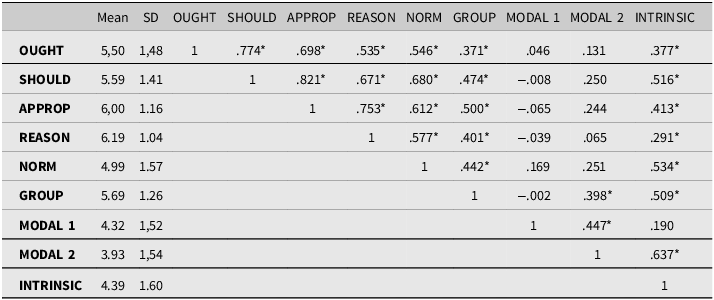
Participants tended to agree that agents in the vignette ought to believe the relevant propositions,Footnote 17 irrespective of the vignette they were presented with.Footnote 18 They also tended to agree that agents should believe the relevant propositions, that it is appropriate for them to believe them, and that they have reasons to believe them. Table 1 depicts mean ratings for all questions in our study.
Descriptive statistics and correlation coefficients for all variables in Study 1. * indicate p < .0025.Footnote 23

We found that responses to OUGHT, SHOULD, APPROP, and REASON were positively correlated with responses to NORM, GROUP, and INTRINSIC.Footnote 19 That is, the more participants tended to agree with OUGHT, SHOULD, APPROP, or REASON, the more they tended to agree with NORM, GROUP, and INTRINSIC. Furthermore, responses to OUGHT, SHOULD, APPROP, and REASON were also positively correlated. The strength of those associations is found in Table 1.
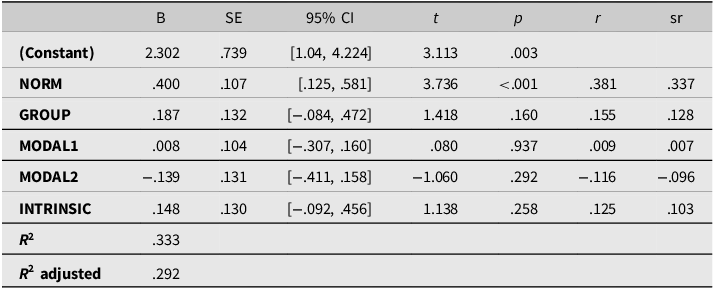
However, note that when we consider the respective contributions of each of the responses at the same time, we find that only responses to Norm significantly predict responses to OUGHT.Footnote 20,Footnote 21 Results of this analysis can be found in Table 2. Similar results were obtained when using the same analyses to predict responses to SHOULD, APPROP, or REASON.Footnote 22
Results of regression analyses with OUGHT as the outcome variable and NORM, GROUP, MODAL 1, MODAL 2, and INTRINSIC as predictors.

5.1.3. Study 1: Discussion
The results of our first study shed light on our three questions. Regarding the first question, the SET-UP, the high number of participants who answered these questions ‘incorrectly’ suggests that it is hard to ‘buy into’ the conditions specified in the vignette. In particular, a substantial set of participants (69 out of 189) seemed to think that agents in cases of epistemic indifference preferred having true beliefs over false beliefs, and another set (25 out of 189) took it that believing with the available evidence in these cases would promote at least some aims of these agents. This indicates that intuitive cases of epistemic indifference are quite rare. Furthermore, our results indicate that many participants thought that agents have a standing preference to acquire true over false beliefs. This is interesting, as it points to a different way in which instrumentalism could accommodate putative cases of epistemic indifference (see, e.g., Willoughby Reference Willoughby2022a).
Results relevant to our second question, KELLY’S VERDICT, show that participants tend to agree that agents in cases of epistemic indifference ought to believe in line with the available evidence. Lay people, it seems, agree with Kelly (and many instrumentalists) regarding the verdict in cases of epistemic indifference.
Lastly, concerning our third question, INSTRUMENTALIST REPLIES, results indicate that NORM, GROUP, and INTRINSIC are related to people’s normative intuitions to different degrees (see Table 1). However, we found no significant correlation between normative intuitions and MODAL 1 and MODAL 2. When controlling for the effect of other variables, only NORM showed a significant effect (see Table 2 and fn. 21). So, participants seem to agree that agents should believe in line with the evidence because they judge that agents in these cases should have aims that would be promoted by believing in line with the evidence.
However, we determined some problems with the wording of the GROUP and INTRINSIC statements. GROUP refers to being able to trust each other’s testimony. However, what’s at stake here is not being able to trust other’s assertions but whether and why agents are supposed to believe with the evidence. Whilst the two are obviously related, these are distinct phenomena. As such, they should be kept separate. INTRINSIC might be too close to the wording of NORM, as both suggest that agents’ preferences don’t play a role. Indeed, we found a significant correlation between participants’ ratings for these two statements. Thus, we will rerun the study using different wordings for these questions. This follow-up study also uses different wordings for our set-up questions, as one might worry that the high number of participants excluded in our first study was partly due to the way these questions are phrased.
5.2. Study 2
5.2.1. Study 2: Methods
ParticipantsFootnote 24 were randomly assigned to one of the three vignettes we used in Study 1. Once again, participants first answered a series of true or false questions intended to check their agreement with the set-up of Kelly’s cases:
(INTEREST) ‘[Agent] is interested in finding out the truth about [Proposition]’. (FALSE)
(PREFERENCE) ‘[Agent] prefers having true beliefs to false beliefs about [Proposition]’. (FALSE)
(GOALS) ‘[Agent] has other goals that would be promoted by her having true beliefs about [Proposition]’. (FALSE)
(INFORMATION) ‘[Agent] has access to reliable information that [Proposition]’. (TRUE)
To answer whether participants agree with the conditions that Kelly stipulates for cases of epistemic indifference (SET-UP question, see §5), we will count how many participants select answers other than Kelly’s stipulations (flagged between brackets after each statement).
Afterwards, participants answered whether they agree or disagree with a series of statements on a scale from 1 (‘strongly disagree’) to 7 (‘strongly agree’), with the midpoint (4) labelled as ‘neither agree nor disagree’. As in study 1, this served to check whether participants tended to agree with Kelly’s verdict in cases of epistemic indifference, thus answering our second question, KELLY’s VERDICT, and whether they favoured an instrumentalist reply, answering our third question, INSTRUMENTALIST REPLIES. In contrast to Study 1, and in light of its results, we used the following modified versions of NORM, GROUP, and INTRINSIC questions:
(NORM) [Agent] should develop a preference for believing in line with the available information.
(GROUP) [Agent]’s social group values their members forming beliefs in line with the available information.
(INTRINSIC) [Agent] ought to believe in line with the available information. This is a fact, and not a matter of preference.
To answer whether participants agree with the intuition that Kelly seeks to elicit with cases of epistemic indifference (KELLY’S VERDICT question, see §5), we will test whether participants’ responses to the normative intuitions statements are above the scale’s midpoint (4 – ‘neither agree nor disagree’) using one-sample t-tests.
To answer whether the instrumentalist replies to Kelly’s objection explain participants’ intuitions in cases of epistemic indifference (INSTRUMENTALIST REPLIES question, see §5), we will test the relation between the reply statements and the normative intuition statements using correlation and multiple linear regression analyses.
5.2.2. Study 2: Results
Once again, a large number of participants (174 out of 301) gave ‘wrong’ responses to at least one of the four questions concerning the set-up of the cases. In particular, 20 answered ‘true’ to INTEREST, 106 answered ‘true’ to PREFERENCE, 61 answered ‘true’ to GOALS, and 65 answered ‘false’ to INFORMATION. As in Study 1, we analysed the results for participants who gave the ‘expected’ responses to INTEREST, PREFERENCES, and INFORMATION but included all responses to GOALS.Footnote 26
Once again, participants tended to agree that agents ought to believe the relevant proposition,Footnote 27 independently of the vignette they read.Footnote 28
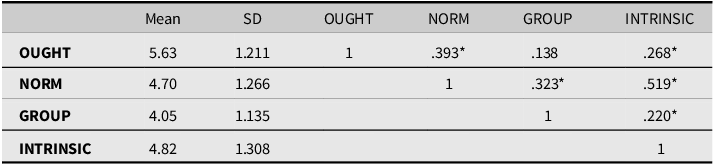
Participants’ responses to the OUGHT question were associated with their responses to NORM and INTRINSIC, but not GROUP (see Table 3).Footnote 29
Descriptive statistics and correlation coefficients for all variables in Study 2. * indicate p < .0167.Footnote 25

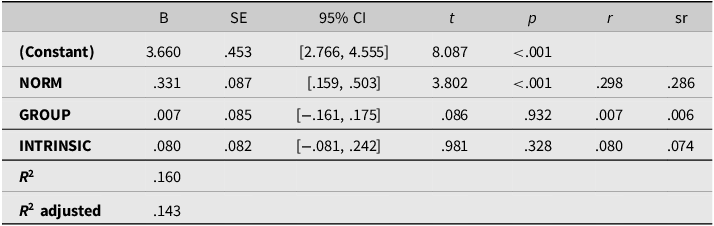
Replicating the results of Study 1, we found that only responses to NORM significantly predict responses to OUGHT when considering the respective contributions of each of the variables at once.Footnote 30 The results of this analysis can be found in Table 4.
Results of regression analyses with OUGHT as the outcome variable and NORM, GROUP, and INTRINSIC as predictors.

5.2.3. Study 2: Discussion
The results again showed that it is hard to ‘buy into’ the conditions specified in the vignette – as evidenced by the high number of participants who didn’t agree with the set-up of the cases. Again, this is relevant to our first question, the SET-UP. Participants also tend to agree that agents in cases of epistemic indifference ought to believe in line with the available evidence, thus informing answers to our second question, KELLY’S VERDICT.
Regarding INSTRUMENTALIS REPLIES, we did not find a significant relation between OUGHT and GROUP. We found a significant association between OUGHT and NORM, and between OUGHT and INTRINSIC, although the former association was weaker (see Table 3). As in Study 1, only NORM showed a significant effect when controlling for the effect of other variables (see Table 4 and fn. 15).
INTRISINC and NORM continued to be relatively highly correlated with one another. However, this might not be a concern, given that collinearity diagnostics showed that multicollinearity was not a concern in either model (Tolerance was >.20 for all variables; Menard (Reference Menard2011)).
6. Upshot and outlook
In two studies, we found potential answers to all three of our questions. Regarding the first question, the SET-UP, we’ve found that a significant subset of participants do not ‘buy into’ how cases of epistemic indifference are set up. In particular, in both studies, a substantial subset of participants agreed with PREFERENCES. Speculating somewhat, this might simply be due to the complexity of the cases and/or the cognitive resources invested by participants. However, it might also reflect a more profound disagreement with how Kelly designed these cases. For example, people might feel that agents always prefer to have true over false beliefs about a particular topic (see, e.g., Willoughby Reference Willoughby2022a) or they might feel that agents simply always prefer to have true beliefs, even about trivial topics, when presented with relevant evidence. Relatedly, a substantial subset gave ‘unexpected’ responses to GOALS, suggesting that the various instrumentalist replies are correct in suggesting that cases of epistemic indifference do contain relevant aims.
Concerning the second question, KELLY’S VERDICT, we found that participants tended to agree with Kelly’s objection: In cases of epistemic indifference, agents have reason to or ought to believe even if doing so doesn’t promote any of their aims.
Regarding INSTRUMENTALIST REPLIES, we’ve found that participants agreed most with what we call the normative reply: That epistemic normativity depends for its force, not on people’s actual aims, but on the aims they should have. Recall the normative reply predicts that agents are supposed to believe that p if there’s evidence that p and if there are practical reasons to find out whether p.Footnote 31 On the face of it, one might think that advocates of this view would predict that the agent doesn’t have reason to believe in cases of epistemic indifference, as they often seem practically inconsequential. This certainly is how Kelly viewed these cases. Perhaps surprisingly, our findings indicate that participants did think that despite the propositions in question being epistemically irrelevant, there were nonetheless practical reasons for agents to find out whether p, as they tended to support the normative reply over others. What’s epistemically uninteresting, laypeople seem to think, might nonetheless be practically relevant! Recall that the normative view maintains that epistemic reasons depend on their normative force not on agents’ actual aims but on the aims that they should have, where the ‘should’ in question is practical (e.g., prudential or moral). On one interpretation of participants’ responses, we can read their agreement with NORM as them being sympathetic to this line of thinking: Whilst the agent in question might currently lack this aim, practically speaking, they should have the relevant epistemic aim. This further supports our finding that people didn’t view cases of epistemic indifference in the same way as Kelly did: There are relevant aims, even if the agent in question is currently lacking them.
A rival explanation of our findings would question whether the statement we used to represent the normative reply might not also support an intrinsicalist reading. After all, it solely mentions that agents should develop a preference to believe with the available information but doesn’t say much about why they should develop this preference. It might be, so the worry goes, that participants thought that agents are to develop this preference simply because it’s a brute normative fact that one should believe with the evidence – regardless of the practical reasons associated. Whilst we acknowledge that future work should seek to delineate the two options more strongly, we take it that the plausibility of this interpretation of the results is weakened by the fact that participants agreed less with the statement representing the key intrinsicalist idea – that one ought to believe with the available information is just a brute normative fact, and not a matter of preference, and that the size of the correlation between responses to NORM and INTRINSIC was rather moderate.
Of course, our findings should be taken with caution. Our studies were limited in that the statements that represented different kinds of instrumentalist replies were kept rather general so as to be accessible to laypeople. As such, they’re likely too general to distinguish between different subkinds of the respective replies (e.g., between different subkinds of the group-reply). However, we did our best to use statements that accurately represent the authors’ views (see footnote 13). Given that Kelly’s objection and the debates surrounding are entered on intuitions, the data we’ve collected supports the idea that in cases of epistemic indifference, there are reasons to believe and that at least some versions of epistemic instrumentalism are doing well in capturing why people judge that this is so. However, we’ve also found that many participants found it difficult to ‘buy into’ cases of epistemic indifference as they’ve been envisaged by Kelly.
As this is the first experimental study to shine a light on people’s intuitions concerning the source question, there’s a lot for future work to address. This includes the following:
-
• First, a significant subset of participants found it hard to ‘buy into’ the conditions stipulated by Kelly. Future work should more closely investigate which aspects of these cases were hard for participants to accept. In particular, a substantial subset of participants seemed to think that agents had a general preference to acquire true over false beliefs. Furthermore, we should better understand what kinds of aims participants deem relevant in cases of epistemic indifference.
-
• Second, we should also again mention that we’ve only tested people’s intuitions regarding one set of cases – epistemic indifference cases – that are being discussed in the literature. Perhaps other cases – e.g., those sometimes called epistemic avoidance (Côté-Bouchard Reference Côté-Bouchard2015) – will elicit different intuitions.
-
• Third, as mentioned, the instrumentalist replies were presented in a rather general way to participants. Developing ways to present these views in more fine-grained ways would thus be worthwhile – as well as presenting instrumentalist replies not sampled here.
-
• Fourth, participants favoured the normative instrumentalist reply to Kelly’s objection. However, it remains unclear why they think that the subjects of these cases should have a preference to find out whether p. Again, future research should thus address what the relevant practical reasons are.
We hope that our work paves the way for more empirical investigations that contribute to and complement theorising around the Source Question and help us make progress on this issue.
Acknowledgements
We received helpful feedback on our questionnaire from Michelle Dyke, Thomas Kelly, and Hillary Kornblith. Basil presented the paper at the 3rd European Experimental Philosophy Conference at the University of Zurich. Our thanks to the organisers and the audience there and to the very helpful reviewers whose comments greatly improved our paper.
Funding statement
Swiss National Science Foundation, Grant Number: PCEFP1_186936, MICIU/AEI/10.13039/501100011033, European Union Next Generation EU/PRTR (grant number: JDC2022-048913-I)
Competing interests
Not applicable.

 Open access

