




Introduction
For many cereals, domestication corresponds with an increase in the size of the grain or caryopsis (Zohary & Hopf Reference Zohary and Hopf2000; Fuller et al. Reference Fuller2014; Stevens et al. Reference Stevens, Shelach-Lavi, Zhang, Teng and Fuller2021). Grain size is therefore an essential measure—alongside the seed dispersal mechanism—of the domestication syndrome. The mechanism is likely related to seedling competition in varying growth conditions (Harlan et al. Reference Harlan, De Wet and Price1973; Allaby et al. Reference Allaby, Stevens and Fuller2022). Human intentionality in this process is subject to debate (Allaby et al. Reference Allaby, Stevens, Kistler and Fuller2021; Jones et al. Reference Jones2021) but there is an increasing understanding that, at the global level, the grain sizes of cereals are driven by regional variations (Liu et al. Reference Liu2016; Fuller et al. Reference Fuller, Colledge, Murphy, Stevens, Eraso, Mujika Alustiza, Arrizabalaga Valbuena and Díez2017) that resonate with the wider discussion of domestication as a transregional process (Kistler et al. Reference Kistler2018; Allaby et al. Reference Allaby, Stevens and Fuller2022). One such example is the eastern dispersal into ancient China of free-threshing wheat (Triticum cf. aestivum) and barley (Hordeum vulgare), which was associated with significant grain-size reductions due to the selection of shorter grains for cooking efficiency in boiling and steaming cuisines (Liu et al. Reference Liu2016; Liu & Reid Reference Liu and Reid2020; Ritchey et al. Reference Ritchey2022). In this article, we shift the focus from the eastern dispersal of cereals from the Fertile Crescent to the western expansion of millets from East Asia. We investigate whether or not this western dispersal of millets (Setaria italica and Panicum miliaceum) involved the selection of larger grains, which were better suited for the grinding-and-baking cuisines of the west.
In recent years, there have been considerable developments in understanding the movement of domesticated crops and livestock across Eurasia in the millennia before the establishment of the so-called Silk Road (e.g. Jones et al. Reference Jones, Hunt, Lightfoot, Lister, Liu and Motuzaite-Matuzeviciute2011; Spengler et al. Reference Spengler, Frachetti, Doumani, Rouse, Cerasetti, Bullion and Mar'yashev2014; Liu et al. Reference Liu2019). In addition to efforts to refine knowledge of specific routes, attention has been drawn to the physical evidence of crops and their culinary preparation, which may be independently traced across space and time (Hunt et al. Reference Hunt2013; Ritchey et al. Reference Ritchey2022). Such research is grounded in the contrast between a boiling-and-steaming culinary tradition in East Asia and a grinding-and-baking tradition in South-west Asia, a structural difference probably rooted in hunting-and-gathering traditions that pre-date the domestication of cereals (Fuller & Rowlands Reference Fuller, Rowlands, Wilkinson, Sherratt and Bennet2011). It is likely that these deep-seated culinary differences were the cause, rather than the consequence, of taxonomic differences between eastern and western agricultures (e.g. wheat/barley versus millet/rice). Recent findings highlight the disaggregation of grains and cooking traditions, such as that wheat and barley travelled into central China during the second millennium BC without their associated grinding-and-baking culinary tradition (Liu et al. Reference Liu2016; Long et al. Reference Long, Leipe, Jin, Wagner, Guo, Schröder and Tarasov2018; Deng et al. Reference Deng, Fuller, Chu, Cao, Jiang, Wang and Lu2020; Ritchey et al. 2021). The eastern spread of these crops involved the selection of morphotypes that were suitable for preparation using the eastern boiling-and-steaming tradition. Similar trends have been observed in Southeast Asia, where boiling-and-steaming traditions led to the preferential rise of ‘sticky’ phenotypes (Castillo et al. Reference Castillo2016).
Less is known about the selective modification of millets in relation to grinding-and-baking traditions as these crops moved from northern China into Central Asia and the Tibetan Plateau from the late fourth millennium BC onwards. Recent genetic studies indicate the potential disaggregation of millets and their associated culinary treatments as cultivation moved west, with the genetic mutations leading to amylose-low/free (sticky) starch genotypes becoming restricted to an East Asian type over time (Hunt et al. Reference Hunt, Rudzinski, Jiang, Wang, Thomas and Jones2018). This is further supported by ongoing archaeogenetic work, revealing the absence of sticky-starch genotypes in prehistoric Central Asia (Hunt et al. Reference Hunt, Jiang, Liu, Lister, Abuduresule, Li and Jones2024). This absence of genetic evidence for the sticky-starch genotype in Central Asia indicates that the western dispersal of broomcorn millet from northern China to the Inner Asian mountains was not accompanied by the transmission of eastern culinary traditions. Genetic research on starch stickiness is currently restricted to broomcorn millet; less is known about foxtail millet, although, historically, Setaria had fewer glutinous varieties than Panicum (Bray Reference Bray1981). The incorporation of millet into grinding-and-baking culinary traditions as it moved westwards would have removed the functional advantage of smaller grains in Eastern cooking and predict an increase in size, mirroring the reduction in the size of wheat and barley grains as they dispersed from Central to East Asia previously documented (Liu et al. Reference Liu2016; Ritchey et al. Reference Ritchey2022). Alternatively, if environmental adaptation was the main driver of changing grain size, we would expect more diverse but generally smaller millet grain sizes in the Inner Asian regions (including the high-altitude Tibetan Plateau) as a result of their cultivation in stressful environments or less intensive seedling competition in mobile pastoral contexts. In the latter scenario, the absence of intensive field management by humans leads to the flourishing of weed taxa and a bias towards smaller grain survival (e.g. Spengler Reference Spengler2015; Motuzaite Matuzeviciute et al. Reference Motuzaite-Matuzeviciute, Mir-Makhamad and Spengler2021).
Here, we compile the measurements from 3876 previously published and newly obtained charred foxtail and broomcorn millet grains from 145 sites across East and Central Asia to evaluate the roles of regional culinary and environmental conditions in morphological variation. Grain size is a complex trait that can be affected by various factors, including the charring effect (Märkle & Rösch Reference Märkle and Rösch2008; Charles et al. Reference Charles, Forster, Wallace and Jones2015), survival of immature seed remains (Motuzaite Matuzeviciute et al. Reference Motuzaite-Matuzeviciute, Hunt and Jones2012; Song et al. Reference Song, Zhao and Fuller2013) and variations at the subspecies level including introgressions with weedy relatives (Song et al. Reference Song, Gao, Tang, Zhang, Hayashi Tang, Xu and Lu2021). Attention should also be drawn to uncertainties resulting from assemblage formation process. This includes the possibility of the intrusion of younger grains into older layers (Motuzaite Matuzeviciute et al. Reference Motuzaite-Matuzeviciute, Staff, Hunt, Liu and Jones2013) and inconsistency in crop processing leading to the disproportional input of immature grains (e.g. Stevens et al. Reference Stevens2003; van der Veen Reference van der Veen2007). However, given the geographical expansiveness of the research, we have chosen to focus on quantitative traits (length and breadth) that can be measured at the population level, an approach that has proven useful in previous studies with a similar scope (e.g. Fuller et al. Reference Fuller2014; Ritchey et al. Reference Ritchey2022).
Materials and methods
We compiled measurements for 2529 foxtail millet (FM) grains from 116 sites and 134 broomcorn millet (BM) grains from 114 sites across eastern Eurasia dating from the late fourth to the late first millennium BC (Figure 1; see online supplementary material (OSM) Table S1 for full details). These data were collected from published archaeobotanical reports and newly gathered measurements conducted by the authors. The study focuses on grain length and breadth dimensions as there is inconsistent reporting of thickness dimensions in the published archaeobotanical studies (Figure 2). A scatter plot of mean millet grain length by site shows a general regional trend in grain size variation (Figure S1). Accordingly, we divide the dataset into six regional groups based on location along an east-to-west gradient: IAMC (Inner Asian Mountain Corridor, a foothill zone spanning from south-western Asia through the Pamir, Tianshan and Dzhungar Mountains), Gansu-Qinghai (north-eastern Qinghai and Gansu), Tibetan Plateau (represented by Karuo site in eastern Tibet), North China (the Loess Plateau including the Yellow-Wei and Western Liao Rivers), South China (Sichuan Basin and Yun-Gui Plateau) and the Russian Far East (represented by data collected from Southern Primorye). Most measurements in our compiled dataset are from single millet grains. However, some source studies report only the mean grain-size measurements. Most sites without individual measurements are from a single region—Gansu-Qinghai (see Table 1 for details). We acknowledge the bias introduced by combining individual measurements and site mean values because sites with more measurements may potentially overrepresent certain grain morphologies. However, when analyses are conducted solely using mean site values, the observed pattern remains consistent (Figure S3).
Site locations of measured foxtail millet and broomcorn millet grains (see site information in Table S1). Dashed lines show geographical groups discussed in Materials and methods. Arrows indicate archaeologically attested millet dispersal routes after Liu et al. (Reference Liu2019) (figure by authors).

Ventral view of charred foxtail millet (a–f) and broomcorn millet (g–k) caryopses from selected sites in this study: a) Taosi (North China); b) Gaozhuang (Gansu-Qingahi); c) Chap II (IAMC); d) Jijiwan (South China); e) Rettihkhovka Geologicheskaya-1 (Russia Far East); f) Karuo (Tibetan Plateau); g) Taosi (North China); h) Siping (Gansu-Qinghai); i) Tuzusai (IAMC); j) Xiawanggang (South China); k) Vodopadnoe-7 (Russia Far East). Scale bar = 1 mm. Taking the foxtail millet grain sample from Taosi (a) as an example, grain length refers to the longest axis of the grain, while grain breadth refers to the axis perpendicular or nearly so to the longest axis (figure by authors).

Summary of foxtail and broomcorn millet grain mean length, breadth, length/breadth, and counts of single grain and mean grain measurements grouped by regions.

We analyse length, breadth and length/breadth ratios of regional groups using descriptive statistics. We employ the parametric null hypothesis testing of ANOVA (analysis of variance, or Welch's F test when different groups of data for comparison are non-homogeneous) with a post-hoc Tukey's honestly significant difference (HSD) test, or the Kruskal–Wallis test with post-hoc pairwise Wilcoxon rank sum for non-parametric data, to identify the significance of variation in measurements between different regions.
Results
Figure 3 shows the regional variations in broomcorn millet and foxtail millet grain size, with the mean values of each regional group summarised in Table 1 and analytical data detailed in Table S2. For both millets, statistically meaningful differences are identified in mean grain length between regional groups (see Table S2, Kruskal-Wallis test, FM: H(5) = 713.5, p<0.01; BM: H(4) = 229.5, p<0.01). Differences in mean grain breadth among regions are more ambiguous virtually. However, such differences are statistically meaningful according to the Kruskal-Wallis test (Table S2, Kruskal-Wallis test, FM: H(5) = 161.5, p<0.01; BM: H(4) = 76.8, p<0.01).
Regional group boxplots for foxtail millet measurements (plots a, c & e) and broomcorn millet measurements (plots b, d & e). Groups with non-significant variations share the same symbol (p<0.05) (figure by author).

For foxtail millet, the grains with longest mean value are from the IAMC group (mean length: 1.54mm), followed by the Tibetan Plateau (1.49mm), both significantly longer than the other regions. There is a general reduction in the mean length of foxtail millet grains moving east from the IAMC and the Tibetan Plateau through Gansu-Qinghai, North China, South China and the Russian Far East (Figure 3). The most compact grains appear in South China (1.2mm) and Russian Far East (1.1mm). When considering only the measurements of grains dated to the second and first millennia BC, these results do not change (Figure S2, Table S3, Kruskal-Wallis test, H(5) = 494.58, p<0.01). This indicates that the observed regional variations are not solely driven by the predominance of older grains in the North China and Gansu-Qinghai groups.
No clear pattern is observable in the breadth of foxtail millet grains. The mean breadth of foxtail millet grains in most regions, including the IAMC, Tibetan Plateau, Gansu-Qinghai and North China groups, is approximately 1.2mm, and there is no obvious difference among them (Figure 3, Tables 1 & S2). The breadth of foxtail millet grains from South China (mean breadth: 1.1mm) and the Russian Far East (1.1mm) is, however, statistically smaller in comparison with the other regions. The most slender grains are found in the IAMC and Tibetan Plateau groups, with the highest mean length/breadth ratios of 1.28 and 1.25, respectively. The grains from Gansu-Qinghai (mean length/breadth ratio: 1.19) and North China (1.13) appear to be shorter and broader than those from the IAMC and Tibetan Plateau. The South China and Russian Far East groups have the most compact grains with a mean length/breadth ratio of 1.07 and 1.04, respectively.
The broomcorn millet measurements display similar regional variations to their foxtail millet counterparts, and the pattern is statistically unambiguous when considering all time periods (Figure 3, Tables 1 & S2). The longest grains are from the IAMC (mean length: 1.9mm), which are significantly longer than other regional groups, followed by North China (1.8mm) and Gansu-Qinghai (1.7mm). Like foxtail millet, the shortest grains are from the South China (1.2mm) and Russian Far East groups (1.1mm). These differences are statistically meaningful (Figure 3, Table S2) but become less clear when only broomcorn millet grains dated to the second or first millennia BC are considered. For this subgroup, no statistically meaningful differences in grain breadth can be observed between the IAMC and North China groups or between the Gansu-Qinghai and North China groups, though there is a meaningful difference between the IAMC and Gansu-Qinghai groups (Figure S2, Table S3). Multiple group variations persist and this is likely driven by the compactness of grains from South China and the Russian Far East (Table S3, Kruskal-Wallis test, H(4) = 231.52, p<0.01). In terms of mean breadth values, grains from Gansu-Qinghai (1.5mm) and the Russian Far East (1.5mm) are significantly narrower than those of other regional groups (IAMC, North and South China) with mean values of approximately 1.6mm. As with foxtail millet, the IAMC group yields the most elongated broomcorn millet grains (mean length/breadth ratio: 1.19), followed by Gansu-Qinghai (1.16) and North China (1.12). The plumpest caryopses are from South China (1.05) and Russian Far East (1.07) groups. Analysis of mean site values (rather than individual grain values) for length and breadth to check for any bias introduced by including sites without individual measurements suggests no substantial difference in results (Figure S3, Tables S1 & S4).
Discussion
East-to-west grain size increase
Our results demonstrate clear regional variations in millet grain size during the period between the late fourth and the late first millennia BC. Most strikingly, there is an increase in the length (and, to a lesser extent, in the breadth) of foxtail millet grains from east to west, indicating phenotypic alteration as the crop moved beyond its centre of origin. Foxtail millet grains from northern China are relatively short but their western movement into Gansu-Qinghai and, subsequently, the Inner Asian mountains is associated with a gradual lengthening of the caryopsis. Similar trends are observed in broomcorn millet, but the pattern is statistically less clear. When considering only those grains dated to the second and first millennia BC, the pattern for foxtail millet remains significant but there is no statistically meaningful increase in broomcorn millet size along the east-to-west gradient (Figure S3), despite the longer mean length of broomcorn millet grains from the IAMC.
Culinary practices are a likely driver of the observed pattern. Broomcorn and foxtail millet were first cultivated in northern China before 6000 BC and dispersed beyond their centre of origins after 5000 BC (Liu et al. Reference Liu, Matuzeviciute, Hunt, Lightfoot, Liu and Fuller2018; Stevens et al. Reference Stevens, Shelach-Lavi, Zhang, Teng and Fuller2021). In northern China, grain cooking traditions in the Neolithic centred on boiling and steaming, methods that favoured sticky-cereal varieties and small grains as the larger surface area to volume ratio of smaller grains increases cooking efficiency (Hunt et al. Reference Hunt, Rudzinski, Jiang, Wang, Thomas and Jones2018, Ritchey et al. Reference Ritchey2022).
The principal evidence for boiling-and-steaming traditions is derived from ceramic vessels (and by the absence of ovens) in Neolithic China. Tracing these ceramic vessels in the archaeological record allows an estimation of the geographical distribution of boiling-and-steaming cuisines (Fuller & Rowlands Reference Fuller, Rowlands, Wilkinson, Sherratt and Bennet2011). Examples of such pottery include Ding 鼎, Li 鬲 (tripod vessels suited to boiling) and Yan 甗 (tripod vessels suited to steaming), which are well documented compared with other boiling/steaming kits such as Gui (or He) 鬶 (盉) and Jia 斝 (Chang Reference Chang1977). The oldest Ding are reported from Jiahu-Peiligang culture sites, c. 7000–6000 BC, and they are subsequently found along the Yellow and Yangtze Rivers in association with cultural groups such as the Yangshao, Longshan, Songze and Majiabang (Makibayashi Reference Makibayashi, Kinoshita, Mori and Yasuda2008; Han Reference Han2015). Li are first documented in Longshan culture c. 2500 BC, becoming predominant on the Loess Plateau after that (Figure 4).
Estimated distributions of tripod pottery vessels li 鬲, ding 鼎, yan 甗, gui 鬶 (or he 盉) and jia 斝 before (a) and after 2000 BC (b) and their westernmost appearance in archaeology at Tuhulu and Lucheng, in relation to the distribution of sticky landrace varieties of modern broomcorn millet (c). Arrows indicate millet dispersal routes after Liu et al. (Reference Liu2019) (figure by authors).

These tripod vessels are found no further west than the Wei River valley prior to c. 2000 BC (Han Reference Han2015). Their range subsequently extended westwards to the Huangshui River during the second millennium BC where they are found at Qijia and Siwa culture sites. With a few exceptions, including Li recovered from Shajing and Tuhulu, marking the western limit of pottery tripods, these vessels are largely absent in the Hexi Corridor, a region west to the Loess Plateau along the northern fringe of the Tibetan Plateau (Li Reference Li and Li2009) (Figure 4), as are the same vessel forms reproduced in bronze during the first millennium BC (cf. von Falkenhausen Reference von Falkenhausen2006). This distribution concurs with the approximate modern western boundary of sticky-type cereal varieties, including sticky broomcorn millet (Sakamoto Reference Sakamoto, Ellen and Fukui1996; Hunt et al. Reference Hunt2013), likely signifying the western boundary of early boiling-and-steaming cuisines (Figure 4). Such a pattern endures from the Neolithic until this day, although a recent hypothesis that Inner Asia might have developed a mixed grinding-baking-boiling tradition adds more layers of complexity to this model (Ritchey et al. Reference Ritchey2022).
Although millet moved westwards through the Hexi and Inner Asian Mountain Corridors and beyond during the second and first millennia BC (Liu et al. Reference Liu2019), it appears that the sticky cuisines did not and nor did the tripod vessels utilised for boiling and steaming (Li Reference Li and Li2009; Hunt et al. Reference Hunt, Rudzinski, Jiang, Wang, Thomas and Jones2018). Broomcorn and foxtail millet were likely folded into different cooking traditions in Inner Asia, featuring flour-making or stewing (Ritchey et al. Reference Ritchey2022). Evidence for later examples of these types of fusion cuisines, such as desiccated noodles, pancakes and cakes made of millet flours, have been recovered from late Bronze and Iron Age sites in southern Tianshan (Xinjiang Uighur Autonomous Region Museum and Xinjiang Institute of Archaeology 2001; Gong et al. Reference Gong2011; Yu Reference Yu2012; Xiao et al. Reference Xiao, Hu, Alip, Rao, Ren and Yang2020). Porridges or stews made of crushed and ground millet grains are also common in Central Asia today, for example, tary [тари]/kozhe [коже] in Kazakhstan (Segizbauly Reference Segizbauly2011; McLean Reference McLean2012). None of these examples would favour small grains (or sticky starch) as these cooking methods do not involve boiling the whole grain.
This observation resonates with trends previously documented in archaeological wheat and barley, showing west-to-east grain size reductions during the same period. Notably, these trends seem to apply to domesticated cereals uniformly across taxa differences (Figure 5), indicating intentional selection. If environmental adaption were the main driving force, one would expect more taxa-specific patterns as these cereals differ widely in their growing seasons, physiological requirements and biological responses to different environments. We suggest that the differing culinary traditions of East Asia and the Eurasian Steppe could be one of the key mechanisms underlying the morphological differences observed in Asian millets.
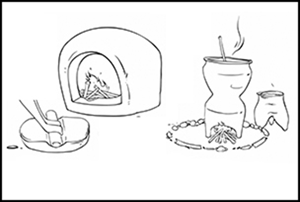
Boxplot of grain measurements of wheat (n = 486) and barley (n = 966) (a, data derived from Liu et al. Reference Liu2016 and Ritchey et al. Reference Ritchey2022), and foxtail (n = 1206) and broomcorn millet (n = 539) (b, this study) from two hypothetical culinary zones in the second and first millennium BC. Non-significant differences share the same symbol (p<0.05). Food preparation methods from c) the Inner Asian Mountain Corridor grinding-and-baking zone and d) Monsoonal China, including North China, Gansu-Qinghai and South China, boiling-and-steaming zone using tripod vessels (adapted from Ritchey et al. 2021) (figure by authors).

North-south trends and the Tibetan Plateau
Our results also show a north-south trend. Broomcorn millet and foxtail millet grains are shorter in southern China (including the Yangtze and the Yun-Gui Plateau) and in north-east Asia (the Russian Far East) compared with those from the North China region. Given that the cooking traditions in these areas are similar, culinary choice may not be the primary driver in this aspect of grain size variation. The observed pattern could result from various conjoined effects, including changes in field conditions, reduced seedling competition, reduced sowing depth and disproportionate inclusion of immature grains due to early harvesting. The currently available information, however, does not allow us to evaluate these localised conditions.
On the high Tibetan Plateau, grain sizes are unexpectedly large. The lengths of foxtail millet grains from Karuo (3100 metres above sea level (masl), 2700–2100 BC), for example, are significantly longer than those from low-elevation North China or mid-altitude sites in Gansu-Qinghai (Figure 6, Table S5). The Karuo samples are comparable with the grain metrics from the Inner Asian mountains. This seems counterintuitive as high-altitude adaptation tend to lead to diverse but generally shorter seeds, as documented in other cereals (e.g. Goodman & Brown Reference Goodman, Brown, Sprague and Dudley1988; Tsehaye et al. Reference Tsehaye, Berg, Tsegaye and Tanto2006). Additionally, C4 plants (including both foxtail and broomcorn millet, which utilise the C4 photosynthetic pathway) are maladapted to high altitudes due to frequent chilling injury and low quantum yields (Sage et al. Reference Sage and Stata2015). It has been assumed that the high-altitude adaptation of foxtail millet could have been achieved through introgression with cold-tolerant and high-altitude adaptive weedy relatives such as Setaria viridis (Song et al. Reference Song, Gao, Tang, Zhang, Hayashi Tang, Xu and Lu2021). In this case, we would expect high-altitude foxtail millet to show more pronounced weedy morphology, which is not consistent with our observations.
Boxplots of foxtail millet measurements from different elevational environments of the eastern Tibetan Plateau (Karuo site). Non-significant variations share the same symbol (p<0.05) (figure by authors).

The unique early cuisine of Tibet may explain the observed pattern. In contrast with other cuisines in East Asia, Tibetan cooking lacks boiling and steaming due to the low vapour pressure at high altitudes (water boils at about 86°C at 4000masl). At this low temperature, boiling and steaming are fuel demanding and inefficient. Traditionally, Tibetan cuisine utilises grinding and baking for flour-based cooking such as tsampa (a roasted meal made of barley flour). Ritchey and colleagues (Reference Ritchey2022) suggest a link between cooking traditions and unusually large barley grains recovered from Tibetan sites. Similarity to the trend in foxtail millet is striking, although we should note that our small sample size negates conclusive interpretations (n = 30 from a single site).
The findings above reinforce the role of culinary practice in the interpretation of millet grain size across Asia. Previous work has focused on changes in millet seed morphology as a proxy for the millet domestication process in northern China during the Neolithic (Stevens et al. Reference Stevens, Shelach-Lavi, Zhang, Teng and Fuller2021). Our research, however, focuses on regional morphological variation of millet associated with dispersals between the late fourth and late first millennia BC. Our findings highlight the role of culinary practices in interpreting millet grain metrics across Asia. Echoing recent discussions of domestication as a transregional process (e.g. Allaby et al. Reference Allaby, Stevens and Fuller2022), greater attention to the importance of regional cooking diversity in the shaping of grain morphology at the population level is therefore needed.
Conclusion
We have collated and analysed the size of almost 4000 broomcorn millet and foxtail millet grains from Central and East Asia dating to the final three millennia BC. We have observed an increase in grain length and breadth as millets moved from their centre of origin in northern China westwards into the Inner Asian mountains. This mirrors the west-to-east trend in wheat and barley, where grain sizes decreased as they moved in the opposite direction into northern China. Regional differences in cooking techniques—grounded in the contrast between boiling and steaming in East Asia and grinding and baking in West and Central Asia—likely underly the observed pattern. In the high-altitude Tibetan environment, we documented unusually large foxtail millet grains attributed to the specific cooking tradition developed on the high plateau under low-vapour pressure conditions.
We also identify some potential limitations of the research. The observed east-to-west reduction in grain size is most clear for foxtail millet. For broomcorn millet, the pattern is equally clear when considering data from all time periods but less so when only data from the second and first millennia BC are singled out. Our research has focused on quantitative traits (length and breadth) that can be measured and compared at the population level. At the community level, however, it is more difficult to distinguish the effects of environmental conditions versus human selection. Future research employing isotopic and archaeogenetic approaches might clarify this. In cross-regional context, our findings offer insight into the geographical decoupling of ingredients from food preparation and cooking techniques, such that Asian millets moved through the Hexi and Inner Asian Mountain Corridors and beyond, but the eastern vessels for boiling and steaming did not, nor did sticky genotypes. The regional variations in millet size documented here can be understood within this context. Notably, the east-to-west trends in reduced grain size seem to apply uniformly to domesticated cereals across taxa despite biological distinctions (millets, wheat and barley, Figure 5), indicating human drivers for morphological change.
Acknowledgements
We thank Professor Zhijun Zhao from Shandong University and Dr Mike Spate from University of Sydney for their valuable assistance during the data-collection process.
Funding statement
This work was supported by the National Science Foundation (“Agricultural labor organizations and management”, Grant no. 2052932, PI: X Liu, Co-PI: Y Sun). Co-author, E. Sergusheva would like to acknowledge the Program of Fundamental Scientific Research in Archaeology, Russian Academy of Sciences (‘Archaeology and history of the Russian Far East and adjacent zones of East Asia in antiquity and the Middle Ages', no. 01201152560, E Sergusheva), for support of data collection from Southern Primorye.
Supplementary material
To view supplementary material for this article, please visit https://doi.org/10.15184/aqy.2024.31.


 Open access

