

Introduction
How do Americans react to the perception of social inequality? If their racial ingroup was disadvantaged, would they take actions to correct that inequality even if such actions were personally costly? Would they behave unfairly themselves so as to help others? These are important open questions in the study of racial resentment and discrimination in America (Peyton and Huber, Reference Peyton and Huber2021).
We address these questions using a well-powered and incentive-compatible behavioral experiment, manipulating perceptions of inequality among Black and White Americans. Participants observe an equal or unequal allocation between a group comprised of Black subjects (“black group”) or White subjects (“white group”). Inequality is caused by a White person, a Black person, or chance. Participants (subjects) are selected on the basis of their racial identities (i.e., they self-identified as either “Black/African American” or “White” in a survey), so the Black group in the experiment is recognized as a racial ingroup for Black subjects and the White group is the outgroup and vice versa for White subjects. After observing an initial allocation of resources between ingroup and outgroup, subjects have the opportunity to correct any inequality they might have witnessed by allocating new resources between these two groups. They can correct the inequality, leave it unchanged, or exacerbate it. We measure whether subjects are willing to bear personal costs to implement their preferred allocations, which creates a tradeoff between participants’ own material interests and their influence over the allocation between the two groups. We explore whether subjects respond differently to inequality that hurts their ingroup versus the outgroup, and whether they are more likely to correct inequality when they perceive it as the result of deliberate actions by others rather than the result of chance.
We find that fairness breeds fairness: most subjects behave fairly (splitting the endowment evenly between the two groups) if they observe equal prior allocations to Black and White groups. Moreover, subjects recognize unfairness and are likely to compensate the disadvantaged group regardless of its racial makeup. However, subjects respond more strongly to observations of inequality that disadvantage their racial ingroup. The source of inequality also matters, but only for Black subjects, who react more strongly to inequality against their ingroup if it is the result of deliberate actions by others.
We distinguish between types of responses to inequality that participants can take: overcompensating, fully compensating, partially compensating, or exacerbating inequality; or always choosing equal treatment of the two groups regardless of initial observations of inequality. These actions reflect differences in the degree of commitment to enforcing an egalitarian norm of fairness and may suggest that observing inequality shapes what actions subjects consider as fair.Footnote 1 More than 25% of subjects switch fairness concepts depending on whether their ingroup or outgroup is disadvantaged. Black subjects are more likely than White subjects to switch. In exploratory analysis, we consider (i) personal normative beliefs about appropriate behavior when allocating money between a Black and a White group and (ii) closeness perceptions towards Black and White people and find that responses are consistent with the behavioral patterns reported above.
Our experiment also tests whether solidarity with the ingroup is diminished if it is individually costly for subjects. Such an effect would be consistent with instrumentalist theories of ethno-racial identification. Identities are frequently thought as endogenous to conflict, competition, or politics (Fearon and Laitin, Reference Fearon and Laitin2000; Michelitch, Reference Michelitch2015; Ichino and Nathan, Reference Ichino and Nathan2013; Eifert et al., Reference Eifert, Miguel and Posner2010), and many scholars posit instrumental/material reasons for ethnic identification (Habyarimana et al., Reference Habyarimana, Humphreys, Posner and Weinstein2007; Posner, Reference Posner2005). Instrumentalism is now the prevalent theoretical orientation in Comparative Politics, as ethnic identification is seen as a (usually strategic) choice that is shaped by material payoffs within the context of a given political–economic system (Posner, Reference Posner2005; Laitin, Reference Laitin1999, Reference Laitin1995).
Contrary to instrumental theories of identity, we find that more than 40% of the subjects are willing to bear personal monetary costs to implement their favored allocations. Their willingness to pay increases if their ingroup is disadvantaged, and Black subjects are more willing than White subjects to bear personal material costs to implement their preferred allocation decisions.
Experimental design
Our experiment has three between-subjects conditions. The design is presented in Figure 1.
1. Demographics, attention check, and instructions: We recruited subjects on Prolific. The survey began with a section on demographics and an attention check. Subjects were informed that they would receive 10 Tokens (equivalent to 25 cents) as a bonus, and they were then given 100 Tokens to split between two groups of recipients. Recipients were not experimental subjects and were not recruited on Prolific (for details on how recipients were recruited, see Appendix A). Subjects made several allocation decisions between groups of recipients who were real people, who received real money in accordance with the subject’s decisions in each round.
2. Decoy allocation decision: We asked subjects to make two decoy allocation decisions so as to familiarize them with the allocation game while generating some uncertainty regarding the true purpose of the experiment.
For the first allocation decision, subjects saw two groups with two recipients in each group, and they were shown pictures of these recipients (four pictures in total).Footnote 2 Using these pictures, we are able to vary the race and gender composition of the groups. Subjects had to split 100 Tokens between a group comprised of two White female recipients and a group comprised of a Black male and an Asian male recipient. They were given two options to choose from: a 50/50 split or an 80/20 split in favor of the all-female group. The amount each group received would be divided equally between group members.
Design of the experiment.

In the second decoy allocation, subjects had to split 100 Tokens between the same groups, but this time they were given a choice between an 80/20 split and a 20/80 split. The decoy allocations obfuscated the true focus of our study, perhaps inviting the interpretation that the study was about gender due to the gender homogeneity of the groups.
3. Treatment phase: Next, subjects were asked to make another split of 100 Tokens between two groups, which now consisted of one White female and one White male (“white group”) vs one Black female and one Black male (“black group”). To make sure that idiosyncratic characteristics of the recipients would not bias allocation decisions, we used four sets of groups with the same racial and gender structure (i.e., 16 recipients in total) and randomly selected one of these sets of groups (4 recipients) to function as recipients in the treatment phase. We also collected data on attributes of the recipients (such as attractiveness) in a prior data collection to make sure that the White and Black recipients were as similar as possible apart from their race (for more information on this see Appendix A).
Subjects were told that in a previous round, 100 Tokens were allocated between the Black group and the White group. Our first experimental condition concerns the source of the initial allocation, and it takes three values: Initial allocations could occur by chance (by casting a die) or as the result of a deliberate decision by a “decider” who could be Black or White. For the “Black decider” or “White decider” treatment, subjects were shown ten pictures and were informed that one of these people was the decider. Deciders were real people who allowed us to take their pictures so as to make a real allocation decision (see Appendix A for more information).
In a second arm, we vary the type of split between the two groups. The decider (or chance) implements one of three conditions: (i) an equal split, (ii) an unequal split (80–20) in favor of the white group, or (iii) an unequal split (20–80) in favor of the black group. We chose an 80–20 allocation as an example of a clearly unequal initial allocation because we are interested in how subjects react to stark evidence of inequality.
4. Main outcome elicitation: After informing subjects about the initial allocation (80–20, 50–50, or 20–80 split) and who made it (Black decider, White decider, or chance), we asked subjects to allocate an additional 100 Tokens between the two groups. This allocation decision does not affect the subjects’ own payoffs, so we use it to measure their social preferences (i.e., preferences regarding the two groups’ payoffs) while removing altruism as a consideration. We used the strategy method and asked subjects to decide how they would split the 100 Tokens in response to each possible initial allocation (i.e., 80/20, 50/50, and 20/80). Use of the strategy method allows us to elicit subjects’ reactions to different conditions without using deception. Only the allocation that corresponded to a single action of the decider/die was payoff-relevant, but subjects were not aware which scenario would be payoff-relevant when making their decisions. The strategy method is a reliable alternative to the direct-response method. However, it might dampen affective reactions to some degree due to its more complex setup (Brandts and Charness, Reference Brandts and Charness2011). Thus, it might in some cases lead to weaker effects than the direct-response method.
5. WTP elicitation: After eliciting subjects’ preferences in each of the three scenarios, we asked them whether they would be willing to pay 10 Tokens (their bonus payment) to implement their preferred split. We used the strategy method again, and only the decision that corresponded to the true initial allocation was payoff-relevant. If subjects were not willing to pay the 10 Tokens, they were told that their 100 Tokens allocation would be determined randomly.
Finally, we measured subjects’ closeness perceptions to different persons, including to a “typical White person living in America” and a “typical Black person living in America”, and their personal normative beliefs regarding some statements about fairness, such as “I feel that it is important for all of us to correct unfairness whenever we see it.”
Pre-registered hypotheses
We explore how subjects react to inequality, whether personal material incentives moderate expressions of solidarity with the ingroup, and whether majority and minority group subjects react differently to perceptions of discrimination.Footnote 3 We focus on the following five pre-registered hypotheses:
H1 [fairness norms]: Subjects are less likely to deviate from fairness norms if they are exposed to fair allocations between groups prior to making their own allocation decisions.
H2 [group solidarity]: Subjects who observe unfair allocations whereby their ingroup receives less than the outgroup will be more likely to make unfair allocations in favor of their ingroup.
H3 [material costs reduce group solidarity]: Subjects’ group solidarity in allocation decisions is moderated by the material costs of correcting perceived inequality.
H4 [identity threat]: Subjects will allocate more to their ingroup when they perceive discrimination of their ingroup by a decider compared to unfair group allocations that occur by chance.
H5 [minority solidarity]: Subjects from minority ethno-racial groups will react more strongly to the perception of discrimination than majority group subjects.
As pre-registered, we use OLS regressions and standard difference in mean tests.
Data
We recruited a sample of 1200 subjects on Prolific.Footnote 4 Eight subjects failed to provide a completion code on Prolific, and no data were saved for them. As pre-registered, we excluded subjects who failed the attention check which left us with a final sample of 1133 subjects.Footnote 5 Subjects were either Black (n = 567) or White (n = 566), with a mean age of 36 years for Black subjects and 45 years for White subjects. Education levels and gender breakdown are similar for Black and White subjects (49% of Black subjects had a college degree vs 60% for White subjects; 55% of Black subjects were female vs 49% for White subjects).Footnote 6 The median annual income was in the range of $40,000–$49,999 for White subjects of and $30,000–$39,999 for Black subjects. We started data collection on December 13, 2022. Data collection for White subjects was completed on the same day and on December 18th for Black subjects.
For each subject, we have data on the main outcome (their allocation decisions) in each of the three initial allocation conditions. The variable “EqualSplit” denotes the amount of money a subject allocated to her ingroup if the initial allocation between ingroup and outgroup was equal (50/50). The variable “IGGetsLess” captures the amount of money that the subject allocated to her ingroup if the ingroup received less than the outgroup in the initial split (20/80), and “IGGetsMore” captures the amount of money that the subject allocated to the ingroup if the ingroup received more than the outgroup (80/20).Footnote 7
Results
Allocation decisions
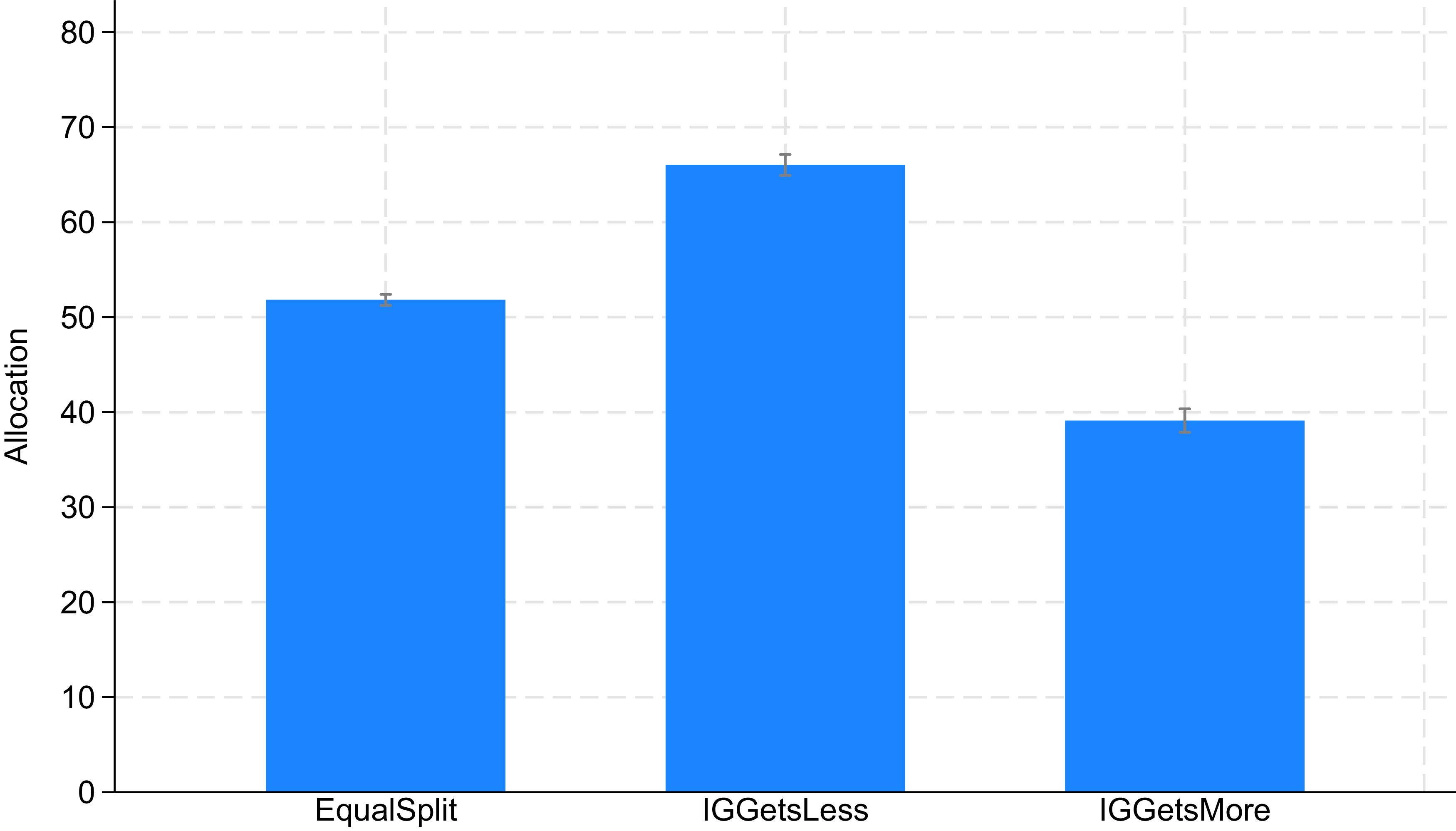
Figure 2 shows results for the three within-subject conditions. In the “EqualSplit” condition, subjects allocate 51.8 Tokens to their ingroup (and thus 48.2 Tokens to their outgroup), in the “IGGetsLess” condition, subjects allocate 66.0 Tokens to their ingroup (and thus 34.0 Tokens to their outgroup), and in the “IGGetsMore” condition, subjects allocate 39.1 Tokens to their ingroup (and thus 60.9 Tokens to their outgroup). Subjects’ allocations to their ingroup in the “EqualSplit” condition are significantly larger than the equal split of 50 (Difference = 1.8 Tokens, p < 0.001, two-tailed t-test). This aligns with general patterns of ingroup bias commonly found in the literature.
Subjects’ reactions to perceptions of unfairness are consistent with Hypothesis 1: Subjects in the “EqualSplit” condition choose a 50/50 split in 87.4% of the cases whereas subjects only choose a 50/50 split in 33.3% of the cases in the “IGGetsLess” condition and in 36.7% of the cases in the “IGGetsMore” condition. To test differences between conditions with regard to the shares of 50/50 splits, we coded a dummy variable for each condition that equals 1 if the subject chooses a 50/50 split in the respective condition and 0 otherwise. We find significant differences between the “EqualSplit” condition and the “IGGetsLess” condition (54.1 percentage points difference, one-tailed t-test, p < 0.001) and between the “EqualSplit” condition and the “IGGetsMore’ condition (50.7 percentage points difference, one-tailed t-test, p < 0.001).
The data also support hypothesis 2: Subjects allocate significantly more to their ingroup in the “IGGetsLess” condition than in the “EqualSplit” condition (Mean “IGGetsLess”=66.0 Tokens, Mean “EqualSplit”=51.8 Tokens, Difference = 14.2 Tokens, one-tailed t-test, p < 0.001).
Next, we compare the “IGGetsLess” and the “IGGetsMore” conditions in an exploratory manner. In both conditions, subjects reduce inequality (by allocating more than 50 Tokens to the disadvantaged group) but do not completely eliminate it, which would require allocating 80 Tokens to the disadvantaged group. However, subjects allocate more to their ingroup when it is disadvantaged (66.0 Tokens in the “IGGetsLess” condition) than to their outgroup when it is disadvantaged (60.9 Tokens in the “IGGetsMore” condition), thereby showing that they care more about compensating their ingroup than the outgroup for past inequality (Difference = 5.1 Tokens, p < 0.001, two-tailed t-test).
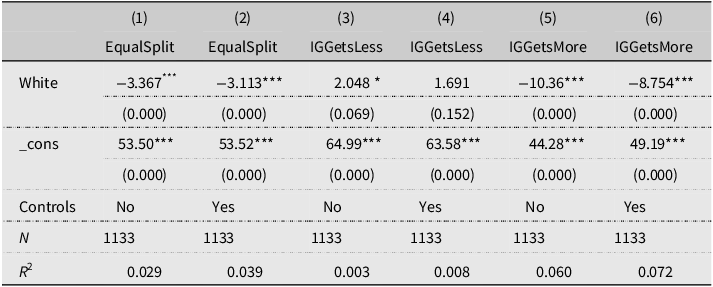
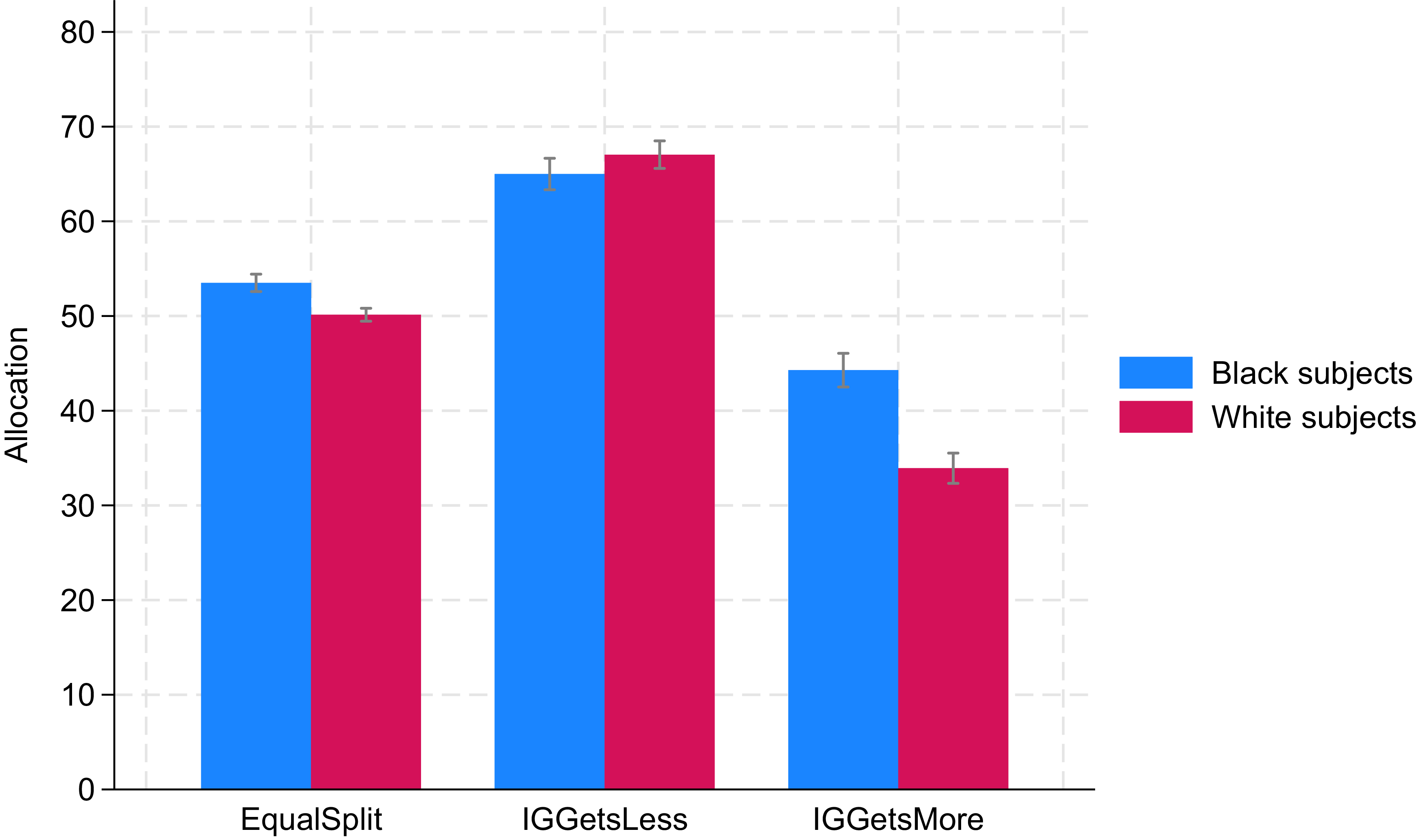
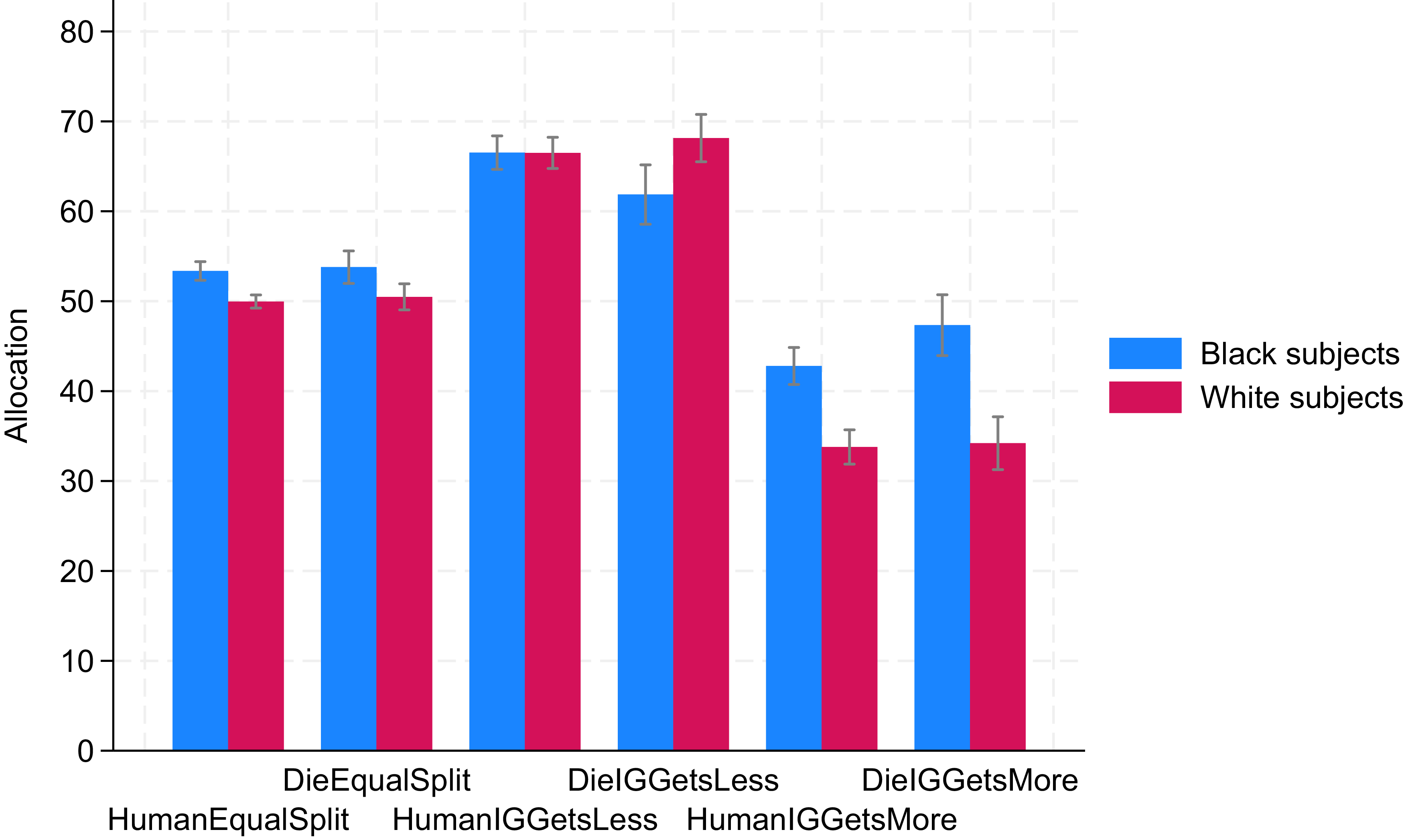
Figure 3 shows allocations by subjects’ racial identity, and Table 1 presents corresponding regression results. Black subjects display stronger ingroup favoritism than White subjects in the “EqualSplit” condition (Difference = 3.4 Tokens, p < 0.001, see Table 1) and, unexpectedly, also in the “IGGetsMore” condition (Difference = −10.4 Tokens, p < 0.001, see Table 1). The difference between Black and White subjects in the “IGGetsLess” condition is not significant (Difference = 2.0 Tokens, p = 0.069, see Table 1). It is surprising that minority subjects, who should be more sensitive to perceptions of inequality than majority subjects, do not react more strongly in the “IGGetsLess” condition. We explore this result further below, by disaggregating behavior when inequality is due to chance vs man-made (due to a human decider).
Effects of subjects’ race on allocations in favor of subjects’ ingroup

p-values in parentheses
* p < 0.1, ** p < 0.05, * * * p < 0.01
Notes: OLS regressions with robust standard errors. “White”: a binary indicator taking the value 1 (0) if the subject is White (Black). Control variables include age, education, and gender.
Allocations to subjects’ ingroup across within-subject conditions.

Allocations to subjects’ ingroup by race.

Allocation decisions for human decider vs die.

Figure 4 presents results on allocations in the “EqualSplit,” “IGGetsLess,” and “IGGetsMore” conditions for human deciders versus chance allocations sorted by subjects’ race. We hypothesized that subjects would allocate more to their ingroup in the “IGGetsLess” condition if the allocation was the result of deliberate action by a human decider rather than the result of chance (hypothesis 4). Man-made inequality is more likely to be perceived as group (identity) threat. We also hypothesized that this effect would be stronger for minority group subjects (hypothesis 5).
For the full sample, there is no significant difference between chance or man-made inequality in the “IGGetsLess” condition (Difference = 1.5 Tokens, p = 0.238, see Table B.6). However, there is a significant effect for Black subjects who allocate more to their ingroup in the IGGetsLess condition if the inequality was caused by a human decider rather than by chance (Difference = 4.7 Tokens, p = 0.016). There is no significant difference for White subjects (Difference = −1.5 Tokens, p = 0.307). The interaction between subjects’ race and the source of inequality is significant in the “IGGetsLess” condition (Interaction effect = −6.3 Tokens, p = 0.012, Table B.8), confirming that Black subjects react more strongly than White subjects to man-made inequality against their ingroup.
A natural follow-up question is whether subjects take into account the identity of the decider when they respond to unfairness toward their ingroup (see Figure B.1 for an overview). We explore this question in Tables B.9 and B.10 in the Appendix, which show allocation results across experimental conditions for outgroup deciders vs ingroup deciders, dropping cases where allocations are made by chance. We see no indication that the decider‘s identity matters for either Black or White subjects. The only (barely) statistically significant result occurs for White subjects who give more to their ingroup in the “IGGetsMore” condition when the initial allocation was made by a Black decider (versus a White decider; Difference = 3.8 Tokens, p = 0.049, see Table B.10).
Identity and fairness
How one should react when confronted with (past) inequality is not obvious. One could decide to treat everyone equally in the present, thereby leaving past inequality unaddressed, or to correct past inequality by treating groups unequally in the present to make up for the past. In exploratory (not pre-registered) analyses, we consider how concepts of fairness interact with racial identification in this context.
First, we distinguish five different ways subjects can respond to observing inequality in initial allocations (see allocation decisions analyzed in section “Allocation Decisions”):
-
1. Overcompensating (allocating more than 80 Tokens to the group that received 20 initially);
-
2. Fully compensating (allocating 80 Tokens to the disadvantaged group);
-
3. Partially compensating (allocating between 80 and 50 Tokens to the disadvantaged group);
-
4. Equal treatment (allocating 50 Tokens to the disadvantaged group); and
-
5. Exacerbating inequality (allocating less than 50 Tokens to the disadvantaged group)
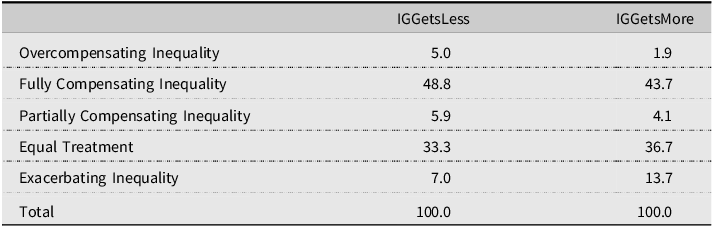
Table 2 shows the prevalence of these five behavioral responses in the “IGGetsLess” and “IGGetsMore” conditions.Footnote 8 For instance, the first row of Table 2 shows that 5.0% of the subjects overcompensate inequality in the “IGGetsLess” condition by allocating more than 80 Tokens to the disadvantaged group (the ingroup) whereas only 1.9% overcompensate in the “IGGetsMore” condition (when the outgroup is disadvantaged). We do not include the “EqualSplit” condition in this table because we are interested in competing fairness principles in response to observations of inequality.
Shares in percent of different types of behavior in the “IGGetsLess” and “IGGetsMore” conditions

Notes: The allocations to the group that received 20 Tokens in the initial allocation are as follows: Overcompensating inequality: More than 80 Tokens. Fully compensating inequality: 80 Tokens. Partially compensating inequality: Between 80 and 50 Tokens. Equal treatment: 50 Tokens. Exacerbating inequality: Less than 50 Tokens.
In the “IGGetsLess” condition compared to the “IGGetsMore” condition, subjects are more likely to overcompensate inequality (Difference = 3.1 percentage points, p < 0.001, two-tailed t-test);Footnote 9 more likely to fully compensate inequality (Difference = 5.1 percentage points, p < 0.001, two-tailed t-test); more likely to partially compensate inequality (Difference = 1.8 percentage points, p = 0.017, two-tailed t-test); less likely to choose an equal treatment (Difference = −3.7 percentage points, p = 0.001, two-tailed t-test); and less likely to exacerbate inequality (Difference = −6.7 percentage points, p = 0.001, two-tailed t-test). Table 2 distinguishes between these types of behavior in each condition.
Next, we distinguish between three types of subjects based on how they respond to inequality, drawing on information presented in 2. Subjects can be sorted into one of the following categories (reflecting different behavioral responses to inequality):
-
A. Normative switch in favor of the ingroup: Subjects who apply a fairness concept (as defined in Table 2) that is more beneficial to the disadvantaged group in the “IGGetsLess” condition than in the “IGGetsMore” condition (e.g., a subject who chooses “Fully Compensating Inequality” in the “IGGetsLess” condition but chooses “Equal Treatment” in the “IGGetsMore” condition.
-
B. Normative switch in favor of the outgroup: Subjects who apply a fairness concept that is less beneficial to the disadvantaged group in the “IGGetsLess” condition than in the “IGGetsMore” condition (e.g., a subject who chooses “Equal Treatment” in the “IGGetsLess” condition but chooses “Fully Compensating Inequality” in the “IGGetsMore” condition.
-
C. No normative switch: Subjects who apply the same fairness concept in the “IGGetsLess” condition and in the “IGGetsMore” condition (e.g., a subject who chooses “Equal Treatment” in both conditions).
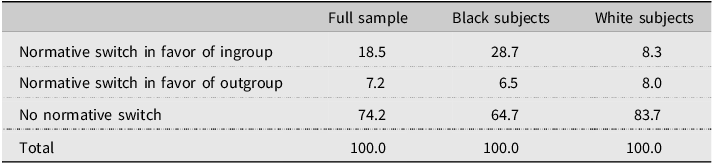
Table 3 presents the shares of subjects in each of these three categories in the full sample (Column 1), among Black subjects (Column 2), and among White subjects (Column 3). In the full sample, normative switching in favor of the ingroup is significantly more common than normative switching in favor of the outgroup (Difference = 11.3 percentage points, p < 0.001, two-tailed t-test).Footnote 10 This is driven by Black subjects (Difference = 22.2 percentage points, p < 0.001, two-tailed t-test); not White subjects (Difference = 0.3 percentage points, p = 0.835, two-tailed t-test). Moreover, normative switching in favor of the ingroup is significantly more common among Black subjects (Difference = 20.4 percentage points, p < 0.001, two-tailed two-sample Welch’s t-test). There is no significant difference in the likelihood of normative switching in favor of the outgroup between Black and White subjects (Difference = 1.5 percentage points, p = 0.355, two-tailed two-sample Welch’s t-test). Applying the same fairness concept in the “IGGetsLess” condition and the “IGGetsMore” condition is significantly less common among Black subjects than among White subjects (Difference = −19.0 percentage points, p < 0.001, two-tailed two-sample Welch’s t-test).
Shares of subjects in percent who switch between the five distinct responses to inequality in the “IGGetsLess” condition and the “IGGetsMore” condition

These patterns show that subjects switch between different concepts of fairness depending on whether their ingroup is advantaged or disadvantaged. This evidence is consistent with existing social identity literature, which shows that individuals adjust their normative principles depending on the identity of recipients in economic games (Eckel et al., Reference Eckel, Hoover, Krupka, Sinha and Wilson2023), often to favor their own group (e.g., Bicchieri et al., Reference Bicchieri, Dimant, Gächter and Nosenzo2022, Reference Bicchieri, Dimant and Sonderegger2023). Our results contribute to this body of knowledge by demonstrating that normative responses to inequality are fluid and can dynamically shift based on the relative position of one’s racial ingroup.
Next, we present correlational evidence on social norms and social identification, which we both measured post-treatment. With regard to norms, we measured personal normative beliefs about whether it is appropriate for Black or White individuals to allocate more money to their racial ingroup and found that subjects believe that it is less inappropriate (more appropriate) for Black individuals to do so than for White individuals. We also measured closeness to the “typical” White person and the “typical” Black person living in the US and found that the closeness gap between ingroup and outgroup members is larger for Black subjects than for White subjects. Both results are consistent with experimental behavior. Appendix C presents tests for these findings and elaborates further.
WTP
Next, we consider how individual material costs shape expressions of social preferences. Instrumentalist theories of identity expect expressions of group solidarity to be muted when they have material costs as this creates a trade-off between individual interest and group identity.
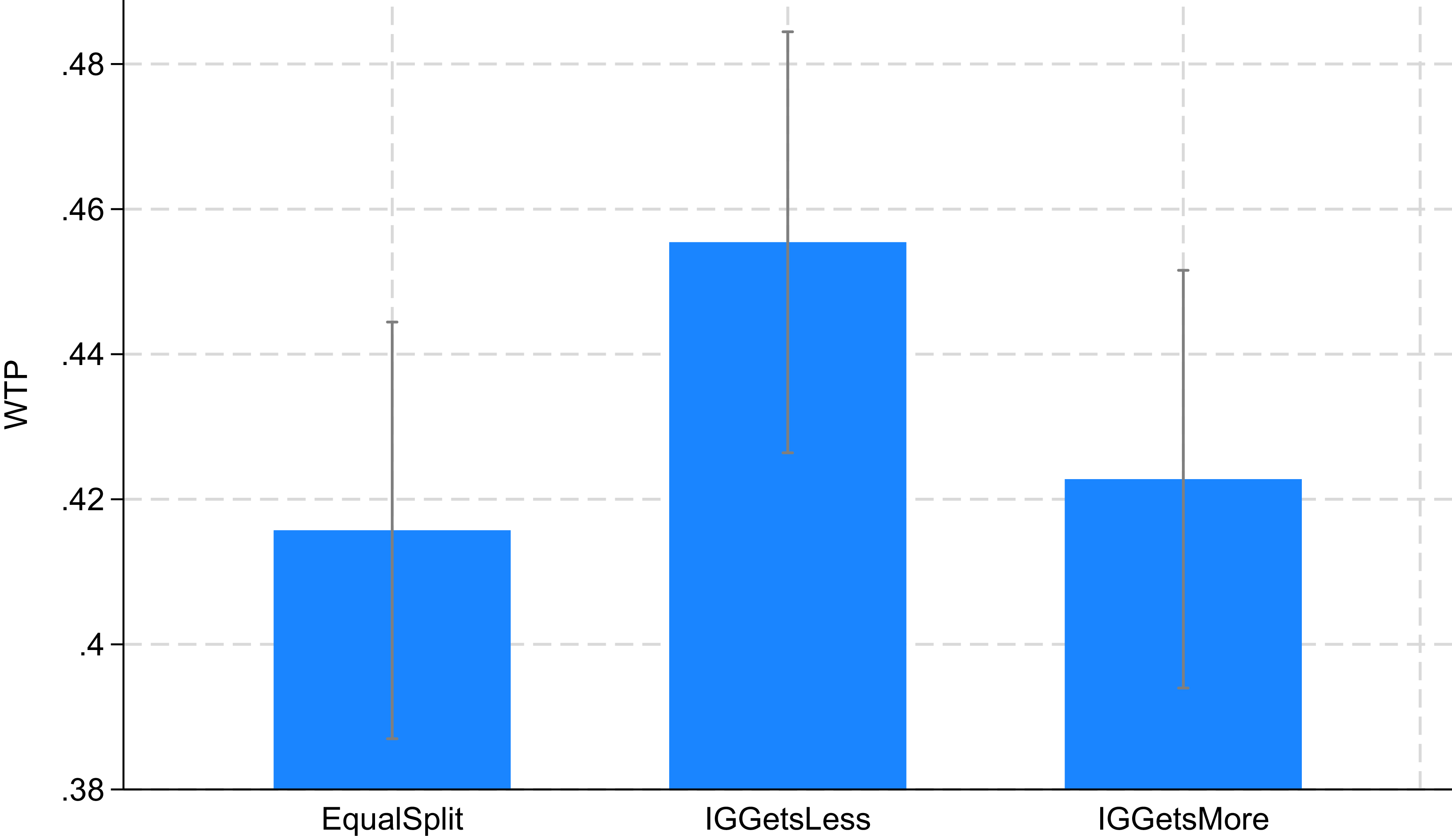
Figure 5 shows the share of subjects who were willing to pay 10 Tokens to implement their preferred allocation in the respective scenario: 41.6% in the “EqualSplit” condition, 44.5% in the “IGGetsLess” condition, and 42.3% in the “IGGetsMore” condition. The difference between the “IGGetsLess” and “EqualSplit” conditions is significant (Difference = 3.9 percentage points, p = 0.005; two-tailed t-test). Moreover, the share of subjects who are willing to pay their bonus is higher in the “IGGetsLess” condition than in the “IGGetsMore” condition (Difference = 3.3 percentage points, p = 0.005; two-tailed t-test). There is no significant difference between the “EqualSplit” and the “IGGetsMore” conditions (Difference = 0.007 percentage points, p = 0.600, two-tailed t-test).
Following Hypothesis 3, we expect that group solidarity to correct unequal treatment of the ingroup will be reduced when subjects must pay for fair allocations to be implemented. As stated in Figure 2, subjects allocate 66.0 Tokens in the “IGGetsLess” scenario. We compare these allocations to a new variable, “IGGetsLessCostly,” that captures the expected value of implemented allocations towards the ingroup in the “IGGetsLess” condition. The values of “IGGetsLessCostly” and “IGGetsLess” would be equal if subjects were willing to pay 10 Tokens to implement their favored allocation in the “IGGetsLess” condition and 50 Tokens (the expected value of the random determination of this allocation we announced in this case) otherwise. Expected implemented allocations to the ingroup are significantly smaller than favored allocations (Mean “IGGetsLess”=66.0 Tokens, Mean “IGGetsLessCostly”=57.6 Tokens, p < 0.001, one-tailed t-test), which supports hypothesis 3.
Share of subjects who were willing to pay their bonus to implement their favored allocation in all three scenarios.

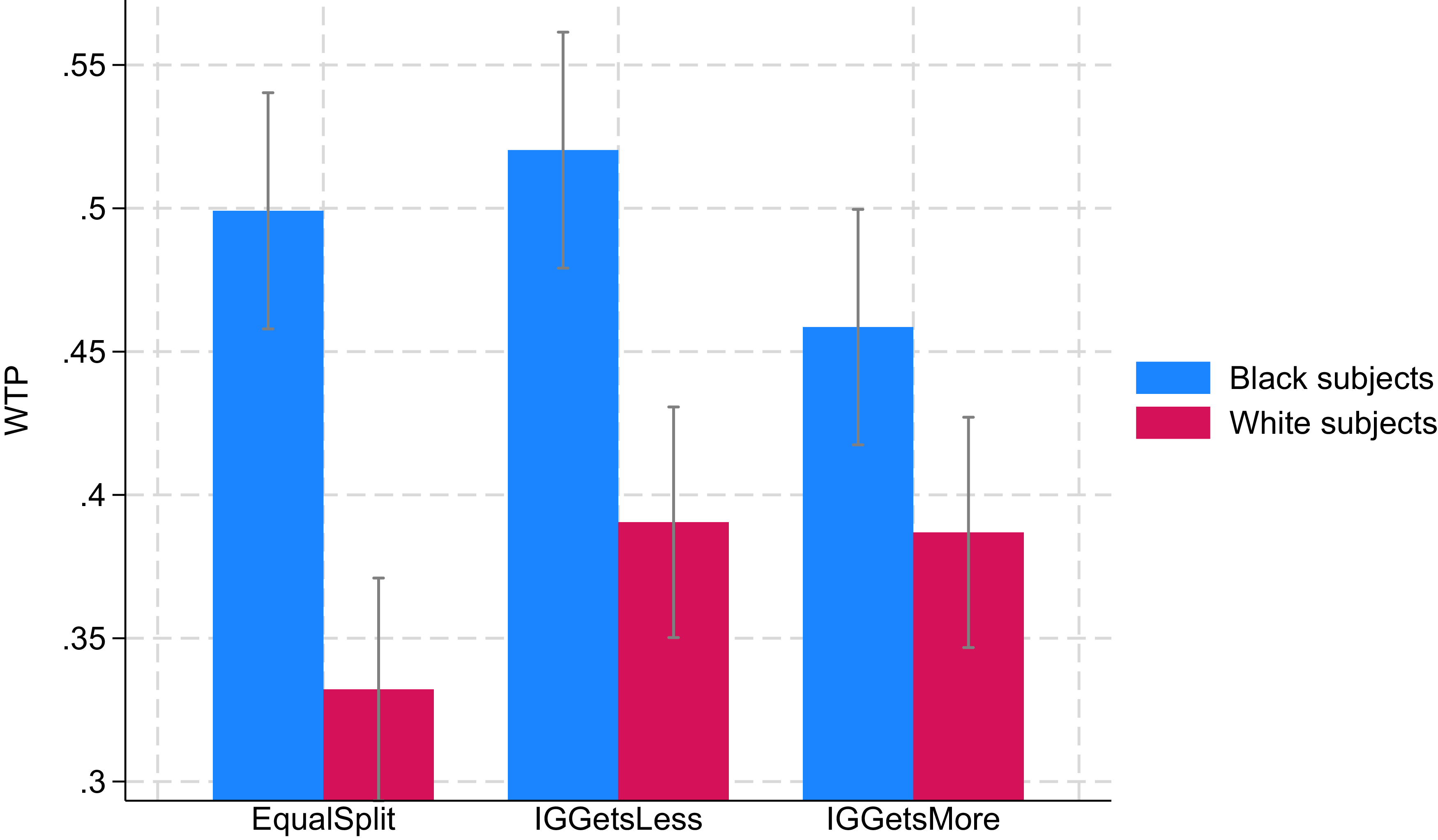
Next, we disaggregate results by respondent race in Figure 6. In each of the three scenarios, Black subjects are significantly more likely than White subjects to pay to implement their preferred allocations (see Table D.13). Table D.14 summarizes the joint distribution of allocations, WTP, and race for all three within-subject conditions. One interesting result that follows from this rich and multidimensional distribution is that 31.6% of all Black subjects compensate their ingroup in the “IGGetsLess” conditions (i.e., they pay at least 51 Tokens to their ingroup) and are willing to pay 10 Tokens to implement their favored split whereas this only holds for 23.7% of all White subjects (Difference = −7.9 percentage points, p = 0.003, see table D.15). To the extent that our WTP measure is a proxy for the “price of identity,” these results show that Black subjects care more strongly about their racial identity than White subjects.
The share of Black subjects who pay their bonuses to implement their favored allocation does not differ significantly between the “EqualSplit” and the “IGGetsLess” condition (Difference = 2.1 percentage points, p = 0.346, two-tailed t-test) whereas the share of White subjects who pay their bonuses is higher in the “IGGetsLess” condition than in the “EqualSplit” condition ((Difference = 5.8 percentage points, p < 0.001, two-tailed t-test). A possible interpretation is that Blacks’ group identity is already more salient than whites due to a history of greater exposure to discrimination as a racial group in the United States. By contrast, White’s group identity is more likely to be activated in the unusual case that their ingroup is disadvantaged.
WTP shares for each scenario by race.

Conclusion
Our experiment has explored decision-making in a setting where individuals react to observations of group inequality that can either privilege or penalize their racial ingroup vs the outgroup. We exposed subjects to examples of inequality that occurred randomly as the result of casting a die, and examples of inequality that were the result of a deliberate decision by another person, which we view as equivalent to exposure to taste-based discrimination. We found that, although subjects privilege their ingroup to some extent, this core distinction – whether inequality is “man-made” (hence potentially discriminatory) or a chance event – makes no difference to White majority subjects, while it matters for Black subjects who respond by giving more to their ingroup to offset “man-made” inequality. The fact that Whites see no difference between random vs deliberate acts of unfairness echoes group differences in perceptions of systemic racial bias in the United States today (Marshburn et al., Reference Marshburn, Reinkensmeyer and Knowles2023), and our study would suggest that Black Americans are more likely to correctly identify systemic (deliberate) bias when it exists.
Our study connects with a core debate in Comparative and American politics regarding the role of group identity in shaping behavior. Our design allows us to measure group identification as revealed by respondents’ actions to reverse group-based inequality when these actions are costly. Our results do not conform to instrumentalist theories of identity, as they show that members of the racial minority group identify more strongly with their group (according to our metric) and they are more willing to incur personal monetary costs to right a wrong against their group.
An unexpected finding is that Black subjects give significantly more than White subjects to their ingroup when prior allocations privilege their ingroup – effectively reifying that type of inequality. The racial gap in allocations to the ingroup is largest in this condition. This pattern is worth further exploration. Several different psychological or cognitive mechanisms could underlie this result – and different mechanisms might operate among members of the majority vs minority population. There may be group-based differences in the ease with which fairness norms are “bent” or violated when individuals find themselves in settings that result in group inequities that affirm group differences in internalized expectations about disadvantage. Members of a historically disadvantaged group that find themselves in the unusual situation of observing their group being privileged might not experience that situation as morally “wrong” or sufficiently wrong to overturn the ingroup bias that has been reified by collective memories of disadvantage. Precisely the opposite (e.g., feelings of guilt) might arise among some members of the majority, who might overcompensate the outgroup when their ingroup is advantaged. Experiences of inequality could trigger group-specific emotions that vary by group status and power.
One could read our results in Figure 4 as suggesting that Black subjects react significantly more strongly to inequality against their ingroup if it is man-made precisely because the group’s history justifies seeing bias when they experience unequal group allocations. It is equally interesting that Black subjects’ reactions – measured by their allocations to their ingroup – are more muted compared to Whites when they face “naturally occurring” (i.e., chance) inequities against their ingroup. One interpretation might be that norms of fairness dominate aversion to inequality. Another (related) possibility is that Black subjects may have internalized inequality due to their group’s prior exposure to unequal treatment in the United States – they have learned to expect it. By contrast, for Whites, any observation of inequality generates a stronger reaction as it appears incongruous with their lived experience and inconsistent with their internalized view of the social order. For the same reason, White majority status makes White respondents less attuned to human-made inequalities as an expression of bias; while it makes them more likely to perceive a need to restore the group hierarchy they have come to rely on.
For Black subjects who react more strongly to man-made inequality, whether such inequality is created by Whites or Blacks is less important than the fact of inequality itself. Further analyses of these patterns would be more meaningful in a framework that allows us to explore subjects’ interpretations of these situations: do minority subjects see their ingroup members who favor the outgroup as “sellouts”? Conversely, do majority group subjects react to observations of their ingroup members favoring the outgroup as “progressive” because they want to right past wrongs? These labels have context-specific meaning in American politics, where there is an ongoing debate regarding the proper measurement of racial bias (Huddy and Feldman, Reference Huddy and Feldman2009) and where racial resentment may have complex effects conditional on other factors, including partisanship (Feldman and Huddy, Reference Feldman and Huddy2005). Our experimental framework could be expanded to explore these ideas. Overall, our study finds that identities shape behavior and that group-based differences in the way people react to observations of social inequality may reflect majority vs minority group differences in the way that the social order is internalized.
Supplementary material
The supplementary material for this article can be found at https://doi.org/10.1017/XPS.2026.10028.
Data availability
The data, code, and any additional materials required to replicate all analyses in this article are available at the Journal of Experimental Political Science Dataverse within the Harvard Dataverse Network, at: https://doi.org/10.7910/DVN/JPJRCD. See Dimant et al. (Reference Dimant, Reinhardt and Sambanis2026).
Acknowledgements
For useful discussions and comments, we thank Daniel Hopkins, Gregory Huber, and Hakeem Jefferson. We acknowledge financial support from the Identity & Conflict Lab and the Cultural Evolution Working Group at the University of Pennsylvania. The study was pre-registered at AsPredicted.org (#115789: https://aspredicted.org/W5V_7KV).
Competing interests
We have no conflicts of interest to report for this research.
Ethics statement
This study was approved by the Institutional Review Board at the University of Pennsylvania (protocol number: 850822). This study adheres to APSA’s Principles and Guidance for Human Subjects Research. More information on the ethical practices related to this study can be found in the Online Appendix.



 Open access

