




In his 1909 preface to The Golden Bowl, Henry James famously decried the relationship between fictional text and image as insidiously competitive and worried that illustrations for his novels might constitute a kind of rival to his words. A writer, James frets in a rhetoric of exaggerated concern, especially as one who makes claims to be illustrative—“that is, producing the effect of illustration”—might find himself “elbowed” or usurped in an essentially “lawless” act.Footnote 1 Other theorists of the relationship between what James sees as two competing forms of illustration have agreed that, deliberately or not, writers and their illustrators have often had different agendas or, at the very least, different emphases. In his short, essayistic book Illustration, J. Hillis Miller proposes that text and image are indeed “two parallel, and to some degree incompatible, expressions.”Footnote 2 He offers an example from Hablot K. Browne’s illustrations of The Pickwick Papers (1836–37) in which he sees the illustrator “interfering” with the text by adding a supplement to it. By giving Samuel Pickwick a prominently rounded belly, Browne adds an allusion to the otherwise sexless Pickwick’s physicality and, indeed, to his masculinity. Miller can claim, then, that Browne “managed to get past Dickens’s censorship a meaning that exceeds, and even to some degree subverts, Dickens’s text.”Footnote 3
Miller offers this assertion with some tentativeness, however, and implies that defining the precise relationship between illustration and text remains a speculative venture. Victorian readers themselves often did not distinguish between the contributions of writer and illustrator, especially in retrospect. Ruskin, for example, elided author and illustrator when he alluded to Dickens as “a caricaturist, both in the studied development of his own manner, and that of his illustrative etchings.”Footnote 4 From the record of the Dickens–Browne relationship and the evidence that remains, it has proved difficult to say with any certainty which “author” was responsible for which aspects of the illustrations.Footnote 5
While we can’t account for the inspiration behind every illustration or pinpoint Browne’s significant departures from Dickens’s text, I will claim here that Browne’s images supplement the written word by suggestively mining veins in the texts and drawing out elements only obliquely present in the narrative. Not exactly rivals or competitors in the Jamesian sense, Dickens and Browne were not always telling an identical story. The latter’s illustrations offer not a counternarrative but a submerged one, especially in relation to controversial or taboo material. The text and plates work in unison to make manifest what might be present but only subtly telegraphed, and sometimes with great restraint, by Dickens’s words. In a line stretching from Dombey and Son (1846–48) and David Copperfield (1849–50) to Bleak House (1852–53), these collaborations of text and image cluster around themes of fallen sexuality, feminine transgression, and the problematic identity of woman as protagonist, narrator, and author. Here, Miller’s allusion to Dickens’s censorship and interpretation of Browne’s focus on Pickwick’s belly as a challenge to the suppressed element of his sexuality in the text seem relevant. At times Dickens himself takes advantage of iconographic traditions, relying on visual cues in the plates to suggest what his words cannot or will not otherwise convey. We might even conjecture that he was more than willing to support, perhaps even insist upon, what seems to Miller like Browne’s enhancement of a more reticent text. Browne’s pattern of distinct visual emphasis or supplement extended not merely to the representation of scandalous material and what we might call the woman question, but also, as we shall see, to the relationship between compromised female sexuality and the modern wastelands of their environment and, ultimately in Bleak House, to the complexities and contested gender of authorship. In this novel of 1852–53, after all, Dickens created a woman narrator for the first and only time, an endeavor inseparable from this work’s preoccupations with women’s virtues and transgressions, self-effacement and self-assertions, purity and corruption.
Dickens and Browne
Browne entered the scene after George Cruikshank had completed Sketches by Boz (1833–36) and Robert Seymour, commissioned to illustrate Pickwick, had died. Browne took over the Pickwick project and proceeded to illustrate ten of Dickens’s novels, among them the middle-period masterpieces Dombey, Copperfield, and Bleak House. Given the often very specific nature of Dickens’s instructions to Browne about what the illustrations were to contain and because Browne burned large numbers of Dickens’s letters when he moved house in 1846, it is hard to know what Browne invented, embellished, left out, changed, or added.Footnote 6 We do know that Dickens typically either read sections of his manuscript to Browne before the latter took pencil to paper or, failing that, conveyed a general account of the moment in the narrative he wished Browne to illustrate. We also know that Browne almost always sent pencil sketches to the author for approval before he engraved the plates.Footnote 7 Dickens seems to have had considerable control, and the fact of Browne’s relative youth—he was twenty-one and a relative unknown when he began to illustrate Pickwick—has led some to think that the fiercely ambitious and ascendant author was glad to have a more malleable partner than either Cruikshank or Seymour.
Many, however, have recognized the memorable force and enormous importance of Browne’s contributions and, despite general agreement on Dickens’s overall efforts at control, nonetheless attribute a measure of autonomy to the illustrator. He experimented with new techniques for producing certain kinds of plates—referred to as “dark plates”—and incorporated these striking and murky images into the novels progressively, most prominently and with greatest frequency in Bleak House. Engraving closely spaced lines into the steel plates used to produce his prints, Browne was able to create a shaded background that was often further elaborated by gradations of darkness, from gray to black.Footnote 8 The contrast in style between these plates and his more typical clean-lined, caricatural drawings is striking, as if two different hands were at work in a single volume. It is likely that the success of Browne’s early efforts with these plates convinced Dickens to sanction the inclusion of many of them in the second half of Bleak House, so that the illustrations were to some degree driving the author’s conception of the text. We also know that Browne didn’t always follow instructions precisely and that Dickens sometimes expressed displeasure as a result.Footnote 9
Mothers and Daughters
The title and subtitle of Dombey and Son announce the novel as the chronicle of a proud man, his sickly male heir, and a family business, but Browne’s illustrations help Dickens to tell and elaborate other stories. Prominent among these is a story of mothers and daughters and of the analogous relationship between the respectable realm of bourgeois marriage and the underworld of sexual sin and the trade in women’s bodies. Further, the illustrations and text together suggest a connection with even wider implications, between two forms of the “perversion of nature”: moral defilement—the buying and selling of women, the abuse of children, and sins of greed—and the physical pollution and blighting of modern life.Footnote 10 It is not that the novel itself hides these themes—indeed, it makes them central—but rather that its language is allusive yet reticent and abstract and that its illustrations draw out and emphasize what the written narrative suggests.
As Mr. Dombey searches for a second wife, his courtship is aided by the pandering Joey Bagstock and his ally, Mrs. Skewton (herself a perversion of nature), the mother who will happily sell off her widowed daughter, Edith, to the highest bidder. In Browne’s “Mr. Dombey introduces his daughter Florence” (#9), which at first glance appears to be a conventional drawing-room meeting between Florence and her stepmother-to-be and that woman’s mother, Mrs. Skewton eyes Dombey’s daughter “through her glass” with corrupt intent, tilting her head to one side to size up the child and “picturing to herself” what Florence might become under her tutelage (Dombey, 431).Footnote 11 The reader can guess what this leering means by piecing it together with Edith Carker’s words to her mother in the previous chapter as she recounts being married off for the first time and thereafter “made the bye-word of all kinds of men,” “hawked and vended here and there” (Dombey, 417–18). That Mrs. Skewton’s designs on Florence are in no way innocent is then borne out a few chapters later when the matron tries to claim possession of the child and make her into a replica of Edith, ripe for the marriage market, or what we might more explicitly call the traffic in women. Ordering Mrs. Skewton to return the girl at once, Edith declares, “I will have no guileless nature undermined, corrupted, and perverted, to amuse the leisure of a world of mothers” (Dombey, 459; emphasis added). She knows her mother to be a bawd—it is not just for her amusement but also for her purse that she seeks to prostitute both her daughter and her step-granddaughter.
Mrs. Skewton’s interest in the Dombey daughter differs not at all from her intentions for her own, nor is it different from “Good” Mrs. Brown’s treatment of her daughter, the convict Alice, and, as we know from chapter 6, Mrs. Brown’s similar threat to Florence. It is these two sets of mothers and daughters, doubles of one another and related through now-dead fathers and a common male predator, Carker, that establish through text and image the novel’s dominant and yet understated theme of exploitative sex and cross-class patterns of prostitution. When Mrs. Brown kidnaps Florence early in the novel, snatching her in Stagg’s Gardens and taking her through a degraded environment of “brick-fields and tile-yards” to a hovel surrounded by mud and cinders, she strips the child, replaces her clothes with rags, and threatens to cut her hair in a gesture of metaphorical defloration (Dombey, 77). She menaces Florence to exact revenge on Dombey, Carker’s employer, but also to suggest that she could “ruin” Florence as Alice had been ruined and to shape her at will. Mrs. Brown could, in other words, do what Mrs. Skewton prepares to do: groom Florence for the marketplace or the street.
A number of Browne’s illustrations underscore these parallels between the two sets of mothers and daughters, one prosperous and respectable, the other debased and criminal, and to remind the reader of the latter’s continuing, ominous presence in Dombey’s life. In “Coming Home from Church” (#10), which features the wedding procession of Dombey and Edith in the midst of a crowded urban scene, Mrs. Brown sits to the right of the archway through which the newlywed couple and their party are about to walk (fig. 1).Footnote 12 She scowls at the bride and groom, cursing them with her glance. Crouching gnomelike among a sea of standing figures, she draws the reader’s eye by virtue of her stature, raggedy garments, and gleeful expression that suggests she anticipates the catastrophic nature of the marriage, the undoing of which she hopes to have a hand in. “Why does Florence,” the text asks of this moment, “think, with a tremble, of her childhood, when she was lost, and of the visage of Good Mrs. Brown?” (Dombey, 473). Browne’s illustration gives us one answer, that the witchlike Brown is present, unbeknownst to Florence, and thereby makes visible what the text intends to leave obscure: the connection between one kind of union and another. Florence’s trembling registers not just the memory of the kidnapping but, we imagine, her barely conscious understanding of Mrs. Brown’s predatory intentions.
“Coming Home from Church,” Dombey and Son, chapter 31 (part #10), July 1847.

Among many other figures and vehicles in this panoramic postwedding scene is a hearse driving toward the rightmost edge of the illustration, almost fading from view. We know the carriage contains a coffin because we see the funeral garb and scarf-draped top hats of the drivers and the men who walk alongside. The hearse’s twin vehicle is a grand carriage holding wedding guests in the picture’s center, with a set of coachmen whose elaborate headgear is mirrored in the mourning hats of the other set of drivers. The illustration thus yokes marriage and death, perhaps reminding us of the death of the first Mrs. Dombey in the early pages of the novel, perhaps injecting a note of doom into the celebration of the current union, and even, as J. R. Harvey suggests, invoking Blake’s “London” poem with its specter of the “marriage hearse” and reminder of the incursion of sexually transmitted disease (the “Harlot’s curse”) into the precincts of the respectably married.Footnote 13 The invisible and unacknowledged link between classes that Blake’s poem exposes is embodied in the doubling of Dickens’s mother-daughter pairs, while the conjoining of high and low figures and circumstances appears, as we know, as a repeated motif in Dickens’s fiction. Here, in Dombey, the particular link is fallen female sexuality and, beyond that, the willingness of women of all ranks to sell—or sell out—their female young.
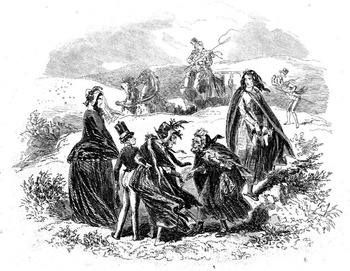
“A Chance Meeting” (#14), an illustration that accompanies the material of chapter 40, “Domestic Relations,” features the two pairs of women posed as mirror images of one another on a barren stretch of land and emphasizes the bond between the two pandering mothers (fig. 2). At the center of the image are the two shrunken women, each with an elongated, witchlike face, in one case surrounded by a feather-draped bonnet and in the other by a poor woman’s cap. They face each other as if staring at their reflections in a glass. The two daughters stand at either side, aloof, staring at each other from a distance throughout the encounter. The wind on the downs blows Alice’s hair, Edith’s veil, and the two mothers’ clothing in the same direction; they are a foursome moving in unison. The accompanying text describes Mrs. Brown and Alice as “an exaggerated imitation” of Mrs. Skewton and Edith, and Edith sees Mrs. Brown as a “distorted shadow of her mother” (Dombey, 609). Notably, Alice’s words imply a rebuke of her mother—“I sold myself long ago”—and Mrs. Skewton tries to defend Mrs. Brown repeatedly in response and to silence her own daughter, whom she anticipates will take Alice’s side. The two mothers seem to understand each other instinctively. “I am sure this is an excellent woman, and a good mother,” Mrs. Skewton lashes out at Edith; and Mrs. Brown returns the compliment (“a good mother yourself”) as she tries to beg a few pence from her twin (Dombey, 609–10). For the two mothers, to defend the other is to defend themselves. The daughters don’t speak to each other until Edith has begun to walk on, at which point Alice, her “shadow,” mutters that good looks and pride will save neither of them.
“A Chance Meeting,” Dombey and Son, chapter 40 (part #14), November 1847.

The final plate of Mrs. Brown and Alice, “Abstraction and Recognition” (#15), features the two of them in a doorway watching Carker ride by on a horse with Rob the Grinder, damaged and twisted son of the wet nurse Polly Toodles, following behind. Mrs. Brown is fully bent over, leaning on a cane, and looking like any wizened, threatening hag in a fairy tale.Footnote 14 Alice stands draped in shawls next to her, hand covering her mouth and staring at Carker as he passes. On a wall in the space between them hang several fraying posters, the words of which allude to the sordid circumstances of the Brown–Skewton–Dombey–Carker web of relations.Footnote 15 Browne, like other illustrators and painters of the period, used emblematic background details like these to trigger associations that would make explicit certain elided or mitigated elements. These allusions via images within images save the writer, or the artist, from needing to fully spell out the terms of the narrative. Michael Steig singles out one poster in this plate as especially meaningful: an advertisement for a production of Philip Massinger’s Jacobean drama, The City Madam, which had appeared on the London stage in 1844. The poster suggests a source for Dickens’s novel and emphasizes points of similarity—a man in want of a male heir, a marriage that involves deceit, a contentious relationship between a pandering mother and her prostituted daughter—that bring into relief some of the seamier aspects of Dombey.Footnote 16 As Carker rides by, his mind rests on Alice’s double, Edith, with whom he is about to run off, and conjures sadomasochistic fantasies of their relationship: the “mystery” of the self-inflicted injury her gloved hand conceals, the image of her “fallen and in the dust” among his horses’ feet (Dombey, 681–82). Carker passes by Alice but sees Edith in his mind’s eye.
In “The Thunderbolt,” the very next chapter of the novel, Edith announces she will leave Dombey and begs the innocent Florence to shun her, a tainted soul and body. Mr. Dombey strikes his daughter in a rage but not before Dickens injects a lengthy and highly allusive narrator’s meditation on the unnaturalness of humankind. In this sweeping, sermonlike passage, in which the specifics of the novel’s plot and characters are elided, the narrator rails against the moral and physical pestilences that plague society. Immoral relations, blighted youth, the starving poor, polluted air, and a sickened race collude to produce an “unnatural humanity.” “Where we generate disease to strike our children down and entail itself on unborn generations,” we read, “there we also breed, by the same certain process, infancy that knows no innocence, youth without modesty or shame, maturity that is mature in nothing but in suffering and guilt, blasted old age that is a scandal on the form we bear” (Dombey, 684–85). The novel’s critique of the greed and brutality of Dombey, the unscrupulousness and predatory sexuality of Carker, and, perhaps most perverse of all, the exploitative selfishness of mothers culminates in the rhetoric and vision of this meditation. The Blakean note of Browne’s wedding procession is here echoed in the language of blighting and blasting and in the idea of generations passing down, unbeknownst to them, the moral and physical deformities produced by personal and social crimes. The urban wasteland evoked here—“our wicked cities” and their “vitiated air”—recalls the brickfields and tile yards that surround Mrs. Brown’s hovel, and a reference to the “convict-ships” that “swim deep” conjure Alice’s deportation to Australia in the past. Physical and moral sin cannot be separated, nor can individual transgression and social corruption.
Mother and Son
David Copperfield sustains the pattern established in Dombey of a subnarrative of female sexuality and contagion. Though not as significant as the thread of images around the multigenerational doublings in the novel that precedes it, Copperfield deploys illustration to trace the story of Little Em’ly’s seduction and disgrace, the pandering of Miss Mowcher (shades of Mrs. Skewton), and the ominous fall of Martha, a double for Em’ly.Footnote 17 Without heavy-handed textual signaling that Martha might be a prefiguration of Em’ly, Browne’s illustrations communicate the parallels clearly, especially in “Martha” (#8), in which David, Ham, and Peggotty encounter the young woman in her rooms, and “Mr. Peggotty’s Dream Comes True” (#16), in which, after much searching, Mr. Peggotty finds his niece. In each illustration the face of the ruined woman—Martha’s in the first instance and Em’ly’s in the second—is obscured, turned away from the viewer, hands hiding her face in a gesture of shame. No facial features are visible, and the two women are indistinguishable. Martha is a peripheral character and, unlike Edith, Alice, and their mothers, serves no function in the novel’s plot. Acting as a focal point and symbol for the ruined-woman theme, her sole raison d’être seems to be to absorb and then represent all of the darker meanings associated with Em’ly’s fall. As if to mark her symbolic significance and emphasize the narrative of self-destruction associated with the ruined woman, Browne made “The River” (#16), his most striking image of Martha, a dark plate—the only one in Copperfield.
Browne’s first dark plate for Dickens appeared in part #18 of Dombey and Son.Footnote 18 “On the Dark Road” shows a fleeing Carker, his cape billowing out as he strains to look behind him from his open carriage to see if anyone follows. The dark effects of this technique correspond to the nighttime flight and atmosphere of villainy surrounding Carker. As in his description of Mrs. Brown’s surroundings, Dickens conjures a demonic “black landscape,” with dust and dirt flying about, and Browne supplies the visual analogue for the novel’s words (Dombey, 812). “The River” in Copperfield gives us a panoramic view of London from the Thames with a despondent Martha, apparently about to throw herself into the river in the foreground (fig. 3). Browne uses a rare horizontal format, as he had done in Dombey’s “Coming from Church,” thereby allowing for a wide, sweeping view of the city that places Martha within the environment of both a remote urban backdrop and a riverside wasteland. The dome of St. Paul’s presides from afar, suggesting the inadequacy and indifference of what Thomas Hood ironically calls “Christian charity” in his influential fallen-woman poem, “The Bridge of Sighs” (1844).Footnote 19 Dickens and Browne elaborated on the current mythology that associated fallen women with suicide and death by drowning in the Thames. Hood’s poem launched this popular motif, and paintings by G. F. Watts and Augustus Egg further developed the iconography.Footnote 20 Visual artists depicted female outcasts contemplating suicide by water’s edge, standing high up on a bridge over the river (Doré) or as a corpse dredged up on the riverbank (Watts).
“The River,” David Copperfield, chapter 47 (part #16), August 1850.

What Browne adds to this evolving visual and literary motif is the detritus arrayed at Martha’s feet in the illustration. Dickens’s text gives us this cue:
In one part, carcases of houses, inauspiciously begun and never finished, rotted away…. [R]usty iron monsters of steam-boilers, wheels, cranks, pipes, furnaces, paddles, anchors, diving-bells, windmill-sails … had the appearance of vainly trying to hide themselves. Slimy gaps and causeways, winding among old wooden piles, with a sickly substance clinging to the latter, like green hair, and the rags of last year’s handbills offering rewards for drowned men fluttering above the high-water mark, led down through the ooze and slush to the ebb tide. There was a story that one of the pits dug for the dead in the time of the Great Plague was hereabout; and a blighting influence seemed to have proceeded from it over the whole place.Footnote 21
This is the Dickensian note. As in the panorama Browne creates, the scope of the description is wide and yokes together fallen sexuality, urban blight, hidden disease, and refuse of all kinds. Contaminated ooze and rusting metal comingle, bringing into proximity the primordial and the modern. The setting and very conditions for the suicidal woman (is the reference to “drowned men” a pointed one?) consist of a corrupt society and decaying environment—twisted social relations and a barren, rubbish-laden cityscape. Dickens and Browne hint at these associations in Dombey in the surroundings of Mrs. Brown’s hovel and here, in Copperfield, and extend them further in Bleak House, as we shall see.Footnote 22 Browne’s dark plates increasingly go beyond figuration and literal representation to a level of generalizing, metaphor, and social critique that is signaled in Dickens’s allegorical prose.
Browne’s extraordinary contribution in David Copperfield includes a seldom-remarked early illustration, “Changes at Home” (# 3; fig. 4). David, his mother now married to Mr. Murdstone, has returned home on holiday from Mr. Creakle’s London school to discover his mother holding a small creature that is both a double of himself and a usurper. At first, he hears his mother singing from the hall, remembers himself as a babe in arms, and believes that she is alone, waiting for him. Entering the parlor where she sits, he discovers that this is not precisely the case. Dickens’s text reads: “She was sitting by the fire, suckling an infant, whose tiny hand she held against her neck. Her eyes were looking down upon its face, and she sat singing to it. I was so far right, that she had no other companions” (Copperfield, 104). Browne’s accompanying illustration, “Changes at Home,” proves true to Dickens’s text but only by making explicit what the author’s words imply. We see Clara Copperfield, her right breast exposed, nursing the baby and holding its hand to her bosom, not to her “neck,” a euphemism for the body part Dickens declines to name in his text.
“Changes at Home,” David Copperfield, chapter 8 (part #3), July 1849.

To the best of my knowledge, this is the only visual image of its kind in Dickens’s work.Footnote 23 It makes graphic and thus more explicit the suckling that is there in the prose and exposes a part of Clara Copperfield’s body that then becomes grist for the illustrator’s mill. As if to underscore the maternal, nurturing function of Clara’s breast, Browne has placed a large oval painting on the wall above Clara’s head that shows an elaborately dressed woman with a risqué eighteenth-century look, her neck circled by a dark ribbon and very visible—and sexualized—bosom pressed up into two half-moons by a stomacher or corset. A beauty mark appears to adorn her cheek. The portrait works in opposing ways: it both offers a contrast to the chaste bosom of David’s mother and hints at a submerged connection between the sexuality of the two women. They are different but alike. The uncomfortable mysteries—to the child David—of his mother’s union with Murdstone and, now, of its reproductive result suggest the pitfalls of adult sexuality. These will later be borne out by David’s failed first marriage, Steerforth’s predatory treatment of Em’ly, and the latter’s subsequent disgrace. And in a less explicit way, they will be manifested very shortly in the novel in Clara Copperfield’s postpartum death and the death of her baby, “the little creature in her arms, [who was] myself, as I had once been” (Copperfield, 127). Browne’s image concentrates and elaborates on David’s oedipal longing for his mother—he is relieved to know that Murdstone is absent from this scene—and on his complicated identification with his new brother. The new baby is a version of himself who nonetheless replaces him. The image also allows Clara Copperfield to remain both chaste and sexually compromised.
Mother and Daughter Redux
The single dark plates of Dombey and Copperfield offer only a hint of the force and brilliance of Browne’s subsequent achievement in Bleak House. The collaboration between Dickens and Browne in this novel yielded an extraordinary work, in which the dominant atmosphere of obscurity and impenetrability established by the opening paragraphs of the novel are matched by ten haunting dark plates.Footnote 24 The mud, fog, and gas that cover London and its environs, themselves metaphors for the opacity of institutions and mysteries of lineage, find their way into the murkiness of a number of illustrations throughout the novel. As many have observed, these images of mainly outdoor spaces—the pauper’s graveyard, Tom-all-Alone’s, the ghost’s walk—are largely empty of people. If figures appear at all in the novel’s dark plates, their faces are not illuminated, as Carker’s is in Dombey, but rather are indecipherable or hidden altogether. Neither is the dark appearance of these plates used to connote the villainy of one individual: it signals instead an entire society void of moral clarity as well as universal problems of vision, blindness, and obscured identity.Footnote 25
The subnarratives of sexual fall and doubling women we have seen in text and image in Dombey and Copperfield reappear here, often against a backdrop of urban decay, but in Bleak House these narratives are extended to encompass what the novel sees as the puzzle of woman’s very identity and the always deferred possibility of knowing woman in a disorienting and deceptive world.Footnote 26 Over fifty years ago, Ellen Moers identified Bleak House as Dickens’s “woman question” novel, the work in which “women’s issues seem … to be treated … as a major social theme, rather than as a diversion.”Footnote 27 Women in this novel are on the move, campaign for their own rights and those of benighted peoples far from England, drive the plot, represent heroic and unblemished virtue, murder, hide their sexual pasts to marry well, investigate, and narrate. Just as in Dombey, Dickens’s misogyny is on display alongside his adulation for the chaste woman. Here, women activists are the objects of dismissive satire—as in the earlier novel, they are agents of corruption, threatening the virtue of their own daughters. In Bleak House, however, the general unknowability of women is linked not only to the mystery of Esther Summerson’s origins but also to her authorial role. As the only female narrator Dickens ever launched into the world of fiction, Esther’s identity challenges our understanding of her relationship to the narrator with whom she shares the text and, beyond that, to their creator, Dickens.
Moers comments on Dickens’s acute awareness of the rise of women novelists around him—Stowe in the U.S., Sand in France, Gaskell and the Brontës in England, to name only the most obvious—and speculates that Esther Summerson might have been conceived “in a spirit of rivalry” with Charlotte Brontë’s Jane Eyre.Footnote 28 Sandwiched chronologically between the orphans Jane and Lucy Snowe, orphaned Esther almost certainly revised Jane and inspired aspects of Lucy.Footnote 29 In Bleak House, Dickens seems to be anxious to establish that he can do, if only once, what Brontë had so brilliantly done in her first published novel and had repeated at the beginning of 1853 with her last: write in a fictional woman’s voice. When the intensity and metaphoric power of Browne’s dark plates reach their height late in the novel in the hunt for Lady Dedlock, Esther takes center stage as author, teller of her own tale, and potential rival to her textual partner, the omniscient narrator.
Seeing is difficult in Bleak House and eyes are at risk. Its first paragraphs powerfully convey just how hard it is to make things out through the obscuring elements: dogs are “undistinguishable,” it’s hard to know if day ever broke, and fog dims the vision to such a degree that the difference between sky and water, up and down, is hard to discern. At sodden Chesney World, where it rains incessantly, the housekeeper Mrs. Rouncewell had “several times taken off her spectacles and cleaned them, to make certain that the drops were not upon the glasses” (BH, 97). The houses in Tom-all-Alone’s are “blind,” with their “eyes stoned out,” and the slum itself is sewerlike and murky—“undrained, unventilated, deep in black mud and corrupt water” (BH, 330). Jo the crossing sweep works to clear the streets of mud and dung, part of a Sisyphean labor to reach clarity of vision and understanding. Illiterate and generally befuddled by what he sees, Jo is rendered “stone blind and dumb,” in “utter darkness” about the meaning of the signs he sees hanging over shops (BH, 236). Later he will strive to remain invisible himself by crouching close to soiled city walls. Just before she falls ill, Esther looks out searchingly over the dim wasteland of London; as the fever takes effect, this inability to see, induced by darkness, enters into her body and begins to originate from within. Eyes reflect the sufferings of other characters as well. Jenny’s eye has been blackened by her husband, and Caddy Jellyby’s baby, perhaps inheriting the acquired characteristics of her mother, has “curious little dark marks under its eyes” (BH, 710). The elements are blinding, institutions are impenetrable, and corrupt human relations lead to disabled sight.Footnote 30
The wasteland terrain of Bleak House, reminiscent of the barren landscape that surrounds Mrs. Brown in Dombey and Martha in David Copperfield, suggests a modern civilization that is already disintegrating and falling back into a primitive state of decay. The rags, bones, and bottles that fill Krook’s shop seem to spill out onto various of the novel’s topographies. The environs of the brickmaker’s home in St. Albans combines aspects of a junkyard and a terrain barely recovered from the biblical flood. The ground that Tulkinghorn traverses between Chesney Wold and his rooms in London is a sterile deathscape, where the noxious lawyer ceases to be human and living creatures are transformed into inanimate objects. A bird of prey, a desiccated soul who eschews human relationship, Tulkinghorn moves along a landscape of obscurity and decomposition.
Browne’s illustrations, especially the dark plates, accentuate and deepen these motifs of impenetrability and decay. Most emblematic and most remarked upon is the plate of Tom-all-Alone’s, the slum property “in Chancery” where Jo lives and fever breeds, that accompanied part #14 and referred to textual material in chapter 46. Death haunts the entire image, from the headstones in the graveyard at the back of the illustration to the gallowslike wooden posts that frame and hold up the slum buildings to the disease-bearing rodent that scurries toward us in the foreground. It is worth noting that the illustration of Tom-all-Alone’s appears some thirty chapters after it has first been described in the chapter that bears its name, chapter 16. One possible explanation for this separation of plate from the textual introduction of its subject seems to be that as Dickens warmed to the idea of the dark plates, Browne was given license to include nine of them in the second half of the novel, as opposed to only one, “Consecrated Ground,” in the first (#5). But there are other reasons as well. The brief chapter, titled “Stop Him!”, that accompanies Browne’s illustration establishes that the fever emanating from Tom-all-Alone’s and the pauper’s graveyard adjacent to it are likely the breeding ground of Jenny’s, Jo’s, and then Esther’s illnesses, that Nemo’s corpse in the graveyard may well have been the precise source, and that thereby, as the chapter’s third paragraph tells us, Tom “has his revenge” (BH, 655).
This chapter, with its Carlylean echoes of the “Thunderbolt” chapter of Dombey, steps back from the characters in question—as it nonetheless personifies the slum as “Tom”—and evokes a circuit of corruption and contamination that travels from low to high. The slum of Tom-all-Alone’s infects the quarters of the respectable classes and will ultimately bring down the house of Dedlock. “There is not an atom of Tom’s slime,” intones the narrator, “not a cubic inch of any pestilential gas in which he lives, not one obscenity or degradation about him, not an ignorance, not a wickedness, not a brutality of his committing, but shall work its retribution through every order of society” (BH, 654). Browne’s illustration of Tom-all-Alone’s matches the apocalyptic prophesy we see in Dickens’s prose: through the dim, ominous, and unpeopled image of the slum, author and illustrator signal its power to wreak havoc far beyond its dilapidated boundaries.
The passage also implicates defiled female sexuality as the conduit for invading and destroying upper-class family life. The focus of this blighted femininity in the novel is, of course, Lady Dedlock and her illegitimate daughter, as it was Mrs. Skewton and Edith and their doubles, Mrs. Brown and Alice, in Dombey. In Copperfield, there is no direct threat to the upper classes, and indeed an ostensibly respectable upper-class man, Steerforth, has been responsible for ruining Em’ly. Yet the association between Em’ly and Martha, with her connection to the riverbank wasteland and iconography of self-destruction, is echoed in Bleak House in the many images of a decaying landscape and in the fear that Lady Dedlock, like Martha, will be a suicide. Disease, whether the unidentified fever that fells Jo and Esther, the “tainted blood” (a likely allusion to venereal disease) that infects the “choice stream,” or Esther’s inheritance of sexual sin from her mother, functions in Bleak House as a mode of connection, represented in a network of linked and easily replicable women’s bodies.
The general murkiness of the atmosphere and problems of vision can be said to coalesce around this problem of who and what women are—their literal unrecognizability and the problem, both actual and metaphorical, of mistaking one for another. The obscuring, disguising, and veiling of female identity points both to the novel’s apparent fear that women, or at the very least their bodies, are on some level interchangeable—a Tulkinghornian perspective without the sadistic edge—and to the fundamental problem of the identity of one of the novel’s narrator’s, Esther. Though, through Guppy, the reader figures out quickly whose daughter she really is, Esther herself is kept in the dark for more than half the novel. She enters the novel as a reluctant narrator and an unwilling subject of her own story. Claiming it preposterous that the tale she narrates will be her own, she tries to reassure us that she’ll shortly weasel out of the lead role and disappear.
Invisibility and self-erasure run through the narrative and, as we shall see, through Browne’s illustrations. Esther’s very name communicates not just a confusion of identity but a vacant or absent one. Though a nameless, illegitimate child, she nevertheless possesses a multitude of names: Esther Hawdon, after her father; Esther Barbary, after her mother’s maiden name; Esther Summerson, a wholly invented name (an “assumed” name, Mr. Jarndyce tells her); and the nicknames she’s given at Bleak House, including Dame Durden, Little Old Woman, and Mother Hubbard. In her fever-induced delirium, she struggles to integrate the different phases of her life and the different parts of her—child, girl, woman—into a coherent whole. As her many names suggest, hers is a fractured and uncertain identity, her parentage, class position, and marital future all unknown. Her parents’ names are also obscured. Lady Dedlock’s surname, Honoria, barely appears in the narrative. Captain Hawdon is disguised behind an alias, Nemo, or “no one,” that evacuates the copyist’s identity almost completely. It also replicates, as many have noticed, the original pseudonym of Hablot Browne, who used Nemo before settling on Phiz, probably to make a better-sounding pairing with Boz and a telling reference to physiognomy, his métier.Footnote 31 The narrator of one half of Bleak House, like the two men who ventriloquize her in prose and portray her in illustration, goes by an invented name.
Dark Journey, Dark Plates
Many have attributed the obfuscation of Esther’s appearance and its transformation by her illness to the novel’s need to keep hidden the link between Esther and her mother. The key to their resemblance—the portrait of Lady Dedlock that Guppy recognizes as the double of Esther—is kept safely in the omniscient narrator’s half of the novel for a long time, just as mother and daughter never occupy the same space until the eighteenth chapter, when Esther sees her mother from across the church in Chesney Wold.Footnote 32 A jolt of recognition—though we are not precisely sure about what it signifies—courses through Esther at that moment, but others apparently notice no striking similarity. After they finally meet and Esther’s old face is destroyed by the fever, the daughter is relieved for her mother’s sake that no resemblance between herself and Lady Dedlock can now be detected. For both women, the mystery of origins has been replaced by the burden of stigma. According to Nancy Armstrong, Esther must cease to resemble her mother or undergo social death.Footnote 33 Of course, that Esther’s illness spares Lady Dedlock the resemblance to her daughter helps the mother not at all.
Armstrong’s suggestive discussion of the photographic image as a backdrop to Bleak House makes significant mention of the withholding of physiognomic detail in the novel and in some of Browne’s illustrations. She singles out the very first plate after the frontispiece, “The Little Old Lady,” in which Miss Flite speaks to Esther, Ada, and Richard. While we see the faces of three of these figures, all we see of Esther is her back.Footnote 34 Other critics have remarked that Esther’s face is often averted, veiled, or obscured in Browne’s illustrations, a visual way to mark her ambiguous and necessarily hidden identity.Footnote 35 It is worth underscoring here, however, just how consistent this pattern is in the novel’s plates. Close to a third of the novel’s thirty-nine illustrations depict Esther with a fully hidden or partly concealed face, with either veil or bonnet as camouflage, her face turned fully from the viewer or in slight profile or downward glance, which substantially minimizes display of her features. After her illness, the plates show her face heavily concealed by both bonnet and veil. This iconography not only emphasizes and protects the mystery of Esther’s origins, but it creates a visual analogue for her namelessness, habit of self-erasure, and recalcitrant narrative voice. One of the frequent responses to Esther, that she is an annoyingly self-abnegating and colorless character, may in part be a reaction to the way she is represented in the plates and in part an accurate but superficial reading of Dickens’s purposeful creation of her wounded psyche and effaced social identity. Her hidden face also recalls those of Martha and Little Em’ly in two separate illustrations in David Copperfield—“Martha” and “Mr. Peggotty’s Dream Comes True”—as if Esther carries the same shame of those two disgraced characters. Browne indicates in his drawings that Esther’s identity is inherited along with the stigma of her birth: in five other plates, Lady Dedlock’s face is also hidden, and in “Consecrated Ground,” in which she stands with Jo as he points to Nemo’s grave, she wears bonnet and veil.Footnote 36
This drama of women’s vexed identities culminates in the narrative-within-a-narrative of Lady Dedlock’s flight from Chesney Wold and Esther and Inspector Bucket’s hunt to track her down. Beginning in chapter 53, “The Track,” with Lady Dedlock’s glimpse of the poster advertising a reward for information about Tulkinghorn’s murder, through chapter 55, “Flight,” when Lady Dedlock veils herself and disappears into the “shrill, frosty wind,” and ending in chapter 59, “Esther’s Narrative,” when the daughter and detective discover the mother’s body at the gate of the pauper’s graveyard, Dickens and Browne work together at a pitch of extraordinary verbal and pictorial intensity to tell the story of nighttime pursuit with a constantly moving—and changing—target. But Browne’s illustrations in this part of the novel take on a power of their own. They are inspired by the ambiguity of the novelist’s words and, through technique and iconography, brilliantly convey the centrality of woman’s illegibility to Dickens’s text. Browne brings together, mobilizing to ingenious effect, all the novel’s imagery of obscurity, blindness, disguise, facelessness, and indecipherable, abject female bodies. The four plates that trace Lady Dedlock’s flight, the peak of Browne’s dark plate innovations in this text, put the reader in the position of those half-blind Londoners in the novel’s opening who cannot make out what they see.
In “Shadow” (#16), the fittingly named first of these four plates, we glimpse Lady Dedlock just before her exile begins. Her face turned almost fully to the wall behind, she stops on the Dedlocks’ stairs to look at a poster offering a £100 reward for knowledge of Tulkinghorn’s murderer. It hangs below a clock held up by a sculpted mermaid, suggesting perhaps that Lady Dedlock possesses both sirenlike and hybrid characteristics—a lady who is not a lady. Is she a murderess, an adulteress, or the mother of an illegitimate child? A medallion on the wall to the left of her features an angel carrying two small children. On the lower left, all but indiscernible in this especially shadowy quadrant of the image, stands a statue the accompanying text refers to as “murderous.” A sword held by one of the sculpture’s figures casts a shadow on the wall. Michael Steig identifies the figures as Abraham and Isaac, so we are ostensibly looking at the father as he is on the verge of striking his son and before the angel (perhaps kin to the angel in the medallion) stops him.Footnote 37 The medallion and the sculpture represent two poles of parental care: solicitude and negligence bordering on annihilation. Lady Dedlock teeters between these two extremes.
There are echoes here of a previous dark plate, “Sunset in the Long Drawing-Room at Chesney Wold” (#13), which pictures a long, unpeopled room filled with paintings and statues. The most prominent of these is another image of maternal care, a mother bent lovingly over a babe in the middle of the drawing-room. On the wall to the left of the statue hangs a portrait of Lady Dedlock over which hovers a large, ominous shadow. The text describes the dark silhouette looking “as if a great arm held a veil or hood, watching an opportunity to draw it over her” (BH, 593). The plate prefigures the later one of Lady Dedlock on the stairs with its themes of both maternal protection and incipient danger and even its foreshadowing of her demise. That Lady Dedlock’s portrait is covered by a veil- or hoodlike shadow signals her kinship with the other veil-wearing women in the novel as well as with the threat of execution—hers or others’. The emblems of Lady Dedlock’s parental love and harm in “Shadow” evoke her tortured and guilt-ridden state of mind, and the “wanted” poster threatens her with accusations of murder. Her flight, engulfed in shadow, is about to commence, and she begins it stealthily, her face wholly obscured and averted, her body now only recognizable because of the clothing and bonnet she wears. What was hinted at in the menacing shadow over Lady Dedlock’s portrait in “Sunset in the Long Drawing-Room at Chesney Wold” now comes to pass.
The hunt has a dreamlike, hallucinatory aspect and begins, appropriately but oddly, with a vision. In the penultimate paragraph of chapter 56, “Pursuit,” after Bucket has secured Mr. Jarndyce’s permission to bring Esther with him on his search for her mother, we read that the detective “mounts a high tower in his mind,” envisioning a bird’s-eye view of London, St. Albans, and environs so that he can begin his pursuit with focus or, perhaps, with his worst suspicions in mind. Strangely, the passage insists on what Bucket sees, not what he thinks:
Many solitary figures, he perceives, creeping through the streets; many solitary figures out on heaths, and roads, and lying under haystacks. But the figure that he sees is not among them. Other solitaries he perceives in nooks of bridges, looking over; and a dark, dark, shapeless object drifting with the tide, more solitary than all, clings with a drowning hold on his attention. (BH, 798)
The figure he sees in his mind—and has reason to suspect he will find—is that of a suicide, a fulfillment of the Dedlock myth, a ruined woman driven to take refuge by the Thames and drown herself in the river. The reader, alert to the cultural iconography of the ruined woman, can follow Bucket’s logic, but, as Rosemary Bodenheimer astutely points out, Bucket is wrong on this score and initially pursues a mistaken path.Footnote 38 The omniscient narrator, as if responding to Bucket’s hallucination, then goes on to pose a series of questions about Lady Dedlock’s possible whereabouts. Here Bucket and the narrator merge, the words of the latter voicing the detective’s visionary musings. The text conjures Lady Dedlock in a particular location near the brickmaker’s cottage, the place where she will pick up the keepsake of Esther’s handkerchief:
On the waste, where the brick-kilns are burning with a pale blue flare; where the straw-roofs of the wretched huts in which the bricks are made, are being scattered by the wind; where the clay and water are hard frozen, and the mill in which the gaunt blind horse goes round all day, looks like an instrument of torture;—traversing this deserted, blighted spot, there is a lonely figure with the sad world to itself, pelted by the snow and driven by the wind. (BH 798)
This sterile landscape, a surreal terrain of waste, fire, and ice, almost lunar in its eerie barrenness and desolation, recalls the scenes in Dombey and Copperfield that link abandoned, lone women with scenes of urban waste. Both of the locales Bucket envisions—the waterside and the wasteland—will provide the material for Browne’s next two illustrations.
The wasteland comes first. In “The Lonely Figure” (#17), a very dark, virtually unreadable plate, an unidentifiable woman in nondescript garb walks against the wind, her body fighting the elements at an angle (fig. 5).Footnote 39 The snow that falls is delineated as white flecks against a dark, nearly indecipherable background. She is dwarfed by the angry, tempestuous sky that occupies almost half of the image and by the rickety wooden structures with straw roofs that surround her. Wheelbarrows are overturned, stacks of bricks cover the uneven ground, and a large mill on top of a mound on the right looms menacingly over all. There are no horses here, but their harnesses hang empty off the mill. From behind a structure on the left, just below the mill, shoot the ominous flames of the kiln fire. The uncanny mixture of elements contributes to the otherworldliness of what the text refers to as “this … blighted spot,” as does our sense that we really can’t know the identity of this tiny figure. Is it Jenny, the brickmaker’s wife, who will also be on the tramp this night? Or is it Lady Dedlock, who will trade clothes with Jenny to put any pursuers off the scent? One of the extraordinary things about this plate is that it is not the illustration of a scene depicted in the novel but rather the illustration of something imagined, or envisioned, by Bucket or the narrator, so that the status and identity of the figure necessarily remain vague, indefinite, hallucinatory. The sex of the figure is at one point ambiguous—“with the sad world to itself”—but ultimately occupies the place of generic womanhood.
“The Lonely Figure,” Bleak House, chapter 56 (part #17), July 1853.

The riverside follows in the next chapter when Esther takes over as narrator. Bucket now actively pursues the vision of the drowned woman. He has picked up Esther to begin the nocturnal journey and leads their carriage driver to a waterside neighborhood so that he can determine if a corpse that has been dredged out of the river is Lady Dedlock’s. He knows his mission, but Esther is kept in the dark, so that his movements remain cryptic to her and, by virtue of her narration, to us. More than once Esther tells us that she has the sensation of being in a dream. She sits in the carriage, gripped by dread as she peruses a bill on the moldering wall that declares “found drowned” and waits for Bucket’s verdict. Not only does Bucket proceed on the basis of a vision, but Esther moves through the search doubly blinded: by the impenetrable dark, snowy night and by ignorance of Bucket’s design for finding her mother.
“The Night” (#18) the plate that accompanies this chapter, sustains this nighttime, nightmare quality and focuses not on the brickmaking wasteland of St. Albans but on the riverside (fig. 6). After determining that the body recovered from the Thames is not Lady Dedlock’s, Bucket and Esther’s carriage continues along and crosses and recrosses the river. Bucket descends, Esther tells us, and looks over the parapet into the “black pit of water, with a face that made my heart die within me” (BH, 804). If the dredged-up corpse he has just seen is not Lady Dedlock’s, her body might nonetheless be floating in the water, as was the “shapeless object” in his vision. He briefly pursues a “shadowy female figure that flitted past.” Bucket’s vision of Lady Dedlock’s watery suicide continues to haunt and propel him forward and has, by this time, also become Esther’s: “In my memory, the lights upon the bridge are always burning dim; the cutting wind is eddying around the homeless woman whom we pass; the monotonous wheels are whirling on; and the light of the carriage-lamps reflected back, looks palely in upon me—a face, rising out of the dreaded water” (BH, 804). “The Night” features another unidentifiable woman, this time with her back to the viewer, a bonnet over her hair and shawl around her shoulders. She follows the low parapet and looks out over the river, broken piers, a distant bridge over the Thames, part of the London skyline, ships, and towers. A streetlamp sheds whatever light exists in this very dark nighttime image. Just to the right of the woman is a carriage with two horses—almost surely Bucket’s phaeton—with a driver on the seat in front, a man standing just behind him looking toward the woman, and a fully veiled and bundled figure—Esther—seated under the hood of the phaeton in back.
“The Night,” Bleak House, chapter 57 (part #18), August 1853.

The presence of a veiled Esther alongside the faceless woman at the water in this plate reminds us iconographically of what we have been seeing and reading throughout the novel: that women, especially Esther, her face obscured in almost every illustration, and those female figures who veil themselves repeatedly, cannot be distinguished from one another. They can use this to their own advantage—or so the likes of Hortense think—but they exploit the world’s metaphorical blindness about their sex when they do. The murkiness of these images—here and in “The Lonely Figure”—conveys through its inky medium the literal and figurative impenetrability of the world Dickens launches from the first page of the novel: where you can’t tell up from down, water from sky, and one woman from another. To be sure, the text and plates seek to withhold from us knowledge of Esther’s resemblance to her mother and the answer to the novel’s mystery, but by this point the secret is out and Esther’s face has presumably been transformed by illness. We are well beyond the need to keep their relationship to each other hidden.
Shortly, Bucket and Esther will stop at the brickmaker’s hovel and discover that Lady Dedlock has been there, spoken to Jenny, and left her watch, likely as a payment for the family’s silence. The brickmaker reports that one woman, presumably Jenny, has gone to London, and Liz, Jenny’s one-time companion on the tramp, tells them that Lady Dedlock has gone north. Was the woman near the Thames Jenny, then, or was it her double?Footnote 40 After navigating the sleet and thick mist and the “darkness of the day” (even the daytime is dark) a while longer, Bucket understands that the women have exchanged clothing and that he and Esther must head toward London, following the trail of Lady Dedlock disguised as the brickmaker’s wife. The mother’s subterfuge adds yet another layer to the pattern of women’s interchangeability and facelessness and to the incognito that this dark night has cast over everything.
Bucket and Esther’s search ends, as we know, at the pauper’s graveyard. Esther’s narrative has been interrupted by an intervening chapter that takes us back to Sir Leicester, now at his London home, stricken and awaiting word of his missing wife, but, once again, she resumes description of the hunt. Accompanied now by Allan Woodcourt, she and Bucket are helped by Snagsby and his maid, Guster, who keeps a letter for Esther from her mother and describes the author of the letter as a well-spoken, “wet and muddy … common-looking person” (BH, 842).Footnote 41 It is morning by the time they arrive at the graveyard, though, as in the novel’s opening, it’s virtually impossible to know whether it’s day or night. We are struck by the fact that this is Esther’s first encounter with Snagsby and her first glimpse of the burial ground, which has loomed so large for so many pages in the omniscient narrative and the geography of the novel. We see it all over again for the first time, now through Esther’s eyes but in language strikingly like the omniscient narrator’s prose and favored imagery: “heaps of dishonoured graves and stones, hemmed in by filthy houses … on whose walls a thick humidity broke out like a disease” (BH, 844).
When they reach the steps leading to the gate of the graveyard, Esther sees the body of a woman she can clearly identify from her clothes as the brickmaker’s wife or, in her words, “the mother of the dead child” (BH, 844). Even after Bucket explains to her that Jenny and her mother had switched clothes at the brickmaker’s house, she cannot absorb the meaning of what she sees: “I could repeat this [knowledge] in my mind too, but I had not the least idea what it meant…. I saw, but did not comprehend … my understanding for all this was gone” (BH, 844; emphasis added). That Lady Dedlock is also the “mother of the dead child”—Esther herself, presumed dead by her mother for all those years—only compounds the confusion that disguised female bodies and Esther’s incredulity and incomprehension confer on this scene. Lady Dedlock and Jenny are doubles not only as wearers of each other’s clothing but also as bereft mothers.Footnote 42
The two men seem to intuit that Esther needs to touch her mother in order to grasp what she sees, vision here being as unreliable and obfuscating as it is elsewhere in the novel. So, pulling aside the veil of Lady Dedlock’s hair as she had not too long before pulled aside her own hair in front of the mirror to see her disfigured face, she now recognizes her mother, “cold and dead.” The illustration of this scene, titled “The Morning” (#18), rather than being sewn into the front of the number part, appeared next to its final page, presumably so that readers would be as startled as Esther to discover her mother’s fate in the last lines (fig. 7). The penultimate dark plate in the novel, the last of the four plates that illustrate the search for Esther’s mother, takes us back to “Consecrated Ground” in chapter 16, where Jo points out Nemo’s body to Lady Dedlock, bonneted and veiled and wearing Hortense’s clothing. Now, in that plate’s companion piece, she wears Jenny’s garments, and an alert reader would know because of this pattern of disguise that it is Esther’s mother on those steps and recognize that Esther simply cannot absorb what lies before her. In Browne’s rendering, morning is as dark as night, and the bits of illumination emanating from a broken lamp above the entrance to the graveyard cast light not on Lady Dedlock’s face but on the back of her bonnet, clothes, and hand, extended around the bars as if to reach for her dead lover. The confusion between her body and Hortense’s, hers and her daughter’s, and hers and Jenny’s concludes here for the purposes of the novel’s plot, but the plate does not put an end to the conundrum of woman’s identity. The indelible images—both textual and graphic—of faceless women; veiled, bonneted, and averted female heads; and obscured forms hint at a perpetual enigma. What, beyond Dickens’s and Browne’s efforts to both represent and reproduce broad cultural confusion and anxiety about female sexuality and the sexes, might this enigma also suggest?
“The Morning,” Bleak House, chapter 59 (part #18), August 1853.

Author Obscure
Many have proposed, as I have already said, that Esther’s face must remain hidden in the novel’s illustrations in order to preserve the mystery of her identity and to obscure any resemblance to her mother. Though a plausible explanation, it cannot be an adequate one for the ubiquity of Esther’s repeatedly concealed—we might even say suppressed—face. In the novel’s penultimate plate, “Magnanimous Conduct of Mr. Guppy” (#19), in which Guppy revives his marriage proposal to Esther now that her mother—the embodiment of her disgrace—has died, Esther’s face is turned completely away from the viewer (fig. 8). We see only the back of her head as she sits dutifully next to Jarndyce, her chin tilted downward. Now that all mysteries have been solved and her mother gone, what reason exists to keep her face hidden? The lingering effects of her illness, perhaps? Still, why would it be necessary to hide from the reader what those assembled in the plate are able to see?
“Magnanimous Conduct of Mr. Guppy,” Bleak House, chapter 64 (part #19), September 1853.

The vagueness, not to say invisibility, of her appearance follows through to the last lines of text. Now, about seven years later, after Esther’s marriage to Woodcourt and the birth of their two children, husband and wife exchange words about her “old looks” and her present appearance, which Allan, persisting in calling his wife by the non-name of Dame Durden, declares “prettier than ever.” Esther has the last words, delivered to us, the readers, rather than to her husband. Sounding a seemingly coy note, she says she didn’t and still doesn’t really know anything about her own prettiness but that those dear to her are all very beautiful, handsome, and benevolent, and that they can do very well without beauty in her. But she ends that thought and her narrative on a tellingly ambiguous note: “—even supposing—” (BH, 914). We have a narrative suspended, rather than ended, around the question of Esther Summerson’s face. Both her face and her name—now in its fourth incarnation, Esther Woodcourt, a married name that covers over and makes irrelevant her original one—remain masked, deliberately and emphatically hidden from us.
I end by proposing that Esther’s permanent facelessness and precarious identity in the novel are tied not just to the novel’s themes of female shame and vexed identities and the general difficulty of seeing and knowing the world but also to her status as narrator. Something significant happens to that status during the hunt for Lady Dedlock. Esther not only narrates the two principal chapters of the search, authorially if not actually in command of the pursuit itself, but she crosses over into the omniscient narrator’s territory, sees things that heretofore only he (or it) has seen, and describes them in words that other voice might well have uttered. Dickens could easily have used the omniscient voice to narrate this episode: he might have sacrificed the immediate sense of Esther’s dread and the suspense created by her ignorance of Bucket’s strategies, but, in other respects, the geography, scope, and atmosphere of these chapters are the omniscient narrator’s usual province. Dickens chose, though, to put Esther in charge. She takes over the terrain of the London slums and the pauper’s graveyard; the riverside scene of dredged-up bodies and, possibly, disgraced, suicidal women; the fiery wasteland of brick-kilns that emerge first in Bucket’s vision; and the labyrinth of urban streets that hide mysteries of crime and identity. She becomes a detective as well as a chronicler of her own family tale and the narrator of her mother’s willed extinction.Footnote 43 Acknowledging this transformation in his companion’s status, Bucket famously tells her that she now deserves the title of queen, a rank that reflects both her conventional feminine traits—she is “mild”—and her less predictable pluckiness—she is also, and equally, “game” (BH, 834).
We see a newly imposing Esther, merged with or at least co-equal to the omniscient narrator. This recalibrates and confuses her identity further. Who or what is this aberration in the Dickens canon? What anxiety about her relationship to both omniscient narrator and author himself is expressed in the novel’s insistence that we don’t really know who she is (or what she looks like), even at the novel’s end? The unreadability of Esther extends well beyond her parentage, “real” name, or facial features—it extends to her role as teller of Dickens’s tale. The final lines of the novel and Browne’s final image of Esther with her back to the reader confirm that the mystery of Esther’s identity, as the mystery of woman’s identity writ large, continues unsolved. But it also hints that the source, and perhaps also the sex, of authorship is mysterious too, especially in this novel with its bifurcated and ventriloquized narrative. In a gesture of implicit and perhaps anxious identification, Dickens disguises himself as a woman, certainly as Esther the narrator, just as a series of women in the novel disguise themselves as one another or obscure their identities altogether. The replicability of women raises the possibility that the wrong kind of woman can enter the realm of the respectable via stealth, but the unreadability of one particular woman can also wreak havoc with our assumptions about the provenance of fiction. Esther’s identity remains a blank, a veiled face, an unfinished sentence, an ellipsis, a vacancy that can be filled by other women but also by Dickens himself. And conversely, if that’s the case, perhaps Dickens’s role can be usurped by Esther Summerson and even by Jane Eyre, Lucy Snowe, or the woman who created them—a woman, no less, who hid behind the androgynous name of Currer Bell.
That Esther’s moment of ascendancy as narrator is not free from Bucket’s control—she may narrate, but he holds the reins—suggests that what we are seeing is indeed a “spirit of rivalry,” a contest for the laurel of authorship. Another question of authorship and competition, the one Henry James fretted about in his 1909 preface to The Golden Bowl, may also inform these images of Esther—the one that haunts the Dickens–Browne relationship. Through his typically careful instructions to Browne, Dickens may have been using images of Esther to reflect on the ambiguities of her identity in relation to his own. It is also possible, though, that Browne used Esther as a submerged commentary on Dickens’s need to control their literary partnership as well as on the writer’s vexed relationship to women, both real and fictional. The illustrator may have had a hand in Esther’s sustained facelessness, as he certainly did in the ultimate proliferation of dark plates. If, when Browne positioned the nursing Clara Copperfield beneath a picture of a buxom coquette, he was, in Hillis Miller’s words, getting “past Dickens’s censorship a meaning that exceeds, and even to some degree subverts Dickens’s text,” then perhaps the repetition of faceless and falling women conveys Browne’s sense of what lay implicit but unstated in Bleak House.



 Open access

