


Introduction
Habitat loss and degradation, largely driven by agricultural expansion, are major threats to biodiversity (Foley et al., Reference Foley, Defries, Asner, Barford, Bonan and Carpenter2005; Maxwell et al., Reference Maxwell, Fuller, Brooks and Watson2016). Consequently, there is an urgent need to reconcile agricultural expansion with the conservation of threatened species, including felids. This is particularly true in tropical regions, which are experiencing considerable land cover change and are a priority for carnivore conservation (Gibbs et al., Reference Gibbs, Ruesch, Achard, Clayton, Holmgren, Ramankutty and Foley2010; Laurance et al., Reference Laurance, Sayer and Cassman2014; Di Minin et al., Reference Di Minin, Slotow, Hunter, Montesino Pouzols, Toivonen and Verburg2016). Wild felids, like other carnivores, exert important functions in the ecosystems they inhabit: by limiting the growth of herbivore populations they help to retain the structure and composition of complex biological communities (Estes et al., Reference Estes, Terborgh, Brashares, Power, Berger and Bond2011; Ripple et al., Reference Ripple, Estes, Beschta, Wilmers, Ritchie and Hebblewhite2014).
Protected areas are crucial for conserving high quality source habitats, but c. 90% of the geographical distribution of wild carnivores falls outside protected areas (Di Minin et al., Reference Di Minin, Slotow, Hunter, Montesino Pouzols, Toivonen and Verburg2016), implying that protected areas alone cannot guarantee carnivore survival in the long term. Species distribution and habitat use in unprotected and modified landscapes are largely unknown, and exploring the role of human-dominated landscapes for large-scale conservation strategies is especially important for wide-ranging carnivores. Species such as the jaguar Panthera onca and puma Puma concolor require large areas, have low reproductive rates and occur at low densities, making them particularly vulnerable to extinction (Cardillo et al., Reference Cardillo, Mace, Jones, Bielby, Bininda-Emonds and Sechrest2005; Carbone et al., Reference Carbone, Pettorelli and Stephens2011).
Populations of all wild felids in Neotropical forests are declining (IUCN, 2018). The Jaguar, the largest Neotropical felid, has experienced a > 50% contraction of its historical geographical distribution (Rabinowitz & Zeller, Reference Rabinowitz and Zeller2010) and is currently categorized as Near Threatened on the IUCN Red List (Quigley et al., Reference Quigley, Foster, Petracca, Payan, Salom and Harmsen2017), with most subpopulations at high risk of extinction (de la Torre et al., Reference de la Torre, Gonzalez-Maya, Zarza, Ceballos and Medellin2018). Pumas are categorized as Least Concern (Nielsen et al., Reference Nielsen, Thompson, Kelly and Lopez-Gonzalez2015), but population estimates are scarce in the Neotropics (Kelly et al., Reference Kelly, Noss, Di Bitetti, Maffei, Arispe and Paviolo2008). Numbers of both the jaguar and puma are declining because of habitat loss, persecution and decline of their prey (Nielsen et al., Reference Nielsen, Thompson, Kelly and Lopez-Gonzalez2015; Quigley et al., Reference Quigley, Foster, Petracca, Payan, Salom and Harmsen2017), yet knowledge of their habitat use in human-modified agricultural areas is limited (Foster et al., Reference Foster, Harmsen and Doncaster2010a,Reference Foster, Harmsen, Valdes, Pomilla and Doncasterb; De Angelo et al., Reference De Angelo, Paviolo and Di Bitetti2011, Reference De Angelo, Paviolo, Wiegand, Kanagaraj and Di Bitetti2013). Even less is known about the ecology of smaller felids such as the ocelot Leopardus pardalis (Least Concern) and jaguarundi Herpailurus yagouaroundi (Least Concern) in agricultural landscapes (Di Bitetti et al., Reference Di Bitetti, Paviolo and De Angelo2006; Kolowski & Alonso, Reference Kolowski and Alonso2010; Giordano, Reference Giordano2015), yet their populations are also declining (Caso et al., Reference Caso, de Oliveira and Carajal2015; Paviolo et al., Reference Paviolo, Crawshaw, Caso, de Oliveira, Lopez-Gonzales and Kelly2015)
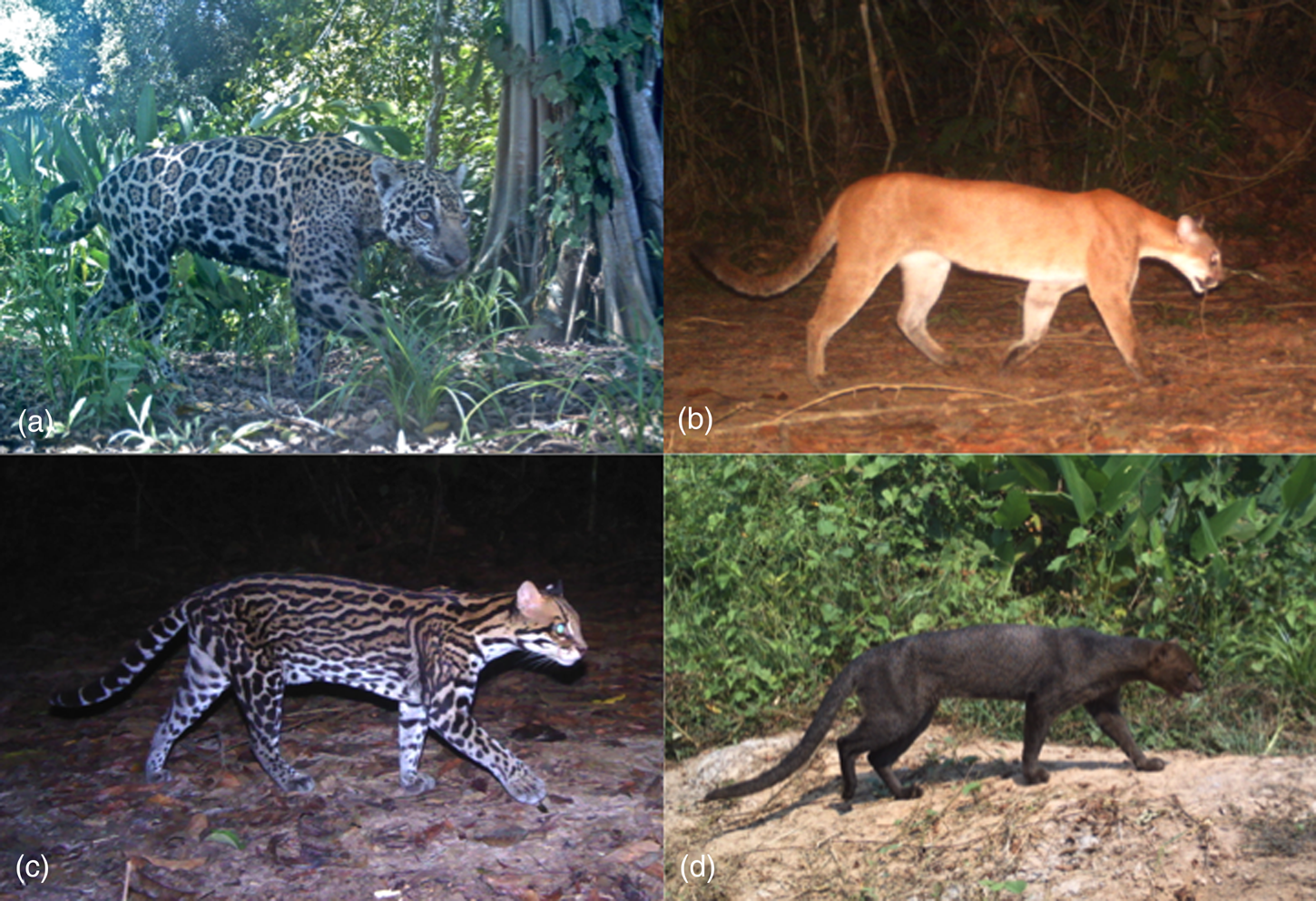
We combined high-resolution land cover maps and camera-trapping data in occupancy models to investigate the habitat use of four sympatric Neotropical felids: jaguar, puma, ocelot and jaguarundi (Plate 1) across an agricultural landscape in Colombia. The area is used for cattle ranching, the main land use in the country (Etter et al., Reference Etter, McAlpine, Wilson, Phinn and Possingham2006), and oil palm plantations, an emerging land use in the Neotropics (Pacheco, Reference Pacheco2012). The latter is of particular concern for conservation because plantations constitute poor habitat for many species (Fitzherbert et al., Reference Fitzherbert, Struebig, Morel, Danielsen, Donald and Phalan2008; Yue et al., Reference Yue, Brodie, Zipkin and Bernard2015) and have an unknown effect on Neotropical felids. We also investigated patterns of spatial co-occurrence or avoidance between the four species. Our data will help inform strategies to align regional development with conservation actions for these predators and the diverse ecosystems they live in. This is particularly timely in Colombia, where the end of the armed conflict represents an opportunity for new developments and investments in biodiversity conservation (Baptiste et al., Reference Baptiste, Pinedo-Vasquez, Gutierrez-Velez, Andrade, Vieira and Estupiñán-Suárez2017).
Map of the study site in the Magdalena river valley of Colombia, with land cover types and camera trap stations. MCP, minimum convex polygon.

Felid species recorded by camera traps across the study site in the Magdalena river valley of Colombia: (a) jaguar Panthera onca, (b) puma Puma concolor, (c) ocelot Leopardus pardalis and (d) jaguarundi Herpailurus yagouaroundi.
Study area
We conducted the study in the central part of the Magdalena River valley in the Department of Santander, Colombia (Fig. 1). The region is part of the tropical forest biome and is rich in wetlands (IDEAM et al., 2007), with a mean annual temperature of 27 °C and total annual rainfall of 2,100–2,600 mm (IDEAM et al., 2007). It is considered an important genetic corridor for several species, including the jaguar, and hosts other threatened and endemic species (Payan-Garrido et al., Reference Payan-Garrido, Castano-Uribe, Gonzalez-Maya, Valderrama-Vasquez, Ruiz-Garcia, Soto, Payan and Castano-Uribe2013). However, the majority of the historical forest cover has been transformed into cattle ranches and oil palm plantations, and the remaining natural areas are fragmented and at risk of further conversion (Etter et al., Reference Etter, McAlpine, Wilson, Phinn and Possingham2006; Castiblanco et al., Reference Castiblanco, Etter and Aide2013; Link et al., Reference Link, De Luna, Burbano, Defler, Stevenson, Bueno and Guzman2013).
We chose our study area because it is an agricultural landscape, including cattle ranching and oil palm plantations, but still hosts top predators such as the jaguar and puma, offering opportunities to study them in an anthropogenic landscape. Land tenure in the region consists principally of private properties and there are no national protected areas. Main land cover types comprise secondary forest, wetlands, pastures, crops and oil palm plantations (Fig. 1).
Methods
Camera trapping
We placed 47 camera stations during April–August 2014, following a systematic sampling approach for camera trapping used in previous studies on Neotropical felids (Maffei & Noss, Reference Maffei and Noss2008; Davis et al., Reference Davis, Kelly and Stauffer2011; Tobler & Powell, Reference Tobler and Powell2013). We positioned the grid to include all main habitat types of the study area: forest (10 stations), wetland (nine stations), pasture (eight stations) and oil palm plantation (eight stations). The remaining stations were located at the edge between forests and oil palm plantations (six stations) and between wetlands and oil palm plantations (six stations). The minimum convex polygon around the camera stations was 154.8 km2. We placed the cameras at regular intervals of 1.6 ± 0.3 km (Fig. 1), which is considered appropriate to investigate habitat use by felids (Davis et al., Reference Davis, Kelly and Stauffer2011; Sunarto et al., Reference Sunarto, Kelly, Parakkasi, Klenzendorf, Septayuda and Kurniawan2012; Everatt et al., Reference Everatt, Andresen, Somers, Everatt, Andresen and Somers2015; Strampelli, Reference Strampelli2015; Alexander et al., Reference Alexander, Shi, Tallents and Riordan2016). When we reached the appropriate distance from the previous camera, we placed the next camera within a radius of 200 m at a location likely to maximize felid encounters (i.e. along roads and established trails where possible). Sixty per cent of stations were placed on roads or trails and 40% away from them, a difference we took into account in the modelling. We used Attack 1149 and Ambush 1170 (both models by Cuddeback, De Pere, USA) camera traps at a height of 35 cm above the forest floor.
Occupancy modelling to study habitat use
We used occupancy models to investigate the potential effects of several variables on species habitat use. Such models take into account imperfect detection and use repeated presence–absence surveys (detection histories) at multiple sampling units to estimate a detection probability (P) and the true proportion of area occupied by a species (ψ) (MacKenzie et al., Reference MacKenzie, Nichols, Royle, Pollock, Bailey and Hines2006). The following assumptions are made: (1) occupancy status of the target species does not change in sampling units (i.e. they are either occupied or not for the duration of the survey), (2) species are correctly identified, (3) detections are independent, and (4) heterogeneity in occupancy or detection probability are modelled using covariates (MacKenzie et al., Reference MacKenzie, Nichols, Royle, Pollock, Bailey and Hines2006). We conducted our analyses at the scale of the camera-trap station rather than at the home range scale and evaluated habitat use rather than the proportion of the study area occupied by each species. We defined a sampling unit as the circular area with a radius of 800 m around each camera station, which corresponds to half the average distance between neighbouring camera stations (Sollmann et al., Reference Sollmann, Furtado, Hofer, Jácomo, Tôrres and Silveira2012). We therefore interpreted ψ as the intensity of use of the various sampling units and modelled both ψ and P using predictor variables (covariates). Under these circumstances assumption (1) can be relaxed and even extensive survey lengths are not problematic (MacKenzie et al., Reference MacKenzie, Nichols, Royle, Pollock, Bailey and Hines2006). We included covariates that have been proposed to explain habitat use (ψ) by felids (Di Bitetti et al., Reference Di Bitetti, Paviolo and De Angelo2006; Foster et al., Reference Foster, Harmsen and Doncaster2010a,Reference Foster, Harmsen, Valdes, Pomilla and Doncasterb; De Angelo et al., Reference De Angelo, Paviolo and Di Bitetti2011; Zeller et al., Reference Zeller, Nijhawan, Salom-Pérez, Potosme and Hines2011; Petracca et al., Reference Petracca, Ramirez-Bravo and Hernandez-Santin2014; Giordano, Reference Giordano2015), considering (1) resources (hypothesized positive effect): proportion of the area covered by forests and wetlands in the sampling units, proximity to water and abundance of prey, and (2) anthropogenic pressures (hypothesized negative effect): proximity to human settlements and the proportion of sampling units covered by pastures and oil palm plantations.
Land cover mapping and generation of covariates
We identified different land cover types and their proportions across the study area, which included a buffer zone of 9.2 km around the camera stations. In the study area, this is the maximum distance moved by jaguars, the species with the largest home range (Nowell & Jackson, Reference Nowell and Jackson1996). We used object oriented image analysis on three Landsat 8 images captured on 4 January 2015, 9 March 2015 and 12 July 2015 (for further details on land cover mapping see Supplementary Material 1). We extracted the proportion of the land cover types in each sampling unit and measured the distance of each camera station from water and settlements in ArcMap 10.3 (Esri, Redlands, USA). For the jaguar and puma we also considered prey availability. These species have a wide dietary spectrum but tend to prefer larger prey species (Polisar et al., Reference Polisar, Maxit, Scognamillo, Farrell, Sunquist and Eisenberg2003; Foster et al., Reference Foster, Harmsen and Doncaster2010a,Reference Foster, Harmsen, Valdes, Pomilla and Doncasterb). Consequently we built two indices: one considering all prey species and another considering only prey species with a body mass > 10 kg, which includes capybaras Hydrochoerus isthmius, white-collared peccaries Pecari tajacu and giant anteaters Myrmecophaga tridactyla. Our index of prey presence was calculated as the sum of the number of days on which a prey species was captured at each camera station, divided by the active trap days at that station (Alexander et al., Reference Alexander, Shi, Tallents and Riordan2016). We could not test prey availability for ocelots and jaguarundis because they hunt small prey such as rodents and small reptiles (Abreua et al., Reference Abreu, Moro-Rios, Silva-Pereira, Miranda, Jablonski and Passos2008; Giordano, Reference Giordano2015), which are under-detected by our camera trap methodology.
Because wild felids tend to use roads and trails (Schaller & Crawshaw, Reference Schaller and Crawshaw1980; Cusack et al., Reference Cusack, Dickman, Rowcliffe and Carbone2015), we included a categorical covariate on P (1 for cameras on roads or trails vs 0 for cameras away from roads or trails). Both camera models have the same trigger speed (0.25 s) and because of high temperatures they were triggered only at distances < 3–4 m. We therefore did not include camera model as a covariate on P and assumed constant detection probability across habitats.
Data analysis
We constructed detection histories for each species and each sampling unit using unambiguously identified species photographs and grouping 14 camera trap nights into one sampling occasion. We then deployed single season single species models in PRESENCE 10.3 (Hines, 2006). Before running the models we standardized continuous covariates to z scores and tested for collinearity using a cut-off value of r = 0.7 (Dormann et al., Reference Dormann, Elith, Bacher, Buchmann, Carl and Carré2013). In the first stage we defined a global model for ψ and assessed whether including the covariate on P improved the Akaike Information Criteria adjusted for small sample size (AICc; Royle & Nichols, Reference Royle and Nichols2003). We then used the best detection model and modelled all combinations of covariates for ψ for each species. We included a maximum of two covariates per model, given the amount of samples to avoid over-fitting (MacKenzie et al., Reference MacKenzie, Nichols, Royle, Pollock, Bailey and Hines2006).
We ranked models based on AICc and if there was no single model possessing a weight ≥ 0.95 we considered models whose combined weight was ≥ 0.95. We added the AICc weights for each covariate in the 95% CI set to evaluate their relative importance. We determined whether the influence of a covariate was positive or negative by the β coefficient (MacKenzie et al., Reference MacKenzie, Nichols, Royle, Pollock, Bailey and Hines2006) and employed a weighted model averaging to calculate overall estimates of β coefficients, ψ and P (Burnham & Anderson, Reference Burnham and Anderson2002). We considered covariates to have a robust effect on ψ if the 95% CIs of their β coefficients or averaged β coefficients did not include zero (Burnham & Anderson, Reference Burnham and Anderson2002; Zuur et al., Reference Zuur, Ieno and Elphick2010; Everatt et al., Reference Everatt, Andresen, Somers, Everatt, Andresen and Somers2015). We assessed model fit for the global standard occupancy model by running goodness-of-fit tests with 10,000 bootstrap samples, obtaining the over-dispersion parameter ĉ (MacKenzie & Bailey, Reference MacKenzie and Bailey2004). We repeated this process for each species.
To test for space partitioning between species, we used two-species single season occupancy models (MacKenzie et al., Reference MacKenzie, Nichols, Royle, Pollock, Bailey and Hines2006; Sollmann et al., Reference Sollmann, Furtado, Hofer, Jácomo, Tôrres and Silveira2012; Sunarto et al., Reference Sunarto, Kelly, Parakkasi and Hutajulu2015). If two species A and B occur independently then the probability of occurrence of both species ψ(A and B) = ψ(A) × ψ(B). We also determined whether A and B co-occurred more or less often than expected using ϕ = ψ(A and B)/(ψA × ψB). Species co-occur more often than expected if ϕ > 1, but co-occur less often than expected if ϕ < 1, provided the 95% CIs of ϕ do not include 1 (MacKenzie et al., Reference MacKenzie, Nichols, Royle, Pollock, Bailey and Hines2006).
Results
We identified seven types of land cover: pasture (35%), wetland (20%), oil palm plantation (19%), forest (12%), water (10%), bare ground (3%), roads and settlements (< 1%). The overall classification accuracy was 0.89. The total sampling effort was 3,069 trap nights, and grouping 14 days into one sampling occasion resulted in 25–58 detections per felid species (Table 1). Detections of jaguars and ocelots corresponded to 12 and 21 individuals, respectively; pumas and jaguarundis could not be identified individually. No variable correlated with any of the others (r < 0.7). Of the 12 jaguars recorded, four are resident individuals that have been in the area since 2012 (Panthera, unpubl. data).
Best models for variables influencing occupancy (ψ) and probability of detection (P) of jaguars Panthera onca, pumas Puma concolor, ocelots Leopardus pardalis and jaguarundis Herpailurus yagouaroundi across the study site in the Magdalena river valley of Colombia (Fig. 1). See Supplementary Table 2 for full model selection results. (.) indicates that no covariates were included in the model.

1Akaike's information criterion adjusted for small sample size.
2Difference in AICc between each model and the best one.
3Model likelihood.
4Number of parameters.
52log-likelihood.
Estimates of β coefficients (± SE), and summed AICc weights for covariates that influenced occupancy (ψ) and probability of detection (P) of jaguars, pumas, ocelots and jaguarundis across the study site.

*Covariates with robust impact (β ± 1.96 × SE does not include zero).
Jaguar occupancy was strongly affected by the proportion of wetland in a sampling unit (positive effect; Tables 1, 2). Puma occupancy was best explained by the distance to water (robust negative effect), availability of prey > 10 kg (positive effect), proportion of pasture (negative effect), and forest (positive effect; Tables 1, 2). Ocelots and jaguarundis were strongly and negatively affected by pastures (Tables 1, 2). With the exception of ocelots, no other species was recorded in oil palm areas (Supplementary Table 1).
Cameras placed on roads or established trails were more likely to detect jaguars, pumas and ocelots (Table 2) and including this covariate for P improved models for these species. These cameras were also the only ones to detect jaguarundis, but we could not include it as a covariate on P because the model did not converge. Full model selection results for the four species are in Supplementary Table 2.
The goodness-of-fit test for global standard occupancy models for all species indicated no over-dispersion, with ĉ values close to 1 and P values > 0.05 (jaguar: ĉ = 0.90, P = 0.77; puma: ĉ = 1.10, P = 0.24; ocelot: ĉ = 1.18, P = 0.19; jaguarundi: ĉ = 1.08, P = 0.29). The species’ mean values for ψ were in the range of 0.27–0.55, and the mean P values were 0.25–0.35 (Table 3). Analyses on space partitioning indicate co-occurrence (ϕ 95% CI > 1) between jaguars and pumas, pumas and jaguarundis, and ocelots and jaguarundis (Table 4).
Model-averaged estimates of probability of site use (ψ), probability of detection (P), and associated standard errors for jaguars, pumas, ocelots, and jaguarundis across the study site.

Species interaction factors (ϕ) between pairs of felid species across the study site.

* Strong interactions (CIs do not include 1).
Discussion
As agriculture continues to expand, causing habitat loss and degradation across the tropics, there is an urgent need to understand how we can support felid conservation across increasingly human-dominated landscapes, which provide habitat connectivity beyond protected areas (Karanth & Chellam, Reference Karanth and Chellam2009; Rabinowitz & Zeller, Reference Rabinowitz and Zeller2010; Boron et al., Reference Boron, Tzanopoulos, Gallo, Barragan, Jaimes-Rodriguez, Schaller and Payán2016b; Di Minin et al., Reference Di Minin, Slotow, Hunter, Montesino Pouzols, Toivonen and Verburg2016). Neotropical felid populations are declining, with important ecological consequences (Estes et al., Reference Estes, Terborgh, Brashares, Power, Berger and Bond2011; Galetti & Dirzo, Reference Galetti and Dirzo2013). Our results can inform strategies to reconcile development with felid conservation, showing that (1) maintaining wetland and forest areas is crucial for the conservation of felids across agricultural landscapes, (2) the expansion of oil palm plantations and agriculture is a growing threat for felids, (3) pastures have limited conservation value for felids and should be targeted for future agricultural expansion, and (4) the four felids did not display any spatial segregation and thus conservation strategies aimed to simultaneously benefit all of them are possible even in modified landscapes.
Factors affecting species habitat use
Wetlands emerged as an important habitat for jaguars and the only variable that strongly influenced their occupancy. The jaguar inhabits a variety of ecosystems but generally prefers forests and habitats dominated by water (Crawshaw & Quigley, Reference Crawshaw and Quigley1991; Nowell & Jackson, Reference Nowell and Jackson1996; Foster et al., Reference Foster, Harmsen and Doncaster2010a, De Angelo et al., Reference De Angelo, Paviolo and Di Bitetti2011, Reference De Angelo, Paviolo, Wiegand, Kanagaraj and Di Bitetti2013; Zeller et al., Reference Zeller, Nijhawan, Salom-Pérez, Potosme and Hines2011). The expansion of the cattle ranching and oil palm agro-industries has restricted forests to only 12% of the study area, and increased human disturbance. Important jaguar prey species such as capybaras, peccaries, tapirs Tapirus terrestris, and deer Mazama sp. (Polisar et al., Reference Polisar, Maxit, Scognamillo, Farrell, Sunquist and Eisenberg2003; Foster et al., Reference Foster, Harmsen and Doncaster2010a,Reference Foster, Harmsen, Valdes, Pomilla and Doncasterb) have been largely depleted by habitat loss and hunting (Rodríguez-Mahecha et al., Reference Rodríguez-Mahecha, Alberico, Trujillo and Jorgenson2006). The presence of prey species exerted no effect on jaguar occupancy, and livestock depredation is rare in the study area (VB, pers. obs.), meaning that jaguars probably use wetlands to complement their diet with aquatic prey such as caimans Caiman crocodilus and turtles Podocnemis sp. and Trachemys sp. (Da Silveira et al., Reference Da Silveira, Ramalho, Thorbjarnarson and Magnusson2010). Preserving wetlands is therefore crucial for jaguar survival in the region.
Pumas were strongly associated with water bodies (streams, ponds and ciénegas), avoided pastures, and their occupancy was positively affected by the presence of forest and larger prey. Their association with water could be related to their use of riparian forests as corridors (De Angelo et al., Reference Davis, Kelly and Stauffer2011), because these forests are usually the last to remain in heavily modified regions. These findings suggest that maintaining forest habitat in modified landscapes is crucial for both pumas and their prey. Pumas are considered more of a habitat generalist than jaguars and can live in close proximity to humans (Dickson & Beier, Reference Dickson and Beier2007; De Angelo et al., Reference De Angelo, Paviolo and Di Bitetti2011; Sollmann et al., Reference Sollmann, Furtado, Hofer, Jácomo, Tôrres and Silveira2012), but they can also avoid modified areas and prefer forests where these are available (Paviolo et al., Reference Paviolo, Di Blanco, De, Angelo and Di Bitetti2009; Di Bitetti et al., Reference Di Bitetti, De Angelo, Di Blanco and Paviolo2010; Foster et al., Reference Foster, Harmsen and Doncaster2010a; Negrões et al., Reference Negrões, Sarmento, Cruz, Eira, Revilla and Fonseca2010; Davis et al., Reference Davis, Kelly and Stauffer2011; De Angelo et al., Reference De Angelo, Paviolo and Di Bitetti2011). This concurs with our findings and is probably caused by higher prey availability in forests compared to modified areas.
Ocelots and jaguarundis are sometimes regarded as ecologically flexible and more tolerant to habitat loss and degradation than the larger felids (Nowell & Jackson, Reference Nowell and Jackson1996; Michalski & Peres, Reference Michalski and Peres2005; Di Bitetti et al., Reference Di Bitetti, Paviolo and De Angelo2006; Lyra-Jorge et al., Reference Lyra-Jorge, Ciocheti and Pivello2008; Kolowski & Alonso, Reference Kolowski and Alonso2010). This is supported by the fact that the ocelot was the only felid species recorded in oil palm plantations, albeit rarely. There have been previous records of ocelots using oil palm areas (Boron & Payan, Reference Boron, Payan, Castaño-Uribe, González-Maya, Zárrate-Charry, Ange-Jaramillo and Vela-Vargas2013; Pardo & Payan, Reference Pardo and Payan2015), possibly because they harbour rodent prey and hunting is facilitated by open visibility, as reported for the leopard cat Prionailurus bengalensis (Rajaratnam et al., Reference Rajaratnam, Sunquist, Rajaratnam and Ambu2007). However, both ocelots and jaguarundis were negatively and strongly affected by pastures, which supports earlier findings showing that they favour more natural forested habitats and avoid human disturbance (Gonzalez et al., Reference Gonzalez, Brown and Gallo-Reynoso2003; Giordano, Reference Giordano2015; Massara et al., Reference Massara, Maria, Paschoal and Doherty2015).
Space partitioning
Interspecies interactions are stronger between species of similar body mass and overlapping prey preferences, and spatial, temporal, and/or diet segregation can improve coexistence (Donadio & Buskirk, Reference Donadio and Buskirk2006). Across Latin America, puma populations tend to be smaller where jaguars are abundant and vice versa (Kelly et al., Reference Kelly, Noss, Di Bitetti, Maffei, Arispe and Paviolo2008; Noss et al., Reference Noss, Gardner, Maffei, Cuellar, Montano and Romero-Munoz2012). However, where the two are sympatric, their habitat use is similar and segregation tends to be temporal or dietary rather than spatial (Harmsen et al., Reference Harmsen, Foster, Silver, Ostro and Doncaster2009; Di Bitetti et al., Reference Di Bitetti, De Angelo, Di Blanco and Paviolo2010; Foster et al., Reference Foster, Harmsen and Doncaster2010a,Reference Foster, Harmsen, Valdes, Pomilla and Doncasterb). This agrees with our findings of spatial co-occurrence, and it is possible that segregation occurs at the dietary level, with jaguars hunting mainly aquatic prey, and pumas targeting terrestrial prey.
Mesocarnivores such as ocelots and jaguarundis can be negatively affected by top predators and succeed when larger predators are rare or absent through phenomena of mesopredator release (Crooks & Soulé, Reference Crooks and Soulé1999; Moreno et al., Reference Moreno, Kays and Samudio2006). However, ocelots can also thrive in large protected areas with better habitat quality inhabited by top predators (Massara et al., Reference Massara, Maria, Paschoal and Doherty2015), and both ocelots and jaguarundis can be positively associated with jaguars and/or pumas (Di Bitetti et al., Reference Di Bitetti, De Angelo, Di Blanco and Paviolo2010; Noss et al., Reference Noss, Gardner, Maffei, Cuellar, Montano and Romero-Munoz2012). We found that jaguarundis tend to co-occur with both ocelots and pumas. Ocelots can negatively affect jaguarundi numbers (Oliveira et al., Reference Oliveira, Tortato, Silveira, Kasper, Mazim, Lucherini, Macdonald and Loveridge2010), but spatial co-occurrence is facilitated by temporal segregation: the jaguarundi is diurnal, whereas the puma and ocelot are mostly crepuscular and nocturnal (Di Bitetti et al., Reference Di Bitetti, De Angelo, Di Blanco and Paviolo2010; Harmsen et al., Reference Harmsen, Foster, Silver and Doncaster2011). Overall, the lack of spatial segregation between species in the region indicates that their distributions can overlap, thus developing conservation strategies to simultaneously benefit all of them may be possible even in modified landscapes.
Methodological considerations
We adopted a survey design that is appropriate for investigating habitat use by felids (Davis et al., Reference Davis, Kelly and Stauffer2011; Sunarto et al., Reference Sunarto, Kelly, Parakkasi, Klenzendorf, Septayuda and Kurniawan2012; Everatt et al., Reference Everatt, Andresen, Somers, Everatt, Andresen and Somers2015; Strampelli, Reference Strampelli2015; Alexander et al., Reference Alexander, Shi, Tallents and Riordan2016). Despite felids being wide-ranging, our models showed no overdispersion, suggesting that our data were not affected by spatial autocorrelation. In addition, the identification of individual jaguars and ocelots showed that adjacent cameras never recorded the same assemblage of individuals. Habitat selection takes place at a variety of spatial and temporal scales ranging from distribution and home range selection to habitat use within the home range (Johnson, Reference Johnson1980; Sunarto et al., Reference Sunarto, Kelly, Parakkasi, Klenzendorf, Septayuda and Kurniawan2012; Strampelli, Reference Strampelli2015), and thus it is important to conduct more studies to explore these differences in modified landscapes. Finally, object oriented image analysis produced highly accurate land cover maps and covariates, and occupancy models reduced bias by taking into account imperfect detection, which is especially important for elusive species such as felids.
Conclusion
Unprotected and increasingly human-modified areas are crucial for wide-ranging carnivores, and thus it is important to understand how to achieve conservation in such landscapes. This study focused on habitat use. However, to conserve predator species across human-modified areas, habitat preservation needs to be complemented by hunting limitations and conflict management (Inskip & Zimmermann, Reference Inskip and Zimmermann2009).
Pasture is the main land cover type in Colombia (Etter et al., Reference Etter, McAlpine, Wilson, Phinn and Possingham2006) and has limited conservation value for felids. Further studies are needed, but our results indicate that oil palm cultivation and agricultural expansion, when inevitable, should be targeted at modified areas such as pastures, to minimize the loss of natural habitats (Garcia-Ulloa et al., Reference Garcia-Ulloa, Sloan, Pacheco, Ghazoul and Koh2012). Concurring results have been documented for other taxa (Gilroy et al., Reference Gilroy, Prescott, Cardenas, Castañeda, Sánchez and Rojas-Murcia2015; Prescott et al., Reference Prescott, Gilroy, Haugaasen, Medina Uribe, Foster and Edwards2016). We did not find a clear effect of oil palm plantations in our models, which could be because it still covers a relatively small proportion of the landscape (19%). Nevertheless jaguars, pumas, and jaguarundis were never detected in oil palm areas. A stronger regulatory framework could facilitate land-use planning and incentive-based approaches (e.g. tax breaks, subsidized credits, premium prices for certified products) and also encourage the preservation of natural areas within productive landscapes (Lambin et al., Reference Lambin, Meyfroidt, Rueda, Blackman, Börner and Cerutti2014; Boron et al., Reference Boron, Payan, MacMillan and Tzanopoulos2016a). This study can guide land-use planning in Colombia, which is particularly timely during the country's transition towards peace following 2016. Further research should explore the habitat requirements for felids and other priority species to identify natural habitat thresholds and optimal landscape configuration, thus reconciling agriculture and biodiversity conservation.
Acknowledgements
Funding bodies included the Liz Claiborne and Art Ortenberg Foundation (Jaguar Research Grant administered by Panthera), Rufford Small Grants, Idea Wild and the Explorers Club. We thank A. Montes, A. Quiñones Guerrero, and L. Jaimes Rodriguez for help with data collection and processing, the Panthera office staff in Bogotá, J. Murillo and Cabildo Verde in the Magdalena river valley for logistical support, the landowners for allowing us to access their properties, R. McCrea, A. Srivathsa and P. Strampelli for advice on data analysis, and the Editor and two anonymous reviewers for their critiques.
Author contributions
Data collection: VB; data processing and analysis: VB and PX; study design and writing: all authors.
Conflicts of interest
None.
Ethical standards
The research complied with the Oryx Code of Conduct for authors.



