


Breast-feeding is unequalled in its ability to promote infant growth and development. Two crucial benefits of breast milk are its ability to provide optimal nutrition and protection against common childhood infections(Reference Bhandari, Bahl and Mazumdar1–3). Yet for infants born to HIV-positive mothers, breast milk can be a source of HIV infection, although the risk of transmission greatly decreases if exclusive breast-feeding (EBF) is practised(Reference Coovadia, Rollins and Bland4, Reference Becquet, Ekouevi and Menan5).
Cessation of breast-feeding in the absence of replacement feeds that are acceptable, feasible, affordable, sustainable and safe (AFASS) is associated with malnutrition, more frequent and severe gastrointestinal and upper respiratory infections, and increased mortality(Reference Coovadia and Bland6). It is for these reasons that recent international guidelines for infant feeding in the context of HIV state that infants born to HIV-positive mothers in developing countries should be exclusively breast-fed for the first 6 months unless replacement feeding meets the AFASS criteria(7, 8). In fact, the importance of breast-feeding among this population was reinforced in the 2009 Revised Principles and Recommendations on HIV and Infant Feeding from the WHO, which recommend breast-feeding for the first 12 months, and thereafter until adequate and safe diet without breast milk is available(8). The guidelines also highlight the need for and importance of appropriate counselling and follow-up support for HIV-infected mothers, and encourage the training of infant feeding counsellors and other health staff to enable them to deliver accurate and up-to-date infant feeding messages and ongoing support to mothers.
In Tanzania, current infant feeding recommendations for HIV-positive mothers are consistent with the 2007 guidelines of the WHO(7); they recommend women to continue EBF up to 6 months and continue to breast-feed after 6 months until replacement feeding is AFASS for mothers and their infants(9). Traditionally, in Tanzania, there is widespread – nearly universal – initiation of breast-feeding, but pre-lacteal feeds are common, as is early introduction of other foods; thus, EBF is not widely practised(10). The median duration of breast-feeding on mainland Tanzania was reported to be 21·1 months in the 2004 Tanzania Demographic and Health Survey (DHS); 20·8 months was the median in urban populations and 21·2 months in rural ones(10). Early rapid cessation of breast-feeding had been previously recommended in Tanzania as per the WHO recommendations(11) but was revised in late 2007 due to adverse health consequences of early and rapid cessation of breast-feeding for both mothers (mastitis) and infants (growth failure, HIV transmission during rapid weaning and mortality)(7, Reference Arpadi, Fawzy and Aldrovandi12). National guidelines will most likely be again revised in light of the WHO 2009 recommendations on HIV and infant feeding.
Active support for the widespread Baby Friendly Hospital Initiative (BFHI) in Tanzania declined rapidly after 1995 due to uncertainties and fear of the effect of the promotion and support of breast-feeding in the context of HIV/AIDS on health outcomes of the child(Reference Swartzendruber and Msamanga13). The extensive training for health-care workers on lactation management and infant feeding counselling skills, as well as the posting of infant feeding guidelines in all of the major regional and district hospitals and antenatal clinics, ended abruptly. By 2003, much of the former knowledge and counselling skills for optimal infant feeding available at health facilities had eroded(Reference Swartzendruber and Msamanga13).
National-level training on infant feeding counselling resumed in 2005 to improve this aspect of national prevention of mother-to-child transmission (PMTCT) service delivery. This was due in part to the fact that Tanzania began receiving President’s Emergency Plan for AIDS Relief funding, which supports comprehensive HIV/AIDS prevention, treatment and care programmes, including PMTCT efforts. The Tanzanian Ministry of Health has now developed standardized counselling job aids and training materials for health-care workers of different cadres on infant feeding in the context of HIV/AIDS. The training is being scaled up nationally according to the steps recommended in the WHO/UNICEF/UNAIDS materials as PMTCT coverage expands(14). National PMTCT guidelines require individualized infant feeding counselling and follow-up for all mothers receiving PMTCT care. Although the national infant feeding training includes a brief component on BFHI and BFHI training and assessment tools have been adopted, as of 2009 no local BFHI initiative existed.
Objective
The objective of the present cross-sectional study was to assess feeding practices in 2008 of infants born to HIV-positive women in Dar es Salaam, Tanzania, with a particular emphasis on EBF up to 6 months. We compared these data to nationally representative data on infant feeding practices among the general population and used them as a proxy to evaluate the adequacy of current infant feeding counselling in the context of HIV.
Methods
Study design, population and location
The cross-sectional study of current and recalled infant feeding practices took place at four urban clinics providing PMTCT services in Dar es Salaam, Tanzania, between March 2008 and May 2008. Mothers were approached by clinic staff during scheduled infant vaccination visits and confidentially informed of the study. Women who were 18 years or older, self-identified as HIV-positive and had a child 6–10 months old at the time of the study were eligible to participate. A total of 208 women were interviewed; twelve were excluded from the analyses because their infants were younger than 6 months (n 10) or older than 10 months (n 2). Infants younger than 6 months were excluded because we were interested in establishing the proportion of infants who were exclusively breast-fed as per national recommendations, which is 6 months, and therefore wanted to have infants with this total period of recall.
If the mother met the eligibility criteria and agreed to participate, a clinic staff member administered a sixteen-question survey in Swahili on current and recalled infant feeding practices. The survey instrument was designed specifically for the present study and built upon similar survey instruments, e.g. WHO infant feeding indicators. It was pre-tested at study sites for comprehension and accuracy. Most survey questions were structured as such: Have you ever fed your child food X? If yes, how old was your child in months and weeks when you first fed food X? Are you still feeding your child food X? (The survey is available in online supplementary materials.) Clinic staff members assigned to administer the survey received approximately 2 h of training on interview methods and proper form filling. No sociodemographic data or identifying information were collected in the present study. To further ensure anonymity, only infant birth month and year were collected. Each interview lasted approximately 8 min.
The four health facilities selected for the present study had similar environments in terms of setting and population characteristics (urban Dar es Salaam). Two of the facilities were hospitals and two were health centres (which have smaller catchment areas than hospitals), with one hospital/health centre pair in Ilala district and the other pair located in Kinondoni district. Although one hospital, facility no. 3 (Table 1), had been certified as baby-friendly in the late 1990s, it has not been reassessed since.
Participation, breast-feeding initiation and median duration of EBF by facility among HIV-positive mothers in Dar es Salaam, Tanzania

EBF, exclusive breast-feeding; IQR, interquartile range.
*Significantly different from clinics 2, 3 and 4 in Fisher’s exact test (P < 0·001).
**Significantly higher than median of entire population using Wilcoxon rank-sum test (P = 0·005).
Definitions
In the present study, the following definitions were used:
• Exclusive breast-feeding is defined as the receipt of only breast milk since birth; only oral rehydration solution (ORS), drops and syrups (vitamins, minerals or medicines) are permitted(15).
• Predominant breast-feeding is defined as the receipt of breast milk as the predominant source of nourishment, but some liquids (water and water-based drinks), ritual fluids, ORS, drops and syrups are permitted(15). Non-human milk and food-based fluids or solids are not permitted.
• Complementary feeding is defined as the receipt of breast milk and any other solid or semi-solid foods. Non-human milk, formula and other liquids and solids are permitted(15).
• Replacement feeding indicates that the infant received no breast milk, but was fed with formula or other breast milk substitutes(14).
Sample size calculation and analysis
There were no data available on rates of EBF in infants of HIV-infected mothers in Dar es Salaam since the revision of national infant feeding recommendations in 2007. In the 2004 DHS data, EBF prevalence based on cross-sectional recalled and current practices was estimated to be 15 % at 4–5 months(10). To be able to detect a 10 % difference between the nationally representative data and the prevalence of EBF among HIV-infected women in care (α = 0·05, β = 0·9), a sample size of 171 was required.
All statistical analyses were conducted with the Stata for Mac statistical software package version 10·1 (StataCorp, College Station, TX, USA). Fisher’s exact tests were used to determine differences in initiation of breast-feeding by clinic type, and χ 2 tests were used to determine whether the prevalence of EBF in our Dar es Salaam samples was significantly different from that of the nationally representative samples. Median and interquartile range (IQR) were calculated for infant feeding behaviours after establishing non-normal distribution; differences in medians were calculated using Wilcoxon rank-sum tests. Survival curves were plotted by feeding modality.
Because the University of California Davis Institutional Review Board asked that the date of birth not be collected (to ensure anonymity), we assigned children’s age as the 15th of their reported month of birth. This means that estimates of survival of EBF, predominant breast-feeding and any breast-feeding could be under- or overestimated by up to 2 weeks. This estimation of age had no effect on information about age at introduction of foods or age of breast-feeding cessation, however, because mothers reported age of child in months and weeks at the time of introduction of food items.
Ethics approval
Oral informed consent was obtained from each participating mother. The present study was approved by the Institutional Review Board at the University of California Davis and the National Institute for Medical Research in Tanzania.
Results
The mean infant age at the time of interview was 7·6 (sd 0·9) months; 187 of 196 (95·4 %) mothers initiated breast-feeding. The overall median duration of EBF among women who ever breast-fed was 3 (IQR: 2·2, 4·0) months. EBF declined sharply between months 2 and 4 (Fig. 1). Across all clinics, 80·1 %, 34·2 % and 13·3 % of women reported EBF up to 2, 4 and 6 months, respectively.
Survival of exclusive ( ), predominant (
 ) and any breast-feeding (
 ) up to 6 months among 196 infants born to HIV-positive women in Dar es Salaam, Tanzania

Predominant breast-feeding (which includes EBF) was slightly higher at each time point; 84·7 %, 41·3 % and 15·3 % of infants were predominantly breast-fed up to 2, 4 and 6 months, respectively. Mothers reported ‘any’ breast-feeding for 86·7 %, 51·5 % and 34·2 % of infants up to 2, 4 and 6 months, respectively. Complete cessation of breast-feeding occurred within 14 d of the introduction of non-breast-milk foods among 138 of the 187 children (73·8 %) who had ever received any human milk. Of the 187 infants in the study who ever received breast milk, 19·4 % received neither human milk nor any replacement milks for 1 week or more (median duration of no milk was 14 (IQR: 7, 152) d).
Porridge was the most frequent non-breast-milk food fed to infants (94·9 %) (Fig. 2). The median age at its introduction was 4·4 months. Water, the second most commonly fed item (92·9 %), was introduced earlier, at a median age of 3·5 months. Family foods were typically introduced very close to month 6; the timing of the introduction of family foods also had the smallest IQR. Fresh fruit juice was the fourth most frequently fed food (87·8 %), with a median age of introduction of 4·7 months. The other food items enquired about were all fed to a much smaller proportion of infants, <40 %. In descending order of frequency, these were cow’s milk with added sugar or water, formula, tea, non-modified cow’s milk, powdered milk and packaged juice. Of all the non-breast-milk foods included in the survey, infant formula was fed at the earliest age (median 3 months), with cow’s milk, tea, powdered milk and packaged juice all being most frequently introduced between months 4 and 5.
Median and interquartile range of age in months at introduction of non-breast-milk foods among infants born to HIV-positive women in Dar es Salaam, in descending order of frequency (n 196); *proportion of infants ever fed item

All mothers who reported never breast-feeding, i.e. who fed only replacement foods, were from Health Centre 1 (Table 1). The median duration of EBF varied significantly by facility; it was higher than the overall median at facilities 1 and 2 (P = 0·005). There were more trained infant feeding counsellors at Health Centre 1 (n 5) than at the other facilities, each of which had only one, although hospitals have larger catchment areas than health centres.
Analysis of the data by age categories used in DHS reports permits comparison of pattern of feeding behaviours to nationally representative data (Table 2). For each age category, the prevalence of EBF was significantly higher (P < 0·001) in the Dar es Salaam HIV-positive population; the median duration of EBF among the HIV-positive women in the present study, 3·0 months, is also higher than the 1·8 months reported in a 2004 nationally representative sample(10).
Prevalence of any EBF among two populations, by age groups used in DHS analyses
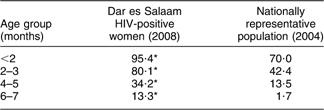
EBF, exclusive breast-feeding; DHS, Demographic and Health Survey.
*Significantly different from the nationally representative data using χ 2 test (P < 0·001).
Discussion
The higher prevalence of EBF at all ages up to 6–7 months and the longer duration of EBF in our subjects suggest that infant feeding counselling for these HIV-infected women has been successful in increasing EBF duration. Alternatively, it is possible that EBF durations could be increasing in the general population, or that the significant variation in EBF by HIV status is unrelated to counselling, i.e. HIV-positive women practise EBF for longer as a result of other factors.
Interestingly, the duration of EBF observed here is similar to that in other studies among HIV-positive women in Tanzania over the past 10 years. For example, in Sedgh et al.’s(Reference Sedgh, Spiegelman and Larsen16) study of breast-feeding practices of HIV-positive women in Dar es Salaam between 1995 and 1997, the average duration of EBF was 2·9 (IQR: 1, 5) months. Similarly, in Leshabari et al.’s(Reference Leshabari, Blystad and Moland17) 2003–2004 study of breast-feeding practices of HIV-positive women in the Kilimanjaro region, the median duration of EBF was 3 (IQR: 2, 4·5) months.
Yet our findings show that mothers may need more support to follow national guidelines on infant feeding in the context of HIV; this is consistent with the conclusions of a number of other studies of infant feeding practices in sub-Saharan Africa(Reference Kulwa, Kinabo and Modest18–Reference Orne-Gliemann, Mukotekwa and Miller21). We observed a number of suboptimal feeding practices. Primarily, both the prevalence and duration of EBF among the entire study population are more limited than the recommended 6 months of EBF; only 13·3 % of women reported EBF up to 6 months. Second, the replacement feeding since birth opted for by 4·6 % of women may be inconsistent with national guidelines. AFASS criteria are very hard for indigent women to meet, and their attendance at a free public clinic, rather than a private clinic that typically offers higher quality of care without the long queues, suggests that these women may not be in a position to afford adequate replacement feeds.
The median 2-week lag between the cessation of breast-feeding and the introduction of milk products and other nutrient-rich foods among 19·4 % of infants also highlights the need for improved feeding practices after breast-feeding cessation. Because breast milk provides a large portion of energy for many children in developing countries in the first 2 years of life(Reference Brown, Dewey and Allen22), infants receiving no breast milk are at risk of malnutrition and growth failure.
There are several limitations to the present study. The retrospective design may introduce recall bias, but it has been shown that mothers are able to recall duration of breast-feeding accurately; they may, however, not remember the age of introduction of other liquids and foods as well(Reference Li, Scanlon and Serdula23). The retrospective design may have caused the infants who were most malnourished to be under-represented, as many may have died before the age at which this survey was conducted. Nor did we perform an assessment of the AFASS criteria to determine the appropriateness of replacement feeding in the infants who were never breast-fed.
Patterns of decline in breast-feeding over the first 6 months of life suggest that they may be at least partially attributable to unclear or erroneous counselling messages and less than adequate follow-up and support for mothers. First, it is striking that all women who opted for replacement feed were from the same clinic. To our knowledge, there were no formula programmes at this clinic. Furthermore, there was a notably steep decline in breast-feeding (exclusive, predominant and any) around month 3 (Fig. 1), with prominent drop-offs also observed at months 4 and 6 for all three modes of feeding. These defined time points are quite possibly the result of infant feeding counselling messages disseminated by clinic staff that did not reflect the infant feeding recommendations revised in 2007, but rather the previous ones. For example, the large percentage of mothers who stopped all breast-feeding between 3 and 4 months may be a residual response to the previous WHO recommendation to exclusively breast-feed during the first few months of life and then discontinue as soon as feasible(8). Alternatively, this 3-month drop-off could reflect the return to work of employed mothers after the mandated 3-month maternity leave. Furthermore, the fact that 73·8 % of mothers stopped breast-feeding within 14 d of the introduction of non-breast-milk foods suggests that they may have been advised that rapidly weaning HIV-exposed infants was optimal, regardless of the quality of available replacement options. The tight clustering of the introduction of family foods around month 6 (Fig. 2) likely also reflects the effects of infant feeding counselling.
These patterns also show the difficulties of providing consistent public health messages at international, national and individual levels. A lack of standard messages from infant feeding counsellors, other members of the health-care team, family, friends and the media, combined with long-held beliefs about the early introduction of complementary foods, all very likely play a role in the infant feeding patterns observed in the present study. Family support in this environment is vital – it is common in Tanzania for a mother-in-law to make decisions surrounding breast-feeding duration and introduction of family foods for her daughter-in-law(Reference Leshabari, Blystad and Moland17). This highlights the need for the community – not only the mother herself or the infant feeding counsellor – to be aware of the most up-to-date infant feeding recommendations in order to properly support the breast-feeding mother.
The Tanzanian Ministry of Health and Implementing Partners have done much to strengthen the infant feeding counselling aspect of PMTCT services with their support of the national scale-up of infant feeding counselling training and distribution of standardized counselling job aids(Reference Leshabari, Blystad and Moland17). Despite this effort, large gaps remain, particularly in achieving adequate numbers of trained counsellors at antenatal care facilities, supportive supervision and coaching of the counsellors and continuous follow-up support of mothers at the community level. Competing priorities, even among activities within the PMTCT programme, limit the funding available to train infant feeding counsellors. Health facilities in Tanzania also experience high staff turnover, and therefore it is difficult to maintain a target number of trained counsellors per clinic. Indeed, insufficient infant feeding counselling is seen throughout much of sub-Saharan Africa(Reference de Paoli, Manongi and Klepp19, Reference Orne-Gliemann, Mukotekwa and Miller21, Reference Coutsoudis24).
Unfortunately, suboptimal durations of EBF and breast-feeding, such as those observed in our study in Tanzania, are common throughout the world in both HIV-positive and HIV-negative populations(Reference Kulwa, Kinabo and Modest18, 25, Reference Lauer, Betran and Barros26). Barriers to EBF include lack of support for EBF in the community and workplace, and perceptions that milk supply is inadequate, that EBF is unimportant or that breast milk alone is insufficient for optimal infant growth and development(Reference Otoo, Lartey and Pérez-Escamilla27–Reference Buskens, Jaffe and Mkhatshwa29). Among HIV-positive women, fear of HIV transmission through breast milk causes some women to avoid breast-feeding or prematurely wean, even in the absence of AFASS alternatives(Reference Leshabari, Blystad and Moland17, Reference Doherty, Chopra and Nkonki30, Reference Lunney, Jenkins and Tavengwa31).
However, available evidence from many settings documents a proven method to increase the prevalence and duration of EBF: intensified infant feeding counselling. A number of studies have shown dramatic improvements in the rates of optimal infant feeding through both clinic-based and home-based infant feeding counselling(Reference Haider, Ashworth and Kabir32–Reference Piwoz, Humphrey and Tavengwa35). Home-based peer counselling has also been shown to profoundly increase EBF prevalence in settings where HIV prevalence is high(Reference Bland, Little and Coovadia36). Furthermore, because infant feeding patterns in the present study suggest that women do listen to infant feeding messages, it seems probable that appropriate, more intensive counselling could be effective in improving infant feeding practices in the present population.
Why, then, are more effective infant feeding programmes not in place? One reason is that the cost of community-based infant feeding programmes has frequently been perceived as prohibitive(Reference Desmond, Bland and Boyce37). However, given our growing understanding of the tremendous benefits of EBF, particularly in the context of HIV and in resource-poor regions, and the consequent cost savings that optimal infant feeding can achieve (through prevention of diseases, including HIV, and promotion of growth), we posit that it is time to evaluate the cost-effectiveness of such a programme. Surely this intervention, which has advantages beyond PMTCT and need not single out HIV-infected mothers, merits cost comparison with extended antiretroviral prophylaxis for HIV-infected breast-feeding mothers.
Such an evaluation may be challenging and will require intense advocacy, as research on the improvement of delivery and use of existing technology is frequently of lower priority than the discovery of novel techniques for the improvement of public health(Reference Leroy, Habicht and Pelto38). This prioritization was recently demonstrated in an assessment of human resource and funding needed to eliminate HIV infection in infants and young children, which completely overlooked the strategy of infant feeding counselling(Reference Nakakeeto and Umaranayake39).
Conclusion
Current breast-feeding practices in this population of HIV-positive women show greater EBF duration than in a recent nationally representative sample, but fall well short of national and international recommendations. These data suggest that cost-effective strategies are urgently needed to improve breast-feeding practices for the vulnerable population of HIV-exposed infants in resource-poor settings. Successful implementation of such strategies would very likely increase HIV-free survival and may have the added benefit of improving EBF rates in the general population(Reference Young, Chantry and Vosti40).
Acknowledgements
We gratefully acknowledge NIH (R01HD057602) and the Thrasher Research Fund for support of the study. None of the authors had any conflicts of interest. S.L.Y. analysed the data and wrote the first draft of the paper. K.A.I.-B. assisted not only with the design of the study and the data collection instrument, but also in the preparation of the manuscript. E.A.D. contributed to the design of the data collection instrument, managed the study implementation and assisted in the preparation of the manuscript. M.M.N. participated in the study design, participant recruitment and manuscript preparation. D.M.A. contributed to the study design and manuscript preparation. C.J.C. was responsible for the overall study design and data collection instruments, and contributed to the manuscript preparation. The authors are deeply grateful to the women who participated in the present study and to the clinic, field and data staff for their hard work in making the present study a success.



