

INTRODUCTION
There is little doubt that identities play an important role in shaping public opinion on politics (Achen and Bartels Reference Achen and Bartels2016; Berelson, Lazarsfeld, and McPhee Reference Berelson, Lazarsfeld and McPhee1954; Campbell et al. Reference Campbell, Converse, Miller and Stokes1960; Huddy Reference Huddy2001; Kinder and Kalmoe Reference Kinder and Kalmoe2017). People have multiple identities and the salience of any one of those identities depends upon various contexts. This is particularly the case for people’s ethnoracial identities (for example, Appiah and Gutmann Reference Appiah and Gutmann1998; Beltrán Reference Beltrán2010; Crenshaw Reference Crenshaw1990; d’Urso Reference d’Urso2022; Davenport Reference Davenport2018; Reference Davenport2020; Dawson Reference Dawson1995; Huddy Reference Huddy2001; Lajevardi Reference Lajevardi2020; Lee Reference Lee2008; Masuoka Reference Masuoka2017; Masuoka, Ramanathan, and Junn Reference Masuoka, Ramanathan and Junn2019; Omi and Winant Reference Omi and Winant2015; Pérez Reference Pérez2021a; Wong et al. Reference Wong, Karthick Ramakrishnan, Lee and Junn2011).Footnote 1 Political institutions play an important role in influencing ethnoracial identity expression (Espiritu Reference Espiritu1992; Lopez Reference Lopez1997; Marx Reference Marx1998; Mora Reference Mora2014; Nobles Reference Nobles2000; Omi and Winant Reference Omi and Winant2015; Schachter, Flores, and Maghbouleh Reference Schachter, Flores and Maghbouleh2021). State-sanctioned identity categories, including but not limited to ethnorace, are created through a fraught political process between multiple actors: “Categories emerge not from one particular source but rather from the interactive relationships between sets of actors” (Mora Reference Mora2014, 11). The identity categories institutions recognize and formally adopt shape the salience of identities in surprising ways (Marx Reference Marx1998; Mora Reference Mora2014; Nobles Reference Nobles2000). This is especially true for individuals who self-identify with a group but are not able to self-categorize—or label themselves—accordingly because their group is not institutionally recognized (Barreto et al. Reference Barreto, Ellemers, Scholten and Smith2010; Cheryan and Monin Reference Cheryan and Monin2005; Fath and Proudfoot Reference Fath and Proudfoot2024; Townsend, Markus, and Bergsieker Reference Townsend, Markus and Bergsieker2009).Footnote 2 Examples of this can be found across many different identity groups including ethnorace and gender. Before the 2000 Census, individuals with multiple ethnoracial backgrounds could only self-categorize with one group (Davenport Reference Davenport2018; Reference Davenport2020; Masuoka Reference Masuoka2017; Nobles Reference Nobles2000; Prewitt Reference Prewitt2013; Williams Reference Williams2006). Today, individuals who identify beyond the gender binary are not always able to self-categorize on important forms or identification cards. The mismatch between identification and categorization also affects Middle Eastern and North African (MENA) Americans.Footnote 3
MENA Americans occupy a paradoxical position in the United States. They are one of the most politically visible groups in the US. They are subjected to increased surveillance (Akram and Johnson Reference Akram and Johnson2003; Beydoun Reference Beydoun2015a; Maira Reference Maira, Perera and Razack2014), stereotyped as subhuman (d’Urso Reference d’Urso2022; Kteily and Bruneau Reference Kteily and Bruneau2017; Kteily et al. Reference Kteily, Bruneau, Waytz and Cotterill2015; Kteily, Hodson, and Bruneau Reference Kteily, Hodson and Bruneau2016), and have unique healthcare needs from other ethnoracial groups (Abuelezam Reference Abuelezam2020; Dallo et al. Reference Dallo, Kindratt, Seaton and Ruterbusch2023; El-Sayed and Galea Reference El-Sayed and Galea2009). Yet MENA Americans are also rendered invisible due to their ethnoracial categorization. From 1977 to 2024, MENA individuals were legally categorized as “White.”Footnote 4 , Footnote 5 Although the Office of Management and Budget (OMB) issued a directive in 2024 for all federal agencies to update their minimum racial categories to include “MENA,” until there is a U.S. census with a “MENA” category, the existing demographic information on MENA Americans is limited.Footnote 6
Generally, MENA individuals are not perceived to be ethnoracially White (d’Urso Reference d’Urso2024; Maghbouleh Reference Maghbouleh2025; Schachter, Flores, and Maghbouleh Reference Schachter, Flores and Maghbouleh2021) nor do they identify as such (Awad, Hashem, and Nguyen Reference Awad, Hashem and Nguyen2021; d’Urso Reference d’Urso2022; Maghbouleh Reference Maghbouleh2017; Maghbouleh, Schachter, and Flores Reference Maghbouleh, Schachter and Flores2022; Naber Reference Naber2000; Reference Naber2012). Despite this, it is rarely the case that demographic questionnaires include “Middle Eastern or North African” as a racial category. Ironically, this institutional disenfranchisement brings MENA identity to the forefront, making it more salient for MENA individuals. Given that MENA identity is both racialized and politicized (Aziz Reference Aziz2022; Bayoumi Reference Bayoumi2006; d’Urso and Bonilla Reference d’Urso and Bonilla2023; d’Urso Reference d’Urso2022; Reference d’Urso2024; Dana et al. Reference Dana, Lajevardi, Oskooii and Walker2019; Hobbs and Lajevardi Reference Hobbs and Lajevardi2019; Lajevardi and Oskooii Reference Lajevardi and Oskooii2018; Lajevardi Reference Lajevardi2020; Maghbouleh Reference Maghbouleh2017; Naber Reference Naber2000; Reference Naber2012; Oskooii, Dana, and Barreto Reference Oskooii, Dana and Barreto2021; Tehranian Reference Tehranian2000), how does the inclusion or exclusion of a “MENA” category affect how MENA individuals respond to political questions?
To test the relationship between institutional category recognition or denial on political attitudes, I draw on two survey experiments fielded in April 2022 and October 2024 through January 2025 on MENA Americans (d’Urso Reference d’Urso2025). These data are unique because without a widely adopted ethnoracial category, MENA individuals are considered hard-to-survey populations (Awad, Kia-Keating, and Amer Reference Awad, Kia-Keating and Amer2019). From these two experiments, I find that when MENA individuals are unable to self-categorize as “MENA,” they experience categorization threat, a form of social identity threat when individuals’ social identities are miscategorized (Barreto et al. Reference Barreto, Ellemers, Scholten and Smith2010; Branscombe et al. Reference Branscombe, Ellemers, Spears, Doosje, Ellemers, Spears and Doosje1999; Townsend, Markus, and Bergsieker Reference Townsend, Markus and Bergsieker2009). Categorization threat is the real-world status quo for MENA Americans, because they are rarely given forms that include “MENA” as an option, even after the OMB’s revisions. In response to categorization threat, MENA individuals respond by asserting their MENA identity within the confines of the survey environment (Cheryan and Monin Reference Cheryan and Monin2005). They express stronger support when answering questions related to MENA identity (such as foreign affairs in the MENA region), and this assertion also seems to extend to issues concerning people of color more generally (Pérez Reference Pérez2021a).
On the other hand, when MENA individuals’ ethnoracial category is affirmed and they are allowed to self-categorize as such, their responses to political questions are, overall, statistically equivalent to when their identity is not made explicitly salient (e.g., when they are not asked to self-categorize). This suggests when individuals with identity categories that are not included by default have the opportunity to meaningfully self-categorize their identities, they express opinions about politics in ways that reflect day-to-day attitudes. People’s identities are often salient in guiding beliefs, even when their identity is not explicitly asked about.
To supplement the survey experiment and ground the findings in the real world, I also present results from interviews with MENA Americans conducted from 2022 through 2025. Even across diverse backgrounds, the MENA Americans I interviewed expressed frustration when they are unable to self-categorize themselves as “MENA.” This frustration leads some to express feeling invisible, consistent with categorization threat. They subsequently reacted to this experience by trying to assert their identity within the constraints of a survey format. These findings provide insight into the construct validity of categorization threat and identity assertion found in Studies 1 and 2.
We may think of forms asking people to categorize their identities—such as on the Census, at the Department of Motor Vehicles, on mortgage applications, or doctors’ offices—as tedious, bureaucratic impositions. However, these demographic data are essential to governing the people being enumerated (e.g., directing federal funding, understanding trends in illnesses, redistricting, voting blocs, etc.). The identity categories available on most forms are largely drawn from the standards set by the federal government—even when the form is not issued by the federal government. Whereas prior research has shown that the inability to self-categorize one’s identity in meaningful ways leads to negative emotional reactions (Barreto et al. Reference Barreto, Ellemers, Scholten and Smith2010; Fath and Proudfoot Reference Fath and Proudfoot2024), this article draws a link between the denial of a politicized identity and its consequences on political opinions related to the identity that was denied. In addition to re-substantiating that MENA Americans prefer to self-categorize as “MENA,” MENA identity is politically meaningful for issues that target their group—both foreign and domestic—with spillover to issues that relate to people of color, more broadly. Beyond the question of which categories we should use to group people, I show the consequences of not including categories that align with people’s identities. This is particularly important as society recognizes the multifaceted and expansive nature of identities.
MENA AMERICAN IDENTITY
MENA Americans are a politically salient, highly visible, and growing demographic group. The Arab American population—an ethnic subset of the MENA American population—is estimated at 3.7 million alone (Maghbouleh Reference Maghbouleh2025; Arab American Institute N.d.). For context, this is roughly the same number of Muslim Americans. However, relatively little is known about MENA Americans as compared to other minority ethnoracial groups. This is in part because until 2024 MENA individuals were legally categorized by the federal government as “White,” with no census data possible until 2030. Despite this longstanding categorization, MENA Americans have experienced steady racialization out of their former “White” designation into a distinct “MENA” identity group (Alsultany Reference Alsultany2012; Beydoun Reference Beydoun2013; Reference Beydoun2015a; Reference Beydoun2015b; d’Urso Reference d’Urso2022; Reference d’Urso2024; Gualtieri Reference Gualtieri2009; Maghbouleh Reference Maghbouleh2017; Reference Maghbouleh2020; Maghbouleh, Schachter, and Flores Reference Maghbouleh, Schachter and Flores2022; Naber Reference Naber2000; Reference Naber2012; Shaheen Reference Shaheen2003; Tehranian Reference Tehranian2000; Reference Tehranian2007; Reference Tehranian2009).
But MENA Americans did not always aim to be categorized as “MENA.” In the early 1900s, the law required that—in addition to other eligibility requirements—only immigrants who were racially “Black” or “White” could naturalize (Immigration and Ethnic History Society 2019). Any individual who was not either “Black” or “White” was deemed ineligible for naturalization. This left immigrants with more ambiguous ethnoracial identities to petition the courts to argue that they should be granted naturalization because they were racially “White” (Beydoun Reference Beydoun2013; Coulson Reference Coulson2017; Gualtieri Reference Gualtieri2009; Lopez Reference Lopez1997; Wang Reference Wang1997). MENA immigrants were among those who petitioned naturalization agencies and immigration judges to grant their naturalization requests on the grounds that they were “White.” A majority of the cases involving MENA petitioners were heard between 1909 and 1928 and ruled that MENA individuals were eligible to naturalize because they were racially “White” (Coulson Reference Coulson2017; d’Urso Reference d’Urso2024; Gualtieri Reference Gualtieri2009; Lopez Reference Lopez1997). However, for MENA Americans, the institutional designation as “White” was tenuous.
Historians point to two main factors contributing to the shift from “White” to “MENA,” and both are inextricably linked with the racial thinking surrounding Muslim identity (Meer Reference Meer2013; Muldoon Reference Muldoon and Berel2000; Ramey Reference Ramey2014; Stepan Reference Stepan1982; Thomas Reference Thomas2010). Indeed, the racialization and politicization of Muslims exacerbated the racialization and politicization of MENA identity, making it impossible to understand the latter without the former (Aziz Reference Aziz2022; Bayoumi Reference Bayoumi2006; Chouhoud Reference Chouhoud and Stockemer2022; Chouhoud, Dana, and Barreto Reference Chouhoud, Dana and Barreto2019; Collingwood, Lajevardi, and Oskooii Reference Collingwood, Lajevardi and Oskooii2018; Considine Reference Considine2017; d’Urso and Bonilla Reference d’Urso and Bonilla2023; Dana and Lajevardi Reference Dana and Lajevardi2025; Dana et al. Reference Dana, Lajevardi, Oskooii and Walker2019; Dana, Barreto, and Oskooii Reference Dana, Barreto and Oskooii2011; Dana, Wilcox-Archuleta, and Barreto Reference Dana, Wilcox-Archuleta and Barreto2017; Galonnier Reference Galonnier2015a; Garner and Selod Reference Garner and Selod2015; Jamal and Sinno Reference Jamal, Sinno and Sinno2009; Lajevardi and Abrajano Reference Lajevardi and Abrajano2019; Lajevardi and Oskooii Reference Lajevardi and Oskooii2018; Meer Reference Meer2013; Oskooii, Dana, and Barreto Reference Oskooii, Dana and Barreto2021; Sediqe Reference Sediqe2025). First, the earliest MENA immigrants to the US were primarily Christian, but beginning in 1945, MENA immigrants were more likely to be Muslim (Kayyali Reference Kayyali2006). Due to the proximity of Christianity to Whiteness and longstanding tropes connecting Islam with non-Whiteness, Muslim MENA immigrants were racialized as non-White (Aziz Reference Aziz2022; Bayoumi Reference Bayoumi2006; Coulson Reference Coulson2017; d’Urso and Bonilla Reference d’Urso and Bonilla2023; d’Urso Reference d’Urso2024; Galonnier Reference Galonnier2015b; Husain Reference Husain2019; Meer Reference Meer2013; Muldoon Reference Muldoon and Berel2000; Oskooii, Dana, and Barreto Reference Oskooii, Dana and Barreto2021; Ramey Reference Ramey2014). Second, US involvement in conflicts in the MENA region, particularly beginning in the 1970s, shaped how American society perceived MENA individuals. These geopolitical conflicts continued to interlink Muslim and MENA identities in ways that situated both as “non-White” outsiders (d’Urso Reference d’Urso2022; Gualtieri Reference Gualtieri2009; Kayyali Reference Kayyali2006; McAlister Reference McAlister2005; Naber Reference Naber2000; Shaheen Reference Shaheen2003; Tehranian Reference Tehranian2009).
The September 11 attacks, therefore, did not catalyze the racialization of MENA and Muslim Americans, but it did reinforce and expedite it. Particularly after 9/11, mass media portrayed both MENA and Muslim individuals as terrorists and threats to American security (Alsultany Reference Alsultany2012; Chouhoud Reference Chouhoud and Stockemer2022; Lajevardi Reference Lajevardi2020; McAlister Reference McAlister2005; Naber Reference Naber2012; Oskooii, Dana, and Barreto Reference Oskooii, Dana and Barreto2021; Shaheen Reference Shaheen2003; Tehranian Reference Tehranian2009; Terman Reference Terman2017). Moreover, the number of hate crimes toward Muslims and MENA individuals—including people perceived to be either Muslim or MENA—increased significantly (Abdelkarim Reference Abdelkarim2003; Kaplan Reference Kaplan2006; Maghbouleh Reference Maghbouleh2025).Footnote 7 Thus, the racialization of MENA Americans away from their legally designated category is not a 21st-century phenomenon but a process that has spanned nearly 100 years. These decades-long processes mean that MENA Americans are simultaneously extremely visible within U.S. society yet invisible throughout American institutions.
MENA Americans are aware of their racialization. They know that they are not generally perceived as White and prefer to self-identify (d’Urso Reference d’Urso2022) and self-categorize as “MENA” (d’Urso Reference d’Urso2022; Maghbouleh, Schachter, and Flores Reference Maghbouleh, Schachter and Flores2022; Mathews et al. Reference Mathews, Phelan, Jones, Konya, Marks, Pratt and Coombs2017; see supplementary results in Section B of the Supplementary Material). For instance, findings from the 2020 Cooperative Multiracial Post-election Survey (CMPS) show that a majority of MENA individuals sampled said that their racial identity was important to them (Section F, Table F.54 in the Supplementary Material) and that they consider their racial identity as central to their sense of selves. MENA individuals were as likely to select their racial identity as they were to select their religious identity as the group most important to their sense of personal identity and ranked both identities as highly important (see Section F, Table F.62 in the Supplementary Material).
Responding to the shift in self-categorization, civic organizations such as the Arab American Institute had petitioned the federal government to add a MENA category as early as the 1990s. By 2015, the Census Bureau conducted a category test, concluding that the OMB should add “MENA” as a distinct ethnoracial group (Mathews et al. Reference Mathews, Phelan, Jones, Konya, Marks, Pratt and Coombs2017). However, this effort did not materialize in a category on the 2020 Census. When the OMB revisited this possibility in 2022 and 2023, they continued to work with a number of civic organizations (such as the Arab American Institute and the American–Arab Anti-Discrimination Committee), met with focus groups, and received comments from thousands of MENA individuals in favor of the change (Orvis Reference Orvis2024). Recognizing the need and desire for a “MENA” category, the OMB updated the federal minimum racial categories. In March of 2024, the OMB altered Directive 15 to include “Middle Eastern or North African” as a distinct, federally-recognized racial group (Orvis Reference Orvis2024). Along with this announcement, they gave all federal agencies 18 months to implement these changes; however, it also allowed agencies to file for extensions to implementing these changes until as late as March of 2029.
This article does not ask whether MENA Americans see themselves as “MENA” instead of “White.” Extant research shows that they do (Awad, Hashem, and Nguyen Reference Awad, Hashem and Nguyen2021; d’Urso Reference d’Urso2022; Maghbouleh, Schachter, and Flores Reference Maghbouleh, Schachter and Flores2022; Mathews et al. Reference Mathews, Phelan, Jones, Konya, Marks, Pratt and Coombs2017). Rather, what are the political and psychological consequences of categorizing MENA individuals as “White” given their desire to self-categorize as “MENA” but the notable absence of a corresponding ethnoracial category on demographic surveys?
SELF-CATEGORIZATION THEORY (SCT)
Research in social psychology demonstrates that group identity plays a crucial role in shaping behavior and attitudes (Hogg and Abrams Reference Hogg and Abrams1988; Tajfel and Turner Reference Tajfel, Turner, Hatch and Schultz1979; Turner Reference Turner and Tajfel1982). Group identities help people organize and navigate interactions with others. An essential aspect of group identity is being recognized as a member within a given group, along with the concomitant meaning or emotional significance of that membership (Brewer Reference Brewer1999; Tajfel Reference Tajfel1981). Membership in a group can be anything as small as being told one is in group A or B, as in the Minimal Group Paradigm (Tajfel et al. Reference Tajfel, Billig, Bundy and Flament1971), or being a fan of a sports team. But it also includes social groups that become politicized, such as groups based on religion, sexual orientation, gender identity, and ethnorace (Huddy Reference Huddy2002).
Self-categorization Theory (SCT), one of the main theoretical branches of social identity theory, provides a framework for understanding the consequences of categorization with a certain group (Turner Reference Turner, Postmes and Branscombe2010). Notably, SCT involves thinking of each group identification as nested within a hierarchy of other groups (Sindic and Condor Reference Sindic, Condor, Nesbitt-Larking, Kinnvall, Capelos and Dekker2014). This means that at any point in time, different memberships can be more salient relative to others, and the context under which these identities are made salient can enhance people’s identification with their group (Huddy Reference Huddy2002). Environmental stimuli can temporarily heighten the salience of one’s social identity, thereby influencing one’s actions to be in line with the norms and behaviors of that group (Ellemers, Spears, and Doosje Reference Ellemers, Spears and Doosje1997; Ellemers, Kortekaas, and Ouwerkerk Reference Ellemers, Kortekaas and Ouwerkerk1999; James Reference James1890; Turner Reference Turner, Postmes and Branscombe2010). Thus, when a given social identity is activated, people categorize themselves and those around them into constructed group norms. An activated social identity, therefore, may lead one to follow “beliefs, attitudes, feelings, and behaviors that optimally minimize in-group differences and maximize intergroup differences” (Terry and Hogg Reference Terry and Hogg1996, 779) and to “act as a group” (Turner et al. [Reference Turner, Hogg, Oakes, Reicher and Wetherell1987, 42] in Huddy [Reference Huddy2002, 132]). Numerous studies have shown how manipulating the salience of different social identities influences people’s attitudes and behaviors (Bargh, Chen, and Burrows Reference Bargh, Chen and Burrows1996; Bradburn, Sudman, and Wansink Reference Bradburn, Sudman and Wansink2004; Dijksterhuis and Van Knippenberg Reference Dijksterhuis and Van Knippenberg1998; Druckman, Kuklinski, and Sigelman Reference Druckman, Kuklinski and Sigelman2009; Hopkins Reference Hopkins2014; Sayre Reference Sayre1939; Schwarz, Strack, and Mai Reference Schwarz, Strack and Mai1991; Shih, Pittinksy, and Ambady Reference Shih, Pittinsky and Ambady1999; Steele and Aronson Reference Steele and Aronson1995; Steele and Ambady Reference Steele and Ambady2006; Turner and Krauss Reference Turner and Krauss1978).
People’s social identities have been shown to drive their political attitudes (see, for example, Althaus and Coe Reference Althaus and Coe2011; Harrison and Michelson Reference Harrison and Michelson2015; Klar Reference Klar2013; Klar, Madonia, and Schneider Reference Klar, Madonia and Schneider2014; Levendusky Reference Levendusky2017; Lacombe, Howat, and Rothschild Reference Lacombe, Howat and Rothschild2019). When one recognizes their identity as politically important, that identity is politicized in addition to the personal or cultural significance it holds. Individuals rely on their identification with different social groups to reach coherent attitudes about politics (Achen and Bartels Reference Achen and Bartels2016; Berelson, Lazarsfeld, and McPhee Reference Berelson, Lazarsfeld and McPhee1954; Campbell et al. Reference Campbell, Converse, Miller and Stokes1960; Dawson Reference Dawson1994; Kinder and Kalmoe Reference Kinder and Kalmoe2017). Politicized identities also aid people in understanding how politics directly or indirectly impact their lives. SCT posits individuals have multiple social identities that can become salient depending on context (Althaus Reference Althaus2006; Bargh Reference Bargh2006; Ellemers, Spears, and Doosje Reference Ellemers, Spears and Doosje2002; Huddy Reference Huddy2002). Sometimes these identities are politicized and sometimes they are not. Systematically manipulating identity salience is a common treatment used in survey experimental contexts to better understand the relationship between individuals’ social identities and their opinions on politics. For example, making ethnoracial identity salient can influence people’s evaluation of political issues and partisanship (Abrajano Reference Abrajano2010; Benjamin, Choi, and Strickland Reference Benjamin, Choi and Joshua Strickland2010; Jackson Reference Jackson2011; Ostfeld and Pedraza Reference Ostfeld and PedrazaN.d.; Shih, Pittinksy, and Ambady Reference Shih, Pittinsky and Ambady1999; White Reference White2007). The salience of one’s identity can be manipulated in any number of ways, including the context under which people are asked to self-categorize (Ostfeld and Pedraza Reference Ostfeld and PedrazaN.d.) or by the options available from which they can self-categorize (Fath and Proudfoot Reference Fath and Proudfoot2024).
Identity Categorization
There is a subtle but important distinction between self-identification and self-categorization. Self-identification involves how individuals understand and claim their own identities. Identification does not necessarily need a formal or shared set of labels that out-group members would use and recognize (Brodkin Reference Brodkin1998). Self-categorization, on the other hand, involves the labels people adopt to describe their group, particularly in an institutionalized setting. It is often the case that these labels are assigned to groups by other groups, emerging either from social practice or institutional designation. These labels are not merely adopted by out-group members but are often adopted by in-group members, unless they “actively resist” the label (Branscombe et al. Reference Branscombe, Ellemers, Spears, Doosje, Ellemers, Spears and Doosje1999, 38–9). Ellemers, Kortekaas, and Ouwerkerk (Reference Ellemers, Kortekaas and Ouwerkerk1999) discuss the three parts of Tajfel’s (Reference Tajfel1978) definition of a social identity. This includes the cognitive (e.g., self-categorization), the evaluative (e.g., positive or negative), and the emotional (e.g., commitment) (Ellemers, Kortekaas, and Ouwerkerk Reference Ellemers, Kortekaas and Ouwerkerk1999, 372). They note that although social identity typically refers to the emotional component, it is just as important “to distinguish cognitive awareness of one’s group membership per se (self-categorisation) from the extent to which one feels emotionally involved with the group” (Ellemers, Kortekaas, and Ouwerkerk Reference Ellemers, Kortekaas and Ouwerkerk1999, 372–3). Therefore, not only is there a conceptual difference between self-identification and self-categorization, but a psychological one as well.
For individuals with identities that are not institutionally categorized, both the absence and the presence of their identity label will make their identity salient. On the one hand, the experience of identifying with a group but being unable to self-categorize with that group heightens the salience of that identity. On the other hand, when individuals who are typically unable to self-categorize with their identity are given the opportunity to self-categorize, the divergence from the status quo can also heighten the salience of that identity. What are some of the consequences resulting from identity salience as a result of one’s category being absent (i.e., status quo) or present (i.e., status novus) when one’s identity category is usually absent? Below, I consider how identity categorization can influence individuals’ responses to relevant stimuli via two contrasting concepts: categorization threat and categorization affirmation.
Categorization Threat
When individuals are miscategorized or are unable to self-categorize in ways that are meaningfully aligned with their identities, they experience a threat to their social identities and identity denial. This specific type of threat is referred to as categorization threat (Barreto et al. Reference Barreto, Ellemers, Scholten and Smith2010; Branscombe et al. Reference Branscombe, Ellemers, Spears, Doosje, Ellemers, Spears and Doosje1999; Townsend, Markus, and Bergsieker Reference Townsend, Markus and Bergsieker2009). Importantly, “categorization threat is not dependent on the existence of negative group stereotypes. Instead, the threat is caused by a mismatch between the category that others use and the category that we prefer” (Barreto et al. Reference Barreto, Ellemers, Scholten and Smith2010, 44). Thus, regardless of whether the group has a positive or negative connotation associated with it, if people identify with that group, they want to be recognized as a part of that category.
People experience categorization threat in many ways: being categorized in the right group at the wrong time or with the wrong group altogether. Categorization threat can occur in social settings but also when there is a mismatch between institutional categories and the categories people want to use for themselves. Categorization threat not only makes one’s identity salient, it also elicits a number of reactions as a result. Research has shown that when individuals have a preferred identity categorization, being miscategorized can lead to anger (Fath and Proudfoot Reference Fath and Proudfoot2024), protest (Barreto et al. Reference Barreto, Ellemers, Scholten and Smith2010), and a re-assertion of their identity (Cheryan and Monin Reference Cheryan and Monin2005; Leach et al. Reference Leach, Rodriguez Mosquera, Vliek and Hirt2010). This leads me to pose:
Hypothesis 1a. MENA individuals experiencing categorization threat will engage in identity assertion when answering political questions, holding all else constant.Footnote 8
Categorization Affirmation
Less research has considered the psychological consequences of an affirmative category option. Social identity affirmation, as opposed to social identity threat, occurs when in-group and out-group members embrace positive expressions of a given individual’s social identity (Wang et al. Reference Wang, Gillian, Smith, Edwards, Scott and Galinsky2024, 810). Categorization affirmation captures the phenomenon of an individual being categorized in ways that match an identity that is often rendered invisible. For individuals occupying identities that are and have been institutionally recognized, this affirmation may go unnoticed. For example, someone who is a cisgender woman, self-categorizing as a woman on a form is a type of category affirmation, but it may not make her gender identity particularly salient since there is an expectation that her category will always be available. However, for individuals occupying identities that do not always have institutionally-recognized or widely-used categories, the ability to self-categorize in ways that align with one’s identity is a form of category affirmation that does make that identity more salient. The deviation from the status quo—including the category—is as likely to be noticed by only those for whom the category is relevant as when the category is absent.
Ellemers, Spears, and Doosje (Reference Ellemers, Spears and Doosje2002) give some insight into the mechanism underlying categorization affirmation. They discuss the social psychological responses to individuals who are committed to their group (i.e., self-identify with a group) when their group is not threatened. They argue that under the condition of no threat, those who self-identify with their group will want to engage in “identity expression” (Ellemers, Spears, and Doosje Reference Ellemers, Spears and Doosje2002, 167). They say, the “importance of group identity [under this context] means the primary concern here will be to express and affirm this identity” (169). As such, identity assertion depends on whether the group identity is fully formed or still developing. If the group identity is still developing, individuals will engage in behavior that will “attempt to create a distinctive identity by distinguishing and differentiating the group from out-groups in the comparative context” (Ellemers, Spears, and Doosje Reference Ellemers, Spears and Doosje2002, 167). Individuals may behave in ways that they believe will underscore how their group would behave, seeking to differentiate themselves from other groups. This leads me to pose an alternative hypothesis to $ {H}_{1a} $
, above:
$ {H}_{1a} $
, above:
Hypothesis 1b. MENA individuals experiencing categorization affirmation will engage in identity assertion when answering political questions, holding all else constant.Footnote 9
Identity Assertion
Both hypotheses argue that for individuals without a widely adopted identity-group label, the absence or presence of that label will make the identity salient. As a result of this identity salience, individuals will engage in identity assertion. Identity assertion refers to behaviors that are related to affirming one’s membership with their group. Individuals might engage in behaviors that are in line with their identities under a number of circumstances but particularly when their identity is made salient or questioned (Barreto et al. Reference Barreto, Ellemers, Scholten and Smith2010; Cheryan and Monin Reference Cheryan and Monin2005; Trujillo, Garcia, and Shelton Reference Trujillo, Garcia and Nicole Shelton2015). For instance, research found that when individuals were questioned about their ethnoracial identity, they were more likely to report engaging in activities such as eating foods or wearing clothing associated with their racial and ethnic cultures (Trujillo, Garcia, and Shelton Reference Trujillo, Garcia and Nicole Shelton2015).Footnote 10
Identity assertion occurs in ways that align with the salient group. This includes changing “one’s behavior to appear more prototypical by engaging in prototypical behavior or displaying evidence of past prototypical behavior. This could lead to changing one’s speech patterns (Shepard, Giles, and Le Poire Reference Shepard, Giles, Le Poire, Robinson and Giles2001), attitudes (Branscombe et al. Reference Branscombe, Ellemers, Spears, Doosje, Ellemers, Spears and Doosje1999; Jetten et al. Reference Jetten, Branscombe, Spears and McKimmie2003), and preferences (DeBono Reference DeBono, Maio and Olson2000; Sherman and Gorkin Reference Sherman and Gorkin1980; Tafarodi, Kang, and Milne Reference Tafarodi, Kang and Milne2002) to come closer to the in-group’s prototype” (Cheryan and Monin Reference Cheryan and Monin2005, 718). Identity assertion should be seen relative to issues that are specifically related to the identity being made salient. For example, when MENA identity is made salient either through categorization threat or categorization affirmation, MENA respondents are not merely giving their opinion on that issue, they are answering questions about politics in a way that will convey that they are a MENA respondent. Thus, identity assertion should relate to issues that affect the MENA community domestically, but also issues that relate to the MENA region abroad. Moreover, as mentioned, Muslim and MENA identity, although distinct, are deeply intertwined. This means identity assertion should also extend to issues related to Muslim identity in addition to MENA identity. On the other hand, responses to issues that do not convey MENA identity—such as the economy—will not change as a result of categorization threat or categorization affirmation. This is because answering questions about the economy does not allow for MENA individuals to assert a MENA identity in the same ways as opinions about foreign affairs in the MENA region and/or about Muslims would.
The question remains, however, whether identity assertion is limited to MENA identity alone. What is the scope of identity assertion? Research has suggested that many non-White Americans are connected with the pan-ethnoracial label “Person of Color” (POC); when people of color are primed to consider their identity as being a part of a broader group, they are more likely to support other people of color outside of their specific ethnoracial groups (Eidgahy and Pérez Reference Eidgahy and Pérez2023; Pérez Reference Pérez2021a; Pérez et al. Reference Pérez, Vicuña, Ramos, Phan, Solano and Tillett2023; Reference Pérez, Goldman, Huo, Nteta and Tropp2024; Pérez Reference Pérez2021b). This relationship has also been found in MENA Americans (Eidgahy and Pérez Reference Eidgahy and Pérez2023). This leads me to pose my second hypothesis:
Hypothesis 2. Identity assertion will occur on issues related to POC identity but not on issues unrelated to (POC/MENA) identity, holding all else constant.Footnote 11
Whereas hypotheses 1a and 1b detail an expectation to observe identity assertion along MENA identity-related issues, hypothesis 2 extends the scope beyond the specific group being made salient to the broader category in which that group resides.
Observable Mechanism: Response Substitution
Hypotheses 1a, 1b, and 2 discuss identity assertion as the outcome of interest. But what is the mechanism through which this can be observed? In a survey context, individuals are unable to express themselves outside of the constraints imposed by researchers. When taking surveys, individuals do not always answer questions in ways that researchers expect. Rather, sometimes individuals respond to survey questions in ways that reflect the “beliefs they want to convey but the researcher has not asked about” (Gal and Rucker Reference Gal and Rucker2011, 185). For example, in the absence of a “MENA” category, researchers might expect MENA individuals to self-categorize as “White.” But MENA respondents may reject this assumption and decide to self-categorize as “Other” or skip the question altogether. The act of shifting response options in an attempt to convey one’s beliefs is referred to as “response substitution” (Gal and Rucker Reference Gal and Rucker2011).
Response substitution is a specific form of response bias when individuals wish to express their opinions but are unable to do so because the questions being asked of them are not specifically related to the attitude they wish to convey. In the absence of being able to self-categorize in meaningful ways, these hypotheses are tested by assessing the extent to which individuals engage in identity assertion observed through response substitution.
STUDIES
I use a mixed-methodological approach to assess the impact of categorization threat and affirmation on identity assertion among MENA Americans. Studies 1 and 2 are survey experiments that manipulate categorization threat and categorization affirmation to assess the causal impact of these treatments on responses to various political questions related to MENA identity, POC identity, or unrelated to these identities. I find support for hypotheses 1a and 2 and fail to reject the null for hypothesis 1b. The inability to self-categorize as “MENA” leads MENA individuals to engage in identity assertion (via response substitution) on both MENA-related and POC-related political questions but not on questions unrelated to these identities. Categorization affirmation, on the other hand, leads MENA individuals to answer political questions in ways that align with how they would answer those same questions under the condition when they were not asked to self-categorize at the outset of the study.
Study 3 provides qualitative evidence from in-depth interviews with a diverse group of MENA Americans to show that MENA individuals experience categorization threat when they are not given the option to self-categorize as “MENA.” Some interviewees continued by sharing that experiencing categorization threat led them to engage in some form of response substitution as a means of identity assertion.
Study 1
Study 1 was conducted from April 5–22, 2022 via YouGov for a total of 400 MENA respondents. This design is a three-condition experiment embedded in an online survey fielded to individuals who were pre-identified by YouGov to be of Middle Eastern or North African heritage. Figure 1, below, visualizes the design.
Study 1 Experimental Design

In the control condition, MENA respondents are asked their opinions on various political questions immediately after consenting to the study but prior to being asked to self-categorize their ethnoracial identity. When respondents in the control are finally asked to self-categorize their identity, “MENA” is included as a response option. The two treatment conditions, on the other hand, ask respondents to self-categorize their ethnoracial identity immediately after consenting to the study. In the categorization threat condition, “MENA” is not given as an option for respondents to select. In the categorization affirmation condition, “MENA” is given as an option. Alongside ethnoracial category options listed, all three conditions also included “some other race.” After self-categorizing their ethnoracial identity, they are then asked their opinion on MENA related, POC related, and non-identity-related political questions. The control condition is a key aspect of this design because it serves as a baseline. Without this condition, it would be impossible to know whether the changes between the two treatments are caused by categorization affirmation or categorization threat.
Table 1, below, summarizes the major facets of design. The first column shows the control (n = 142). MENA respondents are not asked to self-categorize their identity until the end of the survey with “MENA” as an included option. The second column shows the categorization threat treatment (n = 120). Here, respondents are asked to self-categorize their identity immediately after consenting to the study, but “MENA” is not included as an option for individuals to self-categorize. The third column is the categorization affirmation treatment (n = 138). Respondents are asked to self-categorize their identity immediately after consenting to the study, and “MENA” is included as an option.
Study 1 Experimental Features

Outcome Measures
There are three categories of dependent variables. These include MENA identity-related questions, POC identity-related questions, and non-identity-related questions. The list of dependent variables, the question wording, and coding are provided in Section C.2, Tables C.1 through C.2 in the Supplementary Material. Drawing from extant literature and following hypotheses 1a and 1b, we should expect identity assertion to take shape on the questions related to the identity that was denied or affirmed. In this case, MENA identity is being made salient. Thus, to test whether MENA individuals are engaging in identity assertion, we should expect to observe changes in responses to MENA-related questions but not questions unrelated to MENA identity. Following from hypothesis 2, I also include questions that are related to POC identity more broadly. The extent to which categorization threat/affirmation influences responses to POC questions—and not questions unrelated to POC/MENA identity—reveals the scope of the treatment effect.
MENA respondents are asked questions about foreign affairs ranging from US intervention in Syria and Ukraine, support for Palestine, and opinions on Trump’s travel ban. These questions focus mostly on issues that pertain to the MENA community. I also include a range of questions pertaining to intent to participate in politics from attending protests to boycotts to talking with family about politics and joining civic organizations. Questions about how likely respondents are to join organizations based on their ethnic or religious group are related to MENA identity whereas the remaining questions are not related to ethnoracial identities. Finally, I include evaluations of issue importance including civil rights for marginalized groups, COVID-19, the economy, immigration, national security, and social security. Questions about civil rights, immigration, and national security can be thought of as questions related to POC identity whereas the remaining questions are not identity-related. Finally, questions about the environment were preregistered as being non-identity-related. While they are presented in the results according to the preregistration plan, extant literature suggests the environment should be considered as related to POC identity. I discuss this further when conducting cross-study analyses.
All dichotomous variables have been recoded to be either 0 or 1. Ordinal and continuous variables have been rescaled from 0 to 1, with the lowest survey values (e.g., “strongly disagree”) corresponding to 0 and the highest survey values (e.g., “strongly agree”) corresponding to 1. Reverse coding is implemented when necessary to keep directions consistent. Given the number of dependent variables Section C.6.1, Tables C.24 to C.29 in the Supplementary Material provide analyses with p-values adjusted for multiple comparisons.Footnote
12 Substantive results remain robust to this adjustment with minor changes in significance, particularly for those findings reported at the $ p<0.1 $
level.
$ p<0.1 $
level.
Data and Methods
The target population for this survey experiment are respondents who have been pre-identified as being of Middle Eastern or North African descent. They were pre-selected based on ancestry but not whether they identify as “MENA” in order to make this a conservative test. To confirm the sample is of those of MENA descent, I also ask respondents to list their ancestry at the end of the survey. It is important to identify these individuals prior to invitation into the survey because asking about MENA identity or ancestry before the other outcomes of interest would leave no control condition and would make it impossible to induce categorization threat through the exclusion of the “MENA” category.
Most of the respondents (40%) indicated they were between 25 and 54, with a mean age of 42. The sample was skewed female with 52% of respondents identifying as women, 45% as men, and 3% as non-binary or other. The respondents were highly educated: 40% had a four-year college degree and 28% had a post-graduate degree. Moreover, 50% of respondents indicated they made $60K or more in a year with 13% indicating they preferred not to share their income. Forty-two percent of respondents identified as first generation, and 30% indicated they were second-generation. This sample was ethnically and religiously diverse. Respondents were from a variety of ethnicities with the largest proportion indicating they were Arab (54%) or Persian (15%). The sample was also religiously diverse with Christian (22%), Muslim (27%), and Jewish (11%) respondents. The remainder of the sample indicated they were not religious (26%), but this does not necessarily mean that individuals did not grow up in religious households. (All demographic tables are presented in Section C.3, Tables C.4 through C.14 in the Supplementary Material.) Overall, the experimental conditions were balanced on key demographic characteristics (see Section C.4 Table C.15 in the Supplementary Material).
With three conditions, I have power (0.8) to detect an effect as small as Cohen’s $ \delta =0.31 $
. With only 400 individuals across three treatments, this sample is too small to test for heterogeneity among respondents by important characteristics such as religion, ethnicity, generation, age, or socioeconomic status. Moreover, as there is no nationally available data regarding MENA individuals, there is no way to know what a truly representative sample of MENA individuals would look like to understand any heterogeneity.Footnote
13 Because this design is concerned with the impact of categorization threat and affirmation on expressed political opinions, I present the differences in average treatment effect across conditions.Footnote
14
$ \delta =0.31 $
. With only 400 individuals across three treatments, this sample is too small to test for heterogeneity among respondents by important characteristics such as religion, ethnicity, generation, age, or socioeconomic status. Moreover, as there is no nationally available data regarding MENA individuals, there is no way to know what a truly representative sample of MENA individuals would look like to understand any heterogeneity.Footnote
13 Because this design is concerned with the impact of categorization threat and affirmation on expressed political opinions, I present the differences in average treatment effect across conditions.Footnote
14
Results
Figures 2–4, present changes in average treatment effects on the x-axis and dependent variables on the y-axis. The y-axis indicates which variables are identity-related and which are not. Each figure plots one of the dependent variable groups (e.g., Figure 2: foreign affairs; Figure 3: political participation; and Figure 4: issue importance).
Study 1: Opinions on Foreign Affairs Issues
Note: MENA Respondents. + p < 0.1, * p < 0.05, ** p < 0.01, *** p < 0.001

Study 1: Intention to Participate in Politics
Note: MENA Respondents. + p < 0.1, * p < 0.05, ** p < 0.01, *** p < 0.001

Study 1: Issue Importance
Note: MENA Respondents + p < 0.1, * p < 0.05, ** p < 0.01, *** p < 0.001

There are two ways to test hypotheses 1a and 1b. Each treatment can be compared relative to the control condition or both treatments can also be compared relative to each other. Figures 2–4 present both. Panels on the left present the effect of categorization threat (solid black lines) and categorization affirmation (dashed gray lines) relative to the control condition (dashed black line at $ x=0 $
). Panels on the right present the effects of categorization threat (solid black lines) relative to categorization affirmation (dashed gray line at
$ x=0 $
). Panels on the right present the effects of categorization threat (solid black lines) relative to categorization affirmation (dashed gray line at $ x=0 $
). Statistically significant results are indicated in each figure and represent the statistical significance of a given treatment relative to the respective baselines.
$ x=0 $
). Statistically significant results are indicated in each figure and represent the statistical significance of a given treatment relative to the respective baselines.
Figure 2 analyzes opinions on questions about foreign affairs.Footnote
15 When MENA identity is affirmed through the inclusion of a “MENA” category, MENA participants respond to questions about foreign affairs in ways that are statistically equivalent to when MENA identity is not made salient. Across all seven foreign affairs dependent variables, there are no statistically significant results between category affirmation and control. On the other hand, there are differences relative to the control when MENA respondents experience categorization threat. MENA respondents experiencing categorization threat expressed that Trump’s travel ban was not for national security ( $ \Delta \hskip0.1em \overline{x}=0.111 $
,
$ \Delta \hskip0.1em \overline{x}=0.111 $
, $ p<0.05 $
) and that they supported the court decision to strike down Trump’s travel ban (
$ p<0.05 $
) and that they supported the court decision to strike down Trump’s travel ban ( $ \Delta \hskip0.1em \overline{x}=0.142 $
,
$ \Delta \hskip0.1em \overline{x}=0.142 $
, $ p<0.01 $
) at higher rates relative to the control.
$ p<0.01 $
) at higher rates relative to the control.
Next, I consider the differences between categorization threat and categorization affirmation. MENA individuals in the categorization threat condition expressed that Trump’s travel ban was not for national security ( $ \Delta \hskip0.1em \overline{x}=0.101 $
,
$ \Delta \hskip0.1em \overline{x}=0.101 $
, $ p<0.05 $
), that the courts were right to block Trump’s travel ban (
$ p<0.05 $
), that the courts were right to block Trump’s travel ban ( $ \Delta \hskip0.1em \overline{x}=0.091 $
,
$ \Delta \hskip0.1em \overline{x}=0.091 $
, $ p<0.05 $
), and that the US should support Palestinians (
$ p<0.05 $
), and that the US should support Palestinians ( $ \Delta \hskip0.1em \overline{x}=0.097 $
,
$ \Delta \hskip0.1em \overline{x}=0.097 $
, $ p<0.05 $
) at higher rates relative to those in the categorization affirmation condition.
$ p<0.05 $
) at higher rates relative to those in the categorization affirmation condition.
In order to test whether this change in average treatment effect is due to identity assertion, I also include a question that is not related to MENA identity—about US intervention in Ukraine. Here, there were no statistically significant differences when comparing either categorization threat or categorization affirmation to the control or compared to each other. This provides some support to suggest that categorization threat—but not categorization affirmation—leads MENA respondents to engage in identity assertion because these changes were seen on MENA-related issues and not on the issue unrelated to MENA identity. This provides moderate support for H1a, particularly given the subtlety of the experimental treatment and no support for H1b.
Figure 3 analyzes intent to participate in politics between categorization threat and affirmation relative to the control (x = 0; Section C.6, Table C.18 in the Supplementary Material) on the left and categorization threat relative to categorization affirmation (x = 0; Section C.6, Table C.19 in the Supplementary Material) on the right. Although these questions ask about intention to participate in politics, as opposed to measuring actual behavior, “intention to perform a behavior… is the closest cognitive antecedent of actual behavioral performance” (Ajzen and Fishbein Reference Ajzen, Fishbein, Dolores, Blair and Mark2005, 188). There were no statistically significant differences between responses among those in the categorization affirmation treatment relative to the control. However, relative to the control, those in the categorization threat condition were more likely to say they would talk to their friends and family about political issues ( $ \Delta \hskip0.1em \overline{x}=0.062 $
,
$ \Delta \hskip0.1em \overline{x}=0.062 $
, $ p<0.05 $
). When testing the differences between the two treatments relative to one another, the statistical significance of talking to family about politics disappears; however, individuals in the categorization threat condition were more likely to say they would join a civic organization with members of their ethnic group (
$ p<0.05 $
). When testing the differences between the two treatments relative to one another, the statistical significance of talking to family about politics disappears; however, individuals in the categorization threat condition were more likely to say they would join a civic organization with members of their ethnic group ( $ \Delta \hskip0.1em \overline{x}=0.069 $
,
$ \Delta \hskip0.1em \overline{x}=0.069 $
, $ p<0.1 $
). Although this finding is only statistically significant at the
$ p<0.1 $
). Although this finding is only statistically significant at the $ p<0.1 $
level, this finding is in the expected direction (e.g., positive relative to categorization affirmation and related to MENA identity).
$ p<0.1 $
level, this finding is in the expected direction (e.g., positive relative to categorization affirmation and related to MENA identity).
Whereas the questions on foreign affairs and participating in politics with one’s ethnic or religious group are most directly linked to MENA identity, the following questions about how important various issues are to MENA respondents are related to POC identity, more generally. The questions related to broader identity include the importance of civil rights for marginalized groups, immigration, and national security. Questions not related to identity include the importance of COVID-19, the economy, the environment, and social security. This allows insight into the scope of the treatment effect on identity assertion.
Figure 4 analyzes how important different political issues are to MENA respondents between categorization threat and affirmation relative to the control (x = 0; Section C.6, Table C.20 in the Supplementary Material) on the left and categorization threat relative to categorization affirmation (x = 0; Section C.6, Table C.21 in the Supplementary Material) on the right. Consistent with the findings in Figures 2 and 3, categorization affirmation has no discernible treatment effect relative to the control. Those in the category affirmation treatment showed no statistically significant differences in how important they rated political issues relative to the control. On the other hand, there is continued evidence for identity assertions as a response to categorization threat. Those experiencing categorization threat report caring more about “civil rights for marginalized groups” ( $ \Delta \hskip0.1em \overline{x}=0.076 $
,
$ \Delta \hskip0.1em \overline{x}=0.076 $
, $ p<0.05 $
) and the environment (
$ p<0.05 $
) and the environment ( $ \Delta \hskip0.1em \overline{x}=0.081 $
,
$ \Delta \hskip0.1em \overline{x}=0.081 $
, $ p<0.05 $
) relative to the control. These findings are more acute when comparing the effects of identity threat relative to identity affirmation in the panel on the right. Once more, those experiencing categorization threat report caring more about civil rights for marginalized groups (
$ p<0.05 $
) relative to the control. These findings are more acute when comparing the effects of identity threat relative to identity affirmation in the panel on the right. Once more, those experiencing categorization threat report caring more about civil rights for marginalized groups ( $ \Delta \hskip0.1em \overline{x}=0.119 $
,
$ \Delta \hskip0.1em \overline{x}=0.119 $
, $ p<0.01 $
) and the environment (
$ p<0.01 $
) and the environment ( $ \Delta \hskip0.1em \overline{x}=0.082 $
,
$ \Delta \hskip0.1em \overline{x}=0.082 $
, $ p<0.05 $
) relative to the control.
$ p<0.05 $
) relative to the control.
Discussion
The overall results from this study suggest that when experiencing categorization affirmation, MENA individuals answer political questions in ways that are statistically equivalent to when they are not asked to self-categorize their identities at all (e.g., the control), thus failing to reject the null for hypothesis 1b. But when experiencing categorization threat, MENA individuals assert their identity relative to when they are not asked to self-categorize and relative to the categorization affirmation treatment. This lends moderate support for rejecting the null for hypothesis 1a. MENA respondents assert their identity most consistently when answering questions related to MENA identity but not when answering questions unrelated to MENA identity. This finding is also in line with previous research related to identity denial and identity assertion (Cheryan and Monin Reference Cheryan and Monin2005; Barreto et al. Reference Barreto, Ellemers, Scholten and Smith2010; Trujillo, Garcia, and Shelton Reference Trujillo, Garcia and Nicole Shelton2015). Moreover, there is weak support for rejecting the null for hypothesis 2. Identity assertion may spillover to POC identity, not merely MENA identity. Interestingly, although immigration and national security are related to ethnoracial identities, only civil rights mentioned the phrase “for marginalized groups” in the question wording. Moreover, the environment was presented as unrelated to POC identity. However, as I discuss in the robustness analyses for Studies 1 and 2, there is a vast literature which suggests the environment should be thought of as an issue related to POC identity. As such, I believe the results in Figure 4 may be thought to include the environment as POC-related.
Study 2
Study 1 provides evidence that categorization threat leads MENA individuals to assert their identity by answering MENA and POC identity-related questions more strongly relative to non-identity-related questions. In order to ensure this pattern of findings is consistent, I conduct a follow-up study to replicate and expand Study 1. The aim of this study is to test whether similar findings emerge in a different sample at a different time, as well as updating some of the dependent variable questions.
Study 2 follows the same experimental flow as the two treatments in Study 1 displayed Figure 1 but without a control condition. Individuals pre-identified as being “MENA” are randomly assigned into one of two conditions. In both conditions, MENA respondents are asked to self-categorize their ethnoracial identity immediately after consenting to be a part of the study. In the categorization threat condition, “MENA” is not included as an option, whereas it is included in the categorization affirmation condition. Additionally, unlike in Study 1, individuals were not given the option to select “some other race” in either condition. Although the experimental treatment is still subtle, removing the option to self-categorize as “some other race” for those in the categorization threat condition is a slightly stronger treatment relative to Study 1.
Outcome Measures
Between Studies 1 and 2, some dependent variables have remained the same, whereas others have been changed to further assess the scope of categorization threat on identity assertion. Dependent variable questions can be found in Section C.2, Tables C.1 through C.3 in the Supplementary Material. Some of these questions are identity-related, whereas others are non-identity-related. Moreover, within the identity-related questions, some are directly MENA-related, whereas others relate to ethnoracial minorities writ large. Of the specific MENA-related questions, both studies ask about (1) whether Trump’s “Muslim Ban” was issued due to concerns about national security; (2) questions regarding the Palestinian–Israeli conflict; (3) the importance of civil rights for marginalized groups; (4) whether respondents intend on boycotting a company; and (5) whether they would join a civic organization with individuals in their ethnic group to solve a problem in their community. The non-MENA-related questions that are similar across studies include (6) questions regarding the Ukrainian–Russian conflict; (7) the importance of the environment; (8) the importance of social security; and (9) whether respondents intend on speaking with their family about politics. Additional questions included whether they believe President Trump may try to reimpose the travel ban, opinions on tariffs on China, opinions on Joe Biden rejoining the Paris Climate Change Agreement, the importance of surveillance of racial minorities, and the importance of providing ballots in multiple languages. Again, the environmental issues, including the Paris Climate Agreement, are presented as non-identity-related, in line with preregistration, but may be thought of as POC-identity related (discussed in detail during cross-study analyses).
All dichotomous variables have been recoded to be from 0 to 1. Both ordinal and continuous variables have been rescaled from 0 to 1 continuous scale, with the lowest survey values (e.g., “strongly disagree”) corresponding to 0 and the highest survey values (e.g., “strongly agree”) corresponding to 1 and reverse coded when necessary for consistency in direction.Footnote 16 Again, due to the number of outcome variables, adjustments for multiple comparisons can be found in Section D.7.1, Tables D.46–D.48 in the Supplementary Material.
In line with Study 1, I find support that categorization threat leads to identity assertion among MENA respondents. This assertion was observed via response substitution on questions related to MENA identity but not on questions unrelated to MENA identity. Again, there is weaker support that this assertion extends to POC related-identity assertion.
Data and Methods
As in Study 1, I could not advertise that this study is about MENA identity, because that would be affirming the very identity the categorization threat treatment seeks to deny. Thus, I need to only administer this study to individuals who are pre-identified as being of MENA descent. To avoid resampling individuals who had already taken this study, I opted for Prolific, which has a filter for individuals who have indicated they are “Middle Eastern.”Footnote 17
This study was fielded from October 17, 2024, through January 6, 2025, for a total of 297 eligible responses.Footnote
18 With two conditions, I have power (0.8) to detect an effect size as small as Cohen’s $ \delta =0.33 $
. As in Study 1, because there are no nationally representative data on MENA individuals, it is currently not possible to assess how closely this sample aligns with a national sample of MENA Americans across demographic characteristics such as religion, generation, age, or socioeconomic status. Sample demographics are available in Section D.3, Tables D.33 through D.40 in the Supplementary Material and are briefly summarized here. The sample had more women (56%) relative to men (43%) (with 1% identifying as non-binary). A majority of the sample were individuals 44 years or younger (88%). Nearly half of the sample had received a four-year college degree (46%) with an additional quarter of the sample (25%) receiving a post-graduate degree of some sort. One third of the sample reported household income as under $60,000 (33%) with the remainder indicating their household income was $60,000 or above. The sample skewed ideologically liberal with 45% indicating they were either “somewhat” or “very liberal” and 33% indicating they were moderate. Similarly, about 40% of the sample indicated they were Democrats of some strength, and 40% indicated they were Independent. The remainder identified as Republican. A majority of the respondents were second generation with about 74% indicating they were born in the US. Of these individuals, 87% indicated that either one or both of their parents were not born in the US. Finally, I also asked about the religion that respondents practiced or that was practiced in their household while growing up.Footnote
19 The sample was religiously diverse with Christian (28%), Muslim (39%), and Jewish (6%) respondents. Approximately 16% of respondents indicated that they were not religious, with the remainder indicating other religions. Overall, the experimental conditions balanced on key demographic characteristics (see Section D.4 Table D.42 in the Supplementary Material).
$ \delta =0.33 $
. As in Study 1, because there are no nationally representative data on MENA individuals, it is currently not possible to assess how closely this sample aligns with a national sample of MENA Americans across demographic characteristics such as religion, generation, age, or socioeconomic status. Sample demographics are available in Section D.3, Tables D.33 through D.40 in the Supplementary Material and are briefly summarized here. The sample had more women (56%) relative to men (43%) (with 1% identifying as non-binary). A majority of the sample were individuals 44 years or younger (88%). Nearly half of the sample had received a four-year college degree (46%) with an additional quarter of the sample (25%) receiving a post-graduate degree of some sort. One third of the sample reported household income as under $60,000 (33%) with the remainder indicating their household income was $60,000 or above. The sample skewed ideologically liberal with 45% indicating they were either “somewhat” or “very liberal” and 33% indicating they were moderate. Similarly, about 40% of the sample indicated they were Democrats of some strength, and 40% indicated they were Independent. The remainder identified as Republican. A majority of the respondents were second generation with about 74% indicating they were born in the US. Of these individuals, 87% indicated that either one or both of their parents were not born in the US. Finally, I also asked about the religion that respondents practiced or that was practiced in their household while growing up.Footnote
19 The sample was religiously diverse with Christian (28%), Muslim (39%), and Jewish (6%) respondents. Approximately 16% of respondents indicated that they were not religious, with the remainder indicating other religions. Overall, the experimental conditions balanced on key demographic characteristics (see Section D.4 Table D.42 in the Supplementary Material).
Results
All figures present the difference in average treatment effects between the two conditions.Footnote 20 Figure 5 presents the results of categorization threat on opinions on foreign affairs relative to categorization affirmation (plotted at x = 0). As with Study 1, some issues are specifically MENA-related, such as questions about Trump’s “Muslim Ban,” as well as questions related to Israeli and Palestinian affairs. Questions that were not related to identity included opinions on involvement in the conflict between Russia and Ukraine, support for rejoining the Paris Climate Agreement, and support for increasing tariffs on China.
Study 2: Opinions on Foreign Affairs
Note: MENA Respondents. Two-tailed: + p < 0.1, * p < 0.05, ** p < 0.01

When respondents experienced categorization threat, they indicated that Trump’s travel ban was not for national security ( $ \Delta \hskip0.1em \overline{x}=0.074 $
,
$ \Delta \hskip0.1em \overline{x}=0.074 $
, $ p<0.1 $
), expressed worry that Trump will reimpose the travel ban (
$ p<0.1 $
), expressed worry that Trump will reimpose the travel ban ( $ \Delta \hskip0.1em \overline{x}=0.096 $
,
$ \Delta \hskip0.1em \overline{x}=0.096 $
, $ p<0.05 $
) and that Israel’s military response in Gaza has been excessive (
$ p<0.05 $
) and that Israel’s military response in Gaza has been excessive ( $ \Delta \hskip0.1em \overline{x}=0.065 $
,
$ \Delta \hskip0.1em \overline{x}=0.065 $
, $ p<0.05 $
) at levels higher than respondents in the categorization affirmation condition.
$ p<0.05 $
) at levels higher than respondents in the categorization affirmation condition.
On the other hand, there were no statistically significant differences between experimental conditions and opinions on increasing tariffs on China or interference in the conflict between Russia and Ukraine. However, there was a statistically significant difference between support for President Biden’s decision to rejoin the Paris Climate Agreement ( $ \Delta \hskip0.1em \overline{x}=0.078 $
,
$ \Delta \hskip0.1em \overline{x}=0.078 $
, $ p<0.05 $
). Those in the categorization threat condition expressed more support for this decision relative to those in the categorization affirmation condition.
$ p<0.05 $
). Those in the categorization threat condition expressed more support for this decision relative to those in the categorization affirmation condition.
Between Study 1 and Study 2, I repeated questions related to Trump’s Muslim ban, Israel and Palestine, and Russia and Ukraine. The statistical significance and insignificance were consistent across the two studies. MENA identity-related questions about the travel ban and Israel and Palestine were statistically significant and the non-identity-related question about Russia and Ukraine was insignificant.
Figure 6 presents differences in expressed opinions on intention to participate in various political activities over the next 12 months. Drawing from the results in Study 1, I include two MENA identity-related questions and one non-identity-related question. The MENA identity-related questions include whether respondents intend to join a civic organization with other members of their ethnic group and whether they intend to participate in a boycott or buycott. Whereas boycotts and buycotts were not MENA-related issues when Study 1 was administered, they were when Study 2 was administered.Footnote 21 The non-identity-related question relates to whether they plan to talk with their family and friends about politics. I determined this grouping by assessing what respondents shared they were thinking about when answering the political participation questions in open-ended responses.
Study 2: Intention to Participate in Politics
Note: MENA Respondents. Two-tailed: + p < 0.1, * p < 0.05, ** p < 0.01

Relative to respondents in the categorization affirmation condition, those in the categorization threat condition were more likely to say that they intend to participate in a boycott or buycott ( $ \Delta \hskip0.1em \overline{x}=0.083 $
,
$ \Delta \hskip0.1em \overline{x}=0.083 $
, $ p<0.05 $
). However, the other two questions were statistically insignificant.
$ p<0.05 $
). However, the other two questions were statistically insignificant.
Finally, Figure 7 presented the differences in expressed opinions on how important different political issues are relative to categorization affirmation (x = 0). Again, these questions are designed to capture POC identity broadly, as opposed to MENA identity, specifically. Thus, some of these questions are POC identity-related whereas others are not identity-related. The importance of decreasing surveillance on racial minorities, civil rights for marginalized groups, affirmative action for racial minorities, and the availability of multilingual ballotsFootnote 22 are all POC identity-related. The importance of social security for the elderly, rural infrastructure, curbing inflation on grocery prices, and the environment were not identity-related.
Study 2: Issue Importance
Note: MENA Respondents. Two-tailed: + p < 0.1, * p < 0.05, ** p < 0.01

Overall, there is little support indicating that categorization threat extends to the broader category of POC identity. Of the POC identity-related issues, the availability of multilingual ballots was more important for those in the categorization threat condition ( $ \Delta \hskip0.1em \overline{x}=0.094 $
,
$ \Delta \hskip0.1em \overline{x}=0.094 $
, $ p<0.1 $
) relative to the categorization affirmation condition. However, no other POC identity-related issues were statistically distinguishable from responses in the categorization affirmation treatment.
$ p<0.1 $
) relative to the categorization affirmation condition. However, no other POC identity-related issues were statistically distinguishable from responses in the categorization affirmation treatment.
One surprising finding consistent with findings in Study 1, is that individuals in the categorization threat condition listed the environment as more important ( $ \Delta \hskip0.1em \overline{x}=0.064 $
,
$ \Delta \hskip0.1em \overline{x}=0.064 $
, $ p<0.05 $
) relative to the categorization affirmation condition. This is also consistent with the earlier findings in this study that indicated those in the categorization threat condition were more likely to say they supported Biden rejoining the Paris Climate Agreement. Across the two studies, issues related to the environment were asked a total of three times, and all three were statistically significant. As mentioned in Study 1, Figure 4, I preregistered environmental issues as unrelated to identity. However, in the section below, I include a discussion of why, given a host of existing scientific evidence, the environment should be considered POC identity-related.
$ p<0.05 $
) relative to the categorization affirmation condition. This is also consistent with the earlier findings in this study that indicated those in the categorization threat condition were more likely to say they supported Biden rejoining the Paris Climate Agreement. Across the two studies, issues related to the environment were asked a total of three times, and all three were statistically significant. As mentioned in Study 1, Figure 4, I preregistered environmental issues as unrelated to identity. However, in the section below, I include a discussion of why, given a host of existing scientific evidence, the environment should be considered POC identity-related.
Discussion
The results from Study 1 and 2 both indicated support for hypothesis 1a and weak support for hypothesis 2. As with Study 1, this study denied MENA identity by not providing “MENA” as an option for self-categorization among MENA American respondents, inducing categorization threat. This threat leads MENA individuals to assert their identity in other ways while answering the remainder of the survey.
Cross-Study Analyses
Table 2 provides a summary of the results for the two studies. Across two studies, 14 dependent variables related to MENA identity (eight in Study 1 and six in Study 2). Out of these 14, eight were statistically significant (four in each study) or a rate of 57%. This success rate is stark given the extreme subtlety of the treatment.
Studies 1 and 2 Summary of Results

There is mixed support to suggest that this treatment had an impact on POC identity assertion, not merely MENA identity assertion. However, the evidence to support this finding is stronger when deviating from my preregistered hypotheses and drawing on literature related to concern for the environment among people of color. Although I preregistered concern for the environment as a non-identity-related issue, I believe it should be considered POC identity-related. For one, research shows that the environment is often thought to be an issue that White Americans care about more than non-White Americans; however, multiple studies have found that people of color care just as much if not more, about the environment than White Americans (Jones Reference Jones1998; Jones and Rainey Reference Jones and Rainey2006; Lazri and Konisky Reference Lazri and Konisky2019; Li Reference Li2021; McCright and Dunlap Reference McCright and Dunlap2011; Noe and Snow Reference Noe and Snow1990; Pearson et al. Reference Pearson, Schuldt, Romero-Canyas, Ballew and Larson-Konar2018; Song et al. Reference Song, Neil A., Matthew T, Mario, Julie Davydova and Robert J.2020). And this concern is not a new phenomenon. For instance, Lazri and Konisky (Reference Lazri and Konisky2019) use nationally representative data from Gallup across 15 years to show that people of color are more concerned about issues of environmental justice relative to White Americans. Most Americans underestimate how concerned racial and ethnic minorities are about the environment, including other racial and ethnic minorities themselves (Pearson et al. Reference Pearson, Schuldt, Romero-Canyas, Ballew and Larson-Konar2018). Importantly, Li (Reference Li2021) finds that “group consciousness plays an exceptionally important role for racial minorities, and it accounts for much of racial minorities’ higher levels of concern and participatory intentions compared with Whites.” Li (Reference Li2021) empirically shows that group consciousness is the primary mechanism behind the concern people of color have for the environment. Finally, supplementary analyses using the 2020 CMPS also show an association between MENA identity importance and concern for the environment but not for other measures I indicated were not-identity-related, such as the economy (see Section F, Table F.64 in the Supplementary Material). The existing literature, as well as the consistency of the findings related to the environment in Studies 1 and 2, suggests that the environment should not necessarily be thought of as an issue unrelated to POC identity.
This would mean that across both experiments there were a total of ten POC identity-related outcomes (four in Study 1 and six in Study 2). Of these ten, five were statistically significant (two in Study 1 and three in Study 2). On the other hand, out of 18 non-MENA-related outcomes (12 in Study 1 and six in Study 2), only one was statistically significant (in Study 1). Thus, categorization threat led to identity assertion in the form of response substitution 57% of the time for MENA-related questions, 50% of the time for POC identity-related questions, and 6% of the time for non-identity-related questions. These rates of success provide additional support to reject the null of hypotheses 1a and 2; however, they are only descriptive.
To assess the overall effect of categorization threat across the two studies, I present cross-study meta-analytics between an index of MENA identity-related, POC identity-related questions, and non-identity-related questions for Studies 1 and 2 in Figure 8.Footnote
23 First, I create three indexed variables for each study. One indexed item includes all MENA identity-related questions, one includes all POC identity-related questions, and the last includes all non-identity-related questions.Footnote
24 I then transform these indexes into standardized means and plot each dependent variable index for each study separately, in gray. In Study 1, we see that the index of MENA-related items is statistically significantly different for those in the categorization threat condition relative to categorization affirmation ( $ \overline{z}=0.292 $
,
$ \overline{z}=0.292 $
, $ p<0.05 $
), as is the difference for POC identity-related items (
$ p<0.05 $
), as is the difference for POC identity-related items ( $ \overline{z}=0.212 $
,
$ \overline{z}=0.212 $
, $ p<0.1 $
), but not for non-identity-related questions (
$ p<0.1 $
), but not for non-identity-related questions ( $ \overline{z}=0.108 $
,
$ \overline{z}=0.108 $
, $ p=0.374 $
). In Study 2, respondents in the categorization threat condition answered MENA-related items more strongly relative to categorization affirmation (
$ p=0.374 $
). In Study 2, respondents in the categorization threat condition answered MENA-related items more strongly relative to categorization affirmation ( $ \overline{z}=0.264 $
,
$ \overline{z}=0.264 $
, $ p<0.05 $
), but not for either POC identity-related (
$ p<0.05 $
), but not for either POC identity-related ( $ \overline{z}=0.142 $
,
$ \overline{z}=0.142 $
, $ p=0.222 $
) or non-identity-related questions (
$ p=0.222 $
) or non-identity-related questions ( $ \overline{z}=0.032 $
,
$ \overline{z}=0.032 $
, $ p=0.782 $
).
$ p=0.782 $
).
Overall Experimental Results
Note: MENA Respondents. + p < 0.1, * p < 0.05, ** p < 0.01, *** p < 0.001

In addition to testing the indices for each dependent variable grouping in each study, I conduct meta-analytic tests across these studies. The standardized mean difference for each is plotted in black in Figure 8. The standardized mean difference across both studies is statistically significant for categorization threat relative to categorization affirmation ( $ \overline{z}=0.277 $
,
$ \overline{z}=0.277 $
, $ p<0.001 $
) for MENA-related questions and also for POC identity-related questions (
$ p<0.001 $
) for MENA-related questions and also for POC identity-related questions ( $ \overline{z}=0.176 $
,
$ \overline{z}=0.176 $
, $ p<0.05 $
) but statistically insignificant for non-identity-related questions (
$ p<0.05 $
) but statistically insignificant for non-identity-related questions ( $ \overline{z}=0.069 $
,
$ \overline{z}=0.069 $
, $ p=0.414 $
).Footnote
25 Ultimately, this suggests that categorization threat among MENA respondents influences not only the assertion of MENA identity but POC identity more broadly defined. Thus, I reject the null for both hypotheses 1a and 2.Footnote
26
$ p=0.414 $
).Footnote
25 Ultimately, this suggests that categorization threat among MENA respondents influences not only the assertion of MENA identity but POC identity more broadly defined. Thus, I reject the null for both hypotheses 1a and 2.Footnote
26
While the rate of difference between treatment and control across relevant dependent variables may seem small, these results underscore that the sample sizes of the studies are substantially lower relative to most conventional survey experiments and that this experimental treatment was exceptionally conservative. The only difference between these treatments was that in one, “MENA” was available for individuals to self-categorize, and in the other treatment it was absent. Moreover, the subtlety of this treatment is something that MENA individuals experience regularly since most forms do not include “MENA.” This means that there is a potential for habituation to categorization threat. Yet these results are still observed. Although the OMB announced in 2024 that “MENA” is to be added as a distinct category, these changes are unlikely to take shape widely in American society until after the 2030 Census when “MENA” is officially included. This means that for MENA Americans categorization threat is likely to be a continued experience.
Study 3: In-Depth Interviews
When MENA individuals are not given the opportunity to self-categorize their identity, are they really experiencing categorization threat? While the experimental results show that the lack of a MENA category option changes how MENA individuals respond to questions about politics related to MENA and POC identities, is this because they experienced categorization threat? To gain a sense of whether the lack of a MENA category is perceived as categorization threat, I include evidence from in-depth interviews. Between 2022 and 2025, I conducted 17 in-depth, semi-structured interviews with MENA individuals in the US, reaching saturation.Footnote 27 The goal of these interviews is not generalizability, but to provide construct validity that MENA individuals’ identities are made salient when experiencing categorization threat and that they react to this threat by engaging in response substitution to assert their MENA identity. In the case of self-categorization, some MENA individuals deliberately shift their responses to increase the distance from being “White” and/or allow for more proximity to the “MENA” category.
Interviewees and Method
Interviewees were recruited through both convenience and snowball sampling techniques. In addition to recruiting from my networks, I cold-recruited individuals from the D.C. metropolitan area, individuals on social media, and individuals in MENA-related identity groups on college campuses. As a part of the snowballing technique, I also asked individuals to connect me with anyone else in their networks who would be willing to speak with me. I aimed to interview MENA individuals from different racial, ethnic, religious, generational, and age ranges. Each participant filled out a survey which included demographic questionnaires and then participated in an interview lasting anywhere from 45 to 60 minutes. They received $25 for their participation (guiding interview questions can be found in Section G.1 of the Supplementary Material). Although the interviews were recorded, I also took handwritten notes. After the interviews, I transcribed the recordings verbatim and coded them in NVivo.
After I ask the interviewees to discuss their backgrounds (e.g., ethnoracial and country of ancestry), I ask them about the federal categorization of MENA Americans: “Some people are unaware of this but Middle Eastern, North African, and Arab Americans are/were legally categorized in the US as White. What does this mean to you?” From here, interviewees discussed their relationship with the “MENA” category and their reactions when “MENA” is not given as an option with the understanding that the legal category is “White,” instead. I do not directly ask about categorization threat or response substitution. These themes emerged naturally from the prompt.
Section G.2, Table G.67 in the Supplementary Material, includes a list of the descriptive characteristics of the interview participants and is briefly summarized as follows. Most of the interviewees are women. The interviewees are of different age ranges: three are a part of Gen Z, eight are a part of the Millennial cohort, four are Gen X, and two are Boomers. Moreover, their immigration histories differ; six are first-generation, seven are second-generation, and three are Generation 1.5 because they moved to the US at a young age. These interviewees are from different countries of origin and are religiously and ethnically diverse. English was not the first language for half of the interviewees.
Results
Many interviewees discussed their thought process behind why they shifted their response options when “MENA” was not available. Not only did many MENA individuals express frustration when “MENA” is not given as an ethnoracial category option, they spoke about using their responses on the survey to assert their identity. These comments were largely unprompted, as well. This provides insights into the mechanism at play in Studies 1 and 2. Moreover, I find additional insight into why MENA individuals engage in this behavior. For many, they wish to signal proximity to “MENA” identity and distance themselves from their designation as “White.”
Qamar, a Libyan Amazigh woman, expressed her frustration with the lack of a “MENA” category. To her, the absence of a category is “an effort [by the Federal Government] to just dilute who we are… to just suppress who we are.” She added that although she used to feel a sense of validation in the fact that the US federal government categorized MENA individuals as “White,” the racialization she experienced as a North African in the US has made her reassess her ethnoracial category.
It used to be like, Look, look! The federal government [categorizes] me as “White.” I am White! That was then… And then it was, Wait, I’m not White. I’m not seen as White. I’m certainly not treated as White, but yet the federal government continues to dilute my identity and make me pick “White.” I never pick “White” nowadays anymore. I will pick “Other,” or I will not answer the question anymore.
For Qamar, having the legal designation as “White” is not something she can bring herself to self-categorize with. This means that she is acutely aware that when the option to self-categorize as “MENA” is absent, she is supposed to self-categorize as “White.” Yet, she deliberately decides to either skip the question or select “Other” instead.
Grace, a Palestinian Christian woman, expressed similar sentiments. She says that she is very aware that until the OMB updated their racial categories, MENA individuals were legally categorized as “White.” She says that being categorized as “White” makes her feel that MENA Americans “are an invisible race and ethnicity.” “I don’t like it,” she continues. Partly as a response to being made to feel invisible, she says that when she is asked about her race and ethnicity, she will select “Other” or she will completely opt out of responding to that question altogether. She says,
I only [skip answering the race question if] they don’t give me a chance to say “Other,” or “Middle Eastern.” If “Middle Eastern” [is an option], I would fill it out 100% of the time.
Like Qamar, even though her official category is available for her to self-categorize (e.g., “White”), she opts to select “Other” and write in “Middle Eastern.” Doing so allows her to increase her proximity to MENA identity and decrease her proximity to White identity. Writing in “Middle Eastern” is the next best option for Grace. She says if “Other” is not an option, she will skip the question entirely. Although skipping the question does not allow her to assert a “MENA” identity, it does still allow her to distance herself from the “White” category. When confronted with categorization threat on a survey, Grace and Qamar change how they respond to the survey questions.
Arman, an Iranian Armenian man, expressed a similar sentiment to Grace and Qamar but with added nuance. Like Grace and Qamar, he says that he will either select “Other” or he will simply skip the question entirely. However, he also discusses his reaction when he sees that forms include “MENA” as explicitly situated within the “White” category:
I’ve seen more recent forms that have started making that distinction [between “White” and “MENA”], which is nice to see. But if I see that on a form, and it’s just “White,” and it includes “Middle Eastern” [within “White”], I won’t answer it. I will put “Other,” because I think that’s a ridiculous way to classify people from that region.
However, not all interviewees skipped the question when it was set up in that manner. Erum, a young Egyptian woman said:
I’ve never conformed to clicking “Caucasian” on any forums. I’ll always, do “Other,” and I’ll write, “Middle Eastern, North African,” because it’s just– I don’t even have any words. There’s so many things that are wrong with the way government systems in the US identify people… I’ve never conformed to it. I’ve never felt like I need to abide by that. I’m not Caucasian. I’m not grouped into that category. I don’t look Caucasian. I don’t have the privilege of being Caucasian.
However, she has said that when a form is set up in a way where her identity is under “Caucasian,” she will self-categorize as that so that she will be able to self-categorize as “Egyptian.”
[My university] applications are really annoying, though, because they have you put… “Caucasian,” and then they had a breakdown menu where you could choose the countries that you were from. I chose “Caucasian,” but then I chose Egypt.
Thus, for some MENA individuals, categorization threat is not merely about the absence of a “MENA” category. For Arman, MENA individuals should be categorized as a distinct ethnoracial group, not one subsumed under “White.” This means that even if “MENA” is explicitly included, he will purposefully not self-categorize as such if “MENA” is placed within the “White” category. Erum, on the other hand, feels annoyed but nevertheless does self-categorize as “White” only so that she can identify herself as being “Egyptian.” Otherwise, she selects “Other.” Even though there are some variations in how people like Arman or Erum decide to navigate the different ways forms organize ethnoracial identities, it is very clear that they both wish to self-categorize as “MENA” and will shift their responses when they are not able to do so.
But are individuals thinking about their reactions to categorization threat as an assertion of their identity? Simona says,
If it’s an option, I’m putting “Other,” because I definitely feel like “White” does not capture how I identify. It feels like one way of me trying to shift things [is] by giving that feedback [on] the form.
Although Simona knows she is supposed to select “White,” she says she sees herself as providing feedback to those who will eventually look through and analyze the data. There is a hope that by selecting “Other” and writing in “Middle Eastern,” the people administering the survey will decide to add it as a category in the future.
Discussion
There was a consistent theme that emerged from these interviews. When interviewees were unable to self-categorize as “MENA,” many felt a sense of miscategorization and identity denial. This theme provides construct validity that the experimental treatments without a “MENA” category induced categorization threat. When “MENA” is not available, interviewees shared that they preferred not to self-categorize as “White,” instead often selecting “Other,” or even skipping the question altogether. In fact, extant research provides quantitative evidence of this, as well. When MENA individuals are unable to self-categorize as such, it is not uncommon for them to self-categorize as “Some other race” instead of as “White” (d’Urso Reference d’Urso2022; Maghbouleh, Schachter, and Flores Reference Maghbouleh, Schachter and Flores2022; Mathews et al. Reference Mathews, Phelan, Jones, Konya, Marks, Pratt and Coombs2017; see Section B, Table B.1 in the Supplementary Material). Selecting “Other,” or even skipping the question, is a deliberate choice when confronted with the experience of categorization threat. This gives further insights into response substitution as a means to assert one’s identity. Instead of selecting their (formerly) legally-defined category, MENA individuals substitute their response choice to an option that will, at the very least, distance themselves from the identity they have been miscategorized into. These interviews helped to provide additional validity for the claims drawn from the experimental studies.
CONCLUSION
People often rely on their identity groups to seek political representation. In turn, representative democracies aim to be responsive to their citizens. However, it is sometimes the case that the labels individuals use to identify themselves do not align with institutionally recognized categories. Multi-ethnoracial individuals experienced this before they were allowed to select more than one ethnoracial category on the 2000 U.S. Census (Davenport Reference Davenport2018; Masuoka Reference Masuoka2017; Sanchez Reference Sanchez2010; Townsend, Markus, and Bergsieker Reference Townsend, Markus and Bergsieker2009). Today, groups such as Native Hawaiians (Phan and Lee Reference Phan and Lee2022), Afro-Caribbeans (McPherson Reference McPherson and Naomi2017; Smith Reference Smith2020; Waters Reference Waters2009), and transgender individuals (Fath and Proudfoot Reference Fath and Proudfoot2024), among other groups, commonly face the juxtaposition of having an identity without always being able to represent that identity on forms or official documents.Footnote 28 This also includes MENA Americans.
MENA Americans are a politically salient group who have experienced the mismatch of identity categorization. From 1977 to 2024, MENA individuals were legally categorized as “White” in the US despite being racialized as non-White for much of that time (Beydoun Reference Beydoun2013; d’Urso and Bonilla Reference d’Urso and Bonilla2023; d’Urso Reference d’Urso2022; Reference d’Urso2024; Gualtieri Reference Gualtieri2009; Maghbouleh Reference Maghbouleh2017; Reference Maghbouleh2025; Naber Reference Naber2000). Due to this racialization, many MENA individuals do not wish to be labeled as “White.” When MENA Americans are given the opportunity to self-categorize as “MENA,” they will do so, forgoing the category “White” (d’Urso Reference d’Urso2022; Mathews et al. Reference Mathews, Phelan, Jones, Konya, Marks, Pratt and Coombs2017; Maghbouleh, Schachter, and Flores Reference Maghbouleh, Schachter and Flores2022; also, Section B, Figure B.1 in the Supplementary Material). Moreover, MENA individuals are a highly politicized and visible group, often profiled and surveilled in ways that solidify their non-White racial position in the US despite being categorized as “White” for nearly 50 years (Abdelkarim Reference Abdelkarim2003; d’Urso Reference d’Urso2022; Garner and Selod Reference Garner and Selod2015; Hassan Reference Hassan2002; Hobbs and Lajevardi Reference Hobbs and Lajevardi2019; Ibish and Stewart Reference Ibish and Stewart2003; Maghbouleh Reference Maghbouleh2017; Reference Maghbouleh2025; Naber Reference Naber2000; Shaheen Reference Shaheen2003). Even so, they are often unable to self-categorize their identity given most forms do not include “MENA” as a separate ethnoracial response option. Although the OMB has announced changes to the federal racial categories to include “MENA,” absent a census, reliable survey information on MENA Americans will be hard to attain even in the case when those surveys include a “MENA” category.
For a politicized identity, like MENA American identity, what are the consequences of being unable to self-categorize? Across two experimental studies conducted in April 2022 and October 2024 through January 2025, I re-substantiate that MENA Americans prefer to self-categorize as “MENA” and that MENA identity is politically meaningful for issues that target their group, both foreign and domestic. I also show that this effect spills over to issues that relate to people of color, more broadly. When MENA individuals are unable to self-categorize, they face a form of identity denial known as categorization threat. In response, MENA individuals answer survey questions related to their identity group/groups in ways that reassert their identity.
Beyond the question of which categories we should use to group people, I show the consequences of not including categories that align with people’s identities. This mismatch is not bureaucratic mundanity and extends beyond MENA Americans or ethnoracial identity alone. Individuals have always held multifaceted identities, but contemporary research and public discourse increasingly recognize their complexity and fluidity. As a result, more people find themselves caught between the identities they wish to claim and the categories institutions provide. This article shows how categorization threat leads to identity assertion among MENA Americans, revealing the broader consequences of institutional miscategorization. The absence of appropriate categories not only marginalizes communities but also undermines the accuracy of the data used to govern them. As identities become more visible and politically salient, addressing the consequences of category exclusion is essential, both for the integrity of social science and for democratic inclusion.
SUPPLEMENTARY MATERIAL
To view supplementary material for this article, please visit https://doi.org/10.1017/S0003055425100919.
DATA AVAILABILITY STATEMENT
Research documentation and data that support the findings of this study are openly available at the American Political Science Review Dataverse: https://doi.org/10.7910/DVN/H62FLL.
ACKNOWLEDGMENTS
The author thanks the many individuals who helped improve this paper since its first iteration in 2018, especially Matthew D. Nelsen, who helped spark the idea, James Druckman, Kassra Oskooii, Efrén Pérez, Lauren Davenport, Mara Ostfeld, Alex Coppock, Marcel Roman, Aviral Pathak, the APSA DDRIG, and the Rapoport Family Foundation. Additional gratitude is extended to the anonymous reviewers, the APSR editorial board, particularly Editor Marisa Abrajano, and Dragana Svraka for their feedback, guidance, and support.
FUNDING STATEMENT
This research was funded by the American Political Science Association’s Doctoral Dissertation Research Improvement Grant and the Rapoport Family Foundation Dissertation Grant.
CONFLICT OF INTEREST
The author declares no ethical issues or conflicts of interest in this research.
ETHICAL STANDARDS
The author declares the human subject research in this article was reviewed by Northwestern University for Studies 1 and 3 (STU00214213), and Georgetown University for Studies 2 (STU00214213) and 3 (MOD00016929). The author affirms this article adheres to the principles concerning research with human participants laid out in APSA’s Principles and Guidance on Human Subject Research (2020).




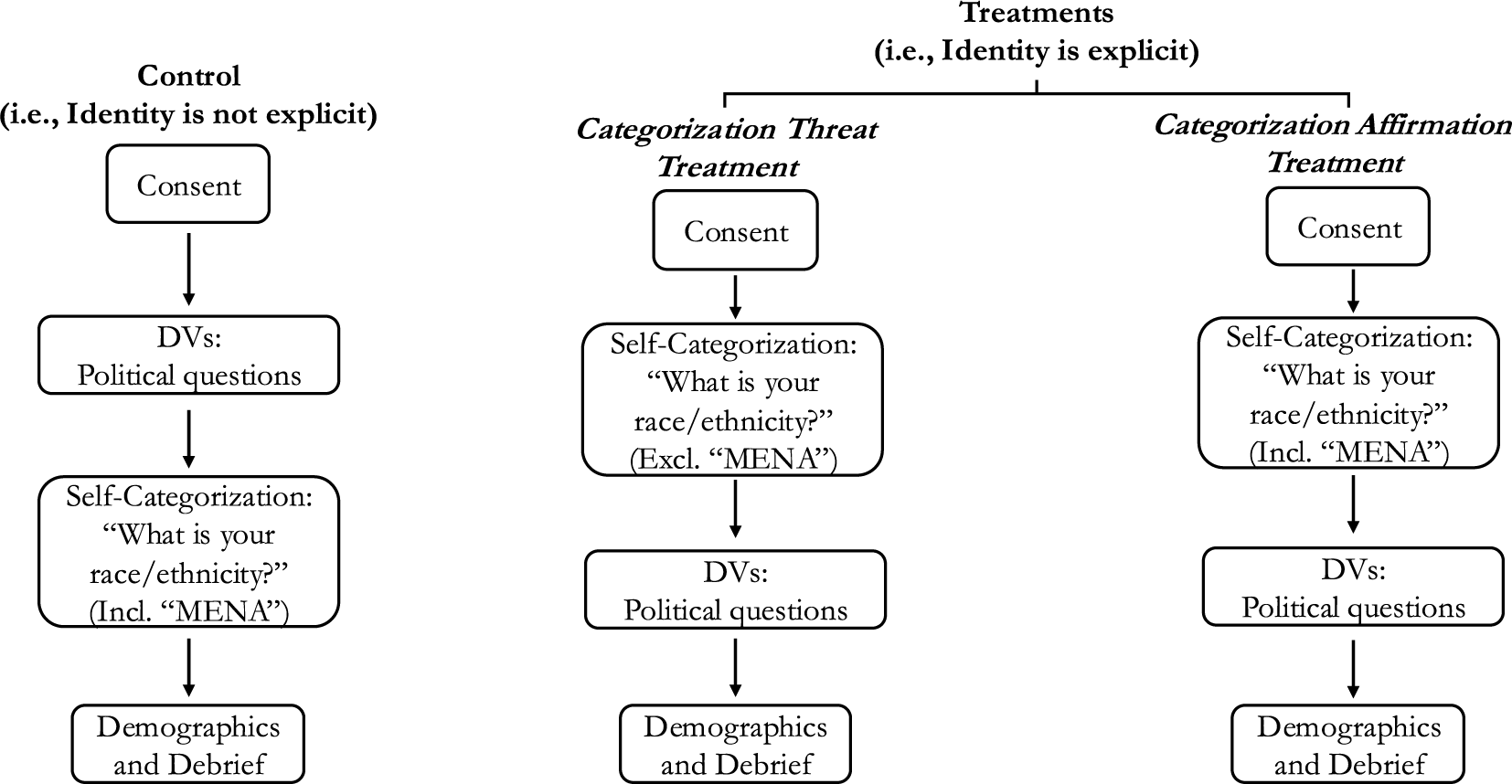
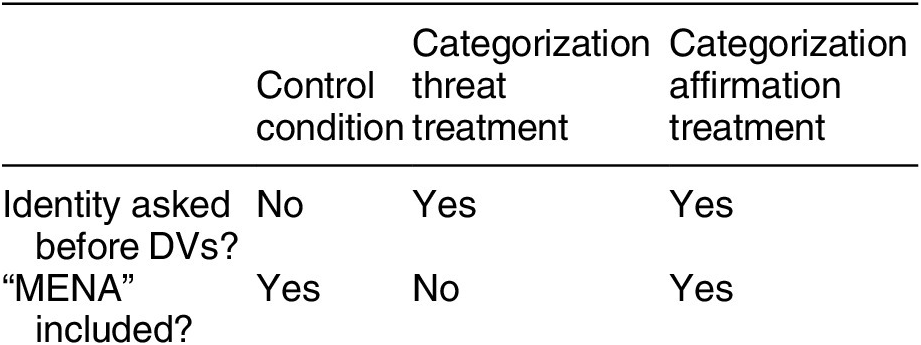
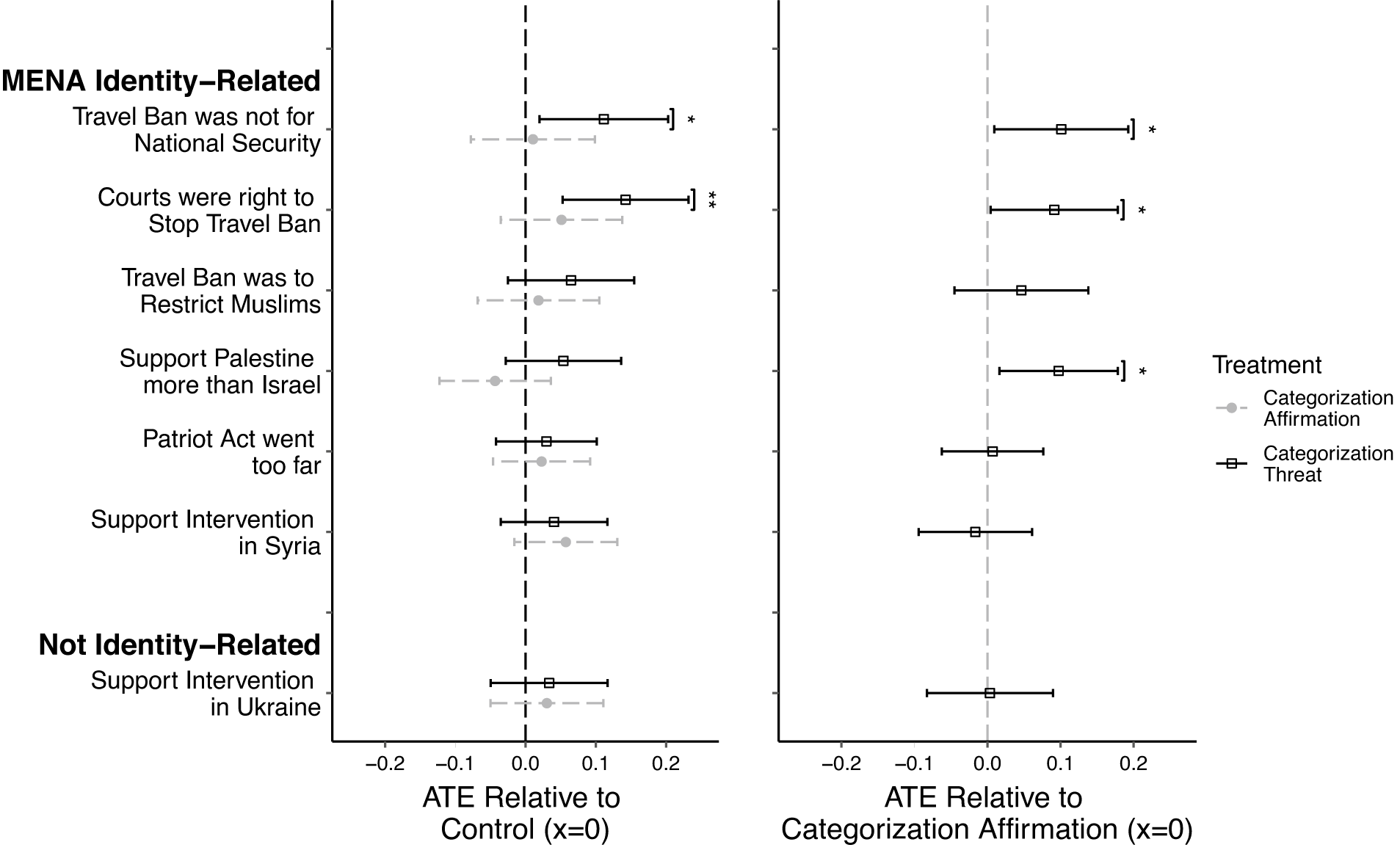
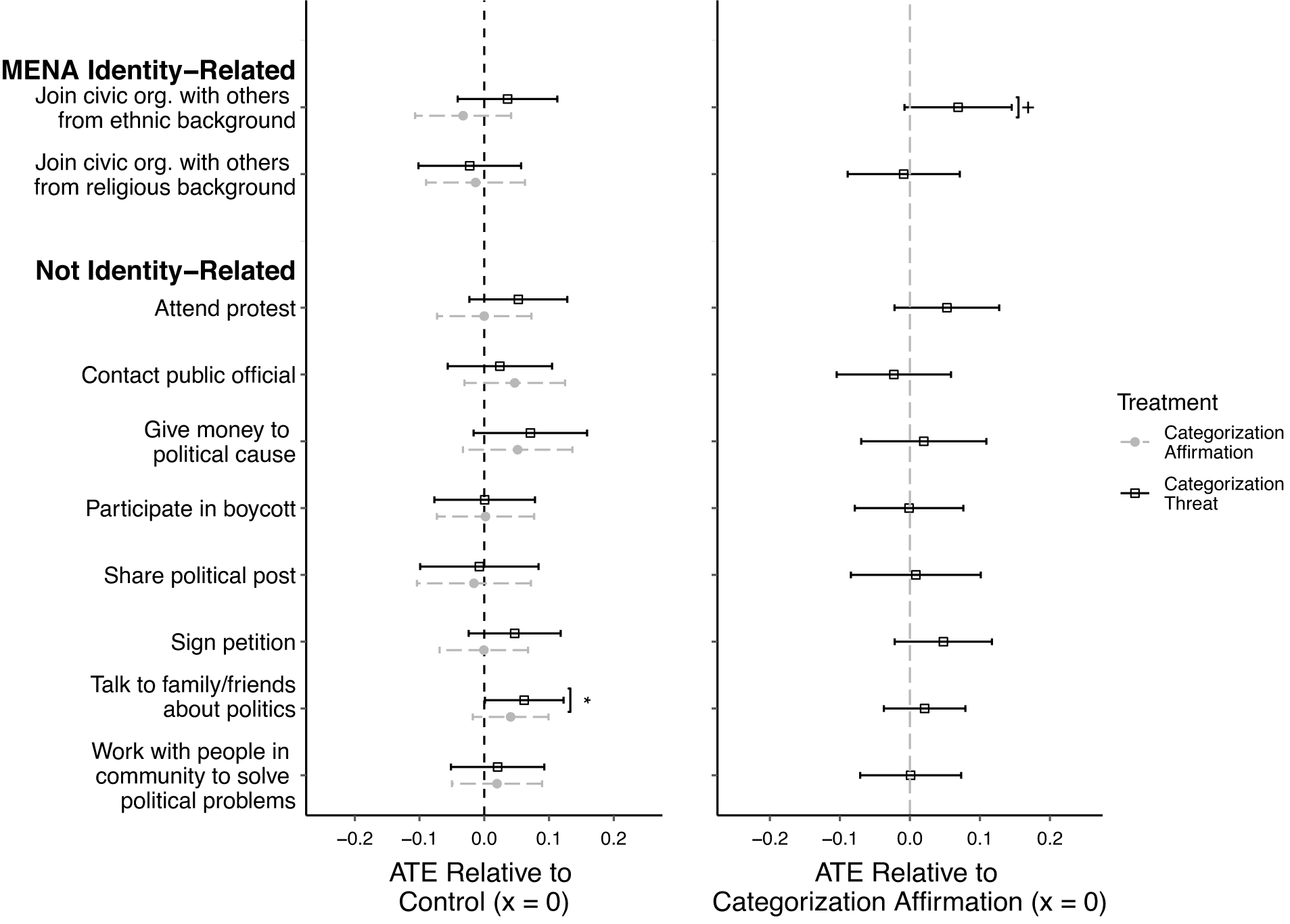
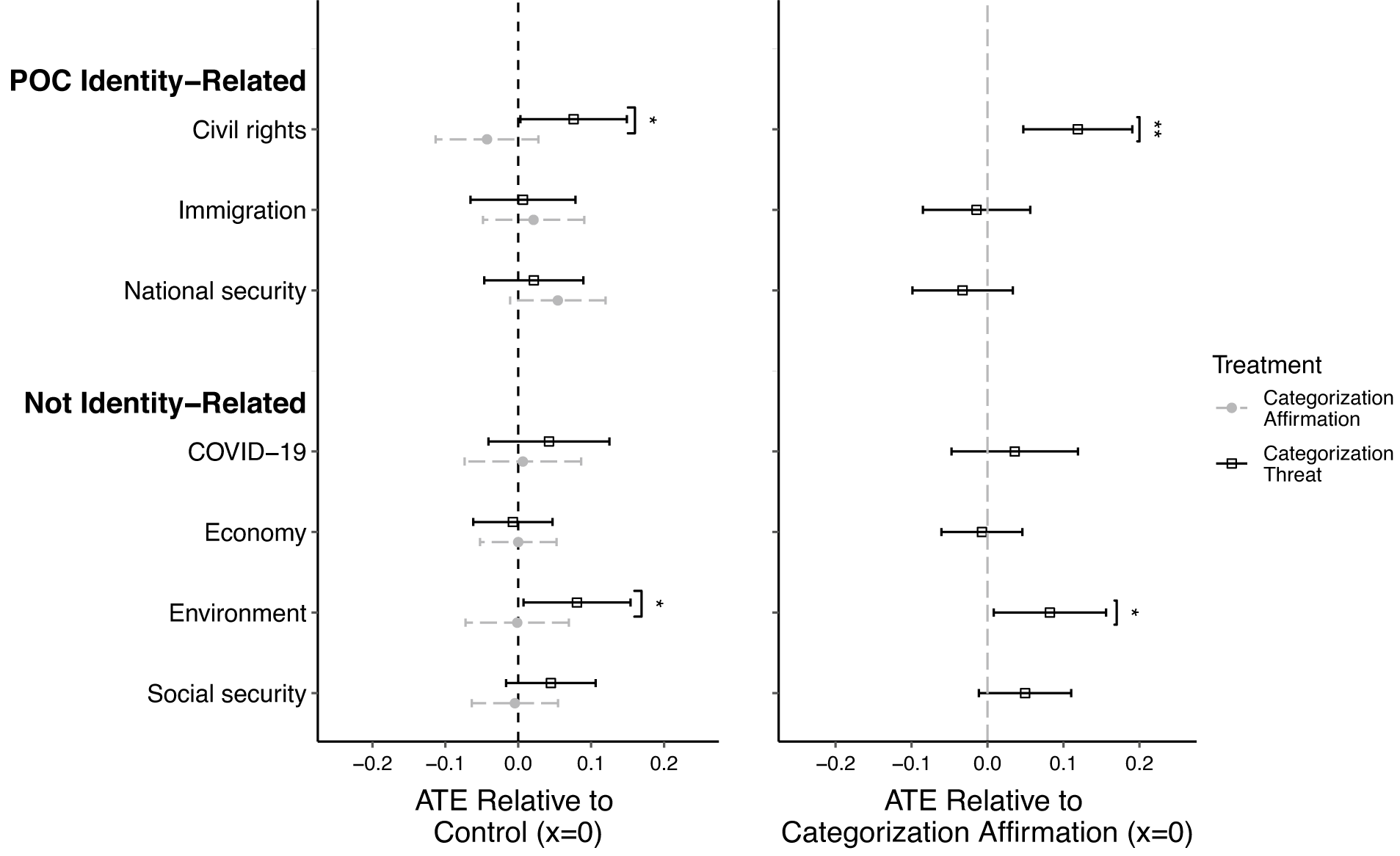
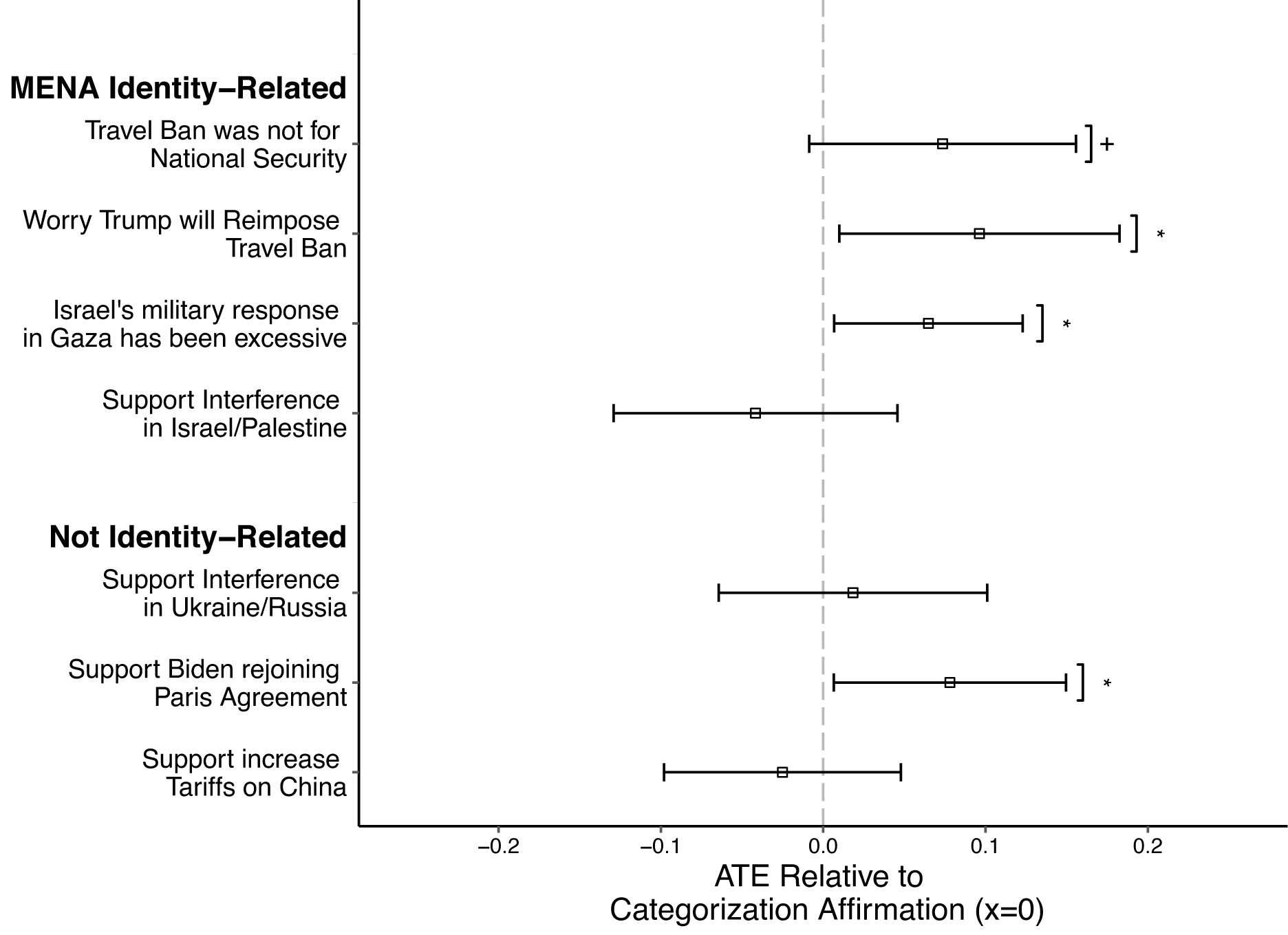
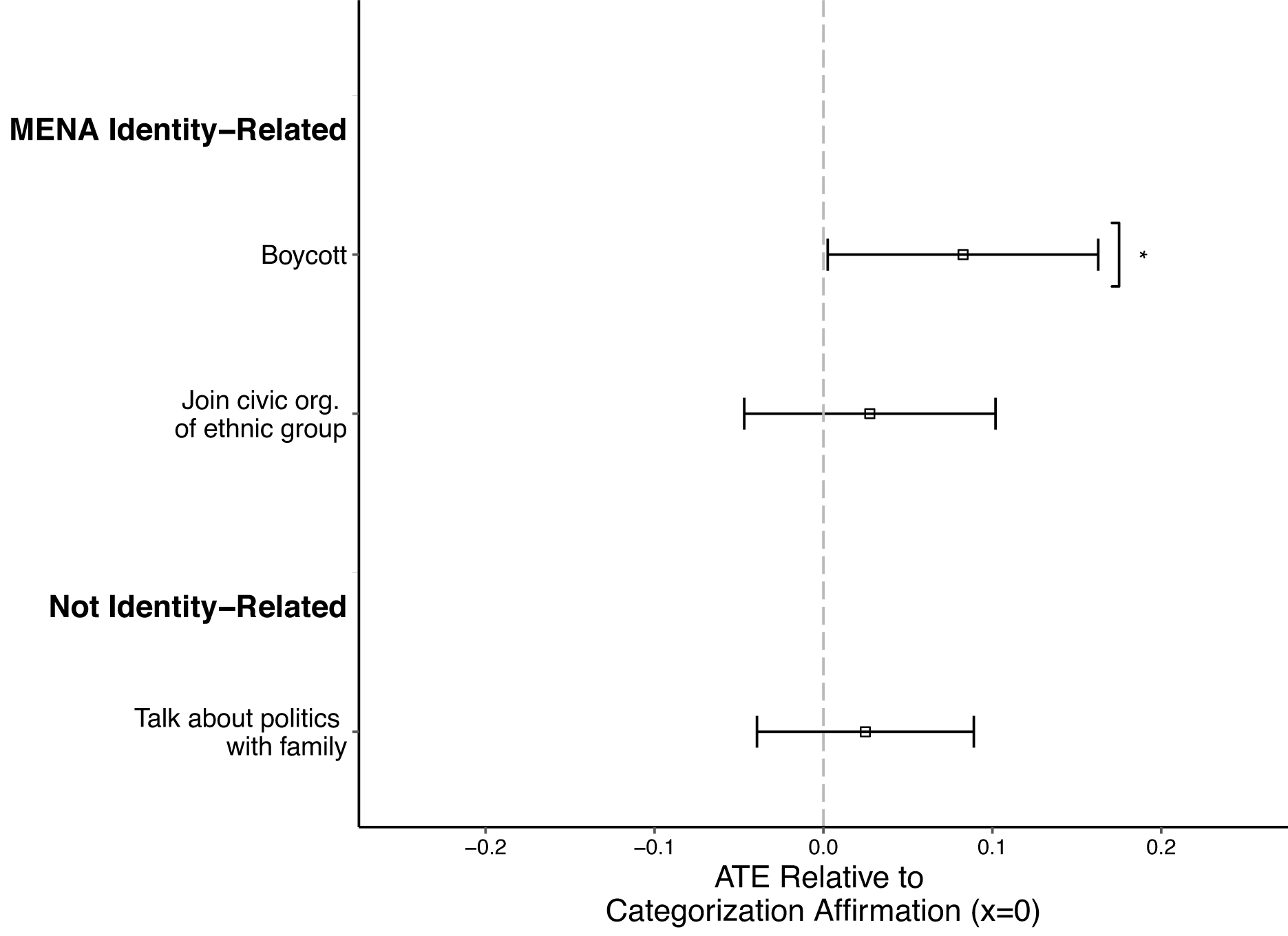
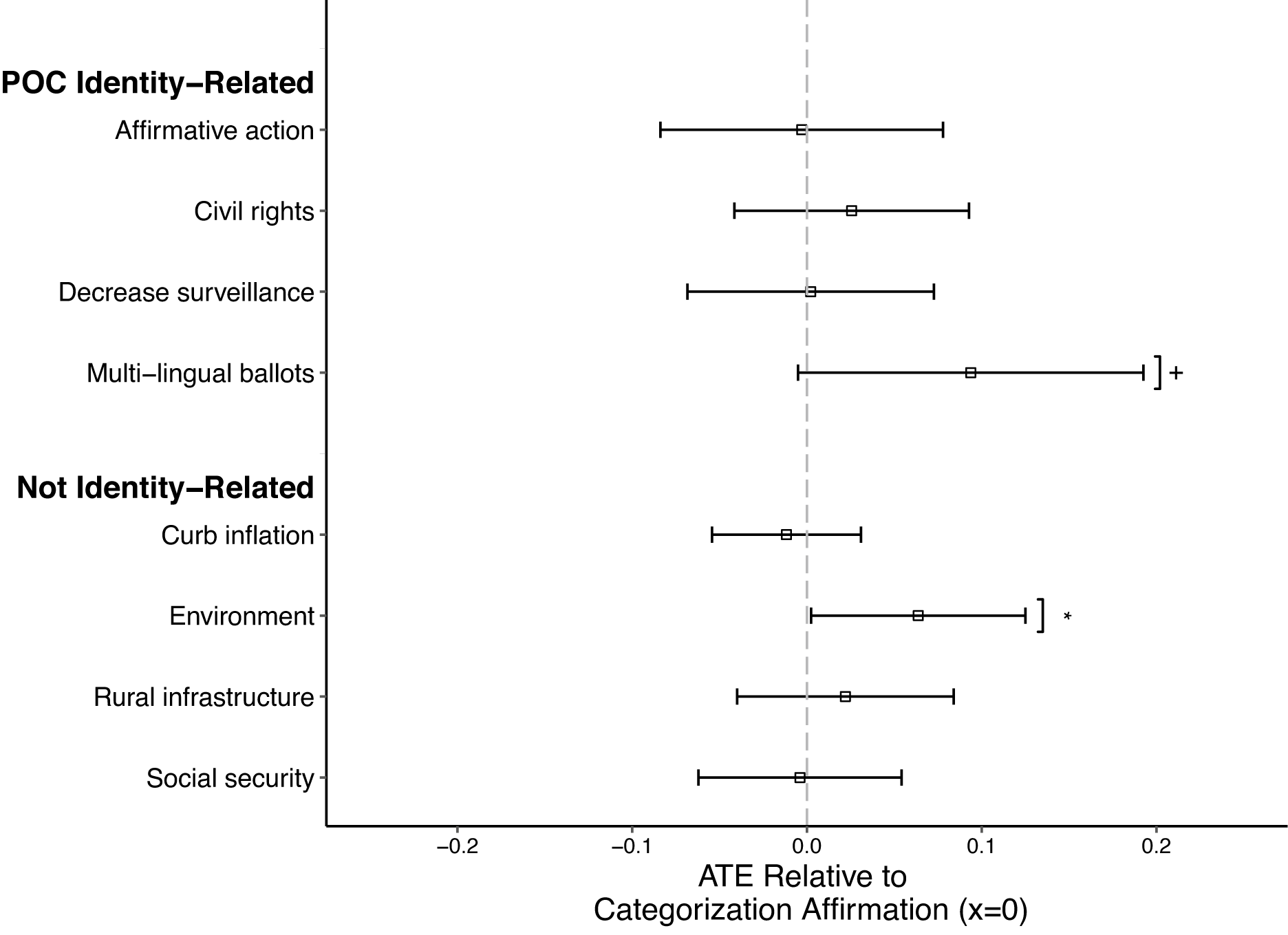
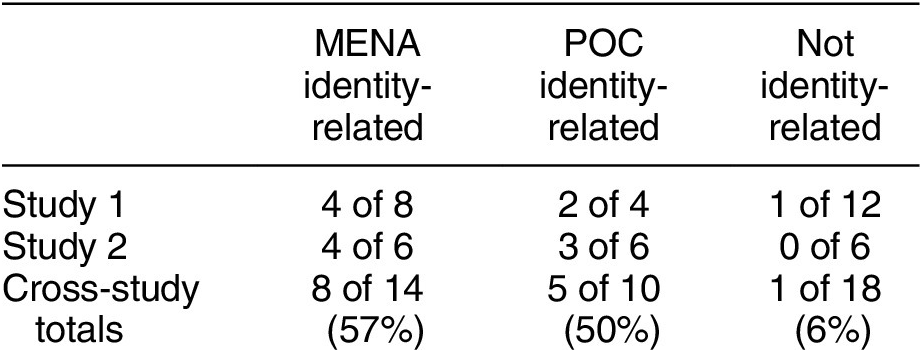
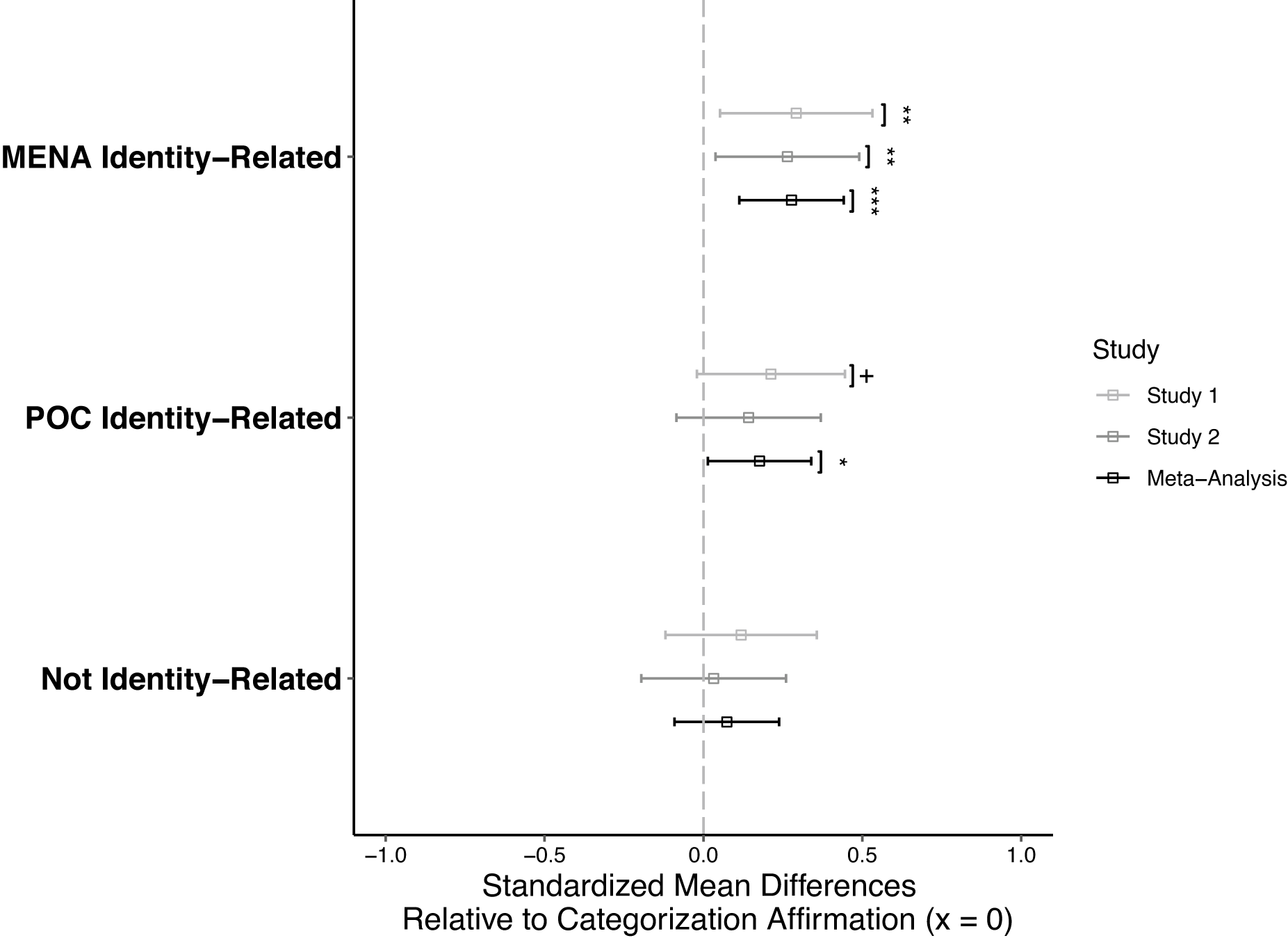


 Open access


Comments
No Comments have been published for this article.