

Public debates about climate change have shifted profoundly over the past decade. The question, for most people, is no longer whether climate change exists but who bears responsibility for it and what can be done about it. As the climate crisis intensifies, the struggle over responsibility has become a critical political battleground. Various actors, including private enterprises and governments, seek to shape the narrative through competing discourses, from accountability to greenwashing. In parallel, the climate movement finds itself in a difficult situation, which many activists describe as a crisis of impotence. Despite clear scientific evidence about the consequences of climate change, meaningful state action remains limited and global emissions continue to rise. The resulting frustration has driven certain groups to radicalize their strategies and tactics, including road blockades, occupation, property damage and industrial sabotage. Some have gone so far as to target public officials for their inaction. The twin dynamics of the politicization of responsibility and the diversification of activist repertoires raise a crucial question: How do publics see radical environmental actions? Why do some citizens tolerate radical actions while others do not?
Despite the prominence of environmental activism in public debates, we know very little about the determinants of public attitudes toward radical environmental action. Research on public attitudes toward tactics such as road blockades, sabotage or targeting officials is scarce. Moreover, our understanding of how public attitudes are structured largely excludes the question of perceived responsibility for climate change. Who do people think is responsible for climate change, and how does this belief affect their attitudes toward environmental activism?
In this article, we address these questions by examining public tolerance for a range of environmental actions in Canada that vary in their degree of radicalism. Using a survey of individual attitudes toward thirteen actions, along with measures of environmental preoccupation and responsibility attribution, we analyze the structure of tolerance for political actions, including disruptive, destructive and violent forms of contestation. We then examine how this tolerance relates to environmental preoccupation and the attribution of responsibility for climate change.
Canada offers an analytically useful case for these questions, as it remains a major fossil fuel producer while experiencing an intensifying environmental mobilization since the Paris Agreement, with groups such as Last Generation, Extinction Rebellion and Fridays for Future contributing to the diffusion of disruptive tactics.Footnote 1 This makes climate politics particularly contentious in the country. Moreover, a defining feature of the Canadian context is the central role of Indigenous-led mobilization, rooted in a long and often-overlooked history of environmental and territorial resistance (Curnow and Helferty, Reference Curnow and Helferty2018). Conflicts over pipeline infrastructure, for instance, have generated sustained forms of resistance rooted in claims for Indigenous self-governance (Do, Reference Do2023). The 2020 solidarity blockades organized in support of Wet’suwet’en opposition to the Coastal GasLink pipeline project illustrate how these struggles can scale into nationwide disruptions. The particular configuration of environmental activism in Canada thus provides a productive setting for examining how citizens evaluate the legitimacy of disruptive and radical environmental actions, as well as public tolerance for such contestation.
We report three findings. First, tolerance for radical environmental actions varies systematically across age groups, education levels and regions of Canada. Second, individuals with a higher environmental preoccupation express greater tolerance for nonviolent but disruptive actions. However, this tolerance largely stops at a “threshold,” as individuals are unwilling to condone destructive or violent methods. Third, who people hold responsible for climate change matters: those who attribute responsibility to governments or corporations show greater acceptance of disruptive tactics than those who blame individuals.
The article proceeds as follows. First, we situate our research within the literature on radical environmentalism and public attitudes toward political violence. We also develop the concept of locus of responsibility to theorize responsibility attribution in climate politics. We then describe our data and methods. Finally, we present our results and discuss their implications for understanding the political boundaries of environmental activism.
Public Attitudes Toward Radical Political Activism
Scholars have long debated the relative effectiveness of violent and nonviolent tactics in political movements. Much of this work has examined how violence helps achieve political outcomes such as leadership turnover, policy reform and regime change (Chenoweth and Schock, Reference Chenoweth and Schock2015; Enos et al., Reference Enos, Kaufman and Sands2019; Soule et al., Reference Soule, Susan, Keith, Berry William, Paul, Jennifer, Ted, Michael, Kris and Laura2004; Tompkins, Reference Tompkins and Coy2007). Findings vary by context, but the current consensus is that nonviolent tactics tend to be more efficient than violent ones (Chenoweth and Cunningham, Reference Chenoweth and Cunningham2013; Howes, Reference Howes2013; Huet-Vaughn, Reference Huet-Vaughn2013; Stephan et al., Reference Stephan, Chenoweth, Ackerman, Bond, Caverley, Clark, Downes, Eidelson, Fuhrmann, Kroenig, Lawrence, Lyall, Mcadam, Mendoza, Merriman, Pearlman, Spector, Toft, Walker and Zunes2008). While armed resistance, particularly when undertaken by radical flanks, may yield short-term strategic leverage, research finds that over time violence generally erodes legitimacy and public support (Chenoweth and Schock, Reference Chenoweth and Schock2015; Wendt, Reference Wendt and Joseph2013).
A parallel body of literature explores how violent protest affects a movement’s appeal to the broader public. In democratic settings, violent tactics tend to alienate potential supporters even when the underlying cause is viewed as legitimate. Violence carries a negative connotation, and people typically see it as unjustifiable. For instance, violence is known to alienate bystander support, making it difficult for them to identify with movement activists (Simpson et al., Reference Simpson, Willer and Feinberg2018). Violence is also generally considered taboo and incompatible with many people’s values and interests, which are crucial to the diffusion of movements (Van Aelst and Walgrave, Reference Van Aelst and Walgrave2001; Soule et al., Reference Soule, Susan, Keith, Berry William, Paul, Jennifer, Ted, Michael, Kris and Laura2004). The public thus tends to place hard moral limits on the use of violent political tactics.
However, those limits vary across individual dispositions and population subgroups. For instance, foundational work on political tolerance underscored the role of perceived threat and internalized democratic values in shaping citizens’ willingness to accept dissent and nonconformity (Sullivan and Transue, Reference Sullivan and Transue1999). More recently, a growing body of research traces how dispositional factors such as aggression, authoritarianism, moral conviction, social dominance orientation and threat sensitivity structure people’s judgments about political violence (Berntzen et al., Reference Berntzen, Kelsall and Harteveld2024; Kalmoe and Mason, Reference Kalmoe and Mason2022; Muñoz and Anduiza, Reference Kalmoe and Mason2019). Research also shows differences between the general public and activists themselves in their perceptions of the radicalism of various methods of contestation (Fisher et al., Reference Fisher, Azedi, Mead and Chris Jayko2025).
Relatedly, the role of media attention and issue salience can structure public views on radical tactics of contestation, as recent works on the “activist’s trade-off”—according to which radical tactics tend to raise the public salience of issues but can also reduce public support for activists—demonstrate (Nylund et al., Reference Nylund, Thai and Hornsey2025; Vandeweerdt, Reference Vandeweerdt2025). In that sense, research mostly shows that disruptive tactics by activist groups can briefly put issues on the agenda. Yet they also have, at best, null or, at worst, negative effects on public attitudes toward such groups (Vandeweerdt, Reference Vandeweerdt2026).
Sociodemographic factors also matter in this issue. Research consistently finds that men and younger people tend to view violence more favorably. For instance, evidence from Spain’s ETA context finds men are more likely to justify violence (Conejero et al., Reference Conejero, Etxebarria and Montero2014). Research on the U.S. links hostile sexism (disproportionately concentrated among men) to support for political violence (Piazza and O’Rourke, Reference Piazza and O’Rourke2025). Recent polling in the United States also shows higher “justifiability” for violence among younger adults than older ones (Enders et al., Reference Enders, Klofstad and Uscinski2024; Norman, Reference Norman2024). These patterns suggest that tolerance for political violence is not evenly distributed across the population but follows identifiable demographic contours.
However, variation in attitudes toward political methods, strategies and tactics is not broadly studied. For instance, one recent study shows that citizens sharply differentiate among tactics “bounded by the norms of the dominant social systems,” those that challenge “the legitimacy of the current social system,” and those that are considered destructive and violent (Zlobina and González Vázquez, Reference Zlobina and Gonzalez Vazquez2018: 236). Indeed, while peaceful but disruptive forms may retain partial legitimacy, violent actions are viewed as less legitimate but more effective. Yet, the broader point is that understanding variation in tolerance for more or less radical political actions is essential to explaining why some groups and movements garner significant support despite employing radical tactics, while others do not. Here, our strategy to address this issue is to disaggregate tactics of contestation into a detailed typology—that is, nonviolent, disruptive, destructive and violent actions—that allows a fine-grained analysis of what the public supports, tolerates and opposes.
Tolerance for Radical Actions and the Locus of Responsibility for Climate Change
While environmental activism has become a focal point for political debates in recent years, we know little about how perceptions of responsibility influence attitudes toward its more radical strands. As public debates shift from whether climate change exists to who is to blame for it, a new line of research has emerged examining who individuals see as responsible for climate change and how this attribution of responsibility affects political attitudes.Footnote 2 Scholars have explored the effects of responsibility attribution on various phenomena, from climate mitigation policies (Jang, Reference Jang2013) to risk perception (Rickard et al., Reference Rickard, Janet Yang, Seo and Harrison2014). For instance, Paço and Gouveia Rodrigues (Reference Paço and Gouveia Rodrigues2016) find that individuals’ perceived responsibility for climate change is only slightly related to their level of environmental activism. Relatedly, Kleres and Wettergren explain how, among environmental activists, the “ascription of guilt can transform potentially demobilizing fear into mobilizing anger” (Reference Kleres and Wettergren2017: 508). Research also shows that one’s felt responsibility to reduce climate change affects future political participation (Munson et al., Reference Munson, Kotcher, Maibach, Rosenthal and Leiserowitz2021). On another level, work on “responsibility frames” shows that citizens differ sharply in their assessments of whether governments, corporations, or individuals are primarily accountable for climate change (McCright et al., Reference McCright, Charters, Dentzman and Dietz2016).
From a normative standpoint, one useful concept is the locus of responsibility, which we use to investigate how the attribution of responsibility for climate change affects tolerance for radical actions. First appearing in discussion in ethics (Weiss, Reference Weiss1939), the locus of responsibility conceptualizes individual agents’ responsibility within a larger social context and among other actors. Scheffler (Reference Scheffler2002), for instance, develops the concept in questioning where to situate responsibility for global injustices, arguing that individuals should not be considered as the primary locus of responsibility for global dynamics since most issues of global justice have transnational, heterogeneous causes beyond individual agency. More recently, the question of responsibility has become a prominent topic in discussions on the ethics of climate change and climate mitigation. One prominent line of research focuses on individual responsibility, as scholars debate how individuals, private enterprises, states and other actors bear varied levels of responsibility for the climate crisis. For instance, Sardo contends that agents are responsible not because of their individual contribution but because of their participation in a global carbon-intensive political and economic system (Reference Sardo2023). Others take this a step further and contend that individual actions that are plausibly detrimental to the environment—for example, driving one’s car—are so insignificant in the grand scheme of things that attributing responsibility to individuals is an untenable position (Kingston and Sinnott-Armstrong, Reference Kingston and Sinnott-Armstrong2018; Sinnott-Armstrong, Reference Kingston and Sinnott-Armstrong2010). By contrast, many scholars argue that we should maintain our focus on individual agency because individuals’ behaviours do negatively, even if only minimally, affect the environment (Broome, Reference Broome2019; Gunnemyr, Reference Gunnemyr2019; Peeters et al., Reference Gunnemyr2014). In parallel, another line of research concerns how responsibility for mitigating climate change should be distributed, with competing options in the current debate including the ability-to-pay (Caney, Reference Caney2010), the polluter-pays (Mittiga, Reference Mittiga, Edmondson and Levy2019) and the beneficiary-pays principles (Page, Reference Page2012).
Beyond normative discussion, however, research on the effects of responsibility attribution on public attitudes toward environmental activism is limited. This is perhaps unsurprising, given the relatively recent emergence of debates over the most appropriate means, if any, of pursuing sociopolitical transformation to tackle climate change. Yet differences in who is perceived as responsible for climate change and for climate mitigation are a central preoccupation in contemporary debates about environmental activism. And beliefs about climate responsibility most likely inform moral judgments about what actions are justified to redress inaction. In fact, people probably adjust their tolerance for, and support of, particular methods of environmental action as a function of who they perceive to be responsible for climate change. For instance, we would expect variation in tolerance for more or less radical methods based on whether individuals see governments, private enterprises or individuals as responsible for climate change.
Here, integrating the literature on responsibility for climate change with research on political violence allows us to examine how the attribution of responsibility for climate change might function as a political filter through which citizens evaluate radical environmental activism. Who do people think is responsible for climate change? Who do people think should bear the costs of resolving the issue? And how does this belief affect their attitudes toward environmental activism?
Data and Methods
We use data collected from a sample of Canadian respondents (n = 1,500) in August 2022. Respondents self-selected into the survey, and data were weighted using sociodemographic variables from the Canadian census to ensure sample representativeness. The survey encompasses sociodemographic characteristics and questions about respondents’ attitudes and preferences toward environmental issues, including their level of preoccupation with climate change. We model determinants of attitudes toward environmental political actions using ordinary least square models.
There are three key features to our research design. First, we ask whether respondents are willing to tolerate a range of actions to advance the environmental cause, from moderate to more radical forms. This measure of individual-level attitudes toward radical environmental actions is a distinctive feature of this survey. Specifically, we measure respondents’ tolerance for thirteen items: signing a petition, boycotting products and companies, divesting from investments, participating in a demonstration, temporarily occupying a public space, tying oneself to a tree or a vehicle, blocking a bridge or a road, blocking the construction of a pipeline, vandalizing objects, sabotaging infrastructure or vehicles, throwing an object at infrastructure or vehicles, confronting police officers in a demonstration and exercising violence against individuals in positions of power. We categorize these items into three types of political action, ranging from low- to high-intensity: nonviolent, non-disruptive actions; nonviolent, disruptive actions; and violent, disruptive actions. This categorization is based on conceptualizations of disruption (Edyvane and Kulenovic, Reference Edyvane and Kulenovic2017; Hayward, Reference Hayward2020) and of other forms of radical contestation (Adams, Reference Adams2018; Malm, 2021; Scheuerman, Reference Malm2021).Footnote 3
Another point is our measure of attribution of responsibility for climate change, which is based on the following question: “What level of responsibility do the following actors have for “taking actions to protect the environment”: not at all responsible; a little bit responsible; partially responsible; completely responsible.”Footnote 4 The actors are corporations, nonprofits, individuals, and the federal, provincial and city governments. We merge all three levels of government in our analysis.
Finally, we construct an original individual-level measure of environmental preoccupation. This measure consists of four variables: “Climate change poses a threat to me in my lifetime,” “How concerned are you about global warming?” “If things continue on their present course, we will soon experience a major ecological catastrophe,” and “Climate change will lead to the end of humanity.” Statistical validity tests confirm that items loaded appropriately on their respective constructs (eigenvalues > 1; loadings > 0.40).
Results
This section presents the empirical findings on attitudes toward radical environmental activism. We first examine general patterns of tolerance toward each political action, disaggregating attitudes across sociodemographic characteristics to assess within-population variation. Next, we investigate how environmental preoccupation shapes individuals’ tolerance toward more radical actions. Finally, we explore how the attribution of responsibility for climate change structures judgment about radical environmental tactics.
Public tolerance for radical environmental actions
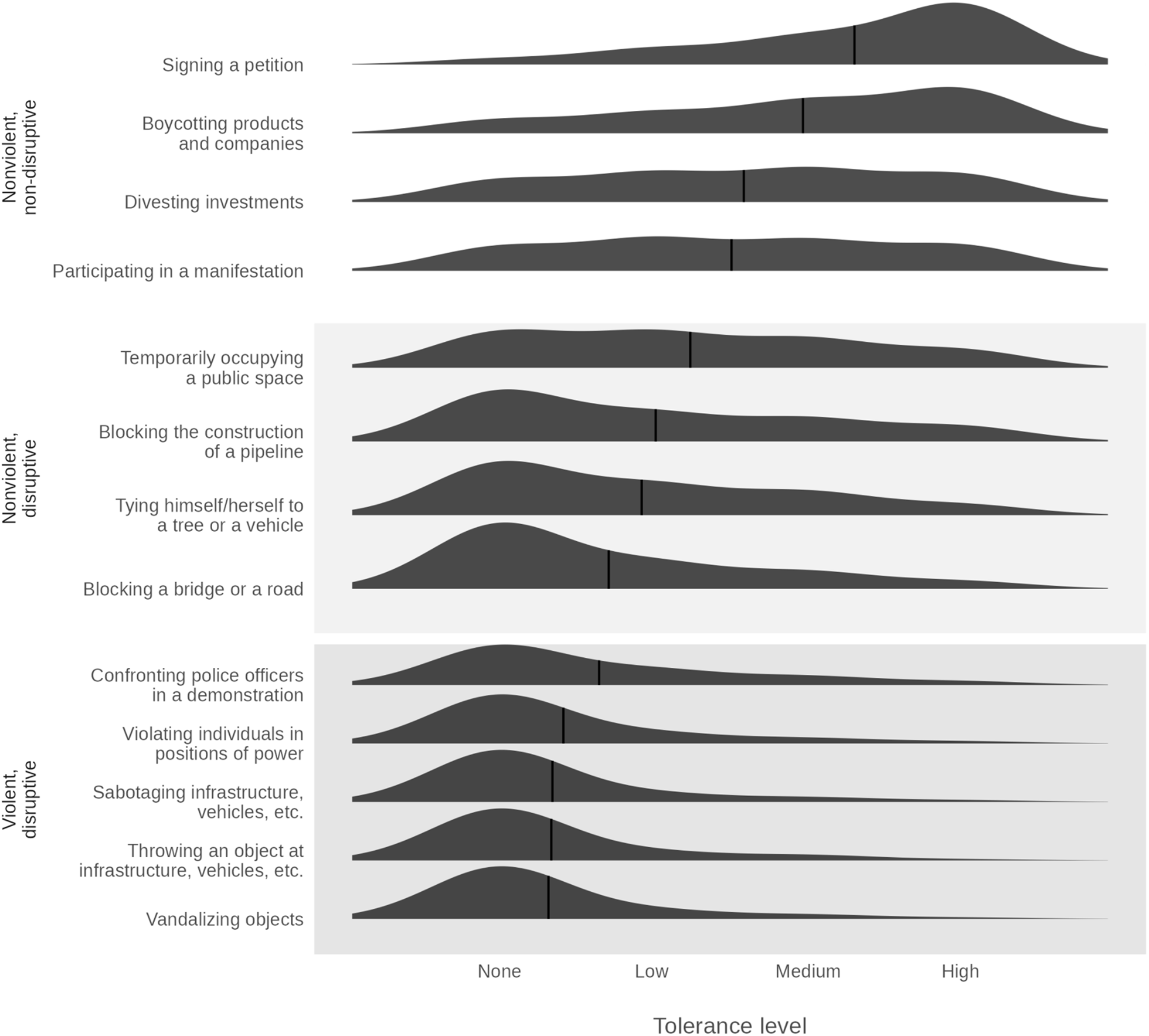
Descriptive analyses of the structure of public attitudes toward radical environmental actions highlight important patterns. For instance, respondents show a high level of tolerance for nonviolent and nondisruptive actions such as signing a petition, engaging in divestment, and boycotting. Yet tolerance is much lower for nonviolent but disruptive actions, such as occupying public spaces or blocking a bridge or road, even though there is variation in respondents’ tolerance within this category. However, when considering actions that involve property destruction and violence, the result is a clear and almost uniform intolerance for such actions (see Figure 1).
Distribution of Tolerance Toward Radical Political Actions.
Source: Synopsis, 2022.

This pattern reveals a “tolerance threshold,” that is, a sharp boundary separating disruptive from openly destructive and violent forms of contestation. While respondents are broadly tolerant of conventional and even disruptive environmental activism, tolerance does not extend to tactics involving material damage or interpersonal violence. This result suggests that citizens’ judgments of activism do not vary linearly with its intensity. Rather, attitudes shift categorically once damage or violence is involved. In other words, attitudes do not follow a gradient of tolerance. They are structured around a sharp rejection of material destruction and violence.
The existence of this tolerance threshold mirrors the dynamics identified in the broader literature on political tolerance (Sullivan and Transue, Reference Sullivan and Transue1999). In that tradition, tolerance reflects the willingness to extend legitimacy to actions one personally disapproves of—a willingness that tends to erode when democratic norms or moral convictions are perceived as violated. Here, this finding suggests that most Canadians uphold a strong normative commitment to nonviolence even in the face of an escalating climate crisis.
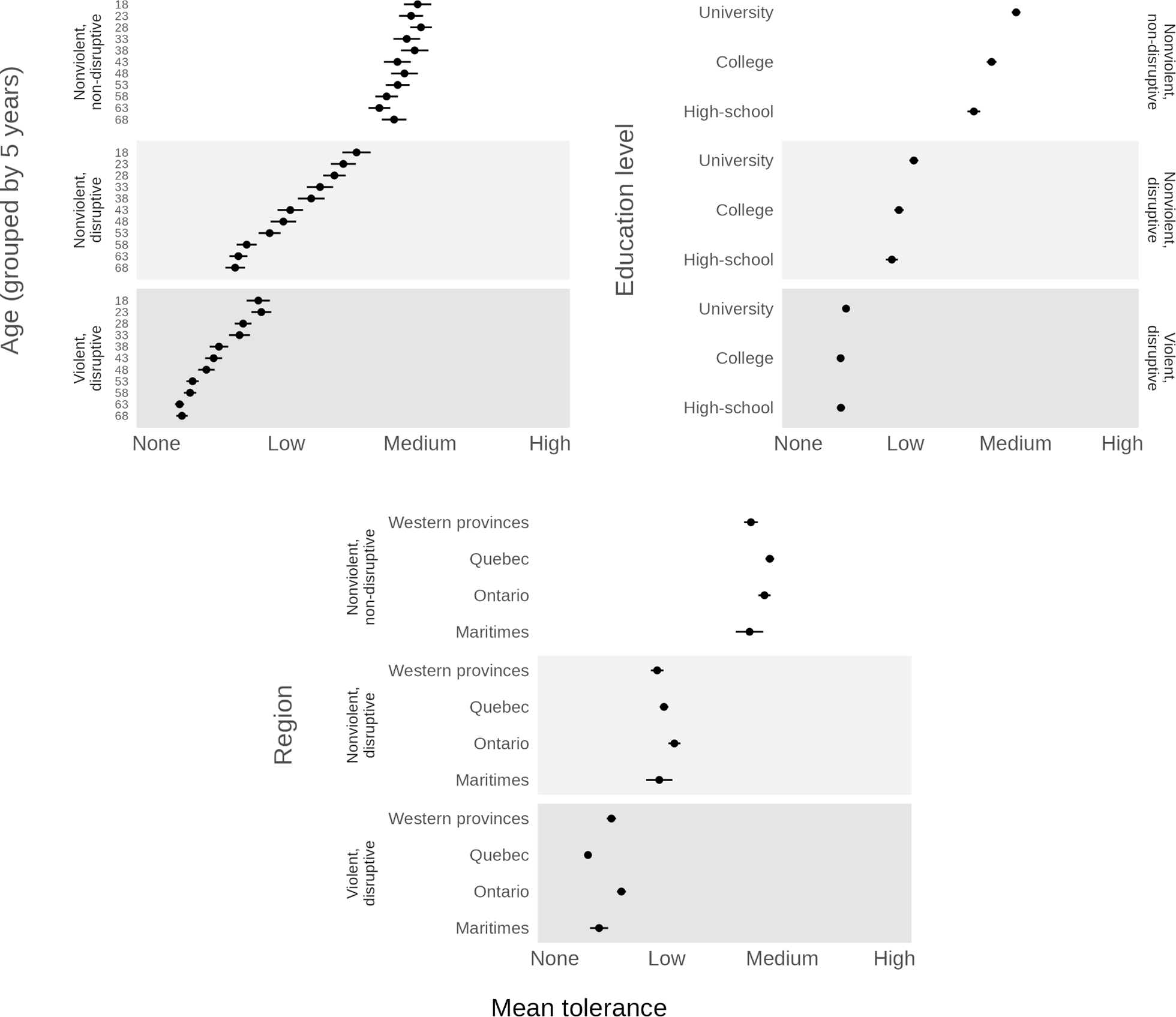
However, further disaggregating this finding by age group, region, and education level highlights important variation in tolerance levels (see Figure 2). There are some clear patterns. First, we see that the mean level of tolerance for property destruction and violent actions is slightly higher among the younger cohort of respondents. Respondents under 33 years old are systematically more tolerant of nonviolent disruptive actions, of material destruction, and of violent actions, although this difference is only statistically significant for the first two categories. But as respondents get older, tolerance declines. The generational cleavage is one of the most consistent predictors in our data. Younger respondents appear more willing to accept forms of disruption. In contrast, older cohorts display markedly lower tolerance for both disruptive and violent tactics.
Tolerance Toward Political Actions, by Age, Education Level and Region.
Source: Synopsis, 2022.
Note: The error bars represent the 95% confidence interval. Due to large error margins, respondents aged over 70 were removed from the age panel in the top-left.

Second, a similar pattern can be observed across education levels. As the education level decreases, respondents show less tolerance for nonviolent, nondisruptive actions. However, this difference is not found when we move to violent, disruptive actions. In this category, respondents display low tolerance regardless of education levels. Thus, education appears to widen tolerance only within the nonviolent but disruptive repertoire of action. Higher education correlates with greater acceptance of nonviolent tactics, but it does not translate into acceptance of property damage or violence. In other words, education enhances the breadth, but not the limits, of tolerance. The boundary between nonviolent, disruptive actions and violent, disruptive actions remains intact across all educational groups.
Finally, the results show a slight variation in tolerance for violent and disruptive actions across regions. For instance, respondents from Quebec and the Maritimes are less tolerant, relative to respondents from other regions, of violent, disruptive actions, including blocking a bridge in protest, targeting police officers, vandalism, and the sabotage of infrastructure. Although we cannot account for this regional difference in tolerance for more radical actions at this point, it raises an interesting question about the genesis of such a regional difference in public attitudes. For instance, Quebec respondents exhibit systematically lower tolerance for all types of radical actions, even after controlling for age, education, and environmental preoccupation. One plausible interpretation is historical and cultural, as the province’s protest tradition—anchored in a collective, performative, but largely peaceful repertoire—might have institutionalized the notion that, to remain a legitimate mode of political participation, contestation should be nonviolent. Quebec’s past experience with political violence in the 1970s may also have established a red line that many Quebecers are unwilling to cross.
Taken together, these demographic patterns point to an important conclusion: Tolerance for radical environmental actions in Canada is socially differentiated but normatively bounded. Age and education broaden citizens’ tolerance for radical activism, yet neither factor erodes the core moral barrier against destruction and violence. Even in contexts of great environmental concern, the public draws a clear line between nonviolence and violence—an empirical manifestation of the tolerance threshold identified earlier.
Environmental preoccupation and tolerance for radical actions
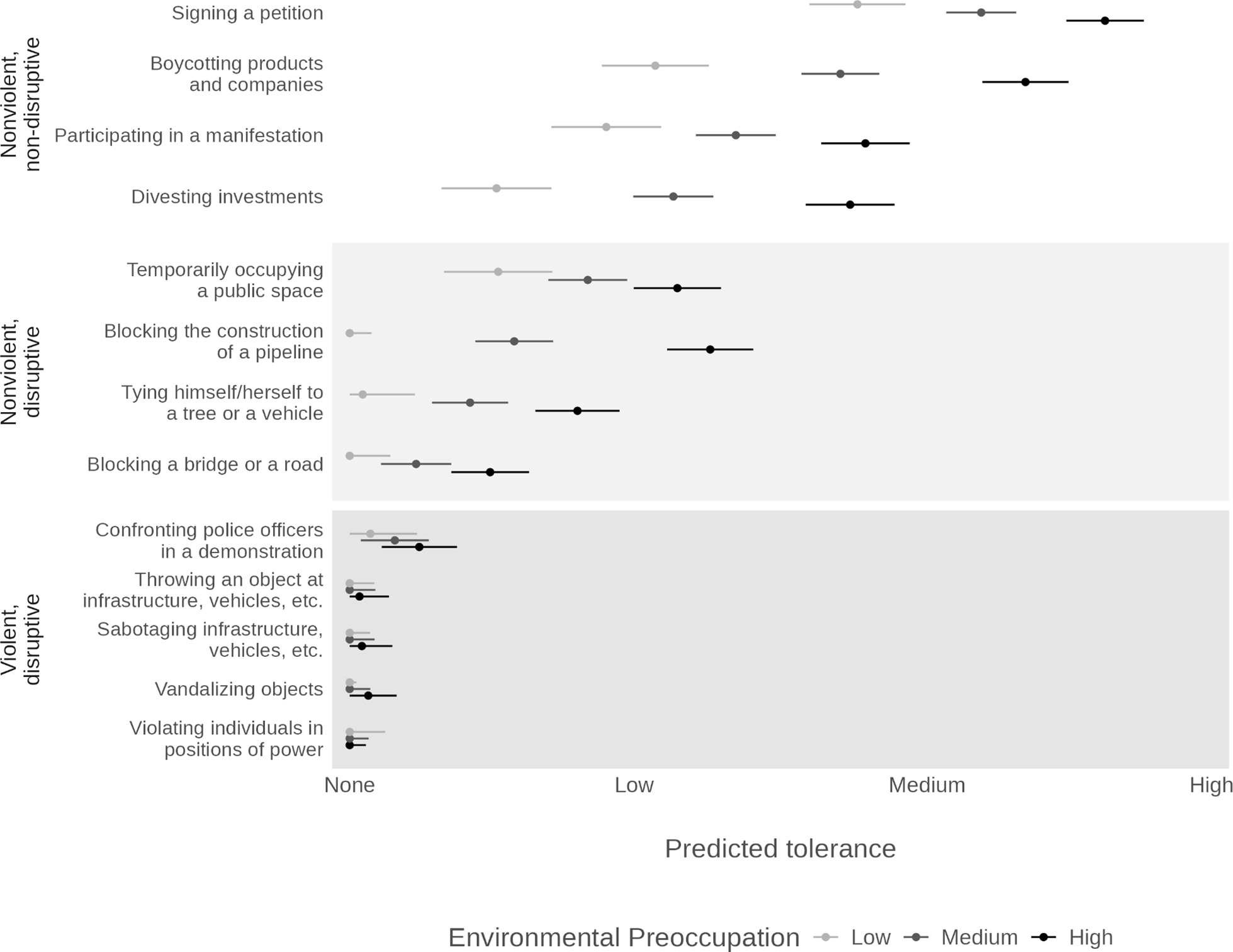
Next, we turn to the question of whether individuals’ preoccupation with the environment shapes attitudes toward political actions, including radical ones (see Figure 3). First, we see that, across our entire sample of respondents, environmental preoccupation is correlated with support for nonviolent, nondisruptive actions and for nonviolent, disruptive ones. However, the important point is that environmental preoccupation ceases to matter in explaining tolerance for political actions once destructive and violent tactics are involved. Tolerance for actions in this latter category is unrelated to respondents’ level of preoccupation with the environment.
Environmental Preoccupation and Tolerance for Political Actions.
Source: Synopsis, 2022.
Note: Predicted tolerance estimated by linear regression models, keeping other variables constant. Details on the models can be found in Tables 1.1, 1.2 and 1.3 in the Appendix.

This finding is striking, given the intensity of current concern about climate change. Even among those who express deep environmental anxiety or who perceive climate change as an existential threat, tolerance for destructive or violent tactics does not increase. Such concern amplifies tolerance for actions within the “conventional” boundaries of contestation, but it does not erode those boundaries. This effect is indeed statistically visible but capped. For low-intensity actions such as petitions and demonstrations, a one-unit increase in environmental preoccupation corresponds to roughly a 0.4-point rise in tolerance (P <0.01). Yet beyond the mid-intensity threshold—road blockade, occupation, sabotage—the effect disappears entirely. This sharp break reinforces the idea that moral rather than instrumental considerations determine support for radical activism.
What we see here can, again, be considered a tolerance threshold. This threshold structures individuals’ tolerance for political actions based on their intensity, such that tolerance is capped at low-intensity actions, thereby excluding mid- and high-intensity actions involving property destruction and violence. In other words, it seems that there is a certain point at which people cease to tolerate more radical actions regardless of their prior level of preoccupation with the fate of the planet. In fact, we find that the tolerance threshold is quite low even for those with high levels of environmental preoccupation.
One important aspect of this point is that it suggests that preoccupation with the environment does not lead respondents to forsake their commitment to largely nonviolent, nondisruptive actions. While we cannot find the ground that accounts for this, we might nonetheless—as a working hypothesis—suggest that there is a plausible connection between this empirical cap in tolerance for radical actions and individuals’ socialization into social norms of nonviolent conflict resolution.
Taken together, these results show that environmental concern functions as a mobilizing sentiment rather than a radicalizing one. It might deepen commitment to activism but does not legitimize destructive and violent methods of contestation. The fact that such a tolerance threshold remains firm, even in a context marked by increasingly frequent environmental emergencies across the country, is a revealing indicator of how social norms of nonviolence continue to shape public responses to the climate crisis.
Attribution of responsibility for climate change and tolerance for radical actions
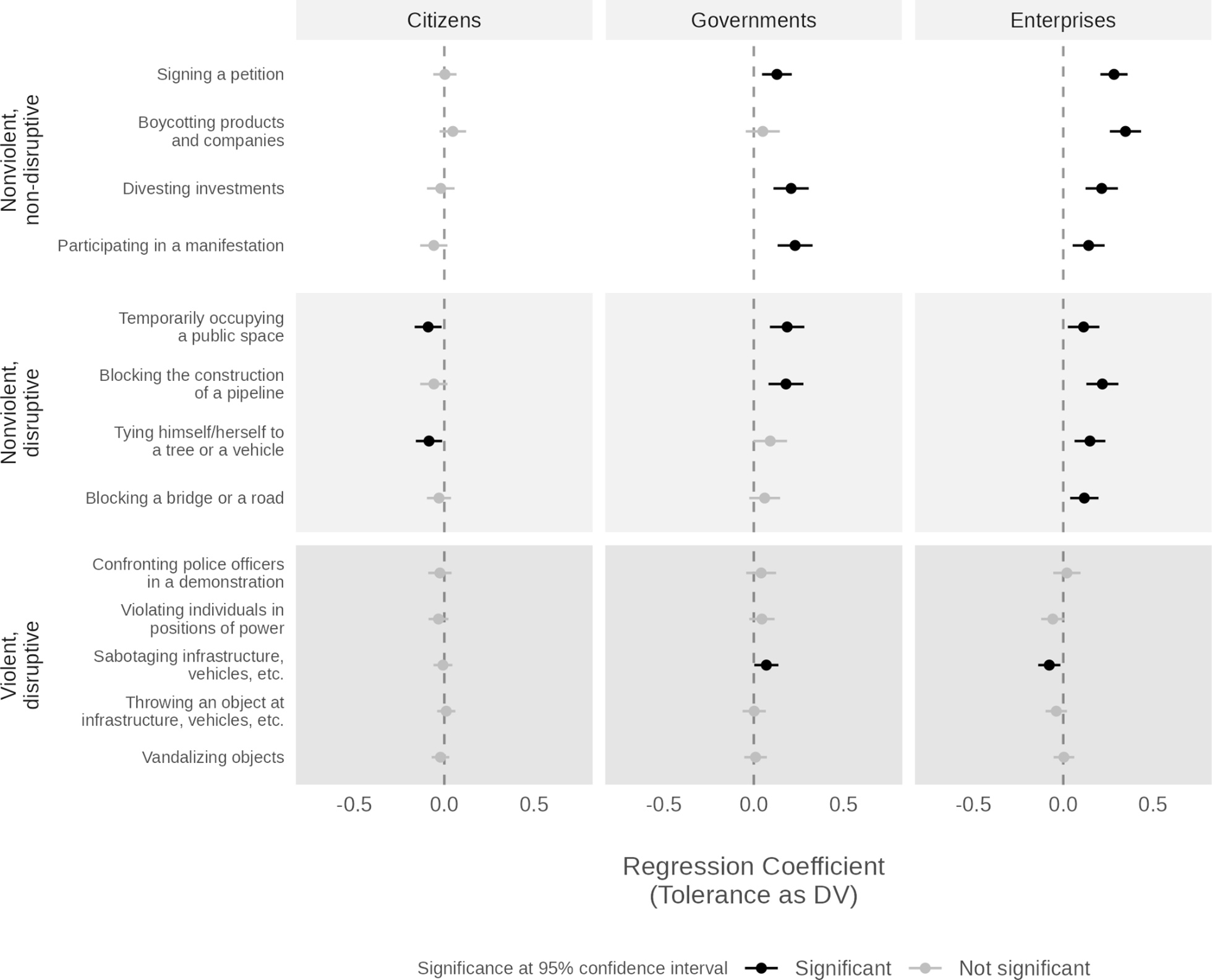
We now examine how the attribution of responsibility for climate change shapes respondents’ tolerance for specific political actions. This provides important insights into the nature of such tolerance. Findings show substantial variation based on whether respondents consider (a) citizens, (b) private enterprises, or (c) governments as mostly responsible for climate change (see Figure 4). For instance, when responsibility is attributed to citizens, respondents show less tolerance for mid- and high-intensity political actions. However, when responsibility is attributed to private enterprises, respondents display more tolerance for the full range of nonviolent but disruptive actions—that is, blocking the construction of a pipeline, tying oneself to a tree or a vehicle, occupying public space, and blocking a bridge or a road. This tolerance does not extend to destruction and violent actions, however. As for the attribution of responsibility for climate change to the government, the results show that respondents exhibit higher tolerance for the occupation of public space and the blockade of pipeline construction, as well as for one destructive action: the sabotage of infrastructure.
Attribution of Responsibility for Climate Change and Tolerance for Political Actions.
Source: Synopsis, 2022.
Note: Details on the models can be found in Tables 2.1, 2.2 and 2.3 in the Appendix.

These patterns suggest that citizens’ reasoning about contestation is filtered through their reasoning about blame. People are more tolerant of disruptive tactics when the actors targeted are perceived as responsible for the problem. In other words, tolerance for radical action appears to follow an implicit logic of discrimination, in the sense that actions are deemed more legitimate when directed toward the agents held culpable for the situation.
Results also show the strength of this dynamic. Respondents who assign “complete responsibility” to governments or corporations score on average 0.30–0.35 points higher on the tolerance index for disruptive tactics than those who blame individuals (P <0.05). By contrast, those emphasizing individual responsibility consistently register the lowest levels of tolerance across all forms of contestation. This pattern remains robust when controlling for age, education, and environmental preoccupation.
This finding provides empirical support for the concept of a locus of responsibility. Individuals’ attributions of responsibility—whether downward toward individuals or upward toward governments and enterprises—anchor their evaluation of political action. When blame is externalized onto powerful collective actors such as governments and corporations, citizens appear to see radical protest as more justified. When blame is directed toward individuals, radical actions seem excessive or misplaced. This moral calibration can help explain why some forms of radical activism elicit sympathy while others provoke condemnation.
Theoretically, this mechanism connects debates in moral psychology and social movement research. It shows that tolerance for radical environmental actions is not simply a function of ideology or environmental concern. It is also connected to how people interpret responsibility for the climate crisis. Those who place responsibility in powerful institutions are more willing to condone activists’ norm violations, interpreting them as proportional responses to institutional failure. By contrast, those who locate responsibility among citizens are more likely to view such activism as illegitimate.
This result expands our understanding of political tolerance beyond attitudinal predispositions (Sullivan and Transue, Reference Sullivan and Transue1999) by incorporating a moral dimension of causal reasoning—who is to blame and, therefore, who deserves to be targeted. It also aligns with recent findings showing that judgments of protest legitimacy depend on the perceived congruence between tactics and targets (Zlobina and González-Vázquez, Reference Zlobina and Gonzalez Vazquez2018). In our data, this congruence operates through responsibility attribution, as the more respondents view governments or enterprises as responsible, the more they accept radical tactics directed at them.
Taken together, these results reveal that tolerance for radical environmental activism is not static but relational, insofar as it depends on how citizens map responsibility within the climate crisis. The locus of responsibility thus serves as a cognitive bridge between moral judgment and political tolerance, shaping who the public believes may legitimately be targeted, and by what means.
Discussion
Public concern about the climate crisis has increased in recent years. Yet, this intensifying preoccupation has not translated into broader public willingness to tolerate more radical forms of environmental contestation. Our results reveal that public tolerance toward environmental political action is structured by a double boundary—one defined by the intensity of tactics and another by the attribution of responsibility for climate change. The broader pattern is strikingly consistent: people largely endorse nonviolent forms of contestation, have mixed feelings about disruptive ones, and reject destruction and violence. Even among respondents who display high levels of environmental preoccupation, tolerance collapses when tactics cross into sabotage, vandalism, or interpersonal violence. This tolerance threshold underscores the force and stability of social norms that separate nonviolent dissent from destructive and violent contestation.
At the same time, our findings show that tolerance for radical environmental activism is not merely attitudinal but relational. It depends on how citizens assign responsibility for climate change. Individuals who hold governments or enterprises primarily responsible exhibit higher tolerance for disruptive tactics, while those assigning responsibility to citizens are the least tolerant, including of conventional strategies of protest.
More broadly, these findings highlight why radical flanks within the climate movement face persistent legitimacy barriers despite the growth in environmental concern. Public preoccupation with climate change does not automatically confer license for radical politics. Even in the face of a perceived climate threat, most citizens remain unwilling to legitimize sabotage or vandalism. This reinforces a central insight from the moral psychology of protest: moral conviction and moral constraint coexist. Citizens may experience intense moral urgency yet remain bound by powerful norms of nonviolence and civic restraint.
From a democratic perspective, the endurance of this tolerance threshold is both reassuring and troubling. On one hand, it reaffirms the strength of social norms that reject violence as a tool of political change. Even in an age of planetary emergency, one of the core pillars in the moral architecture of democratic societies remains intact. On the other hand, it exposes the rigidity of democratic publics in the face of an existential crisis. When institutional channels fail to deliver adequate environmental action, and yet the public remains averse to radical means of social change, societies face the dilemma of reconciling the urgency of preserving essential ecosystems with the moral limits of democratic contestation. This tension between ecological urgency and democratic restraint may well define the future terrain of climate politics.
Supplementary material
The supplementary material for this article can be found at https://doi.org/10.1017/S0008423926101310.


 Open access

