




Introduction
Aligned with older adults’ expressed preferences, provincial and national policies and programs have emphasized supporting ‘aging in place’ (Government of Alberta, 2010; National Institute on Ageing, 2022; Nova Scotia Department of Seniors, 2017) – a focus that is increasingly important given projected growth in the proportion of Canadians aged 65 years and older (Statistics Canada, 2018). Aging in place is a term used to generally describe the desire to grow old in one’s home and community of choice with appropriate resources and supports (Bigonnesse & Chaudhury, Reference Bigonnesse and Chaudhury2020). A growing body of empirical research has explored strategies to facilitate aging in place, with community-based programming emerging as a particularly effective and sustainable approach (Chum et al., Reference Chum, Fitzhenry, Robinson, Murphy, Phan, Alvarez, Hand, Laliberte Rudman and McGrath2022).
Naturally Occurring Retirement Communities (NORCs) are geographical areas, developments, or communities that are not specifically planned for older adults but which over time come to house a high proportion of older adult residents (Hunt & Gunter-Hunt, Reference Hunt and Gunter-Hunt1986). NORCs provide an ideal context for targeted community-based interventions to support aging in place (DePaul et al., Reference DePaul, Parniak, Nguyen, Hand, Letts, McGrath, Richardson, Rudman, Bayoumi, Cooper, Tranmer and Donnelly2022; Greenfield, Reference Greenfield2014). However, a recent population-based study compared the unmet health needs of older adults living in NORCs with those living in the broader community and found that NORC residents experience significantly more unmet health needs (Savage et al., Reference Savage, Huynh, Hahn‐Goldberg, Matai, Boblitz, Altaf, Bronskill, Brown, Feng, Lewis‐Fung, Sheth, Yu, Recknagel and Rochon2025). Evidence from the United States shows that NORC-based programs are both cost-effective and beneficial to the health and wellbeing of older adults (Bedney et al., Reference Bedney, Goldberg and Josephson2010; Masotti et al., Reference Masotti, Fick, Johnson-Masotti and MacLeod2006). Such outcomes can be attributed to the fact that NORC-based programs bring together older people where they live and offer group activities, social events, and services to build social connections and community ties, supporting them to age in their homes and communities (Parniak et al., Reference Parniak, DePaul, Frymire, DePaul and Donnelly2022). These programs are often driven by older adults, enabling them to support one another and take active roles in shaping their communities (Greenfield et al., Reference Greenfield, Scharlach, Lehning and Davitt2012).
Within Canada, research on NORC and NORC-based programs remains limited (Parniak et al., Reference Parniak, DePaul, Frymire, DePaul and Donnelly2022). Among the few existing studies, a pandemic initiative conducted in Toronto Metropolitan area described the implementation of mobile onsite COVID-19 vaccination clinics within high-rise apartment buildings (Huynh et al., Reference Huynh, Sava, Hahn-Goldberg, Recknagel, Bogoch, Brown, Dubey, Isaacksz, Juni, Kouyoumdjian, Maltsev, Manuel, Martin, Matlow, McGeer, Mills, Niedra, Powis, Rochon and Brown2021). Another study offered a detailed, step-by-step process for identifying NORCs and implementing a NORC-based program (DePaul et al., Reference DePaul, Parniak, Nguyen, Hand, Letts, McGrath, Richardson, Rudman, Bayoumi, Cooper, Tranmer and Donnelly2022). In addition, three studies have explored the experience of a NORC-based program from the perspective of older adult members (Fernandes et al., Reference Fernandes, Hand, Laliberte Rudman, McGrath, Cooper, Donnelly, DePaul, Letts and Richardson2024; Garcia Diaz et al., Reference Garcia Diaz, Durocher, McAiney, Richardson and Letts2023; Mills et al., Reference Mills, Parniak, Hand, McGrath, Laliberte Rudman, Chislett, Giberson, White, DePaul and Donnelly2022). Together, these studies highlight a growing recognition of potential benefits of programming in NORCs in Canada and lay the groundwork for more targeted research and program development to support aging in place. A key part of this conversation is the role of housing partners, who are increasingly recognized as central to enabling aging in place.
Housing partners’ role in supporting aging in place
Housing partners, in particular social housing, are increasingly offering onsite programs and services to older adults, either on their own or in partnership with community organizations and research initiatives (Dong, Reference Dong2018; Sheppard, Hemphill, et al., Reference Sheppard, Hemphill, Austen and Hitzig2023a). Evidence shows that such onsite programs across diverse social housing settings not only reduce access barriers but also positively impact older adults’ physical health, wellbeing, and social connectedness (Dong, Reference Dong2018; Sheppard, Kwon, et al., Reference Sheppard, Kwon, Yau, Rios, Austen and Hitzig2023b). For example, a supportive housing facility, called The Residence, in Toronto, offers a wide range of onsite programs and amenities, including wellness activities, volunteer-run services, and communal spaces to older adults. Tenants reported that these facilities enhanced their quality of life by promoting social interaction and a sense of belonging (Dong, Reference Dong2018). In addition to delivering programs themselves, housing providers play a central role in the implementation of onsite programs that can range from the provision of logistical support (e.g., providing space) to active promotion of onsite services (Lucio & McFadden, Reference Lucio and McFadden2017; Resnick et al., Reference Resnick, Brandt, Holmes and Klinedinst2024). For example, in the United States, the success of an Interdisciplinary Wellness Clinic in low-income senior housing was largely attributed to the engagement of property managers, who promoted the clinic and encouraged participation of older adults residing in their building (Resnick et al., Reference Resnick, Brandt, Holmes and Klinedinst2024). In Toronto, social housing providers partnered with municipal agencies to embed services that addressed both health and housing stability, demonstrating how cross-sectoral collaboration can enhance outcomes (Sheppard et al., Reference Sheppard, Gould, Guilcher, Liu, Linkewich, Austen and Hitzig2022).
However, implementing onsite programs can present challenges, particularly when multiple agencies are involved. Key issues include coordinating the program across organizations, navigating different reporting requirements, sharing confidential information, and scheduling programs around staff availability (Yaggy et al., Reference Yaggy, Michener, Yaggy, Champagne, Silberberg, Lyn, Johnson and Yarnall2006). Additional barriers include unclear role definitions, ambiguous decision-making, staff turnover, and low awareness among housing personnel regarding the benefits of onsite programming (Sheppard et al., Reference Sheppard, Gould, Guilcher, Liu, Linkewich, Austen and Hitzig2022).
While these studies have enhanced our understanding of onsite programs, particularly those implemented in social or congregate housing, there has been no exploration of the housing partners’ perspectives on the barriers and facilitators of implementing NORC-based programs. NORC-based programs are different than other older-adult focused programs, which may be short-term time-limited programs, limited in programming focus, provided in age-segregated settings, and require participants to travel significant distance to the program. This study sought to fill this gap by exploring diverse housing partners’ experiences with the implementation of a NORC-based program, Oasis, guided by the following questions:
-
1. How do housing partners experience the implementation of the Oasis program, including the facilitators and barriers of program implementation?
-
2. What are the perceived benefits of the Oasis program from the perspective of a housing partner?
-
3. What would enhance and support the implementation and sustainability of Oasis program?
Overview of the Oasis program
Oasis is a NORC-based program that was first developed in 2009 by a group of older adults living in an apartment building in Kingston, Ontario, in collaboration with the Kingston Council on Aging (see: https://www.oasisagingwell.com/). Since 2018, the Oasis model has been further refined and implemented in other NORCs. At the time of data collection in August 2024, the Oasis program was operating in 19 locations. Expansion has continued, with 22 sites now established across 12 Canadian cities, in 4 provinces. Participating communities include vertical NORCs (e.g., social housing, market-priced apartments, condominiums), and horizontal NORCs (e.g., neighbourhoods, co-op housing developments, mobile home communities). Each location has a housing partner and is supported by a community organization (e.g., community-based seniors-serving organization) and university partner.
The Oasis program is founded on principles of empowerment and community development to create meaningful opportunities for older adults to shape activities around their shared interests and needs. Empowerment is both a process and an outcome through which individuals gain greater control over decisions that affect their lives (Falk-Rafael, Reference Falk-Rafael2001). Aligned with a focus on empowerment, community development centres the lived experience and wisdom of community members as essential to driving meaningful change while also emphasizing inclusion, equity, and collective action (Kenny & Connors, Reference Kenny, Connors and Cambell-Avenell2017). Guided by these foundations, Oasis focuses on three core areas known to foster healthy aging and community ties: communal nutrition activities, such as shared meals and community kitchens; group-based physical activity, such as exercise classes, dance, and gardening; and social engagement through activities like games, guest speakers, and coffee gatherings. Older adults who join the program play an active role in identifying activities to be provided at their site or leading and supporting the delivery of programs as able. In addition, Oasis leverages existing community programs and services by identifying and engaging health and social support services and programs (e.g., hearing clinics, vaccine clinics, and emergency preparedness education) that older adult members are interested in and delivering them in the Oasis program.
Key to the program is an Oasis Coordinator (Site Coordinator) who animates and organizes programs and activities that older adult members prioritize. The Oasis Coordinator also facilitates community engagement activities and partnership building with community programs and services. It is important to note that the Oasis program is designed to build social connections in the community, and while the program may have health benefits, it is not an individualized health program. Coordinators, therefore, do not work one-on-one with members to navigate health systems, make referrals, or track service use. They do, however, increase member’s awareness and access to these health-related programs and services by coordinating talks, services, and events onsite by expert community partners as described previously. Likewise, they remain at arm’s length from housing partners, with no direct involvement in advocating for home maintenance or tenancy issues. In this way, the role of the Oasis Coordinator differs from that of Senior Services Coordinators in other models, who often focus on individualized case management and direct service navigation (Sheppard, Hemphill, et al., Reference Sheppard, Hemphill, Austen and Hitzig2023a). In keeping with an empowerment lens, the hiring of the coordinator is done in collaboration with the Oasis members, along with the site community and university partners.
Housing partners, including landlords, superintendents, property owners, and property management representatives, play a key role in the Oasis program by offering the use of common or dedicated spaces (e.g., party rooms, lounges) for Oasis activities and by supporting communications with resident members (DePaul et al., Reference DePaul, Parniak, Nguyen, Hand, Letts, McGrath, Richardson, Rudman, Bayoumi, Cooper, Tranmer and Donnelly2022; Parniak et al., Reference Parniak, DePaul, Frymire, DePaul and Donnelly2022). They also ensure that the Oasis Coordinator and partner agencies have access to these spaces and the building to deliver their programs (DePaul et al., Reference DePaul, Parniak, Nguyen, Hand, Letts, McGrath, Richardson, Rudman, Bayoumi, Cooper, Tranmer and Donnelly2022). Although housing partners play a crucial role in facilitating Oasis and other NORC-based programming, their perspectives on program implementation have not been explored in research. This paper seeks to fill that gap by examining the experiences of housing partners involved in the implementation of the Oasis program.
Methods
Study design
A qualitative study was conducted, using a qualitative descriptive approach (Sandelowski, Reference Sandelowski2000). Qualitative description provides a detailed account of individuals’ experiences in everyday language. Further, this method provides answers to questions that matter to both practitioners and policymakers by offering rich, descriptive insights into the phenomenon being studied (Sandelowski, Reference Sandelowski2000). Qualitative description was ideally suited to understand the experiences of implementing Oasis from the perspective of the housing partners supporting the program, including the challenges they faced, the benefits they perceived, and the overall impact on the housing community and tenants.
Participants recruitment
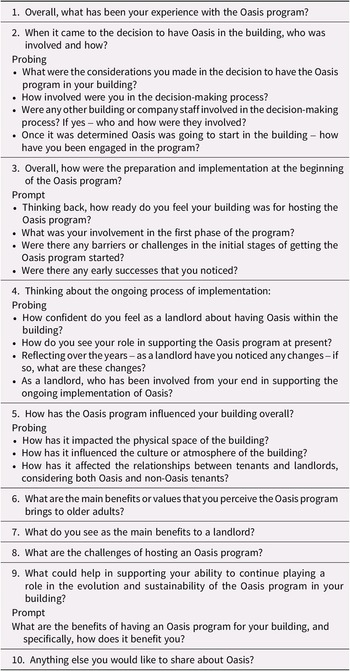
Following the receipt of institutional ethics approval (Queen’s University Health Sciences and Affiliated Teaching Hospitals Research Ethics Board [HSREB] [6034585]), the research project manager used a pre-established contact list to connect via e-mail or telephone with housing partners of all 19 Oasis sites across Canada, operating at the time of the initiation of the study. These contacts had been identified through prior collaboration or outreach and typically served as the primary point of contact or the individual responsible for Oasis-related matters at their respective properties. During the initial e-mail or telephone contact, we informed potential participants about the study purpose, associated risks and benefits, and participation requirements. We invited individuals who had expressed interest and contributed to various aspects of the Oasis program implementation to participate in interviews. Three interviewers conducted interviews via Zoom (Zoom Communication Inc.) at mutually agreed dates and times. Two interviewers had significant experience with qualitative interviews (RPN and CD). The third interviewer (AR) was an undergraduate student working as a Research Assistant on the Oasis project and received training and mentoring in qualitative interviewing, including observing interviews by the project lead and through debriefing following each interview. Two interviewers had no prior relationship with any study participant, while the third had previous interactions with some participants as part of the implementation of the Oasis program. We used a semi-structured interview guide and probed when needed to elicit in-depth information (see Table 1: Interview guide). We also collected participant’s gender identity and their professional role related to housing. Before conducting each interview, we obtained verbal consent from all participants. We digitally recorded all interviews.
Interview guide

Table 1. Long description
The table is arranged vertically. The first row presents question 1: ‘Overall, what has been your experience with the Oasis program?’ The second row lists question 2: ‘When it came to the decision to have Oasis in the building, who was involved and how?’ followed by a probing section with four bullet points: considerations in the decision, level of involvement, involvement of other staff, and engagement after the program started. The third row contains question 3: ‘Overall, how were the preparation and implementation at the beginning of the Oasis program?’ followed by a prompt section with four bullet points: building readiness, involvement in the first phase, barriers or challenges, and early successes. The fourth row presents question 4: ‘Thinking about the ongoing process of implementation,’ followed by a probing section with four bullet points: landlord confidence, current role in supporting Oasis, observed changes over the years, and who has been involved in ongoing support. The fifth row lists question 5: ‘How has the Oasis program influenced your building overall?’ with a probing section of three bullet points: impact on physical space, influence on culture or atmosphere, and effect on tenant-landlord relationships. The sixth row presents question 6: ‘What are the main benefits or values that you perceive the Oasis program brings to older adults?’ The seventh row lists question 7: ‘What do you see as the main benefits to a landlord?’ The eighth row contains question 8: ‘What are the challenges of hosting an Oasis program?’ The ninth row presents question 9: ‘What could help in supporting your ability to continue playing a role in the evolution and sustainability of the Oasis program in your building?’ followed by a prompt: ‘What are the benefits of having an Oasis program for your building, and specifically, how does it benefit you?’ The tenth row lists question 10: ‘Anything else you would like to share about Oasis?’ Each question and its associated probes or prompts are clearly separated by rows, with bullet points providing detailed sub-questions for qualitative exploration.
Data analysis and rigor
After transcribing all interviews, we removed identifying information, assigned code numbers, and used NVivo to organize data. We followed the reflexive thematic analysis approach outlined by Braun et al. (Reference Braun, Clarke, Hayfield, Davey and Jenkinson2022). Consistent with this approach, we engaged in ongoing reflexivity to consider how our positionalities might influence interpretation. For example, we reflected on the possibility of overestimating the value of Oasis to housing partners. To mitigate such risks, we repeatedly returned to the data to clarify and reinterpret meanings.
Two researchers (RPN and CD) independently read and re-read three transcripts to familiarize themselves with the data and began open inductive coding. Through open coding, we aimed to capture meaningful features of the data rather than fitting them into a pre-existing framework. After coding three transcripts, the researchers met to reflect on their coding, compare codes, and develop a shared understanding of the data. This discussion led to the creation of a preliminary list of codes that served as a guide for further analysis. One researcher (RPN) coded the remaining transcripts and continued to refine codes as new insights emerged. We then organized the codes into themes. The development of themes was not a linear grouping of codes but an active process of meaning-making.
During theme development, all researchers met twice to examine and discuss how codes related conceptually and how they contributed to broader patterns across the data set. For example, we initially grouped codes such as ‘spending time together’, ‘checking in on each other’, ‘taking care of the building’, and ‘bringing people out of their apartments’ under the broader theme ‘sense of community’, which we later refined as ‘fostering community and empowering older adults’. After discussing and organizing codes into initial themes, the lead author drafted the first version of the results and incorporated illustrative quotes under each theme. The team then reviewed the draft, shared feedback, and engaged in multiple rounds of revision until we reached consensus on the final themes and codes.
By working collaboratively and engaging in reflective dialogue, we integrated multiple perspectives and shaped nuanced themes closely aligned with participants’ experiences. These strategies collectively contributed to the trustworthiness, credibility, and depth of our analysis. Additionally, we ensured diversity in our participant pool by including individuals representing various types of properties (e.g., ownership models, vertical and horizontal NORCs), provided a detailed account of our data analysis approach, and tracked the decisions made collaboratively throughout the process (Tracy, Reference Tracy2010).
Positionality
The research team brought diverse disciplinary backgrounds and positionalities, which informed the study design, shaped our engagement with the data, and enriched the analysis and interpretation of the data. The research team included seven faculty members specializing in health services research, gerontology and rehabilitation sciences, with backgrounds in occupational therapy and physiotherapy. They have extensive experience conducting qualitative research and working with older adults in Canada. Since 2018, they have collaborated on the implementation of the Oasis program. The team, which also includes two research project managers with over a year of experience in the Oasis program, provided practical support in implementing Oasis and recruiting participants for this study. Additionally, three trainees offered fresh perspectives: one postdoctoral fellow with extensive experience in qualitative study in the field of disability and two undergraduate students in health and life sciences. These diverse backgrounds enabled us to view the data through different lenses and to crystallize our varied positionalities.
Results
Participants overview
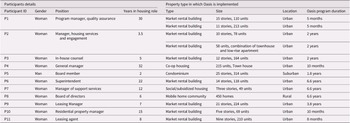
Out of the 19 Oasis sites, 12 individuals representing 13 sites agreed to participate in virtual interviews. Among them, six were in managerial roles; others included two board members, one member of the board of directors, one in-house counsel, one leasing agent, and one superintendent. However, one participant missed the scheduled interview due to a health emergency. Ultimately, we interviewed 11 participants (Women = 10), covering 13 Oasis sites across eight cities and three provinces. Nearly half of the 11 participants (n = 5) had over 10 years of experience in property management (see Table 2). It is worth mentioning that three participants (P5, P6, and P8) held dual roles. For instance, P5 was a board member of a condominium, P6 was a superintendent, and P8 was on the board of directors. All three also identified as community residents, Oasis members, and participants in Oasis programming. Additionally, P1 and P2 oversaw a combined total of four properties hosting the Oasis program.
Participants and property types in which the Oasis program was implemented
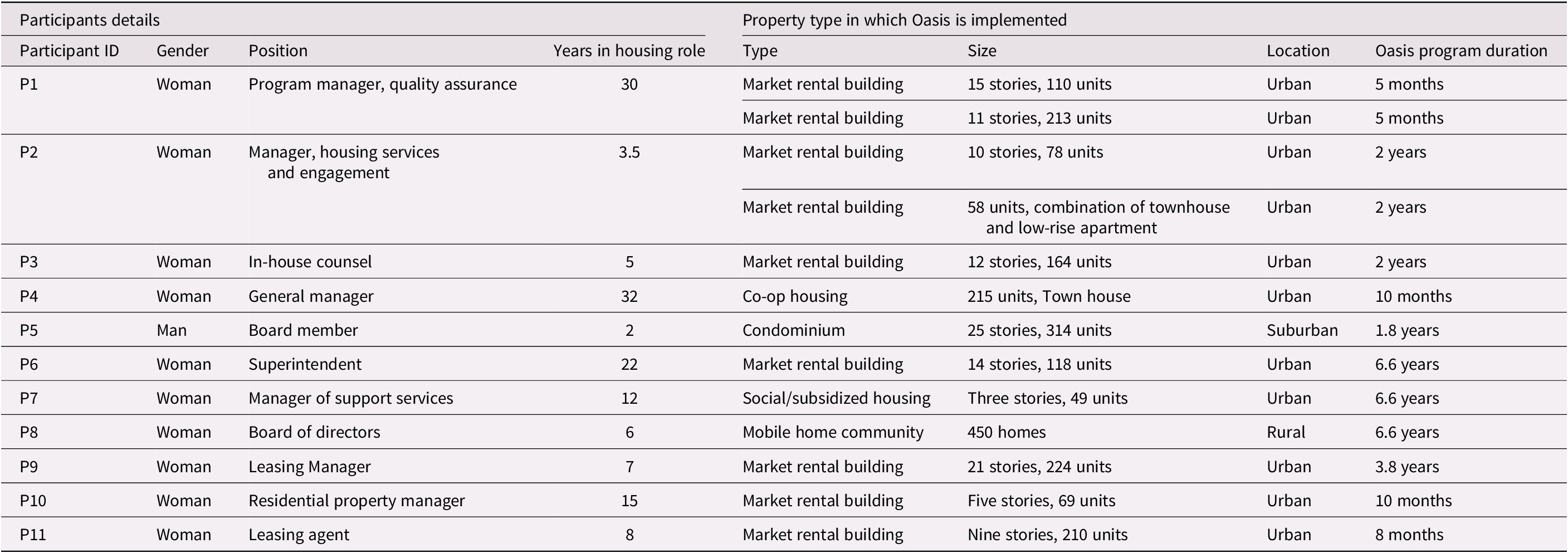
Table 2. Long description
The table is organized with two main header groups: participant details and property type in which Oasis is implemented. The participant details group includes columns for Participant ID, Gender, Position, and Years in housing role. The property type group includes columns for Type, Size, Location, and Oasis program duration. From the top row, participant P1 is a woman, program manager in quality assurance, with 30 years in housing, involved in two urban market rental buildings: one with 15 stories and 110 units, and another with 11 stories and 213 units, both with 5 months of Oasis program duration. P2 is a woman, manager of housing services and engagement, with 3.5 years in housing, involved in two urban market rental buildings: one with 10 stories and 78 units, and another with 58 units (combination of townhouse and low-rise apartment), both with 2 years of program duration. P3 is a woman, in-house counsel, 5 years in housing, involved in an urban market rental building with 12 stories and 164 units, 2 years of program duration. P4 is a woman, general manager, 32 years in housing, involved in urban co-op housing with 215 townhouse units, 10 months of program duration. P5 is a man, board member, 2 years in housing, involved in a suburban condominium with 25 stories and 314 units, 1.8 years of program duration. P6 is a woman, superintendent, 22 years in housing, involved in an urban market rental building with 14 stories and 118 units, 6.6 years of program duration. P7 is a woman, manager of support services, 12 years in housing, involved in urban social/subsidized housing with three stories and 49 units, 6.6 years of program duration. P8 is a woman, board of directors, 6 years in housing, involved in a rural mobile home community with 450 homes, 6.6 years of program duration. P9 is a woman, leasing manager, 7 years in housing, involved in an urban market rental building with 21 stories and 224 units, 3.8 years of program duration. P10 is a woman, residential property manager, 15 years in housing, involved in an urban market rental building with five stories and 69 units, 10 months of program duration. P11 is a woman, leasing agent, 8 years in housing, involved in an urban market rental building with nine stories and 210 units, 8 months of program duration. Several participants are associated with multiple properties, and most properties are urban market rental buildings, with durations of Oasis program implementation ranging from 5 months to 6.6 years.
Oasis sites overview
To optimally protect anonymity, we chose not to disclose the specific cities and provinces. Of the 13 Oasis sites, most were market rental properties (n = 9) located in urban settings (n = 11). Seven sites were housed in high-rise buildings (>10 stories), with unit counts ranging from 78 to a maximum of 314. Three sites were in low-rise buildings (<10 stories), containing between 49 and 214 units. The other three sites were classified as neighborhoods consisting of 450 homes in a mobile home community, 215 units in co-op housing, and 58 units in a family townhouse/low-rise building. Seven sites had Oasis program running for over two years (See Table 2).
Housing partners from six sites declined our invitation to participate in this study. Of these six sites, four were market rental buildings: three of these were high-rises (≥10 stories), with unit counts ranging from 109 to 320 units, and one was an eight-story building with 267 units. One was a condominium (a 26-story building with 320 units), and one was a school in a neighbourhood model of Oasis, where the program served a bounded neighbourhood in an urban environment.
Qualitative findings
We identified four themes that captured participants’ views on the benefits and challenges of the Oasis program and their experiences with its implementation. Themes included the following: (i) perceived benefits of Oasis program: building social connections and promoting health among older adults, (ii) transforming the building, (iii) Site Coordinator is the ‘secret sauce’, and (iv) starting up and sustaining Oasis: facilitators and challenges. Below, we describe each theme along with representative quotes.
Theme 1: Perceived benefits of the Oasis program: Building social connections and promoting health among older adults
Almost every participant reported that the Oasis program fosters a strong sense of community and enhances the physical and mental well-being of older adults. Participants shared that activities such as having coffee, listening to music, and doing arts and crafts together encouraged older adults to leave their apartments and connect with those around them. They observed that these shared experiences appeared to foster a sense of belonging and helped cultivate meaningful friendships and supportive relationships. One participant remarked, ‘it [Oasis program] gets tenants out of their apartments, gets them socializing, and keep them active’. (P9) Another participant highlighted, ‘They [Oasis members] just don’t feel like they’re sitting here waiting to die. They feel like they have a reason to get up in the morning and do things’. (P6) Participants also described how members now connect beyond organized Oasis activities, using e-mail or WhatsApp, to arrange informal gatherings and to check in on one another. One participant explained that members will ‘WhatsApp each other in the evening on a non-Oasis Day and go play cards or…start a game’, which they found ‘quite heartwarming’. (P2) Similarly, another participant illustrated the routine of socializing by describing how members would ‘go to one side of the hall in the morning for coffee and watch the sunrise and go to the other side of the hall in the afternoon for a glass of wine to watch the sunset’. (P6)
The strength of informal networks became clear to housing partners during times of crisis. For example, one participant shared stories of Oasis members stepping up to provide emotional support, coordinate care, and offered practical assistance: ‘Last night, she [one of the tenants/Oasis members] had a meltdown in the lobby and two of the ladies [other tenants/Oasis members] took her upstairs. Got her calmed down … gave her a cup of tea and gave her a warm blanket while one lady was on the phone with her daughter talking to her and the other lady was sitting comforting her’. (P6) This sense of community also contributed to a greater sense of empowerment among older adults. Participants noted that residents became more confident, less fearful of being alone, and more willing to advocate for themselves or seek help when needed.
Participants emphasized that having opportunities to participate in social activities inside the building was especially important during the winter months, when mobility and transportation can be challenging. This convenience allowed residents to remain engaged without the burden of travel, contributing to improved mood. As one participant narrated it, ‘They can take off their slippers, put on their shoes, and just go downstairs… a chance to connect with people’. (P3) Participants also highlighted the role of Oasis’ food programs in strengthening social bonds and supporting emotional well-being. Shared meals and food-related gatherings created a sense of belonging and comfort, particularly for those coping with grief or loss. Participants also mentioned that the Oasis program is helping older adults remain in their homes longer, delaying or avoiding transitions to long-term care. One participant summarized, ‘It allows them to stay in their apartment longer… it’s truly helping people age-in-place because of all of the opportunities that Oasis provides’. (P3)
Participants also emphasized the program’s positive impact on physical health. Organized physical activities such as chair yoga, line dancing, and nature walks were seen as instrumental in maintaining mobility and improving physical strength. Several participants reported hearing from older adults that these activities helped them regain abilities they had previously lost. One participant noted, ‘It’s improved their strength and, you know, things like that’. (P9) Another participant (P6) observed that ambulance calls have noticeably declined in their building, which they attributed to the supportive relationships formed through Oasis. According to that participant, older adults perhaps seek help from neighbours instead of relying on emergency responders when faced with non-urgent health issues.
Theme 2: Transforming the building
Participants reported that the Oasis program changed the atmosphere of their building and spaces in ways that created a more welcoming place. Specifically, participants recounted that the building of community through the Oasis program led to a more vibrant atmosphere, increased foot traffic, and maximized the use of building amenities. A couple of participants shared how the Oasis program transformed their building, which was generally a quiet space, into a bustling community. Participant 3 commented: ‘It’s not a ghost town anymore. It’s just always bustling. Very active tenants coming and going to different events in the building. They do some nature walks, so they’ll all gather in the lobby, and they wait for each other’.
Another participant reported:
You get a buzz around certain activities, whether it be, you know, a book reading or it’s like, ‘Hey, did you know that we’re doing, you know, or we’ve got this food tasting or this food demo or we’ve got this exercise class.’ You’d find people kind of connecting a little bit more with maybe neighbours they may necessarily not have connected with because of these activities, which is always good. So, it leads to a good positive atmosphere. (P10)
One participant mentioned that they used to receive numerous complaints from tenants, but since the Oasis program began, the number of complaints has significantly decreased. This participant said, ‘the biggest thing I saw for us as a landlord, the building became, I’m not sure if, like, silence is not the right word, right? But there were no more grumblings and confronting’. (P7) This participant explained that the Oasis program ‘gave them [Oasis members] occupational engagement and it radically shifted my work, it wasn’t a building I had to be concerned about. It wasn’t a building I had to like, keep responding to because people were fighting or not getting along’. (P7)
Additionally, participants mentioned that the appearance of the building had also changed since the start of the Oasis program in their properties. One participant reported that Oasis members ‘treat not only their apartment but also the building in general with care’. (P11) Another participant went so far as to say, ‘They [Oasis members] care about how the building looks because they feel that there’s belonging in the building’. (P7) Other participants also emphasized the role of the Site Coordinator in creating a welcoming space and keeping it tidy: ‘She [Coordinator] brought in some really, like, antique furnishings, and she made a nice open area for people to sit as a group. She made the space more welcoming rather than just an office’. (P4)
Interestingly, some participants noted that the Oasis program has boosted their building’s reputation and attracted new tenants. Participants highlighted that the Oasis program in market rental buildings acts as an ‘incentive’ or ‘selling point for people’ (P9), which has facilitated the rental of their units: ‘If this Oasis wasn’t here, it would be a little bit more difficult to rent the units’. (P9) Participants shared that current tenants are spreading positive information about Oasis, which generates interest among prospective tenants: ‘We have a lot of prospective tenants that call us that specifically want to rent an apartment at … [name of the building] because of the Oasis program’. (P3) Some participants reported that they promote the Oasis program to prospective tenants during viewings, believing it helps find tenants who are a good fit and prefer to stay longer. Participants mentioned that long-term tenants take better care of their units, ‘which in turn, from a landlord perspective, reduces turn [over], which again, saves you money on turn’. (P10) Another participant mentioned that the Oasis program indirectly contributed to creating an age-friendly community:
Oasis brought in the councillor [local politician] from this district and he took questions from the people [Oasis members]. They explained what the problem was, and he [councillor] went back and some of the things have not changed, but some of the things have changed. The crosswalks are more clearly marked, the snow shoveling on the sidewalks is better. So, it helped everyone in the neighborhood. (P6)
Several participants reported that the Oasis program reduced their workload by providing extra support that aligned with their goals and compensated for the limitations in resources that landlords faced. Some participants noted that the Oasis program eased their workload by organizing events for older adults, which landlords would otherwise have to arrange. One participant recounted:
It was kind of always stressful for me to try to figure out what we are gonna do for the holidays? What are we gonna do for Halloween? You know, things like that. Oasis handled all of that, so that’s taken a huge weight off of me because I know the tenants are happy and they’re doing things for the holidays. (P9)
Additionally, participants noted that the Oasis program offered an extra pair of eyes to spot items needing maintenance:
Having another set of eyes who’s in the building, you know, semi-regularly and can alert us when things are going on that… [wrong] or repairs that need [to be] done that we might not know, residents may not tell us that outlet doesn’t work. But … [name of the Site Coordinator] will tell us that ‘it isn’t working, you need to fix it’. (P2)
Theme 3: Site Coordinator is the ‘secret sauce’
Several participants described the Site Coordinator (hired by Oasis) as the ‘secret sauce’ (P2) and the key facilitator of the program. They were also identified as instrumental in encouraging older adults to come out of their apartments and participate in activities. The Site Coordinator spent considerable time understanding the needs of the older adults and tailored programs, accordingly, as noted by Participant 4:
At the beginning of the program, … [Site Coordinator] used to offer a bingo afternoon. So, after she was able to recognize and collect some of the data from the members, she realized attendance was very low. Then she realized, nope, they want more arts and crafts, they want more exercise programs and once those needs were met, more people came out.
Some participants emphasized the proactive role of their Site Coordinator in promoting older adults’ participation in the Oasis program. For example, Participant 3 noted that the Site Coordinator went ‘door to door’ to personally invite residents and encourage them to join. Expanding on this, Participant 3 described how the Site Coordinator actively engaged older adults through a variety of activities:
… [Name of the Site Coordinator] is always going out into the community to find right type of people to come in, to cook with the tenants, to paint with the tenants, to talk with the tenants. So, there’s never a shortage of activities. And I think that’s what, you know, has everybody so engaged all the time.
Similarly, Participant 5 narrated how their Coordinator invited older adults to join the Oasis program, ‘… [name of the Site Coordinator] spent a lot of time, I believe, knocking on doors and meeting with people in the lobby sort of to get them interested in what was going on and what would be going on’. The Coordinator’s enthusiasm was seen as essential to the program’s success. As Participant 6 explained: ‘If she’s [Site Coordinator] not enthusiastic and doesn’t make it seem like fun and make you want to get involved, people are not going to come in’. Participant 4 also mentioned several key traits of their Site Coordinator, such as being approachable, easygoing, and confident, which were crucial in encouraging older adults to join the Oasis program and also gave her confidence that the program would continue to grow with the Coordinator’s help. Participants also emphasized that an onsite Coordinator is important for the sustainability of Oasis because older adults tend to get more involved with support from an outsider. As described by Participant 2:
Some of the secret sauce of Oasis is the onsite facilitator because people have, and this is partly from some of my previous experience in my previous life of work, that when there’s that buffer person, that external person, the expert that’s come in, you know, whatever it is, even though they’re not an expert necessarily to help with that, I think that makes people feel more comfortable to try new things.
Participant 5 echoed this sentiment: ‘If she [Site Coordinator] is gone by next spring, because we can’t afford to keep her going, then the future of Oasis here is kind of doomed, well, not doomed, that’s a heavy duty’. This highlights the importance of continued funding to support the coordinator role. Participant 7 also emphasized the need for financial support to ensure the presence of a Site Coordinator: ‘we would have to be looking to find ways to fundraise to have to pay an outside agency to come in and be an Oasis Coordinator’.
Theme 4: Starting up and sustaining Oasis: Facilitators and challenges
Subtheme: Facilitators. Participants described several factors that influenced their decision to host the Oasis program on their property. For many housing partners, the decision aligned with organizational priorities and, more importantly, their commitment to enhancing tenant well-being. As Participant 3 explained:
The timing was kind of perfect because we had, I think it was around the end of COVID, and our company [name of the company] was looking for some type of organization to come in and offer different kinds of events to our tenants. I believe the … [name of an organization] used to come in and offer exercise classes prior to COVID. So, a lot of my tenants were asking if they could come back, and Oasis kind of fell in my lap as they [tenants] were asking me to find them something.
Other housing partners highlighted the value of social connection and its contribution to helping older adults remain in their homes longer. Participant 10 noted: ‘This [hosting Oasis] was a good way for us to support our residents and continue to engage them in their environment and hope to elongate the time that they’re able to live in their own homes without having to go to assisted living’. Similarly, Participant 2 stressed the importance of ‘social connection’ and ‘neighbour helping neighbour’ as key reasons for introducing Oasis, while Participant 1 emphasized on senior empowerment component, where ‘seniors are an active part, not just participants, but actively engaged throughout all aspects of the program’.
Several participants also identified the program’s minimal resource requirements as a strong facilitator. As Participant 4 noted:
We have a meeting space that’s available for all of their events. We also have office space available for the Coordinator through the Oasis to work onsite here. So, we’re supporting the program by no expense to them at all. They’re bringing the services, we provide the space.
Others described this as simply ‘opening the door and turning on the lights’ (P7). Accessibility of existing spaces was also seen as an advantage, though some older properties lacked suitable common rooms. As Participant 3 reflected:
We did a lot of touring of our properties, seeing which properties had a common space or a common room that tenants could gather and it be accessible for all tenants, because that’s another factor that we really had to consider, is accessibility, because obviously not a lot of our older properties were built with a common space or a space that could be accessible for all.
Finally, in some cases, tenants themselves initiated the introduction of Oasis, demonstrating demand for the program and reducing the effort required of housing providers. Participant 10 recalled:
The tenants were the ones who brought it to us. Once I found out about the program, it was, it was an easy sell to our owners to at least try it and see how it goes. There was positive feedback from the residents, so it just kind of all worked out.
Subtheme: Challenges. Participants identified several interconnected challenges in implementing the Oasis program. These challenges clustered around four main areas: building trust and communication, pandemic-related disruptions, managing shared spaces and community perceptions, and ensuring long-term sustainability.
Building trust and communication was an early concern. Some participants found it difficult to gain tenants’ confidence and worried that Oasis might be perceived as ‘taking over’ existing activities (P9). Frequent staff turnover in the early stages, such as having three different Coordinators, further undermined stability and reduced tenants’ willingness to participate (P5). At the same time, hiring a Coordinator who shared tenants’ language helped build trust. As one participant noted, having a facilitator who spoke Mandarin and Cantonese ‘was a big benefit … people sometimes stay away when they don’t understand what’s being said or don’t feel like it’s their community’ (P2).
Communication with older adults during an initial Oasis information session, which aimed to gauge interest, was another challenge that some participants encountered in the early stages of implementation. Participants noted that many older adults had communication difficulties due to hearing impairments or low literacy in using digital communication methods, such as e-mail. A participant from one site indicated that they used various methods to communicate with older adult tenants about an Oasis information session:
It is a three-pronged approach to communicate effectively with all the tenants in our portfolio, there are many streams of communication that we have to use, including door knocking, posting things on their doors, postering, and e-mails if we have e-mail accounts. So, it could be time-consuming to actually want to get everybody the information that’s out there. I think that was our biggest challenge. (P1)
Some participants noted that the COVID-19 pandemic created additional setbacks, halting activities that had been gaining momentum and reinforcing hesitancy among tenants to engage socially. Concerns about food safety and heightened caution in shared spaces made gatherings more difficult to sustain. As one participant put it, ‘It [Oasis program] was really coming along nicely until we had COVID… They weren’t able to do anything’ (P6). Participants also described some practical challenges related to shared spaces and boundary-setting. Participant 10 specifically noted confusion around expectations when Oasis members used the common space, with questions like ‘Who is responsible for the cleaning?’ being unclear during the initial stage of the Oasis program. As a result, the participant emphasized the need for clearer guidelines and shared responsibilities. They also suggested that when Oasis members plan to use the shared space, it is important to ensure that ‘it’s booked’ and that the ‘resident manager is aware’ (P10) of who will be using the space.
Within a site located in a condominium, some unique challenges surfaced in reaction to an initial Oasis information session. This participant noted that some residents of the condominium initially thought that the presence of the Oasis program will ‘reduce the property values’ (P5) due to perceptions that their building was a seniors-only building. This participant also highlighted a recurring issue with the party room usage. They explained that the party room could be booked free of charge for any Oasis social and recreation programs. However, conflicts arose when the room was booked by other residents for paid events. This often led to the Oasis program being rescheduled in favour of the paid event:
I mean, one of the problems with our party room, which is an ongoing problem, not an initial problem, is that if somebody pays, we’re not paying to use it. Any program under the social and recreation committee, gets to use it for free. But the other reality is, if somebody books it for two days on the day when you have a [Oasis] Program, then your program gets bumped because they’re making money out of the other one. (P5)
Security concerns added another layer of complexity, particularly when non-residents wanted to join the Oasis program. As one participant explained, ‘From a safety perspective, you just never know … if someone loses their key, and someone picks it up off the street. And if they have the address on the key, well then, they can come into the building’ (P11). Finally, participants emphasized concerns about sustainability. Without ongoing financial support, they questioned whether Oasis could continue to provide meaningful opportunities for older tenants. As one participant concluded, ‘there’s no future for aging in place in these three buildings’ without dedicated funding (P5).
Discussion
This is the first study to explore the facilitators, challenges and benefits of the implementation of Oasis, a NORC-based program, from the perspective of the housing partners. While housing partners do not play a direct role in the delivery of NORC-based programs, they play a foundational role in the implementation of NORC-based programs, providing space for program delivery and welcoming broader community services and programs into the building. Gathering their perspective is crucial to understand the elements that support both the early implementation and sustainability of NORC-based program and can inform the initiation of other NORC-based programs.
Consistent with previous research examining the outcomes of onsite programming in apartments (Dong, Reference Dong2018; Lo et al., Reference Lo, Conboy, Rukhadze, Georgetti, Gagnon, Manor, Lachman, Lipsitz and Wayne2020; Resnick et al., Reference Resnick, Brandt, Holmes and Klinedinst2024), participants of this study highlighted several positive outcomes they perceived the Oasis program had brought to the lives of older adults. One of the key insights shared by participants is that the Oasis program enabled building social connections among older adults living in the same building, complex or neighbourhood. These connections facilitated spending quality time together, supporting each other both in their everyday lives and during crises, and enhanced a sense of community. The importance of such connections within one’s own community is well recognized, particularly for older adults (Mills et al., Reference Mills, Parniak, Hand, McGrath, Laliberte Rudman, Chislett, Giberson, White, DePaul and Donnelly2022). Social connections and cohesion have been shown to enhance familiarity with neighbourhood environment, strengthen place attachment, and increase community involvement, all factors essential for supporting aging in place (Bigonnesse & Chaudhury, Reference Bigonnesse and Chaudhury2022). NORC-based programs like Oasis can serve to nurture social ties among older adults living in a NORC while also facilitating mutual support and enhancing community cohesion.
One of the key facilitators of Oasis that participants consistently highlighted was the pivotal role of the Oasis Site Coordinator in fostering connections among older adults, which in turn contributed to an overall positive building culture. Site Coordinators facilitated engagement through their energy and creativity to spark interest among older residents and understand and implement their unique program needs. This finding corroborates earlier research that has explored the experience of Oasis members (Fernandes et al., Reference Fernandes, Hand, Laliberte Rudman, McGrath, Cooper, Donnelly, DePaul, Letts and Richardson2024; Mills et al., Reference Mills, Parniak, Hand, McGrath, Laliberte Rudman, Chislett, Giberson, White, DePaul and Donnelly2022), providing further data regarding the vital role of the Site Coordinator in the implementation of the Oasis program. This finding also aligns with broader literature that has examined onsite programs in social housing (Lo et al., Reference Lo, Conboy, Rukhadze, Georgetti, Gagnon, Manor, Lachman, Lipsitz and Wayne2020; Lucio & McFadden, Reference Lucio and McFadden2017). Lo et al. (Reference Lo, Conboy, Rukhadze, Georgetti, Gagnon, Manor, Lachman, Lipsitz and Wayne2020) found that consistent contact from a skilled research support team was a key factor in engaging older adults in Tai Chi program in subsidized housing. Similarly, Lucio and McFadden (Reference Lucio and McFadden2017) emphasized the role of tenant-facing staff in fostering resilience by creating a safe and supportive environment that promotes trust and belonging among older residents. Building on this, our findings underscore the value of incorporating formal support into NORC-based programs, such as hiring paid staff who can develop and implement plans and animate the programs activities and events that older adults themselves identify (Greenfield et al., Reference Greenfield, Scharlach, Lehning and Davitt2012). Furthermore, a neutral actor who is neither part of the housing partners nor a tenant, such as a Program Coordinator, can play a vital role in reaching out and connecting residents to community programs and resources outside of NORCs (Anetzberger, Reference Anetzberger2009), which we also found in our study. In the case of Oasis, Site Coordinators fulfill this bridging function by facilitating connections and encouraging participation. Given the role of Site Coordinators in Oasis, it would be important to explore their perspectives in future studies to gain deeper insights into the nuances of this role and the core skills and competencies.
A unique finding in our study was the positive influence the program had in transforming building culture, with greater connectivity among tenants observed along with a noted reduction in the complaints among residents, particularly in social housing settings. Housing is a key determinant of aging in place and overall health and plays a vital role in sense of belonging (Patino & Siegel, Reference Patino and Siegel2018), and the positive perception of the Oasis program by housing partners suggests that NORC-based programs may contribute to a greater cohesion and community. Additionally, housing partners noted that Oasis enhanced the building’s reputation, making it more attractive to prospective tenants and helping them secure tenants who were more likely to stay long term. These benefits highlight how NORC-based programs can add value for housing providers, strengthening the case for future collaborations.
Our study clearly indicates the broader changes that can occur through NORC-based programs like Oasis. As indicated in the results, in one instance, a participant specifically noted that the Oasis program created an opportunity for older adults to share their concerns with local political leaders, which subsequently had a large impact on building a more age-friendly neighborhood around NORC. This result affirms that programs like Oasis, driven by older adults, have the potential to empower them to act as agents of change for their community. Greenfield et al. (Reference Greenfield, Scharlach, Lehning and Davitt2012) explained how civic engagement in later life can lead to the creation of more accessible outdoor spaces and buildings, as well as include older adults in community-level decision-making. As such, we propose that supporting a senior-driven program provides an opportunity for older adults to advocate for accessible, age-friendly neighborhoods from which everyone can benefit.
Implications
This study offers valuable insights for housing providers considering onsite initiatives such as Oasis, whether independently or in partnership with community organizations. The findings indicate that programs of this nature can yield meaningful benefits for older tenants with relatively modest investments, typically limited to providing space and sharing information with tenants. These modest contributions were associated with substantial outcomes: improved building atmosphere, enhanced tenant stability, and reputational gains for providers. These results suggest a practical and scalable model for engaging housing providers in NORC-based initiatives, where small commitments can generate significant social and operational returns.
A central implication concerns the pivotal role of the Site Coordinator. Positioned as a bridge between housing providers and community programming, Coordinators facilitate collaboration, maintain ongoing communication, and contribute to the everyday life of the building. Their consistent presence allows them to address minor maintenance issues early and take on responsibilities, such as organizing social activities for tenants, that might otherwise fall to landlords or staff. This active involvement enhances tenant engagement and helps housing providers recognize the broader benefits of the program.
Future implementations of Oasis and similar programs should consider several factors. Clear articulation of program goals is essential to prevent misunderstandings among tenants and housing providers. Employing diverse communication strategies, including phone calls, in-person visits, door-to-door engagement, and e-mail, can help maximize tenant participation. Providing accessible and welcoming communal spaces is also critical for encouraging informal interactions and strengthening social cohesion. Ensuring that programming remains inclusive and open to all interested tenants may further amplify its impact. Finally, when housing providers collaborate with external partners, such as university research teams or community organizations, establishing clear guidelines for role clarification is essential to prevent misunderstandings and support effective, coordinated implementation.
We believe the time has arrived for policymakers to incentivize NORC-based programs not only for its numerous benefits (e.g., enhancing health, delaying the need for long-term care, and alleviating social isolation and loneliness) (Parniak et al., Reference Parniak, DePaul, Frymire, DePaul and Donnelly2022) but because it supports older adults’ desire to age in place and aligns directly with current aging-in-place initiatives (Government of Canada, 2024, 2025). The high density of older adults in NORCs creates an opportunity for policymakers to deliver services in a cost-effective way. Beyond policy and practice, this study also identifies important directions for future research. Our team is collecting longitudinal data from older adults to assess the long-term impact of Oasis. We also plan to explore the perspectives of Site Coordinators and family members to deepen our understanding and triangulate insights across multiple sources.
Limitations
In this study, we captured the voices of eleven NORC housing partners who hosted the Oasis program. It is possible that housing partners who were positive about the Oasis program participated in the study, which may have skewed our findings towards predominantly positive outcomes. Additionally, we collected data at a single point in time and thus were not able to capture if and how participants’ thoughts and experiences might evolve over time. Despite these limitations, the study has strengths. We interviewed housing partners with experience managing various types of properties, which reflects that Oasis has a positive impact across different communities and NORC sites.
Conclusion
This research has provided insights into the experiences and perceptions of housing partners who have supported the implementation of Oasis. Our findings indicate the multifaceted advantages of implementing the Oasis program. Specifically, the perceived benefits of the Oasis program for both older communities and the business landscape are key and unique contributions to literature. Our findings emphasize the value in expanding NORC-based programs like Oasis to support healthy aging and aging-in-place. Therefore, we advocate for increased resource allocations from municipal, provincial, and federal governments.
Data availability statement
Except for the data presented in this manuscript, no additional data are publicly available due to privacy, ethical considerations, and the protection of personal information. This study was not pre-registered.
Acknowledgements
We are grateful to all study participants for taking the time to share their experiences with us. We also appreciate the Site Coordinators for their support in reaching out to some of the study participants. Finally, we sincerely appreciate Sophie Labossiere’s assistance in translating the English abstract into French.
Financial support
This work was supported by funding from the Canadian Institutes of Health Research (grant number 175146). This research is also undertaken thanks, in part, to funding from the Connected Minds program, supported by Canada First Research Excellence Fund, grant number CFREF-2022-00010.
Competing interests
The authors declare none.

 Open access

