

Introduction
There is a consensus that mobility is important to the wellbeing of older citizens (Gabriel and Bowling Reference Gabriel and Bowling2004; Metz Reference Metz2003; Siren and Hakamies-Blomqvist Reference Siren and Hakamies-Blomqvist2004, Reference Siren and Hakamies-Blomqvist2009; Webber, Porter and Menec Reference Webber, Porter and Menec2010). While mobility has a range of meanings, in this article, we refer to it in terms of how people travel in the course of their everyday lives. Older citizens, in common with most other citizens, rely on transport for access to goods, services and social networks that enable wellbeing, and it is known that psycho-social benefits accrue from the ability to make trips for discretionary as well as instrumental purposes (Davey Reference Davey2007; Metz Reference Metz2000). Social exclusion arising from transport exclusion and the web of complex relationships between exclusion of various types is, then, a major challenge to wellbeing as people move through the lifecourse, when disability, financial barriers or lack of accessibility potentially restrict transport availability and choice (Church, Frost and Sullivan Reference Church, Frost and Sullivan2000; Rye and Mykura Reference Rye and Mykura2009; Social Exclusion Unit 2003). Despite an increasing understanding of the multiple dimensions of social exclusion and the challenges to policy makers which this brings (Scharf et al. Reference Scharf, Phillipson, Kingston and Smith2001; Shergold, Parkhurst and Musselwhite Reference Shergold, Parkhurst and Musselwhite2012; Shergold and Parkhurst Reference Shergold and Parkhurst2012), there remains a paucity of evidence on the mechanisms and policies likely to reduce transport exclusion (Metz Reference Metz2000). Much research on mobility and ageing has focused on car driving, and the implications for older citizens of losing a licence (Adler and Rottunda Reference Adler and Rottunda2006; Davey Reference Davey2007) or having no access to a car. In what has been described as a ‘system of automobilty’ (Sheller and Urry Reference Sheller and Urry2000), where motorised private transport is taken for granted as the privileged mode, the loss of the ability to drive can be a blow not only to mobility, but to one's identity as an independent adult: a ‘major life event’ (Ziegler and Schwanen Reference Ziegler and Schwanen2011). Even where public transport options are available and accessible, older adults have reported public transport as inconvenient, risky, poorly designed or poorly routed, or of lower status than car travel (Adler and Rottunda Reference Adler and Rottunda2006; Cattan et al. Reference Cattan, Woodward, Marsden and Jopson2009; Ellaway et al. Reference Ellaway, Macintyre, Hiscock and Kearns2003; Hiscock et al. Reference Hiscock, Macintyre, Kearns and Ellaway2002; Musselwhite and Haddad Reference Musselwhite and Haddad2010). Bus services in particular remain a stigmatised form of mobility in many settings: used only where there are no other transport options. Notwithstanding this, older people are disproportionate users (King and Grayling Reference King, Grayling and Grayling2001).
This paper takes London as a case study to focus on public transport, specifically freeFootnote 1 bus transport, in maintaining mobility for older citizens. While concepts of mobility and wellbeing are contested, and there are different ways in which mobility can be enacted – not all of which involve getting from A to B (Schwanen and Ziegler Reference Schwanen and Ziegler2011; Ziegler and Schwanen Reference Ziegler and Schwanen2011), the focus of this article is on the mundane enactment of everyday life through journeying – an aspect to which Siren and Hakamies-Blomqvist (Reference Siren and Hakamies-Blomqvist2009) refer in their qualitative work of older citizens in Scandinavia and mobility.
The research context for this work is a study designed to evaluate the impact of introducing free bus travel for young people on the public health (Jones et al. Reference Jones, Steinbach, Roberts, Goodman and Green2012; Wilkinson et al. Reference Wilkinson, Edwards, Steinbach, Petticrew, Goodman, Jones, Roberts, Kelly, Nellthorp and Green2011). While the work on older citizens was based largely on a concern that increased bus use by young people might reduce the willingness of Freedom Pass holders to travel,Footnote 2 widening age-related inequalities, hearing their bus narratives inevitably raised other wide-ranging implications of bus-mediated mobility for wellbeing. We see the paper as an empirical contribution to understanding the mechanisms that link mobility practices and wellbeing, informed by theoretical perspectives such as those of Sheller and Urry (Reference Sheller and Urry2000) on automobility, across a range of issues of relevance to social scientists, clinicians and transport specialists.
The setting
In the United Kingdom (UK), older citizens are entitled to free bus travel outside peak times (i.e. after 9 am or 9.30 am on a weekday) when they reach pensionable age (or, if born before 1950, on their 60th birthday) (for England and Wales, Concessionary Bus Travel Act 2007, Order No. 2010). In London, older citizens resident in London boroughs are further entitled to use all bus, tram and underground train services within the Greater London area with no time restrictions, and rail services at off-peak times. Eligible citizens use a Freedom Pass, a card that uses the same technology as the card used by most residents and visitors to London, and so does not identify the older user as ‘different’. The cultural connotations of public transport use in London differ from the rest of the UK, with private car use relatively low (Department for Transport 2007), particularly in the inner London boroughs, and bus use less clearly associated with marginalised transport users (King and Grayling Reference King, Grayling and Grayling2001; Shaw, Mackinnon and Docherty Reference Shaw, Mackinnon and Docherty2009). Following expansions of the bus network, the proportion of trips undertaken by bus has grown in London (Transport for London 2010). This case study is not, then, offered as a ‘typical’ setting to explore the ways in which mobility and wellbeing may be linked for older people. Rather, by taking a setting where bus transport has fewer negative connotations, and where the consequences of driving cessation may be less severe as a result of good transport networks, we are able to explore the possibilities of public transport mobilities for wellbeing which may be generalisable to other urban settings in a context where sustainability is moving up the policy agenda.
Methods
We draw on data from 47 participants aged over 60 living in London, interviewed in either individual (N = 14), dyad (N = 12) or small group (N = 21) interviews. Different modes of interviewing can yield different kinds of data, with groups enabling an interactive discussion, increased potential for story-telling (in which we were particularly interested) but also increased potential for more confident and talkative respondents to take a lead, while individual interviews may be more likely to uncover sensitive data on, for instance, some of the features of ageing felt to be damaging to the self.
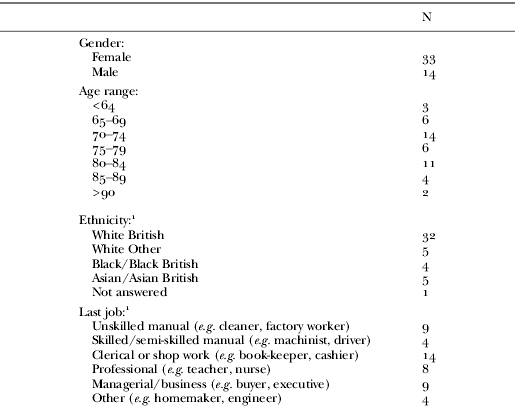
Given our core interest in the current experience of older citizens using the buses in relation to young passengers with free passes, we did not seek out (though did not exclude) non-users or rare users of Freedom Passes. That the data in this paper relates to users suggests some limitations, which we discuss below. To ensure that a range of older people were included in the study, participants were contacted through both formal approaches to community organisations (such as lunch clubs and senior citizens' events), opportunistically through contacts in public spaces (e.g. park benches) and occasionally through personal networks. These contacts were made across four geographically diverse areas of London, including two in outer London, where transport networks are typically less dense. A £5 supermarket voucher was offered as a thank you for taking part (except to the small number of participants recruited through personal networks). Interviews were conducted by the authors, audio recorded with permission, transcribed and analysed thematically, drawing on techniques from grounded theory, including detailed open coding of initial transcripts, a comparative approach and team discussion of the coding framework (Strauss Reference Strauss1987). The interview schedule was relatively open, to allow participants to discuss their experiences of travelling around London in detail, with prompts covering typical journeys, journeys on a specific day, types of transport used, preferences for different modes, likes and dislikes, views of the Freedom Pass and views of other bus users. Participants completed a form with details of their age range, current or last job, ethnicity, and whether they had any long-standing illnesses or disabilities that would limit mobility. They came from a range of ethnicities, ages, and work histories (see Table 1), and while only 14 participants reported a long-standing illness or disability on the form, many more discussed the ways in which physical impairments hindered their mobility. Extracts from interviews are tagged in this paper with an identifier for gender (male [M] or female [F]), and for type of interview (individual [Ind], dyad [D] or group [G]); location (inner [I] or outer [O] London); and age range (of group for group interviews). This study was approved by the LSHTM Ethics Committee.
Interview participants

Notes: N = 47. 1. These are indicative groupings based on self-report.
Findings
A ‘lifeline’: the role of the bus pass in facilitating access to the essentials of wellbeing
F1: It's my lifeline really, isn't it?
F2: It is, it is.
F1: Bus pass, a lifeline. (G, I, 75–84)
The Freedom Pass, despite entitling users to free transport on a range of services, was often simply called the ‘Bus Pass’, as this was the mode of transport used most often. Participants from all areas, backgrounds and ages were overwhelmingly positive about their access to free bus travel, and eloquent on the ways in which it facilitated wellbeing. All but one of our participants had a current Freedom Pass (one was about to apply), and used it for a wide range of journeys. The extracts below from a group discussion, which followed a general question asking what they used the Freedom Pass for, illustrate this range: from providing essential transport to hospitals to the more psycho-social benefits arising from access to interaction and keeping yourself ‘active’:
F: Well, I use it every day … And if I didn't have a Freedom Pass, I wouldn't be able to go out every day. Because I've got sticks, so I can't walk very far …
F: It'd make you a cabbage otherwise …
Int: And how about you? …
F: Yes, it's the same. If I never had my bus pass, I wouldn't have the freedom that I've got. I go to clubs … Which helps me to, you know, do the rest of the week, so it's not so long. I like to go out every day to get, and meet people. I like to go to the shops, not every day do shopping, because I haven't got the money to do it every day. But, I do like to go round and see what's happening in the rest of the world …
F: I don't cook indoors, so I have, I come out for food and that. I come to Age Concern. I go to a church dinner. And also, two church dinners, one Wednesday, one on Tuesday. And I go to a club.
F: … it's a godsend, because, where, it's very lonely where I am, although it's sheltered housing, and you've got your flat, and you'd be lost without it. It's the only thing that gets you around.
F: … I have to walk up to the hospital, so … if a bus comes, I'm going to jump on it … Because it saves me walking with my legs, because my legs are so bad, and if I never had the bus pass, I couldn't do that, because I would, that'd, it'd be £2.20 for a stop. (G, I, 75–84)
Such accounts and exchanges were typical across the data set. The Freedom Pass, many older residents noted, was well named in that it provided a number of freedoms that they reported would otherwise be difficult or, in some cases, impossible to achieve:
You've got freedom, freedom to go out, meet people and we are supposed to get out and use our little grey cells and that, which you do when you go out and meet people … well it is a Freedom Pass … And well I find it, well I don't know what I'd do if you took it away. (F, Ind, O, 80–84)
Almost all of those interviewed used buses at least occasionally, and many were daily and frequent users. Indeed some made impressive use of the network to access activities across wide geographical reach, for both regular and ‘day out’ journeys:
I am out most days … Mondays I travel on the bus because I do an activity called circuit training in Hammersmith … On Tuesday … we have got meetings because I'm a member of … the University of the Third Age … there's a social club which is run by the Football Association … on a Wednesday morning. So I use my Freedom Pass to get there and home. On Thursday I go swimming and there's an activity at the [hospital] Sports Club where we do swimming … Friday morning … I go to do my table tennis which is in Shepherd's Bush and I need to get there and back … And of course on Sunday morning … I go to church and I use my Freedom Pass. (F, Ind, I, 75–79)
Free bus travel had a number of implications for physical wellbeing. Entitlement to travel at any time of day enabled people to get to hospital appointments, which were often scheduled for early mornings. Accessing shopping facilities was perhaps the most widely mentioned benefit, as unlimited bus use enabled Freedom Pass users to shop around to cut costs, and shop frequently to lighten the load:
F: So it depends what sort of shopping I want, whether it's heavy or light …
Int: So actually, yeah, so it helps you to do –
F: To get to the cheaper places. I mean Sainsbury's has got some things cheaper and Morrison's [supermarket] are very good for other things so it helps, well with your spending money as well. (Ind, O, 80–84)
In addition to generating a certain amount of exercise walking to and between bus stops, free bus travel was described as enabling access to pleasurable, rather than merely instrumental, walking journeys, and, in the context of decreasing energy levels, as replacing exhausting ‘travel’ with preferred activity:
I very often take the bus to Banstead because that gets me out into walking terrain, for footpaths, proper foot, proper walking with proper boots and … I can walk for miles then into Surrey Hills… (F, G, O, 65–89)
I mean a pensioner like me … if I walked to Hammersmith then by the time I get there I'd be so exhausted I couldn't do anything else … So I am grateful for the Freedom Pass. (F, Ind, I, 75–79)
That the Freedom Pass was often called the ‘Bus Pass’ reflected the importance of bus travel in particular for participants’ mobility. Although many did also use underground and mainline train services, buses were widely reported as the most accessible mode of transport. Underground (‘tube’) trains, although faster, could be difficult to access as people became less sure-footed or unable to move at the fast pace of other travellers.
I'm nervous [on the tube]. People push and shove … standing on the platform, pushing and shoving, people have been knocked off. (F, G, I, 65–89)
Indeed the tube trains were unpopular in general: not only crowded and perceived as dirty, but (crucially) also reportedly less sociable than the bus. Mostly underground, with fewer opportunities for ‘seeing life’ going on outside, or moving around the carriage, passengers on the tube may feel too ‘trapped’ and crowded to risk initiating interaction. This contrasts with the bus, where it is easier to change seats or to exit, and where there are therefore fewer social risks of initiating or responding to interaction.
In our sample, few participants were currently regular drivers. Although a minority reported missing their car since stopping driving (due to impairments, costs or the challenges of driving in London), this was not widespread. More common were preferences for public transport:
F: As I say, I haven't got enough money to buy a car. When I think about it, now I've got my bus pass, even if I had a car I don't think I'd use it very much, because I would much rather use public transport.
Int: Why is that, just –?
F: Parking, and the drivers on the road, I've noticed are, it's the aggression, people are so aggressive, and there's far more traffic. (Ind, O, 70–74)
Although buses were reported as more accessible than other forms of transport, some mobility challenges were reported. One participant, whose sight had deteriorated to the point where she was registered blind, began using buses after having to stop driving, but talked of gradually losing her confidence to travel alone on the bus, and now rarely did so without her daughter. However, she noted that ‘if it comes to an emergency, I could always use the Freedom Pass’ (Ind, O, 80–84).
In summary, the Freedom Pass was experienced as life-enhancing by almost all. Those who were not regular bus users appreciated free travel for convenience, emergencies or for visiting others, whereas the majority spoke at length about the role of free, accessible bus travel as an essential contributor to their own ability to undertake not only essential tasks (such as getting to the hospital, doctor or shops) but also pleasurable and discretionary ones. The metaphor of ‘lifeline’ at the start of this section is a strong one, but one which was supported, implicitly or explicitly, by other interviewees. This is not to suggest that bus transport is inevitably equally and universally accessible (Rye and Mykura Reference Rye and Mykura2009), and indeed the challenges of using buses even where the infrastructure is supportive may marginalise the most socially excluded within a population. However, for those such as the participants in this study, who were on the whole able to use buses, the ways in which the Freedom Pass facilitated this mobility were highly prized.
A lifestyle: the importance of the bus pass
It's not just about travel, it's about my lifestyle. (F, Ind, I, 75–79)
That the provision of a service free at the point of use, and accessible to those with a range of physical mobilities, was popular is hardly surprising. What was more unexpected was the level of passion many expressed about the impact of the Freedom Pass on their everyday lives, and its importance to them:
I treasure it … Yeah because we are elderly people, we don't have money so we usually keep our bank cards … safely … I keep my Freedom Pass as safe as how I would keep my bank card. (F, Ind, I, 75–79)
Strong feelings about the pass were typical, and elicited broad agreement in group discussions:
F: If they take our bus pass away you will find our, this older generation will die very quickly…
(Respondents all talk at once)
M: They'd be isolated.
M: There'll be a revolution. (G, O, 65–89)
Int: Well, what we picked up in the beginning was people are really, really keen on a Freedom Pass.
All: Oh yeah (collective agreement).
F1: It's our lifeblood.
F2: Take it away and there'll be blood on the streets.
F3: Really it's a way of living.
F1: There'll be blood on the streets, absolutely. (G, I, 65–89)
This last exchange was from a group of community centre users who had discussed in detail alternative transport modes that were available to them, including a local bus specially adapted for people with disabilities that could be hailed at any point on the route, and a minibus run by a community organisation that would pick them up from their residences for the lunch clubs. Although appreciated, and sometimes preferred for certain journeys, none of these ostensibly more accessible or tailored services generated anything like the passion for the Freedom Pass.
That a benefit generated this degree of attachment, even among those who had alternative means of making at least essential, if not discretionary journeys, suggests that the value of the pass went beyond either the financial benefit or its role in accessing basic determinants of health. Describing it as a ‘way of living’ or a ‘lifestyle’ points to the pass making a broader contribution to wellbeing.
A defence against loneliness: the bus as a place for interaction
The key benefit of the bus pass cited by many participants was the way it facilitated easy access to interaction, particularly opportunistic interaction, for those who might otherwise have few opportunities to meet and socialise with others. Having free access to the bus network meant that the bus could be taken to maximise such opportunities, rather than interaction being a by-product of essential journeys. Waiting at bus stops and being on the bus were, it was widely agreed, one of the few places in the city where it was acceptable to engage strangers in conversation. Even mundane exchanges, generated by talk about the bus itself or the weather, were an element of human interaction that many participants would not have otherwise had, and more sustained interactions were highly valued:
You want something to help your life along really because there are lots of people that live on their own, lots of people that are widows and well if you've been married for a long time and you're suddenly widowed it's a very different life. … So with the Freedom Pass they can go out and I'll talk to anybody … The lady on the bus this morning, she got on with a pram so, you look at the little kiddy and then, it was her grandson and she's got three grandsons and one granddaughter. Then we got on to the fact that she was a widow and where she'd met her husband. I'd never seen her before but you pass the journey, and, oh, it was good. (F, Ind, O, 80–84)
The freedom to just take a bus to get out and about was widely reported as a major and non-stigmatising defence against isolation, particularly for older people who live alone. Loneliness is a human condition which is widely recognised as a major source of difficulty for older people (Cattan et al. Reference Cattan, White, Bond and Learmouth2005, Reference Cattan, Woodward, Marsden and Jopson2009; Victor et al. Reference Victor, Scambler, Bond and Bowling2000). Admitting to loneliness can carry a stigma. In the extract above, the experience of an encounter was clearly much enjoyed, yet the preceding point about bus journeys being a mechanism for reducing loneliness is related to ‘lots of people’ who live alone; with the comment ‘they can go out’. So while some participants were open about the role of the bus pass in mitigating their own loneliness, more typically, they discussed the benefits in relation to others:
F: For a lot people that are very lonely and that, erm, they will get on a bus and go for a little ride…
F: There are some very nice bus routes, eh.
F: There are so many people, and I find that people do speak to you on a bus.
F: I can't understand people who say they're lonely. They've only got to get themselves out. (G, I, 65–89)
Even if not actively socialising, getting a bus meant one could enjoy the spectacle of others’ interactions, and the sense of life going on:
I get out every day because I get bored living alone in the flat, so I get out every day, catch the bus, sometimes two, three buses a day. (F, G, O, 65–89)
Apart from the opportunistic encounters provided by bus travel, the pass also played its role in maintaining friendship networks. Free bus travel meant friends could afford to go out and meet more often, but the bus itself also provided an accessible space for socialising:
So if we meet up somewhere and we use our Freedom Pass, we go somewhere, we can even have a picnic lunch in the park and we can go there and we can do all the chatting and all the socialising we want and then go home … the Freedom Pass has helped me immensely because I like to socialise, I like to meet up with my friends and … and it allows me to go out. (F, Ind, O, 75–79)
F2: Whoever is about I sit and talk to.
F1: Lots of people do that, just chat away to anybody don't they?
F2: Yeah, we do, don't we?
F1: Yeah and when we're split up even you're talking to someone.
F2: I'll be chatting to someone in the front. (D, I, 70–74)
For groups of friends and peers, bus journeys were often the core of an organised outing, ranging from more or less regular shared trips to local shopping amenities, to more ambitious projects, such as visits to places of interest, or (for one group) educational outings linked to museums, or lectures. Such bus journeys were also a source of shared experiences, including everyday interchanges about particular routes and their peculiarities, but also more noteworthy experiences. Such stories, sometimes told collaboratively, had clearly become part of the common stock of group knowledge, experiences shared and recounted:
F1: Well we got off at Euston Station didn't we? And this is on our way back from Victoria, we got off at Euston Station, went into the garden because we smoke, we had a cigarette walked around, 20 minutes break because we were tired on the bus, and got on the same bus as we'd come off!
…
F2: Yeah because that's how long he took to come round!
F1: That's how long he was sitting in there because he couldn't get out. (D, I, 70–74)
Individual experiences could also be used to entertain friends familiar with the buses, routes and interactions that can happen:
F1: And this bus [which was officially not in service], I said [to the driver] well, I'm trying to get to [Victoria] Coach Station, as I said, and I'm nervous, they [others at the bus stop] say, ‘get on the tube’. But I don't want to get on the tube.
F2: No.
(Multiple voices)
F1: So you know, you know what he said to me. He said, ‘sit down, darling, I've got to go Victoria’ (laughter), er, on my life, ‘I've got to go to Victoria’, he says, ‘sit down, I'll take you there, because that's where I'm dropping my bus, for another driver’. (G, I, 65–89)
However, despite the importance placed by most on the abundant interactive opportunities that bus travel provided, not everyone welcomed or encouraged such encounters. For a few, this kind of interaction was avoided simply because it risked marking one out as a stereotypically ‘older person’. This woman describes how she would deliberately avoid using the bus as a social space:
Yeah, no, I, I personally wouldn't … I wouldn't get on the bus with any of my friends. If there were two or three of 'em waiting at the bus stop, er, I would just walk on. I wouldn't wanna, because … they go, ‘oh, I sit 'ere’, ‘no I don't like it sitting there’, they wanna chop seats, and I think ‘for God's sake, you're on the bus!’ (starts laughing). … And they all swap seats, like, if her mate gets on, she goes ‘oh come and sit here, dear’, ‘no I'll go and sit over there’, and they're swapping … and, oh God, you're boring old people! (laughing). (F, Ind, I, 70–74)
Although not typical of the generally positive accounts of interactive opportunities, this account is typical in another respect: that of the reluctance of many to conform to what are seen as negative stereotypes of older people. In this lies one clue as to the particular benefits of the Freedom Pass, over and above its facilitation of ‘travelling from a to b’.
Participation in society
The fact that the Freedom Pass provided access to transport on the public buses, rather than special services, was perhaps an essential element of its popularity. As noted in research in areas as diverse as coping with cold weather and influenza immunisation (Day and Hitchings Reference Day and Hitchings2011; Evans et al. Reference Evans, Prout, Prior, Tapper-Jones and Butler2007), few people self-identify with the population group ‘older citizen’. Using the public bus, as opposed to (say) transport dedicated for those with disabilities, was a means for older citizens to demonstrate their belonging, participation, independence and competence in their city. Indeed, a few spoke explicitly about their pride in knowing rather more about how to access sites and parts of the city than other, younger, members of their families:
So when they [grandchildren] come up to visit I like to take them out … before they come I've got to plan a schedule. So when they come I say, oh ‘Princess Diana playground’ or they're going to the pool, or they're going to the park, or where[ever] it is and then of course I've got to research it … I don't want to get lost and find out in front of everybody, because I want them to think that I'm … very clever. (F, Ind, I, 75–79)
My daughter had students, and they wanted to go to Harrods. My daughter said ‘I don't know how to get to Harrods’ … So I took [them] … then … we went into a restaurant and we had Eastern food, it was Libyan … I'd never eaten that sort of food before. (F, Ind, O, 70–74)
Apart from such overt opportunities to demonstrate one's competence and usefulness, the more mundane fact of simply sharing the same space as workers, mothers, school children and tourists is a way of enacting participation in wider society: by utilising the public transport network, one is visibly part of ‘the general public’. Stories of everyday encounters were part of the ways in which people could demonstrate their ‘belonging’ to a collectivity that included all of those travelling in the city.
Some bus pass users used particular strategies to avoid being identified as ‘older’. Resistance of the ‘older person’ stereotype could be achieved (as above) through avoiding other older people on the buses. Another telling strategy reported by some users was hiding the Freedom Pass in a different holder, in case it ‘gave away’ the user's entitlement to free travel, and thus their age. Whereas in other parts of the country one risked the potential embarrassment of trying to use the pass in peak times and being asked to get off the bus, in London the card itself, usable at any time, is indistinguishable from the card used by fare-paying travellers on the network:
… but I must admit I took my Freedom Pass out of its Freedom Pass holder (starts laughing) and put it into something else (laughs). (F, Ind, I, 70–74)
Disavowals of an ‘older’ identity were openly discussed by some. This woman, for instance, notes the potential discomfort of being offered seats by other passengers, given that this marks one in public as an ‘older’ citizen:
I've kind of got embarrassed … that you're actually old, it's not that I feel insulted, it's that I'm somehow I'm in that state. … I think, and when somebody's nice to you, you know that it's not always definite how you're going to respond. Are you going to thank them, are you going to burst into tears, or are you going to, you know? (F, Ind, I, 70–74)
Others noted general dislike of public symbols associating ageing with infirmity, with a group participant suggesting that ‘there's a lot of people that take umbrage to the, the advert [priority seat sign] of “sit, like, in this seat, give it up”, [the] walking sticks [sign] … people don't, a lot of elderly people, don't like it’. (G, I, 65–89)
Of course not everyone wanted to resist the ‘older person’ identity, and it could be used strategically for particular gains, such as preferential access to seats. Such uses were almost always discussed humorously, suggesting perhaps the difficult tension between acknowledging vulnerability and need, and defending a valued, competent self-image:
I can do dopey old dear or I can do strong old lady, which one do you want? (laughing). (F, Ind, I, 70–74)
I don't know if they've all put rails in now, but the 341 [bus], there was nothing to hang on to, from the back seat, to get down … And, invariably I hung on [to] a young man who was, if there was a young man! (Laughter all round) Very young man! (multiple voices and laughter). (F, G, I, 65–89)
if joking stories about the strategic use of an ‘older’ identity was one approach to depicting competent presentations of the self, another was the confident display of competence on public transport. This referred not just to being able to physically access and know about the bus network, but also to manage social encounters. These have been described thus far as a relatively unproblematic or positive contribution to older passengers’ wellbeing, but of course negotiating with other bus users could also be rather challenging.
Sharing the bus network: encounters with younger people
Interactions on buses were not always comfortable, and participants did complain about other passengers’ luggage, loud teenagers, rudeness, and the competition over seating and space. Conflicts over space on buses were often around the space reserved for wheelchairs or pushchairs, which was typically near the more accessible seats at the rear door, simply because those using them tended to travel at the same times of day as older travellers. Although some older citizens did find others on the bus network intimidating, and a few reported having changed their behaviour in response to the noise or jostling of school children on the buses, there was in general a large tolerance of young people, and reports of ‘fear based exclusion’ (Transport for London 2008) from transport were infrequent. Despite many not enjoying the shouting, or crowds, of buses used by school children, most pointed out that this was what one might expect from excited young people. Crucially, it did not put them off using the services.
We know they are noisy but we don't really, doesn't bother you know? Sometimes they get together at the end of the bus but that is children, you can't do much about it. (M, D, I, 70–79)
F1: Probably we done it when we were kids but we don't notice it you know?
F2: It's high jinks isn't it? It's high jinks more than, we've never been involved in anything any time on the bus where there's been trouble. (D, I, 70–74)
Indeed many reported general civility from younger people, who would offer seats and allow them on first:
M1: Yeah, I must say, another thing … I find the young people tremendously
M2: Helpful and kind.
M1: Willing to get up and give you their seat. (D, I, >90)
Because you're standing at the bus stop with hundreds, it seems like hundreds of girls screaming around you, the bus pulls up, they are polite, they do at least let you go first. (F, Ind, O, 70–74)
Older citizens had at their disposal several strategies for reducing the incidence and impact of potential conflicts over space on or access to the bus, including avoiding school hours or opting to use parts of the bus (downstairs on a double-decked bus, or near the front) that children reportedly preferred to avoid. Indeed the division of space and time according to age on the buses was largely taken for granted, such that breaches were a source of amusement:
If I'm out at the weekend with my friend, if we're going say to Kingston, we'll go upstairs on the bus. (Laughter) We behave like kids. (F, Ind, O, 70–74)
However, as well as being examples of the everyday challenges of negotiating crowded transport networks, stories of encounters with younger travellers, particularly children, also provided a resource for bolstering identity as an older person who can ‘manage’: someone who has learnt how to handle social interactions, and is not intimidated by the on occasion confrontational bustle of a busy city. This woman, talking of how difficult it can be to board a bus in the mornings, goes on to say that she personally has few such problems:
F: But I can get to the front of the queue quite easily. (Laughter)
Int: OK, what tricks do you use?
F: Shopping bag. Well you have, you have to. But I notice we all use the same techniques and the bus drivers are very good. If they see an elderly woman there and all these children they come right where the elderly person's standing. (Ind, O, 80–84)
The ability to ‘manage’ and the strategies used to negotiate, for instance, access to their rightful place in the queue or a seat on the bus, were part of a valued demonstration of independence, or ‘hardiness’ to the demands of navigating your neighbourhood and the wider city, and typically participants ended comments about rowdiness or unpleasantness with a comment asserting that they (if not other people) were able to cope:
F1: Yeah, yeah young people it doesn't really stop you going anywhere or whatever.
F2: We go wherever we want don't we?
F1: Yeah that's right.
F2: It doesn't stop us. (D, I, 70–74)
Some participants did report limited, or decreasing, confidence in using the bus service, and talked of avoiding certain routes or times of day. Indeed, a number talked of the challenges of access as physical impairments began to limit ability to stand, or balance on a moving bus. ‘Managing’ the physical challenges of alighting and riding the bus, and navigating potentially difficult interactions with other bus users was not always straightforward, or pleasurable. That these challenges were often reported as being overcome, though, has positive implications for wellbeing simply because they provided opportunities to both exercise and to account for valued agency in the world, as a competent, coping and even ‘hardy’ traveller.
Enacting belonging: the bus as a microcosm of society
Finally, as well as being a resource for telling positive stories about the self, the bus journey, and relating stories about the bus journey, was a resource to rehearse and exchange social commentary. The very range of people encountered on the bus, from a larger cross-section of the city than most other sites would provide, meant that even the most mundane of journeys might furnish a store of examples for exploring both social cohesion and social change, and the role of the narrator in those. In interviews, participants typically began to exchange views on how behaviour on the buses had changed over their lifetimes, with common themes being a decrease in civility and people's awareness of the needs of others. Explanations of this trend ranged across examples relating to child-rearing practices, immigration, social disintegration and general social change. Common themes were dislikes of mobile phones, eating on the buses, boarding the bus with too many belongings and general lack of civility in queues for boarding:
The adults, the young adults, especially I don't know I don't because myself I am from the Caribbean but you have most of these people from […] they speak [a] different language, and they are so loud on the mobile phones yeah. You sit beside them and all you can hear and I sort of said, why do they have to come on the bus to use the phone when they can use it at home or when they get somewhere? So that is a nuisance, the mobile phone has become a nuisance on the buses. (F, G, I, 70–74)
Such dislikes are, of course, not unique to older citizens (Beirão and Sarsfield Cabral Reference Beirão and Sarsfield Cabral2007). As well as being stories utilised to rehearse accounts of social change, encounters were also used as vehicles for recounting examples of preconceptions challenged:
M: I thought they're smoking, but it didn't smell like cigarettes …. But I, I thought, well I'll keep my head down … one of the girls shouted, ‘oh he doesn't like what you're doing’ or something, because I didn't look round. And then she shouted out, ‘oh I'm very sorry. We're not very well behaved, are we?’ And she said ‘we're getting off now’. And as they got off one by one they said, ‘oh sorry, mate…’ ‘I said no, don't worry. I was young once’ … So these kids I'm first of all thinking what an unpleasant lot of nasty kids.
F: Yes, yeah.
M: And then all of a sudden they were saying, oh sorry. So three or four times we've had this happen with kids that on first sight don't appear the best ones to be on a bus with, but you realise it's high spirits. What you have to do is decide when high spirits becomes unpleasantness and then possible danger. But I think, I don't think that's ever happened to me on a bus ever where you think you're in some danger. I don't think we've ever had to run for it. (D, O, 60–69)
Although we have focused here on the relationships between younger and older bus travellers, there are, of course, other axes of relationships negotiated on and around buses (Valentine Reference Valentine2008; Wilson Reference Wilson2011). The bus as a place for social interactions across, for instance, class and ethnicity was touched on in a number of our interviews, also as a way of both reiterating and exploring how individuals saw themselves in relation to a variety of ‘others’ that might be encountered:
So a young Irish lady, young Irish girl, said do you, will you take my seat? So I said, no thank you. … so she literally got up off her seat, this Irish girl, got me by the left arm, and said, now sit down, if you think I'm going to sit here and watch you stand, I couldn't believe it. I thought it was marvellous. (M, D, O, >90)
The key point here is that, for the older people we interviewed, to be on public buses is to be in the world and part of that world, however chaotic, and accounting for one's place in it. Encountering both ‘people like you’ and ‘strangers’ is part of living in an urban environment, as is having to constantly develop new strategies for understanding and managing those encounters. This provided, as we have outlined above, a range of positive experiences, which were widely linked to wellbeing by our participants. It also provided some less comfortable experiences, where older citizens reported managing potential confrontations, or interactions with those who behaved in ways that were less easily understood. However, such interactions are precisely those of any other traveller in a large city, and it is in this very ‘normality’ that a less obvious, but nonetheless significant, benefit of the free bus pass for older people perhaps resides. Being so inescapably and visibly part of the ‘general public’, rather than sequestered on special transport, or alone in private cars or taxis, was an ambiguous benefit, and only partly articulated, but it does suggest one reason why free bus travel, in a city where a large cross-section of the public use the bus, is so passionately defended by older citizens. Their Freedom Pass, in a meaningful sense, provided ‘freedom’ to use the city in ways precisely like those of other citizens, with all the benefits and drawbacks anyone would encounter.
Discussion
In this study, we have documented the views of a wide cross-section of older citizens in London about the role of free bus travel in maintaining their wellbeing. We are aware of some limitations. Although, as Table 1 indicates, our sample was relatively heterogeneous in terms of age, gender, and ethnicity, and we did not exclude those who never or rarely used their Freedom Passes, it may well be that those who would not dream of getting on a bus might have rather different views to those described here. Evidence from other studies, however, looking at increases in bus pass use among car-owning older people in a rural English area and in Scotland suggests that incentivising bus travel can ‘work’ as a policy measure to reduce car use (Baker and White Reference Baker and White2010; Rye and Mykura Reference Rye and Mykura2009; Shergold, Parkhurst and Musselwhite Reference Shergold, Parkhurst and Musselwhite2012).
Schwanen and Ziegler (Reference Schwanen and Ziegler2011) noted that studies of mobility for older people need to move beyond a consideration of ‘getting from a to b’ and begin to unpack the various ways in which moving through space are tied to wellbeing through the lifecourse. In this paper, we have shown how the value of the bus pass was, for most of these participants, far more than that of simply accessing destinations. Rather, it had a range of both direct and indirect instrumental benefits for wellbeing, and some symbolic functions which we argue are core to a healthy older life in a city. In outlining these, we have explored the mechanisms by which mobility contributes to wellbeing in a setting where older citizens have access to a relatively good network of public transport.
First, our data suggest a number of explicit ways in which this benefit reduced transport exclusion, and thus facilitated access to health care, better value food, social life and opportunities for exercise (often for those with relatively limited financial resources). To take just one example of these direct benefits, that of potentially increased access to physical exercise, this study has identified some possible mechanisms for the recently reported finding (Webb, Netuveli and Millett Reference Webb, Netuveli and Millett2012) that access to free bus passes for older citizens leads to reductions in obesity. To some extent, this is counter-intuitive, given that one might expect greater access to buses to reduce walking. Our qualitative data suggest the mechanisms that might explain this link between free bus travel and wellbeing. For a group of older citizens who may have limited reserves of energy, a bus pass did not mean that walking trips were simply replaced by bus trips. Rather, more trips were undertaken, all of which would require some walking (e.g. to the bus stop). Importantly, some users were clear that the bus pass enabled ‘valued’ walking to be undertaken (such as walking in the park) which was perceived as healthy, with bus travel replacing what might be less valued walking (such as walking to distant shops or services). Given that the psychological meaning of ‘exercise’ might well have physiological impacts on health (Bostock Reference Bostock2001; Crum and Langer Reference Crum and Langer2007), the role of free bus passes in enabling ‘preferred’ walking trips (such as in the park) to be undertaken may well be one mechanism linking it to health outcomes.
Second, there is a range of less tangible benefits. We have illustrated how the Freedom Pass opened up an important public space (the bus network itself) as a site for socialisation, as a way of mitigating loneliness, as an opportunity for engagement in the public realm, and for simply feeling and enacting being ‘part’ of the wider community. These benefits echo those found for young people, for whom free bus travel also provided a route to participation (Jones et al. Reference Jones, Steinbach, Roberts, Goodman and Green2012). Such apparently unspectacular opportunities for interaction and simply being in the public arena should not be underestimated: they were widely reported as fundamental to wellbeing for participants in this study. As Cattell et al. (Reference Cattell, Dines, Gesler and Curtis2008) observed, the mundane places in a city can be essential for wellbeing – providing spectacle, opportunities for interaction and strengthened community relationships as people encounter both those ‘like themselves’ and those from other communities. We argue that the bus provides just such a mundane, yet potentially therapeutic, space: a taken-for-granted part of the city landscape which nonetheless provides a source of potential events, social encounters and opportunities for engagement. The role of the bus pass in facilitating everyday interaction between older people (many of whom reported themselves as being relatively isolated) and others, is a crucial element of the contribution of this form of mobility to older citizens’ wellbeing.
A systematic review of studies that have evaluated the effectiveness of health promotion interventions to tackle social isolation and loneliness among older people (Cattan et al. Reference Cattan, White, Bond and Learmouth2005) found few effective interventions. However, the authors suggest that programmes that enable older people to be involved in planning, developing and delivering activities seemed more likely to be effective. It may well be that an intervention such as free bus travel, although not designed to alleviate loneliness, may have precisely the characteristics that the review authors identify.
The mechanisms linking mobility and wellbeing are culturally, materially and politically specific. London has a good transport network, and it is much more common for public transport to be used right across the social spectrum than it is in rural areas of the UK where bus transport may be irregular, or entirely absent at weekends. At the global level, public transport in London is almost certainly more socially acceptable for the reasons above than it might be in Los Angeles, Cape Town or Managua where public transport may be considered (and be) dangerous, difficult or insufficiently speedy. In comparison to other studies, especially from the United States of America (Adler and Rottunda 2006), which identify preferences for special services dedicated to older residents over public services, the accounts of our participants suggest that public services are preferred. Part of the explanation for these differences lies in the unique transport infrastructure of London, with a well-developed public transport network, and relatively accessible buses which are (importantly) used by a wide cross-section of the public, rather than being a stigmatised poor choice. Using the public buses therefore signals being part of a larger polity, rather than being ‘needy’, and mitigates the potential for the marginalisation of older people. Simply being visible as part of ‘the public’ and enacting that participation in daily activities was a significant contribution to the maintenance of self-esteem, and of a valued self-identity as an active participant in your immediate neighbourhood, London, and the travelling community. In this respect, it is interesting that for some, it was important that the Freedom Pass did not identify them as ‘older’ passengers.
It has been suggested in this context that concessionary fares may have perverse consequences insofar as they enhance older people's complicity in the production of ageist denials of some of the changes in appearance, conduct and competencies that for many people are associated with ageing, and that policy interventions such as the Freedom Pass are infused by the logic of ‘active ageing’ (McHugh Reference McHugh2003; Schwanen, Banister and Bowling Reference Schwanen, Banister and Bowling2012). There may well be disadvantages at a social level from perpetuating a normalised cultural value of participation as involving ‘activity’. However, at an individual level, what is clear from our study is that, for a wide range of older citizens, access to a form of mobility that was widely used by a cross-section of the population was important to wellbeing in a number of ways.
There is no reason to suppose that many of these individual-level benefits would not be replicable in other metropolitan contexts where public transport is de-stigmatised. While London is unusual in that public transport tends to be used right across the social spectrum, in a different context, Baker and White (Reference Baker and White2010) in their case study of free concessionary travel in an English rural region found that those with access to cars were also making significant use of buses following the introduction of concessionary travel. This, they point out, may have implications for wider policies aimed at traffic reduction. In a global context, where the need to introduce measures to address carbon emissions are largely recognised in high- and middle-income countries, there may also be wider benefits to extending concessionary schemes in differing social, economic and political contexts.
Conclusion
We have suggested that universal, free travel on public transport has a significant role in limiting the possible effects of transport exclusion for many older citizens in London. The participants in this study listed a large number of activities, sites and people that they reported would not have been visited, or not so often, if they had had to pay for transport from what were often limited financial resources. Beyond this, though, the fact that the Freedom Pass provided access to the public transport service – and increasingly (in London) a public transport service used by a large cross-section of many of London's populations – provided a tangible and daily reminder of their position in society, rather than at its margins. The inevitable conflicts over entitlements to board and sit on the bus could be troublesome, but these are the very same conflicts that all travellers on a busy network complain of. Engagement in such conflicts (so long as they do not in themselves result in exclusion) demonstrates belonging – one's engagement with the (at times) abrasive cheek by jowl crush of the city. Demonstrating strategies for ‘managing’, whether from knowledge of the best times and routes for an easy journey, or enacting an assertiveness borne of experience and hardiness, is a resource for demonstrating continued competence as an urban adult, part of the diverse and varied ‘public’ that make a city. Opportunities to demonstrate and account for these competencies are an important element of self-worth, and thus contribute to the wellbeing of older citizens.
Acknowledgements
This project was funded by the National Institute for Health Research Public Health Research programme (project number 09/3001/13). The views and opinions expressed herein are those of the authors and do not necessarily reflect those of the Department of Health. We are grateful to Phil Edwards, Rebecca Steinbach, Anna Goodman, and the wider project team and Steering Committee for support and comments, to two anonymous referees for helpful advice on an earlier draft, and to all those who took part in interviews for their generosity with their time and views. All authors contributed to the design, data collection, analysis and writing of this paper, and have approved the final version. They have no conflicts of interest.

 Open access

