

Multilingualism and English in the world
Multilingualism has a long history but its visibility has increased in recent times due to factors such as globalization or the mobility of the population (Cenoz Reference Cenoz2013). Globalization refers to the connectivity of world's economies and cultures and it is often regarded as a recent phenomenon starting at the end of the nineteenth century. However, some scholars consider that globalization could be much older. For example, in a recent interview, Mary Beard (Reference Beard2016), Professor of Classics at the University of Cambridge and presenter of the BBC series Mary Beard's Ultimate Rome: Empire without Limit, highlights the situation of the Roman Empire as related to globalization:
Rome became the centre for an Empire that survived for six or seven hundred years, and at its height stretched from the fringes of the Sahara, North Africa and the Nile, from the west to the eastern Mediterranean, from Spain to Israel, and north to Gaul and Britain. It was perhaps the first globalization.
Another term that is widely used nowadays is ‘super-diversity’. This term was coined by the sociologist Vertovec (Reference Vertovec2007) to refer to high levels of population diversity and it is also considered an important factor in the study of multilingualism. According to Blommaert & Rampton (Reference Blommaert and Rampton2011: 7):
Super-diversity is characterized by a tremendous increase in the categories of migrants, not only in terms of nationality, ethnicity, language, and religion, but also in terms of motives, patterns and itineraries of migration, processes of insertion into the labour and housing markets of the host societies, and so on.
Is super-diversity new? Pavlenko (forthcoming) maintains that super-diversity is not novel and refers to other situations in the past characterized by the arrival of large numbers of new immigrants, such as that of the US between 1880 and 1924. When reading Beard's and Pavlenko's quotes we can see that globalization and super-diversity are not necessarily new phenomena. What about multilingualism? When we think of the Behistun Inscription (sixth or fifth century bc) or the Rosetta Stone (196 bc) we can certainly see that multilingualism also has a long history, which is related to globalization and mobility of the people.
What is new about multilingualism nowadays? When comparing the features of historical and contemporary multilingualism, Aronin & Singleton (Reference Aronin and Singleton2008) found several differences that can be gathered into three main ideas:
• Geographical: In comparison with the past, multilingualism is a more global phenomenon spread over different parts of the world and not limited to geographically close languages or to specific border areas or trade routes.
• Social: Multilingualism is increasingly spreading across different social classes, professions, and sociocultural activities and it is no longer associated with specific strata.
• Medium: Nowadays, multilingual communication is multimodal and instantaneous as opposed to multilingual communication in the past, which was slow and limited to writing.
An additional characteristic of contemporary multilingualism that brings together multilingualism and ELF is that in most cases nowadays, multilingualism involves the English language. This can be seen when looking at the presence of the English language in the school curriculum in different parts of the world or when looking at signs in the linguistic landscape in the cities of different countries (Gorter & Cenoz Reference Gorter, Cenoz, Cenoz, Gorter and May2017a). Nowadays, most speakers of English are multilingual speakers for whom English is one of the languages in their linguistic repertoire but not necessarily their first language (L1) (Seidlhofer Reference Seidlhofer2011; Jenkins Reference Jenkins2015). Seidlhofer (Reference Seidlhofer2011: 7) defines ELF as ‘any use of English among speakers of different first languages for whom English is the communicative medium of choice, and often the only option’. According to this definition, English native speakers can also be included as users of ELF. However, due to the spread of English all over the world, the use of English very often involves non-native speakers. The more English becomes ‘everybody's’ language, the more it dissociates itself from English as a native language. This brings into question the ownership of English and the reference to native norms (see also Widdowson Reference Widdowson2003). ELF is developed through interaction in social contexts and for this reason it is characterized by its fluidity, dynamism and creativity (Li Reference Li2016: 2).
For many years, studies in ELF and multilingualism have followed separate paths. Just recently, however, some voices in ELF are highlighting the need to look at multilingualism.
For example, Hülmbauer (Reference Hülmbauer2013: 54) believes that multilingual resources are integral elements of ELF and have additional meaning-making potential. She sees the need to add a multilingual dimension to the study of ELF (see also Cogo & Jenkins Reference Cogo and Jenkins2010). Jenkins (Reference Jenkins2015) goes further and suggests that the current view, which sees multilingualism as an aspect of ELF, should be replaced by a view of ELF that positions it within multilingualism. Jenkins considers that ELF is a multilingual practice and that multilingualism should be the ‘overarching framework’ (Jenkins Reference Jenkins2015: 67).
Studies in ELF have evolved in different directions in the last few years (Mauranen Reference Mauranen2012; Seidlhofer Reference Seidlhofer, Cenoz, Gorter and May2017) and new ideas have also affected the study of multilingualism. In the following sections I will look at the development of new trends in multilingual education and ELF as well as possible synergies that can emerge. Multilingualism is a very broad phenomenon which can be analysed from different perspectives. Here, the main focus is on multilingualism as related to language learning in educational contexts and its relationship to ELF.
New trends in multilingual education and ELF
‘Multilingual education’ can be understood in different ways. Cenoz & Gorter (Reference Cenoz, Gorter, Cenoz and Gorter2015: 2) highlight the aims of the school and define multilingual education as ‘the use of two or more languages in education provided that schools aim at multilingualism and multiliteracy’. This definition suggests that multilingualism is the main objective but it can also be present in school settings even if it is not an educational goal. For example, García & Lin (Reference García, Lin, García, Lin and May2017: 2) extend the term to situations in which several languages spoken by minoritized students are used ‘to make subject matter comprehensible and enhance the development of a dominant language’.
Schools whose aims are the teaching of communicative competence in several languages have traditionally kept those languages separate from one another in the school curriculum. Pedagogical practices have been based on isolating languages to maximize exposure to the target language and avoid interference. However, in recent years the ideologies of language separation have been criticized, and different proposals have been suggested that look at multilingualism and multilingual education from a holistic perspective (Cenoz & Gorter Reference Cenoz and Gorter2013; Cummins Reference Cummins, García, Lin and May2017). Languages are seen as socially and politically constructed and not as fixed codes that can pollute each other (Makoni & Pennycook Reference Makoni, Pennycook, Makoni and Pennycook2007). Within this context, new concepts have been proposed such as flexible bilingualism (Creese & Blackledge Reference Creese and Blackledge2010), translanguaging (García Reference García2009), translingual practices (Canagarajah Reference Canagarajah2013), polylingualism (Jørgensen Reference Jørgensen2008) or metrolingualism (Otsuji & Pennycook Reference Otsuji and Pennycook2009).
The concept most widely used when describing new trends in the study of multilingualism and multilingual education is translanguaging. This was first used in the context of bilingual education in Wales and referred to a bilingual pedagogy based on alternating the languages used for input and output in a systematic way (Lewis, Jones & Baker Reference Lewis, Jones and Baker2012). Nowadays, the concept of translanguaging has gone beyond being a pedagogical strategy and has extended to other contexts. Definitions of translanguaging reflect different perspectives regarding conceptualizations of language. Canagarajah (Reference Canagarajah2011: 401) defines translanguaging as ‘the ability of multilingual speakers to shuttle between languages, treating the diverse languages that form their repertoire as an integrated system’. Otheguy, García & Reid (Reference Otheguy, García and Reid2015: 297) consider it refers to ‘. . .using one's idiolect, that is, one's linguistic repertoire, without regard for socially and politically defined language labels or boundaries’. In these definitions, we see that while Canagarajah (Reference Canagarajah2011) refers to ‘languages’ Otheguy, García & Reid (Reference Otheguy, García and Reid2015) go further and use the term ‘idiolect’ because they question the concept of language (see also García & Li Reference García and Li2014). Here, I will not expand further on the way translanguaging has been understood but rather focus on how the multilingual turn and translanguaging impact the study of ELF.
As we have already seen, the field of ELF has recently also embraced these new trends. Jenkins (Reference Jenkins2015) highlights the multilingual nature of ELF since people with different language backgrounds use English for communication. She adds that for this reason ELF does not need a ‘multilingual turn’. However, she explains that the notion of translanguaging requires further development in studies on ELF. Seidlhofer (Reference Seidlhofer, Cenoz, Gorter and May2017) also shares this view and sees the need to focus on the use of multiple linguistic resources and the use of English along with other linguistic resources in ELF interaction.
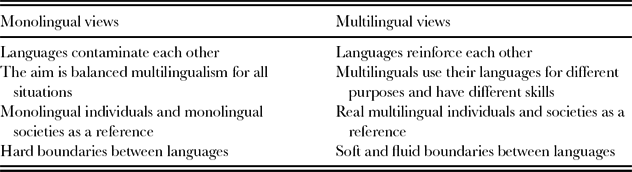
We can see that both the study of multilingualism in educational contexts and teaching ELF have started to follow the trend that is replacing monolingual views with multilingual views. The differences between these views can be seen in Table 1.
Monolingual and multilingual views
Focus on multilingualism and ELF
There are different ways to analyse the synergies between ELF and multilingualism that can emerge from adopting a multilingual view in educational contexts. The new trends presented in the previous section seem to be giving shape to a new, emergent paradigm with various proposals related to different views of multilingualism. In this paper I explore the similarities and differences between these two areas by taking ‘Focus on Multilingualism’ (FoM) as a model (Cenoz & Gorter Reference Cenoz and Gorter2011, Reference Cenoz, Gorter, Cenoz and Gorter2015). Consistent with the new trends in multilingualism, FoM is an alternative to traditional perspectives that emphasize language separation. FoM ‘proposes soft boundaries between languages and relates the way multilingual students use their communicative resources in spontaneous conversation to the way languages are learned and taught at school’ (Cenoz & Gorter (Reference Cenoz, Gorter, Cenoz and Gorter2015: 8). FoM has three dimensions: (1) the multilingual speaker; (2) the whole linguistic repertoire; and (3) the social context. The three dimensions of FoM are related to each other because the multilingual speaker uses his/her whole linguistic repertoire to communicate in social contexts. These three dimensions will be discussed to identify the similarities that can develop between the study of multilingualism in educational context and ELF.
As will be seen, the concept of translanguaging is a central part of this comparison.
The multilingual speaker
According to FoM, a multilingual speaker uses different languages either in isolation or mixed, for different purposes instead of using one language for all possible situations. Cook (Reference Cook1992) explains that multilinguals have a qualitatively different type of competence, a complex type of competence that he calls ‘multicompetence’. The analysis of multilingual discourse practices also shows that multilingual speakers are different from monolingual speakers because they can use more linguistic resources to shape the communicative context (Creese & Blackledge Reference Creese and Blackledge2010). Most speakers of ELF are multilingual and speak English as a second or additional language. The type of competence ELF speakers have cannot be separated from their multilingual experience (Canagarajah Reference Canagarajah2007).
Therefore, both for FoM and ELF, the multilingual speaker is seen as different from a monolingual speaker. This difference does not mean that multilingual speakers are deficient speakers of the target language. On the contrary, as Block (Reference Block2007: 72) points out, they can be seen more ‘hyperlingual’ than semilingual because of the different linguistic resources they have at their disposal. This idea of looking at multilinguals as skilled communicators, which is crucial in the new trends in multilingualism, was also highlighted by Jenkins, Cogo & Dewey (Reference Jenkins and Dewey2011: 284) in the context of ELF: ‘once NNSEs are no longer learners of English, they are not the ‘failed native speakers’ of EFL, but – more often – highly skilled communicators who make use of their multilingual resources. . .’.
Traditionally the communicative skills of multilingual speakers have been measured from a monolingual perspective against the yardstick of the ideal native speaker of each of the languages involved. Learners are expected to achieve some level of communicative competence that could get them progressively closer to the native speaker of the target language. The native speaker is usually identified with a total command of the target language and this goal is seen as unreachable and unfair (Cook Reference Cook and Macaro2010). As Llurda explains (Reference Llurda2014: 2): ‘Many non-native English teachers (NNESTs) feel inferior or suffer from low self-esteem due to the native/non-native categorization and the attitudes associated with it’. Lee, Schutz & van Vlack (Reference Lee, Schutz, Van Vlack and Martínez Agudo2017) discuss anxieties and insecurities of NNESTs and how the South Korean participants in this study highlight the differences between native and non-native teachers (see also Nagamine Reference Nagamine and Agudo2017).
FoM looks at multilingual speakers and proposes examining the different ways these speakers learn and use their languages without comparing them to ideal native speakers of different languages. However, it is important to consider that the communicative competence of multilingual speakers is fluid and can change from speaker to speaker. In the context of ELF, Kirkpatrick (Reference Kirkpatrick2011) argues that it is necessary to provide multilingual learners with models and to set appropriate goals for learning English so that they are not penalized for being different from native speakers. Indeed, Kirkpatrick (Reference Kirkpatrick2011: 10) goes further, and refers to linguistic models based on the way multilingual English teachers communicate, arguing that the ‘second language speakers should be measured against the successful bilingual or multilingual speaker’. The idea is that non-native multilingual English teachers are a more appropriate linguistic model than the native speaker and can become the source of linguistic ‘norms’ for the students. The goal of learning English is not to acquire native-like proficiency but to be a successful communicator when using ELF. Some years earlier, House (Reference House2003) proposed that ELF speakers should be measured against the stable multilingual speaker under comparable conditions of use and goals for interaction rather than against monolingual native speakers’ norms. Even if these ideas are interesting, they face certain challenges derived from the variability of multilingual speakers’ competences as will be seen later.
So far, we can see that FoM and ELF share the perspective of considering the multilingual speaker (or ELF user) as different from the native speaker and both see the need to replace the reference to the native speaker as a model with that of the multilingual speaker. The reason for this is that the multilingual speaker is a different type of speaker with different competences. Despite these similarities there are also some differences between FoM and ELF at least when considering the reference to the multilingual speaker as a linguistic model.
The whole linguistic repertoire
FoM goes against well-established traditions of language separation by softening boundaries between languages. This challenges the traditional idea that the L1 or other previously learned languages may interfere in the process of learning the target language.
FoM takes into account the multilingual speaker's whole linguistic repertoire when learning and using languages (Cenoz & Gorter Reference Cenoz, Gorter, Creese and Blackledge2014, Reference Cenoz, Gorter, Cenoz and Gorter2015). There are at least two reasons for this. The first is that the processing of new information is linked to existing prior knowledge and experiences. If prior knowledge of linguistic resources is suppressed, learning can be less effective. As Jonassen & Grabowsky (Reference Jonassen and Grabowski1993: 426) explain, ‘the more prior knowledge an individual possesses, the less instructional support is needed; the less prior knowledge an individual possesses, the more instructional support will be needed’. The second reason is related to the idea that prior knowledge already exists in the case of multilingual speakers and this knowledge is naturally used as a resource. This can be seen in the study reported by Cenoz & Gorter (Reference Cenoz and Gorter2011) who observed that multilingual learners use common strategies when writing compositions on three different topics in three languages. Multilingual students organized paragraphs in the same way in different languages and used similar strategies when writing about different topics using the resources in their whole linguistic repertoire and sharing them across languages.
The interaction between languages can also be seen when looking at cross-linguistic influence. Studies in third language (L3) acquisition report that these learners are influenced by their first and second language lexis, phonetics and phonology, morphology and syntax, pragmatics and discourse (see for example Safont Reference Safont2005; De Angelis Reference De Angelis2007). Moreover, the interaction between languages can also be seen in ‘reverse transfer’ when multilingual speakers use linguistic resources from the L3 to the second language (L2) or the L2 to the L1 (Tsang Reference Tsang2016). Taken together, these findings indicate that multilingual speakers use resources from their whole linguistic repertoire.
The use of linguistic resources from the whole linguistic repertoire is related to translanguaging. In the context of multilingual education, a distinction can be made between pedagogical and spontaneous translanguaging. The original concept was developed in Wales, based on alternating the languages used for input and output in a systematic way, as mentioned in the previous section, would be an example of pedagogical translanguaging because it was designed as a teaching strategy (Lewis, Jones & Baker Reference Lewis, Jones and Baker2012). As foreshadowed, the notion of translanguaging is not unique to the classroom setting. According to FoM, pedagogical translanguaging is not limited to the alternation of input and output and includes other pedagogical strategies based on the use of the multilingual speaker's linguistic resources from the whole linguistic repertoire. Spontaneous translanguaging refers to the reality of multilingual usage in naturally occurring contexts where boundaries between languages are fluid and constantly shifting. It can take place both inside and outside the classroom. Inside the classroom, it can have pedagogical value but it has not been planned in advance as a pedagogical strategy.
FoM and ELF share the idea of paying attention to the speaker's multilingual repertoire and not just to the target language. Some years ago, Seidlhofer (Reference Seidlhofer2009: 242) referred to multilingual repertoires and the fluidity of boundaries between languages:
. . .the interactants are making use of their multi-faceted multilingual repertoires in a fashion motivated by the communicative purpose and the interpersonal dynamics of the interaction. In many speech events, boundaries between languages also seem to be perceived as fluid or irrelevant. . .
Cogo (Reference Cogo, Bowles and Cogo2015: 3) also considers the multilingual nature of ELF and the use of plurilingual resources ‘to flexibly co-construct their common repertoire in accordance with the needs of their community and the circumstances of the interaction’. The boundaries between languages in the context of ELF are artificial according to Hülmbauer (Reference Hülmbauer2013: 67), who considers that the whole concept of language as a ‘relatively fixed entity’ can be called into question (see also Seidlhofer Reference Seidlhofer2011; Cogo Reference Cogo2012).
In addition, Jenkins (Reference Jenkins2015) and Seidlhofer (Reference Seidlhofer, Cenoz, Gorter and May2017) highlight the need for a reorientation in ELF studies to point them in a more multilingual direction. Jenkins (Reference Jenkins2015) explains the importance of the concept of translanguaging in ELF studies and that even if ELF refers to translanguaging, its full potential has yet to be developed. She adds that translanguaging should be regarded as normal language behaviour and emphasizes the need to develop the relationship between English and other languages. Seidlhofer (Reference Seidlhofer, Cenoz, Gorter and May2017) highlights the importance of considering English as an additional communicative resource in the multilingual speaker's repertoire and of building on the learner's own language experience.
As can be seen, FoM and recent developments in ELF go in the same direction. New approaches in multilingualism highlight a holistic vision that takes into account the multilingual speaker's linguistic resources and translanguaging. As can be expected, the role of English is more central in ELF than in FoM. There are also some differences regarding the role of the interaction between languages, which is a central part of research in multilingualism but not in ELF.
The social context
Multilingual speakers acquire and use languages while engaging in language practices in a social context. FoM looks at the way multilingual speakers use their linguistic resources and translanguage in spontaneous interaction both at school and outside school (Gorter Reference Gorter2015). The study of the interaction between multilingual speakers may include spontaneous translanguaging when speakers use their multilingual resources to shape the social context. Multilingual students have their own communities of practice in which they share ways of doing things together. It is in these natural contexts, which include computer-mediated communication, where there are more opportunities for learners to use languages as a resource in successful communication (see, for example, Cenoz & Bereziartua Reference Cenoz and Bereziartua2016).
FoM and ELF share an interest in communicative interaction in the social context and the idea of linking natural communicative practices to teaching. Languages are not fixed codes that can be taught without looking at the natural communicative way they are used in the social context. The use of languages in the social context, including translanguaging, needs to be taken into consideration in language teaching if students are going to be successful communicators. When comparing FoM to ELF there are also some differences in the emphasis given to English. ELF looks at interaction in English in the social context acknowledging that ELF speakers use multilingual resources. FoM considers the way multilingual speakers use their multilingual resources in natural communicative interaction. Multilingual speakers always have their linguistic resources available but depending on the social context, translanguaging can be more or less prominent. Research on multilingualism places an emphasis on episodes of translanguaging because these can show the use of multilingual resources more clearly than discursive practices only taking place in one language. Therefore, while ELF researchers identify some features from other languages in the speakers’ communication in English, for researchers focusing on multilingualism, these features from the whole linguistic repertoire are central to the study of communicative interaction in the social context.
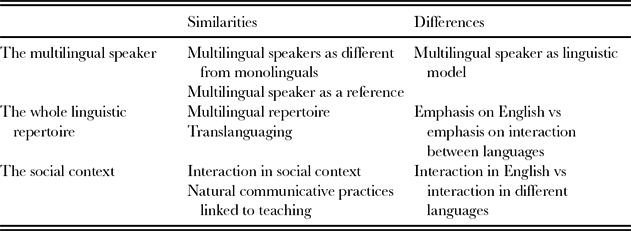
In this section we have seen that there are many similarities between FoM and ELF regarding the multilingual speaker, the whole linguistic repertoire and the social context. There are also some differences because FoM does not necessarily include English and looks at the interaction between languages while in ELF the principal focus is on English. This can be seen in the summary of similarities and differences in Table 2.
Multilingual views: Similarities and differences between FoM and ELF
Translanguaging pedagogies
In the previous section we have seen that multilingual speakers can use their linguistic resources from the whole linguistic repertoire when learning and using languages in the social context. However, multilingual speakers are not always aware of the resources they have and may not use them to their full extent if they are not activated. Multilingual speakers use their resources when they translanguage spontaneously but pedagogical translanguaging has great potential because it can provide a deeper understanding of the content and can also be useful as scaffolding across languages. One such strategy is to use the L1 as a resource when the L2 is used as the medium of instruction and the learning tasks are complex (Llurda, Cots & Armengol Reference Llurda, Cots, Armengol, Haberland, Lonsman and Preisler2013; Swain & Lapkin Reference Swain and Lapkin2013).
FoM proposes going one step further by using translanguaging strategies with the purpose of developing language awareness and metalinguistic awareness. The idea is that languages are used more efficiently when students are aware of their own linguistic resources in the whole linguistic repertoire. As we have already seen, Cenoz & Gorter (Reference Cenoz and Gorter2011, Reference Cenoz, Gorter, Creese and Blackledge2014) reported similarities in content and organization when writing compositions on three different topics in three languages. This finding has important implications for language teaching because writing strategies can be reinforced across languages provided that students are aware of this possibility. Metalinguistic awareness can also be developed by working with vocabulary across languages when focusing on cognates, derivatives and compounds, enabling learners to realize that they can use the linguistic resources in their multilingual repertoire (see also Arteagoitia & Howard Reference Arteagoitia, Howard, Cenoz and Gorter2015; Simpson Baird, Palacios & Kibler Reference Simpson Baird, Palacios and Kibler2016). For example, in a project conducted in the Basque Country, primary school students were shown pictures of the linguistic landscape in their town including Basque words such as loredenda (flower shop) or liburudenda (bookstore). They were asked to compare the elements of these two compound words in Basque and English so that they realized that even if these languages are not typologically related, some words share the same structure (flower + shop; book + store). Learners could also compare these words to the Spanish floristería and librería, which do not have the same structure. One way to extend this activity to develop language awareness is to look at how multilingualism is present in the linguistic landscape of the students’ town. Many of the shops have multilingual signs that could be analysed in class thus developing awareness about the way languages are used in the social context (Gorter & Cenoz Reference Gorter and Cenoz2015).
Besides using strategies to develop metalinguistic awareness by using the multilingual speaker's resources in the whole linguistic repertoire, FoM also puts the multilingual speaker at the forefront. How can this be done? One example could be to interview a multilingual speaker who explains his/her own linguistic experience. Students can be asked to write and present their language biography. Another possibility is to ask students to reflect on the use of translanguaging in different contexts by comparing their informal communicative practices with the academic use of the language at school. These strategies can raise awareness about the way multilingual speakers learn languages and the role of the social context.
FoM uses translanguaging pedagogies in the teaching of different languages but these strategies can be used to teach ELF as well. The idea is to maximize the learner's linguistic resources when learning English. Translanguaging strategies can be used both in English language classes and when English is the language of instruction.
Multilingual views in language teaching: Achievements and challenges
The use of multilingual perspectives in language teaching and translanguaging pedagogies goes against long-lasting traditions of language separation when teaching languages in school contexts. The teaching of ELF also challenges monolingual-oriented traditions of teaching English. It is no wonder then that some of the ideas discussed here have proved controversial. Kramsch (Reference Kramsch2012: 109) considers that this multilingual perspective is revolutionary because ‘it puts into question [both] . . . the whole monolingual foundation of theoretical and applied linguistics and the traditional national underpinnings of foreign language (FL) teaching’.
In fact, and despite the multilingual turn in the study of multilingualism, ELF and second language acquisition (SLA) monolingual ideologies are still very strong and influence language teaching all over the world (Widdowson Reference Widdowson2012; The Douglas Fir Group 2016). Jenkins, Cogo & Dewey (Reference Jenkins and Dewey2011: 308) explain how teachers persist in having native English as a goal, stating that ‘the notion that they should all endeavour to conform to the kinds of English which the NS minority use to communicate with each other is proving very resistant to change’. Meanwhile, Llurda (Reference Llurda2014) explains the resistance to multilingual views by employees in language schools who only look for native English-speaking teachers. Paquet-Gauthier & Beaulieu (Reference Paquet-Gauthier and Beaulieu2016) also argue that the multilingual turn has led to major changes in teaching practices.
Multilingual views in language teaching face some resistance yet multilingual ideologies have been spreading in recent years. Cook (Reference Cook2016: 187) says that ‘It is true that second language acquisition researchers’ reliance on the native speaker is now more covert’ even though it still exists. The acceptance of multilingual views in SLA research can also be seen in the way multilinguals are described by the Douglas Fir Group (2016: 26): ‘Multilinguals are well documented as handling this rich semiotic repertoire flexibly, sometimes keeping the languages separate, at other times alternating them, mixing them, or meshing them.’
As we have already seen when looking at FoM, multilingual speakers are different from monolingual speakers (see also, for example, Cook & Li Reference Li2016). We have also observed that this is important when setting appropriate goals so that multilinguals or speakers of ELF are not considered failed native speakers (Jenkins, Cogo & Dewey Reference Jenkins and Dewey2011; Kirkpatrick Reference Kirkpatrick2011). This view implies a real challenge for language teaching because in comparison with the ideal and fixed reference of the native speaker, multilingual competence is ‘fluid, not fixed: difficult to measure, but real’ (Cenoz & Gorter Reference Cenoz, Gorter, Creese and Blackledge2014: 245). Paquet-Gauthier & Beaulieu (Reference Paquet-Gauthier and Beaulieu2016: 169) explain that even if there has been a turn towards multilingualism, multicompetence is still defined very vaguely and ‘it has very little operative value in the classroom’. This presents an important challenge for FoM and ELF. It is possible to show the way multilingual speakers communicate and to analyse the linguistic resources used but multilingual speakers use their resources in their own unique ways according to the situation. Is it a good idea to replace ideal native speaker competence with ideal multilingual speaker competence? This can be quite problematic for several reasons: first, because the communicative competence of multilingual speakers is fluid and can change from speaker to speaker. Would it make sense to create an ideal multilingual English speaker based on competent multilingual speakers and use it as a yardstick in language teaching and testing? If so, the model that has been criticized is replaced by another fixed model that does not reflect the flexibility and fluidity of languages. The second problem is that, as Canagarajah (Reference Canagarajah2007: 927) states, ‘Multilingual speakers are not moving towards someone else's target; they are constructing their own norms’. Monolingual speakers are not a homogeneous group but multilingual speakers are even less so because of the richer range of possibilities in communicative interaction. There are many ways to be a competent multilingual speaker and it would not make sense to codify one specific way and take it as the only model.
The challenge of adopting a multilingual perspective in language teaching is not to describe and codify the linguistic resources used by the ideal multilingual speaker. However, there are considerable challenges and implications when adopting a multilingual perspective. If the multilingual speaker is constructing his/her own norms, how can competence in the relevant languages be evaluated? Cogo (Reference Cogo, Bowles and Cogo2015: 9) acknowledges this challenge in ELF and states that concepts such as ‘competent user’ need to be operationalized. Jenkins (Reference Jenkins2006) pointed out contradictions in the policy of English language tests which are supposed to be international but which penalize internationally communicative forms of English. She also added that it was too early to give very specific criteria about ELF assessment. Now, more than a decade later, some progress has been made in the assessment of multilingual competence and ELF. Gorter & Cenoz (Reference Gorter and Cenoz2017b: 11) explain that multilingual assessment can refer to three possibilities:
• A multilingualism approach towards comprehension. This idea is to provide translations of the tasks and allow students to answer content questions in the language they feel more comfortable with. This type of assessment has been carried out in different contexts with immigrant students (see, for example, De Backer, Van Avermaet & Slembrouck Reference De Backer, Van Avermaet and Slembrouck2017). Heugh et al. (Reference Heugh, Prinsloo, Makgamatha, Diedericks and Winnaar2017) report data from South Africa to show how this approach can work even in large-scale testing. Menken & Shohamy (Reference Menken and Shohamy2015: 421) explain that this type of multilingual assessment reflects the multilingual speaker's knowledge more accurately and contributes to higher scores in an academic content. This type of assessment can work when assessing content rather than language.
• A multilingualism approach towards multilingual scoring. This approach would be based on assessing two or more languages separately but combining the scores to consider the total competencies of the multilingual speaker. Cenoz, Arocena & Gorter (Reference Cenoz, Arocena, Gorter and Gathercole2013) reported a research study consisting of assessing writing skills in Basque, Spanish and English. After scoring the three languages separately, they created a bilingual and multilingual index by adding up scores to evaluate multilingual competence levels. This type of assessment can be used to assess multilingual competence as a combination of competences in two or more languages.
• A translanguaging approach to assessment. This approach, which has also been used to assess multilingual competence, implies looking at the different languages and translanguaging not only when scoring but also during the assessment process. Escamilla et al. (Reference Escamilla, Hopewell, Butvilofsky, Sparrow, Soltero-González, Ruiz-Figueroa and Escamilla2013) look at compositions in English and Spanish side-by-side to evaluate content, structural elements and spelling, and identify patterns that go across languages. A similar approach has also been used by Cenoz & Gorter (Reference Cenoz and Gorter2011, Reference Cenoz and Gorter2013).
The first of these three approaches assesses content in a way that tries to avoid linguistic discrimination while the other two aim at assessment of the whole linguistic repertoire. There have also been some specific suggestions for assessing ELF. Some years ago, Elder & Davies (Reference Elder and Davies2006) presented two proposals to evaluate ELF. The first was to use standard English as a reference but to make some modifications to make the tests accessible to non-native speakers. This could be done by avoiding particular topics or genres in the tests or training evaluators to focus on communication when scoring the tests. This approach is taken into consideration in some textbooks and by some teachers, yet it is not as widespread in language assessment. The second proposal is to consider ELF as a code in itself. Elder & Davies (Reference Elder and Davies2006) encountered some problems with this latter proposal because of the difficulty in developing a code due to the diversity of ELF speakers. If a code were developed, we would run the risk of replacing one monolithic standard with another. These types of assessment are just the first steps and there is still a long way to go before an extensive use of multilingual approaches and tools become widespread in the assessment process.
This presentation has analysed the relationship between recent trends in multilingualism and ELF. I have looked at FoM, a specific approach in the study of multilingualism in educational contexts and analysed its relationship with new trends in the study of ELF. There are enough similarities to justify establishing closer links between FoM and ELF to obtain significant further insights into the way languages are learned and used. This is particularly important nowadays because of the characteristics of multilingualism and ELF in the twenty-first century.
Acknowledgement
This work was supported by the MINECO/FEDER [Grant number EDU2015-63967-R] and the Basque Government [Grant number DREAM IT-714-13].
Jasone Cenoz is Professor of Research Methods in Education at the University of the Basque Country, UPV/EHU (Spain). Her research focuses on multilingual education, third language acquisition, bilingualism and multilingualism. Specific topics Jasone Cenoz has investigated in her research include the multilingual lexicon, translanguaging in written production, Basque multilingual education and cross-linguistic influence. She has published articles on multilingual education in The Modern Language Journal, Applied Linguistics, Language Culture and Curriculum, TESOL Quarterly, Language Teaching and the International Journal of Bilingual Education and Bilingualism among others. She is also the author of several book chapters and books, including the award-winning monograph Towards multilingual education (Multilingual Matters, 2009). She is Past President of the International Association of Multilingualism and has served as AILA publications coordinator for eight years, and she has been a member of the Executive Committee of IASCL and the International Association of Multilingualism.


 Open access

