

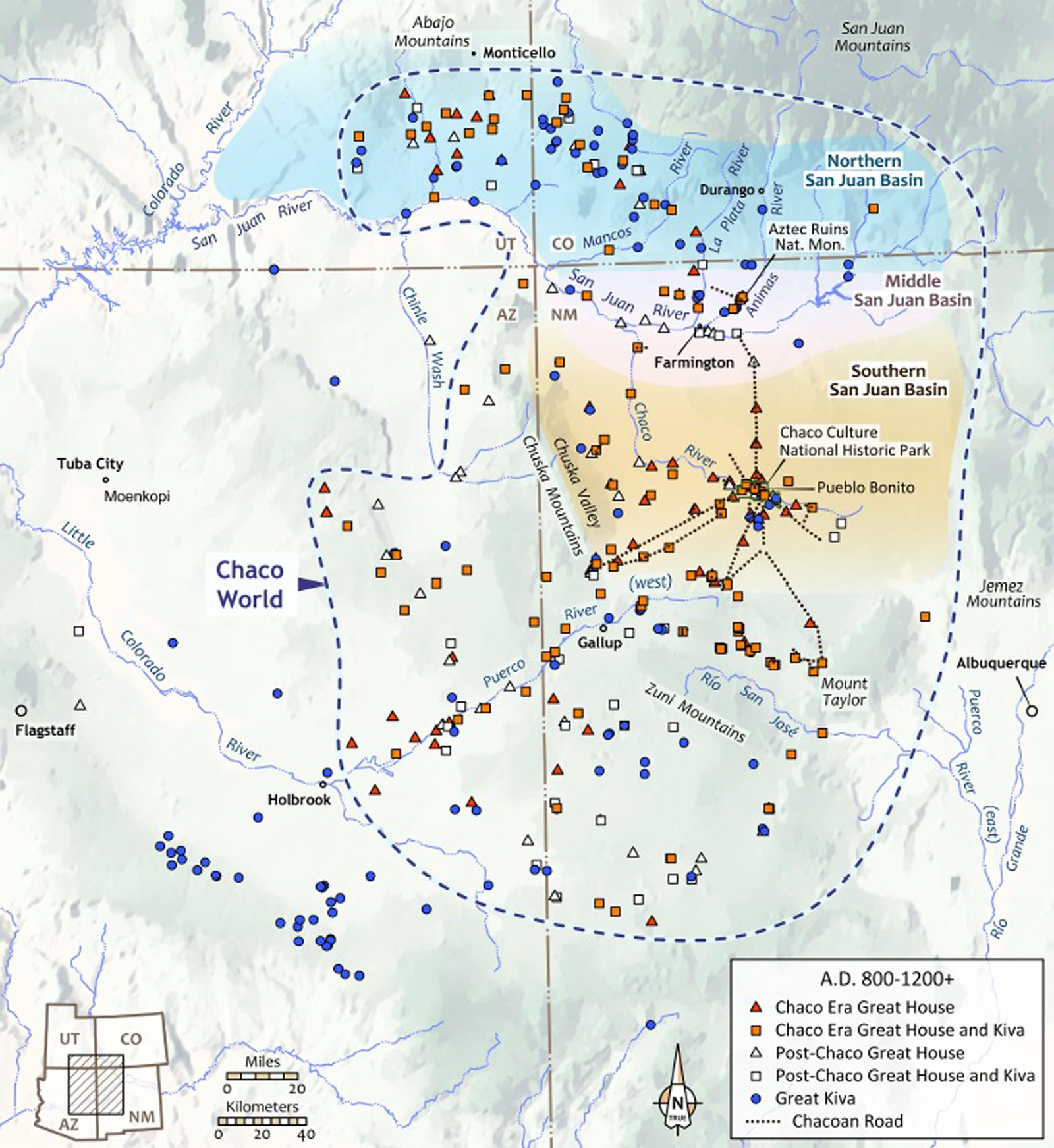
The “Chaco World” is an archaeological pattern covering a large area of the North American Southwest between roughly AD 800 and 1150, and it is centered on the eponymous Chaco Canyon (Figure 1). The growth and extent of this pattern is primarily measured by the distribution of architectural features identified as distinctly Chacoan, including formal roads, great kivas, great houses, and specific masonry styles (Judge Reference Judge, Crown and James Judge1991; Kantner Reference Kantner2003a, Reference Kantner2003b; Lekson Reference Lekson and Lekson2007; Plog Reference Plog, Heitman and Plog2015). Increasing social differentiation also helps to define the Chaco World, particularly the existence of elites at Pueblo Bonito starting in the AD 800s (Plog and Heitman Reference Plog and Heitman2010), and later at Aztec in the Middle San Juan area (Lekson Reference Lekson2015). Another distinguishing feature of the Chaco World was the acquisition of long-distance goods from as far away as Mesoamerica (Crown and Hurst Reference Crown and Hurst2009; Nelson et al. Reference Nelson, Fish, Fish, Mills and Fowles2017; Watson et al. Reference Watson, Plog, Culleton, Gilman, LeBlanc, Whiteley, Claramunt and Kennett2015) and large-scale regional procurement of other materials, such as turquoise (e.g., Thibodeau et al. Reference Thibodeau, Chesley, Ruiz, Killick, Vokes, King, Cartwright and McEwan2012), wood (Guiterman et al. Reference Guiterman, Swetnam and Dean2016), flaked stone (Cameron Reference Cameron2001), and ceramics (Cameron and Toll Reference Cameron and Toll2001).
Map of great kivas and great houses that define the Chaco World, as well as regions mentioned in the text (adapted from Mills et al. Reference Mills, Peeples, Aragon, Bellorado, Clark, Giomi and Windes2018). (Color online)
The spread of styles strongly associated with Chaco Canyon itself—including architectural layouts, masonry styles, and ceramic decorative styles—are other ways that archaeologists have looked at both social connectedness and social differentiation within the Chaco World. If style is defined as a choice or “a way of doing things” (Hegmon Reference Hegmon1992:518), then the inherent sociality of learning and doing style makes it suitable for understanding social connectedness from archaeological materials. Likewise, variation in style allows for some kinds of highly visible styles to serve a communicative function in culture, including marking participation in social groups and social differences (Carr Reference Carr, Carr and Neitzel1995). Yet, how style is variably employed across different statuses and their related identities needs to be demonstrated rather than assumed. In this article, we look at how style was employed in contexts of differential statuses to investigate how inequality and region-wide styles intersect.
In the Chaco World, a particular ceramic decorative style known as Dogoszhi style cross-cuts ceramic types and zones of ceramic production and has been argued to indicate participation in the broader Chaco network (Judge Reference Judge, Crown and James Judge1991:27–28; Lekson Reference Lekson and Lekson2007; Plog Reference Plog, Carr and Neitzel1995, Reference Plog, Heitman and Plog2015:10; Toll Reference Toll1985:215–216). Neitzel (Reference Neitzel, Carr and Neitzel1995) explicitly tied Dogoszhi style to elites in Chaco Canyon and inferred that the regional distribution of the style stemmed from emulation by other elites. According to this interpretation, the distribution of the style is the result of its association with elites in Chaco Canyon and was a means of marking social status. Others reject the proposition that Dogoszhi-style ceramics represent a Chacoan elite style, and they suggest instead that the widespread distribution of Dogoszhi-style ceramics within the Chaco World indicates that the style acted as a marker of community membership that was more broadly shared (see, especially, Toll et al. Reference Toll, Blinman, Wilson and Doyel1992). Both sides of this debate cite the high percentage of Chaco cylinder jars decorated in Dogoszhi style as one of the primary lines of evidence. Even before Crown and Hurst's (Reference Crown and Hurst2009) finding that cylinder jars were used for the preparation of cacao beverages, archaeologists recognized the restricted distribution of these jars to Chaco Canyon and especially within Pueblo Bonito's Room 28 (Neitzel Reference Neitzel, Carr and Neitzel1995; Toll Reference Toll1985, Reference Toll, Duran and Kirkpatrick1990). Room 28 was ritually terminated, adjacent to other ritual storage rooms, and it was two rooms away from the densest concentration of elite burials in the northern Southwest (Crown Reference Crown2018, Reference Crown2020). The use of the style on special forms such as cylinder jars is in contrast to the dominance of Dogoszhi style on other vessel forms used in everyday practice at a variety of site types, including both great and small houses, which some researchers suggest is more indicative of broader community membership rather than of elite status (Toll Reference Toll1985; Toll et al. Reference Toll, Blinman, Wilson and Doyel1992).
These ideas fall on a continuum of interpretations about what constitutes an elite style and how such styles may or may not be produced and used by members of the larger community. In many areas of the world, elite styles are intentionally restrictive in order to mark who is an elite, especially through clothing and house styles (Feinman and Neitzel Reference Feinman, Neitzel and Schiffer1984). In societies with clearly demarcated hierarchies, such trappings of prestige are used to legitimize and perpetuate the existing social order. But even within state societies, such as the Inka, elite styles were replicated to various degrees through multiple social strata (Morris Reference Morris, Carr and Neitzel1995). In the Monte Albán polity, demand for highly valued Crema ware by subordinate elites in outlying areas was met by encouraging production outside the center (Elson and Sherman Reference Elson and Sherman2013). In the Maya area, it has been suggested that some artifact styles were strategically and widely used by elites in two ways: (1) to promote shared identities among elites, and (2) to encourage an inclusive identity among all members of the society to support emerging or established elites (Schortman et al. Reference Schortman, Urban and Ausec2001). In the latter strategy, the presence of widespread styles may be evidence of elites seeking self-legitimacy by including other elites and even nonelites in social, ritual, and political practices that fostered cooperation and solidified alliances to create networks of power (Schortman Reference Schortman2014).
In this article, we revisit the proposition that Dogoszhi style is an elite style by comparing the distribution of ceramics decorated with this style across the Chaco World. Proponents of Dogoszhi as an elite style have largely based their argument on smaller-scale studies in the Black Mesa area to the west of the Chaco World (Neitzel and Bishop Reference Neitzel and Bishop1990; Plog Reference Plog, Upham, Lightfoot and Jewett1989, Reference Plog, Conkey and Hastorf1990). Only two larger-scale, regional analyses have been previously conducted. Neitzel (Reference Neitzel, Carr and Neitzel1995) used whole vessels from 10 excavated great houses and found that higher percentages of Dogoszhi-style vessels were generally correlated with the largest sites in the settlement hierarchy, which she interpreted as evidence that it was an elite style. In a larger sample of sherd assemblages from great and small houses, Toll and colleagues (Reference Toll, Blinman, Wilson and Doyel1992) found that the percentages of Dogoszhi-style ceramics were highly variable and present at both site types. They suggested that, like its predecessor, Black Mesa–styleFootnote 1, the use of Dogoszhi style indicates regional-scale communication and social ties to multiple areas, which would have been an adaptive strategy to ameliorate local crop failures. In both studies, sites and assemblages with different chronological placement were pooled, and in the case of Toll and colleagues’ analysis, only two sites from Chaco Canyon were included—the great house of Pueblo Alto and one small house (29SJ627). Later compositional analysis of Dogoszhi-style vessel temper and clay found little evidence for centralized production (Neitzel et al. Reference Neitzel, Neff, Glascock, Bishop, Glowacki and Neff2002). Results instead indicate production in a diversity of regions, with distribution cutting across these zones of production.
The increasing availability of regional databases, particularly the Chaco Social Networks database used in this study, now allows us to address the distribution of Dogoszhi style at the macroscale of the entire Chaco World. We look at a large sample of ceramics from great houses and great kivas, as well as a group of outlier communities that includes both great and small houses. We employ a consistent chronological tool based on the dating of individual types and divide each assemblage into 50-year intervals (Roberts et al. Reference Roberts, Mills, Clark, Randall Haas, Huntley and Trowbridge2012). If Dogoszhi-style ceramics were a component of an elite style, they should be differentially distributed across the Chaco World. In particular, they should be found in higher proportions in contexts associated with elite activities (including residence or ceremony) relative to nonelite contexts, and also in greater proportions at great houses and great kivas in central Chaco over more distant outliers. This should be true at both the community and regional scales, with a higher proportion of elite goods at socially prominent sites within the settlement system relative to less prominent sites (Neitzel Reference Neitzel, Carr and Neitzel1995:397). By contrast, if Dogoszhi-style ceramics were markers of membership in the broader Chaco World, they should be distributed relatively homogenously across the entire region with sharp boundaries marking edges with other regions outside the Chaco World (Neitzel Reference Neitzel, Carr and Neitzel1995:397; Plog Reference Plog, Carr and Neitzel1995:372; see Hegmon et al. [Reference Hegmon, Russell, Baller, Peeples and Striker2021] for a southern Southwest example). In this study, we look at the distribution of Dogoszhi style over several chronological periods and assess whether the distribution of the style is related to settlement size, the importance of settlements in terms of centrality or position within the overall network, or proximity to Chaco Canyon. We also examine the overall homogeneity or heterogeneity of the distribution of Dogoszhi-style ceramics within the broader Chaco World in comparison to the earlier Black Mesa style.
What Is Dogoszhi Style?
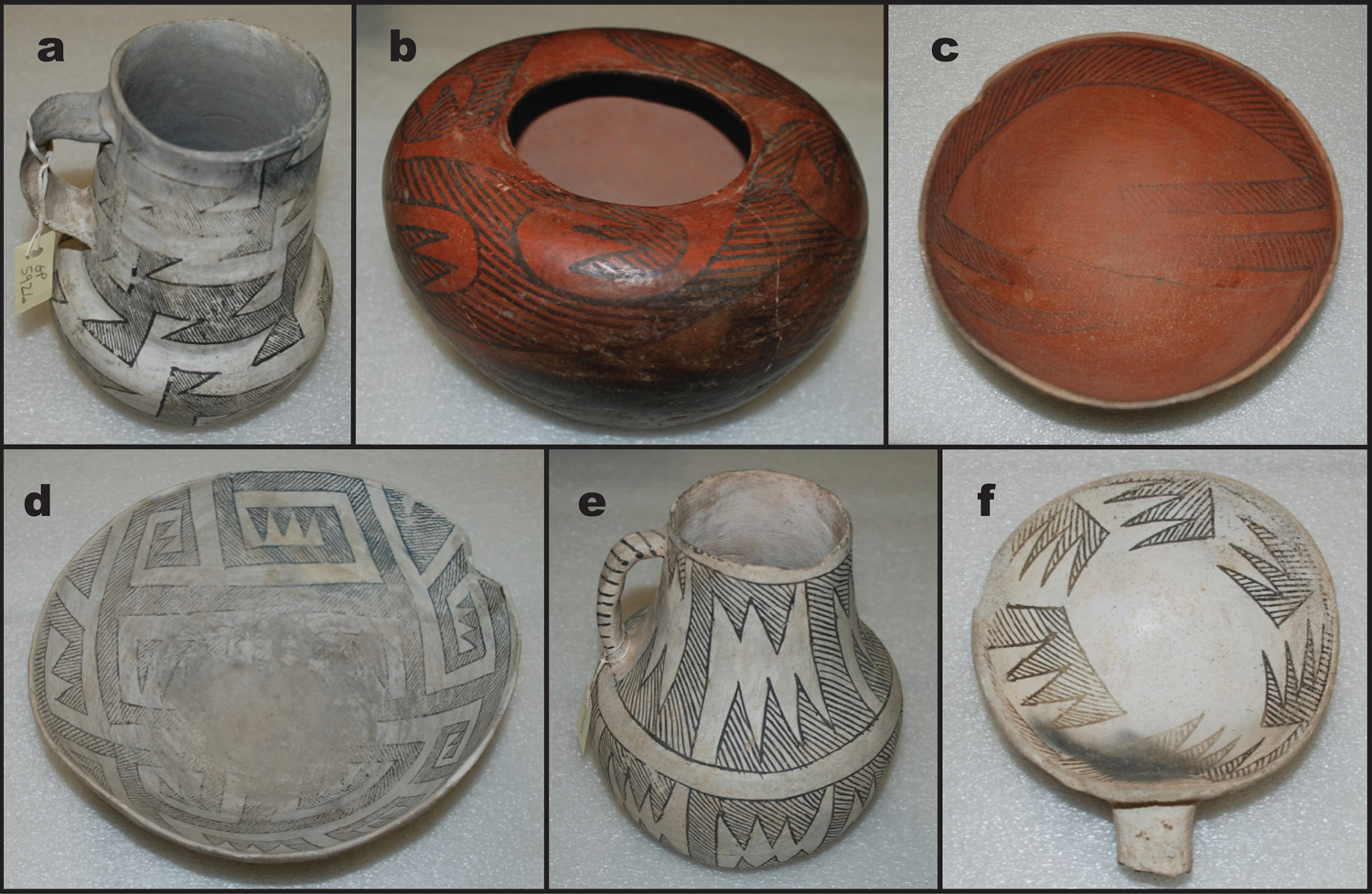
Dogoszhi style is found on ceramic vessels across the northern Southwest and is especially prevalent during the Pueblo II (AD 900–1150) period. In Chaco Canyon assemblages, it peaks in the century between AD 1020 and 1120 (Toll and McKenna Reference Toll, McKenna and Joan Mathien1997:Table 2.11B), which is also when the Chaco World reached its maximum extent (Mills et al. Reference Mills, Peeples, Aragon, Bellorado, Clark, Giomi and Windes2018). The style is characterized by an all-over design of rectilinear or curvilinear elements filled with parallel lines, or hachure (Figure 2). Dogoszhi style cross-cuts different wares, which are defined in the Southwest on the basis of suites of technological attributes including paste color, temper type, slip color, and paint types. Such cross-cutting is the basis for Colton's (Reference Colton1943, Reference Colton1953) concept of “analogous types”—types that are technologically distinct but that share a common design repertoire, similar to what have been called “horizon styles” in other areas of the world.
Examples of vessels of different wares decorated in Dogoszhi style: (a) Chaco Black-on-white (GP 5926); (b) Tusayan Black-on-red (3742); (c) Tusayan Black-on-red (GP 3385); (d) Gallup Black-on-white (GP 42594); (e) Gallup Black-on-white (GP 1624); (f) Gallup Black-on-white (04254) (Arizona State Museum, University of Arizona collections). (Color online)
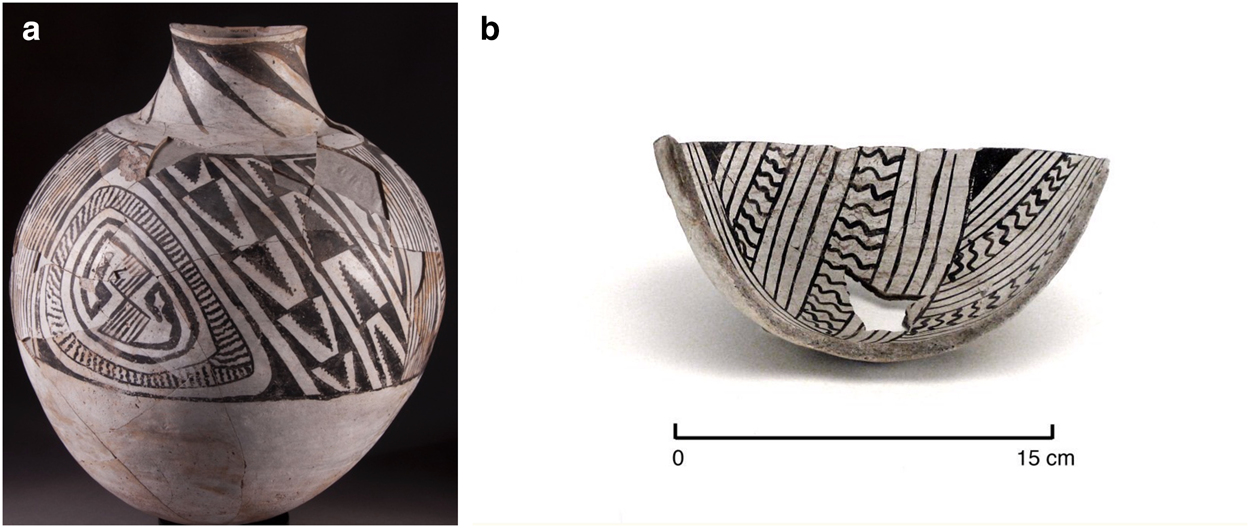
The earliest example of a southwestern ceramic type with a predominantly hachured design comes not from the northern Southwest but from the Hohokam World. Early Snaketown Red-on-buff and Late Snaketown Red-on-buff, both part of the Middle Gila Buff Ware sequence, date to AD 700–730 and 730–750, respectively (Heidke and Ownby Reference Heidke, Ownby and Lindeman2015; Wallace Reference Wallace and Abbott2001), although the connections between these designs and later designs on the Colorado Plateau have not been investigated in detail. In the Ancestral Pueblo area, the first black-on-white ceramic type with Dogoszhi-style design is Brimhall Black-on-white of the Chuska White Ware sequence, which was made between AD 900 and 1070 (Windes Reference Windes and Reher1977). The early end of this range, however, is not well dated. Dogoszhi style rapidly increased in frequency and geographic distribution in the AD 1000s. Ceramic types characterized by Dogoszhi-style designs proliferated throughout the Chaco World between AD 980 and 1040 across four additional wares: Cibola White Ware, Tusayan White Ware, Tsegi Orange Ware, and Mesa Verde White Ware (see Table 1 for a list of Dogoszhi-style analogs). Dogoszhi style followed another region-wide style, called Black Mesa style (Figure 3; see Table 1 for analogs).
Examples of vessels of different wares decorated in Black Mesa style: (a) Black Mesa Black-on-white (height: 53.4 cm, diameter: 42.0 cm) (Collections of Grand Canyon National Park. Photo courtesy of American Southwest Virtual Museum [Northern Arizona University] and National Park Service); (b) Catalog #18263, Red Mesa Black-on-white bowl, Site LA 2585, San Juan County, New Mexico (photo by Daisy Levine and Dennis Brandt. Removed from Navajo Nation Lands and administered by the Bureau of Indian Affairs, Museum Property Program at the Museum of Indian Arts & Culture / Laboratory of Anthropology, Museum of New Mexico). (Color online)
Analog Types Used in the Current Study.

The evolution of Dogoszhi-style designs has been addressed by a number of researchers (Hayes and Lancaster Reference Hayes and Lancaster1975; Roberts Reference Roberts1927; Toll and McKenna Reference Toll, McKenna and Joan Mathien1997). Toll and McKenna (Reference Toll, McKenna and Joan Mathien1997) note that the squiggle-line hachure generally precedes straight-line hachure, but it may also be found later. Squiggle hachure design elements first appeared around AD 880 as small components of the earlier Black Mesa style (e.g., Figure 3a), although it was just one of a variety of design elements in the Black Mesa–style design repertoire. Squiggle hachure was especially common on the analog type of Red Mesa Black-on-white (Figure 3b). These squiggle hachure elements changed over time, eventually being executed as the oblique and densely packed straight lines most characteristic of Dogoszhi-style designs (Figure 4; Hayes and Lancaster Reference Hayes and Lancaster1975:130).
Chronological sequence of hachure execution for Dogoszhi-style ceramics, based on descriptions and photos of Cortez Black-on-white sherds in Hayes and Lancaster (Reference Hayes and Lancaster1975:124, 130).
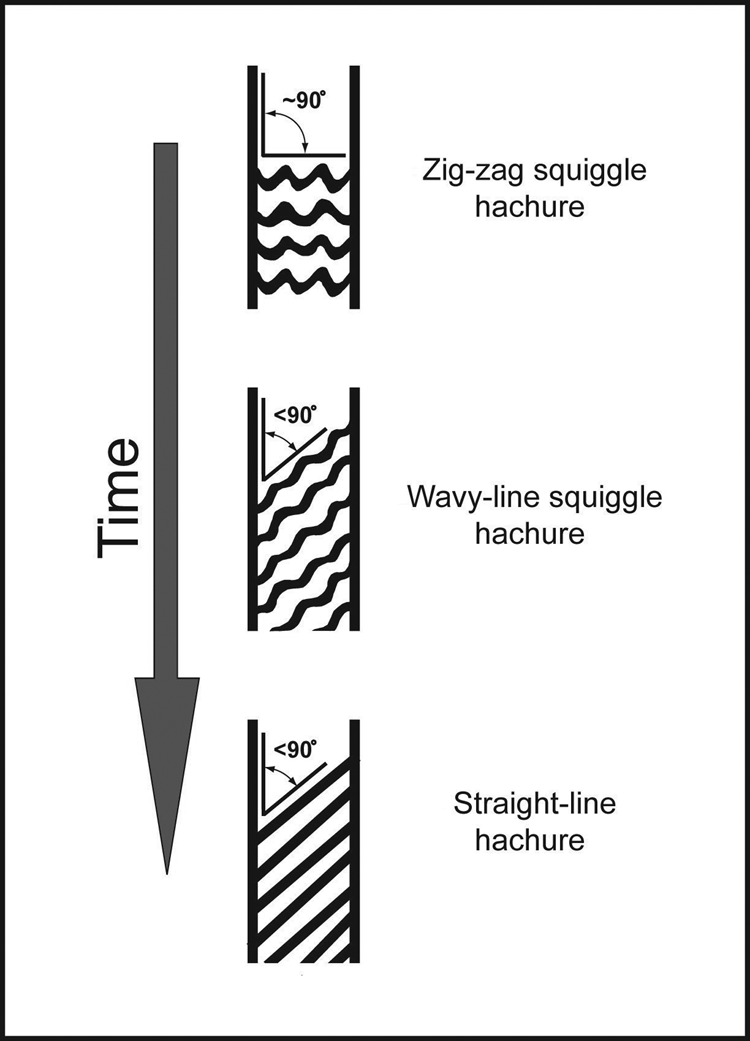
Although there is a clear temporal progression of hachure elements, in some sequences, there is significant overlap in the production of Black Mesa–style ceramics and those executed in Dogoszhi style. This is the case for Cortez Black-on-white in the Mesa Verde White Ware sequence (Hayes and Lancaster Reference Hayes and Lancaster1975:124), as well as for Black Mesa– and Dogoszhi-style analogs in the Chuska White Ware, Little Colorado White Ware, San Juan Red Ware (Allison Reference Allison2008:Figure 2k–l), and Tusayan White Ware sequences. By contrast, there are no Black Mesa analogs in the Tsegi Orange Ware tradition that began production around AD 1000, coincident with a decline in the production of San Juan Red Ware (Allison Reference Allison2008:24). Replacement also occurred in the Cibola White Ware sequence, with production of the Black Mesa–style analog in that sequence (Red Mesa Black-on-white) ceasing around AD 1040, when the Dogoszhi-style analog (Gallup Black-on-white) began being produced.
Regardless of the exact relationship between Black Mesa– and Dogoszhi-style analogs in a particular sequence, the early eleventh century marks a significant shift in ceramic production from earlier styles to a new suite of designs across the northern Southwest. This transition is closely associated with the most prolific material and ideological expansion of the Chaco World in the AD 1000s. Because of the presumed social significance of this shift in ceramic designs, our analysis evaluates the distribution of not only Dogoszhi-style ceramics but also Black Mesa-style ceramics, from which the hachure fill of Dogoszhi style likely derived.
The social importance of Dogoszhi style is further suggested by detailed analyses of the style's execution and the contexts in which the style occurs. Counter-change is produced when the area filled by the hachure (or solid fill in other design systems) is the same size as the unfilled area in between. The counter-change produced through balanced hachure and nonhachure designs is also found on other media—including wood, textiles, ground stone, and rock art—in the Chaco area. In many of these cross-media cases, the counter-change is not executed with hachure but instead with contrasting colors, including red, yellow, or blue (see Bellorado Reference Bellorado2020:Figures 4.2-E–F and 4.3-A–C). Bellorado (Reference Bellorado2020:4.1-B–C) documented the similarity between hachure filled designs and their layouts on Chaco Black-on-white cylinder jars and the raised tread designs on twined sandals made during the Chaco era from Pueblo Bonito and Aztec West. Plog (Reference Plog2003) has argued that the black-painted hachure on ceramics is a metaphor for turquoise and other blue-green colors used on these other objects. Given the importance of blue-green in counter-change designs on ceremonial objects, hachure may have had symbolic value to potters. Several scholars (Bellorado Reference Bellorado2020; DeBoer Reference DeBoer and Longacre1991; Hays-Gilpin Reference Hays-Gilpin, Hays-Gilpin, Deegan and Morris1998; Hegmon et al. Reference Hegmon, Russell, Baller, Peeples and Striker2021) have argued that styles that occur pervasively on multiple classes of media are often charged with meaning, and these meanings often relate to important aspects of shared worldviews and ideological systems. The widespread use of Dogoszhi style on cylinder jars reinforces its potential significance (e.g., Crown and Wills Reference Crown and Wills2003), but it was also used on a large number of other forms in daily use—such as serving bowls, pitchers, and jars. Hachure designs may even have symbolic significance in ceramic traditions outside the Chaco World (Russell et al. Reference Russell, Klassen and Salazar2017). The sudden proliferation of Dogoszhi-style ceramics coinciding with major growth of other material indicators of the Chaco World and the potential symbolic importance of hachure designs on ceramic vessels are potential evidence favoring arguments for Dogoszhi as an elite style. In this study, we evaluate the distribution of Dogoszhi-style ceramics across the Chacoan World and what this distribution means for the possible social significance of the style and its development from earlier design repertoires.
Data and Methods
As Neitzel (Reference Neitzel, Carr and Neitzel1995:399) notes in her study of style and hierarchy in the Chaco World, “The major obstacle to testing expectations about stylistic patterning within the Chacoan regional system is the incompleteness of the available data.” The development of the Chaco Social Networks (CSN) database is one step toward overcoming this obstacle, allowing for a larger-scale exploration of the distribution of both Dogoszhi-style and Black Mesa–style ceramics. The CSN database contains information about location, site size, and monumental and public architecture attributes for 467 Chacoan sites dating between AD 800 and 1300, with ceramic assemblages available for 298 of those sites (Mills et al. Reference Mills, Peeples, Aragon, Bellorado, Clark, Giomi and Windes2018). The database includes only sites that have Chacoan architectural features: great houses, great kivas, or both. Ceramic assemblages for each site have been previously apportioned across 10 50-year intervals, between AD 800 and 1300, using methods originally established for the Southwest Social Networks Project (Roberts et al. Reference Roberts, Mills, Clark, Randall Haas, Huntley and Trowbridge2012).
For this analysis, the percentage of Black Mesa–style and Dogoszhi-style ceramics within the decorated assemblage was calculated for each great house or great kiva site in each 50-year interval using the list of analog styles in Table 1. An important caveat to this list of Dogoszhi-style analogs is that most archaeologists in the Mesa Verde region have combined vessels with a variety of design repertories (including Dogoszhi style) into a single type based on their shared technological attributes: Mancos Black-on-white (Breternitz et al. Reference Breternitz and Rohn1974). As such, only a subset of Mancos Black-on-white is decorated with all-over hachure designs.Footnote 2 However, for 19 assemblages where analysts recorded the style of individual Mancos Black-on-white sherds, Dogoszhi-style sherds comprised, on average, 40% of the Mancos Black-on-white sherds (see Table 2). The relative frequency of Dogoszhi-style Mancos Black-on-white sherds seems to have a rough correlation with distance from Chaco Canyon and the San Juan Basin, with lower proportions of Dogoszhi-style sherds in assemblages from southeast Utah and the Mesa Verde region. So as not to overrepresent the relative frequency of Dogoszhi-style ceramics in assemblages dominated by Mancos Black-on-white, we counted only 40% of Mancos Black-on-white sherds as analogous in our analysis. This approach does not account for variability between sites, but it does more accurately capture the distribution of Dogoszhi style than the alternatives of excluding all Mancos Black-on-white sherds, or using 100% of those sherds.
Proportion of Mancos Black-on-White with Dogoszhi-Style Decoration.
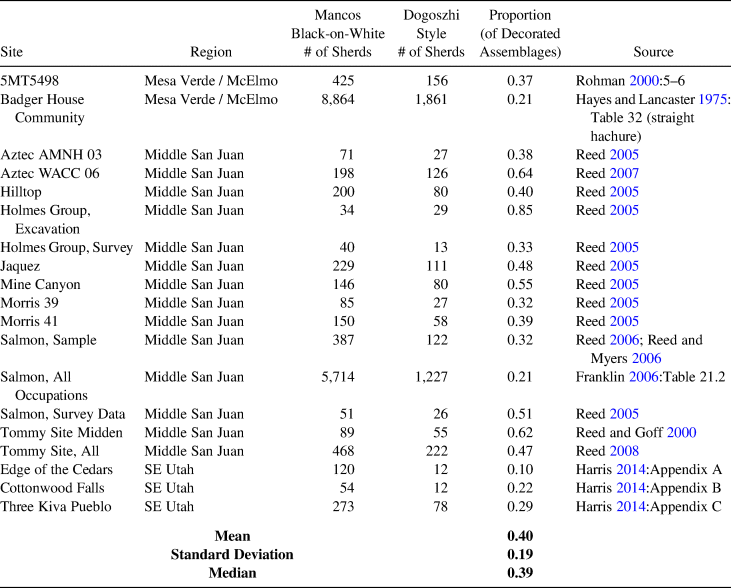
The relative frequency of both Black Mesa– and Dogoszhi-style ceramics was also calculated for every site within eight Chacoan great house communities included in the CSN database (Supplemental Table 1). Chacoan communities consist of a number of small residential sites that are associated with one or more great houses and/or great kivas (Doyel et al. Reference Doyel, Breternitz, Marshall, James Judge and Schelberg1984). Some communities have more than one associated great house or great kiva, whereas others have only one of these features. For Chacoan outlier communities, Black Mesa– and Dogoszhi-style frequency was averaged for each interval, independently for small sites and for sites with Chacoan architecture.
To evaluate the distribution of each style across the Chaco World, the proportion of each style was compared against other site-level metrics for each 50-year interval. These site-level metrics serve as proxies for the possible importance of a site in the Chacoan settlement system and include size class of the site, number of rooms, and eigenvector centrality. A size class was assigned to each site based on the four size classes identified previously by Jill Neitzel (Reference Neitzel, Carr and Neitzel1995:399) as potential tiers of a settlement hierarchy. Mean room counts constitute another proxy for each site's importance, but they are not available for all sites in the CSN database due to variability in site recording. Furthermore, site size is invariant across all intervals examined here; without detailed intrasite information, it is difficult to vary size with the actual growth of a site. As such, our measure of mean site size will tend to overestimate true site size for long-lived sites and for early intervals in the occupation of a site.
As a final proxy measure of a site's importance, we used network measures from previously published studies to evaluate the proportion of Black Mesa– and Dogoszhi-style in relation to the position of a given site in the overall network of ceramic similarity. The construction of networks used here is described in detail by Mills and colleagues (Reference Mills, Peeples, Aragon, Bellorado, Clark, Giomi and Windes2018). The networks constructed for this prior project are weighted networks where the similarity of the ceramic assemblage between every pair of sites per 50-year interval is seen as an estimate of the probability that those two sites were connected (further suggesting some degree of interaction). The present research makes use of a particular network metric—eigenvector centrality—calculated for use in this prior work (Mills et al. Reference Mills, Peeples, Aragon, Bellorado, Clark, Giomi and Windes2018). In network analysis, centrality is viewed as a measure of the social influence and importance of an actor, which in this case is the settlement. Eigenvector centrality considers not only a node's immediate connections but also that node's higher-order connections weighted inversely to the degree of separation to the target node (Newman Reference Newman2010), providing a good measure of the importance of a node (site) in the overall structure of the network.
Style prevalence was also evaluated on a region-by-region basis using macroregional groupings encoded in the Chaco Social Networks database. Measures of variance were calculated for macroregions to evaluate the homogeneity of Black Mesa– and Dogoszhi-style ceramic distributions within these regions (Supplemental Tables 2 and 3). Both interquartile range and standard deviation were calculated, but only for regions with a ≥10% average percentage of Black Mesa– or Dogoszhi-style ceramics and with ≥8 sites in the region. As the number of sites in a region or the mean percentage of either style in a region approaches 0, measures of variability become both increasingly unnecessary to interpret the distribution of ceramics and less informative about that distribution.
Analysis Results
Relationship of Style Frequency and Site Size and Centrality
The percentages of Dogoszhi style by different measures of site size show that there is a high degree of variation among our sample of great house and great kiva sites. Looking first at the size classes defined by Neitzel (Reference Neitzel, Carr and Neitzel1995; Figure 5), “Small” and “Medium” sites have values that range from 0% to 91% and 0% to 71%, respectively. Four of the five sites in the “Large” and “Very Large” categories, however, have higher than mean frequencies of Dogoszhi style (though perhaps not exceptionally high), as expected for an elite style. The lower ratio for Aztec may be a product of the later occupation of the site, which is often considered the twelfth-century replacement for Pueblo Bonito in terms of importance within the Chaco World. Both Chetro Ketl and Pueblo del Arroyo are a stone's throw from Pueblo Bonito and part of the dense cluster of sites in Chaco Canyon often referred to as “Downtown Chaco.”
Boxplots of Dogoszhi-style relative frequencies by Neitzel's (Reference Neitzel, Carr and Neitzel1995) site size classes for Chacoan great houses.

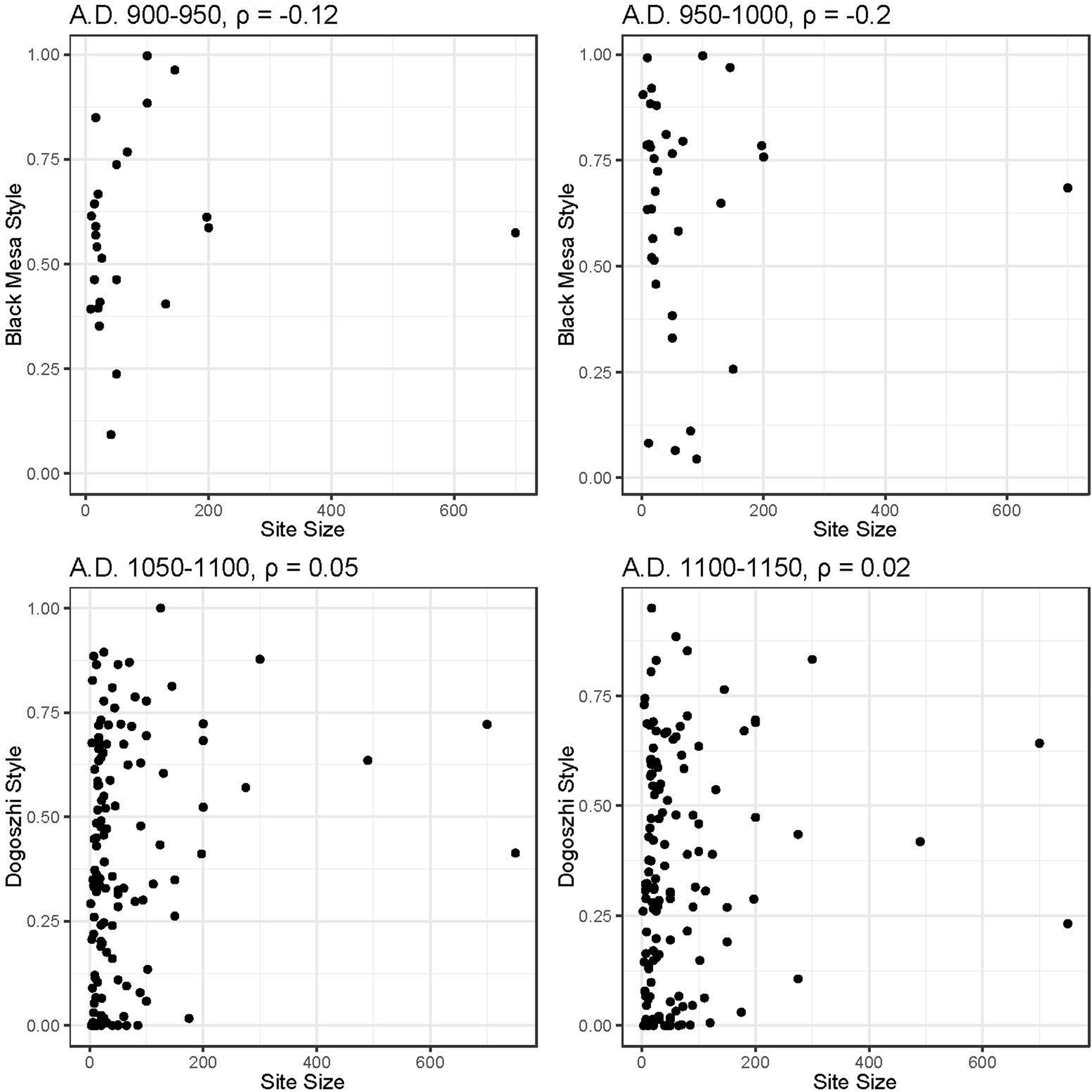
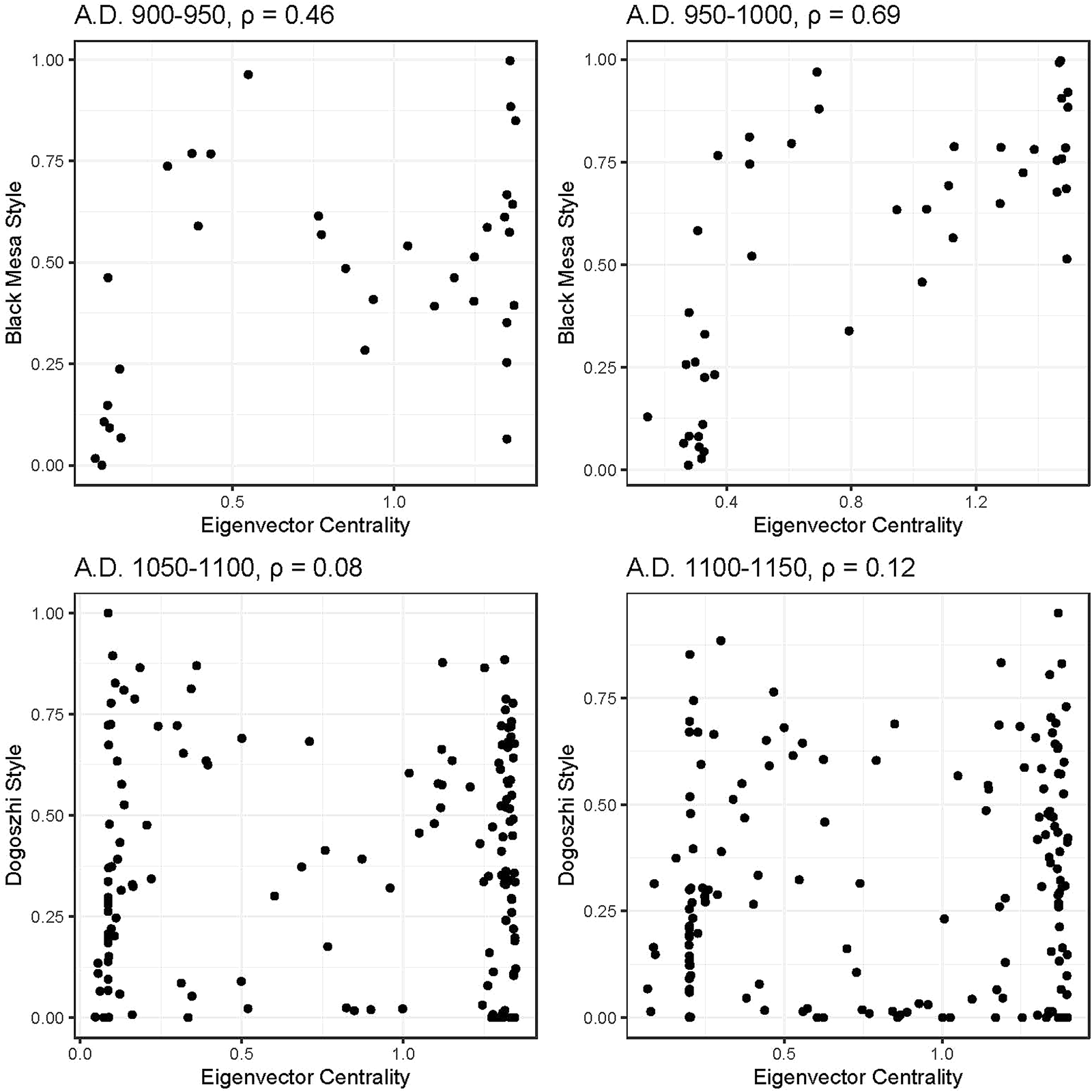
Figures 6 and 7 show the relationship between both Black Mesa– and Dogoszhi-style through time compared to site size (number of rooms) and network (eigenvector) centrality through time. Rank-order Spearman's ρ correlation coefficients are reported. There is little correlation between site size or eigenvector centrality and Dogoszhi-style proportions, which illustrates a high degree of variation and no clear associations. There is a stronger rank-order correlation between Black Mesa–style and eigenvector centrality, increasing from the AD 900–950 to the 950–1000 interval, although there is still considerable variability. The correlation, however, between the relative frequency of Black Mesa–style ceramics and site size is near 0. This indicates that if either of these styles is associated with network prominence, it is this earlier style rather than Dogoszhi style. Because our site size estimates are invariant over time, however, the earlier style correlations may be inflated.
Relationship of site size with Black Mesa– and Dogoszhi-style relative frequency for intervals of peak production. Pearson's r correlation coefficient noted for each interval.
Relationship of eigenvector centrality with Black Mesa– and Dogoszhi-style relative frequency for intervals of peak production. Pearson's r correlation coefficient noted for each interval.
Relationship of Style Frequency at Great Houses and Great Kivas by Macroregion
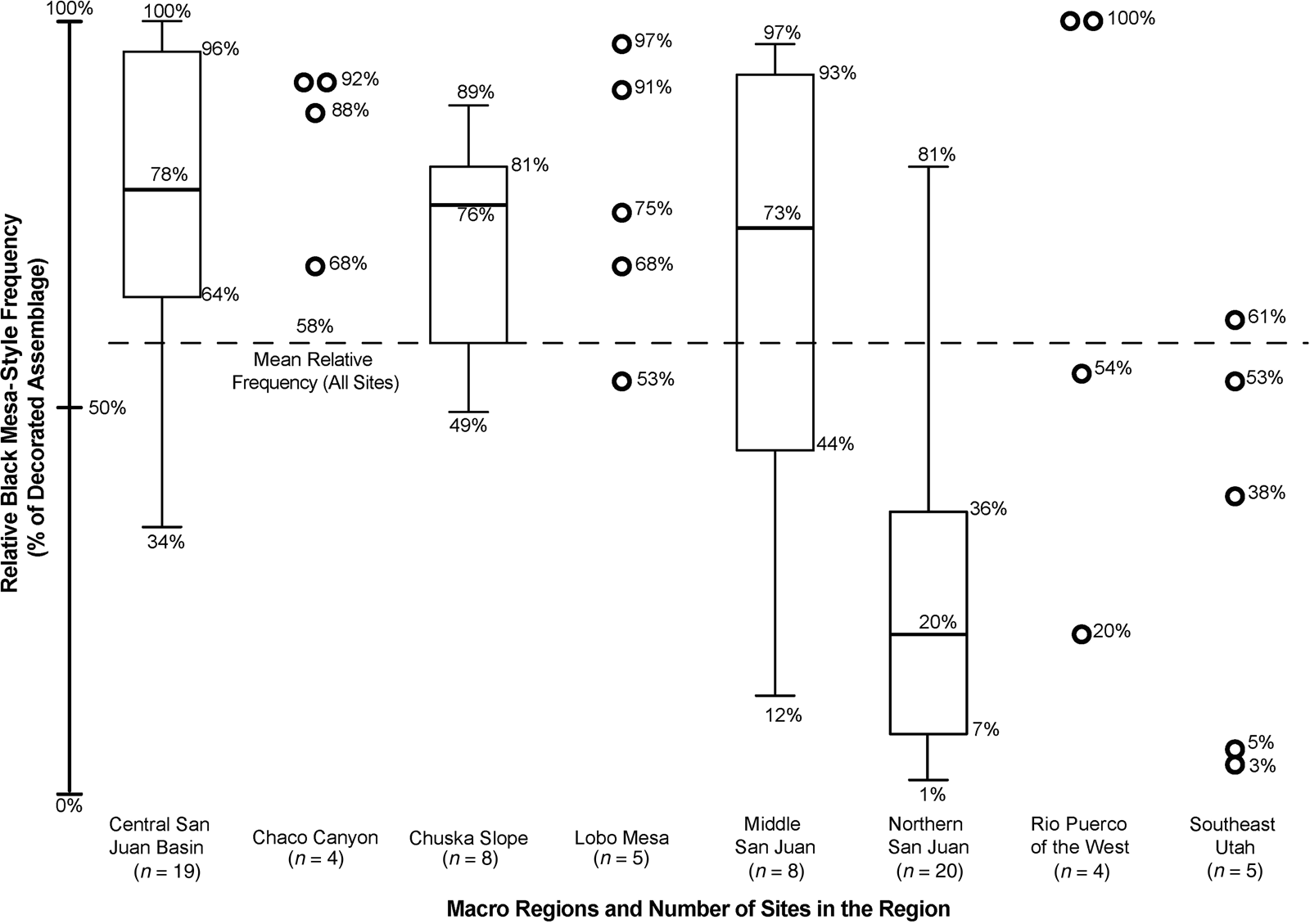
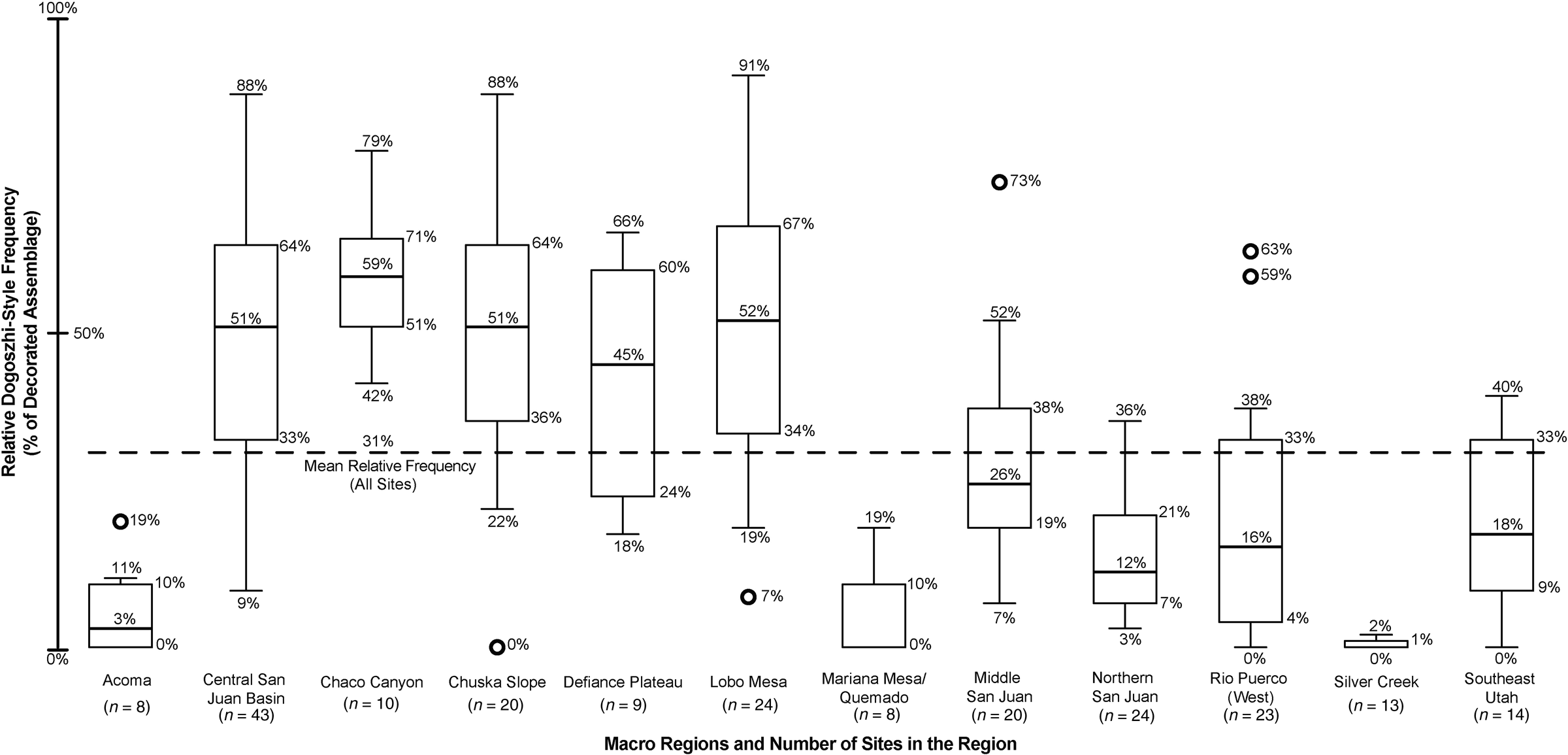
All evaluated metrics indicate a high degree of variability in the spatial distribution of Black Mesa– and Dogoszhi-style ceramics by subareas of the Chaco World (Figures 8 and 9). During the peak of Dogoszhi-style production, in the intervals AD 1050–1100 and 1150–1200, variability is high across the entire Chaco World and within macroregions (Supplemental Table 2). Mean proportion of Dogoszhi-style ceramics varies highly among regions, between 0.01 and 0.60 in the intervals of peak production. Standard deviations are likewise high for both intervals. It is apparent from examining these measures of variability that although some regions have a low or zero frequency of Dogoszhi-style ceramics, among regions with higher frequencies of the style, there are no regions without considerable variability. This pattern follows even for the highest frequency regions, such as the Chuska Slope and Lobo Mesa / Red Mesa Valley. Notably, of the macroregions with a higher mean proportion of Dogoszhi style, Chaco Canyon has by far the least variability for both intervals of peak production.
Boxplots of Black Mesa style by region (AD 950–1000), where number of sites is greater than seven and percentage is greater than 10%.
Boxplots of Dogoszhi style by region (AD 1050–1100), where number of sites is greater than seven and percentage is greater than 10%.
Variability is similarly high in the distribution of Black Mesa–style ceramics, with slight differences. The mean proportion of Black Mesa–style ceramics during the peak of Black Mesa production (the AD 900–950 and 950–1000 intervals) is higher across all regions (Supplemental Table 2) than the mean frequency of Dogoszhi-style ceramics during the peak of its production (Supplemental Table 3). Standard deviations in periods of peak production for both styles are generally comparable when considering both all regions together and regions individually.
Variability within and among regions is visible spatially in distributional heat maps of Black Mesa–style ceramics in the interval of AD 950 to 1000 and Dogoszhi-style ceramics in the interval AD 1050 to 1100 (Figure 10). The map of the distribution of Dogoszhi-style ceramics is mostly circumscribed by the bounds of the San Juan Basin, in the core of the Chaco World, with a few exceptions. It is also apparent, however, that Dogoszhi-style ceramics are distributed highly variably within these geographic limits. Although larger areas of generally high or low frequency are apparent, the frequency gradient within these areas is irregular and marked by lower-frequency sites within otherwise high-frequency areas.
Inverse Distance Weighted (IDW) heat map of (left) Black Mesa–style relative frequencies (AD 950–1000) and (right) Dogoszhi-style relative frequencies (AD 1050–1100). (Color online)
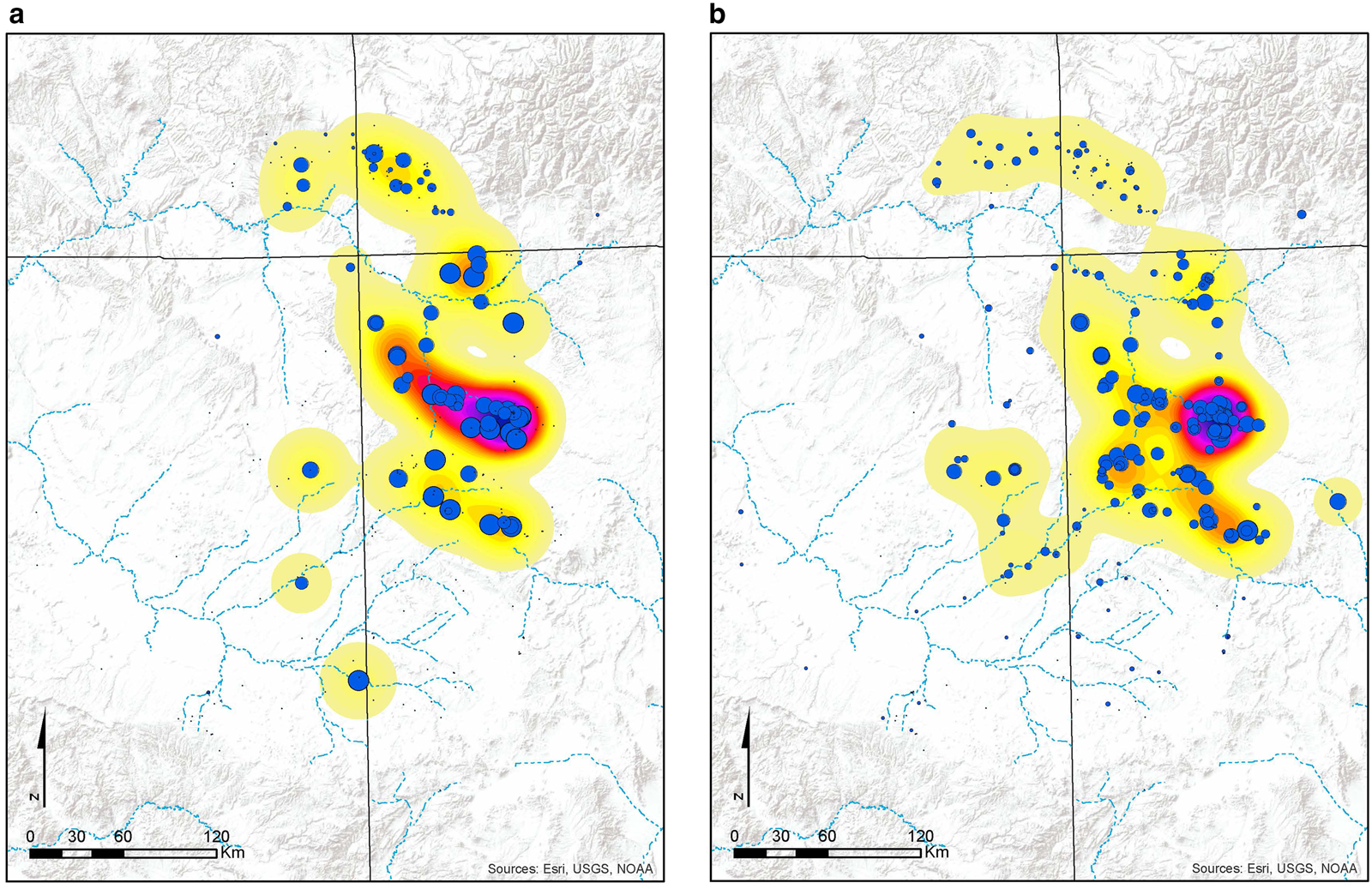
Relative to the distribution of Dogoszhi-style ceramics, Black Mesa–style ceramics are more homogenously distributed within the regions where the style occurs frequently. In general, the distribution of Black Mesa–style spatially follows a more even gradient than the more irregular distribution of Dogoszhi style.
Finally, it is important to note that the macroregions with the highest percentage of Black Mesa–style in the AD 900–950 and 950–1000 intervals are generally among the regions with the highest percentage of Dogoszhi style in the AD 1050–1100 and AD 1100–1150 intervals. We find that there is a positive rank-order correlation (ρ = 0.56) between mean proportion of Black Mesa–style ceramics at a site during the AD 950–1000 interval and the mean proportion of Dogoszhi-style ceramics at the same site in the AD 1050–1100 interval. In particular, the Chuska Slope, Lobo Mesa, Middle San Juan, and Chaco Canyon regions are among the regions with the highest values for both styles. The most prominent exception to this pattern is the Rio Puerco of the West macroregion. Although Black Mesa–style ceramics are common in this region between AD 900 and 1000 (between 48% and 68% of decorated assemblages, on average), the mean percent of Dogoszhi-style ceramics in this region between AD 1050 and 1150 (21%–27%) is slightly below the mean for sites as a whole and well below the aforementioned regions with high proportions of both styles. This observation is further validation of the pattern previously noted by Windes (Reference Windes, Sullivan and Hantman1984) of a sharp decline in Dogoszhi-style ceramics at the southern edge of the San Juan Basin, where Puerco and Reserve styles predominate instead.
Relationship of Style by Great House versus Small Houses within Chaco Communities
In contrast to the high variability within and between regions, our distributional analysis of both Black Mesa– and Dogoszhi-style ceramics within great house and great kiva outlier communities indicates a high degree of similarity between smaller residential sites and large sites featuring Chacoan public architecture. Table 3 summarizes Black Mesa– and Dogoszhi-style percentages in the eight communities tested. The similar frequency of styles at both small and large house sites is true across all intervals and for communities with varying mean percentages of each style. For instance, sites in the Kin Nizhoni community—both large and small—have a high frequency of both Black Mesa– and Dogoszhi-style ceramics, between 80% and 100% during intervals of peak production, whereas both large and small sites in the Chacra Mesa community have more average frequencies of these styles. For the instances where this generalization is not true—namely, that the relative frequency of a style is not the same at the small and large sites in a community—the small sites tend to have the higher proportion of a style. A related observation is that within the eight Chacoan communities analyzed in this study, the sites with large, public architecture are never the sites with the highest percentages of either Black Mesa or Dogoszhi style. These observations match our observations on the regional distribution of these styles, where the highest frequencies of Dogoszhi-style ceramics are in assemblages from small sites (see Figure 5). The pattern we find within Chacoan outlier communities, however, also contrasts somewhat with the pattern we observe at the regional scale, in that the largest great houses (“Large” and “Very Large” sites) have higher-than-average frequencies of Dogoszhi-style ceramics.
Black Mesa–Style and Dogoszhi-Style Proportions at Great Houses / Great Kivas versus Small Houses by Time Period and Community (% of Decorated Assemblage).

Conclusions
Dogoszhi as a Marker of Regional Community Membership
On the basis of this analysis, we find only partial evidence supporting the proposition that Dogoszhi-style ceramics may have acted as markers of regional-scale community identity in the same way or at the same scale as Chacoan architectural features. The distribution of Chacoan architecture is more widespread, with ceramic styles other than Dogoszhi predominating in the northern and southern portions of the Chaco World. Furthermore, even within the core of the Chaco World (the middle San Juan Basin and surroundings), there is considerable variation in the distribution of Dogoszhi-style ceramics. As discussed, the distribution of a style used to mark community membership and social boundaries should be relatively homogenous within the community it marks, whereas the boundaries of its distribution should be relatively sharp (Hegmon et al. Reference Hegmon, Russell, Baller, Peeples and Striker2021; Neitzel Reference Neitzel, Carr and Neitzel1995:397; Plog Reference Plog, Carr and Neitzel1995:372). Our analysis indicates that the percentage of Dogoszhi-style ceramics in an assemblage drops rapidly beyond the core regions of the Chaco World within the San Juan Basin. Sharp boundaries also exist within this primary extent, however. Even in regions with a high average percentage of Dogoszhi-style ceramics, such as the Chuska Slope, some sites have more than twice the percentage of the style than neighboring sites (see Figure 9). Although this sharp drop in Dogoszhi-style frequency beyond the San Juan Basin matches our second expectation for a style marking community membership, the highly variable distribution of the style within this geographic extent does not match our first expectation of homogeneity within the proposed community of the core Chaco World.
On this basis, we can draw two conclusions about Dogoszhi style as a marker of membership in the Chaco World. First, because ceramics decorated in this style are limited largely to the core of the Chaco World in the San Juan Basin, with some exceptions such as the Defiance Plateau macroregion, the style does not likely mark participation in the Chaco World as a whole (as suggested by Toll et al. Reference Toll, Blinman, Wilson and Doyel1992). Instead, it marks participation in a community that is either coterminous with the core regions of the Chaco World or that is contained within these regions. The highly discontinuous distribution of the style within its maximal geographic extent supports the latter conclusion. This conclusion is further supported by our observation that Dogoszhi-style ceramics are distributed highly homogenously within the eight Chacoan communities we analyzed. This indicates that, at the level of individual communities, Dogoszhi style likely acted as a marker of membership, even if it did not function this way at the scale of the macroregions identified in the CSN database.
Dogoszhi as Elite Style
We also find little evidence in the distribution of Dogoszhi-style ceramics to support the proposition that Dogoszhi acted as an exclusively elite style throughout the Chaco World, primarily because of its presence in large quantities at small sites and medium sites. We do find, however, that the very largest of great houses (those with room counts above 250 rooms), generally had much higher proportions of Dogoszhi style than the population on the whole (see Figure 5). This fits one of our expectations of an elite style—of differential distribution across a settlement hierarchy—although similar proportions of Dogoszhi style at some smaller sites means there is no one-to-one correlation of site importance and proportion of Dogoszhi-style ceramics.
From these observations we draw several conclusions about Dogoszhi as an elite style in the Chaco World. First, the near-zero correlation of both centrality and site size with Dogoszhi-style percentage violates the expectation of elite styles as more frequent at elite settlements. The relationship to site size is particularly contrary to the expectation given that, even though the largest sites uniformly have high proportions of Dogoszhi-style ceramics, the largest sites do not have a higher proportion of the style than the highest proportion among smaller sites. These smaller sites are likely to have been shorter lived than Chaco great houses, which may have more mixed deposits and/or were places that housed a greater diversity of people. The high percentages at small sites in certain areas support the idea that for some subregions, Dogoszhi style marked broader community membership as opposed to elite versus nonelite social groups. Second, the low variability in the proportion of both Black Mesa– and Dogoszhi-style ceramics within Chaco Canyon—at least compared to other regions with high mean proportions of each style (see Figures 8 and 9)—indicates that Dogoszhi-style ceramics were consistently important to or consumed by Canyon elites, even if they were not the only major consumers of the style. Third, the conflicting interpretation of the first two points (of both widespread distribution of the style and elite preference for the style) demonstrates that Dogoszhi-style ceramics had multiple values within the Chaco World, depending in part on the context of consumption. Although Dogoszhi-style ceramics are not uniformly more frequent at larger sites (i.e., those that are higher in the settlement hierarchy, as we might expect for an elite style), there are intrasite contexts in which the style may be concentrated. For example, the clustering of cylinder jars in Room 28 at Pueblo Bonito, of which more than 75% are decorated in Dogoszhi style (Crown Reference Crown2018), suggests that it did serve as a marker of elite status for at least some social elements within a few great houses and for vessels used in restricted contexts, even if it did not serve this function across the Chaco World as a whole.
The Social Value of Dogoszhi Style
On the basis of these conclusions, we can make three inferences about the social value of Dogoszhi-style ceramics within the Chaco World. First, although a primary marker of an elite style is its greater occurrence in elite contexts, elite styles should also reach their greatest elaboration in the most important, central, or restricted elite contexts (Neitzel Reference Neitzel, Carr and Neitzel1995:397). Given this, we suggest that Chacoan elites may have marked their special social status not through simply accessing and consuming Dogoszhi-style ceramics, but rather through special contexts of use (like the aforementioned cylinder jar cache at Pueblo Bonito) or through special forms or executions of Dogoszhi-style ceramics (again, like the aforementioned cylinder jars). Our analysis would not capture these distinctions within the style, potentially resulting in our somewhat contradictory findings.
Second, Dogoszhi-style ceramics may have held multiple values across distinct social contexts that could be the result of heterarchical structures of power and status within the Chaco World. Such a heterarchical structure would have complemented the hierarchical structure evident within Chaco Canyon and its successor in the Middle San Juan—the Aztec Complex—and similar structures between these areas and other great house communities. In a heterarchical social structure, social elements are either unranked or can be ranked in multiple ways (Crumley Reference Crumley1995:3). In such a structure, social power and prestige can be counterpoised, rather than ranked, so that power and prestige are generated from a diversity of sources. This structure has been previously argued as applying to Western Pueblo societies in the Pueblo IV period of the Southwest (Rautman Reference Rautman1998; Saitta and McGuire Reference Saitta and McGuire1998). Although Chaco was very different from the later Pueblo IV societies—which have been interpreted as a reaction to the hierarchy of Chaco society (Fowles Reference Fowles and Pauketat2012)—if sources of social prestige in the Chaco World were diverse, we could expect that markers of prestige would be similarly diverse to distinguish not only elites from nonelites but elites of one kind from those of another kind. In this case, the high proportion of Dogoszhi-style ceramics at some, but not all, lower-ranked sites may reflect the diversity of sources of prestige within the Chaco World, particularly if those sources had geographic correlates. Distinct methods for signaling status may have been unified under a larger ideological system of Chacoan values. For instance, if Dogoszhi style is representative of the cosmologically significant color blue-green, as has been previously argued (Plog Reference Plog2003), Dogoszhi style may have been one component in a larger symbolic and stylistic system of Chacoan value placed on the color blue-green. Some segments of the Chacoan elite population may therefore have referenced this broader system of Chacoan values through intensive consumption of Dogoszhi-style ceramics, whereas other elites may have eschewed Dogoszhi-style ceramics in favor of other referents of possible pan-Chacoan values. The fact that the largest of Chacoan sites almost all have significant proportions of Dogoszhi-style ceramics may reflect the presence of multiple groups of elites at these sites, whereas the greater variability in Dogoszhi-style consumption at smaller sites may reflect their ability to host a smaller diversity of elites who draw legitimacy from only some sources.
Third, the irregular geographic distribution of communities with high frequencies of Dogoszhi-style ceramics is potentially explained through a growth of associations, sodalities, or other similar organizations in response to the expansion of the Chaco World around AD 1000. Organizations such as sodalities can cross-cut other social boundaries, serving an integrative function in situations of increased interaction across these boundaries (Ware Reference Ware2014:35) or a competitive function when they are different factions (Plog and Solometo Reference Plog and Solometo1997). Likewise, broadly shared styles can serve a similar integrative function across distinct social boundaries (Hegmon Reference Hegmon1995:41–43), but in other cases, a variety of styles may be expected in situations such as migration in what Hegmon and colleagues (Reference Hegmon, Freeman, Kintigh, Nelson, Oas, Peeples and Torvinen2016) call “representational diversity.” If the expansion of the Chaco World in the early eleventh century created a larger system of interaction within the greater San Juan Basin, sodalities and other cross-cutting social structures such as alliances built through intermarriage and cooperative building programs may have been increasingly necessary to maintain a system of cross-regional interactions. In this scenario, Dogoszhi-style ceramics may have been a stylistic marker of just one or a subset of these cross-cutting associations within a system of representational diversity.
Relationship with Black Mesa Style
These inferences are strengthened by our comparison between the distribution of Black Mesa style with the distribution of Dogoszhi style. This comparison suggests that the social value of Dogoszhi style may have been related to specific geographic associations, particularly with the Chuska Slope and Lobo Mesa macroregions. A primary conclusion of our analysis of Black Mesa style is that the frequency of Black Mesa–style ceramics in a macroregion during peak intervals of production for that style (AD 900–1000) strongly predicts the frequency of Dogoszhi-style ceramics in that same region, with the important exceptions of the Rio Puerco of the West macroregions. Yet, the existence of these exceptions to a strong overall pattern suggests that the social value of Dogoszhi style is not exactly analogous with that of Black Mesa style. The transition to Dogoszhi style from the earlier Black Mesa style in the early eleventh century coincides with other major transformations in the structure of the Chaco World, particularly the rapid spread of hallmarks of the Chaco World, such as great-house architecture, across the Four Corners region. The high average proportions of Dogoszhi-style ceramics in assemblages from Chaco Canyon and the Middle San Juan—the core of the Chaco World—heighten this connection. The greater formality of Dogoszhi style relative to Black Mesa style also suggests a greater value placed on the production of Dogoszhi-style ceramics relative to their Black Mesa counterparts.
The continuity of Black Mesa– and Dogoszhi-style ceramic consumption in the core regions of the Chaco World around Chaco Canyon, as well as in the more outlying macroregions of the Chuska Slope and Lobo Mesa, is informative about both the origins of Dogoszhi as a style and its probable social value. This continuity in the popularity of both styles, combined with the earliest Dogoszhi-style analogs belonging to the Chuska White Ware series, suggests that the style may have originated in the late tenth- and early eleventh-century communities of the Chuska Slope and spread effectively to communities to the east in the San Juan Basin and to the south in the Lobo Mesa macroregion. The discontinuity of high Black Mesa–style consumption followed by low Dogoszhi–style consumption in the Rio Puerco of the West macroregion further suggests that communities in the Chuska Slope, Lobo Mesa, and Red Mesa regions were the primary agents in developing a style with distinct social value from the earlier and more widespread Black Mesa style.
Archaeologists have previously connected communities in the Chuska Slope with Chaco Canyon itself through importation of timbers for great house construction (Betancourt et al.Reference Betancourt, Dean and Hull1986; Guiterman et al. Reference Guiterman, Swetnam and Dean2016), Narbona Pass chert (Cameron Reference Cameron2001), and large quantities of ceramics (Cameron and Toll Reference Cameron and Toll2001; Warren Reference Warren1976). Importantly, recent research suggests that timber importation from the Chuska Mountains into Chaco Canyon was most prolific around AD 1000 (Guiterman et al. Reference Guiterman, Swetnam and Dean2016), at the same time that communities in the Chuska Slope were likely developing early forms of Dogoszhi style. We therefore conclude that the social value of Dogoszhi-style ceramics may largely be tied to its geographic associations with the Chuska Mountains and/or the communities in the Chuska Slope. Furthermore, communities in Chaco Canyon preferentially imported timbers and Zuni Spotted Chert from the Zuni Mountains (Cameron Reference Cameron2001; Guiterman et al. Reference Guiterman, Swetnam and Dean2016), in the vicinity of communities assigned to our Lobo Mesa macroregion. These connections between Chaco Canyon sites and regions of high Dogoszhi-style frequency underscore the social value Chacoan elites put on making connections with place.
We conclude that one of many sources of prestige and power in the Chaco World was based in developing strong connections to the region of the Chuska Mountains, and Dogoszhi style served as one marker, among many, of that place-based status. Furthermore, as we have already argued, the distribution of Dogoszhi-style ceramics was irregularly structured on the basis of cross-cutting social boundaries within the Chaco World. The association or associations marked by Dogoszhi-style ceramics may have originated among the same communities in the Chuska Slope that likely played a large role in developing Dogoszhi style as distinct from the tradition of Black Mesa–style ceramics. This viewpoint helps synthesize our observations that Dogoszhi style likely acted as a marker of both elite status and participation in a social group internal to the Chaco World. The social value of Dogoszhi-style ceramics in both cases may be based strongly on the association of the style with the Chuska Mountains and Lobo Mesa regions.
Our conclusions support the general interpretation that elites use style in multiple ways. One way is to differentiate themselves through the use of particular styles on objects of great value. At Chaco, examples of this are drinking vessels used in special contexts at Pueblo Bonito (Crown Reference Crown2018) or particular forms of ornaments placed in burials and caches (Mattson Reference Mattson2016). Another way that elites may employ style is by encouraging nonelites to use the style to foster shared identities, build alliances, and promote cooperation (Schortman et al. Reference Schortman, Urban and Ausec2001). Chaco Canyon elites may have intentionally adopted a popular region-wide style in order to build coalitions and encourage cooperation that would have been necessary for constructing great kivas and great houses, especially during the largest building programs of the eleventh and early twelfth centuries. It is perhaps significant to point out that the two foundational burials in Room 33 at Pueblo Bonito had only two whole vessels—one was a smudged brown ware bowl more typical of areas at the southern edge of the Chaco World (Mills et al. Reference Mills, Peeples, Aragon, Bellorado, Clark, Giomi and Windes2018), and the other was a Black Mesa–style bowl.
In comparison to other studies of regional styles in the Southwest and elsewhere, Chaco pottery provides some interesting contrasts. Recent work by Hegmon and colleagues (Reference Hegmon, Russell, Baller, Peeples and Striker2021) in the southern Southwest demonstrated the convergence of spatial and stylistic boundaries for the Mimbres area and low representational diversity. Our Chaco example contrasts in having much greater representational heterogeneity; spatial boundedness was shared at the level of the great house community, but not shared by all great houses—even among some in close proximity. The Chaco case is also contrastive with the Mimbres region in that there is considerably more evidence for intracommunity and intraregional social inequality. At the intracommunity level, style seems to be shared much more frequently—as would be expected with high levels of cooperation—between elites in great houses and those in surrounding small houses. At the intraregional scale, however, we see that entire communities, and especially many great houses, had highly variable assemblages composed of a diversity of styles. Elites and nonelites living in great house communities outside of Chaco Canyon showed more representational diversity, which indicates multiple connections within the Chaco World rather than an adherence to a single style. We think that the variability in style choices made by residents of great houses is one way of looking at intraregional networks that represent different histories, alliances, and perhaps even competition among elites within the Chaco World.
As one of the well-known examples of social inequality in the Southwest, the Chaco World provides insights into the multiple ways elites and nonelites employed style. These insights may be a useful comparison to other areas of the world. The results also point to the importance of considering variation within the category of elites. Not all elites, even those in similarly sized great houses, can be considered as the same. Their spheres of control and influence varied across the social landscape of the Chaco World, as reflected by variation in the production and use of Dogoszhi-style painted ceramics. Current research in the social sciences has called for a breaking down of the category of “elites” to better understand how they operate within different fields (Cousin et al. Reference Cousin, Khan and Mears2018). Our analyses underscore appreciation for looking at heterogeneity among the Chaco World's great house occupants, such as the ways that they used style to convey differences in status and their variable engagements with each other.
Acknowledgments
Financial support was provided by NSF Awards #1355374 (to Barbara Mills, University of Arizona) and #1355381 (to Jeffery Clark, Archaeology Southwest). We especially thank Dennis Gilpin, Paul Reed, and Lori Reed for sharing ceramic data. We also thank the staff of many institutions that provided access to collections, including the American Museum of Natural History, Arizona State Museum, Arizona State University Archaeological Repository, Chaco Culture National Historic Park, Museum of New Mexico, Museum of Northern Arizona, Salmon Ruins Museum, School for Advanced Research, and the Navajo Nation. Photo permissions were facilitated by Julia Clifton (Museum of Indian Arts and Culture), Kim Besom (Grand Canyon National Park), Kelley Hays-Gilpin (Northern Arizona University), and Suzanne Eckert (Arizona State Museum). Thanks also to the three anonymous reviewers who provided useful comments on our submission.
Data Availability Statement
Data used in this article are available through cyberSW.org (https://cybersw.org). Data and code necessary to replicate the analyses and figures presented in this article are available at: https://github.com/mpeeples2008/Dogoszhi_AmericanAntiquity.
Supplemental Material
For supplemental material accompanying this article, visit https://doi.org/10.1017/aaq.2021.50.
Supplemental Table 1. Chaco Outlier Communities with Ceramic Data from Great Houses, Great Kivas, and Small Houses.
Supplemental Table 2. Black Mesa–Style Relative Frequency and Variance by Macroregion. Standard deviation and interquartile range are calculated only for regions with at least four sites and greater than 10% relative frequency of Black Mesa style.
Supplemental Table 3. Dogoszhi-Style Relative Frequency and Variance by Macroregion. Standard deviation and interquartile range are calculated only for regions with at least eight sites and greater than 10% relative frequency of Dogoszhi style.


 Open access

