Bangladesh is an international health success story. In the past three decades, it has made enormous strides in reducing population growth, mortality and morbidity. It is one of the few countries that will achieve Millennium Development Goal 4, a two-thirds reduction in the under-five mortality rate by 2015. In contrast to the impressive advances that have been made in general health status, nutritional deficiencies remain high and have proven more intractable. Anthropometric measures, for instance, only began to improve in the mid-1990s and nutritional deficiencies remain higher than would be predicted by the country’s income level alone(1). Despite having what many regard as one of the most successful vitamin A supplementation programmes in the world, with nearly three decades of high and sustained coverage rates, vitamin A deficiency remains at 76·9 % among pre-school children(2). Moreover, evidence from the 2011 Demographic and Health Survey suggests that the programme’s performance has begun to slip(3). Bangladesh needs to examine other options for accelerating its progress in improving nutrition.
Major characteristics of the vegetable oil market in Bangladesh
Traditionally, the main source of vegetable oil in Bangladesh was home-grown and home-processed mustard-seed. That market has changed dramatically in recent years with rapid growth in low-priced imports of soya and especially palm oil (refined palm olein)(Reference Choudhury and Costa4, 5). Bangladesh’s total vegetable oil market is 1·3 million Mt of which about 55 % is food. Of the vegetable oil that is consumed as food, mustard-seed-based oil now comprises only 15 % of the total market, while soya constitutes about 35 %, palm 45 % and all other sources account for the residual 5 %(5). The sixteen companies that are now fortifying have a combined output that is estimated at 85–90 % of Bangladesh’s total palm- and soya-based vegetable oil market (P Randall, consultant to the Bangladesh National Fortification Alliance, personal communication, 2013).
Vitamin A fortification in Bangladesh
The introduction of vitamin A fortification in Bangladesh has been actively considered for decades. The Bangladesh Standards and Testing Institute (BSTI) of the Ministry of Industries established fortification standards in 2006, and fortification feasibility studies – primarily of wheat flour – have been conducted in Bangladesh starting at least 30 years ago(Reference Darnton-Hill and Nalubola6–8). The current oil fortification initiative dates from 2008. In June of that year, UNICEF, the BSTI, the Bangladesh Vegetable Oil Refiners Association (BVOA) and the Global Alliance for Improved Nutrition (GAIN) formed a partnership and signed an agreement to implement a 3-year project that would culminate with the introduction of vegetable oil fortification. GAIN provided $US 3 million that was used to pay for the development of fortification quality assurance and control protocols, oil refinery recruitment and premix (which were provided to participating companies), fortification training of both public and private stakeholders, and a consumer awareness campaign.
The original project was delayed and revamped several times as a result of recurrent food price crises, which dampened industry’s enthusiasm to participate. The initial intention was to introduce fortification in seven of Bangladesh’s twenty-two refineries, with the longer-term goal of expanding participation to twelve companies. The first fortified oil was produced in February 2012 and was accompanied by a bandwagon effect: within 6 months, the number of participating companies jumped to sixteen (Mr B Kar, GAIN Bangladesh Country Director, personal communication, 16 August 2012).
Use of household income and expenditure surveys for dietary assessment
Designing and assessing micronutrient programmes requires an understanding of the magnitude, distribution and causes of the deficiencies in the population, as well as knowledge about other existing interventions that affect the same deficiency(Reference Neufeld and Tolentino9). Only a handful of countries, however, have food consumption data from what nutritionists generally regard as the preferred food consumption methodologies, i.e. observed-weighed food records or 24 h recall surveys, because such surveys are expensive and difficult to conduct(Reference Neufeld and Tolentino9–Reference Gibson11). The lack of evidence on the nature and magnitude of nutritional deficiencies has slowed the development of nutrition policies and programmes, and has probably contributed to the design and implementation of suboptimal programmes. The present paper addresses this lack of food and nutrition information by using an alternative, less precise, but more affordable and readily available data set – the Bangladesh 2010 Household Income and Expenditure Survey (HIES) – to estimate the prevalence of inadequate vitamin A intake and the impact of the recent introduction of vitamin A-fortified vegetable oil. We follow the assumptions and methodologies already applied to estimate food consumption from HIES for estimating nutrient intakes and selecting food fortification vehicles for Bangladesh(Reference Bermudez, Lividini and Smitz12), India(Reference Fiedler, Babu and Bermudez13), Guatemala(Reference Fiedler and Helleranta14), Zambia(Reference Fiedler, Zulu and Kabaghe15) and, more generally, designing food fortification programmes and providing a proxy measure for food and nutrition information(Reference Fiedler10, Reference Coates, Colaiezzi and Fiedler16).
Methods
Data source
Bangladesh began conducting HIES in 1972. The particular survey analysed here, which is the fifteenth HIES round, incorporated a two-stage stratified sampling design using probability proportional to size based on the 2001 population census(17, 18). A total of 12240 households were included in the sample. Demographic information was collected on each household member.
Sample weights, adjusted for non-response, were included in the database and were used to determine total population estimates of households and individual household members (Table 1). The Institutional Review Board at Tufts Medical Center/Tufts University gave an exemption for the present study because it was based on secondary analysis of a publicly available data set without personal identifiers.
Weighted numbers and percentages of households and individuals, by division, in the Bangladesh 2010 Household Income and Expenditure Survey

Estimating usual intakes
The 2010 HIES Daily Consumption Module contains 134 food items. Households reported their food consumption and acquisition using a 14d diary. Households identified the quantity, value and source (i.e. purchases, in-kind wage, own production, gifted and other) of each food item for each day during the 14 d reporting period. We combined these data with energy and nutrient information from food composition tables created for this analysis(Reference Bermudez, Lividini and Smitz12) to estimate the household’s intakes of total energy and the micronutrients vitamin A, Fe, Zn and Ca. In addition to the specific foods identified in the 134-item food list, each of the thirteen general food categories contained an entry called ‘Other’. For these ‘other’ categories (e.g. ‘other fruits’, ‘other vegetables’), energy and nutrient values were estimated by taking the food composition tables’ average of all other items within the general food category. The HIES also included several ‘dining out’ meals and differentiated them by their primary ingredient (e.g. rice). Typical recipes were used to estimate the energy and nutrient composition of these meals(Reference Bermudez, Lividini and Smitz12). For the study reported here, we included only energy and vitamin A results.
In analysing the HIES we assumed that food that was purchased during the 14d reference period was entirely consumed during that period and no other food was consumed (e.g. from food stores purchased in an earlier period). Adjustments were made for the edible portion of foods, but no additional account was made for waste or loss. To remind the reader of these assumptions and limitations we refer to the HIES-based estimate of food consumed as ‘apparent food consumption’.
The HIES reports food consumption data for the entire household, not for individual members. Given the lack of information about the intra-household distribution of food, to make inferences about individual household members’ nutrient intake requires making an assumption about the intra-household distribution of the household’s food. We assumed that all household food was distributed among its members in direct proportion to each member’s share of the household’s total adult male consumption equivalents (ACE)(Reference Weisell and Dop19). ACE values were calculated as the ratio of the energy requirement of an individual of a particular age and gender with a medium physical activity level, to the energy requirement of an adult male age 18–30 years. The HIES lacked details about pregnant or lactating women. Therefore, in our analysis, all women were treated as non-pregnant, non-lactating women.
The cut-point method was used to evaluate the prevalence of inadequate intakes of vitamin A(20). We quantified each individual’s ‘usual daily intake’ of dietary energy and vitamin A from the household’s total food intake over the 14 d diary period, and compared the individual vitamin A intake levels with their age- and sex-specific Estimated Average Requirements (EAR) to characterize the individual’s vitamin intake level as ‘adequate’ (for levels equal to or greater than the EAR) or ‘inadequate’ (for levels less than the EAR). We assumed the bioavailability of vitamin A was 100 %.
Simulation of fortification interventions
We simulated vitamin A fortification of vegetable oil assuming the vitamin A levels were equal to those established in the BSTI’s 2006 standards for cooking oil in the retail marketplace, i.e. 10 mg/kg. To take into account vitamin A degradation from the time the vegetable oil is manufactured to the time it is sold at retail, it was assumed that a vitamin A overage of 5 mg/kg, and thus a total of 15 mg/kg, is added at the factory. We also assumed an additional 20 % of the vitamin A added to the vegetable oil is lost between the time the oil is sold at retail and when it is consumed. Thus we assumed that the vitamin A content of ingested vegetable oil was 8 mg/kg, implying total vitamin A losses from the point of fortification to ingestion to be 47 %. Using this information, we calculated the daily additional intake of vitamin A (measured in µg of retinol activity equivalents, or RAE) by households consuming fortifiable vegetable oil.
Results and discussion
Consumption of fortifiable vegetable oil
In our modelling, we assumed that mustard-seed-based oil, which is generally home-produced or produced in artisan-scaled plants, is not fortifiable because of (i) the inherent difficulties of small, technologically simple plants adhering to quality assurance standards necessary to ensure the regulatory requirements are strictly adhered to and (ii) the difficulties of monitoring compliance in a large number of plants in what is often a largely informal sector. We assumed that only the other-than mustard vegetable oil and only that portion of it that is purchased is likely to be produced in larger-scale plants and is amenable to being fortified.
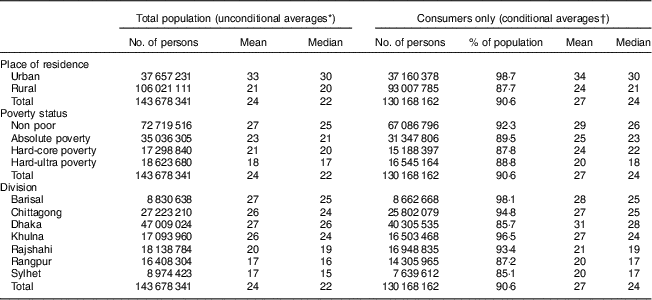
Table 2 shows the number and percentage (i.e. coverage) of persons consuming fortifiable vegetable oil and the average (mean and median) quantities consumed, per ACE, by place of residence, poverty status and division. Two sets of averages are presented: (i) those calculated for the entire population (referred to as the ‘unconditional’ averages), which include vegetable oil consumers and non-consumers alike; and (ii) those calculated using only the portion of the population that purchases some fortifiable vegetable oil (referred to as the ‘conditional’ averages). Figures 1 and 2 detail the percentage contribution of vitamin A, at baseline, from fortifiable oil by poverty groups and administrative divisions, respectively. The coverage of the fortification vehicle is consistently high across the three sets of characteristics analysed. While both the coverage and the quantities purchased vary across households in ways that one would anticipate, i.e. larger percentages and quantities being purchased by urban and wealthier households, the differences are not extreme.
(colour online) Prevalence of inadequate vitamin A intake in Bangladesh (percentage of persons with vitamin A intake less than their Estimated Average Requirement) before (baseline) and after (endline) introduction of fortified vegetable oil, by poverty status. Weighted sample of 12 240 households comprised of 55 580 individuals from the Bangladesh 2010 Household Income and Expenditure Survey

(colour online) Prevalence of inadequate vitamin A intake in Bangladesh (percentage of persons with vitamin A intake less than their Estimated Average Requirement) before (baseline) and after (endline) introduction of fortified vegetable oil, by division. Weighted sample of 12 240 households comprised of 55 580 individuals from the Bangladesh 2010 Household Income and Expenditure Survey
Estimates of coverage and consumption of fortifiable vegetable oil in Bangladesh (g/adult consumption equivalent per d) based on the Bangladesh 2010 Household Income and Expenditure Survey
* Unconditional averages: calculates averages based on the number of persons in the entire population, those apparently consuming vegetable oil and those not consuming vegetable oil.
† Conditional averages: calculates averages based only on the number of persons who consume vegetable oil, excludes those not consuming vegetable oil.
Not having any information about the brand-names consumed or the geographic dimensions of the market of the companies that are fortifying and those that are not, we have no way of adjusting our household-level based data to identify the 10–15 % of the palm- and soya-based vegetable oil that is not fortified. Our approach, therefore, results in an overestimation of the consumption and probably of the impact of vitamin A-fortified vegetable oil.
Table 3 shows three measures of average vitamin A intake levels: at baseline (i.e. prior to the introduction of fortification), the additional intake due to fortification and intake at endline (i.e. after the introduction of fortification). Table 3 also reports the percentage of the EAR that the mean intake level represents, thereby providing an age- and sex-adjusted reference point for better understanding the significance of the mean value relative to physiological requirements. While the urban and wealthier populations attain larger absolute quantities of additional intake, the proportion and relative importance of the additional vitamin A obtained by the rural and poorer populations are greater. For instance, while the non-poor have a mean additional intake of 206 µg of RAE, compared with the ultra-poor’s 132 µg of RAE, these quantities constitute 40 % and 43 % of the baseline intakes of the two groups, respectively.
Estimates of vitamin A intakes in Bangladesh – baseline intakes, additional intakes due to fortifiable oil and endline intakes (reported as vitamin A in μg of RAE, unless otherwise indicated) – based on the Bangladesh 2010 Household Income and Expenditure Survey

RAE, retinol activity equivalents; EAR, Estimated Average Requirement.
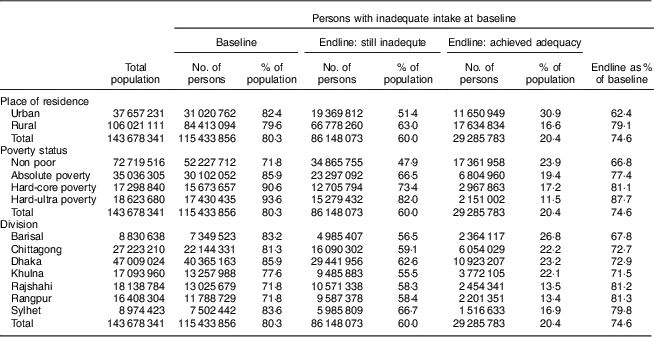
Table 4 shows the number and percentage of persons with inadequate vitamin A intake at baseline and endline, together with the changes in these measures due to oil fortification. At baseline, the national prevalence of inadequate vitamin A intake is 80·3 %. Oil fortification results in more than 29 million of the 115 million Bangladeshis with inadequate vitamin A intake at baseline achieving adequate vitamin A intake levels. In other words, as a result of oil fortification, 20 % of all Bangladeshis go from having inadequate to adequate vitamin A intakes and another 86 million with inadequate VA intakes at baseline benefit from increased vitamin A intakes but continue to have inadequate vitamin A intakes at endline.
Estimates of baseline and endline prevalences of inadequate vitamin A intakes based on the Bangladesh 2010 Household Income and Expenditure Survey
The benefits of oil fortification are not only significant, they are also widespread. Even among the ultra-poor there are substantial gains in the percentage of the population that achieves adequate vitamin A intake with the introduction of fortification, as the prevalence of inadequate vitamin A intake falls from 80·3 % to 60·0 % (Table 4). Seventeen million rural residents achieve adequate vitamin A intake. Three of the four divisions that had the highest baseline prevalence rates of inadequate vitamin A intake – Barisal, Chittagong and Dhaka – experience the largest reductions in prevalence; while Sylhet, the division with next to highest baseline prevalence of inadequate vitamin A intake (84 %), achieved an important reduction of 17 percentage points (Fig. 2).
Limitations of the study
There are several limitations of the present study, which stem primarily from our use of a household-based survey to estimate the vitamin A intake adequacy of individuals: (i) the lack of information about the intra-household distribution of foods; (ii) the extent to which the assumption holds that foods containing vitamin A are distributed among household members in direct proportion to the energy requirements; (iii) our use of ‘apparent’ consumption to estimate consumption; (iv) seasonality might affect the types and quantities of foods apparently consumed; and (v) our inability to identify the portion of palm- or soya-based vegetable oil that is not fortified, which results in overestimation of the consumption of fortified oil by 15–20 % and an overestimation of the impact of fortified by oil by perhaps as much as that as well.
The price elasticity of demand for a particular good is a measure of the responsiveness of a change in demand for a good to a change in its price, other things held constant. Ganesh-Kumar et al. estimate the price elasticity of demand for vegetable oil in Bangladesh (using the 2006 Bangladesh HIES) at −0·697(Reference Ganesh-Kumar, Prasad and Pullabhotla21). This indicates that the demand for vegetable oil is relatively price inelastic (i.e. relatively insensitive to changes in price). The incremental cost of vegetable oil fortification across a number of countries has consistently been found to be <1 % of the pre-fortification retail price of oil(Reference Fiedler and Afidra22–Reference Fiedler, Zulu and Kabaghe24). If it is assumed that all incremental costs of vegetable oil fortification in Bangladesh are passed on to the consumer, the price of vegetable oil would increase by <1 %. Thus, the introduction of vegetable oil fortification in Bangladesh would be expected to have less than a 1 % increase in its price and less than a 0·697 % decrease in the quantity of it demanded. While the impact would be somewhat higher among the poor (who have a larger, but un-quantified, price elasticity), the impact would still be minor.
Conclusion
The results of the present study indicate that palm- and soya-based vegetable oil in Bangladesh has the characteristics of an ideal vitamin A fortification vehicle: (i) it covers a high proportion of the population; (ii) the quantities in which it is consumed are relatively uniform across both the divisions and socio-economic levels; and (iii) the quantities in which it is consumed are adequately large to have a significant impact on vitamin A deficiency. The fortification of vegetable oil will reduce the prevalence of inadequate vitamin A intake in Bangladesh by 20 percentage points, a reduction of one-quarter. Vitamin A fortification of vegetable oil in Bangladesh is an important public health intervention.
Acknowledgements
Financial support: This work was supported by The Strengthening Partnerships, Results and Innovations in Nutrition Globally (SPRING) Project of the US Agency for International Development (USAID) under Cooperative Agreement No. AID-OAA-A-11-00031. Neither SPRING nor USAID had any role in the design, analysis or writing of this article. Conflict of interest: None. Authorship: J.L.F., conceptualization, data analysis and writing text; K.L., data cleaning and processing; O.I.B., development of analytic file, data cleaning and processing, analysis and writing text. Each of the authors has seen and approved the contents of the submitted manuscript. Ethics of human subject participation: Ethical approval was not required.