



The prevalence of obesity is high and rising not only in the USA but also globally, with rates disproportionately higher for low-income populations( Reference Swinburn, Millar and Utter 1 , Reference Ogden, Carroll and Fryar 2 ). While multiple factors influence obesity risk, research focused on obesogenic environments illuminates that improving access to nutritious foods is a key target for intervention( Reference Lake and Townshend 3 , Reference Swinburn and Egger 4 ). Nutritious food is generally defined as fruits, vegetables, whole grains and other nutrient-dense foods to promote overall health( 5 ). This is particularly important for low-income populations living in communities with low spatial access to full-service supermarkets selling a wide variety of nutritious foods and with high access to smaller stores and fast-food restaurants selling convenience foods that are higher in energy and low in nutritional value( Reference Dutko, Ver Ploeg and Farrigan 6 – Reference Walker and Kawachi 9 ). Moreover, food prices and quality also vary within community food environments, with patterns of inequity occurring along lines of racial and socio-economic composition of communities( Reference Giskes, Van Lenthe and Brug 10 – Reference Rimkus, Isgor and Ohri-Vachaspati 13 ). Obesity prevention interventions that include strategies to address some of these nutritious food access barriers within community settings have been found to be more effective among low-income populations compared with interventions focused on changing individual-level factors( Reference Beauchamp, Backholer and Magliano 14 ). To maximize the effect of community food environment interventions, it is important to develop measures to assess multiple factors within food environments to evaluate mechanisms of influence and guide intervention planning.
The most common method for assessing community food environments is through geographic analysis of food stores within a targeted context to capture a measure of spatial access( Reference Ohri-Vachaspati and Leviton 15 , Reference McKinnon, Reedy and Morrissette 16 ). Geographic analysis methods include in-store observations of food availability, quality, price and/or marketing( Reference Glanz, Sallis and Saelens 17 – Reference Rimkus, Powell and Zenk 19 ), analysis of the balance of food retailers in a specific context based on secondary data sources of food businesses( Reference Truong, Fernandes and An 20 ), and assessment of self-reported perceptions of the food environment( Reference Giskes, Van Lenthe and Brug 10 , Reference Dibsdall, Lambert and Bobbin 21 , Reference Echeverria, Diez-Roux and Link 22 ). While geographic access is one component of the community food environment, there is a need to establish measures to systematically evaluate food access from a multidimensional framework of food access( Reference Cummins 23 , Reference Lytle 24 ).
A multidimensional framework of nutritious food access developed by Freedman and colleagues provides a model for generating measures related to five domains of nutritious food access, including spatial-temporal, economic, service, social and personal( Reference Freedman, Blake and Liese 25 ). Informed by qualitative data, this multidimensional framework highlights different types of access needed to foster nutritious food choices in community food environments( Reference McKinnon, Reedy and Morrissette 16 ). For instance, while a community food environment may have several food retailers available (spatial-temporal) offering a variety of foods at affordable prices (economic), the stores may not be socially acceptable (social) or welcoming (service) or may not offer food products needed for personal health needs (personal), thereby constraining nutritious food choice. Given the importance of nutritious food access to obesity prevention and health promotion, there is a need for valid and reliable measures that assess the complexity of this phenomenon to not only examine need, but also to evaluate interventions intended to improve community food environments.
The present study aimed to develop and evaluate psychometric properties of scales designed to measure perceptions of the five domains of the Freedman multidimensional nutritious food access framework among low-income populations. Measure development was shaped by two considerations in the current research. First, given the growing emphasis on the utility of farmers’ markets to fill the gap in nutritious food access in low-income urban settings( 26 , 27 ), the research goal was to develop and test the psychometric properties of a comprehensive measure of nutritious food access with an emphasis on fresh fruits and vegetables that included items explicitly focused on farmers’ markets in the community food environment, in addition to assessing other food retailers. Second, because lack of access to nutritious food and obesity disproportionately burden low-income populations, measures were developed specifically for people living in low-income neighbourhoods receiving federal nutrition assistance benefits (i.e. individuals receiving Supplemental Nutrition Assistance Program (SNAP) benefits). Given the context of the present study, measure development with this population is designed to promote relevance and utility for future research targeting community food environments as a strategy to reduce obesity disparities in low-income populations.
Methods
Study setting
The current research occurred in Cleveland and East Cleveland, Ohio, USA; cities adjacently located with a total of about 400 000 residents. Most residents in Cleveland (53·3 %) and East Cleveland (93·2 %) identify as African American( 28 ) and a substantial portion of the households in Cleveland (34·5 %) and East Cleveland (43·5 %) receive SNAP benefits( 28 ). The measurement development that is the focus of the present analysis was part of formative research to guide a study aimed at improving healthy food access in the two study cities by increasing use of farmers’ markets among SNAP recipients. These cities offer a unique context to evaluate multidimensional measures of nutritious food access among low-income urban residents for three key reasons. First, these cities have high rates of poverty, with 31 % of households in Cleveland and 42 % of households in East Cleveland having annual income below $US 14 999( 28 ). Second, the majority of the census tracts in these cities are defined by the US Department of Agriculture( 29 ) as ‘food deserts’, indicating that most census tracts have low spatial access to full-service supermarkets within 0·8 km (0·5 miles). Finally, these cities have addressed food access challenges through wide-scale implementation of farmers’ markets( Reference Walsh, Taggart and Freedman 30 ).
Geographic sampling
Sampling focused first on identifying the targeted geographic area and then study participants who met specific inclusion requirements. The goal was to identify and enrol individuals who lived within 1·6 km (1 mile) of a farmers’ market to ensure a minimal level of spatial access to at least one food retailer offering nutritious choices. Geographic sampling occurred by mapping all farmers’ markets in Greater Cleveland in ArcGIS version 10.2, placing a 1·6 km (1 mile) radius around the markets, and identifying those markets that had at least one census tract with a SNAP participation rate of 30 % or higher in the 1·6 km (1 mile) radius. This resulted in the identification of seventeen farmers’ markets and a geographic target area of 89 km2 (32·5 miles2).
Participant inclusion criteria
Within this target area, inclusion criteria for individuals included: reside in targeted geographic area for ≥1 year, currently receive SNAP, have child(ren) ≤18 years old in the household, responsible for household food shopping, English or Spanish speaking, and age ≥18 years. Only one adult per household could participate. All participants provided verbal informed consent to join the study.
Data collection procedures
Data collection was conducted between June and August of 2015. A team of six trained study personnel conducted thirty-seven recruitment events at seventeen community-based sites to raise awareness about the study and directly recruit. Recruitment sites focused on spaces with high numbers of SNAP or SNAP-eligible populations and included county offices where SNAP benefits and other social services were provided, emergency food assistance sites, neighbourhood centres and farmers’ markets. Additionally, interested individuals could call the study phone line in response to fliers and word of mouth to join the study. Study personnel screened all interested individuals, and those eligible were invited to complete the survey. Five of the study personal were long-term residents of Greater Cleveland with experience living and/or working in the targeted study area and one was a bilingual (English/Spanish) research assistant from the university.
The study survey included close-ended items that were orally administered in person or over the telephone. Surveys took approximately 40 min to complete. Study personnel administered the survey using an iPad and a web-based survey program (Qualtrics) which allowed for direct entry of responses and facilitated skip patterns. Participants were compensated with a $US 25 gift card to a local supermarket chain.
Measures
The selection of measures was guided by the Freedman multidimensional nutritious food access framework( Reference Freedman, Blake and Liese 25 ), which includes five domains: spatial-temporal, economic, social, service and personal. Items relevant to these domains of food access were drawn from the literature, modelled after items in the literature or developed de novo. Selected items for the five access domains captured elements of general food shopping, farmers’ market shopping and perceptions of overall food access within the neighbourhood. The survey focused mainly on fresh fruits and vegetables as markers of nutritious foods.
Spatial-temporal access is defined as geographic and time-related factors influencing nutritious food access, including perceived boundaries of the local food environment, diversity of food stores available, travel time and transportation resources, and time costs. A total of twenty-three items were identified to assess this domain. Items were drawn from the Food Choice Questionnaire( Reference Steptoe, Pollard and Wardle 31 ) and items from another study were adapted( Reference Liese, Bell and Barnes 32 ).
Economic access represents financial constraints and facilitators influencing nutritious food access, including food costs, household finances, perceived value of foods in stores and the importance of store incentive programmes. Single items were drawn from prior studies( Reference Steptoe, Pollard and Wardle 31 – Reference Leone, Beth and Ickes 33 ) and two items were developed by the study team for a total of seven items to assess economic access.
Service delivery access is defined as store-level factors influencing nutritious food access, including the quality and variety of foods sold, staff and customer service, and the presentation of the food space with regard to organization and cleanliness. All items for this domain were drawn from a measure by Liese et al.( Reference Liese, Bell and Barnes 32 ) and several of these items were adapted to fit the context of the present study. A total of nineteen items were evaluated to assess service delivery access.
Social access is defined as the familial, racial and ethnic foodways and traditions influencing nutritious food access and the relationships with others around food purchasing. Items for this domain were drawn from multiple other studies( Reference Steptoe, Pollard and Wardle 31 – Reference Thompson, Haziris and Alekos 34 ) and adapted for the present study, and several new items were developed to more fully assess the domain of social access. A total of seventeen items were evaluated.
Personal access is defined as food-related identities and preferences as well as health status that shape nutritious food access and consumption. Items to measure this domain were largely drawn and adapted from two sources( Reference Leone, Beth and Ickes 33 , Reference Thompson, Haziris and Alekos 34 ). A total of eighteen items were evaluated to assess personal access.
All items selected to represent a domain of access were carefully reviewed by a team of four researchers to assess clarity and readability. Some stems and items were revised to simplify the wording while retaining the main concept of the item. All item stems and response formats are provided in the Results section. An example item stem for the spatial-temporal access domain is ‘When thinking about shopping for food, how important are the following features?’ item: ‘It is close to your home’ and the response format was 1=‘not at all important’, 2=‘somewhat important’, 3=‘important’, 4=‘very important’. Most items had response options that fit into one of these three formats: (i) importance (1=‘not at all important’, 2=‘somewhat important’, 3=‘important’, 4=‘very important’); (ii) rating quality (1=‘poor’, 2=‘fair’, 3=‘good’, 4=‘very good’, 5=‘excellent’); or (iii) agreement with statement (1=‘strongly disagree’, 2=‘disagree’, 3=‘neutral’, 4=‘agree’, 5=‘strongly agree’). The reading level of final items was 6th grade, assessed by the Fleishman test. The survey went through several cycles of pre-testing with SNAP recipients to refine the wording of items and instructions before beginning data collection.
Demographic characteristics of the participants were also assessed and included age, sex, race/ethnicity, household structure, employment status, income level and health status using standard items from the Behavioral Risk Factor Surveillance System questionnaire( 35 ).
Analysis
Data were entered using Qualtrics (2016; Provo, UT, USA) and were organized for analysis in the statistical software package IBM SPSS Statistics version 23. Descriptive statistics were used to report the participant characteristics.
Items for each of the five access domains were first evaluated to determine if more than one dimension was represented among the items using exploratory factor analysis (EFA). This approach was selected because of the a priori designation of items to assess each of the five domains of food access and the relatively modest respondent-to-item ratio (i.e. 5:1). EFA was specified with a principal axis solution and orthogonal rotation. Eigenvalues >1·0, scree plots and a minimum of three or more items loading >|0·30| on a factor were examined to determine the number of factors. EFA was re-run limiting the number of factors and then the item loadings were examined. Items with no loading of >|0·30| on a factor or having loadings of >|0·30| on two or more factors were excluded from the final solution. For each domain identified, the internal consistency reliability was assessed using Cronbach’s α, with α<0·60 unacceptable, α=0·65–0·69 minimally acceptable, α=0·70–0·79 respectable, α=0·80–0·89 very good and α>0·90 consider shortening the scale( Reference DeVellis 36 ). Subscale scores within each domain were computed by summing each item and dividing by the total number of items in each scale. We report the item loadings on subscales, the internal consistency reliability of each subscale, and the subscale mean, standard deviation and range.
Results
Study personnel approached 1182 individuals about the study, 910 (77·0 %) expressed interest and completed the eligibility screener, and 360 (39·6 %) were eligible to take part. Those not eligible were most frequently excluded because they did not live in the target geographic area or did not receive SNAP benefits. Of those eligible, a total of 355 individuals (98·6 %) consented to join the study and scheduled a survey appointment; and 322 (90·7 %) completed the survey. The remaining analyses focus on 304 participants with complete data for the specified analyses.
The characteristics of the 304 individuals who completed the survey are displayed in Table 1. The sample was predominantly female and African American. These characteristics are largely similar those of SNAP recipients in the census tracts that overlap with the geographic regions for the study with regard to the proportion of children on SNAP (2015 aggregate data by census tract from Cuyahoga County Jobs and Family Services). The study sample represents a higher proportion of females (88 v. 60 %) and substantially more African Americans (83 v. 48 %) compared with the total population of SNAP recipients from the same time period and within the same census tracts.
Demographic and farmers’ market use characteristics of the 304 survey participants, Greater Cleveland, Ohio, USA, June–August 2015

SNAP, Supplemental Nutrition Assistance Program.
* Employed status means that participants are employed with wages.
† One or more chronic disease means that participants self-reported having at least one chronic condition among obesity, diabetes, high blood pressure, cancer and other chronic conditions.
‡ Other category included multiple responses (e.g. ‘Yes’ for both White and Black).
Tables 2–6 provide findings from the item analyses for each of the five access domains. Overall, our EFA identified that each domain is multidimensional and that all items selected to assess a domain had strong loadings on only one of the factors. Factor loadings are indicated in bold in the tables.
Factor and item analysis of Spatial-Temporal Access domain items and resulting four sub-domains
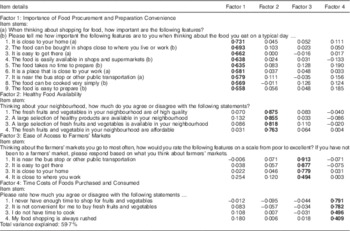
Factor loadings are indicated in bold.
Response formats: importance (1=‘not at all’, 2=‘somewhat important’, 3=‘important’, 4=‘very important’); rating quality (1=‘poor’, 2=‘fair’, 3=‘good’, 4=‘very good’, 5=‘excellent’); agreement with statement (1=‘strongly disagree’, 2=‘disagree’, 3=‘neutral’, 4=‘agree’, 5=‘strongly agree’).
Factor and item analysis of Economic Access domain items and resulting two sub-domains
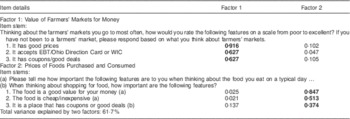
EBT, electronic benefit card; WIC, Special Supplemental Nutrition Program for Women, Infants, and Children.
Factor loadings are indicated in bold.
Response formats: importance (1=‘not at all’, 2=‘somewhat important’, 3=‘important’, 4=‘very important’); rating quality (1=‘poor’, 2=‘fair’, 3=‘good’, 4=‘very good’, 5=‘excellent’).
Factor and item analysis of Service Delivery domain items and resulting two sub-domains

Factor loadings are indicated in bold.
Response formats: importance (1=‘not at all’, 2=‘somewhat important’, 3=‘important’, 4=‘very important’); rating quality (1=‘poor’, 2=‘fair’, 3=‘good’, 4=‘very good’, 5=‘excellent’).
Factor and item analysis of Social Access domain items and resulting three sub-domains

EBT, electronic benefit card.
Factor loadings are indicated in bold.
Response formats: importance (1=‘not at all’, 2=‘somewhat important’, 3=’ important’, 4=‘very important’); rating quality (1=‘poor’, 2=‘fair’, 3=‘good’, 4=‘very good’, 5=‘excellent’); agreement with statement (1=‘strongly disagree’, 2=‘disagree’, 3=‘neutral’, 4=‘agree’, 5=‘strongly agree’); among the people close to you in Cleveland (1=‘none’, 2=‘less than half’, 3=‘about half’, 4=‘more than half’, 5=‘all’).
Factor and item analysis of Personal Access domain items and resulting three sub-domains
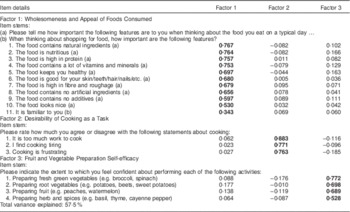
Factor loadings are indicated in bold.
Response formats: importance (1=‘not at all’, 2=‘somewhat important’, 3 =’ important’, 4=‘very important’); agreement with statement (1=‘strongly disagree’, 2=‘disagree’, 3=‘neutral’, 4=‘agree’, 5=‘strongly agree’); confidence (1=‘not at all confident’, 2=‘not very confident’, 3=‘neutral’, 4=‘confident’, 5=‘extremely confident’).
Exploratory factor analyses
Spatial-Temporal Access domain
The twenty-three items selected to measure spatial-temporal access were subjected to EFA and four sub-domains emerged (Table 2). Sub-domain Importance of Food Procurement and Preparation Convenience (nine items) includes items about the food access point being close to home or work, that it is easy to get there, and the ease of preparation of the foods. Healthy Food Availability (four items) includes items specific to the quality, affordability and selection of fruits and vegetables in the neighbourhood. Ease of Access to Farmers’ Markets (four items) includes items about being close to home and public transportation and it is easy to get there. The final sub-domain, Time Costs of Foods Purchased and Consumed (four items), includes items that measure lack of time to cook and shop and that it is not convenient to buy fruits and vegetables. Together, these four sub-domains explain 60 % of the variance among the items.
Economic Access domain
Economic access was assessed by seven items and the EFA identified two sub-domains. Sub-domain Value of Farmers’ Markets for Money (three items) includes items about perception of good prices, accepts the Ohio Direction Card (i.e. SNAP card in Ohio) and has coupons and good deals (Table 3). The second sub-domain, Prices of Foods Purchased and Consumed, is also represented by three items. The focus of these items is on the food eaten on a typical day and the importance of value for money and being inexpensive, and for general food shopping the importance of having coupons or good deals. One item did not meaningfully contribute and was dropped from further consideration. The two factors explained 62 % of the variance among the economic access items.
Service Delivery domain
Analysis of the nineteen items selected to measure service delivery resulted in two factors (Table 4). Service Delivery at Farmers’ Markets is represented by eleven items that cover quality and variety of products and aspects of the shopping experience, like hours of shopping and customer service. The second factor, Importance of Food Store Qualities, includes eight items that rate the importance of quality and variety of products, and aspects of the shopping experience for general food shopping. These items parallel the items in the first factor. Overall, these two factors explain 54 % of the variance.
Social Access domain
Social access was assessed with seventeen items and the EFA identified three factors (Table 5). Social Connectedness to Farmers’ Markets includes seven items representing feeling welcome, familiarity and having social relations with the people there. The second factor, Food Culture and Food Store Relationships, is represented by six items in the context of food shopping and the food eaten on a typical day and the importance of familiarity of foods and people. The last social access factor is Healthy Eating Social Networks and is represented by four items. The items on this sub-domain assess the number of people close to the respondent who have engaged in specific healthy eating activities: using the Ohio Direction Card at a farmers’ market, shopped at a farmers’ market, have used an incentive programme at a farmers’ market or have been engaged in nutritional education classes. For the social access items, these three factors explain 56 % of variance.
Personal Access domain
A total of eighteen items were used to assess personal access and EFA identified three factors (Table 6). Wholesomeness and Appeal of Foods Consumed is represented by eleven items about nutrients and overall appeal of the food eaten on a typical day. The second factor, Desirability of Cooking as a Task, includes three items about cooking as too much work, tiring or frustrating. The third factor is Fruit and Vegetable Preparation Self-efficacy, which includes four items and represents the degree of confidence in preparing fruits and vegetables. The variance explained by these three factors of personal access is 57 %.
Summary statistics
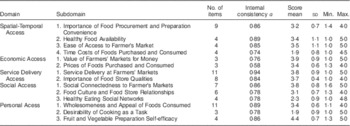
The summary statistics including the number of items, the internal consistency reliability and descriptive statistics (mean, standard deviation and range) for each of the sub-domains is presented in Table 7. Of the fourteen scored sub-domains, one had outstanding Cronbach’s α internal consistency reliability greater than 0·90, seven had excellent internal consistency reliability between 0·80 and 0·89, and five had very good internal consistency reliability between 0·70 and 0·79. One scale, the Prices of Foods Purchased and Consumed, had low internal consistency reliability of 0·58. Overall, the internal consistency reliability values for these relatively short subscales are high, indicating the number of items per sub-domain may be reduced and still maintain an acceptable internal consistency of 0·80. For example, for the nine-item Importance of Food Procurement and Preparation Convenience scale within the spatial-temporal domain can be reduced to a four-item scale and maintain an internal consistency reliability of 0·80. However, given the preliminary nature of these measures that they are based on a single sample, we do not present further information on the reduced scales.
Summary statistics for each of the sub-domain scores
Discussion
The findings of the present study support the proposition that perception of access to nutritious foods is a multidimensional concept; the five proposed domains of access can be represented as multiple sub-domains; and each can be measured using self-report items with good reliability. All sub-domains, except for the Prices of Foods Purchased and Consumed subscale of economic access, met an acceptable level of reliability. We found that the Freedman conceptual framework of access to nutritious food( Reference Freedman, Blake and Liese 25 ), consisting of spatial-temporal, economic, social, service and personal access, for venues of general food shopping and farmers’ markets can be robustly measured using eighty-one items representing fourteen subscales. The access to healthy food subscales reported in the present paper were created by combining items from multiple sources and adapting them to reflect both general food stores and farmers’ markets( Reference Steptoe, Pollard and Wardle 31 – Reference Thompson, Haziris and Alekos 34 , Reference Mujahid, Diez Roux and Morenoff 37 , Reference Middleton and Smith 38 ) and from unpublished research from our team.
Our analyses further revealed that for many of the subscales the number of items per scale may be reduced and still maintain an acceptable internal consistency of 0·80. For example, for the Service Delivery at Farmers’ Markets subscale, the eleven items can be reduced to six items and maintain an internal consistency reliability of 0·80. Shorter assessment tools have pragmatic appeal for some research or evaluation needs because they can reduce participant burden and the cost of assessing the concept( Reference Glasgow and Riley 39 ).
The current work adds substantially to the ability to assess multiple domains of food access and to measure access specific to farmers’ markets. The measures presented herein can be particularly useful to inform the design and targeting of interventions to increase access to nutritious foods and can also be used to evaluate perceptions of access among a variety of groups. For example, if assessments using these measures indicate low levels of social access among a subgroup, this might point to interventions specifically designed to increase perceptions of social access within existing food retailers. As another example, our team used the scores on the measures to guide purposive sampling for inclusion in a qualitative study to gain deeper insight into individuals’ social networks, understanding of food environments and practices of procuring and preparing food.
While the survey items were designed for use with a low-income population, the content and the reading level are relevant and accessible to all groups. Likewise, the study team chose to focus a substantial number of the items on farmers’ markets because of the growing prevalence and keen interest in their impact on fruit and vegetable consumption in our region. We envision that the subscales to assess the conceptual framework of access to nutritious foods presented here could be tailored and used in other contexts important to food access such as corner stores or other types of food outlets. Using robust measures of multiple aspects of food access, such as the measure presented in the current research, in studies conducted in a wide range of contexts would greatly advance our understanding of underlying access facilitators and barriers.
In considering the use of the measures presented, subscales can be used in whole or part depending on the goals of the project, research questions and the feasible length of survey. Further, as noted earlier, some of the scales could be shortened with no or small reduction in internal consistency reliability. Before such reduction, the subscales should be subjected to additional testing with larger samples across varied contexts to inform how items perform across settings; and item reduction should be equally informed by maintaining the content coverage of the scale and by avoiding efforts to maximize internal consistency at the risk of severely restricting the breadth of coverage of the concept.
Use of the measures in other geographic settings, food environment contexts and with other populations (e.g. different proximity to farmers’ markets, individuals with different or no supplemental benefits, those living in less-dense farmers’ market environments, different income levels) will greatly contribute to the evaluation and utility of the subscales for continued application. Indeed, additional testing of the items and subscales in different contexts is warranted to build evidence for the validity and reliability of these measures and to understand how they perform across types of survey participants. Of particular value would be studies designed to test the construct and predictive validity of the subscales; such work is necessary to build additional evidence for the utility of each subscale and can help inform the selection of items to retain for future study.
Limitations
The limitations of the present study include the modest sample size of 304 participants and the homogeneous sampling frame of individuals who receive SNAP and who live within a specific geographic location. This measurement development work is part of a larger study with a focus on food access in this population, which thus drove the sampling frame for the measurement development phase. This sample, therefore, represents individuals who are likely to have greater restrictions on nutritious food access and are therefore those with whom the development of interventions to improve food access is of high interest. Establishing measures that are reliable and sensitive to change among this population is necessary. A second limitation is that the study was conducted in an urban community with high access to farmers’ markets. Awareness and use of farmers’ markets may be higher among this sample, and frequency of use may be associated with scores on perceptions of quality and access. It is unlikely to have an impact on the underlying structure of the concepts or the reliability with which the sub-domains in the measure are assessed. Finally, future work should assess objective indicators including distance to food purchasing locations and food purchasing behaviours so that their association with measures of multidimensional food access can be evaluated.
Conclusions
Multiple levels of food access can be assessed with short measures with good internal consistency. The measures evaluated in the present study may be used in future studies to measure the complex phenomenon of nutritious food access more accurately and robustly.
Acknowledgements
Acknowledgements: The authors wish to thank the community members who completed the survey, the community partners that supported recruitment and the team of data collectors. Financial support: This publication is a product of a Health Promotion and Disease Prevention Research Center supported by Cooperative Agreement Number 1U48DP005030 from the Centers for Disease Control and Prevention. The findings and conclusions in this publication are those of the authors and do not necessarily represent the official position of the Centers for Disease Control and Prevention. The Centers for Disease Control and Prevention had no role in the design, analysis or writing of this article. Conflict of interest: The authors have no conflicts of interest to declare. Authorship: S.A.F. contributed to the design and implementation of the study, data analyses and interpretation of the findings, and writing of the manuscript; P.O.-V. contributed to the study design, interpretation of the findings and to multiple drafts of the manuscript; E.-J.S. assisted with data analyses, generation of tables, and contributed to the methods and results sections; E.S.T. contributed to interpretation of the findings and to multiple drafts of the manuscript; E.B. contributed to interpretation of the findings and to multiple drafts of the manuscript; K.M. contributed to the implementation of the study, survey development and to the methods section; and D.A.F. contributed to the design and implementation of the study, interpretation of the findings and to all sections of the manuscript. Ethics of human subject participation: This study was conducted according to the guidelines laid down in the Declaration of Helsinki and all procedures involving human participants were approved by the Case Western Reserve University Institutional Review Board. Verbal informed consent was obtained from all participants. Verbal consent was witnessed and formally recorded.



