




Impact statement
Before the next session of the negotiation of the Global Plastics Treaty (INC5.2), we draw attention to the independent scientific knowledge on the negative impacts of plastics on soil health, food safety in the short term, food security in the long term and on human health. Taking into account the long-term adverse impacts of plastics in agricultural systems and in food supply is essential to make informed decisions.
Introduction
Soils are a fragile, thin fertile layer on the Earth’s surface. While soils form the foundation of our society by providing food and are fundamental for environmental sustainability and human health and well-being, intensified agricultural practices have exhausted and polluted soils at an accelerating pace. Soils are threatened by plastic pollution, including microplastics and nanoplastics (MNPs) and the thousands of chemicals they leach. Soils are nonrenewable resources at the scale of a human lifetime; they take hundreds to thousands of years to form. Global rules, as expected in the Global Plastics Treaty, are needed to end plastic pollution in soils.
Direct and indirect sources of plastics in soils
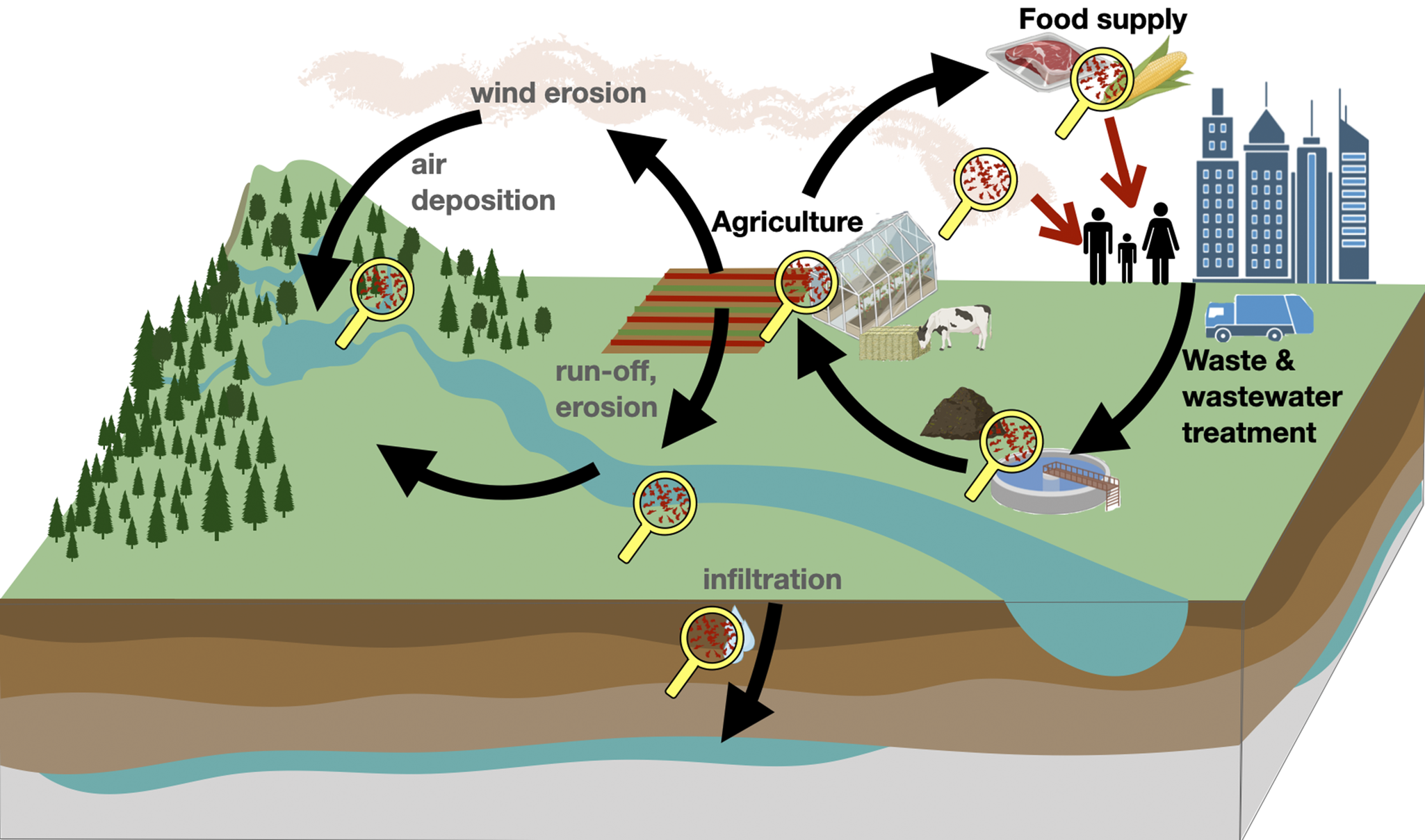
Plastics are increasingly used in agriculture (greenhouses, nets, haylage covers, mulching, irrigation pipes, coated fertilizers, etc.), representing 7.4 million tons of plastic per year (FAO, 2021). They release MNPs and chemicals during their use and disposal. Mulching films fragment during use and are not completely recovered after the growing season, leaving up to 25–33% of the film in the field (Yang et al., Reference Yang, Li, Yan, Chadwick, Jones, Liu, Liu, Bai and He2022). Polyethylene films, as used in greenhouses, are known to release MNPs when exposed to UV light (Masry et al., Reference Masry, Rossignol, Gardette, Therias, Bussière and Wong-Wah-Chung2021).
Land application of compost and sludge (biosolids from wastewater treatment) is another major source of MNPs (e.g., Colombini et al., Reference Colombini, Rumpel, Houot, Biron and Dignac2022; Lofty et al., Reference Lofty, Muhawenimana, Wilson and Ouro2022; Hooge et al., Reference Hooge, Hauggaard-Nielsen, Heinze, Lyngsie, Ramos, Sandgaard, Vollertsen and Syberg2023). In some countries, over 50% of biosolids, which retain more than 90% of the MNPs and microfiber from wastewater, are applied agriculturally, and often near marginalized communities (Geyer et al., Reference Geyer, Gavigan, Jackson, Saccomanno, Suh and Gleason2022).
Due to the MNPs’ persistence in soils (Chamas et al., Reference Chamas, Moon, Zheng, Qiu, Tabassum, Jang, Abu-Omar, Scott and Suh2020; Liu et al., Reference Liu, Xu, Ye and Zhang2022), current plastic use, both on and off-farm, is driving unsustainable accumulation in soils (Colombini et al., Reference Colombini, Senouci, Rumpel, Houot, Biron, Felbacq and Dignac2024; Cusworth et al., Reference Cusworth, Davies, McAinsh, Gregory, Storkey and Stevens2024). Terrestrial reservoirs of macroplastics and MNPs represent 97% of total plastic pollution that can be transferred to aquatic ecosystems (groundwater, lakes, rivers and ultimately the oceans) through infiltration and erosion, or to the air through wind remobilization (Sonke et al., Reference Sonke, Koenig, Yakovenko, Hagelskjær, Margenat, Hansson, De Vleeschouwer, Magand, Le Roux and Thomas2022; Morales-Caselles et al., Reference Morales-Caselles, Viejo, Montero and Cózar2025).
Impacts of plastics on soil functions
MNPs pollution has adverse effects on soil health (including soil properties, biodiversity, fertility) and on agricultural yields (Gao et al., Reference Gao, Yan, Liu, Ding, Chen and Li2019; Zhu et al., Reference Zhu, Zhang, Zhang, Zhong, Zhou, Zhang, Liu, Huang, Yuan, Wang and Li2025) and may contaminate the edible parts of plants (Conti et al., Reference Conti, Ferrante, Banni, Favara, Nicolosi, Cristaldi, Fiore and Zuccarello2020; Li et al., Reference Li, Zhang, Xu, Li, Zhang, Li, Ran, Rao, Wei, Chen and Wang2025). MNPs have direct and indirect effects on soil biota, through their impacts on soil properties – particularly critical for the microbiome, which is a key driver for nutrient cycles, carbon sequestration and soil structure (Seeley et al., Reference Seeley, Song, Passie and Hale2020; Joos and De Tender, Reference Joos and De Tender2022; Li and Xiao, Reference Li and Xiao2023; Sun et al., Reference Sun, Tao, Xu, Qu, Zheng, Zhang and Mei2023), and thus for soil resilience. MNPs affect soil fauna (Selonen et al., Reference Selonen, Dolar, Kokalj, Skalar, Dolcet, Hurley and van Gestel2020; Guo et al., Reference Guo, Wang, Li, Chen, Li, Zhang, Wang, Liu, Cao, Zou and Zhang2023), notably earthworms (Huerta Lwanga et al., Reference Huerta Lwanga, Gertsen, Gooren, Peters, Salánki, Van Der Ploeg, Besseling, Koelmans and Geissen2016), and even pollinators (Sheng et al., Reference Sheng, Jing, He, Klein, Köhler and Wanger2024).
Effects of MNPs on soil health depend on their contents and properties (composition, shape, size, surface, additives), which are highly variable due to the large combination of sources, particularly from composts and biosolids. Recycling organic matter in soils is crucial for many soil properties and functions, but due to excessive use of plastics, the increasing share of plastics in waste (US-EPA, 2021) and few controls on microplastics in composts and biosolids, they are a key vector of MNPs, undermining soil functions. If we do not want the incentives to sequester soil carbon to end up paradoxically promoting plastic carbon storage in soils, it is crucial to improve compost quality by limiting plastic waste at source. To enable the essential circularity of organic matter, we urgently need to reduce plastic production (Baztan et al., Reference Baztan, Jorgensen, Almroth, Bergmann, Farrelly, Muncke, Syberg, Thompson, Boucher, Olsen and Álava2024) to decrease plastics in waste and wastewater.
Ending soil plastic pollution to strengthen food safety and food security and protect human health
As populations worldwide become increasingly disconnected from the means of food production, the accumulation of plastic pollution in soils goes largely unseen. However, mounting evidence from fields and farms worldwide suggests its impacts on soil health, food safety and human health are already here. From invertebrate behavior to nutrient cycling and carbon sequestration (Rillig et al., Reference Rillig, Leifheit and Lehmann2021; Joos and De Tender, Reference Joos and De Tender2022), from pollinator disturbance to decrease in photosynthesis and plant growth (Jia et al., Reference Jia, Liu, Zhang, Fu, Liu, Wang, Tanveer and Huang2023; Sheng et al., Reference Sheng, Jing, He, Klein, Köhler and Wanger2024; Zhu et al., Reference Zhu, Zhang, Zhang, Zhong, Zhou, Zhang, Liu, Huang, Yuan, Wang and Li2025), plastic pollution is undermining the fundamental role of healthy soils in ecosystem functioning and terrestrial food production. Projected plastic pollution growth represents an alarming threat to food production and food security (Gao et al., Reference Gao, Yan, Liu, Ding, Chen and Li2019; Zhu et al., Reference Zhu, Zhang, Zhang, Zhong, Zhou, Zhang, Liu, Huang, Yuan, Wang and Li2025), especially critical for already malnourished populations (FAO, IFAD, UNICEF, WFP and WHO, 2022).
Soil plastic pollution is not just a medium-term problem for food security; it is an immediate challenge for food safety and health. MNPs, and the thousands of chemicals they leach, may enter plants and crops (Conti et al., Reference Conti, Ferrante, Banni, Favara, Nicolosi, Cristaldi, Fiore and Zuccarello2020; Li et al., Reference Li, Zhang, Xu, Li, Zhang, Li, Ran, Rao, Wei, Chen and Wang2025), now even appearing in the livestock we raise for meat (Huerta Lwanga et al., Reference Huerta Lwanga, Mendoza Vega, Ku Quej, Chi, del Cid, Chi, Escalona Segura, Gertsen, Salánki, van der Ploeg and Koelmans2017; Bahrani et al., Reference Bahrani, Mohammadi, Dobaradaran, De-la-Torre, Arfaeinia, Ramavandi, Saeedi and Tekle-Röttering2024). Off-site transport by wind erosion contaminates the air and indoor dust. Soil plastic pollution reaches humans via dietary and non-dietary exposure (Geueke et al., Reference Geueke, Parkinson, Groh, Kassotis, Maffini, Martin, Zimmermann, Scheringer and Muncke2024). While the exact effects of MNPs across human bodies are yet to be fully understood (Xu et al., Reference Xu, Wright, Rauert and Thomas2025), plastic chemicals have well-established hazards (Wagner et al., Reference Wagner, Monclús, Arp, Groh, Løseth, Muncke, Wang, Wolf and Zimmermann2024) – contributing to a wide range of adverse health outcomes related to childbirth, endocrine function, neurodevelopment, nutrition, circulatory and respiratory systems and cancers (Symeonides et al., Reference Symeonides, Aromataris, Mulders, Dizon, Stern, Barker, Whitehorn, Pollock, Marin and Dunlop2024). Over 300,000 annual deaths from cardiovascular disease have been associated with exposure to di-2-ethylhexylphthalate (DEHP), just one of the chemicals that leach from plastics (Hyman et al., Reference Hyman, Acevedo, Giannarelli and Trasande2025), including agricultural plastics (Ramanayaka et al., Reference Ramanayaka, Zhang and Semple2024).
The chronic and growing exposure of global populations to MNPs across the food chain and via non-dietary routes is therefore an unprecedented risk to global food safety and public health. Food insecurity already affects a third of the world (FAO, IFAD, UNICEF, WFP and WHO, 2024). More than 11 million people die each year from dietary risk (Afshin et al., Reference Afshin, Sur, Fay, Cornaby, Ferrara, Salama, Mullany, Abate, Abbafati, Abebe and Afarideh2019) and almost half of the deaths in children under five are due to undernourishment. In the context of global health crises and with increasing threats to global food production and supply chains amidst the volatility of geopolitics, conflict and climate change, we cannot afford to further undermine food systems and risk health. And yet, plastic pollution in agriculture continues to rise.
Avoiding regrettable substitutions and alternatives
The so-called “biodegradable” plastics, a promise proposed since the 1970s to replace conventional plastics, have not been proven to be less harmful to the environment (de Sadeleer and Woodhouse, Reference de Sadeleer and Woodhouse2024) or human health. Adverse health effects of starch-based microplastics (PLA) have been evidenced in mouse models (Liu et al., Reference Liu, Xia, Qu, Zhang, Shen, Yang, Tan, Chen and Deng2025b). The industrial facilities necessary to effectively biodegrade biodegradable plastics – whose end-of-life is planned in composting or methanization – are limited, and the produced compost and digestates may be enriched in plastic particles and chemicals, which are further applied to soils (Afshar et al., Reference Afshar, Boldrin, Astrup, Daugaard and Hartmann2024). Additives can sum up to 50% of the plastic mulch, but there is no regulation on the declaration of chemicals used in mulching films.
Although some studies have reported short-term benefits of biodegradable mulch films, including improved crop yields, regulation of soil moisture and temperature (Iacuzzi et al., Reference Iacuzzi, Tortorici, Ida, Alaimo, Cozzolino, Sarno, Mori and Tuttolomondo2024; Ramadhani et al., Reference Ramadhani, Nassary, Rwehumbiza, Massawe and Nchimbi-Msolla2024), these advantages depend on agricultural practices, climatic conditions and the physicochemical properties of the materials used (Renumala et al., Reference Renumala, Jolly, Singh, Sri and Sulluru2025). In contrast, many studies highlight long-term adverse effects, such as microplastic fragmentation, disturbance of soil microbiome and altered nutrient cycling (Campanale et al., Reference Campanale, Galafassi, Di Pippo, Pojar, Massarelli and Uricchio2024; Dewi et al., Reference Dewi, Bhat, Wei and Li2024). Notably, long-term exposure to (poly(butylene adipate terephthalate)) PBAT-based biodegradable plastics altered soil microbial composition and functions, particularly those related to carbon, nitrogen and sulfur cycling, while also potentially increasing the relative abundance of plant pathogenic fungi (Liu et al., Reference Liu, Wen, Zhou, Dong, Ren, Liang and Gong2025a). Biodegradable mulch films could be more harmful than nonbiodegradable plastics by releasing microplastics and toxic chemicals when used and disposed of directly into the soil (Tartiu et al., Reference Tartiu, Hurley, Baann, Briassoulis, Schettini, Convertino, Le Moine, Martinelli, Vernet, Ranneklev and Geissen2025).
The precautionary principle should apply to avoid regrettable substitutions that create unknown long-term consequences and future problems. It is imperative to test all new materials on soil biota under a range of realistic environmental conditions before those materials are introduced to the market.
Are agricultural plastics essential?
Since their introduction in the 1950s and their exponential increase since the 1990s, first in China and then in the rest of the world, plastics have become widespread in conventional agriculture (Orzolek, Reference Orzolek and William2017). These materials, now deemed indispensable, are closely tied to the petrochemical industry’s efforts to create new markets. In France, for instance, by 1961, an engineer from the Ethylène-Plastique company believed that their nascent use constituted a revolution and that everyone should be “well imbued with its inevitability” (Duranel, Reference Duranel1961). “Whether we like it or not,” (Duranel, Reference Duranel1961) plastics would intensify global agricultural production and address the scarcity of arable land needed to feed a growing world population.
This narrative, though biased by commercial interests, highlighted the benefits of plastics while marginalizing traditional techniques and competing materials. It led to adopting methods that were not essential and overlooked long-term risks, such as the degradation and accumulation of plastics in soils through the many residues left by their use. These issues, identified early on, were initially seen as technical challenges that progress would solve.
Today, this progressivist and biased narrative persists. However, given the multiple environmental threats posed by plastics, it is urgent to question the agricultural model that relies on them and to develop practices that lessen the dependence on plastics by integrating seasonality, diversification and reduction of the distance between consumers and producers (Duquesne et al., Reference Duquesne, Mercier-Bonin, Monsaingeon, Paresys, Akoueson, Baudrin, Bensaude-Vincent, Beriot, Body-Malapel, Bouillot, Camargo-Pardo, Cordier, Corvellec, Da Costa, Dabert, Dashkina, Debeaufort, Dedieu, Desvaux, Duflos, Duval, Ferlay, Gontard, Grassl, Lampi, Le Tilly, Le Perchec, Mougin, Munhoz, Nerín, Notelet, Ovlaque, Picuno, Rayns, Siracusa, Soulestin and Tassin2025).
Plastic use in agriculture is expected to increase in response to the growing population and to rising temperatures and extreme weather events due to climate change (FAO, 2021). However, plastic production and the incineration and open burning of agricultural plastics also emit significant quantities of greenhouse gases, exacerbating the climate crisis (Karali et al., Reference Karali, Khanna and Shah2024). While plastics may support climate adaptation and food production in the short term, the manifold direct and indirect implications for health, now and in the future, cannot be ignored (Hofmann et al., Reference Hofmann, Ghoshal, Tufenkji, Adamowski, Bayen, Chen, Demokritou, Flury, Hüffer, Ivleva and Ji2023). Financial mechanisms to support countries grappling with the most severe effects of climate change are needed, within a framework of globally coordinated, science-based, sustainable strategy development for plastics in agriculture.
Ending the toxic legacy of plastics in agriculture through a strong global plastics treaty
The UN Treaty is essential to facilitate a shift in the way we use and assess plastics, both on and off-farm, to avoid the unsustainable accumulation of plastic pollution in soil. The agricultural system is a typical example of how a system has been created that produces high yields, but at the expense of both natural systems and human and environmental health. In addition to damaging soil conditions, plastics are made from fossil fuels (including half of biodegradable plastics), which greatly exacerbates the climate crisis (Villarrubia-Gómez et al., Reference Villarrubia-Gómez, Almroth, Eriksen, Ryberg and Cornell2024). The positive short-term effects of agricultural plastics are offset by the pollution increase and their negative long-term invisible effects. The narrative that presents agricultural plastics as necessary is no longer acceptable if we take into account the knowledge produced by independent scientists with no conflicts of interest, which shows the strong adverse effects of plastics, that release greenhouse gases, decrease soil quality and health and contribute to the loss of biodiversity (a pillar of soil productivity), the decline of agricultural yields and to numerous human health issues. To produce quality food without destroying the soil resource for future generations and ultimately reducing the quality of crops and livestock, other paths are possible. For example, agroecology can help mitigate climate change and adapt to its effects without compromising food security (Dittmer et al., Reference Dittmer, Rose, Snapp, Kebede, Brickman, Shelton, Egler, Stier and Wollenberg2023) by developing a holistic vision that improves both yields and soil quality, using principles that have been practiced for thousands of years.
A strong global plastics treaty is needed to end plastic pollution threatening food safety now and food security in the long-term, taking into consideration decreasing soil health. Reduction of plastic production with global targets, improvement of product conception and regulation of harmful plastic chemicals are needed in the agriculture sector, where plastics are used unsustainably and are not all essential, as well as in all sectors along the food production value chain (food processing, food packaging, etc.).
Global, harmonized and science-based criteria and standards for evaluating plastics’ essentiality, sustainability and safety for the environment and human health would benefit the evaluation of plastics used in agriculture and their alternatives. Monitoring existing plastic pollution is crucial to avoid food production on highly polluted soils and to minimize transfers to other environmental compartments. A decrease in plastic consumption will reduce pollution of the first receptors of plastic pollution, the soils.
Open peer review
To view the open peer review materials for this article, please visit http://doi.org/10.1017/plc.2025.10006.
Author contribution
Conceptualization: MFD; writing original draft: MFD; writing, review and editing: all authors. All authors have read and agreed to the published version of the article.
Financial support
This research did not benefit from any specific grant.
Competing interests
The authors declare none.
In agreement with the Editor, a French version of this article has been published: Dignac M-F., Bakhos M., Brander S., Colombini G., Deeney M., Dufour E., Geissen V., Hooge A., Huerta Lwanga E., Monsaingeon B., Syberg K. et Yates J., 2025 - Pourquoi un traité mondial ambitieux sur les plastiques est essentiel pour les systèmes agricoles, la sécurité alimentaire et la santé humaine. Étude et Gestion des Sols, 32, 85-93

 Open access


Comments
Dear Editor-in-Chief, Cambridge Prisms: Plastics
In this letter, we draw attention to the independent scientific knowledge on the negative impacts of plastics on soil health, food safety in the short term and food security in the long term, and on human health. Before the next session of the negotiation of the Global plastics treaty (INC5.2), taking into account the long term adverse impacts of plastics in agricultural systems and in food supply is essential to make informed decisions.
With best regards,
Marie-France Dignac