

The curtain rises. Two young Haitians take the stage, teasing one another in the honeyed tones of nascent courtship. Marguerite requests proof of Valentin’s affection – evidence that her love is not taken for granted. Valentin, from his pocket, hands her the perfect response: a song. “But it’s not in Creole,” Marguerite observes.Footnote 1 “This,” Valentin assures her, “is so all the world may know it.”Footnote 2 And besides, he continues, when Marguerite cares to, she speaks impeccable French.
Marguerite sings.
We begin with the opening scene of Haiti’s first opera.
When, in 1818, Juste Chanlatte’s L’Entrée du Roi, en sa capitale (The Return of the King to His Capital) was premiered in the northern capital of Sans-Souci, it was already year 15 of Haitian independence. The tumultuous Revolution, though never a distant memory, had reached its conclusion, and Henry Christophe, once a revolutionary general, was now king of Haiti and the evening’s dedicatee.
But outside the opera house, a transatlantic paper war had begun. Seeking to challenge and conciliate their foreign critics, the writers of Haiti briskly conscripted the printing press in support of themselves, and sent tidings of liberté to their former colonizers and fraternité to their enslaved brethren across the vast Atlantic expanse. It is this impulse that gave to the world the earliest specimens of a Haitian literature, cast in a variety of genres (treatises, essays, poems, plays, songs, operas) which eloquently heightened the irony of Haiti’s position – the lone “free” nation in a world of “enlightened” enslavers.Footnote 3 And yet this literature was not in Creole, but in French – French, in the words of the suitor Valentin, “so all the world may know it.”
This chapter proposes song and opera as untapped sources for literary analysis and important forerunners in the development of Haitian literature.Footnote 4 In them can be found a vast miscellany of moods and perspectives, seeming to comment, as music and literature often do, on the various historical, political, and social events of their age. We see songs of celebration and of mourning, of peace and of war, music to recognize Haiti’s independence or to heap praise upon the government. Indeed, there was perhaps no civil or political occurrence in early Haiti for which the nation’s poets and songwriters could not find subjects ripe for musical treatment; and no subject was more vivid in their imaginations, surely, than their revolution and war of independence from France. For the Haitian statesman Baron de Vastey, these early achievements in the arts revealed the deep reservoirs of creative and intellectual talent among his people. He writes:
nous avons également fait des essais dans les beaux arts, et nous nous sommes convaincus, qu’il ne nous manquait que des maîtres habiles, pour avoir bientôt nos Lepoussin, nos Mignard, nos Rameaux, et nos Gretry, etc. Enfin l’expérience a prouvé au monde que les noirs comme les blancs avaient la même aptitude aux sciences et aux arts par les progrès immenses que nous avons faits dans les lumières et la civilisation. Parcourez l’histoire du genre humain, jamais vit-on un pareil prodige dans le monde, que les ennemis des noirs citent un seul exemple d’aucun peuple qui se soit trouvé dans une situation semblable à la nôtre, et qui ait fait de plus grandes choses que nous dans moins d’un quart de siècle …Footnote 5
we have also produced specimens in the beaux arts, and are convinced we lack only the competent masters necessary to have soon our Lepoussins, our Mignards, our Rameaux, and our Grétrys. Experience has well proven to the world, by the tremendous progress we have made in learning and civilization, that the capacity of blacks and whites for the arts and sciences is equal. Explore the history of mankind. Never has the world seen such a marvel. Let the enemies of the blacks cite a single example of a people, beset by circumstances like ours, who have achieved greater things than we in less than a quarter of a century …
Far from being of merely local consequence, early Haitian publications circulated widely throughout the Atlantic, placing before foreign readers evidence of luxury and literary accomplishment that wreaked havoc on narratives of Black inferiority and incapacity for civilizational excellence. Yet the songs and operas of Haiti also demand our consideration for their chronological primacy. Whatever we may ultimately determine to be their value as literature – for my part, I think it considerable – these musical works must continue to be held in common interest by students of Haitian letters as containing the seeds of the nation’s literature, a class of writings already distinct in style, subject, and sentiment.
Though most of Haiti’s early songwriters remain anonymous – their ephemeral, unsigned creations leaving few identifying clues – one name rose above those of his countrymen. A child of colonial Saint-Domingue and a student of France, Juste Chanlatte (1766–1828) returned to an independent Haiti with a studied intellect and a practiced pen which he wielded in patriotic service of the nation. Later, serving as secretary of the Kingdom of Haiti, Chanlatte was conferred the title of Comte des Rosiers, and under this royal moniker, produced a wide-ranging corpus: laws and proclamations, encomium and occasional verse, treatises and pamphlets, and songs and operas. Yet like many of his contemporaries, Chanlatte routinely referred to himself as a military man rather than as an author. To be a professional writer was a rare and dubious distinction, and the prospect of a literature purely for literature’s sake was yet to be realized in this society still threatened by the material realities of colonialism. It is appropriate, then, that this chapter concentrate on the work on Chanlatte. More than any of his contemporaries, it might fairly be said, he left an indelible mark on the development of early Haitian music and letters.
The Haitian Contrafactum
As musicologists have demonstrated, song culture took on new utility and political valence during the French and American Revolutions.Footnote 6 Revolutionaries and counterrevolutionaries alike took to the streets, filling the air with new and piquant verses reflecting the shifting fortunes of public opinion and political conviction. The same was true in Haiti: no sooner had a Black revolution broken out in Saint-Domingue than the anthems of France were heard from the mouths of the enslaved. A robust body of scholarship has addressed the performance and practice of French music in Saint-Domingue, yielding much insight into the politics of the colonial theater, the local authorship of opera and song, and the biographies and contributions of enslaved Africans and other musicians of color.Footnote 7 Yet the impact of song culture in the Haitian Revolution and in the subsequent state of Haiti remains relatively unexamined, a reflection, perhaps, of the relative inaccessibility of primary source material. The songs and operas of Haiti, in their published forms, remain scattered among far-flung libraries and institutions, often in uniquely held editions, and it has fallen to digitization – and the characteristic beneficence of librarians – to make much of this musical patrimony available.Footnote 8
The musical genre most favored in these printed annals of Haitian culture is, in fact, also a literary genre: a species of song, created by setting new Haitian words over preexisting French melodies – what musicologists have termed a contrafactum. Easy to learn, and delightful to sing, the contrafactum enjoyed a remarkable efflorescence throughout the Age of Revolutions. In Haiti alone, over one hundred were published from the declaration of Haiti’s independence in 1804 to the fall of the northern monarchy in 1820.Footnote 9 Closely associated with these is also a small but compelling body of Haitian opéra comique in which contrafacta are interspersed with spoken dialogue.Footnote 10 As such, it is helpful to consider the two genres in tandem – the contrafactum and the opéra comique – as the latter often included the former.
Fashionable throughout the Atlantic world, the contrafactum was doubly attractive to Haitian writers for its practical value. It is a thrifty genre. With a simple indication (“sung to the tune of ___”), the contrafactum did away with the need for music notation and, by extension, the many scripts – scores, partbooks, tablature, etc. – that are traditionally associated with the enterprise of Western musical performance.Footnote 11 A reader, cognizant of the French melodies then in vogue, could reconstruct with relative facility what to later readers might appear as poetry on a page. This rendered the contrafactum eminently portable and circulatable, easily transgressing the boundaries between oral and print cultures – a useful convention for a nation that, like France, possessed a semiliterate population.
With tastes that closely corresponded to those of their French colonizers, Haitian writers of contrafacta exhibited a predilection toward eighteenth-century opera, revolutionary anthems, and a selection of popular melodies that had passed by common consent into the realm of folk music. Typically, these songwriters worked either by furnishing melodies with new words or by divining, through a poem’s scansion and stanza formation, a suitable tune. Though in one rare instance, from the Haitian opera Le Philosophe-Physicien (1820), the librettist does not provide a melody but rather invites the reader to come up with a preexisting one (air à choisir) that fits the lyrics.Footnote 12
Composed within the orbit of French generic convention, Haitian contrafacta offer insight into the sensibilities and tastes of the very men (and, to a limited extent, women) entrusted with the leadership of early independent Haiti, in politics as well as literature. With mannered eloquence and Classical allusion, they tapped into a vein of shared musical knowledge and textual association, often eliciting irony, humor, or contention, and standing testament to the educations then afforded wealthy Haitians. Yet regardless of scholarly judgments of their literary import, there is still much to be gained in considering Haitian contrafacta on their own terms – that is, as music – for it is only when these Haitian verses are reunited with their melodies that they divulge to us their polyvalence of meaning.
The “Chant du Corps Royal des Amazones de la Reine” (“Song of the Queen’s Royal Corps of Amazons”) comes from Chanlatte’s magisterial songbook for the Haitian royal family. Written in honor of Queen Marie-Louise Coidavid and her royal guard of sixty female warriors, the song is thoroughly expressive of the period’s vogue for neoclassicism and revolutionary sentiment:Footnote 13
The song goes on to refer glowingly to the female warriors, calling them “ardent sisters” (bouillantes sœurs) and the “heroines of America” (héroïnes d’Amérique), while reviling the French as “contemptible tyrants” (méprisables tyrants) and an “iniquitous race” (race inique). Also referred to in the song is Henry and Marie-Louise’s first son, born in 1794 in Cap-Français. Ferdinand Christophe, at 9 years old, was sent to Paris to receive a military education befitting his esteemed birth but, in a string of perfidious and unknown events, was taken out of school and died in the Orphans’ Hospital on October 7, 1805 – “Most unfortunate Ferdinand,” the song laments, “Vengeance has demanded your blood.” Finally, having thoroughly eviscerated Haiti’s adversaries in ten verses, the eleventh and final verse turns to the song’s patrons: “Long live Marie and Henry | The Restorers of the New World.”
Although printed without a melodic attribution, it is certain that these words were intended to be sung. After all, the indication bis is an instruction for a singer to repeat a chosen word or line of text, a common feature in strophic song. And the melodic attribution was likely unnecessary. For those ensconced in the poetic and musical styles of the eighteenth century, verse structure was itself a form of music notation, and thus the very appearance of the song – a repeated fourth line, an exhortatory chorus of four lines of six syllables – would have been recognizable to Haitians as the hymn of the French National Convention, in other words, the Marseillaise (see Figure 4.1).
Extract from “La Marseillaise”

It might seem unusual or unthinkable that early Haitians would coopt the anthem of their colonial oppressors. Yet it was, on the contrary, a typical choice: in both their musical and poetic idioms, the songwriters of early independent Haiti harkened back to the French Revolution and the ancien régime. Indeed, three other retextings of the Marseillaise were published in Haiti from the years 1804 to 1820.Footnote 14 But rather than understand this “aesthetic lag” as a necessary consequence of Haiti’s geographical remoteness from France and the attendant delay in importing cultural trends, we might interpret it as a protracted engagement with the unrealized ambitions of Enlightenment thought and expressive culture. These were, after all, anthems of and to liberty, no matter how passé the concept had become to the French Empire.
Yet for a people throwing off the yoke of slavery, perhaps the Marseillaise was a fitting anthem after all. At any rate, with its condemnations of old slavery (antique esclavage) and vile chains (ignobles entraves), the Marseillaise would seem a peculiar choice for a nation that, intending these words metaphorically, persisted in the cruel traffic of enslaved Africans for decades after its revolution. In retexting the anthem, then, Haitian songwriters gestured toward some of the most stunning inconsistencies and contradictions in France’s revolutionary vision – one that was ultimately complacent regarding its colonial holdings and the unprecedentedly low price of sugar. Could there be any more effective burlesque upon the supposed superiority and rationality of France than this?
The Haitian Opera
Let us rejoin the lovers Marguerite and Valentin.
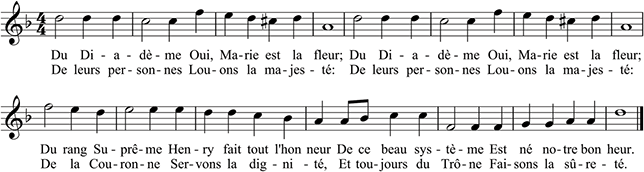
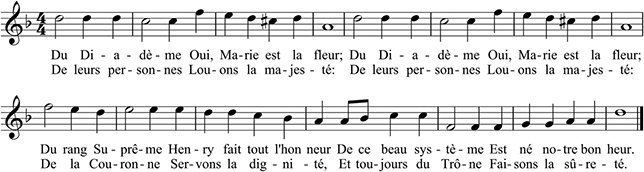
Having handed Marguerite his song, Valentin reveals it to be a contrafactum of “Vive Henry IV,” a tune that would surely have been familiar to Haitian audiences, as it was to Marguerite. “Ah! I know it!” Marguerite exclaims, “In that case, I will start to learn it right away.”Footnote 15
Originally written to celebrate King Henry IV of France, the buoyant and catchy air was taken up by various political bodies for various political ends throughout the course of the French Revolution. Retexting the melody in glorification of King Henry I and Queen Marie-Louise, Chanlatte calls upon a favorite conceit of the monarch – that Henry I of Haiti is like the fabled King of France and Navarre (see Figure 4.2).
Extract from “Vive Henri IV”
This song is printed in Comte de Rosiers [Juste Chanlatte], L’Entrée du Roi, en sa capitale (Sans-Souci: L’Imprimerie Royale, 1818), 7 and Comte de Rosiers [Juste Chanlatte], Recueil de chants et de couplets à la gloire de Leurs Majestés et de la Famille Royale d’Hayti, etc. etc. etc. à l’usage de la cour et des haytiens (Sans-Souci: L’Imprimerie Royale, 181-?), 32.
In general terms, Haitian opera and contrafacta celebrated the government under which they were composed. Christophe, like Jean-Jacques Dessalines before him, favored music for its utility and diplomatic expediency, glorifying his monarchy in ceremony and spectacle. Indeed, the music of his court shows everywhere the hallmarks of having been written on commission, drawing favorable comparisons between Christophe and foreign sovereigns, and often serving to commemorate a particular civic function or season of festivity.
The only known copy of L’Entrée du Roi en sa capitale is a slim, 60-page libretto at Harvard’s Houghton Library. Cast in seven scenes within a single act, the opera takes the form of a staged pageant as members of the Haitian court assemble to witness the arrival of the King’s cortege. There is little mystery, as such, in the unfolding action and not much that departs from the standards of ancien régime opera. Yet the literary value of this work lies in its recasting French operatic conventions to fit the external realities of Haitian life. Chanlatte’s libretto is thus rich with local flavor and colloquial expression. Marguerite and Valentin’s idle chatter is, in fact, one of the earliest Creole texts written by a Haitian and is of enduring interest to the history of the language. In it, we can identify a defunct informal second-person pronoun (to), a defunct present continuous tense (après being since shortened to ap), and the appearance of a well-known Haitian proverb, yon jou pou chas yon jou pou jibie – a day for the hunter, a day for the prey.Footnote 16 Chanlatte – far from being an outmoded mimic, as some scornful critics claimed – masterminded an alternative model of aesthetic sovereignty in which French operatic convention was called upon to express the vernacular beauties of his homeland.Footnote 17
Committing the dialects and idioms of his multilingual kingdom to the accessible permanence of print, Chanlatte elsewhere bends French orthography to his will. In scene five of the opera, an Englishman resident in Haiti (“L’Anglais”) appears onstage and delivers, as an aside, a gush of encomium praising the Kingdom of Haiti and its monarch. Delivered in the Englishman’s tortured French, which Chanlatte meticulously spells out, the monologue is partially intended as a comic send-up. But it also serves to legitimize the Haitian monarchy, with the Englishman favorably comparing Christophe with “all the world’s monarchs.”
Je souis bien content de n’être point parti pour Londeune, je n’aurais pas eû cette grande satisfaichone, le piple de cette contri, il être aisaible, générouce, mais rien de plous graiciouce, de plous engaidgente que l’accueil de Sa Madjesti. Quand je le voir dans son palais, il me comble de ses bonnes graices. Je pouis dire, à présent, avoir vou tous les monarques de la terre, et Sa Madjesti Henry, il être oune des plous grands et des plous gloriouces. Cette caipitaile me plaire gradement beaucoup, et les environs de cette Citi li être aigriaible et maidgestouce.Footnote 18
I would be well pleased never to depart for London. Never have I been this satisfied. The people of this country are carefree and generous, and nothing could be more gracious and welcoming than the reception of His Majesty. When I visit him in his palace, he showers me with his good graces. I can presently claim to have seen all the world’s monarchs, and His Majesty Henry is one of the greatest and most glorious. This capital pleases me very much, and the surroundings of this city are charming and majestic.
Chanlatte, an agile and experienced diplomat, knew what his patron liked to hear. But the Englishman’s monologue also seems to have been inspired by a speech given by an English merchant in 1816 in the presence of Christophe. Delivered at a feast in honor of foreign commerce, these words must have impressed themselves favorably upon Christophe, for it was afterward published in the royal gazette. It reads:
Messieurs, je suis anglais et habitué à exprimer librement mes sentimens [sic]; j’ai vu tous les souverains de l’Europe, les troupes de toutes les nations; j’ai observé les mœurs et les lois des peuples de tous les pays que j’ai visités [sic], eh bien! messieurs, je vous dis avec vérité, j’ai vu le roi d’Hayti à la tête de ses troupes, j’ai examiné la richesse des uniformes, la tenue et la discipline de l’armée haytienne; j’ai observé les mœurs et étudié les lois de ce pays; je n’ai point vu en Europe, de souverain qui représente mieux, de troupes mieux tenues ni mieux disciplinées, ni plus d’ordre, de régularité et de justice que dans ce royaume. Dans la situation où vous êtes vous ne pouvez craindre aucun ennemi, vous êtes invincibles!Footnote 19
Messieurs, I am English and accustomed to expressing freely my opinions. I’ve seen all the sovereigns of Europe, the troops of every nation. I’ve observed the customs and laws of all the peoples I’ve visited, eh bien! Messieurs, I tell you in truth. I’ve seen the King of Haiti at the head of his troops. I’ve examined the richness of the uniforms, the conduct and the discipline of the Haitian army. I’ve observed the customs and studied the laws of this country. Never have I seen in Europe a more exemplary sovereign, better-dressed or -disciplined troops, or more order, lawfulness, or justice than in this kingdom. In your present situation, you have reason to fear no enemy; you are invincible!
It makes sense that the Englishman’s speech found a corollary in Chanlatte’s libretto. The Kingdom of Haiti enjoyed strong commercial relations with the British, and one of the functions of this opera was to stage, before local and foreign audiences, acts of Haitian diplomacy and statecraft. Yet though essential to the libretto genre, it is also this commitment to verisimilitude that so recommends this opera as an object of literary study. Taking us within hearing distance of early independent Haiti, Chanlatte preserves the sounds and sights of his cosmopolitan surroundings – a sonic world abuzz with dazzled Englishmen and Creole-speaking sweethearts.
For students of Haitian letters, further study of the vast and heterogenous body of Haitian musical patrimony will yield rich rewards. Both examples introduced here – L’Entrée du Roi, en sa capitale and “Chant du Corps Royal des Amazones de la Reine” – push back against deep-rooted assumptions about the one-way communication of aesthetic movements from France to Haiti. Indeed, just as the Haitian Revolution took Enlightenment thought to its furthest and most radical conclusions, so did Haitian songwriters like Juste Chanlatte give new topical relevance to the corpus of French revolutionary anthems extolling the virtues and sweetness of liberty. Never content to be mere recipients of cultural production, early Haitians reshaped French music even as they reshaped their Atlantic world.